Research
Methods in
Social
Science
Course Code: BAHU 3033
Dr. Waqar Ahmad
Date: 23-04-2024
Previous
Learning
• Formulation and identification of
variables
• Develop theoretical Framework
• Research Questions. Proposition /
Hypothesis
Learning
Outcomes
• Explain how variables are measured.
• Explain when operationalization of
variables is necessary.
• Operationally define (or
operationalize) abstract and
subjective variables.
• Research design
HOW VARIABLES ARE MEASURED
• To test the hypothesis that workforce diversity affects organizational
effectiveness we have to measure workforce diversity and organizational
effectiveness.
• Measurement is the assignment of numbers or other symbols to characteristics
(or attributes) of objects according to a prespecified set of rules.
• Objects include persons, strategic business units, companies, countries,
bicycles, elephants, kitchen appliances, restaurants, shampoo, yogurt, and so
on.
HOW VARIABLES ARE MEASURED
Identify the object and the attribute.
• Price consciousness of car buyers.
• Self esteem of dyslexic children.
‐
• Organizational commitment of school teachers.
• Marketing orientation of companies.
• Product quality of tablets (such as the Apple iPad and the
Samsung Galaxy Tab)
OPERATIONAL DEFINITION (OPERATIONALIZATION)
Reduction of abstract concepts to render them measurable in a
tangible way is called operationalizing the concepts.
E.g., the concept of thirst is abstract; we cannot see it. However, we
would expect a thirsty person to drink plenty of fluids. In other words, the
expected reaction of people to thirst is to drink fluids. If several people
say they are thirsty, then we may determine the thirst levels of each of
these individuals by the measure of the quantity of fluids that they drink
to satisfy their thirst. We will thus be able to measure their levels of
thirst, even though the concept of thirst itself is abstract and unclear.
OPERATIONAL DEFINITION (OPERATIONALIZATION)
Operationalizing a concept involves a series of steps.
1. The first step is to come up with a definition of the construct that you want to measure.
2. Then, it is necessary to think about the content of the measure; that is, an instrument (one
or more items or questions) that actually measures the concept that one wants to measure
has to be developed.
3. Subsequently, a response format (for instance, a seven point rating scale with end points
‐ ‐
anchored by “strongly disagree” and “strongly agree”) is needed, and,
4. Finally, the validity and reliability of the measurement scale has to be assessed.
OPERATIONAL DEFINITION (OPERATIONALIZATION)
Aggression has at least two dimensions:
1. Verbal aggression (behavior such as shouting and swearing at a person)
2. Physical aggression (throwing objects, hitting a wall, and physically hurting others).
• A valid measurement scale of aggression would have to include items that measure
verbal aggression and items that measure physical aggression.
• A measurement scale that would only include items measuring physical aggression
would not be valid.
Operationalizing the (multidimensional) concept of achievement
motivation
Suppose that we are interested in establishing a relationship between gender and
achievement motivation. To test this relationship we will have to measure both gender and
achievement motivation. At this point, you will probably understand that whereas measuring
gender will not cause any problems, measuring achievement motivation probably will,
because the latter construct is abstract and subjective in nature. For this reason we must
infer achievement motivation by measuring behavioral dimensions, facets, or characteristics
we would expect to find in people with high achievement motivation.
After we have defined the construct, the next step in the process of measuring abstract
constructs such as achievement motivation is to go through the literature to find out whether
there are any existing measures of the concept.
• Journals
• Scale books (Marketing Scales Handbook or the Handbook of Organizational Measurement)
1st
2nd
Operationalizing the (multidimensional) concept of achievement
motivation
The use of existing measurement scales has several advantages.
1. First, it saves you a lot of time and energy.
2. Second, it allows you to verify the findings of others and to build on the work of others (this is
very important in scientific research but impossible if you use measures that differ from those
that our predecessors have used!).
Research Design
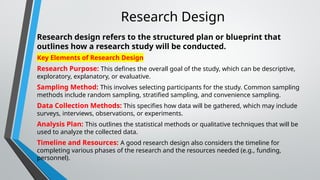
Research design refers to the structured plan or blueprint that
outlines how a research study will be conducted.
Key Elements of Research Design
Research Purpose: This defines the overall goal of the study, which can be descriptive,
exploratory, explanatory, or evaluative.
Sampling Method: This involves selecting participants for the study. Common sampling
methods include random sampling, stratified sampling, and convenience sampling.
Data Collection Methods: This specifies how data will be gathered, which may include
surveys, interviews, observations, or experiments.
Analysis Plan: This outlines the statistical methods or qualitative techniques that will be
used to analyze the collected data.
Timeline and Resources: A good research design also considers the timeline for
completing various phases of the research and the resources needed (e.g., funding,
personnel).
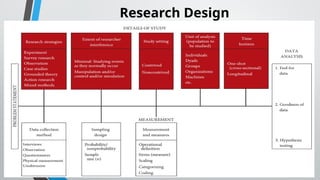
Research Design
• Research design refers to the overall plan or strategy that a researcher uses to conduct a study
and achieve specific research objectives. It outlines the approach, methods, procedures, and
techniques that will be used to gather and analyze data. A well-designed research study is
essential for ensuring the validity, reliability, and generalizability of the findings.
• The components of a research design typically include:
• Research Questions or Objectives: Clear and focused questions or objectives that guide the
research process and determine what information needs to be collected.
• Research Approach: The overarching approach or methodology that will be used to address the
research questions. Common approaches include quantitative, qualitative, and mixed methods.
• Sampling Strategy: The process of selecting participants or cases from the population of interest.
This includes decisions about the sampling method (e.g., random sampling, purposive sampling),
sample size, and sampling frame.
• Data Collection Methods: The specific techniques and instruments that will be used to collect
data. This may include surveys, interviews, observations, experiments, or document analysis,
among others.
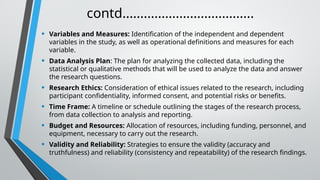
contd.....................................
• Variables and Measures: Identification of the independent and dependent
variables in the study, as well as operational definitions and measures for each
variable.
• Data Analysis Plan: The plan for analyzing the collected data, including the
statistical or qualitative methods that will be used to analyze the data and answer
the research questions.
• Research Ethics: Consideration of ethical issues related to the research, including
participant confidentiality, informed consent, and potential risks or benefits.
• Time Frame: A timeline or schedule outlining the stages of the research process,
from data collection to analysis and reporting.
• Budget and Resources: Allocation of resources, including funding, personnel, and
equipment, necessary to carry out the research.
• Validity and Reliability: Strategies to ensure the validity (accuracy and
truthfulness) and reliability (consistency and repeatability) of the research findings.
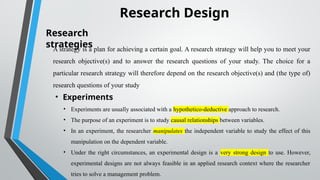
Research Design
Research
strategies
A strategy is a plan for achieving a certain goal. A research strategy will help you to meet your
research objective(s) and to answer the research questions of your study. The choice for a
particular research strategy will therefore depend on the research objective(s) and (the type of)
research questions of your study
• Experiments
• Experiments are usually associated with a hypothetico deductive
‐ approach to research.
• The purpose of an experiment is to study causal relationships between variables.
• In an experiment, the researcher manipulates the independent variable to study the effect of this
manipulation on the dependent variable.
• Under the right circumstances, an experimental design is a very strong design to use. However,
experimental designs are not always feasible in an applied research context where the researcher
tries to solve a management problem.
Research Design
Research
strategies
• Survey
• A survey is a system for collecting information from or about people to describe, compare, or
explain their knowledge, attitudes, and behavior.
• The survey strategy is very popular in business research, because it allows the researcher to collect
quantitative and qualitative data on many types of research questions.
• The questions in survey instruments are typically arranged into self administered
‐ questionnaires
that a respondent completes on his or her own, either on paper or via the computer.
• Ethnography
• Ethnography is a research strategy that has its roots in anthropology.
• It is a strategy in which the researcher “closely observes, records, and engages in the daily life of
another culture [. . .] and then writes accounts of this culture, emphasizing descriptive detail”.
• Ethnography involves immersion in the culture of the social group that is being studied.
• It thus aims to generate an understanding of the culture and behavior of a social group from an
“insider’s point of view.
Research Design
Research
strategies
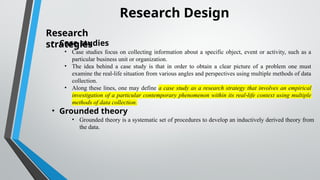
• Case studies
• Case studies focus on collecting information about a specific object, event or activity, such as a
particular business unit or organization.
• The idea behind a case study is that in order to obtain a clear picture of a problem one must
examine the real life situation from various angles and perspectives using multiple methods of data
‐
collection.
• Along these lines, one may define a case study as a research strategy that involves an empirical
investigation of a particular contemporary phenomenon within its real life context using multiple
‐
methods of data collection.
• Grounded theory
• Grounded theory is a systematic set of procedures to develop an inductively derived theory from
the data.
Research Design
Research
strategies
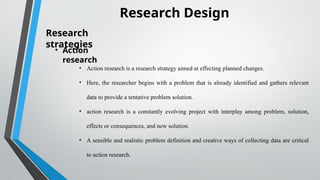
• Action
research
• Action research is a research strategy aimed at effecting planned changes.
• Here, the researcher begins with a problem that is already identified and gathers relevant
data to provide a tentative problem solution.
• action research is a constantly evolving project with interplay among problem, solution,
effects or consequences, and new solution.
• A sensible and realistic problem definition and creative ways of collecting data are critical
to action research.
Research Design
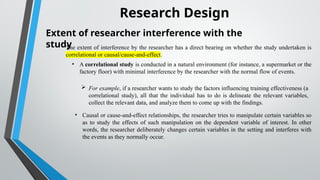
Extent of researcher interference with the
study
The extent of interference by the researcher has a direct bearing on whether the study undertaken is
correlational or causal/cause-and-effect.
• A correlational study is conducted in a natural environment (for instance, a supermarket or the
factory floor) with minimal interference by the researcher with the normal flow of events.
 For example, if a researcher wants to study the factors influencing training effectiveness (a
correlational study), all that the individual has to do is delineate the relevant variables,
collect the relevant data, and analyze them to come up with the findings.
• Causal or cause and effect relationships, the researcher tries to manipulate certain variables so
‐ ‐
as to study the effects of such manipulation on the dependent variable of interest. In other
words, the researcher deliberately changes certain variables in the setting and interferes with
the events as they normally occur.
Research Design
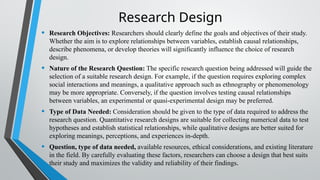
• Research Objectives: Researchers should clearly define the goals and objectives of their study.
Whether the aim is to explore relationships between variables, establish causal relationships,
describe phenomena, or develop theories will significantly influence the choice of research
design.
• Nature of the Research Question: The specific research question being addressed will guide the
selection of a suitable research design. For example, if the question requires exploring complex
social interactions and meanings, a qualitative approach such as ethnography or phenomenology
may be more appropriate. Conversely, if the question involves testing causal relationships
between variables, an experimental or quasi-experimental design may be preferred.
• Type of Data Needed: Consideration should be given to the type of data required to address the
research question. Quantitative research designs are suitable for collecting numerical data to test
hypotheses and establish statistical relationships, while qualitative designs are better suited for
exploring meanings, perceptions, and experiences in-depth.
• Question, type of data needed, available resources, ethical considerations, and existing literature
in the field. By carefully evaluating these factors, researchers can choose a design that best suits
their study and maximizes the validity and reliability of their findings.
• Time and Resources: Researchers should assess the availability of time, budget, and
resources needed to conduct the study. Some research designs may be more time-
consuming and resource-intensive than others, so feasibility considerations are
essential.
• Ethical Considerations: Ethical concerns, such as participant privacy, confidentiality,
and informed consent, should be carefully considered when selecting a research
design. Researchers must ensure that their chosen design aligns with ethical guidelines
and protects the rights and well-being of participants.
• Existing Literature: Reviewing the existing literature on the topic can provide
insights into which research designs have been commonly used and proven effective in
similar studies. Researchers should build upon existing knowledge and select a design
that complements and contributes to the existing body of literature.
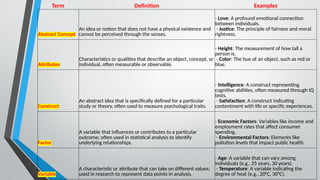
Term Definition Examples
Abstract Concept
An idea or notion that does not have a physical existence and
cannot be perceived through the senses.
- Love: A profound emotional connection
between individuals.
- Justice: The principle of fairness and moral
rightness.
Attributes
Characteristics or qualities that describe an object, concept, or
individual, often measurable or observable.
- Height: The measurement of how tall a
person is.
- Color: The hue of an object, such as red or
blue.
Construct
An abstract idea that is specifically defined for a particular
study or theory, often used to measure psychological traits.
- Intelligence: A construct representing
cognitive abilities, often measured through IQ
tests.
- Satisfaction: A construct indicating
contentment with life or specific experiences.
Factor
A variable that influences or contributes to a particular
outcome; often used in statistical analysis to identify
underlying relationships.
- Economic Factors: Variables like income and
employment rates that affect consumer
spending.
- Environmental Factors: Elements like
pollution levels that impact public health.
Variable
A characteristic or attribute that can take on different values;
used in research to represent data points in analysis.
- Age: A variable that can vary among
individuals (e.g., 25 years, 30 years).
- Temperature: A variable indicating the
degree of heat (e.g., 20°C, 30°C).

Research Design , Business Research Method , Research Variablespptx

  • 1.
    Research Methods in Social Science Course Code:BAHU 3033 Dr. Waqar Ahmad Date: 23-04-2024
  • 2.
    Previous Learning • Formulation andidentification of variables • Develop theoretical Framework • Research Questions. Proposition / Hypothesis
  • 3.
    Learning Outcomes • Explain howvariables are measured. • Explain when operationalization of variables is necessary. • Operationally define (or operationalize) abstract and subjective variables. • Research design
  • 4.
    HOW VARIABLES AREMEASURED • To test the hypothesis that workforce diversity affects organizational effectiveness we have to measure workforce diversity and organizational effectiveness. • Measurement is the assignment of numbers or other symbols to characteristics (or attributes) of objects according to a prespecified set of rules. • Objects include persons, strategic business units, companies, countries, bicycles, elephants, kitchen appliances, restaurants, shampoo, yogurt, and so on.
  • 5.
    HOW VARIABLES AREMEASURED Identify the object and the attribute. • Price consciousness of car buyers. • Self esteem of dyslexic children. ‐ • Organizational commitment of school teachers. • Marketing orientation of companies. • Product quality of tablets (such as the Apple iPad and the Samsung Galaxy Tab)
  • 6.
    OPERATIONAL DEFINITION (OPERATIONALIZATION) Reductionof abstract concepts to render them measurable in a tangible way is called operationalizing the concepts. E.g., the concept of thirst is abstract; we cannot see it. However, we would expect a thirsty person to drink plenty of fluids. In other words, the expected reaction of people to thirst is to drink fluids. If several people say they are thirsty, then we may determine the thirst levels of each of these individuals by the measure of the quantity of fluids that they drink to satisfy their thirst. We will thus be able to measure their levels of thirst, even though the concept of thirst itself is abstract and unclear.
  • 7.
    OPERATIONAL DEFINITION (OPERATIONALIZATION) Operationalizinga concept involves a series of steps. 1. The first step is to come up with a definition of the construct that you want to measure. 2. Then, it is necessary to think about the content of the measure; that is, an instrument (one or more items or questions) that actually measures the concept that one wants to measure has to be developed. 3. Subsequently, a response format (for instance, a seven point rating scale with end points ‐ ‐ anchored by “strongly disagree” and “strongly agree”) is needed, and, 4. Finally, the validity and reliability of the measurement scale has to be assessed.
  • 8.
    OPERATIONAL DEFINITION (OPERATIONALIZATION) Aggressionhas at least two dimensions: 1. Verbal aggression (behavior such as shouting and swearing at a person) 2. Physical aggression (throwing objects, hitting a wall, and physically hurting others). • A valid measurement scale of aggression would have to include items that measure verbal aggression and items that measure physical aggression. • A measurement scale that would only include items measuring physical aggression would not be valid.
  • 9.
    Operationalizing the (multidimensional)concept of achievement motivation Suppose that we are interested in establishing a relationship between gender and achievement motivation. To test this relationship we will have to measure both gender and achievement motivation. At this point, you will probably understand that whereas measuring gender will not cause any problems, measuring achievement motivation probably will, because the latter construct is abstract and subjective in nature. For this reason we must infer achievement motivation by measuring behavioral dimensions, facets, or characteristics we would expect to find in people with high achievement motivation. After we have defined the construct, the next step in the process of measuring abstract constructs such as achievement motivation is to go through the literature to find out whether there are any existing measures of the concept. • Journals • Scale books (Marketing Scales Handbook or the Handbook of Organizational Measurement) 1st 2nd
  • 10.
    Operationalizing the (multidimensional)concept of achievement motivation The use of existing measurement scales has several advantages. 1. First, it saves you a lot of time and energy. 2. Second, it allows you to verify the findings of others and to build on the work of others (this is very important in scientific research but impossible if you use measures that differ from those that our predecessors have used!).
  • 11.
    Research Design Research designrefers to the structured plan or blueprint that outlines how a research study will be conducted. Key Elements of Research Design Research Purpose: This defines the overall goal of the study, which can be descriptive, exploratory, explanatory, or evaluative. Sampling Method: This involves selecting participants for the study. Common sampling methods include random sampling, stratified sampling, and convenience sampling. Data Collection Methods: This specifies how data will be gathered, which may include surveys, interviews, observations, or experiments. Analysis Plan: This outlines the statistical methods or qualitative techniques that will be used to analyze the collected data. Timeline and Resources: A good research design also considers the timeline for completing various phases of the research and the resources needed (e.g., funding, personnel).
  • 12.
  • 13.
    • Research designrefers to the overall plan or strategy that a researcher uses to conduct a study and achieve specific research objectives. It outlines the approach, methods, procedures, and techniques that will be used to gather and analyze data. A well-designed research study is essential for ensuring the validity, reliability, and generalizability of the findings. • The components of a research design typically include: • Research Questions or Objectives: Clear and focused questions or objectives that guide the research process and determine what information needs to be collected. • Research Approach: The overarching approach or methodology that will be used to address the research questions. Common approaches include quantitative, qualitative, and mixed methods. • Sampling Strategy: The process of selecting participants or cases from the population of interest. This includes decisions about the sampling method (e.g., random sampling, purposive sampling), sample size, and sampling frame. • Data Collection Methods: The specific techniques and instruments that will be used to collect data. This may include surveys, interviews, observations, experiments, or document analysis, among others.
  • 14.
    contd..................................... • Variables andMeasures: Identification of the independent and dependent variables in the study, as well as operational definitions and measures for each variable. • Data Analysis Plan: The plan for analyzing the collected data, including the statistical or qualitative methods that will be used to analyze the data and answer the research questions. • Research Ethics: Consideration of ethical issues related to the research, including participant confidentiality, informed consent, and potential risks or benefits. • Time Frame: A timeline or schedule outlining the stages of the research process, from data collection to analysis and reporting. • Budget and Resources: Allocation of resources, including funding, personnel, and equipment, necessary to carry out the research. • Validity and Reliability: Strategies to ensure the validity (accuracy and truthfulness) and reliability (consistency and repeatability) of the research findings.
  • 15.
    Research Design Research strategies A strategyis a plan for achieving a certain goal. A research strategy will help you to meet your research objective(s) and to answer the research questions of your study. The choice for a particular research strategy will therefore depend on the research objective(s) and (the type of) research questions of your study • Experiments • Experiments are usually associated with a hypothetico deductive ‐ approach to research. • The purpose of an experiment is to study causal relationships between variables. • In an experiment, the researcher manipulates the independent variable to study the effect of this manipulation on the dependent variable. • Under the right circumstances, an experimental design is a very strong design to use. However, experimental designs are not always feasible in an applied research context where the researcher tries to solve a management problem.
  • 16.
    Research Design Research strategies • Survey •A survey is a system for collecting information from or about people to describe, compare, or explain their knowledge, attitudes, and behavior. • The survey strategy is very popular in business research, because it allows the researcher to collect quantitative and qualitative data on many types of research questions. • The questions in survey instruments are typically arranged into self administered ‐ questionnaires that a respondent completes on his or her own, either on paper or via the computer. • Ethnography • Ethnography is a research strategy that has its roots in anthropology. • It is a strategy in which the researcher “closely observes, records, and engages in the daily life of another culture [. . .] and then writes accounts of this culture, emphasizing descriptive detail”. • Ethnography involves immersion in the culture of the social group that is being studied. • It thus aims to generate an understanding of the culture and behavior of a social group from an “insider’s point of view.
  • 17.
    Research Design Research strategies • Casestudies • Case studies focus on collecting information about a specific object, event or activity, such as a particular business unit or organization. • The idea behind a case study is that in order to obtain a clear picture of a problem one must examine the real life situation from various angles and perspectives using multiple methods of data ‐ collection. • Along these lines, one may define a case study as a research strategy that involves an empirical investigation of a particular contemporary phenomenon within its real life context using multiple ‐ methods of data collection. • Grounded theory • Grounded theory is a systematic set of procedures to develop an inductively derived theory from the data.
  • 18.
    Research Design Research strategies • Action research •Action research is a research strategy aimed at effecting planned changes. • Here, the researcher begins with a problem that is already identified and gathers relevant data to provide a tentative problem solution. • action research is a constantly evolving project with interplay among problem, solution, effects or consequences, and new solution. • A sensible and realistic problem definition and creative ways of collecting data are critical to action research.
  • 19.
    Research Design Extent ofresearcher interference with the study The extent of interference by the researcher has a direct bearing on whether the study undertaken is correlational or causal/cause-and-effect. • A correlational study is conducted in a natural environment (for instance, a supermarket or the factory floor) with minimal interference by the researcher with the normal flow of events.  For example, if a researcher wants to study the factors influencing training effectiveness (a correlational study), all that the individual has to do is delineate the relevant variables, collect the relevant data, and analyze them to come up with the findings. • Causal or cause and effect relationships, the researcher tries to manipulate certain variables so ‐ ‐ as to study the effects of such manipulation on the dependent variable of interest. In other words, the researcher deliberately changes certain variables in the setting and interferes with the events as they normally occur.
  • 20.
    Research Design • ResearchObjectives: Researchers should clearly define the goals and objectives of their study. Whether the aim is to explore relationships between variables, establish causal relationships, describe phenomena, or develop theories will significantly influence the choice of research design. • Nature of the Research Question: The specific research question being addressed will guide the selection of a suitable research design. For example, if the question requires exploring complex social interactions and meanings, a qualitative approach such as ethnography or phenomenology may be more appropriate. Conversely, if the question involves testing causal relationships between variables, an experimental or quasi-experimental design may be preferred. • Type of Data Needed: Consideration should be given to the type of data required to address the research question. Quantitative research designs are suitable for collecting numerical data to test hypotheses and establish statistical relationships, while qualitative designs are better suited for exploring meanings, perceptions, and experiences in-depth. • Question, type of data needed, available resources, ethical considerations, and existing literature in the field. By carefully evaluating these factors, researchers can choose a design that best suits their study and maximizes the validity and reliability of their findings.
  • 21.
    • Time andResources: Researchers should assess the availability of time, budget, and resources needed to conduct the study. Some research designs may be more time- consuming and resource-intensive than others, so feasibility considerations are essential. • Ethical Considerations: Ethical concerns, such as participant privacy, confidentiality, and informed consent, should be carefully considered when selecting a research design. Researchers must ensure that their chosen design aligns with ethical guidelines and protects the rights and well-being of participants. • Existing Literature: Reviewing the existing literature on the topic can provide insights into which research designs have been commonly used and proven effective in similar studies. Researchers should build upon existing knowledge and select a design that complements and contributes to the existing body of literature.
  • 22.
    Term Definition Examples AbstractConcept An idea or notion that does not have a physical existence and cannot be perceived through the senses. - Love: A profound emotional connection between individuals. - Justice: The principle of fairness and moral rightness. Attributes Characteristics or qualities that describe an object, concept, or individual, often measurable or observable. - Height: The measurement of how tall a person is. - Color: The hue of an object, such as red or blue. Construct An abstract idea that is specifically defined for a particular study or theory, often used to measure psychological traits. - Intelligence: A construct representing cognitive abilities, often measured through IQ tests. - Satisfaction: A construct indicating contentment with life or specific experiences. Factor A variable that influences or contributes to a particular outcome; often used in statistical analysis to identify underlying relationships. - Economic Factors: Variables like income and employment rates that affect consumer spending. - Environmental Factors: Elements like pollution levels that impact public health. Variable A characteristic or attribute that can take on different values; used in research to represent data points in analysis. - Age: A variable that can vary among individuals (e.g., 25 years, 30 years). - Temperature: A variable indicating the degree of heat (e.g., 20°C, 30°C).