Reporting responsibilities matrix
SM.1 Safety Intelligence and Performance
Date: January 2019
Version: 1.0
Disclaimer
The content of this course is for training purposes only. All information provided is of a general nature only and is not intended to address
the circumstances of any particular individual or entity. Any time there is a conflict or discrepancy between the information provided in this
presentation and information in an official regulation or Agency document, the later prevails.
Despite every effort to ensure the accuracy of the information provided, it may contain occasional inadvertent inaccuracies or typographical
errors. Any error brought to our attention (IORS@easa.europa.eu) will be promptly corrected. In no event shall EASA be liable for any
incidental or consequential damages, even if EASA has been informed of the possibility thereof. The content may be subject to changes at
any time without prior notice. Subsequent revisions or updates will not be provided. To the maximum extent permitted by law, EASA is not
liable (whether in contract, negligence or otherwise) for any loss or damage arising from the use of theses materials.
All training materials, including any documentation, publications, software programs, and other information provided by or on behalf of
EASA are furnished on an “as-is” basis, without warranty of any kind, whether express, implied, statutory or otherwise especially as to its
quality, reliability, currency, accuracy or fitness for purpose.
Ownership of all copyright and other intellectual property rights contained within the EASA training material, including any documentation,
data, technical information and know-how provided as part of the training, remains vested in EASA. None of the materials provided may be
used, reproduced or transmitted, in any form or by any means, electronic or mechanical, including recording or the use of any information
storage and retrieval system, without the written permission from EASA. All logo, copyrights, trademarks and registered trademarks in these
training materials are the property of their respective owners.
2
06/02/2019 Version 1.0
3
Reporting function
Click on the Role who’s reporting function you would like to see
EASA industry partners EU Aviation Authorities Non-EU organisation
ANSP (Pan - EU)
ANSP
DAH
POA (Singe European)
POA
Part - M
Part - 145
AOC
Aerodrome Operator
ATO
DAT provider (Pan - EU)
DAT provider
SIA
NAA
EASA
European Central Repository
POA
Part - M
Part - 145
DAH (without Bilateral)
DAH (Bilateral)
AOC – EASA TCO
Foreign ATO
ANSP
DAT provider (non – EU)
Acronyms
06/02/2019 Version 1.0
Acronyms
Acronym Meaning
ANSP Air Navigation Service provider
AOC Air Operator Certificate holder
ATO Approved Training Organisation (Pilot)
DAH Design Approval Holder
DAT Navigation Database Suppliers
EASA European Union Aviation Safety Agency
NAA National Aviation Authority
POA Production Organisation Approval Holder
Part M Part M Maintenance organisation
Part 145 Part 145 Maintenance organisation
SIA Safety Investigation Authority
TCO Third Country Operators
Version 1.0 4
Return to “Reporting function” page
06/02/2019
5
Reporting responsibilities for Pan – EU ANSP
EASA industry partners EU Aviation Authorities Non-EU organisation
EASA
Pan – EU ANSP Air Navigation Service Provider
Reg. 2015/1018 Reg. 376/2014 Reg. 2017/373
Return to “Reporting function” page
AMC 20-8
06/02/2019 Version 1.0
6
Reporting responsibilities for ANSP
EASA industry partners EU Aviation Authorities Non-EU organisation
EASA
ANSP Air Navigation Service Provider
Reg. 2015/1018 Reg. 376/2014 Reg. 2017/373
Return to “Reporting function” page
AMC 20-8
06/02/2019 Version 1.0
7
Reporting responsibilities for DAH
EASA industry partners EU Aviation Authorities Non-EU organisation
EASA
DAH Design Approval Holder
Reg. 2015/1018 Reg. 376/2014 Reg. 748/2012
Return to “Reporting function” page
DAH
AMC 20-8
06/02/2019 Version 1.0
8
Reporting responsibilities for POA (single European)
EASA industry partners EU Aviation Authorities Non-EU organisation
EASA
POA (single European) Single EASA Member State Production
Organisation Approval Holder
Reg. 2015/1018 Reg. 376/2014 Reg. 748/2012
Return to “Reporting function” page
DAH
POA
DAH (No Bilateral)
POA
AMC 20-8
06/02/2019 Version 1.0
9
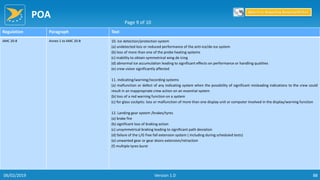
Reporting responsibilities for POA
EASA industry partners EU Aviation Authorities Non-EU organisation
EASA
POA Production Organisation
Approval Holder
Reg. 2015/1018 Reg. 376/2014 Reg. 748/2012
Return to “Reporting function” page
DAH
POA
DAH (No Bilateral)
POA
NAA
AMC 20-8
06/02/2019 Version 1.0
10
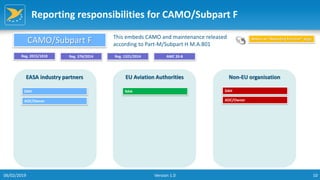
Reporting responsibilities for CAMO/Subpart F
EASA industry partners EU Aviation Authorities Non-EU organisation
CAMO/Subpart F This embeds CAMO and maintenance released
according to Part-M/Subpart H M.A.801
Reg. 2015/1018 Reg. 376/2014 Reg. 1321/2014
Return to “Reporting function” page
DAH
AOC/Owner
DAH
AOC/Owner
NAA
AMC 20-8
06/02/2019 Version 1.0
11
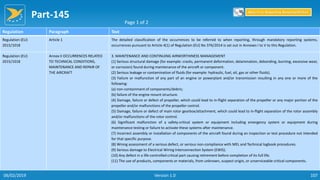
Reporting responsibilities for Part-145
EASA industry partners EU Aviation Authorities Non-EU organisation
Part-145 Part-145 Maintenance Organisation
Reg. 2015/1018 Reg. 376/2014 Reg. 1321/2014
Return to “Reporting function” page
DAH
AOC
DAH
AOC
NAA
AMC 20-8
06/02/2019 Version 1.0
12
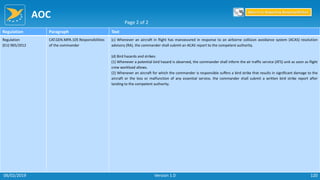
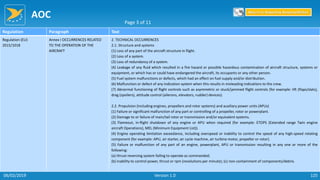
Reporting responsibilities for AOC
EASA industry partners EU Aviation Authorities Non-EU organisation
AOC Air Operators Certificate holder
Reg. 2015/1018 Reg. 376/2014 Reg. 965/2012
Return to “Reporting function” page
Part-145
CAMO/Subpart F
Part-145
CAMO/Subpart F
SIA
DAH
ANSP
NAA
DAH
ANSP
AMC 20-8
06/02/2019 Version 1.0
Version 1.0 13
Reporting responsibilities for Aerodrome
EASA industry partners EU Aviation Authorities Non-EU organisation
Aerodrome Aerodrome operators in an EASA Member State
should report to the NAA in that Member State
Reg. 2015/1018 Reg. 376/2014 Reg. 139/2014
Return to “Reporting function” page
NAA
06/02/2019
14
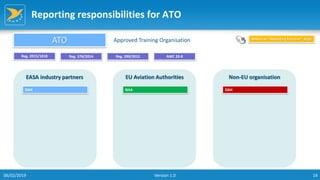
Reporting responsibilities for ATO
EASA industry partners EU Aviation Authorities Non-EU organisation
ATO Approved Training Organisation
Reg. 2015/1018 Reg. 376/2014 Reg. 290/2012
Return to “Reporting function” page
DAH NAA DAH
AMC 20-8
06/02/2019 Version 1.0
15
Reporting responsibilities for DAT provider (Pan – EU)
EASA industry partners EU Aviation Authorities Non-EU organisation
DAT provider (Pan-EU) DAT provider (pan European)
Reg. 2017/373 Reg. 376/2014
Return to “Reporting function” page
DAT provider EASA
DAH
06/02/2019 Version 1.0
16
Reporting responsibilities for DAT provider
EASA industry partners EU Aviation Authorities Non-EU organisation
DAT provider DAT provider
Reg. 2017/373 Reg. 376/2014
Return to “Reporting function” page
DAT provider EASA
DAH
06/02/2019 Version 1.0
17
Reporting responsibilities for SIA
EASA industry partners EU Aviation Authorities Non-EU organisation
SIA Safety Investigation Authority
Reg. 996/2010 Reg. 376/2014
Return to “Reporting function” page
EASA
NAA
06/02/2019 Version 1.0
18
Reporting responsibilities for NAA
EASA industry partners EU Aviation Authorities Non-EU organisation
NAA National Aviation Authority
Reg. 2018/1139 Reg. 290/2012
Return to “Reporting function” page
EASA
Reg. 2017/373
Reg. 376/2014 Reg. 139/2014 Reg. 965/2012
European Central Repository
Reg. 2015/340
06/02/2019 Version 1.0
NAA
SIA
Reg. 996/2010
19
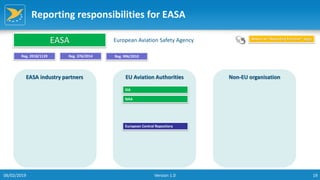
Reporting responsibilities for EASA
EASA industry partners EU Aviation Authorities Non-EU organisation
EASA European Aviation Safety Agency
Reg. 2018/1139 Reg. 376/2014
Return to “Reporting function” page
SIA
NAA
European Central Repository
Reg. 996/2010
06/02/2019 Version 1.0
20
Reporting responsibilities for European Central Repository
European Central Repository Return to “Reporting function” page
• The European Central Repository is a database that is reported to. As such it has no reporting responsibilities.
06/02/2019 Version 1.0
Version 1.0 21
Reporting responsibilities for Part-M (non EU)
EASA industry partners EU Aviation Authorities Non-EU organisation
EASA
POA (non EU) Production Organisation
Approval Holder
Reg. 748/2012
Return to “Reporting function” page
DAH
POA
DAH
POA
AMC 20-8
06/02/2019
22
Reporting responsibilities for POA (non EU)
EASA industry partners EU Aviation Authorities Non-EU organisation
NAA
Part-M (non EU) Non-EASA Member State based
CAMO maintenance organisation
Reg. 1321/2014
Return to “Reporting function” page
DAH
AOC/Owner
DAH
AOC/Owner
AMC 20-8
06/02/2019 Version 1.0
23
Reporting responsibilities for Part-145 (non EU)
EASA industry partners EU Aviation Authorities Non-EU organisation
EASA
Part-145 (non EU) Non-EASA Part-145 maintenance
organisation
Reg. 1321/2014
Return to “Reporting function” page
DAH
AOC
DAH
AOC
AMC 20-8
06/02/2019 Version 1.0
24
Reporting responsibilities for DAH (non EU) without Bilateral
EASA industry partners EU Aviation Authorities Non-EU organisation
EASA
DAH (non EU) No Bilateral Design Approval Holder from non-EASA
country without Bilateral Agreement
Reg. 748/2012
Return to “Reporting function” page
DAH
AMC 20-8
06/02/2019 Version 1.0
25
Reporting responsibilities for DAH (non EU) with Bilateral
DAH (non EU) Bilateral Design Approval Holder from non-EASA
country with a Bilateral Agreement with EU
Bilateral US
Return to “Reporting function” page
Bilateral Canada Bilateral Brazil
• Bilateral Agreement waives reporting obligations to EASA:
06/02/2019 Version 1.0
26
Reporting responsibilities for AOC with EASA TCO authorisation
EASA industry partners EU Aviation Authorities Non-EU organisation
EASA
AOC with EASA TCO Non-EASA Air Operator Certificate holder
based in a Third Country with EASA TCO
Reg. 452/2014
Return to “Reporting function” page
06/02/2019 Version 1.0
27
Reporting responsibilities for Foreign ATO
EASA industry partners EU Aviation Authorities Non-EU organisation
EASA
Foreign ATO Non-EASA Member State Approved
Training Organisation
Reg. 290/2012
Return to “Reporting function” page
DAH DAH
AMC 20-8
06/02/2019 Version 1.0
28
Reporting responsibilities for ANSP (non-EU)
EASA industry partners EU Aviation Authorities Non-EU organisation
EASA
ANSP (non-EU) Non-EASA Air Navigation Service
Provider
Reg. 2017/373
Return to “Reporting function” page
AMC 20-8
06/02/2019 Version 1.0
29
Reporting responsibilities for DAT provider (non-EU)
EASA industry partners EU Aviation Authorities Non-EU organisation
EASA
DAT provider (non-EU) DAT Provider (non-EU)
Reg. 2017/373
Return to “Reporting function” page
DAT provider
DAH
06/02/2019 Version 1.0
ANSP (Pan-EU)
30
Regulation Paragraph Text
Regulation
(EU) 2017/373
ATM/ANS.OR.A.065 (a) A service provider shall report to the competent authority, and to any other organisation required by the Member State
where the service provider provides its services, any accident, serious incident and occurrence as defined in Regulation (EU) No
996/2010 of the European Parliament and of the Council (1) and Regulation (EU) No 376/2014.
(b) Without prejudice to point (a), the service provider shall report to the competent authority and to the organisation
responsible for the design of system and constituents, if different from the service provider, any malfunction, technical defect,
exceeding of technical limitations, occurrence, or other irregular circumstance that has or may have endangered the safety of
services and that has not resulted in an accident or serious incident.
(c) Without prejudice to Regulations (EU) No 996/2010 and (EU) No 376/2014, the reports referred to in points (a) and (b) shall
be made in a form and manner established by the competent authority and contain all the pertinent information about the
event known to the service provider.
(d) Reports shall be made as soon as possible and in any case within 72 hours of the service provider identifying the details of
the event to which the report relates unless exceptional circumstances prevent this.
(e) Without prejudice to Regulation (EU) No 376/2014, where relevant, the service provider shall produce a follow-up report to
provide details of actions it intends to take to prevent similar occurrences in the future, as soon as these actions have been
identified. This report shall be produced in a form and manner established by the competent authority.
Page 1 of 1
Return to Reporting Responsibilities
06/02/2019 Version 1.0
ANSP (Pan-EU)
31
Regulation Paragraph Text
Regulation (EU)
376/2014
Article 4 Mandatory reporting 1. Occurrences which may represent a significant risk to aviation safety and which fall into the following categories shall be
reported by the persons listed in paragraph 6 through the mandatory occurrence reporting systems pursuant to this Article:
(c) occurrences related to air navigation services and facilities, such as:
(i) collisions, near collisions or potential for collisions;
(ii) specific occurrences of air traffic management and air navigation services (ATM/ANS);
(iii) ATM/ANS operational occurrences.
8. Following notification of an occurrence, any organisation established in a Member State which is not covered by paragraph 9
shall report to the competent authority of that Member State, as referred to in Article 6(3), the details of occurrences collected
in accordance with paragraph 2 of this Article as soon as possible, and in any event no later than 72 hours after becoming
aware of the occurrence.
Regulation (EU)
376/2014
Article 5 Voluntary reporting 1. Each organisation established in a Member State shall establish a voluntary reporting system to facilitate the collection of:
(a) details of occurrences that may not be captured by the mandatory reporting system;
(b) other safety-related information which is perceived by the reporter as an actual or potential hazard to aviation safety.
6. Each organisation established in a Member State that is not certified or approved by the Agency shall, in a timely manner,
report to the competent authority of that Member State, as designated pursuant to Article 6(3), the details of occurrences and
other safety-related information which have been collected pursuant to paragraph 1 of this Article and which may involve an
actual or potential aviation safety risk. Member States may require any organisation established in their territory to report the
details of all occurrences collected pursuant to paragraph 1 of this Article.
Page 1 of 1
Return to Reporting Responsibilities
06/02/2019 Version 1.0
ANSP (Pan-EU)
32
Regulation Paragraph Text
Regulation (EU)
2015/1018
Article 1 The detailed classification of the occurrences to be referred to when reporting, through mandatory reporting systems,
occurrences pursuant to Article 4(1) of Regulation (EU) No 376/2014 is set out in Annexes I to V to this Regulation.
Regulation (EU)
2015/1018
ANNEX III OCCURRENCES RELATED
TO AIR NAVIGATION SERVICES AND
FACILITIES
Remark: This Annex is structured in such a way that the pertinent occurrences are linked with categories of activities during
which they are normally observed, according to experience, in order to facilitate the reporting of those occurrences. However,
this presentation must not be understood as meaning that occurrences must not be reported in case they take place outside
the category of activities to which they are linked in the list.
1. AIRCRAFT-RELATED OCCURRENCES
(1) A collision or a near collision on the ground or in the air, between an aircraft and another aircraft, terrain or obstacle,
including near-controlled flight into terrain (near CFIT).
(2) Separation minima infringement.
(3) Inadequate separation.
(4) ACAS RAs.
(5) Wildlife strike including bird strike.
(6) Taxiway or runway excursion.
(7) Actual or potential taxiway or runway incursion.
(8) Final Approach and Take-off Area (FATO) incursion.
(9) Aircraft deviation from ATC clearance.
(10) Aircraft deviation from applicable air traffic management (ATM) regulation:
(a) aircraft deviation from applicable published ATM procedures;
(b) airspace infringement including unauthorised penetration of airspace;
(c) deviation from aircraft ATM-related equipment carriage and operations, as mandated by applicable regulations.
(11) Call sign confusion related occurrences.
Page 1 of 3
Return to Reporting Responsibilities
06/02/2019 Version 1.0
ANSP (Pan-EU)
33
Regulation Paragraph Text
Regulation (EU)
2015/1018
ANNEX III OCCURRENCES RELATED
TO AIR NAVIGATION SERVICES AND
FACILITIES
2. DEGRADATION OR TOTAL LOSS OF SERVICES OR FUNCTIONS
(1) Inability to provide ATM services or to execute ATM functions:
(a) inability to provide air traffic services or to execute air traffic services functions;
(b) inability to provide airspace management services or to execute airspace management functions;
(c) inability to provide air traffic flow management and capacity services or to execute air traffic flow management and
capacity functions.
(2) Missing or significantly incorrect, corrupted, inadequate or misleading information from any support service, including
relating to poor runway surface conditions.
(3) Failure of communication service.
(4) Failure of surveillance service.
(5) Failure of data processing and distribution function or service.
(6) Failure of navigation service.
(7) Failure of ATM system security which had or could have a direct negative impact on the safe provision of service.
(8) Significant ATS sector/position overload leading to a potential deterioration in service provision.
(9) Incorrect receipt or interpretation of significant communications, including lack of understanding of the language used,
when this had or could have a direct negative impact on the safe provision of service.
(10) Prolonged loss of communication with an aircraft or with other ATS unit.
Page 2 of 3
Return to Reporting Responsibilities
06/02/2019 Version 1.0
ANSP (Pan-EU)
34
Regulation Paragraph Text
Regulation (EU)
2015/1018
ANNEX III OCCURRENCES RELATED
TO AIR NAVIGATION SERVICES AND
FACILITIES
3. OTHER OCCURRENCES
(1) Declaration of an emergency (‘Mayday’ or ‘PAN’ call).
(2) Significant external interference with Air Navigation Services (for example radio broadcast stations transmitting in the FM
band, interfering with ILS (instrument landing system), VOR (VHF Omni Directional Radio Range) and communication).
(3) Interference with an aircraft, an ATS unit or a radio communication transmission including by firearms, fireworks, flying
kites, laser illumination, high-powered lights lasers, Remotely Piloted Aircraft Systems, model aircraft or by similar means.
(4) Fuel dumping.
(5) Bomb threat or hijack.
(6) Fatigue impacting or potentially impacting the ability to perform safely the air navigation or air traffic duties.
(7) Any occurrence where the human performance has directly contributed to or could have contributed to an accident or a
serious incident.
Page 3 of 3
Return to Reporting Responsibilities
06/02/2019 Version 1.0
ANSP (Pan-EU)
35
Regulation Paragraph Text
AMC 20-8 IV. AIR NAVIGATION SERVICESIV.
AIR NAVIGATION SERVICES,
FACILITIES AND GROUND SERVICES
A. Air Navigation Services
(1) Provision of significantly incorrect, inadequate or misleading information from any ground sources, e.g. Air Traffic Control
(ATC), Automatic Terminal Information Service (ATIS), Meteorological Services, navigation databases, maps, charts, manuals,
etc.
(2) Provision of less than prescribed terrain clearance.
(3) Provision of incorrect pressure reference data (i.e. altimeter setting).
(4) Incorrect transmission, receipt or interpretation of significant messages when this results in a hazardous situation.
(5) Separation minima infringement.
(6) Unauthorised penetration of airspace.
(7) Unlawful radio communication transmission.
(8) Failure of ANS ground or satellite facilities.
(9) Major ATC/ Air Traffic Management (ATM) failure or significant deterioration of aerodrome infrastructure.
(10) Aerodrome movement areas obstructed by aircraft, vehicles, animals or foreign objects, resulting in a hazardous or
potentially hazardous situation.
(11) Errors or inadequacies in marking of obstructions or hazards on aerodrome movement areas resulting in a hazardous
situation.
(12) Failure, significant malfunction or unavailability of airfield lighting.
Page 1 of 1
Return to Reporting Responsibilities
06/02/2019 Version 1.0
ANSP
36
Regulation Paragraph Text
Regulation
(EU) 2017/373
ATM/ANS.OR.A.065 (a) A service provider shall report to the competent authority, and to any other organisation required by the Member State
where the service provider provides its services, any accident, serious incident and occurrence as defined in Regulation (EU) No
996/2010 of the European Parliament and of the Council (1) and Regulation (EU) No 376/2014.
(b) Without prejudice to point (a), the service provider shall report to the competent authority and to the organisation
responsible for the design of system and constituents, if different from the service provider, any malfunction, technical defect,
exceeding of technical limitations, occurrence, or other irregular circumstance that has or may have endangered the safety of
services and that has not resulted in an accident or serious incident.
(c) Without prejudice to Regulations (EU) No 996/2010 and (EU) No 376/2014, the reports referred to in points (a) and (b) shall
be made in a form and manner established by the competent authority and contain all the pertinent information about the
event known to the service provider.
(d) Reports shall be made as soon as possible and in any case within 72 hours of the service provider identifying the details of
the event to which the report relates unless exceptional circumstances prevent this.
(e) Without prejudice to Regulation (EU) No 376/2014, where relevant, the service provider shall produce a follow-up report to
provide details of actions it intends to take to prevent similar occurrences in the future, as soon as these actions have been
identified. This report shall be produced in a form and manner established by the competent authority.
Page 1 of 1
Return to Reporting Responsibilities
06/02/2019 Version 1.0
ANSP
37
Regulation Paragraph Text
Regulation (EU)
376/2014
Article 4 Mandatory reporting 1. Occurrences which may represent a significant risk to aviation safety and which fall into the following categories shall be
reported by the persons listed in paragraph 6 through the mandatory occurrence reporting systems pursuant to this Article:
(c) occurrences related to air navigation services and facilities, such as:
(i) collisions, near collisions or potential for collisions;
(ii) specific occurrences of air traffic management and air navigation services (ATM/ANS);
(iii) ATM/ANS operational occurrences.
8. Following notification of an occurrence, any organisation established in a Member State which is not covered by paragraph 9
shall report to the competent authority of that Member State, as referred to in Article 6(3), the details of occurrences collected
in accordance with paragraph 2 of this Article as soon as possible, and in any event no later than 72 hours after becoming
aware of the occurrence.
Regulation (EU)
376/2014
Article 5 Voluntary reporting 1. Each organisation established in a Member State shall establish a voluntary reporting system to facilitate the collection of:
(a) details of occurrences that may not be captured by the mandatory reporting system;
(b) other safety-related information which is perceived by the reporter as an actual or potential hazard to aviation safety.
6. Each organisation established in a Member State that is not certified or approved by the Agency shall, in a timely manner,
report to the competent authority of that Member State, as designated pursuant to Article 6(3), the details of occurrences and
other safety-related information which have been collected pursuant to paragraph 1 of this Article and which may involve an
actual or potential aviation safety risk. Member States may require any organisation established in their territory to report the
details of all occurrences collected pursuant to paragraph 1 of this Article.
Page 1 of 2
Return to Reporting Responsibilities
06/02/2019 Version 1.0
ANSP
38
Regulation Paragraph Text
Regulation (EU)
376/2014
Article 13 Occurrence analysis and
follow-up at national level
4. Where an organisation established in a Member State which is not covered by paragraph 5 identifies an actual or potential
aviation safety risk as a result of its analysis of occurrences or group of occurrences reported pursuant to Articles 4(8) and 5(6),
it shall transmit to the competent authority of that Member State, within 30 days from the date of notification of the
occurrence by the reporter:
(a) the preliminary results of the analysis performed pursuant to paragraph 1, if any; and
(b) any action to be taken pursuant to paragraph 2.
The organisation shall report the final results of the analysis, where required, as soon as they are available and, in principle, no
later than three months from the date of notification of the occurrence.
A competent authority of a Member State may request organisations to transmit to it the preliminary or final results of the
analysis of any occurrence of which it has been notified but in relation to which it has received no follow-up or only the
preliminary results.
Page 2 of 2
Return to Reporting Responsibilities
06/02/2019 Version 1.0
ANSP
39
Regulation Paragraph Text
Regulation (EU)
2015/1018
Article 1 The detailed classification of the occurrences to be referred to when reporting, through mandatory reporting systems,
occurrences pursuant to Article 4(1) of Regulation (EU) No 376/2014 is set out in Annexes I to V to this Regulation.
Regulation (EU)
2015/1018
ANNEX III OCCURRENCES RELATED
TO AIR NAVIGATION SERVICES AND
FACILITIES
Remark: This Annex is structured in such a way that the pertinent occurrences are linked with categories of activities during
which they are normally observed, according to experience, in order to facilitate the reporting of those occurrences. However,
this presentation must not be understood as meaning that occurrences must not be reported in case they take place outside
the category of activities to which they are linked in the list.
1. AIRCRAFT-RELATED OCCURRENCES
(1) A collision or a near collision on the ground or in the air, between an aircraft and another aircraft, terrain or obstacle,
including near-controlled flight into terrain (near CFIT).
(2) Separation minima infringement.
(3) Inadequate separation.
(4) ACAS RAs.
(5) Wildlife strike including bird strike.
(6) Taxiway or runway excursion.
(7) Actual or potential taxiway or runway incursion.
(8) Final Approach and Take-off Area (FATO) incursion.
(9) Aircraft deviation from ATC clearance.
(10) Aircraft deviation from applicable air traffic management (ATM) regulation:
(a) aircraft deviation from applicable published ATM procedures;
(b) airspace infringement including unauthorised penetration of airspace;
(c) deviation from aircraft ATM-related equipment carriage and operations, as mandated by applicable regulations.
(11) Call sign confusion related occurrences.
Page 1 of 3
Return to Reporting Responsibilities
06/02/2019 Version 1.0
ANSP
40
Regulation Paragraph Text
Regulation (EU)
2015/1018
ANNEX III OCCURRENCES RELATED
TO AIR NAVIGATION SERVICES AND
FACILITIES
2. DEGRADATION OR TOTAL LOSS OF SERVICES OR FUNCTIONS
(1) Inability to provide ATM services or to execute ATM functions:
(a) inability to provide air traffic services or to execute air traffic services functions;
(b) inability to provide airspace management services or to execute airspace management functions;
(c) inability to provide air traffic flow management and capacity services or to execute air traffic flow management and
capacity functions.
(2) Missing or significantly incorrect, corrupted, inadequate or misleading information from any support service, including
relating to poor runway surface conditions.
(3) Failure of communication service.
(4) Failure of surveillance service.
(5) Failure of data processing and distribution function or service.
(6) Failure of navigation service.
(7) Failure of ATM system security which had or could have a direct negative impact on the safe provision of service.
(8) Significant ATS sector/position overload leading to a potential deterioration in service provision.
(9) Incorrect receipt or interpretation of significant communications, including lack of understanding of the language used,
when this had or could have a direct negative impact on the safe provision of service.
(10) Prolonged loss of communication with an aircraft or with other ATS unit.
Page 2 of 3
Return to Reporting Responsibilities
06/02/2019 Version 1.0
ANSP
41
Regulation Paragraph Text
Regulation (EU)
2015/1018
ANNEX III OCCURRENCES RELATED
TO AIR NAVIGATION SERVICES AND
FACILITIES
3. OTHER OCCURRENCES
(1) Declaration of an emergency (‘Mayday’ or ‘PAN’ call).
(2) Significant external interference with Air Navigation Services (for example radio broadcast stations transmitting in the FM
band, interfering with ILS (instrument landing system), VOR (VHF Omni Directional Radio Range) and communication).
(3) Interference with an aircraft, an ATS unit or a radio communication transmission including by firearms, fireworks, flying
kites, laser illumination, high-powered lights lasers, Remotely Piloted Aircraft Systems, model aircraft or by similar means.
(4) Fuel dumping.
(5) Bomb threat or hijack.
(6) Fatigue impacting or potentially impacting the ability to perform safely the air navigation or air traffic duties.
(7) Any occurrence where the human performance has directly contributed to or could have contributed to an accident or a
serious incident.
Page 3 of 3
Return to Reporting Responsibilities
06/02/2019 Version 1.0
ANSP
42
Regulation Paragraph Text
AMC 20-8 IV. AIR NAVIGATION SERVICESIV.
AIR NAVIGATION SERVICES,
FACILITIES AND GROUND SERVICES
A. Air Navigation Services
(1) Provision of significantly incorrect, inadequate or misleading information from any ground sources, e.g. Air Traffic Control
(ATC), Automatic Terminal Information Service (ATIS), Meteorological Services, navigation databases, maps, charts, manuals,
etc.
(2) Provision of less than prescribed terrain clearance.
(3) Provision of incorrect pressure reference data (i.e. altimeter setting).
(4) Incorrect transmission, receipt or interpretation of significant messages when this results in a hazardous situation.
(5) Separation minima infringement.
(6) Unauthorised penetration of airspace.
(7) Unlawful radio communication transmission.
(8) Failure of ANS ground or satellite facilities.
(9) Major ATC/ Air Traffic Management (ATM) failure or significant deterioration of aerodrome infrastructure.
(10) Aerodrome movement areas obstructed by aircraft, vehicles, animals or foreign objects, resulting in a hazardous or
potentially hazardous situation.
(11) Errors or inadequacies in marking of obstructions or hazards on aerodrome movement areas resulting in a hazardous
situation.
(12) Failure, significant malfunction or unavailability of airfield lighting.
Page 1 of 1
Return to Reporting Responsibilities
06/02/2019 Version 1.0
DAH
43
Regulation Paragraph Text
Regulation
(EU) 748/2012
(Part 21)
21A.3A (b) 1. The holder of a type-certificate, restricted type-certificate, supplemental type-certificate, ETSO authorisation, major repair
design approval or any other relevant approval deemed to have been issued under this Regulation shall report to the Agency
any failure, malfunction, defect or other occurrence of which it is aware related to a product, part, or appliance covered by the
type-certificate, restricted type-certificate, supplemental type-certificate, ETSO authorisation, major repair design approval or
any other relevant approval deemed to have been issued under this Regulation, and which has resulted in or may result in an
unsafe condition.
2. These reports shall be made in a form and manner established by the Agency, as soon as practicable and in any case
dispatched not later than 72 hours after the identification of the possible unsafe condition, unless exceptional circumstances
prevent this.
Regulation
(EU) 748/2012
(Part 21)
21A.265 (e) The holder of a design organisation approval shall provide to the Agency information or instructions related to required actions
under point 21.A.3B.
Page 1 of 1
Return to Reporting Responsibilities
06/02/2019 Version 1.0
DAH
44
Regulation Paragraph Text
Regulation (EU)
376/2014
Article 4 Mandatory reporting 1. Occurrences which may represent a significant risk to aviation safety and which fall into the following categories shall be
reported by the persons listed in paragraph 6 through the mandatory occurrence reporting systems pursuant to this Article:
(b) occurrences related to technical conditions, maintenance and repair of aircraft, such as:
(i) structural defects;
(ii) system malfunctions;
(iii) maintenance and repair problems;
(iv) propulsion problems (including engines, propellers and rotor systems) and auxiliary power unit problems.
9. Following notification of an occurrence, each organisation established in a Member State which is certified or approved by
the Agency shall report to the Agency the details of occurrences collected in accordance with paragraph 2 as soon as possible,
and in any event no later than 72 hours after becoming aware of the occurrence.
Regulation (EU)
376/2014
Article 5 Voluntary reporting 1. Each organisation established in a Member State shall establish a voluntary reporting system to facilitate the collection of:
(a) details of occurrences that may not be captured by the mandatory reporting system;
(b) other safety-related information which is perceived by the reporter as an actual or potential hazard to aviation safety.
5. Each organisation established in a Member State and certified or approved by the Agency shall report to the Agency, in a
timely manner, details of occurrences and safety-related information which have been collected pursuant to paragraph 1 and
which may involve an actual or potential aviation safety risk.
Page 1 of 2
Return to Reporting Responsibilities
06/02/2019 Version 1.0
DAH
45
Regulation Paragraph Text
Regulation (EU)
376/2014
Article 13 Occurrence analysis and
follow-up at national level
5. Where an organisation established in a Member State and certified or approved by the Agency identifies an actual or
potential aviation safety risk as a result of its analysis of occurrences or group of occurrences reported pursuant to Articles 4(9)
and 5(5), it shall transmit to the Agency, within 30 days from the date of notification of the occurrence by the reporter:
(a) the preliminary results of the analysis performed pursuant to paragraph 1, if any; and
(b) any action to be taken pursuant to paragraph 2.
The organisation certified or approved by the Agency shall transmit to the Agency the final results of the analysis, where
required, as soon as they are available and, in principle, no later than three months from the date of notification of the
occurrence.
The Agency may request organisations to transmit to it the preliminary or final results of the analysis of any occurrence of
which it has been notified but in relation to which it has received no follow-up or only the preliminary results.
Page 2 of 2
Return to Reporting Responsibilities
06/02/2019 Version 1.0
DAH
46
Regulation Paragraph Text
Regulation (EU)
2015/1018
Article 1 The detailed classification of the occurrences to be referred to when reporting, through mandatory reporting systems,
occurrences pursuant to Article 4(1) of Regulation (EU) No 376/2014 is set out in Annexes I to V to this Regulation.
Regulation (EU)
2015/1018
Annex II OCCURRENCES RELATED
TO TECHNICAL CONDITIONS,
MAINTENANCE AND REPAIR OF
THE AIRCRAFT
2. DESIGN
Any failure, malfunction, defect or other occurrence related to a product, part, or appliance which has resulted in or may result
in an unsafe condition.
Remark: This list is applicable to occurrences occurring on a product, part, or appliance covered by the type- certificate,
restricted type-certificate, supplemental type-certificate, ETSO authorisation, major repair design approval or any other
relevant approval deemed to have been issued under Commission Regulation (EU) No 748/2012.
Page 1 of 1
Return to Reporting Responsibilities
06/02/2019 Version 1.0
DAH
47
Regulation Paragraph Text
AMC 20-8 10. REPORTABLE OCCURRENCES (c) Design. The list of examples will not be used by design organisations directly for the purpose of determining when a report
has to be made to the authority, but it can serve as guidance for the establishment of the system for collecting data. After
receipt of reports from the primary sources of information, designers will normally perform some kind of analysis to determine
whether an occurrence has resulted or may result in an unsafe condition and a report to the authority should be made. An
analysis method for determining when an unsafe condition exists in relation to continuing airworthiness is detailed in the
AMC’s regarding the issuance of Airworthiness Directives.
Page 1 of 13
Return to Reporting Responsibilities
06/02/2019 Version 1.0
DAH
48
Regulation Paragraph Text
AMC 20-8 II. AIRCRAFT TECHNICAL A. Structural
Not all structural failures need to be reported. Engineering judgement is required to decide whether a failure is serious enough
to be reported. The following examples can be taken into consideration:
(1) Damage to a Principal Structural Element that has not been qualified as damage tolerant (life limited element). Principal
Structural Elements are those which contribute significantly to carrying flight, ground, and pressurisation loads, and whose
failure could result in a catastrophic failure of the aircraft. Typical examples of such elements are listed for large aeroplanes in
AC/AMC 25.571(a) "damage tolerance and fatigue evaluation of structure", and in the equivalent AMC material for rotorcraft.
(2) Defect or damage exceeding admissible damages to a Principal Structural Element that has been qualified as damage
tolerant.
(3) Damage to or defect exceeding allowed tolerances of a structural element which failure could reduce the structural stiffness
to such an extent that the required flutter, divergence or control reversal margins are no longer achieved.
(4) Damage to or defect of a structural element, which could result in the liberation of items of mass that may injure occupants
of the aircraft.
(5) Damage to or defect of a structural element, which could jeopardise proper operation of systems. See paragraph II.B.
below.
(6) Loss of any part of the aircraft structure in flight.
Page 2 of 13
Return to Reporting Responsibilities
06/02/2019 Version 1.0
DAH
49
Regulation Paragraph Text
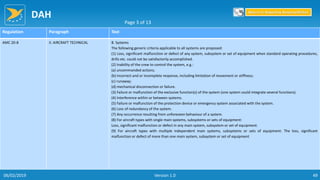
AMC 20-8 II. AIRCRAFT TECHNICAL B. Systems
The following generic criteria applicable to all systems are proposed:
(1) Loss, significant malfunction or defect of any system, subsystem or set of equipment when standard operating procedures,
drills etc. could not be satisfactorily accomplished.
(2) Inability of the crew to control the system, e.g.:
(a) uncommanded actions;
(b) incorrect and or incomplete response, including limitation of movement or stiffness;
(c) runaway;
(d) mechanical disconnection or failure.
(3) Failure or malfunction of the exclusive function(s) of the system (one system could integrate several functions).
(4) Interference within or between systems.
(5) Failure or malfunction of the protection device or emergency system associated with the system.
(6) Loss of redundancy of the system.
(7) Any occurrence resulting from unforeseen behaviour of a system.
(8) For aircraft types with single main systems, subsystems or sets of equipment:
Loss, significant malfunction or defect in any main system, subsystem or set of equipment.
(9) For aircraft types with multiple independent main systems, subsystems or sets of equipment: The loss, significant
malfunction or defect of more than one main system, subsystem or set of equipment
Page 3 of 13
Return to Reporting Responsibilities
06/02/2019 Version 1.0
DAH
50
Regulation Paragraph Text
AMC 20-8 II. AIRCRAFT TECHNICAL B. Systems
(10) Operation of any primary warning system associated with aircraft systems or equipment unless the crew conclusively
established that the indication was false provided that the false warning did not result in difficulty or hazard arising from the
crew response to the warning.
(11) Leakage of hydraulic fluids, fuel, oil or other fluids which resulted in a fire hazard or possible hazardous contamination of
aircraft structure, systems or equipment, or risk to occupants.
(12) Malfunction or defect of any indication system when this results in the possibility of misleading indications to the crew.
(13) Any failure, malfunction or defect if it occurs at a critical phase of flight and relevant to the operation of that system.
(14) Occurrences of significant shortfall of the actual performances compared to the approved performance which resulted in a
hazardous situation (taking into account the accuracy of the performance calculation method) including braking action, fuel
consumption etc.
(15) Asymmetry of flight controls; e.g. flaps, slats, spoilers etc.
Annex 1 to this AMC gives a list of examples of reportable occurrences resulting from the application of these generic criteria
to specific systems
Page 4 of 13
Return to Reporting Responsibilities
06/02/2019 Version 1.0
DAH
51
Regulation Paragraph Text
AMC 20-8 II. AIRCRAFT TECHNICAL C. Propulsion (including Engines, Propellers and Rotor Systems) and APUs
(1) Flameout, shutdown or malfunction of any engine.
(2) Overspeed or inability to control the speed of any high speed rotating component (for example: Auxiliary power unit, air
starter, air cycle machine, air turbine motor, propeller or rotor).
(3) Failure or malfunction of any part of an engine or powerplant resulting in any one or more of the following:
(a) non containment of components/debris;
(b) uncontrolled internal or external fire, or hot gas breakout;
(c) thrust in a different direction from that demanded by the pilot;
(d) thrust reversing system failing to operate or operating inadvertently;
(e) inability to control power, thrust or rpm;
(f) failure of the engine mount structure;
(g) partial or complete loss of a major part of the powerplant;
(h) Dense visible fumes or concentrations of toxic products sufficient to incapacitate crew or passengers;
(i) inability, by use of normal procedures, to shutdown an engine;
(j) inability to restart a serviceable engine.
Page 5 of 13
Return to Reporting Responsibilities
06/02/2019 Version 1.0
DAH
52
Regulation Paragraph Text
AMC 20-8 II. AIRCRAFT TECHNICAL C. Propulsion (including Engines, Propellers and Rotor Systems) and APUs
(4) An uncommanded thrust/power loss , change or oscillation which is classified as a loss of thrust or power control (LOTC) as
defined in AMC 20-1:
(a) for a single engine aircraft; or
(b) where it is considered excessive for the application, or
(c) where this could affect more than one engine in a multi-engine aircraft, particularly in the case of a twin engine aircraft; or
(d) for a multi engine aircraft where the same, or similar, engine type is used in an application where the event would be
considered hazardous or critical.
(5) Any defect in a life controlled part causing retirement before completion of its full life.
(6) Defects of common origin which could cause an in flight shut down rate so high that there is the possibility of more than
one engine being shut down on the same flight.
(7) An engine limiter or control device failing to operate when required or operating inadvertently.
(8) exceedance of engine parameters.
(9) FOD resulting in damage.
Page 6 of 13
Return to Reporting Responsibilities
06/02/2019 Version 1.0
DAH
53
Regulation Paragraph Text
AMC 20-8 II. AIRCRAFT TECHNICAL C. Propulsion (including Engines, Propellers and Rotor Systems) and APUs
Propellers and -transmission
(10) Failure or malfunction of any part of a propeller or powerplant resulting in any
one or more of the following:
(a) an overspeed of the propeller;
(b) the development of excessive drag;
(c) a thrust in the opposite direction to that commanded by the pilot;
(d) a release of the propeller or any major portion of the propeller;
(e) a failure that results in excessive unbalance;
(f) the unintended movement of the propeller blades below the established minimum in-flight low-pitch position;
(g) an inability to feather the propeller;
(h) an inability to command a change in propeller pitch;
(i) an uncommanded change in pitch;
(j) an uncontrollable torque or speed fluctuation;
(k) The release of low energy parts.
Rotors and -transmission
(11) Damage or defect of main rotor gearbox / attachment which could lead to in flight separation of the rotor assembly, and
/or malfunctions of the rotor control.
(12) Damage to tail rotor, transmission and equivalent systems.
Page 7 of 13
Return to Reporting Responsibilities
06/02/2019 Version 1.0
DAH
54
Regulation Paragraph Text
AMC 20-8 II. AIRCRAFT TECHNICAL C. Propulsion (including Engines, Propellers and Rotor Systems) and APUs
APUs
(13) Shut down or failure when the APU is required to be available by operational requirements, e.g. ETOPS, MEL.
(14) Inability to shut down the APU.
(15) Overspeed.
(16) Inability to start the APU when needed for operational reasons.
D. Human Factors
(1) Any incident where any feature or inadequacy of the aircraft design could have led to an error of use that could contribute
to a hazardous or catastrophic effect.
E. Other Occurrences
(1) Any incident where any feature or inadequacy of the aircraft design could have led to an error of use that could contribute
to a hazardous or catastrophic effect.
(2) An occurrence not normally considered as reportable (for example, furnishing and cabin equipment, water systems), where
the circumstances resulted in endangering of the aircraft or its occupants.
(3) A fire, explosion, smoke or toxic or noxious fumes.
(4) Any other event which could hazard the aircraft, or affect the safety of the occupants of the aircraft, or people or property
in the vicinity of the aircraft or on the ground.
(5) Failure or defect of passenger address system resulting in loss or inaudible passenger address system.
(6) Loss of pilots seat control during flight.
Page 8 of 13
Return to Reporting Responsibilities
06/02/2019 Version 1.0
DAH
55
Regulation Paragraph Text
AMC 20-8 Annex 1 to AMC 20-8 Reportable occurrences to specific systems
The following subparagraphs give examples of reportable occurrences resulting from the application of the generic criteria to
specific systems listed in paragraph 10.g. II.B of this AMC.
1. Air conditioning/ventilation
(a) complete loss of avionics cooling
(b) depressurisation
2. Autoflight system
(a) failure of the autoflight system to achieve the intended operation while engaged
(b) significant reported crew difficulty to control the aircraft linked to autoflight system functioning
(c) failure of any autoflight system disconnect device
(d) Uncommanded autoflight mode change
3. Communications
(a) failure or defect of passenger address system resulting in loss or inaudible passenger address
(b) total loss of communication in flight
4. Electrical system
(a) loss of one electrical system distribution system ( AC or DC)
(b) total loss or loss or more than one electrical generation system
(c) failure of the back up ( emergency ) electrical generating system
Page 9 of 13
Return to Reporting Responsibilities
06/02/2019 Version 1.0
DAH
56
Regulation Paragraph Text
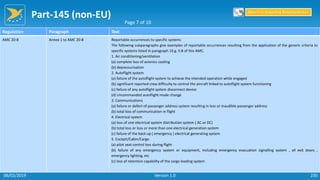
AMC 20-8 Annex 1 to AMC 20-8 5. Cockpit/Cabin/Cargo
(a) pilot seat control loss during flight
(b) failure of any emergency system or equipment, including emergency evacuation signalling system , all exit doors ,
emergency lighting, etc
(c) loss of retention capability of the cargo loading system
6. Fire protection system
(a) fire warnings, except those immediately confirmed as false
(b) undetected failure or defect of fire/smoke detection/protection system, which could lead to loss or reduced fire
detection/protection
(c) absence of warning in case of actual fire or smoke
7. Flight controls
(a) Asymmetry of flaps, slats, spoilers etc.
(b) limitation of movement, stiffness or poor or delayed response in the operation of primary flight control systems or their
associated tab and lock systems
(c) flight control surface run away
(d) flight control surface vibration felt by the crew
(e) mechanical flight control disconnection or failure
(f) significant interference with normal control of the aircraft or degradation of flying qualities
Page 10 of 13
Return to Reporting Responsibilities
06/02/2019 Version 1.0
DAH
57
Regulation Paragraph Text
AMC 20-8 Annex 1 to AMC 20-8 8. Fuel system
(a) fuel quantity indicating system malfunction resulting in total loss or erroneous indicated fuel quantity on board
(b) leakage of fuel which resulted in major loss, fire hazard , significant contamination
(c) malfunction or defects of the fuel jettisoning system which resulted in inadvertent loss of significant quantity, fire hazard,
hazardous contamination of aircraft equipment or inability to jettison fuel
(d) fuel system malfunctions or defects which had a significant effect on fuel supply and/or distribution
(e) inability to transfer or use total quantity of usable fuel
9. Hydraulics
(a) loss of one hydraulic system ( ETOPS only)
(b) failure of the isolation system to operate
(c) loss of more than one hydraulic circuits
(d) failure of the back up hydraulic system
(e) inadvertent Ram Air Turbine extension
10. Ice detection/protection system
(a) undetected loss or reduced performance of the anti-ice/de-ice system
(b) loss of more than one of the probe heating systems
(c) inability to obtain symmetrical wing de icing
(d) abnormal ice accumulation leading to significant effects on performance or handling qualities
(e) crew vision significantly affected
Page 11 of 13
Return to Reporting Responsibilities
06/02/2019 Version 1.0
DAH
58
Regulation Paragraph Text
AMC 20-8 Annex 1 to AMC 20-8 11. Indicating/warning/recording systems
(a) malfunction or defect of any indicating system when the possibility of significant misleading indications to the crew could
result in an inappropriate crew action on an essential system
(b) loss of a red warning function on a system
(c) for glass cockpits: loss or malfunction of more than one display unit or computer involved in the display/warning function
12. Landing gear system /brakes/tyres
(a) brake fire
(b) significant loss of braking action
(c) unsymmetrical braking leading to significant path deviation
(d) failure of the L/G free fall extension system ( including during scheduled tests)
(e) unwanted gear or gear doors extension/retraction
(f) multiple tyres burst
Page 12 of 13
Return to Reporting Responsibilities
06/02/2019 Version 1.0
DAH
59
Regulation Paragraph Text
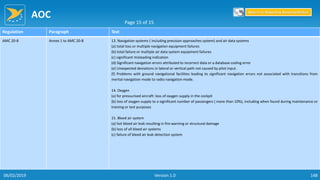
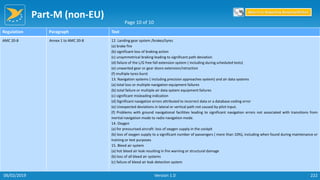
AMC 20-8 Annex 1 to AMC 20-8 13. Navigation systems ( including precision approaches system) and air data systems
(a) total loss or multiple navigation equipment failures
(b) total failure or multiple air data system equipment failures
(c) significant misleading indication
(d) Significant navigation errors attributed to incorrect data or a database coding error
(e) Unexpected deviations in lateral or vertical path not caused by pilot input.
(f) Problems with ground navigational facilities leading to significant navigation errors not associated with transitions from
inertial navigation mode to radio navigation mode.
14. Oxygen
(a) for pressurised aircraft: loss of oxygen supply in the cockpit
(b) loss of oxygen supply to a significant number of passengers ( more than 10%), including when found during maintenance or
training or test purposes
15. Bleed air system
(a) hot bleed air leak resulting in fire warning or structural damage
(b) loss of all bleed air systems
(c) failure of bleed air leak detection system
Page 13 of 13
Return to Reporting Responsibilities
06/02/2019 Version 1.0
POA (Single European)
60
Regulation Paragraph Text
Regulation
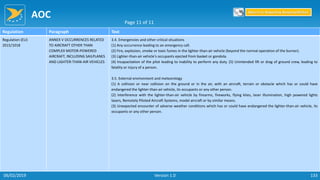
(EU) 748/2012
21.A.129 (f) Obligations of the
manufacturer
Each manufacturer of a product, part or appliance being manufactured under this Subpart shall:
1. report to the holder of the type-certificate, restricted type-certificate or design approval, all cases where products, parts or
appliances have been released by the manufacturer and subsequently identified to have deviations from the applicable design
data, and investigate with the holder of the type-certificate, restricted type-certificate or design approval to identify those
deviations which could lead to an unsafe condition;
2. report to the Agency and the competent authority of the Member State the deviations which could lead to an unsafe
condition identified according to point (1). Such reports shall be made in a form and manner established by the Agency under
point 21.A.3A(b)(2) or accepted by the competent authority of the Member State;
3. where the manufacturer acts as supplier to another production organisation, report also to that other organisation all cases
where it has released products, parts or appliances to that organisation and subsequently identified them to have possible
deviations from the applicable design data.
Page 1 of 2
Return to Reporting Responsibilities
06/02/2019 Version 1.0
POA (Single European)
61
Regulation Paragraph Text
Regulation
(EU) 748/2012
21.A.165 (f) Obligations of the
holder
The holder of a production organisation approval shall:
1. report to the holder of the type-certificate or design approval, all cases where products, parts or appliances have been
released by the production organisation and subsequently identified to have possible deviations from the applicable design
data, and investigate with the holder of the type-certificate or design approval in order to identify those deviations which could
lead to an unsafe condition;
2. report to the Agency and the competent authority of the Member State the deviations which could lead to an unsafe
condition identified according to point (1). Such reports shall be made in a form and manner established by the Agency under
point 21.A.3A(b)(2) or accepted by the competent authority of the Member State;
3. where the holder of the production organisation approval is acting as a supplier to another production organisation, report
also to that other organisation all cases where it has released products, parts or appliances to that organisation and
subsequently identified them to have possible deviations from the applicable design data.
Page 2 of 2
Return to Reporting Responsibilities
06/02/2019 Version 1.0
POA (Single European)
62
Regulation Paragraph Text
Regulation (EU)
376/2014
Article 4 Mandatory reporting 1. Occurrences which may represent a significant risk to aviation safety and which fall into the following categories shall be
reported by the persons listed in paragraph 6 through the mandatory occurrence reporting systems pursuant to this Article:
(b) occurrences related to technical conditions, maintenance and repair of aircraft, such as:
(i) structural defects;
(ii) system malfunctions;
(iii) maintenance and repair problems;
(iv) propulsion problems (including engines, propellers and rotor systems) and auxiliary power unit problems.
8. Following notification of an occurrence, any organisation established in a Member State which is not covered by paragraph 9
shall report to the competent authority of that Member State, as referred to in Article 6(3), the details of occurrences collected
in accordance with paragraph 2 of this Article as soon as possible, and in any event no later than 72 hours after becoming
aware of the occurrence.
9. Following notification of an occurrence, each organisation established in a Member State which is certified or approved by
the Agency shall report to the Agency the details of occurrences collected in accordance with paragraph 2 as soon as possible,
and in any event no later than 72 hours after becoming aware of the occurrence.
Page 1 of 2
Return to Reporting Responsibilities
06/02/2019 Version 1.0
POA (Single European)
63
Regulation Paragraph Text
Regulation (EU)
376/2014
Article 5 Voluntary reporting 1. Each organisation established in a Member State shall establish a voluntary reporting system to facilitate the collection of:
(a) details of occurrences that may not be captured by the mandatory reporting system;
(b) other safety-related information which is perceived by the reporter as an actual or potential hazard to aviation safety.
5. Each organisation established in a Member State and certified or approved by the Agency shall report to the Agency, in a
timely manner, details of occurrences and safety-related information which have been collected pursuant to paragraph 1 and
which may involve an actual or potential aviation safety risk.
6. Each organisation established in a Member State that is not certified or approved by the Agency shall, in a timely manner,
report to the competent authority of that Member State, as designated pursuant to Article 6(3), the details of occurrences and
other safety-related information which have been collected pursuant to paragraph 1 of this Article and which may involve an
actual or potential aviation safety risk. Member States may require any organisation established in their territory to report the
details of all occurrences collected pursuant to paragraph 1 of this Article.
Page 2 of 2
Return to Reporting Responsibilities
06/02/2019 Version 1.0
POA (Single European)
64
Regulation Paragraph Text
Regulation (EU)
2015/1018
Article 1 The detailed classification of the occurrences to be referred to when reporting, through mandatory reporting systems,
occurrences pursuant to Article 4(1) of Regulation (EU) No 376/2014 is set out in Annexes I to V to this Regulation.
Regulation (EU)
2015/1018
Annex II OCCURRENCES RELATED
TO TECHNICAL CONDITIONS,
MAINTENANCE AND REPAIR OF
THE AIRCRAFT
1. MANUFACTURING
Products, parts or appliances released from the production organisation with deviations from applicable design data that could
lead to a potential unsafe condition as identified with the holder of the type-certificate or design approval.
Page 1 of 1
Return to Reporting Responsibilities
06/02/2019 Version 1.0
POA (Single European)
65
Regulation Paragraph Text
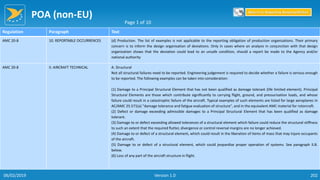
AMC 20-8 10. REPORTABLE OCCURRENCES (d) Production. The list of examples is not applicable to the reporting obligation of production organisations. Their primary
concern is to inform the design organisation of deviations. Only in cases where an analysis in conjunction with that design
organisation shows that the deviation could lead to an unsafe condition, should a report be made to the Agency and/or
national authority
AMC 20-8 II. AIRCRAFT TECHNICAL A. Structural
Not all structural failures need to be reported. Engineering judgement is required to decide whether a failure is serious enough
to be reported. The following examples can be taken into consideration:
(1) Damage to a Principal Structural Element that has not been qualified as damage tolerant (life limited element). Principal
Structural Elements are those which contribute significantly to carrying flight, ground, and pressurisation loads, and whose
failure could result in a catastrophic failure of the aircraft. Typical examples of such elements are listed for large aeroplanes in
AC/AMC 25.571(a) "damage tolerance and fatigue evaluation of structure", and in the equivalent AMC material for rotorcraft.
(2) Defect or damage exceeding admissible damages to a Principal Structural Element that has been qualified as damage
tolerant.
(3) Damage to or defect exceeding allowed tolerances of a structural element which failure could reduce the structural stiffness
to such an extent that the required flutter, divergence or control reversal margins are no longer achieved.
(4) Damage to or defect of a structural element, which could result in the liberation of items of mass that may injure occupants
of the aircraft.
(5) Damage to or defect of a structural element, which could jeopardise proper operation of systems. See paragraph II.B.
below.
(6) Loss of any part of the aircraft structure in flight.
Page 1 of 12
Return to Reporting Responsibilities
06/02/2019 Version 1.0
POA (Single European)
66
Regulation Paragraph Text
AMC 20-8 II. AIRCRAFT TECHNICAL B. Systems
The following generic criteria applicable to all systems are proposed:
(1) Loss, significant malfunction or defect of any system, subsystem or set of equipment when standard operating procedures,
drills etc. could not be satisfactorily accomplished.
(2) Inability of the crew to control the system, e.g.:
(a) uncommanded actions;
(b) incorrect and or incomplete response, including limitation of movement or stiffness;
(c) runaway;
(d) mechanical disconnection or failure.
(3) Failure or malfunction of the exclusive function(s) of the system (one system could integrate several functions).
(4) Interference within or between systems.
(5) Failure or malfunction of the protection device or emergency system associated with the system.
(6) Loss of redundancy of the system.
(7) Any occurrence resulting from unforeseen behaviour of a system.
(8) For aircraft types with single main systems, subsystems or sets of equipment:
Loss, significant malfunction or defect in any main system, subsystem or set of equipment.
(9) For aircraft types with multiple independent main systems, subsystems or sets of equipment: The loss, significant
malfunction or defect of more than one main system, subsystem or set of equipment
Page 2 of 12
Return to Reporting Responsibilities
06/02/2019 Version 1.0
POA (Single European)
67
Regulation Paragraph Text
AMC 20-8 II. AIRCRAFT TECHNICAL B. Systems
The following generic criteria applicable to all systems are proposed:
(10) Operation of any primary warning system associated with aircraft systems or equipment unless the crew conclusively
established that the indication was false provided that the false warning did not result in difficulty or hazard arising from the
crew response to the warning.
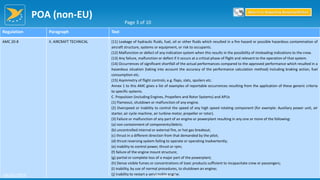
(11) Leakage of hydraulic fluids, fuel, oil or other fluids which resulted in a fire hazard or possible hazardous contamination of
aircraft structure, systems or equipment, or risk to occupants.
(12) Malfunction or defect of any indication system when this results in the possibility of misleading indications to the crew.
(13) Any failure, malfunction or defect if it occurs at a critical phase of flight and relevant to the operation of that system.
(14) Occurrences of significant shortfall of the actual performances compared to the approved performance which resulted in a
hazardous situation (taking into account the accuracy of the performance calculation method) including braking action, fuel
consumption etc.
(15) Asymmetry of flight controls; e.g. flaps, slats, spoilers etc.
Annex 1 to this AMC gives a list of examples of reportable occurrences resulting from the application of these generic criteria
to specific systems
Page 3 of 12
Return to Reporting Responsibilities
06/02/2019 Version 1.0
POA (Single European)
68
Regulation Paragraph Text
AMC 20-8 II. AIRCRAFT TECHNICAL C. Propulsion (including Engines, Propellers and Rotor Systems) and APUs
(1) Flameout, shutdown or malfunction of any engine.
(2) Overspeed or inability to control the speed of any high speed rotating component (for example: Auxiliary power unit, air
starter, air cycle machine, air turbine motor, propeller or rotor).
(3) Failure or malfunction of any part of an engine or powerplant resulting in any one or more of the following:
(a) non containment of components/debris;
(b) uncontrolled internal or external fire, or hot gas breakout;
(c) thrust in a different direction from that demanded by the pilot;
(d) thrust reversing system failing to operate or operating inadvertently;
(e) inability to control power, thrust or rpm;
(f) failure of the engine mount structure;
(g) partial or complete loss of a major part of the powerplant;
(h) Dense visible fumes or concentrations of toxic products sufficient to incapacitate crew or passengers;
(i) inability, by use of normal procedures, to shutdown an engine;
(j) inability to restart a serviceable engine.
Page 4 of 12
Return to Reporting Responsibilities
06/02/2019 Version 1.0
POA (Single European)
69
Regulation Paragraph Text
AMC 20-8 II. AIRCRAFT TECHNICAL C. Propulsion (including Engines, Propellers and Rotor Systems) and APUs
(4) An uncommanded thrust/power loss , change or oscillation which is classified as a loss of thrust or power control (LOTC) as
defined in AMC 20-1:
(a) for a single engine aircraft; or
(b) where it is considered excessive for the application, or
(c) where this could affect more than one engine in a multi-engine aircraft, particularly in the case of a twin engine aircraft; or
(d) for a multi engine aircraft where the same, or similar, engine type is used in an application where the event would be
considered hazardous or critical.
(5) Any defect in a life controlled part causing retirement before completion of its full life.
(6) Defects of common origin which could cause an in flight shut down rate so high that there is the possibility of more than
one engine being shut down on the same flight.
(7) An engine limiter or control device failing to operate when required or operating inadvertently.
(8) exceedance of engine parameters.
(9) FOD resulting in damage.
Page 5 of 12
Return to Reporting Responsibilities
06/02/2019 Version 1.0
POA (Single European)
70
Regulation Paragraph Text
AMC 20-8 II. AIRCRAFT TECHNICAL C. Propulsion (including Engines, Propellers and Rotor Systems) and APUs
Propellers and -transmission
(10) Failure or malfunction of any part of a propeller or powerplant resulting in any
one or more of the following:
(a) an overspeed of the propeller;
(b) the development of excessive drag;
(c) a thrust in the opposite direction to that commanded by the pilot;
(d) a release of the propeller or any major portion of the propeller;
(e) a failure that results in excessive unbalance;
(f) the unintended movement of the propeller blades below the established minimum in-flight low-pitch position;
(g) an inability to feather the propeller;
(h) an inability to command a change in propeller pitch;
(i) an uncommanded change in pitch;
(j) an uncontrollable torque or speed fluctuation;
(k) The release of low energy parts.
Rotors and -transmission
(11) Damage or defect of main rotor gearbox / attachment which could lead to in flight separation of the rotor assembly, and
/or malfunctions of the rotor control.
(12) Damage to tail rotor, transmission and equivalent systems.
Page 6 of 12
Return to Reporting Responsibilities
06/02/2019 Version 1.0
POA (Single European)
71
Regulation Paragraph Text
AMC 20-8 II. AIRCRAFT TECHNICAL C. Propulsion (including Engines, Propellers and Rotor Systems) and APUs
APUs
(13) Shut down or failure when the APU is required to be available by operational requirements, e.g. ETOPS, MEL.
(14) Inability to shut down the APU.
(15) Overspeed.
(16) Inability to start the APU when needed for operational reasons.
D. Human Factors
(1) Any incident where any feature or inadequacy of the aircraft design could have led to an error of use that could contribute
to a hazardous or catastrophic effect.
E. Other Occurrences
(1) Any incident where any feature or inadequacy of the aircraft design could have led to an error of use that could contribute
to a hazardous or catastrophic effect.
(2) An occurrence not normally considered as reportable (for example, furnishing and cabin equipment, water systems), where
the circumstances resulted in endangering of the aircraft or its occupants.
(3) A fire, explosion, smoke or toxic or noxious fumes.
(4) Any other event which could hazard the aircraft, or affect the safety of the occupants of the aircraft, or people or property
in the vicinity of the aircraft or on the ground.
(5) Failure or defect of passenger address system resulting in loss or inaudible passenger address system.
(6) Loss of pilots seat control during flight.
Page 7 of 12
Return to Reporting Responsibilities
06/02/2019 Version 1.0
POA (Single European)
72
Regulation Paragraph Text
AMC 20-8 Annex 1 to AMC 20-8 Reportable occurrences to specific systems
The following subparagraphs give examples of reportable occurrences resulting from the application of the generic criteria to
specific systems listed in paragraph 10.g. II.B of this AMC.
1. Air conditioning/ventilation
(a) complete loss of avionics cooling
(b) depressurisation
2. Autoflight system
(a) failure of the autoflight system to achieve the intended operation while engaged
(b) significant reported crew difficulty to control the aircraft linked to autoflight system functioning
(c) failure of any autoflight system disconnect device
(d) Uncommanded autoflight mode change
3. Communications
(a) failure or defect of passenger address system resulting in loss or inaudible passenger address
(b) total loss of communication in flight
4. Electrical system
(a) loss of one electrical system distribution system ( AC or DC)
(b) total loss or loss or more than one electrical generation system
(c) failure of the back up ( emergency ) electrical generating system
Page 8 of 12
Return to Reporting Responsibilities
06/02/2019 Version 1.0
POA (Single European)
73
Regulation Paragraph Text
AMC 20-8 Annex 1 to AMC 20-8 5. Cockpit/Cabin/Cargo
(a) pilot seat control loss during flight
(b) failure of any emergency system or equipment, including emergency evacuation signalling system , all exit doors ,
emergency lighting, etc
(c) loss of retention capability of the cargo loading system
6. Fire protection system
(a) fire warnings, except those immediately confirmed as false
(b) undetected failure or defect of fire/smoke detection/protection system, which could lead to loss or reduced fire
detection/protection
(c) absence of warning in case of actual fire or smoke
7. Flight controls
(a) Asymmetry of flaps, slats, spoilers etc.
(b) limitation of movement, stiffness or poor or delayed response in the operation of primary flight control systems or their
associated tab and lock systems
(c) flight control surface run away
(d) flight control surface vibration felt by the crew
(e) mechanical flight control disconnection or failure
(f) significant interference with normal control of the aircraft or degradation of flying qualities
Page 9 of 12
Return to Reporting Responsibilities
06/02/2019 Version 1.0
POA (Single European)
74
Regulation Paragraph Text
AMC 20-8 Annex 1 to AMC 20-8 8. Fuel system
(a) fuel quantity indicating system malfunction resulting in total loss or erroneous indicated fuel quantity on board
(b) leakage of fuel which resulted in major loss, fire hazard , significant contamination
(c) malfunction or defects of the fuel jettisoning system which resulted in inadvertent loss of significant quantity, fire hazard,
hazardous contamination of aircraft equipment or inability to jettison fuel
(d) fuel system malfunctions or defects which had a significant effect on fuel supply and/or distribution
(e) inability to transfer or use total quantity of usable fuel
9. Hydraulics
(a) loss of one hydraulic system ( ETOPS only)
(b) failure of the isolation system to operate
(c) loss of more than one hydraulic circuits
(d) failure of the back up hydraulic system
(e) inadvertent Ram Air Turbine extension
10. Ice detection/protection system
(a) undetected loss or reduced performance of the anti-ice/de-ice system
(b) loss of more than one of the probe heating systems
(c) inability to obtain symmetrical wing de icing
(d) abnormal ice accumulation leading to significant effects on performance or handling qualities
(e) crew vision significantly affected
Page 10 of 12
Return to Reporting Responsibilities
06/02/2019 Version 1.0
POA (Single European)
75
Regulation Paragraph Text
AMC 20-8 Annex 1 to AMC 20-8 11. Indicating/warning/recording systems
(a) malfunction or defect of any indicating system when the possibility of significant misleading indications to the crew could
result in an inappropriate crew action on an essential system
(b) loss of a red warning function on a system
(c) for glass cockpits: loss or malfunction of more than one display unit or computer involved in the display/warning function
12. Landing gear system /brakes/tyres
(a) brake fire
(b) significant loss of braking action
(c) unsymmetrical braking leading to significant path deviation
(d) failure of the L/G free fall extension system ( including during scheduled tests)
(e) unwanted gear or gear doors extension/retraction
(f) multiple tyres burst
13. Navigation systems ( including precision approaches system) and air data systems
(a) total loss or multiple navigation equipment failures
(b) total failure or multiple air data system equipment failures
(c) significant misleading indication
(d) Significant navigation errors attributed to incorrect data or a database coding error
(e) Unexpected deviations in lateral or vertical path not caused by pilot input.
(f) Problems with ground navigational facilities leading to significant navigation errors not associated with transitions from
inertial navigation mode to radio navigation mode.
Page 11 of 12
Return to Reporting Responsibilities
06/02/2019 Version 1.0
POA (Single European)
76
Regulation Paragraph Text
AMC 20-8 Annex 1 to AMC 20-8 14. Oxygen
(a) for pressurised aircraft: loss of oxygen supply in the cockpit
(b) loss of oxygen supply to a significant number of passengers ( more than 10%), including when found during maintenance or
training or test purposes
15. Bleed air system
(a) hot bleed air leak resulting in fire warning or structural damage
(b) loss of all bleed air systems
(c) failure of bleed air leak detection system
Page 12 of 12
Return to Reporting Responsibilities
06/02/2019 Version 1.0
POA
77
Regulation Paragraph Text
Regulation
(EU) 748/2012
21.A.129 (f) Obligations of the
manufacturer
Each manufacturer of a product, part or appliance being manufactured under this Subpart shall:
1. report to the holder of the type-certificate, restricted type-certificate or design approval, all cases where products, parts or
appliances have been released by the manufacturer and subsequently identified to have deviations from the applicable design
data, and investigate with the holder of the type-certificate, restricted type-certificate or design approval to identify those
deviations which could lead to an unsafe condition;
2. report to the Agency and the competent authority of the Member State the deviations which could lead to an unsafe
condition identified according to point (1). Such reports shall be made in a form and manner established by the Agency under
point 21.A.3A(b)(2) or accepted by the competent authority of the Member State;
3. where the manufacturer acts as supplier to another production organisation, report also to that other organisation all cases
where it has released products, parts or appliances to that organisation and subsequently identified them to have possible
deviations from the applicable design data.
Regulation
(EU) 748/2012
21.A.165 (f) Obligations of the
holder
The holder of a production organisation approval shall:
1. report to the holder of the type-certificate or design approval, all cases where products, parts or appliances have been
released by the production organisation and subsequently identified to have possible deviations from the applicable design
data, and investigate with the holder of the type-certificate or design approval in order to identify those deviations which could
lead to an unsafe condition;
2. report to the Agency and the competent authority of the Member State the deviations which could lead to an unsafe
condition identified according to point (1). Such reports shall be made in a form and manner established by the Agency under
point 21.A.3A(b)(2) or accepted by the competent authority of the Member State;
3. where the holder of the production organisation approval is acting as a supplier to another production organisation, report
also to that other organisation all cases where it has released products, parts or appliances to that organisation and
subsequently identified them to have possible deviations from the applicable design data.
Page 1 of 1
Return to Reporting Responsibilities
06/02/2019 Version 1.0
POA
78
Regulation Paragraph Text
Regulation (EU)
376/2014
Article 4 Mandatory reporting 1. Occurrences which may represent a significant risk to aviation safety and which fall into the following categories shall be
reported by the persons listed in paragraph 6 through the mandatory occurrence reporting systems pursuant to this Article:
(b) occurrences related to technical conditions, maintenance and repair of aircraft, such as:
(i) structural defects;
(ii) system malfunctions;
(iii) maintenance and repair problems;
(iv) propulsion problems (including engines, propellers and rotor systems) and auxiliary power unit problems.
8. Following notification of an occurrence, any organisation established in a Member State which is not covered by paragraph 9
shall report to the competent authority of that Member State, as referred to in Article 6(3), the details of occurrences collected
in accordance with paragraph 2 of this Article as soon as possible, and in any event no later than 72 hours after becoming
aware of the occurrence.
9. Following notification of an occurrence, each organisation established in a Member State which is certified or approved by
the Agency shall report to the Agency the details of occurrences collected in accordance with paragraph 2 as soon as possible,
and in any event no later than 72 hours after becoming aware of the occurrence.
Regulation (EU)
376/2014
Article 5 Voluntary reporting 1. Each organisation established in a Member State shall establish a voluntary reporting system to facilitate the collection of:
(a) details of occurrences that may not be captured by the mandatory reporting system;
(b) other safety-related information which is perceived by the reporter as an actual or potential hazard to aviation safety.
5. Each organisation established in a Member State and certified or approved by the Agency shall report to the Agency, in a
timely manner, details of occurrences and safety-related information which have been collected pursuant to paragraph 1 and
which may involve an actual or potential aviation safety risk.
6. Each organisation established in a Member State that is not certified or approved by the Agency shall, in a timely manner,
report to the competent authority of that Member State, as designated pursuant to Article 6(3), the details of occurrences and
other safety-related information which have been collected pursuant to paragraph 1 of this Article and which may involve an
actual or potential aviation safety risk. Member States may require any organisation established in their territory to report the
details of all occurrences collected pursuant to paragraph 1 of this Article.
Page 1 of 1
Return to Reporting Responsibilities
06/02/2019 Version 1.0
POA
79
Regulation Paragraph Text
Regulation (EU)
2015/1018
Article 1 The detailed classification of the occurrences to be referred to when reporting, through mandatory reporting systems,
occurrences pursuant to Article 4(1) of Regulation (EU) No 376/2014 is set out in Annexes I to V to this Regulation.
Regulation (EU)
2015/1018
Annex II OCCURRENCES RELATED
TO TECHNICAL CONDITIONS,
MAINTENANCE AND REPAIR OF
THE AIRCRAFT
1. MANUFACTURING
Products, parts or appliances released from the production organisation with deviations from applicable design data that could
lead to a potential unsafe condition as identified with the holder of the type-certificate or design approval.
Page 1 of 1
Return to Reporting Responsibilities
06/02/2019 Version 1.0
POA
80
Regulation Paragraph Text
AMC 20-8 10. REPORTABLE OCCURRENCES (d) Production. The list of examples is not applicable to the reporting obligation of production organisations. Their primary
concern is to inform the design organisation of deviations. Only in cases where an analysis in conjunction with that design
organisation shows that the deviation could lead to an unsafe condition, should a report be made to the Agency and/or
national authority
AMC 20-8 II. AIRCRAFT TECHNICAL A. Structural
Not all structural failures need to be reported. Engineering judgement is required to decide whether a failure is serious enough
to be reported. The following examples can be taken into consideration:
(1) Damage to a Principal Structural Element that has not been qualified as damage tolerant (life limited element). Principal
Structural Elements are those which contribute significantly to carrying flight, ground, and pressurisation loads, and whose
failure could result in a catastrophic failure of the aircraft. Typical examples of such elements are listed for large aeroplanes in
AC/AMC 25.571(a) "damage tolerance and fatigue evaluation of structure", and in the equivalent AMC material for rotorcraft.
(2) Defect or damage exceeding admissible damages to a Principal Structural Element that has been qualified as damage
tolerant.
(3) Damage to or defect exceeding allowed tolerances of a structural element which failure could reduce the structural stiffness
to such an extent that the required flutter, divergence or control reversal margins are no longer achieved.
(4) Damage to or defect of a structural element, which could result in the liberation of items of mass that may injure occupants
of the aircraft.
(5) Damage to or defect of a structural element, which could jeopardise proper operation of systems. See paragraph II.B.
below.
(6) Loss of any part of the aircraft structure in flight.
Page 1 of 10
Return to Reporting Responsibilities
06/02/2019 Version 1.0
POA
81
Regulation Paragraph Text
AMC 20-8 II. AIRCRAFT TECHNICAL B. Systems
The following generic criteria applicable to all systems are proposed:
(1) Loss, significant malfunction or defect of any system, subsystem or set of equipment when standard operating procedures,
drills etc. could not be satisfactorily accomplished.
(2) Inability of the crew to control the system, e.g.:
(a) uncommanded actions;
(b) incorrect and or incomplete response, including limitation of movement or stiffness;
(c) runaway;
(d) mechanical disconnection or failure.
(3) Failure or malfunction of the exclusive function(s) of the system (one system could integrate several functions).
(4) Interference within or between systems.
(5) Failure or malfunction of the protection device or emergency system associated with the system.
(6) Loss of redundancy of the system.
(7) Any occurrence resulting from unforeseen behaviour of a system.
(8) For aircraft types with single main systems, subsystems or sets of equipment:
Loss, significant malfunction or defect in any main system, subsystem or set of equipment.
(9) For aircraft types with multiple independent main systems, subsystems or sets of equipment: The loss, significant
malfunction or defect of more than one main system, subsystem or set of equipment
(10) Operation of any primary warning system associated with aircraft systems or equipment unless the crew conclusively
established that the indication was false provided that the false warning did not result in difficulty or hazard arising from the
crew response to the warning.
Page 2 of 10
Return to Reporting Responsibilities
06/02/2019 Version 1.0
POA
82
Regulation Paragraph Text
AMC 20-8 II. AIRCRAFT TECHNICAL (11) Leakage of hydraulic fluids, fuel, oil or other fluids which resulted in a fire hazard or possible hazardous contamination of
aircraft structure, systems or equipment, or risk to occupants.
(12) Malfunction or defect of any indication system when this results in the possibility of misleading indications to the crew.
(13) Any failure, malfunction or defect if it occurs at a critical phase of flight and relevant to the operation of that system.
(14) Occurrences of significant shortfall of the actual performances compared to the approved performance which resulted in a
hazardous situation (taking into account the accuracy of the performance calculation method) including braking action, fuel
consumption etc.
(15) Asymmetry of flight controls; e.g. flaps, slats, spoilers etc.
Annex 1 to this AMC gives a list of examples of reportable occurrences resulting from the application of these generic criteria
to specific systems.
C. Propulsion (including Engines, Propellers and Rotor Systems) and APUs
(1) Flameout, shutdown or malfunction of any engine.
(2) Overspeed or inability to control the speed of any high speed rotating component (for example: Auxiliary power unit, air
starter, air cycle machine, air turbine motor, propeller or rotor).
(3) Failure or malfunction of any part of an engine or powerplant resulting in any one or more of the following:
(a) non containment of components/debris;
(b) uncontrolled internal or external fire, or hot gas breakout;
(c) thrust in a different direction from that demanded by the pilot;
(d) thrust reversing system failing to operate or operating inadvertently;
(e) inability to control power, thrust or rpm;
(f) failure of the engine mount structure;
(g) partial or complete loss of a major part of the powerplant;
(h) Dense visible fumes or concentrations of toxic products sufficient to incapacitate crew or passengers;
(i) inability, by use of normal procedures, to shutdown an engine;
(j) inability to restart a serviceable engine.
Page 3 of 10
Return to Reporting Responsibilities
06/02/2019 Version 1.0
POA
83
Regulation Paragraph Text
AMC 20-8 II. AIRCRAFT TECHNICAL C. Propulsion (including Engines, Propellers and Rotor Systems) and APUs
(4) An uncommanded thrust/power loss , change or oscillation which is classified as a loss of thrust or power control (LOTC) as
defined in AMC 20-1:
(a) for a single engine aircraft; or
(b) where it is considered excessive for the application, or
(c) where this could affect more than one engine in a multi-engine aircraft, particularly in the case of a twin engine aircraft; or
(d) for a multi engine aircraft where the same, or similar, engine type is used in an application where the event would be
considered hazardous or critical.
(5) Any defect in a life controlled part causing retirement before completion of its full life.
(6) Defects of common origin which could cause an in flight shut down rate so high that there is the possibility of more than
one engine being shut down on the same flight.
(7) An engine limiter or control device failing to operate when required or operating inadvertently.
(8) exceedance of engine parameters.
(9) FOD resulting in damage.
Propellers and -transmission
(10) Failure or malfunction of any part of a propeller or powerplant resulting in any
one or more of the following:
(a) an overspeed of the propeller;
(b) the development of excessive drag;
(c) a thrust in the opposite direction to that commanded by the pilot;
(d) a release of the propeller or any major portion of the propeller;
(e) a failure that results in excessive unbalance;
(f) the unintended movement of the propeller blades below the established minimum in-flight low-pitch position;
(g) an inability to feather the propeller;
Page 4 of 10
Return to Reporting Responsibilities
06/02/2019 Version 1.0
POA
84
Regulation Paragraph Text
AMC 20-8 II. AIRCRAFT TECHNICAL C. Propulsion (including Engines, Propellers and Rotor Systems) and APUs
(j) an uncontrollable torque or speed fluctuation;
(k) The release of low energy parts.
Rotors and -transmission
(11) Damage or defect of main rotor gearbox / attachment which could lead to in flight separation of the rotor assembly, and
/or malfunctions of the rotor control.
(12) Damage to tail rotor, transmission and equivalent systems.
APUs
(13) Shut down or failure when the APU is required to be available by operational requirements, e.g. ETOPS, MEL.
(14) Inability to shut down the APU.
(15) Overspeed.
(16) Inability to start the APU when needed for operational reasons.
D. Human Factors
(1) Any incident where any feature or inadequacy of the aircraft design could have led to an error of use that could contribute
to a hazardous or catastrophic effect.
Page 5 of 10
Return to Reporting Responsibilities
06/02/2019 Version 1.0
POA
85
Regulation Paragraph Text
AMC 20-8 II. AIRCRAFT TECHNICAL E. Other Occurrences
(1) Any incident where any feature or inadequacy of the aircraft design could have led to an error of use that could contribute
to a hazardous or catastrophic effect.
(2) An occurrence not normally considered as reportable (for example, furnishing and cabin equipment, water systems), where
the circumstances resulted in endangering of the aircraft or its occupants.
(3) A fire, explosion, smoke or toxic or noxious fumes.
(4) Any other event which could hazard the aircraft, or affect the safety of the occupants of the aircraft, or people or property
in the vicinity of the aircraft or on the ground.
(5) Failure or defect of passenger address system resulting in loss or inaudible passenger address system.
(6) Loss of pilots seat control during flight.
AMC 20-8 Annex 1 to AMC 20-8 Reportable occurrences to specific systems
The following subparagraphs give examples of reportable occurrences resulting from the application of the generic criteria to
specific systems listed in paragraph 10.g. II.B of this AMC.
1. Air conditioning/ventilation
(a) complete loss of avionics cooling
(b) depressurisation
2. Autoflight system
(a) failure of the autoflight system to achieve the intended operation while engaged
(b) significant reported crew difficulty to control the aircraft linked to autoflight system functioning
(c) failure of any autoflight system disconnect device
(d) Uncommanded autoflight mode change
Page 6 of 10
Return to Reporting Responsibilities
06/02/2019 Version 1.0
POA
86
Regulation Paragraph Text
AMC 20-8 Annex 1 to AMC 20-8 3. Communications
(a) failure or defect of passenger address system resulting in loss or inaudible passenger address
(b) total loss of communication in flight
4. Electrical system
(a) loss of one electrical system distribution system ( AC or DC)
(b) total loss or loss or more than one electrical generation system
(c) failure of the back up ( emergency ) electrical generating system
5. Cockpit/Cabin/Cargo
(a) pilot seat control loss during flight
(b) failure of any emergency system or equipment, including emergency evacuation signalling system , all exit doors ,
emergency lighting, etc
(c) loss of retention capability of the cargo loading system
6. Fire protection system
(a) fire warnings, except those immediately confirmed as false
(b) undetected failure or defect of fire/smoke detection/protection system, which could lead to loss or reduced fire
detection/protection
(c) absence of warning in case of actual fire or smoke
Page 7 of 10
Return to Reporting Responsibilities
06/02/2019 Version 1.0
POA
87
Regulation Paragraph Text
AMC 20-8 Annex 1 to AMC 20-8 7. Flight controls
(a) Asymmetry of flaps, slats, spoilers etc.
(b) limitation of movement, stiffness or poor or delayed response in the operation of primary flight control systems or their
associated tab and lock systems
(c) flight control surface run away
(d) flight control surface vibration felt by the crew
(e) mechanical flight control disconnection or failure
(f) significant interference with normal control of the aircraft or degradation of flying qualities
8. Fuel system
(a) fuel quantity indicating system malfunction resulting in total loss or erroneous indicated fuel quantity on board
(b) leakage of fuel which resulted in major loss, fire hazard , significant contamination
(c) malfunction or defects of the fuel jettisoning system which resulted in inadvertent loss of significant quantity, fire hazard,
hazardous contamination of aircraft equipment or inability to jettison fuel
(d) fuel system malfunctions or defects which had a significant effect on fuel supply and/or distribution
(e) inability to transfer or use total quantity of usable fuel
9. Hydraulics
(a) loss of one hydraulic system ( ETOPS only)
(b) failure of the isolation system to operate
(c) loss of more than one hydraulic circuits
(d) failure of the back up hydraulic system
(e) inadvertent Ram Air Turbine extension
Page 8 of 10
Return to Reporting Responsibilities
06/02/2019 Version 1.0
POA
88
Regulation Paragraph Text
AMC 20-8 Annex 1 to AMC 20-8 10. Ice detection/protection system
(a) undetected loss or reduced performance of the anti-ice/de-ice system
(b) loss of more than one of the probe heating systems
(c) inability to obtain symmetrical wing de icing
(d) abnormal ice accumulation leading to significant effects on performance or handling qualities
(e) crew vision significantly affected
11. Indicating/warning/recording systems
(a) malfunction or defect of any indicating system when the possibility of significant misleading indications to the crew could
result in an inappropriate crew action on an essential system
(b) loss of a red warning function on a system
(c) for glass cockpits: loss or malfunction of more than one display unit or computer involved in the display/warning function
12. Landing gear system /brakes/tyres
(a) brake fire
(b) significant loss of braking action
(c) unsymmetrical braking leading to significant path deviation
(d) failure of the L/G free fall extension system ( including during scheduled tests)
(e) unwanted gear or gear doors extension/retraction
(f) multiple tyres burst
Page 9 of 10
Return to Reporting Responsibilities
06/02/2019 Version 1.0
POA
89
Regulation Paragraph Text
AMC 20-8 Annex 1 to AMC 20-8 13. Navigation systems ( including precision approaches system) and air data systems
(a) total loss or multiple navigation equipment failures
(b) total failure or multiple air data system equipment failures
(c) significant misleading indication
(d) Significant navigation errors attributed to incorrect data or a database coding error
(e) Unexpected deviations in lateral or vertical path not caused by pilot input.
(f) Problems with ground navigational facilities leading to significant navigation errors not associated with transitions from
inertial navigation mode to radio navigation mode.
14. Oxygen
(a) for pressurised aircraft: loss of oxygen supply in the cockpit
(b) loss of oxygen supply to a significant number of passengers ( more than 10%), including when found during maintenance or
training or test purposes
15. Bleed air system
(a) hot bleed air leak resulting in fire warning or structural damage
(b) loss of all bleed air systems
(c) failure of bleed air leak detection system
Page 10 of 10
Return to Reporting Responsibilities
06/02/2019 Version 1.0
Part-M
90
Regulation Paragraph Text
Regulation (EU)
1321/2014
M.A.202 Occurrence reporting (a) Any person or organisation responsible in accordance with point M.A.201 shall report to the competent authority
designated by the State of Registry, the organisation responsible for the type design or supplemental type design and, if
applicable, the Member State of operator, any identified condition of an aircraft or component which endangers flight safety.
(b) Reports shall be made in a manner established by the Agency and contain all pertinent information about the condition
known to the person or organisation.
(c) Where the person or organisation maintaining the aircraft is contracted by an owner or an operator to carry out
maintenance, the person or the organisation maintaining the aircraft shall also report to the owner, the operator or the
continuing airworthiness management organisation any such condition affecting the owner's or the operator's aircraft or
component.
(d) Reports shall be made as soon as practicable, but in any case within 72 hours of the person or organisation identifying the
condition to which the report relates.
Page 1 of 1
Return to Reporting Responsibilities
06/02/2019 Version 1.0
Part-M
91
Regulation Paragraph Text
Regulation (EU)
376/2014
Article 4 Mandatory reporting 1. Occurrences which may represent a significant risk to aviation safety and which fall into the following categories shall be
reported by the persons listed in paragraph 6 through the mandatory occurrence reporting systems pursuant to this Article:
(b) occurrences related to technical conditions, maintenance and repair of aircraft, such as:
(i) structural defects;
(ii) system malfunctions;
(iii) maintenance and repair problems;
(iv) propulsion problems (including engines, propellers and rotor systems) and auxiliary power unit problems.
8. Following notification of an occurrence, any organisation established in a Member State which is not covered by paragraph 9
shall report to the competent authority of that Member State, as referred to in Article 6(3), the details of occurrences collected
in accordance with paragraph 2 of this Article as soon as possible, and in any event no later than 72 hours after becoming
aware of the occurrence.
Regulation (EU)
376/2014
Article 5 Voluntary reporting 1. Each organisation established in a Member State shall establish a voluntary reporting system to facilitate the collection of:
(a) details of occurrences that may not be captured by the mandatory reporting system;
(b) other safety-related information which is perceived by the reporter as an actual or potential hazard to aviation safety.
6. Each organisation established in a Member State that is not certified or approved by the Agency shall, in a timely manner,
report to the competent authority of that Member State, as designated pursuant to Article 6(3), the details of occurrences and
other safety-related information which have been collected pursuant to paragraph 1 of this Article and which may involve an
actual or potential aviation safety risk. Member States may require any organisation established in their territory to report the
details of all occurrences collected pursuant to paragraph 1 of this Article.
Page 1 of 1
Return to Reporting Responsibilities
06/02/2019 Version 1.0
Part-M
92
Regulation Paragraph Text
Regulation (EU)
2015/1018
Article 1 The detailed classification of the occurrences to be referred to when reporting, through mandatory reporting systems,
occurrences pursuant to Article 4(1) of Regulation (EU) No 376/2014 is set out in Annexes I to V to this Regulation.
Regulation (EU)
2015/1018
Annex II OCCURRENCES RELATED
TO TECHNICAL CONDITIONS,
MAINTENANCE AND REPAIR OF
THE AIRCRAFT
3. MAINTENANCE AND CONTINUING AIRWORTHINESS MANAGEMENT
(1) Serious structural damage (for example: cracks, permanent deformation, delamination, debonding, burning, excessive wear,
or corrosion) found during maintenance of the aircraft or component.
(2) Serious leakage or contamination of fluids (for example: hydraulic, fuel, oil, gas or other fluids).
(3) Failure or malfunction of any part of an engine or powerplant and/or transmission resulting in any one or more of the
following:
(a) non-containment of components/debris;
(b) failure of the engine mount structure.
(4) Damage, failure or defect of propeller, which could lead to in-flight separation of the propeller or any major portion of the
propeller and/or malfunctions of the propeller control.
(5) Damage, failure or defect of main rotor gearbox/attachment, which could lead to in-flight separation of the rotor assembly
and/or malfunctions of the rotor control.
(6) Significant malfunction of a safety-critical system or equipment including emergency system or equipment during
maintenance testing or failure to activate these systems after maintenance.
(7) Incorrect assembly or installation of components of the aircraft found during an inspection or test procedure not intended
for that specific purpose.
(8) Wrong assessment of a serious defect, or serious non-compliance with MEL and Technical logbook procedures.
(9) Serious damage to Electrical Wiring Interconnection System (EWIS).
(10) Any defect in a life-controlled critical part causing retirement before completion of its full life.
(11) The use of products, components or materials, from unknown, suspect origin, or unserviceable critical components.
Page 1 of 2
Return to Reporting Responsibilities
06/02/2019 Version 1.0
Part-M
93
Regulation Paragraph Text
Regulation (EU)
2015/1018
Annex II OCCURRENCES RELATED
TO TECHNICAL CONDITIONS,
MAINTENANCE AND REPAIR OF
THE AIRCRAFT
3. MAINTENANCE AND CONTINUING AIRWORTHINESS MANAGEMENT
(12) Misleading, incorrect or insufficient applicable maintenance data or procedures that could lead to significant maintenance
errors, including language issue.
(13) Incorrect control or application of aircraft maintenance limitations or scheduled maintenance.
(14) Releasing an aircraft to service from maintenance in case of any non-compliance which endangers the flight safety.
(15) Serious damage caused to an aircraft during maintenance activities due to incorrect maintenance or use of inappropriate
or unserviceable ground support equipment that requires additional maintenance actions.
(16) Identified burning, melting, smoke, arcing, overheating or fire occurrences.
(17) Any occurrence where the human performance, including fatigue of personnel, has directly contributed to or could have
contributed to an accident or a serious incident.
(18) Significant malfunction, reliability issue, or recurrent recording quality issue affecting a flight recorder system (such as a
flight data recorder system, a data link recording system or a cockpit voice recorder system) or lack of information needed to
ensure the serviceability of a flight recorder system.
Page 2 of 2
Return to Reporting Responsibilities
06/02/2019 Version 1.0
Part-M
94
Regulation Paragraph Text
AMC 20-8 10. REPORTABLE OCCURRENCES (b) Operations and Maintenance. The list of examples of reportable occurrences offered below under g. is established from the
perspective of primary sources of occurrence information in the operational area (operators and maintenance organisations)
to provide guidance for those persons developing criteria for individual organisations on what they need to report to the
Agency and/or national authority. The list is neither definitive nor exhaustive and judgement by the reporter of the degree of
hazard or potential hazard involved is essential.
AMC 20-8 II. AIRCRAFT TECHNICAL A. Structural
Not all structural failures need to be reported. Engineering judgement is required to decide whether a failure is serious enough
to be reported. The following examples can be taken into consideration:
(1) Damage to a Principal Structural Element that has not been qualified as damage tolerant (life limited element). Principal
Structural Elements are those which contribute significantly to carrying flight, ground, and pressurisation loads, and whose
failure could result in a catastrophic failure of the aircraft. Typical examples of such elements are listed for large aeroplanes in
AC/AMC 25.571(a) "damage tolerance and fatigue evaluation of structure", and in the equivalent AMC material for rotorcraft.
(2) Defect or damage exceeding admissible damages to a Principal Structural Element that has been qualified as damage
tolerant.
(3) Damage to or defect exceeding allowed tolerances of a structural element which failure could reduce the structural stiffness
to such an extent that the required flutter, divergence or control reversal margins are no longer achieved.
(4) Damage to or defect of a structural element, which could result in the liberation of items of mass that may injure occupants
of the aircraft.
(5) Damage to or defect of a structural element, which could jeopardise proper operation of systems. See paragraph II.B.
below.
(6) Loss of any part of the aircraft structure in flight.
Page 1 of 10
Return to Reporting Responsibilities
06/02/2019 Version 1.0
Part-M
95
Regulation Paragraph Text
AMC 20-8 II. AIRCRAFT TECHNICAL B. Systems
The following generic criteria applicable to all systems are proposed:
(1) Loss, significant malfunction or defect of any system, subsystem or set of equipment when standard operating procedures,
drills etc. could not be satisfactorily accomplished.
(2) Inability of the crew to control the system, e.g.:
(a) uncommanded actions;
(b) incorrect and or incomplete response, including limitation of movement or stiffness;
(c) runaway;
(d) mechanical disconnection or failure.
(3) Failure or malfunction of the exclusive function(s) of the system (one system could integrate several functions).
(4) Interference within or between systems.
(5) Failure or malfunction of the protection device or emergency system associated with the system.
(6) Loss of redundancy of the system.
(7) Any occurrence resulting from unforeseen behaviour of a system.
(8) For aircraft types with single main systems, subsystems or sets of equipment:
Loss, significant malfunction or defect in any main system, subsystem or set of equipment.
(9) For aircraft types with multiple independent main systems, subsystems or sets of equipment: The loss, significant
malfunction or defect of more than one main system, subsystem or set of equipment
(10) Operation of any primary warning system associated with aircraft systems or equipment unless the crew conclusively
established that the indication was false provided that the false warning did not result in difficulty or hazard arising from the
crew response to the warning.
(11) Leakage of hydraulic fluids, fuel, oil or other fluids which resulted in a fire hazard or possible hazardous contamination of
aircraft structure, systems or equipment, or risk to occupants.
Page 2 of 10
Return to Reporting Responsibilities
06/02/2019 Version 1.0
Part-M
96
Regulation Paragraph Text
AMC 20-8 II. AIRCRAFT TECHNICAL B. Systems
(12) Malfunction or defect of any indication system when this results in the possibility of misleading indications to the crew.
(13) Any failure, malfunction or defect if it occurs at a critical phase of flight and relevant to the operation of that system.
(14) Occurrences of significant shortfall of the actual performances compared to the approved performance which resulted in a
hazardous situation (taking into account the accuracy of the performance calculation method) including braking action, fuel
consumption etc.
(15) Asymmetry of flight controls; e.g. flaps, slats, spoilers etc.
Annex 1 to this AMC gives a list of examples of reportable occurrences resulting from the application of these generic criteria
to specific systems
C. Propulsion (including Engines, Propellers and Rotor Systems) and APUs
(1) Flameout, shutdown or malfunction of any engine.
(2) Overspeed or inability to control the speed of any high speed rotating component (for example: Auxiliary power unit, air
starter, air cycle machine, air turbine motor, propeller or rotor).
(3) Failure or malfunction of any part of an engine or powerplant resulting in any one or more of the following:
(a) non containment of components/debris;
(b) uncontrolled internal or external fire, or hot gas breakout;
(c) thrust in a different direction from that demanded by the pilot;
(d) thrust reversing system failing to operate or operating inadvertently;
(e) inability to control power, thrust or rpm;
(f) failure of the engine mount structure;
(g) partial or complete loss of a major part of the powerplant;
(h) Dense visible fumes or concentrations of toxic products sufficient to incapacitate crew or passengers;
(i) inability, by use of normal procedures, to shutdown an engine;
(j) inability to restart a serviceable engine.
Page 3 of 10
Return to Reporting Responsibilities
06/02/2019 Version 1.0
Part-M
97
Regulation Paragraph Text
AMC 20-8 II. AIRCRAFT TECHNICAL C. Propulsion (including Engines, Propellers and Rotor Systems) and APUs
(4) An uncommanded thrust/power loss , change or oscillation which is classified as a loss of thrust or power control (LOTC) as
defined in AMC 20-1:
(a) for a single engine aircraft; or
(b) where it is considered excessive for the application, or
(c) where this could affect more than one engine in a multi-engine aircraft, particularly in the case of a twin engine aircraft; or
(d) for a multi engine aircraft where the same, or similar, engine type is used in an application where the event would be
considered hazardous or critical.
(5) Any defect in a life controlled part causing retirement before completion of its full life.
(6) Defects of common origin which could cause an in flight shut down rate so high that there is the possibility of more than
one engine being shut down on the same flight.
(7) An engine limiter or control device failing to operate when required or operating inadvertently.
(8) exceedance of engine parameters.
(9) FOD resulting in damage.
Propellers and -transmission
(10) Failure or malfunction of any part of a propeller or powerplant resulting in any
one or more of the following:
(a) an overspeed of the propeller;
(b) the development of excessive drag;
(c) a thrust in the opposite direction to that commanded by the pilot;
(d) a release of the propeller or any major portion of the propeller;
(e) a failure that results in excessive unbalance;
(f) the unintended movement of the propeller blades below the established minimum in-flight low-pitch position;
(g) an inability to feather the propeller;
Page 4 of 10
Return to Reporting Responsibilities
06/02/2019 Version 1.0
Part-M
98
Regulation Paragraph Text
AMC 20-8 II. AIRCRAFT TECHNICAL C. Propulsion (including Engines, Propellers and Rotor Systems) and APUs
(h) an inability to command a change in propeller pitch;
(i) an uncommanded change in pitch;
(j) an uncontrollable torque or speed fluctuation;
(k) The release of low energy parts.
Rotors and -transmission
(11) Damage or defect of main rotor gearbox / attachment which could lead to in flight separation of the rotor assembly, and
/or malfunctions of the rotor control.
(12) Damage to tail rotor, transmission and equivalent systems.
APUs
(13) Shut down or failure when the APU is required to be available by operational requirements, e.g. ETOPS, MEL.
(14) Inability to shut down the APU.
(15) Overspeed.
(16) Inability to start the APU when needed for operational reasons.
D. Human Factors
(1) Any incident where any feature or inadequacy of the aircraft design could have led to an error of use that could contribute
to a hazardous or catastrophic effect.
Page 5 of 10
Return to Reporting Responsibilities
06/02/2019 Version 1.0
Part-M
99
Regulation Paragraph Text
AMC 20-8 II. AIRCRAFT TECHNICAL E. Other Occurrences
(1) Any incident where any feature or inadequacy of the aircraft design could have led to an error of use that could contribute
to a hazardous or catastrophic effect.
(2) An occurrence not normally considered as reportable (for example, furnishing and cabin equipment, water systems), where
the circumstances resulted in endangering of the aircraft or its occupants.
(3) A fire, explosion, smoke or toxic or noxious fumes.
(4) Any other event which could hazard the aircraft, or affect the safety of the occupants of the aircraft, or people or property
in the vicinity of the aircraft or on the ground.
(5) Failure or defect of passenger address system resulting in loss or inaudible passenger address system.
(6) Loss of pilots seat control during flight.
AMC 20-8 III.AIRCRAFT MAINTENANCE AND
REPAIR
A. Incorrect assembly of parts or components of the aircraft found during an inspection or test procedure not intended for that
specific purpose.
B. Hot bleed air leak resulting in structural damage.
C. Any defect in a life controlled part causing retirement before completion of its full life.
D. Any damage or deterioration (i.e. fractures, cracks, corrosion, delamination, disbonding etc) resulting from any cause (such
as flutter, loss of stiffness or structural
failure) to:
(1) primary structure or a principal structural element (as defined in the manufacturers’ Repair Manual) where such damage or
deterioration exceeds allowable limits specified in the Repair Manual and requires a repair or complete or partial replacement
of the element;
(2) secondary structure which consequently has or may have endangered the aircraft;
(3) the engine, propeller or rotorcraft rotor system.
Page 6 of 10
Return to Reporting Responsibilities
06/02/2019 Version 1.0
Part-M
100
Regulation Paragraph Text
AMC 20-8 III.AIRCRAFT MAINTENANCE AND
REPAIR
E. Any failure, malfunction or defect of any system or equipment, or damage or deterioration found as a result of compliance
with an Airworthiness Directive or other mandatory instruction issued by a Regulatory Authority, when:
(1) it is detected for the first time by the reporting organisation implementing compliance;
(2) on any subsequent compliance where it exceeds the permissible limits quoted in the instruction and/or published
repair/rectification procedures are not available.
F. Failure of any emergency system or equipment, including all exit doors and lighting, to perform satisfactorily, including when
being used for maintenance or test purposes.
G. Non compliance or significant errors in compliance with required maintenance procedures.
H. Products, parts, appliances and materials of unknown or suspect origin.
I. Misleading, incorrect or insufficient maintenance data or procedures that could lead to maintenance errors.
J. Failure, malfunction or defect of ground equipment used for test or checking of aircraft systems and equipment when the
required routine inspection and test procedures did not clearly identify the problem when this results in a hazardous situation.
AMC 20-8 Annex 1 to AMC 20-8 Reportable occurrences to specific systems
The following subparagraphs give examples of reportable occurrences resulting from the application of the generic criteria to
specific systems listed in paragraph 10.g. II.B of this AMC.
1. Air conditioning/ventilation
(a) complete loss of avionics cooling
(b) depressurisation
2. Autoflight system
(a) failure of the autoflight system to achieve the intended operation while engaged
(b) significant reported crew difficulty to control the aircraft linked to autoflight system functioning
(c) failure of any autoflight system disconnect device
(d) Uncommanded autoflight mode change
Page 7 of 10
Return to Reporting Responsibilities
06/02/2019 Version 1.0
Part-M
101
Regulation Paragraph Text
AMC 20-8 Annex 1 to AMC 20-8 3. Communications
(a) failure or defect of passenger address system resulting in loss or inaudible passenger address
(b) total loss of communication in flight
4. Electrical system
(a) loss of one electrical system distribution system ( AC or DC)
(b) total loss or loss or more than one electrical generation system
(c) failure of the back up ( emergency ) electrical generating system
5. Cockpit/Cabin/Cargo
(a) pilot seat control loss during flight
(b) failure of any emergency system or equipment, including emergency evacuation signalling system , all exit doors ,
emergency lighting, etc
(c) loss of retention capability of the cargo loading system
6. Fire protection system
(a) fire warnings, except those immediately confirmed as false
(b) undetected failure or defect of fire/smoke detection/protection system, which could lead to loss or reduced fire
detection/protection
(c) absence of warning in case of actual fire or smoke
7. Flight controls
(a) Asymmetry of flaps, slats, spoilers etc.
(b) limitation of movement, stiffness or poor or delayed response in the operation of primary flight control systems or their
associated tab and lock systems
(c) flight control surface run away
(d) flight control surface vibration felt by the crew
(e) mechanical flight control disconnection or failure
(f) significant interference with normal control of the aircraft or degradation of flying qualities
Page 8 of 10
Return to Reporting Responsibilities
06/02/2019 Version 1.0
Part-M
102
Regulation Paragraph Text
AMC 20-8 Annex 1 to AMC 20-8 8. Fuel system
(a) fuel quantity indicating system malfunction resulting in total loss or erroneous indicated fuel quantity on board
(b) leakage of fuel which resulted in major loss, fire hazard , significant contamination
(c) malfunction or defects of the fuel jettisoning system which resulted in inadvertent loss of significant quantity, fire hazard,
hazardous contamination of aircraft equipment or inability to jettison fuel
(d) fuel system malfunctions or defects which had a significant effect on fuel supply and/or distribution
(e) inability to transfer or use total quantity of usable fuel
9. Hydraulics
(a) loss of one hydraulic system ( ETOPS only)
(b) failure of the isolation system to operate
(c) loss of more than one hydraulic circuits
(d) failure of the back up hydraulic system
(e) inadvertent Ram Air Turbine extension
10. Ice detection/protection system
(a) undetected loss or reduced performance of the anti-ice/de-ice system
(b) loss of more than one of the probe heating systems
(c) inability to obtain symmetrical wing de icing
(d) abnormal ice accumulation leading to significant effects on performance or handling qualities
(e) crew vision significantly affected
11. Indicating/warning/recording systems
(a) malfunction or defect of any indicating system when the possibility of significant misleading indications to the crew could
result in an inappropriate crew action on an essential system
(b) loss of a red warning function on a system
(c) for glass cockpits: loss or malfunction of more than one display unit or computer involved in the display/warning function
Page 9 of 10
Return to Reporting Responsibilities
06/02/2019 Version 1.0
Part-M
103
Regulation Paragraph Text
AMC 20-8 Annex 1 to AMC 20-8 12. Landing gear system /brakes/tyres
(a) brake fire
(b) significant loss of braking action
(c) unsymmetrical braking leading to significant path deviation
(d) failure of the L/G free fall extension system ( including during scheduled tests)
(e) unwanted gear or gear doors extension/retraction
(f) multiple tyres burst
13. Navigation systems ( including precision approaches system) and air data systems
(a) total loss or multiple navigation equipment failures
(b) total failure or multiple air data system equipment failures
(c) significant misleading indication
(d) Significant navigation errors attributed to incorrect data or a database coding error
(e) Unexpected deviations in lateral or vertical path not caused by pilot input.
(f) Problems with ground navigational facilities leading to significant navigation errors not associated with transitions from
inertial navigation mode to radio navigation mode.
14. Oxygen
(a) for pressurised aircraft: loss of oxygen supply in the cockpit
(b) loss of oxygen supply to a significant number of passengers ( more than 10%), including when found during maintenance or
training or test purposes
15. Bleed air system
(a) hot bleed air leak resulting in fire warning or structural damage
(b) loss of all bleed air systems
(c) failure of bleed air leak detection system
Page 10 of 10
Return to Reporting Responsibilities
06/02/2019 Version 1.0
Part-145
104
Regulation Paragraph Text
Regulation
(EU) 1321/2014
145.A.60 Occurrence reporting (a) The organisation shall report to the competent authority, the state of registry and the organisation responsible for the
design of the aircraft or component any condition of the aircraft or component identified by the organisation that has resulted
or may result in an unsafe condition that hazards seriously the flight safety.
(b) The organisation shall establish an internal occurrence reporting system as detailed in the exposition to enable the
collection and evaluation of such reports, including the assessment and extraction of those occurrences to be reported under
point (a). This procedure shall identify adverse trends, corrective actions taken or to be taken by the organisation to address
deficiencies and include evaluation of all known relevant information relating to such occurrences and a method to circulate
the information as necessary.
(c) The organisation shall make such reports in a form and manner established by the Agency and ensure that they contain all
pertinent information about the condition and evaluation results known to the organisation.
(d) Where the organisation is contracted by a commercial operator to carry out maintenance, the organisation shall also report
to the operator any such condition affecting the operator's aircraft or component.
(e) The organisation shall produce and submit such reports as soon as practicable but in any case within 72 hours of the
organisation identifying the condition to which the report relates.
Page 1 of 1
Return to Reporting Responsibilities
06/02/2019 Version 1.0
Part-145
105
Regulation Paragraph Text
Regulation (EU)
376/2014
Article 4 Mandatory reporting 1. Occurrences which may represent a significant risk to aviation safety and which fall into the following categories shall be
reported by the persons listed in paragraph 6 through the mandatory occurrence reporting systems pursuant to this Article:
(b) occurrences related to technical conditions, maintenance and repair of aircraft, such as:
(i) structural defects;
(ii) system malfunctions;
(iii) maintenance and repair problems;
(iv) propulsion problems (including engines, propellers and rotor systems) and auxiliary power unit problems.
8. Following notification of an occurrence, any organisation established in a Member State which is not covered by paragraph 9
shall report to the competent authority of that Member State, as referred to in Article 6(3), the details of occurrences collected
in accordance with paragraph 2 of this Article as soon as possible, and in any event no later than 72 hours after becoming
aware of the occurrence.
Regulation (EU)
376/2014
Article 5 Voluntary reporting 1. Each organisation established in a Member State shall establish a voluntary reporting system to facilitate the collection of:
(a) details of occurrences that may not be captured by the mandatory reporting system;
(b) other safety-related information which is perceived by the reporter as an actual or potential hazard to aviation safety.
6. Each organisation established in a Member State that is not certified or approved by the Agency shall, in a timely manner,
report to the competent authority of that Member State, as designated pursuant to Article 6(3), the details of occurrences and
other safety-related information which have been collected pursuant to paragraph 1 of this Article and which may involve an
actual or potential aviation safety risk. Member States may require any organisation established in their territory to report the
details of all occurrences collected pursuant to paragraph 1 of this Article.
Page 1 of 2
Return to Reporting Responsibilities
06/02/2019 Version 1.0
Part-145
106
Regulation Paragraph Text
Regulation (EU)
376/2014
Article 13 Occurrence analysis and
follow-up at national level
4. Where an organisation established in a Member State which is not covered by paragraph 5 identifies an actual or potential
aviation safety risk as a result of its analysis of occurrences or group of occurrences reported pursuant to Articles 4(8) and 5(6),
it shall transmit to the competent authority of that Member State, within 30 days from the date of notification of the
occurrence by the reporter:
(a) the preliminary results of the analysis performed pursuant to paragraph 1, if any; and
(b) any action to be taken pursuant to paragraph 2.
The organisation shall report the final results of the analysis, where required, as soon as they are available and, in principle, no
later than three months from the date of notification of the occurrence.
A competent authority of a Member State may request organisations to transmit to it the preliminary or final results of the
analysis of any occurrence of which it has been notified but in relation to which it has received no follow-up or only the
preliminary results.
Page 2 of 2
Return to Reporting Responsibilities
06/02/2019 Version 1.0
Part-145
107
Regulation Paragraph Text
Regulation (EU)
2015/1018
Article 1 The detailed classification of the occurrences to be referred to when reporting, through mandatory reporting systems,
occurrences pursuant to Article 4(1) of Regulation (EU) No 376/2014 is set out in Annexes I to V to this Regulation.
Regulation (EU)
2015/1018
Annex II OCCURRENCES RELATED
TO TECHNICAL CONDITIONS,
MAINTENANCE AND REPAIR OF
THE AIRCRAFT
3. MAINTENANCE AND CONTINUING AIRWORTHINESS MANAGEMENT
(1) Serious structural damage (for example: cracks, permanent deformation, delamination, debonding, burning, excessive wear,
or corrosion) found during maintenance of the aircraft or component.
(2) Serious leakage or contamination of fluids (for example: hydraulic, fuel, oil, gas or other fluids).
(3) Failure or malfunction of any part of an engine or powerplant and/or transmission resulting in any one or more of the
following:
(a) non-containment of components/debris;
(b) failure of the engine mount structure.
(4) Damage, failure or defect of propeller, which could lead to in-flight separation of the propeller or any major portion of the
propeller and/or malfunctions of the propeller control.
(5) Damage, failure or defect of main rotor gearbox/attachment, which could lead to in-flight separation of the rotor assembly
and/or malfunctions of the rotor control.
(6) Significant malfunction of a safety-critical system or equipment including emergency system or equipment during
maintenance testing or failure to activate these systems after maintenance.
(7) Incorrect assembly or installation of components of the aircraft found during an inspection or test procedure not intended
for that specific purpose.
(8) Wrong assessment of a serious defect, or serious non-compliance with MEL and Technical logbook procedures.
(9) Serious damage to Electrical Wiring Interconnection System (EWIS).
(10) Any defect in a life-controlled critical part causing retirement before completion of its full life.
(11) The use of products, components or materials, from unknown, suspect origin, or unserviceable critical components.
Page 1 of 2
Return to Reporting Responsibilities
06/02/2019 Version 1.0
Part-145
108
Regulation Paragraph Text
Regulation (EU)
2015/1018
Annex II OCCURRENCES RELATED
TO TECHNICAL CONDITIONS,
MAINTENANCE AND REPAIR OF
THE AIRCRAFT
3. MAINTENANCE AND CONTINUING AIRWORTHINESS MANAGEMENT
(12) Misleading, incorrect or insufficient applicable maintenance data or procedures that could lead to significant maintenance
errors, including language issue.
(13) Incorrect control or application of aircraft maintenance limitations or scheduled maintenance.
(14) Releasing an aircraft to service from maintenance in case of any non-compliance which endangers the flight safety.
(15) Serious damage caused to an aircraft during maintenance activities due to incorrect maintenance or use of inappropriate
or unserviceable ground support equipment that requires additional maintenance actions.
(16) Identified burning, melting, smoke, arcing, overheating or fire occurrences.
(17) Any occurrence where the human performance, including fatigue of personnel, has directly contributed to or could have
contributed to an accident or a serious incident.
(18) Significant malfunction, reliability issue, or recurrent recording quality issue affecting a flight recorder system (such as a
flight data recorder system, a data link recording system or a cockpit voice recorder system) or lack of information needed to
ensure the serviceability of a flight recorder system.
Page 2 of 2
Return to Reporting Responsibilities
06/02/2019 Version 1.0
Part-145
109
Regulation Paragraph Text
AMC 20-8 10. REPORTABLE OCCURRENCES (b) Operations and Maintenance. The list of examples of reportable occurrences offered below under g. is established from the
perspective of primary sources of occurrence information in the operational area (operators and maintenance organisations)
to provide guidance for those persons developing criteria for individual organisations on what they need to report to the
Agency and/or national authority. The list is neither definitive nor exhaustive and judgement by the reporter of the degree of
hazard or potential hazard involved is essential.
AMC 20-8 II. AIRCRAFT TECHNICAL A. Structural
Not all structural failures need to be reported. Engineering judgement is required to decide whether a failure is serious enough to be
reported. The following examples can be taken into consideration:
(1) Damage to a Principal Structural Element that has not been qualified as damage tolerant (life limited element). Principal Structural
Elements are those which contribute significantly to carrying flight, ground, and pressurisation loads, and whose failure could result in a
catastrophic failure of the aircraft. Typical examples of such elements are listed for large aeroplanes in AC/AMC 25.571(a) "damage
tolerance and fatigue evaluation of structure", and in the equivalent AMC material for rotorcraft.
(2) Defect or damage exceeding admissible damages to a Principal Structural Element that has been qualified as damage tolerant.
(3) Damage to or defect exceeding allowed tolerances of a structural element which failure could reduce the structural stiffness to such an
extent that the required flutter, divergence or control reversal margins are no longer achieved.
(4) Damage to or defect of a structural element, which could result in the liberation of items of mass that may injure occupants of the
aircraft.
(5) Damage to or defect of a structural element, which could jeopardise proper operation of systems. See paragraph II.B. below.
(6) Loss of any part of the aircraft structure in flight.
Page 1 of 10
Return to Reporting Responsibilities
06/02/2019 Version 1.0
Part-145
110
Regulation Paragraph Text
AMC 20-8 II. AIRCRAFT TECHNICAL B. Systems
The following generic criteria applicable to all systems are proposed:
(1) Loss, significant malfunction or defect of any system, subsystem or set of equipment when standard operating procedures,
drills etc. could not be satisfactorily accomplished.
(2) Inability of the crew to control the system, e.g.:
(a) uncommanded actions;
(b) incorrect and or incomplete response, including limitation of movement or stiffness;
(c) runaway;
(d) mechanical disconnection or failure.
(3) Failure or malfunction of the exclusive function(s) of the system (one system could integrate several functions).
(4) Interference within or between systems.
(5) Failure or malfunction of the protection device or emergency system associated with the system.
(6) Loss of redundancy of the system.
(7) Any occurrence resulting from unforeseen behaviour of a system.
(8) For aircraft types with single main systems, subsystems or sets of equipment:
Loss, significant malfunction or defect in any main system, subsystem or set of equipment.
(9) For aircraft types with multiple independent main systems, subsystems or sets of equipment: The loss, significant
malfunction or defect of more than one main system, subsystem or set of equipment
(10) Operation of any primary warning system associated with aircraft systems or equipment unless the crew conclusively
established that the indication was false provided that the false warning did not result in difficulty or hazard arising from the
crew response to the warning.
(11) Leakage of hydraulic fluids, fuel, oil or other fluids which resulted in a fire hazard or possible hazardous contamination of
aircraft structure, systems or equipment, or risk to occupants.
(12) Malfunction or defect of any indication system when this results in the possibility of misleading indications to the crew.
(13) Any failure, malfunction or defect if it occurs at a critical phase of flight and relevant to the operation of that system.
Page 2 of 10
Return to Reporting Responsibilities
06/02/2019 Version 1.0
Part-145
111
Regulation Paragraph Text
AMC 20-8 II. AIRCRAFT TECHNICAL (14) Occurrences of significant shortfall of the actual performances compared to the approved performance which resulted in a
hazardous situation (taking into account the accuracy of the performance calculation method) including braking action, fuel
consumption etc.
(15) Asymmetry of flight controls; e.g. flaps, slats, spoilers etc.
Annex 1 to this AMC gives a list of examples of reportable occurrences resulting from the application of these generic criteria
to specific systems
C. Propulsion (including Engines, Propellers and Rotor Systems) and APUs
(1) Flameout, shutdown or malfunction of any engine.
(2) Overspeed or inability to control the speed of any high speed rotating component (for example: Auxiliary power unit, air
starter, air cycle machine, air turbine motor, propeller or rotor).
(3) Failure or malfunction of any part of an engine or powerplant resulting in any one or more of the following:
(a) non containment of components/debris;
(b) uncontrolled internal or external fire, or hot gas breakout;
(c) thrust in a different direction from that demanded by the pilot;
(d) thrust reversing system failing to operate or operating inadvertently;
(e) inability to control power, thrust or rpm;
(f) failure of the engine mount structure;
(g) partial or complete loss of a major part of the powerplant;
(h) Dense visible fumes or concentrations of toxic products sufficient to incapacitate crew or passengers;
(i) inability, by use of normal procedures, to shutdown an engine;
(j) inability to restart a serviceable engine.
Page 3 of 10
Return to Reporting Responsibilities
06/02/2019 Version 1.0
Part-145
112
Regulation Paragraph Text
AMC 20-8 II. AIRCRAFT TECHNICAL (4) An uncommanded thrust/power loss , change or oscillation which is classified as a loss of thrust or power control (LOTC) as
defined in AMC 20-1:
(a) for a single engine aircraft; or
(b) where it is considered excessive for the application, or
(c) where this could affect more than one engine in a multi-engine aircraft, particularly in the case of a twin engine aircraft; or
(d) for a multi engine aircraft where the same, or similar, engine type is used in an application where the event would be
considered hazardous or critical.
(5) Any defect in a life controlled part causing retirement before completion of its full life.
(6) Defects of common origin which could cause an in flight shut down rate so high that there is the possibility of more than
one engine being shut down on the same flight.
(7) An engine limiter or control device failing to operate when required or operating inadvertently.
(8) exceedance of engine parameters.
(9) FOD resulting in damage.
Propellers and -transmission
(10) Failure or malfunction of any part of a propeller or powerplant resulting in any
one or more of the following:
(a) an overspeed of the propeller;
(b) the development of excessive drag;
(c) a thrust in the opposite direction to that commanded by the pilot;
(d) a release of the propeller or any major portion of the propeller;
(e) a failure that results in excessive unbalance;
(f) the unintended movement of the propeller blades below the established minimum in-flight low-pitch position;
(g) an inability to feather the propeller;
(h) an inability to command a change in propeller pitch;
Page 4 of 10
Return to Reporting Responsibilities
06/02/2019 Version 1.0
Part-145
113
Regulation Paragraph Text
AMC 20-8 II. AIRCRAFT TECHNICAL (i) an uncommanded change in pitch;
(j) an uncontrollable torque or speed fluctuation;
(k) The release of low energy parts.
Rotors and -transmission
(11) Damage or defect of main rotor gearbox / attachment which could lead to in flight separation of the rotor assembly, and
/or malfunctions of the rotor control.
(12) Damage to tail rotor, transmission and equivalent systems.
APUs
(13) Shut down or failure when the APU is required to be available by operational requirements, e.g. ETOPS, MEL.
(14) Inability to shut down the APU.
(15) Overspeed.
(16) Inability to start the APU when needed for operational reasons.
D. Human Factors
(1) Any incident where any feature or inadequacy of the aircraft design could have led to an error of use that could contribute
to a hazardous or catastrophic effect.
E. Other Occurrences
(1) Any incident where any feature or inadequacy of the aircraft design could have led to an error of use that could contribute
to a hazardous or catastrophic effect.
(2) An occurrence not normally considered as reportable (for example, furnishing and cabin equipment, water systems), where
the circumstances resulted in endangering of the aircraft or its occupants.
(3) A fire, explosion, smoke or toxic or noxious fumes.
(4) Any other event which could hazard the aircraft, or affect the safety of the occupants of the aircraft, or people or property
in the vicinity of the aircraft or on the ground.
(5) Failure or defect of passenger address system resulting in loss or inaudible passenger address system.
(6) Loss of pilots seat control during flight.
Page 5 of 10
Return to Reporting Responsibilities
06/02/2019 Version 1.0
Part-145
114
Regulation Paragraph Text
AMC 20-8 III.AIRCRAFT MAINTENANCE AND
REPAIR
A. Incorrect assembly of parts or components of the aircraft found during an inspection or test procedure not intended for that
specific purpose.
B. Hot bleed air leak resulting in structural damage.
C. Any defect in a life controlled part causing retirement before completion of its full life.
D. Any damage or deterioration (i.e. fractures, cracks, corrosion, delamination, disbonding etc) resulting from any cause (such
as flutter, loss of stiffness or structural
failure) to:
(1) primary structure or a principal structural element (as defined in the manufacturers’ Repair Manual) where such damage or
deterioration exceeds allowable limits specified in the Repair Manual and requires a repair or complete or partial replacement
of the element;
(2) secondary structure which consequently has or may have endangered the aircraft;
(3) the engine, propeller or rotorcraft rotor system.
E. Any failure, malfunction or defect of any system or equipment, or damage or deterioration found as a result of compliance
with an Airworthiness Directive or other mandatory instruction issued by a Regulatory Authority, when:
(1) it is detected for the first time by the reporting organisation implementing compliance;
(2) on any subsequent compliance where it exceeds the permissible limits quoted in the instruction and/or published
repair/rectification procedures are not available.
F. Failure of any emergency system or equipment, including all exit doors and lighting, to perform satisfactorily, including when
being used for maintenance or test purposes.
G. Non compliance or significant errors in compliance with required maintenance procedures.
H. Products, parts, appliances and materials of unknown or suspect origin.
I. Misleading, incorrect or insufficient maintenance data or procedures that could lead to maintenance errors.
J. Failure, malfunction or defect of ground equipment used for test or checking of aircraft systems and equipment when the
required routine inspection and test procedures did not clearly identify the problem when this results in a hazardous situation.
Page 6 of 10
Return to Reporting Responsibilities
06/02/2019 Version 1.0
Part-145
115
Regulation Paragraph Text
AMC 20-8 Annex 1 to AMC 20-8 Reportable occurrences to specific systems
The following subparagraphs give examples of reportable occurrences resulting from the application of the generic criteria to
specific systems listed in paragraph 10.g. II.B of this AMC.
1. Air conditioning/ventilation
(a) complete loss of avionics cooling
(b) depressurisation
2. Autoflight system
(a) failure of the autoflight system to achieve the intended operation while engaged
(b) significant reported crew difficulty to control the aircraft linked to autoflight system functioning
(c) failure of any autoflight system disconnect device
(d) Uncommanded autoflight mode change
3. Communications
(a) failure or defect of passenger address system resulting in loss or inaudible passenger address
(b) total loss of communication in flight
4. Electrical system
(a) loss of one electrical system distribution system ( AC or DC)
(b) total loss or loss or more than one electrical generation system
(c) failure of the back up ( emergency ) electrical generating system
5. Cockpit/Cabin/Cargo
(a) pilot seat control loss during flight
(b) failure of any emergency system or equipment, including emergency evacuation signalling system , all exit doors ,
emergency lighting, etc
(c) loss of retention capability of the cargo loading system
Page 7 of 10
Return to Reporting Responsibilities
06/02/2019 Version 1.0
Part-145
116
Regulation Paragraph Text
AMC 20-8 Annex 1 to AMC 20-8 6. Fire protection system
(a) fire warnings, except those immediately confirmed as false
(b) undetected failure or defect of fire/smoke detection/protection system, which could lead to loss or reduced fire
detection/protection
(c) absence of warning in case of actual fire or smoke
7. Flight controls
(a) Asymmetry of flaps, slats, spoilers etc.
(b) limitation of movement, stiffness or poor or delayed response in the operation of primary flight control systems or their
associated tab and lock systems
(c) flight control surface run away
(d) flight control surface vibration felt by the crew
(e) mechanical flight control disconnection or failure
(f) significant interference with normal control of the aircraft or degradation of flying qualities
8. Fuel system
(a) fuel quantity indicating system malfunction resulting in total loss or erroneous indicated fuel quantity on board
(b) leakage of fuel which resulted in major loss, fire hazard , significant contamination
(c) malfunction or defects of the fuel jettisoning system which resulted in inadvertent loss of significant quantity, fire hazard,
hazardous contamination of aircraft equipment or inability to jettison fuel
(d) fuel system malfunctions or defects which had a significant effect on fuel supply and/or distribution
(e) inability to transfer or use total quantity of usable fuel
Page 8 of 10
Return to Reporting Responsibilities
06/02/2019 Version 1.0
Part-145
117
Regulation Paragraph Text
AMC 20-8 Annex 1 to AMC 20-8 9. Hydraulics
(a) loss of one hydraulic system ( ETOPS only)
(b) failure of the isolation system to operate
(c) loss of more than one hydraulic circuits
(d) failure of the back up hydraulic system
(e) inadvertent Ram Air Turbine extension
10. Ice detection/protection system
(a) undetected loss or reduced performance of the anti-ice/de-ice system
(b) loss of more than one of the probe heating systems
(c) inability to obtain symmetrical wing de icing
(d) abnormal ice accumulation leading to significant effects on performance or handling qualities
(e) crew vision significantly affected
11. Indicating/warning/recording systems
(a) malfunction or defect of any indicating system when the possibility of significant misleading indications to the crew could
result in an inappropriate crew action on an essential system
(b) loss of a red warning function on a system
(c) for glass cockpits: loss or malfunction of more than one display unit or computer involved in the display/warning function
12. Landing gear system /brakes/tyres
(a) brake fire
(b) significant loss of braking action
(c) unsymmetrical braking leading to significant path deviation
(d) failure of the L/G free fall extension system ( including during scheduled tests)
(e) unwanted gear or gear doors extension/retraction
(f) multiple tyres burst
Page 9 of 10
Return to Reporting Responsibilities
06/02/2019 Version 1.0
Part-145
118
Regulation Paragraph Text
AMC 20-8 Annex 1 to AMC 20-8 13. Navigation systems ( including precision approaches system) and air data systems
(a) total loss or multiple navigation equipment failures
(b) total failure or multiple air data system equipment failures
(c) significant misleading indication
(d) Significant navigation errors attributed to incorrect data or a database coding error
(e) Unexpected deviations in lateral or vertical path not caused by pilot input.
(f) Problems with ground navigational facilities leading to significant navigation errors not associated with transitions from
inertial navigation mode to radio navigation mode.
14. Oxygen
(a) for pressurised aircraft: loss of oxygen supply in the cockpit
(b) loss of oxygen supply to a significant number of passengers ( more than 10%), including when found during maintenance or
training or test purposes
15. Bleed air system
(a) hot bleed air leak resulting in fire warning or structural damage
(b) loss of all bleed air systems
(c) failure of bleed air leak detection system
Page 10 of 10
Return to Reporting Responsibilities
06/02/2019 Version 1.0
AOC
119
Regulation Paragraph Text
Regulation
(EU) 965/2012
ORO.GEN.160 Occurrence
reporting
(a) The operator shall report to the competent authority, and to any other organisation required by the State of the operator to
be informed, any accident, serious incident and occurrence as defined in Regulation (EU) No 996/2010 of the European
Parliament and of the Council and Directive 2003/42/EC.
(b) Without prejudice to point (a) the operator shall report to the competent authority and to the organisation responsible for
the design of the aircraft any incident, malfunction, technical defect, exceeding of technical limitations or occurrence that
would highlight inaccurate, incomplete or ambiguous information contained in the operational suitability data established in
accordance with Regulation (EU) No 748/2012 or other irregular circumstance that has or may have endangered the safe
operation of the aircraft and that has not resulted in an accident or serious incident.
(c) Without prejudice to Regulation (EU) No 996/2010, Directive 2003/42/EC, Commission Regulation (EC) No 1321/2007 and
Commission Regulation (EC) No 1330/2007, the reports referred in paragraphs (a) and (b) shall be made in a form and manner
established by the competent authority and contain all pertinent information about the condition known to the operator.
(d) Reports shall be made as soon as practicable, but in any case within 72 hours of the operator identifying the condition to
which the report relates, unless exceptional circumstances prevent this.
(e) Where relevant, the operator shall produce a follow-up report to provide details of actions it intends to take to prevent
similar occurrences in the future, as soon as these actions have been identified. This report shall be produced in a form and
manner established by the competent authority.
Page 1 of 2
Return to Reporting Responsibilities
06/02/2019 Version 1.0
AOC
120
Regulation Paragraph Text
Regulation
(EU) 965/2012
CAT.GEN.MPA.105 Responsibilities
of the commander
(c) Whenever an aircraft in flight has manoeuvred in response to an airborne collision avoidance system (ACAS) resolution
advisory (RA), the commander shall submit an ACAS report to the competent authority.
(d) Bird hazards and strikes:
(1) Whenever a potential bird hazard is observed, the commander shall inform the air traffic service (ATS) unit as soon as flight
crew workload allows.
(2) Whenever an aircraft for which the commander is responsible suffers a bird strike that results in significant damage to the
aircraft or the loss or malfunction of any essential service, the commander shall submit a written bird strike report after
landing to the competent authority.
Page 2 of 2
Return to Reporting Responsibilities
06/02/2019 Version 1.0
AOC
121
Regulation Paragraph Text
Regulation (EU)
376/2014
Article 4 Mandatory reporting 1. Occurrences which may represent a significant risk to aviation safety and which fall into the following categories shall be
reported by the persons listed in paragraph 6 through the mandatory occurrence reporting systems pursuant to this Article:
(a) occurrences related to the operation of the aircraft, such as:
(i) collision-related occurrences;
(ii) take-off and landing-related occurrences;
(iii) fuel-related occurrences;
(iv) in-flight occurrences;
(v) communication-related occurrences;
(vi) occurrences related to injury, emergencies and other critical situations;
(vii) crew incapacitation and other crew-related occurrences;
(viii) meteorological conditions or security-related occurrences.
8. Following notification of an occurrence, any organisation established in a Member State which is not covered by paragraph 9
shall report to the competent authority of that Member State, as referred to in Article 6(3), the details of occurrences collected
in accordance with paragraph 2 of this Article as soon as possible, and in any event no later than 72 hours after becoming
aware of the occurrence.
Regulation (EU)
376/2014
Article 5 Voluntary reporting 1. Each organisation established in a Member State shall establish a voluntary reporting system to facilitate the collection of:
(a) details of occurrences that may not be captured by the mandatory reporting system;
(b) other safety-related information which is perceived by the reporter as an actual or potential hazard to aviation safety.
6. Each organisation established in a Member State that is not certified or approved by the Agency shall, in a timely manner,
report to the competent authority of that Member State, as designated pursuant to Article 6(3), the details of occurrences and
other safety-related information which have been collected pursuant to paragraph 1 of this Article and which may involve an
actual or potential aviation safety risk. Member States may require any organisation established in their territory to report the
details of all occurrences collected pursuant to paragraph 1 of this Article.
Page 1 of 2
Return to Reporting Responsibilities
06/02/2019 Version 1.0
AOC
122
Regulation Paragraph Text
Regulation (EU)
376/2014
Article 13 Occurrence analysis and
follow-up at national level
4. Where an organisation established in a Member State which is not covered by paragraph 5 identifies an actual or potential
aviation safety risk as a result of its analysis of occurrences or group of occurrences reported pursuant to Articles 4(8) and 5(6),
it shall transmit to the competent authority of that Member State, within 30 days from the date of notification of the
occurrence by the reporter:
(a) the preliminary results of the analysis performed pursuant to paragraph 1, if any; and
(b) any action to be taken pursuant to paragraph 2.
The organisation shall report the final results of the analysis, where required, as soon as they are available and, in principle, no
later than three months from the date of notification of the occurrence.
A competent authority of a Member State may request organisations to transmit to it the preliminary or final results of the
analysis of any occurrence of which it has been notified but in relation to which it has received no follow-up or only the
preliminary results.
Page 2 of 2
Return to Reporting Responsibilities
06/02/2019 Version 1.0
AOC
123
Regulation Paragraph Text
Regulation (EU)
2015/1018
Article 1 The detailed classification of the occurrences to be referred to when reporting, through mandatory reporting systems,
occurrences pursuant to Article 4(1) of Regulation (EU) No 376/2014 is set out in Annexes I to V to this Regulation.
Regulation (EU)
2015/1018
Annex I OCCURRENCES RELATED
TO THE OPERATION OF THE
AIRCRAFT
Remark: This Annex is structured in such a way that the pertinent occurrences are linked with categories of activities during
which they are normally observed, according to experience, in order to facilitate the reporting of those occurrences. However,
this presentation must not be understood as meaning that occurrences must not be reported in case they take place outside
the category of activities to which they are linked in the list.
1. AIR OPERATIONS
1.1. Flight preparation
(1) Use of incorrect data or erroneous entries into equipment used for navigation or performance calculations which has or
could have endangered the aircraft, its occupants or any other person.
(2) Carriage or attempted carriage of dangerous goods in contravention of applicable legislations including incorrect labelling,
packaging and handling of dangerous goods.
1.2. Aircraft preparation
(1) Incorrect fuel type or contaminated fuel.
(2) Missing, incorrect or inadequate De-icing/Anti-icing treatment.
1.3. Take-off and landing
(1) Taxiway or runway excursion.
(2) Actual or potential taxiway or runway incursion.
(3) Final Approach and Take-off Area (FATO) incursion.
(4) Any rejected take-off.
(5) Inability to achieve required or expected performance during take-off, go-around or landing.
(6) Actual or attempted take-off, approach or landing with incorrect configuration setting.
Page 1 of 11
Return to Reporting Responsibilities
06/02/2019 Version 1.0
AOC
124
Regulation Paragraph Text
Regulation (EU)
2015/1018
Annex I OCCURRENCES RELATED
TO THE OPERATION OF THE
AIRCRAFT
(7) Tail, blade/wingtip or nacelle strike during take-off or landing.
(8) Approach continued against air operator stabilised approach criteria.
(9) Continuation of an instrument approach below published minimums with inadequate visual references.
(10) Precautionary or forced landing.
(11) Short and long landing.
(12) Hard landing.
1.4. Any phase of flight
(1) Loss of control.
(2) Aircraft upset, exceeding normal pitch attitude, bank angle or airspeed inappropriate for the conditions.
(3) Level bust.
(4) Activation of any flight envelope protection, including stall warning, stick shaker, stick pusher and automatic protections.
(5) Unintentional deviation from intended or assigned track of the lowest of twice the required navigation performance or 10
nautical miles.
(6) Exceedance of aircraft flight manual limitation.
(7) Operation with incorrect altimeter setting.
(8) Jet blast or rotor and prop wash occurrences which have or could have endangered the aircraft, its occupants or any other
person.
(9) Misinterpretation of automation mode or of any flight deck information provided to the flight crew which has or could have
endangered the aircraft, its occupants or any other person.
1.5. Other types of occurrences
(1) Unintentional release of cargo or other externally carried equipment.
(2) Loss of situational awareness (including environmental, mode and system awareness, spatial disorientation, and time
horizon).
(3) Any occurrence where the human performance has directly contributed to or could have contributed to an accident or a
serious incident.
Page 2 of 11
Return to Reporting Responsibilities
06/02/2019 Version 1.0
AOC
125
Regulation Paragraph Text
Regulation (EU)
2015/1018
Annex I OCCURRENCES RELATED
TO THE OPERATION OF THE
AIRCRAFT
2. TECHNICAL OCCURRENCES
2.1. Structure and systems
(1) Loss of any part of the aircraft structure in flight.
(2) Loss of a system.
(3) Loss of redundancy of a system.
(4) Leakage of any fluid which resulted in a fire hazard or possible hazardous contamination of aircraft structure, systems or
equipment, or which has or could have endangered the aircraft, its occupants or any other person.
(5) Fuel system malfunctions or defects, which had an effect on fuel supply and/or distribution.
(6) Malfunction or defect of any indication system when this results in misleading indications to the crew.
(7) Abnormal functioning of flight controls such as asymmetric or stuck/jammed flight controls (for example: lift (flaps/slats),
drag (spoilers), attitude control (ailerons, elevators, rudder) devices).
2.2. Propulsion (including engines, propellers and rotor systems) and auxiliary power units (APUs)
(1) Failure or significant malfunction of any part or controlling of a propeller, rotor or powerplant.
(2) Damage to or failure of main/tail rotor or transmission and/or equivalent systems.
(3) Flameout, in-flight shutdown of any engine or APU when required (for example: ETOPS (Extended range Twin engine
aircraft Operations), MEL (Minimum Equipment List)).
(4) Engine operating limitation exceedance, including overspeed or inability to control the speed of any high-speed rotating
component (for example: APU, air starter, air cycle machine, air turbine motor, propeller or rotor).
(5) Failure or malfunction of any part of an engine, powerplant, APU or transmission resulting in any one or more of the
following:
(a) thrust-reversing system failing to operate as commanded;
(b) inability to control power, thrust or rpm (revolutions per minute); (c) non-containment of components/debris.
Page 3 of 11
Return to Reporting Responsibilities
06/02/2019 Version 1.0
AOC
126
Regulation Paragraph Text
Regulation (EU)
2015/1018
Annex I OCCURRENCES RELATED
TO THE OPERATION OF THE
AIRCRAFT
3. INTERACTION WITH AIR NAVIGATION SERVICES (ANS) AND AIR TRAFFIC MANAGEMENT (ATM)
(1) Unsafe ATC (Air Traffic Control) clearance.
(2) Prolonged loss of communication with ATS (Air Traffic Service) or ATM Unit.
(3) Conflicting instructions from different ATS Units potentially leading to a loss of separation.
(4) Misinterpretation of radio-communication which has or could have endangered the aircraft, its occupants or any other
person.
(5) Intentional deviation from ATC instruction which has or could have endangered the aircraft, its occupants or any other
person.
4. EMERGENCIES AND OTHER CRITICAL SITUATIONS
(1) Any event leading to the declaration of an emergency (‘Mayday’ or ‘PAN call’).
(2) Any burning, melting, smoke, fumes, arcing, overheating, fire or explosion.
(3) Contaminated air in the cockpit or in the passenger compartment which has or could have endangered the aircraft, its
occupants or any other person.
(4) Failure to apply the correct non-normal or emergency procedure by the flight or cabin crew to deal with an emergency.
(5) Use of any emergency equipment or non-normal procedure affecting in-flight or landing performance.
(6) Failure of any emergency or rescue system or equipment which has or could have endangered the aircraft, its occupants or
any other person.
(7) Uncontrollable cabin pressure.
(8) Critically low fuel quantity or fuel quantity at destination below required final reserve fuel.
(9) Any use of crew oxygen system by the crew.
(10) Incapacitation of any member of the flight or cabin crew that results in the reduction below the minimum certified crew
complement.
(11) Crew fatigue impacting or potentially impacting their ability to perform safely their flight duties.
Page 4 of 11
Return to Reporting Responsibilities
06/02/2019 Version 1.0
AOC
127
Regulation Paragraph Text
Regulation (EU)
2015/1018
Annex I OCCURRENCES RELATED
TO THE OPERATION OF THE
AIRCRAFT
5. EXTERNAL ENVIRONMENT AND METEOROLOGY
(1) A collision or a near collision on the ground or in the air, with another aircraft, terrain or obstacle.
(2) ACAS RA (Airborne Collision Avoidance System, Resolution Advisory).
(3) Activation of genuine ground collision system such as GPWS (Ground Proximity Warning System)/TAWS (Terrain Awareness
and Warning System) ‘warning’.
(4) Wildlife strike including bird strike.
(5) Foreign object damage/debris (FOD).
(6) Unexpected encounter of poor runway surface conditions.
(7) Wake-turbulence encounters.
(8) Interference with the aircraft by firearms, fireworks, flying kites, laser illumination, high powered lights, lasers, Remotely
Piloted Aircraft Systems, model aircraft or by similar means.
(9) A lightning strike which resulted in damage to the aircraft or loss or malfunction of any aircraft system.
(10) A hail encounter which resulted in damage to the aircraft or loss or malfunction of any aircraft system.
(11) Severe turbulence encounter or any encounter resulting in injury to occupants or deemed to require a ‘turbulence check’
of the aircraft. (12) A significant wind shear or thunderstorm encounter which has or could have endangered the aircraft, its
occupants or any other person.
(13) Icing encounter resulting in handling difficulties, damage to the aircraft or loss or malfunction of any aircraft system.
(14) Volcanic ash encounter.
6. SECURITY
(1) Bomb threat or hijack.
(2) Difficulty in controlling intoxicated, violent or unruly passengers.
(3) Discovery of a stowaway.
Page 5 of 11
Return to Reporting Responsibilities
06/02/2019 Version 1.0
AOC
128
Regulation Paragraph Text
Regulation (EU)
2015/1018
ANNEX V OCCURRENCES RELATED
TO AIRCRAFT OTHER THAN
COMPLEX MOTOR-POWERED
AIRCRAFT, INCLUDING SAILPLANES
AND LIGHTER-THAN-AIR VEHICLES
For the purposes of this Annex:
(a) ‘Aircraft other than complex motor-powered aircraft’ means any aircraft other than that defined in Article 3(j) of Regulation
(EC) No 216/2008;
(b) ‘Sailplane’ has the meaning assigned in Article 2(117) of Commission Implementing Regulation (EU) No 923/2012 (1);
(c) ‘Lighter-than-air vehicles’ has the meaning assigned in point ML10 of the section ‘Definitions of terms used in this list’ of
the Annex to Directive 2009/43/EC of the European Parliament and of the Council.
1. AIRCRAFT OTHER THAN COMPLEX MOTOR-POWERED AIRCRAFT EXCLUDING SAILPLANES AND LIGHTER-THAN-AIR VEHICLES
Remark: This Section is structured in such a way that the pertinent occurrences are linked with categories of activities during
which they are normally observed, according to experience, in order to facilitate the reporting of those occurrences. However,
this presentation must not be understood as meaning that occurrences must not be reported in case they take place outside
the category of activities to which they are linked in the list.
1.1. Air operations
(1) Unintentional loss of control.
(2) Landing outside of intended landing area.
(3) Inability or failure to achieve required aircraft performance expected in normal conditions during take-off, climb or landing.
(4) Runway incursion
(5) Runway excursion.
(6) Any flight which has been performed with an aircraft which was not airworthy, or for which flight preparation was not
completed, which has or could have endangered the aircraft, its occupants or any other person.
(7) Unintended flight into IMC (Instrument Meteorological Conditions) conditions of aircraft not IFR (Instrument flight rules)
certified, or a pilot not qualified for IFR, which has or could have endangered the aircraft, its occupants or any other person.
(8) Unintentional release of cargo.
Page 6 of 11
Return to Reporting Responsibilities
06/02/2019 Version 1.0
AOC
129
Regulation Paragraph Text
Regulation (EU)
2015/1018
ANNEX V OCCURRENCES RELATED
TO AIRCRAFT OTHER THAN
COMPLEX MOTOR-POWERED
AIRCRAFT, INCLUDING SAILPLANES
AND LIGHTER-THAN-AIR VEHICLES
1.2. Technical occurrences
(1) Abnormal severe vibration (for example: aileron or elevator ‘flutter’, or of propeller).
(2) Any flight control not functioning correctly or disconnected.
(3) A failure or substantial deterioration of the aircraft structure.
(4) A loss of any part of the aircraft structure or installation in flight.
(5) A failure of an engine, rotor, propeller, fuel system or other essential system.
(6) Leakage of any fluid which resulted in a fire hazard or possible hazardous contamination of aircraft structure, systems or
equipment, or risk to occupants.
1.3. Interaction with air navigation services and air traffic management
(1) Interaction with air navigation services (for example: incorrect services provided, conflicting communications or deviation
from clearance) which has or could have endangered the aircraft, its occupants or any other person.
(2) Airspace infringement.
1.4. Emergencies and other critical situations
(1) Any occurrence leading to an emergency call.
(2) Fire, explosion, smoke, toxic gases or toxic fumes in the aircraft.
(3) Incapacitation of the pilot leading to inability to perform any duty.
Page 7 of 11
Return to Reporting Responsibilities
06/02/2019 Version 1.0
AOC
130
Regulation Paragraph Text
Regulation (EU)
2015/1018
ANNEX V OCCURRENCES RELATED
TO AIRCRAFT OTHER THAN
COMPLEX MOTOR-POWERED
AIRCRAFT, INCLUDING SAILPLANES
AND LIGHTER-THAN-AIR VEHICLES
1.5. External environment and meteorology
(1) A collision on the ground or in the air, with another aircraft, terrain or obstacle.
(2) A near collision, on the ground or in the air, with another aircraft, terrain or obstacle requiring an emergency avoidance
manoeuvre to avoid a collision.
(3) Wildlife strike including bird strike which resulted in damage to the aircraft or loss or malfunction of any essential service.
(4) Interference with the aircraft by firearms, fireworks, flying kites, laser illumination, high powered lights lasers, Remotely
Piloted Aircraft Systems, model aircraft or by similar means.
(5) A lightning strike resulting in damage to or loss of functions of the aircraft.
(6) Severe turbulence encounter which resulted in injury to aircraft occupants or in the need for a post-flight turbulence
damage check of the aircraft.
(7) Icing including carburettor icing which has or could have endangered the aircraft, its occupants or any other person.
2. SAILPLANES (GLIDERS)
Remark: This Section is structured in such a way that the pertinent occurrences are linked with categories of activities during
which they are normally observed, according to experience, in order to facilitate the reporting of those occurrences. However,
this presentation must not be understood as meaning that occurrences must not be reported in case they take place outside
the category of activities to which they are linked in the list.
2.1. Air operations
(1) Unintentional loss of control.
(2) An occurrence where the sailplane pilot was unable to release either the winch cable or the aerotow rope and had to do so
using emergency procedures.
(3) Any release of the winch cable or the aerotow rope if the release has or could have endangered the sailplane, its occupants
or any other person.
(4) In the case of a powered sailplane, an engine failure during take-off.
(5) Any flight which has been performed with a sailplane which was not airworthy, or for which an incomplete flight
preparation has or could have endangered the sailplane, its occupants or any other person.
Page 8 of 11
Return to Reporting Responsibilities
06/02/2019 Version 1.0
AOC
131
Regulation Paragraph Text
Regulation (EU)
2015/1018
ANNEX V OCCURRENCES RELATED
TO AIRCRAFT OTHER THAN
COMPLEX MOTOR-POWERED
AIRCRAFT, INCLUDING SAILPLANES
AND LIGHTER-THAN-AIR VEHICLES
2.2. Technical occurrences
(1) Abnormal severe vibration (for example: aileron or elevator ‘flutter’, or of propeller).
(2) Any flight control not functioning correctly or disconnected.
(3) A failure or substantial deterioration of the sailplane structure.
(4) A loss of any part of the sailplane structure or installation in flight.
2.3. Interaction with air navigation services and air traffic management
(1) Interaction with air navigation services (for example:. incorrect services provided, conflicting communications or deviation
from clearance) which has or could have endangered the sailplane, its occupants or any other person.
(2) Airspace infringements.
2.4. Emergencies and other critical situations
(1) Any occurrence leading to an emergency call.
(2) Any situation where no safe landing area remains available.
(3) Fire, explosion, smoke, or toxic gases or fumes in the sailplane.
(4) Incapacitation of the pilot leading to inability to perform any duty.
2.5. External environment and meteorology
(1) A collision on the ground or in the air, with an aircraft, terrain or obstacle.
(2) A near collision, on the ground or in the air, with an aircraft, terrain or obstacle requiring an emergency avoidance
manoeuvre to avoid a collision.
(3) Interference with the sailplane by firearms, fireworks, flying kites, laser illumination, high powered lights lasers, Remotely
Piloted Aircraft Systems, model aircraft or by similar means.
(4) A lightning strike resulting in damage to the sailplane.
Page 9 of 11
Return to Reporting Responsibilities
06/02/2019 Version 1.0
AOC
132
Regulation Paragraph Text
Regulation (EU)
2015/1018
ANNEX V OCCURRENCES RELATED
TO AIRCRAFT OTHER THAN
COMPLEX MOTOR-POWERED
AIRCRAFT, INCLUDING SAILPLANES
AND LIGHTER-THAN-AIR VEHICLES
3. LIGHTER-THAN-AIR VEHICLES (BALLOONS AND AIRSHIPS)
Remark: This Section is structured in such a way that the pertinent occurrences are linked with categories of activities during
which they are normally observed, according to experience, in order to facilitate the reporting of those occurrences. However,
this presentation must not be understood as meaning that occurrences must not be reported in case they take place outside
the category of activities to which they are linked in the list.
3.1. Air operations
(1) Any flight which has been performed with a lighter-than-air vehicle which was not airworthy, or for which an incomplete
flight preparation has or could have endangered the lighter-than-air vehicle, its occupants or any other person.
(2) Unintended permanent extinction of the pilot light.
3.2. Technical occurrences
(1) Failure of any of the following parts or controls: dip tube on fuel cylinder, envelope pulley, control line, tether rope, valve
seal leak on burner, valve seal leak on fuel cylinder, carabiner, damage to fuel line, lifting gas valve, envelope or ballonet,
blower, pressure relief valve (gas balloon), winch (tethered gas balloons).
(2) Significant leakage or loss of lifting gas (for example: porosity, unseated lifting gas valves).
3.3. Interaction with air navigation services and air traffic management
(1) Interaction with air navigation services (for example: incorrect services provided, conflicting communications or deviation
from clearance) which has or could have endangered the lighter-than-air vehicle, its occupants or any other person.
(2) Airspace infringement.
Page 10 of 11
Return to Reporting Responsibilities
06/02/2019 Version 1.0
AOC
133
Regulation Paragraph Text
Regulation (EU)
2015/1018
ANNEX V OCCURRENCES RELATED
TO AIRCRAFT OTHER THAN
COMPLEX MOTOR-POWERED
AIRCRAFT, INCLUDING SAILPLANES
AND LIGHTER-THAN-AIR VEHICLES
3.4. Emergencies and other critical situations
(1) Any occurrence leading to an emergency call.
(2) Fire, explosion, smoke or toxic fumes in the lighter-than-air vehicle (beyond the normal operation of the burner).
(3) Lighter-than-air vehicle's occupants ejected from basket or gondola.
(4) Incapacitation of the pilot leading to inability to perform any duty. (5) Unintended lift or drag of ground crew, leading to
fatality or injury of a person.
3.5. External environment and meteorology
(1) A collision or near collision on the ground or in the air, with an aircraft, terrain or obstacle which has or could have
endangered the lighter-than-air vehicle, its occupants or any other person.
(2) Interference with the lighter-than-air vehicle by firearms, fireworks, flying kites, laser illumination, high powered lights
lasers, Remotely Piloted Aircraft Systems, model aircraft or by similar means.
(3) Unexpected encounter of adverse weather conditions which has or could have endangered the lighter-than-air vehicle, its
occupants or any other person.
Page 11 of 11
Return to Reporting Responsibilities
06/02/2019 Version 1.0
AOC
134
Regulation Paragraph Text
AMC 20-8 10. REPORTABLE OCCURRENCES (b) Operations and Maintenance. The list of examples of reportable occurrences offered below under g. is established from the
perspective of primary sources of occurrence information in the operational area (operators and maintenance organisations)
to provide guidance for those persons developing criteria for individual organisations on what they need to report to the
Agency and/or national authority. The list is neither definitive nor exhaustive and judgement by the reporter of the degree of
hazard or potential hazard involved is essential.
AMC 20-8 I. AIRCRAFT FLIGHT OPERATIONS A. Operation of the Aircraft
(1) (a) Risk of collision with an aircraft, terrain or other object or an unsafe situation when avoidance action would have been
appropriate.
(b) An avoidance manoeuvre required to avoid a collision with an aircraft, terrain or other object.
(c) An avoidance manoeuvre to avoid other unsafe situations.
(2) Take-off or landing incidents, including precautionary or forced landings. Incidents such as under-shooting, overrunning or
running off the side of runways. Take-offs, rejected take-offs, landings or attempted landings on a closed, occupied or incorrect
runway. Runway incursions.
(3) Inability to achieve predicted performance during take-off or initial climb.
(4) Critically low fuel quantity or inability to transfer fuel or use total quantity of usable fuel.
(5) Loss of control (including partial or temporary loss of control) from any cause.
(6) Occurrences close to or above V1 resulting from or producing a hazardous or potentially hazardous situation (e.g. rejected
take-off, tail strike, engine power loss etc.).
(7) Go-around producing a hazardous or potentially hazardous situation.
(8) Unintentional significant deviation from airspeed, intended track or altitude. (more than 91 m (300 ft)) from any cause.
(9) Descent below decision height/altitude or minimum descent height/altitude without the required visual reference.
(10) Loss of position awareness relative to actual position or to other aircraft.
(11) Breakdown in communication between flight crew (CRM) or between Flight crew and other parties (cabin crew, ATC,
engineering).
(12) Heavy landing - a landing deemed to require a 'heavy landing check'.
Page 1 of 15
Return to Reporting Responsibilities
06/02/2019 Version 1.0
AOC
135
Regulation Paragraph Text
AMC 20-8 I. AIRCRAFT FLIGHT OPERATIONS (13) Exceedance of fuel imbalance limits.
(14) Incorrect setting of an SSR code or of an altimeter subscale.
(15) Incorrect programming of, or erroneous entries into, equipment used for navigation or performance calculations, or use of
incorrect data.
(16) Incorrect receipt or interpretation of radiotelephony messages.
(17) Fuel system malfunctions or defects, which had an effect on fuel supply and/or distribution.
(18) Aircraft unintentionally departing a paved surface.
(19) Collision between an aircraft and any other aircraft, vehicle or other ground object.
(20) Inadvertent and/or incorrect operation of any controls.
(21) Inability to achieve the intended aircraft configuration for any flight phase (e.g. landing gear and doors, flaps, stabilisers,
slats etc).
(22) A hazard or potential hazard which arises as a consequence of any deliberate simulation of failure conditions for training,
system checks or training purposes.
(23) Abnormal vibration.
(24) Operation of any primary warning system associated with manoeuvring of the aircraft e.g. configuration warning, stall
warning (stick shake), over speed warning etc. unless:
(a) the crew conclusively established that the indication was false. Provided that the false warning did not result in difficulty or
hazard arising from the crew response to the warning; or
(b) operated for training or test purposes.
Page 2 of 15
Return to Reporting Responsibilities
06/02/2019 Version 1.0
AOC
136
Regulation Paragraph Text
AMC 20-8 I. AIRCRAFT FLIGHT OPERATIONS (25) GPWS/TAWS ‘warning’ when:
(a) the aircraft comes into closer proximity to the ground than had been planned or anticipated; or
(b) the warning is experienced in IMC or at night and is established as having been triggered by a high rate of descent (Mode
1); or
(c) the warning results from failure to select landing gear or land flap by the appropriate point on the approach (Mode 4); or
(d) any difficulty or hazard arises or might have arisen as a result of crew response to the ‘warning’ e.g. possible reduced
separation from other traffic.
This could include warning of any Mode or Type i.e. genuine, nuisance or false.
(26) GPWS/TAWS ‘alert’ when any difficulty or hazard arises or might have arisen as a result of crew response to the ‘alert’.
(27) ACAS RAs.
(28) Jet or prop blast incidents resulting in significant damage or serious injury.
B. Emergencies
(1) Fire, explosion, smoke or toxic or noxious fumes, even though fires were extinguished.
(2) The use of any non-standard procedure by the flight or cabin crew to deal with an emergency when:
(a) the procedure exists but is not used; or
(b) a procedure does not exist; or
(c) the procedure exists but is incomplete or inappropriate; or
(d) the procedure is incorrect; or
(e) the incorrect procedure is used.
(3) Inadequacy of any procedures designed to be used in an emergency, including when being used for maintenance, training
or test purposes.
(4) An event leading to an emergency evacuation.
(5) Depressurisation.
Page 3 of 15
Return to Reporting Responsibilities
06/02/2019 Version 1.0
AOC
137
Regulation Paragraph Text
AMC 20-8 I. AIRCRAFT FLIGHT OPERATIONS (6) The use of any emergency equipment or prescribed emergency procedures in order to deal with a situation.
(7) An event leading to the declaration of an emergency (‘Mayday’ or ‘Pan’).
(8) Failure of any emergency system or equipment, including all exit doors and lighting, to perform satisfactorily, including
when being used for maintenance, training or test purposes.
(9) Events requiring any emergency use of oxygen by any crew member.
C. Crew Incapacitation
(1) Incapacitation of any member of the flight crew, including that which occurs prior to departure if it is considered that it
could have resulted in incapacitation after take-off.
(2) Incapacitation of any member of the cabin crew which renders them unable to perform essential emergency duties.
D. Injury
(1) Occurrences, which have or could have led to significant injury to passengers or crew but which are not considered
reportable as an accident.
E. Meteorology
(1) A lightning strike which resulted in damage to the aircraft or loss or malfunction of any essential service.
(2) A hail strike which resulted in damage to the aircraft or loss or malfunction of any essential service.
(3) Severe turbulence encounter – an encounter resulting in injury to occupants or deemed to require a ‘turbulence check’ of
the aircraft.
(4) A windshear encounter.
(5) Icing encounter resulting in handling difficulties, damage to the aircraft or loss or malfunction of any essential service.
F. Security
(1) Unlawful interference with the aircraft including a bomb threat or hijack.
(2) Difficulty in controlling intoxicated, violent or unruly passengers.
(3) Discovery of a stowaway.
Page 4 of 15
Return to Reporting Responsibilities
06/02/2019 Version 1.0
AOC
138
Regulation Paragraph Text
AMC 20-8 I. AIRCRAFT FLIGHT OPERATIONS G. Other Occurrences
(1) Repetitive instances of a specific type of occurrence which in isolation would not be considered 'reportable' but which due
to the frequency at which they arise, form a potential hazard.
(2) A bird strike which resulted in damage to the aircraft or loss or malfunction of any essential service.
(3) Wake turbulence encounters.
(4) Any other occurrence of any type considered to have endangered or which might have endangered the aircraft or its
occupants on board the aircraft or on the ground.
AMC 20-8 II. AIRCRAFT TECHNICAL A. Structural
Not all structural failures need to be reported. Engineering judgement is required to decide whether a failure is serious enough
to be reported. The following examples can be taken into consideration:
(1) Damage to a Principal Structural Element that has not been qualified as damage tolerant (life limited element). Principal
Structural Elements are those which contribute significantly to carrying flight, ground, and pressurisation loads, and whose
failure could result in a catastrophic failure of the aircraft. Typical examples of such elements are listed for large aeroplanes in
AC/AMC 25.571(a) "damage tolerance and fatigue evaluation of structure", and in the equivalent AMC material for rotorcraft.
(2) Defect or damage exceeding admissible damages to a Principal Structural Element that has been qualified as damage
tolerant.
(3) Damage to or defect exceeding allowed tolerances of a structural element which failure could reduce the structural stiffness
to such an extent that the required flutter, divergence or control reversal margins are no longer achieved.
(4) Damage to or defect of a structural element, which could result in the liberation of items of mass that may injure occupants
of the aircraft.
(5) Damage to or defect of a structural element, which could jeopardise proper operation of systems. See paragraph II.B.
below.
(6) Loss of any part of the aircraft structure in flight.
Page 5 of 15
Return to Reporting Responsibilities
06/02/2019 Version 1.0
AOC
139
Regulation Paragraph Text
AMC 20-8 II. AIRCRAFT TECHNICAL B. Systems
The following generic criteria applicable to all systems are proposed:
(1) Loss, significant malfunction or defect of any system, subsystem or set of equipment when standard operating procedures,
drills etc. could not be satisfactorily accomplished.
(2) Inability of the crew to control the system, e.g.:
(a) uncommanded actions;
(b) incorrect and or incomplete response, including limitation of movement or stiffness;
(c) runaway;
(d) mechanical disconnection or failure.
(3) Failure or malfunction of the exclusive function(s) of the system (one system could integrate several functions).
(4) Interference within or between systems.
(5) Failure or malfunction of the protection device or emergency system associated with the system.
(6) Loss of redundancy of the system.
(7) Any occurrence resulting from unforeseen behaviour of a system.
(8) For aircraft types with single main systems, subsystems or sets of equipment:
Loss, significant malfunction or defect in any main system, subsystem or set of equipment.
(9) For aircraft types with multiple independent main systems, subsystems or sets of equipment: The loss, significant
malfunction or defect of more than one main system, subsystem or set of equipment
(10) Operation of any primary warning system associated with aircraft systems or equipment unless the crew conclusively
established that the indication was false provided that the false warning did not result in difficulty or hazard arising from the
crew response to the warning.
(11) Leakage of hydraulic fluids, fuel, oil or other fluids which resulted in a fire hazard or possible hazardous contamination of
aircraft structure, systems or equipment, or risk to occupants.
Page 6 of 15
Return to Reporting Responsibilities
06/02/2019 Version 1.0
AOC
140
Regulation Paragraph Text
AMC 20-8 II. AIRCRAFT TECHNICAL (12) Malfunction or defect of any indication system when this results in the possibility of misleading indications to the crew.
(13) Any failure, malfunction or defect if it occurs at a critical phase of flight and relevant to the operation of that system.
(14) Occurrences of significant shortfall of the actual performances compared to the approved performance which resulted in a
hazardous situation (taking into account the accuracy of the performance calculation method) including braking action, fuel
consumption etc.
(15) Asymmetry of flight controls; e.g. flaps, slats, spoilers etc.
Annex 1 to this AMC gives a list of examples of reportable occurrences resulting from the application of these generic criteria
to specific systems
C. Propulsion (including Engines, Propellers and Rotor Systems) and APUs
(1) Flameout, shutdown or malfunction of any engine.
(2) Overspeed or inability to control the speed of any high speed rotating component (for example: Auxiliary power unit, air
starter, air cycle machine, air turbine motor, propeller or rotor).
(3) Failure or malfunction of any part of an engine or powerplant resulting in any one or more of the following:
(a) non containment of components/debris;
(b) uncontrolled internal or external fire, or hot gas breakout;
(c) thrust in a different direction from that demanded by the pilot;
(d) thrust reversing system failing to operate or operating inadvertently;
(e) inability to control power, thrust or rpm;
(f) failure of the engine mount structure;
(g) partial or complete loss of a major part of the powerplant;
(h) Dense visible fumes or concentrations of toxic products sufficient to incapacitate crew or passengers;
(i) inability, by use of normal procedures, to shutdown an engine;
(j) inability to restart a serviceable engine.
Page 7 of 15
Return to Reporting Responsibilities
06/02/2019 Version 1.0
AOC
141
Regulation Paragraph Text
AMC 20-8 II. AIRCRAFT TECHNICAL (4) An uncommanded thrust/power loss , change or oscillation which is classified as a loss of thrust or power control (LOTC) as
defined in AMC 20-1:
(a) for a single engine aircraft; or
(b) where it is considered excessive for the application, or
(c) where this could affect more than one engine in a multi-engine aircraft, particularly in the case of a twin engine aircraft; or
(d) for a multi engine aircraft where the same, or similar, engine type is used in an application where the event would be
considered hazardous or critical.
(5) Any defect in a life controlled part causing retirement before completion of its full life.
(6) Defects of common origin which could cause an in flight shut down rate so high that there is the possibility of more than
one engine being shut down on the same flight.
(7) An engine limiter or control device failing to operate when required or operating inadvertently.
(8) exceedance of engine parameters.
(9) FOD resulting in damage.
Propellers and -transmission
(10) Failure or malfunction of any part of a propeller or powerplant resulting in any
one or more of the following:
(a) an overspeed of the propeller;
(b) the development of excessive drag;
(c) a thrust in the opposite direction to that commanded by the pilot;
(d) a release of the propeller or any major portion of the propeller;
(e) a failure that results in excessive unbalance;
(f) the unintended movement of the propeller blades below the established minimum in-flight low-pitch position;
(g) an inability to feather the propeller;
Page 8 of 15
Return to Reporting Responsibilities
06/02/2019 Version 1.0
AOC
142
Regulation Paragraph Text
AMC 20-8 II. AIRCRAFT TECHNICAL (h) an inability to command a change in propeller pitch;
(i) an uncommanded change in pitch;
(j) an uncontrollable torque or speed fluctuation;
(k) The release of low energy parts.
Rotors and -transmission
(11) Damage or defect of main rotor gearbox / attachment which could lead to in flight separation of the rotor assembly, and
/or malfunctions of the rotor control.
(12) Damage to tail rotor, transmission and equivalent systems.
APUs
(13) Shut down or failure when the APU is required to be available by operational requirements, e.g. ETOPS, MEL.
(14) Inability to shut down the APU.
(15) Overspeed.
(16) Inability to start the APU when needed for operational reasons.
D. Human Factors
(1) Any incident where any feature or inadequacy of the aircraft design could have led to an error of use that could contribute
to a hazardous or catastrophic effect.
E. Other Occurrences
(1) Any incident where any feature or inadequacy of the aircraft design could have led to an error of use that could contribute
to a hazardous or catastrophic effect.
(2) An occurrence not normally considered as reportable (for example, furnishing and cabin equipment, water systems), where
the circumstances resulted in endangering of the aircraft or its occupants.
(3) A fire, explosion, smoke or toxic or noxious fumes.
(4) Any other event which could hazard the aircraft, or affect the safety of the occupants of the aircraft, or people or property
in the vicinity of the aircraft or on the ground.
(5) Failure or defect of passenger address system resulting in loss or inaudible passenger address system.
(6) Loss of pilots seat control during flight.
Page 9 of 15
Return to Reporting Responsibilities
06/02/2019 Version 1.0
AOC
143
Regulation Paragraph Text
AMC 20-8 IV. AIR NAVIGATION SERVICES,
FACILITIES AND GROUND SERVICES
A. Air Navigation Services
(1) Provision of significantly incorrect, inadequate or misleading information from any ground sources, e.g. Air Traffic Control
(ATC), Automatic Terminal Information Service (ATIS), Meteorological Services, navigation databases, maps, charts, manuals,
etc.
(2) Provision of less than prescribed terrain clearance.
(3) Provision of incorrect pressure reference data (i.e. altimeter setting).
(4) Incorrect transmission, receipt or interpretation of significant messages when this results in a hazardous situation.
(5) Separation minima infringement.
(6) Unauthorised penetration of airspace.
(7) Unlawful radio communication transmission.
(8) Failure of ANS ground or satellite facilities.
(9) Major ATC/ Air Traffic Management (ATM) failure or significant deterioration of aerodrome infrastructure.
(10) Aerodrome movement areas obstructed by aircraft, vehicles, animals or foreign objects, resulting in a hazardous or
potentially hazardous situation.
(11) Errors or inadequacies in marking of obstructions or hazards on aerodrome movement areas resulting in a hazardous
situation.
(12) Failure, significant malfunction or unavailability of airfield lighting.
B. Aerodrome and Aerodrome Facilities
(1) Significant spillage during fuelling operations.
(2) Loading of incorrect fuel quantities likely to have a significant effect on aircraft endurance, performance, balance or
structural strength.
(3) unsatisfactory ground de-icing / anti-icing
Page 10 of 15
Return to Reporting Responsibilities
06/02/2019 Version 1.0
AOC
144
Regulation Paragraph Text
AMC 20-8 IV. AIR NAVIGATION SERVICES,
FACILITIES AND GROUND SERVICES
C. Passenger Handling, Baggage and Cargo
(1) Significant contamination of aircraft structure, or systems and equipment arising from the carriage of baggage or cargo.
(2) Incorrect loading of passengers, baggage or cargo, likely to have a significant effect on aircraft mass and/or balance.
(3) Incorrect stowage of baggage or cargo (including hand baggage) likely in any way to hazard the aircraft, its equipment or
occupants or to impede emergency evacuation.
(4) Inadequate stowage of cargo containers or other substantial items of cargo.
(5) Dangerous goods incidents reporting: see operating rules.
D. Aircraft Ground Handling and Servicing
(1) Failure, malfunction or defect of ground equipment used for test or checking of aircraft systems and equipment when the
required routine inspection and test procedures did not clearly identify the problem when this results in a hazardous situation.
(2) Non compliance or significant errors in compliance with required servicing procedures.
(3) Loading of contaminated or incorrect type of fuel or other essential fluids (including oxygen and potable water).
AMC 20-8 Annex 1 to AMC 20-8 Reportable occurrences to specific systems
The following subparagraphs give examples of reportable occurrences resulting from the application of the generic criteria to
specific systems listed in paragraph 10.g. II.B of this AMC.
1. Air conditioning/ventilation
(a) complete loss of avionics cooling
(b) depressurisation
2. Autoflight system
(a) failure of the autoflight system to achieve the intended operation while engaged
(b) significant reported crew difficulty to control the aircraft linked to autoflight system functioning
(c) failure of any autoflight system disconnect device
(d) Uncommanded autoflight mode change
Page 11 of 15
Return to Reporting Responsibilities
06/02/2019 Version 1.0
AOC
145
Regulation Paragraph Text
AMC 20-8 Annex 1 to AMC 20-8 3. Communications
(a) failure or defect of passenger address system resulting in loss or inaudible passenger address
(b) total loss of communication in flight
4. Electrical system
(a) loss of one electrical system distribution system ( AC or DC)
(b) total loss or loss or more than one electrical generation system
(c) failure of the back up ( emergency ) electrical generating system
5. Cockpit/Cabin/Cargo
(a) pilot seat control loss during flight
(b) failure of any emergency system or equipment, including emergency evacuation signalling system , all exit doors ,
emergency lighting, etc
(c) loss of retention capability of the cargo loading system
6. Fire protection system
(a) fire warnings, except those immediately confirmed as false
(b) undetected failure or defect of fire/smoke detection/protection system, which could lead to loss or reduced fire
detection/protection
(c) absence of warning in case of actual fire or smoke
Page 12 of 15
Return to Reporting Responsibilities
06/02/2019 Version 1.0
AOC
146
Regulation Paragraph Text
AMC 20-8 Annex 1 to AMC 20-8 7. Flight controls
(a) Asymmetry of flaps, slats, spoilers etc.
(b) limitation of movement, stiffness or poor or delayed response in the operation of primary flight control systems or their
associated tab and lock systems
(c) flight control surface run away
(d) flight control surface vibration felt by the crew
(e) mechanical flight control disconnection or failure
(f) significant interference with normal control of the aircraft or degradation of flying qualities
8. Fuel system
(a) fuel quantity indicating system malfunction resulting in total loss or erroneous indicated fuel quantity on board
(b) leakage of fuel which resulted in major loss, fire hazard , significant contamination
(c) malfunction or defects of the fuel jettisoning system which resulted in inadvertent loss of significant quantity, fire hazard,
hazardous contamination of aircraft equipment or inability to jettison fuel
(d) fuel system malfunctions or defects which had a significant effect on fuel supply and/or distribution
(e) inability to transfer or use total quantity of usable fuel
9. Hydraulics
(a) loss of one hydraulic system ( ETOPS only)
(b) failure of the isolation system to operate
(c) loss of more than one hydraulic circuits
(d) failure of the back up hydraulic system
(e) inadvertent Ram Air Turbine extension
Page 13 of 15
Return to Reporting Responsibilities
06/02/2019 Version 1.0
AOC
147
Regulation Paragraph Text
AMC 20-8 Annex 1 to AMC 20-8 10. Ice detection/protection system
(a) undetected loss or reduced performance of the anti-ice/de-ice system
(b) loss of more than one of the probe heating systems
(c) inability to obtain symmetrical wing de icing
(d) abnormal ice accumulation leading to significant effects on performance or handling qualities
(e) crew vision significantly affected
11. Indicating/warning/recording systems
(a) malfunction or defect of any indicating system when the possibility of significant misleading indications to the crew could
result in an inappropriate crew action on an essential system
(b) loss of a red warning function on a system
(c) for glass cockpits: loss or malfunction of more than one display unit or computer involved in the display/warning function
12. Landing gear system /brakes/tyres
(a) brake fire
(b) significant loss of braking action
(c) unsymmetrical braking leading to significant path deviation
(d) failure of the L/G free fall extension system ( including during scheduled tests)
(e) unwanted gear or gear doors extension/retraction
(f) multiple tyres burst
Page 14 of 15
Return to Reporting Responsibilities
06/02/2019 Version 1.0
AOC
148
Regulation Paragraph Text
AMC 20-8 Annex 1 to AMC 20-8 13. Navigation systems ( including precision approaches system) and air data systems
(a) total loss or multiple navigation equipment failures
(b) total failure or multiple air data system equipment failures
(c) significant misleading indication
(d) Significant navigation errors attributed to incorrect data or a database coding error
(e) Unexpected deviations in lateral or vertical path not caused by pilot input.
(f) Problems with ground navigational facilities leading to significant navigation errors not associated with transitions from
inertial navigation mode to radio navigation mode.
14. Oxygen
(a) for pressurised aircraft: loss of oxygen supply in the cockpit
(b) loss of oxygen supply to a significant number of passengers ( more than 10%), including when found during maintenance or
training or test purposes
15. Bleed air system
(a) hot bleed air leak resulting in fire warning or structural damage
(b) loss of all bleed air systems
(c) failure of bleed air leak detection system
Page 15 of 15
Return to Reporting Responsibilities
06/02/2019 Version 1.0
Aerodrome
149
Regulation Paragraph Text
Regulation (EU)
139/2014
ADR.OR.C.030 Occurrence
reporting
(a) The aerodrome operator and the provider of apron management services shall report to the Competent Authority, and to
any other organisation required by the State where the aerodrome is located, any accident, serious incident and occurrence as
defined in Regulation (EU) No 996/2010 of the European Parliament and the Council and Directive 2003/42/EC.
(b) Without prejudice to point (a) the operator shall report to the Competent Authority and to the organisation responsible for
the design of aerodrome equipment any malfunction, technical defect, exceeding of technical limitations, occurrence or other
irregular circumstance that has or may have endangered safety and that has not resulted in an accident or serious incident.
(c) Without prejudice to Regulation (EU) No 996/2010 and Directive 2003/42/EC, Commission Regulation (EC) No 1321/2007
and Commission Regulation (EC) No 1330/2007 the reports referred to in points (a) and (b) shall be made in a form and
manner established by the Competent Authority and contain all pertinent information about the condition known to the
aerodrome operator or the provider of apron management services.
(d) Reports shall be made as soon as practicable, but in any case within 72 hours of the aerodrome operator or the provider of
the apron management services identifying the condition to which the report relates, unless exceptional circumstances
prevent this.
(e) Where relevant, the aerodrome operator or the provider of apron management services shall produce a follow-up report to
provide details of actions it intends to take to prevent similar occurrences in the future, as soon as these actions have been
identified. This report shall be produced in a form and manner established by the Competent Authority.
Page 1 of 1
Return to Reporting Responsibilities
06/02/2019 Version 1.0
Aerodrome
150
Regulation Paragraph Text
Regulation (EU)
376/2014
Article 4 Mandatory reporting 1. Occurrences which may represent a significant risk to aviation safety and which fall into the following categories shall be
reported by the persons listed in paragraph 6 through the mandatory occurrence reporting systems pursuant to this Article:
(d) occurrences related to aerodromes and ground services, such as: (i) occurrences related to aerodrome activities and
facilities;
(ii) occurrences related to handling of passengers, baggage, mail and cargo;
(iii) occurrences related to aircraft ground handling and related services.
8. Following notification of an occurrence, any organisation established in a Member State which is not covered by paragraph 9
shall report to the competent authority of that Member State, as referred to in Article 6(3), the details of occurrences collected
in accordance with paragraph 2 of this Article as soon as possible, and in any event no later than 72 hours after becoming
aware of the occurrence.
Regulation (EU)
376/2014
Article 5 Voluntary reporting 1. Each organisation established in a Member State shall establish a voluntary reporting system to facilitate the collection of:
(a) details of occurrences that may not be captured by the mandatory reporting system;
(b) other safety-related information which is perceived by the reporter as an actual or potential hazard to aviation safety.
6. Each organisation established in a Member State that is not certified or approved by the Agency shall, in a timely manner,
report to the competent authority of that Member State, as designated pursuant to Article 6(3), the details of occurrences and
other safety-related information which have been collected pursuant to paragraph 1 of this Article and which may involve an
actual or potential aviation safety risk. Member States may require any organisation established in their territory to report the
details of all occurrences collected pursuant to paragraph 1 of this Article.
Page 1 of 2
Return to Reporting Responsibilities
06/02/2019 Version 1.0
Aerodrome
151
Regulation Paragraph Text
Regulation (EU)
376/2014
Article 13 Occurrence analysis and
follow-up at national level
4. Where an organisation established in a Member State which is not covered by paragraph 5 identifies an actual or potential
aviation safety risk as a result of its analysis of occurrences or group of occurrences reported pursuant to Articles 4(8) and 5(6),
it shall transmit to the competent authority of that Member State, within 30 days from the date of notification of the
occurrence by the reporter:
(a) the preliminary results of the analysis performed pursuant to paragraph 1, if any; and
(b) any action to be taken pursuant to paragraph 2.
The organisation shall report the final results of the analysis, where required, as soon as they are available and, in principle, no
later than three months from the date of notification of the occurrence.
A competent authority of a Member State may request organisations to transmit to it the preliminary or final results of the
analysis of any occurrence of which it has been notified but in relation to which it has received no follow-up or only the
preliminary results.
Page 2 of 2
Return to Reporting Responsibilities
06/02/2019 Version 1.0
Aerodrome
152
Regulation Paragraph Text
Regulation (EU)
2015/1018
Article 1 The detailed classification of the occurrences to be referred to when reporting, through mandatory reporting systems,
occurrences pursuant to Article 4(1) of Regulation (EU) No 376/2014 is set out in Annexes I to V to this Regulation.
Regulation (EU)
2015/1018
Annex IV OCCURRENCES RELATED
TO AERODROMES AND GROUND
SERVICES
1. SAFETY MANAGEMENT OF AN AERODROME
Remark: This Section is structured in such a way that the pertinent occurrences are linked with categories of activities during
which they are normally observed, according to experience, in order to facilitate the reporting of those occurrences. However,
this presentation must not be understood as meaning that occurrences must not be reported in case they take place outside
the category of activities to which they are linked in the list.
1.1. Aircraft- and obstacle-related occurrences
(1) A collision or near collision, on the ground or in the air, between an aircraft and another aircraft, terrain or obstacle.
(2) Wildlife strike including bird strike.
(3) Taxiway or runway excursion.
(4) Actual or potential taxiway or runway incursion.
(5) Final Approach and Take-off Area (FATO) incursion or excursion.
(6) Aircraft or vehicle failure to follow clearance, instruction or restriction while operating on the movement area of an
aerodrome (for example: wrong runway, taxiway or restricted part of an aerodrome).
(7) Foreign object on the aerodrome movement area which has or could have endangered the aircraft, its occupants or any
other person. (8) Presence of obstacles on the aerodrome or in the vicinity of the aerodrome which are not published in the
AIP (Aeronautical Information Publication) or by NOTAM (Notice to Airmen) and/or that are not marked or lighted properly.
(9) Push-back, power-back or taxi interference by vehicle, equipment or person.
(10) Passengers or unauthorised person left unsupervised on apron. (11) Jet blast, rotor down wash or propeller blast effect.
(12) Declaration of an emergency (‘Mayday’ or ‘PAN’ call).
Page 1 of 5
Return to Reporting Responsibilities
06/02/2019 Version 1.0
Aerodrome
153
Regulation Paragraph Text
Regulation (EU)
2015/1018
Annex IV OCCURRENCES RELATED
TO AERODROMES AND GROUND
SERVICES
1.2. Degradation or total loss of services or functions
(1) Loss or failure of communication between:
(a) aerodrome, vehicle or other ground personnel and air traffic services unit or apron management service unit;
(b) apron management service unit and aircraft, vehicle or air traffic services unit.
(2) Significant failure, malfunction or defect of aerodrome equipment or system which has or could have endangered the
aircraft or its occupants.
(3) Significant deficiencies in aerodrome lighting, marking or signs.
(4) Failure of the aerodrome emergency alerting system.
(5) Rescue and firefighting services not available according to applicable requirements.
1.3. Other occurrences
(1) Fire, smoke, explosions in aerodrome facilities, vicinities and equipment which has or could have endangered the aircraft,
its occupants or any other person.
(2) Aerodrome security related occurrences (for example: unlawful entry, sabotage, bomb threat).
(3) Absence of reporting of a significant change in aerodrome operating conditions which has or could have endangered the
aircraft, its occupants or any other person.
(4) Missing, incorrect or inadequate de-icing/anti-icing treatment.
(5) Significant spillage during fuelling operations.
(6) Loading of contaminated or incorrect type of fuel or other essential fluids (including oxygen, nitrogen, oil and potable
water).
(7) Failure to handle poor runway surface conditions.
(8) Any occurrence where the human performance has directly contributed to or could have contributed to an accident or a
serious incident.
Page 2 of 5
Return to Reporting Responsibilities
06/02/2019 Version 1.0
Aerodrome
154
Regulation Paragraph Text
Regulation (EU)
2015/1018
Annex IV OCCURRENCES RELATED
TO AERODROMES AND GROUND
SERVICES
2. GROUND HANDLING OF AN AIRCRAFT
Remark: This Section is structured in such a way that the pertinent occurrences are linked with categories of activities during
which they are normally observed, according to experience, in order to facilitate the reporting of those occurrences. However,
this presentation must not be understood as meaning that occurrences must not be reported in case they take place outside
the category of activities to which they are linked in the list.
2.1. Aircraft- and aerodrome-related occurrences
(1) A collision or near collision, on the ground or in the air, between an aircraft and another aircraft, terrain or obstacle.
(2) Runway or taxiway incursion.
(3) Runway or taxiway excursion.
(4) Significant contamination of aircraft structure, systems and equipment arising from the carriage of baggage, mail or cargo.
(5) Push-back, power-back or taxi interference by vehicle, equipment or person.
(6) Foreign object on the aerodrome movement area which has or could have endangered the aircraft, its occupants or any
other person. (7) Passengers or unauthorised person left unsupervised on apron.
(8) Fire, smoke, explosions in aerodrome facilities, vicinities and equipment which has or could have endangered the aircraft,
its occupants or any other person.
(9) Aerodrome security-related occurrences (for example: unlawful entry, sabotage, bomb threat).
2.2. Degradation or total loss of services or functions
(1) Loss or failure of communication with aircraft, vehicle, air traffic services unit or apron management service unit.
(2) Significant failure, malfunction or defect of aerodrome equipment or system which has or could have endangered the
aircraft or its occupants.
(3) Significant deficiencies in aerodrome lighting, marking or signs.
Page 3 of 5
Return to Reporting Responsibilities
06/02/2019 Version 1.0
Aerodrome
155
Regulation Paragraph Text
Regulation (EU)
2015/1018
Annex IV OCCURRENCES RELATED
TO AERODROMES AND GROUND
SERVICES
2.3. Ground handling specific occurrences
(1) Incorrect handling or loading of passengers, baggage, mail or cargo, likely to have a significant effect on aircraft mass and/or
balance (including significant errors in loadsheet calculations).
(2) Boarding equipment removed leading to endangerment of aircraft occupants.
(3) Incorrect stowage or securing of baggage, mail or cargo likely in any way to endanger the aircraft, its equipment or
occupants or to impede emergency evacuation.
(4) Transport, attempted transport or handling of dangerous goods which resulted or could have resulted in the safety of the
operation being endangered or led to an unsafe condition (for example: dangerous goods incident or accident as defined in the
ICAO Technical Instructions).
(5) Non-compliance on baggage or passenger reconciliation.
(6) Non-compliance with required aircraft ground handling and servicing procedures, especially in de-icing, refuelling or loading
procedures, including incorrect positioning or removal of equipment. (7) Significant spillage during fuelling operations.
(8) Loading of incorrect fuel quantities likely to have a significant effect on aircraft endurance, performance, balance or
structural strength.
(9) Loading of contaminated or incorrect type of fuel or other essential fluids (including oxygen, nitrogen, oil and potable
water).
(10) Failure, malfunction or defect of ground equipment used for ground handling, resulting into damage or potential damage
to the aircraft (for example: tow bar or GPU (Ground Power Unit)).
(11) Missing, incorrect or inadequate de-icing/anti-icing treatment. (12) Damage to aircraft by ground handling equipment or
vehicles including previously unreported damage.
(13) Any occurrence where the human performance has directly contributed to or could have contributed to an accident or a
serious incident.
Page 4 of 5
Return to Reporting Responsibilities
06/02/2019 Version 1.0
Aerodrome
156
Regulation Paragraph Text
Regulation (EU)
2015/1018
IV. AIR NAVIGATION SERVICES,
FACILITIES AND GROUND SERVICES
B. Aerodrome and Aerodrome Facilities
(1) Significant spillage during fuelling operations.
(2) Loading of incorrect fuel quantities likely to have a significant effect on aircraft endurance, performance, balance or
structural strength.
(3) unsatisfactory ground de-icing / anti-icing
C. Passenger Handling, Baggage and Cargo
(1) Significant contamination of aircraft structure, or systems and equipment arising from the carriage of baggage or cargo.
(2) Incorrect loading of passengers, baggage or cargo, likely to have a significant effect on aircraft mass and/or balance.
(3) Incorrect stowage of baggage or cargo (including hand baggage) likely in any way to hazard the aircraft, its equipment or
occupants or to impede emergency evacuation.
(4) Inadequate stowage of cargo containers or other substantial items of cargo.
(5) Dangerous goods incidents reporting: see operating rules.
D. Aircraft Ground Handling and Servicing
(1) Failure, malfunction or defect of ground equipment used for test or checking of aircraft systems and equipment when the
required routine inspection and test procedures did not clearly identify the problem when this results in a hazardous situation.
(2) Non compliance or significant errors in compliance with required servicing procedures.
(3) Loading of contaminated or incorrect type of fuel or other essential fluids (including oxygen and potable water).
Page 5 of 5
Return to Reporting Responsibilities
06/02/2019 Version 1.0
ATO
157
Regulation Paragraph Text
Regulation (EU)
290/2012
ORA.GEN.160 Occurrence
reporting
(a) The organisation shall report to the competent authority, and to any other organisation required by the State of the
operator to be informed, any accident, serious incident and occurrence as defined in Regulation (EU) No 996/2010 of the
European Parliament and of the Council and Directive 2003/42/EC of the European Parliament and of the Council.
(b) Without prejudice to paragraph (a) the organisation shall report to the competent authority and to the organisation
responsible for the design of the aircraft any incident, malfunction, technical defect, exceeding of technical limitations,
occurrence that would highlight inaccurate, incomplete or ambiguous information contained in data established in accordance
with Part-21 or other irregular circumstance that has or may have endangered the safe operation of the aircraft and that has
not resulted in an accident or serious incident.
(c) Without prejudice to Regulation (EU) No 996/2010, Directive 2003/42/EC, Commission Regulation (EC) No 1321/2007 and
Commission Regulation (EC) No 1330/2007, the reports referred in paragraphs (a) and (b) shall be made in a form and manner
established by the competent authority and contain all pertinent information about the condition known to the organisation.
(d) Reports shall be made as soon as practicable, but in any case within 72 hours of the organisation identifying the condition
to which the report relates, unless exceptional circumstances prevent this.
(e) Where relevant, the organisation shall produce a follow-up report to provide details of actions it intends to take to prevent
similar occurrences in the future, as soon as these actions have been identified. This report shall be produced in a form and
manner established by the competent authority.
Page 1 of 1
Return to Reporting Responsibilities
06/02/2019 Version 1.0
ATO
158
Regulation Paragraph Text
Regulation (EU)
376/2014
Article 4 Mandatory reporting 1. Occurrences which may represent a significant risk to aviation safety and which fall into the following categories shall be
reported by the persons listed in paragraph 6 through the mandatory occurrence reporting systems pursuant to this Article:
(a) occurrences related to the operation of the aircraft, such as:
(i) collision-related occurrences;
(ii) take-off and landing-related occurrences;
(iii) fuel-related occurrences;
(iv) in-flight occurrences;
(v) communication-related occurrences;
(vi) occurrences related to injury, emergencies and other critical situations;
(vii) crew incapacitation and other crew-related occurrences;
(viii) meteorological conditions or security-related occurrences.
8. Following notification of an occurrence, any organisation established in a Member State which is not covered by paragraph 9
shall report to the competent authority of that Member State, as referred to in Article 6(3), the details of occurrences collected
in accordance with paragraph 2 of this Article as soon as possible, and in any event no later than 72 hours after becoming
aware of the occurrence.
Page 1 of 2
Return to Reporting Responsibilities
06/02/2019 Version 1.0
ATO
159
Regulation Paragraph Text
Regulation (EU)
376/2014
Article 5 Voluntary reporting 1. Each organisation established in a Member State shall establish a voluntary reporting system to facilitate the collection of:
(a) details of occurrences that may not be captured by the mandatory reporting system;
(b) other safety-related information which is perceived by the reporter as an actual or potential hazard to aviation safety.
6. Each organisation established in a Member State that is not certified or approved by the Agency shall, in a timely manner,
report to the competent authority of that Member State, as designated pursuant to Article 6(3), the details of occurrences and
other safety-related information which have been collected pursuant to paragraph 1 of this Article and which may involve an
actual or potential aviation safety risk. Member States may require any organisation established in their territory to report the
details of all occurrences collected pursuant to paragraph 1 of this Article.
Regulation (EU)
376/2014
Article 13 Occurrence analysis and
follow-up at national level
4. Where an organisation established in a Member State which is not covered by paragraph 5 identifies an actual or potential
aviation safety risk as a result of its analysis of occurrences or group of occurrences reported pursuant to Articles 4(8) and 5(6),
it shall transmit to the competent authority of that Member State, within 30 days from the date of notification of the
occurrence by the reporter:
(a) the preliminary results of the analysis performed pursuant to paragraph 1, if any; and
(b) any action to be taken pursuant to paragraph 2.
The organisation shall report the final results of the analysis, where required, as soon as they are available and, in principle, no
later than three months from the date of notification of the occurrence.
A competent authority of a Member State may request organisations to transmit to it the preliminary or final results of the
analysis of any occurrence of which it has been notified but in relation to which it has received no follow-up or only the
preliminary results.
Page 2 of 2
Return to Reporting Responsibilities
06/02/2019 Version 1.0
ATO
160
Regulation Paragraph Text
Regulation (EU)
2015/1018
Article 1 The detailed classification of the occurrences to be referred to when reporting, through mandatory reporting systems,
occurrences pursuant to Article 4(1) of Regulation (EU) No 376/2014 is set out in Annexes I to V to this Regulation.
Regulation (EU)
2015/1018
Annex I OCCURRENCES RELATED
TO THE OPERATION OF THE
AIRCRAFT
Remark: This Annex is structured in such a way that the pertinent occurrences are linked with categories of activities during
which they are normally observed, according to experience, in order to facilitate the reporting of those occurrences. However,
this presentation must not be understood as meaning that occurrences must not be reported in case they take place outside
the category of activities to which they are linked in the list.
1. AIR OPERATIONS
1.1. Flight preparation
(1) Use of incorrect data or erroneous entries into equipment used for navigation or performance calculations which has or
could have endangered the aircraft, its occupants or any other person.
(2) Carriage or attempted carriage of dangerous goods in contravention of applicable legislations including incorrect labelling,
packaging and handling of dangerous goods.
1.2. Aircraft preparation
(1) Incorrect fuel type or contaminated fuel.
(2) Missing, incorrect or inadequate De-icing/Anti-icing treatment.
1.3. Take-off and landing
(1) Taxiway or runway excursion.
(2) Actual or potential taxiway or runway incursion.
(3) Final Approach and Take-off Area (FATO) incursion.
(4) Any rejected take-off.
(5) Inability to achieve required or expected performance during take-off, go-around or landing.
Page 1 of 11
Return to Reporting Responsibilities
06/02/2019 Version 1.0
ATO
161
Regulation Paragraph Text
Regulation (EU)
2015/1018
Annex I OCCURRENCES RELATED
TO THE OPERATION OF THE
AIRCRAFT
(6) Actual or attempted take-off, approach or landing with incorrect configuration setting.
(7) Tail, blade/wingtip or nacelle strike during take-off or landing.
(8) Approach continued against air operator stabilised approach criteria.
(9) Continuation of an instrument approach below published minimums with inadequate visual references.
(10) Precautionary or forced landing.
(11) Short and long landing.
(12) Hard landing.
1.4. Any phase of flight
(1) Loss of control.
(2) Aircraft upset, exceeding normal pitch attitude, bank angle or airspeed inappropriate for the conditions.
(3) Level bust.
(4) Activation of any flight envelope protection, including stall warning, stick shaker, stick pusher and automatic protections.
(5) Unintentional deviation from intended or assigned track of the lowest of twice the required navigation performance or 10
nautical miles.
(6) Exceedance of aircraft flight manual limitation.
(7) Operation with incorrect altimeter setting.
(8) Jet blast or rotor and prop wash occurrences which have or could have endangered the aircraft, its occupants or any other
person.
(9) Misinterpretation of automation mode or of any flight deck information provided to the flight crew which has or could have
endangered the aircraft, its occupants or any other person.
1.5. Other types of occurrences
(1) Unintentional release of cargo or other externally carried equipment.
(2) Loss of situational awareness (including environmental, mode and system awareness, spatial disorientation, and time
horizon).
(3) Any occurrence where the human performance has directly contributed to or could have contributed to an accident or a
serious incident.
Page 2 of 11
Return to Reporting Responsibilities
06/02/2019 Version 1.0
ATO
162
Regulation Paragraph Text
Regulation (EU)
2015/1018
Annex I OCCURRENCES RELATED
TO THE OPERATION OF THE
AIRCRAFT
2. TECHNICAL OCCURRENCES
2.1. Structure and systems
(1) Loss of any part of the aircraft structure in flight.
(2) Loss of a system.
(3) Loss of redundancy of a system.
(4) Leakage of any fluid which resulted in a fire hazard or possible hazardous contamination of aircraft structure, systems or
equipment, or which has or could have endangered the aircraft, its occupants or any other person.
(5) Fuel system malfunctions or defects, which had an effect on fuel supply and/or distribution.
(6) Malfunction or defect of any indication system when this results in misleading indications to the crew.
(7) Abnormal functioning of flight controls such as asymmetric or stuck/jammed flight controls (for example: lift (flaps/slats),
drag (spoilers), attitude control (ailerons, elevators, rudder) devices).
2.2. Propulsion (including engines, propellers and rotor systems) and auxiliary power units (APUs)
(1) Failure or significant malfunction of any part or controlling of a propeller, rotor or powerplant.
(2) Damage to or failure of main/tail rotor or transmission and/or equivalent systems.
(3) Flameout, in-flight shutdown of any engine or APU when required (for example: ETOPS (Extended range Twin engine
aircraft Operations), MEL (Minimum Equipment List)).
(4) Engine operating limitation exceedance, including overspeed or inability to control the speed of any high-speed rotating
component (for example: APU, air starter, air cycle machine, air turbine motor, propeller or rotor).
(5) Failure or malfunction of any part of an engine, powerplant, APU or transmission resulting in any one or more of the
following:
(a) thrust-reversing system failing to operate as commanded;
(b) inability to control power, thrust or rpm (revolutions per minute); (c) non-containment of components/debris.
Page 3 of 11
Return to Reporting Responsibilities
06/02/2019 Version 1.0
ATO
163
Regulation Paragraph Text
Regulation (EU)
2015/1018
Annex I OCCURRENCES RELATED
TO THE OPERATION OF THE
AIRCRAFT
3. INTERACTION WITH AIR NAVIGATION SERVICES (ANS) AND AIR TRAFFIC MANAGEMENT (ATM)
(1) Unsafe ATC (Air Traffic Control) clearance.
(2) Prolonged loss of communication with ATS (Air Traffic Service) or ATM Unit.
(3) Conflicting instructions from different ATS Units potentially leading to a loss of separation.
(4) Misinterpretation of radio-communication which has or could have endangered the aircraft, its occupants or any other
person.
(5) Intentional deviation from ATC instruction which has or could have endangered the aircraft, its occupants or any other
person.
4. EMERGENCIES AND OTHER CRITICAL SITUATIONS
(1) Any event leading to the declaration of an emergency (‘Mayday’ or ‘PAN call’).
(2) Any burning, melting, smoke, fumes, arcing, overheating, fire or explosion.
(3) Contaminated air in the cockpit or in the passenger compartment which has or could have endangered the aircraft, its
occupants or any other person.
(4) Failure to apply the correct non-normal or emergency procedure by the flight or cabin crew to deal with an emergency.
(5) Use of any emergency equipment or non-normal procedure affecting in-flight or landing performance.
(6) Failure of any emergency or rescue system or equipment which has or could have endangered the aircraft, its occupants or
any other person.
(7) Uncontrollable cabin pressure.
(8) Critically low fuel quantity or fuel quantity at destination below required final reserve fuel.
(9) Any use of crew oxygen system by the crew.
(10) Incapacitation of any member of the flight or cabin crew that results in the reduction below the minimum certified crew
complement.
(11) Crew fatigue impacting or potentially impacting their ability to perform safely their flight duties.
Page 4 of 11
Return to Reporting Responsibilities
06/02/2019 Version 1.0
ATO
164
Regulation Paragraph Text
Regulation (EU)
2015/1018
Annex I OCCURRENCES RELATED
TO THE OPERATION OF THE
AIRCRAFT
5. EXTERNAL ENVIRONMENT AND METEOROLOGY
(1) A collision or a near collision on the ground or in the air, with another aircraft, terrain or obstacle.
(2) ACAS RA (Airborne Collision Avoidance System, Resolution Advisory).
(3) Activation of genuine ground collision system such as GPWS (Ground Proximity Warning System)/TAWS (Terrain Awareness
and Warning System) ‘warning’.
(4) Wildlife strike including bird strike.
(5) Foreign object damage/debris (FOD).
(6) Unexpected encounter of poor runway surface conditions.
(7) Wake-turbulence encounters.
(8) Interference with the aircraft by firearms, fireworks, flying kites, laser illumination, high powered lights, lasers, Remotely
Piloted Aircraft Systems, model aircraft or by similar means.
(9) A lightning strike which resulted in damage to the aircraft or loss or malfunction of any aircraft system.
(10) A hail encounter which resulted in damage to the aircraft or loss or malfunction of any aircraft system.
(11) Severe turbulence encounter or any encounter resulting in injury to occupants or deemed to require a ‘turbulence check’
of the aircraft. (12) A significant wind shear or thunderstorm encounter which has or could have endangered the aircraft, its
occupants or any other person.
(13) Icing encounter resulting in handling difficulties, damage to the aircraft or loss or malfunction of any aircraft system.
(14) Volcanic ash encounter.
6. SECURITY
(1) Bomb threat or hijack.
(2) Difficulty in controlling intoxicated, violent or unruly passengers.
(3) Discovery of a stowaway.
Page 5 of 11
Return to Reporting Responsibilities
06/02/2019 Version 1.0
ATO
165
Regulation Paragraph Text
Regulation (EU)
2015/1018
ANNEX V OCCURRENCES RELATED
TO AIRCRAFT OTHER THAN
COMPLEX MOTOR-POWERED
AIRCRAFT, INCLUDING SAILPLANES
AND LIGHTER-THAN-AIR VEHICLES
For the purposes of this Annex:
(a) ‘Aircraft other than complex motor-powered aircraft’ means any aircraft other than that defined in Article 3(j) of Regulation
(EC) No 216/2008;
(b) ‘Sailplane’ has the meaning assigned in Article 2(117) of Commission Implementing Regulation (EU) No 923/2012 (1);
(c) ‘Lighter-than-air vehicles’ has the meaning assigned in point ML10 of the section ‘Definitions of terms used in this list’ of
the Annex to Directive 2009/43/EC of the European Parliament and of the Council.
1. AIRCRAFT OTHER THAN COMPLEX MOTOR-POWERED AIRCRAFT EXCLUDING SAILPLANES AND LIGHTER-THAN-AIR VEHICLES
Remark: This Section is structured in such a way that the pertinent occurrences are linked with categories of activities during
which they are normally observed, according to experience, in order to facilitate the reporting of those occurrences. However,
this presentation must not be understood as meaning that occurrences must not be reported in case they take place outside
the category of activities to which they are linked in the list.
1.1. Air operations
(1) Unintentional loss of control.
(2) Landing outside of intended landing area.
(3) Inability or failure to achieve required aircraft performance expected in normal conditions during take-off, climb or landing.
(4) Runway incursion
(5) Runway excursion.
(6) Any flight which has been performed with an aircraft which was not airworthy, or for which flight preparation was not
completed, which has or could have endangered the aircraft, its occupants or any other person.
(7) Unintended flight into IMC (Instrument Meteorological Conditions) conditions of aircraft not IFR (Instrument flight rules)
certified, or a pilot not qualified for IFR, which has or could have endangered the aircraft, its occupants or any other person.
(8) Unintentional release of cargo.
Page 6 of 11
Return to Reporting Responsibilities
06/02/2019 Version 1.0
ATO
166
Regulation Paragraph Text
Regulation (EU)
2015/1018
ANNEX V OCCURRENCES RELATED
TO AIRCRAFT OTHER THAN
COMPLEX MOTOR-POWERED
AIRCRAFT, INCLUDING SAILPLANES
AND LIGHTER-THAN-AIR VEHICLES
1.2. Technical occurrences
(1) Abnormal severe vibration (for example: aileron or elevator ‘flutter’, or of propeller).
(2) Any flight control not functioning correctly or disconnected.
(3) A failure or substantial deterioration of the aircraft structure.
(4) A loss of any part of the aircraft structure or installation in flight.
(5) A failure of an engine, rotor, propeller, fuel system or other essential system.
(6) Leakage of any fluid which resulted in a fire hazard or possible hazardous contamination of aircraft structure, systems or
equipment, or risk to occupants.
1.3. Interaction with air navigation services and air traffic management
(1) Interaction with air navigation services (for example: incorrect services provided, conflicting communications or deviation
from clearance) which has or could have endangered the aircraft, its occupants or any other person.
(2) Airspace infringement.
1.4. Emergencies and other critical situations
(1) Any occurrence leading to an emergency call.
(2) Fire, explosion, smoke, toxic gases or toxic fumes in the aircraft.
(3) Incapacitation of the pilot leading to inability to perform any duty.
1.5. External environment and meteorology
(1) A collision on the ground or in the air, with another aircraft, terrain or obstacle.
(2) A near collision, on the ground or in the air, with another aircraft, terrain or obstacle requiring an emergency avoidance
manoeuvre to avoid a collision.
(3) Wildlife strike including bird strike which resulted in damage to the aircraft or loss or malfunction of any essential service.
Page 7 of 11
Return to Reporting Responsibilities
06/02/2019 Version 1.0
ATO
167
Regulation Paragraph Text
Regulation (EU)
2015/1018
ANNEX V OCCURRENCES RELATED
TO AIRCRAFT OTHER THAN
COMPLEX MOTOR-POWERED
AIRCRAFT, INCLUDING SAILPLANES
AND LIGHTER-THAN-AIR VEHICLES
(4) Interference with the aircraft by firearms, fireworks, flying kites, laser illumination, high powered lights lasers, Remotely
Piloted Aircraft Systems, model aircraft or by similar means.
(5) A lightning strike resulting in damage to or loss of functions of the aircraft.
(6) Severe turbulence encounter which resulted in injury to aircraft occupants or in the need for a post-flight turbulence
damage check of the aircraft.
(7) Icing including carburettor icing which has or could have endangered the aircraft, its occupants or any other person.
2. SAILPLANES (GLIDERS)
Remark: This Section is structured in such a way that the pertinent occurrences are linked with categories of activities during
which they are normally observed, according to experience, in order to facilitate the reporting of those occurrences. However,
this presentation must not be understood as meaning that occurrences must not be reported in case they take place outside
the category of activities to which they are linked in the list.
2.1. Air operations
(1) Unintentional loss of control.
(2) An occurrence where the sailplane pilot was unable to release either the winch cable or the aerotow rope and had to do so
using emergency procedures.
(3) Any release of the winch cable or the aerotow rope if the release has or could have endangered the sailplane, its occupants
or any other person.
(4) In the case of a powered sailplane, an engine failure during take-off.
(5) Any flight which has been performed with a sailplane which was not airworthy, or for which an incomplete flight
preparation has or could have endangered the sailplane, its occupants or any other person.
Page 8 of 11
Return to Reporting Responsibilities
06/02/2019 Version 1.0
ATO
168
Regulation Paragraph Text
Regulation (EU)
2015/1018
ANNEX V OCCURRENCES RELATED
TO AIRCRAFT OTHER THAN
COMPLEX MOTOR-POWERED
AIRCRAFT, INCLUDING SAILPLANES
AND LIGHTER-THAN-AIR VEHICLES
2.2. Technical occurrences
(1) Abnormal severe vibration (for example: aileron or elevator ‘flutter’, or of propeller).
(2) Any flight control not functioning correctly or disconnected.
(3) A failure or substantial deterioration of the sailplane structure.
(4) A loss of any part of the sailplane structure or installation in flight.
2.3. Interaction with air navigation services and air traffic management
(1) Interaction with air navigation services (for example:. incorrect services provided, conflicting communications or deviation
from clearance) which has or could have endangered the sailplane, its occupants or any other person.
(2) Airspace infringements.
2.4. Emergencies and other critical situations
(1) Any occurrence leading to an emergency call.
(2) Any situation where no safe landing area remains available.
(3) Fire, explosion, smoke, or toxic gases or fumes in the sailplane.
(4) Incapacitation of the pilot leading to inability to perform any duty.
2.5. External environment and meteorology
(1) A collision on the ground or in the air, with an aircraft, terrain or obstacle.
(2) A near collision, on the ground or in the air, with an aircraft, terrain or obstacle requiring an emergency avoidance
manoeuvre to avoid a collision.
(3) Interference with the sailplane by firearms, fireworks, flying kites, laser illumination, high powered lights lasers, Remotely
Piloted Aircraft Systems, model aircraft or by similar means.
(4) A lightning strike resulting in damage to the sailplane.
Page 9 of 11
Return to Reporting Responsibilities
06/02/2019 Version 1.0
ATO
169
Regulation Paragraph Text
Regulation (EU)
2015/1018
ANNEX V OCCURRENCES RELATED
TO AIRCRAFT OTHER THAN
COMPLEX MOTOR-POWERED
AIRCRAFT, INCLUDING SAILPLANES
AND LIGHTER-THAN-AIR VEHICLES
3. LIGHTER-THAN-AIR VEHICLES (BALLOONS AND AIRSHIPS)
Remark: This Section is structured in such a way that the pertinent occurrences are linked with categories of activities during
which they are normally observed, according to experience, in order to facilitate the reporting of those occurrences. However,
this presentation must not be understood as meaning that occurrences must not be reported in case they take place outside
the category of activities to which they are linked in the list.
3.1. Air operations
(1) Any flight which has been performed with a lighter-than-air vehicle which was not airworthy, or for which an incomplete
flight preparation has or could have endangered the lighter-than-air vehicle, its occupants or any other person.
(2) Unintended permanent extinction of the pilot light.
3.2. Technical occurrences
(1) Failure of any of the following parts or controls: dip tube on fuel cylinder, envelope pulley, control line, tether rope, valve
seal leak on burner, valve seal leak on fuel cylinder, carabiner, damage to fuel line, lifting gas valve, envelope or ballonet,
blower, pressure relief valve (gas balloon), winch (tethered gas balloons).
(2) Significant leakage or loss of lifting gas (for example: porosity, unseated lifting gas valves).
3.3. Interaction with air navigation services and air traffic management
(1) Interaction with air navigation services (for example: incorrect services provided, conflicting communications or deviation
from clearance) which has or could have endangered the lighter-than-air vehicle, its occupants or any other person.
(2) Airspace infringement.
Page 10 of 11
Return to Reporting Responsibilities
06/02/2019 Version 1.0
ATO
170
Regulation Paragraph Text
Regulation (EU)
2015/1018
ANNEX V OCCURRENCES RELATED
TO AIRCRAFT OTHER THAN
COMPLEX MOTOR-POWERED
AIRCRAFT, INCLUDING SAILPLANES
AND LIGHTER-THAN-AIR VEHICLES
3.4. Emergencies and other critical situations
(1) Any occurrence leading to an emergency call.
(2) Fire, explosion, smoke or toxic fumes in the lighter-than-air vehicle (beyond the normal operation of the burner).
(3) Lighter-than-air vehicle's occupants ejected from basket or gondola.
(4) Incapacitation of the pilot leading to inability to perform any duty. (5) Unintended lift or drag of ground crew, leading to
fatality or injury of a person.
3.5. External environment and meteorology
(1) A collision or near collision on the ground or in the air, with an aircraft, terrain or obstacle which has or could have
endangered the lighter-than-air vehicle, its occupants or any other person.
(2) Interference with the lighter-than-air vehicle by firearms, fireworks, flying kites, laser illumination, high powered lights
lasers, Remotely Piloted Aircraft Systems, model aircraft or by similar means.
(3) Unexpected encounter of adverse weather conditions which has or could have endangered the lighter-than-air vehicle, its
occupants or any other person.
Page 11 of 11
Return to Reporting Responsibilities
06/02/2019 Version 1.0
ATO
171
Regulation Paragraph Text
AMC 20-8 10. REPORTABLE OCCURRENCES (b) Operations and Maintenance. The list of examples of reportable occurrences offered below under g. is established from the
perspective of primary sources of occurrence information in the operational area (operators and maintenance organisations)
to provide guidance for those persons developing criteria for individual organisations on what they need to report to the
Agency and/or national authority. The list is neither definitive nor exhaustive and judgement by the reporter of the degree of
hazard or potential hazard involved is essential.
AMC 20-8 I. AIRCRAFT FLIGHT OPERATIONS A. Operation of the Aircraft
(1) (a) Risk of collision with an aircraft, terrain or other object or an unsafe situation when avoidance action would have been
appropriate.
(b) An avoidance manoeuvre required to avoid a collision with an aircraft, terrain or other object.
(c) An avoidance manoeuvre to avoid other unsafe situations.
(2) Take-off or landing incidents, including precautionary or forced landings. Incidents such as under-shooting, overrunning or
running off the side of runways. Take-offs, rejected take-offs, landings or attempted landings on a closed, occupied or incorrect
runway. Runway incursions.
(3) Inability to achieve predicted performance during take-off or initial climb.
(4) Critically low fuel quantity or inability to transfer fuel or use total quantity of usable fuel.
(5) Loss of control (including partial or temporary loss of control) from any cause.
(6) Occurrences close to or above V1 resulting from or producing a hazardous or potentially hazardous situation (e.g. rejected
take-off, tail strike, engine power loss etc.).
(7) Go-around producing a hazardous or potentially hazardous situation.
(8) Unintentional significant deviation from airspeed, intended track or altitude. (more than 91 m (300 ft)) from any cause.
(9) Descent below decision height/altitude or minimum descent height/altitude without the required visual reference.
(10) Loss of position awareness relative to actual position or to other aircraft.
Page 1 of 15
Return to Reporting Responsibilities
06/02/2019 Version 1.0
ATO
172
Regulation Paragraph Text
AMC 20-8 I. AIRCRAFT FLIGHT OPERATIONS (11) Breakdown in communication between flight crew (CRM) or between Flight crew and other parties (cabin crew, ATC,
engineering).
(12) Heavy landing - a landing deemed to require a 'heavy landing check'.
(13) Exceedance of fuel imbalance limits.
(14) Incorrect setting of an SSR code or of an altimeter subscale.
(15) Incorrect programming of, or erroneous entries into, equipment used for navigation or performance calculations, or use of
incorrect data.
(16) Incorrect receipt or interpretation of radiotelephony messages.
(17) Fuel system malfunctions or defects, which had an effect on fuel supply and/or distribution.
(18) Aircraft unintentionally departing a paved surface.
(19) Collision between an aircraft and any other aircraft, vehicle or other ground object.
(20) Inadvertent and/or incorrect operation of any controls.
(21) Inability to achieve the intended aircraft configuration for any flight phase (e.g. landing gear and doors, flaps, stabilisers,
slats etc).
(22) A hazard or potential hazard which arises as a consequence of any deliberate simulation of failure conditions for training,
system checks or training purposes.
(23) Abnormal vibration.
(24) Operation of any primary warning system associated with manoeuvring of the aircraft e.g. configuration warning, stall
warning (stick shake), over speed warning etc. unless:
(a) the crew conclusively established that the indication was false. Provided that the false warning did not result in difficulty or
hazard arising from the crew response to the warning; or
(b) operated for training or test purposes.
Page 2 of 15
Return to Reporting Responsibilities
06/02/2019 Version 1.0
ATO
173
Regulation Paragraph Text
AMC 20-8 I. AIRCRAFT FLIGHT OPERATIONS (25) GPWS/TAWS ‘warning’ when:
(a) the aircraft comes into closer proximity to the ground than had been planned or anticipated; or
(b) the warning is experienced in IMC or at night and is established as having been triggered by a high rate of descent (Mode
1); or
(c) the warning results from failure to select landing gear or land flap by the appropriate point on the approach (Mode 4); or
(d) any difficulty or hazard arises or might have arisen as a result of crew response to the ‘warning’ e.g. possible reduced
separation from other traffic.
This could include warning of any Mode or Type i.e. genuine, nuisance or false.
(26) GPWS/TAWS ‘alert’ when any difficulty or hazard arises or might have arisen as a result of crew response to the ‘alert’.
(27) ACAS RAs.
(28) Jet or prop blast incidents resulting in significant damage or serious injury.
B. Emergencies
(1) Fire, explosion, smoke or toxic or noxious fumes, even though fires were extinguished.
(2) The use of any non-standard procedure by the flight or cabin crew to deal with an emergency when:
(a) the procedure exists but is not used; or
(b) a procedure does not exist; or
(c) the procedure exists but is incomplete or inappropriate; or
(d) the procedure is incorrect; or
(e) the incorrect procedure is used.
(3) Inadequacy of any procedures designed to be used in an emergency, including when being used for maintenance, training
or test purposes.
(4) An event leading to an emergency evacuation.
(5) Depressurisation.
(6) The use of any emergency equipment or prescribed emergency procedures in order to deal with a situation.
Page 3 of 15
Return to Reporting Responsibilities
06/02/2019 Version 1.0
ATO
174
Regulation Paragraph Text
AMC 20-8 I. AIRCRAFT FLIGHT OPERATIONS (7) An event leading to the declaration of an emergency (‘Mayday’ or ‘Pan’).
(8) Failure of any emergency system or equipment, including all exit doors and lighting, to perform satisfactorily, including
when being used for maintenance, training or test purposes.
(9) Events requiring any emergency use of oxygen by any crew member.
C. Crew Incapacitation
(1) Incapacitation of any member of the flight crew, including that which occurs prior to departure if it is considered that it
could have resulted in incapacitation after take-off.
(2) Incapacitation of any member of the cabin crew which renders them unable to perform essential emergency duties.
D. Injury
(1) Occurrences, which have or could have led to significant injury to passengers or crew but which are not considered
reportable as an accident.
E. Meteorology
(1) A lightning strike which resulted in damage to the aircraft or loss or malfunction of any essential service.
(2) A hail strike which resulted in damage to the aircraft or loss or malfunction of any essential service.
(3) Severe turbulence encounter – an encounter resulting in injury to occupants or deemed to require a ‘turbulence check’ of
the aircraft.
(4) A windshear encounter.
(5) Icing encounter resulting in handling difficulties, damage to the aircraft or loss or malfunction of any essential service.
F. Security
(1) Unlawful interference with the aircraft including a bomb threat or hijack.
(2) Difficulty in controlling intoxicated, violent or unruly passengers.
(3) Discovery of a stowaway.
Page 4 of 15
Return to Reporting Responsibilities
06/02/2019 Version 1.0
ATO
175
Regulation Paragraph Text
AMC 20-8 I. AIRCRAFT FLIGHT OPERATIONS G. Other Occurrences
(1) Repetitive instances of a specific type of occurrence which in isolation would not be considered 'reportable' but which due
to the frequency at which they arise, form a potential hazard.
(2) A bird strike which resulted in damage to the aircraft or loss or malfunction of any essential service.
(3) Wake turbulence encounters.
(4) Any other occurrence of any type considered to have endangered or which might have endangered the aircraft or its
occupants on board the aircraft or on the ground.
AMC 20-8 II. AIRCRAFT TECHNICAL A. Structural
Not all structural failures need to be reported. Engineering judgement is required to decide whether a failure is serious enough
to be reported. The following examples can be taken into consideration:
(1) Damage to a Principal Structural Element that has not been qualified as damage tolerant (life limited element). Principal
Structural Elements are those which contribute significantly to carrying flight, ground, and pressurisation loads, and whose
failure could result in a catastrophic failure of the aircraft. Typical examples of such elements are listed for large aeroplanes in
AC/AMC 25.571(a) "damage tolerance and fatigue evaluation of structure", and in the equivalent AMC material for rotorcraft.
(2) Defect or damage exceeding admissible damages to a Principal Structural Element that has been qualified as damage
tolerant.
(3) Damage to or defect exceeding allowed tolerances of a structural element which failure could reduce the structural stiffness
to such an extent that the required flutter, divergence or control reversal margins are no longer achieved.
(4) Damage to or defect of a structural element, which could result in the liberation of items of mass that may injure occupants
of the aircraft.
(5) Damage to or defect of a structural element, which could jeopardise proper operation of systems. See paragraph II.B.
below.
(6) Loss of any part of the aircraft structure in flight.
Page 5 of 15
Return to Reporting Responsibilities
06/02/2019 Version 1.0
ATO
176
Regulation Paragraph Text
AMC 20-8 II. AIRCRAFT TECHNICAL B. Systems
The following generic criteria applicable to all systems are proposed:
(1) Loss, significant malfunction or defect of any system, subsystem or set of equipment when standard operating procedures,
drills etc. could not be satisfactorily accomplished.
(2) Inability of the crew to control the system, e.g.:
(a) uncommanded actions;
(b) incorrect and or incomplete response, including limitation of movement or stiffness;
(c) runaway;
(d) mechanical disconnection or failure.
(3) Failure or malfunction of the exclusive function(s) of the system (one system could integrate several functions).
(4) Interference within or between systems.
(5) Failure or malfunction of the protection device or emergency system associated with the system.
(6) Loss of redundancy of the system.
(7) Any occurrence resulting from unforeseen behaviour of a system.
(8) For aircraft types with single main systems, subsystems or sets of equipment:
Loss, significant malfunction or defect in any main system, subsystem or set of equipment.
(9) For aircraft types with multiple independent main systems, subsystems or sets of equipment: The loss, significant
malfunction or defect of more than one main system, subsystem or set of equipment
(10) Operation of any primary warning system associated with aircraft systems or equipment unless the crew conclusively
established that the indication was false provided that the false warning did not result in difficulty or hazard arising from the
crew response to the warning.
(11) Leakage of hydraulic fluids, fuel, oil or other fluids which resulted in a fire hazard or possible hazardous contamination of
aircraft structure, systems or equipment, or risk to occupants.
(12) Malfunction or defect of any indication system when this results in the possibility of misleading indications to the crew.
Page 6 of 15
Return to Reporting Responsibilities
06/02/2019 Version 1.0
ATO
177
Regulation Paragraph Text
AMC 20-8 II. AIRCRAFT TECHNICAL (13) Any failure, malfunction or defect if it occurs at a critical phase of flight and relevant to the operation of that system.
(14) Occurrences of significant shortfall of the actual performances compared to the approved performance which resulted in a
hazardous situation (taking into account the accuracy of the performance calculation method) including braking action, fuel
consumption etc.
(15) Asymmetry of flight controls; e.g. flaps, slats, spoilers etc.
Annex 1 to this AMC gives a list of examples of reportable occurrences resulting from the application of these generic criteria
to specific systems
C. Propulsion (including Engines, Propellers and Rotor Systems) and APUs
(1) Flameout, shutdown or malfunction of any engine.
(2) Overspeed or inability to control the speed of any high speed rotating component (for example: Auxiliary power unit, air
starter, air cycle machine, air turbine motor, propeller or rotor).
(3) Failure or malfunction of any part of an engine or powerplant resulting in any one or more of the following:
(a) non containment of components/debris;
(b) uncontrolled internal or external fire, or hot gas breakout;
(c) thrust in a different direction from that demanded by the pilot;
(d) thrust reversing system failing to operate or operating inadvertently;
(e) inability to control power, thrust or rpm;
(f) failure of the engine mount structure;
(g) partial or complete loss of a major part of the powerplant;
(h) Dense visible fumes or concentrations of toxic products sufficient to incapacitate crew or passengers;
(i) inability, by use of normal procedures, to shutdown an engine;
(j) inability to restart a serviceable engine.
Page 7 of 15
Return to Reporting Responsibilities
06/02/2019 Version 1.0
ATO
178
Regulation Paragraph Text
AMC 20-8 II. AIRCRAFT TECHNICAL (4) An uncommanded thrust/power loss , change or oscillation which is classified as a loss of thrust or power control (LOTC) as
defined in AMC 20-1:
(a) for a single engine aircraft; or
(b) where it is considered excessive for the application, or
(c) where this could affect more than one engine in a multi-engine aircraft, particularly in the case of a twin engine aircraft; or
(d) for a multi engine aircraft where the same, or similar, engine type is used in an application where the event would be
considered hazardous or critical.
(5) Any defect in a life controlled part causing retirement before completion of its full life.
(6) Defects of common origin which could cause an in flight shut down rate so high that there is the possibility of more than
one engine being shut down on the same flight.
(7) An engine limiter or control device failing to operate when required or operating inadvertently.
(8) exceedance of engine parameters.
(9) FOD resulting in damage.
Propellers and -transmission
(10) Failure or malfunction of any part of a propeller or powerplant resulting in any
one or more of the following:
(a) an overspeed of the propeller;
(b) the development of excessive drag;
(c) a thrust in the opposite direction to that commanded by the pilot;
(d) a release of the propeller or any major portion of the propeller;
(e) a failure that results in excessive unbalance;
(f) the unintended movement of the propeller blades below the established minimum in-flight low-pitch position;
(g) an inability to feather the propeller;
(h) an inability to command a change in propeller pitch;
Page 8 of 15
Return to Reporting Responsibilities
06/02/2019 Version 1.0
ATO
179
Regulation Paragraph Text
AMC 20-8 II. AIRCRAFT TECHNICAL (i) an uncommanded change in pitch;
(j) an uncontrollable torque or speed fluctuation;
(k) The release of low energy parts.
Rotors and -transmission
(11) Damage or defect of main rotor gearbox / attachment which could lead to in flight separation of the rotor assembly, and
/or malfunctions of the rotor control.
(12) Damage to tail rotor, transmission and equivalent systems.
APUs
(13) Shut down or failure when the APU is required to be available by operational requirements, e.g. ETOPS, MEL.
(14) Inability to shut down the APU.
(15) Overspeed.
(16) Inability to start the APU when needed for operational reasons.
D. Human Factors
(1) Any incident where any feature or inadequacy of the aircraft design could have led to an error of use that could contribute
to a hazardous or catastrophic effect.
E. Other Occurrences
(1) Any incident where any feature or inadequacy of the aircraft design could have led to an error of use that could contribute
to a hazardous or catastrophic effect.
(2) An occurrence not normally considered as reportable (for example, furnishing and cabin equipment, water systems), where
the circumstances resulted in endangering of the aircraft or its occupants.
(3) A fire, explosion, smoke or toxic or noxious fumes.
(4) Any other event which could hazard the aircraft, or affect the safety of the occupants of the aircraft, or people or property
in the vicinity of the aircraft or on the ground.
(5) Failure or defect of passenger address system resulting in loss or inaudible passenger address system.
(6) Loss of pilots seat control during flight.
Page 9 of 15
Return to Reporting Responsibilities
06/02/2019 Version 1.0
ATO
180
Regulation Paragraph Text
AMC 20-8 IV. AIR NAVIGATION SERVICES,
FACILITIES AND GROUND SERVICES
A. Air Navigation Services
(1) Provision of significantly incorrect, inadequate or misleading information from any ground sources, e.g. Air Traffic Control
(ATC), Automatic Terminal Information Service (ATIS), Meteorological Services, navigation databases, maps, charts, manuals,
etc.
(2) Provision of less than prescribed terrain clearance.
(3) Provision of incorrect pressure reference data (i.e. altimeter setting).
(4) Incorrect transmission, receipt or interpretation of significant messages when this results in a hazardous situation.
(5) Separation minima infringement.
(6) Unauthorised penetration of airspace.
(7) Unlawful radio communication transmission.
(8) Failure of ANS ground or satellite facilities.
(9) Major ATC/ Air Traffic Management (ATM) failure or significant deterioration of aerodrome infrastructure.
(10) Aerodrome movement areas obstructed by aircraft, vehicles, animals or foreign objects, resulting in a hazardous or
potentially hazardous situation.
(11) Errors or inadequacies in marking of obstructions or hazards on aerodrome movement areas resulting in a hazardous
situation.
(12) Failure, significant malfunction or unavailability of airfield lighting.
B. Aerodrome and Aerodrome Facilities
(1) Significant spillage during fuelling operations.
(2) Loading of incorrect fuel quantities likely to have a significant effect on aircraft endurance, performance, balance or
structural strength.
(3) unsatisfactory ground de-icing / anti-icing
Page 10 of 15
Return to Reporting Responsibilities
06/02/2019 Version 1.0
ATO
181
Regulation Paragraph Text
AMC 20-8 IV. AIR NAVIGATION SERVICES,
FACILITIES AND GROUND SERVICES
C. Passenger Handling, Baggage and Cargo
(1) Significant contamination of aircraft structure, or systems and equipment arising from the carriage of baggage or cargo.
(2) Incorrect loading of passengers, baggage or cargo, likely to have a significant effect on aircraft mass and/or balance.
(3) Incorrect stowage of baggage or cargo (including hand baggage) likely in any way to hazard the aircraft, its equipment or
occupants or to impede emergency evacuation.
(4) Inadequate stowage of cargo containers or other substantial items of cargo.
(5) Dangerous goods incidents reporting: see operating rules.
D. Aircraft Ground Handling and Servicing
(1) Failure, malfunction or defect of ground equipment used for test or checking of aircraft systems and equipment when the
required routine inspection and test procedures did not clearly identify the problem when this results in a hazardous situation.
(2) Non compliance or significant errors in compliance with required servicing procedures.
(3) Loading of contaminated or incorrect type of fuel or other essential fluids (including oxygen and potable water).
AMC 20-8 Annex 1 to AMC 20-8 Reportable occurrences to specific systems
The following subparagraphs give examples of reportable occurrences resulting from the application of the generic criteria to
specific systems listed in paragraph 10.g. II.B of this AMC.
1. Air conditioning/ventilation
(a) complete loss of avionics cooling
(b) depressurisation
2. Autoflight system
(a) failure of the autoflight system to achieve the intended operation while engaged
(b) significant reported crew difficulty to control the aircraft linked to autoflight system functioning
(c) failure of any autoflight system disconnect device
(d) Uncommanded autoflight mode change
Page 11 of 15
Return to Reporting Responsibilities
06/02/2019 Version 1.0
ATO
182
Regulation Paragraph Text
AMC 20-8 Annex 1 to AMC 20-8 Reportable occurrences to specific systems
The following subparagraphs give examples of reportable occurrences resulting from the application of the generic criteria to
specific systems listed in paragraph 10.g. II.B of this AMC.
1. Air conditioning/ventilation
(a) complete loss of avionics cooling
(b) depressurisation
2. Autoflight system
(a) failure of the autoflight system to achieve the intended operation while engaged
(b) significant reported crew difficulty to control the aircraft linked to autoflight system functioning
(c) failure of any autoflight system disconnect device
(d) Uncommanded autoflight mode change
3. Communications
(a) failure or defect of passenger address system resulting in loss or inaudible passenger address
(b) total loss of communication in flight
4. Electrical system
(a) loss of one electrical system distribution system ( AC or DC)
(b) total loss or loss or more than one electrical generation system
(c) failure of the back up ( emergency ) electrical generating system
5. Cockpit/Cabin/Cargo
(a) pilot seat control loss during flight
(b) failure of any emergency system or equipment, including emergency evacuation signalling system , all exit doors ,
emergency lighting, etc
(c) loss of retention capability of the cargo loading system
Page 12 of 15
Return to Reporting Responsibilities
06/02/2019 Version 1.0
ATO
183
Regulation Paragraph Text
AMC 20-8 Annex 1 to AMC 20-8 6. Fire protection system
(a) fire warnings, except those immediately confirmed as false
(b) undetected failure or defect of fire/smoke detection/protection system, which could lead to loss or reduced fire
detection/protection
(c) absence of warning in case of actual fire or smoke
7. Flight controls
(a) Asymmetry of flaps, slats, spoilers etc.
(b) limitation of movement, stiffness or poor or delayed response in the operation of primary flight control systems or their
associated tab and lock systems
(c) flight control surface run away
(d) flight control surface vibration felt by the crew
(e) mechanical flight control disconnection or failure
(f) significant interference with normal control of the aircraft or degradation of flying qualities
8. Fuel system
(a) fuel quantity indicating system malfunction resulting in total loss or erroneous indicated fuel quantity on board
(b) leakage of fuel which resulted in major loss, fire hazard , significant contamination
(c) malfunction or defects of the fuel jettisoning system which resulted in inadvertent loss of significant quantity, fire hazard,
hazardous contamination of aircraft equipment or inability to jettison fuel
(d) fuel system malfunctions or defects which had a significant effect on fuel supply and/or distribution
(e) inability to transfer or use total quantity of usable fuel
Page 13 of 15
Return to Reporting Responsibilities
06/02/2019 Version 1.0
ATO
184
Regulation Paragraph Text
AMC 20-8 Annex 1 to AMC 20-8 9. Hydraulics
(a) loss of one hydraulic system ( ETOPS only)
(b) failure of the isolation system to operate
(c) loss of more than one hydraulic circuits
(d) failure of the back up hydraulic system
(e) inadvertent Ram Air Turbine extension
10. Ice detection/protection system
(a) undetected loss or reduced performance of the anti-ice/de-ice system
(b) loss of more than one of the probe heating systems
(c) inability to obtain symmetrical wing de icing
(d) abnormal ice accumulation leading to significant effects on performance or handling qualities
(e) crew vision significantly affected
11. Indicating/warning/recording systems
(a) malfunction or defect of any indicating system when the possibility of significant misleading indications to the crew could
result in an inappropriate crew action on an essential system
(b) loss of a red warning function on a system
(c) for glass cockpits: loss or malfunction of more than one display unit or computer involved in the display/warning function
12. Landing gear system /brakes/tyres
(a) brake fire
(b) significant loss of braking action
(c) unsymmetrical braking leading to significant path deviation
(d) failure of the L/G free fall extension system ( including during scheduled tests)
(e) unwanted gear or gear doors extension/retraction
(f) multiple tyres burst
Page 14 of 15
Return to Reporting Responsibilities
06/02/2019 Version 1.0
ATO
185
Regulation Paragraph Text
AMC 20-8 Annex 1 to AMC 20-8 13. Navigation systems ( including precision approaches system) and air data systems
(a) total loss or multiple navigation equipment failures
(b) total failure or multiple air data system equipment failures
(c) significant misleading indication
(d) Significant navigation errors attributed to incorrect data or a database coding error
(e) Unexpected deviations in lateral or vertical path not caused by pilot input.
(f) Problems with ground navigational facilities leading to significant navigation errors not associated with transitions from
inertial navigation mode to radio navigation mode.
14. Oxygen
(a) for pressurised aircraft: loss of oxygen supply in the cockpit
(b) loss of oxygen supply to a significant number of passengers ( more than 10%), including when found during maintenance or
training or test purposes
15. Bleed air system
(a) hot bleed air leak resulting in fire warning or structural damage
(b) loss of all bleed air systems
(c) failure of bleed air leak detection system
Page 15 of 15
Return to Reporting Responsibilities
06/02/2019 Version 1.0
DAT provider/DAT provider(Pan-EU)
186
Regulation Paragraph Text
Regulation
(EU) 2017/373
DAT.OR.200 (a) The DAT provider shall:
(1) report to the customer and, where applicable, the equipment design approval holder all the cases where aeronautical
databases have been released by the DAT provider and have been subsequently identified to have deficiencies and/or errors,
thus not meeting the applicable data requirements.;
(2) report to the competent authority the deficiencies and/or errors identified according to point (1), which could lead to an
unsafe condition. Such reports shall be made in a form and manner acceptable to the competent authority;
(3) where the certified DAT provider is acting as a supplier to another DAT provider, report also to that other organisation all
the cases where it has released aeronautical databases to that organisation and have been subsequently identified to have
errors;
(4) report to the aeronautical data source provider instances of erroneous, inconsistent or missing data in the aeronautical
source.
Page 1 of 1
Return to Reporting Responsibilities
06/02/2019 Version 1.0
DAT provider/DAT provider (Pan-EU)
187
Regulation Paragraph Text
Regulation (EU)
376/2014
Article 4 Mandatory reporting 1. Occurrences which may represent a significant risk to aviation safety and which fall into the following categories shall be
reported by the persons listed in paragraph 6 through the mandatory occurrence reporting systems pursuant to this Article.
8. Following notification of an occurrence, any organisation established in a Member State which is not covered by paragraph 9
shall report to the competent authority of that Member State, as referred to in Article 6(3), the details of occurrences collected
in accordance with paragraph 2 of this Article as soon as possible, and in any event no later than 72 hours after becoming
aware of the occurrence.
Regulation (EU)
376/2014
Article 5 Voluntary reporting 1. Each organisation established in a Member State shall establish a voluntary reporting system to facilitate the collection of:
(a) details of occurrences that may not be captured by the mandatory reporting system;
(b) other safety-related information which is perceived by the reporter as an actual or potential hazard to aviation safety.
6. Each organisation established in a Member State that is not certified or approved by the Agency shall, in a timely manner,
report to the competent authority of that Member State, as designated pursuant to Article 6(3), the details of occurrences and
other safety-related information which have been collected pursuant to paragraph 1 of this Article and which may involve an
actual or potential aviation safety risk. Member States may require any organisation established in their territory to report the
details of all occurrences collected pursuant to paragraph 1 of this Article.
Page 1 of 2
Return to Reporting Responsibilities
06/02/2019 Version 1.0
DAT provider/DAT provider (Pan-EU)
188
Regulation Paragraph Text
Regulation (EU)
376/2014
Article 13 Occurrence analysis and
follow-up at national level
4. Where an organisation established in a Member State which is not covered by paragraph 5 identifies an actual or potential
aviation safety risk as a result of its analysis of occurrences or group of occurrences reported pursuant to Articles 4(8) and 5(6),
it shall transmit to the competent authority of that Member State, within 30 days from the date of notification of the
occurrence by the reporter:
(a) the preliminary results of the analysis performed pursuant to paragraph 1, if any; and
(b) any action to be taken pursuant to paragraph 2.
The organisation shall report the final results of the analysis, where required, as soon as they are available and, in principle, no
later than three months from the date of notification of the occurrence.
A competent authority of a Member State may request organisations to transmit to it the preliminary or final results of the
analysis of any occurrence of which it has been notified but in relation to which it has received no follow-up or only the
preliminary results.
Page 2 of 2
Return to Reporting Responsibilities
06/02/2019 Version 1.0
SIA
189
Regulation Paragraph Text
Regulation (EU)
996/2010
Article 9 Obligation to notify accidents and serious incidents
1. Any person involved who has knowledge of the occurrence of an accident or serious incident shall notify without delay the
competent safety investigation authority of the State of Occurrence thereof.
2. The safety investigation authority shall notify without delay the Commission, EASA, the International Civil Aviation
Organisation (ICAO), the Member States and third countries concerned in accordance with the international standards and
recommended practices of the occurrence of all accidents and serious incidents of which it has been notified.
Regulation (EU)
996/2010
Article 15 Communication of information
2. Without prejudice to the obligations set out […], the safety investigation authority in charge shall communicate the
information which it deems relevant to the prevention of an accident or serious incident, to persons responsible for aircraft or
aircraft equipment manufacture or maintenance, and to individuals or legal entities responsible for operating aircraft or for the
training of personnel.
3. Without prejudice to the obligations set out […], the safety investigation authority in charge and the accredited
representative(s) […] shall release to EASA and national civil aviation authorities relevant factual information obtained during
the safety investigation, except information referred to in Article 14(1) or causing a conflict of interest. The information
received by EASA and the national civil aviation authorities shall be protected in accordance with Article 14 and applicable legal
acts of the Union and national legislation.
Regulation (EU)
996/2010
Article 19 Occurrence reporting
1. EASA and the competent authorities of the Member States shall in collaboration participate regularly in the exchange and
analysis of information […].
Page 1 of 1
Return to Reporting Responsibilities
06/02/2019 Version 1.0
SIA
190
Regulation Paragraph Text
Regulation (EU)
376/2014
Article 9 Exchange of information
1. Member States and the Agency shall participate in an exchange of information by making all information relating to safety
stored in their respective reporting databases available to the competent authorities of the other Member States, the Agency
and the Commission, through the European Central Repository.
Occurrence reports shall be transferred to the European Central Repository no later than 30 days after having been entered in
the national database.
Occurrence reports shall be updated whenever necessary with additional information relating to safety.
2. Member States shall also transfer information related to accidents and serious incidents to the European Central Repository
as follows: (a) during the course of the investigation: preliminary factual information on accidents and serious incidents;
(b) when the investigation is completed:
(i) the final investigation report; and
(ii) when available, a summary in English of the final investigation report.
3. A Member State or the Agency shall forward all pertinent safety-related information to the relevant authority of the
Member State or the Agency as soon as possible if, while collecting details of occurrences or when storing occurrence reports
or carrying out an analysis […] it identifies safety matters which it considers either:
(a) to be of interest to other Member States or the Agency; or
(b) to possibly require safety action to be taken by other Member States or the Agency.
Page 1 of 1
Return to Reporting Responsibilities
06/02/2019 Version 1.0
NAA
191
Regulation Paragraph Text
Regulation (EU)
2018/1139
Article 72 1. The Commission, the Agency and the national competent authorities shall exchange any information available to
them in the context of the application of this Regulation and of the delegated and implementing acts adopted on the
basis thereof, which is relevant to the other parties for the performance of their tasks under this Regulation. The
competent authorities of the Member States entrusted with the investigation of civil aviation accidents and incidents, or
with the analysis of occurrences, shall also be entitled to access to that information for the performance of their
tasks. That information may also be disseminated to interested parties in accordance with the implementing acts referred
to in paragraph 5.
Page 1 of 1
Return to Reporting Responsibilities
06/02/2019 Version 1.0
NAA
192
Regulation Paragraph Text
Regulation (EU)
376/2014
Article 9 Exchange of information
1. Member States and the Agency shall participate in an exchange of information by making all information relating to safety
stored in their respective reporting databases available to the competent authorities of the other Member States, the Agency
and the Commission, through the European Central Repository.
Occurrence reports shall be transferred to the European Central Repository no later than 30 days after having been entered in
the national database.
Occurrence reports shall be updated whenever necessary with additional information relating to safety.
3. A Member State or the Agency shall forward all pertinent safety-related information to the relevant authority of the
Member State or the Agency as soon as possible if, while collecting details of occurrences or when storing occurrence reports
or carrying out an analysis […] it identifies safety matters which it considers either: (a) to be of interest to other Member States
or the Agency; or (b) to possibly require safety action to be taken by other Member States or the Agency.
Page 1 of 1
Return to Reporting Responsibilities
06/02/2019 Version 1.0
NAA
193
Regulation Paragraph Text
Regulation (EU)
290/2012
ARA.GEN.125 (b) The competent authority shall provide the Agency with safety-significant information stemming from the occurrence
reports it has received.
Page 1 of 1
Return to Reporting Responsibilities
06/02/2019 Version 1.0
NAA
194
Regulation Paragraph Text
Regulation (EU)
965/2012
ARO.GEN.125 (b) The competent authority shall provide the Agency with safety-significant information stemming from the occurrence
reports it has received.
Page 1 of 1
Return to Reporting Responsibilities
06/02/2019 Version 1.0
NAA
195
Regulation Paragraph Text
Regulation (EU)
2017/373
ATM/ANS.AR.A.020 (b) Without prejudice to Regulation (EU) No 376/2014 the competent authority shall provide the Agency with safety-significant
information stemming from the occurrence reports it has received.
Page 1 of 1
Return to Reporting Responsibilities
06/02/2019 Version 1.0
NAA
196
Regulation Paragraph Text
Regulation (EU)
2015/340
ATCO.AR.A.020 (b) The competent authority shall provide the Agency with safety-significant information stemming from the occurrence
reports it has received.
Page 1 of 1
Return to Reporting Responsibilities
06/02/2019 Version 1.0
NAA
197
Regulation Paragraph Text
Regulation (EU)
139/2014
ADR.AR.A.025 (b) The Competent Authority shall provide the Agency with safety-significant information stemming from the occurrence
reports it has received.
Page 1 of 1
Return to Reporting Responsibilities
06/02/2019 Version 1.0
EASA
198
Regulation Paragraph Text
Regulation (EU)
2018/1139
Article 72 1. The Commission, the Agency and the national competent authorities shall exchange any information available to
them in the context of the application of this Regulation and of the delegated and implementing acts adopted on the
basis thereof, which is relevant to the other parties for the performance of their tasks under this Regulation. The
competent authorities of the Member States entrusted with the investigation of civil aviation accidents and incidents, or
with the analysis of occurrences, shall also be entitled to access to that information for the performance of their
tasks. That information may also be disseminated to interested parties in accordance with the implementing acts referred
to in paragraph 5.
Page 1 of 1
Return to Reporting Responsibilities
06/02/2019 Version 1.0
EASA
199
Regulation Paragraph Text
Regulation (EU)
376/2014
Article 9 Exchange of information
1. Member States and the Agency shall participate in an exchange of information by making all information relating to safety
stored in their respective reporting databases available to the competent authorities of the other Member States, the Agency
and the Commission, through the European Central Repository.
Occurrence reports shall be transferred to the European Central Repository no later than 30 days after having been entered in
the national database.
Occurrence reports shall be updated whenever necessary with additional information relating to safety.
3. A Member State or the Agency shall forward all pertinent safety-related information to the relevant authority of the
Member State or the Agency as soon as possible if, while collecting details of occurrences or when storing occurrence reports
or carrying out an analysis […] it identifies safety matters which it considers either: (a) to be of interest to other Member States
or the Agency; or (b) to possibly require safety action to be taken by other Member States or the Agency.
Page 1 of 1
Return to Reporting Responsibilities
06/02/2019 Version 1.0
EASA
200
Regulation Paragraph Text
Regulation (EU)
996/2010
Article 19 Occurrence reporting
1. EASA and the competent authorities of the Member States shall in collaboration participate regularly in the exchange and
analysis of information […].
Page 1 of 1
Return to Reporting Responsibilities
06/02/2019 Version 1.0
POA (non-EU)
201
Regulation Paragraph Text
Regulation
(EU) 748/2012
21.A.129 (f) Obligations of the
manufacturer
Each manufacturer of a product, part or appliance being manufactured under this Subpart shall:
1. report to the holder of the type-certificate, restricted type-certificate or design approval, all cases where products, parts or
appliances have been released by the manufacturer and subsequently identified to have deviations from the applicable design
data, and investigate with the holder of the type-certificate, restricted type-certificate or design approval to identify those
deviations which could lead to an unsafe condition;
2. report to the Agency and the competent authority of the Member State the deviations which could lead to an unsafe
condition identified according to point (1). Such reports shall be made in a form and manner established by the Agency under
point 21.A.3A(b)(2) or accepted by the competent authority of the Member State;
3. where the manufacturer acts as supplier to another production organisation, report also to that other organisation all cases
where it has released products, parts or appliances to that organisation and subsequently identified them to have possible
deviations from the applicable design data.
Regulation
(EU) 748/2012
21.A.165 (f) Obligations of the
holder
The holder of a production organisation approval shall:
1. report to the holder of the type-certificate or design approval, all cases where products, parts or appliances have been
released by the production organisation and subsequently identified to have possible deviations from the applicable design
data, and investigate with the holder of the type-certificate or design approval in order to identify those deviations which could
lead to an unsafe condition;
2. report to the Agency and the competent authority of the Member State the deviations which could lead to an unsafe
condition identified according to point (1). Such reports shall be made in a form and manner established by the Agency under
point 21.A.3A(b)(2) or accepted by the competent authority of the Member State;
3. where the holder of the production organisation approval is acting as a supplier to another production organisation, report
also to that other organisation all cases where it has released products, parts or appliances to that organisation and
subsequently identified them to have possible deviations from the applicable design data.
Page 1 of 1
Return to Reporting Responsibilities
06/02/2019 Version 1.0
POA (non-EU)
202
Regulation Paragraph Text
AMC 20-8 10. REPORTABLE OCCURRENCES (d) Production. The list of examples is not applicable to the reporting obligation of production organisations. Their primary
concern is to inform the design organisation of deviations. Only in cases where an analysis in conjunction with that design
organisation shows that the deviation could lead to an unsafe condition, should a report be made to the Agency and/or
national authority
AMC 20-8 II. AIRCRAFT TECHNICAL A. Structural
Not all structural failures need to be reported. Engineering judgement is required to decide whether a failure is serious enough
to be reported. The following examples can be taken into consideration:
(1) Damage to a Principal Structural Element that has not been qualified as damage tolerant (life limited element). Principal
Structural Elements are those which contribute significantly to carrying flight, ground, and pressurisation loads, and whose
failure could result in a catastrophic failure of the aircraft. Typical examples of such elements are listed for large aeroplanes in
AC/AMC 25.571(a) "damage tolerance and fatigue evaluation of structure", and in the equivalent AMC material for rotorcraft.
(2) Defect or damage exceeding admissible damages to a Principal Structural Element that has been qualified as damage
tolerant.
(3) Damage to or defect exceeding allowed tolerances of a structural element which failure could reduce the structural stiffness
to such an extent that the required flutter, divergence or control reversal margins are no longer achieved.
(4) Damage to or defect of a structural element, which could result in the liberation of items of mass that may injure occupants
of the aircraft.
(5) Damage to or defect of a structural element, which could jeopardise proper operation of systems. See paragraph II.B.
below.
(6) Loss of any part of the aircraft structure in flight.
Page 1 of 10
Return to Reporting Responsibilities
06/02/2019 Version 1.0
POA (non-EU)
203
Regulation Paragraph Text
AMC 20-8 II. AIRCRAFT TECHNICAL B. Systems
The following generic criteria applicable to all systems are proposed:
(1) Loss, significant malfunction or defect of any system, subsystem or set of equipment when standard operating procedures,
drills etc. could not be satisfactorily accomplished.
(2) Inability of the crew to control the system, e.g.:
(a) uncommanded actions;
(b) incorrect and or incomplete response, including limitation of movement or stiffness;
(c) runaway;
(d) mechanical disconnection or failure.
(3) Failure or malfunction of the exclusive function(s) of the system (one system could integrate several functions).
(4) Interference within or between systems.
(5) Failure or malfunction of the protection device or emergency system associated with the system.
(6) Loss of redundancy of the system.
(7) Any occurrence resulting from unforeseen behaviour of a system.
(8) For aircraft types with single main systems, subsystems or sets of equipment:
Loss, significant malfunction or defect in any main system, subsystem or set of equipment.
(9) For aircraft types with multiple independent main systems, subsystems or sets of equipment: The loss, significant
malfunction or defect of more than one main system, subsystem or set of equipment
(10) Operation of any primary warning system associated with aircraft systems or equipment unless the crew conclusively
established that the indication was false provided that the false warning did not result in difficulty or hazard arising from the
crew response to the warning.
Page 2 of 10
Return to Reporting Responsibilities
06/02/2019 Version 1.0
POA (non-EU)
204
Regulation Paragraph Text
AMC 20-8 II. AIRCRAFT TECHNICAL (11) Leakage of hydraulic fluids, fuel, oil or other fluids which resulted in a fire hazard or possible hazardous contamination of
aircraft structure, systems or equipment, or risk to occupants.
(12) Malfunction or defect of any indication system when this results in the possibility of misleading indications to the crew.
(13) Any failure, malfunction or defect if it occurs at a critical phase of flight and relevant to the operation of that system.
(14) Occurrences of significant shortfall of the actual performances compared to the approved performance which resulted in a
hazardous situation (taking into account the accuracy of the performance calculation method) including braking action, fuel
consumption etc.
(15) Asymmetry of flight controls; e.g. flaps, slats, spoilers etc.
Annex 1 to this AMC gives a list of examples of reportable occurrences resulting from the application of these generic criteria
to specific systems.
C. Propulsion (including Engines, Propellers and Rotor Systems) and APUs
(1) Flameout, shutdown or malfunction of any engine.
(2) Overspeed or inability to control the speed of any high speed rotating component (for example: Auxiliary power unit, air
starter, air cycle machine, air turbine motor, propeller or rotor).
(3) Failure or malfunction of any part of an engine or powerplant resulting in any one or more of the following:
(a) non containment of components/debris;
(b) uncontrolled internal or external fire, or hot gas breakout;
(c) thrust in a different direction from that demanded by the pilot;
(d) thrust reversing system failing to operate or operating inadvertently;
(e) inability to control power, thrust or rpm;
(f) failure of the engine mount structure;
(g) partial or complete loss of a major part of the powerplant;
(h) Dense visible fumes or concentrations of toxic products sufficient to incapacitate crew or passengers;
(i) inability, by use of normal procedures, to shutdown an engine;
(j) inability to restart a serviceable engine.
Page 3 of 10
Return to Reporting Responsibilities
06/02/2019 Version 1.0
POA (non-EU)
205
Regulation Paragraph Text
AMC 20-8 II. AIRCRAFT TECHNICAL C. Propulsion (including Engines, Propellers and Rotor Systems) and APUs
(4) An uncommanded thrust/power loss , change or oscillation which is classified as a loss of thrust or power control (LOTC) as
defined in AMC 20-1:
(a) for a single engine aircraft; or
(b) where it is considered excessive for the application, or
(c) where this could affect more than one engine in a multi-engine aircraft, particularly in the case of a twin engine aircraft; or
(d) for a multi engine aircraft where the same, or similar, engine type is used in an application where the event would be
considered hazardous or critical.
(5) Any defect in a life controlled part causing retirement before completion of its full life.
(6) Defects of common origin which could cause an in flight shut down rate so high that there is the possibility of more than
one engine being shut down on the same flight.
(7) An engine limiter or control device failing to operate when required or operating inadvertently.
(8) exceedance of engine parameters.
(9) FOD resulting in damage.
Propellers and -transmission
(10) Failure or malfunction of any part of a propeller or powerplant resulting in any
one or more of the following:
(a) an overspeed of the propeller;
(b) the development of excessive drag;
(c) a thrust in the opposite direction to that commanded by the pilot;
(d) a release of the propeller or any major portion of the propeller;
(e) a failure that results in excessive unbalance;
(f) the unintended movement of the propeller blades below the established minimum in-flight low-pitch position;
(g) an inability to feather the propeller;
Page 4 of 10
Return to Reporting Responsibilities
06/02/2019 Version 1.0
POA (non-EU)
206
Regulation Paragraph Text
AMC 20-8 II. AIRCRAFT TECHNICAL C. Propulsion (including Engines, Propellers and Rotor Systems) and APUs
(j) an uncontrollable torque or speed fluctuation;
(k) The release of low energy parts.
Rotors and -transmission
(11) Damage or defect of main rotor gearbox / attachment which could lead to in flight separation of the rotor assembly, and
/or malfunctions of the rotor control.
(12) Damage to tail rotor, transmission and equivalent systems.
APUs
(13) Shut down or failure when the APU is required to be available by operational requirements, e.g. ETOPS, MEL.
(14) Inability to shut down the APU.
(15) Overspeed.
(16) Inability to start the APU when needed for operational reasons.
D. Human Factors
(1) Any incident where any feature or inadequacy of the aircraft design could have led to an error of use that could contribute
to a hazardous or catastrophic effect.
Page 5 of 10
Return to Reporting Responsibilities
06/02/2019 Version 1.0
POA (non-EU)
207
Regulation Paragraph Text
AMC 20-8 II. AIRCRAFT TECHNICAL E. Other Occurrences
(1) Any incident where any feature or inadequacy of the aircraft design could have led to an error of use that could contribute
to a hazardous or catastrophic effect.
(2) An occurrence not normally considered as reportable (for example, furnishing and cabin equipment, water systems), where
the circumstances resulted in endangering of the aircraft or its occupants.
(3) A fire, explosion, smoke or toxic or noxious fumes.
(4) Any other event which could hazard the aircraft, or affect the safety of the occupants of the aircraft, or people or property
in the vicinity of the aircraft or on the ground.
(5) Failure or defect of passenger address system resulting in loss or inaudible passenger address system.
(6) Loss of pilots seat control during flight.
AMC 20-8 Annex 1 to AMC 20-8 Reportable occurrences to specific systems
The following subparagraphs give examples of reportable occurrences resulting from the application of the generic criteria to
specific systems listed in paragraph 10.g. II.B of this AMC.
1. Air conditioning/ventilation
(a) complete loss of avionics cooling
(b) depressurisation
2. Autoflight system
(a) failure of the autoflight system to achieve the intended operation while engaged
(b) significant reported crew difficulty to control the aircraft linked to autoflight system functioning
(c) failure of any autoflight system disconnect device
(d) Uncommanded autoflight mode change
Page 6 of 10
Return to Reporting Responsibilities
06/02/2019 Version 1.0
POA (non-EU)
208
Regulation Paragraph Text
AMC 20-8 Annex 1 to AMC 20-8 3. Communications
(a) failure or defect of passenger address system resulting in loss or inaudible passenger address
(b) total loss of communication in flight
4. Electrical system
(a) loss of one electrical system distribution system ( AC or DC)
(b) total loss or loss or more than one electrical generation system
(c) failure of the back up ( emergency ) electrical generating system
5. Cockpit/Cabin/Cargo
(a) pilot seat control loss during flight
(b) failure of any emergency system or equipment, including emergency evacuation signalling system , all exit doors ,
emergency lighting, etc
(c) loss of retention capability of the cargo loading system
6. Fire protection system
(a) fire warnings, except those immediately confirmed as false
(b) undetected failure or defect of fire/smoke detection/protection system, which could lead to loss or reduced fire
detection/protection
(c) absence of warning in case of actual fire or smoke
Page 7 of 10
Return to Reporting Responsibilities
06/02/2019 Version 1.0
POA (non-EU)
209
Regulation Paragraph Text
AMC 20-8 Annex 1 to AMC 20-8 7. Flight controls
(a) Asymmetry of flaps, slats, spoilers etc.
(b) limitation of movement, stiffness or poor or delayed response in the operation of primary flight control systems or their
associated tab and lock systems
(c) flight control surface run away
(d) flight control surface vibration felt by the crew
(e) mechanical flight control disconnection or failure
(f) significant interference with normal control of the aircraft or degradation of flying qualities
8. Fuel system
(a) fuel quantity indicating system malfunction resulting in total loss or erroneous indicated fuel quantity on board
(b) leakage of fuel which resulted in major loss, fire hazard , significant contamination
(c) malfunction or defects of the fuel jettisoning system which resulted in inadvertent loss of significant quantity, fire hazard,
hazardous contamination of aircraft equipment or inability to jettison fuel
(d) fuel system malfunctions or defects which had a significant effect on fuel supply and/or distribution
(e) inability to transfer or use total quantity of usable fuel
9. Hydraulics
(a) loss of one hydraulic system ( ETOPS only)
(b) failure of the isolation system to operate
(c) loss of more than one hydraulic circuits
(d) failure of the back up hydraulic system
(e) inadvertent Ram Air Turbine extension
Page 8 of 10
Return to Reporting Responsibilities
06/02/2019 Version 1.0
POA (non-EU)
210
Regulation Paragraph Text
AMC 20-8 Annex 1 to AMC 20-8 10. Ice detection/protection system
(a) undetected loss or reduced performance of the anti-ice/de-ice system
(b) loss of more than one of the probe heating systems
(c) inability to obtain symmetrical wing de icing
(d) abnormal ice accumulation leading to significant effects on performance or handling qualities
(e) crew vision significantly affected
11. Indicating/warning/recording systems
(a) malfunction or defect of any indicating system when the possibility of significant misleading indications to the crew could
result in an inappropriate crew action on an essential system
(b) loss of a red warning function on a system
(c) for glass cockpits: loss or malfunction of more than one display unit or computer involved in the display/warning function
12. Landing gear system /brakes/tyres
(a) brake fire
(b) significant loss of braking action
(c) unsymmetrical braking leading to significant path deviation
(d) failure of the L/G free fall extension system ( including during scheduled tests)
(e) unwanted gear or gear doors extension/retraction
(f) multiple tyres burst
Page 9 of 10
Return to Reporting Responsibilities
06/02/2019 Version 1.0
POA (non-EU)
211
Regulation Paragraph Text
AMC 20-8 Annex 1 to AMC 20-8 13. Navigation systems ( including precision approaches system) and air data systems
(a) total loss or multiple navigation equipment failures
(b) total failure or multiple air data system equipment failures
(c) significant misleading indication
(d) Significant navigation errors attributed to incorrect data or a database coding error
(e) Unexpected deviations in lateral or vertical path not caused by pilot input.
(f) Problems with ground navigational facilities leading to significant navigation errors not associated with transitions from
inertial navigation mode to radio navigation mode.
14. Oxygen
(a) for pressurised aircraft: loss of oxygen supply in the cockpit
(b) loss of oxygen supply to a significant number of passengers ( more than 10%), including when found during maintenance or
training or test purposes
15. Bleed air system
(a) hot bleed air leak resulting in fire warning or structural damage
(b) loss of all bleed air systems
(c) failure of bleed air leak detection system
Page 10 of 10
Return to Reporting Responsibilities
06/02/2019 Version 1.0
Part-M (non-EU)
212
Regulation Paragraph Text
Regulation (EU)
1321/2014
M.A.202 Occurrence reporting (a) Any person or organisation responsible in accordance with point M.A.201 shall report to the competent authority
designated by the State of Registry, the organisation responsible for the type design or supplemental type design and, if
applicable, the Member State of operator, any identified condition of an aircraft or component which endangers flight safety.
(b) Reports shall be made in a manner established by the Agency and contain all pertinent information about the condition
known to the person or organisation.
(c) Where the person or organisation maintaining the aircraft is contracted by an owner or an operator to carry out
maintenance, the person or the organisation maintaining the aircraft shall also report to the owner, the operator or the
continuing airworthiness management organisation any such condition affecting the owner's or the operator's aircraft or
component.
(d) Reports shall be made as soon as practicable, but in any case within 72 hours of the person or organisation identifying the
condition to which the report relates.
Page 1 of 1
Return to Reporting Responsibilities
06/02/2019 Version 1.0
Part-M (non-EU)
213
Regulation Paragraph Text
AMC 20-8 10. REPORTABLE OCCURRENCES (b) Operations and Maintenance. The list of examples of reportable occurrences offered below under g. is established from the
perspective of primary sources of occurrence information in the operational area (operators and maintenance organisations)
to provide guidance for those persons developing criteria for individual organisations on what they need to report to the
Agency and/or national authority. The list is neither definitive nor exhaustive and judgement by the reporter of the degree of
hazard or potential hazard involved is essential.
AMC 20-8 II. AIRCRAFT TECHNICAL A. Structural
Not all structural failures need to be reported. Engineering judgement is required to decide whether a failure is serious enough
to be reported. The following examples can be taken into consideration:
(1) Damage to a Principal Structural Element that has not been qualified as damage tolerant (life limited element). Principal
Structural Elements are those which contribute significantly to carrying flight, ground, and pressurisation loads, and whose
failure could result in a catastrophic failure of the aircraft. Typical examples of such elements are listed for large aeroplanes in
AC/AMC 25.571(a) "damage tolerance and fatigue evaluation of structure", and in the equivalent AMC material for rotorcraft.
(2) Defect or damage exceeding admissible damages to a Principal Structural Element that has been qualified as damage
tolerant.
(3) Damage to or defect exceeding allowed tolerances of a structural element which failure could reduce the structural stiffness
to such an extent that the required flutter, divergence or control reversal margins are no longer achieved.
(4) Damage to or defect of a structural element, which could result in the liberation of items of mass that may injure occupants
of the aircraft.
(5) Damage to or defect of a structural element, which could jeopardise proper operation of systems. See paragraph II.B.
below.
(6) Loss of any part of the aircraft structure in flight.
Page 1 of 10
Return to Reporting Responsibilities
06/02/2019 Version 1.0
Part-M (non-EU)
214
Regulation Paragraph Text
AMC 20-8 II. AIRCRAFT TECHNICAL B. Systems
The following generic criteria applicable to all systems are proposed:
(1) Loss, significant malfunction or defect of any system, subsystem or set of equipment when standard operating procedures,
drills etc. could not be satisfactorily accomplished.
(2) Inability of the crew to control the system, e.g.:
(a) uncommanded actions;
(b) incorrect and or incomplete response, including limitation of movement or stiffness;
(c) runaway;
(d) mechanical disconnection or failure.
(3) Failure or malfunction of the exclusive function(s) of the system (one system could integrate several functions).
(4) Interference within or between systems.
(5) Failure or malfunction of the protection device or emergency system associated with the system.
(6) Loss of redundancy of the system.
(7) Any occurrence resulting from unforeseen behaviour of a system.
(8) For aircraft types with single main systems, subsystems or sets of equipment:
Loss, significant malfunction or defect in any main system, subsystem or set of equipment.
(9) For aircraft types with multiple independent main systems, subsystems or sets of equipment: The loss, significant
malfunction or defect of more than one main system, subsystem or set of equipment
(10) Operation of any primary warning system associated with aircraft systems or equipment unless the crew conclusively
established that the indication was false provided that the false warning did not result in difficulty or hazard arising from the
crew response to the warning.
(11) Leakage of hydraulic fluids, fuel, oil or other fluids which resulted in a fire hazard or possible hazardous contamination of
aircraft structure, systems or equipment, or risk to occupants.
Page 2 of 10
Return to Reporting Responsibilities
06/02/2019 Version 1.0
Part-M (non-EU)
215
Regulation Paragraph Text
AMC 20-8 II. AIRCRAFT TECHNICAL B. Systems
(12) Malfunction or defect of any indication system when this results in the possibility of misleading indications to the crew.
(13) Any failure, malfunction or defect if it occurs at a critical phase of flight and relevant to the operation of that system.
(14) Occurrences of significant shortfall of the actual performances compared to the approved performance which resulted in a
hazardous situation (taking into account the accuracy of the performance calculation method) including braking action, fuel
consumption etc.
(15) Asymmetry of flight controls; e.g. flaps, slats, spoilers etc.
Annex 1 to this AMC gives a list of examples of reportable occurrences resulting from the application of these generic criteria
to specific systems
C. Propulsion (including Engines, Propellers and Rotor Systems) and APUs
(1) Flameout, shutdown or malfunction of any engine.
(2) Overspeed or inability to control the speed of any high speed rotating component (for example: Auxiliary power unit, air
starter, air cycle machine, air turbine motor, propeller or rotor).
(3) Failure or malfunction of any part of an engine or powerplant resulting in any one or more of the following:
(a) non containment of components/debris;
(b) uncontrolled internal or external fire, or hot gas breakout;
(c) thrust in a different direction from that demanded by the pilot;
(d) thrust reversing system failing to operate or operating inadvertently;
(e) inability to control power, thrust or rpm;
(f) failure of the engine mount structure;
(g) partial or complete loss of a major part of the powerplant;
(h) Dense visible fumes or concentrations of toxic products sufficient to incapacitate crew or passengers;
(i) inability, by use of normal procedures, to shutdown an engine;
(j) inability to restart a serviceable engine.
Page 3 of 10
Return to Reporting Responsibilities
06/02/2019 Version 1.0
Part-M (non-EU)
216
Regulation Paragraph Text
AMC 20-8 II. AIRCRAFT TECHNICAL C. Propulsion (including Engines, Propellers and Rotor Systems) and APUs
(4) An uncommanded thrust/power loss , change or oscillation which is classified as a loss of thrust or power control (LOTC) as
defined in AMC 20-1:
(a) for a single engine aircraft; or
(b) where it is considered excessive for the application, or
(c) where this could affect more than one engine in a multi-engine aircraft, particularly in the case of a twin engine aircraft; or
(d) for a multi engine aircraft where the same, or similar, engine type is used in an application where the event would be
considered hazardous or critical.
(5) Any defect in a life controlled part causing retirement before completion of its full life.
(6) Defects of common origin which could cause an in flight shut down rate so high that there is the possibility of more than
one engine being shut down on the same flight.
(7) An engine limiter or control device failing to operate when required or operating inadvertently.
(8) exceedance of engine parameters.
(9) FOD resulting in damage.
Propellers and -transmission
(10) Failure or malfunction of any part of a propeller or powerplant resulting in any
one or more of the following:
(a) an overspeed of the propeller;
(b) the development of excessive drag;
(c) a thrust in the opposite direction to that commanded by the pilot;
(d) a release of the propeller or any major portion of the propeller;
(e) a failure that results in excessive unbalance;
(f) the unintended movement of the propeller blades below the established minimum in-flight low-pitch position;
(g) an inability to feather the propeller;
Page 4 of 10
Return to Reporting Responsibilities
06/02/2019 Version 1.0
Part-M (non-EU)
217
Regulation Paragraph Text
AMC 20-8 II. AIRCRAFT TECHNICAL C. Propulsion (including Engines, Propellers and Rotor Systems) and APUs
(h) an inability to command a change in propeller pitch;
(i) an uncommanded change in pitch;
(j) an uncontrollable torque or speed fluctuation;
(k) The release of low energy parts.
Rotors and -transmission
(11) Damage or defect of main rotor gearbox / attachment which could lead to in flight separation of the rotor assembly, and
/or malfunctions of the rotor control.
(12) Damage to tail rotor, transmission and equivalent systems.
APUs
(13) Shut down or failure when the APU is required to be available by operational requirements, e.g. ETOPS, MEL.
(14) Inability to shut down the APU.
(15) Overspeed.
(16) Inability to start the APU when needed for operational reasons.
D. Human Factors
(1) Any incident where any feature or inadequacy of the aircraft design could have led to an error of use that could contribute
to a hazardous or catastrophic effect.
Page 5 of 10
Return to Reporting Responsibilities
06/02/2019 Version 1.0
Part-M (non-EU)
218
Regulation Paragraph Text
AMC 20-8 II. AIRCRAFT TECHNICAL E. Other Occurrences
(1) Any incident where any feature or inadequacy of the aircraft design could have led to an error of use that could contribute
to a hazardous or catastrophic effect.
(2) An occurrence not normally considered as reportable (for example, furnishing and cabin equipment, water systems), where
the circumstances resulted in endangering of the aircraft or its occupants.
(3) A fire, explosion, smoke or toxic or noxious fumes.
(4) Any other event which could hazard the aircraft, or affect the safety of the occupants of the aircraft, or people or property
in the vicinity of the aircraft or on the ground.
(5) Failure or defect of passenger address system resulting in loss or inaudible passenger address system.
(6) Loss of pilots seat control during flight.
AMC 20-8 III.AIRCRAFT MAINTENANCE AND
REPAIR
A. Incorrect assembly of parts or components of the aircraft found during an inspection or test procedure not intended for that
specific purpose.
B. Hot bleed air leak resulting in structural damage.
C. Any defect in a life controlled part causing retirement before completion of its full life.
D. Any damage or deterioration (i.e. fractures, cracks, corrosion, delamination, disbonding etc) resulting from any cause (such
as flutter, loss of stiffness or structural
failure) to:
(1) primary structure or a principal structural element (as defined in the manufacturers’ Repair Manual) where such damage or
deterioration exceeds allowable limits specified in the Repair Manual and requires a repair or complete or partial replacement
of the element;
(2) secondary structure which consequently has or may have endangered the aircraft;
(3) the engine, propeller or rotorcraft rotor system.
Page 6 of 10
Return to Reporting Responsibilities
06/02/2019 Version 1.0
Part-M (non-EU)
219
Regulation Paragraph Text
AMC 20-8 III.AIRCRAFT MAINTENANCE AND
REPAIR
E. Any failure, malfunction or defect of any system or equipment, or damage or deterioration found as a result of compliance
with an Airworthiness Directive or other mandatory instruction issued by a Regulatory Authority, when:
(1) it is detected for the first time by the reporting organisation implementing compliance;
(2) on any subsequent compliance where it exceeds the permissible limits quoted in the instruction and/or published
repair/rectification procedures are not available.
F. Failure of any emergency system or equipment, including all exit doors and lighting, to perform satisfactorily, including when
being used for maintenance or test purposes.
G. Non compliance or significant errors in compliance with required maintenance procedures.
H. Products, parts, appliances and materials of unknown or suspect origin.
I. Misleading, incorrect or insufficient maintenance data or procedures that could lead to maintenance errors.
J. Failure, malfunction or defect of ground equipment used for test or checking of aircraft systems and equipment when the
required routine inspection and test procedures did not clearly identify the problem when this results in a hazardous situation.
AMC 20-8 Annex 1 to AMC 20-8 Reportable occurrences to specific systems
The following subparagraphs give examples of reportable occurrences resulting from the application of the generic criteria to
specific systems listed in paragraph 10.g. II.B of this AMC.
1. Air conditioning/ventilation
(a) complete loss of avionics cooling
(b) depressurisation
2. Autoflight system
(a) failure of the autoflight system to achieve the intended operation while engaged
(b) significant reported crew difficulty to control the aircraft linked to autoflight system functioning
(c) failure of any autoflight system disconnect device
(d) Uncommanded autoflight mode change
Page 7 of 10
Return to Reporting Responsibilities
06/02/2019 Version 1.0
Part-M (non-EU)
220
Regulation Paragraph Text
AMC 20-8 Annex 1 to AMC 20-8 3. Communications
(a) failure or defect of passenger address system resulting in loss or inaudible passenger address
(b) total loss of communication in flight
4. Electrical system
(a) loss of one electrical system distribution system ( AC or DC)
(b) total loss or loss or more than one electrical generation system
(c) failure of the back up ( emergency ) electrical generating system
5. Cockpit/Cabin/Cargo
(a) pilot seat control loss during flight
(b) failure of any emergency system or equipment, including emergency evacuation signalling system , all exit doors ,
emergency lighting, etc
(c) loss of retention capability of the cargo loading system
6. Fire protection system
(a) fire warnings, except those immediately confirmed as false
(b) undetected failure or defect of fire/smoke detection/protection system, which could lead to loss or reduced fire
detection/protection
(c) absence of warning in case of actual fire or smoke
7. Flight controls
(a) Asymmetry of flaps, slats, spoilers etc.
(b) limitation of movement, stiffness or poor or delayed response in the operation of primary flight control systems or their
associated tab and lock systems
(c) flight control surface run away
(d) flight control surface vibration felt by the crew
(e) mechanical flight control disconnection or failure
(f) significant interference with normal control of the aircraft or degradation of flying qualities
Page 8 of 10
Return to Reporting Responsibilities
06/02/2019 Version 1.0
Part-M (non-EU)
221
Regulation Paragraph Text
AMC 20-8 Annex 1 to AMC 20-8 8. Fuel system
(a) fuel quantity indicating system malfunction resulting in total loss or erroneous indicated fuel quantity on board
(b) leakage of fuel which resulted in major loss, fire hazard , significant contamination
(c) malfunction or defects of the fuel jettisoning system which resulted in inadvertent loss of significant quantity, fire hazard,
hazardous contamination of aircraft equipment or inability to jettison fuel
(d) fuel system malfunctions or defects which had a significant effect on fuel supply and/or distribution
(e) inability to transfer or use total quantity of usable fuel
9. Hydraulics
(a) loss of one hydraulic system ( ETOPS only)
(b) failure of the isolation system to operate
(c) loss of more than one hydraulic circuits
(d) failure of the back up hydraulic system
(e) inadvertent Ram Air Turbine extension
10. Ice detection/protection system
(a) undetected loss or reduced performance of the anti-ice/de-ice system
(b) loss of more than one of the probe heating systems
(c) inability to obtain symmetrical wing de icing
(d) abnormal ice accumulation leading to significant effects on performance or handling qualities
(e) crew vision significantly affected
11. Indicating/warning/recording systems
(a) malfunction or defect of any indicating system when the possibility of significant misleading indications to the crew could
result in an inappropriate crew action on an essential system
(b) loss of a red warning function on a system
(c) for glass cockpits: loss or malfunction of more than one display unit or computer involved in the display/warning function
Page 9 of 10
Return to Reporting Responsibilities
06/02/2019 Version 1.0
Part-M (non-EU)
222
Regulation Paragraph Text
AMC 20-8 Annex 1 to AMC 20-8 12. Landing gear system /brakes/tyres
(a) brake fire
(b) significant loss of braking action
(c) unsymmetrical braking leading to significant path deviation
(d) failure of the L/G free fall extension system ( including during scheduled tests)
(e) unwanted gear or gear doors extension/retraction
(f) multiple tyres burst
13. Navigation systems ( including precision approaches system) and air data systems
(a) total loss or multiple navigation equipment failures
(b) total failure or multiple air data system equipment failures
(c) significant misleading indication
(d) Significant navigation errors attributed to incorrect data or a database coding error
(e) Unexpected deviations in lateral or vertical path not caused by pilot input.
(f) Problems with ground navigational facilities leading to significant navigation errors not associated with transitions from
inertial navigation mode to radio navigation mode.
14. Oxygen
(a) for pressurised aircraft: loss of oxygen supply in the cockpit
(b) loss of oxygen supply to a significant number of passengers ( more than 10%), including when found during maintenance or
training or test purposes
15. Bleed air system
(a) hot bleed air leak resulting in fire warning or structural damage
(b) loss of all bleed air systems
(c) failure of bleed air leak detection system
Page 10 of 10
Return to Reporting Responsibilities
06/02/2019 Version 1.0
Part-145 (non-EU)
223
Regulation Paragraph Text
Regulation
(EU) 1321/2014
145.A.60 Occurrence reporting (a) The organisation shall report to the competent authority, the state of registry and the organisation responsible for the
design of the aircraft or component any condition of the aircraft or component identified by the organisation that has resulted
or may result in an unsafe condition that hazards seriously the flight safety.
(b) The organisation shall establish an internal occurrence reporting system as detailed in the exposition to enable the
collection and evaluation of such reports, including the assessment and extraction of those occurrences to be reported under
point (a). This procedure shall identify adverse trends, corrective actions taken or to be taken by the organisation to address
deficiencies and include evaluation of all known relevant information relating to such occurrences and a method to circulate
the information as necessary.
(c) The organisation shall make such reports in a form and manner established by the Agency and ensure that they contain all
pertinent information about the condition and evaluation results known to the organisation.
(d) Where the organisation is contracted by a commercial operator to carry out maintenance, the organisation shall also report
to the operator any such condition affecting the operator's aircraft or component.
(e) The organisation shall produce and submit such reports as soon as practicable but in any case within 72 hours of the
organisation identifying the condition to which the report relates.
Page 1 of 1
Return to Reporting Responsibilities
06/02/2019 Version 1.0
Part-145 (non-EU)
224
Regulation Paragraph Text
AMC 20-8 10. REPORTABLE OCCURRENCES (b) Operations and Maintenance. The list of examples of reportable occurrences offered below under g. is established from the
perspective of primary sources of occurrence information in the operational area (operators and maintenance organisations)
to provide guidance for those persons developing criteria for individual organisations on what they need to report to the
Agency and/or national authority. The list is neither definitive nor exhaustive and judgement by the reporter of the degree of
hazard or potential hazard involved is essential.
AMC 20-8 II. AIRCRAFT TECHNICAL A. Structural
Not all structural failures need to be reported. Engineering judgement is required to decide whether a failure is serious enough to be
reported. The following examples can be taken into consideration:
(1) Damage to a Principal Structural Element that has not been qualified as damage tolerant (life limited element). Principal Structural
Elements are those which contribute significantly to carrying flight, ground, and pressurisation loads, and whose failure could result in a
catastrophic failure of the aircraft. Typical examples of such elements are listed for large aeroplanes in AC/AMC 25.571(a) "damage
tolerance and fatigue evaluation of structure", and in the equivalent AMC material for rotorcraft.
(2) Defect or damage exceeding admissible damages to a Principal Structural Element that has been qualified as damage tolerant.
(3) Damage to or defect exceeding allowed tolerances of a structural element which failure could reduce the structural stiffness to such an
extent that the required flutter, divergence or control reversal margins are no longer achieved.
(4) Damage to or defect of a structural element, which could result in the liberation of items of mass that may injure occupants of the
aircraft.
(5) Damage to or defect of a structural element, which could jeopardise proper operation of systems. See paragraph II.B. below.
(6) Loss of any part of the aircraft structure in flight.
Page 1 of 10
Return to Reporting Responsibilities
06/02/2019 Version 1.0
Part-145 (non-EU)
225
Regulation Paragraph Text
AMC 20-8 II. AIRCRAFT TECHNICAL B. Systems
The following generic criteria applicable to all systems are proposed:
(1) Loss, significant malfunction or defect of any system, subsystem or set of equipment when standard operating procedures,
drills etc. could not be satisfactorily accomplished.
(2) Inability of the crew to control the system, e.g.:
(a) uncommanded actions;
(b) incorrect and or incomplete response, including limitation of movement or stiffness;
(c) runaway;
(d) mechanical disconnection or failure.
(3) Failure or malfunction of the exclusive function(s) of the system (one system could integrate several functions).
(4) Interference within or between systems.
(5) Failure or malfunction of the protection device or emergency system associated with the system.
(6) Loss of redundancy of the system.
(7) Any occurrence resulting from unforeseen behaviour of a system.
(8) For aircraft types with single main systems, subsystems or sets of equipment:
Loss, significant malfunction or defect in any main system, subsystem or set of equipment.
(9) For aircraft types with multiple independent main systems, subsystems or sets of equipment: The loss, significant
malfunction or defect of more than one main system, subsystem or set of equipment
(10) Operation of any primary warning system associated with aircraft systems or equipment unless the crew conclusively
established that the indication was false provided that the false warning did not result in difficulty or hazard arising from the
crew response to the warning.
(11) Leakage of hydraulic fluids, fuel, oil or other fluids which resulted in a fire hazard or possible hazardous contamination of
aircraft structure, systems or equipment, or risk to occupants.
(12) Malfunction or defect of any indication system when this results in the possibility of misleading indications to the crew.
(13) Any failure, malfunction or defect if it occurs at a critical phase of flight and relevant to the operation of that system.
Page 2 of 10
Return to Reporting Responsibilities
06/02/2019 Version 1.0
Part-145 (non-EU)
226
Regulation Paragraph Text
AMC 20-8 II. AIRCRAFT TECHNICAL (14) Occurrences of significant shortfall of the actual performances compared to the approved performance which resulted in a
hazardous situation (taking into account the accuracy of the performance calculation method) including braking action, fuel
consumption etc.
(15) Asymmetry of flight controls; e.g. flaps, slats, spoilers etc.
Annex 1 to this AMC gives a list of examples of reportable occurrences resulting from the application of these generic criteria
to specific systems
C. Propulsion (including Engines, Propellers and Rotor Systems) and APUs
(1) Flameout, shutdown or malfunction of any engine.
(2) Overspeed or inability to control the speed of any high speed rotating component (for example: Auxiliary power unit, air
starter, air cycle machine, air turbine motor, propeller or rotor).
(3) Failure or malfunction of any part of an engine or powerplant resulting in any one or more of the following:
(a) non containment of components/debris;
(b) uncontrolled internal or external fire, or hot gas breakout;
(c) thrust in a different direction from that demanded by the pilot;
(d) thrust reversing system failing to operate or operating inadvertently;
(e) inability to control power, thrust or rpm;
(f) failure of the engine mount structure;
(g) partial or complete loss of a major part of the powerplant;
(h) Dense visible fumes or concentrations of toxic products sufficient to incapacitate crew or passengers;
(i) inability, by use of normal procedures, to shutdown an engine;
(j) inability to restart a serviceable engine.
Page 3 of 10
Return to Reporting Responsibilities
06/02/2019 Version 1.0
Part-145 (non-EU)
227
Regulation Paragraph Text
AMC 20-8 II. AIRCRAFT TECHNICAL (4) An uncommanded thrust/power loss , change or oscillation which is classified as a loss of thrust or power control (LOTC) as
defined in AMC 20-1:
(a) for a single engine aircraft; or
(b) where it is considered excessive for the application, or
(c) where this could affect more than one engine in a multi-engine aircraft, particularly in the case of a twin engine aircraft; or
(d) for a multi engine aircraft where the same, or similar, engine type is used in an application where the event would be
considered hazardous or critical.
(5) Any defect in a life controlled part causing retirement before completion of its full life.
(6) Defects of common origin which could cause an in flight shut down rate so high that there is the possibility of more than
one engine being shut down on the same flight.
(7) An engine limiter or control device failing to operate when required or operating inadvertently.
(8) exceedance of engine parameters.
(9) FOD resulting in damage.
Propellers and -transmission
(10) Failure or malfunction of any part of a propeller or powerplant resulting in any
one or more of the following:
(a) an overspeed of the propeller;
(b) the development of excessive drag;
(c) a thrust in the opposite direction to that commanded by the pilot;
(d) a release of the propeller or any major portion of the propeller;
(e) a failure that results in excessive unbalance;
(f) the unintended movement of the propeller blades below the established minimum in-flight low-pitch position;
(g) an inability to feather the propeller;
(h) an inability to command a change in propeller pitch;
Page 4 of 10
Return to Reporting Responsibilities
06/02/2019 Version 1.0
Part-145 (non-EU)
228
Regulation Paragraph Text
AMC 20-8 II. AIRCRAFT TECHNICAL (i) an uncommanded change in pitch;
(j) an uncontrollable torque or speed fluctuation;
(k) The release of low energy parts.
Rotors and -transmission
(11) Damage or defect of main rotor gearbox / attachment which could lead to in flight separation of the rotor assembly, and
/or malfunctions of the rotor control.
(12) Damage to tail rotor, transmission and equivalent systems.
APUs
(13) Shut down or failure when the APU is required to be available by operational requirements, e.g. ETOPS, MEL.
(14) Inability to shut down the APU.
(15) Overspeed.
(16) Inability to start the APU when needed for operational reasons.
D. Human Factors
(1) Any incident where any feature or inadequacy of the aircraft design could have led to an error of use that could contribute
to a hazardous or catastrophic effect.
E. Other Occurrences
(1) Any incident where any feature or inadequacy of the aircraft design could have led to an error of use that could contribute
to a hazardous or catastrophic effect.
(2) An occurrence not normally considered as reportable (for example, furnishing and cabin equipment, water systems), where
the circumstances resulted in endangering of the aircraft or its occupants.
(3) A fire, explosion, smoke or toxic or noxious fumes.
(4) Any other event which could hazard the aircraft, or affect the safety of the occupants of the aircraft, or people or property
in the vicinity of the aircraft or on the ground.
(5) Failure or defect of passenger address system resulting in loss or inaudible passenger address system.
(6) Loss of pilots seat control during flight.
Page 5 of 10
Return to Reporting Responsibilities
06/02/2019 Version 1.0
Part-145 (non-EU)
229
Regulation Paragraph Text
AMC 20-8 III.AIRCRAFT MAINTENANCE AND
REPAIR
A. Incorrect assembly of parts or components of the aircraft found during an inspection or test procedure not intended for that
specific purpose.
B. Hot bleed air leak resulting in structural damage.
C. Any defect in a life controlled part causing retirement before completion of its full life.
D. Any damage or deterioration (i.e. fractures, cracks, corrosion, delamination, disbonding etc) resulting from any cause (such
as flutter, loss of stiffness or structural
failure) to:
(1) primary structure or a principal structural element (as defined in the manufacturers’ Repair Manual) where such damage or
deterioration exceeds allowable limits specified in the Repair Manual and requires a repair or complete or partial replacement
of the element;
(2) secondary structure which consequently has or may have endangered the aircraft;
(3) the engine, propeller or rotorcraft rotor system.
E. Any failure, malfunction or defect of any system or equipment, or damage or deterioration found as a result of compliance
with an Airworthiness Directive or other mandatory instruction issued by a Regulatory Authority, when:
(1) it is detected for the first time by the reporting organisation implementing compliance;
(2) on any subsequent compliance where it exceeds the permissible limits quoted in the instruction and/or published
repair/rectification procedures are not available.
F. Failure of any emergency system or equipment, including all exit doors and lighting, to perform satisfactorily, including when
being used for maintenance or test purposes.
G. Non compliance or significant errors in compliance with required maintenance procedures.
H. Products, parts, appliances and materials of unknown or suspect origin.
I. Misleading, incorrect or insufficient maintenance data or procedures that could lead to maintenance errors.
J. Failure, malfunction or defect of ground equipment used for test or checking of aircraft systems and equipment when the
required routine inspection and test procedures did not clearly identify the problem when this results in a hazardous situation.
Page 6 of 10
Return to Reporting Responsibilities
06/02/2019 Version 1.0
Part-145 (non-EU)
230
Regulation Paragraph Text
AMC 20-8 Annex 1 to AMC 20-8 Reportable occurrences to specific systems
The following subparagraphs give examples of reportable occurrences resulting from the application of the generic criteria to
specific systems listed in paragraph 10.g. II.B of this AMC.
1. Air conditioning/ventilation
(a) complete loss of avionics cooling
(b) depressurisation
2. Autoflight system
(a) failure of the autoflight system to achieve the intended operation while engaged
(b) significant reported crew difficulty to control the aircraft linked to autoflight system functioning
(c) failure of any autoflight system disconnect device
(d) Uncommanded autoflight mode change
3. Communications
(a) failure or defect of passenger address system resulting in loss or inaudible passenger address
(b) total loss of communication in flight
4. Electrical system
(a) loss of one electrical system distribution system ( AC or DC)
(b) total loss or loss or more than one electrical generation system
(c) failure of the back up ( emergency ) electrical generating system
5. Cockpit/Cabin/Cargo
(a) pilot seat control loss during flight
(b) failure of any emergency system or equipment, including emergency evacuation signalling system , all exit doors ,
emergency lighting, etc
(c) loss of retention capability of the cargo loading system
Page 7 of 10
Return to Reporting Responsibilities
06/02/2019 Version 1.0
Part-145 (non-EU)
231
Regulation Paragraph Text
AMC 20-8 Annex 1 to AMC 20-8 6. Fire protection system
(a) fire warnings, except those immediately confirmed as false
(b) undetected failure or defect of fire/smoke detection/protection system, which could lead to loss or reduced fire
detection/protection
(c) absence of warning in case of actual fire or smoke
7. Flight controls
(a) Asymmetry of flaps, slats, spoilers etc.
(b) limitation of movement, stiffness or poor or delayed response in the operation of primary flight control systems or their
associated tab and lock systems
(c) flight control surface run away
(d) flight control surface vibration felt by the crew
(e) mechanical flight control disconnection or failure
(f) significant interference with normal control of the aircraft or degradation of flying qualities
8. Fuel system
(a) fuel quantity indicating system malfunction resulting in total loss or erroneous indicated fuel quantity on board
(b) leakage of fuel which resulted in major loss, fire hazard , significant contamination
(c) malfunction or defects of the fuel jettisoning system which resulted in inadvertent loss of significant quantity, fire hazard,
hazardous contamination of aircraft equipment or inability to jettison fuel
(d) fuel system malfunctions or defects which had a significant effect on fuel supply and/or distribution
(e) inability to transfer or use total quantity of usable fuel
Page 8 of 10
Return to Reporting Responsibilities
06/02/2019 Version 1.0
Part-145 (non-EU)
232
Regulation Paragraph Text
AMC 20-8 Annex 1 to AMC 20-8 9. Hydraulics
(a) loss of one hydraulic system ( ETOPS only)
(b) failure of the isolation system to operate
(c) loss of more than one hydraulic circuits
(d) failure of the back up hydraulic system
(e) inadvertent Ram Air Turbine extension
10. Ice detection/protection system
(a) undetected loss or reduced performance of the anti-ice/de-ice system
(b) loss of more than one of the probe heating systems
(c) inability to obtain symmetrical wing de icing
(d) abnormal ice accumulation leading to significant effects on performance or handling qualities
(e) crew vision significantly affected
11. Indicating/warning/recording systems
(a) malfunction or defect of any indicating system when the possibility of significant misleading indications to the crew could
result in an inappropriate crew action on an essential system
(b) loss of a red warning function on a system
(c) for glass cockpits: loss or malfunction of more than one display unit or computer involved in the display/warning function
12. Landing gear system /brakes/tyres
(a) brake fire
(b) significant loss of braking action
(c) unsymmetrical braking leading to significant path deviation
(d) failure of the L/G free fall extension system ( including during scheduled tests)
(e) unwanted gear or gear doors extension/retraction
(f) multiple tyres burst
Page 9 of 10
Return to Reporting Responsibilities
06/02/2019 Version 1.0
Part-145 (non-EU)
233
Regulation Paragraph Text
AMC 20-8 Annex 1 to AMC 20-8 13. Navigation systems ( including precision approaches system) and air data systems
(a) total loss or multiple navigation equipment failures
(b) total failure or multiple air data system equipment failures
(c) significant misleading indication
(d) Significant navigation errors attributed to incorrect data or a database coding error
(e) Unexpected deviations in lateral or vertical path not caused by pilot input.
(f) Problems with ground navigational facilities leading to significant navigation errors not associated with transitions from
inertial navigation mode to radio navigation mode.
14. Oxygen
(a) for pressurised aircraft: loss of oxygen supply in the cockpit
(b) loss of oxygen supply to a significant number of passengers ( more than 10%), including when found during maintenance or
training or test purposes
15. Bleed air system
(a) hot bleed air leak resulting in fire warning or structural damage
(b) loss of all bleed air systems
(c) failure of bleed air leak detection system
Page 10 of 10
Return to Reporting Responsibilities
06/02/2019 Version 1.0
DAH (non-EU, without bilateral)
234
Regulation Paragraph Text
Regulation
(EU) 748/2012
(Part 21)
21A.3A (b) 1. The holder of a type-certificate, restricted type-certificate, supplemental type-certificate, ETSO authorisation, major repair
design approval or any other relevant approval deemed to have been issued under this Regulation shall report to the Agency
any failure, malfunction, defect or other occurrence of which it is aware related to a product, part, or appliance covered by the
type-certificate, restricted type-certificate, supplemental type-certificate, ETSO authorisation, major repair design approval or
any other relevant approval deemed to have been issued under this Regulation, and which has resulted in or may result in an
unsafe condition.
2. These reports shall be made in a form and manner established by the Agency, as soon as practicable and in any case
dispatched not later than 72 hours after the identification of the possible unsafe condition, unless exceptional circumstances
prevent this.
Regulation
(EU) 748/2012
(Part 21)
21A.265 (e) The holder of a design organisation approval shall provide to the Agency information or instructions related to required actions
under point 21.A.3B.
Page 1 of 1
Return to Reporting Responsibilities
06/02/2019 Version 1.0
DAH (non-EU, without bilateral)
235
Regulation Paragraph Text
AMC 20-8 10. REPORTABLE OCCURRENCES (c) Design. The list of examples will not be used by design organisations directly for the purpose of determining when a report
has to be made to the authority, but it can serve as guidance for the establishment of the system for collecting data. After
receipt of reports from the primary sources of information, designers will normally perform some kind of analysis to determine
whether an occurrence has resulted or may result in an unsafe condition and a report to the authority should be made. An
analysis method for determining when an unsafe condition exists in relation to continuing airworthiness is detailed in the
AMC’s regarding the issuance of Airworthiness Directives.
Page 1 of 13
Return to Reporting Responsibilities
06/02/2019 Version 1.0
DAH (non-EU, without bilateral)
236
Regulation Paragraph Text
AMC 20-8 II. AIRCRAFT TECHNICAL A. Structural
Not all structural failures need to be reported. Engineering judgement is required to decide whether a failure is serious enough
to be reported. The following examples can be taken into consideration:
(1) Damage to a Principal Structural Element that has not been qualified as damage tolerant (life limited element). Principal
Structural Elements are those which contribute significantly to carrying flight, ground, and pressurisation loads, and whose
failure could result in a catastrophic failure of the aircraft. Typical examples of such elements are listed for large aeroplanes in
AC/AMC 25.571(a) "damage tolerance and fatigue evaluation of structure", and in the equivalent AMC material for rotorcraft.
(2) Defect or damage exceeding admissible damages to a Principal Structural Element that has been qualified as damage
tolerant.
(3) Damage to or defect exceeding allowed tolerances of a structural element which failure could reduce the structural stiffness
to such an extent that the required flutter, divergence or control reversal margins are no longer achieved.
(4) Damage to or defect of a structural element, which could result in the liberation of items of mass that may injure occupants
of the aircraft.
(5) Damage to or defect of a structural element, which could jeopardise proper operation of systems. See paragraph II.B.
below.
(6) Loss of any part of the aircraft structure in flight.
Page 2 of 13
Return to Reporting Responsibilities
06/02/2019 Version 1.0
DAH (non-EU, without bilateral)
237
Regulation Paragraph Text
AMC 20-8 II. AIRCRAFT TECHNICAL B. Systems
The following generic criteria applicable to all systems are proposed:
(1) Loss, significant malfunction or defect of any system, subsystem or set of equipment when standard operating procedures,
drills etc. could not be satisfactorily accomplished.
(2) Inability of the crew to control the system, e.g.:
(a) uncommanded actions;
(b) incorrect and or incomplete response, including limitation of movement or stiffness;
(c) runaway;
(d) mechanical disconnection or failure.
(3) Failure or malfunction of the exclusive function(s) of the system (one system could integrate several functions).
(4) Interference within or between systems.
(5) Failure or malfunction of the protection device or emergency system associated with the system.
(6) Loss of redundancy of the system.
(7) Any occurrence resulting from unforeseen behaviour of a system.
(8) For aircraft types with single main systems, subsystems or sets of equipment:
Loss, significant malfunction or defect in any main system, subsystem or set of equipment.
(9) For aircraft types with multiple independent main systems, subsystems or sets of equipment: The loss, significant
malfunction or defect of more than one main system, subsystem or set of equipment
Page 3 of 13
Return to Reporting Responsibilities
06/02/2019 Version 1.0
DAH (non-EU, without bilateral)
238
Regulation Paragraph Text
AMC 20-8 II. AIRCRAFT TECHNICAL B. Systems
(10) Operation of any primary warning system associated with aircraft systems or equipment unless the crew conclusively
established that the indication was false provided that the false warning did not result in difficulty or hazard arising from the
crew response to the warning.
(11) Leakage of hydraulic fluids, fuel, oil or other fluids which resulted in a fire hazard or possible hazardous contamination of
aircraft structure, systems or equipment, or risk to occupants.
(12) Malfunction or defect of any indication system when this results in the possibility of misleading indications to the crew.
(13) Any failure, malfunction or defect if it occurs at a critical phase of flight and relevant to the operation of that system.
(14) Occurrences of significant shortfall of the actual performances compared to the approved performance which resulted in a
hazardous situation (taking into account the accuracy of the performance calculation method) including braking action, fuel
consumption etc.
(15) Asymmetry of flight controls; e.g. flaps, slats, spoilers etc.
Annex 1 to this AMC gives a list of examples of reportable occurrences resulting from the application of these generic criteria
to specific systems
Page 4 of 13
Return to Reporting Responsibilities
06/02/2019 Version 1.0
DAH (non-EU, without bilateral)
239
Regulation Paragraph Text
AMC 20-8 II. AIRCRAFT TECHNICAL C. Propulsion (including Engines, Propellers and Rotor Systems) and APUs
(1) Flameout, shutdown or malfunction of any engine.
(2) Overspeed or inability to control the speed of any high speed rotating component (for example: Auxiliary power unit, air
starter, air cycle machine, air turbine motor, propeller or rotor).
(3) Failure or malfunction of any part of an engine or powerplant resulting in any one or more of the following:
(a) non containment of components/debris;
(b) uncontrolled internal or external fire, or hot gas breakout;
(c) thrust in a different direction from that demanded by the pilot;
(d) thrust reversing system failing to operate or operating inadvertently;
(e) inability to control power, thrust or rpm;
(f) failure of the engine mount structure;
(g) partial or complete loss of a major part of the powerplant;
(h) Dense visible fumes or concentrations of toxic products sufficient to incapacitate crew or passengers;
(i) inability, by use of normal procedures, to shutdown an engine;
(j) inability to restart a serviceable engine.
Page 5 of 13
Return to Reporting Responsibilities
06/02/2019 Version 1.0
DAH (non-EU, without bilateral)
240
Regulation Paragraph Text
AMC 20-8 II. AIRCRAFT TECHNICAL C. Propulsion (including Engines, Propellers and Rotor Systems) and APUs
(4) An uncommanded thrust/power loss , change or oscillation which is classified as a loss of thrust or power control (LOTC) as
defined in AMC 20-1:
(a) for a single engine aircraft; or
(b) where it is considered excessive for the application, or
(c) where this could affect more than one engine in a multi-engine aircraft, particularly in the case of a twin engine aircraft; or
(d) for a multi engine aircraft where the same, or similar, engine type is used in an application where the event would be
considered hazardous or critical.
(5) Any defect in a life controlled part causing retirement before completion of its full life.
(6) Defects of common origin which could cause an in flight shut down rate so high that there is the possibility of more than
one engine being shut down on the same flight.
(7) An engine limiter or control device failing to operate when required or operating inadvertently.
(8) exceedance of engine parameters.
(9) FOD resulting in damage.
Page 6 of 13
Return to Reporting Responsibilities
06/02/2019 Version 1.0
DAH (non-EU, without bilateral)
241
Regulation Paragraph Text
AMC 20-8 II. AIRCRAFT TECHNICAL C. Propulsion (including Engines, Propellers and Rotor Systems) and APUs
Propellers and -transmission
(10) Failure or malfunction of any part of a propeller or powerplant resulting in any
one or more of the following:
(a) an overspeed of the propeller;
(b) the development of excessive drag;
(c) a thrust in the opposite direction to that commanded by the pilot;
(d) a release of the propeller or any major portion of the propeller;
(e) a failure that results in excessive unbalance;
(f) the unintended movement of the propeller blades below the established minimum in-flight low-pitch position;
(g) an inability to feather the propeller;
(h) an inability to command a change in propeller pitch;
(i) an uncommanded change in pitch;
(j) an uncontrollable torque or speed fluctuation;
(k) The release of low energy parts.
Rotors and -transmission
(11) Damage or defect of main rotor gearbox / attachment which could lead to in flight separation of the rotor assembly, and
/or malfunctions of the rotor control.
(12) Damage to tail rotor, transmission and equivalent systems.
Page 7 of 13
Return to Reporting Responsibilities
06/02/2019 Version 1.0
DAH (non-EU, without bilateral)
242
Regulation Paragraph Text
AMC 20-8 II. AIRCRAFT TECHNICAL C. Propulsion (including Engines, Propellers and Rotor Systems) and APUs
APUs
(13) Shut down or failure when the APU is required to be available by operational requirements, e.g. ETOPS, MEL.
(14) Inability to shut down the APU.
(15) Overspeed.
(16) Inability to start the APU when needed for operational reasons.
D. Human Factors
(1) Any incident where any feature or inadequacy of the aircraft design could have led to an error of use that could contribute
to a hazardous or catastrophic effect.
E. Other Occurrences
(1) Any incident where any feature or inadequacy of the aircraft design could have led to an error of use that could contribute
to a hazardous or catastrophic effect.
(2) An occurrence not normally considered as reportable (for example, furnishing and cabin equipment, water systems), where
the circumstances resulted in endangering of the aircraft or its occupants.
(3) A fire, explosion, smoke or toxic or noxious fumes.
(4) Any other event which could hazard the aircraft, or affect the safety of the occupants of the aircraft, or people or property
in the vicinity of the aircraft or on the ground.
(5) Failure or defect of passenger address system resulting in loss or inaudible passenger address system.
(6) Loss of pilots seat control during flight.
Page 8 of 13
Return to Reporting Responsibilities
06/02/2019 Version 1.0
DAH (non-EU, without bilateral)
243
Regulation Paragraph Text
AMC 20-8 Annex 1 to AMC 20-8 Reportable occurrences to specific systems
The following subparagraphs give examples of reportable occurrences resulting from the application of the generic criteria to
specific systems listed in paragraph 10.g. II.B of this AMC.
1. Air conditioning/ventilation
(a) complete loss of avionics cooling
(b) depressurisation
2. Autoflight system
(a) failure of the autoflight system to achieve the intended operation while engaged
(b) significant reported crew difficulty to control the aircraft linked to autoflight system functioning
(c) failure of any autoflight system disconnect device
(d) Uncommanded autoflight mode change
3. Communications
(a) failure or defect of passenger address system resulting in loss or inaudible passenger address
(b) total loss of communication in flight
4. Electrical system
(a) loss of one electrical system distribution system ( AC or DC)
(b) total loss or loss or more than one electrical generation system
(c) failure of the back up ( emergency ) electrical generating system
Page 9 of 13
Return to Reporting Responsibilities
06/02/2019 Version 1.0
DAH (non-EU, without bilateral)
244
Regulation Paragraph Text
AMC 20-8 Annex 1 to AMC 20-8 5. Cockpit/Cabin/Cargo
(a) pilot seat control loss during flight
(b) failure of any emergency system or equipment, including emergency evacuation signalling system , all exit doors ,
emergency lighting, etc
(c) loss of retention capability of the cargo loading system
6. Fire protection system
(a) fire warnings, except those immediately confirmed as false
(b) undetected failure or defect of fire/smoke detection/protection system, which could lead to loss or reduced fire
detection/protection
(c) absence of warning in case of actual fire or smoke
7. Flight controls
(a) Asymmetry of flaps, slats, spoilers etc.
(b) limitation of movement, stiffness or poor or delayed response in the operation of primary flight control systems or their
associated tab and lock systems
(c) flight control surface run away
(d) flight control surface vibration felt by the crew
(e) mechanical flight control disconnection or failure
(f) significant interference with normal control of the aircraft or degradation of flying qualities
Page 10 of 13
Return to Reporting Responsibilities
06/02/2019 Version 1.0
DAH (non-EU, without bilateral)
245
Regulation Paragraph Text
AMC 20-8 Annex 1 to AMC 20-8 8. Fuel system
(a) fuel quantity indicating system malfunction resulting in total loss or erroneous indicated fuel quantity on board
(b) leakage of fuel which resulted in major loss, fire hazard , significant contamination
(c) malfunction or defects of the fuel jettisoning system which resulted in inadvertent loss of significant quantity, fire hazard,
hazardous contamination of aircraft equipment or inability to jettison fuel
(d) fuel system malfunctions or defects which had a significant effect on fuel supply and/or distribution
(e) inability to transfer or use total quantity of usable fuel
9. Hydraulics
(a) loss of one hydraulic system ( ETOPS only)
(b) failure of the isolation system to operate
(c) loss of more than one hydraulic circuits
(d) failure of the back up hydraulic system
(e) inadvertent Ram Air Turbine extension
10. Ice detection/protection system
(a) undetected loss or reduced performance of the anti-ice/de-ice system
(b) loss of more than one of the probe heating systems
(c) inability to obtain symmetrical wing de icing
(d) abnormal ice accumulation leading to significant effects on performance or handling qualities
(e) crew vision significantly affected
Page 11 of 13
Return to Reporting Responsibilities
06/02/2019 Version 1.0
DAH (non-EU, without bilateral)
246
Regulation Paragraph Text
AMC 20-8 Annex 1 to AMC 20-8 11. Indicating/warning/recording systems
(a) malfunction or defect of any indicating system when the possibility of significant misleading indications to the crew could
result in an inappropriate crew action on an essential system
(b) loss of a red warning function on a system
(c) for glass cockpits: loss or malfunction of more than one display unit or computer involved in the display/warning function
12. Landing gear system /brakes/tyres
(a) brake fire
(b) significant loss of braking action
(c) unsymmetrical braking leading to significant path deviation
(d) failure of the L/G free fall extension system ( including during scheduled tests)
(e) unwanted gear or gear doors extension/retraction
(f) multiple tyres burst
Page 12 of 13
Return to Reporting Responsibilities
06/02/2019 Version 1.0
DAH (non-EU, without bilateral)
247
Regulation Paragraph Text
AMC 20-8 Annex 1 to AMC 20-8 13. Navigation systems ( including precision approaches system) and air data systems
(a) total loss or multiple navigation equipment failures
(b) total failure or multiple air data system equipment failures
(c) significant misleading indication
(d) Significant navigation errors attributed to incorrect data or a database coding error
(e) Unexpected deviations in lateral or vertical path not caused by pilot input.
(f) Problems with ground navigational facilities leading to significant navigation errors not associated with transitions from
inertial navigation mode to radio navigation mode.
14. Oxygen
(a) for pressurised aircraft: loss of oxygen supply in the cockpit
(b) loss of oxygen supply to a significant number of passengers ( more than 10%), including when found during maintenance or
training or test purposes
15. Bleed air system
(a) hot bleed air leak resulting in fire warning or structural damage
(b) loss of all bleed air systems
(c) failure of bleed air leak detection system
Page 13 of 13
Return to Reporting Responsibilities
06/02/2019 Version 1.0
AOC with EASA TCO authorisation
248
Regulation Paragraph Text
Regulation (EU)
452/2014
TCO.200 (e) Without prejudice to Regulation (EU) No 996/2010 of the European Parliament and of the Council, the third country
operator shall without undue delay report to the Agency any accident as defined in ICAO Annex 13, involving aircraft used
under its AOC.
Page 1 of 1
Return to Reporting Responsibilities
06/02/2019 Version 1.0
ATO (non-EU)
249
Regulation Paragraph Text
Regulation (EU)
290/2012
ORA.GEN.160 Occurrence
reporting
(a) The organisation shall report to the competent authority, and to any other organisation required by the State of the
operator to be informed, any accident, serious incident and occurrence as defined in Regulation (EU) No 996/2010 of the
European Parliament and of the Council and Directive 2003/42/EC of the European Parliament and of the Council.
(b) Without prejudice to paragraph (a) the organisation shall report to the competent authority and to the organisation
responsible for the design of the aircraft any incident, malfunction, technical defect, exceeding of technical limitations,
occurrence that would highlight inaccurate, incomplete or ambiguous information contained in data established in accordance
with Part-21 or other irregular circumstance that has or may have endangered the safe operation of the aircraft and that has
not resulted in an accident or serious incident.
(c) Without prejudice to Regulation (EU) No 996/2010, Directive 2003/42/EC, Commission Regulation (EC) No 1321/2007 and
Commission Regulation (EC) No 1330/2007, the reports referred in paragraphs (a) and (b) shall be made in a form and manner
established by the competent authority and contain all pertinent information about the condition known to the organisation.
(d) Reports shall be made as soon as practicable, but in any case within 72 hours of the organisation identifying the condition
to which the report relates, unless exceptional circumstances prevent this.
(e) Where relevant, the organisation shall produce a follow-up report to provide details of actions it intends to take to prevent
similar occurrences in the future, as soon as these actions have been identified. This report shall be produced in a form and
manner established by the competent authority.
Page 1 of 1
Return to Reporting Responsibilities
06/02/2019 Version 1.0
ATO (non-EU)
250
Regulation Paragraph Text
AMC 20-8 10. REPORTABLE OCCURRENCES (b) Operations and Maintenance. The list of examples of reportable occurrences offered below under g. is established from the
perspective of primary sources of occurrence information in the operational area (operators and maintenance organisations)
to provide guidance for those persons developing criteria for individual organisations on what they need to report to the
Agency and/or national authority. The list is neither definitive nor exhaustive and judgement by the reporter of the degree of
hazard or potential hazard involved is essential.
AMC 20-8 I. AIRCRAFT FLIGHT OPERATIONS A. Operation of the Aircraft
(1) (a) Risk of collision with an aircraft, terrain or other object or an unsafe situation when avoidance action would have been
appropriate.
(b) An avoidance manoeuvre required to avoid a collision with an aircraft, terrain or other object.
(c) An avoidance manoeuvre to avoid other unsafe situations.
(2) Take-off or landing incidents, including precautionary or forced landings. Incidents such as under-shooting, overrunning or
running off the side of runways. Take-offs, rejected take-offs, landings or attempted landings on a closed, occupied or incorrect
runway. Runway incursions.
(3) Inability to achieve predicted performance during take-off or initial climb.
(4) Critically low fuel quantity or inability to transfer fuel or use total quantity of usable fuel.
(5) Loss of control (including partial or temporary loss of control) from any cause.
(6) Occurrences close to or above V1 resulting from or producing a hazardous or potentially hazardous situation (e.g. rejected
take-off, tail strike, engine power loss etc.).
(7) Go-around producing a hazardous or potentially hazardous situation.
(8) Unintentional significant deviation from airspeed, intended track or altitude. (more than 91 m (300 ft)) from any cause.
(9) Descent below decision height/altitude or minimum descent height/altitude without the required visual reference.
(10) Loss of position awareness relative to actual position or to other aircraft.
Page 1 of 15
Return to Reporting Responsibilities
06/02/2019 Version 1.0
ATO (non-EU)
251
Regulation Paragraph Text
AMC 20-8 I. AIRCRAFT FLIGHT OPERATIONS (11) Breakdown in communication between flight crew (CRM) or between Flight crew and other parties (cabin crew, ATC,
engineering).
(12) Heavy landing - a landing deemed to require a 'heavy landing check'.
(13) Exceedance of fuel imbalance limits.
(14) Incorrect setting of an SSR code or of an altimeter subscale.
(15) Incorrect programming of, or erroneous entries into, equipment used for navigation or performance calculations, or use of
incorrect data.
(16) Incorrect receipt or interpretation of radiotelephony messages.
(17) Fuel system malfunctions or defects, which had an effect on fuel supply and/or distribution.
(18) Aircraft unintentionally departing a paved surface.
(19) Collision between an aircraft and any other aircraft, vehicle or other ground object.
(20) Inadvertent and/or incorrect operation of any controls.
(21) Inability to achieve the intended aircraft configuration for any flight phase (e.g. landing gear and doors, flaps, stabilisers,
slats etc).
(22) A hazard or potential hazard which arises as a consequence of any deliberate simulation of failure conditions for training,
system checks or training purposes.
(23) Abnormal vibration.
(24) Operation of any primary warning system associated with manoeuvring of the aircraft e.g. configuration warning, stall
warning (stick shake), over speed warning etc. unless:
(a) the crew conclusively established that the indication was false. Provided that the false warning did not result in difficulty or
hazard arising from the crew response to the warning; or
(b) operated for training or test purposes.
Page 2 of 15
Return to Reporting Responsibilities
06/02/2019 Version 1.0
ATO (non-EU)
252
Regulation Paragraph Text
AMC 20-8 I. AIRCRAFT FLIGHT OPERATIONS (25) GPWS/TAWS ‘warning’ when:
(a) the aircraft comes into closer proximity to the ground than had been planned or anticipated; or
(b) the warning is experienced in IMC or at night and is established as having been triggered by a high rate of descent (Mode
1); or
(c) the warning results from failure to select landing gear or land flap by the appropriate point on the approach (Mode 4); or
(d) any difficulty or hazard arises or might have arisen as a result of crew response to the ‘warning’ e.g. possible reduced
separation from other traffic.
This could include warning of any Mode or Type i.e. genuine, nuisance or false.
(26) GPWS/TAWS ‘alert’ when any difficulty or hazard arises or might have arisen as a result of crew response to the ‘alert’.
(27) ACAS RAs.
(28) Jet or prop blast incidents resulting in significant damage or serious injury.
B. Emergencies
(1) Fire, explosion, smoke or toxic or noxious fumes, even though fires were extinguished.
(2) The use of any non-standard procedure by the flight or cabin crew to deal with an emergency when:
(a) the procedure exists but is not used; or
(b) a procedure does not exist; or
(c) the procedure exists but is incomplete or inappropriate; or
(d) the procedure is incorrect; or
(e) the incorrect procedure is used.
(3) Inadequacy of any procedures designed to be used in an emergency, including when being used for maintenance, training
or test purposes.
(4) An event leading to an emergency evacuation.
(5) Depressurisation.
(6) The use of any emergency equipment or prescribed emergency procedures in order to deal with a situation.
Page 3 of 15
Return to Reporting Responsibilities
06/02/2019 Version 1.0
ATO (non-EU)
253
Regulation Paragraph Text
AMC 20-8 I. AIRCRAFT FLIGHT OPERATIONS (7) An event leading to the declaration of an emergency (‘Mayday’ or ‘Pan’).
(8) Failure of any emergency system or equipment, including all exit doors and lighting, to perform satisfactorily, including
when being used for maintenance, training or test purposes.
(9) Events requiring any emergency use of oxygen by any crew member.
C. Crew Incapacitation
(1) Incapacitation of any member of the flight crew, including that which occurs prior to departure if it is considered that it
could have resulted in incapacitation after take-off.
(2) Incapacitation of any member of the cabin crew which renders them unable to perform essential emergency duties.
D. Injury
(1) Occurrences, which have or could have led to significant injury to passengers or crew but which are not considered
reportable as an accident.
E. Meteorology
(1) A lightning strike which resulted in damage to the aircraft or loss or malfunction of any essential service.
(2) A hail strike which resulted in damage to the aircraft or loss or malfunction of any essential service.
(3) Severe turbulence encounter – an encounter resulting in injury to occupants or deemed to require a ‘turbulence check’ of
the aircraft.
(4) A windshear encounter.
(5) Icing encounter resulting in handling difficulties, damage to the aircraft or loss or malfunction of any essential service.
F. Security
(1) Unlawful interference with the aircraft including a bomb threat or hijack.
(2) Difficulty in controlling intoxicated, violent or unruly passengers.
(3) Discovery of a stowaway.
Page 4 of 15
Return to Reporting Responsibilities
06/02/2019 Version 1.0
ATO (non-EU)
254
Regulation Paragraph Text
AMC 20-8 I. AIRCRAFT FLIGHT OPERATIONS G. Other Occurrences
(1) Repetitive instances of a specific type of occurrence which in isolation would not be considered 'reportable' but which due
to the frequency at which they arise, form a potential hazard.
(2) A bird strike which resulted in damage to the aircraft or loss or malfunction of any essential service.
(3) Wake turbulence encounters.
(4) Any other occurrence of any type considered to have endangered or which might have endangered the aircraft or its
occupants on board the aircraft or on the ground.
AMC 20-8 II. AIRCRAFT TECHNICAL A. Structural
Not all structural failures need to be reported. Engineering judgement is required to decide whether a failure is serious enough
to be reported. The following examples can be taken into consideration:
(1) Damage to a Principal Structural Element that has not been qualified as damage tolerant (life limited element). Principal
Structural Elements are those which contribute significantly to carrying flight, ground, and pressurisation loads, and whose
failure could result in a catastrophic failure of the aircraft. Typical examples of such elements are listed for large aeroplanes in
AC/AMC 25.571(a) "damage tolerance and fatigue evaluation of structure", and in the equivalent AMC material for rotorcraft.
(2) Defect or damage exceeding admissible damages to a Principal Structural Element that has been qualified as damage
tolerant.
(3) Damage to or defect exceeding allowed tolerances of a structural element which failure could reduce the structural stiffness
to such an extent that the required flutter, divergence or control reversal margins are no longer achieved.
(4) Damage to or defect of a structural element, which could result in the liberation of items of mass that may injure occupants
of the aircraft.
(5) Damage to or defect of a structural element, which could jeopardise proper operation of systems. See paragraph II.B.
below.
(6) Loss of any part of the aircraft structure in flight.
Page 5 of 15
Return to Reporting Responsibilities
06/02/2019 Version 1.0
ATO (non-EU)
255
Regulation Paragraph Text
AMC 20-8 II. AIRCRAFT TECHNICAL B. Systems
The following generic criteria applicable to all systems are proposed:
(1) Loss, significant malfunction or defect of any system, subsystem or set of equipment when standard operating procedures,
drills etc. could not be satisfactorily accomplished.
(2) Inability of the crew to control the system, e.g.:
(a) uncommanded actions;
(b) incorrect and or incomplete response, including limitation of movement or stiffness;
(c) runaway;
(d) mechanical disconnection or failure.
(3) Failure or malfunction of the exclusive function(s) of the system (one system could integrate several functions).
(4) Interference within or between systems.
(5) Failure or malfunction of the protection device or emergency system associated with the system.
(6) Loss of redundancy of the system.
(7) Any occurrence resulting from unforeseen behaviour of a system.
(8) For aircraft types with single main systems, subsystems or sets of equipment:
Loss, significant malfunction or defect in any main system, subsystem or set of equipment.
(9) For aircraft types with multiple independent main systems, subsystems or sets of equipment: The loss, significant
malfunction or defect of more than one main system, subsystem or set of equipment
(10) Operation of any primary warning system associated with aircraft systems or equipment unless the crew conclusively
established that the indication was false provided that the false warning did not result in difficulty or hazard arising from the
crew response to the warning.
(11) Leakage of hydraulic fluids, fuel, oil or other fluids which resulted in a fire hazard or possible hazardous contamination of
aircraft structure, systems or equipment, or risk to occupants.
(12) Malfunction or defect of any indication system when this results in the possibility of misleading indications to the crew.
Page 6 of 15
Return to Reporting Responsibilities
06/02/2019 Version 1.0
ATO (non-EU)
256
Regulation Paragraph Text
AMC 20-8 II. AIRCRAFT TECHNICAL (13) Any failure, malfunction or defect if it occurs at a critical phase of flight and relevant to the operation of that system.
(14) Occurrences of significant shortfall of the actual performances compared to the approved performance which resulted in a
hazardous situation (taking into account the accuracy of the performance calculation method) including braking action, fuel
consumption etc.
(15) Asymmetry of flight controls; e.g. flaps, slats, spoilers etc.
Annex 1 to this AMC gives a list of examples of reportable occurrences resulting from the application of these generic criteria
to specific systems
C. Propulsion (including Engines, Propellers and Rotor Systems) and APUs
(1) Flameout, shutdown or malfunction of any engine.
(2) Overspeed or inability to control the speed of any high speed rotating component (for example: Auxiliary power unit, air
starter, air cycle machine, air turbine motor, propeller or rotor).
(3) Failure or malfunction of any part of an engine or powerplant resulting in any one or more of the following:
(a) non containment of components/debris;
(b) uncontrolled internal or external fire, or hot gas breakout;
(c) thrust in a different direction from that demanded by the pilot;
(d) thrust reversing system failing to operate or operating inadvertently;
(e) inability to control power, thrust or rpm;
(f) failure of the engine mount structure;
(g) partial or complete loss of a major part of the powerplant;
(h) Dense visible fumes or concentrations of toxic products sufficient to incapacitate crew or passengers;
(i) inability, by use of normal procedures, to shutdown an engine;
(j) inability to restart a serviceable engine.
Page 7 of 15
Return to Reporting Responsibilities
06/02/2019 Version 1.0
ATO (non-EU)
257
Regulation Paragraph Text
AMC 20-8 II. AIRCRAFT TECHNICAL (4) An uncommanded thrust/power loss , change or oscillation which is classified as a loss of thrust or power control (LOTC) as
defined in AMC 20-1:
(a) for a single engine aircraft; or
(b) where it is considered excessive for the application, or
(c) where this could affect more than one engine in a multi-engine aircraft, particularly in the case of a twin engine aircraft; or
(d) for a multi engine aircraft where the same, or similar, engine type is used in an application where the event would be
considered hazardous or critical.
(5) Any defect in a life controlled part causing retirement before completion of its full life.
(6) Defects of common origin which could cause an in flight shut down rate so high that there is the possibility of more than
one engine being shut down on the same flight.
(7) An engine limiter or control device failing to operate when required or operating inadvertently.
(8) exceedance of engine parameters.
(9) FOD resulting in damage.
Propellers and -transmission
(10) Failure or malfunction of any part of a propeller or powerplant resulting in any
one or more of the following:
(a) an overspeed of the propeller;
(b) the development of excessive drag;
(c) a thrust in the opposite direction to that commanded by the pilot;
(d) a release of the propeller or any major portion of the propeller;
(e) a failure that results in excessive unbalance;
(f) the unintended movement of the propeller blades below the established minimum in-flight low-pitch position;
(g) an inability to feather the propeller;
(h) an inability to command a change in propeller pitch;
Page 8 of 15
Return to Reporting Responsibilities
06/02/2019 Version 1.0
ATO (non-EU)
258
Regulation Paragraph Text
AMC 20-8 II. AIRCRAFT TECHNICAL (i) an uncommanded change in pitch;
(j) an uncontrollable torque or speed fluctuation;
(k) The release of low energy parts.
Rotors and -transmission
(11) Damage or defect of main rotor gearbox / attachment which could lead to in flight separation of the rotor assembly, and
/or malfunctions of the rotor control.
(12) Damage to tail rotor, transmission and equivalent systems.
APUs
(13) Shut down or failure when the APU is required to be available by operational requirements, e.g. ETOPS, MEL.
(14) Inability to shut down the APU.
(15) Overspeed.
(16) Inability to start the APU when needed for operational reasons.
D. Human Factors
(1) Any incident where any feature or inadequacy of the aircraft design could have led to an error of use that could contribute
to a hazardous or catastrophic effect.
E. Other Occurrences
(1) Any incident where any feature or inadequacy of the aircraft design could have led to an error of use that could contribute
to a hazardous or catastrophic effect.
(2) An occurrence not normally considered as reportable (for example, furnishing and cabin equipment, water systems), where
the circumstances resulted in endangering of the aircraft or its occupants.
(3) A fire, explosion, smoke or toxic or noxious fumes.
(4) Any other event which could hazard the aircraft, or affect the safety of the occupants of the aircraft, or people or property
in the vicinity of the aircraft or on the ground.
(5) Failure or defect of passenger address system resulting in loss or inaudible passenger address system.
(6) Loss of pilots seat control during flight.
Page 9 of 15
Return to Reporting Responsibilities
06/02/2019 Version 1.0
ATO (non-EU)
259
Regulation Paragraph Text
AMC 20-8 IV. AIR NAVIGATION SERVICES,
FACILITIES AND GROUND SERVICES
A. Air Navigation Services
(1) Provision of significantly incorrect, inadequate or misleading information from any ground sources, e.g. Air Traffic Control
(ATC), Automatic Terminal Information Service (ATIS), Meteorological Services, navigation databases, maps, charts, manuals,
etc.
(2) Provision of less than prescribed terrain clearance.
(3) Provision of incorrect pressure reference data (i.e. altimeter setting).
(4) Incorrect transmission, receipt or interpretation of significant messages when this results in a hazardous situation.
(5) Separation minima infringement.
(6) Unauthorised penetration of airspace.
(7) Unlawful radio communication transmission.
(8) Failure of ANS ground or satellite facilities.
(9) Major ATC/ Air Traffic Management (ATM) failure or significant deterioration of aerodrome infrastructure.
(10) Aerodrome movement areas obstructed by aircraft, vehicles, animals or foreign objects, resulting in a hazardous or
potentially hazardous situation.
(11) Errors or inadequacies in marking of obstructions or hazards on aerodrome movement areas resulting in a hazardous
situation.
(12) Failure, significant malfunction or unavailability of airfield lighting.
B. Aerodrome and Aerodrome Facilities
(1) Significant spillage during fuelling operations.
(2) Loading of incorrect fuel quantities likely to have a significant effect on aircraft endurance, performance, balance or
structural strength.
(3) unsatisfactory ground de-icing / anti-icing
Page 10 of 15
Return to Reporting Responsibilities
06/02/2019 Version 1.0
ATO (non-EU)
260
Regulation Paragraph Text
AMC 20-8 IV. AIR NAVIGATION SERVICES,
FACILITIES AND GROUND SERVICES
C. Passenger Handling, Baggage and Cargo
(1) Significant contamination of aircraft structure, or systems and equipment arising from the carriage of baggage or cargo.
(2) Incorrect loading of passengers, baggage or cargo, likely to have a significant effect on aircraft mass and/or balance.
(3) Incorrect stowage of baggage or cargo (including hand baggage) likely in any way to hazard the aircraft, its equipment or
occupants or to impede emergency evacuation.
(4) Inadequate stowage of cargo containers or other substantial items of cargo.
(5) Dangerous goods incidents reporting: see operating rules.
D. Aircraft Ground Handling and Servicing
(1) Failure, malfunction or defect of ground equipment used for test or checking of aircraft systems and equipment when the
required routine inspection and test procedures did not clearly identify the problem when this results in a hazardous situation.
(2) Non compliance or significant errors in compliance with required servicing procedures.
(3) Loading of contaminated or incorrect type of fuel or other essential fluids (including oxygen and potable water).
AMC 20-8 Annex 1 to AMC 20-8 Reportable occurrences to specific systems
The following subparagraphs give examples of reportable occurrences resulting from the application of the generic criteria to
specific systems listed in paragraph 10.g. II.B of this AMC.
1. Air conditioning/ventilation
(a) complete loss of avionics cooling
(b) depressurisation
2. Autoflight system
(a) failure of the autoflight system to achieve the intended operation while engaged
(b) significant reported crew difficulty to control the aircraft linked to autoflight system functioning
(c) failure of any autoflight system disconnect device
(d) Uncommanded autoflight mode change
Page 11 of 15
Return to Reporting Responsibilities
06/02/2019 Version 1.0
ATO (non-EU)
261
Regulation Paragraph Text
AMC 20-8 Annex 1 to AMC 20-8 Reportable occurrences to specific systems
The following subparagraphs give examples of reportable occurrences resulting from the application of the generic criteria to
specific systems listed in paragraph 10.g. II.B of this AMC.
1. Air conditioning/ventilation
(a) complete loss of avionics cooling
(b) depressurisation
2. Autoflight system
(a) failure of the autoflight system to achieve the intended operation while engaged
(b) significant reported crew difficulty to control the aircraft linked to autoflight system functioning
(c) failure of any autoflight system disconnect device
(d) Uncommanded autoflight mode change
3. Communications
(a) failure or defect of passenger address system resulting in loss or inaudible passenger address
(b) total loss of communication in flight
4. Electrical system
(a) loss of one electrical system distribution system ( AC or DC)
(b) total loss or loss or more than one electrical generation system
(c) failure of the back up ( emergency ) electrical generating system
5. Cockpit/Cabin/Cargo
(a) pilot seat control loss during flight
(b) failure of any emergency system or equipment, including emergency evacuation signalling system , all exit doors ,
emergency lighting, etc
(c) loss of retention capability of the cargo loading system
Page 12 of 15
Return to Reporting Responsibilities
06/02/2019 Version 1.0
ATO (non-EU)
262
Regulation Paragraph Text
AMC 20-8 Annex 1 to AMC 20-8 6. Fire protection system
(a) fire warnings, except those immediately confirmed as false
(b) undetected failure or defect of fire/smoke detection/protection system, which could lead to loss or reduced fire
detection/protection
(c) absence of warning in case of actual fire or smoke
7. Flight controls
(a) Asymmetry of flaps, slats, spoilers etc.
(b) limitation of movement, stiffness or poor or delayed response in the operation of primary flight control systems or their
associated tab and lock systems
(c) flight control surface run away
(d) flight control surface vibration felt by the crew
(e) mechanical flight control disconnection or failure
(f) significant interference with normal control of the aircraft or degradation of flying qualities
8. Fuel system
(a) fuel quantity indicating system malfunction resulting in total loss or erroneous indicated fuel quantity on board
(b) leakage of fuel which resulted in major loss, fire hazard , significant contamination
(c) malfunction or defects of the fuel jettisoning system which resulted in inadvertent loss of significant quantity, fire hazard,
hazardous contamination of aircraft equipment or inability to jettison fuel
(d) fuel system malfunctions or defects which had a significant effect on fuel supply and/or distribution
(e) inability to transfer or use total quantity of usable fuel
Page 13 of 15
Return to Reporting Responsibilities
06/02/2019 Version 1.0
ATO (non-EU)
263
Regulation Paragraph Text
AMC 20-8 Annex 1 to AMC 20-8 9. Hydraulics
(a) loss of one hydraulic system ( ETOPS only)
(b) failure of the isolation system to operate
(c) loss of more than one hydraulic circuits
(d) failure of the back up hydraulic system
(e) inadvertent Ram Air Turbine extension
10. Ice detection/protection system
(a) undetected loss or reduced performance of the anti-ice/de-ice system
(b) loss of more than one of the probe heating systems
(c) inability to obtain symmetrical wing de icing
(d) abnormal ice accumulation leading to significant effects on performance or handling qualities
(e) crew vision significantly affected
11. Indicating/warning/recording systems
(a) malfunction or defect of any indicating system when the possibility of significant misleading indications to the crew could
result in an inappropriate crew action on an essential system
(b) loss of a red warning function on a system
(c) for glass cockpits: loss or malfunction of more than one display unit or computer involved in the display/warning function
12. Landing gear system /brakes/tyres
(a) brake fire
(b) significant loss of braking action
(c) unsymmetrical braking leading to significant path deviation
(d) failure of the L/G free fall extension system ( including during scheduled tests)
(e) unwanted gear or gear doors extension/retraction
(f) multiple tyres burst
Page 14 of 15
Return to Reporting Responsibilities
06/02/2019 Version 1.0
ATO (non-EU)
264
Regulation Paragraph Text
AMC 20-8 Annex 1 to AMC 20-8 13. Navigation systems ( including precision approaches system) and air data systems
(a) total loss or multiple navigation equipment failures
(b) total failure or multiple air data system equipment failures
(c) significant misleading indication
(d) Significant navigation errors attributed to incorrect data or a database coding error
(e) Unexpected deviations in lateral or vertical path not caused by pilot input.
(f) Problems with ground navigational facilities leading to significant navigation errors not associated with transitions from
inertial navigation mode to radio navigation mode.
14. Oxygen
(a) for pressurised aircraft: loss of oxygen supply in the cockpit
(b) loss of oxygen supply to a significant number of passengers ( more than 10%), including when found during maintenance or
training or test purposes
15. Bleed air system
(a) hot bleed air leak resulting in fire warning or structural damage
(b) loss of all bleed air systems
(c) failure of bleed air leak detection system
Page 15 of 15
Return to Reporting Responsibilities
06/02/2019 Version 1.0
ANSP (non-EU)
265
Regulation Paragraph Text
Regulation
(EU) 2017/373
ATM/ANS.OR.A.065 (a) A service provider shall report to the competent authority, and to any other organisation required by the Member State
where the service provider provides its services, any accident, serious incident and occurrence as defined in Regulation (EU) No
996/2010 of the European Parliament and of the Council (1) and Regulation (EU) No 376/2014.
(b) Without prejudice to point (a), the service provider shall report to the competent authority and to the organisation
responsible for the design of system and constituents, if different from the service provider, any malfunction, technical defect,
exceeding of technical limitations, occurrence, or other irregular circumstance that has or may have endangered the safety of
services and that has not resulted in an accident or serious incident.
(c) Without prejudice to Regulations (EU) No 996/2010 and (EU) No 376/2014, the reports referred to in points (a) and (b) shall
be made in a form and manner established by the competent authority and contain all the pertinent information about the
event known to the service provider.
(d) Reports shall be made as soon as possible and in any case within 72 hours of the service provider identifying the details of
the event to which the report relates unless exceptional circumstances prevent this.
(e) Without prejudice to Regulation (EU) No 376/2014, where relevant, the service provider shall produce a follow-up report to
provide details of actions it intends to take to prevent similar occurrences in the future, as soon as these actions have been
identified. This report shall be produced in a form and manner established by the competent authority.
Page 1 of 1
Return to Reporting Responsibilities
06/02/2019 Version 1.0
ANSP (non-EU)
266
Regulation Paragraph Text
AMC 20-8 IV. AIR NAVIGATION SERVICES,
FACILITIES AND GROUND SERVICES
A. Air Navigation Services
(1) Provision of significantly incorrect, inadequate or misleading information from any ground sources, e.g. Air Traffic Control
(ATC), Automatic Terminal Information Service (ATIS), Meteorological Services, navigation databases, maps, charts, manuals,
etc.
(2) Provision of less than prescribed terrain clearance.
(3) Provision of incorrect pressure reference data (i.e. altimeter setting).
(4) Incorrect transmission, receipt or interpretation of significant messages when this results in a hazardous situation.
(5) Separation minima infringement.
(6) Unauthorised penetration of airspace.
(7) Unlawful radio communication transmission.
(8) Failure of ANS ground or satellite facilities.
(9) Major ATC/ Air Traffic Management (ATM) failure or significant deterioration of aerodrome infrastructure.
(10) Aerodrome movement areas obstructed by aircraft, vehicles, animals or foreign objects, resulting in a hazardous or
potentially hazardous situation.
(11) Errors or inadequacies in marking of obstructions or hazards on aerodrome movement areas resulting in a hazardous
situation.
(12) Failure, significant malfunction or unavailability of airfield lighting.
Page 1 of 1
Return to Reporting Responsibilities
06/02/2019 Version 1.0
DAT provider (non-EU)
267
Regulation Paragraph Text
Regulation
(EU) 2017/373
DAT.OR.200 (a) The DAT provider shall:
(1) report to the customer and, where applicable, the equipment design approval holder all the cases where aeronautical
databases have been released by the DAT provider and have been subsequently identified to have deficiencies and/or errors,
thus not meeting the applicable data requirements.;
(2) report to the competent authority the deficiencies and/or errors identified according to point (1), which could lead to an
unsafe condition. Such reports shall be made in a form and manner acceptable to the competent authority;
(3) where the certified DAT provider is acting as a supplier to another DAT provider, report also to that other organisation all
the cases where it has released aeronautical databases to that organisation and have been subsequently identified to have
errors;
(4) report to the aeronautical data source provider instances of erroneous, inconsistent or missing data in the aeronautical
source.
Page 1 of 1
Return to Reporting Responsibilities
06/02/2019 Version 1.0
End slide

Reporting_responsibilities_matrix.pptx

  • 1.
    Reporting responsibilities matrix SM.1Safety Intelligence and Performance Date: January 2019 Version: 1.0
  • 2.
    Disclaimer The content ofthis course is for training purposes only. All information provided is of a general nature only and is not intended to address the circumstances of any particular individual or entity. Any time there is a conflict or discrepancy between the information provided in this presentation and information in an official regulation or Agency document, the later prevails. Despite every effort to ensure the accuracy of the information provided, it may contain occasional inadvertent inaccuracies or typographical errors. Any error brought to our attention (IORS@easa.europa.eu) will be promptly corrected. In no event shall EASA be liable for any incidental or consequential damages, even if EASA has been informed of the possibility thereof. The content may be subject to changes at any time without prior notice. Subsequent revisions or updates will not be provided. To the maximum extent permitted by law, EASA is not liable (whether in contract, negligence or otherwise) for any loss or damage arising from the use of theses materials. All training materials, including any documentation, publications, software programs, and other information provided by or on behalf of EASA are furnished on an “as-is” basis, without warranty of any kind, whether express, implied, statutory or otherwise especially as to its quality, reliability, currency, accuracy or fitness for purpose. Ownership of all copyright and other intellectual property rights contained within the EASA training material, including any documentation, data, technical information and know-how provided as part of the training, remains vested in EASA. None of the materials provided may be used, reproduced or transmitted, in any form or by any means, electronic or mechanical, including recording or the use of any information storage and retrieval system, without the written permission from EASA. All logo, copyrights, trademarks and registered trademarks in these training materials are the property of their respective owners. 2 06/02/2019 Version 1.0
  • 3.
    3 Reporting function Click onthe Role who’s reporting function you would like to see EASA industry partners EU Aviation Authorities Non-EU organisation ANSP (Pan - EU) ANSP DAH POA (Singe European) POA Part - M Part - 145 AOC Aerodrome Operator ATO DAT provider (Pan - EU) DAT provider SIA NAA EASA European Central Repository POA Part - M Part - 145 DAH (without Bilateral) DAH (Bilateral) AOC – EASA TCO Foreign ATO ANSP DAT provider (non – EU) Acronyms 06/02/2019 Version 1.0
  • 4.
    Acronyms Acronym Meaning ANSP AirNavigation Service provider AOC Air Operator Certificate holder ATO Approved Training Organisation (Pilot) DAH Design Approval Holder DAT Navigation Database Suppliers EASA European Union Aviation Safety Agency NAA National Aviation Authority POA Production Organisation Approval Holder Part M Part M Maintenance organisation Part 145 Part 145 Maintenance organisation SIA Safety Investigation Authority TCO Third Country Operators Version 1.0 4 Return to “Reporting function” page 06/02/2019
  • 5.
    5 Reporting responsibilities forPan – EU ANSP EASA industry partners EU Aviation Authorities Non-EU organisation EASA Pan – EU ANSP Air Navigation Service Provider Reg. 2015/1018 Reg. 376/2014 Reg. 2017/373 Return to “Reporting function” page AMC 20-8 06/02/2019 Version 1.0
  • 6.
    6 Reporting responsibilities forANSP EASA industry partners EU Aviation Authorities Non-EU organisation EASA ANSP Air Navigation Service Provider Reg. 2015/1018 Reg. 376/2014 Reg. 2017/373 Return to “Reporting function” page AMC 20-8 06/02/2019 Version 1.0
  • 7.
    7 Reporting responsibilities forDAH EASA industry partners EU Aviation Authorities Non-EU organisation EASA DAH Design Approval Holder Reg. 2015/1018 Reg. 376/2014 Reg. 748/2012 Return to “Reporting function” page DAH AMC 20-8 06/02/2019 Version 1.0
  • 8.
    8 Reporting responsibilities forPOA (single European) EASA industry partners EU Aviation Authorities Non-EU organisation EASA POA (single European) Single EASA Member State Production Organisation Approval Holder Reg. 2015/1018 Reg. 376/2014 Reg. 748/2012 Return to “Reporting function” page DAH POA DAH (No Bilateral) POA AMC 20-8 06/02/2019 Version 1.0
  • 9.
    9 Reporting responsibilities forPOA EASA industry partners EU Aviation Authorities Non-EU organisation EASA POA Production Organisation Approval Holder Reg. 2015/1018 Reg. 376/2014 Reg. 748/2012 Return to “Reporting function” page DAH POA DAH (No Bilateral) POA NAA AMC 20-8 06/02/2019 Version 1.0
  • 10.
    10 Reporting responsibilities forCAMO/Subpart F EASA industry partners EU Aviation Authorities Non-EU organisation CAMO/Subpart F This embeds CAMO and maintenance released according to Part-M/Subpart H M.A.801 Reg. 2015/1018 Reg. 376/2014 Reg. 1321/2014 Return to “Reporting function” page DAH AOC/Owner DAH AOC/Owner NAA AMC 20-8 06/02/2019 Version 1.0
  • 11.
    11 Reporting responsibilities forPart-145 EASA industry partners EU Aviation Authorities Non-EU organisation Part-145 Part-145 Maintenance Organisation Reg. 2015/1018 Reg. 376/2014 Reg. 1321/2014 Return to “Reporting function” page DAH AOC DAH AOC NAA AMC 20-8 06/02/2019 Version 1.0
  • 12.
    12 Reporting responsibilities forAOC EASA industry partners EU Aviation Authorities Non-EU organisation AOC Air Operators Certificate holder Reg. 2015/1018 Reg. 376/2014 Reg. 965/2012 Return to “Reporting function” page Part-145 CAMO/Subpart F Part-145 CAMO/Subpart F SIA DAH ANSP NAA DAH ANSP AMC 20-8 06/02/2019 Version 1.0
  • 13.
    Version 1.0 13 Reportingresponsibilities for Aerodrome EASA industry partners EU Aviation Authorities Non-EU organisation Aerodrome Aerodrome operators in an EASA Member State should report to the NAA in that Member State Reg. 2015/1018 Reg. 376/2014 Reg. 139/2014 Return to “Reporting function” page NAA 06/02/2019
  • 14.
    14 Reporting responsibilities forATO EASA industry partners EU Aviation Authorities Non-EU organisation ATO Approved Training Organisation Reg. 2015/1018 Reg. 376/2014 Reg. 290/2012 Return to “Reporting function” page DAH NAA DAH AMC 20-8 06/02/2019 Version 1.0
  • 15.
    15 Reporting responsibilities forDAT provider (Pan – EU) EASA industry partners EU Aviation Authorities Non-EU organisation DAT provider (Pan-EU) DAT provider (pan European) Reg. 2017/373 Reg. 376/2014 Return to “Reporting function” page DAT provider EASA DAH 06/02/2019 Version 1.0
  • 16.
    16 Reporting responsibilities forDAT provider EASA industry partners EU Aviation Authorities Non-EU organisation DAT provider DAT provider Reg. 2017/373 Reg. 376/2014 Return to “Reporting function” page DAT provider EASA DAH 06/02/2019 Version 1.0
  • 17.
    17 Reporting responsibilities forSIA EASA industry partners EU Aviation Authorities Non-EU organisation SIA Safety Investigation Authority Reg. 996/2010 Reg. 376/2014 Return to “Reporting function” page EASA NAA 06/02/2019 Version 1.0
  • 18.
    18 Reporting responsibilities forNAA EASA industry partners EU Aviation Authorities Non-EU organisation NAA National Aviation Authority Reg. 2018/1139 Reg. 290/2012 Return to “Reporting function” page EASA Reg. 2017/373 Reg. 376/2014 Reg. 139/2014 Reg. 965/2012 European Central Repository Reg. 2015/340 06/02/2019 Version 1.0 NAA SIA Reg. 996/2010
  • 19.
    19 Reporting responsibilities forEASA EASA industry partners EU Aviation Authorities Non-EU organisation EASA European Aviation Safety Agency Reg. 2018/1139 Reg. 376/2014 Return to “Reporting function” page SIA NAA European Central Repository Reg. 996/2010 06/02/2019 Version 1.0
  • 20.
    20 Reporting responsibilities forEuropean Central Repository European Central Repository Return to “Reporting function” page • The European Central Repository is a database that is reported to. As such it has no reporting responsibilities. 06/02/2019 Version 1.0
  • 21.
    Version 1.0 21 Reportingresponsibilities for Part-M (non EU) EASA industry partners EU Aviation Authorities Non-EU organisation EASA POA (non EU) Production Organisation Approval Holder Reg. 748/2012 Return to “Reporting function” page DAH POA DAH POA AMC 20-8 06/02/2019
  • 22.
    22 Reporting responsibilities forPOA (non EU) EASA industry partners EU Aviation Authorities Non-EU organisation NAA Part-M (non EU) Non-EASA Member State based CAMO maintenance organisation Reg. 1321/2014 Return to “Reporting function” page DAH AOC/Owner DAH AOC/Owner AMC 20-8 06/02/2019 Version 1.0
  • 23.
    23 Reporting responsibilities forPart-145 (non EU) EASA industry partners EU Aviation Authorities Non-EU organisation EASA Part-145 (non EU) Non-EASA Part-145 maintenance organisation Reg. 1321/2014 Return to “Reporting function” page DAH AOC DAH AOC AMC 20-8 06/02/2019 Version 1.0
  • 24.
    24 Reporting responsibilities forDAH (non EU) without Bilateral EASA industry partners EU Aviation Authorities Non-EU organisation EASA DAH (non EU) No Bilateral Design Approval Holder from non-EASA country without Bilateral Agreement Reg. 748/2012 Return to “Reporting function” page DAH AMC 20-8 06/02/2019 Version 1.0
  • 25.
    25 Reporting responsibilities forDAH (non EU) with Bilateral DAH (non EU) Bilateral Design Approval Holder from non-EASA country with a Bilateral Agreement with EU Bilateral US Return to “Reporting function” page Bilateral Canada Bilateral Brazil • Bilateral Agreement waives reporting obligations to EASA: 06/02/2019 Version 1.0
  • 26.
    26 Reporting responsibilities forAOC with EASA TCO authorisation EASA industry partners EU Aviation Authorities Non-EU organisation EASA AOC with EASA TCO Non-EASA Air Operator Certificate holder based in a Third Country with EASA TCO Reg. 452/2014 Return to “Reporting function” page 06/02/2019 Version 1.0
  • 27.
    27 Reporting responsibilities forForeign ATO EASA industry partners EU Aviation Authorities Non-EU organisation EASA Foreign ATO Non-EASA Member State Approved Training Organisation Reg. 290/2012 Return to “Reporting function” page DAH DAH AMC 20-8 06/02/2019 Version 1.0
  • 28.
    28 Reporting responsibilities forANSP (non-EU) EASA industry partners EU Aviation Authorities Non-EU organisation EASA ANSP (non-EU) Non-EASA Air Navigation Service Provider Reg. 2017/373 Return to “Reporting function” page AMC 20-8 06/02/2019 Version 1.0
  • 29.
    29 Reporting responsibilities forDAT provider (non-EU) EASA industry partners EU Aviation Authorities Non-EU organisation EASA DAT provider (non-EU) DAT Provider (non-EU) Reg. 2017/373 Return to “Reporting function” page DAT provider DAH 06/02/2019 Version 1.0
  • 30.
    ANSP (Pan-EU) 30 Regulation ParagraphText Regulation (EU) 2017/373 ATM/ANS.OR.A.065 (a) A service provider shall report to the competent authority, and to any other organisation required by the Member State where the service provider provides its services, any accident, serious incident and occurrence as defined in Regulation (EU) No 996/2010 of the European Parliament and of the Council (1) and Regulation (EU) No 376/2014. (b) Without prejudice to point (a), the service provider shall report to the competent authority and to the organisation responsible for the design of system and constituents, if different from the service provider, any malfunction, technical defect, exceeding of technical limitations, occurrence, or other irregular circumstance that has or may have endangered the safety of services and that has not resulted in an accident or serious incident. (c) Without prejudice to Regulations (EU) No 996/2010 and (EU) No 376/2014, the reports referred to in points (a) and (b) shall be made in a form and manner established by the competent authority and contain all the pertinent information about the event known to the service provider. (d) Reports shall be made as soon as possible and in any case within 72 hours of the service provider identifying the details of the event to which the report relates unless exceptional circumstances prevent this. (e) Without prejudice to Regulation (EU) No 376/2014, where relevant, the service provider shall produce a follow-up report to provide details of actions it intends to take to prevent similar occurrences in the future, as soon as these actions have been identified. This report shall be produced in a form and manner established by the competent authority. Page 1 of 1 Return to Reporting Responsibilities 06/02/2019 Version 1.0
  • 31.
    ANSP (Pan-EU) 31 Regulation ParagraphText Regulation (EU) 376/2014 Article 4 Mandatory reporting 1. Occurrences which may represent a significant risk to aviation safety and which fall into the following categories shall be reported by the persons listed in paragraph 6 through the mandatory occurrence reporting systems pursuant to this Article: (c) occurrences related to air navigation services and facilities, such as: (i) collisions, near collisions or potential for collisions; (ii) specific occurrences of air traffic management and air navigation services (ATM/ANS); (iii) ATM/ANS operational occurrences. 8. Following notification of an occurrence, any organisation established in a Member State which is not covered by paragraph 9 shall report to the competent authority of that Member State, as referred to in Article 6(3), the details of occurrences collected in accordance with paragraph 2 of this Article as soon as possible, and in any event no later than 72 hours after becoming aware of the occurrence. Regulation (EU) 376/2014 Article 5 Voluntary reporting 1. Each organisation established in a Member State shall establish a voluntary reporting system to facilitate the collection of: (a) details of occurrences that may not be captured by the mandatory reporting system; (b) other safety-related information which is perceived by the reporter as an actual or potential hazard to aviation safety. 6. Each organisation established in a Member State that is not certified or approved by the Agency shall, in a timely manner, report to the competent authority of that Member State, as designated pursuant to Article 6(3), the details of occurrences and other safety-related information which have been collected pursuant to paragraph 1 of this Article and which may involve an actual or potential aviation safety risk. Member States may require any organisation established in their territory to report the details of all occurrences collected pursuant to paragraph 1 of this Article. Page 1 of 1 Return to Reporting Responsibilities 06/02/2019 Version 1.0
  • 32.
    ANSP (Pan-EU) 32 Regulation ParagraphText Regulation (EU) 2015/1018 Article 1 The detailed classification of the occurrences to be referred to when reporting, through mandatory reporting systems, occurrences pursuant to Article 4(1) of Regulation (EU) No 376/2014 is set out in Annexes I to V to this Regulation. Regulation (EU) 2015/1018 ANNEX III OCCURRENCES RELATED TO AIR NAVIGATION SERVICES AND FACILITIES Remark: This Annex is structured in such a way that the pertinent occurrences are linked with categories of activities during which they are normally observed, according to experience, in order to facilitate the reporting of those occurrences. However, this presentation must not be understood as meaning that occurrences must not be reported in case they take place outside the category of activities to which they are linked in the list. 1. AIRCRAFT-RELATED OCCURRENCES (1) A collision or a near collision on the ground or in the air, between an aircraft and another aircraft, terrain or obstacle, including near-controlled flight into terrain (near CFIT). (2) Separation minima infringement. (3) Inadequate separation. (4) ACAS RAs. (5) Wildlife strike including bird strike. (6) Taxiway or runway excursion. (7) Actual or potential taxiway or runway incursion. (8) Final Approach and Take-off Area (FATO) incursion. (9) Aircraft deviation from ATC clearance. (10) Aircraft deviation from applicable air traffic management (ATM) regulation: (a) aircraft deviation from applicable published ATM procedures; (b) airspace infringement including unauthorised penetration of airspace; (c) deviation from aircraft ATM-related equipment carriage and operations, as mandated by applicable regulations. (11) Call sign confusion related occurrences. Page 1 of 3 Return to Reporting Responsibilities 06/02/2019 Version 1.0
  • 33.
    ANSP (Pan-EU) 33 Regulation ParagraphText Regulation (EU) 2015/1018 ANNEX III OCCURRENCES RELATED TO AIR NAVIGATION SERVICES AND FACILITIES 2. DEGRADATION OR TOTAL LOSS OF SERVICES OR FUNCTIONS (1) Inability to provide ATM services or to execute ATM functions: (a) inability to provide air traffic services or to execute air traffic services functions; (b) inability to provide airspace management services or to execute airspace management functions; (c) inability to provide air traffic flow management and capacity services or to execute air traffic flow management and capacity functions. (2) Missing or significantly incorrect, corrupted, inadequate or misleading information from any support service, including relating to poor runway surface conditions. (3) Failure of communication service. (4) Failure of surveillance service. (5) Failure of data processing and distribution function or service. (6) Failure of navigation service. (7) Failure of ATM system security which had or could have a direct negative impact on the safe provision of service. (8) Significant ATS sector/position overload leading to a potential deterioration in service provision. (9) Incorrect receipt or interpretation of significant communications, including lack of understanding of the language used, when this had or could have a direct negative impact on the safe provision of service. (10) Prolonged loss of communication with an aircraft or with other ATS unit. Page 2 of 3 Return to Reporting Responsibilities 06/02/2019 Version 1.0
  • 34.
    ANSP (Pan-EU) 34 Regulation ParagraphText Regulation (EU) 2015/1018 ANNEX III OCCURRENCES RELATED TO AIR NAVIGATION SERVICES AND FACILITIES 3. OTHER OCCURRENCES (1) Declaration of an emergency (‘Mayday’ or ‘PAN’ call). (2) Significant external interference with Air Navigation Services (for example radio broadcast stations transmitting in the FM band, interfering with ILS (instrument landing system), VOR (VHF Omni Directional Radio Range) and communication). (3) Interference with an aircraft, an ATS unit or a radio communication transmission including by firearms, fireworks, flying kites, laser illumination, high-powered lights lasers, Remotely Piloted Aircraft Systems, model aircraft or by similar means. (4) Fuel dumping. (5) Bomb threat or hijack. (6) Fatigue impacting or potentially impacting the ability to perform safely the air navigation or air traffic duties. (7) Any occurrence where the human performance has directly contributed to or could have contributed to an accident or a serious incident. Page 3 of 3 Return to Reporting Responsibilities 06/02/2019 Version 1.0
  • 35.
    ANSP (Pan-EU) 35 Regulation ParagraphText AMC 20-8 IV. AIR NAVIGATION SERVICESIV. AIR NAVIGATION SERVICES, FACILITIES AND GROUND SERVICES A. Air Navigation Services (1) Provision of significantly incorrect, inadequate or misleading information from any ground sources, e.g. Air Traffic Control (ATC), Automatic Terminal Information Service (ATIS), Meteorological Services, navigation databases, maps, charts, manuals, etc. (2) Provision of less than prescribed terrain clearance. (3) Provision of incorrect pressure reference data (i.e. altimeter setting). (4) Incorrect transmission, receipt or interpretation of significant messages when this results in a hazardous situation. (5) Separation minima infringement. (6) Unauthorised penetration of airspace. (7) Unlawful radio communication transmission. (8) Failure of ANS ground or satellite facilities. (9) Major ATC/ Air Traffic Management (ATM) failure or significant deterioration of aerodrome infrastructure. (10) Aerodrome movement areas obstructed by aircraft, vehicles, animals or foreign objects, resulting in a hazardous or potentially hazardous situation. (11) Errors or inadequacies in marking of obstructions or hazards on aerodrome movement areas resulting in a hazardous situation. (12) Failure, significant malfunction or unavailability of airfield lighting. Page 1 of 1 Return to Reporting Responsibilities 06/02/2019 Version 1.0
  • 36.
    ANSP 36 Regulation Paragraph Text Regulation (EU)2017/373 ATM/ANS.OR.A.065 (a) A service provider shall report to the competent authority, and to any other organisation required by the Member State where the service provider provides its services, any accident, serious incident and occurrence as defined in Regulation (EU) No 996/2010 of the European Parliament and of the Council (1) and Regulation (EU) No 376/2014. (b) Without prejudice to point (a), the service provider shall report to the competent authority and to the organisation responsible for the design of system and constituents, if different from the service provider, any malfunction, technical defect, exceeding of technical limitations, occurrence, or other irregular circumstance that has or may have endangered the safety of services and that has not resulted in an accident or serious incident. (c) Without prejudice to Regulations (EU) No 996/2010 and (EU) No 376/2014, the reports referred to in points (a) and (b) shall be made in a form and manner established by the competent authority and contain all the pertinent information about the event known to the service provider. (d) Reports shall be made as soon as possible and in any case within 72 hours of the service provider identifying the details of the event to which the report relates unless exceptional circumstances prevent this. (e) Without prejudice to Regulation (EU) No 376/2014, where relevant, the service provider shall produce a follow-up report to provide details of actions it intends to take to prevent similar occurrences in the future, as soon as these actions have been identified. This report shall be produced in a form and manner established by the competent authority. Page 1 of 1 Return to Reporting Responsibilities 06/02/2019 Version 1.0
  • 37.
    ANSP 37 Regulation Paragraph Text Regulation(EU) 376/2014 Article 4 Mandatory reporting 1. Occurrences which may represent a significant risk to aviation safety and which fall into the following categories shall be reported by the persons listed in paragraph 6 through the mandatory occurrence reporting systems pursuant to this Article: (c) occurrences related to air navigation services and facilities, such as: (i) collisions, near collisions or potential for collisions; (ii) specific occurrences of air traffic management and air navigation services (ATM/ANS); (iii) ATM/ANS operational occurrences. 8. Following notification of an occurrence, any organisation established in a Member State which is not covered by paragraph 9 shall report to the competent authority of that Member State, as referred to in Article 6(3), the details of occurrences collected in accordance with paragraph 2 of this Article as soon as possible, and in any event no later than 72 hours after becoming aware of the occurrence. Regulation (EU) 376/2014 Article 5 Voluntary reporting 1. Each organisation established in a Member State shall establish a voluntary reporting system to facilitate the collection of: (a) details of occurrences that may not be captured by the mandatory reporting system; (b) other safety-related information which is perceived by the reporter as an actual or potential hazard to aviation safety. 6. Each organisation established in a Member State that is not certified or approved by the Agency shall, in a timely manner, report to the competent authority of that Member State, as designated pursuant to Article 6(3), the details of occurrences and other safety-related information which have been collected pursuant to paragraph 1 of this Article and which may involve an actual or potential aviation safety risk. Member States may require any organisation established in their territory to report the details of all occurrences collected pursuant to paragraph 1 of this Article. Page 1 of 2 Return to Reporting Responsibilities 06/02/2019 Version 1.0
  • 38.
    ANSP 38 Regulation Paragraph Text Regulation(EU) 376/2014 Article 13 Occurrence analysis and follow-up at national level 4. Where an organisation established in a Member State which is not covered by paragraph 5 identifies an actual or potential aviation safety risk as a result of its analysis of occurrences or group of occurrences reported pursuant to Articles 4(8) and 5(6), it shall transmit to the competent authority of that Member State, within 30 days from the date of notification of the occurrence by the reporter: (a) the preliminary results of the analysis performed pursuant to paragraph 1, if any; and (b) any action to be taken pursuant to paragraph 2. The organisation shall report the final results of the analysis, where required, as soon as they are available and, in principle, no later than three months from the date of notification of the occurrence. A competent authority of a Member State may request organisations to transmit to it the preliminary or final results of the analysis of any occurrence of which it has been notified but in relation to which it has received no follow-up or only the preliminary results. Page 2 of 2 Return to Reporting Responsibilities 06/02/2019 Version 1.0
  • 39.
    ANSP 39 Regulation Paragraph Text Regulation(EU) 2015/1018 Article 1 The detailed classification of the occurrences to be referred to when reporting, through mandatory reporting systems, occurrences pursuant to Article 4(1) of Regulation (EU) No 376/2014 is set out in Annexes I to V to this Regulation. Regulation (EU) 2015/1018 ANNEX III OCCURRENCES RELATED TO AIR NAVIGATION SERVICES AND FACILITIES Remark: This Annex is structured in such a way that the pertinent occurrences are linked with categories of activities during which they are normally observed, according to experience, in order to facilitate the reporting of those occurrences. However, this presentation must not be understood as meaning that occurrences must not be reported in case they take place outside the category of activities to which they are linked in the list. 1. AIRCRAFT-RELATED OCCURRENCES (1) A collision or a near collision on the ground or in the air, between an aircraft and another aircraft, terrain or obstacle, including near-controlled flight into terrain (near CFIT). (2) Separation minima infringement. (3) Inadequate separation. (4) ACAS RAs. (5) Wildlife strike including bird strike. (6) Taxiway or runway excursion. (7) Actual or potential taxiway or runway incursion. (8) Final Approach and Take-off Area (FATO) incursion. (9) Aircraft deviation from ATC clearance. (10) Aircraft deviation from applicable air traffic management (ATM) regulation: (a) aircraft deviation from applicable published ATM procedures; (b) airspace infringement including unauthorised penetration of airspace; (c) deviation from aircraft ATM-related equipment carriage and operations, as mandated by applicable regulations. (11) Call sign confusion related occurrences. Page 1 of 3 Return to Reporting Responsibilities 06/02/2019 Version 1.0
  • 40.
    ANSP 40 Regulation Paragraph Text Regulation(EU) 2015/1018 ANNEX III OCCURRENCES RELATED TO AIR NAVIGATION SERVICES AND FACILITIES 2. DEGRADATION OR TOTAL LOSS OF SERVICES OR FUNCTIONS (1) Inability to provide ATM services or to execute ATM functions: (a) inability to provide air traffic services or to execute air traffic services functions; (b) inability to provide airspace management services or to execute airspace management functions; (c) inability to provide air traffic flow management and capacity services or to execute air traffic flow management and capacity functions. (2) Missing or significantly incorrect, corrupted, inadequate or misleading information from any support service, including relating to poor runway surface conditions. (3) Failure of communication service. (4) Failure of surveillance service. (5) Failure of data processing and distribution function or service. (6) Failure of navigation service. (7) Failure of ATM system security which had or could have a direct negative impact on the safe provision of service. (8) Significant ATS sector/position overload leading to a potential deterioration in service provision. (9) Incorrect receipt or interpretation of significant communications, including lack of understanding of the language used, when this had or could have a direct negative impact on the safe provision of service. (10) Prolonged loss of communication with an aircraft or with other ATS unit. Page 2 of 3 Return to Reporting Responsibilities 06/02/2019 Version 1.0
  • 41.
    ANSP 41 Regulation Paragraph Text Regulation(EU) 2015/1018 ANNEX III OCCURRENCES RELATED TO AIR NAVIGATION SERVICES AND FACILITIES 3. OTHER OCCURRENCES (1) Declaration of an emergency (‘Mayday’ or ‘PAN’ call). (2) Significant external interference with Air Navigation Services (for example radio broadcast stations transmitting in the FM band, interfering with ILS (instrument landing system), VOR (VHF Omni Directional Radio Range) and communication). (3) Interference with an aircraft, an ATS unit or a radio communication transmission including by firearms, fireworks, flying kites, laser illumination, high-powered lights lasers, Remotely Piloted Aircraft Systems, model aircraft or by similar means. (4) Fuel dumping. (5) Bomb threat or hijack. (6) Fatigue impacting or potentially impacting the ability to perform safely the air navigation or air traffic duties. (7) Any occurrence where the human performance has directly contributed to or could have contributed to an accident or a serious incident. Page 3 of 3 Return to Reporting Responsibilities 06/02/2019 Version 1.0
  • 42.
    ANSP 42 Regulation Paragraph Text AMC20-8 IV. AIR NAVIGATION SERVICESIV. AIR NAVIGATION SERVICES, FACILITIES AND GROUND SERVICES A. Air Navigation Services (1) Provision of significantly incorrect, inadequate or misleading information from any ground sources, e.g. Air Traffic Control (ATC), Automatic Terminal Information Service (ATIS), Meteorological Services, navigation databases, maps, charts, manuals, etc. (2) Provision of less than prescribed terrain clearance. (3) Provision of incorrect pressure reference data (i.e. altimeter setting). (4) Incorrect transmission, receipt or interpretation of significant messages when this results in a hazardous situation. (5) Separation minima infringement. (6) Unauthorised penetration of airspace. (7) Unlawful radio communication transmission. (8) Failure of ANS ground or satellite facilities. (9) Major ATC/ Air Traffic Management (ATM) failure or significant deterioration of aerodrome infrastructure. (10) Aerodrome movement areas obstructed by aircraft, vehicles, animals or foreign objects, resulting in a hazardous or potentially hazardous situation. (11) Errors or inadequacies in marking of obstructions or hazards on aerodrome movement areas resulting in a hazardous situation. (12) Failure, significant malfunction or unavailability of airfield lighting. Page 1 of 1 Return to Reporting Responsibilities 06/02/2019 Version 1.0
  • 43.
    DAH 43 Regulation Paragraph Text Regulation (EU)748/2012 (Part 21) 21A.3A (b) 1. The holder of a type-certificate, restricted type-certificate, supplemental type-certificate, ETSO authorisation, major repair design approval or any other relevant approval deemed to have been issued under this Regulation shall report to the Agency any failure, malfunction, defect or other occurrence of which it is aware related to a product, part, or appliance covered by the type-certificate, restricted type-certificate, supplemental type-certificate, ETSO authorisation, major repair design approval or any other relevant approval deemed to have been issued under this Regulation, and which has resulted in or may result in an unsafe condition. 2. These reports shall be made in a form and manner established by the Agency, as soon as practicable and in any case dispatched not later than 72 hours after the identification of the possible unsafe condition, unless exceptional circumstances prevent this. Regulation (EU) 748/2012 (Part 21) 21A.265 (e) The holder of a design organisation approval shall provide to the Agency information or instructions related to required actions under point 21.A.3B. Page 1 of 1 Return to Reporting Responsibilities 06/02/2019 Version 1.0
  • 44.
    DAH 44 Regulation Paragraph Text Regulation(EU) 376/2014 Article 4 Mandatory reporting 1. Occurrences which may represent a significant risk to aviation safety and which fall into the following categories shall be reported by the persons listed in paragraph 6 through the mandatory occurrence reporting systems pursuant to this Article: (b) occurrences related to technical conditions, maintenance and repair of aircraft, such as: (i) structural defects; (ii) system malfunctions; (iii) maintenance and repair problems; (iv) propulsion problems (including engines, propellers and rotor systems) and auxiliary power unit problems. 9. Following notification of an occurrence, each organisation established in a Member State which is certified or approved by the Agency shall report to the Agency the details of occurrences collected in accordance with paragraph 2 as soon as possible, and in any event no later than 72 hours after becoming aware of the occurrence. Regulation (EU) 376/2014 Article 5 Voluntary reporting 1. Each organisation established in a Member State shall establish a voluntary reporting system to facilitate the collection of: (a) details of occurrences that may not be captured by the mandatory reporting system; (b) other safety-related information which is perceived by the reporter as an actual or potential hazard to aviation safety. 5. Each organisation established in a Member State and certified or approved by the Agency shall report to the Agency, in a timely manner, details of occurrences and safety-related information which have been collected pursuant to paragraph 1 and which may involve an actual or potential aviation safety risk. Page 1 of 2 Return to Reporting Responsibilities 06/02/2019 Version 1.0
  • 45.
    DAH 45 Regulation Paragraph Text Regulation(EU) 376/2014 Article 13 Occurrence analysis and follow-up at national level 5. Where an organisation established in a Member State and certified or approved by the Agency identifies an actual or potential aviation safety risk as a result of its analysis of occurrences or group of occurrences reported pursuant to Articles 4(9) and 5(5), it shall transmit to the Agency, within 30 days from the date of notification of the occurrence by the reporter: (a) the preliminary results of the analysis performed pursuant to paragraph 1, if any; and (b) any action to be taken pursuant to paragraph 2. The organisation certified or approved by the Agency shall transmit to the Agency the final results of the analysis, where required, as soon as they are available and, in principle, no later than three months from the date of notification of the occurrence. The Agency may request organisations to transmit to it the preliminary or final results of the analysis of any occurrence of which it has been notified but in relation to which it has received no follow-up or only the preliminary results. Page 2 of 2 Return to Reporting Responsibilities 06/02/2019 Version 1.0
  • 46.
    DAH 46 Regulation Paragraph Text Regulation(EU) 2015/1018 Article 1 The detailed classification of the occurrences to be referred to when reporting, through mandatory reporting systems, occurrences pursuant to Article 4(1) of Regulation (EU) No 376/2014 is set out in Annexes I to V to this Regulation. Regulation (EU) 2015/1018 Annex II OCCURRENCES RELATED TO TECHNICAL CONDITIONS, MAINTENANCE AND REPAIR OF THE AIRCRAFT 2. DESIGN Any failure, malfunction, defect or other occurrence related to a product, part, or appliance which has resulted in or may result in an unsafe condition. Remark: This list is applicable to occurrences occurring on a product, part, or appliance covered by the type- certificate, restricted type-certificate, supplemental type-certificate, ETSO authorisation, major repair design approval or any other relevant approval deemed to have been issued under Commission Regulation (EU) No 748/2012. Page 1 of 1 Return to Reporting Responsibilities 06/02/2019 Version 1.0
  • 47.
    DAH 47 Regulation Paragraph Text AMC20-8 10. REPORTABLE OCCURRENCES (c) Design. The list of examples will not be used by design organisations directly for the purpose of determining when a report has to be made to the authority, but it can serve as guidance for the establishment of the system for collecting data. After receipt of reports from the primary sources of information, designers will normally perform some kind of analysis to determine whether an occurrence has resulted or may result in an unsafe condition and a report to the authority should be made. An analysis method for determining when an unsafe condition exists in relation to continuing airworthiness is detailed in the AMC’s regarding the issuance of Airworthiness Directives. Page 1 of 13 Return to Reporting Responsibilities 06/02/2019 Version 1.0
  • 48.
    DAH 48 Regulation Paragraph Text AMC20-8 II. AIRCRAFT TECHNICAL A. Structural Not all structural failures need to be reported. Engineering judgement is required to decide whether a failure is serious enough to be reported. The following examples can be taken into consideration: (1) Damage to a Principal Structural Element that has not been qualified as damage tolerant (life limited element). Principal Structural Elements are those which contribute significantly to carrying flight, ground, and pressurisation loads, and whose failure could result in a catastrophic failure of the aircraft. Typical examples of such elements are listed for large aeroplanes in AC/AMC 25.571(a) "damage tolerance and fatigue evaluation of structure", and in the equivalent AMC material for rotorcraft. (2) Defect or damage exceeding admissible damages to a Principal Structural Element that has been qualified as damage tolerant. (3) Damage to or defect exceeding allowed tolerances of a structural element which failure could reduce the structural stiffness to such an extent that the required flutter, divergence or control reversal margins are no longer achieved. (4) Damage to or defect of a structural element, which could result in the liberation of items of mass that may injure occupants of the aircraft. (5) Damage to or defect of a structural element, which could jeopardise proper operation of systems. See paragraph II.B. below. (6) Loss of any part of the aircraft structure in flight. Page 2 of 13 Return to Reporting Responsibilities 06/02/2019 Version 1.0
  • 49.
    DAH 49 Regulation Paragraph Text AMC20-8 II. AIRCRAFT TECHNICAL B. Systems The following generic criteria applicable to all systems are proposed: (1) Loss, significant malfunction or defect of any system, subsystem or set of equipment when standard operating procedures, drills etc. could not be satisfactorily accomplished. (2) Inability of the crew to control the system, e.g.: (a) uncommanded actions; (b) incorrect and or incomplete response, including limitation of movement or stiffness; (c) runaway; (d) mechanical disconnection or failure. (3) Failure or malfunction of the exclusive function(s) of the system (one system could integrate several functions). (4) Interference within or between systems. (5) Failure or malfunction of the protection device or emergency system associated with the system. (6) Loss of redundancy of the system. (7) Any occurrence resulting from unforeseen behaviour of a system. (8) For aircraft types with single main systems, subsystems or sets of equipment: Loss, significant malfunction or defect in any main system, subsystem or set of equipment. (9) For aircraft types with multiple independent main systems, subsystems or sets of equipment: The loss, significant malfunction or defect of more than one main system, subsystem or set of equipment Page 3 of 13 Return to Reporting Responsibilities 06/02/2019 Version 1.0
  • 50.
    DAH 50 Regulation Paragraph Text AMC20-8 II. AIRCRAFT TECHNICAL B. Systems (10) Operation of any primary warning system associated with aircraft systems or equipment unless the crew conclusively established that the indication was false provided that the false warning did not result in difficulty or hazard arising from the crew response to the warning. (11) Leakage of hydraulic fluids, fuel, oil or other fluids which resulted in a fire hazard or possible hazardous contamination of aircraft structure, systems or equipment, or risk to occupants. (12) Malfunction or defect of any indication system when this results in the possibility of misleading indications to the crew. (13) Any failure, malfunction or defect if it occurs at a critical phase of flight and relevant to the operation of that system. (14) Occurrences of significant shortfall of the actual performances compared to the approved performance which resulted in a hazardous situation (taking into account the accuracy of the performance calculation method) including braking action, fuel consumption etc. (15) Asymmetry of flight controls; e.g. flaps, slats, spoilers etc. Annex 1 to this AMC gives a list of examples of reportable occurrences resulting from the application of these generic criteria to specific systems Page 4 of 13 Return to Reporting Responsibilities 06/02/2019 Version 1.0
  • 51.
    DAH 51 Regulation Paragraph Text AMC20-8 II. AIRCRAFT TECHNICAL C. Propulsion (including Engines, Propellers and Rotor Systems) and APUs (1) Flameout, shutdown or malfunction of any engine. (2) Overspeed or inability to control the speed of any high speed rotating component (for example: Auxiliary power unit, air starter, air cycle machine, air turbine motor, propeller or rotor). (3) Failure or malfunction of any part of an engine or powerplant resulting in any one or more of the following: (a) non containment of components/debris; (b) uncontrolled internal or external fire, or hot gas breakout; (c) thrust in a different direction from that demanded by the pilot; (d) thrust reversing system failing to operate or operating inadvertently; (e) inability to control power, thrust or rpm; (f) failure of the engine mount structure; (g) partial or complete loss of a major part of the powerplant; (h) Dense visible fumes or concentrations of toxic products sufficient to incapacitate crew or passengers; (i) inability, by use of normal procedures, to shutdown an engine; (j) inability to restart a serviceable engine. Page 5 of 13 Return to Reporting Responsibilities 06/02/2019 Version 1.0
  • 52.
    DAH 52 Regulation Paragraph Text AMC20-8 II. AIRCRAFT TECHNICAL C. Propulsion (including Engines, Propellers and Rotor Systems) and APUs (4) An uncommanded thrust/power loss , change or oscillation which is classified as a loss of thrust or power control (LOTC) as defined in AMC 20-1: (a) for a single engine aircraft; or (b) where it is considered excessive for the application, or (c) where this could affect more than one engine in a multi-engine aircraft, particularly in the case of a twin engine aircraft; or (d) for a multi engine aircraft where the same, or similar, engine type is used in an application where the event would be considered hazardous or critical. (5) Any defect in a life controlled part causing retirement before completion of its full life. (6) Defects of common origin which could cause an in flight shut down rate so high that there is the possibility of more than one engine being shut down on the same flight. (7) An engine limiter or control device failing to operate when required or operating inadvertently. (8) exceedance of engine parameters. (9) FOD resulting in damage. Page 6 of 13 Return to Reporting Responsibilities 06/02/2019 Version 1.0
  • 53.
    DAH 53 Regulation Paragraph Text AMC20-8 II. AIRCRAFT TECHNICAL C. Propulsion (including Engines, Propellers and Rotor Systems) and APUs Propellers and -transmission (10) Failure or malfunction of any part of a propeller or powerplant resulting in any one or more of the following: (a) an overspeed of the propeller; (b) the development of excessive drag; (c) a thrust in the opposite direction to that commanded by the pilot; (d) a release of the propeller or any major portion of the propeller; (e) a failure that results in excessive unbalance; (f) the unintended movement of the propeller blades below the established minimum in-flight low-pitch position; (g) an inability to feather the propeller; (h) an inability to command a change in propeller pitch; (i) an uncommanded change in pitch; (j) an uncontrollable torque or speed fluctuation; (k) The release of low energy parts. Rotors and -transmission (11) Damage or defect of main rotor gearbox / attachment which could lead to in flight separation of the rotor assembly, and /or malfunctions of the rotor control. (12) Damage to tail rotor, transmission and equivalent systems. Page 7 of 13 Return to Reporting Responsibilities 06/02/2019 Version 1.0
  • 54.
    DAH 54 Regulation Paragraph Text AMC20-8 II. AIRCRAFT TECHNICAL C. Propulsion (including Engines, Propellers and Rotor Systems) and APUs APUs (13) Shut down or failure when the APU is required to be available by operational requirements, e.g. ETOPS, MEL. (14) Inability to shut down the APU. (15) Overspeed. (16) Inability to start the APU when needed for operational reasons. D. Human Factors (1) Any incident where any feature or inadequacy of the aircraft design could have led to an error of use that could contribute to a hazardous or catastrophic effect. E. Other Occurrences (1) Any incident where any feature or inadequacy of the aircraft design could have led to an error of use that could contribute to a hazardous or catastrophic effect. (2) An occurrence not normally considered as reportable (for example, furnishing and cabin equipment, water systems), where the circumstances resulted in endangering of the aircraft or its occupants. (3) A fire, explosion, smoke or toxic or noxious fumes. (4) Any other event which could hazard the aircraft, or affect the safety of the occupants of the aircraft, or people or property in the vicinity of the aircraft or on the ground. (5) Failure or defect of passenger address system resulting in loss or inaudible passenger address system. (6) Loss of pilots seat control during flight. Page 8 of 13 Return to Reporting Responsibilities 06/02/2019 Version 1.0
  • 55.
    DAH 55 Regulation Paragraph Text AMC20-8 Annex 1 to AMC 20-8 Reportable occurrences to specific systems The following subparagraphs give examples of reportable occurrences resulting from the application of the generic criteria to specific systems listed in paragraph 10.g. II.B of this AMC. 1. Air conditioning/ventilation (a) complete loss of avionics cooling (b) depressurisation 2. Autoflight system (a) failure of the autoflight system to achieve the intended operation while engaged (b) significant reported crew difficulty to control the aircraft linked to autoflight system functioning (c) failure of any autoflight system disconnect device (d) Uncommanded autoflight mode change 3. Communications (a) failure or defect of passenger address system resulting in loss or inaudible passenger address (b) total loss of communication in flight 4. Electrical system (a) loss of one electrical system distribution system ( AC or DC) (b) total loss or loss or more than one electrical generation system (c) failure of the back up ( emergency ) electrical generating system Page 9 of 13 Return to Reporting Responsibilities 06/02/2019 Version 1.0
  • 56.
    DAH 56 Regulation Paragraph Text AMC20-8 Annex 1 to AMC 20-8 5. Cockpit/Cabin/Cargo (a) pilot seat control loss during flight (b) failure of any emergency system or equipment, including emergency evacuation signalling system , all exit doors , emergency lighting, etc (c) loss of retention capability of the cargo loading system 6. Fire protection system (a) fire warnings, except those immediately confirmed as false (b) undetected failure or defect of fire/smoke detection/protection system, which could lead to loss or reduced fire detection/protection (c) absence of warning in case of actual fire or smoke 7. Flight controls (a) Asymmetry of flaps, slats, spoilers etc. (b) limitation of movement, stiffness or poor or delayed response in the operation of primary flight control systems or their associated tab and lock systems (c) flight control surface run away (d) flight control surface vibration felt by the crew (e) mechanical flight control disconnection or failure (f) significant interference with normal control of the aircraft or degradation of flying qualities Page 10 of 13 Return to Reporting Responsibilities 06/02/2019 Version 1.0
  • 57.
    DAH 57 Regulation Paragraph Text AMC20-8 Annex 1 to AMC 20-8 8. Fuel system (a) fuel quantity indicating system malfunction resulting in total loss or erroneous indicated fuel quantity on board (b) leakage of fuel which resulted in major loss, fire hazard , significant contamination (c) malfunction or defects of the fuel jettisoning system which resulted in inadvertent loss of significant quantity, fire hazard, hazardous contamination of aircraft equipment or inability to jettison fuel (d) fuel system malfunctions or defects which had a significant effect on fuel supply and/or distribution (e) inability to transfer or use total quantity of usable fuel 9. Hydraulics (a) loss of one hydraulic system ( ETOPS only) (b) failure of the isolation system to operate (c) loss of more than one hydraulic circuits (d) failure of the back up hydraulic system (e) inadvertent Ram Air Turbine extension 10. Ice detection/protection system (a) undetected loss or reduced performance of the anti-ice/de-ice system (b) loss of more than one of the probe heating systems (c) inability to obtain symmetrical wing de icing (d) abnormal ice accumulation leading to significant effects on performance or handling qualities (e) crew vision significantly affected Page 11 of 13 Return to Reporting Responsibilities 06/02/2019 Version 1.0
  • 58.
    DAH 58 Regulation Paragraph Text AMC20-8 Annex 1 to AMC 20-8 11. Indicating/warning/recording systems (a) malfunction or defect of any indicating system when the possibility of significant misleading indications to the crew could result in an inappropriate crew action on an essential system (b) loss of a red warning function on a system (c) for glass cockpits: loss or malfunction of more than one display unit or computer involved in the display/warning function 12. Landing gear system /brakes/tyres (a) brake fire (b) significant loss of braking action (c) unsymmetrical braking leading to significant path deviation (d) failure of the L/G free fall extension system ( including during scheduled tests) (e) unwanted gear or gear doors extension/retraction (f) multiple tyres burst Page 12 of 13 Return to Reporting Responsibilities 06/02/2019 Version 1.0
  • 59.
    DAH 59 Regulation Paragraph Text AMC20-8 Annex 1 to AMC 20-8 13. Navigation systems ( including precision approaches system) and air data systems (a) total loss or multiple navigation equipment failures (b) total failure or multiple air data system equipment failures (c) significant misleading indication (d) Significant navigation errors attributed to incorrect data or a database coding error (e) Unexpected deviations in lateral or vertical path not caused by pilot input. (f) Problems with ground navigational facilities leading to significant navigation errors not associated with transitions from inertial navigation mode to radio navigation mode. 14. Oxygen (a) for pressurised aircraft: loss of oxygen supply in the cockpit (b) loss of oxygen supply to a significant number of passengers ( more than 10%), including when found during maintenance or training or test purposes 15. Bleed air system (a) hot bleed air leak resulting in fire warning or structural damage (b) loss of all bleed air systems (c) failure of bleed air leak detection system Page 13 of 13 Return to Reporting Responsibilities 06/02/2019 Version 1.0
  • 60.
    POA (Single European) 60 RegulationParagraph Text Regulation (EU) 748/2012 21.A.129 (f) Obligations of the manufacturer Each manufacturer of a product, part or appliance being manufactured under this Subpart shall: 1. report to the holder of the type-certificate, restricted type-certificate or design approval, all cases where products, parts or appliances have been released by the manufacturer and subsequently identified to have deviations from the applicable design data, and investigate with the holder of the type-certificate, restricted type-certificate or design approval to identify those deviations which could lead to an unsafe condition; 2. report to the Agency and the competent authority of the Member State the deviations which could lead to an unsafe condition identified according to point (1). Such reports shall be made in a form and manner established by the Agency under point 21.A.3A(b)(2) or accepted by the competent authority of the Member State; 3. where the manufacturer acts as supplier to another production organisation, report also to that other organisation all cases where it has released products, parts or appliances to that organisation and subsequently identified them to have possible deviations from the applicable design data. Page 1 of 2 Return to Reporting Responsibilities 06/02/2019 Version 1.0
  • 61.
    POA (Single European) 61 RegulationParagraph Text Regulation (EU) 748/2012 21.A.165 (f) Obligations of the holder The holder of a production organisation approval shall: 1. report to the holder of the type-certificate or design approval, all cases where products, parts or appliances have been released by the production organisation and subsequently identified to have possible deviations from the applicable design data, and investigate with the holder of the type-certificate or design approval in order to identify those deviations which could lead to an unsafe condition; 2. report to the Agency and the competent authority of the Member State the deviations which could lead to an unsafe condition identified according to point (1). Such reports shall be made in a form and manner established by the Agency under point 21.A.3A(b)(2) or accepted by the competent authority of the Member State; 3. where the holder of the production organisation approval is acting as a supplier to another production organisation, report also to that other organisation all cases where it has released products, parts or appliances to that organisation and subsequently identified them to have possible deviations from the applicable design data. Page 2 of 2 Return to Reporting Responsibilities 06/02/2019 Version 1.0
  • 62.
    POA (Single European) 62 RegulationParagraph Text Regulation (EU) 376/2014 Article 4 Mandatory reporting 1. Occurrences which may represent a significant risk to aviation safety and which fall into the following categories shall be reported by the persons listed in paragraph 6 through the mandatory occurrence reporting systems pursuant to this Article: (b) occurrences related to technical conditions, maintenance and repair of aircraft, such as: (i) structural defects; (ii) system malfunctions; (iii) maintenance and repair problems; (iv) propulsion problems (including engines, propellers and rotor systems) and auxiliary power unit problems. 8. Following notification of an occurrence, any organisation established in a Member State which is not covered by paragraph 9 shall report to the competent authority of that Member State, as referred to in Article 6(3), the details of occurrences collected in accordance with paragraph 2 of this Article as soon as possible, and in any event no later than 72 hours after becoming aware of the occurrence. 9. Following notification of an occurrence, each organisation established in a Member State which is certified or approved by the Agency shall report to the Agency the details of occurrences collected in accordance with paragraph 2 as soon as possible, and in any event no later than 72 hours after becoming aware of the occurrence. Page 1 of 2 Return to Reporting Responsibilities 06/02/2019 Version 1.0
  • 63.
    POA (Single European) 63 RegulationParagraph Text Regulation (EU) 376/2014 Article 5 Voluntary reporting 1. Each organisation established in a Member State shall establish a voluntary reporting system to facilitate the collection of: (a) details of occurrences that may not be captured by the mandatory reporting system; (b) other safety-related information which is perceived by the reporter as an actual or potential hazard to aviation safety. 5. Each organisation established in a Member State and certified or approved by the Agency shall report to the Agency, in a timely manner, details of occurrences and safety-related information which have been collected pursuant to paragraph 1 and which may involve an actual or potential aviation safety risk. 6. Each organisation established in a Member State that is not certified or approved by the Agency shall, in a timely manner, report to the competent authority of that Member State, as designated pursuant to Article 6(3), the details of occurrences and other safety-related information which have been collected pursuant to paragraph 1 of this Article and which may involve an actual or potential aviation safety risk. Member States may require any organisation established in their territory to report the details of all occurrences collected pursuant to paragraph 1 of this Article. Page 2 of 2 Return to Reporting Responsibilities 06/02/2019 Version 1.0
  • 64.
    POA (Single European) 64 RegulationParagraph Text Regulation (EU) 2015/1018 Article 1 The detailed classification of the occurrences to be referred to when reporting, through mandatory reporting systems, occurrences pursuant to Article 4(1) of Regulation (EU) No 376/2014 is set out in Annexes I to V to this Regulation. Regulation (EU) 2015/1018 Annex II OCCURRENCES RELATED TO TECHNICAL CONDITIONS, MAINTENANCE AND REPAIR OF THE AIRCRAFT 1. MANUFACTURING Products, parts or appliances released from the production organisation with deviations from applicable design data that could lead to a potential unsafe condition as identified with the holder of the type-certificate or design approval. Page 1 of 1 Return to Reporting Responsibilities 06/02/2019 Version 1.0
  • 65.
    POA (Single European) 65 RegulationParagraph Text AMC 20-8 10. REPORTABLE OCCURRENCES (d) Production. The list of examples is not applicable to the reporting obligation of production organisations. Their primary concern is to inform the design organisation of deviations. Only in cases where an analysis in conjunction with that design organisation shows that the deviation could lead to an unsafe condition, should a report be made to the Agency and/or national authority AMC 20-8 II. AIRCRAFT TECHNICAL A. Structural Not all structural failures need to be reported. Engineering judgement is required to decide whether a failure is serious enough to be reported. The following examples can be taken into consideration: (1) Damage to a Principal Structural Element that has not been qualified as damage tolerant (life limited element). Principal Structural Elements are those which contribute significantly to carrying flight, ground, and pressurisation loads, and whose failure could result in a catastrophic failure of the aircraft. Typical examples of such elements are listed for large aeroplanes in AC/AMC 25.571(a) "damage tolerance and fatigue evaluation of structure", and in the equivalent AMC material for rotorcraft. (2) Defect or damage exceeding admissible damages to a Principal Structural Element that has been qualified as damage tolerant. (3) Damage to or defect exceeding allowed tolerances of a structural element which failure could reduce the structural stiffness to such an extent that the required flutter, divergence or control reversal margins are no longer achieved. (4) Damage to or defect of a structural element, which could result in the liberation of items of mass that may injure occupants of the aircraft. (5) Damage to or defect of a structural element, which could jeopardise proper operation of systems. See paragraph II.B. below. (6) Loss of any part of the aircraft structure in flight. Page 1 of 12 Return to Reporting Responsibilities 06/02/2019 Version 1.0
  • 66.
    POA (Single European) 66 RegulationParagraph Text AMC 20-8 II. AIRCRAFT TECHNICAL B. Systems The following generic criteria applicable to all systems are proposed: (1) Loss, significant malfunction or defect of any system, subsystem or set of equipment when standard operating procedures, drills etc. could not be satisfactorily accomplished. (2) Inability of the crew to control the system, e.g.: (a) uncommanded actions; (b) incorrect and or incomplete response, including limitation of movement or stiffness; (c) runaway; (d) mechanical disconnection or failure. (3) Failure or malfunction of the exclusive function(s) of the system (one system could integrate several functions). (4) Interference within or between systems. (5) Failure or malfunction of the protection device or emergency system associated with the system. (6) Loss of redundancy of the system. (7) Any occurrence resulting from unforeseen behaviour of a system. (8) For aircraft types with single main systems, subsystems or sets of equipment: Loss, significant malfunction or defect in any main system, subsystem or set of equipment. (9) For aircraft types with multiple independent main systems, subsystems or sets of equipment: The loss, significant malfunction or defect of more than one main system, subsystem or set of equipment Page 2 of 12 Return to Reporting Responsibilities 06/02/2019 Version 1.0
  • 67.
    POA (Single European) 67 RegulationParagraph Text AMC 20-8 II. AIRCRAFT TECHNICAL B. Systems The following generic criteria applicable to all systems are proposed: (10) Operation of any primary warning system associated with aircraft systems or equipment unless the crew conclusively established that the indication was false provided that the false warning did not result in difficulty or hazard arising from the crew response to the warning. (11) Leakage of hydraulic fluids, fuel, oil or other fluids which resulted in a fire hazard or possible hazardous contamination of aircraft structure, systems or equipment, or risk to occupants. (12) Malfunction or defect of any indication system when this results in the possibility of misleading indications to the crew. (13) Any failure, malfunction or defect if it occurs at a critical phase of flight and relevant to the operation of that system. (14) Occurrences of significant shortfall of the actual performances compared to the approved performance which resulted in a hazardous situation (taking into account the accuracy of the performance calculation method) including braking action, fuel consumption etc. (15) Asymmetry of flight controls; e.g. flaps, slats, spoilers etc. Annex 1 to this AMC gives a list of examples of reportable occurrences resulting from the application of these generic criteria to specific systems Page 3 of 12 Return to Reporting Responsibilities 06/02/2019 Version 1.0
  • 68.
    POA (Single European) 68 RegulationParagraph Text AMC 20-8 II. AIRCRAFT TECHNICAL C. Propulsion (including Engines, Propellers and Rotor Systems) and APUs (1) Flameout, shutdown or malfunction of any engine. (2) Overspeed or inability to control the speed of any high speed rotating component (for example: Auxiliary power unit, air starter, air cycle machine, air turbine motor, propeller or rotor). (3) Failure or malfunction of any part of an engine or powerplant resulting in any one or more of the following: (a) non containment of components/debris; (b) uncontrolled internal or external fire, or hot gas breakout; (c) thrust in a different direction from that demanded by the pilot; (d) thrust reversing system failing to operate or operating inadvertently; (e) inability to control power, thrust or rpm; (f) failure of the engine mount structure; (g) partial or complete loss of a major part of the powerplant; (h) Dense visible fumes or concentrations of toxic products sufficient to incapacitate crew or passengers; (i) inability, by use of normal procedures, to shutdown an engine; (j) inability to restart a serviceable engine. Page 4 of 12 Return to Reporting Responsibilities 06/02/2019 Version 1.0
  • 69.
    POA (Single European) 69 RegulationParagraph Text AMC 20-8 II. AIRCRAFT TECHNICAL C. Propulsion (including Engines, Propellers and Rotor Systems) and APUs (4) An uncommanded thrust/power loss , change or oscillation which is classified as a loss of thrust or power control (LOTC) as defined in AMC 20-1: (a) for a single engine aircraft; or (b) where it is considered excessive for the application, or (c) where this could affect more than one engine in a multi-engine aircraft, particularly in the case of a twin engine aircraft; or (d) for a multi engine aircraft where the same, or similar, engine type is used in an application where the event would be considered hazardous or critical. (5) Any defect in a life controlled part causing retirement before completion of its full life. (6) Defects of common origin which could cause an in flight shut down rate so high that there is the possibility of more than one engine being shut down on the same flight. (7) An engine limiter or control device failing to operate when required or operating inadvertently. (8) exceedance of engine parameters. (9) FOD resulting in damage. Page 5 of 12 Return to Reporting Responsibilities 06/02/2019 Version 1.0
  • 70.
    POA (Single European) 70 RegulationParagraph Text AMC 20-8 II. AIRCRAFT TECHNICAL C. Propulsion (including Engines, Propellers and Rotor Systems) and APUs Propellers and -transmission (10) Failure or malfunction of any part of a propeller or powerplant resulting in any one or more of the following: (a) an overspeed of the propeller; (b) the development of excessive drag; (c) a thrust in the opposite direction to that commanded by the pilot; (d) a release of the propeller or any major portion of the propeller; (e) a failure that results in excessive unbalance; (f) the unintended movement of the propeller blades below the established minimum in-flight low-pitch position; (g) an inability to feather the propeller; (h) an inability to command a change in propeller pitch; (i) an uncommanded change in pitch; (j) an uncontrollable torque or speed fluctuation; (k) The release of low energy parts. Rotors and -transmission (11) Damage or defect of main rotor gearbox / attachment which could lead to in flight separation of the rotor assembly, and /or malfunctions of the rotor control. (12) Damage to tail rotor, transmission and equivalent systems. Page 6 of 12 Return to Reporting Responsibilities 06/02/2019 Version 1.0
  • 71.
    POA (Single European) 71 RegulationParagraph Text AMC 20-8 II. AIRCRAFT TECHNICAL C. Propulsion (including Engines, Propellers and Rotor Systems) and APUs APUs (13) Shut down or failure when the APU is required to be available by operational requirements, e.g. ETOPS, MEL. (14) Inability to shut down the APU. (15) Overspeed. (16) Inability to start the APU when needed for operational reasons. D. Human Factors (1) Any incident where any feature or inadequacy of the aircraft design could have led to an error of use that could contribute to a hazardous or catastrophic effect. E. Other Occurrences (1) Any incident where any feature or inadequacy of the aircraft design could have led to an error of use that could contribute to a hazardous or catastrophic effect. (2) An occurrence not normally considered as reportable (for example, furnishing and cabin equipment, water systems), where the circumstances resulted in endangering of the aircraft or its occupants. (3) A fire, explosion, smoke or toxic or noxious fumes. (4) Any other event which could hazard the aircraft, or affect the safety of the occupants of the aircraft, or people or property in the vicinity of the aircraft or on the ground. (5) Failure or defect of passenger address system resulting in loss or inaudible passenger address system. (6) Loss of pilots seat control during flight. Page 7 of 12 Return to Reporting Responsibilities 06/02/2019 Version 1.0
  • 72.
    POA (Single European) 72 RegulationParagraph Text AMC 20-8 Annex 1 to AMC 20-8 Reportable occurrences to specific systems The following subparagraphs give examples of reportable occurrences resulting from the application of the generic criteria to specific systems listed in paragraph 10.g. II.B of this AMC. 1. Air conditioning/ventilation (a) complete loss of avionics cooling (b) depressurisation 2. Autoflight system (a) failure of the autoflight system to achieve the intended operation while engaged (b) significant reported crew difficulty to control the aircraft linked to autoflight system functioning (c) failure of any autoflight system disconnect device (d) Uncommanded autoflight mode change 3. Communications (a) failure or defect of passenger address system resulting in loss or inaudible passenger address (b) total loss of communication in flight 4. Electrical system (a) loss of one electrical system distribution system ( AC or DC) (b) total loss or loss or more than one electrical generation system (c) failure of the back up ( emergency ) electrical generating system Page 8 of 12 Return to Reporting Responsibilities 06/02/2019 Version 1.0
  • 73.
    POA (Single European) 73 RegulationParagraph Text AMC 20-8 Annex 1 to AMC 20-8 5. Cockpit/Cabin/Cargo (a) pilot seat control loss during flight (b) failure of any emergency system or equipment, including emergency evacuation signalling system , all exit doors , emergency lighting, etc (c) loss of retention capability of the cargo loading system 6. Fire protection system (a) fire warnings, except those immediately confirmed as false (b) undetected failure or defect of fire/smoke detection/protection system, which could lead to loss or reduced fire detection/protection (c) absence of warning in case of actual fire or smoke 7. Flight controls (a) Asymmetry of flaps, slats, spoilers etc. (b) limitation of movement, stiffness or poor or delayed response in the operation of primary flight control systems or their associated tab and lock systems (c) flight control surface run away (d) flight control surface vibration felt by the crew (e) mechanical flight control disconnection or failure (f) significant interference with normal control of the aircraft or degradation of flying qualities Page 9 of 12 Return to Reporting Responsibilities 06/02/2019 Version 1.0
  • 74.
    POA (Single European) 74 RegulationParagraph Text AMC 20-8 Annex 1 to AMC 20-8 8. Fuel system (a) fuel quantity indicating system malfunction resulting in total loss or erroneous indicated fuel quantity on board (b) leakage of fuel which resulted in major loss, fire hazard , significant contamination (c) malfunction or defects of the fuel jettisoning system which resulted in inadvertent loss of significant quantity, fire hazard, hazardous contamination of aircraft equipment or inability to jettison fuel (d) fuel system malfunctions or defects which had a significant effect on fuel supply and/or distribution (e) inability to transfer or use total quantity of usable fuel 9. Hydraulics (a) loss of one hydraulic system ( ETOPS only) (b) failure of the isolation system to operate (c) loss of more than one hydraulic circuits (d) failure of the back up hydraulic system (e) inadvertent Ram Air Turbine extension 10. Ice detection/protection system (a) undetected loss or reduced performance of the anti-ice/de-ice system (b) loss of more than one of the probe heating systems (c) inability to obtain symmetrical wing de icing (d) abnormal ice accumulation leading to significant effects on performance or handling qualities (e) crew vision significantly affected Page 10 of 12 Return to Reporting Responsibilities 06/02/2019 Version 1.0
  • 75.
    POA (Single European) 75 RegulationParagraph Text AMC 20-8 Annex 1 to AMC 20-8 11. Indicating/warning/recording systems (a) malfunction or defect of any indicating system when the possibility of significant misleading indications to the crew could result in an inappropriate crew action on an essential system (b) loss of a red warning function on a system (c) for glass cockpits: loss or malfunction of more than one display unit or computer involved in the display/warning function 12. Landing gear system /brakes/tyres (a) brake fire (b) significant loss of braking action (c) unsymmetrical braking leading to significant path deviation (d) failure of the L/G free fall extension system ( including during scheduled tests) (e) unwanted gear or gear doors extension/retraction (f) multiple tyres burst 13. Navigation systems ( including precision approaches system) and air data systems (a) total loss or multiple navigation equipment failures (b) total failure or multiple air data system equipment failures (c) significant misleading indication (d) Significant navigation errors attributed to incorrect data or a database coding error (e) Unexpected deviations in lateral or vertical path not caused by pilot input. (f) Problems with ground navigational facilities leading to significant navigation errors not associated with transitions from inertial navigation mode to radio navigation mode. Page 11 of 12 Return to Reporting Responsibilities 06/02/2019 Version 1.0
  • 76.
    POA (Single European) 76 RegulationParagraph Text AMC 20-8 Annex 1 to AMC 20-8 14. Oxygen (a) for pressurised aircraft: loss of oxygen supply in the cockpit (b) loss of oxygen supply to a significant number of passengers ( more than 10%), including when found during maintenance or training or test purposes 15. Bleed air system (a) hot bleed air leak resulting in fire warning or structural damage (b) loss of all bleed air systems (c) failure of bleed air leak detection system Page 12 of 12 Return to Reporting Responsibilities 06/02/2019 Version 1.0
  • 77.
    POA 77 Regulation Paragraph Text Regulation (EU)748/2012 21.A.129 (f) Obligations of the manufacturer Each manufacturer of a product, part or appliance being manufactured under this Subpart shall: 1. report to the holder of the type-certificate, restricted type-certificate or design approval, all cases where products, parts or appliances have been released by the manufacturer and subsequently identified to have deviations from the applicable design data, and investigate with the holder of the type-certificate, restricted type-certificate or design approval to identify those deviations which could lead to an unsafe condition; 2. report to the Agency and the competent authority of the Member State the deviations which could lead to an unsafe condition identified according to point (1). Such reports shall be made in a form and manner established by the Agency under point 21.A.3A(b)(2) or accepted by the competent authority of the Member State; 3. where the manufacturer acts as supplier to another production organisation, report also to that other organisation all cases where it has released products, parts or appliances to that organisation and subsequently identified them to have possible deviations from the applicable design data. Regulation (EU) 748/2012 21.A.165 (f) Obligations of the holder The holder of a production organisation approval shall: 1. report to the holder of the type-certificate or design approval, all cases where products, parts or appliances have been released by the production organisation and subsequently identified to have possible deviations from the applicable design data, and investigate with the holder of the type-certificate or design approval in order to identify those deviations which could lead to an unsafe condition; 2. report to the Agency and the competent authority of the Member State the deviations which could lead to an unsafe condition identified according to point (1). Such reports shall be made in a form and manner established by the Agency under point 21.A.3A(b)(2) or accepted by the competent authority of the Member State; 3. where the holder of the production organisation approval is acting as a supplier to another production organisation, report also to that other organisation all cases where it has released products, parts or appliances to that organisation and subsequently identified them to have possible deviations from the applicable design data. Page 1 of 1 Return to Reporting Responsibilities 06/02/2019 Version 1.0
  • 78.
    POA 78 Regulation Paragraph Text Regulation(EU) 376/2014 Article 4 Mandatory reporting 1. Occurrences which may represent a significant risk to aviation safety and which fall into the following categories shall be reported by the persons listed in paragraph 6 through the mandatory occurrence reporting systems pursuant to this Article: (b) occurrences related to technical conditions, maintenance and repair of aircraft, such as: (i) structural defects; (ii) system malfunctions; (iii) maintenance and repair problems; (iv) propulsion problems (including engines, propellers and rotor systems) and auxiliary power unit problems. 8. Following notification of an occurrence, any organisation established in a Member State which is not covered by paragraph 9 shall report to the competent authority of that Member State, as referred to in Article 6(3), the details of occurrences collected in accordance with paragraph 2 of this Article as soon as possible, and in any event no later than 72 hours after becoming aware of the occurrence. 9. Following notification of an occurrence, each organisation established in a Member State which is certified or approved by the Agency shall report to the Agency the details of occurrences collected in accordance with paragraph 2 as soon as possible, and in any event no later than 72 hours after becoming aware of the occurrence. Regulation (EU) 376/2014 Article 5 Voluntary reporting 1. Each organisation established in a Member State shall establish a voluntary reporting system to facilitate the collection of: (a) details of occurrences that may not be captured by the mandatory reporting system; (b) other safety-related information which is perceived by the reporter as an actual or potential hazard to aviation safety. 5. Each organisation established in a Member State and certified or approved by the Agency shall report to the Agency, in a timely manner, details of occurrences and safety-related information which have been collected pursuant to paragraph 1 and which may involve an actual or potential aviation safety risk. 6. Each organisation established in a Member State that is not certified or approved by the Agency shall, in a timely manner, report to the competent authority of that Member State, as designated pursuant to Article 6(3), the details of occurrences and other safety-related information which have been collected pursuant to paragraph 1 of this Article and which may involve an actual or potential aviation safety risk. Member States may require any organisation established in their territory to report the details of all occurrences collected pursuant to paragraph 1 of this Article. Page 1 of 1 Return to Reporting Responsibilities 06/02/2019 Version 1.0
  • 79.
    POA 79 Regulation Paragraph Text Regulation(EU) 2015/1018 Article 1 The detailed classification of the occurrences to be referred to when reporting, through mandatory reporting systems, occurrences pursuant to Article 4(1) of Regulation (EU) No 376/2014 is set out in Annexes I to V to this Regulation. Regulation (EU) 2015/1018 Annex II OCCURRENCES RELATED TO TECHNICAL CONDITIONS, MAINTENANCE AND REPAIR OF THE AIRCRAFT 1. MANUFACTURING Products, parts or appliances released from the production organisation with deviations from applicable design data that could lead to a potential unsafe condition as identified with the holder of the type-certificate or design approval. Page 1 of 1 Return to Reporting Responsibilities 06/02/2019 Version 1.0
  • 80.
    POA 80 Regulation Paragraph Text AMC20-8 10. REPORTABLE OCCURRENCES (d) Production. The list of examples is not applicable to the reporting obligation of production organisations. Their primary concern is to inform the design organisation of deviations. Only in cases where an analysis in conjunction with that design organisation shows that the deviation could lead to an unsafe condition, should a report be made to the Agency and/or national authority AMC 20-8 II. AIRCRAFT TECHNICAL A. Structural Not all structural failures need to be reported. Engineering judgement is required to decide whether a failure is serious enough to be reported. The following examples can be taken into consideration: (1) Damage to a Principal Structural Element that has not been qualified as damage tolerant (life limited element). Principal Structural Elements are those which contribute significantly to carrying flight, ground, and pressurisation loads, and whose failure could result in a catastrophic failure of the aircraft. Typical examples of such elements are listed for large aeroplanes in AC/AMC 25.571(a) "damage tolerance and fatigue evaluation of structure", and in the equivalent AMC material for rotorcraft. (2) Defect or damage exceeding admissible damages to a Principal Structural Element that has been qualified as damage tolerant. (3) Damage to or defect exceeding allowed tolerances of a structural element which failure could reduce the structural stiffness to such an extent that the required flutter, divergence or control reversal margins are no longer achieved. (4) Damage to or defect of a structural element, which could result in the liberation of items of mass that may injure occupants of the aircraft. (5) Damage to or defect of a structural element, which could jeopardise proper operation of systems. See paragraph II.B. below. (6) Loss of any part of the aircraft structure in flight. Page 1 of 10 Return to Reporting Responsibilities 06/02/2019 Version 1.0
  • 81.
    POA 81 Regulation Paragraph Text AMC20-8 II. AIRCRAFT TECHNICAL B. Systems The following generic criteria applicable to all systems are proposed: (1) Loss, significant malfunction or defect of any system, subsystem or set of equipment when standard operating procedures, drills etc. could not be satisfactorily accomplished. (2) Inability of the crew to control the system, e.g.: (a) uncommanded actions; (b) incorrect and or incomplete response, including limitation of movement or stiffness; (c) runaway; (d) mechanical disconnection or failure. (3) Failure or malfunction of the exclusive function(s) of the system (one system could integrate several functions). (4) Interference within or between systems. (5) Failure or malfunction of the protection device or emergency system associated with the system. (6) Loss of redundancy of the system. (7) Any occurrence resulting from unforeseen behaviour of a system. (8) For aircraft types with single main systems, subsystems or sets of equipment: Loss, significant malfunction or defect in any main system, subsystem or set of equipment. (9) For aircraft types with multiple independent main systems, subsystems or sets of equipment: The loss, significant malfunction or defect of more than one main system, subsystem or set of equipment (10) Operation of any primary warning system associated with aircraft systems or equipment unless the crew conclusively established that the indication was false provided that the false warning did not result in difficulty or hazard arising from the crew response to the warning. Page 2 of 10 Return to Reporting Responsibilities 06/02/2019 Version 1.0
  • 82.
    POA 82 Regulation Paragraph Text AMC20-8 II. AIRCRAFT TECHNICAL (11) Leakage of hydraulic fluids, fuel, oil or other fluids which resulted in a fire hazard or possible hazardous contamination of aircraft structure, systems or equipment, or risk to occupants. (12) Malfunction or defect of any indication system when this results in the possibility of misleading indications to the crew. (13) Any failure, malfunction or defect if it occurs at a critical phase of flight and relevant to the operation of that system. (14) Occurrences of significant shortfall of the actual performances compared to the approved performance which resulted in a hazardous situation (taking into account the accuracy of the performance calculation method) including braking action, fuel consumption etc. (15) Asymmetry of flight controls; e.g. flaps, slats, spoilers etc. Annex 1 to this AMC gives a list of examples of reportable occurrences resulting from the application of these generic criteria to specific systems. C. Propulsion (including Engines, Propellers and Rotor Systems) and APUs (1) Flameout, shutdown or malfunction of any engine. (2) Overspeed or inability to control the speed of any high speed rotating component (for example: Auxiliary power unit, air starter, air cycle machine, air turbine motor, propeller or rotor). (3) Failure or malfunction of any part of an engine or powerplant resulting in any one or more of the following: (a) non containment of components/debris; (b) uncontrolled internal or external fire, or hot gas breakout; (c) thrust in a different direction from that demanded by the pilot; (d) thrust reversing system failing to operate or operating inadvertently; (e) inability to control power, thrust or rpm; (f) failure of the engine mount structure; (g) partial or complete loss of a major part of the powerplant; (h) Dense visible fumes or concentrations of toxic products sufficient to incapacitate crew or passengers; (i) inability, by use of normal procedures, to shutdown an engine; (j) inability to restart a serviceable engine. Page 3 of 10 Return to Reporting Responsibilities 06/02/2019 Version 1.0
  • 83.
    POA 83 Regulation Paragraph Text AMC20-8 II. AIRCRAFT TECHNICAL C. Propulsion (including Engines, Propellers and Rotor Systems) and APUs (4) An uncommanded thrust/power loss , change or oscillation which is classified as a loss of thrust or power control (LOTC) as defined in AMC 20-1: (a) for a single engine aircraft; or (b) where it is considered excessive for the application, or (c) where this could affect more than one engine in a multi-engine aircraft, particularly in the case of a twin engine aircraft; or (d) for a multi engine aircraft where the same, or similar, engine type is used in an application where the event would be considered hazardous or critical. (5) Any defect in a life controlled part causing retirement before completion of its full life. (6) Defects of common origin which could cause an in flight shut down rate so high that there is the possibility of more than one engine being shut down on the same flight. (7) An engine limiter or control device failing to operate when required or operating inadvertently. (8) exceedance of engine parameters. (9) FOD resulting in damage. Propellers and -transmission (10) Failure or malfunction of any part of a propeller or powerplant resulting in any one or more of the following: (a) an overspeed of the propeller; (b) the development of excessive drag; (c) a thrust in the opposite direction to that commanded by the pilot; (d) a release of the propeller or any major portion of the propeller; (e) a failure that results in excessive unbalance; (f) the unintended movement of the propeller blades below the established minimum in-flight low-pitch position; (g) an inability to feather the propeller; Page 4 of 10 Return to Reporting Responsibilities 06/02/2019 Version 1.0
  • 84.
    POA 84 Regulation Paragraph Text AMC20-8 II. AIRCRAFT TECHNICAL C. Propulsion (including Engines, Propellers and Rotor Systems) and APUs (j) an uncontrollable torque or speed fluctuation; (k) The release of low energy parts. Rotors and -transmission (11) Damage or defect of main rotor gearbox / attachment which could lead to in flight separation of the rotor assembly, and /or malfunctions of the rotor control. (12) Damage to tail rotor, transmission and equivalent systems. APUs (13) Shut down or failure when the APU is required to be available by operational requirements, e.g. ETOPS, MEL. (14) Inability to shut down the APU. (15) Overspeed. (16) Inability to start the APU when needed for operational reasons. D. Human Factors (1) Any incident where any feature or inadequacy of the aircraft design could have led to an error of use that could contribute to a hazardous or catastrophic effect. Page 5 of 10 Return to Reporting Responsibilities 06/02/2019 Version 1.0
  • 85.
    POA 85 Regulation Paragraph Text AMC20-8 II. AIRCRAFT TECHNICAL E. Other Occurrences (1) Any incident where any feature or inadequacy of the aircraft design could have led to an error of use that could contribute to a hazardous or catastrophic effect. (2) An occurrence not normally considered as reportable (for example, furnishing and cabin equipment, water systems), where the circumstances resulted in endangering of the aircraft or its occupants. (3) A fire, explosion, smoke or toxic or noxious fumes. (4) Any other event which could hazard the aircraft, or affect the safety of the occupants of the aircraft, or people or property in the vicinity of the aircraft or on the ground. (5) Failure or defect of passenger address system resulting in loss or inaudible passenger address system. (6) Loss of pilots seat control during flight. AMC 20-8 Annex 1 to AMC 20-8 Reportable occurrences to specific systems The following subparagraphs give examples of reportable occurrences resulting from the application of the generic criteria to specific systems listed in paragraph 10.g. II.B of this AMC. 1. Air conditioning/ventilation (a) complete loss of avionics cooling (b) depressurisation 2. Autoflight system (a) failure of the autoflight system to achieve the intended operation while engaged (b) significant reported crew difficulty to control the aircraft linked to autoflight system functioning (c) failure of any autoflight system disconnect device (d) Uncommanded autoflight mode change Page 6 of 10 Return to Reporting Responsibilities 06/02/2019 Version 1.0
  • 86.
    POA 86 Regulation Paragraph Text AMC20-8 Annex 1 to AMC 20-8 3. Communications (a) failure or defect of passenger address system resulting in loss or inaudible passenger address (b) total loss of communication in flight 4. Electrical system (a) loss of one electrical system distribution system ( AC or DC) (b) total loss or loss or more than one electrical generation system (c) failure of the back up ( emergency ) electrical generating system 5. Cockpit/Cabin/Cargo (a) pilot seat control loss during flight (b) failure of any emergency system or equipment, including emergency evacuation signalling system , all exit doors , emergency lighting, etc (c) loss of retention capability of the cargo loading system 6. Fire protection system (a) fire warnings, except those immediately confirmed as false (b) undetected failure or defect of fire/smoke detection/protection system, which could lead to loss or reduced fire detection/protection (c) absence of warning in case of actual fire or smoke Page 7 of 10 Return to Reporting Responsibilities 06/02/2019 Version 1.0
  • 87.
    POA 87 Regulation Paragraph Text AMC20-8 Annex 1 to AMC 20-8 7. Flight controls (a) Asymmetry of flaps, slats, spoilers etc. (b) limitation of movement, stiffness or poor or delayed response in the operation of primary flight control systems or their associated tab and lock systems (c) flight control surface run away (d) flight control surface vibration felt by the crew (e) mechanical flight control disconnection or failure (f) significant interference with normal control of the aircraft or degradation of flying qualities 8. Fuel system (a) fuel quantity indicating system malfunction resulting in total loss or erroneous indicated fuel quantity on board (b) leakage of fuel which resulted in major loss, fire hazard , significant contamination (c) malfunction or defects of the fuel jettisoning system which resulted in inadvertent loss of significant quantity, fire hazard, hazardous contamination of aircraft equipment or inability to jettison fuel (d) fuel system malfunctions or defects which had a significant effect on fuel supply and/or distribution (e) inability to transfer or use total quantity of usable fuel 9. Hydraulics (a) loss of one hydraulic system ( ETOPS only) (b) failure of the isolation system to operate (c) loss of more than one hydraulic circuits (d) failure of the back up hydraulic system (e) inadvertent Ram Air Turbine extension Page 8 of 10 Return to Reporting Responsibilities 06/02/2019 Version 1.0
  • 88.
    POA 88 Regulation Paragraph Text AMC20-8 Annex 1 to AMC 20-8 10. Ice detection/protection system (a) undetected loss or reduced performance of the anti-ice/de-ice system (b) loss of more than one of the probe heating systems (c) inability to obtain symmetrical wing de icing (d) abnormal ice accumulation leading to significant effects on performance or handling qualities (e) crew vision significantly affected 11. Indicating/warning/recording systems (a) malfunction or defect of any indicating system when the possibility of significant misleading indications to the crew could result in an inappropriate crew action on an essential system (b) loss of a red warning function on a system (c) for glass cockpits: loss or malfunction of more than one display unit or computer involved in the display/warning function 12. Landing gear system /brakes/tyres (a) brake fire (b) significant loss of braking action (c) unsymmetrical braking leading to significant path deviation (d) failure of the L/G free fall extension system ( including during scheduled tests) (e) unwanted gear or gear doors extension/retraction (f) multiple tyres burst Page 9 of 10 Return to Reporting Responsibilities 06/02/2019 Version 1.0
  • 89.
    POA 89 Regulation Paragraph Text AMC20-8 Annex 1 to AMC 20-8 13. Navigation systems ( including precision approaches system) and air data systems (a) total loss or multiple navigation equipment failures (b) total failure or multiple air data system equipment failures (c) significant misleading indication (d) Significant navigation errors attributed to incorrect data or a database coding error (e) Unexpected deviations in lateral or vertical path not caused by pilot input. (f) Problems with ground navigational facilities leading to significant navigation errors not associated with transitions from inertial navigation mode to radio navigation mode. 14. Oxygen (a) for pressurised aircraft: loss of oxygen supply in the cockpit (b) loss of oxygen supply to a significant number of passengers ( more than 10%), including when found during maintenance or training or test purposes 15. Bleed air system (a) hot bleed air leak resulting in fire warning or structural damage (b) loss of all bleed air systems (c) failure of bleed air leak detection system Page 10 of 10 Return to Reporting Responsibilities 06/02/2019 Version 1.0
  • 90.
    Part-M 90 Regulation Paragraph Text Regulation(EU) 1321/2014 M.A.202 Occurrence reporting (a) Any person or organisation responsible in accordance with point M.A.201 shall report to the competent authority designated by the State of Registry, the organisation responsible for the type design or supplemental type design and, if applicable, the Member State of operator, any identified condition of an aircraft or component which endangers flight safety. (b) Reports shall be made in a manner established by the Agency and contain all pertinent information about the condition known to the person or organisation. (c) Where the person or organisation maintaining the aircraft is contracted by an owner or an operator to carry out maintenance, the person or the organisation maintaining the aircraft shall also report to the owner, the operator or the continuing airworthiness management organisation any such condition affecting the owner's or the operator's aircraft or component. (d) Reports shall be made as soon as practicable, but in any case within 72 hours of the person or organisation identifying the condition to which the report relates. Page 1 of 1 Return to Reporting Responsibilities 06/02/2019 Version 1.0
  • 91.
    Part-M 91 Regulation Paragraph Text Regulation(EU) 376/2014 Article 4 Mandatory reporting 1. Occurrences which may represent a significant risk to aviation safety and which fall into the following categories shall be reported by the persons listed in paragraph 6 through the mandatory occurrence reporting systems pursuant to this Article: (b) occurrences related to technical conditions, maintenance and repair of aircraft, such as: (i) structural defects; (ii) system malfunctions; (iii) maintenance and repair problems; (iv) propulsion problems (including engines, propellers and rotor systems) and auxiliary power unit problems. 8. Following notification of an occurrence, any organisation established in a Member State which is not covered by paragraph 9 shall report to the competent authority of that Member State, as referred to in Article 6(3), the details of occurrences collected in accordance with paragraph 2 of this Article as soon as possible, and in any event no later than 72 hours after becoming aware of the occurrence. Regulation (EU) 376/2014 Article 5 Voluntary reporting 1. Each organisation established in a Member State shall establish a voluntary reporting system to facilitate the collection of: (a) details of occurrences that may not be captured by the mandatory reporting system; (b) other safety-related information which is perceived by the reporter as an actual or potential hazard to aviation safety. 6. Each organisation established in a Member State that is not certified or approved by the Agency shall, in a timely manner, report to the competent authority of that Member State, as designated pursuant to Article 6(3), the details of occurrences and other safety-related information which have been collected pursuant to paragraph 1 of this Article and which may involve an actual or potential aviation safety risk. Member States may require any organisation established in their territory to report the details of all occurrences collected pursuant to paragraph 1 of this Article. Page 1 of 1 Return to Reporting Responsibilities 06/02/2019 Version 1.0
  • 92.
    Part-M 92 Regulation Paragraph Text Regulation(EU) 2015/1018 Article 1 The detailed classification of the occurrences to be referred to when reporting, through mandatory reporting systems, occurrences pursuant to Article 4(1) of Regulation (EU) No 376/2014 is set out in Annexes I to V to this Regulation. Regulation (EU) 2015/1018 Annex II OCCURRENCES RELATED TO TECHNICAL CONDITIONS, MAINTENANCE AND REPAIR OF THE AIRCRAFT 3. MAINTENANCE AND CONTINUING AIRWORTHINESS MANAGEMENT (1) Serious structural damage (for example: cracks, permanent deformation, delamination, debonding, burning, excessive wear, or corrosion) found during maintenance of the aircraft or component. (2) Serious leakage or contamination of fluids (for example: hydraulic, fuel, oil, gas or other fluids). (3) Failure or malfunction of any part of an engine or powerplant and/or transmission resulting in any one or more of the following: (a) non-containment of components/debris; (b) failure of the engine mount structure. (4) Damage, failure or defect of propeller, which could lead to in-flight separation of the propeller or any major portion of the propeller and/or malfunctions of the propeller control. (5) Damage, failure or defect of main rotor gearbox/attachment, which could lead to in-flight separation of the rotor assembly and/or malfunctions of the rotor control. (6) Significant malfunction of a safety-critical system or equipment including emergency system or equipment during maintenance testing or failure to activate these systems after maintenance. (7) Incorrect assembly or installation of components of the aircraft found during an inspection or test procedure not intended for that specific purpose. (8) Wrong assessment of a serious defect, or serious non-compliance with MEL and Technical logbook procedures. (9) Serious damage to Electrical Wiring Interconnection System (EWIS). (10) Any defect in a life-controlled critical part causing retirement before completion of its full life. (11) The use of products, components or materials, from unknown, suspect origin, or unserviceable critical components. Page 1 of 2 Return to Reporting Responsibilities 06/02/2019 Version 1.0
  • 93.
    Part-M 93 Regulation Paragraph Text Regulation(EU) 2015/1018 Annex II OCCURRENCES RELATED TO TECHNICAL CONDITIONS, MAINTENANCE AND REPAIR OF THE AIRCRAFT 3. MAINTENANCE AND CONTINUING AIRWORTHINESS MANAGEMENT (12) Misleading, incorrect or insufficient applicable maintenance data or procedures that could lead to significant maintenance errors, including language issue. (13) Incorrect control or application of aircraft maintenance limitations or scheduled maintenance. (14) Releasing an aircraft to service from maintenance in case of any non-compliance which endangers the flight safety. (15) Serious damage caused to an aircraft during maintenance activities due to incorrect maintenance or use of inappropriate or unserviceable ground support equipment that requires additional maintenance actions. (16) Identified burning, melting, smoke, arcing, overheating or fire occurrences. (17) Any occurrence where the human performance, including fatigue of personnel, has directly contributed to or could have contributed to an accident or a serious incident. (18) Significant malfunction, reliability issue, or recurrent recording quality issue affecting a flight recorder system (such as a flight data recorder system, a data link recording system or a cockpit voice recorder system) or lack of information needed to ensure the serviceability of a flight recorder system. Page 2 of 2 Return to Reporting Responsibilities 06/02/2019 Version 1.0
  • 94.
    Part-M 94 Regulation Paragraph Text AMC20-8 10. REPORTABLE OCCURRENCES (b) Operations and Maintenance. The list of examples of reportable occurrences offered below under g. is established from the perspective of primary sources of occurrence information in the operational area (operators and maintenance organisations) to provide guidance for those persons developing criteria for individual organisations on what they need to report to the Agency and/or national authority. The list is neither definitive nor exhaustive and judgement by the reporter of the degree of hazard or potential hazard involved is essential. AMC 20-8 II. AIRCRAFT TECHNICAL A. Structural Not all structural failures need to be reported. Engineering judgement is required to decide whether a failure is serious enough to be reported. The following examples can be taken into consideration: (1) Damage to a Principal Structural Element that has not been qualified as damage tolerant (life limited element). Principal Structural Elements are those which contribute significantly to carrying flight, ground, and pressurisation loads, and whose failure could result in a catastrophic failure of the aircraft. Typical examples of such elements are listed for large aeroplanes in AC/AMC 25.571(a) "damage tolerance and fatigue evaluation of structure", and in the equivalent AMC material for rotorcraft. (2) Defect or damage exceeding admissible damages to a Principal Structural Element that has been qualified as damage tolerant. (3) Damage to or defect exceeding allowed tolerances of a structural element which failure could reduce the structural stiffness to such an extent that the required flutter, divergence or control reversal margins are no longer achieved. (4) Damage to or defect of a structural element, which could result in the liberation of items of mass that may injure occupants of the aircraft. (5) Damage to or defect of a structural element, which could jeopardise proper operation of systems. See paragraph II.B. below. (6) Loss of any part of the aircraft structure in flight. Page 1 of 10 Return to Reporting Responsibilities 06/02/2019 Version 1.0
  • 95.
    Part-M 95 Regulation Paragraph Text AMC20-8 II. AIRCRAFT TECHNICAL B. Systems The following generic criteria applicable to all systems are proposed: (1) Loss, significant malfunction or defect of any system, subsystem or set of equipment when standard operating procedures, drills etc. could not be satisfactorily accomplished. (2) Inability of the crew to control the system, e.g.: (a) uncommanded actions; (b) incorrect and or incomplete response, including limitation of movement or stiffness; (c) runaway; (d) mechanical disconnection or failure. (3) Failure or malfunction of the exclusive function(s) of the system (one system could integrate several functions). (4) Interference within or between systems. (5) Failure or malfunction of the protection device or emergency system associated with the system. (6) Loss of redundancy of the system. (7) Any occurrence resulting from unforeseen behaviour of a system. (8) For aircraft types with single main systems, subsystems or sets of equipment: Loss, significant malfunction or defect in any main system, subsystem or set of equipment. (9) For aircraft types with multiple independent main systems, subsystems or sets of equipment: The loss, significant malfunction or defect of more than one main system, subsystem or set of equipment (10) Operation of any primary warning system associated with aircraft systems or equipment unless the crew conclusively established that the indication was false provided that the false warning did not result in difficulty or hazard arising from the crew response to the warning. (11) Leakage of hydraulic fluids, fuel, oil or other fluids which resulted in a fire hazard or possible hazardous contamination of aircraft structure, systems or equipment, or risk to occupants. Page 2 of 10 Return to Reporting Responsibilities 06/02/2019 Version 1.0
  • 96.
    Part-M 96 Regulation Paragraph Text AMC20-8 II. AIRCRAFT TECHNICAL B. Systems (12) Malfunction or defect of any indication system when this results in the possibility of misleading indications to the crew. (13) Any failure, malfunction or defect if it occurs at a critical phase of flight and relevant to the operation of that system. (14) Occurrences of significant shortfall of the actual performances compared to the approved performance which resulted in a hazardous situation (taking into account the accuracy of the performance calculation method) including braking action, fuel consumption etc. (15) Asymmetry of flight controls; e.g. flaps, slats, spoilers etc. Annex 1 to this AMC gives a list of examples of reportable occurrences resulting from the application of these generic criteria to specific systems C. Propulsion (including Engines, Propellers and Rotor Systems) and APUs (1) Flameout, shutdown or malfunction of any engine. (2) Overspeed or inability to control the speed of any high speed rotating component (for example: Auxiliary power unit, air starter, air cycle machine, air turbine motor, propeller or rotor). (3) Failure or malfunction of any part of an engine or powerplant resulting in any one or more of the following: (a) non containment of components/debris; (b) uncontrolled internal or external fire, or hot gas breakout; (c) thrust in a different direction from that demanded by the pilot; (d) thrust reversing system failing to operate or operating inadvertently; (e) inability to control power, thrust or rpm; (f) failure of the engine mount structure; (g) partial or complete loss of a major part of the powerplant; (h) Dense visible fumes or concentrations of toxic products sufficient to incapacitate crew or passengers; (i) inability, by use of normal procedures, to shutdown an engine; (j) inability to restart a serviceable engine. Page 3 of 10 Return to Reporting Responsibilities 06/02/2019 Version 1.0
  • 97.
    Part-M 97 Regulation Paragraph Text AMC20-8 II. AIRCRAFT TECHNICAL C. Propulsion (including Engines, Propellers and Rotor Systems) and APUs (4) An uncommanded thrust/power loss , change or oscillation which is classified as a loss of thrust or power control (LOTC) as defined in AMC 20-1: (a) for a single engine aircraft; or (b) where it is considered excessive for the application, or (c) where this could affect more than one engine in a multi-engine aircraft, particularly in the case of a twin engine aircraft; or (d) for a multi engine aircraft where the same, or similar, engine type is used in an application where the event would be considered hazardous or critical. (5) Any defect in a life controlled part causing retirement before completion of its full life. (6) Defects of common origin which could cause an in flight shut down rate so high that there is the possibility of more than one engine being shut down on the same flight. (7) An engine limiter or control device failing to operate when required or operating inadvertently. (8) exceedance of engine parameters. (9) FOD resulting in damage. Propellers and -transmission (10) Failure or malfunction of any part of a propeller or powerplant resulting in any one or more of the following: (a) an overspeed of the propeller; (b) the development of excessive drag; (c) a thrust in the opposite direction to that commanded by the pilot; (d) a release of the propeller or any major portion of the propeller; (e) a failure that results in excessive unbalance; (f) the unintended movement of the propeller blades below the established minimum in-flight low-pitch position; (g) an inability to feather the propeller; Page 4 of 10 Return to Reporting Responsibilities 06/02/2019 Version 1.0
  • 98.
    Part-M 98 Regulation Paragraph Text AMC20-8 II. AIRCRAFT TECHNICAL C. Propulsion (including Engines, Propellers and Rotor Systems) and APUs (h) an inability to command a change in propeller pitch; (i) an uncommanded change in pitch; (j) an uncontrollable torque or speed fluctuation; (k) The release of low energy parts. Rotors and -transmission (11) Damage or defect of main rotor gearbox / attachment which could lead to in flight separation of the rotor assembly, and /or malfunctions of the rotor control. (12) Damage to tail rotor, transmission and equivalent systems. APUs (13) Shut down or failure when the APU is required to be available by operational requirements, e.g. ETOPS, MEL. (14) Inability to shut down the APU. (15) Overspeed. (16) Inability to start the APU when needed for operational reasons. D. Human Factors (1) Any incident where any feature or inadequacy of the aircraft design could have led to an error of use that could contribute to a hazardous or catastrophic effect. Page 5 of 10 Return to Reporting Responsibilities 06/02/2019 Version 1.0
  • 99.
    Part-M 99 Regulation Paragraph Text AMC20-8 II. AIRCRAFT TECHNICAL E. Other Occurrences (1) Any incident where any feature or inadequacy of the aircraft design could have led to an error of use that could contribute to a hazardous or catastrophic effect. (2) An occurrence not normally considered as reportable (for example, furnishing and cabin equipment, water systems), where the circumstances resulted in endangering of the aircraft or its occupants. (3) A fire, explosion, smoke or toxic or noxious fumes. (4) Any other event which could hazard the aircraft, or affect the safety of the occupants of the aircraft, or people or property in the vicinity of the aircraft or on the ground. (5) Failure or defect of passenger address system resulting in loss or inaudible passenger address system. (6) Loss of pilots seat control during flight. AMC 20-8 III.AIRCRAFT MAINTENANCE AND REPAIR A. Incorrect assembly of parts or components of the aircraft found during an inspection or test procedure not intended for that specific purpose. B. Hot bleed air leak resulting in structural damage. C. Any defect in a life controlled part causing retirement before completion of its full life. D. Any damage or deterioration (i.e. fractures, cracks, corrosion, delamination, disbonding etc) resulting from any cause (such as flutter, loss of stiffness or structural failure) to: (1) primary structure or a principal structural element (as defined in the manufacturers’ Repair Manual) where such damage or deterioration exceeds allowable limits specified in the Repair Manual and requires a repair or complete or partial replacement of the element; (2) secondary structure which consequently has or may have endangered the aircraft; (3) the engine, propeller or rotorcraft rotor system. Page 6 of 10 Return to Reporting Responsibilities 06/02/2019 Version 1.0
  • 100.
    Part-M 100 Regulation Paragraph Text AMC20-8 III.AIRCRAFT MAINTENANCE AND REPAIR E. Any failure, malfunction or defect of any system or equipment, or damage or deterioration found as a result of compliance with an Airworthiness Directive or other mandatory instruction issued by a Regulatory Authority, when: (1) it is detected for the first time by the reporting organisation implementing compliance; (2) on any subsequent compliance where it exceeds the permissible limits quoted in the instruction and/or published repair/rectification procedures are not available. F. Failure of any emergency system or equipment, including all exit doors and lighting, to perform satisfactorily, including when being used for maintenance or test purposes. G. Non compliance or significant errors in compliance with required maintenance procedures. H. Products, parts, appliances and materials of unknown or suspect origin. I. Misleading, incorrect or insufficient maintenance data or procedures that could lead to maintenance errors. J. Failure, malfunction or defect of ground equipment used for test or checking of aircraft systems and equipment when the required routine inspection and test procedures did not clearly identify the problem when this results in a hazardous situation. AMC 20-8 Annex 1 to AMC 20-8 Reportable occurrences to specific systems The following subparagraphs give examples of reportable occurrences resulting from the application of the generic criteria to specific systems listed in paragraph 10.g. II.B of this AMC. 1. Air conditioning/ventilation (a) complete loss of avionics cooling (b) depressurisation 2. Autoflight system (a) failure of the autoflight system to achieve the intended operation while engaged (b) significant reported crew difficulty to control the aircraft linked to autoflight system functioning (c) failure of any autoflight system disconnect device (d) Uncommanded autoflight mode change Page 7 of 10 Return to Reporting Responsibilities 06/02/2019 Version 1.0
  • 101.
    Part-M 101 Regulation Paragraph Text AMC20-8 Annex 1 to AMC 20-8 3. Communications (a) failure or defect of passenger address system resulting in loss or inaudible passenger address (b) total loss of communication in flight 4. Electrical system (a) loss of one electrical system distribution system ( AC or DC) (b) total loss or loss or more than one electrical generation system (c) failure of the back up ( emergency ) electrical generating system 5. Cockpit/Cabin/Cargo (a) pilot seat control loss during flight (b) failure of any emergency system or equipment, including emergency evacuation signalling system , all exit doors , emergency lighting, etc (c) loss of retention capability of the cargo loading system 6. Fire protection system (a) fire warnings, except those immediately confirmed as false (b) undetected failure or defect of fire/smoke detection/protection system, which could lead to loss or reduced fire detection/protection (c) absence of warning in case of actual fire or smoke 7. Flight controls (a) Asymmetry of flaps, slats, spoilers etc. (b) limitation of movement, stiffness or poor or delayed response in the operation of primary flight control systems or their associated tab and lock systems (c) flight control surface run away (d) flight control surface vibration felt by the crew (e) mechanical flight control disconnection or failure (f) significant interference with normal control of the aircraft or degradation of flying qualities Page 8 of 10 Return to Reporting Responsibilities 06/02/2019 Version 1.0
  • 102.
    Part-M 102 Regulation Paragraph Text AMC20-8 Annex 1 to AMC 20-8 8. Fuel system (a) fuel quantity indicating system malfunction resulting in total loss or erroneous indicated fuel quantity on board (b) leakage of fuel which resulted in major loss, fire hazard , significant contamination (c) malfunction or defects of the fuel jettisoning system which resulted in inadvertent loss of significant quantity, fire hazard, hazardous contamination of aircraft equipment or inability to jettison fuel (d) fuel system malfunctions or defects which had a significant effect on fuel supply and/or distribution (e) inability to transfer or use total quantity of usable fuel 9. Hydraulics (a) loss of one hydraulic system ( ETOPS only) (b) failure of the isolation system to operate (c) loss of more than one hydraulic circuits (d) failure of the back up hydraulic system (e) inadvertent Ram Air Turbine extension 10. Ice detection/protection system (a) undetected loss or reduced performance of the anti-ice/de-ice system (b) loss of more than one of the probe heating systems (c) inability to obtain symmetrical wing de icing (d) abnormal ice accumulation leading to significant effects on performance or handling qualities (e) crew vision significantly affected 11. Indicating/warning/recording systems (a) malfunction or defect of any indicating system when the possibility of significant misleading indications to the crew could result in an inappropriate crew action on an essential system (b) loss of a red warning function on a system (c) for glass cockpits: loss or malfunction of more than one display unit or computer involved in the display/warning function Page 9 of 10 Return to Reporting Responsibilities 06/02/2019 Version 1.0
  • 103.
    Part-M 103 Regulation Paragraph Text AMC20-8 Annex 1 to AMC 20-8 12. Landing gear system /brakes/tyres (a) brake fire (b) significant loss of braking action (c) unsymmetrical braking leading to significant path deviation (d) failure of the L/G free fall extension system ( including during scheduled tests) (e) unwanted gear or gear doors extension/retraction (f) multiple tyres burst 13. Navigation systems ( including precision approaches system) and air data systems (a) total loss or multiple navigation equipment failures (b) total failure or multiple air data system equipment failures (c) significant misleading indication (d) Significant navigation errors attributed to incorrect data or a database coding error (e) Unexpected deviations in lateral or vertical path not caused by pilot input. (f) Problems with ground navigational facilities leading to significant navigation errors not associated with transitions from inertial navigation mode to radio navigation mode. 14. Oxygen (a) for pressurised aircraft: loss of oxygen supply in the cockpit (b) loss of oxygen supply to a significant number of passengers ( more than 10%), including when found during maintenance or training or test purposes 15. Bleed air system (a) hot bleed air leak resulting in fire warning or structural damage (b) loss of all bleed air systems (c) failure of bleed air leak detection system Page 10 of 10 Return to Reporting Responsibilities 06/02/2019 Version 1.0
  • 104.
    Part-145 104 Regulation Paragraph Text Regulation (EU)1321/2014 145.A.60 Occurrence reporting (a) The organisation shall report to the competent authority, the state of registry and the organisation responsible for the design of the aircraft or component any condition of the aircraft or component identified by the organisation that has resulted or may result in an unsafe condition that hazards seriously the flight safety. (b) The organisation shall establish an internal occurrence reporting system as detailed in the exposition to enable the collection and evaluation of such reports, including the assessment and extraction of those occurrences to be reported under point (a). This procedure shall identify adverse trends, corrective actions taken or to be taken by the organisation to address deficiencies and include evaluation of all known relevant information relating to such occurrences and a method to circulate the information as necessary. (c) The organisation shall make such reports in a form and manner established by the Agency and ensure that they contain all pertinent information about the condition and evaluation results known to the organisation. (d) Where the organisation is contracted by a commercial operator to carry out maintenance, the organisation shall also report to the operator any such condition affecting the operator's aircraft or component. (e) The organisation shall produce and submit such reports as soon as practicable but in any case within 72 hours of the organisation identifying the condition to which the report relates. Page 1 of 1 Return to Reporting Responsibilities 06/02/2019 Version 1.0
  • 105.
    Part-145 105 Regulation Paragraph Text Regulation(EU) 376/2014 Article 4 Mandatory reporting 1. Occurrences which may represent a significant risk to aviation safety and which fall into the following categories shall be reported by the persons listed in paragraph 6 through the mandatory occurrence reporting systems pursuant to this Article: (b) occurrences related to technical conditions, maintenance and repair of aircraft, such as: (i) structural defects; (ii) system malfunctions; (iii) maintenance and repair problems; (iv) propulsion problems (including engines, propellers and rotor systems) and auxiliary power unit problems. 8. Following notification of an occurrence, any organisation established in a Member State which is not covered by paragraph 9 shall report to the competent authority of that Member State, as referred to in Article 6(3), the details of occurrences collected in accordance with paragraph 2 of this Article as soon as possible, and in any event no later than 72 hours after becoming aware of the occurrence. Regulation (EU) 376/2014 Article 5 Voluntary reporting 1. Each organisation established in a Member State shall establish a voluntary reporting system to facilitate the collection of: (a) details of occurrences that may not be captured by the mandatory reporting system; (b) other safety-related information which is perceived by the reporter as an actual or potential hazard to aviation safety. 6. Each organisation established in a Member State that is not certified or approved by the Agency shall, in a timely manner, report to the competent authority of that Member State, as designated pursuant to Article 6(3), the details of occurrences and other safety-related information which have been collected pursuant to paragraph 1 of this Article and which may involve an actual or potential aviation safety risk. Member States may require any organisation established in their territory to report the details of all occurrences collected pursuant to paragraph 1 of this Article. Page 1 of 2 Return to Reporting Responsibilities 06/02/2019 Version 1.0
  • 106.
    Part-145 106 Regulation Paragraph Text Regulation(EU) 376/2014 Article 13 Occurrence analysis and follow-up at national level 4. Where an organisation established in a Member State which is not covered by paragraph 5 identifies an actual or potential aviation safety risk as a result of its analysis of occurrences or group of occurrences reported pursuant to Articles 4(8) and 5(6), it shall transmit to the competent authority of that Member State, within 30 days from the date of notification of the occurrence by the reporter: (a) the preliminary results of the analysis performed pursuant to paragraph 1, if any; and (b) any action to be taken pursuant to paragraph 2. The organisation shall report the final results of the analysis, where required, as soon as they are available and, in principle, no later than three months from the date of notification of the occurrence. A competent authority of a Member State may request organisations to transmit to it the preliminary or final results of the analysis of any occurrence of which it has been notified but in relation to which it has received no follow-up or only the preliminary results. Page 2 of 2 Return to Reporting Responsibilities 06/02/2019 Version 1.0
  • 107.
    Part-145 107 Regulation Paragraph Text Regulation(EU) 2015/1018 Article 1 The detailed classification of the occurrences to be referred to when reporting, through mandatory reporting systems, occurrences pursuant to Article 4(1) of Regulation (EU) No 376/2014 is set out in Annexes I to V to this Regulation. Regulation (EU) 2015/1018 Annex II OCCURRENCES RELATED TO TECHNICAL CONDITIONS, MAINTENANCE AND REPAIR OF THE AIRCRAFT 3. MAINTENANCE AND CONTINUING AIRWORTHINESS MANAGEMENT (1) Serious structural damage (for example: cracks, permanent deformation, delamination, debonding, burning, excessive wear, or corrosion) found during maintenance of the aircraft or component. (2) Serious leakage or contamination of fluids (for example: hydraulic, fuel, oil, gas or other fluids). (3) Failure or malfunction of any part of an engine or powerplant and/or transmission resulting in any one or more of the following: (a) non-containment of components/debris; (b) failure of the engine mount structure. (4) Damage, failure or defect of propeller, which could lead to in-flight separation of the propeller or any major portion of the propeller and/or malfunctions of the propeller control. (5) Damage, failure or defect of main rotor gearbox/attachment, which could lead to in-flight separation of the rotor assembly and/or malfunctions of the rotor control. (6) Significant malfunction of a safety-critical system or equipment including emergency system or equipment during maintenance testing or failure to activate these systems after maintenance. (7) Incorrect assembly or installation of components of the aircraft found during an inspection or test procedure not intended for that specific purpose. (8) Wrong assessment of a serious defect, or serious non-compliance with MEL and Technical logbook procedures. (9) Serious damage to Electrical Wiring Interconnection System (EWIS). (10) Any defect in a life-controlled critical part causing retirement before completion of its full life. (11) The use of products, components or materials, from unknown, suspect origin, or unserviceable critical components. Page 1 of 2 Return to Reporting Responsibilities 06/02/2019 Version 1.0
  • 108.
    Part-145 108 Regulation Paragraph Text Regulation(EU) 2015/1018 Annex II OCCURRENCES RELATED TO TECHNICAL CONDITIONS, MAINTENANCE AND REPAIR OF THE AIRCRAFT 3. MAINTENANCE AND CONTINUING AIRWORTHINESS MANAGEMENT (12) Misleading, incorrect or insufficient applicable maintenance data or procedures that could lead to significant maintenance errors, including language issue. (13) Incorrect control or application of aircraft maintenance limitations or scheduled maintenance. (14) Releasing an aircraft to service from maintenance in case of any non-compliance which endangers the flight safety. (15) Serious damage caused to an aircraft during maintenance activities due to incorrect maintenance or use of inappropriate or unserviceable ground support equipment that requires additional maintenance actions. (16) Identified burning, melting, smoke, arcing, overheating or fire occurrences. (17) Any occurrence where the human performance, including fatigue of personnel, has directly contributed to or could have contributed to an accident or a serious incident. (18) Significant malfunction, reliability issue, or recurrent recording quality issue affecting a flight recorder system (such as a flight data recorder system, a data link recording system or a cockpit voice recorder system) or lack of information needed to ensure the serviceability of a flight recorder system. Page 2 of 2 Return to Reporting Responsibilities 06/02/2019 Version 1.0
  • 109.
    Part-145 109 Regulation Paragraph Text AMC20-8 10. REPORTABLE OCCURRENCES (b) Operations and Maintenance. The list of examples of reportable occurrences offered below under g. is established from the perspective of primary sources of occurrence information in the operational area (operators and maintenance organisations) to provide guidance for those persons developing criteria for individual organisations on what they need to report to the Agency and/or national authority. The list is neither definitive nor exhaustive and judgement by the reporter of the degree of hazard or potential hazard involved is essential. AMC 20-8 II. AIRCRAFT TECHNICAL A. Structural Not all structural failures need to be reported. Engineering judgement is required to decide whether a failure is serious enough to be reported. The following examples can be taken into consideration: (1) Damage to a Principal Structural Element that has not been qualified as damage tolerant (life limited element). Principal Structural Elements are those which contribute significantly to carrying flight, ground, and pressurisation loads, and whose failure could result in a catastrophic failure of the aircraft. Typical examples of such elements are listed for large aeroplanes in AC/AMC 25.571(a) "damage tolerance and fatigue evaluation of structure", and in the equivalent AMC material for rotorcraft. (2) Defect or damage exceeding admissible damages to a Principal Structural Element that has been qualified as damage tolerant. (3) Damage to or defect exceeding allowed tolerances of a structural element which failure could reduce the structural stiffness to such an extent that the required flutter, divergence or control reversal margins are no longer achieved. (4) Damage to or defect of a structural element, which could result in the liberation of items of mass that may injure occupants of the aircraft. (5) Damage to or defect of a structural element, which could jeopardise proper operation of systems. See paragraph II.B. below. (6) Loss of any part of the aircraft structure in flight. Page 1 of 10 Return to Reporting Responsibilities 06/02/2019 Version 1.0
  • 110.
    Part-145 110 Regulation Paragraph Text AMC20-8 II. AIRCRAFT TECHNICAL B. Systems The following generic criteria applicable to all systems are proposed: (1) Loss, significant malfunction or defect of any system, subsystem or set of equipment when standard operating procedures, drills etc. could not be satisfactorily accomplished. (2) Inability of the crew to control the system, e.g.: (a) uncommanded actions; (b) incorrect and or incomplete response, including limitation of movement or stiffness; (c) runaway; (d) mechanical disconnection or failure. (3) Failure or malfunction of the exclusive function(s) of the system (one system could integrate several functions). (4) Interference within or between systems. (5) Failure or malfunction of the protection device or emergency system associated with the system. (6) Loss of redundancy of the system. (7) Any occurrence resulting from unforeseen behaviour of a system. (8) For aircraft types with single main systems, subsystems or sets of equipment: Loss, significant malfunction or defect in any main system, subsystem or set of equipment. (9) For aircraft types with multiple independent main systems, subsystems or sets of equipment: The loss, significant malfunction or defect of more than one main system, subsystem or set of equipment (10) Operation of any primary warning system associated with aircraft systems or equipment unless the crew conclusively established that the indication was false provided that the false warning did not result in difficulty or hazard arising from the crew response to the warning. (11) Leakage of hydraulic fluids, fuel, oil or other fluids which resulted in a fire hazard or possible hazardous contamination of aircraft structure, systems or equipment, or risk to occupants. (12) Malfunction or defect of any indication system when this results in the possibility of misleading indications to the crew. (13) Any failure, malfunction or defect if it occurs at a critical phase of flight and relevant to the operation of that system. Page 2 of 10 Return to Reporting Responsibilities 06/02/2019 Version 1.0
  • 111.
    Part-145 111 Regulation Paragraph Text AMC20-8 II. AIRCRAFT TECHNICAL (14) Occurrences of significant shortfall of the actual performances compared to the approved performance which resulted in a hazardous situation (taking into account the accuracy of the performance calculation method) including braking action, fuel consumption etc. (15) Asymmetry of flight controls; e.g. flaps, slats, spoilers etc. Annex 1 to this AMC gives a list of examples of reportable occurrences resulting from the application of these generic criteria to specific systems C. Propulsion (including Engines, Propellers and Rotor Systems) and APUs (1) Flameout, shutdown or malfunction of any engine. (2) Overspeed or inability to control the speed of any high speed rotating component (for example: Auxiliary power unit, air starter, air cycle machine, air turbine motor, propeller or rotor). (3) Failure or malfunction of any part of an engine or powerplant resulting in any one or more of the following: (a) non containment of components/debris; (b) uncontrolled internal or external fire, or hot gas breakout; (c) thrust in a different direction from that demanded by the pilot; (d) thrust reversing system failing to operate or operating inadvertently; (e) inability to control power, thrust or rpm; (f) failure of the engine mount structure; (g) partial or complete loss of a major part of the powerplant; (h) Dense visible fumes or concentrations of toxic products sufficient to incapacitate crew or passengers; (i) inability, by use of normal procedures, to shutdown an engine; (j) inability to restart a serviceable engine. Page 3 of 10 Return to Reporting Responsibilities 06/02/2019 Version 1.0
  • 112.
    Part-145 112 Regulation Paragraph Text AMC20-8 II. AIRCRAFT TECHNICAL (4) An uncommanded thrust/power loss , change or oscillation which is classified as a loss of thrust or power control (LOTC) as defined in AMC 20-1: (a) for a single engine aircraft; or (b) where it is considered excessive for the application, or (c) where this could affect more than one engine in a multi-engine aircraft, particularly in the case of a twin engine aircraft; or (d) for a multi engine aircraft where the same, or similar, engine type is used in an application where the event would be considered hazardous or critical. (5) Any defect in a life controlled part causing retirement before completion of its full life. (6) Defects of common origin which could cause an in flight shut down rate so high that there is the possibility of more than one engine being shut down on the same flight. (7) An engine limiter or control device failing to operate when required or operating inadvertently. (8) exceedance of engine parameters. (9) FOD resulting in damage. Propellers and -transmission (10) Failure or malfunction of any part of a propeller or powerplant resulting in any one or more of the following: (a) an overspeed of the propeller; (b) the development of excessive drag; (c) a thrust in the opposite direction to that commanded by the pilot; (d) a release of the propeller or any major portion of the propeller; (e) a failure that results in excessive unbalance; (f) the unintended movement of the propeller blades below the established minimum in-flight low-pitch position; (g) an inability to feather the propeller; (h) an inability to command a change in propeller pitch; Page 4 of 10 Return to Reporting Responsibilities 06/02/2019 Version 1.0
  • 113.
    Part-145 113 Regulation Paragraph Text AMC20-8 II. AIRCRAFT TECHNICAL (i) an uncommanded change in pitch; (j) an uncontrollable torque or speed fluctuation; (k) The release of low energy parts. Rotors and -transmission (11) Damage or defect of main rotor gearbox / attachment which could lead to in flight separation of the rotor assembly, and /or malfunctions of the rotor control. (12) Damage to tail rotor, transmission and equivalent systems. APUs (13) Shut down or failure when the APU is required to be available by operational requirements, e.g. ETOPS, MEL. (14) Inability to shut down the APU. (15) Overspeed. (16) Inability to start the APU when needed for operational reasons. D. Human Factors (1) Any incident where any feature or inadequacy of the aircraft design could have led to an error of use that could contribute to a hazardous or catastrophic effect. E. Other Occurrences (1) Any incident where any feature or inadequacy of the aircraft design could have led to an error of use that could contribute to a hazardous or catastrophic effect. (2) An occurrence not normally considered as reportable (for example, furnishing and cabin equipment, water systems), where the circumstances resulted in endangering of the aircraft or its occupants. (3) A fire, explosion, smoke or toxic or noxious fumes. (4) Any other event which could hazard the aircraft, or affect the safety of the occupants of the aircraft, or people or property in the vicinity of the aircraft or on the ground. (5) Failure or defect of passenger address system resulting in loss or inaudible passenger address system. (6) Loss of pilots seat control during flight. Page 5 of 10 Return to Reporting Responsibilities 06/02/2019 Version 1.0
  • 114.
    Part-145 114 Regulation Paragraph Text AMC20-8 III.AIRCRAFT MAINTENANCE AND REPAIR A. Incorrect assembly of parts or components of the aircraft found during an inspection or test procedure not intended for that specific purpose. B. Hot bleed air leak resulting in structural damage. C. Any defect in a life controlled part causing retirement before completion of its full life. D. Any damage or deterioration (i.e. fractures, cracks, corrosion, delamination, disbonding etc) resulting from any cause (such as flutter, loss of stiffness or structural failure) to: (1) primary structure or a principal structural element (as defined in the manufacturers’ Repair Manual) where such damage or deterioration exceeds allowable limits specified in the Repair Manual and requires a repair or complete or partial replacement of the element; (2) secondary structure which consequently has or may have endangered the aircraft; (3) the engine, propeller or rotorcraft rotor system. E. Any failure, malfunction or defect of any system or equipment, or damage or deterioration found as a result of compliance with an Airworthiness Directive or other mandatory instruction issued by a Regulatory Authority, when: (1) it is detected for the first time by the reporting organisation implementing compliance; (2) on any subsequent compliance where it exceeds the permissible limits quoted in the instruction and/or published repair/rectification procedures are not available. F. Failure of any emergency system or equipment, including all exit doors and lighting, to perform satisfactorily, including when being used for maintenance or test purposes. G. Non compliance or significant errors in compliance with required maintenance procedures. H. Products, parts, appliances and materials of unknown or suspect origin. I. Misleading, incorrect or insufficient maintenance data or procedures that could lead to maintenance errors. J. Failure, malfunction or defect of ground equipment used for test or checking of aircraft systems and equipment when the required routine inspection and test procedures did not clearly identify the problem when this results in a hazardous situation. Page 6 of 10 Return to Reporting Responsibilities 06/02/2019 Version 1.0
  • 115.
    Part-145 115 Regulation Paragraph Text AMC20-8 Annex 1 to AMC 20-8 Reportable occurrences to specific systems The following subparagraphs give examples of reportable occurrences resulting from the application of the generic criteria to specific systems listed in paragraph 10.g. II.B of this AMC. 1. Air conditioning/ventilation (a) complete loss of avionics cooling (b) depressurisation 2. Autoflight system (a) failure of the autoflight system to achieve the intended operation while engaged (b) significant reported crew difficulty to control the aircraft linked to autoflight system functioning (c) failure of any autoflight system disconnect device (d) Uncommanded autoflight mode change 3. Communications (a) failure or defect of passenger address system resulting in loss or inaudible passenger address (b) total loss of communication in flight 4. Electrical system (a) loss of one electrical system distribution system ( AC or DC) (b) total loss or loss or more than one electrical generation system (c) failure of the back up ( emergency ) electrical generating system 5. Cockpit/Cabin/Cargo (a) pilot seat control loss during flight (b) failure of any emergency system or equipment, including emergency evacuation signalling system , all exit doors , emergency lighting, etc (c) loss of retention capability of the cargo loading system Page 7 of 10 Return to Reporting Responsibilities 06/02/2019 Version 1.0
  • 116.
    Part-145 116 Regulation Paragraph Text AMC20-8 Annex 1 to AMC 20-8 6. Fire protection system (a) fire warnings, except those immediately confirmed as false (b) undetected failure or defect of fire/smoke detection/protection system, which could lead to loss or reduced fire detection/protection (c) absence of warning in case of actual fire or smoke 7. Flight controls (a) Asymmetry of flaps, slats, spoilers etc. (b) limitation of movement, stiffness or poor or delayed response in the operation of primary flight control systems or their associated tab and lock systems (c) flight control surface run away (d) flight control surface vibration felt by the crew (e) mechanical flight control disconnection or failure (f) significant interference with normal control of the aircraft or degradation of flying qualities 8. Fuel system (a) fuel quantity indicating system malfunction resulting in total loss or erroneous indicated fuel quantity on board (b) leakage of fuel which resulted in major loss, fire hazard , significant contamination (c) malfunction or defects of the fuel jettisoning system which resulted in inadvertent loss of significant quantity, fire hazard, hazardous contamination of aircraft equipment or inability to jettison fuel (d) fuel system malfunctions or defects which had a significant effect on fuel supply and/or distribution (e) inability to transfer or use total quantity of usable fuel Page 8 of 10 Return to Reporting Responsibilities 06/02/2019 Version 1.0
  • 117.
    Part-145 117 Regulation Paragraph Text AMC20-8 Annex 1 to AMC 20-8 9. Hydraulics (a) loss of one hydraulic system ( ETOPS only) (b) failure of the isolation system to operate (c) loss of more than one hydraulic circuits (d) failure of the back up hydraulic system (e) inadvertent Ram Air Turbine extension 10. Ice detection/protection system (a) undetected loss or reduced performance of the anti-ice/de-ice system (b) loss of more than one of the probe heating systems (c) inability to obtain symmetrical wing de icing (d) abnormal ice accumulation leading to significant effects on performance or handling qualities (e) crew vision significantly affected 11. Indicating/warning/recording systems (a) malfunction or defect of any indicating system when the possibility of significant misleading indications to the crew could result in an inappropriate crew action on an essential system (b) loss of a red warning function on a system (c) for glass cockpits: loss or malfunction of more than one display unit or computer involved in the display/warning function 12. Landing gear system /brakes/tyres (a) brake fire (b) significant loss of braking action (c) unsymmetrical braking leading to significant path deviation (d) failure of the L/G free fall extension system ( including during scheduled tests) (e) unwanted gear or gear doors extension/retraction (f) multiple tyres burst Page 9 of 10 Return to Reporting Responsibilities 06/02/2019 Version 1.0
  • 118.
    Part-145 118 Regulation Paragraph Text AMC20-8 Annex 1 to AMC 20-8 13. Navigation systems ( including precision approaches system) and air data systems (a) total loss or multiple navigation equipment failures (b) total failure or multiple air data system equipment failures (c) significant misleading indication (d) Significant navigation errors attributed to incorrect data or a database coding error (e) Unexpected deviations in lateral or vertical path not caused by pilot input. (f) Problems with ground navigational facilities leading to significant navigation errors not associated with transitions from inertial navigation mode to radio navigation mode. 14. Oxygen (a) for pressurised aircraft: loss of oxygen supply in the cockpit (b) loss of oxygen supply to a significant number of passengers ( more than 10%), including when found during maintenance or training or test purposes 15. Bleed air system (a) hot bleed air leak resulting in fire warning or structural damage (b) loss of all bleed air systems (c) failure of bleed air leak detection system Page 10 of 10 Return to Reporting Responsibilities 06/02/2019 Version 1.0
  • 119.
    AOC 119 Regulation Paragraph Text Regulation (EU)965/2012 ORO.GEN.160 Occurrence reporting (a) The operator shall report to the competent authority, and to any other organisation required by the State of the operator to be informed, any accident, serious incident and occurrence as defined in Regulation (EU) No 996/2010 of the European Parliament and of the Council and Directive 2003/42/EC. (b) Without prejudice to point (a) the operator shall report to the competent authority and to the organisation responsible for the design of the aircraft any incident, malfunction, technical defect, exceeding of technical limitations or occurrence that would highlight inaccurate, incomplete or ambiguous information contained in the operational suitability data established in accordance with Regulation (EU) No 748/2012 or other irregular circumstance that has or may have endangered the safe operation of the aircraft and that has not resulted in an accident or serious incident. (c) Without prejudice to Regulation (EU) No 996/2010, Directive 2003/42/EC, Commission Regulation (EC) No 1321/2007 and Commission Regulation (EC) No 1330/2007, the reports referred in paragraphs (a) and (b) shall be made in a form and manner established by the competent authority and contain all pertinent information about the condition known to the operator. (d) Reports shall be made as soon as practicable, but in any case within 72 hours of the operator identifying the condition to which the report relates, unless exceptional circumstances prevent this. (e) Where relevant, the operator shall produce a follow-up report to provide details of actions it intends to take to prevent similar occurrences in the future, as soon as these actions have been identified. This report shall be produced in a form and manner established by the competent authority. Page 1 of 2 Return to Reporting Responsibilities 06/02/2019 Version 1.0
  • 120.
    AOC 120 Regulation Paragraph Text Regulation (EU)965/2012 CAT.GEN.MPA.105 Responsibilities of the commander (c) Whenever an aircraft in flight has manoeuvred in response to an airborne collision avoidance system (ACAS) resolution advisory (RA), the commander shall submit an ACAS report to the competent authority. (d) Bird hazards and strikes: (1) Whenever a potential bird hazard is observed, the commander shall inform the air traffic service (ATS) unit as soon as flight crew workload allows. (2) Whenever an aircraft for which the commander is responsible suffers a bird strike that results in significant damage to the aircraft or the loss or malfunction of any essential service, the commander shall submit a written bird strike report after landing to the competent authority. Page 2 of 2 Return to Reporting Responsibilities 06/02/2019 Version 1.0
  • 121.
    AOC 121 Regulation Paragraph Text Regulation(EU) 376/2014 Article 4 Mandatory reporting 1. Occurrences which may represent a significant risk to aviation safety and which fall into the following categories shall be reported by the persons listed in paragraph 6 through the mandatory occurrence reporting systems pursuant to this Article: (a) occurrences related to the operation of the aircraft, such as: (i) collision-related occurrences; (ii) take-off and landing-related occurrences; (iii) fuel-related occurrences; (iv) in-flight occurrences; (v) communication-related occurrences; (vi) occurrences related to injury, emergencies and other critical situations; (vii) crew incapacitation and other crew-related occurrences; (viii) meteorological conditions or security-related occurrences. 8. Following notification of an occurrence, any organisation established in a Member State which is not covered by paragraph 9 shall report to the competent authority of that Member State, as referred to in Article 6(3), the details of occurrences collected in accordance with paragraph 2 of this Article as soon as possible, and in any event no later than 72 hours after becoming aware of the occurrence. Regulation (EU) 376/2014 Article 5 Voluntary reporting 1. Each organisation established in a Member State shall establish a voluntary reporting system to facilitate the collection of: (a) details of occurrences that may not be captured by the mandatory reporting system; (b) other safety-related information which is perceived by the reporter as an actual or potential hazard to aviation safety. 6. Each organisation established in a Member State that is not certified or approved by the Agency shall, in a timely manner, report to the competent authority of that Member State, as designated pursuant to Article 6(3), the details of occurrences and other safety-related information which have been collected pursuant to paragraph 1 of this Article and which may involve an actual or potential aviation safety risk. Member States may require any organisation established in their territory to report the details of all occurrences collected pursuant to paragraph 1 of this Article. Page 1 of 2 Return to Reporting Responsibilities 06/02/2019 Version 1.0
  • 122.
    AOC 122 Regulation Paragraph Text Regulation(EU) 376/2014 Article 13 Occurrence analysis and follow-up at national level 4. Where an organisation established in a Member State which is not covered by paragraph 5 identifies an actual or potential aviation safety risk as a result of its analysis of occurrences or group of occurrences reported pursuant to Articles 4(8) and 5(6), it shall transmit to the competent authority of that Member State, within 30 days from the date of notification of the occurrence by the reporter: (a) the preliminary results of the analysis performed pursuant to paragraph 1, if any; and (b) any action to be taken pursuant to paragraph 2. The organisation shall report the final results of the analysis, where required, as soon as they are available and, in principle, no later than three months from the date of notification of the occurrence. A competent authority of a Member State may request organisations to transmit to it the preliminary or final results of the analysis of any occurrence of which it has been notified but in relation to which it has received no follow-up or only the preliminary results. Page 2 of 2 Return to Reporting Responsibilities 06/02/2019 Version 1.0
  • 123.
    AOC 123 Regulation Paragraph Text Regulation(EU) 2015/1018 Article 1 The detailed classification of the occurrences to be referred to when reporting, through mandatory reporting systems, occurrences pursuant to Article 4(1) of Regulation (EU) No 376/2014 is set out in Annexes I to V to this Regulation. Regulation (EU) 2015/1018 Annex I OCCURRENCES RELATED TO THE OPERATION OF THE AIRCRAFT Remark: This Annex is structured in such a way that the pertinent occurrences are linked with categories of activities during which they are normally observed, according to experience, in order to facilitate the reporting of those occurrences. However, this presentation must not be understood as meaning that occurrences must not be reported in case they take place outside the category of activities to which they are linked in the list. 1. AIR OPERATIONS 1.1. Flight preparation (1) Use of incorrect data or erroneous entries into equipment used for navigation or performance calculations which has or could have endangered the aircraft, its occupants or any other person. (2) Carriage or attempted carriage of dangerous goods in contravention of applicable legislations including incorrect labelling, packaging and handling of dangerous goods. 1.2. Aircraft preparation (1) Incorrect fuel type or contaminated fuel. (2) Missing, incorrect or inadequate De-icing/Anti-icing treatment. 1.3. Take-off and landing (1) Taxiway or runway excursion. (2) Actual or potential taxiway or runway incursion. (3) Final Approach and Take-off Area (FATO) incursion. (4) Any rejected take-off. (5) Inability to achieve required or expected performance during take-off, go-around or landing. (6) Actual or attempted take-off, approach or landing with incorrect configuration setting. Page 1 of 11 Return to Reporting Responsibilities 06/02/2019 Version 1.0
  • 124.
    AOC 124 Regulation Paragraph Text Regulation(EU) 2015/1018 Annex I OCCURRENCES RELATED TO THE OPERATION OF THE AIRCRAFT (7) Tail, blade/wingtip or nacelle strike during take-off or landing. (8) Approach continued against air operator stabilised approach criteria. (9) Continuation of an instrument approach below published minimums with inadequate visual references. (10) Precautionary or forced landing. (11) Short and long landing. (12) Hard landing. 1.4. Any phase of flight (1) Loss of control. (2) Aircraft upset, exceeding normal pitch attitude, bank angle or airspeed inappropriate for the conditions. (3) Level bust. (4) Activation of any flight envelope protection, including stall warning, stick shaker, stick pusher and automatic protections. (5) Unintentional deviation from intended or assigned track of the lowest of twice the required navigation performance or 10 nautical miles. (6) Exceedance of aircraft flight manual limitation. (7) Operation with incorrect altimeter setting. (8) Jet blast or rotor and prop wash occurrences which have or could have endangered the aircraft, its occupants or any other person. (9) Misinterpretation of automation mode or of any flight deck information provided to the flight crew which has or could have endangered the aircraft, its occupants or any other person. 1.5. Other types of occurrences (1) Unintentional release of cargo or other externally carried equipment. (2) Loss of situational awareness (including environmental, mode and system awareness, spatial disorientation, and time horizon). (3) Any occurrence where the human performance has directly contributed to or could have contributed to an accident or a serious incident. Page 2 of 11 Return to Reporting Responsibilities 06/02/2019 Version 1.0
  • 125.
    AOC 125 Regulation Paragraph Text Regulation(EU) 2015/1018 Annex I OCCURRENCES RELATED TO THE OPERATION OF THE AIRCRAFT 2. TECHNICAL OCCURRENCES 2.1. Structure and systems (1) Loss of any part of the aircraft structure in flight. (2) Loss of a system. (3) Loss of redundancy of a system. (4) Leakage of any fluid which resulted in a fire hazard or possible hazardous contamination of aircraft structure, systems or equipment, or which has or could have endangered the aircraft, its occupants or any other person. (5) Fuel system malfunctions or defects, which had an effect on fuel supply and/or distribution. (6) Malfunction or defect of any indication system when this results in misleading indications to the crew. (7) Abnormal functioning of flight controls such as asymmetric or stuck/jammed flight controls (for example: lift (flaps/slats), drag (spoilers), attitude control (ailerons, elevators, rudder) devices). 2.2. Propulsion (including engines, propellers and rotor systems) and auxiliary power units (APUs) (1) Failure or significant malfunction of any part or controlling of a propeller, rotor or powerplant. (2) Damage to or failure of main/tail rotor or transmission and/or equivalent systems. (3) Flameout, in-flight shutdown of any engine or APU when required (for example: ETOPS (Extended range Twin engine aircraft Operations), MEL (Minimum Equipment List)). (4) Engine operating limitation exceedance, including overspeed or inability to control the speed of any high-speed rotating component (for example: APU, air starter, air cycle machine, air turbine motor, propeller or rotor). (5) Failure or malfunction of any part of an engine, powerplant, APU or transmission resulting in any one or more of the following: (a) thrust-reversing system failing to operate as commanded; (b) inability to control power, thrust or rpm (revolutions per minute); (c) non-containment of components/debris. Page 3 of 11 Return to Reporting Responsibilities 06/02/2019 Version 1.0
  • 126.
    AOC 126 Regulation Paragraph Text Regulation(EU) 2015/1018 Annex I OCCURRENCES RELATED TO THE OPERATION OF THE AIRCRAFT 3. INTERACTION WITH AIR NAVIGATION SERVICES (ANS) AND AIR TRAFFIC MANAGEMENT (ATM) (1) Unsafe ATC (Air Traffic Control) clearance. (2) Prolonged loss of communication with ATS (Air Traffic Service) or ATM Unit. (3) Conflicting instructions from different ATS Units potentially leading to a loss of separation. (4) Misinterpretation of radio-communication which has or could have endangered the aircraft, its occupants or any other person. (5) Intentional deviation from ATC instruction which has or could have endangered the aircraft, its occupants or any other person. 4. EMERGENCIES AND OTHER CRITICAL SITUATIONS (1) Any event leading to the declaration of an emergency (‘Mayday’ or ‘PAN call’). (2) Any burning, melting, smoke, fumes, arcing, overheating, fire or explosion. (3) Contaminated air in the cockpit or in the passenger compartment which has or could have endangered the aircraft, its occupants or any other person. (4) Failure to apply the correct non-normal or emergency procedure by the flight or cabin crew to deal with an emergency. (5) Use of any emergency equipment or non-normal procedure affecting in-flight or landing performance. (6) Failure of any emergency or rescue system or equipment which has or could have endangered the aircraft, its occupants or any other person. (7) Uncontrollable cabin pressure. (8) Critically low fuel quantity or fuel quantity at destination below required final reserve fuel. (9) Any use of crew oxygen system by the crew. (10) Incapacitation of any member of the flight or cabin crew that results in the reduction below the minimum certified crew complement. (11) Crew fatigue impacting or potentially impacting their ability to perform safely their flight duties. Page 4 of 11 Return to Reporting Responsibilities 06/02/2019 Version 1.0
  • 127.
    AOC 127 Regulation Paragraph Text Regulation(EU) 2015/1018 Annex I OCCURRENCES RELATED TO THE OPERATION OF THE AIRCRAFT 5. EXTERNAL ENVIRONMENT AND METEOROLOGY (1) A collision or a near collision on the ground or in the air, with another aircraft, terrain or obstacle. (2) ACAS RA (Airborne Collision Avoidance System, Resolution Advisory). (3) Activation of genuine ground collision system such as GPWS (Ground Proximity Warning System)/TAWS (Terrain Awareness and Warning System) ‘warning’. (4) Wildlife strike including bird strike. (5) Foreign object damage/debris (FOD). (6) Unexpected encounter of poor runway surface conditions. (7) Wake-turbulence encounters. (8) Interference with the aircraft by firearms, fireworks, flying kites, laser illumination, high powered lights, lasers, Remotely Piloted Aircraft Systems, model aircraft or by similar means. (9) A lightning strike which resulted in damage to the aircraft or loss or malfunction of any aircraft system. (10) A hail encounter which resulted in damage to the aircraft or loss or malfunction of any aircraft system. (11) Severe turbulence encounter or any encounter resulting in injury to occupants or deemed to require a ‘turbulence check’ of the aircraft. (12) A significant wind shear or thunderstorm encounter which has or could have endangered the aircraft, its occupants or any other person. (13) Icing encounter resulting in handling difficulties, damage to the aircraft or loss or malfunction of any aircraft system. (14) Volcanic ash encounter. 6. SECURITY (1) Bomb threat or hijack. (2) Difficulty in controlling intoxicated, violent or unruly passengers. (3) Discovery of a stowaway. Page 5 of 11 Return to Reporting Responsibilities 06/02/2019 Version 1.0
  • 128.
    AOC 128 Regulation Paragraph Text Regulation(EU) 2015/1018 ANNEX V OCCURRENCES RELATED TO AIRCRAFT OTHER THAN COMPLEX MOTOR-POWERED AIRCRAFT, INCLUDING SAILPLANES AND LIGHTER-THAN-AIR VEHICLES For the purposes of this Annex: (a) ‘Aircraft other than complex motor-powered aircraft’ means any aircraft other than that defined in Article 3(j) of Regulation (EC) No 216/2008; (b) ‘Sailplane’ has the meaning assigned in Article 2(117) of Commission Implementing Regulation (EU) No 923/2012 (1); (c) ‘Lighter-than-air vehicles’ has the meaning assigned in point ML10 of the section ‘Definitions of terms used in this list’ of the Annex to Directive 2009/43/EC of the European Parliament and of the Council. 1. AIRCRAFT OTHER THAN COMPLEX MOTOR-POWERED AIRCRAFT EXCLUDING SAILPLANES AND LIGHTER-THAN-AIR VEHICLES Remark: This Section is structured in such a way that the pertinent occurrences are linked with categories of activities during which they are normally observed, according to experience, in order to facilitate the reporting of those occurrences. However, this presentation must not be understood as meaning that occurrences must not be reported in case they take place outside the category of activities to which they are linked in the list. 1.1. Air operations (1) Unintentional loss of control. (2) Landing outside of intended landing area. (3) Inability or failure to achieve required aircraft performance expected in normal conditions during take-off, climb or landing. (4) Runway incursion (5) Runway excursion. (6) Any flight which has been performed with an aircraft which was not airworthy, or for which flight preparation was not completed, which has or could have endangered the aircraft, its occupants or any other person. (7) Unintended flight into IMC (Instrument Meteorological Conditions) conditions of aircraft not IFR (Instrument flight rules) certified, or a pilot not qualified for IFR, which has or could have endangered the aircraft, its occupants or any other person. (8) Unintentional release of cargo. Page 6 of 11 Return to Reporting Responsibilities 06/02/2019 Version 1.0
  • 129.
    AOC 129 Regulation Paragraph Text Regulation(EU) 2015/1018 ANNEX V OCCURRENCES RELATED TO AIRCRAFT OTHER THAN COMPLEX MOTOR-POWERED AIRCRAFT, INCLUDING SAILPLANES AND LIGHTER-THAN-AIR VEHICLES 1.2. Technical occurrences (1) Abnormal severe vibration (for example: aileron or elevator ‘flutter’, or of propeller). (2) Any flight control not functioning correctly or disconnected. (3) A failure or substantial deterioration of the aircraft structure. (4) A loss of any part of the aircraft structure or installation in flight. (5) A failure of an engine, rotor, propeller, fuel system or other essential system. (6) Leakage of any fluid which resulted in a fire hazard or possible hazardous contamination of aircraft structure, systems or equipment, or risk to occupants. 1.3. Interaction with air navigation services and air traffic management (1) Interaction with air navigation services (for example: incorrect services provided, conflicting communications or deviation from clearance) which has or could have endangered the aircraft, its occupants or any other person. (2) Airspace infringement. 1.4. Emergencies and other critical situations (1) Any occurrence leading to an emergency call. (2) Fire, explosion, smoke, toxic gases or toxic fumes in the aircraft. (3) Incapacitation of the pilot leading to inability to perform any duty. Page 7 of 11 Return to Reporting Responsibilities 06/02/2019 Version 1.0
  • 130.
    AOC 130 Regulation Paragraph Text Regulation(EU) 2015/1018 ANNEX V OCCURRENCES RELATED TO AIRCRAFT OTHER THAN COMPLEX MOTOR-POWERED AIRCRAFT, INCLUDING SAILPLANES AND LIGHTER-THAN-AIR VEHICLES 1.5. External environment and meteorology (1) A collision on the ground or in the air, with another aircraft, terrain or obstacle. (2) A near collision, on the ground or in the air, with another aircraft, terrain or obstacle requiring an emergency avoidance manoeuvre to avoid a collision. (3) Wildlife strike including bird strike which resulted in damage to the aircraft or loss or malfunction of any essential service. (4) Interference with the aircraft by firearms, fireworks, flying kites, laser illumination, high powered lights lasers, Remotely Piloted Aircraft Systems, model aircraft or by similar means. (5) A lightning strike resulting in damage to or loss of functions of the aircraft. (6) Severe turbulence encounter which resulted in injury to aircraft occupants or in the need for a post-flight turbulence damage check of the aircraft. (7) Icing including carburettor icing which has or could have endangered the aircraft, its occupants or any other person. 2. SAILPLANES (GLIDERS) Remark: This Section is structured in such a way that the pertinent occurrences are linked with categories of activities during which they are normally observed, according to experience, in order to facilitate the reporting of those occurrences. However, this presentation must not be understood as meaning that occurrences must not be reported in case they take place outside the category of activities to which they are linked in the list. 2.1. Air operations (1) Unintentional loss of control. (2) An occurrence where the sailplane pilot was unable to release either the winch cable or the aerotow rope and had to do so using emergency procedures. (3) Any release of the winch cable or the aerotow rope if the release has or could have endangered the sailplane, its occupants or any other person. (4) In the case of a powered sailplane, an engine failure during take-off. (5) Any flight which has been performed with a sailplane which was not airworthy, or for which an incomplete flight preparation has or could have endangered the sailplane, its occupants or any other person. Page 8 of 11 Return to Reporting Responsibilities 06/02/2019 Version 1.0
  • 131.
    AOC 131 Regulation Paragraph Text Regulation(EU) 2015/1018 ANNEX V OCCURRENCES RELATED TO AIRCRAFT OTHER THAN COMPLEX MOTOR-POWERED AIRCRAFT, INCLUDING SAILPLANES AND LIGHTER-THAN-AIR VEHICLES 2.2. Technical occurrences (1) Abnormal severe vibration (for example: aileron or elevator ‘flutter’, or of propeller). (2) Any flight control not functioning correctly or disconnected. (3) A failure or substantial deterioration of the sailplane structure. (4) A loss of any part of the sailplane structure or installation in flight. 2.3. Interaction with air navigation services and air traffic management (1) Interaction with air navigation services (for example:. incorrect services provided, conflicting communications or deviation from clearance) which has or could have endangered the sailplane, its occupants or any other person. (2) Airspace infringements. 2.4. Emergencies and other critical situations (1) Any occurrence leading to an emergency call. (2) Any situation where no safe landing area remains available. (3) Fire, explosion, smoke, or toxic gases or fumes in the sailplane. (4) Incapacitation of the pilot leading to inability to perform any duty. 2.5. External environment and meteorology (1) A collision on the ground or in the air, with an aircraft, terrain or obstacle. (2) A near collision, on the ground or in the air, with an aircraft, terrain or obstacle requiring an emergency avoidance manoeuvre to avoid a collision. (3) Interference with the sailplane by firearms, fireworks, flying kites, laser illumination, high powered lights lasers, Remotely Piloted Aircraft Systems, model aircraft or by similar means. (4) A lightning strike resulting in damage to the sailplane. Page 9 of 11 Return to Reporting Responsibilities 06/02/2019 Version 1.0
  • 132.
    AOC 132 Regulation Paragraph Text Regulation(EU) 2015/1018 ANNEX V OCCURRENCES RELATED TO AIRCRAFT OTHER THAN COMPLEX MOTOR-POWERED AIRCRAFT, INCLUDING SAILPLANES AND LIGHTER-THAN-AIR VEHICLES 3. LIGHTER-THAN-AIR VEHICLES (BALLOONS AND AIRSHIPS) Remark: This Section is structured in such a way that the pertinent occurrences are linked with categories of activities during which they are normally observed, according to experience, in order to facilitate the reporting of those occurrences. However, this presentation must not be understood as meaning that occurrences must not be reported in case they take place outside the category of activities to which they are linked in the list. 3.1. Air operations (1) Any flight which has been performed with a lighter-than-air vehicle which was not airworthy, or for which an incomplete flight preparation has or could have endangered the lighter-than-air vehicle, its occupants or any other person. (2) Unintended permanent extinction of the pilot light. 3.2. Technical occurrences (1) Failure of any of the following parts or controls: dip tube on fuel cylinder, envelope pulley, control line, tether rope, valve seal leak on burner, valve seal leak on fuel cylinder, carabiner, damage to fuel line, lifting gas valve, envelope or ballonet, blower, pressure relief valve (gas balloon), winch (tethered gas balloons). (2) Significant leakage or loss of lifting gas (for example: porosity, unseated lifting gas valves). 3.3. Interaction with air navigation services and air traffic management (1) Interaction with air navigation services (for example: incorrect services provided, conflicting communications or deviation from clearance) which has or could have endangered the lighter-than-air vehicle, its occupants or any other person. (2) Airspace infringement. Page 10 of 11 Return to Reporting Responsibilities 06/02/2019 Version 1.0
  • 133.
    AOC 133 Regulation Paragraph Text Regulation(EU) 2015/1018 ANNEX V OCCURRENCES RELATED TO AIRCRAFT OTHER THAN COMPLEX MOTOR-POWERED AIRCRAFT, INCLUDING SAILPLANES AND LIGHTER-THAN-AIR VEHICLES 3.4. Emergencies and other critical situations (1) Any occurrence leading to an emergency call. (2) Fire, explosion, smoke or toxic fumes in the lighter-than-air vehicle (beyond the normal operation of the burner). (3) Lighter-than-air vehicle's occupants ejected from basket or gondola. (4) Incapacitation of the pilot leading to inability to perform any duty. (5) Unintended lift or drag of ground crew, leading to fatality or injury of a person. 3.5. External environment and meteorology (1) A collision or near collision on the ground or in the air, with an aircraft, terrain or obstacle which has or could have endangered the lighter-than-air vehicle, its occupants or any other person. (2) Interference with the lighter-than-air vehicle by firearms, fireworks, flying kites, laser illumination, high powered lights lasers, Remotely Piloted Aircraft Systems, model aircraft or by similar means. (3) Unexpected encounter of adverse weather conditions which has or could have endangered the lighter-than-air vehicle, its occupants or any other person. Page 11 of 11 Return to Reporting Responsibilities 06/02/2019 Version 1.0
  • 134.
    AOC 134 Regulation Paragraph Text AMC20-8 10. REPORTABLE OCCURRENCES (b) Operations and Maintenance. The list of examples of reportable occurrences offered below under g. is established from the perspective of primary sources of occurrence information in the operational area (operators and maintenance organisations) to provide guidance for those persons developing criteria for individual organisations on what they need to report to the Agency and/or national authority. The list is neither definitive nor exhaustive and judgement by the reporter of the degree of hazard or potential hazard involved is essential. AMC 20-8 I. AIRCRAFT FLIGHT OPERATIONS A. Operation of the Aircraft (1) (a) Risk of collision with an aircraft, terrain or other object or an unsafe situation when avoidance action would have been appropriate. (b) An avoidance manoeuvre required to avoid a collision with an aircraft, terrain or other object. (c) An avoidance manoeuvre to avoid other unsafe situations. (2) Take-off or landing incidents, including precautionary or forced landings. Incidents such as under-shooting, overrunning or running off the side of runways. Take-offs, rejected take-offs, landings or attempted landings on a closed, occupied or incorrect runway. Runway incursions. (3) Inability to achieve predicted performance during take-off or initial climb. (4) Critically low fuel quantity or inability to transfer fuel or use total quantity of usable fuel. (5) Loss of control (including partial or temporary loss of control) from any cause. (6) Occurrences close to or above V1 resulting from or producing a hazardous or potentially hazardous situation (e.g. rejected take-off, tail strike, engine power loss etc.). (7) Go-around producing a hazardous or potentially hazardous situation. (8) Unintentional significant deviation from airspeed, intended track or altitude. (more than 91 m (300 ft)) from any cause. (9) Descent below decision height/altitude or minimum descent height/altitude without the required visual reference. (10) Loss of position awareness relative to actual position or to other aircraft. (11) Breakdown in communication between flight crew (CRM) or between Flight crew and other parties (cabin crew, ATC, engineering). (12) Heavy landing - a landing deemed to require a 'heavy landing check'. Page 1 of 15 Return to Reporting Responsibilities 06/02/2019 Version 1.0
  • 135.
    AOC 135 Regulation Paragraph Text AMC20-8 I. AIRCRAFT FLIGHT OPERATIONS (13) Exceedance of fuel imbalance limits. (14) Incorrect setting of an SSR code or of an altimeter subscale. (15) Incorrect programming of, or erroneous entries into, equipment used for navigation or performance calculations, or use of incorrect data. (16) Incorrect receipt or interpretation of radiotelephony messages. (17) Fuel system malfunctions or defects, which had an effect on fuel supply and/or distribution. (18) Aircraft unintentionally departing a paved surface. (19) Collision between an aircraft and any other aircraft, vehicle or other ground object. (20) Inadvertent and/or incorrect operation of any controls. (21) Inability to achieve the intended aircraft configuration for any flight phase (e.g. landing gear and doors, flaps, stabilisers, slats etc). (22) A hazard or potential hazard which arises as a consequence of any deliberate simulation of failure conditions for training, system checks or training purposes. (23) Abnormal vibration. (24) Operation of any primary warning system associated with manoeuvring of the aircraft e.g. configuration warning, stall warning (stick shake), over speed warning etc. unless: (a) the crew conclusively established that the indication was false. Provided that the false warning did not result in difficulty or hazard arising from the crew response to the warning; or (b) operated for training or test purposes. Page 2 of 15 Return to Reporting Responsibilities 06/02/2019 Version 1.0
  • 136.
    AOC 136 Regulation Paragraph Text AMC20-8 I. AIRCRAFT FLIGHT OPERATIONS (25) GPWS/TAWS ‘warning’ when: (a) the aircraft comes into closer proximity to the ground than had been planned or anticipated; or (b) the warning is experienced in IMC or at night and is established as having been triggered by a high rate of descent (Mode 1); or (c) the warning results from failure to select landing gear or land flap by the appropriate point on the approach (Mode 4); or (d) any difficulty or hazard arises or might have arisen as a result of crew response to the ‘warning’ e.g. possible reduced separation from other traffic. This could include warning of any Mode or Type i.e. genuine, nuisance or false. (26) GPWS/TAWS ‘alert’ when any difficulty or hazard arises or might have arisen as a result of crew response to the ‘alert’. (27) ACAS RAs. (28) Jet or prop blast incidents resulting in significant damage or serious injury. B. Emergencies (1) Fire, explosion, smoke or toxic or noxious fumes, even though fires were extinguished. (2) The use of any non-standard procedure by the flight or cabin crew to deal with an emergency when: (a) the procedure exists but is not used; or (b) a procedure does not exist; or (c) the procedure exists but is incomplete or inappropriate; or (d) the procedure is incorrect; or (e) the incorrect procedure is used. (3) Inadequacy of any procedures designed to be used in an emergency, including when being used for maintenance, training or test purposes. (4) An event leading to an emergency evacuation. (5) Depressurisation. Page 3 of 15 Return to Reporting Responsibilities 06/02/2019 Version 1.0
  • 137.
    AOC 137 Regulation Paragraph Text AMC20-8 I. AIRCRAFT FLIGHT OPERATIONS (6) The use of any emergency equipment or prescribed emergency procedures in order to deal with a situation. (7) An event leading to the declaration of an emergency (‘Mayday’ or ‘Pan’). (8) Failure of any emergency system or equipment, including all exit doors and lighting, to perform satisfactorily, including when being used for maintenance, training or test purposes. (9) Events requiring any emergency use of oxygen by any crew member. C. Crew Incapacitation (1) Incapacitation of any member of the flight crew, including that which occurs prior to departure if it is considered that it could have resulted in incapacitation after take-off. (2) Incapacitation of any member of the cabin crew which renders them unable to perform essential emergency duties. D. Injury (1) Occurrences, which have or could have led to significant injury to passengers or crew but which are not considered reportable as an accident. E. Meteorology (1) A lightning strike which resulted in damage to the aircraft or loss or malfunction of any essential service. (2) A hail strike which resulted in damage to the aircraft or loss or malfunction of any essential service. (3) Severe turbulence encounter – an encounter resulting in injury to occupants or deemed to require a ‘turbulence check’ of the aircraft. (4) A windshear encounter. (5) Icing encounter resulting in handling difficulties, damage to the aircraft or loss or malfunction of any essential service. F. Security (1) Unlawful interference with the aircraft including a bomb threat or hijack. (2) Difficulty in controlling intoxicated, violent or unruly passengers. (3) Discovery of a stowaway. Page 4 of 15 Return to Reporting Responsibilities 06/02/2019 Version 1.0
  • 138.
    AOC 138 Regulation Paragraph Text AMC20-8 I. AIRCRAFT FLIGHT OPERATIONS G. Other Occurrences (1) Repetitive instances of a specific type of occurrence which in isolation would not be considered 'reportable' but which due to the frequency at which they arise, form a potential hazard. (2) A bird strike which resulted in damage to the aircraft or loss or malfunction of any essential service. (3) Wake turbulence encounters. (4) Any other occurrence of any type considered to have endangered or which might have endangered the aircraft or its occupants on board the aircraft or on the ground. AMC 20-8 II. AIRCRAFT TECHNICAL A. Structural Not all structural failures need to be reported. Engineering judgement is required to decide whether a failure is serious enough to be reported. The following examples can be taken into consideration: (1) Damage to a Principal Structural Element that has not been qualified as damage tolerant (life limited element). Principal Structural Elements are those which contribute significantly to carrying flight, ground, and pressurisation loads, and whose failure could result in a catastrophic failure of the aircraft. Typical examples of such elements are listed for large aeroplanes in AC/AMC 25.571(a) "damage tolerance and fatigue evaluation of structure", and in the equivalent AMC material for rotorcraft. (2) Defect or damage exceeding admissible damages to a Principal Structural Element that has been qualified as damage tolerant. (3) Damage to or defect exceeding allowed tolerances of a structural element which failure could reduce the structural stiffness to such an extent that the required flutter, divergence or control reversal margins are no longer achieved. (4) Damage to or defect of a structural element, which could result in the liberation of items of mass that may injure occupants of the aircraft. (5) Damage to or defect of a structural element, which could jeopardise proper operation of systems. See paragraph II.B. below. (6) Loss of any part of the aircraft structure in flight. Page 5 of 15 Return to Reporting Responsibilities 06/02/2019 Version 1.0
  • 139.
    AOC 139 Regulation Paragraph Text AMC20-8 II. AIRCRAFT TECHNICAL B. Systems The following generic criteria applicable to all systems are proposed: (1) Loss, significant malfunction or defect of any system, subsystem or set of equipment when standard operating procedures, drills etc. could not be satisfactorily accomplished. (2) Inability of the crew to control the system, e.g.: (a) uncommanded actions; (b) incorrect and or incomplete response, including limitation of movement or stiffness; (c) runaway; (d) mechanical disconnection or failure. (3) Failure or malfunction of the exclusive function(s) of the system (one system could integrate several functions). (4) Interference within or between systems. (5) Failure or malfunction of the protection device or emergency system associated with the system. (6) Loss of redundancy of the system. (7) Any occurrence resulting from unforeseen behaviour of a system. (8) For aircraft types with single main systems, subsystems or sets of equipment: Loss, significant malfunction or defect in any main system, subsystem or set of equipment. (9) For aircraft types with multiple independent main systems, subsystems or sets of equipment: The loss, significant malfunction or defect of more than one main system, subsystem or set of equipment (10) Operation of any primary warning system associated with aircraft systems or equipment unless the crew conclusively established that the indication was false provided that the false warning did not result in difficulty or hazard arising from the crew response to the warning. (11) Leakage of hydraulic fluids, fuel, oil or other fluids which resulted in a fire hazard or possible hazardous contamination of aircraft structure, systems or equipment, or risk to occupants. Page 6 of 15 Return to Reporting Responsibilities 06/02/2019 Version 1.0
  • 140.
    AOC 140 Regulation Paragraph Text AMC20-8 II. AIRCRAFT TECHNICAL (12) Malfunction or defect of any indication system when this results in the possibility of misleading indications to the crew. (13) Any failure, malfunction or defect if it occurs at a critical phase of flight and relevant to the operation of that system. (14) Occurrences of significant shortfall of the actual performances compared to the approved performance which resulted in a hazardous situation (taking into account the accuracy of the performance calculation method) including braking action, fuel consumption etc. (15) Asymmetry of flight controls; e.g. flaps, slats, spoilers etc. Annex 1 to this AMC gives a list of examples of reportable occurrences resulting from the application of these generic criteria to specific systems C. Propulsion (including Engines, Propellers and Rotor Systems) and APUs (1) Flameout, shutdown or malfunction of any engine. (2) Overspeed or inability to control the speed of any high speed rotating component (for example: Auxiliary power unit, air starter, air cycle machine, air turbine motor, propeller or rotor). (3) Failure or malfunction of any part of an engine or powerplant resulting in any one or more of the following: (a) non containment of components/debris; (b) uncontrolled internal or external fire, or hot gas breakout; (c) thrust in a different direction from that demanded by the pilot; (d) thrust reversing system failing to operate or operating inadvertently; (e) inability to control power, thrust or rpm; (f) failure of the engine mount structure; (g) partial or complete loss of a major part of the powerplant; (h) Dense visible fumes or concentrations of toxic products sufficient to incapacitate crew or passengers; (i) inability, by use of normal procedures, to shutdown an engine; (j) inability to restart a serviceable engine. Page 7 of 15 Return to Reporting Responsibilities 06/02/2019 Version 1.0
  • 141.
    AOC 141 Regulation Paragraph Text AMC20-8 II. AIRCRAFT TECHNICAL (4) An uncommanded thrust/power loss , change or oscillation which is classified as a loss of thrust or power control (LOTC) as defined in AMC 20-1: (a) for a single engine aircraft; or (b) where it is considered excessive for the application, or (c) where this could affect more than one engine in a multi-engine aircraft, particularly in the case of a twin engine aircraft; or (d) for a multi engine aircraft where the same, or similar, engine type is used in an application where the event would be considered hazardous or critical. (5) Any defect in a life controlled part causing retirement before completion of its full life. (6) Defects of common origin which could cause an in flight shut down rate so high that there is the possibility of more than one engine being shut down on the same flight. (7) An engine limiter or control device failing to operate when required or operating inadvertently. (8) exceedance of engine parameters. (9) FOD resulting in damage. Propellers and -transmission (10) Failure or malfunction of any part of a propeller or powerplant resulting in any one or more of the following: (a) an overspeed of the propeller; (b) the development of excessive drag; (c) a thrust in the opposite direction to that commanded by the pilot; (d) a release of the propeller or any major portion of the propeller; (e) a failure that results in excessive unbalance; (f) the unintended movement of the propeller blades below the established minimum in-flight low-pitch position; (g) an inability to feather the propeller; Page 8 of 15 Return to Reporting Responsibilities 06/02/2019 Version 1.0
  • 142.
    AOC 142 Regulation Paragraph Text AMC20-8 II. AIRCRAFT TECHNICAL (h) an inability to command a change in propeller pitch; (i) an uncommanded change in pitch; (j) an uncontrollable torque or speed fluctuation; (k) The release of low energy parts. Rotors and -transmission (11) Damage or defect of main rotor gearbox / attachment which could lead to in flight separation of the rotor assembly, and /or malfunctions of the rotor control. (12) Damage to tail rotor, transmission and equivalent systems. APUs (13) Shut down or failure when the APU is required to be available by operational requirements, e.g. ETOPS, MEL. (14) Inability to shut down the APU. (15) Overspeed. (16) Inability to start the APU when needed for operational reasons. D. Human Factors (1) Any incident where any feature or inadequacy of the aircraft design could have led to an error of use that could contribute to a hazardous or catastrophic effect. E. Other Occurrences (1) Any incident where any feature or inadequacy of the aircraft design could have led to an error of use that could contribute to a hazardous or catastrophic effect. (2) An occurrence not normally considered as reportable (for example, furnishing and cabin equipment, water systems), where the circumstances resulted in endangering of the aircraft or its occupants. (3) A fire, explosion, smoke or toxic or noxious fumes. (4) Any other event which could hazard the aircraft, or affect the safety of the occupants of the aircraft, or people or property in the vicinity of the aircraft or on the ground. (5) Failure or defect of passenger address system resulting in loss or inaudible passenger address system. (6) Loss of pilots seat control during flight. Page 9 of 15 Return to Reporting Responsibilities 06/02/2019 Version 1.0
  • 143.
    AOC 143 Regulation Paragraph Text AMC20-8 IV. AIR NAVIGATION SERVICES, FACILITIES AND GROUND SERVICES A. Air Navigation Services (1) Provision of significantly incorrect, inadequate or misleading information from any ground sources, e.g. Air Traffic Control (ATC), Automatic Terminal Information Service (ATIS), Meteorological Services, navigation databases, maps, charts, manuals, etc. (2) Provision of less than prescribed terrain clearance. (3) Provision of incorrect pressure reference data (i.e. altimeter setting). (4) Incorrect transmission, receipt or interpretation of significant messages when this results in a hazardous situation. (5) Separation minima infringement. (6) Unauthorised penetration of airspace. (7) Unlawful radio communication transmission. (8) Failure of ANS ground or satellite facilities. (9) Major ATC/ Air Traffic Management (ATM) failure or significant deterioration of aerodrome infrastructure. (10) Aerodrome movement areas obstructed by aircraft, vehicles, animals or foreign objects, resulting in a hazardous or potentially hazardous situation. (11) Errors or inadequacies in marking of obstructions or hazards on aerodrome movement areas resulting in a hazardous situation. (12) Failure, significant malfunction or unavailability of airfield lighting. B. Aerodrome and Aerodrome Facilities (1) Significant spillage during fuelling operations. (2) Loading of incorrect fuel quantities likely to have a significant effect on aircraft endurance, performance, balance or structural strength. (3) unsatisfactory ground de-icing / anti-icing Page 10 of 15 Return to Reporting Responsibilities 06/02/2019 Version 1.0
  • 144.
    AOC 144 Regulation Paragraph Text AMC20-8 IV. AIR NAVIGATION SERVICES, FACILITIES AND GROUND SERVICES C. Passenger Handling, Baggage and Cargo (1) Significant contamination of aircraft structure, or systems and equipment arising from the carriage of baggage or cargo. (2) Incorrect loading of passengers, baggage or cargo, likely to have a significant effect on aircraft mass and/or balance. (3) Incorrect stowage of baggage or cargo (including hand baggage) likely in any way to hazard the aircraft, its equipment or occupants or to impede emergency evacuation. (4) Inadequate stowage of cargo containers or other substantial items of cargo. (5) Dangerous goods incidents reporting: see operating rules. D. Aircraft Ground Handling and Servicing (1) Failure, malfunction or defect of ground equipment used for test or checking of aircraft systems and equipment when the required routine inspection and test procedures did not clearly identify the problem when this results in a hazardous situation. (2) Non compliance or significant errors in compliance with required servicing procedures. (3) Loading of contaminated or incorrect type of fuel or other essential fluids (including oxygen and potable water). AMC 20-8 Annex 1 to AMC 20-8 Reportable occurrences to specific systems The following subparagraphs give examples of reportable occurrences resulting from the application of the generic criteria to specific systems listed in paragraph 10.g. II.B of this AMC. 1. Air conditioning/ventilation (a) complete loss of avionics cooling (b) depressurisation 2. Autoflight system (a) failure of the autoflight system to achieve the intended operation while engaged (b) significant reported crew difficulty to control the aircraft linked to autoflight system functioning (c) failure of any autoflight system disconnect device (d) Uncommanded autoflight mode change Page 11 of 15 Return to Reporting Responsibilities 06/02/2019 Version 1.0
  • 145.
    AOC 145 Regulation Paragraph Text AMC20-8 Annex 1 to AMC 20-8 3. Communications (a) failure or defect of passenger address system resulting in loss or inaudible passenger address (b) total loss of communication in flight 4. Electrical system (a) loss of one electrical system distribution system ( AC or DC) (b) total loss or loss or more than one electrical generation system (c) failure of the back up ( emergency ) electrical generating system 5. Cockpit/Cabin/Cargo (a) pilot seat control loss during flight (b) failure of any emergency system or equipment, including emergency evacuation signalling system , all exit doors , emergency lighting, etc (c) loss of retention capability of the cargo loading system 6. Fire protection system (a) fire warnings, except those immediately confirmed as false (b) undetected failure or defect of fire/smoke detection/protection system, which could lead to loss or reduced fire detection/protection (c) absence of warning in case of actual fire or smoke Page 12 of 15 Return to Reporting Responsibilities 06/02/2019 Version 1.0
  • 146.
    AOC 146 Regulation Paragraph Text AMC20-8 Annex 1 to AMC 20-8 7. Flight controls (a) Asymmetry of flaps, slats, spoilers etc. (b) limitation of movement, stiffness or poor or delayed response in the operation of primary flight control systems or their associated tab and lock systems (c) flight control surface run away (d) flight control surface vibration felt by the crew (e) mechanical flight control disconnection or failure (f) significant interference with normal control of the aircraft or degradation of flying qualities 8. Fuel system (a) fuel quantity indicating system malfunction resulting in total loss or erroneous indicated fuel quantity on board (b) leakage of fuel which resulted in major loss, fire hazard , significant contamination (c) malfunction or defects of the fuel jettisoning system which resulted in inadvertent loss of significant quantity, fire hazard, hazardous contamination of aircraft equipment or inability to jettison fuel (d) fuel system malfunctions or defects which had a significant effect on fuel supply and/or distribution (e) inability to transfer or use total quantity of usable fuel 9. Hydraulics (a) loss of one hydraulic system ( ETOPS only) (b) failure of the isolation system to operate (c) loss of more than one hydraulic circuits (d) failure of the back up hydraulic system (e) inadvertent Ram Air Turbine extension Page 13 of 15 Return to Reporting Responsibilities 06/02/2019 Version 1.0
  • 147.
    AOC 147 Regulation Paragraph Text AMC20-8 Annex 1 to AMC 20-8 10. Ice detection/protection system (a) undetected loss or reduced performance of the anti-ice/de-ice system (b) loss of more than one of the probe heating systems (c) inability to obtain symmetrical wing de icing (d) abnormal ice accumulation leading to significant effects on performance or handling qualities (e) crew vision significantly affected 11. Indicating/warning/recording systems (a) malfunction or defect of any indicating system when the possibility of significant misleading indications to the crew could result in an inappropriate crew action on an essential system (b) loss of a red warning function on a system (c) for glass cockpits: loss or malfunction of more than one display unit or computer involved in the display/warning function 12. Landing gear system /brakes/tyres (a) brake fire (b) significant loss of braking action (c) unsymmetrical braking leading to significant path deviation (d) failure of the L/G free fall extension system ( including during scheduled tests) (e) unwanted gear or gear doors extension/retraction (f) multiple tyres burst Page 14 of 15 Return to Reporting Responsibilities 06/02/2019 Version 1.0
  • 148.
    AOC 148 Regulation Paragraph Text AMC20-8 Annex 1 to AMC 20-8 13. Navigation systems ( including precision approaches system) and air data systems (a) total loss or multiple navigation equipment failures (b) total failure or multiple air data system equipment failures (c) significant misleading indication (d) Significant navigation errors attributed to incorrect data or a database coding error (e) Unexpected deviations in lateral or vertical path not caused by pilot input. (f) Problems with ground navigational facilities leading to significant navigation errors not associated with transitions from inertial navigation mode to radio navigation mode. 14. Oxygen (a) for pressurised aircraft: loss of oxygen supply in the cockpit (b) loss of oxygen supply to a significant number of passengers ( more than 10%), including when found during maintenance or training or test purposes 15. Bleed air system (a) hot bleed air leak resulting in fire warning or structural damage (b) loss of all bleed air systems (c) failure of bleed air leak detection system Page 15 of 15 Return to Reporting Responsibilities 06/02/2019 Version 1.0
  • 149.
    Aerodrome 149 Regulation Paragraph Text Regulation(EU) 139/2014 ADR.OR.C.030 Occurrence reporting (a) The aerodrome operator and the provider of apron management services shall report to the Competent Authority, and to any other organisation required by the State where the aerodrome is located, any accident, serious incident and occurrence as defined in Regulation (EU) No 996/2010 of the European Parliament and the Council and Directive 2003/42/EC. (b) Without prejudice to point (a) the operator shall report to the Competent Authority and to the organisation responsible for the design of aerodrome equipment any malfunction, technical defect, exceeding of technical limitations, occurrence or other irregular circumstance that has or may have endangered safety and that has not resulted in an accident or serious incident. (c) Without prejudice to Regulation (EU) No 996/2010 and Directive 2003/42/EC, Commission Regulation (EC) No 1321/2007 and Commission Regulation (EC) No 1330/2007 the reports referred to in points (a) and (b) shall be made in a form and manner established by the Competent Authority and contain all pertinent information about the condition known to the aerodrome operator or the provider of apron management services. (d) Reports shall be made as soon as practicable, but in any case within 72 hours of the aerodrome operator or the provider of the apron management services identifying the condition to which the report relates, unless exceptional circumstances prevent this. (e) Where relevant, the aerodrome operator or the provider of apron management services shall produce a follow-up report to provide details of actions it intends to take to prevent similar occurrences in the future, as soon as these actions have been identified. This report shall be produced in a form and manner established by the Competent Authority. Page 1 of 1 Return to Reporting Responsibilities 06/02/2019 Version 1.0
  • 150.
    Aerodrome 150 Regulation Paragraph Text Regulation(EU) 376/2014 Article 4 Mandatory reporting 1. Occurrences which may represent a significant risk to aviation safety and which fall into the following categories shall be reported by the persons listed in paragraph 6 through the mandatory occurrence reporting systems pursuant to this Article: (d) occurrences related to aerodromes and ground services, such as: (i) occurrences related to aerodrome activities and facilities; (ii) occurrences related to handling of passengers, baggage, mail and cargo; (iii) occurrences related to aircraft ground handling and related services. 8. Following notification of an occurrence, any organisation established in a Member State which is not covered by paragraph 9 shall report to the competent authority of that Member State, as referred to in Article 6(3), the details of occurrences collected in accordance with paragraph 2 of this Article as soon as possible, and in any event no later than 72 hours after becoming aware of the occurrence. Regulation (EU) 376/2014 Article 5 Voluntary reporting 1. Each organisation established in a Member State shall establish a voluntary reporting system to facilitate the collection of: (a) details of occurrences that may not be captured by the mandatory reporting system; (b) other safety-related information which is perceived by the reporter as an actual or potential hazard to aviation safety. 6. Each organisation established in a Member State that is not certified or approved by the Agency shall, in a timely manner, report to the competent authority of that Member State, as designated pursuant to Article 6(3), the details of occurrences and other safety-related information which have been collected pursuant to paragraph 1 of this Article and which may involve an actual or potential aviation safety risk. Member States may require any organisation established in their territory to report the details of all occurrences collected pursuant to paragraph 1 of this Article. Page 1 of 2 Return to Reporting Responsibilities 06/02/2019 Version 1.0
  • 151.
    Aerodrome 151 Regulation Paragraph Text Regulation(EU) 376/2014 Article 13 Occurrence analysis and follow-up at national level 4. Where an organisation established in a Member State which is not covered by paragraph 5 identifies an actual or potential aviation safety risk as a result of its analysis of occurrences or group of occurrences reported pursuant to Articles 4(8) and 5(6), it shall transmit to the competent authority of that Member State, within 30 days from the date of notification of the occurrence by the reporter: (a) the preliminary results of the analysis performed pursuant to paragraph 1, if any; and (b) any action to be taken pursuant to paragraph 2. The organisation shall report the final results of the analysis, where required, as soon as they are available and, in principle, no later than three months from the date of notification of the occurrence. A competent authority of a Member State may request organisations to transmit to it the preliminary or final results of the analysis of any occurrence of which it has been notified but in relation to which it has received no follow-up or only the preliminary results. Page 2 of 2 Return to Reporting Responsibilities 06/02/2019 Version 1.0
  • 152.
    Aerodrome 152 Regulation Paragraph Text Regulation(EU) 2015/1018 Article 1 The detailed classification of the occurrences to be referred to when reporting, through mandatory reporting systems, occurrences pursuant to Article 4(1) of Regulation (EU) No 376/2014 is set out in Annexes I to V to this Regulation. Regulation (EU) 2015/1018 Annex IV OCCURRENCES RELATED TO AERODROMES AND GROUND SERVICES 1. SAFETY MANAGEMENT OF AN AERODROME Remark: This Section is structured in such a way that the pertinent occurrences are linked with categories of activities during which they are normally observed, according to experience, in order to facilitate the reporting of those occurrences. However, this presentation must not be understood as meaning that occurrences must not be reported in case they take place outside the category of activities to which they are linked in the list. 1.1. Aircraft- and obstacle-related occurrences (1) A collision or near collision, on the ground or in the air, between an aircraft and another aircraft, terrain or obstacle. (2) Wildlife strike including bird strike. (3) Taxiway or runway excursion. (4) Actual or potential taxiway or runway incursion. (5) Final Approach and Take-off Area (FATO) incursion or excursion. (6) Aircraft or vehicle failure to follow clearance, instruction or restriction while operating on the movement area of an aerodrome (for example: wrong runway, taxiway or restricted part of an aerodrome). (7) Foreign object on the aerodrome movement area which has or could have endangered the aircraft, its occupants or any other person. (8) Presence of obstacles on the aerodrome or in the vicinity of the aerodrome which are not published in the AIP (Aeronautical Information Publication) or by NOTAM (Notice to Airmen) and/or that are not marked or lighted properly. (9) Push-back, power-back or taxi interference by vehicle, equipment or person. (10) Passengers or unauthorised person left unsupervised on apron. (11) Jet blast, rotor down wash or propeller blast effect. (12) Declaration of an emergency (‘Mayday’ or ‘PAN’ call). Page 1 of 5 Return to Reporting Responsibilities 06/02/2019 Version 1.0
  • 153.
    Aerodrome 153 Regulation Paragraph Text Regulation(EU) 2015/1018 Annex IV OCCURRENCES RELATED TO AERODROMES AND GROUND SERVICES 1.2. Degradation or total loss of services or functions (1) Loss or failure of communication between: (a) aerodrome, vehicle or other ground personnel and air traffic services unit or apron management service unit; (b) apron management service unit and aircraft, vehicle or air traffic services unit. (2) Significant failure, malfunction or defect of aerodrome equipment or system which has or could have endangered the aircraft or its occupants. (3) Significant deficiencies in aerodrome lighting, marking or signs. (4) Failure of the aerodrome emergency alerting system. (5) Rescue and firefighting services not available according to applicable requirements. 1.3. Other occurrences (1) Fire, smoke, explosions in aerodrome facilities, vicinities and equipment which has or could have endangered the aircraft, its occupants or any other person. (2) Aerodrome security related occurrences (for example: unlawful entry, sabotage, bomb threat). (3) Absence of reporting of a significant change in aerodrome operating conditions which has or could have endangered the aircraft, its occupants or any other person. (4) Missing, incorrect or inadequate de-icing/anti-icing treatment. (5) Significant spillage during fuelling operations. (6) Loading of contaminated or incorrect type of fuel or other essential fluids (including oxygen, nitrogen, oil and potable water). (7) Failure to handle poor runway surface conditions. (8) Any occurrence where the human performance has directly contributed to or could have contributed to an accident or a serious incident. Page 2 of 5 Return to Reporting Responsibilities 06/02/2019 Version 1.0
  • 154.
    Aerodrome 154 Regulation Paragraph Text Regulation(EU) 2015/1018 Annex IV OCCURRENCES RELATED TO AERODROMES AND GROUND SERVICES 2. GROUND HANDLING OF AN AIRCRAFT Remark: This Section is structured in such a way that the pertinent occurrences are linked with categories of activities during which they are normally observed, according to experience, in order to facilitate the reporting of those occurrences. However, this presentation must not be understood as meaning that occurrences must not be reported in case they take place outside the category of activities to which they are linked in the list. 2.1. Aircraft- and aerodrome-related occurrences (1) A collision or near collision, on the ground or in the air, between an aircraft and another aircraft, terrain or obstacle. (2) Runway or taxiway incursion. (3) Runway or taxiway excursion. (4) Significant contamination of aircraft structure, systems and equipment arising from the carriage of baggage, mail or cargo. (5) Push-back, power-back or taxi interference by vehicle, equipment or person. (6) Foreign object on the aerodrome movement area which has or could have endangered the aircraft, its occupants or any other person. (7) Passengers or unauthorised person left unsupervised on apron. (8) Fire, smoke, explosions in aerodrome facilities, vicinities and equipment which has or could have endangered the aircraft, its occupants or any other person. (9) Aerodrome security-related occurrences (for example: unlawful entry, sabotage, bomb threat). 2.2. Degradation or total loss of services or functions (1) Loss or failure of communication with aircraft, vehicle, air traffic services unit or apron management service unit. (2) Significant failure, malfunction or defect of aerodrome equipment or system which has or could have endangered the aircraft or its occupants. (3) Significant deficiencies in aerodrome lighting, marking or signs. Page 3 of 5 Return to Reporting Responsibilities 06/02/2019 Version 1.0
  • 155.
    Aerodrome 155 Regulation Paragraph Text Regulation(EU) 2015/1018 Annex IV OCCURRENCES RELATED TO AERODROMES AND GROUND SERVICES 2.3. Ground handling specific occurrences (1) Incorrect handling or loading of passengers, baggage, mail or cargo, likely to have a significant effect on aircraft mass and/or balance (including significant errors in loadsheet calculations). (2) Boarding equipment removed leading to endangerment of aircraft occupants. (3) Incorrect stowage or securing of baggage, mail or cargo likely in any way to endanger the aircraft, its equipment or occupants or to impede emergency evacuation. (4) Transport, attempted transport or handling of dangerous goods which resulted or could have resulted in the safety of the operation being endangered or led to an unsafe condition (for example: dangerous goods incident or accident as defined in the ICAO Technical Instructions). (5) Non-compliance on baggage or passenger reconciliation. (6) Non-compliance with required aircraft ground handling and servicing procedures, especially in de-icing, refuelling or loading procedures, including incorrect positioning or removal of equipment. (7) Significant spillage during fuelling operations. (8) Loading of incorrect fuel quantities likely to have a significant effect on aircraft endurance, performance, balance or structural strength. (9) Loading of contaminated or incorrect type of fuel or other essential fluids (including oxygen, nitrogen, oil and potable water). (10) Failure, malfunction or defect of ground equipment used for ground handling, resulting into damage or potential damage to the aircraft (for example: tow bar or GPU (Ground Power Unit)). (11) Missing, incorrect or inadequate de-icing/anti-icing treatment. (12) Damage to aircraft by ground handling equipment or vehicles including previously unreported damage. (13) Any occurrence where the human performance has directly contributed to or could have contributed to an accident or a serious incident. Page 4 of 5 Return to Reporting Responsibilities 06/02/2019 Version 1.0
  • 156.
    Aerodrome 156 Regulation Paragraph Text Regulation(EU) 2015/1018 IV. AIR NAVIGATION SERVICES, FACILITIES AND GROUND SERVICES B. Aerodrome and Aerodrome Facilities (1) Significant spillage during fuelling operations. (2) Loading of incorrect fuel quantities likely to have a significant effect on aircraft endurance, performance, balance or structural strength. (3) unsatisfactory ground de-icing / anti-icing C. Passenger Handling, Baggage and Cargo (1) Significant contamination of aircraft structure, or systems and equipment arising from the carriage of baggage or cargo. (2) Incorrect loading of passengers, baggage or cargo, likely to have a significant effect on aircraft mass and/or balance. (3) Incorrect stowage of baggage or cargo (including hand baggage) likely in any way to hazard the aircraft, its equipment or occupants or to impede emergency evacuation. (4) Inadequate stowage of cargo containers or other substantial items of cargo. (5) Dangerous goods incidents reporting: see operating rules. D. Aircraft Ground Handling and Servicing (1) Failure, malfunction or defect of ground equipment used for test or checking of aircraft systems and equipment when the required routine inspection and test procedures did not clearly identify the problem when this results in a hazardous situation. (2) Non compliance or significant errors in compliance with required servicing procedures. (3) Loading of contaminated or incorrect type of fuel or other essential fluids (including oxygen and potable water). Page 5 of 5 Return to Reporting Responsibilities 06/02/2019 Version 1.0
  • 157.
    ATO 157 Regulation Paragraph Text Regulation(EU) 290/2012 ORA.GEN.160 Occurrence reporting (a) The organisation shall report to the competent authority, and to any other organisation required by the State of the operator to be informed, any accident, serious incident and occurrence as defined in Regulation (EU) No 996/2010 of the European Parliament and of the Council and Directive 2003/42/EC of the European Parliament and of the Council. (b) Without prejudice to paragraph (a) the organisation shall report to the competent authority and to the organisation responsible for the design of the aircraft any incident, malfunction, technical defect, exceeding of technical limitations, occurrence that would highlight inaccurate, incomplete or ambiguous information contained in data established in accordance with Part-21 or other irregular circumstance that has or may have endangered the safe operation of the aircraft and that has not resulted in an accident or serious incident. (c) Without prejudice to Regulation (EU) No 996/2010, Directive 2003/42/EC, Commission Regulation (EC) No 1321/2007 and Commission Regulation (EC) No 1330/2007, the reports referred in paragraphs (a) and (b) shall be made in a form and manner established by the competent authority and contain all pertinent information about the condition known to the organisation. (d) Reports shall be made as soon as practicable, but in any case within 72 hours of the organisation identifying the condition to which the report relates, unless exceptional circumstances prevent this. (e) Where relevant, the organisation shall produce a follow-up report to provide details of actions it intends to take to prevent similar occurrences in the future, as soon as these actions have been identified. This report shall be produced in a form and manner established by the competent authority. Page 1 of 1 Return to Reporting Responsibilities 06/02/2019 Version 1.0
  • 158.
    ATO 158 Regulation Paragraph Text Regulation(EU) 376/2014 Article 4 Mandatory reporting 1. Occurrences which may represent a significant risk to aviation safety and which fall into the following categories shall be reported by the persons listed in paragraph 6 through the mandatory occurrence reporting systems pursuant to this Article: (a) occurrences related to the operation of the aircraft, such as: (i) collision-related occurrences; (ii) take-off and landing-related occurrences; (iii) fuel-related occurrences; (iv) in-flight occurrences; (v) communication-related occurrences; (vi) occurrences related to injury, emergencies and other critical situations; (vii) crew incapacitation and other crew-related occurrences; (viii) meteorological conditions or security-related occurrences. 8. Following notification of an occurrence, any organisation established in a Member State which is not covered by paragraph 9 shall report to the competent authority of that Member State, as referred to in Article 6(3), the details of occurrences collected in accordance with paragraph 2 of this Article as soon as possible, and in any event no later than 72 hours after becoming aware of the occurrence. Page 1 of 2 Return to Reporting Responsibilities 06/02/2019 Version 1.0
  • 159.
    ATO 159 Regulation Paragraph Text Regulation(EU) 376/2014 Article 5 Voluntary reporting 1. Each organisation established in a Member State shall establish a voluntary reporting system to facilitate the collection of: (a) details of occurrences that may not be captured by the mandatory reporting system; (b) other safety-related information which is perceived by the reporter as an actual or potential hazard to aviation safety. 6. Each organisation established in a Member State that is not certified or approved by the Agency shall, in a timely manner, report to the competent authority of that Member State, as designated pursuant to Article 6(3), the details of occurrences and other safety-related information which have been collected pursuant to paragraph 1 of this Article and which may involve an actual or potential aviation safety risk. Member States may require any organisation established in their territory to report the details of all occurrences collected pursuant to paragraph 1 of this Article. Regulation (EU) 376/2014 Article 13 Occurrence analysis and follow-up at national level 4. Where an organisation established in a Member State which is not covered by paragraph 5 identifies an actual or potential aviation safety risk as a result of its analysis of occurrences or group of occurrences reported pursuant to Articles 4(8) and 5(6), it shall transmit to the competent authority of that Member State, within 30 days from the date of notification of the occurrence by the reporter: (a) the preliminary results of the analysis performed pursuant to paragraph 1, if any; and (b) any action to be taken pursuant to paragraph 2. The organisation shall report the final results of the analysis, where required, as soon as they are available and, in principle, no later than three months from the date of notification of the occurrence. A competent authority of a Member State may request organisations to transmit to it the preliminary or final results of the analysis of any occurrence of which it has been notified but in relation to which it has received no follow-up or only the preliminary results. Page 2 of 2 Return to Reporting Responsibilities 06/02/2019 Version 1.0
  • 160.
    ATO 160 Regulation Paragraph Text Regulation(EU) 2015/1018 Article 1 The detailed classification of the occurrences to be referred to when reporting, through mandatory reporting systems, occurrences pursuant to Article 4(1) of Regulation (EU) No 376/2014 is set out in Annexes I to V to this Regulation. Regulation (EU) 2015/1018 Annex I OCCURRENCES RELATED TO THE OPERATION OF THE AIRCRAFT Remark: This Annex is structured in such a way that the pertinent occurrences are linked with categories of activities during which they are normally observed, according to experience, in order to facilitate the reporting of those occurrences. However, this presentation must not be understood as meaning that occurrences must not be reported in case they take place outside the category of activities to which they are linked in the list. 1. AIR OPERATIONS 1.1. Flight preparation (1) Use of incorrect data or erroneous entries into equipment used for navigation or performance calculations which has or could have endangered the aircraft, its occupants or any other person. (2) Carriage or attempted carriage of dangerous goods in contravention of applicable legislations including incorrect labelling, packaging and handling of dangerous goods. 1.2. Aircraft preparation (1) Incorrect fuel type or contaminated fuel. (2) Missing, incorrect or inadequate De-icing/Anti-icing treatment. 1.3. Take-off and landing (1) Taxiway or runway excursion. (2) Actual or potential taxiway or runway incursion. (3) Final Approach and Take-off Area (FATO) incursion. (4) Any rejected take-off. (5) Inability to achieve required or expected performance during take-off, go-around or landing. Page 1 of 11 Return to Reporting Responsibilities 06/02/2019 Version 1.0
  • 161.
    ATO 161 Regulation Paragraph Text Regulation(EU) 2015/1018 Annex I OCCURRENCES RELATED TO THE OPERATION OF THE AIRCRAFT (6) Actual or attempted take-off, approach or landing with incorrect configuration setting. (7) Tail, blade/wingtip or nacelle strike during take-off or landing. (8) Approach continued against air operator stabilised approach criteria. (9) Continuation of an instrument approach below published minimums with inadequate visual references. (10) Precautionary or forced landing. (11) Short and long landing. (12) Hard landing. 1.4. Any phase of flight (1) Loss of control. (2) Aircraft upset, exceeding normal pitch attitude, bank angle or airspeed inappropriate for the conditions. (3) Level bust. (4) Activation of any flight envelope protection, including stall warning, stick shaker, stick pusher and automatic protections. (5) Unintentional deviation from intended or assigned track of the lowest of twice the required navigation performance or 10 nautical miles. (6) Exceedance of aircraft flight manual limitation. (7) Operation with incorrect altimeter setting. (8) Jet blast or rotor and prop wash occurrences which have or could have endangered the aircraft, its occupants or any other person. (9) Misinterpretation of automation mode or of any flight deck information provided to the flight crew which has or could have endangered the aircraft, its occupants or any other person. 1.5. Other types of occurrences (1) Unintentional release of cargo or other externally carried equipment. (2) Loss of situational awareness (including environmental, mode and system awareness, spatial disorientation, and time horizon). (3) Any occurrence where the human performance has directly contributed to or could have contributed to an accident or a serious incident. Page 2 of 11 Return to Reporting Responsibilities 06/02/2019 Version 1.0
  • 162.
    ATO 162 Regulation Paragraph Text Regulation(EU) 2015/1018 Annex I OCCURRENCES RELATED TO THE OPERATION OF THE AIRCRAFT 2. TECHNICAL OCCURRENCES 2.1. Structure and systems (1) Loss of any part of the aircraft structure in flight. (2) Loss of a system. (3) Loss of redundancy of a system. (4) Leakage of any fluid which resulted in a fire hazard or possible hazardous contamination of aircraft structure, systems or equipment, or which has or could have endangered the aircraft, its occupants or any other person. (5) Fuel system malfunctions or defects, which had an effect on fuel supply and/or distribution. (6) Malfunction or defect of any indication system when this results in misleading indications to the crew. (7) Abnormal functioning of flight controls such as asymmetric or stuck/jammed flight controls (for example: lift (flaps/slats), drag (spoilers), attitude control (ailerons, elevators, rudder) devices). 2.2. Propulsion (including engines, propellers and rotor systems) and auxiliary power units (APUs) (1) Failure or significant malfunction of any part or controlling of a propeller, rotor or powerplant. (2) Damage to or failure of main/tail rotor or transmission and/or equivalent systems. (3) Flameout, in-flight shutdown of any engine or APU when required (for example: ETOPS (Extended range Twin engine aircraft Operations), MEL (Minimum Equipment List)). (4) Engine operating limitation exceedance, including overspeed or inability to control the speed of any high-speed rotating component (for example: APU, air starter, air cycle machine, air turbine motor, propeller or rotor). (5) Failure or malfunction of any part of an engine, powerplant, APU or transmission resulting in any one or more of the following: (a) thrust-reversing system failing to operate as commanded; (b) inability to control power, thrust or rpm (revolutions per minute); (c) non-containment of components/debris. Page 3 of 11 Return to Reporting Responsibilities 06/02/2019 Version 1.0
  • 163.
    ATO 163 Regulation Paragraph Text Regulation(EU) 2015/1018 Annex I OCCURRENCES RELATED TO THE OPERATION OF THE AIRCRAFT 3. INTERACTION WITH AIR NAVIGATION SERVICES (ANS) AND AIR TRAFFIC MANAGEMENT (ATM) (1) Unsafe ATC (Air Traffic Control) clearance. (2) Prolonged loss of communication with ATS (Air Traffic Service) or ATM Unit. (3) Conflicting instructions from different ATS Units potentially leading to a loss of separation. (4) Misinterpretation of radio-communication which has or could have endangered the aircraft, its occupants or any other person. (5) Intentional deviation from ATC instruction which has or could have endangered the aircraft, its occupants or any other person. 4. EMERGENCIES AND OTHER CRITICAL SITUATIONS (1) Any event leading to the declaration of an emergency (‘Mayday’ or ‘PAN call’). (2) Any burning, melting, smoke, fumes, arcing, overheating, fire or explosion. (3) Contaminated air in the cockpit or in the passenger compartment which has or could have endangered the aircraft, its occupants or any other person. (4) Failure to apply the correct non-normal or emergency procedure by the flight or cabin crew to deal with an emergency. (5) Use of any emergency equipment or non-normal procedure affecting in-flight or landing performance. (6) Failure of any emergency or rescue system or equipment which has or could have endangered the aircraft, its occupants or any other person. (7) Uncontrollable cabin pressure. (8) Critically low fuel quantity or fuel quantity at destination below required final reserve fuel. (9) Any use of crew oxygen system by the crew. (10) Incapacitation of any member of the flight or cabin crew that results in the reduction below the minimum certified crew complement. (11) Crew fatigue impacting or potentially impacting their ability to perform safely their flight duties. Page 4 of 11 Return to Reporting Responsibilities 06/02/2019 Version 1.0
  • 164.
    ATO 164 Regulation Paragraph Text Regulation(EU) 2015/1018 Annex I OCCURRENCES RELATED TO THE OPERATION OF THE AIRCRAFT 5. EXTERNAL ENVIRONMENT AND METEOROLOGY (1) A collision or a near collision on the ground or in the air, with another aircraft, terrain or obstacle. (2) ACAS RA (Airborne Collision Avoidance System, Resolution Advisory). (3) Activation of genuine ground collision system such as GPWS (Ground Proximity Warning System)/TAWS (Terrain Awareness and Warning System) ‘warning’. (4) Wildlife strike including bird strike. (5) Foreign object damage/debris (FOD). (6) Unexpected encounter of poor runway surface conditions. (7) Wake-turbulence encounters. (8) Interference with the aircraft by firearms, fireworks, flying kites, laser illumination, high powered lights, lasers, Remotely Piloted Aircraft Systems, model aircraft or by similar means. (9) A lightning strike which resulted in damage to the aircraft or loss or malfunction of any aircraft system. (10) A hail encounter which resulted in damage to the aircraft or loss or malfunction of any aircraft system. (11) Severe turbulence encounter or any encounter resulting in injury to occupants or deemed to require a ‘turbulence check’ of the aircraft. (12) A significant wind shear or thunderstorm encounter which has or could have endangered the aircraft, its occupants or any other person. (13) Icing encounter resulting in handling difficulties, damage to the aircraft or loss or malfunction of any aircraft system. (14) Volcanic ash encounter. 6. SECURITY (1) Bomb threat or hijack. (2) Difficulty in controlling intoxicated, violent or unruly passengers. (3) Discovery of a stowaway. Page 5 of 11 Return to Reporting Responsibilities 06/02/2019 Version 1.0
  • 165.
    ATO 165 Regulation Paragraph Text Regulation(EU) 2015/1018 ANNEX V OCCURRENCES RELATED TO AIRCRAFT OTHER THAN COMPLEX MOTOR-POWERED AIRCRAFT, INCLUDING SAILPLANES AND LIGHTER-THAN-AIR VEHICLES For the purposes of this Annex: (a) ‘Aircraft other than complex motor-powered aircraft’ means any aircraft other than that defined in Article 3(j) of Regulation (EC) No 216/2008; (b) ‘Sailplane’ has the meaning assigned in Article 2(117) of Commission Implementing Regulation (EU) No 923/2012 (1); (c) ‘Lighter-than-air vehicles’ has the meaning assigned in point ML10 of the section ‘Definitions of terms used in this list’ of the Annex to Directive 2009/43/EC of the European Parliament and of the Council. 1. AIRCRAFT OTHER THAN COMPLEX MOTOR-POWERED AIRCRAFT EXCLUDING SAILPLANES AND LIGHTER-THAN-AIR VEHICLES Remark: This Section is structured in such a way that the pertinent occurrences are linked with categories of activities during which they are normally observed, according to experience, in order to facilitate the reporting of those occurrences. However, this presentation must not be understood as meaning that occurrences must not be reported in case they take place outside the category of activities to which they are linked in the list. 1.1. Air operations (1) Unintentional loss of control. (2) Landing outside of intended landing area. (3) Inability or failure to achieve required aircraft performance expected in normal conditions during take-off, climb or landing. (4) Runway incursion (5) Runway excursion. (6) Any flight which has been performed with an aircraft which was not airworthy, or for which flight preparation was not completed, which has or could have endangered the aircraft, its occupants or any other person. (7) Unintended flight into IMC (Instrument Meteorological Conditions) conditions of aircraft not IFR (Instrument flight rules) certified, or a pilot not qualified for IFR, which has or could have endangered the aircraft, its occupants or any other person. (8) Unintentional release of cargo. Page 6 of 11 Return to Reporting Responsibilities 06/02/2019 Version 1.0
  • 166.
    ATO 166 Regulation Paragraph Text Regulation(EU) 2015/1018 ANNEX V OCCURRENCES RELATED TO AIRCRAFT OTHER THAN COMPLEX MOTOR-POWERED AIRCRAFT, INCLUDING SAILPLANES AND LIGHTER-THAN-AIR VEHICLES 1.2. Technical occurrences (1) Abnormal severe vibration (for example: aileron or elevator ‘flutter’, or of propeller). (2) Any flight control not functioning correctly or disconnected. (3) A failure or substantial deterioration of the aircraft structure. (4) A loss of any part of the aircraft structure or installation in flight. (5) A failure of an engine, rotor, propeller, fuel system or other essential system. (6) Leakage of any fluid which resulted in a fire hazard or possible hazardous contamination of aircraft structure, systems or equipment, or risk to occupants. 1.3. Interaction with air navigation services and air traffic management (1) Interaction with air navigation services (for example: incorrect services provided, conflicting communications or deviation from clearance) which has or could have endangered the aircraft, its occupants or any other person. (2) Airspace infringement. 1.4. Emergencies and other critical situations (1) Any occurrence leading to an emergency call. (2) Fire, explosion, smoke, toxic gases or toxic fumes in the aircraft. (3) Incapacitation of the pilot leading to inability to perform any duty. 1.5. External environment and meteorology (1) A collision on the ground or in the air, with another aircraft, terrain or obstacle. (2) A near collision, on the ground or in the air, with another aircraft, terrain or obstacle requiring an emergency avoidance manoeuvre to avoid a collision. (3) Wildlife strike including bird strike which resulted in damage to the aircraft or loss or malfunction of any essential service. Page 7 of 11 Return to Reporting Responsibilities 06/02/2019 Version 1.0
  • 167.
    ATO 167 Regulation Paragraph Text Regulation(EU) 2015/1018 ANNEX V OCCURRENCES RELATED TO AIRCRAFT OTHER THAN COMPLEX MOTOR-POWERED AIRCRAFT, INCLUDING SAILPLANES AND LIGHTER-THAN-AIR VEHICLES (4) Interference with the aircraft by firearms, fireworks, flying kites, laser illumination, high powered lights lasers, Remotely Piloted Aircraft Systems, model aircraft or by similar means. (5) A lightning strike resulting in damage to or loss of functions of the aircraft. (6) Severe turbulence encounter which resulted in injury to aircraft occupants or in the need for a post-flight turbulence damage check of the aircraft. (7) Icing including carburettor icing which has or could have endangered the aircraft, its occupants or any other person. 2. SAILPLANES (GLIDERS) Remark: This Section is structured in such a way that the pertinent occurrences are linked with categories of activities during which they are normally observed, according to experience, in order to facilitate the reporting of those occurrences. However, this presentation must not be understood as meaning that occurrences must not be reported in case they take place outside the category of activities to which they are linked in the list. 2.1. Air operations (1) Unintentional loss of control. (2) An occurrence where the sailplane pilot was unable to release either the winch cable or the aerotow rope and had to do so using emergency procedures. (3) Any release of the winch cable or the aerotow rope if the release has or could have endangered the sailplane, its occupants or any other person. (4) In the case of a powered sailplane, an engine failure during take-off. (5) Any flight which has been performed with a sailplane which was not airworthy, or for which an incomplete flight preparation has or could have endangered the sailplane, its occupants or any other person. Page 8 of 11 Return to Reporting Responsibilities 06/02/2019 Version 1.0
  • 168.
    ATO 168 Regulation Paragraph Text Regulation(EU) 2015/1018 ANNEX V OCCURRENCES RELATED TO AIRCRAFT OTHER THAN COMPLEX MOTOR-POWERED AIRCRAFT, INCLUDING SAILPLANES AND LIGHTER-THAN-AIR VEHICLES 2.2. Technical occurrences (1) Abnormal severe vibration (for example: aileron or elevator ‘flutter’, or of propeller). (2) Any flight control not functioning correctly or disconnected. (3) A failure or substantial deterioration of the sailplane structure. (4) A loss of any part of the sailplane structure or installation in flight. 2.3. Interaction with air navigation services and air traffic management (1) Interaction with air navigation services (for example:. incorrect services provided, conflicting communications or deviation from clearance) which has or could have endangered the sailplane, its occupants or any other person. (2) Airspace infringements. 2.4. Emergencies and other critical situations (1) Any occurrence leading to an emergency call. (2) Any situation where no safe landing area remains available. (3) Fire, explosion, smoke, or toxic gases or fumes in the sailplane. (4) Incapacitation of the pilot leading to inability to perform any duty. 2.5. External environment and meteorology (1) A collision on the ground or in the air, with an aircraft, terrain or obstacle. (2) A near collision, on the ground or in the air, with an aircraft, terrain or obstacle requiring an emergency avoidance manoeuvre to avoid a collision. (3) Interference with the sailplane by firearms, fireworks, flying kites, laser illumination, high powered lights lasers, Remotely Piloted Aircraft Systems, model aircraft or by similar means. (4) A lightning strike resulting in damage to the sailplane. Page 9 of 11 Return to Reporting Responsibilities 06/02/2019 Version 1.0
  • 169.
    ATO 169 Regulation Paragraph Text Regulation(EU) 2015/1018 ANNEX V OCCURRENCES RELATED TO AIRCRAFT OTHER THAN COMPLEX MOTOR-POWERED AIRCRAFT, INCLUDING SAILPLANES AND LIGHTER-THAN-AIR VEHICLES 3. LIGHTER-THAN-AIR VEHICLES (BALLOONS AND AIRSHIPS) Remark: This Section is structured in such a way that the pertinent occurrences are linked with categories of activities during which they are normally observed, according to experience, in order to facilitate the reporting of those occurrences. However, this presentation must not be understood as meaning that occurrences must not be reported in case they take place outside the category of activities to which they are linked in the list. 3.1. Air operations (1) Any flight which has been performed with a lighter-than-air vehicle which was not airworthy, or for which an incomplete flight preparation has or could have endangered the lighter-than-air vehicle, its occupants or any other person. (2) Unintended permanent extinction of the pilot light. 3.2. Technical occurrences (1) Failure of any of the following parts or controls: dip tube on fuel cylinder, envelope pulley, control line, tether rope, valve seal leak on burner, valve seal leak on fuel cylinder, carabiner, damage to fuel line, lifting gas valve, envelope or ballonet, blower, pressure relief valve (gas balloon), winch (tethered gas balloons). (2) Significant leakage or loss of lifting gas (for example: porosity, unseated lifting gas valves). 3.3. Interaction with air navigation services and air traffic management (1) Interaction with air navigation services (for example: incorrect services provided, conflicting communications or deviation from clearance) which has or could have endangered the lighter-than-air vehicle, its occupants or any other person. (2) Airspace infringement. Page 10 of 11 Return to Reporting Responsibilities 06/02/2019 Version 1.0
  • 170.
    ATO 170 Regulation Paragraph Text Regulation(EU) 2015/1018 ANNEX V OCCURRENCES RELATED TO AIRCRAFT OTHER THAN COMPLEX MOTOR-POWERED AIRCRAFT, INCLUDING SAILPLANES AND LIGHTER-THAN-AIR VEHICLES 3.4. Emergencies and other critical situations (1) Any occurrence leading to an emergency call. (2) Fire, explosion, smoke or toxic fumes in the lighter-than-air vehicle (beyond the normal operation of the burner). (3) Lighter-than-air vehicle's occupants ejected from basket or gondola. (4) Incapacitation of the pilot leading to inability to perform any duty. (5) Unintended lift or drag of ground crew, leading to fatality or injury of a person. 3.5. External environment and meteorology (1) A collision or near collision on the ground or in the air, with an aircraft, terrain or obstacle which has or could have endangered the lighter-than-air vehicle, its occupants or any other person. (2) Interference with the lighter-than-air vehicle by firearms, fireworks, flying kites, laser illumination, high powered lights lasers, Remotely Piloted Aircraft Systems, model aircraft or by similar means. (3) Unexpected encounter of adverse weather conditions which has or could have endangered the lighter-than-air vehicle, its occupants or any other person. Page 11 of 11 Return to Reporting Responsibilities 06/02/2019 Version 1.0
  • 171.
    ATO 171 Regulation Paragraph Text AMC20-8 10. REPORTABLE OCCURRENCES (b) Operations and Maintenance. The list of examples of reportable occurrences offered below under g. is established from the perspective of primary sources of occurrence information in the operational area (operators and maintenance organisations) to provide guidance for those persons developing criteria for individual organisations on what they need to report to the Agency and/or national authority. The list is neither definitive nor exhaustive and judgement by the reporter of the degree of hazard or potential hazard involved is essential. AMC 20-8 I. AIRCRAFT FLIGHT OPERATIONS A. Operation of the Aircraft (1) (a) Risk of collision with an aircraft, terrain or other object or an unsafe situation when avoidance action would have been appropriate. (b) An avoidance manoeuvre required to avoid a collision with an aircraft, terrain or other object. (c) An avoidance manoeuvre to avoid other unsafe situations. (2) Take-off or landing incidents, including precautionary or forced landings. Incidents such as under-shooting, overrunning or running off the side of runways. Take-offs, rejected take-offs, landings or attempted landings on a closed, occupied or incorrect runway. Runway incursions. (3) Inability to achieve predicted performance during take-off or initial climb. (4) Critically low fuel quantity or inability to transfer fuel or use total quantity of usable fuel. (5) Loss of control (including partial or temporary loss of control) from any cause. (6) Occurrences close to or above V1 resulting from or producing a hazardous or potentially hazardous situation (e.g. rejected take-off, tail strike, engine power loss etc.). (7) Go-around producing a hazardous or potentially hazardous situation. (8) Unintentional significant deviation from airspeed, intended track or altitude. (more than 91 m (300 ft)) from any cause. (9) Descent below decision height/altitude or minimum descent height/altitude without the required visual reference. (10) Loss of position awareness relative to actual position or to other aircraft. Page 1 of 15 Return to Reporting Responsibilities 06/02/2019 Version 1.0
  • 172.
    ATO 172 Regulation Paragraph Text AMC20-8 I. AIRCRAFT FLIGHT OPERATIONS (11) Breakdown in communication between flight crew (CRM) or between Flight crew and other parties (cabin crew, ATC, engineering). (12) Heavy landing - a landing deemed to require a 'heavy landing check'. (13) Exceedance of fuel imbalance limits. (14) Incorrect setting of an SSR code or of an altimeter subscale. (15) Incorrect programming of, or erroneous entries into, equipment used for navigation or performance calculations, or use of incorrect data. (16) Incorrect receipt or interpretation of radiotelephony messages. (17) Fuel system malfunctions or defects, which had an effect on fuel supply and/or distribution. (18) Aircraft unintentionally departing a paved surface. (19) Collision between an aircraft and any other aircraft, vehicle or other ground object. (20) Inadvertent and/or incorrect operation of any controls. (21) Inability to achieve the intended aircraft configuration for any flight phase (e.g. landing gear and doors, flaps, stabilisers, slats etc). (22) A hazard or potential hazard which arises as a consequence of any deliberate simulation of failure conditions for training, system checks or training purposes. (23) Abnormal vibration. (24) Operation of any primary warning system associated with manoeuvring of the aircraft e.g. configuration warning, stall warning (stick shake), over speed warning etc. unless: (a) the crew conclusively established that the indication was false. Provided that the false warning did not result in difficulty or hazard arising from the crew response to the warning; or (b) operated for training or test purposes. Page 2 of 15 Return to Reporting Responsibilities 06/02/2019 Version 1.0
  • 173.
    ATO 173 Regulation Paragraph Text AMC20-8 I. AIRCRAFT FLIGHT OPERATIONS (25) GPWS/TAWS ‘warning’ when: (a) the aircraft comes into closer proximity to the ground than had been planned or anticipated; or (b) the warning is experienced in IMC or at night and is established as having been triggered by a high rate of descent (Mode 1); or (c) the warning results from failure to select landing gear or land flap by the appropriate point on the approach (Mode 4); or (d) any difficulty or hazard arises or might have arisen as a result of crew response to the ‘warning’ e.g. possible reduced separation from other traffic. This could include warning of any Mode or Type i.e. genuine, nuisance or false. (26) GPWS/TAWS ‘alert’ when any difficulty or hazard arises or might have arisen as a result of crew response to the ‘alert’. (27) ACAS RAs. (28) Jet or prop blast incidents resulting in significant damage or serious injury. B. Emergencies (1) Fire, explosion, smoke or toxic or noxious fumes, even though fires were extinguished. (2) The use of any non-standard procedure by the flight or cabin crew to deal with an emergency when: (a) the procedure exists but is not used; or (b) a procedure does not exist; or (c) the procedure exists but is incomplete or inappropriate; or (d) the procedure is incorrect; or (e) the incorrect procedure is used. (3) Inadequacy of any procedures designed to be used in an emergency, including when being used for maintenance, training or test purposes. (4) An event leading to an emergency evacuation. (5) Depressurisation. (6) The use of any emergency equipment or prescribed emergency procedures in order to deal with a situation. Page 3 of 15 Return to Reporting Responsibilities 06/02/2019 Version 1.0
  • 174.
    ATO 174 Regulation Paragraph Text AMC20-8 I. AIRCRAFT FLIGHT OPERATIONS (7) An event leading to the declaration of an emergency (‘Mayday’ or ‘Pan’). (8) Failure of any emergency system or equipment, including all exit doors and lighting, to perform satisfactorily, including when being used for maintenance, training or test purposes. (9) Events requiring any emergency use of oxygen by any crew member. C. Crew Incapacitation (1) Incapacitation of any member of the flight crew, including that which occurs prior to departure if it is considered that it could have resulted in incapacitation after take-off. (2) Incapacitation of any member of the cabin crew which renders them unable to perform essential emergency duties. D. Injury (1) Occurrences, which have or could have led to significant injury to passengers or crew but which are not considered reportable as an accident. E. Meteorology (1) A lightning strike which resulted in damage to the aircraft or loss or malfunction of any essential service. (2) A hail strike which resulted in damage to the aircraft or loss or malfunction of any essential service. (3) Severe turbulence encounter – an encounter resulting in injury to occupants or deemed to require a ‘turbulence check’ of the aircraft. (4) A windshear encounter. (5) Icing encounter resulting in handling difficulties, damage to the aircraft or loss or malfunction of any essential service. F. Security (1) Unlawful interference with the aircraft including a bomb threat or hijack. (2) Difficulty in controlling intoxicated, violent or unruly passengers. (3) Discovery of a stowaway. Page 4 of 15 Return to Reporting Responsibilities 06/02/2019 Version 1.0
  • 175.
    ATO 175 Regulation Paragraph Text AMC20-8 I. AIRCRAFT FLIGHT OPERATIONS G. Other Occurrences (1) Repetitive instances of a specific type of occurrence which in isolation would not be considered 'reportable' but which due to the frequency at which they arise, form a potential hazard. (2) A bird strike which resulted in damage to the aircraft or loss or malfunction of any essential service. (3) Wake turbulence encounters. (4) Any other occurrence of any type considered to have endangered or which might have endangered the aircraft or its occupants on board the aircraft or on the ground. AMC 20-8 II. AIRCRAFT TECHNICAL A. Structural Not all structural failures need to be reported. Engineering judgement is required to decide whether a failure is serious enough to be reported. The following examples can be taken into consideration: (1) Damage to a Principal Structural Element that has not been qualified as damage tolerant (life limited element). Principal Structural Elements are those which contribute significantly to carrying flight, ground, and pressurisation loads, and whose failure could result in a catastrophic failure of the aircraft. Typical examples of such elements are listed for large aeroplanes in AC/AMC 25.571(a) "damage tolerance and fatigue evaluation of structure", and in the equivalent AMC material for rotorcraft. (2) Defect or damage exceeding admissible damages to a Principal Structural Element that has been qualified as damage tolerant. (3) Damage to or defect exceeding allowed tolerances of a structural element which failure could reduce the structural stiffness to such an extent that the required flutter, divergence or control reversal margins are no longer achieved. (4) Damage to or defect of a structural element, which could result in the liberation of items of mass that may injure occupants of the aircraft. (5) Damage to or defect of a structural element, which could jeopardise proper operation of systems. See paragraph II.B. below. (6) Loss of any part of the aircraft structure in flight. Page 5 of 15 Return to Reporting Responsibilities 06/02/2019 Version 1.0
  • 176.
    ATO 176 Regulation Paragraph Text AMC20-8 II. AIRCRAFT TECHNICAL B. Systems The following generic criteria applicable to all systems are proposed: (1) Loss, significant malfunction or defect of any system, subsystem or set of equipment when standard operating procedures, drills etc. could not be satisfactorily accomplished. (2) Inability of the crew to control the system, e.g.: (a) uncommanded actions; (b) incorrect and or incomplete response, including limitation of movement or stiffness; (c) runaway; (d) mechanical disconnection or failure. (3) Failure or malfunction of the exclusive function(s) of the system (one system could integrate several functions). (4) Interference within or between systems. (5) Failure or malfunction of the protection device or emergency system associated with the system. (6) Loss of redundancy of the system. (7) Any occurrence resulting from unforeseen behaviour of a system. (8) For aircraft types with single main systems, subsystems or sets of equipment: Loss, significant malfunction or defect in any main system, subsystem or set of equipment. (9) For aircraft types with multiple independent main systems, subsystems or sets of equipment: The loss, significant malfunction or defect of more than one main system, subsystem or set of equipment (10) Operation of any primary warning system associated with aircraft systems or equipment unless the crew conclusively established that the indication was false provided that the false warning did not result in difficulty or hazard arising from the crew response to the warning. (11) Leakage of hydraulic fluids, fuel, oil or other fluids which resulted in a fire hazard or possible hazardous contamination of aircraft structure, systems or equipment, or risk to occupants. (12) Malfunction or defect of any indication system when this results in the possibility of misleading indications to the crew. Page 6 of 15 Return to Reporting Responsibilities 06/02/2019 Version 1.0
  • 177.
    ATO 177 Regulation Paragraph Text AMC20-8 II. AIRCRAFT TECHNICAL (13) Any failure, malfunction or defect if it occurs at a critical phase of flight and relevant to the operation of that system. (14) Occurrences of significant shortfall of the actual performances compared to the approved performance which resulted in a hazardous situation (taking into account the accuracy of the performance calculation method) including braking action, fuel consumption etc. (15) Asymmetry of flight controls; e.g. flaps, slats, spoilers etc. Annex 1 to this AMC gives a list of examples of reportable occurrences resulting from the application of these generic criteria to specific systems C. Propulsion (including Engines, Propellers and Rotor Systems) and APUs (1) Flameout, shutdown or malfunction of any engine. (2) Overspeed or inability to control the speed of any high speed rotating component (for example: Auxiliary power unit, air starter, air cycle machine, air turbine motor, propeller or rotor). (3) Failure or malfunction of any part of an engine or powerplant resulting in any one or more of the following: (a) non containment of components/debris; (b) uncontrolled internal or external fire, or hot gas breakout; (c) thrust in a different direction from that demanded by the pilot; (d) thrust reversing system failing to operate or operating inadvertently; (e) inability to control power, thrust or rpm; (f) failure of the engine mount structure; (g) partial or complete loss of a major part of the powerplant; (h) Dense visible fumes or concentrations of toxic products sufficient to incapacitate crew or passengers; (i) inability, by use of normal procedures, to shutdown an engine; (j) inability to restart a serviceable engine. Page 7 of 15 Return to Reporting Responsibilities 06/02/2019 Version 1.0
  • 178.
    ATO 178 Regulation Paragraph Text AMC20-8 II. AIRCRAFT TECHNICAL (4) An uncommanded thrust/power loss , change or oscillation which is classified as a loss of thrust or power control (LOTC) as defined in AMC 20-1: (a) for a single engine aircraft; or (b) where it is considered excessive for the application, or (c) where this could affect more than one engine in a multi-engine aircraft, particularly in the case of a twin engine aircraft; or (d) for a multi engine aircraft where the same, or similar, engine type is used in an application where the event would be considered hazardous or critical. (5) Any defect in a life controlled part causing retirement before completion of its full life. (6) Defects of common origin which could cause an in flight shut down rate so high that there is the possibility of more than one engine being shut down on the same flight. (7) An engine limiter or control device failing to operate when required or operating inadvertently. (8) exceedance of engine parameters. (9) FOD resulting in damage. Propellers and -transmission (10) Failure or malfunction of any part of a propeller or powerplant resulting in any one or more of the following: (a) an overspeed of the propeller; (b) the development of excessive drag; (c) a thrust in the opposite direction to that commanded by the pilot; (d) a release of the propeller or any major portion of the propeller; (e) a failure that results in excessive unbalance; (f) the unintended movement of the propeller blades below the established minimum in-flight low-pitch position; (g) an inability to feather the propeller; (h) an inability to command a change in propeller pitch; Page 8 of 15 Return to Reporting Responsibilities 06/02/2019 Version 1.0
  • 179.
    ATO 179 Regulation Paragraph Text AMC20-8 II. AIRCRAFT TECHNICAL (i) an uncommanded change in pitch; (j) an uncontrollable torque or speed fluctuation; (k) The release of low energy parts. Rotors and -transmission (11) Damage or defect of main rotor gearbox / attachment which could lead to in flight separation of the rotor assembly, and /or malfunctions of the rotor control. (12) Damage to tail rotor, transmission and equivalent systems. APUs (13) Shut down or failure when the APU is required to be available by operational requirements, e.g. ETOPS, MEL. (14) Inability to shut down the APU. (15) Overspeed. (16) Inability to start the APU when needed for operational reasons. D. Human Factors (1) Any incident where any feature or inadequacy of the aircraft design could have led to an error of use that could contribute to a hazardous or catastrophic effect. E. Other Occurrences (1) Any incident where any feature or inadequacy of the aircraft design could have led to an error of use that could contribute to a hazardous or catastrophic effect. (2) An occurrence not normally considered as reportable (for example, furnishing and cabin equipment, water systems), where the circumstances resulted in endangering of the aircraft or its occupants. (3) A fire, explosion, smoke or toxic or noxious fumes. (4) Any other event which could hazard the aircraft, or affect the safety of the occupants of the aircraft, or people or property in the vicinity of the aircraft or on the ground. (5) Failure or defect of passenger address system resulting in loss or inaudible passenger address system. (6) Loss of pilots seat control during flight. Page 9 of 15 Return to Reporting Responsibilities 06/02/2019 Version 1.0
  • 180.
    ATO 180 Regulation Paragraph Text AMC20-8 IV. AIR NAVIGATION SERVICES, FACILITIES AND GROUND SERVICES A. Air Navigation Services (1) Provision of significantly incorrect, inadequate or misleading information from any ground sources, e.g. Air Traffic Control (ATC), Automatic Terminal Information Service (ATIS), Meteorological Services, navigation databases, maps, charts, manuals, etc. (2) Provision of less than prescribed terrain clearance. (3) Provision of incorrect pressure reference data (i.e. altimeter setting). (4) Incorrect transmission, receipt or interpretation of significant messages when this results in a hazardous situation. (5) Separation minima infringement. (6) Unauthorised penetration of airspace. (7) Unlawful radio communication transmission. (8) Failure of ANS ground or satellite facilities. (9) Major ATC/ Air Traffic Management (ATM) failure or significant deterioration of aerodrome infrastructure. (10) Aerodrome movement areas obstructed by aircraft, vehicles, animals or foreign objects, resulting in a hazardous or potentially hazardous situation. (11) Errors or inadequacies in marking of obstructions or hazards on aerodrome movement areas resulting in a hazardous situation. (12) Failure, significant malfunction or unavailability of airfield lighting. B. Aerodrome and Aerodrome Facilities (1) Significant spillage during fuelling operations. (2) Loading of incorrect fuel quantities likely to have a significant effect on aircraft endurance, performance, balance or structural strength. (3) unsatisfactory ground de-icing / anti-icing Page 10 of 15 Return to Reporting Responsibilities 06/02/2019 Version 1.0
  • 181.
    ATO 181 Regulation Paragraph Text AMC20-8 IV. AIR NAVIGATION SERVICES, FACILITIES AND GROUND SERVICES C. Passenger Handling, Baggage and Cargo (1) Significant contamination of aircraft structure, or systems and equipment arising from the carriage of baggage or cargo. (2) Incorrect loading of passengers, baggage or cargo, likely to have a significant effect on aircraft mass and/or balance. (3) Incorrect stowage of baggage or cargo (including hand baggage) likely in any way to hazard the aircraft, its equipment or occupants or to impede emergency evacuation. (4) Inadequate stowage of cargo containers or other substantial items of cargo. (5) Dangerous goods incidents reporting: see operating rules. D. Aircraft Ground Handling and Servicing (1) Failure, malfunction or defect of ground equipment used for test or checking of aircraft systems and equipment when the required routine inspection and test procedures did not clearly identify the problem when this results in a hazardous situation. (2) Non compliance or significant errors in compliance with required servicing procedures. (3) Loading of contaminated or incorrect type of fuel or other essential fluids (including oxygen and potable water). AMC 20-8 Annex 1 to AMC 20-8 Reportable occurrences to specific systems The following subparagraphs give examples of reportable occurrences resulting from the application of the generic criteria to specific systems listed in paragraph 10.g. II.B of this AMC. 1. Air conditioning/ventilation (a) complete loss of avionics cooling (b) depressurisation 2. Autoflight system (a) failure of the autoflight system to achieve the intended operation while engaged (b) significant reported crew difficulty to control the aircraft linked to autoflight system functioning (c) failure of any autoflight system disconnect device (d) Uncommanded autoflight mode change Page 11 of 15 Return to Reporting Responsibilities 06/02/2019 Version 1.0
  • 182.
    ATO 182 Regulation Paragraph Text AMC20-8 Annex 1 to AMC 20-8 Reportable occurrences to specific systems The following subparagraphs give examples of reportable occurrences resulting from the application of the generic criteria to specific systems listed in paragraph 10.g. II.B of this AMC. 1. Air conditioning/ventilation (a) complete loss of avionics cooling (b) depressurisation 2. Autoflight system (a) failure of the autoflight system to achieve the intended operation while engaged (b) significant reported crew difficulty to control the aircraft linked to autoflight system functioning (c) failure of any autoflight system disconnect device (d) Uncommanded autoflight mode change 3. Communications (a) failure or defect of passenger address system resulting in loss or inaudible passenger address (b) total loss of communication in flight 4. Electrical system (a) loss of one electrical system distribution system ( AC or DC) (b) total loss or loss or more than one electrical generation system (c) failure of the back up ( emergency ) electrical generating system 5. Cockpit/Cabin/Cargo (a) pilot seat control loss during flight (b) failure of any emergency system or equipment, including emergency evacuation signalling system , all exit doors , emergency lighting, etc (c) loss of retention capability of the cargo loading system Page 12 of 15 Return to Reporting Responsibilities 06/02/2019 Version 1.0
  • 183.
    ATO 183 Regulation Paragraph Text AMC20-8 Annex 1 to AMC 20-8 6. Fire protection system (a) fire warnings, except those immediately confirmed as false (b) undetected failure or defect of fire/smoke detection/protection system, which could lead to loss or reduced fire detection/protection (c) absence of warning in case of actual fire or smoke 7. Flight controls (a) Asymmetry of flaps, slats, spoilers etc. (b) limitation of movement, stiffness or poor or delayed response in the operation of primary flight control systems or their associated tab and lock systems (c) flight control surface run away (d) flight control surface vibration felt by the crew (e) mechanical flight control disconnection or failure (f) significant interference with normal control of the aircraft or degradation of flying qualities 8. Fuel system (a) fuel quantity indicating system malfunction resulting in total loss or erroneous indicated fuel quantity on board (b) leakage of fuel which resulted in major loss, fire hazard , significant contamination (c) malfunction or defects of the fuel jettisoning system which resulted in inadvertent loss of significant quantity, fire hazard, hazardous contamination of aircraft equipment or inability to jettison fuel (d) fuel system malfunctions or defects which had a significant effect on fuel supply and/or distribution (e) inability to transfer or use total quantity of usable fuel Page 13 of 15 Return to Reporting Responsibilities 06/02/2019 Version 1.0
  • 184.
    ATO 184 Regulation Paragraph Text AMC20-8 Annex 1 to AMC 20-8 9. Hydraulics (a) loss of one hydraulic system ( ETOPS only) (b) failure of the isolation system to operate (c) loss of more than one hydraulic circuits (d) failure of the back up hydraulic system (e) inadvertent Ram Air Turbine extension 10. Ice detection/protection system (a) undetected loss or reduced performance of the anti-ice/de-ice system (b) loss of more than one of the probe heating systems (c) inability to obtain symmetrical wing de icing (d) abnormal ice accumulation leading to significant effects on performance or handling qualities (e) crew vision significantly affected 11. Indicating/warning/recording systems (a) malfunction or defect of any indicating system when the possibility of significant misleading indications to the crew could result in an inappropriate crew action on an essential system (b) loss of a red warning function on a system (c) for glass cockpits: loss or malfunction of more than one display unit or computer involved in the display/warning function 12. Landing gear system /brakes/tyres (a) brake fire (b) significant loss of braking action (c) unsymmetrical braking leading to significant path deviation (d) failure of the L/G free fall extension system ( including during scheduled tests) (e) unwanted gear or gear doors extension/retraction (f) multiple tyres burst Page 14 of 15 Return to Reporting Responsibilities 06/02/2019 Version 1.0
  • 185.
    ATO 185 Regulation Paragraph Text AMC20-8 Annex 1 to AMC 20-8 13. Navigation systems ( including precision approaches system) and air data systems (a) total loss or multiple navigation equipment failures (b) total failure or multiple air data system equipment failures (c) significant misleading indication (d) Significant navigation errors attributed to incorrect data or a database coding error (e) Unexpected deviations in lateral or vertical path not caused by pilot input. (f) Problems with ground navigational facilities leading to significant navigation errors not associated with transitions from inertial navigation mode to radio navigation mode. 14. Oxygen (a) for pressurised aircraft: loss of oxygen supply in the cockpit (b) loss of oxygen supply to a significant number of passengers ( more than 10%), including when found during maintenance or training or test purposes 15. Bleed air system (a) hot bleed air leak resulting in fire warning or structural damage (b) loss of all bleed air systems (c) failure of bleed air leak detection system Page 15 of 15 Return to Reporting Responsibilities 06/02/2019 Version 1.0
  • 186.
    DAT provider/DAT provider(Pan-EU) 186 RegulationParagraph Text Regulation (EU) 2017/373 DAT.OR.200 (a) The DAT provider shall: (1) report to the customer and, where applicable, the equipment design approval holder all the cases where aeronautical databases have been released by the DAT provider and have been subsequently identified to have deficiencies and/or errors, thus not meeting the applicable data requirements.; (2) report to the competent authority the deficiencies and/or errors identified according to point (1), which could lead to an unsafe condition. Such reports shall be made in a form and manner acceptable to the competent authority; (3) where the certified DAT provider is acting as a supplier to another DAT provider, report also to that other organisation all the cases where it has released aeronautical databases to that organisation and have been subsequently identified to have errors; (4) report to the aeronautical data source provider instances of erroneous, inconsistent or missing data in the aeronautical source. Page 1 of 1 Return to Reporting Responsibilities 06/02/2019 Version 1.0
  • 187.
    DAT provider/DAT provider(Pan-EU) 187 Regulation Paragraph Text Regulation (EU) 376/2014 Article 4 Mandatory reporting 1. Occurrences which may represent a significant risk to aviation safety and which fall into the following categories shall be reported by the persons listed in paragraph 6 through the mandatory occurrence reporting systems pursuant to this Article. 8. Following notification of an occurrence, any organisation established in a Member State which is not covered by paragraph 9 shall report to the competent authority of that Member State, as referred to in Article 6(3), the details of occurrences collected in accordance with paragraph 2 of this Article as soon as possible, and in any event no later than 72 hours after becoming aware of the occurrence. Regulation (EU) 376/2014 Article 5 Voluntary reporting 1. Each organisation established in a Member State shall establish a voluntary reporting system to facilitate the collection of: (a) details of occurrences that may not be captured by the mandatory reporting system; (b) other safety-related information which is perceived by the reporter as an actual or potential hazard to aviation safety. 6. Each organisation established in a Member State that is not certified or approved by the Agency shall, in a timely manner, report to the competent authority of that Member State, as designated pursuant to Article 6(3), the details of occurrences and other safety-related information which have been collected pursuant to paragraph 1 of this Article and which may involve an actual or potential aviation safety risk. Member States may require any organisation established in their territory to report the details of all occurrences collected pursuant to paragraph 1 of this Article. Page 1 of 2 Return to Reporting Responsibilities 06/02/2019 Version 1.0
  • 188.
    DAT provider/DAT provider(Pan-EU) 188 Regulation Paragraph Text Regulation (EU) 376/2014 Article 13 Occurrence analysis and follow-up at national level 4. Where an organisation established in a Member State which is not covered by paragraph 5 identifies an actual or potential aviation safety risk as a result of its analysis of occurrences or group of occurrences reported pursuant to Articles 4(8) and 5(6), it shall transmit to the competent authority of that Member State, within 30 days from the date of notification of the occurrence by the reporter: (a) the preliminary results of the analysis performed pursuant to paragraph 1, if any; and (b) any action to be taken pursuant to paragraph 2. The organisation shall report the final results of the analysis, where required, as soon as they are available and, in principle, no later than three months from the date of notification of the occurrence. A competent authority of a Member State may request organisations to transmit to it the preliminary or final results of the analysis of any occurrence of which it has been notified but in relation to which it has received no follow-up or only the preliminary results. Page 2 of 2 Return to Reporting Responsibilities 06/02/2019 Version 1.0
  • 189.
    SIA 189 Regulation Paragraph Text Regulation(EU) 996/2010 Article 9 Obligation to notify accidents and serious incidents 1. Any person involved who has knowledge of the occurrence of an accident or serious incident shall notify without delay the competent safety investigation authority of the State of Occurrence thereof. 2. The safety investigation authority shall notify without delay the Commission, EASA, the International Civil Aviation Organisation (ICAO), the Member States and third countries concerned in accordance with the international standards and recommended practices of the occurrence of all accidents and serious incidents of which it has been notified. Regulation (EU) 996/2010 Article 15 Communication of information 2. Without prejudice to the obligations set out […], the safety investigation authority in charge shall communicate the information which it deems relevant to the prevention of an accident or serious incident, to persons responsible for aircraft or aircraft equipment manufacture or maintenance, and to individuals or legal entities responsible for operating aircraft or for the training of personnel. 3. Without prejudice to the obligations set out […], the safety investigation authority in charge and the accredited representative(s) […] shall release to EASA and national civil aviation authorities relevant factual information obtained during the safety investigation, except information referred to in Article 14(1) or causing a conflict of interest. The information received by EASA and the national civil aviation authorities shall be protected in accordance with Article 14 and applicable legal acts of the Union and national legislation. Regulation (EU) 996/2010 Article 19 Occurrence reporting 1. EASA and the competent authorities of the Member States shall in collaboration participate regularly in the exchange and analysis of information […]. Page 1 of 1 Return to Reporting Responsibilities 06/02/2019 Version 1.0
  • 190.
    SIA 190 Regulation Paragraph Text Regulation(EU) 376/2014 Article 9 Exchange of information 1. Member States and the Agency shall participate in an exchange of information by making all information relating to safety stored in their respective reporting databases available to the competent authorities of the other Member States, the Agency and the Commission, through the European Central Repository. Occurrence reports shall be transferred to the European Central Repository no later than 30 days after having been entered in the national database. Occurrence reports shall be updated whenever necessary with additional information relating to safety. 2. Member States shall also transfer information related to accidents and serious incidents to the European Central Repository as follows: (a) during the course of the investigation: preliminary factual information on accidents and serious incidents; (b) when the investigation is completed: (i) the final investigation report; and (ii) when available, a summary in English of the final investigation report. 3. A Member State or the Agency shall forward all pertinent safety-related information to the relevant authority of the Member State or the Agency as soon as possible if, while collecting details of occurrences or when storing occurrence reports or carrying out an analysis […] it identifies safety matters which it considers either: (a) to be of interest to other Member States or the Agency; or (b) to possibly require safety action to be taken by other Member States or the Agency. Page 1 of 1 Return to Reporting Responsibilities 06/02/2019 Version 1.0
  • 191.
    NAA 191 Regulation Paragraph Text Regulation(EU) 2018/1139 Article 72 1. The Commission, the Agency and the national competent authorities shall exchange any information available to them in the context of the application of this Regulation and of the delegated and implementing acts adopted on the basis thereof, which is relevant to the other parties for the performance of their tasks under this Regulation. The competent authorities of the Member States entrusted with the investigation of civil aviation accidents and incidents, or with the analysis of occurrences, shall also be entitled to access to that information for the performance of their tasks. That information may also be disseminated to interested parties in accordance with the implementing acts referred to in paragraph 5. Page 1 of 1 Return to Reporting Responsibilities 06/02/2019 Version 1.0
  • 192.
    NAA 192 Regulation Paragraph Text Regulation(EU) 376/2014 Article 9 Exchange of information 1. Member States and the Agency shall participate in an exchange of information by making all information relating to safety stored in their respective reporting databases available to the competent authorities of the other Member States, the Agency and the Commission, through the European Central Repository. Occurrence reports shall be transferred to the European Central Repository no later than 30 days after having been entered in the national database. Occurrence reports shall be updated whenever necessary with additional information relating to safety. 3. A Member State or the Agency shall forward all pertinent safety-related information to the relevant authority of the Member State or the Agency as soon as possible if, while collecting details of occurrences or when storing occurrence reports or carrying out an analysis […] it identifies safety matters which it considers either: (a) to be of interest to other Member States or the Agency; or (b) to possibly require safety action to be taken by other Member States or the Agency. Page 1 of 1 Return to Reporting Responsibilities 06/02/2019 Version 1.0
  • 193.
    NAA 193 Regulation Paragraph Text Regulation(EU) 290/2012 ARA.GEN.125 (b) The competent authority shall provide the Agency with safety-significant information stemming from the occurrence reports it has received. Page 1 of 1 Return to Reporting Responsibilities 06/02/2019 Version 1.0
  • 194.
    NAA 194 Regulation Paragraph Text Regulation(EU) 965/2012 ARO.GEN.125 (b) The competent authority shall provide the Agency with safety-significant information stemming from the occurrence reports it has received. Page 1 of 1 Return to Reporting Responsibilities 06/02/2019 Version 1.0
  • 195.
    NAA 195 Regulation Paragraph Text Regulation(EU) 2017/373 ATM/ANS.AR.A.020 (b) Without prejudice to Regulation (EU) No 376/2014 the competent authority shall provide the Agency with safety-significant information stemming from the occurrence reports it has received. Page 1 of 1 Return to Reporting Responsibilities 06/02/2019 Version 1.0
  • 196.
    NAA 196 Regulation Paragraph Text Regulation(EU) 2015/340 ATCO.AR.A.020 (b) The competent authority shall provide the Agency with safety-significant information stemming from the occurrence reports it has received. Page 1 of 1 Return to Reporting Responsibilities 06/02/2019 Version 1.0
  • 197.
    NAA 197 Regulation Paragraph Text Regulation(EU) 139/2014 ADR.AR.A.025 (b) The Competent Authority shall provide the Agency with safety-significant information stemming from the occurrence reports it has received. Page 1 of 1 Return to Reporting Responsibilities 06/02/2019 Version 1.0
  • 198.
    EASA 198 Regulation Paragraph Text Regulation(EU) 2018/1139 Article 72 1. The Commission, the Agency and the national competent authorities shall exchange any information available to them in the context of the application of this Regulation and of the delegated and implementing acts adopted on the basis thereof, which is relevant to the other parties for the performance of their tasks under this Regulation. The competent authorities of the Member States entrusted with the investigation of civil aviation accidents and incidents, or with the analysis of occurrences, shall also be entitled to access to that information for the performance of their tasks. That information may also be disseminated to interested parties in accordance with the implementing acts referred to in paragraph 5. Page 1 of 1 Return to Reporting Responsibilities 06/02/2019 Version 1.0
  • 199.
    EASA 199 Regulation Paragraph Text Regulation(EU) 376/2014 Article 9 Exchange of information 1. Member States and the Agency shall participate in an exchange of information by making all information relating to safety stored in their respective reporting databases available to the competent authorities of the other Member States, the Agency and the Commission, through the European Central Repository. Occurrence reports shall be transferred to the European Central Repository no later than 30 days after having been entered in the national database. Occurrence reports shall be updated whenever necessary with additional information relating to safety. 3. A Member State or the Agency shall forward all pertinent safety-related information to the relevant authority of the Member State or the Agency as soon as possible if, while collecting details of occurrences or when storing occurrence reports or carrying out an analysis […] it identifies safety matters which it considers either: (a) to be of interest to other Member States or the Agency; or (b) to possibly require safety action to be taken by other Member States or the Agency. Page 1 of 1 Return to Reporting Responsibilities 06/02/2019 Version 1.0
  • 200.
    EASA 200 Regulation Paragraph Text Regulation(EU) 996/2010 Article 19 Occurrence reporting 1. EASA and the competent authorities of the Member States shall in collaboration participate regularly in the exchange and analysis of information […]. Page 1 of 1 Return to Reporting Responsibilities 06/02/2019 Version 1.0
  • 201.
    POA (non-EU) 201 Regulation ParagraphText Regulation (EU) 748/2012 21.A.129 (f) Obligations of the manufacturer Each manufacturer of a product, part or appliance being manufactured under this Subpart shall: 1. report to the holder of the type-certificate, restricted type-certificate or design approval, all cases where products, parts or appliances have been released by the manufacturer and subsequently identified to have deviations from the applicable design data, and investigate with the holder of the type-certificate, restricted type-certificate or design approval to identify those deviations which could lead to an unsafe condition; 2. report to the Agency and the competent authority of the Member State the deviations which could lead to an unsafe condition identified according to point (1). Such reports shall be made in a form and manner established by the Agency under point 21.A.3A(b)(2) or accepted by the competent authority of the Member State; 3. where the manufacturer acts as supplier to another production organisation, report also to that other organisation all cases where it has released products, parts or appliances to that organisation and subsequently identified them to have possible deviations from the applicable design data. Regulation (EU) 748/2012 21.A.165 (f) Obligations of the holder The holder of a production organisation approval shall: 1. report to the holder of the type-certificate or design approval, all cases where products, parts or appliances have been released by the production organisation and subsequently identified to have possible deviations from the applicable design data, and investigate with the holder of the type-certificate or design approval in order to identify those deviations which could lead to an unsafe condition; 2. report to the Agency and the competent authority of the Member State the deviations which could lead to an unsafe condition identified according to point (1). Such reports shall be made in a form and manner established by the Agency under point 21.A.3A(b)(2) or accepted by the competent authority of the Member State; 3. where the holder of the production organisation approval is acting as a supplier to another production organisation, report also to that other organisation all cases where it has released products, parts or appliances to that organisation and subsequently identified them to have possible deviations from the applicable design data. Page 1 of 1 Return to Reporting Responsibilities 06/02/2019 Version 1.0
  • 202.
    POA (non-EU) 202 Regulation ParagraphText AMC 20-8 10. REPORTABLE OCCURRENCES (d) Production. The list of examples is not applicable to the reporting obligation of production organisations. Their primary concern is to inform the design organisation of deviations. Only in cases where an analysis in conjunction with that design organisation shows that the deviation could lead to an unsafe condition, should a report be made to the Agency and/or national authority AMC 20-8 II. AIRCRAFT TECHNICAL A. Structural Not all structural failures need to be reported. Engineering judgement is required to decide whether a failure is serious enough to be reported. The following examples can be taken into consideration: (1) Damage to a Principal Structural Element that has not been qualified as damage tolerant (life limited element). Principal Structural Elements are those which contribute significantly to carrying flight, ground, and pressurisation loads, and whose failure could result in a catastrophic failure of the aircraft. Typical examples of such elements are listed for large aeroplanes in AC/AMC 25.571(a) "damage tolerance and fatigue evaluation of structure", and in the equivalent AMC material for rotorcraft. (2) Defect or damage exceeding admissible damages to a Principal Structural Element that has been qualified as damage tolerant. (3) Damage to or defect exceeding allowed tolerances of a structural element which failure could reduce the structural stiffness to such an extent that the required flutter, divergence or control reversal margins are no longer achieved. (4) Damage to or defect of a structural element, which could result in the liberation of items of mass that may injure occupants of the aircraft. (5) Damage to or defect of a structural element, which could jeopardise proper operation of systems. See paragraph II.B. below. (6) Loss of any part of the aircraft structure in flight. Page 1 of 10 Return to Reporting Responsibilities 06/02/2019 Version 1.0
  • 203.
    POA (non-EU) 203 Regulation ParagraphText AMC 20-8 II. AIRCRAFT TECHNICAL B. Systems The following generic criteria applicable to all systems are proposed: (1) Loss, significant malfunction or defect of any system, subsystem or set of equipment when standard operating procedures, drills etc. could not be satisfactorily accomplished. (2) Inability of the crew to control the system, e.g.: (a) uncommanded actions; (b) incorrect and or incomplete response, including limitation of movement or stiffness; (c) runaway; (d) mechanical disconnection or failure. (3) Failure or malfunction of the exclusive function(s) of the system (one system could integrate several functions). (4) Interference within or between systems. (5) Failure or malfunction of the protection device or emergency system associated with the system. (6) Loss of redundancy of the system. (7) Any occurrence resulting from unforeseen behaviour of a system. (8) For aircraft types with single main systems, subsystems or sets of equipment: Loss, significant malfunction or defect in any main system, subsystem or set of equipment. (9) For aircraft types with multiple independent main systems, subsystems or sets of equipment: The loss, significant malfunction or defect of more than one main system, subsystem or set of equipment (10) Operation of any primary warning system associated with aircraft systems or equipment unless the crew conclusively established that the indication was false provided that the false warning did not result in difficulty or hazard arising from the crew response to the warning. Page 2 of 10 Return to Reporting Responsibilities 06/02/2019 Version 1.0
  • 204.
    POA (non-EU) 204 Regulation ParagraphText AMC 20-8 II. AIRCRAFT TECHNICAL (11) Leakage of hydraulic fluids, fuel, oil or other fluids which resulted in a fire hazard or possible hazardous contamination of aircraft structure, systems or equipment, or risk to occupants. (12) Malfunction or defect of any indication system when this results in the possibility of misleading indications to the crew. (13) Any failure, malfunction or defect if it occurs at a critical phase of flight and relevant to the operation of that system. (14) Occurrences of significant shortfall of the actual performances compared to the approved performance which resulted in a hazardous situation (taking into account the accuracy of the performance calculation method) including braking action, fuel consumption etc. (15) Asymmetry of flight controls; e.g. flaps, slats, spoilers etc. Annex 1 to this AMC gives a list of examples of reportable occurrences resulting from the application of these generic criteria to specific systems. C. Propulsion (including Engines, Propellers and Rotor Systems) and APUs (1) Flameout, shutdown or malfunction of any engine. (2) Overspeed or inability to control the speed of any high speed rotating component (for example: Auxiliary power unit, air starter, air cycle machine, air turbine motor, propeller or rotor). (3) Failure or malfunction of any part of an engine or powerplant resulting in any one or more of the following: (a) non containment of components/debris; (b) uncontrolled internal or external fire, or hot gas breakout; (c) thrust in a different direction from that demanded by the pilot; (d) thrust reversing system failing to operate or operating inadvertently; (e) inability to control power, thrust or rpm; (f) failure of the engine mount structure; (g) partial or complete loss of a major part of the powerplant; (h) Dense visible fumes or concentrations of toxic products sufficient to incapacitate crew or passengers; (i) inability, by use of normal procedures, to shutdown an engine; (j) inability to restart a serviceable engine. Page 3 of 10 Return to Reporting Responsibilities 06/02/2019 Version 1.0
  • 205.
    POA (non-EU) 205 Regulation ParagraphText AMC 20-8 II. AIRCRAFT TECHNICAL C. Propulsion (including Engines, Propellers and Rotor Systems) and APUs (4) An uncommanded thrust/power loss , change or oscillation which is classified as a loss of thrust or power control (LOTC) as defined in AMC 20-1: (a) for a single engine aircraft; or (b) where it is considered excessive for the application, or (c) where this could affect more than one engine in a multi-engine aircraft, particularly in the case of a twin engine aircraft; or (d) for a multi engine aircraft where the same, or similar, engine type is used in an application where the event would be considered hazardous or critical. (5) Any defect in a life controlled part causing retirement before completion of its full life. (6) Defects of common origin which could cause an in flight shut down rate so high that there is the possibility of more than one engine being shut down on the same flight. (7) An engine limiter or control device failing to operate when required or operating inadvertently. (8) exceedance of engine parameters. (9) FOD resulting in damage. Propellers and -transmission (10) Failure or malfunction of any part of a propeller or powerplant resulting in any one or more of the following: (a) an overspeed of the propeller; (b) the development of excessive drag; (c) a thrust in the opposite direction to that commanded by the pilot; (d) a release of the propeller or any major portion of the propeller; (e) a failure that results in excessive unbalance; (f) the unintended movement of the propeller blades below the established minimum in-flight low-pitch position; (g) an inability to feather the propeller; Page 4 of 10 Return to Reporting Responsibilities 06/02/2019 Version 1.0
  • 206.
    POA (non-EU) 206 Regulation ParagraphText AMC 20-8 II. AIRCRAFT TECHNICAL C. Propulsion (including Engines, Propellers and Rotor Systems) and APUs (j) an uncontrollable torque or speed fluctuation; (k) The release of low energy parts. Rotors and -transmission (11) Damage or defect of main rotor gearbox / attachment which could lead to in flight separation of the rotor assembly, and /or malfunctions of the rotor control. (12) Damage to tail rotor, transmission and equivalent systems. APUs (13) Shut down or failure when the APU is required to be available by operational requirements, e.g. ETOPS, MEL. (14) Inability to shut down the APU. (15) Overspeed. (16) Inability to start the APU when needed for operational reasons. D. Human Factors (1) Any incident where any feature or inadequacy of the aircraft design could have led to an error of use that could contribute to a hazardous or catastrophic effect. Page 5 of 10 Return to Reporting Responsibilities 06/02/2019 Version 1.0
  • 207.
    POA (non-EU) 207 Regulation ParagraphText AMC 20-8 II. AIRCRAFT TECHNICAL E. Other Occurrences (1) Any incident where any feature or inadequacy of the aircraft design could have led to an error of use that could contribute to a hazardous or catastrophic effect. (2) An occurrence not normally considered as reportable (for example, furnishing and cabin equipment, water systems), where the circumstances resulted in endangering of the aircraft or its occupants. (3) A fire, explosion, smoke or toxic or noxious fumes. (4) Any other event which could hazard the aircraft, or affect the safety of the occupants of the aircraft, or people or property in the vicinity of the aircraft or on the ground. (5) Failure or defect of passenger address system resulting in loss or inaudible passenger address system. (6) Loss of pilots seat control during flight. AMC 20-8 Annex 1 to AMC 20-8 Reportable occurrences to specific systems The following subparagraphs give examples of reportable occurrences resulting from the application of the generic criteria to specific systems listed in paragraph 10.g. II.B of this AMC. 1. Air conditioning/ventilation (a) complete loss of avionics cooling (b) depressurisation 2. Autoflight system (a) failure of the autoflight system to achieve the intended operation while engaged (b) significant reported crew difficulty to control the aircraft linked to autoflight system functioning (c) failure of any autoflight system disconnect device (d) Uncommanded autoflight mode change Page 6 of 10 Return to Reporting Responsibilities 06/02/2019 Version 1.0
  • 208.
    POA (non-EU) 208 Regulation ParagraphText AMC 20-8 Annex 1 to AMC 20-8 3. Communications (a) failure or defect of passenger address system resulting in loss or inaudible passenger address (b) total loss of communication in flight 4. Electrical system (a) loss of one electrical system distribution system ( AC or DC) (b) total loss or loss or more than one electrical generation system (c) failure of the back up ( emergency ) electrical generating system 5. Cockpit/Cabin/Cargo (a) pilot seat control loss during flight (b) failure of any emergency system or equipment, including emergency evacuation signalling system , all exit doors , emergency lighting, etc (c) loss of retention capability of the cargo loading system 6. Fire protection system (a) fire warnings, except those immediately confirmed as false (b) undetected failure or defect of fire/smoke detection/protection system, which could lead to loss or reduced fire detection/protection (c) absence of warning in case of actual fire or smoke Page 7 of 10 Return to Reporting Responsibilities 06/02/2019 Version 1.0
  • 209.
    POA (non-EU) 209 Regulation ParagraphText AMC 20-8 Annex 1 to AMC 20-8 7. Flight controls (a) Asymmetry of flaps, slats, spoilers etc. (b) limitation of movement, stiffness or poor or delayed response in the operation of primary flight control systems or their associated tab and lock systems (c) flight control surface run away (d) flight control surface vibration felt by the crew (e) mechanical flight control disconnection or failure (f) significant interference with normal control of the aircraft or degradation of flying qualities 8. Fuel system (a) fuel quantity indicating system malfunction resulting in total loss or erroneous indicated fuel quantity on board (b) leakage of fuel which resulted in major loss, fire hazard , significant contamination (c) malfunction or defects of the fuel jettisoning system which resulted in inadvertent loss of significant quantity, fire hazard, hazardous contamination of aircraft equipment or inability to jettison fuel (d) fuel system malfunctions or defects which had a significant effect on fuel supply and/or distribution (e) inability to transfer or use total quantity of usable fuel 9. Hydraulics (a) loss of one hydraulic system ( ETOPS only) (b) failure of the isolation system to operate (c) loss of more than one hydraulic circuits (d) failure of the back up hydraulic system (e) inadvertent Ram Air Turbine extension Page 8 of 10 Return to Reporting Responsibilities 06/02/2019 Version 1.0
  • 210.
    POA (non-EU) 210 Regulation ParagraphText AMC 20-8 Annex 1 to AMC 20-8 10. Ice detection/protection system (a) undetected loss or reduced performance of the anti-ice/de-ice system (b) loss of more than one of the probe heating systems (c) inability to obtain symmetrical wing de icing (d) abnormal ice accumulation leading to significant effects on performance or handling qualities (e) crew vision significantly affected 11. Indicating/warning/recording systems (a) malfunction or defect of any indicating system when the possibility of significant misleading indications to the crew could result in an inappropriate crew action on an essential system (b) loss of a red warning function on a system (c) for glass cockpits: loss or malfunction of more than one display unit or computer involved in the display/warning function 12. Landing gear system /brakes/tyres (a) brake fire (b) significant loss of braking action (c) unsymmetrical braking leading to significant path deviation (d) failure of the L/G free fall extension system ( including during scheduled tests) (e) unwanted gear or gear doors extension/retraction (f) multiple tyres burst Page 9 of 10 Return to Reporting Responsibilities 06/02/2019 Version 1.0
  • 211.
    POA (non-EU) 211 Regulation ParagraphText AMC 20-8 Annex 1 to AMC 20-8 13. Navigation systems ( including precision approaches system) and air data systems (a) total loss or multiple navigation equipment failures (b) total failure or multiple air data system equipment failures (c) significant misleading indication (d) Significant navigation errors attributed to incorrect data or a database coding error (e) Unexpected deviations in lateral or vertical path not caused by pilot input. (f) Problems with ground navigational facilities leading to significant navigation errors not associated with transitions from inertial navigation mode to radio navigation mode. 14. Oxygen (a) for pressurised aircraft: loss of oxygen supply in the cockpit (b) loss of oxygen supply to a significant number of passengers ( more than 10%), including when found during maintenance or training or test purposes 15. Bleed air system (a) hot bleed air leak resulting in fire warning or structural damage (b) loss of all bleed air systems (c) failure of bleed air leak detection system Page 10 of 10 Return to Reporting Responsibilities 06/02/2019 Version 1.0
  • 212.
    Part-M (non-EU) 212 Regulation ParagraphText Regulation (EU) 1321/2014 M.A.202 Occurrence reporting (a) Any person or organisation responsible in accordance with point M.A.201 shall report to the competent authority designated by the State of Registry, the organisation responsible for the type design or supplemental type design and, if applicable, the Member State of operator, any identified condition of an aircraft or component which endangers flight safety. (b) Reports shall be made in a manner established by the Agency and contain all pertinent information about the condition known to the person or organisation. (c) Where the person or organisation maintaining the aircraft is contracted by an owner or an operator to carry out maintenance, the person or the organisation maintaining the aircraft shall also report to the owner, the operator or the continuing airworthiness management organisation any such condition affecting the owner's or the operator's aircraft or component. (d) Reports shall be made as soon as practicable, but in any case within 72 hours of the person or organisation identifying the condition to which the report relates. Page 1 of 1 Return to Reporting Responsibilities 06/02/2019 Version 1.0
  • 213.
    Part-M (non-EU) 213 Regulation ParagraphText AMC 20-8 10. REPORTABLE OCCURRENCES (b) Operations and Maintenance. The list of examples of reportable occurrences offered below under g. is established from the perspective of primary sources of occurrence information in the operational area (operators and maintenance organisations) to provide guidance for those persons developing criteria for individual organisations on what they need to report to the Agency and/or national authority. The list is neither definitive nor exhaustive and judgement by the reporter of the degree of hazard or potential hazard involved is essential. AMC 20-8 II. AIRCRAFT TECHNICAL A. Structural Not all structural failures need to be reported. Engineering judgement is required to decide whether a failure is serious enough to be reported. The following examples can be taken into consideration: (1) Damage to a Principal Structural Element that has not been qualified as damage tolerant (life limited element). Principal Structural Elements are those which contribute significantly to carrying flight, ground, and pressurisation loads, and whose failure could result in a catastrophic failure of the aircraft. Typical examples of such elements are listed for large aeroplanes in AC/AMC 25.571(a) "damage tolerance and fatigue evaluation of structure", and in the equivalent AMC material for rotorcraft. (2) Defect or damage exceeding admissible damages to a Principal Structural Element that has been qualified as damage tolerant. (3) Damage to or defect exceeding allowed tolerances of a structural element which failure could reduce the structural stiffness to such an extent that the required flutter, divergence or control reversal margins are no longer achieved. (4) Damage to or defect of a structural element, which could result in the liberation of items of mass that may injure occupants of the aircraft. (5) Damage to or defect of a structural element, which could jeopardise proper operation of systems. See paragraph II.B. below. (6) Loss of any part of the aircraft structure in flight. Page 1 of 10 Return to Reporting Responsibilities 06/02/2019 Version 1.0
  • 214.
    Part-M (non-EU) 214 Regulation ParagraphText AMC 20-8 II. AIRCRAFT TECHNICAL B. Systems The following generic criteria applicable to all systems are proposed: (1) Loss, significant malfunction or defect of any system, subsystem or set of equipment when standard operating procedures, drills etc. could not be satisfactorily accomplished. (2) Inability of the crew to control the system, e.g.: (a) uncommanded actions; (b) incorrect and or incomplete response, including limitation of movement or stiffness; (c) runaway; (d) mechanical disconnection or failure. (3) Failure or malfunction of the exclusive function(s) of the system (one system could integrate several functions). (4) Interference within or between systems. (5) Failure or malfunction of the protection device or emergency system associated with the system. (6) Loss of redundancy of the system. (7) Any occurrence resulting from unforeseen behaviour of a system. (8) For aircraft types with single main systems, subsystems or sets of equipment: Loss, significant malfunction or defect in any main system, subsystem or set of equipment. (9) For aircraft types with multiple independent main systems, subsystems or sets of equipment: The loss, significant malfunction or defect of more than one main system, subsystem or set of equipment (10) Operation of any primary warning system associated with aircraft systems or equipment unless the crew conclusively established that the indication was false provided that the false warning did not result in difficulty or hazard arising from the crew response to the warning. (11) Leakage of hydraulic fluids, fuel, oil or other fluids which resulted in a fire hazard or possible hazardous contamination of aircraft structure, systems or equipment, or risk to occupants. Page 2 of 10 Return to Reporting Responsibilities 06/02/2019 Version 1.0
  • 215.
    Part-M (non-EU) 215 Regulation ParagraphText AMC 20-8 II. AIRCRAFT TECHNICAL B. Systems (12) Malfunction or defect of any indication system when this results in the possibility of misleading indications to the crew. (13) Any failure, malfunction or defect if it occurs at a critical phase of flight and relevant to the operation of that system. (14) Occurrences of significant shortfall of the actual performances compared to the approved performance which resulted in a hazardous situation (taking into account the accuracy of the performance calculation method) including braking action, fuel consumption etc. (15) Asymmetry of flight controls; e.g. flaps, slats, spoilers etc. Annex 1 to this AMC gives a list of examples of reportable occurrences resulting from the application of these generic criteria to specific systems C. Propulsion (including Engines, Propellers and Rotor Systems) and APUs (1) Flameout, shutdown or malfunction of any engine. (2) Overspeed or inability to control the speed of any high speed rotating component (for example: Auxiliary power unit, air starter, air cycle machine, air turbine motor, propeller or rotor). (3) Failure or malfunction of any part of an engine or powerplant resulting in any one or more of the following: (a) non containment of components/debris; (b) uncontrolled internal or external fire, or hot gas breakout; (c) thrust in a different direction from that demanded by the pilot; (d) thrust reversing system failing to operate or operating inadvertently; (e) inability to control power, thrust or rpm; (f) failure of the engine mount structure; (g) partial or complete loss of a major part of the powerplant; (h) Dense visible fumes or concentrations of toxic products sufficient to incapacitate crew or passengers; (i) inability, by use of normal procedures, to shutdown an engine; (j) inability to restart a serviceable engine. Page 3 of 10 Return to Reporting Responsibilities 06/02/2019 Version 1.0
  • 216.
    Part-M (non-EU) 216 Regulation ParagraphText AMC 20-8 II. AIRCRAFT TECHNICAL C. Propulsion (including Engines, Propellers and Rotor Systems) and APUs (4) An uncommanded thrust/power loss , change or oscillation which is classified as a loss of thrust or power control (LOTC) as defined in AMC 20-1: (a) for a single engine aircraft; or (b) where it is considered excessive for the application, or (c) where this could affect more than one engine in a multi-engine aircraft, particularly in the case of a twin engine aircraft; or (d) for a multi engine aircraft where the same, or similar, engine type is used in an application where the event would be considered hazardous or critical. (5) Any defect in a life controlled part causing retirement before completion of its full life. (6) Defects of common origin which could cause an in flight shut down rate so high that there is the possibility of more than one engine being shut down on the same flight. (7) An engine limiter or control device failing to operate when required or operating inadvertently. (8) exceedance of engine parameters. (9) FOD resulting in damage. Propellers and -transmission (10) Failure or malfunction of any part of a propeller or powerplant resulting in any one or more of the following: (a) an overspeed of the propeller; (b) the development of excessive drag; (c) a thrust in the opposite direction to that commanded by the pilot; (d) a release of the propeller or any major portion of the propeller; (e) a failure that results in excessive unbalance; (f) the unintended movement of the propeller blades below the established minimum in-flight low-pitch position; (g) an inability to feather the propeller; Page 4 of 10 Return to Reporting Responsibilities 06/02/2019 Version 1.0
  • 217.
    Part-M (non-EU) 217 Regulation ParagraphText AMC 20-8 II. AIRCRAFT TECHNICAL C. Propulsion (including Engines, Propellers and Rotor Systems) and APUs (h) an inability to command a change in propeller pitch; (i) an uncommanded change in pitch; (j) an uncontrollable torque or speed fluctuation; (k) The release of low energy parts. Rotors and -transmission (11) Damage or defect of main rotor gearbox / attachment which could lead to in flight separation of the rotor assembly, and /or malfunctions of the rotor control. (12) Damage to tail rotor, transmission and equivalent systems. APUs (13) Shut down or failure when the APU is required to be available by operational requirements, e.g. ETOPS, MEL. (14) Inability to shut down the APU. (15) Overspeed. (16) Inability to start the APU when needed for operational reasons. D. Human Factors (1) Any incident where any feature or inadequacy of the aircraft design could have led to an error of use that could contribute to a hazardous or catastrophic effect. Page 5 of 10 Return to Reporting Responsibilities 06/02/2019 Version 1.0
  • 218.
    Part-M (non-EU) 218 Regulation ParagraphText AMC 20-8 II. AIRCRAFT TECHNICAL E. Other Occurrences (1) Any incident where any feature or inadequacy of the aircraft design could have led to an error of use that could contribute to a hazardous or catastrophic effect. (2) An occurrence not normally considered as reportable (for example, furnishing and cabin equipment, water systems), where the circumstances resulted in endangering of the aircraft or its occupants. (3) A fire, explosion, smoke or toxic or noxious fumes. (4) Any other event which could hazard the aircraft, or affect the safety of the occupants of the aircraft, or people or property in the vicinity of the aircraft or on the ground. (5) Failure or defect of passenger address system resulting in loss or inaudible passenger address system. (6) Loss of pilots seat control during flight. AMC 20-8 III.AIRCRAFT MAINTENANCE AND REPAIR A. Incorrect assembly of parts or components of the aircraft found during an inspection or test procedure not intended for that specific purpose. B. Hot bleed air leak resulting in structural damage. C. Any defect in a life controlled part causing retirement before completion of its full life. D. Any damage or deterioration (i.e. fractures, cracks, corrosion, delamination, disbonding etc) resulting from any cause (such as flutter, loss of stiffness or structural failure) to: (1) primary structure or a principal structural element (as defined in the manufacturers’ Repair Manual) where such damage or deterioration exceeds allowable limits specified in the Repair Manual and requires a repair or complete or partial replacement of the element; (2) secondary structure which consequently has or may have endangered the aircraft; (3) the engine, propeller or rotorcraft rotor system. Page 6 of 10 Return to Reporting Responsibilities 06/02/2019 Version 1.0
  • 219.
    Part-M (non-EU) 219 Regulation ParagraphText AMC 20-8 III.AIRCRAFT MAINTENANCE AND REPAIR E. Any failure, malfunction or defect of any system or equipment, or damage or deterioration found as a result of compliance with an Airworthiness Directive or other mandatory instruction issued by a Regulatory Authority, when: (1) it is detected for the first time by the reporting organisation implementing compliance; (2) on any subsequent compliance where it exceeds the permissible limits quoted in the instruction and/or published repair/rectification procedures are not available. F. Failure of any emergency system or equipment, including all exit doors and lighting, to perform satisfactorily, including when being used for maintenance or test purposes. G. Non compliance or significant errors in compliance with required maintenance procedures. H. Products, parts, appliances and materials of unknown or suspect origin. I. Misleading, incorrect or insufficient maintenance data or procedures that could lead to maintenance errors. J. Failure, malfunction or defect of ground equipment used for test or checking of aircraft systems and equipment when the required routine inspection and test procedures did not clearly identify the problem when this results in a hazardous situation. AMC 20-8 Annex 1 to AMC 20-8 Reportable occurrences to specific systems The following subparagraphs give examples of reportable occurrences resulting from the application of the generic criteria to specific systems listed in paragraph 10.g. II.B of this AMC. 1. Air conditioning/ventilation (a) complete loss of avionics cooling (b) depressurisation 2. Autoflight system (a) failure of the autoflight system to achieve the intended operation while engaged (b) significant reported crew difficulty to control the aircraft linked to autoflight system functioning (c) failure of any autoflight system disconnect device (d) Uncommanded autoflight mode change Page 7 of 10 Return to Reporting Responsibilities 06/02/2019 Version 1.0
  • 220.
    Part-M (non-EU) 220 Regulation ParagraphText AMC 20-8 Annex 1 to AMC 20-8 3. Communications (a) failure or defect of passenger address system resulting in loss or inaudible passenger address (b) total loss of communication in flight 4. Electrical system (a) loss of one electrical system distribution system ( AC or DC) (b) total loss or loss or more than one electrical generation system (c) failure of the back up ( emergency ) electrical generating system 5. Cockpit/Cabin/Cargo (a) pilot seat control loss during flight (b) failure of any emergency system or equipment, including emergency evacuation signalling system , all exit doors , emergency lighting, etc (c) loss of retention capability of the cargo loading system 6. Fire protection system (a) fire warnings, except those immediately confirmed as false (b) undetected failure or defect of fire/smoke detection/protection system, which could lead to loss or reduced fire detection/protection (c) absence of warning in case of actual fire or smoke 7. Flight controls (a) Asymmetry of flaps, slats, spoilers etc. (b) limitation of movement, stiffness or poor or delayed response in the operation of primary flight control systems or their associated tab and lock systems (c) flight control surface run away (d) flight control surface vibration felt by the crew (e) mechanical flight control disconnection or failure (f) significant interference with normal control of the aircraft or degradation of flying qualities Page 8 of 10 Return to Reporting Responsibilities 06/02/2019 Version 1.0
  • 221.
    Part-M (non-EU) 221 Regulation ParagraphText AMC 20-8 Annex 1 to AMC 20-8 8. Fuel system (a) fuel quantity indicating system malfunction resulting in total loss or erroneous indicated fuel quantity on board (b) leakage of fuel which resulted in major loss, fire hazard , significant contamination (c) malfunction or defects of the fuel jettisoning system which resulted in inadvertent loss of significant quantity, fire hazard, hazardous contamination of aircraft equipment or inability to jettison fuel (d) fuel system malfunctions or defects which had a significant effect on fuel supply and/or distribution (e) inability to transfer or use total quantity of usable fuel 9. Hydraulics (a) loss of one hydraulic system ( ETOPS only) (b) failure of the isolation system to operate (c) loss of more than one hydraulic circuits (d) failure of the back up hydraulic system (e) inadvertent Ram Air Turbine extension 10. Ice detection/protection system (a) undetected loss or reduced performance of the anti-ice/de-ice system (b) loss of more than one of the probe heating systems (c) inability to obtain symmetrical wing de icing (d) abnormal ice accumulation leading to significant effects on performance or handling qualities (e) crew vision significantly affected 11. Indicating/warning/recording systems (a) malfunction or defect of any indicating system when the possibility of significant misleading indications to the crew could result in an inappropriate crew action on an essential system (b) loss of a red warning function on a system (c) for glass cockpits: loss or malfunction of more than one display unit or computer involved in the display/warning function Page 9 of 10 Return to Reporting Responsibilities 06/02/2019 Version 1.0
  • 222.
    Part-M (non-EU) 222 Regulation ParagraphText AMC 20-8 Annex 1 to AMC 20-8 12. Landing gear system /brakes/tyres (a) brake fire (b) significant loss of braking action (c) unsymmetrical braking leading to significant path deviation (d) failure of the L/G free fall extension system ( including during scheduled tests) (e) unwanted gear or gear doors extension/retraction (f) multiple tyres burst 13. Navigation systems ( including precision approaches system) and air data systems (a) total loss or multiple navigation equipment failures (b) total failure or multiple air data system equipment failures (c) significant misleading indication (d) Significant navigation errors attributed to incorrect data or a database coding error (e) Unexpected deviations in lateral or vertical path not caused by pilot input. (f) Problems with ground navigational facilities leading to significant navigation errors not associated with transitions from inertial navigation mode to radio navigation mode. 14. Oxygen (a) for pressurised aircraft: loss of oxygen supply in the cockpit (b) loss of oxygen supply to a significant number of passengers ( more than 10%), including when found during maintenance or training or test purposes 15. Bleed air system (a) hot bleed air leak resulting in fire warning or structural damage (b) loss of all bleed air systems (c) failure of bleed air leak detection system Page 10 of 10 Return to Reporting Responsibilities 06/02/2019 Version 1.0
  • 223.
    Part-145 (non-EU) 223 Regulation ParagraphText Regulation (EU) 1321/2014 145.A.60 Occurrence reporting (a) The organisation shall report to the competent authority, the state of registry and the organisation responsible for the design of the aircraft or component any condition of the aircraft or component identified by the organisation that has resulted or may result in an unsafe condition that hazards seriously the flight safety. (b) The organisation shall establish an internal occurrence reporting system as detailed in the exposition to enable the collection and evaluation of such reports, including the assessment and extraction of those occurrences to be reported under point (a). This procedure shall identify adverse trends, corrective actions taken or to be taken by the organisation to address deficiencies and include evaluation of all known relevant information relating to such occurrences and a method to circulate the information as necessary. (c) The organisation shall make such reports in a form and manner established by the Agency and ensure that they contain all pertinent information about the condition and evaluation results known to the organisation. (d) Where the organisation is contracted by a commercial operator to carry out maintenance, the organisation shall also report to the operator any such condition affecting the operator's aircraft or component. (e) The organisation shall produce and submit such reports as soon as practicable but in any case within 72 hours of the organisation identifying the condition to which the report relates. Page 1 of 1 Return to Reporting Responsibilities 06/02/2019 Version 1.0
  • 224.
    Part-145 (non-EU) 224 Regulation ParagraphText AMC 20-8 10. REPORTABLE OCCURRENCES (b) Operations and Maintenance. The list of examples of reportable occurrences offered below under g. is established from the perspective of primary sources of occurrence information in the operational area (operators and maintenance organisations) to provide guidance for those persons developing criteria for individual organisations on what they need to report to the Agency and/or national authority. The list is neither definitive nor exhaustive and judgement by the reporter of the degree of hazard or potential hazard involved is essential. AMC 20-8 II. AIRCRAFT TECHNICAL A. Structural Not all structural failures need to be reported. Engineering judgement is required to decide whether a failure is serious enough to be reported. The following examples can be taken into consideration: (1) Damage to a Principal Structural Element that has not been qualified as damage tolerant (life limited element). Principal Structural Elements are those which contribute significantly to carrying flight, ground, and pressurisation loads, and whose failure could result in a catastrophic failure of the aircraft. Typical examples of such elements are listed for large aeroplanes in AC/AMC 25.571(a) "damage tolerance and fatigue evaluation of structure", and in the equivalent AMC material for rotorcraft. (2) Defect or damage exceeding admissible damages to a Principal Structural Element that has been qualified as damage tolerant. (3) Damage to or defect exceeding allowed tolerances of a structural element which failure could reduce the structural stiffness to such an extent that the required flutter, divergence or control reversal margins are no longer achieved. (4) Damage to or defect of a structural element, which could result in the liberation of items of mass that may injure occupants of the aircraft. (5) Damage to or defect of a structural element, which could jeopardise proper operation of systems. See paragraph II.B. below. (6) Loss of any part of the aircraft structure in flight. Page 1 of 10 Return to Reporting Responsibilities 06/02/2019 Version 1.0
  • 225.
    Part-145 (non-EU) 225 Regulation ParagraphText AMC 20-8 II. AIRCRAFT TECHNICAL B. Systems The following generic criteria applicable to all systems are proposed: (1) Loss, significant malfunction or defect of any system, subsystem or set of equipment when standard operating procedures, drills etc. could not be satisfactorily accomplished. (2) Inability of the crew to control the system, e.g.: (a) uncommanded actions; (b) incorrect and or incomplete response, including limitation of movement or stiffness; (c) runaway; (d) mechanical disconnection or failure. (3) Failure or malfunction of the exclusive function(s) of the system (one system could integrate several functions). (4) Interference within or between systems. (5) Failure or malfunction of the protection device or emergency system associated with the system. (6) Loss of redundancy of the system. (7) Any occurrence resulting from unforeseen behaviour of a system. (8) For aircraft types with single main systems, subsystems or sets of equipment: Loss, significant malfunction or defect in any main system, subsystem or set of equipment. (9) For aircraft types with multiple independent main systems, subsystems or sets of equipment: The loss, significant malfunction or defect of more than one main system, subsystem or set of equipment (10) Operation of any primary warning system associated with aircraft systems or equipment unless the crew conclusively established that the indication was false provided that the false warning did not result in difficulty or hazard arising from the crew response to the warning. (11) Leakage of hydraulic fluids, fuel, oil or other fluids which resulted in a fire hazard or possible hazardous contamination of aircraft structure, systems or equipment, or risk to occupants. (12) Malfunction or defect of any indication system when this results in the possibility of misleading indications to the crew. (13) Any failure, malfunction or defect if it occurs at a critical phase of flight and relevant to the operation of that system. Page 2 of 10 Return to Reporting Responsibilities 06/02/2019 Version 1.0
  • 226.
    Part-145 (non-EU) 226 Regulation ParagraphText AMC 20-8 II. AIRCRAFT TECHNICAL (14) Occurrences of significant shortfall of the actual performances compared to the approved performance which resulted in a hazardous situation (taking into account the accuracy of the performance calculation method) including braking action, fuel consumption etc. (15) Asymmetry of flight controls; e.g. flaps, slats, spoilers etc. Annex 1 to this AMC gives a list of examples of reportable occurrences resulting from the application of these generic criteria to specific systems C. Propulsion (including Engines, Propellers and Rotor Systems) and APUs (1) Flameout, shutdown or malfunction of any engine. (2) Overspeed or inability to control the speed of any high speed rotating component (for example: Auxiliary power unit, air starter, air cycle machine, air turbine motor, propeller or rotor). (3) Failure or malfunction of any part of an engine or powerplant resulting in any one or more of the following: (a) non containment of components/debris; (b) uncontrolled internal or external fire, or hot gas breakout; (c) thrust in a different direction from that demanded by the pilot; (d) thrust reversing system failing to operate or operating inadvertently; (e) inability to control power, thrust or rpm; (f) failure of the engine mount structure; (g) partial or complete loss of a major part of the powerplant; (h) Dense visible fumes or concentrations of toxic products sufficient to incapacitate crew or passengers; (i) inability, by use of normal procedures, to shutdown an engine; (j) inability to restart a serviceable engine. Page 3 of 10 Return to Reporting Responsibilities 06/02/2019 Version 1.0
  • 227.
    Part-145 (non-EU) 227 Regulation ParagraphText AMC 20-8 II. AIRCRAFT TECHNICAL (4) An uncommanded thrust/power loss , change or oscillation which is classified as a loss of thrust or power control (LOTC) as defined in AMC 20-1: (a) for a single engine aircraft; or (b) where it is considered excessive for the application, or (c) where this could affect more than one engine in a multi-engine aircraft, particularly in the case of a twin engine aircraft; or (d) for a multi engine aircraft where the same, or similar, engine type is used in an application where the event would be considered hazardous or critical. (5) Any defect in a life controlled part causing retirement before completion of its full life. (6) Defects of common origin which could cause an in flight shut down rate so high that there is the possibility of more than one engine being shut down on the same flight. (7) An engine limiter or control device failing to operate when required or operating inadvertently. (8) exceedance of engine parameters. (9) FOD resulting in damage. Propellers and -transmission (10) Failure or malfunction of any part of a propeller or powerplant resulting in any one or more of the following: (a) an overspeed of the propeller; (b) the development of excessive drag; (c) a thrust in the opposite direction to that commanded by the pilot; (d) a release of the propeller or any major portion of the propeller; (e) a failure that results in excessive unbalance; (f) the unintended movement of the propeller blades below the established minimum in-flight low-pitch position; (g) an inability to feather the propeller; (h) an inability to command a change in propeller pitch; Page 4 of 10 Return to Reporting Responsibilities 06/02/2019 Version 1.0
  • 228.
    Part-145 (non-EU) 228 Regulation ParagraphText AMC 20-8 II. AIRCRAFT TECHNICAL (i) an uncommanded change in pitch; (j) an uncontrollable torque or speed fluctuation; (k) The release of low energy parts. Rotors and -transmission (11) Damage or defect of main rotor gearbox / attachment which could lead to in flight separation of the rotor assembly, and /or malfunctions of the rotor control. (12) Damage to tail rotor, transmission and equivalent systems. APUs (13) Shut down or failure when the APU is required to be available by operational requirements, e.g. ETOPS, MEL. (14) Inability to shut down the APU. (15) Overspeed. (16) Inability to start the APU when needed for operational reasons. D. Human Factors (1) Any incident where any feature or inadequacy of the aircraft design could have led to an error of use that could contribute to a hazardous or catastrophic effect. E. Other Occurrences (1) Any incident where any feature or inadequacy of the aircraft design could have led to an error of use that could contribute to a hazardous or catastrophic effect. (2) An occurrence not normally considered as reportable (for example, furnishing and cabin equipment, water systems), where the circumstances resulted in endangering of the aircraft or its occupants. (3) A fire, explosion, smoke or toxic or noxious fumes. (4) Any other event which could hazard the aircraft, or affect the safety of the occupants of the aircraft, or people or property in the vicinity of the aircraft or on the ground. (5) Failure or defect of passenger address system resulting in loss or inaudible passenger address system. (6) Loss of pilots seat control during flight. Page 5 of 10 Return to Reporting Responsibilities 06/02/2019 Version 1.0
  • 229.
    Part-145 (non-EU) 229 Regulation ParagraphText AMC 20-8 III.AIRCRAFT MAINTENANCE AND REPAIR A. Incorrect assembly of parts or components of the aircraft found during an inspection or test procedure not intended for that specific purpose. B. Hot bleed air leak resulting in structural damage. C. Any defect in a life controlled part causing retirement before completion of its full life. D. Any damage or deterioration (i.e. fractures, cracks, corrosion, delamination, disbonding etc) resulting from any cause (such as flutter, loss of stiffness or structural failure) to: (1) primary structure or a principal structural element (as defined in the manufacturers’ Repair Manual) where such damage or deterioration exceeds allowable limits specified in the Repair Manual and requires a repair or complete or partial replacement of the element; (2) secondary structure which consequently has or may have endangered the aircraft; (3) the engine, propeller or rotorcraft rotor system. E. Any failure, malfunction or defect of any system or equipment, or damage or deterioration found as a result of compliance with an Airworthiness Directive or other mandatory instruction issued by a Regulatory Authority, when: (1) it is detected for the first time by the reporting organisation implementing compliance; (2) on any subsequent compliance where it exceeds the permissible limits quoted in the instruction and/or published repair/rectification procedures are not available. F. Failure of any emergency system or equipment, including all exit doors and lighting, to perform satisfactorily, including when being used for maintenance or test purposes. G. Non compliance or significant errors in compliance with required maintenance procedures. H. Products, parts, appliances and materials of unknown or suspect origin. I. Misleading, incorrect or insufficient maintenance data or procedures that could lead to maintenance errors. J. Failure, malfunction or defect of ground equipment used for test or checking of aircraft systems and equipment when the required routine inspection and test procedures did not clearly identify the problem when this results in a hazardous situation. Page 6 of 10 Return to Reporting Responsibilities 06/02/2019 Version 1.0
  • 230.
    Part-145 (non-EU) 230 Regulation ParagraphText AMC 20-8 Annex 1 to AMC 20-8 Reportable occurrences to specific systems The following subparagraphs give examples of reportable occurrences resulting from the application of the generic criteria to specific systems listed in paragraph 10.g. II.B of this AMC. 1. Air conditioning/ventilation (a) complete loss of avionics cooling (b) depressurisation 2. Autoflight system (a) failure of the autoflight system to achieve the intended operation while engaged (b) significant reported crew difficulty to control the aircraft linked to autoflight system functioning (c) failure of any autoflight system disconnect device (d) Uncommanded autoflight mode change 3. Communications (a) failure or defect of passenger address system resulting in loss or inaudible passenger address (b) total loss of communication in flight 4. Electrical system (a) loss of one electrical system distribution system ( AC or DC) (b) total loss or loss or more than one electrical generation system (c) failure of the back up ( emergency ) electrical generating system 5. Cockpit/Cabin/Cargo (a) pilot seat control loss during flight (b) failure of any emergency system or equipment, including emergency evacuation signalling system , all exit doors , emergency lighting, etc (c) loss of retention capability of the cargo loading system Page 7 of 10 Return to Reporting Responsibilities 06/02/2019 Version 1.0
  • 231.
    Part-145 (non-EU) 231 Regulation ParagraphText AMC 20-8 Annex 1 to AMC 20-8 6. Fire protection system (a) fire warnings, except those immediately confirmed as false (b) undetected failure or defect of fire/smoke detection/protection system, which could lead to loss or reduced fire detection/protection (c) absence of warning in case of actual fire or smoke 7. Flight controls (a) Asymmetry of flaps, slats, spoilers etc. (b) limitation of movement, stiffness or poor or delayed response in the operation of primary flight control systems or their associated tab and lock systems (c) flight control surface run away (d) flight control surface vibration felt by the crew (e) mechanical flight control disconnection or failure (f) significant interference with normal control of the aircraft or degradation of flying qualities 8. Fuel system (a) fuel quantity indicating system malfunction resulting in total loss or erroneous indicated fuel quantity on board (b) leakage of fuel which resulted in major loss, fire hazard , significant contamination (c) malfunction or defects of the fuel jettisoning system which resulted in inadvertent loss of significant quantity, fire hazard, hazardous contamination of aircraft equipment or inability to jettison fuel (d) fuel system malfunctions or defects which had a significant effect on fuel supply and/or distribution (e) inability to transfer or use total quantity of usable fuel Page 8 of 10 Return to Reporting Responsibilities 06/02/2019 Version 1.0
  • 232.
    Part-145 (non-EU) 232 Regulation ParagraphText AMC 20-8 Annex 1 to AMC 20-8 9. Hydraulics (a) loss of one hydraulic system ( ETOPS only) (b) failure of the isolation system to operate (c) loss of more than one hydraulic circuits (d) failure of the back up hydraulic system (e) inadvertent Ram Air Turbine extension 10. Ice detection/protection system (a) undetected loss or reduced performance of the anti-ice/de-ice system (b) loss of more than one of the probe heating systems (c) inability to obtain symmetrical wing de icing (d) abnormal ice accumulation leading to significant effects on performance or handling qualities (e) crew vision significantly affected 11. Indicating/warning/recording systems (a) malfunction or defect of any indicating system when the possibility of significant misleading indications to the crew could result in an inappropriate crew action on an essential system (b) loss of a red warning function on a system (c) for glass cockpits: loss or malfunction of more than one display unit or computer involved in the display/warning function 12. Landing gear system /brakes/tyres (a) brake fire (b) significant loss of braking action (c) unsymmetrical braking leading to significant path deviation (d) failure of the L/G free fall extension system ( including during scheduled tests) (e) unwanted gear or gear doors extension/retraction (f) multiple tyres burst Page 9 of 10 Return to Reporting Responsibilities 06/02/2019 Version 1.0
  • 233.
    Part-145 (non-EU) 233 Regulation ParagraphText AMC 20-8 Annex 1 to AMC 20-8 13. Navigation systems ( including precision approaches system) and air data systems (a) total loss or multiple navigation equipment failures (b) total failure or multiple air data system equipment failures (c) significant misleading indication (d) Significant navigation errors attributed to incorrect data or a database coding error (e) Unexpected deviations in lateral or vertical path not caused by pilot input. (f) Problems with ground navigational facilities leading to significant navigation errors not associated with transitions from inertial navigation mode to radio navigation mode. 14. Oxygen (a) for pressurised aircraft: loss of oxygen supply in the cockpit (b) loss of oxygen supply to a significant number of passengers ( more than 10%), including when found during maintenance or training or test purposes 15. Bleed air system (a) hot bleed air leak resulting in fire warning or structural damage (b) loss of all bleed air systems (c) failure of bleed air leak detection system Page 10 of 10 Return to Reporting Responsibilities 06/02/2019 Version 1.0
  • 234.
    DAH (non-EU, withoutbilateral) 234 Regulation Paragraph Text Regulation (EU) 748/2012 (Part 21) 21A.3A (b) 1. The holder of a type-certificate, restricted type-certificate, supplemental type-certificate, ETSO authorisation, major repair design approval or any other relevant approval deemed to have been issued under this Regulation shall report to the Agency any failure, malfunction, defect or other occurrence of which it is aware related to a product, part, or appliance covered by the type-certificate, restricted type-certificate, supplemental type-certificate, ETSO authorisation, major repair design approval or any other relevant approval deemed to have been issued under this Regulation, and which has resulted in or may result in an unsafe condition. 2. These reports shall be made in a form and manner established by the Agency, as soon as practicable and in any case dispatched not later than 72 hours after the identification of the possible unsafe condition, unless exceptional circumstances prevent this. Regulation (EU) 748/2012 (Part 21) 21A.265 (e) The holder of a design organisation approval shall provide to the Agency information or instructions related to required actions under point 21.A.3B. Page 1 of 1 Return to Reporting Responsibilities 06/02/2019 Version 1.0
  • 235.
    DAH (non-EU, withoutbilateral) 235 Regulation Paragraph Text AMC 20-8 10. REPORTABLE OCCURRENCES (c) Design. The list of examples will not be used by design organisations directly for the purpose of determining when a report has to be made to the authority, but it can serve as guidance for the establishment of the system for collecting data. After receipt of reports from the primary sources of information, designers will normally perform some kind of analysis to determine whether an occurrence has resulted or may result in an unsafe condition and a report to the authority should be made. An analysis method for determining when an unsafe condition exists in relation to continuing airworthiness is detailed in the AMC’s regarding the issuance of Airworthiness Directives. Page 1 of 13 Return to Reporting Responsibilities 06/02/2019 Version 1.0
  • 236.
    DAH (non-EU, withoutbilateral) 236 Regulation Paragraph Text AMC 20-8 II. AIRCRAFT TECHNICAL A. Structural Not all structural failures need to be reported. Engineering judgement is required to decide whether a failure is serious enough to be reported. The following examples can be taken into consideration: (1) Damage to a Principal Structural Element that has not been qualified as damage tolerant (life limited element). Principal Structural Elements are those which contribute significantly to carrying flight, ground, and pressurisation loads, and whose failure could result in a catastrophic failure of the aircraft. Typical examples of such elements are listed for large aeroplanes in AC/AMC 25.571(a) "damage tolerance and fatigue evaluation of structure", and in the equivalent AMC material for rotorcraft. (2) Defect or damage exceeding admissible damages to a Principal Structural Element that has been qualified as damage tolerant. (3) Damage to or defect exceeding allowed tolerances of a structural element which failure could reduce the structural stiffness to such an extent that the required flutter, divergence or control reversal margins are no longer achieved. (4) Damage to or defect of a structural element, which could result in the liberation of items of mass that may injure occupants of the aircraft. (5) Damage to or defect of a structural element, which could jeopardise proper operation of systems. See paragraph II.B. below. (6) Loss of any part of the aircraft structure in flight. Page 2 of 13 Return to Reporting Responsibilities 06/02/2019 Version 1.0
  • 237.
    DAH (non-EU, withoutbilateral) 237 Regulation Paragraph Text AMC 20-8 II. AIRCRAFT TECHNICAL B. Systems The following generic criteria applicable to all systems are proposed: (1) Loss, significant malfunction or defect of any system, subsystem or set of equipment when standard operating procedures, drills etc. could not be satisfactorily accomplished. (2) Inability of the crew to control the system, e.g.: (a) uncommanded actions; (b) incorrect and or incomplete response, including limitation of movement or stiffness; (c) runaway; (d) mechanical disconnection or failure. (3) Failure or malfunction of the exclusive function(s) of the system (one system could integrate several functions). (4) Interference within or between systems. (5) Failure or malfunction of the protection device or emergency system associated with the system. (6) Loss of redundancy of the system. (7) Any occurrence resulting from unforeseen behaviour of a system. (8) For aircraft types with single main systems, subsystems or sets of equipment: Loss, significant malfunction or defect in any main system, subsystem or set of equipment. (9) For aircraft types with multiple independent main systems, subsystems or sets of equipment: The loss, significant malfunction or defect of more than one main system, subsystem or set of equipment Page 3 of 13 Return to Reporting Responsibilities 06/02/2019 Version 1.0
  • 238.
    DAH (non-EU, withoutbilateral) 238 Regulation Paragraph Text AMC 20-8 II. AIRCRAFT TECHNICAL B. Systems (10) Operation of any primary warning system associated with aircraft systems or equipment unless the crew conclusively established that the indication was false provided that the false warning did not result in difficulty or hazard arising from the crew response to the warning. (11) Leakage of hydraulic fluids, fuel, oil or other fluids which resulted in a fire hazard or possible hazardous contamination of aircraft structure, systems or equipment, or risk to occupants. (12) Malfunction or defect of any indication system when this results in the possibility of misleading indications to the crew. (13) Any failure, malfunction or defect if it occurs at a critical phase of flight and relevant to the operation of that system. (14) Occurrences of significant shortfall of the actual performances compared to the approved performance which resulted in a hazardous situation (taking into account the accuracy of the performance calculation method) including braking action, fuel consumption etc. (15) Asymmetry of flight controls; e.g. flaps, slats, spoilers etc. Annex 1 to this AMC gives a list of examples of reportable occurrences resulting from the application of these generic criteria to specific systems Page 4 of 13 Return to Reporting Responsibilities 06/02/2019 Version 1.0
  • 239.
    DAH (non-EU, withoutbilateral) 239 Regulation Paragraph Text AMC 20-8 II. AIRCRAFT TECHNICAL C. Propulsion (including Engines, Propellers and Rotor Systems) and APUs (1) Flameout, shutdown or malfunction of any engine. (2) Overspeed or inability to control the speed of any high speed rotating component (for example: Auxiliary power unit, air starter, air cycle machine, air turbine motor, propeller or rotor). (3) Failure or malfunction of any part of an engine or powerplant resulting in any one or more of the following: (a) non containment of components/debris; (b) uncontrolled internal or external fire, or hot gas breakout; (c) thrust in a different direction from that demanded by the pilot; (d) thrust reversing system failing to operate or operating inadvertently; (e) inability to control power, thrust or rpm; (f) failure of the engine mount structure; (g) partial or complete loss of a major part of the powerplant; (h) Dense visible fumes or concentrations of toxic products sufficient to incapacitate crew or passengers; (i) inability, by use of normal procedures, to shutdown an engine; (j) inability to restart a serviceable engine. Page 5 of 13 Return to Reporting Responsibilities 06/02/2019 Version 1.0
  • 240.
    DAH (non-EU, withoutbilateral) 240 Regulation Paragraph Text AMC 20-8 II. AIRCRAFT TECHNICAL C. Propulsion (including Engines, Propellers and Rotor Systems) and APUs (4) An uncommanded thrust/power loss , change or oscillation which is classified as a loss of thrust or power control (LOTC) as defined in AMC 20-1: (a) for a single engine aircraft; or (b) where it is considered excessive for the application, or (c) where this could affect more than one engine in a multi-engine aircraft, particularly in the case of a twin engine aircraft; or (d) for a multi engine aircraft where the same, or similar, engine type is used in an application where the event would be considered hazardous or critical. (5) Any defect in a life controlled part causing retirement before completion of its full life. (6) Defects of common origin which could cause an in flight shut down rate so high that there is the possibility of more than one engine being shut down on the same flight. (7) An engine limiter or control device failing to operate when required or operating inadvertently. (8) exceedance of engine parameters. (9) FOD resulting in damage. Page 6 of 13 Return to Reporting Responsibilities 06/02/2019 Version 1.0
  • 241.
    DAH (non-EU, withoutbilateral) 241 Regulation Paragraph Text AMC 20-8 II. AIRCRAFT TECHNICAL C. Propulsion (including Engines, Propellers and Rotor Systems) and APUs Propellers and -transmission (10) Failure or malfunction of any part of a propeller or powerplant resulting in any one or more of the following: (a) an overspeed of the propeller; (b) the development of excessive drag; (c) a thrust in the opposite direction to that commanded by the pilot; (d) a release of the propeller or any major portion of the propeller; (e) a failure that results in excessive unbalance; (f) the unintended movement of the propeller blades below the established minimum in-flight low-pitch position; (g) an inability to feather the propeller; (h) an inability to command a change in propeller pitch; (i) an uncommanded change in pitch; (j) an uncontrollable torque or speed fluctuation; (k) The release of low energy parts. Rotors and -transmission (11) Damage or defect of main rotor gearbox / attachment which could lead to in flight separation of the rotor assembly, and /or malfunctions of the rotor control. (12) Damage to tail rotor, transmission and equivalent systems. Page 7 of 13 Return to Reporting Responsibilities 06/02/2019 Version 1.0
  • 242.
    DAH (non-EU, withoutbilateral) 242 Regulation Paragraph Text AMC 20-8 II. AIRCRAFT TECHNICAL C. Propulsion (including Engines, Propellers and Rotor Systems) and APUs APUs (13) Shut down or failure when the APU is required to be available by operational requirements, e.g. ETOPS, MEL. (14) Inability to shut down the APU. (15) Overspeed. (16) Inability to start the APU when needed for operational reasons. D. Human Factors (1) Any incident where any feature or inadequacy of the aircraft design could have led to an error of use that could contribute to a hazardous or catastrophic effect. E. Other Occurrences (1) Any incident where any feature or inadequacy of the aircraft design could have led to an error of use that could contribute to a hazardous or catastrophic effect. (2) An occurrence not normally considered as reportable (for example, furnishing and cabin equipment, water systems), where the circumstances resulted in endangering of the aircraft or its occupants. (3) A fire, explosion, smoke or toxic or noxious fumes. (4) Any other event which could hazard the aircraft, or affect the safety of the occupants of the aircraft, or people or property in the vicinity of the aircraft or on the ground. (5) Failure or defect of passenger address system resulting in loss or inaudible passenger address system. (6) Loss of pilots seat control during flight. Page 8 of 13 Return to Reporting Responsibilities 06/02/2019 Version 1.0
  • 243.
    DAH (non-EU, withoutbilateral) 243 Regulation Paragraph Text AMC 20-8 Annex 1 to AMC 20-8 Reportable occurrences to specific systems The following subparagraphs give examples of reportable occurrences resulting from the application of the generic criteria to specific systems listed in paragraph 10.g. II.B of this AMC. 1. Air conditioning/ventilation (a) complete loss of avionics cooling (b) depressurisation 2. Autoflight system (a) failure of the autoflight system to achieve the intended operation while engaged (b) significant reported crew difficulty to control the aircraft linked to autoflight system functioning (c) failure of any autoflight system disconnect device (d) Uncommanded autoflight mode change 3. Communications (a) failure or defect of passenger address system resulting in loss or inaudible passenger address (b) total loss of communication in flight 4. Electrical system (a) loss of one electrical system distribution system ( AC or DC) (b) total loss or loss or more than one electrical generation system (c) failure of the back up ( emergency ) electrical generating system Page 9 of 13 Return to Reporting Responsibilities 06/02/2019 Version 1.0
  • 244.
    DAH (non-EU, withoutbilateral) 244 Regulation Paragraph Text AMC 20-8 Annex 1 to AMC 20-8 5. Cockpit/Cabin/Cargo (a) pilot seat control loss during flight (b) failure of any emergency system or equipment, including emergency evacuation signalling system , all exit doors , emergency lighting, etc (c) loss of retention capability of the cargo loading system 6. Fire protection system (a) fire warnings, except those immediately confirmed as false (b) undetected failure or defect of fire/smoke detection/protection system, which could lead to loss or reduced fire detection/protection (c) absence of warning in case of actual fire or smoke 7. Flight controls (a) Asymmetry of flaps, slats, spoilers etc. (b) limitation of movement, stiffness or poor or delayed response in the operation of primary flight control systems or their associated tab and lock systems (c) flight control surface run away (d) flight control surface vibration felt by the crew (e) mechanical flight control disconnection or failure (f) significant interference with normal control of the aircraft or degradation of flying qualities Page 10 of 13 Return to Reporting Responsibilities 06/02/2019 Version 1.0
  • 245.
    DAH (non-EU, withoutbilateral) 245 Regulation Paragraph Text AMC 20-8 Annex 1 to AMC 20-8 8. Fuel system (a) fuel quantity indicating system malfunction resulting in total loss or erroneous indicated fuel quantity on board (b) leakage of fuel which resulted in major loss, fire hazard , significant contamination (c) malfunction or defects of the fuel jettisoning system which resulted in inadvertent loss of significant quantity, fire hazard, hazardous contamination of aircraft equipment or inability to jettison fuel (d) fuel system malfunctions or defects which had a significant effect on fuel supply and/or distribution (e) inability to transfer or use total quantity of usable fuel 9. Hydraulics (a) loss of one hydraulic system ( ETOPS only) (b) failure of the isolation system to operate (c) loss of more than one hydraulic circuits (d) failure of the back up hydraulic system (e) inadvertent Ram Air Turbine extension 10. Ice detection/protection system (a) undetected loss or reduced performance of the anti-ice/de-ice system (b) loss of more than one of the probe heating systems (c) inability to obtain symmetrical wing de icing (d) abnormal ice accumulation leading to significant effects on performance or handling qualities (e) crew vision significantly affected Page 11 of 13 Return to Reporting Responsibilities 06/02/2019 Version 1.0
  • 246.
    DAH (non-EU, withoutbilateral) 246 Regulation Paragraph Text AMC 20-8 Annex 1 to AMC 20-8 11. Indicating/warning/recording systems (a) malfunction or defect of any indicating system when the possibility of significant misleading indications to the crew could result in an inappropriate crew action on an essential system (b) loss of a red warning function on a system (c) for glass cockpits: loss or malfunction of more than one display unit or computer involved in the display/warning function 12. Landing gear system /brakes/tyres (a) brake fire (b) significant loss of braking action (c) unsymmetrical braking leading to significant path deviation (d) failure of the L/G free fall extension system ( including during scheduled tests) (e) unwanted gear or gear doors extension/retraction (f) multiple tyres burst Page 12 of 13 Return to Reporting Responsibilities 06/02/2019 Version 1.0
  • 247.
    DAH (non-EU, withoutbilateral) 247 Regulation Paragraph Text AMC 20-8 Annex 1 to AMC 20-8 13. Navigation systems ( including precision approaches system) and air data systems (a) total loss or multiple navigation equipment failures (b) total failure or multiple air data system equipment failures (c) significant misleading indication (d) Significant navigation errors attributed to incorrect data or a database coding error (e) Unexpected deviations in lateral or vertical path not caused by pilot input. (f) Problems with ground navigational facilities leading to significant navigation errors not associated with transitions from inertial navigation mode to radio navigation mode. 14. Oxygen (a) for pressurised aircraft: loss of oxygen supply in the cockpit (b) loss of oxygen supply to a significant number of passengers ( more than 10%), including when found during maintenance or training or test purposes 15. Bleed air system (a) hot bleed air leak resulting in fire warning or structural damage (b) loss of all bleed air systems (c) failure of bleed air leak detection system Page 13 of 13 Return to Reporting Responsibilities 06/02/2019 Version 1.0
  • 248.
    AOC with EASATCO authorisation 248 Regulation Paragraph Text Regulation (EU) 452/2014 TCO.200 (e) Without prejudice to Regulation (EU) No 996/2010 of the European Parliament and of the Council, the third country operator shall without undue delay report to the Agency any accident as defined in ICAO Annex 13, involving aircraft used under its AOC. Page 1 of 1 Return to Reporting Responsibilities 06/02/2019 Version 1.0
  • 249.
    ATO (non-EU) 249 Regulation ParagraphText Regulation (EU) 290/2012 ORA.GEN.160 Occurrence reporting (a) The organisation shall report to the competent authority, and to any other organisation required by the State of the operator to be informed, any accident, serious incident and occurrence as defined in Regulation (EU) No 996/2010 of the European Parliament and of the Council and Directive 2003/42/EC of the European Parliament and of the Council. (b) Without prejudice to paragraph (a) the organisation shall report to the competent authority and to the organisation responsible for the design of the aircraft any incident, malfunction, technical defect, exceeding of technical limitations, occurrence that would highlight inaccurate, incomplete or ambiguous information contained in data established in accordance with Part-21 or other irregular circumstance that has or may have endangered the safe operation of the aircraft and that has not resulted in an accident or serious incident. (c) Without prejudice to Regulation (EU) No 996/2010, Directive 2003/42/EC, Commission Regulation (EC) No 1321/2007 and Commission Regulation (EC) No 1330/2007, the reports referred in paragraphs (a) and (b) shall be made in a form and manner established by the competent authority and contain all pertinent information about the condition known to the organisation. (d) Reports shall be made as soon as practicable, but in any case within 72 hours of the organisation identifying the condition to which the report relates, unless exceptional circumstances prevent this. (e) Where relevant, the organisation shall produce a follow-up report to provide details of actions it intends to take to prevent similar occurrences in the future, as soon as these actions have been identified. This report shall be produced in a form and manner established by the competent authority. Page 1 of 1 Return to Reporting Responsibilities 06/02/2019 Version 1.0
  • 250.
    ATO (non-EU) 250 Regulation ParagraphText AMC 20-8 10. REPORTABLE OCCURRENCES (b) Operations and Maintenance. The list of examples of reportable occurrences offered below under g. is established from the perspective of primary sources of occurrence information in the operational area (operators and maintenance organisations) to provide guidance for those persons developing criteria for individual organisations on what they need to report to the Agency and/or national authority. The list is neither definitive nor exhaustive and judgement by the reporter of the degree of hazard or potential hazard involved is essential. AMC 20-8 I. AIRCRAFT FLIGHT OPERATIONS A. Operation of the Aircraft (1) (a) Risk of collision with an aircraft, terrain or other object or an unsafe situation when avoidance action would have been appropriate. (b) An avoidance manoeuvre required to avoid a collision with an aircraft, terrain or other object. (c) An avoidance manoeuvre to avoid other unsafe situations. (2) Take-off or landing incidents, including precautionary or forced landings. Incidents such as under-shooting, overrunning or running off the side of runways. Take-offs, rejected take-offs, landings or attempted landings on a closed, occupied or incorrect runway. Runway incursions. (3) Inability to achieve predicted performance during take-off or initial climb. (4) Critically low fuel quantity or inability to transfer fuel or use total quantity of usable fuel. (5) Loss of control (including partial or temporary loss of control) from any cause. (6) Occurrences close to or above V1 resulting from or producing a hazardous or potentially hazardous situation (e.g. rejected take-off, tail strike, engine power loss etc.). (7) Go-around producing a hazardous or potentially hazardous situation. (8) Unintentional significant deviation from airspeed, intended track or altitude. (more than 91 m (300 ft)) from any cause. (9) Descent below decision height/altitude or minimum descent height/altitude without the required visual reference. (10) Loss of position awareness relative to actual position or to other aircraft. Page 1 of 15 Return to Reporting Responsibilities 06/02/2019 Version 1.0
  • 251.
    ATO (non-EU) 251 Regulation ParagraphText AMC 20-8 I. AIRCRAFT FLIGHT OPERATIONS (11) Breakdown in communication between flight crew (CRM) or between Flight crew and other parties (cabin crew, ATC, engineering). (12) Heavy landing - a landing deemed to require a 'heavy landing check'. (13) Exceedance of fuel imbalance limits. (14) Incorrect setting of an SSR code or of an altimeter subscale. (15) Incorrect programming of, or erroneous entries into, equipment used for navigation or performance calculations, or use of incorrect data. (16) Incorrect receipt or interpretation of radiotelephony messages. (17) Fuel system malfunctions or defects, which had an effect on fuel supply and/or distribution. (18) Aircraft unintentionally departing a paved surface. (19) Collision between an aircraft and any other aircraft, vehicle or other ground object. (20) Inadvertent and/or incorrect operation of any controls. (21) Inability to achieve the intended aircraft configuration for any flight phase (e.g. landing gear and doors, flaps, stabilisers, slats etc). (22) A hazard or potential hazard which arises as a consequence of any deliberate simulation of failure conditions for training, system checks or training purposes. (23) Abnormal vibration. (24) Operation of any primary warning system associated with manoeuvring of the aircraft e.g. configuration warning, stall warning (stick shake), over speed warning etc. unless: (a) the crew conclusively established that the indication was false. Provided that the false warning did not result in difficulty or hazard arising from the crew response to the warning; or (b) operated for training or test purposes. Page 2 of 15 Return to Reporting Responsibilities 06/02/2019 Version 1.0
  • 252.
    ATO (non-EU) 252 Regulation ParagraphText AMC 20-8 I. AIRCRAFT FLIGHT OPERATIONS (25) GPWS/TAWS ‘warning’ when: (a) the aircraft comes into closer proximity to the ground than had been planned or anticipated; or (b) the warning is experienced in IMC or at night and is established as having been triggered by a high rate of descent (Mode 1); or (c) the warning results from failure to select landing gear or land flap by the appropriate point on the approach (Mode 4); or (d) any difficulty or hazard arises or might have arisen as a result of crew response to the ‘warning’ e.g. possible reduced separation from other traffic. This could include warning of any Mode or Type i.e. genuine, nuisance or false. (26) GPWS/TAWS ‘alert’ when any difficulty or hazard arises or might have arisen as a result of crew response to the ‘alert’. (27) ACAS RAs. (28) Jet or prop blast incidents resulting in significant damage or serious injury. B. Emergencies (1) Fire, explosion, smoke or toxic or noxious fumes, even though fires were extinguished. (2) The use of any non-standard procedure by the flight or cabin crew to deal with an emergency when: (a) the procedure exists but is not used; or (b) a procedure does not exist; or (c) the procedure exists but is incomplete or inappropriate; or (d) the procedure is incorrect; or (e) the incorrect procedure is used. (3) Inadequacy of any procedures designed to be used in an emergency, including when being used for maintenance, training or test purposes. (4) An event leading to an emergency evacuation. (5) Depressurisation. (6) The use of any emergency equipment or prescribed emergency procedures in order to deal with a situation. Page 3 of 15 Return to Reporting Responsibilities 06/02/2019 Version 1.0
  • 253.
    ATO (non-EU) 253 Regulation ParagraphText AMC 20-8 I. AIRCRAFT FLIGHT OPERATIONS (7) An event leading to the declaration of an emergency (‘Mayday’ or ‘Pan’). (8) Failure of any emergency system or equipment, including all exit doors and lighting, to perform satisfactorily, including when being used for maintenance, training or test purposes. (9) Events requiring any emergency use of oxygen by any crew member. C. Crew Incapacitation (1) Incapacitation of any member of the flight crew, including that which occurs prior to departure if it is considered that it could have resulted in incapacitation after take-off. (2) Incapacitation of any member of the cabin crew which renders them unable to perform essential emergency duties. D. Injury (1) Occurrences, which have or could have led to significant injury to passengers or crew but which are not considered reportable as an accident. E. Meteorology (1) A lightning strike which resulted in damage to the aircraft or loss or malfunction of any essential service. (2) A hail strike which resulted in damage to the aircraft or loss or malfunction of any essential service. (3) Severe turbulence encounter – an encounter resulting in injury to occupants or deemed to require a ‘turbulence check’ of the aircraft. (4) A windshear encounter. (5) Icing encounter resulting in handling difficulties, damage to the aircraft or loss or malfunction of any essential service. F. Security (1) Unlawful interference with the aircraft including a bomb threat or hijack. (2) Difficulty in controlling intoxicated, violent or unruly passengers. (3) Discovery of a stowaway. Page 4 of 15 Return to Reporting Responsibilities 06/02/2019 Version 1.0
  • 254.
    ATO (non-EU) 254 Regulation ParagraphText AMC 20-8 I. AIRCRAFT FLIGHT OPERATIONS G. Other Occurrences (1) Repetitive instances of a specific type of occurrence which in isolation would not be considered 'reportable' but which due to the frequency at which they arise, form a potential hazard. (2) A bird strike which resulted in damage to the aircraft or loss or malfunction of any essential service. (3) Wake turbulence encounters. (4) Any other occurrence of any type considered to have endangered or which might have endangered the aircraft or its occupants on board the aircraft or on the ground. AMC 20-8 II. AIRCRAFT TECHNICAL A. Structural Not all structural failures need to be reported. Engineering judgement is required to decide whether a failure is serious enough to be reported. The following examples can be taken into consideration: (1) Damage to a Principal Structural Element that has not been qualified as damage tolerant (life limited element). Principal Structural Elements are those which contribute significantly to carrying flight, ground, and pressurisation loads, and whose failure could result in a catastrophic failure of the aircraft. Typical examples of such elements are listed for large aeroplanes in AC/AMC 25.571(a) "damage tolerance and fatigue evaluation of structure", and in the equivalent AMC material for rotorcraft. (2) Defect or damage exceeding admissible damages to a Principal Structural Element that has been qualified as damage tolerant. (3) Damage to or defect exceeding allowed tolerances of a structural element which failure could reduce the structural stiffness to such an extent that the required flutter, divergence or control reversal margins are no longer achieved. (4) Damage to or defect of a structural element, which could result in the liberation of items of mass that may injure occupants of the aircraft. (5) Damage to or defect of a structural element, which could jeopardise proper operation of systems. See paragraph II.B. below. (6) Loss of any part of the aircraft structure in flight. Page 5 of 15 Return to Reporting Responsibilities 06/02/2019 Version 1.0
  • 255.
    ATO (non-EU) 255 Regulation ParagraphText AMC 20-8 II. AIRCRAFT TECHNICAL B. Systems The following generic criteria applicable to all systems are proposed: (1) Loss, significant malfunction or defect of any system, subsystem or set of equipment when standard operating procedures, drills etc. could not be satisfactorily accomplished. (2) Inability of the crew to control the system, e.g.: (a) uncommanded actions; (b) incorrect and or incomplete response, including limitation of movement or stiffness; (c) runaway; (d) mechanical disconnection or failure. (3) Failure or malfunction of the exclusive function(s) of the system (one system could integrate several functions). (4) Interference within or between systems. (5) Failure or malfunction of the protection device or emergency system associated with the system. (6) Loss of redundancy of the system. (7) Any occurrence resulting from unforeseen behaviour of a system. (8) For aircraft types with single main systems, subsystems or sets of equipment: Loss, significant malfunction or defect in any main system, subsystem or set of equipment. (9) For aircraft types with multiple independent main systems, subsystems or sets of equipment: The loss, significant malfunction or defect of more than one main system, subsystem or set of equipment (10) Operation of any primary warning system associated with aircraft systems or equipment unless the crew conclusively established that the indication was false provided that the false warning did not result in difficulty or hazard arising from the crew response to the warning. (11) Leakage of hydraulic fluids, fuel, oil or other fluids which resulted in a fire hazard or possible hazardous contamination of aircraft structure, systems or equipment, or risk to occupants. (12) Malfunction or defect of any indication system when this results in the possibility of misleading indications to the crew. Page 6 of 15 Return to Reporting Responsibilities 06/02/2019 Version 1.0
  • 256.
    ATO (non-EU) 256 Regulation ParagraphText AMC 20-8 II. AIRCRAFT TECHNICAL (13) Any failure, malfunction or defect if it occurs at a critical phase of flight and relevant to the operation of that system. (14) Occurrences of significant shortfall of the actual performances compared to the approved performance which resulted in a hazardous situation (taking into account the accuracy of the performance calculation method) including braking action, fuel consumption etc. (15) Asymmetry of flight controls; e.g. flaps, slats, spoilers etc. Annex 1 to this AMC gives a list of examples of reportable occurrences resulting from the application of these generic criteria to specific systems C. Propulsion (including Engines, Propellers and Rotor Systems) and APUs (1) Flameout, shutdown or malfunction of any engine. (2) Overspeed or inability to control the speed of any high speed rotating component (for example: Auxiliary power unit, air starter, air cycle machine, air turbine motor, propeller or rotor). (3) Failure or malfunction of any part of an engine or powerplant resulting in any one or more of the following: (a) non containment of components/debris; (b) uncontrolled internal or external fire, or hot gas breakout; (c) thrust in a different direction from that demanded by the pilot; (d) thrust reversing system failing to operate or operating inadvertently; (e) inability to control power, thrust or rpm; (f) failure of the engine mount structure; (g) partial or complete loss of a major part of the powerplant; (h) Dense visible fumes or concentrations of toxic products sufficient to incapacitate crew or passengers; (i) inability, by use of normal procedures, to shutdown an engine; (j) inability to restart a serviceable engine. Page 7 of 15 Return to Reporting Responsibilities 06/02/2019 Version 1.0
  • 257.
    ATO (non-EU) 257 Regulation ParagraphText AMC 20-8 II. AIRCRAFT TECHNICAL (4) An uncommanded thrust/power loss , change or oscillation which is classified as a loss of thrust or power control (LOTC) as defined in AMC 20-1: (a) for a single engine aircraft; or (b) where it is considered excessive for the application, or (c) where this could affect more than one engine in a multi-engine aircraft, particularly in the case of a twin engine aircraft; or (d) for a multi engine aircraft where the same, or similar, engine type is used in an application where the event would be considered hazardous or critical. (5) Any defect in a life controlled part causing retirement before completion of its full life. (6) Defects of common origin which could cause an in flight shut down rate so high that there is the possibility of more than one engine being shut down on the same flight. (7) An engine limiter or control device failing to operate when required or operating inadvertently. (8) exceedance of engine parameters. (9) FOD resulting in damage. Propellers and -transmission (10) Failure or malfunction of any part of a propeller or powerplant resulting in any one or more of the following: (a) an overspeed of the propeller; (b) the development of excessive drag; (c) a thrust in the opposite direction to that commanded by the pilot; (d) a release of the propeller or any major portion of the propeller; (e) a failure that results in excessive unbalance; (f) the unintended movement of the propeller blades below the established minimum in-flight low-pitch position; (g) an inability to feather the propeller; (h) an inability to command a change in propeller pitch; Page 8 of 15 Return to Reporting Responsibilities 06/02/2019 Version 1.0
  • 258.
    ATO (non-EU) 258 Regulation ParagraphText AMC 20-8 II. AIRCRAFT TECHNICAL (i) an uncommanded change in pitch; (j) an uncontrollable torque or speed fluctuation; (k) The release of low energy parts. Rotors and -transmission (11) Damage or defect of main rotor gearbox / attachment which could lead to in flight separation of the rotor assembly, and /or malfunctions of the rotor control. (12) Damage to tail rotor, transmission and equivalent systems. APUs (13) Shut down or failure when the APU is required to be available by operational requirements, e.g. ETOPS, MEL. (14) Inability to shut down the APU. (15) Overspeed. (16) Inability to start the APU when needed for operational reasons. D. Human Factors (1) Any incident where any feature or inadequacy of the aircraft design could have led to an error of use that could contribute to a hazardous or catastrophic effect. E. Other Occurrences (1) Any incident where any feature or inadequacy of the aircraft design could have led to an error of use that could contribute to a hazardous or catastrophic effect. (2) An occurrence not normally considered as reportable (for example, furnishing and cabin equipment, water systems), where the circumstances resulted in endangering of the aircraft or its occupants. (3) A fire, explosion, smoke or toxic or noxious fumes. (4) Any other event which could hazard the aircraft, or affect the safety of the occupants of the aircraft, or people or property in the vicinity of the aircraft or on the ground. (5) Failure or defect of passenger address system resulting in loss or inaudible passenger address system. (6) Loss of pilots seat control during flight. Page 9 of 15 Return to Reporting Responsibilities 06/02/2019 Version 1.0
  • 259.
    ATO (non-EU) 259 Regulation ParagraphText AMC 20-8 IV. AIR NAVIGATION SERVICES, FACILITIES AND GROUND SERVICES A. Air Navigation Services (1) Provision of significantly incorrect, inadequate or misleading information from any ground sources, e.g. Air Traffic Control (ATC), Automatic Terminal Information Service (ATIS), Meteorological Services, navigation databases, maps, charts, manuals, etc. (2) Provision of less than prescribed terrain clearance. (3) Provision of incorrect pressure reference data (i.e. altimeter setting). (4) Incorrect transmission, receipt or interpretation of significant messages when this results in a hazardous situation. (5) Separation minima infringement. (6) Unauthorised penetration of airspace. (7) Unlawful radio communication transmission. (8) Failure of ANS ground or satellite facilities. (9) Major ATC/ Air Traffic Management (ATM) failure or significant deterioration of aerodrome infrastructure. (10) Aerodrome movement areas obstructed by aircraft, vehicles, animals or foreign objects, resulting in a hazardous or potentially hazardous situation. (11) Errors or inadequacies in marking of obstructions or hazards on aerodrome movement areas resulting in a hazardous situation. (12) Failure, significant malfunction or unavailability of airfield lighting. B. Aerodrome and Aerodrome Facilities (1) Significant spillage during fuelling operations. (2) Loading of incorrect fuel quantities likely to have a significant effect on aircraft endurance, performance, balance or structural strength. (3) unsatisfactory ground de-icing / anti-icing Page 10 of 15 Return to Reporting Responsibilities 06/02/2019 Version 1.0
  • 260.
    ATO (non-EU) 260 Regulation ParagraphText AMC 20-8 IV. AIR NAVIGATION SERVICES, FACILITIES AND GROUND SERVICES C. Passenger Handling, Baggage and Cargo (1) Significant contamination of aircraft structure, or systems and equipment arising from the carriage of baggage or cargo. (2) Incorrect loading of passengers, baggage or cargo, likely to have a significant effect on aircraft mass and/or balance. (3) Incorrect stowage of baggage or cargo (including hand baggage) likely in any way to hazard the aircraft, its equipment or occupants or to impede emergency evacuation. (4) Inadequate stowage of cargo containers or other substantial items of cargo. (5) Dangerous goods incidents reporting: see operating rules. D. Aircraft Ground Handling and Servicing (1) Failure, malfunction or defect of ground equipment used for test or checking of aircraft systems and equipment when the required routine inspection and test procedures did not clearly identify the problem when this results in a hazardous situation. (2) Non compliance or significant errors in compliance with required servicing procedures. (3) Loading of contaminated or incorrect type of fuel or other essential fluids (including oxygen and potable water). AMC 20-8 Annex 1 to AMC 20-8 Reportable occurrences to specific systems The following subparagraphs give examples of reportable occurrences resulting from the application of the generic criteria to specific systems listed in paragraph 10.g. II.B of this AMC. 1. Air conditioning/ventilation (a) complete loss of avionics cooling (b) depressurisation 2. Autoflight system (a) failure of the autoflight system to achieve the intended operation while engaged (b) significant reported crew difficulty to control the aircraft linked to autoflight system functioning (c) failure of any autoflight system disconnect device (d) Uncommanded autoflight mode change Page 11 of 15 Return to Reporting Responsibilities 06/02/2019 Version 1.0
  • 261.
    ATO (non-EU) 261 Regulation ParagraphText AMC 20-8 Annex 1 to AMC 20-8 Reportable occurrences to specific systems The following subparagraphs give examples of reportable occurrences resulting from the application of the generic criteria to specific systems listed in paragraph 10.g. II.B of this AMC. 1. Air conditioning/ventilation (a) complete loss of avionics cooling (b) depressurisation 2. Autoflight system (a) failure of the autoflight system to achieve the intended operation while engaged (b) significant reported crew difficulty to control the aircraft linked to autoflight system functioning (c) failure of any autoflight system disconnect device (d) Uncommanded autoflight mode change 3. Communications (a) failure or defect of passenger address system resulting in loss or inaudible passenger address (b) total loss of communication in flight 4. Electrical system (a) loss of one electrical system distribution system ( AC or DC) (b) total loss or loss or more than one electrical generation system (c) failure of the back up ( emergency ) electrical generating system 5. Cockpit/Cabin/Cargo (a) pilot seat control loss during flight (b) failure of any emergency system or equipment, including emergency evacuation signalling system , all exit doors , emergency lighting, etc (c) loss of retention capability of the cargo loading system Page 12 of 15 Return to Reporting Responsibilities 06/02/2019 Version 1.0
  • 262.
    ATO (non-EU) 262 Regulation ParagraphText AMC 20-8 Annex 1 to AMC 20-8 6. Fire protection system (a) fire warnings, except those immediately confirmed as false (b) undetected failure or defect of fire/smoke detection/protection system, which could lead to loss or reduced fire detection/protection (c) absence of warning in case of actual fire or smoke 7. Flight controls (a) Asymmetry of flaps, slats, spoilers etc. (b) limitation of movement, stiffness or poor or delayed response in the operation of primary flight control systems or their associated tab and lock systems (c) flight control surface run away (d) flight control surface vibration felt by the crew (e) mechanical flight control disconnection or failure (f) significant interference with normal control of the aircraft or degradation of flying qualities 8. Fuel system (a) fuel quantity indicating system malfunction resulting in total loss or erroneous indicated fuel quantity on board (b) leakage of fuel which resulted in major loss, fire hazard , significant contamination (c) malfunction or defects of the fuel jettisoning system which resulted in inadvertent loss of significant quantity, fire hazard, hazardous contamination of aircraft equipment or inability to jettison fuel (d) fuel system malfunctions or defects which had a significant effect on fuel supply and/or distribution (e) inability to transfer or use total quantity of usable fuel Page 13 of 15 Return to Reporting Responsibilities 06/02/2019 Version 1.0
  • 263.
    ATO (non-EU) 263 Regulation ParagraphText AMC 20-8 Annex 1 to AMC 20-8 9. Hydraulics (a) loss of one hydraulic system ( ETOPS only) (b) failure of the isolation system to operate (c) loss of more than one hydraulic circuits (d) failure of the back up hydraulic system (e) inadvertent Ram Air Turbine extension 10. Ice detection/protection system (a) undetected loss or reduced performance of the anti-ice/de-ice system (b) loss of more than one of the probe heating systems (c) inability to obtain symmetrical wing de icing (d) abnormal ice accumulation leading to significant effects on performance or handling qualities (e) crew vision significantly affected 11. Indicating/warning/recording systems (a) malfunction or defect of any indicating system when the possibility of significant misleading indications to the crew could result in an inappropriate crew action on an essential system (b) loss of a red warning function on a system (c) for glass cockpits: loss or malfunction of more than one display unit or computer involved in the display/warning function 12. Landing gear system /brakes/tyres (a) brake fire (b) significant loss of braking action (c) unsymmetrical braking leading to significant path deviation (d) failure of the L/G free fall extension system ( including during scheduled tests) (e) unwanted gear or gear doors extension/retraction (f) multiple tyres burst Page 14 of 15 Return to Reporting Responsibilities 06/02/2019 Version 1.0
  • 264.
    ATO (non-EU) 264 Regulation ParagraphText AMC 20-8 Annex 1 to AMC 20-8 13. Navigation systems ( including precision approaches system) and air data systems (a) total loss or multiple navigation equipment failures (b) total failure or multiple air data system equipment failures (c) significant misleading indication (d) Significant navigation errors attributed to incorrect data or a database coding error (e) Unexpected deviations in lateral or vertical path not caused by pilot input. (f) Problems with ground navigational facilities leading to significant navigation errors not associated with transitions from inertial navigation mode to radio navigation mode. 14. Oxygen (a) for pressurised aircraft: loss of oxygen supply in the cockpit (b) loss of oxygen supply to a significant number of passengers ( more than 10%), including when found during maintenance or training or test purposes 15. Bleed air system (a) hot bleed air leak resulting in fire warning or structural damage (b) loss of all bleed air systems (c) failure of bleed air leak detection system Page 15 of 15 Return to Reporting Responsibilities 06/02/2019 Version 1.0
  • 265.
    ANSP (non-EU) 265 Regulation ParagraphText Regulation (EU) 2017/373 ATM/ANS.OR.A.065 (a) A service provider shall report to the competent authority, and to any other organisation required by the Member State where the service provider provides its services, any accident, serious incident and occurrence as defined in Regulation (EU) No 996/2010 of the European Parliament and of the Council (1) and Regulation (EU) No 376/2014. (b) Without prejudice to point (a), the service provider shall report to the competent authority and to the organisation responsible for the design of system and constituents, if different from the service provider, any malfunction, technical defect, exceeding of technical limitations, occurrence, or other irregular circumstance that has or may have endangered the safety of services and that has not resulted in an accident or serious incident. (c) Without prejudice to Regulations (EU) No 996/2010 and (EU) No 376/2014, the reports referred to in points (a) and (b) shall be made in a form and manner established by the competent authority and contain all the pertinent information about the event known to the service provider. (d) Reports shall be made as soon as possible and in any case within 72 hours of the service provider identifying the details of the event to which the report relates unless exceptional circumstances prevent this. (e) Without prejudice to Regulation (EU) No 376/2014, where relevant, the service provider shall produce a follow-up report to provide details of actions it intends to take to prevent similar occurrences in the future, as soon as these actions have been identified. This report shall be produced in a form and manner established by the competent authority. Page 1 of 1 Return to Reporting Responsibilities 06/02/2019 Version 1.0
  • 266.
    ANSP (non-EU) 266 Regulation ParagraphText AMC 20-8 IV. AIR NAVIGATION SERVICES, FACILITIES AND GROUND SERVICES A. Air Navigation Services (1) Provision of significantly incorrect, inadequate or misleading information from any ground sources, e.g. Air Traffic Control (ATC), Automatic Terminal Information Service (ATIS), Meteorological Services, navigation databases, maps, charts, manuals, etc. (2) Provision of less than prescribed terrain clearance. (3) Provision of incorrect pressure reference data (i.e. altimeter setting). (4) Incorrect transmission, receipt or interpretation of significant messages when this results in a hazardous situation. (5) Separation minima infringement. (6) Unauthorised penetration of airspace. (7) Unlawful radio communication transmission. (8) Failure of ANS ground or satellite facilities. (9) Major ATC/ Air Traffic Management (ATM) failure or significant deterioration of aerodrome infrastructure. (10) Aerodrome movement areas obstructed by aircraft, vehicles, animals or foreign objects, resulting in a hazardous or potentially hazardous situation. (11) Errors or inadequacies in marking of obstructions or hazards on aerodrome movement areas resulting in a hazardous situation. (12) Failure, significant malfunction or unavailability of airfield lighting. Page 1 of 1 Return to Reporting Responsibilities 06/02/2019 Version 1.0
  • 267.
    DAT provider (non-EU) 267 RegulationParagraph Text Regulation (EU) 2017/373 DAT.OR.200 (a) The DAT provider shall: (1) report to the customer and, where applicable, the equipment design approval holder all the cases where aeronautical databases have been released by the DAT provider and have been subsequently identified to have deficiencies and/or errors, thus not meeting the applicable data requirements.; (2) report to the competent authority the deficiencies and/or errors identified according to point (1), which could lead to an unsafe condition. Such reports shall be made in a form and manner acceptable to the competent authority; (3) where the certified DAT provider is acting as a supplier to another DAT provider, report also to that other organisation all the cases where it has released aeronautical databases to that organisation and have been subsequently identified to have errors; (4) report to the aeronautical data source provider instances of erroneous, inconsistent or missing data in the aeronautical source. Page 1 of 1 Return to Reporting Responsibilities 06/02/2019 Version 1.0
  • 268.