Small countries are economically
viable
November, 2011
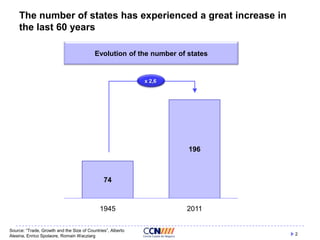
The number of states has experienced a great increase in
the last 60 years
Evolution of the number of states

x 2,6

196

74

1945
Source: “Trade, Growth and the Size of Countries”, Alberto
Alesina, Enrico Spolaore, Romain Wacziarg

2011

2
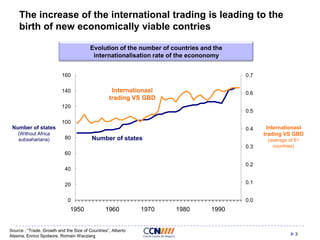
The increase of the international trading is leading to the
birth of new economically viable contries
Evolution of the number of countries and the
internationalisation rate of the econonomy
160
140

0.7

Internationasl
trading VS GBD

0.6

120

0.5

100
Number of states
(Without Africa
subsahariana)

0.4
80

Number of states
0.3

Internationasl
trading VS GBD
(average of 61
countries)

60
0.2

40

20

0.1

0

0.0

1950

1960

Source : “Trade, Growth and the Size of Countries”, Alberto
Alesina, Enrico Spolaore, Romain Wacziarg

1970

1980

1990

3
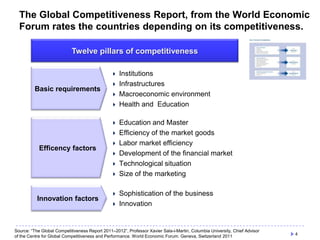
The Global Competitiveness Report, from the World Economic
Forum rates the countries depending on its competitiveness.
Twelve pillars of competitiveness


Basic requirements







Efficency factors







Innovation factors




Institutions
Infrastructures
Macroeconomic environment
Health and Education
Education and Master
Efficiency of the market goods
Labor market efficiency
Development of the financial market
Technological situation
Size of the marketing
Sophistication of the business
Innovation

Source: “The Global Competitiveness Report 2011–2012”, Professor Xavier Sala-i-Martin, Columbia University, Chief Advisor
of the Centre for Global Competitiveness and Performance. World Economic Forum. Geneva, Switzerland 2011

4
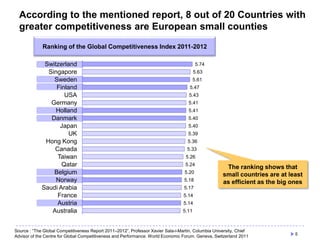
According to the mentioned report, 8 out of 20 Countries with
greater competitiveness are European small counties
Ranking of the Global Competitiveness Index 2011-2012
Switzerland
Singapore
Sweden
Finland
USA
Germany
Holland
Danmark
Japan
UK
Hong Kong
Canada
Taiwan
Qatar
Belgium
Norway
Saudi Arabia
France
Austria
Australia

5.74
5.63
5.61
5.47
5.43
5.41
5.41
5.40

5.40
5.39

5.36
5.33

5.26
5.24
5.20
5.18

The ranking shows that
small countries are at least
as efficient as the big ones

5.17
5.14
5.14
5.11

Source : “The Global Competitiveness Report 2011–2012”, Professor Xavier Sala-i-Martin, Columbia University, Chief
Advisor of the Centre for Global Competitiveness and Performance. World Economic Forum. Geneva, Switzerland 2011

5
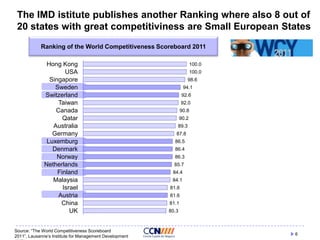
The IMD istitute publishes another Ranking where also 8 out of
20 states with great competitiviness are Small European States
Ranking of the World Competitiveness Scoreboard 2011
Hong Kong
USA
Singapore
Sweden
Switzerland
Taiwan
Canada
Qatar
Australia
Germany
Luxemburg
Denmark
Norway
Netherlands
Finland
Malaysia
Israel
Austria
China
UK
Source: “The World Competitiveness Scoreboard
2011”, Lausanne‟s Institute for Management Development

100.0
100.0
98.6
94.1
92.6
92.0
90.8
90.2

89.3
87.8

86.5
86.4

86.3
85.7
84.4
84.1
81.6
81.6
81.1
80.3

6
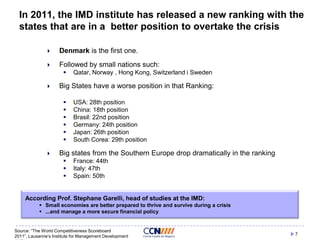
In 2011, the IMD institute has released a new ranking with the
states that are in a better position to overtake the crisis


Denmark is the first one.



Followed by small nations such:




Big States have a worse position in that Ranking:









Qatar, Norway , Hong Kong, Switzerland i Sweden

USA: 28th position
China: 18th position
Brasil: 22nd position
Germany: 24th position
Japan: 26th position
South Corea: 29th position

Big states from the Southern Europe drop dramatically in the ranking




France: 44th
Italy: 47th
Spain: 50th

According Prof. Stephane Garelli, head of studies at the IMD:
 Small economies are better prepared to thrive and survive during a crisis
 ...and manage a more secure financial policy

Source: “The World Competitiveness Scoreboard
2011”, Lausanne‟s Institute for Management Development

7
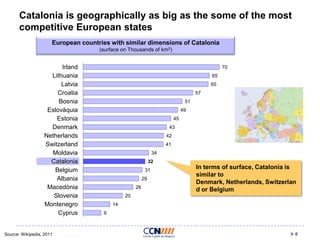
Catalonia is geographically as big as the some of the most
competitive European states
European countries with similar dimensions of Catalonia
(surface on Thousands of km2)

Irland
Lithuania
Latvia
Croatia
Bosnia
Eslovàquia
Estonia
Denmark
Netherlands
Switzerland
Moldavia
Catalonia
Belgium
Albania
Macedònia
Slovenia
Montenegro
Cyprus

Source: Wikipedia, 2011

70
65
65
57
51

49
45
43
42
41
34
32
31

29
26

In terms of surface, Catalonia is
similar to
Denmark, Netherlands, Switzerlan
d or Belgium

20
14
9

8
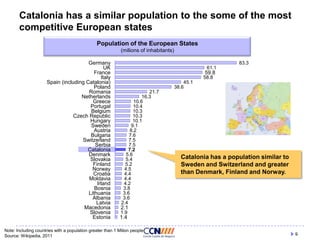
Catalonia has a similar population to the some of the most
competitive European states
Population of the European States
(milions of inhabitants)
Germany
UK
France
Italy
Spain (including Catalonia)
Poland
Romania
Netherlands
Greece
Portugal
Belgium
Czech Republic
Hungary
Sweden
Austria
Bulgaria
Switzerland
Serbia
Catalonia
Denmark
Slovakia
Finland
Norway
Croatia
Moldavia
Irland
Bosnia
Lithuania
Albania
Latvia
Macedonia
Slovenia
Estonia

83.3
61.1

59.8
58.8
45.1
38.6
21.7
16.3
10.6
10.4
10.3
10.3
10.1
9.1
8.2
7.6
7.5
7.5
7.2
5.6
5.4
5.2
4.5
4.4
4.4
4.2
3.8
3.6
3.6
2.4

Catalonia has a population similar to
Sweden and Switzerland and greater
than Denmark, Finland and Norway.

2.1
1.9

1.4

Note: Including countries with a population greater than 1 Milion people
Source: Wikipedia, 2011

9
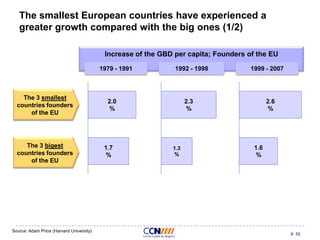
The smallest European countries have experienced a
greater growth compared with the big ones (1/2)
Increase of the GBD per capita; Founders of the EU
1979 - 1991

The 3 smallest
countries founders
of the EU

The 3 bigest
countries founders
of the EU

Source: Adam Price (Harvard University)

1992 - 1998

2.0
%

1.7
%

1999 - 2007

2.3
%

1.3
%

2.6
%

1.6
%

10
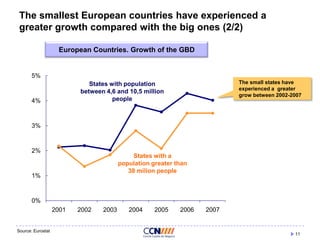
The smallest European countries have experienced a
greater growth compared with the big ones (2/2)
European Countries. Growth of the GBD

5%
The small states have
experienced a greater
grow between 2002-2007

States with population
between 4,6 and 10,5 million
people

4%

3%

2%

States with a
population greater than
38 milion people

1%

0%
2001

Source: Eurostat

2002

2003

2004

2005

2006

2007

11
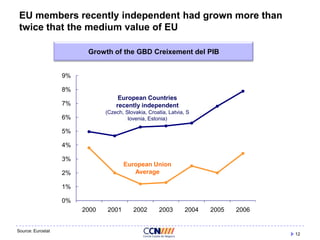
EU members recently independent had grown more than
twice that the medium value of EU
Growth of the GBD Creixement del PIB
9%
8%
7%

European Countries
recently independent

6%

(Czech, Slovakia, Croatia, Latvia, S
lovenia, Estonia)

5%
4%
3%

European Union
Average

2%
1%
0%
2000

Source: Eurostat

2001

2002

2003

2004

2005

2006

12
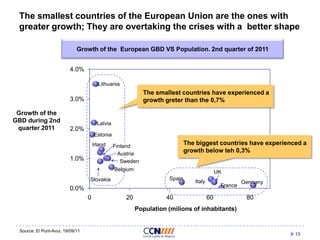
The smallest countries of the European Union are the ones with
greater growth; They are overtaking the crises with a better shape
Growth of the European GBD VS Population. 2nd quarter of 2011
4.0%
Lithuania

The smallest countries have experienced a
growth greter than the 0,7%

3.0%
Growth of the
GBD during 2nd
quarter 2011

Latvia

2.0%
Estonia
Irland

1.0%

The biggest countries have experienced a
growth below teh 0,3%

Finland
Austria
Sweden
Belgium

UK
Spain

Slovakia

Italy

France

0.0%
0

20

40

60

Germany

80

Population (milions of inhabitants)

Source: El Punt-Avui, 19/09/11

13
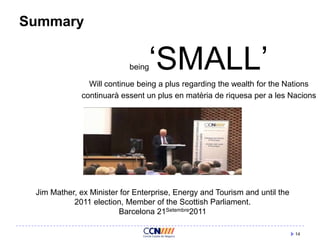
Summary

„SMALL‟

being

Will continue being a plus regarding the wealth for the Nations
continuarà essent un plus en matèria de riquesa per a les Nacions

Jim Mather, ex Minister for Enterprise, Energy and Tourism and until the
2011 election, Member of the Scottish Parliament.
Barcelona 21Setembre2011
14
Només amb un Estat propi
Catalunya serà econòmicament viable

Empresaris per l’Estat propi

www.ccncat.cat

info@ccncat.cat

Report 2 small countries are economically viable

  • 1.
    Small countries areeconomically viable November, 2011
  • 2.
    The number ofstates has experienced a great increase in the last 60 years Evolution of the number of states x 2,6 196 74 1945 Source: “Trade, Growth and the Size of Countries”, Alberto Alesina, Enrico Spolaore, Romain Wacziarg 2011 2
  • 3.
    The increase ofthe international trading is leading to the birth of new economically viable contries Evolution of the number of countries and the internationalisation rate of the econonomy 160 140 0.7 Internationasl trading VS GBD 0.6 120 0.5 100 Number of states (Without Africa subsahariana) 0.4 80 Number of states 0.3 Internationasl trading VS GBD (average of 61 countries) 60 0.2 40 20 0.1 0 0.0 1950 1960 Source : “Trade, Growth and the Size of Countries”, Alberto Alesina, Enrico Spolaore, Romain Wacziarg 1970 1980 1990 3
  • 4.
    The Global CompetitivenessReport, from the World Economic Forum rates the countries depending on its competitiveness. Twelve pillars of competitiveness  Basic requirements      Efficency factors     Innovation factors   Institutions Infrastructures Macroeconomic environment Health and Education Education and Master Efficiency of the market goods Labor market efficiency Development of the financial market Technological situation Size of the marketing Sophistication of the business Innovation Source: “The Global Competitiveness Report 2011–2012”, Professor Xavier Sala-i-Martin, Columbia University, Chief Advisor of the Centre for Global Competitiveness and Performance. World Economic Forum. Geneva, Switzerland 2011 4
  • 5.
    According to thementioned report, 8 out of 20 Countries with greater competitiveness are European small counties Ranking of the Global Competitiveness Index 2011-2012 Switzerland Singapore Sweden Finland USA Germany Holland Danmark Japan UK Hong Kong Canada Taiwan Qatar Belgium Norway Saudi Arabia France Austria Australia 5.74 5.63 5.61 5.47 5.43 5.41 5.41 5.40 5.40 5.39 5.36 5.33 5.26 5.24 5.20 5.18 The ranking shows that small countries are at least as efficient as the big ones 5.17 5.14 5.14 5.11 Source : “The Global Competitiveness Report 2011–2012”, Professor Xavier Sala-i-Martin, Columbia University, Chief Advisor of the Centre for Global Competitiveness and Performance. World Economic Forum. Geneva, Switzerland 2011 5
  • 6.
    The IMD istitutepublishes another Ranking where also 8 out of 20 states with great competitiviness are Small European States Ranking of the World Competitiveness Scoreboard 2011 Hong Kong USA Singapore Sweden Switzerland Taiwan Canada Qatar Australia Germany Luxemburg Denmark Norway Netherlands Finland Malaysia Israel Austria China UK Source: “The World Competitiveness Scoreboard 2011”, Lausanne‟s Institute for Management Development 100.0 100.0 98.6 94.1 92.6 92.0 90.8 90.2 89.3 87.8 86.5 86.4 86.3 85.7 84.4 84.1 81.6 81.6 81.1 80.3 6
  • 7.
    In 2011, theIMD institute has released a new ranking with the states that are in a better position to overtake the crisis  Denmark is the first one.  Followed by small nations such:   Big States have a worse position in that Ranking:        Qatar, Norway , Hong Kong, Switzerland i Sweden USA: 28th position China: 18th position Brasil: 22nd position Germany: 24th position Japan: 26th position South Corea: 29th position Big states from the Southern Europe drop dramatically in the ranking    France: 44th Italy: 47th Spain: 50th According Prof. Stephane Garelli, head of studies at the IMD:  Small economies are better prepared to thrive and survive during a crisis  ...and manage a more secure financial policy Source: “The World Competitiveness Scoreboard 2011”, Lausanne‟s Institute for Management Development 7
  • 8.
    Catalonia is geographicallyas big as the some of the most competitive European states European countries with similar dimensions of Catalonia (surface on Thousands of km2) Irland Lithuania Latvia Croatia Bosnia Eslovàquia Estonia Denmark Netherlands Switzerland Moldavia Catalonia Belgium Albania Macedònia Slovenia Montenegro Cyprus Source: Wikipedia, 2011 70 65 65 57 51 49 45 43 42 41 34 32 31 29 26 In terms of surface, Catalonia is similar to Denmark, Netherlands, Switzerlan d or Belgium 20 14 9 8
  • 9.
    Catalonia has asimilar population to the some of the most competitive European states Population of the European States (milions of inhabitants) Germany UK France Italy Spain (including Catalonia) Poland Romania Netherlands Greece Portugal Belgium Czech Republic Hungary Sweden Austria Bulgaria Switzerland Serbia Catalonia Denmark Slovakia Finland Norway Croatia Moldavia Irland Bosnia Lithuania Albania Latvia Macedonia Slovenia Estonia 83.3 61.1 59.8 58.8 45.1 38.6 21.7 16.3 10.6 10.4 10.3 10.3 10.1 9.1 8.2 7.6 7.5 7.5 7.2 5.6 5.4 5.2 4.5 4.4 4.4 4.2 3.8 3.6 3.6 2.4 Catalonia has a population similar to Sweden and Switzerland and greater than Denmark, Finland and Norway. 2.1 1.9 1.4 Note: Including countries with a population greater than 1 Milion people Source: Wikipedia, 2011 9
  • 10.
    The smallest Europeancountries have experienced a greater growth compared with the big ones (1/2) Increase of the GBD per capita; Founders of the EU 1979 - 1991 The 3 smallest countries founders of the EU The 3 bigest countries founders of the EU Source: Adam Price (Harvard University) 1992 - 1998 2.0 % 1.7 % 1999 - 2007 2.3 % 1.3 % 2.6 % 1.6 % 10
  • 11.
    The smallest Europeancountries have experienced a greater growth compared with the big ones (2/2) European Countries. Growth of the GBD 5% The small states have experienced a greater grow between 2002-2007 States with population between 4,6 and 10,5 million people 4% 3% 2% States with a population greater than 38 milion people 1% 0% 2001 Source: Eurostat 2002 2003 2004 2005 2006 2007 11
  • 12.
    EU members recentlyindependent had grown more than twice that the medium value of EU Growth of the GBD Creixement del PIB 9% 8% 7% European Countries recently independent 6% (Czech, Slovakia, Croatia, Latvia, S lovenia, Estonia) 5% 4% 3% European Union Average 2% 1% 0% 2000 Source: Eurostat 2001 2002 2003 2004 2005 2006 12
  • 13.
    The smallest countriesof the European Union are the ones with greater growth; They are overtaking the crises with a better shape Growth of the European GBD VS Population. 2nd quarter of 2011 4.0% Lithuania The smallest countries have experienced a growth greter than the 0,7% 3.0% Growth of the GBD during 2nd quarter 2011 Latvia 2.0% Estonia Irland 1.0% The biggest countries have experienced a growth below teh 0,3% Finland Austria Sweden Belgium UK Spain Slovakia Italy France 0.0% 0 20 40 60 Germany 80 Population (milions of inhabitants) Source: El Punt-Avui, 19/09/11 13
  • 14.
    Summary „SMALL‟ being Will continue beinga plus regarding the wealth for the Nations continuarà essent un plus en matèria de riquesa per a les Nacions Jim Mather, ex Minister for Enterprise, Energy and Tourism and until the 2011 election, Member of the Scottish Parliament. Barcelona 21Setembre2011 14
  • 15.
    Només amb unEstat propi Catalunya serà econòmicament viable Empresaris per l’Estat propi www.ccncat.cat info@ccncat.cat