© Tefko Saracevic 1
Relevance
in information science
Relevance
© Tefko Saracevic 2
Preface
1975 & 1976
ïź Relevance: A Review of the Literature
and a Framework for Thinking on the
Notion in Information Science
2006
ïź Relevance: A Review of the Literature
and a Framework for Thinking on the
Notion in Information Science. Part II
Relevance
© Tefko Saracevic 3
Purpose
trace the evolution of thinking on
relevance in information science for
the past three decades
provide an updated framework within
which the still widely dissonant ideas
on relevance might be interpreted
and related to one another
Relevance
© Tefko Saracevic 4
Relevance & information
technology
Relevance around forever
Computers ~ 50 years
ïź internet ~ 30; web ~ 15
IT changed information activities
Systems designed to provide
relevant information
Invisible hand of relevance always
present
Relevance
© Tefko Saracevic 5

 in information science
Information retrieval (IR) systems
offer their version of what may be
relevant
People go their way & asses relevance
The two worlds interact
Concern here:
ïź human world of relevance
ïź how IR deals with relevance NOT covered
Relevance
© Tefko Saracevic 6
Significance of relevance
research
Contribution of relevance
scholarship:
ïź knowledge for knowledge sake
 better understanding of the notion of
relevance significant in itself
ïź potential for making information systems
better – more human oriented
 technological advances often dependent on
better understanding of underlying notions,
phenomena
Relevance
© Tefko Saracevic 7
Historical note
Relevance came into IR unannounced
From very start after WWII IR was
about retrieval of relevant information
First concerns: about “false drops” –
non relevant retrievals
First direct recognition in 1955 with
proposal for precision & recall as
evaluation measures based on relevance
Relevance
© Tefko Saracevic 8
Organization of presentation
1. What is the NATURE of relevance?
ïź 1.1 Meaning?
ïź 1.2 Theories?
ïź 1.3 Models?
2. What are MANIFESTATIONS of
relevance?
3. What is the BEHAVIOR of
relevance?
4. What are the EFFECTS of
relevance?
Relevance
© Tefko Saracevic 9
1.1 Meaning of relevance
Intuitively well understood
ïź same perception globally – “y’know”
ïź a “to” and context always present
Relevance:
ïź a relation between objects P & Q along
property R
ïź may also include a measure S of the strength
of connection
Relevance
© Tefko Saracevic 10

 in information science
Relation between inf. or inf. objects
(Ps) & contexts (Qs) based on some
property R & measure of intensity S
But: relevance is not given – it is
established
Big questions & challenges
ïź How does relevance happen?
ïź Who does it, under what circumstances,
and how?
Relevance
© Tefko Saracevic 11
Inference:
created - derived
Systems & automatons create
relevance
Users derive relevance
ïź but could be more complex & a continuum
ïź derive could involve more than topicality
 greater expertise = greater derivative powers
ïź create could involve “intelligence”
ïź also involves
 intent
 selection & interaction processes
Relevance
© Tefko Saracevic 12
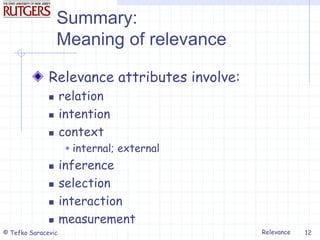
Summary:
Meaning of relevance
Relevance attributes involve:
ïź relation
ïź intention
ïź context
 internal; external
ïź inference
ïź selection
ïź interaction
ïź measurement
Relevance
© Tefko Saracevic 13
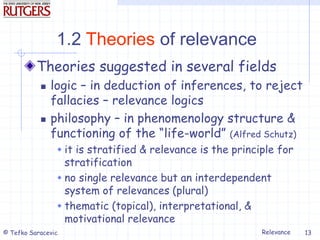
1.2 Theories of relevance
Theories suggested in several fields
ïź logic – in deduction of inferences, to reject
fallacies – relevance logics
ïź philosophy – in phenomenology structure &
functioning of the “life-world” (Alfred Schutz)
 it is stratified & relevance is the principle for
stratification
 no single relevance but an interdependent
system of relevances (plural)
 thematic (topical), interpretational, &
motivational relevance
Relevance
© Tefko Saracevic 14

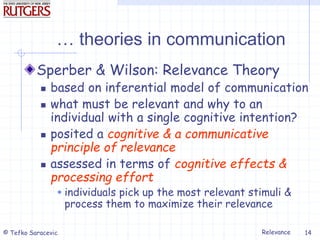
 theories in communication
Sperber & Wilson: Relevance Theory
ïź based on inferential model of communication
ïź what must be relevant and why to an
individual with a single cognitive intention?
ïź posited a cognitive & a communicative
principle of relevance
ïź assessed in terms of cognitive effects &
processing effort
 individuals pick up the most relevant stimuli &
process them to maximize their relevance
Relevance
© Tefko Saracevic 15
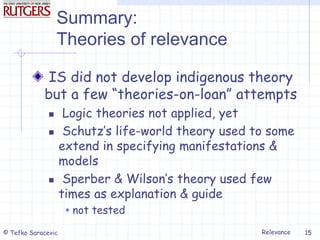
Summary:
Theories of relevance
IS did not develop indigenous theory
but a few “theories-on-loan” attempts
ïź Logic theories not applied, yet
ïź Schutz’s life-world theory used to some
extend in specifying manifestations &
models
ïź Sperber & Wilson’s theory used few
times as explanation & guide
 not tested
Relevance
© Tefko Saracevic 16
1.3 Models of relevance
Reviews – also produced models
Syracuse school of relevance
ïź dynamic & situational model (Schamber, Eisenberg
& Nilan, 1990)
 connection with human information behavior
“Whole history of relevance” (Mizzaro, 1997)
ïź duality in modeling & studying
 documents & queries, 1959-1976
 dynamics & multidimensionality, 1977-present
Relevance
© Tefko Saracevic 17
Split between system & user
models
Opposing views of IR: systems & users
 IR traditional model does not deal with users
Battle royal started by Dervin & Nilan
(1986)
 criticism of system viewpoint
 call for user orientation
Several user & interaction models
proposed – to reconcile, bridge
ïź still relevance has two basic models &
cultures & they map like Australia
Relevance
© Tefko Saracevic 18
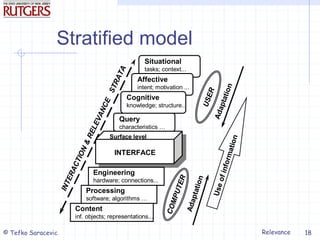
Stratified model
Situational
tasks; context...
A
d
a
p
t
a
t
i
o
n
Engineering
hardware; connections...
A
d
a
p
t
a
t
i
o
n
I
N
T
E
R
A
C
T
I
O
N
&
R
E
L
E
V
A
N
C
E
S
T
R
A
T
A
Surface level
U
s
e
o
f
i
n
f
o
r
m
a
t
i
o
n
Query
characteristics 

C
O
M
P
U
T
E
R
Affective
intent; motivation ...
Cognitive
knowledge; structure...
Processing
software; algorithms 

Content
inf. objects; representations...
U
S
E
R
INTERFACE
Situational
tasks; context...
A
d
a
p
t
a
t
i
o
n
Engineering
hardware; connections...
A
d
a
p
t
a
t
i
o
n
I
N
T
E
R
A
C
T
I
O
N
&
R
E
L
E
V
A
N
C
E
S
T
R
A
T
A
Surface level
U
s
e
o
f
i
n
f
o
r
m
a
t
i
o
n
Query
characteristics 

C
O
M
P
U
T
E
R
Affective
intent; motivation ...
Cognitive
knowledge; structure...
Processing
software; algorithms 

Content
inf. objects; representations...
U
S
E
R
INTERFACE
Relevance
© Tefko Saracevic 19
User vs system models
“Informing systems design”
ïź became mantra of all relevance studies
“Tell us what to do and we will do it.”
ïź response from systems side
But “telling” is not that simple
Issue is not a conflict but:
ïź how can we make user & system side work
together for benefit of both?
Relevance
© Tefko Saracevic 20
Summary:
relevance models
All IR & inf. seeking models have
relevance at their base
Traditional IR model has most
simplified –“weak”- version of relevance
ïź but with the weak model IR is successful
Variety of integrative models have
been proposed
ïź more complex models = increased challenge
to incorporate in practice
Relevance
© Tefko Saracevic 21
Relevance
© Tefko Saracevic 22
2. Manifestations of
relevance
“How many relevances in IR?” (Mizzaro, 1998)
 Several manifestations recognized since 1950s
 Issue: What given objects (Ps & Qs) are related
by what given property (Rs) as relation?
 [adjective] relevance or different name
Duality strikes again
ïź subject (topic, system) relevance
vs user (psychological, cognitive) relevance
ïź objective vs subjective relevance
Relevance
© Tefko Saracevic 23
Issue of primacy:
weak and strong relevance
Does topical relevance underlie all
others?
 predictably two answers: yes and no
ïź in a strict correspondence between
query & answer topical is basic – weak
relevance
ïź if derivation is involved topical may not
be basic – strong relevance
 weak relevance is more associated with
systems
 strong more with people
Relevance
© Tefko Saracevic 24
Beyond duality
Numerous other kinds of relevance
were identified
ïź for user relevances:
 psychological, cognitive, affective, situational,
socio-cognitive, pertinence, utility 

ïź for topical relevances:
 logical, systems, algorithmic, documentary,
bibliographic 

ïź each indicates different relations
Relevance
© Tefko Saracevic 25
Summary:
Manifestations of relevance
There are a limited number of
manifestations – could be grouped:
ïź System or algorithmic relevance
ïź Topical or subject relevance
ïź Cognitive relevance or pertinence
ïź Situational relevance or utility
ïź Affective relevance
These are interdependent – they
feed on each other interactively
Relevance
© Tefko Saracevic 26
3. Behavior of relevance
Relevance does not behave, people do
ïź how humans determine relevance of
information or information objects?
ïź reviewed only studies that have data
 some 30 studies – started in 1991
 related to information seeking & use studies &
implicit relevance studies – not reviewed
Pattern for review:
 [author] used [subjects] to do [tasks] in order to
study [object of research]
Relevance
© Tefko Saracevic 27
Relevance clues
What makes information or information
objects relevant? What do people look
for in order to infer relevance?
 two approaches: topic & clues analysis
Clues research:
 uncover & classify attributes or criteria that
users concentrate on while making relevance
inferences
 usually on documents but also other objects
Relevance
© Tefko Saracevic 28
Examples
Schamber (1991) interviewed 30 users of weather
information using different sources, from oral
reports to documents and maps in order to derive
and categorize their relevance criteria. She
identified 22 categories in 10 groups.
Barry (1994) interviewed 18 academic users (not
specified as being students or faculty) who had
requested an information search for documents
related to their work in order to categorize their
relevance criteria. She identified 23 categories in
7 groups
Relevance
© Tefko Saracevic 29
Relevance dynamics
Do relevance inferences and criteria
change over time for the same user
and task, and if so, how?
As a user progresses through various
stages of a task
ïź the user’s cognitive state changes
ïź the task changes as well
ïź thus, something about relevance also is
changing.
Relevance
© Tefko Saracevic 30
Relevance feedback
What factors affect the process of
relevance feedback?
ïź What types of feedback? How much is
feedback used?
Dealing here with manual not
automatic feedback
ïź behavior of people when involved in
manual feedback
Relevance
© Tefko Saracevic 31
Summary on behavior
Caveats abound – nothing standardized
ïź still refreshing to see data
Some generalizations on clues:
ïź criteria finite in number, similar, but
different weights assigned
 Different users, tasks, progress in tasks, classes
of users = similar criteria = different weights
 Different ratings of relevance = similar criteria
= different weights.
Relevance
© Tefko Saracevic 32

summary clues
Clues criteria:
ïź content
ïź object
ïź validity
ïź use or situational match
ïź cognitive match
ïź affective match
ïź belief match
Relevance
© Tefko Saracevic 33

 summary clues
Criteria are not independent; people
apply multiple criteria; they interact
ïź content (topic) criteria very important
but not sole – interact with others
ïź for search outputs value of results as a
whole critical
Visual information = faster inference
than textual information
Relevance
© Tefko Saracevic 34

 summary dynamics
Inferences dependent on task stage
ïź criteria stable, selection changes
ïź Different stages = differing selections
but different stages = similar criteria =
different weights
ïź Increased focus = increased
discrimination = more stringent
relevance inferences
ïź What is topical changes with progress in
time and task
Relevance
© Tefko Saracevic 35

 summary feedback
Several kinds
ïź search term, content, magnitude, tactics
Use of relevance feedback = increase
in performance
ïź however, used rarely in practice
Searching behavior different when
using feedback
Relevance
© Tefko Saracevic 36
5. Effects of relevance
Works both ways: relevance affected by
and affects host of factors
Relevance judges
ïź What factors inherent in relevance judges make
a difference in relevance inferences?
ïź How large are and what affects individual
differences in relevance inferences?
 similar question asked for a number of information
activities – indexing, searching 

 most often studied: domain knowledge
Relevance
© Tefko Saracevic 37
Relevance judgments
What factors affect relevance
judgments?
ïź short answer: a lot of them
ïź approach: classify into tables e.g.
 Schamber (1994) 80 factors, 6 categories
 Harter (1996) 24 factors, 4 categories
ïź different approach here:
 classify studies along basic assumptions in IR
evaluations
Relevance
© Tefko Saracevic 38
Central assumptions
Relevance is:
ïź topical
ïź binary
ïź independent
ïź stable
ïź consistent
ïź if pooling: complete
Not to prove or disprove these assumptions
but to organize studies along questions
Relevance
© Tefko Saracevic 39
Beyond topicality
Do people infer relevance based on
topicality only?
Other factors enter & interact
Only a few studies directly addressed
 Wang & Soergel (1998) 11 criteria for
selection, with topicality being top
 Xu & Chen (2006) in web searching: topicality &
novelty most significant, then reliability &
understandability
Relevance
© Tefko Saracevic 40
Beyond binary
Are relevance inferences binary i.e.
relevant – not relevant? If not, what
gradation do people use in inferences
about relevance of information or
information objects?
Number of studies addressed this
ïź studied distributions of relevance
inferences
ïź regions of relevance
Relevance
© Tefko Saracevic 41
Beyond independence
Are information objects assessed
independently of each other? Does the
order or size of the presentation affect
relevance judgments?
ïź Only a few studies on the questions
ïź Includes presentation of different
representations
Relevance
© Tefko Saracevic 42
Beyond stability
Are relevance judgments stable as
tasks and other aspects change? Do
relevance inferences and criteria
change over time for the same user and
task, and if so how?
ïź mentioned already under dynamics
 judgments not completely stable, criteria are
 Plato: “Everything is flux.”
Relevance
© Tefko Saracevic 43
Beyond consistency
Are relevance judgments consistent
among judges or group of judges?
 human judgments about anything informational
are not consistent, relevance included
Gull (1956) opened the Pandora box
 classic example of law of unintended
consequences
Some 6 studies addressed consistency
ïź subjects: experts, students
Relevance
© Tefko Saracevic 44
But does it matter?
How does inconsistency in human
relevance judgments affect results of
IR evaluation?
ïź main contention by critics
Five studies 1968 – 2000 addressed
the question
ïź four also showed magnitude of agreement
Relevance
© Tefko Saracevic 45
Summary: judges
Subject expertise accounts strongly
 higher expertise = higher agreement, less
differences
 lesser expertise = more leniency in judgment
ïź large variability in relevance inferences
by individuals
 same range as in other cognitive processes
Relevance
© Tefko Saracevic 46
Summary: judgments
Relevance is measurable!
None of the 5 postulates hold
ïź but by simplifying relevance for labs IR
made significant advances
Relevance judgments are not binary
but are bimodal
ïź regions of low, middle and high relevance
 high peaks at both end
Order affect relevance judgment
Relevance
© Tefko Saracevic 47

 summary: judgments
Consistency:
 Higher expertise = higher consistency =
more stringent. Lower expertise = lower
consistency= more encompassing
 overlap using different populations hovers
around 30%
 higher expertise up to 80%
 when 3rd, 4th 
 judge added overlap falls
 Higher expertise =larger overlap. Lower
expertise =smaller overlap. More judges =
less overlap.
Relevance
© Tefko Saracevic 48
Summary: does it matter?
In lab conditions disagreement among
judges does not affect evaluation
ïź rank order of different IR systems changes
minimally
 Different judges = same relative performance (on
the average)
ïź swaps in ranking do occur = low probability
ïź but performance for individual topics differs
significantly
 law of averages kicks in
Relevance
© Tefko Saracevic 49
Summary: measures
Users can use a variety of scales
ïź there is no “best” scale
ïź magnitude scales very appropriate but
hard to explain & analyze
Relevance
© Tefko Saracevic 50
Epilogue
Many things changed in IR &
information science but goals the same
As to nature of relevance:
 marked progress in understanding
 little in theory
 diversification in models in models
As to manifestations:
 consensus there are several kinds of
relevance, grouped in a half dozen or so well
distinguished classes - interdependent
Relevance
© Tefko Saracevic 51

 epilogue
As to behavior & effects:
ïź seen a number of experimental &
observational studies
 lifted the discourse beyond debate,
anecdotes to data interpretation
 but generalizations difficult – findings
should be treated as hypotheses
Relevance
© Tefko Saracevic 52

 epilogue: reflections
Relevance is poor
ïź no funding for relevance research
 of studies with data less than 17% mentioned outside
funding, half from outside the US
 scholarship progressed sporadically & all over the
place
Globalization of IR – globalization of
relevance
ïź as relevance went global & to the masses many
& different research questions emerged
Relevance
© Tefko Saracevic 53

 epilogue: reflections

Proprietary IR – proprietary relevance
ïź major search engines proprietary =
relevance proprietary
 for innovation must study users & use, but
findings kept private
 relevance research into public & private branch
 paradox of the internet
Relevance
© Tefko Saracevic 54

 epilogue: research agenda
- beyonds
Beyond behaviorism & black box
ïź many studies stimulus-response & no
diagnostics
ïź need to go use/adapt other approaches
Relevance
© Tefko Saracevic 55

 epilogue: research agenda
- beyonds
Beyond mantra
ïź “implication for system design”
 incorporating user concerns &
characteristics not that simple
 integration between user/cognitive &
systems approaches needed
 relevance research and IR research should
at least get engaged, if not married
 interactive research on the right track
Relevance
© Tefko Saracevic 56

 epilogue: research agenda
- beyonds
Beyond students
ïź ~70% of behavior & effect studies used
students as population
 not surprising – they are affordable
 we know a lot about student relevance
 does it generalize to other populations?
Relevance
© Tefko Saracevic 57
In conclusion
Information technology & systems
will change dramatically
ïź even in the short run
ïź and in unforeseeable directions
But relevance is here to stay!
Relevance
© Tefko Saracevic 58
Relevance
© Tefko Saracevic 59
Relevance
© Tefko Saracevic 60
Acknowledgments
Ying Zhang & Yuelin Li for searches &
organization
Sandra Lanman for editing
Students in Spring 2006 class Human
Information Behavior for comments
ïź Jeanette de Richemond for corrections
SCILS for research & collegial
atmosphere. BEST COLLEAGUES!
Gus Friedrich for understanding & time

Relevance.ppt

  • 1.
    © Tefko Saracevic1 Relevance in information science
  • 2.
    Relevance © Tefko Saracevic2 Preface 1975 & 1976 ïź Relevance: A Review of the Literature and a Framework for Thinking on the Notion in Information Science 2006 ïź Relevance: A Review of the Literature and a Framework for Thinking on the Notion in Information Science. Part II
  • 3.
    Relevance © Tefko Saracevic3 Purpose trace the evolution of thinking on relevance in information science for the past three decades provide an updated framework within which the still widely dissonant ideas on relevance might be interpreted and related to one another
  • 4.
    Relevance © Tefko Saracevic4 Relevance & information technology Relevance around forever Computers ~ 50 years ïź internet ~ 30; web ~ 15 IT changed information activities Systems designed to provide relevant information Invisible hand of relevance always present
  • 5.
    Relevance © Tefko Saracevic5 
 in information science Information retrieval (IR) systems offer their version of what may be relevant People go their way & asses relevance The two worlds interact Concern here: ïź human world of relevance ïź how IR deals with relevance NOT covered
  • 6.
    Relevance © Tefko Saracevic6 Significance of relevance research Contribution of relevance scholarship: ïź knowledge for knowledge sake  better understanding of the notion of relevance significant in itself ïź potential for making information systems better – more human oriented  technological advances often dependent on better understanding of underlying notions, phenomena
  • 7.
    Relevance © Tefko Saracevic7 Historical note Relevance came into IR unannounced From very start after WWII IR was about retrieval of relevant information First concerns: about “false drops” – non relevant retrievals First direct recognition in 1955 with proposal for precision & recall as evaluation measures based on relevance
  • 8.
    Relevance © Tefko Saracevic8 Organization of presentation 1. What is the NATURE of relevance? ïź 1.1 Meaning? ïź 1.2 Theories? ïź 1.3 Models? 2. What are MANIFESTATIONS of relevance? 3. What is the BEHAVIOR of relevance? 4. What are the EFFECTS of relevance?
  • 9.
    Relevance © Tefko Saracevic9 1.1 Meaning of relevance Intuitively well understood ïź same perception globally – “y’know” ïź a “to” and context always present Relevance: ïź a relation between objects P & Q along property R ïź may also include a measure S of the strength of connection
  • 10.
    Relevance © Tefko Saracevic10 
 in information science Relation between inf. or inf. objects (Ps) & contexts (Qs) based on some property R & measure of intensity S But: relevance is not given – it is established Big questions & challenges ïź How does relevance happen? ïź Who does it, under what circumstances, and how?
  • 11.
    Relevance © Tefko Saracevic11 Inference: created - derived Systems & automatons create relevance Users derive relevance ïź but could be more complex & a continuum ïź derive could involve more than topicality  greater expertise = greater derivative powers ïź create could involve “intelligence” ïź also involves  intent  selection & interaction processes
  • 12.
    Relevance © Tefko Saracevic12 Summary: Meaning of relevance Relevance attributes involve: ïź relation ïź intention ïź context  internal; external ïź inference ïź selection ïź interaction ïź measurement
  • 13.
    Relevance © Tefko Saracevic13 1.2 Theories of relevance Theories suggested in several fields ïź logic – in deduction of inferences, to reject fallacies – relevance logics ïź philosophy – in phenomenology structure & functioning of the “life-world” (Alfred Schutz)  it is stratified & relevance is the principle for stratification  no single relevance but an interdependent system of relevances (plural)  thematic (topical), interpretational, & motivational relevance
  • 14.
    Relevance © Tefko Saracevic14 
 theories in communication Sperber & Wilson: Relevance Theory ïź based on inferential model of communication ïź what must be relevant and why to an individual with a single cognitive intention? ïź posited a cognitive & a communicative principle of relevance ïź assessed in terms of cognitive effects & processing effort  individuals pick up the most relevant stimuli & process them to maximize their relevance
  • 15.
    Relevance © Tefko Saracevic15 Summary: Theories of relevance IS did not develop indigenous theory but a few “theories-on-loan” attempts ïź Logic theories not applied, yet ïź Schutz’s life-world theory used to some extend in specifying manifestations & models ïź Sperber & Wilson’s theory used few times as explanation & guide  not tested
  • 16.
    Relevance © Tefko Saracevic16 1.3 Models of relevance Reviews – also produced models Syracuse school of relevance ïź dynamic & situational model (Schamber, Eisenberg & Nilan, 1990)  connection with human information behavior “Whole history of relevance” (Mizzaro, 1997) ïź duality in modeling & studying  documents & queries, 1959-1976  dynamics & multidimensionality, 1977-present
  • 17.
    Relevance © Tefko Saracevic17 Split between system & user models Opposing views of IR: systems & users  IR traditional model does not deal with users Battle royal started by Dervin & Nilan (1986)  criticism of system viewpoint  call for user orientation Several user & interaction models proposed – to reconcile, bridge ïź still relevance has two basic models & cultures & they map like Australia
  • 18.
    Relevance © Tefko Saracevic18 Stratified model Situational tasks; context... A d a p t a t i o n Engineering hardware; connections... A d a p t a t i o n I N T E R A C T I O N & R E L E V A N C E S T R A T A Surface level U s e o f i n f o r m a t i o n Query characteristics 
 C O M P U T E R Affective intent; motivation ... Cognitive knowledge; structure... Processing software; algorithms 
 Content inf. objects; representations... U S E R INTERFACE Situational tasks; context... A d a p t a t i o n Engineering hardware; connections... A d a p t a t i o n I N T E R A C T I O N & R E L E V A N C E S T R A T A Surface level U s e o f i n f o r m a t i o n Query characteristics 
 C O M P U T E R Affective intent; motivation ... Cognitive knowledge; structure... Processing software; algorithms 
 Content inf. objects; representations... U S E R INTERFACE
  • 19.
    Relevance © Tefko Saracevic19 User vs system models “Informing systems design” ïź became mantra of all relevance studies “Tell us what to do and we will do it.” ïź response from systems side But “telling” is not that simple Issue is not a conflict but: ïź how can we make user & system side work together for benefit of both?
  • 20.
    Relevance © Tefko Saracevic20 Summary: relevance models All IR & inf. seeking models have relevance at their base Traditional IR model has most simplified –“weak”- version of relevance ïź but with the weak model IR is successful Variety of integrative models have been proposed ïź more complex models = increased challenge to incorporate in practice
  • 21.
  • 22.
    Relevance © Tefko Saracevic22 2. Manifestations of relevance “How many relevances in IR?” (Mizzaro, 1998)  Several manifestations recognized since 1950s  Issue: What given objects (Ps & Qs) are related by what given property (Rs) as relation?  [adjective] relevance or different name Duality strikes again ïź subject (topic, system) relevance vs user (psychological, cognitive) relevance ïź objective vs subjective relevance
  • 23.
    Relevance © Tefko Saracevic23 Issue of primacy: weak and strong relevance Does topical relevance underlie all others?  predictably two answers: yes and no ïź in a strict correspondence between query & answer topical is basic – weak relevance ïź if derivation is involved topical may not be basic – strong relevance  weak relevance is more associated with systems  strong more with people
  • 24.
    Relevance © Tefko Saracevic24 Beyond duality Numerous other kinds of relevance were identified ïź for user relevances:  psychological, cognitive, affective, situational, socio-cognitive, pertinence, utility 
 ïź for topical relevances:  logical, systems, algorithmic, documentary, bibliographic 
 ïź each indicates different relations
  • 25.
    Relevance © Tefko Saracevic25 Summary: Manifestations of relevance There are a limited number of manifestations – could be grouped: ïź System or algorithmic relevance ïź Topical or subject relevance ïź Cognitive relevance or pertinence ïź Situational relevance or utility ïź Affective relevance These are interdependent – they feed on each other interactively
  • 26.
    Relevance © Tefko Saracevic26 3. Behavior of relevance Relevance does not behave, people do ïź how humans determine relevance of information or information objects? ïź reviewed only studies that have data  some 30 studies – started in 1991  related to information seeking & use studies & implicit relevance studies – not reviewed Pattern for review:  [author] used [subjects] to do [tasks] in order to study [object of research]
  • 27.
    Relevance © Tefko Saracevic27 Relevance clues What makes information or information objects relevant? What do people look for in order to infer relevance?  two approaches: topic & clues analysis Clues research:  uncover & classify attributes or criteria that users concentrate on while making relevance inferences  usually on documents but also other objects
  • 28.
    Relevance © Tefko Saracevic28 Examples Schamber (1991) interviewed 30 users of weather information using different sources, from oral reports to documents and maps in order to derive and categorize their relevance criteria. She identified 22 categories in 10 groups. Barry (1994) interviewed 18 academic users (not specified as being students or faculty) who had requested an information search for documents related to their work in order to categorize their relevance criteria. She identified 23 categories in 7 groups
  • 29.
    Relevance © Tefko Saracevic29 Relevance dynamics Do relevance inferences and criteria change over time for the same user and task, and if so, how? As a user progresses through various stages of a task ïź the user’s cognitive state changes ïź the task changes as well ïź thus, something about relevance also is changing.
  • 30.
    Relevance © Tefko Saracevic30 Relevance feedback What factors affect the process of relevance feedback? ïź What types of feedback? How much is feedback used? Dealing here with manual not automatic feedback ïź behavior of people when involved in manual feedback
  • 31.
    Relevance © Tefko Saracevic31 Summary on behavior Caveats abound – nothing standardized ïź still refreshing to see data Some generalizations on clues: ïź criteria finite in number, similar, but different weights assigned  Different users, tasks, progress in tasks, classes of users = similar criteria = different weights  Different ratings of relevance = similar criteria = different weights.
  • 32.
    Relevance © Tefko Saracevic32 
summary clues Clues criteria: ïź content ïź object ïź validity ïź use or situational match ïź cognitive match ïź affective match ïź belief match
  • 33.
    Relevance © Tefko Saracevic33 
 summary clues Criteria are not independent; people apply multiple criteria; they interact ïź content (topic) criteria very important but not sole – interact with others ïź for search outputs value of results as a whole critical Visual information = faster inference than textual information
  • 34.
    Relevance © Tefko Saracevic34 
 summary dynamics Inferences dependent on task stage ïź criteria stable, selection changes ïź Different stages = differing selections but different stages = similar criteria = different weights ïź Increased focus = increased discrimination = more stringent relevance inferences ïź What is topical changes with progress in time and task
  • 35.
    Relevance © Tefko Saracevic35 
 summary feedback Several kinds ïź search term, content, magnitude, tactics Use of relevance feedback = increase in performance ïź however, used rarely in practice Searching behavior different when using feedback
  • 36.
    Relevance © Tefko Saracevic36 5. Effects of relevance Works both ways: relevance affected by and affects host of factors Relevance judges ïź What factors inherent in relevance judges make a difference in relevance inferences? ïź How large are and what affects individual differences in relevance inferences?  similar question asked for a number of information activities – indexing, searching 
  most often studied: domain knowledge
  • 37.
    Relevance © Tefko Saracevic37 Relevance judgments What factors affect relevance judgments? ïź short answer: a lot of them ïź approach: classify into tables e.g.  Schamber (1994) 80 factors, 6 categories  Harter (1996) 24 factors, 4 categories ïź different approach here:  classify studies along basic assumptions in IR evaluations
  • 38.
    Relevance © Tefko Saracevic38 Central assumptions Relevance is: ïź topical ïź binary ïź independent ïź stable ïź consistent ïź if pooling: complete Not to prove or disprove these assumptions but to organize studies along questions
  • 39.
    Relevance © Tefko Saracevic39 Beyond topicality Do people infer relevance based on topicality only? Other factors enter & interact Only a few studies directly addressed  Wang & Soergel (1998) 11 criteria for selection, with topicality being top  Xu & Chen (2006) in web searching: topicality & novelty most significant, then reliability & understandability
  • 40.
    Relevance © Tefko Saracevic40 Beyond binary Are relevance inferences binary i.e. relevant – not relevant? If not, what gradation do people use in inferences about relevance of information or information objects? Number of studies addressed this ïź studied distributions of relevance inferences ïź regions of relevance
  • 41.
    Relevance © Tefko Saracevic41 Beyond independence Are information objects assessed independently of each other? Does the order or size of the presentation affect relevance judgments? ïź Only a few studies on the questions ïź Includes presentation of different representations
  • 42.
    Relevance © Tefko Saracevic42 Beyond stability Are relevance judgments stable as tasks and other aspects change? Do relevance inferences and criteria change over time for the same user and task, and if so how? ïź mentioned already under dynamics  judgments not completely stable, criteria are  Plato: “Everything is flux.”
  • 43.
    Relevance © Tefko Saracevic43 Beyond consistency Are relevance judgments consistent among judges or group of judges?  human judgments about anything informational are not consistent, relevance included Gull (1956) opened the Pandora box  classic example of law of unintended consequences Some 6 studies addressed consistency ïź subjects: experts, students
  • 44.
    Relevance © Tefko Saracevic44 But does it matter? How does inconsistency in human relevance judgments affect results of IR evaluation? ïź main contention by critics Five studies 1968 – 2000 addressed the question ïź four also showed magnitude of agreement
  • 45.
    Relevance © Tefko Saracevic45 Summary: judges Subject expertise accounts strongly  higher expertise = higher agreement, less differences  lesser expertise = more leniency in judgment ïź large variability in relevance inferences by individuals  same range as in other cognitive processes
  • 46.
    Relevance © Tefko Saracevic46 Summary: judgments Relevance is measurable! None of the 5 postulates hold ïź but by simplifying relevance for labs IR made significant advances Relevance judgments are not binary but are bimodal ïź regions of low, middle and high relevance  high peaks at both end Order affect relevance judgment
  • 47.
    Relevance © Tefko Saracevic47 
 summary: judgments Consistency:  Higher expertise = higher consistency = more stringent. Lower expertise = lower consistency= more encompassing  overlap using different populations hovers around 30%  higher expertise up to 80%  when 3rd, 4th 
 judge added overlap falls  Higher expertise =larger overlap. Lower expertise =smaller overlap. More judges = less overlap.
  • 48.
    Relevance © Tefko Saracevic48 Summary: does it matter? In lab conditions disagreement among judges does not affect evaluation ïź rank order of different IR systems changes minimally  Different judges = same relative performance (on the average) ïź swaps in ranking do occur = low probability ïź but performance for individual topics differs significantly  law of averages kicks in
  • 49.
    Relevance © Tefko Saracevic49 Summary: measures Users can use a variety of scales ïź there is no “best” scale ïź magnitude scales very appropriate but hard to explain & analyze
  • 50.
    Relevance © Tefko Saracevic50 Epilogue Many things changed in IR & information science but goals the same As to nature of relevance:  marked progress in understanding  little in theory  diversification in models in models As to manifestations:  consensus there are several kinds of relevance, grouped in a half dozen or so well distinguished classes - interdependent
  • 51.
    Relevance © Tefko Saracevic51 
 epilogue As to behavior & effects: ïź seen a number of experimental & observational studies  lifted the discourse beyond debate, anecdotes to data interpretation  but generalizations difficult – findings should be treated as hypotheses
  • 52.
    Relevance © Tefko Saracevic52 
 epilogue: reflections Relevance is poor ïź no funding for relevance research  of studies with data less than 17% mentioned outside funding, half from outside the US  scholarship progressed sporadically & all over the place Globalization of IR – globalization of relevance ïź as relevance went global & to the masses many & different research questions emerged
  • 53.
    Relevance © Tefko Saracevic53 
 epilogue: reflections
 Proprietary IR – proprietary relevance ïź major search engines proprietary = relevance proprietary  for innovation must study users & use, but findings kept private  relevance research into public & private branch  paradox of the internet
  • 54.
    Relevance © Tefko Saracevic54 
 epilogue: research agenda - beyonds Beyond behaviorism & black box ïź many studies stimulus-response & no diagnostics ïź need to go use/adapt other approaches
  • 55.
    Relevance © Tefko Saracevic55 
 epilogue: research agenda - beyonds Beyond mantra ïź “implication for system design”  incorporating user concerns & characteristics not that simple  integration between user/cognitive & systems approaches needed  relevance research and IR research should at least get engaged, if not married  interactive research on the right track
  • 56.
    Relevance © Tefko Saracevic56 
 epilogue: research agenda - beyonds Beyond students ïź ~70% of behavior & effect studies used students as population  not surprising – they are affordable  we know a lot about student relevance  does it generalize to other populations?
  • 57.
    Relevance © Tefko Saracevic57 In conclusion Information technology & systems will change dramatically ïź even in the short run ïź and in unforeseeable directions But relevance is here to stay!
  • 58.
  • 59.
  • 60.
    Relevance © Tefko Saracevic60 Acknowledgments Ying Zhang & Yuelin Li for searches & organization Sandra Lanman for editing Students in Spring 2006 class Human Information Behavior for comments ïź Jeanette de Richemond for corrections SCILS for research & collegial atmosphere. BEST COLLEAGUES! Gus Friedrich for understanding & time

Editor's Notes

  • #2 © Tefko Saracevic, Rutgers University
  • #3 © Tefko Saracevic, Rutgers University
  • #4 © Tefko Saracevic, Rutgers University
  • #5 © Tefko Saracevic, Rutgers University
  • #6 © Tefko Saracevic, Rutgers University
  • #7 © Tefko Saracevic, Rutgers University
  • #8 © Tefko Saracevic, Rutgers University
  • #9 © Tefko Saracevic, Rutgers University
  • #10 © Tefko Saracevic, Rutgers University
  • #11 © Tefko Saracevic, Rutgers University
  • #12 © Tefko Saracevic, Rutgers University
  • #13 © Tefko Saracevic, Rutgers University
  • #14 © Tefko Saracevic, Rutgers University
  • #15 © Tefko Saracevic, Rutgers University
  • #16 © Tefko Saracevic, Rutgers University
  • #17 © Tefko Saracevic, Rutgers University
  • #18 © Tefko Saracevic, Rutgers University
  • #19 © Tefko Saracevic, Rutgers University
  • #20 © Tefko Saracevic, Rutgers University
  • #21 © Tefko Saracevic, Rutgers University
  • #23 © Tefko Saracevic, Rutgers University
  • #24 © Tefko Saracevic, Rutgers University
  • #25 © Tefko Saracevic, Rutgers University
  • #26 © Tefko Saracevic, Rutgers University
  • #27 © Tefko Saracevic, Rutgers University
  • #28 © Tefko Saracevic, Rutgers University
  • #29 © Tefko Saracevic, Rutgers University
  • #30 © Tefko Saracevic, Rutgers University
  • #31 © Tefko Saracevic, Rutgers University
  • #32 © Tefko Saracevic, Rutgers University
  • #33 © Tefko Saracevic, Rutgers University
  • #34 © Tefko Saracevic, Rutgers University
  • #35 © Tefko Saracevic, Rutgers University
  • #36 © Tefko Saracevic, Rutgers University
  • #38 © Tefko Saracevic, Rutgers University
  • #39 © Tefko Saracevic, Rutgers University
  • #40 © Tefko Saracevic, Rutgers University
  • #41 © Tefko Saracevic, Rutgers University
  • #42 © Tefko Saracevic, Rutgers University
  • #43 © Tefko Saracevic, Rutgers University
  • #44 © Tefko Saracevic, Rutgers University
  • #45 © Tefko Saracevic, Rutgers University
  • #46 © Tefko Saracevic, Rutgers University
  • #47 © Tefko Saracevic, Rutgers University
  • #48 © Tefko Saracevic, Rutgers University
  • #49 © Tefko Saracevic, Rutgers University
  • #50 © Tefko Saracevic, Rutgers University
  • #51 © Tefko Saracevic, Rutgers University
  • #52 © Tefko Saracevic, Rutgers University
  • #53 © Tefko Saracevic, Rutgers University
  • #54 © Tefko Saracevic, Rutgers University
  • #55 © Tefko Saracevic, Rutgers University
  • #56 © Tefko Saracevic, Rutgers University
  • #57 © Tefko Saracevic, Rutgers University
  • #61 © Tefko Saracevic, Rutgers University