The Modern Kikokusei.
Returnee Experience & Returnee
    English Usage In Japan.

(Re-)Imagining ‘Return Migration’: Language, Concepts & Contexts.
        RGS - IBG Annual International Conference 2011.


                                                                             Carol Begg
                                               Kanda University of International Studies
                                                              carol-b@kanda.kuis.ac.jp
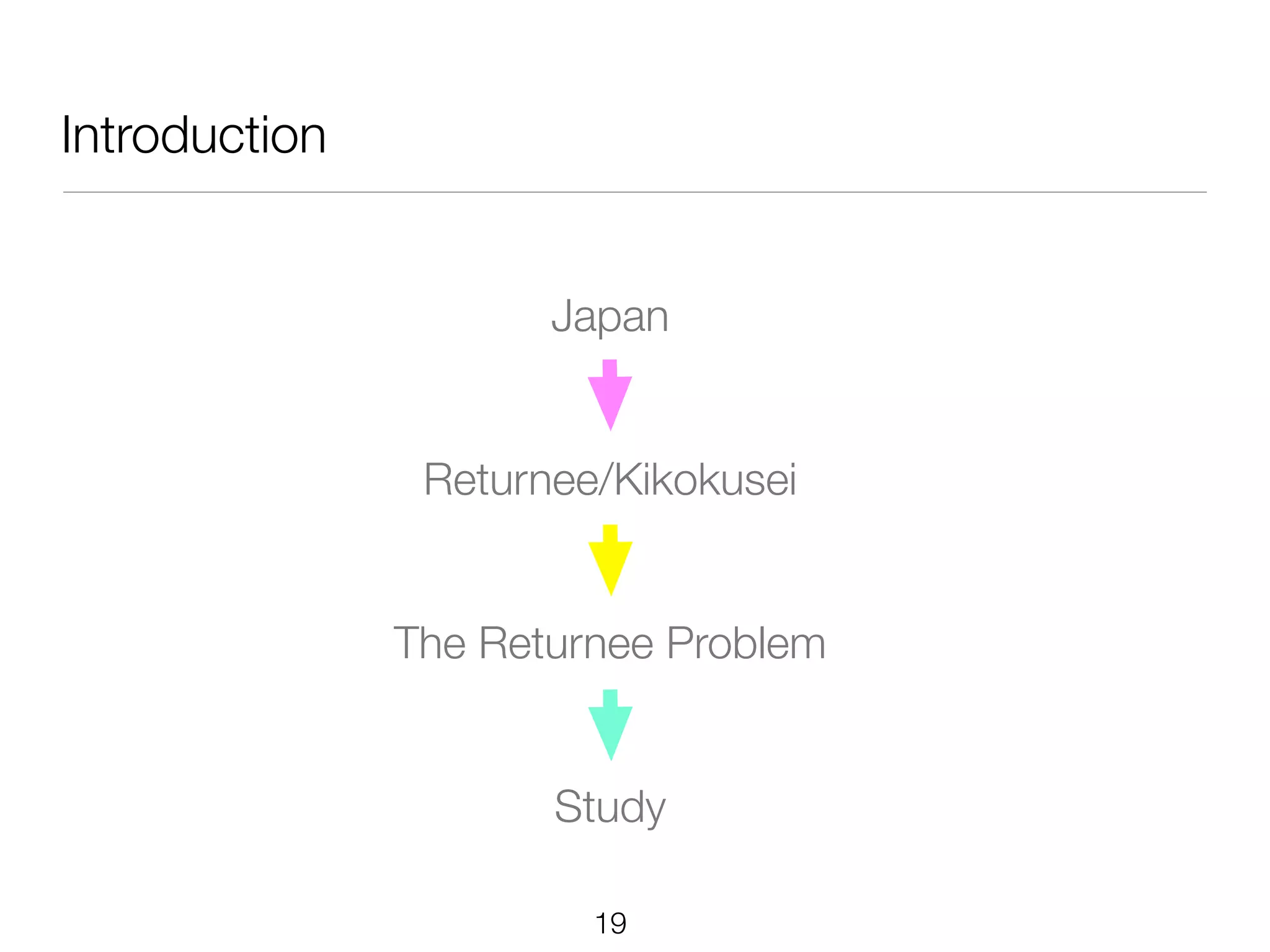
Introduction


                      Japan


                Returnee/Kikokusei


               The Returnee Problem


                      Study

                        19
Japan

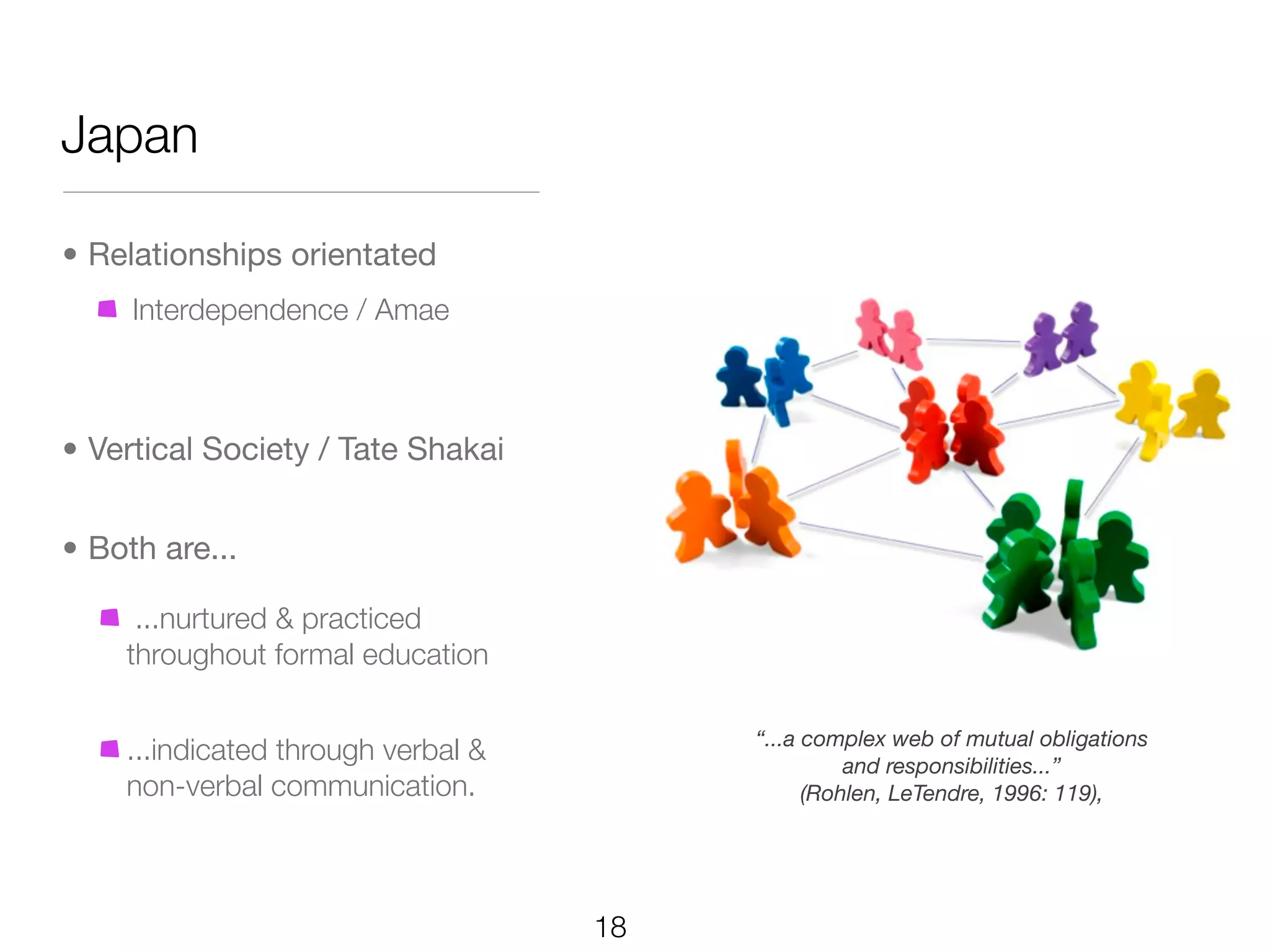
• Relationships orientated
     Interdependence / Amae


• Vertical Society / Tate Shakai


• Both are...

     ...nurtured & practiced
    throughout formal education

                                         “...a complex web of mutual obligations
    ...indicated through verbal &                  and responsibilities...”
    non-verbal communication.                  (Rohlen, LeTendre, 1996: 119),


                                    18
Japan
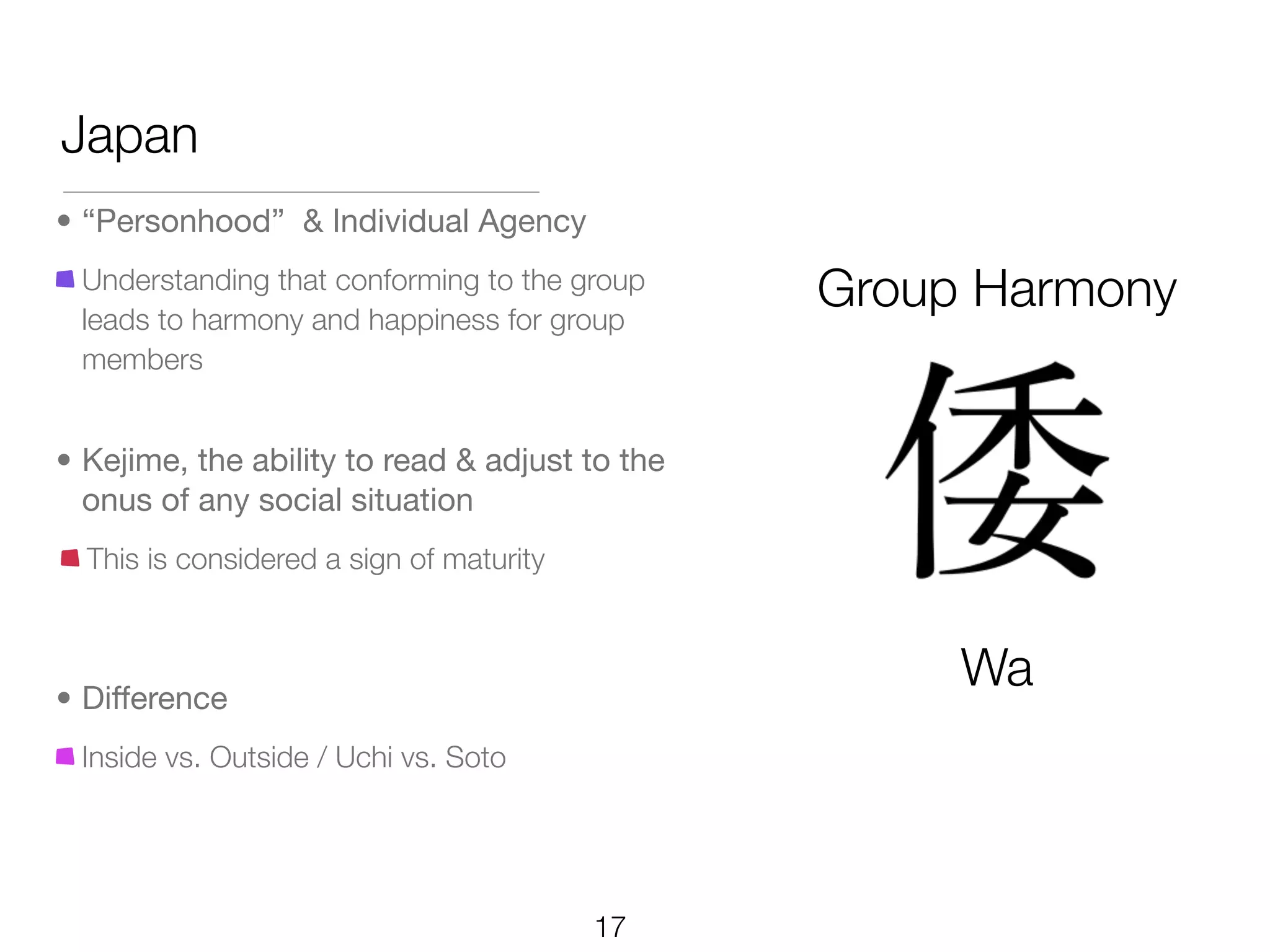
• “Personhood” & Individual Agency
 Understanding that conforming to the group
 leads to harmony and happiness for group
                                                Group Harmony
 members


• Kejime, the ability to read & adjust to the
  onus of any social situation
  This is considered a sign of maturity


• Difference
                                                     Wa
 Inside vs. Outside / Uchi vs. Soto


                                          17
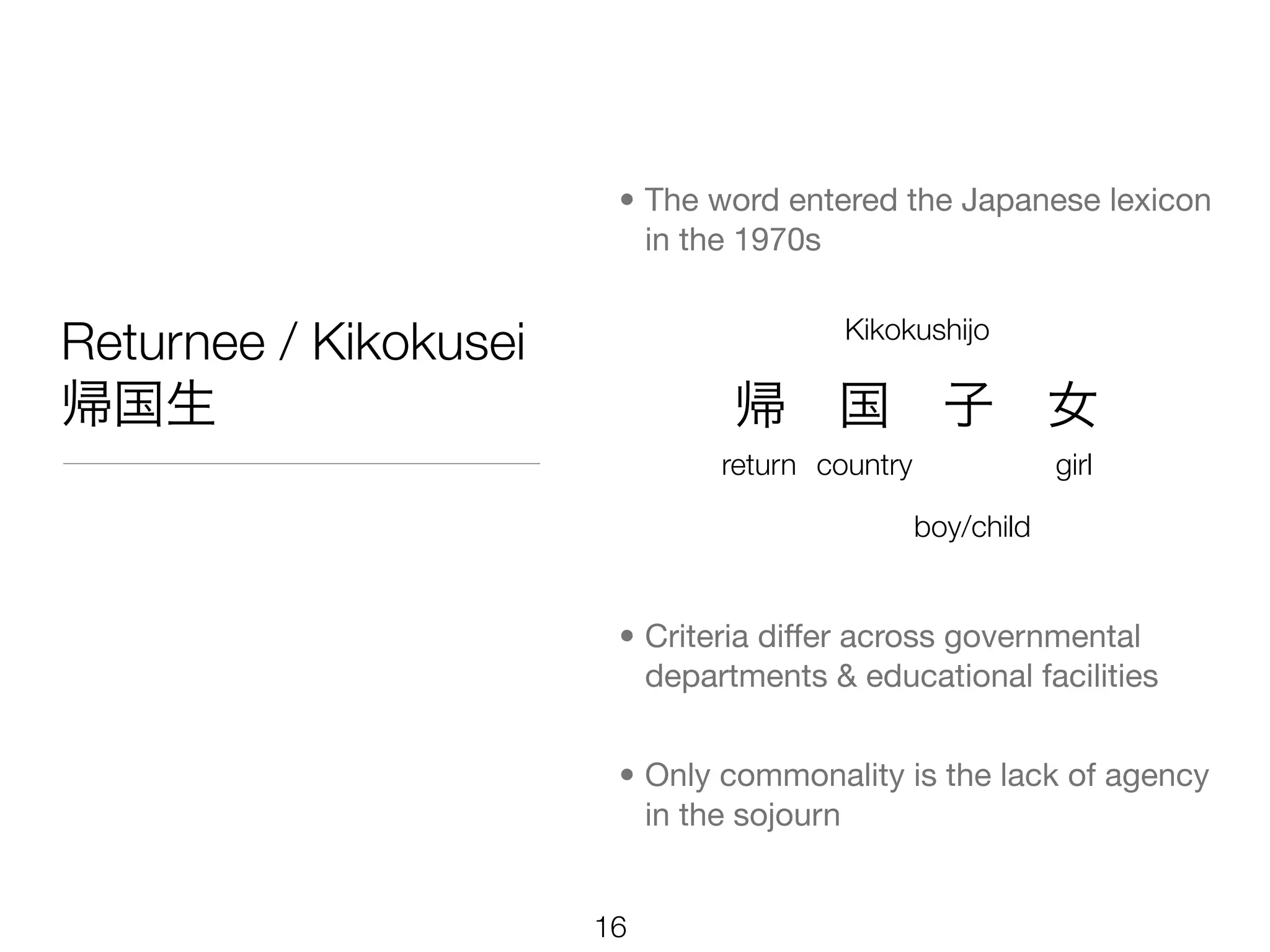
• The word entered the Japanese lexicon
                          in the 1970s


Returnee / Kikokusei                    Kikokushijo

帰国生                             帰 国 子 女
                               return country               girl

                                                boy/child


                        • Criteria differ across governmental
                          departments & educational facilities


                        • Only commonality is the lack of agency
                          in the sojourn


                       16
Returnee / Kikokusei
帰国生

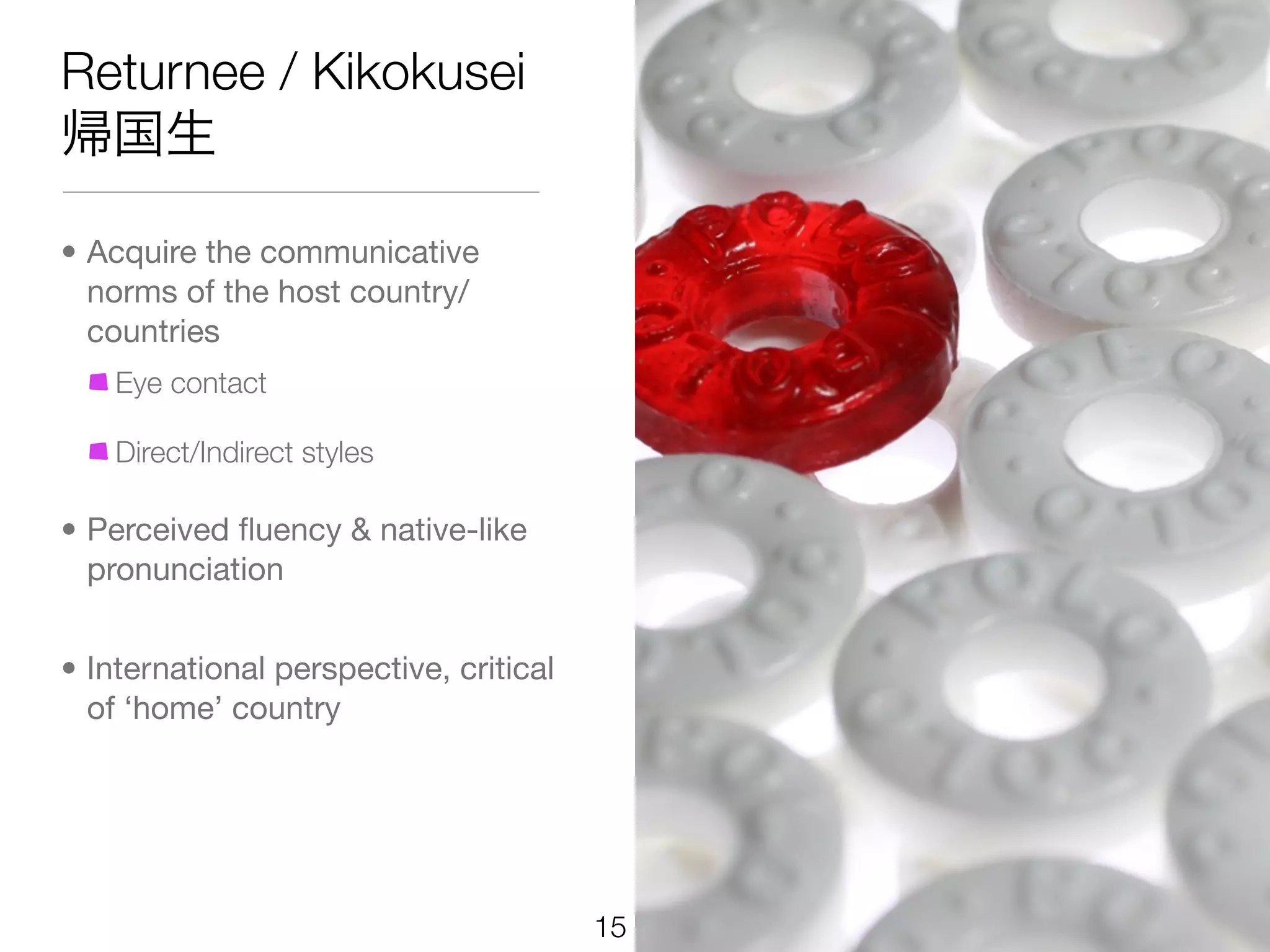
• Acquire the communicative
  norms of the host country/
  countries
    Eye contact

    Direct/Indirect styles

• Perceived fluency & native-like
  pronunciation


• International perspective, critical
  of ‘home’ country


                                        15
The Returnee Problem /
帰国生 問題
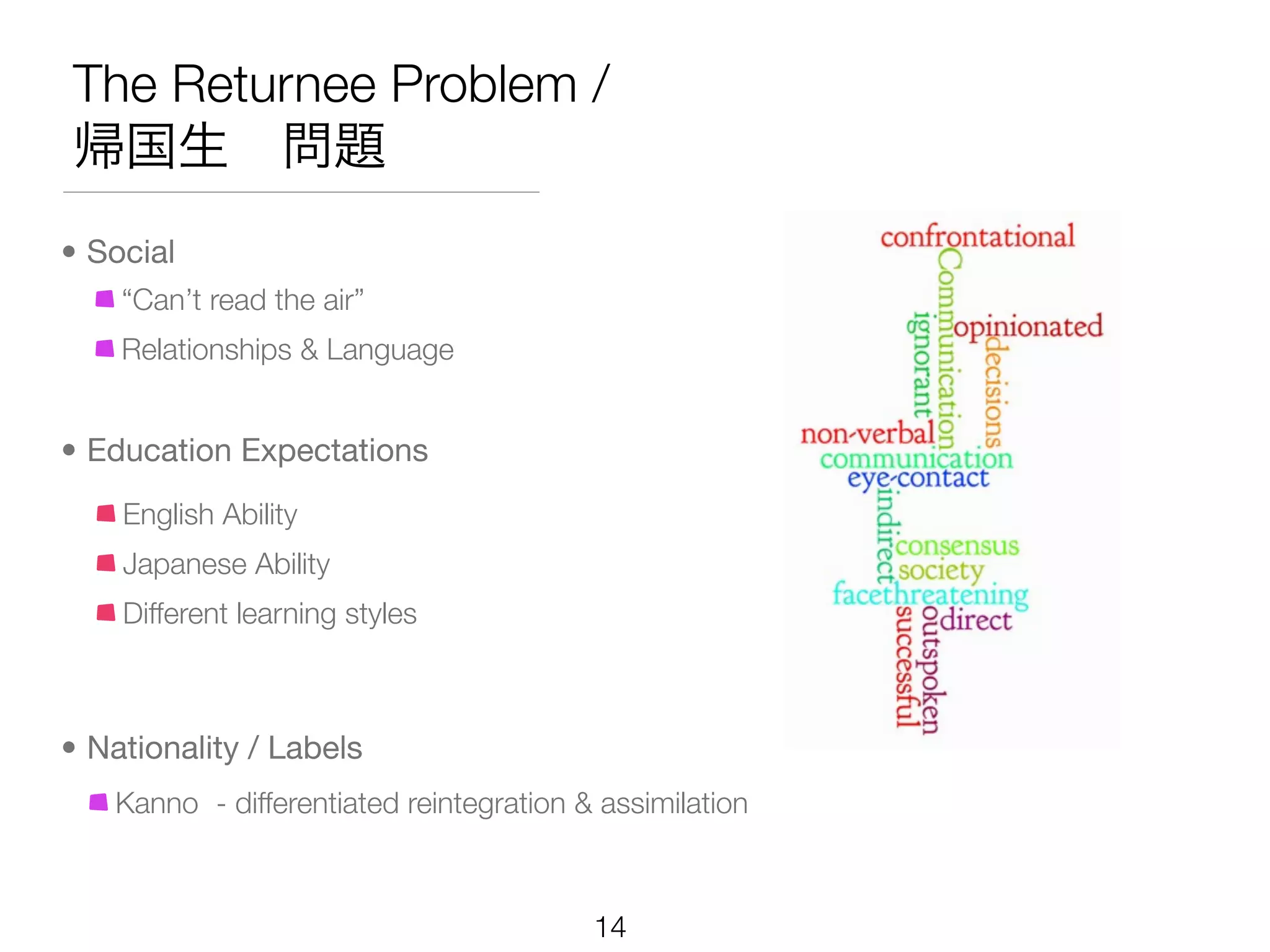
• Social
    “Can’t read the air”
    Relationships & Language


• Education Expectations
    English Ability
    Japanese Ability
    Different learning styles


• Nationality / Labels
   Kanno - differentiated reintegration & assimilation


                                         14
The Returnee Problem /
帰国生 問題

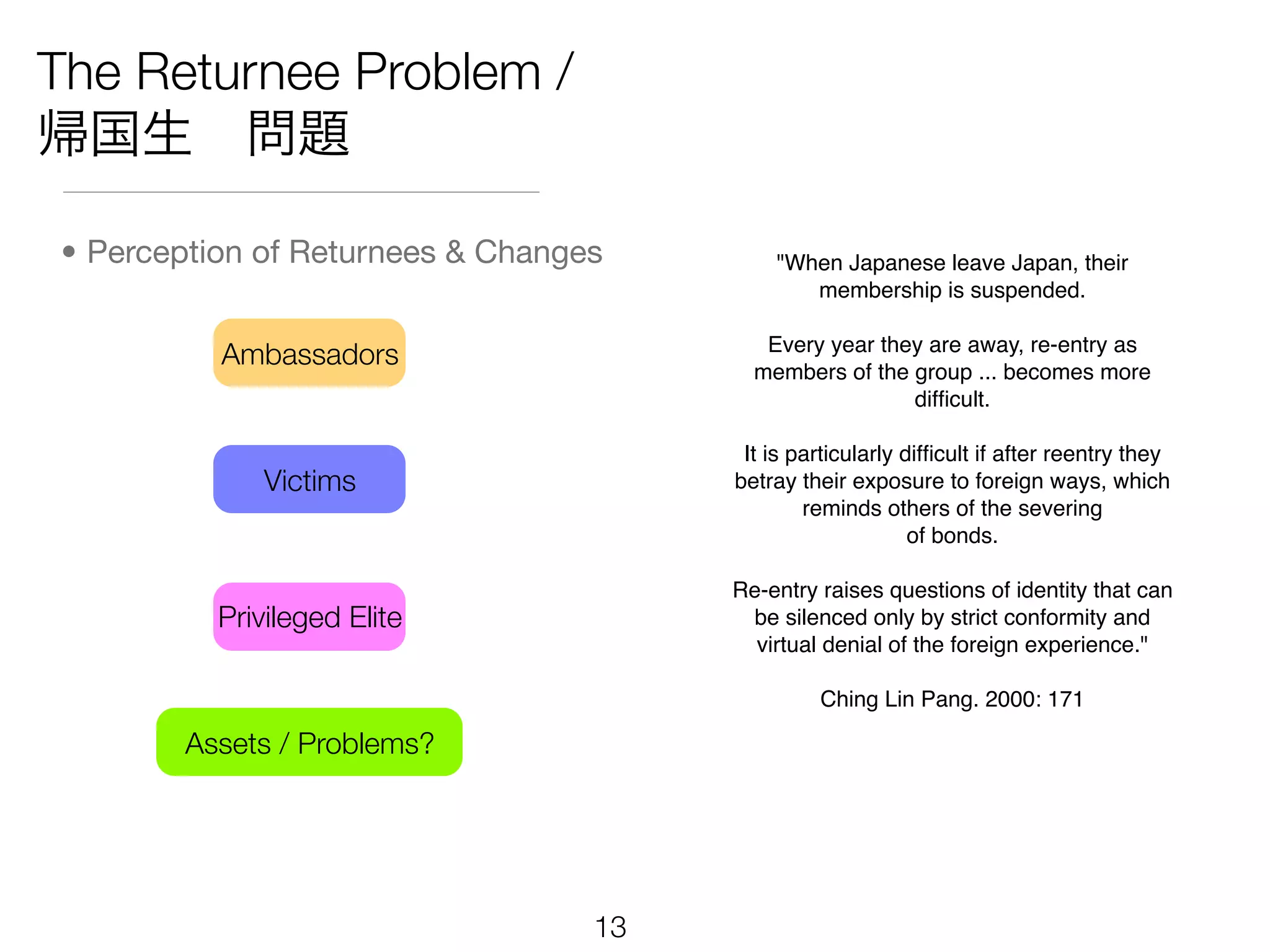
• Perception of Returnees & Changes        "When Japanese leave Japan, their
                                              membership is suspended.

                                          Every year they are away, re-entry as
          Ambassadors                    members of the group ... becomes more
                                                        difficult.

                                        It is particularly difficult if after reentry they
             Victims                   betray their exposure to foreign ways, which
                                               reminds others of the severing
                                                            of bonds.

                                       Re-entry raises questions of identity that can
          Privileged Elite              be silenced only by strict conformity and
                                         virtual denial of the foreign experience."

                                                Ching Lin Pang. 2000: 171

        Assets / Problems?


                                  13
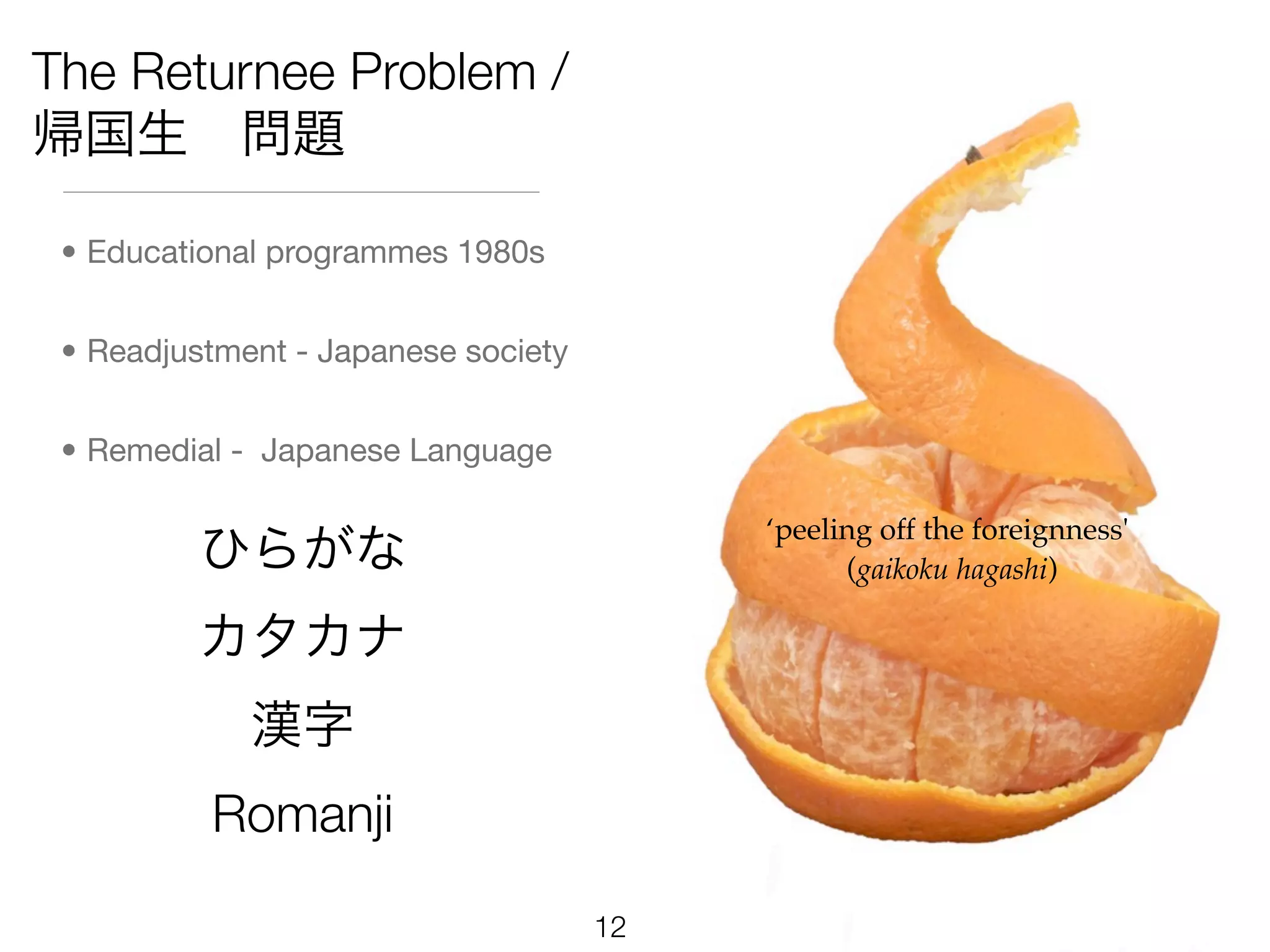
The Returnee Problem /
帰国生 問題

 • Educational programmes 1980s


 • Readjustment - Japanese society


 • Remedial - Japanese Language

                                          ‘peeling off the foreignness'
         ひらがな                                   (gaikoku hagashi)

         カタカナ
             漢字
          Romanji

                                     12
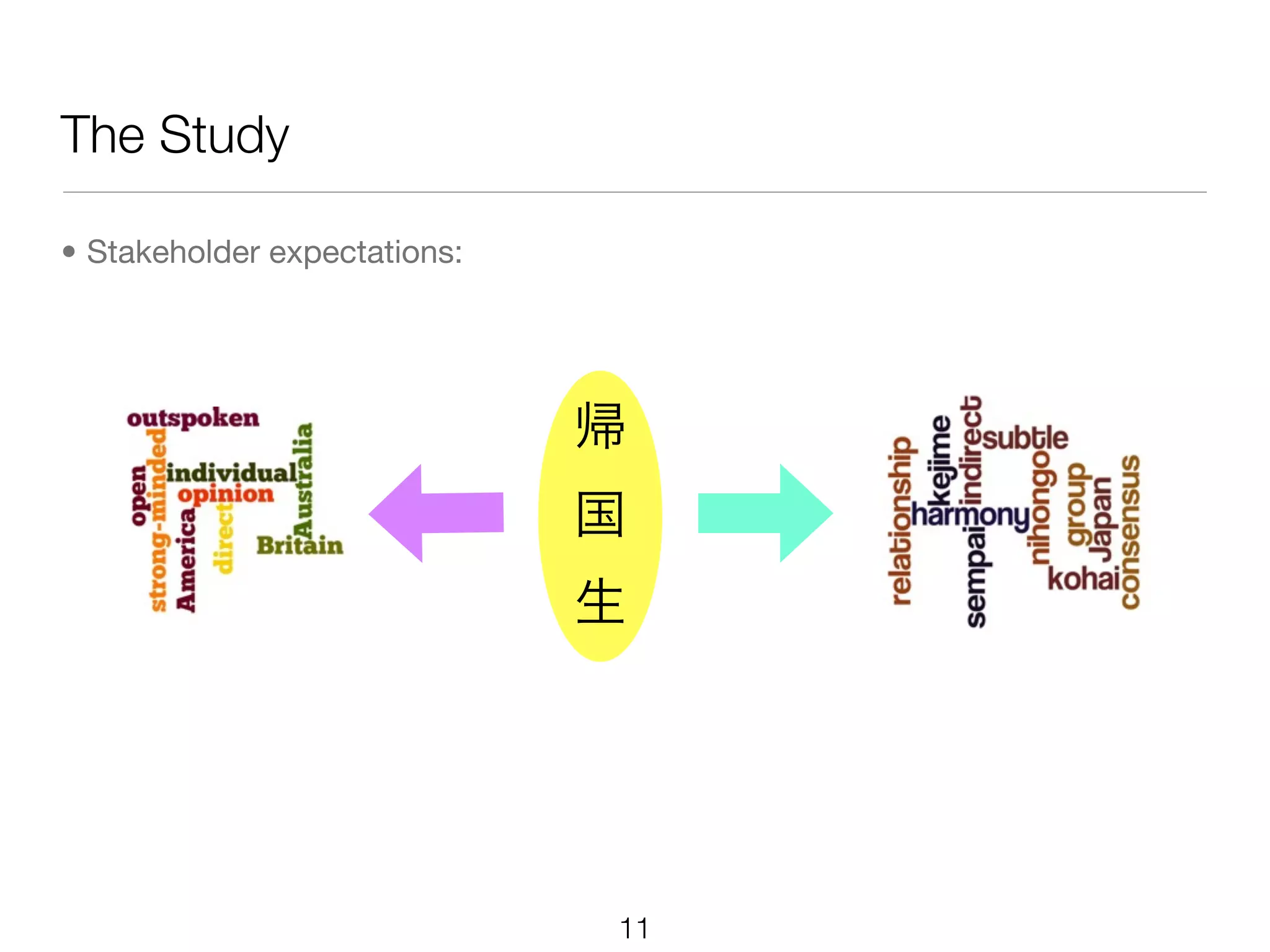
The Study

• Stakeholder expectations:


                              帰
                              国
                              生


                              11
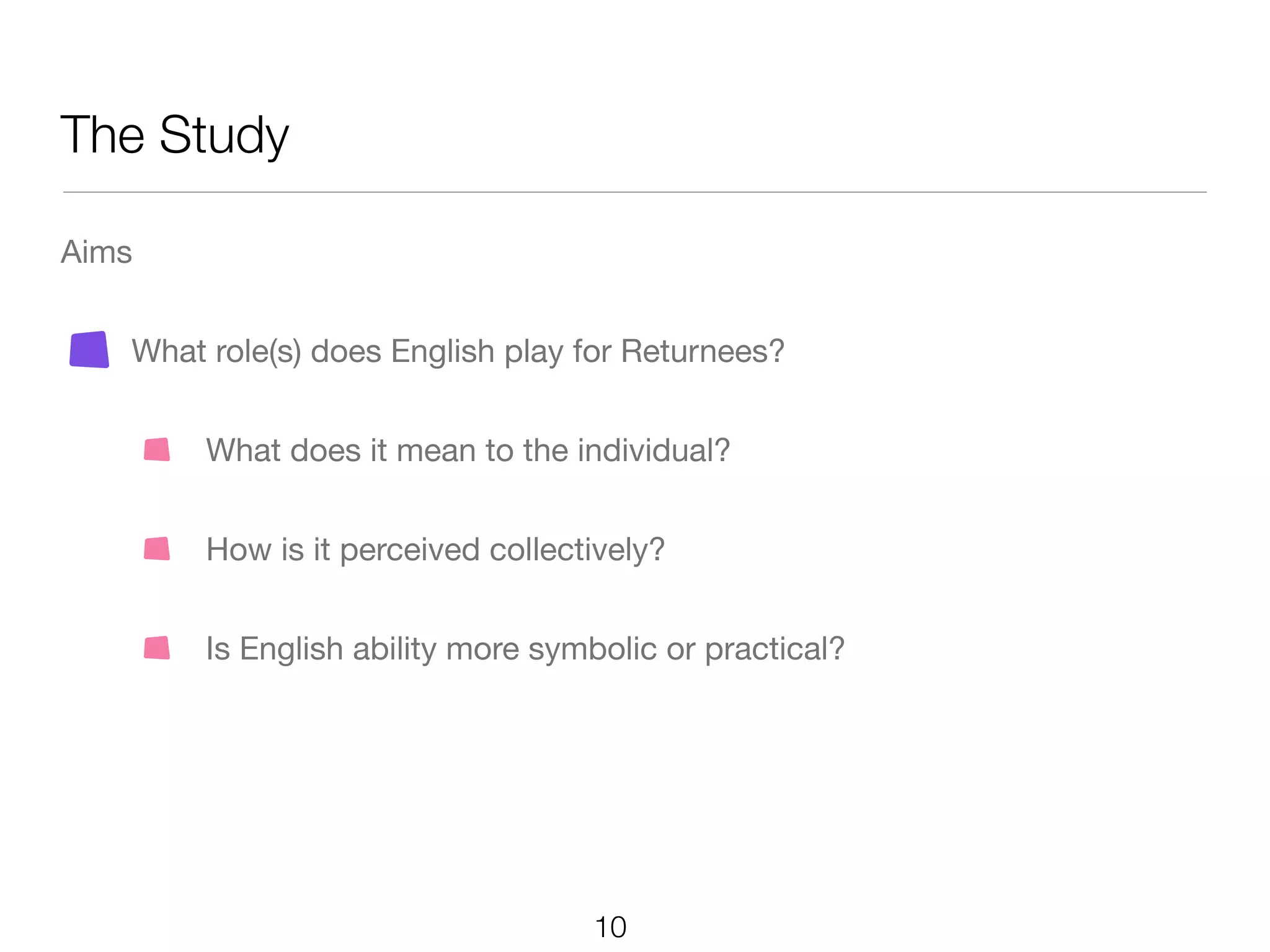
The Study

Aims


   What role(s) does English play for Returnees?


        What does it mean to the individual?


        How is it perceived collectively?


        Is English ability more symbolic or practical?


                                   10
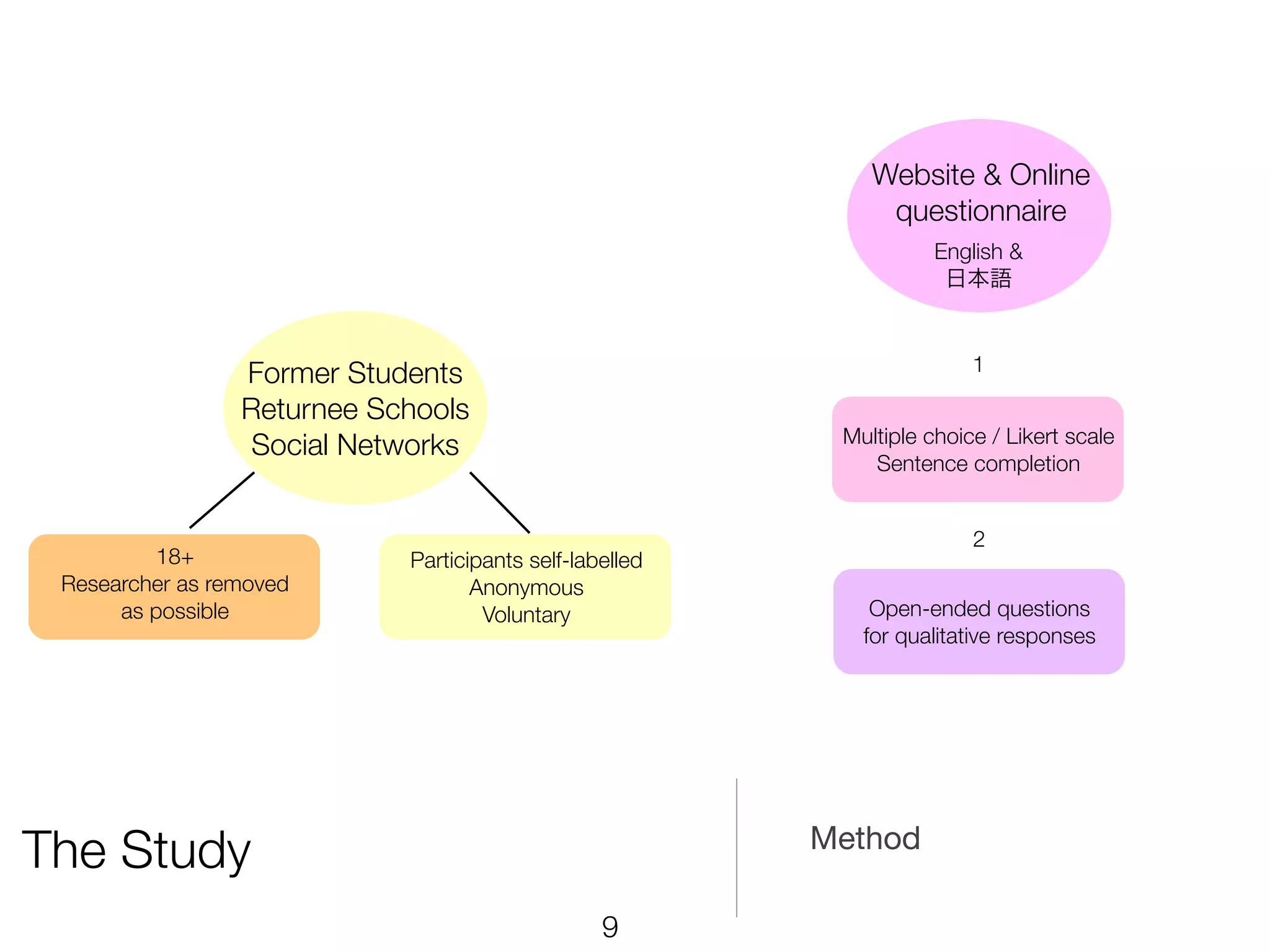
Website & Online
                                                              questionnaire
                                                                    English &
                                                                     日本語


                                                                        1
                 Former Students
                 Returnee Schools
                                                          Multiple choice / Likert scale
                  Social Networks
                                                             Sentence completion


                                                                        2
         18+                Participants self-labelled
 Researcher as removed             Anonymous
      as possible                   Voluntary                Open-ended questions
                                                            for qualitative responses


The Study                                                Method

                                                 9
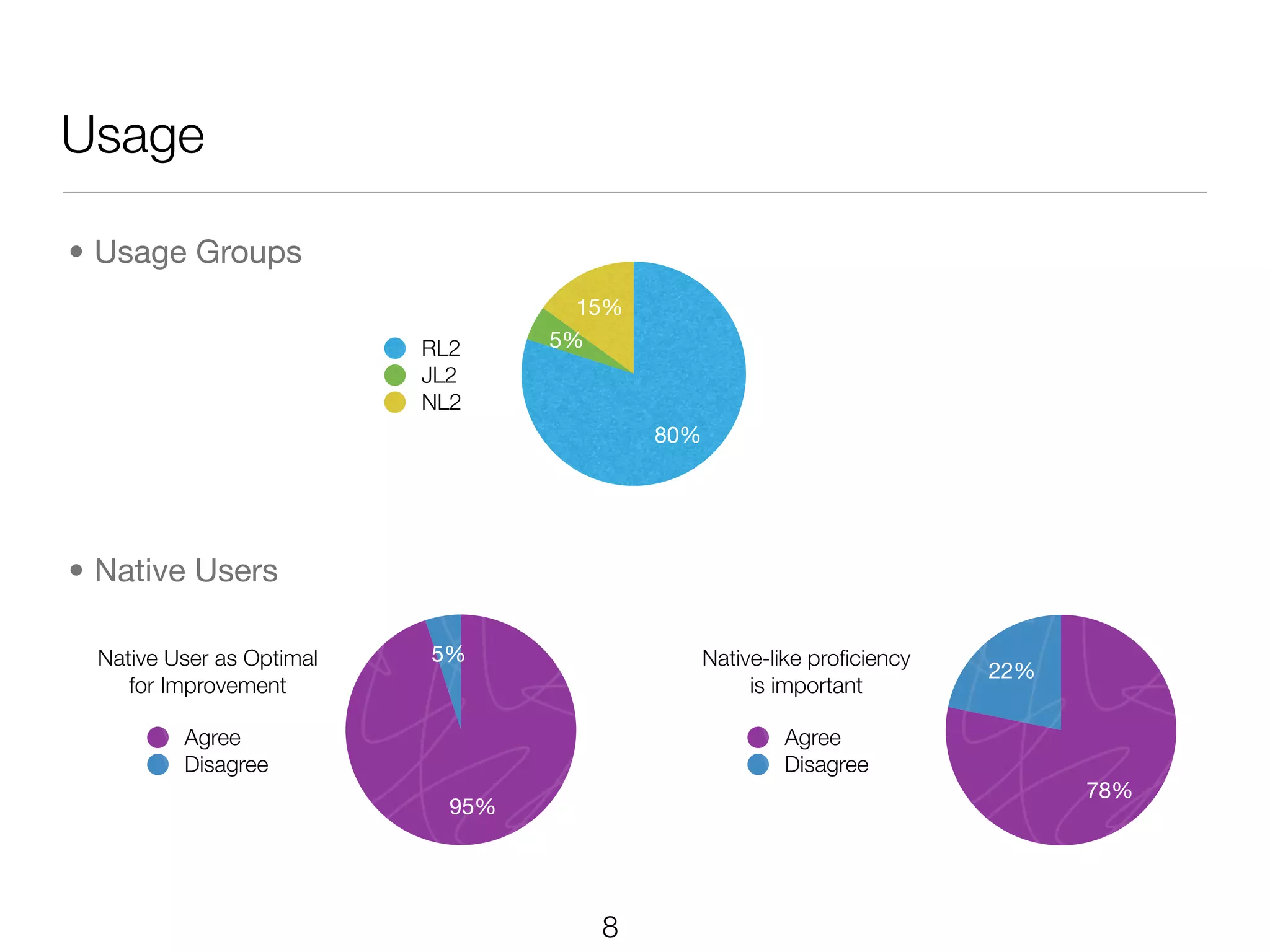
Usage

• Usage Groups
                                    15%
                          RL2     5%
                          JL2
                          NL2
                                          80%


• Native Users

 Native User as Optimal   5%                    Native-like proficiency
                                                                         22%
    for Improvement                                  is important

         Agree                                          Agree
         Disagree                                       Disagree
                                                                               78%
                            95%


                                     8
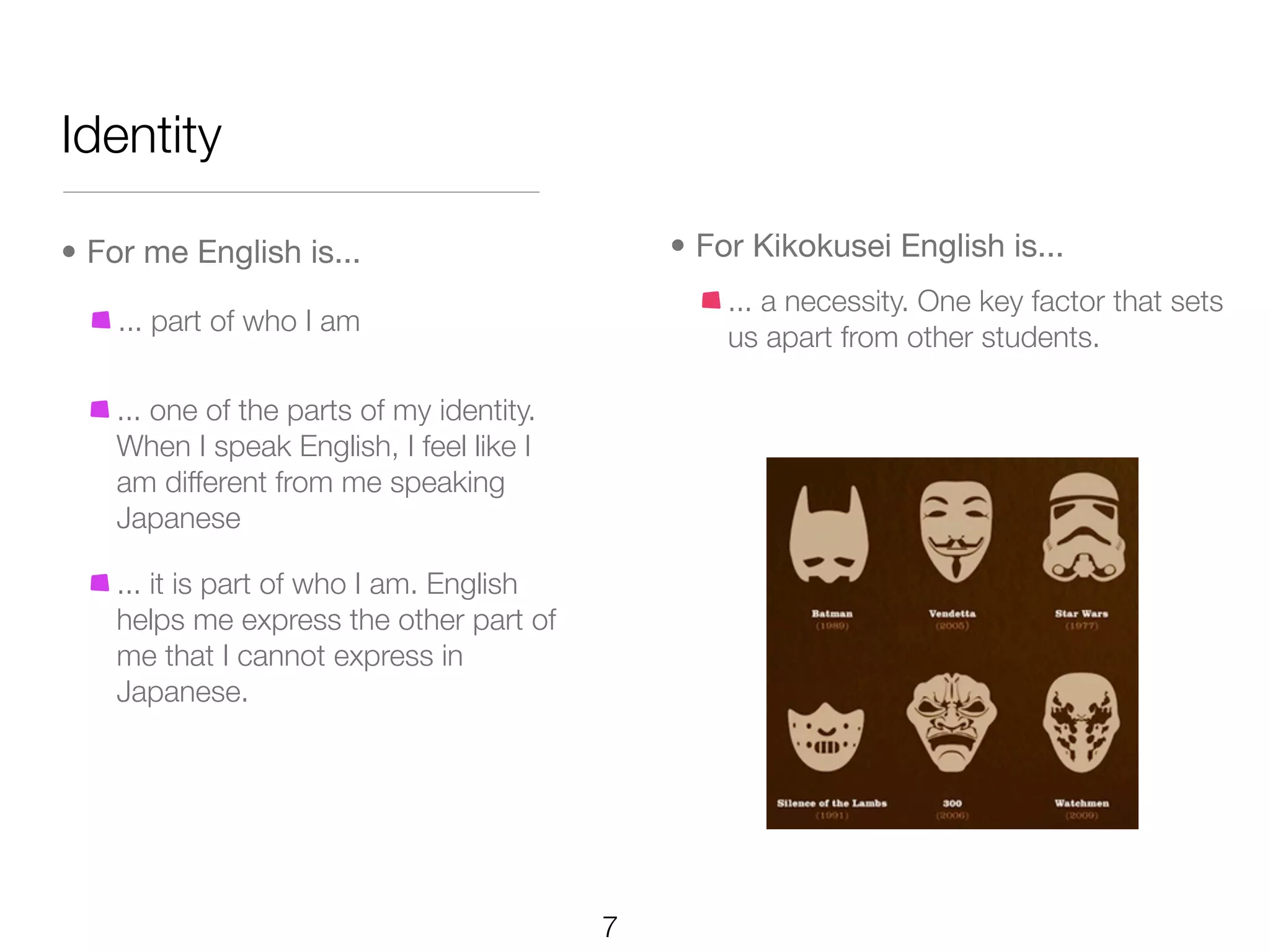
Identity

• For me English is...                         • For Kikokusei English is...
                                                   ... a necessity. One key factor that sets
    ... part of who I am
                                                   us apart from other students.

    ... one of the parts of my identity.
    When I speak English, I feel like I
    am different from me speaking
    Japanese

    ... it is part of who I am. English
    helps me express the other part of
    me that I cannot express in
    Japanese.


                                           7
Internationalism & Transformation

• For me English is...


        ... a thing that connects me with other cultures.


        ... a language that completely changed my life by letting me see the whole
        wide world.


        ... a language tool and something which keeps me international than being
        national. Whenever I speak English, it is a great chance to express my
        ideas which could not be expressed in my mother-tongue


                                          6
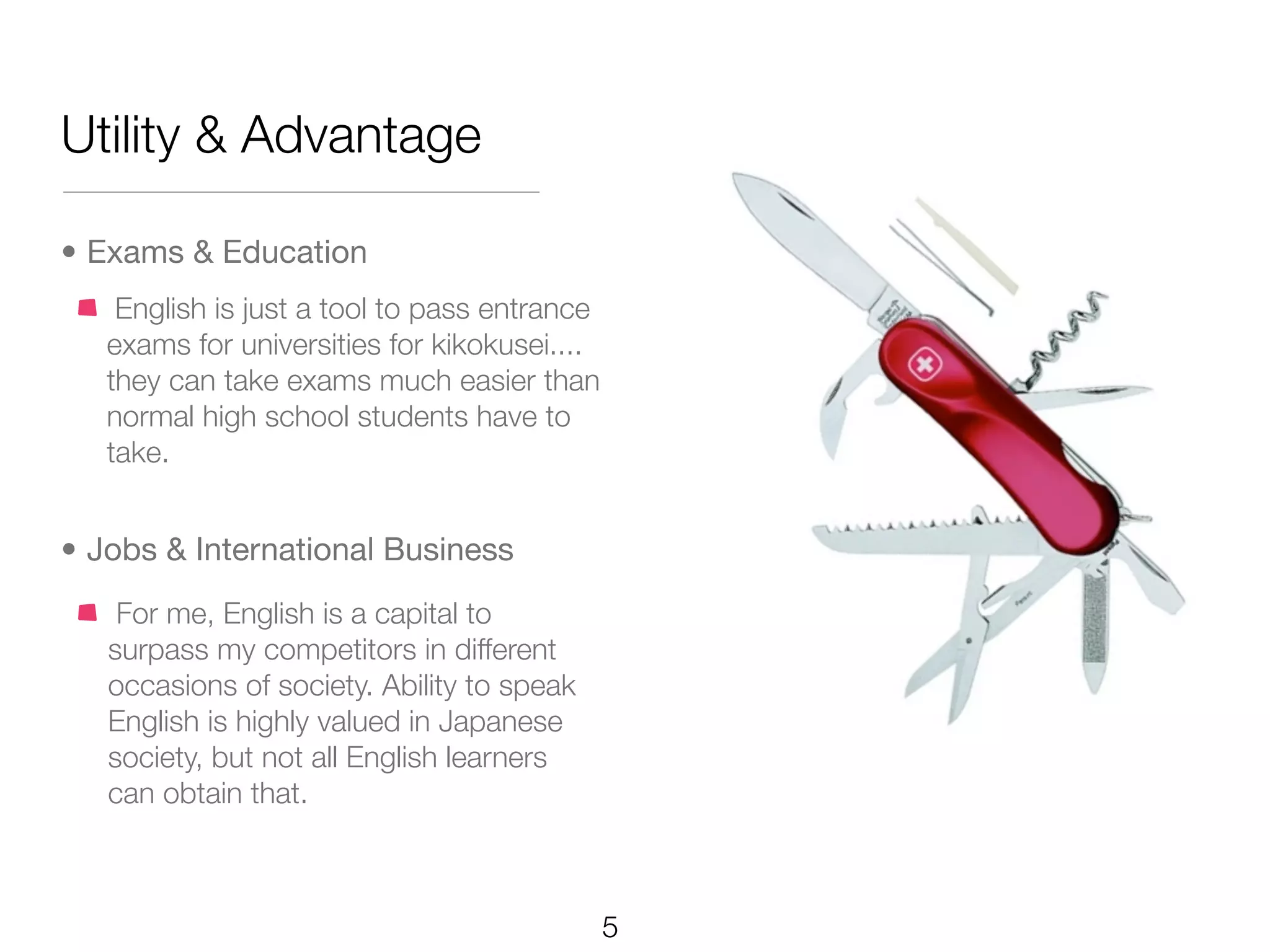
Utility & Advantage

• Exams & Education
    English is just a tool to pass entrance
   exams for universities for kikokusei....
   they can take exams much easier than
   normal high school students have to
   take.


• Jobs & International Business
    For me, English is a capital to
   surpass my competitors in different
   occasions of society. Ability to speak
   English is highly valued in Japanese
   society, but not all English learners
   can obtain that.


                                              5
Identity Maintenance

• Returnees have their identity constantly challenged.


• Dichotomised notions of identity are misplaced & detrimental.


• Their identity is unique as Kikokusei (Sasagawa, Toyoda & Sakano).


• Accuracy of language vs. Intra-language, code-switching, code-mixing


                                     4
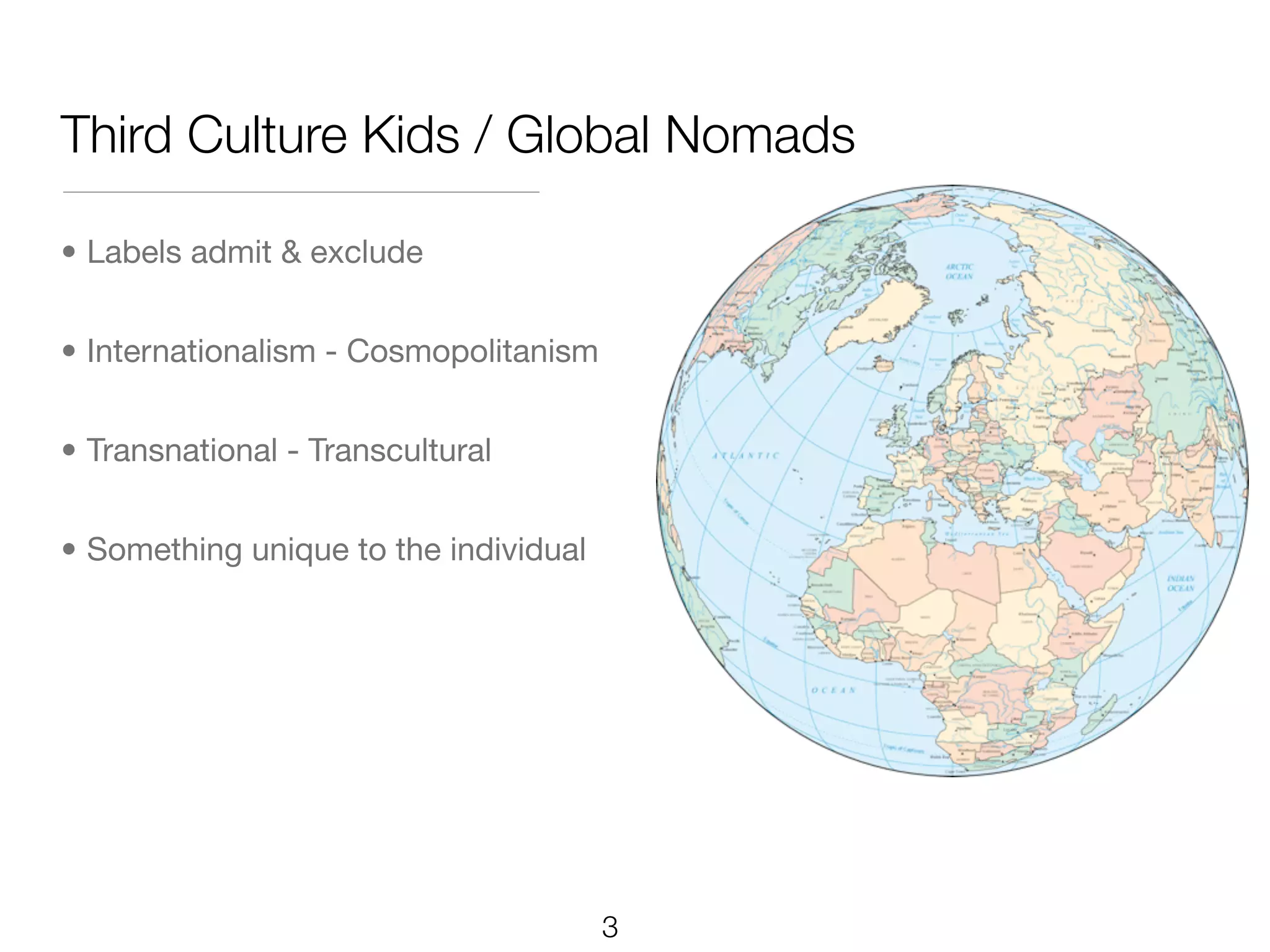
Third Culture Kids / Global Nomads

• Labels admit & exclude


• Internationalism - Cosmopolitanism


• Transnational - Transcultural


• Something unique to the individual


                                       3
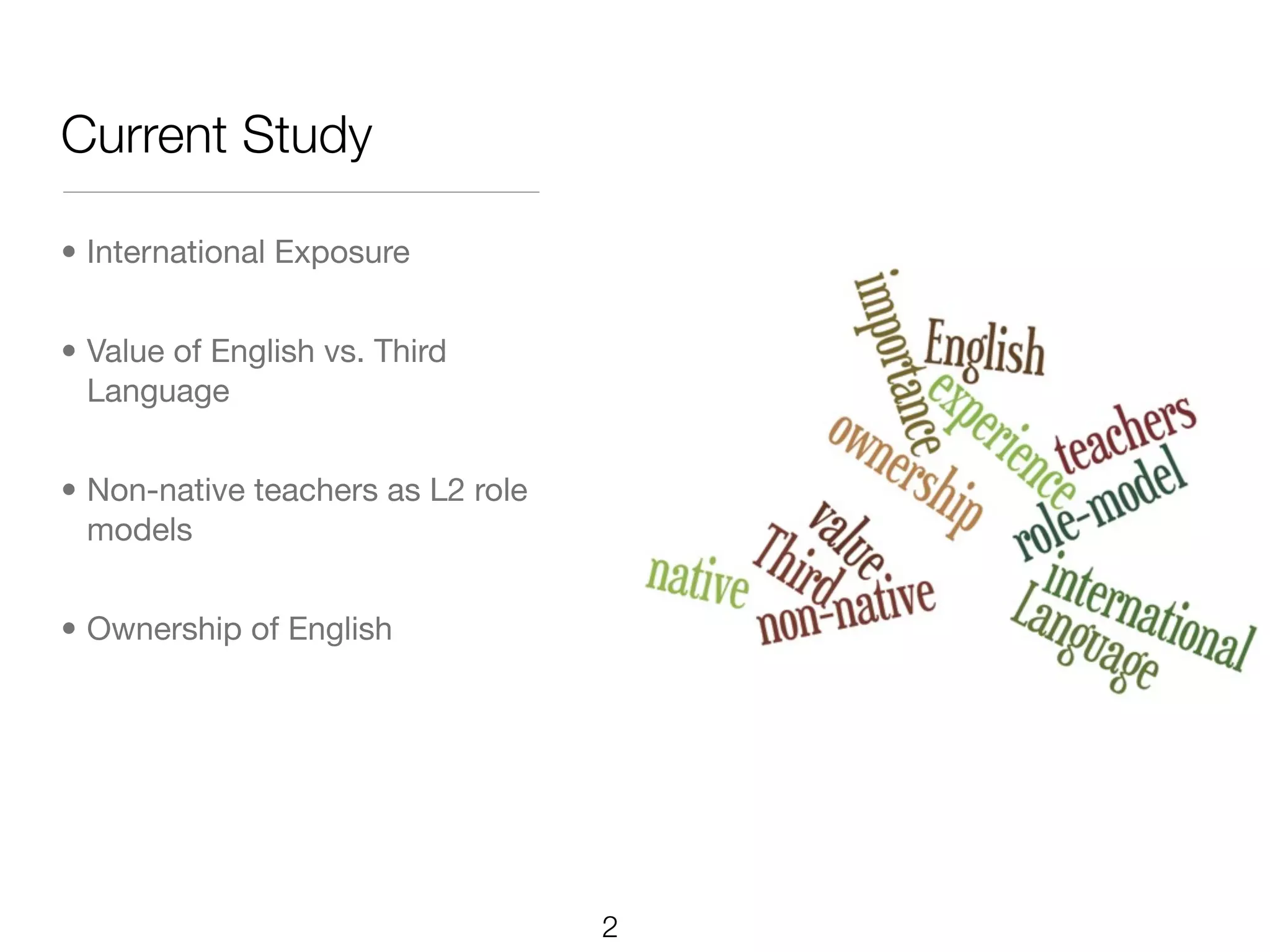
Current Study

• International Exposure


• Value of English vs. Third
  Language


• Non-native teachers as L2 role
  models


• Ownership of English


                                   2
Thank you for listening.
                              carol-b@kanda.kuis.ac.jp


                                         References:
Ching Lin Pang., 2000. Negotiating Identity in Contemporary Japan: The Case of Kikokushijo. London:
Kegan Paul International.
Kanno, Y., 2000. Bilingualism and Identity: Stories of Japanese Returnees. International Journal of Bilingual
Education and Bilingualism. Volume 3:1, pp. 1 - 18.
Kanno, Y., 2002. The Development of Bicultural Identities: Japanese Returnees' Experiences. The Language
Teacher. Vol. 6
Kanno, Y., 2003. Negotiating Bilingual and Bicultural Identities: Japanese Returnees Betwixt Two Worlds.
University of Washington: Washington
Rohlen, T P., LeTendre, G K., Eds. 1996. Learning and Teaching in Japan. United States of America:
Cambridge University Press.
Sasagawa, S., Toyoda, H., Sakano, Y., 2006. The Acquisition of Cultural Values in Japanese Returnee
Students. International Journal of Intercultural Relations. Vol. 30. pp. 333-343.


                                                   1

(Re)imagining return migration modern kikokusei

  • 1.
    The Modern Kikokusei. ReturneeExperience & Returnee English Usage In Japan. (Re-)Imagining ‘Return Migration’: Language, Concepts & Contexts. RGS - IBG Annual International Conference 2011. Carol Begg Kanda University of International Studies carol-b@kanda.kuis.ac.jp
  • 2.
    Introduction Japan Returnee/Kikokusei The Returnee Problem Study 19
  • 3.
    Japan • Relationships orientated Interdependence / Amae • Vertical Society / Tate Shakai • Both are... ...nurtured & practiced throughout formal education “...a complex web of mutual obligations ...indicated through verbal & and responsibilities...” non-verbal communication. (Rohlen, LeTendre, 1996: 119), 18
  • 4.
    Japan • “Personhood” &Individual Agency Understanding that conforming to the group leads to harmony and happiness for group Group Harmony members • Kejime, the ability to read & adjust to the onus of any social situation This is considered a sign of maturity • Difference Wa Inside vs. Outside / Uchi vs. Soto 17
  • 5.
    • The wordentered the Japanese lexicon in the 1970s Returnee / Kikokusei Kikokushijo 帰国生 帰 国 子 女 return country girl boy/child • Criteria differ across governmental departments & educational facilities • Only commonality is the lack of agency in the sojourn 16
  • 6.
    Returnee / Kikokusei 帰国生 •Acquire the communicative norms of the host country/ countries Eye contact Direct/Indirect styles • Perceived fluency & native-like pronunciation • International perspective, critical of ‘home’ country 15
  • 7.
    The Returnee Problem/ 帰国生 問題 • Social “Can’t read the air” Relationships & Language • Education Expectations English Ability Japanese Ability Different learning styles • Nationality / Labels Kanno - differentiated reintegration & assimilation 14
  • 8.
    The Returnee Problem/ 帰国生 問題 • Perception of Returnees & Changes "When Japanese leave Japan, their membership is suspended. Every year they are away, re-entry as Ambassadors members of the group ... becomes more difficult. It is particularly difficult if after reentry they Victims betray their exposure to foreign ways, which reminds others of the severing of bonds. Re-entry raises questions of identity that can Privileged Elite be silenced only by strict conformity and virtual denial of the foreign experience." Ching Lin Pang. 2000: 171 Assets / Problems? 13
  • 9.
    The Returnee Problem/ 帰国生 問題 • Educational programmes 1980s • Readjustment - Japanese society • Remedial - Japanese Language ‘peeling off the foreignness' ひらがな (gaikoku hagashi) カタカナ 漢字 Romanji 12
  • 10.
    The Study • Stakeholderexpectations: 帰 国 生 11
  • 11.
    The Study Aims What role(s) does English play for Returnees? What does it mean to the individual? How is it perceived collectively? Is English ability more symbolic or practical? 10
  • 12.
    Website & Online questionnaire English & 日本語 1 Former Students Returnee Schools Multiple choice / Likert scale Social Networks Sentence completion 2 18+ Participants self-labelled Researcher as removed Anonymous as possible Voluntary Open-ended questions for qualitative responses The Study Method 9
  • 13.
    Usage • Usage Groups 15% RL2 5% JL2 NL2 80% • Native Users Native User as Optimal 5% Native-like proficiency 22% for Improvement is important Agree Agree Disagree Disagree 78% 95% 8
  • 14.
    Identity • For meEnglish is... • For Kikokusei English is... ... a necessity. One key factor that sets ... part of who I am us apart from other students. ... one of the parts of my identity. When I speak English, I feel like I am different from me speaking Japanese ... it is part of who I am. English helps me express the other part of me that I cannot express in Japanese. 7
  • 15.
    Internationalism & Transformation •For me English is... ... a thing that connects me with other cultures. ... a language that completely changed my life by letting me see the whole wide world. ... a language tool and something which keeps me international than being national. Whenever I speak English, it is a great chance to express my ideas which could not be expressed in my mother-tongue 6
  • 16.
    Utility & Advantage •Exams & Education English is just a tool to pass entrance exams for universities for kikokusei.... they can take exams much easier than normal high school students have to take. • Jobs & International Business For me, English is a capital to surpass my competitors in different occasions of society. Ability to speak English is highly valued in Japanese society, but not all English learners can obtain that. 5
  • 17.
    Identity Maintenance • Returneeshave their identity constantly challenged. • Dichotomised notions of identity are misplaced & detrimental. • Their identity is unique as Kikokusei (Sasagawa, Toyoda & Sakano). • Accuracy of language vs. Intra-language, code-switching, code-mixing 4
  • 18.
    Third Culture Kids/ Global Nomads • Labels admit & exclude • Internationalism - Cosmopolitanism • Transnational - Transcultural • Something unique to the individual 3
  • 19.
    Current Study • InternationalExposure • Value of English vs. Third Language • Non-native teachers as L2 role models • Ownership of English 2
  • 20.
    Thank you forlistening. carol-b@kanda.kuis.ac.jp References: Ching Lin Pang., 2000. Negotiating Identity in Contemporary Japan: The Case of Kikokushijo. London: Kegan Paul International. Kanno, Y., 2000. Bilingualism and Identity: Stories of Japanese Returnees. International Journal of Bilingual Education and Bilingualism. Volume 3:1, pp. 1 - 18. Kanno, Y., 2002. The Development of Bicultural Identities: Japanese Returnees' Experiences. The Language Teacher. Vol. 6 Kanno, Y., 2003. Negotiating Bilingual and Bicultural Identities: Japanese Returnees Betwixt Two Worlds. University of Washington: Washington Rohlen, T P., LeTendre, G K., Eds. 1996. Learning and Teaching in Japan. United States of America: Cambridge University Press. Sasagawa, S., Toyoda, H., Sakano, Y., 2006. The Acquisition of Cultural Values in Japanese Returnee Students. International Journal of Intercultural Relations. Vol. 30. pp. 333-343. 1