Energy Rationing:  A Market-Based Approach  Luiz Maurer THE WORLD BANK - EWDEN Rome, October 6,  2003
No one likes to talk about power rationing   Most of the electric sector reforms omit this subject Perhaps because no one believes it is going to occur if reform is implemented Or perhaps because it is not perceived as “politically correct”, and may defeat the purpose of the entire reform  Not many countries have experience in implementing rationing measures
However, it is unavoidable - energy and/or capacity scarcity is becoming widespread   Chile - 1998  Ivory Coast, Ghana, Togo and Benin – 1998 Tanzania, Kenya - 2000 California – 2000 - 2001 Yugoslavia – 2000-2001 Norway – 2001, 2003 New Zealand – 2001 Russia – 2001 Brazil – 2001-2002 Dominican Republic – 2002-2003 Venezuela - 2002 Marahashtra - India – 2002
Objective of this presentation –  to discuss the case study of Brazil   Present nature and extent of the energy crisis in 2001-2002 Discuss how the government dealt with this crisis Assess consumer response and achievement of the initially stated conservation goals Evaluate other implications – economic, institutional, regulatory Discuss lessons learned that may be applied to other countries
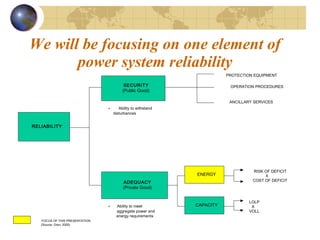
We will be focusing on one element of power system reliability RELIABILITY SECURITY (Public Good) ADEQUACY (Private Good) PROTECTION EQUIPMENT OPERATION PROCEDURES ANCILLARY SERVICES • Ability to withstand disturbances ENERGY CAPACITY RISK OF DEFICIT X COST OF DEFICIT LOLP X VOLL • Ability to meet  aggregate power and  energy requirements FOCUS OF THIS PRESENTATION (Source: Oren, 2000)
NATURE AND EXTENT OF THE BRAZILIAN ENERGY CRISIS IN 2001
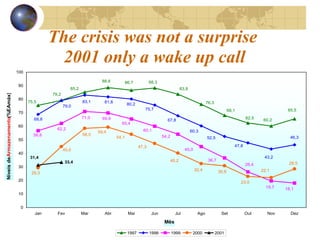
Nature and extent of the energy crisis in 2001 The most serious energy crisis in recent history Affecting 80% of the electric system, including the heavily industrialized and populated Southeast region Sector was “ energy constrained ” – hydro reservoirs were getting depleted at a very fast pace Reservoirs would be completely depleted in 4-5 months at the prevailing rate of consumption It was necessary to conserve 20-25% of historical energy consumption, at least for 8 months Some experience in the past in dealing with similar situations – but not to this extent and magnitude
The crisis was not a surprise   2001 only a wake up call
First and most important decision –How to implement rationing? Proposal I – “Rolling Black-Outs” or “Apagão” Geographical regions disconnected on a rotating basis, according to a pre-agreed schedule  Priority loads preserved – e.g. hospitals, police, etc. Apparent advantage – immediate implementation and 100% effectiveness Proposal II – “Quota System”  Allocate “quotas” to customers, taking into account historical consumption, and define saving targets = “baseline consumption” Enforcement for those who exceed the quota – financial penalty, threat of disconnection, or both Apparent disadvantages – complex, subject to complaints, demand elasticity was unknown – possibly jeopardizing overall effectiveness
Implementation of “rolling black-outs” would have been more complex than alleged Networks are inter-meshed  -  preserving “essential” customers would exclude part of the load from the rolling black-outs –up to 40%  Not a peak shaving issue -  significant “intra-day” load shift Those two factors would entail a disproportionate burden on some customers -- 10 to 16 hours/day !! Due to the manual nature of disconnection operations, it would have been very difficult to follow a precise timetable Lack of energy, even during short periods of time, would create social and economic chaos in certain areas Traffic lights and crime rates in large cities Hurting some manufacturing activities with continuous processes
Despite large number or supporters, “rolling black-outs” were overruled  A “quota” was set for each customer,  Based on a three-month average (or estimate) of 2000 consumption Differentiated by customer group Financial penalties for those who exceeded the quotas Bonuses for overachievers  Possibility given to large users to exchange quotas in the secondary market Penalties linked to the energy price at wholesale level Disconnection threat for those who did not meet targets
A quota system is not ideal – but it is certainly the best solution in a regulated world Quota itself sounds “interventionist” – and it is indeed  However, in a regulated world, prices are not allowed to fluctuate to convey the cost of scarcity  Which creates two distortions: Demand does not adjust itself when electricity becomes more scarce – otherwise mandatory rationing would not be necessary Gives a misleading impression that demand for this commodity is “inelastic” – in reality, regulation has muted the price signal If rationing becomes necessary, a sensible solution is to force customers to “see” marginal price for the consumption above those individual reduction targets
A quota system is a sensible solution, from an economic, legal, and technical standpoint   Economic  Cutting “across the board” – a very inefficient way to allocate a scarce resource whose willingness to pay vary within a wide range – from US$ 100 to 6,000/MWh With “quotas”, customers “see” the real cost of scarcity via prices, and make consumption and conservation decisions accordingly Legal By being based on real economics, price increases more defensible Technical No need to operate feeders, or reshuffle the network Some additional effort to handle customer complaints, disconnections, and public lightning
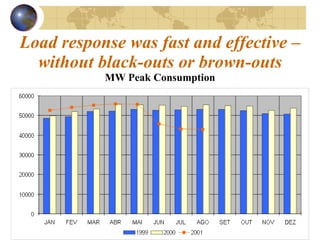
Load response was fast and effective – without black-outs or brown-outs MW Peak Consumption
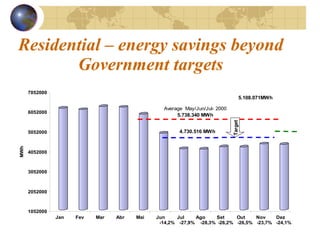
Significant energy savings were achieved Total savings = 26 TWh, 13,000 MW peak For a total national consumption of 284 TWh Results of PROCEL = National Conservation Program (1994-2000)  10.7 TWh 640 MW peak (2000) Savings continued after rationing measures ceased – overall 2002 consumption similar to 1998 levels Average residential = 1994 levels Industrial consumption grew 3.4% vis-à-vis 2001
Residential – energy savings beyond Government targets
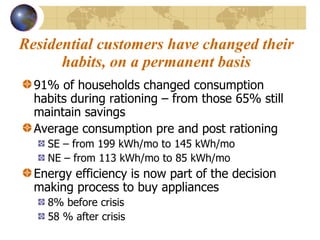
Residential customers have changed their habits, on a permanent basis 91% of households changed consumption habits during rationing – from those 65% still maintain savings Average consumption pre and post rationing SE – from 199 kWh/mo to 145 kWh/mo NE – from 113 kWh/mo to 85 kWh/mo Energy efficiency is now part of the decision making process to buy appliances 8% before crisis 58 % after crisis
IMPLICATIONS – ECONOMIC, INSTITUTIONAL, AND REGULATORY
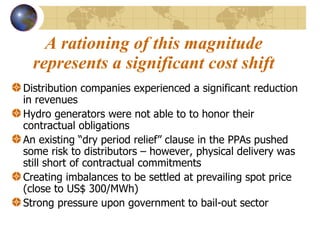
A rationing of this magnitude represents a significant cost shift Distribution companies experienced a significant reduction in revenues Hydro generators were not able to to honor their contractual obligations An existing “dry period relief” clause in the PPAs pushed some risk to distributors – however, physical delivery was still short of contractual commitments Creating imbalances to be settled at prevailing spot price (close to US$ 300/MWh)  Strong pressure upon government to bail-out sector
A rationing of this magnitude is a real strain for any institutional model   It is a combination of several factors, involving two supply and one demand shocks However, someone has to be blamed for the demise Such a visible and important event weakens institutions and their personnel, particularly those institutions in their infancy After the smoke cleared, there seems to be consensus that a half-away restructuring process was a major factor determining the difficulties faced by the electric sector
Economic impact was mitigated A significant economic impact was expected GDP reduction Unemployment Price increases Deterioration in the balance of trade Due to a well designed rationing scheme, none of these things materialized Quick and strong reaction from residential customers – more energy left for productive activities Mechanism of trading quotas helped improve energy allocation amongst industrial customers  Some industries  even benefited from rationing – e.g. capital goods, growing 13% A lot of room for rationalization and efficient usage became evident A very conservative estimate – scheme saved 1% of GDP
LESSONS LEARNED THAT MAY BE APPLIED TO OTHER GEOGRAPHIES
Important lessons can be drawn  from this case study … No excuses for Brazil getting into this situation  However, the country was able to implement a very effective rationing scheme Relying on economic/market signals – as opposed to more popular “rolling black-outs” With an dynamic coordination by the Civil House Minister throughout the entire process – a missing ingredient in some phases of the electric sector reform And an honest perception of crisis being transmitted  Contrary to some initial expectations, society became an ally Consumer behavior has changed on a permanent basis
Lessons may be applied, to varying degrees,  to other countries and situations Brazil was an “energy constrained” case – in some aspects, easier to handle than “capacity constrained” sectors  … Where market signals should be conveyed on a real time basis And real time pricing/metering rarely exists Brazil leveraged on a few market driven institutions in place  Wholesale market, albeit in its infancy Vested contracts with built in incentives for Discos to engage Some retail competition Some lessons need to be underscored Contrary to common wisdom, electricity was a commodity which rapidly responded to prices  Price signals were key to harness demand side opportunities Should the system be implemented on a permanent basis? – e.g. Fixed-Variable Tariffs for mass markets, creating some exposure?  Subject deserves further thinking and refinement
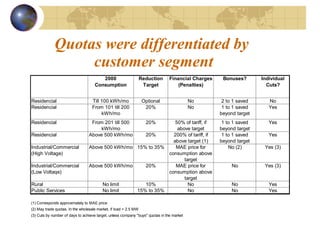
Quotas were differentiated by  customer segment

Regulatory Meeting - Rome 2003

  • 1.
    Energy Rationing: A Market-Based Approach Luiz Maurer THE WORLD BANK - EWDEN Rome, October 6, 2003
  • 2.
    No one likesto talk about power rationing   Most of the electric sector reforms omit this subject Perhaps because no one believes it is going to occur if reform is implemented Or perhaps because it is not perceived as “politically correct”, and may defeat the purpose of the entire reform Not many countries have experience in implementing rationing measures
  • 3.
    However, it isunavoidable - energy and/or capacity scarcity is becoming widespread Chile - 1998 Ivory Coast, Ghana, Togo and Benin – 1998 Tanzania, Kenya - 2000 California – 2000 - 2001 Yugoslavia – 2000-2001 Norway – 2001, 2003 New Zealand – 2001 Russia – 2001 Brazil – 2001-2002 Dominican Republic – 2002-2003 Venezuela - 2002 Marahashtra - India – 2002
  • 4.
    Objective of thispresentation – to discuss the case study of Brazil Present nature and extent of the energy crisis in 2001-2002 Discuss how the government dealt with this crisis Assess consumer response and achievement of the initially stated conservation goals Evaluate other implications – economic, institutional, regulatory Discuss lessons learned that may be applied to other countries
  • 5.
    We will befocusing on one element of power system reliability RELIABILITY SECURITY (Public Good) ADEQUACY (Private Good) PROTECTION EQUIPMENT OPERATION PROCEDURES ANCILLARY SERVICES • Ability to withstand disturbances ENERGY CAPACITY RISK OF DEFICIT X COST OF DEFICIT LOLP X VOLL • Ability to meet aggregate power and energy requirements FOCUS OF THIS PRESENTATION (Source: Oren, 2000)
  • 6.
    NATURE AND EXTENTOF THE BRAZILIAN ENERGY CRISIS IN 2001
  • 7.
    Nature and extentof the energy crisis in 2001 The most serious energy crisis in recent history Affecting 80% of the electric system, including the heavily industrialized and populated Southeast region Sector was “ energy constrained ” – hydro reservoirs were getting depleted at a very fast pace Reservoirs would be completely depleted in 4-5 months at the prevailing rate of consumption It was necessary to conserve 20-25% of historical energy consumption, at least for 8 months Some experience in the past in dealing with similar situations – but not to this extent and magnitude
  • 8.
    The crisis wasnot a surprise 2001 only a wake up call
  • 9.
    First and mostimportant decision –How to implement rationing? Proposal I – “Rolling Black-Outs” or “Apagão” Geographical regions disconnected on a rotating basis, according to a pre-agreed schedule Priority loads preserved – e.g. hospitals, police, etc. Apparent advantage – immediate implementation and 100% effectiveness Proposal II – “Quota System” Allocate “quotas” to customers, taking into account historical consumption, and define saving targets = “baseline consumption” Enforcement for those who exceed the quota – financial penalty, threat of disconnection, or both Apparent disadvantages – complex, subject to complaints, demand elasticity was unknown – possibly jeopardizing overall effectiveness
  • 10.
    Implementation of “rollingblack-outs” would have been more complex than alleged Networks are inter-meshed - preserving “essential” customers would exclude part of the load from the rolling black-outs –up to 40% Not a peak shaving issue - significant “intra-day” load shift Those two factors would entail a disproportionate burden on some customers -- 10 to 16 hours/day !! Due to the manual nature of disconnection operations, it would have been very difficult to follow a precise timetable Lack of energy, even during short periods of time, would create social and economic chaos in certain areas Traffic lights and crime rates in large cities Hurting some manufacturing activities with continuous processes
  • 11.
    Despite large numberor supporters, “rolling black-outs” were overruled A “quota” was set for each customer, Based on a three-month average (or estimate) of 2000 consumption Differentiated by customer group Financial penalties for those who exceeded the quotas Bonuses for overachievers Possibility given to large users to exchange quotas in the secondary market Penalties linked to the energy price at wholesale level Disconnection threat for those who did not meet targets
  • 12.
    A quota systemis not ideal – but it is certainly the best solution in a regulated world Quota itself sounds “interventionist” – and it is indeed However, in a regulated world, prices are not allowed to fluctuate to convey the cost of scarcity Which creates two distortions: Demand does not adjust itself when electricity becomes more scarce – otherwise mandatory rationing would not be necessary Gives a misleading impression that demand for this commodity is “inelastic” – in reality, regulation has muted the price signal If rationing becomes necessary, a sensible solution is to force customers to “see” marginal price for the consumption above those individual reduction targets
  • 13.
    A quota systemis a sensible solution, from an economic, legal, and technical standpoint Economic Cutting “across the board” – a very inefficient way to allocate a scarce resource whose willingness to pay vary within a wide range – from US$ 100 to 6,000/MWh With “quotas”, customers “see” the real cost of scarcity via prices, and make consumption and conservation decisions accordingly Legal By being based on real economics, price increases more defensible Technical No need to operate feeders, or reshuffle the network Some additional effort to handle customer complaints, disconnections, and public lightning
  • 14.
    Load response wasfast and effective – without black-outs or brown-outs MW Peak Consumption
  • 15.
    Significant energy savingswere achieved Total savings = 26 TWh, 13,000 MW peak For a total national consumption of 284 TWh Results of PROCEL = National Conservation Program (1994-2000) 10.7 TWh 640 MW peak (2000) Savings continued after rationing measures ceased – overall 2002 consumption similar to 1998 levels Average residential = 1994 levels Industrial consumption grew 3.4% vis-à-vis 2001
  • 16.
    Residential – energysavings beyond Government targets
  • 17.
    Residential customers havechanged their habits, on a permanent basis 91% of households changed consumption habits during rationing – from those 65% still maintain savings Average consumption pre and post rationing SE – from 199 kWh/mo to 145 kWh/mo NE – from 113 kWh/mo to 85 kWh/mo Energy efficiency is now part of the decision making process to buy appliances 8% before crisis 58 % after crisis
  • 18.
    IMPLICATIONS – ECONOMIC,INSTITUTIONAL, AND REGULATORY
  • 19.
    A rationing ofthis magnitude represents a significant cost shift Distribution companies experienced a significant reduction in revenues Hydro generators were not able to to honor their contractual obligations An existing “dry period relief” clause in the PPAs pushed some risk to distributors – however, physical delivery was still short of contractual commitments Creating imbalances to be settled at prevailing spot price (close to US$ 300/MWh) Strong pressure upon government to bail-out sector
  • 20.
    A rationing ofthis magnitude is a real strain for any institutional model It is a combination of several factors, involving two supply and one demand shocks However, someone has to be blamed for the demise Such a visible and important event weakens institutions and their personnel, particularly those institutions in their infancy After the smoke cleared, there seems to be consensus that a half-away restructuring process was a major factor determining the difficulties faced by the electric sector
  • 21.
    Economic impact wasmitigated A significant economic impact was expected GDP reduction Unemployment Price increases Deterioration in the balance of trade Due to a well designed rationing scheme, none of these things materialized Quick and strong reaction from residential customers – more energy left for productive activities Mechanism of trading quotas helped improve energy allocation amongst industrial customers Some industries even benefited from rationing – e.g. capital goods, growing 13% A lot of room for rationalization and efficient usage became evident A very conservative estimate – scheme saved 1% of GDP
  • 22.
    LESSONS LEARNED THATMAY BE APPLIED TO OTHER GEOGRAPHIES
  • 23.
    Important lessons canbe drawn from this case study … No excuses for Brazil getting into this situation However, the country was able to implement a very effective rationing scheme Relying on economic/market signals – as opposed to more popular “rolling black-outs” With an dynamic coordination by the Civil House Minister throughout the entire process – a missing ingredient in some phases of the electric sector reform And an honest perception of crisis being transmitted Contrary to some initial expectations, society became an ally Consumer behavior has changed on a permanent basis
  • 24.
    Lessons may beapplied, to varying degrees, to other countries and situations Brazil was an “energy constrained” case – in some aspects, easier to handle than “capacity constrained” sectors … Where market signals should be conveyed on a real time basis And real time pricing/metering rarely exists Brazil leveraged on a few market driven institutions in place Wholesale market, albeit in its infancy Vested contracts with built in incentives for Discos to engage Some retail competition Some lessons need to be underscored Contrary to common wisdom, electricity was a commodity which rapidly responded to prices Price signals were key to harness demand side opportunities Should the system be implemented on a permanent basis? – e.g. Fixed-Variable Tariffs for mass markets, creating some exposure? Subject deserves further thinking and refinement
  • 25.
    Quotas were differentiatedby customer segment