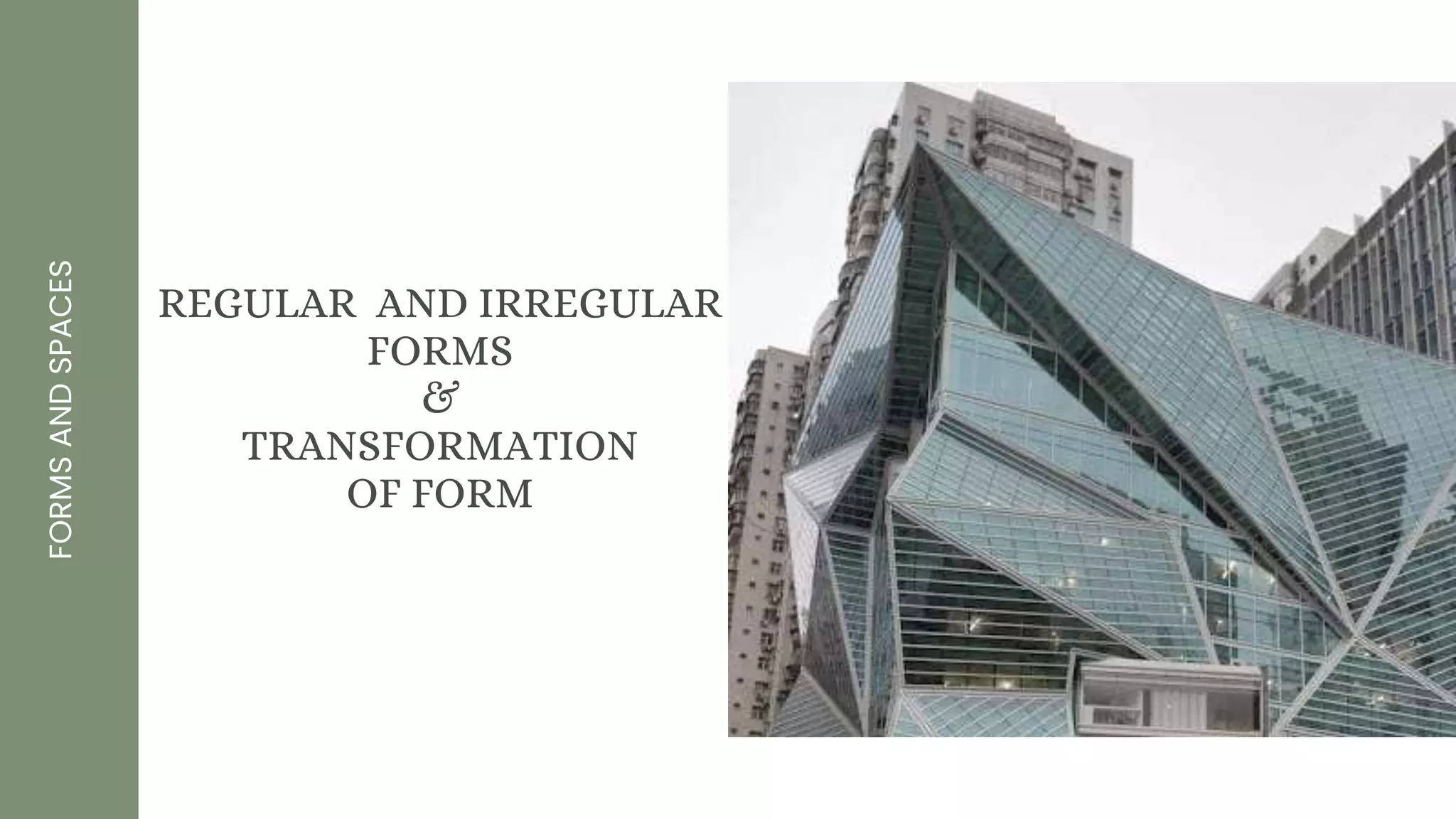
REGULAR AND IRREGULAR
FORMS
&
TRANSFORMATION
OF FORM
FORMS
AND
SPACES
SUBMITTED BY:- 1. Yashika Tharwani
2. Sakshi Sitpal
3. Jaykishan Mansoriya
4. Anshul Jotwani
5. Diya Lalwani
SUBMITTED TO:-
FORMS AND SPACES
ASSIGNMENT - II
ACAD INDORE
Ayushi Ma'am
REGULAR
FORMS
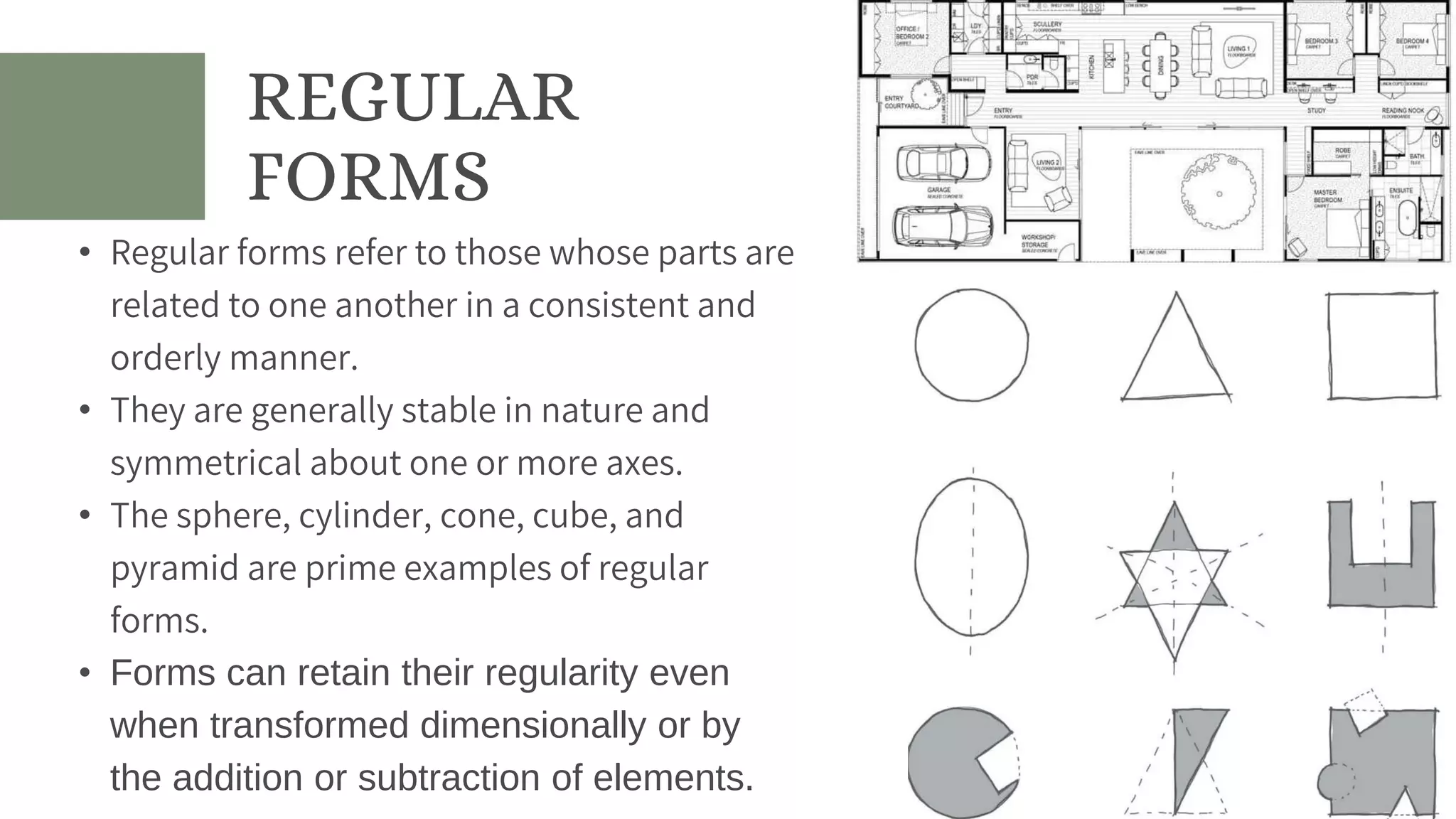
• Regular forms refer to those whose parts are
related to one another in a consistent and
orderly manner.
• They are generally stable in nature and
symmetrical about one or more axes.
• The sphere, cylinder, cone, cube, and
pyramid are prime examples of regular
forms.
• Forms can retain their regularity even
when transformed dimensionally or by
the addition or subtraction of elements.
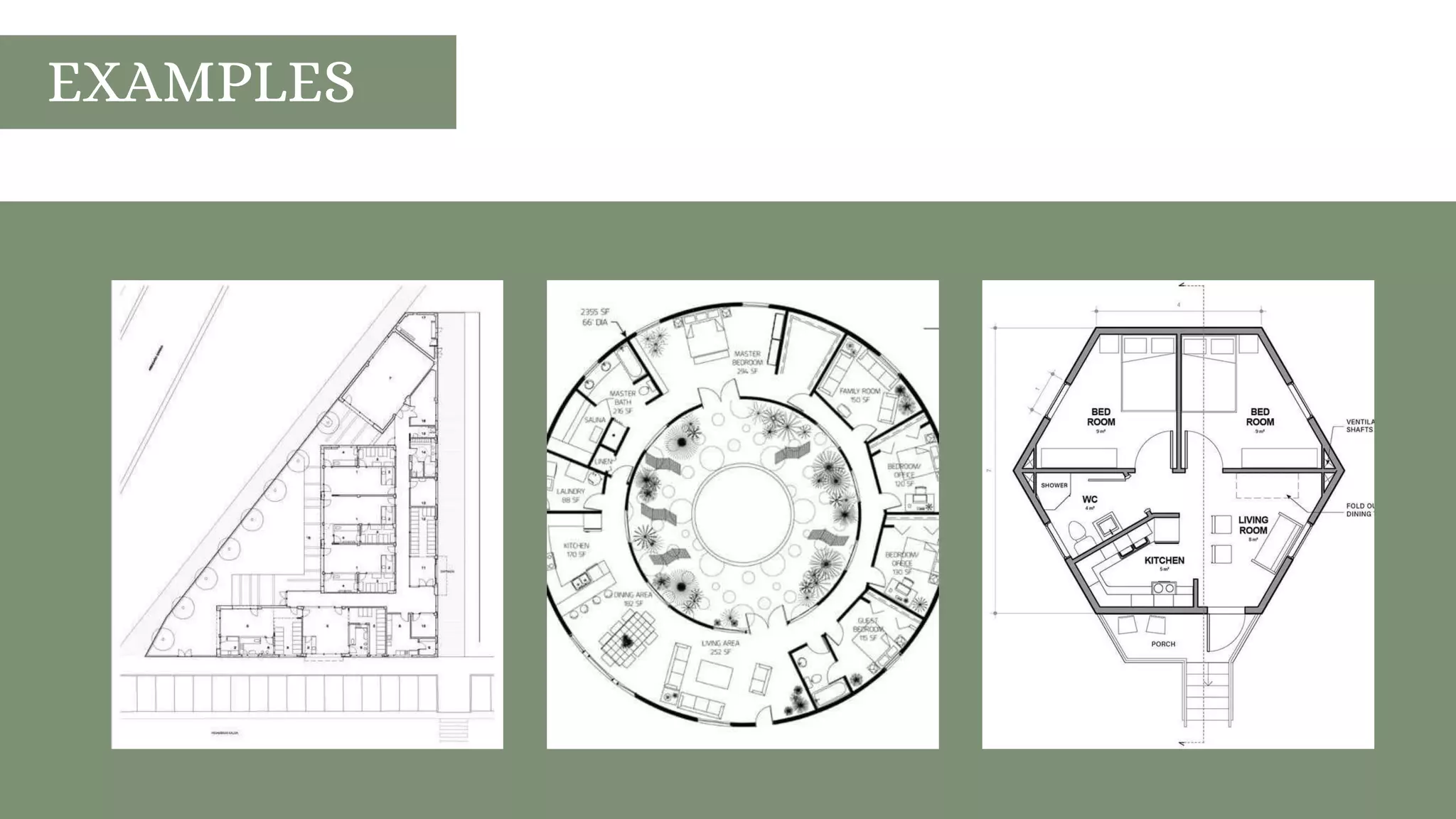
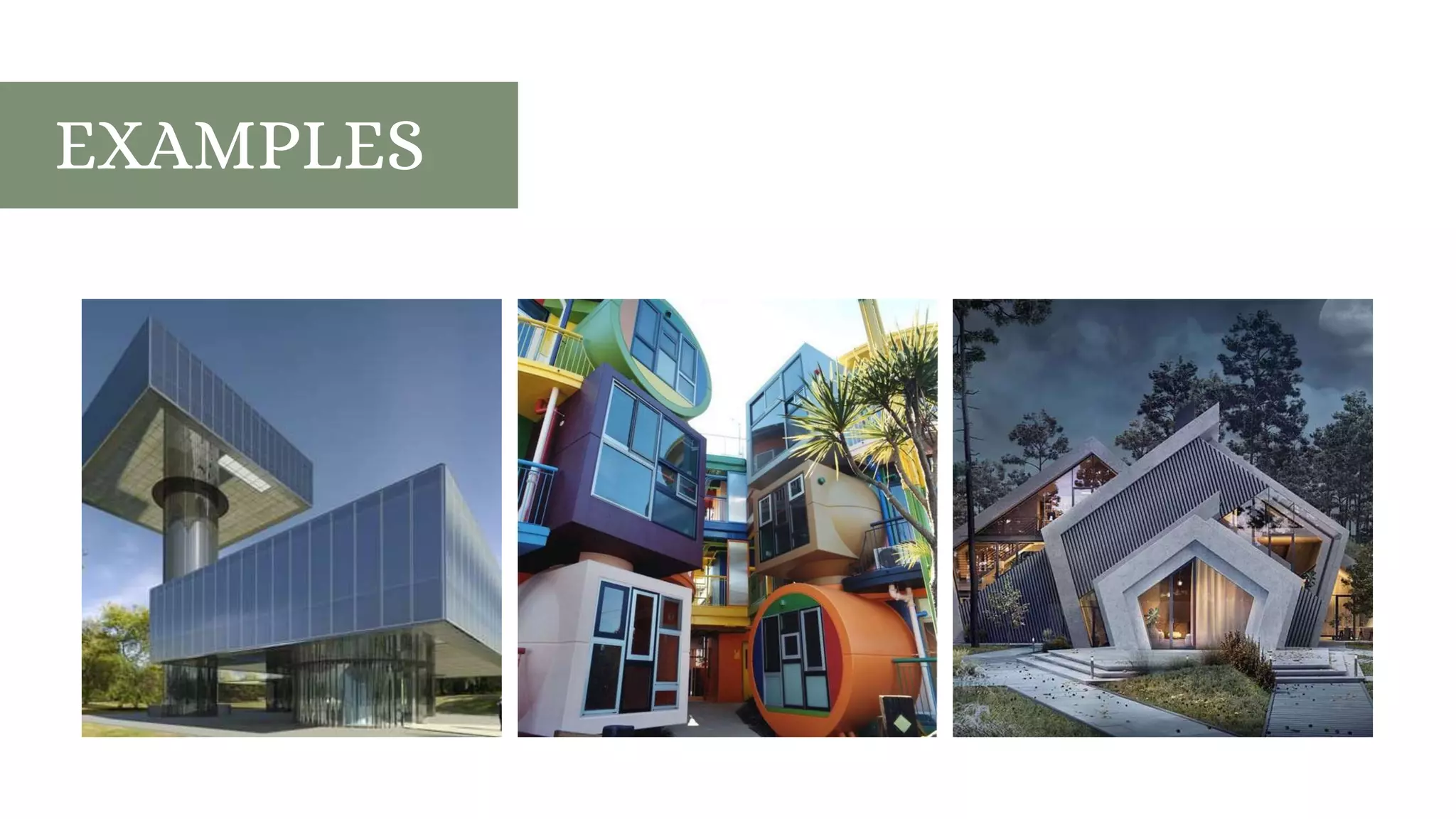
EXAMPLES
IRREGULAR
FORMS
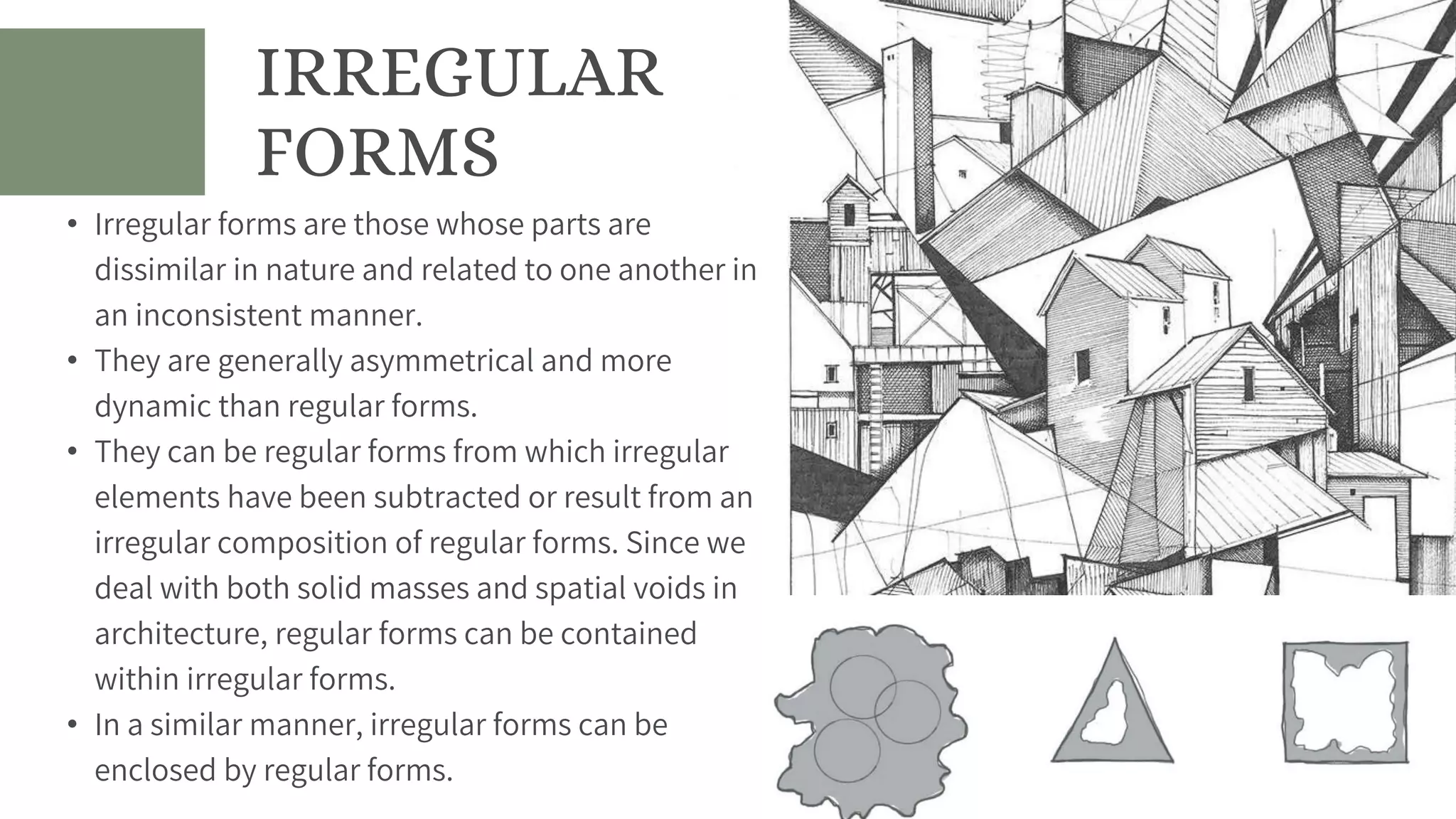
• Irregular forms are those whose parts are
dissimilar in nature and related to one another in
an inconsistent manner.
• They are generally asymmetrical and more
dynamic than regular forms.
• They can be regular forms from which irregular
elements have been subtracted or result from an
irregular composition of regular forms. Since we
deal with both solid masses and spatial voids in
architecture, regular forms can be contained
within irregular forms.
• In a similar manner, irregular forms can be
enclosed by regular forms.
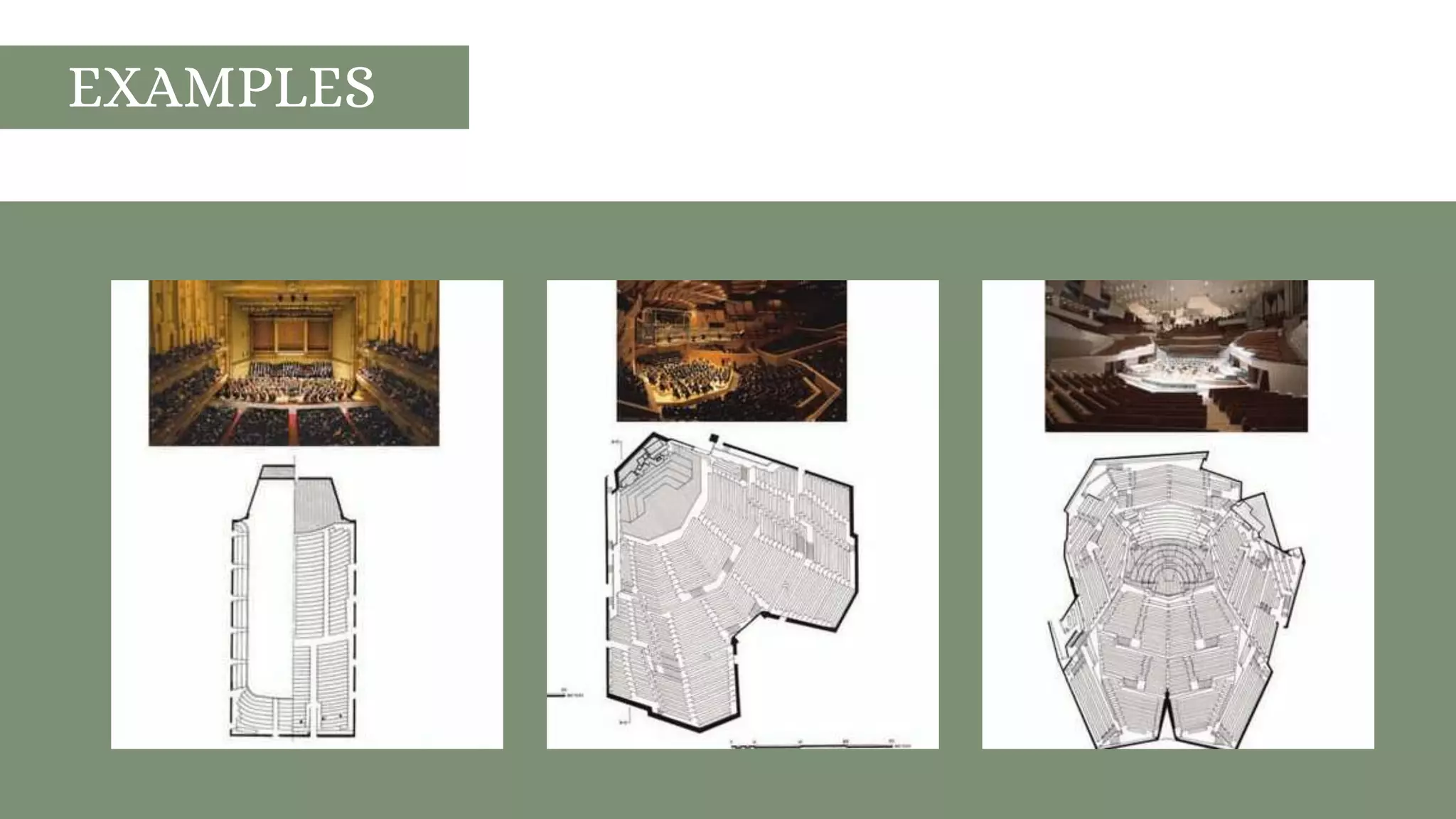
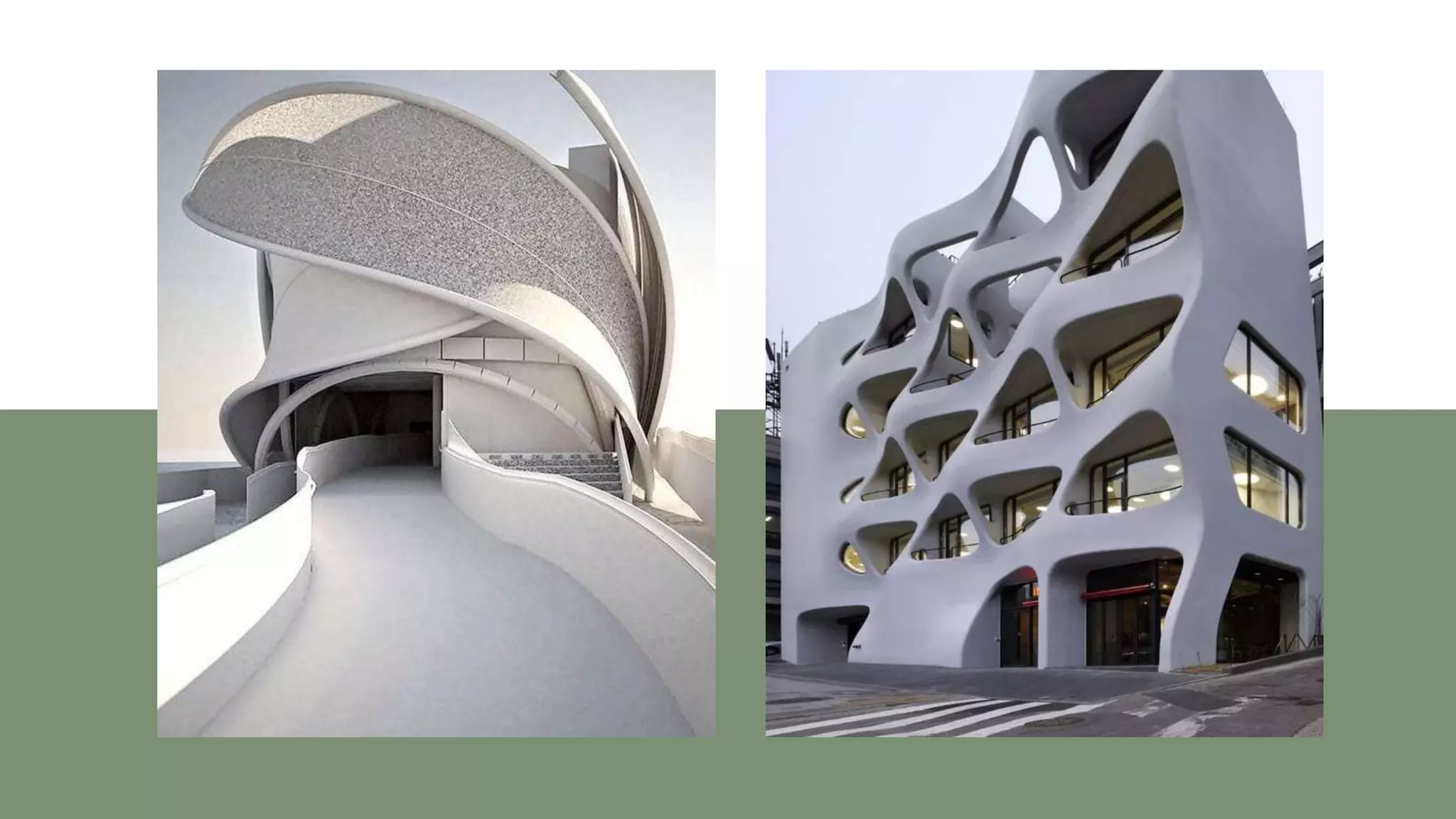
EXAMPLES
TRANSFORMATION
OF FORMS
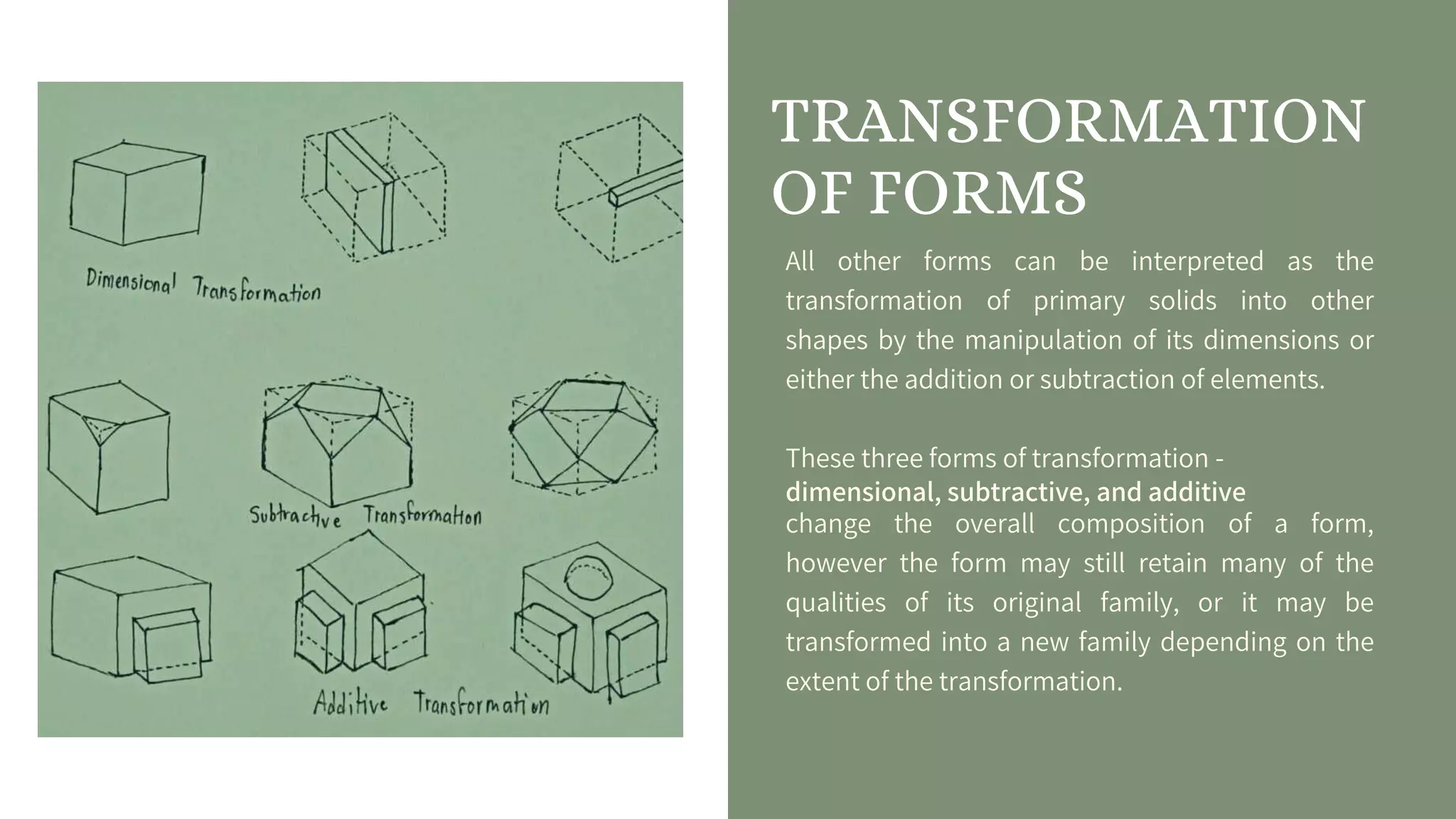
All other forms can be interpreted as the
transformation of primary solids into other
shapes by the manipulation of its dimensions or
either the addition or subtraction of elements.
These three forms of transformation -
dimensional, subtractive, and additive
change the overall composition of a form,
however the form may still retain many of the
qualities of its original family, or it may be
transformed into a new family depending on the
extent of the transformation.
EXAMPLES

Regular & Irregular Forms and Transformation.pptx

  • 1.
  • 2.
    SUBMITTED BY:- 1.Yashika Tharwani 2. Sakshi Sitpal 3. Jaykishan Mansoriya 4. Anshul Jotwani 5. Diya Lalwani SUBMITTED TO:- FORMS AND SPACES ASSIGNMENT - II ACAD INDORE Ayushi Ma'am
  • 3.
    REGULAR FORMS • Regular formsrefer to those whose parts are related to one another in a consistent and orderly manner. • They are generally stable in nature and symmetrical about one or more axes. • The sphere, cylinder, cone, cube, and pyramid are prime examples of regular forms. • Forms can retain their regularity even when transformed dimensionally or by the addition or subtraction of elements.
  • 4.
  • 6.
    IRREGULAR FORMS • Irregular formsare those whose parts are dissimilar in nature and related to one another in an inconsistent manner. • They are generally asymmetrical and more dynamic than regular forms. • They can be regular forms from which irregular elements have been subtracted or result from an irregular composition of regular forms. Since we deal with both solid masses and spatial voids in architecture, regular forms can be contained within irregular forms. • In a similar manner, irregular forms can be enclosed by regular forms.
  • 7.
  • 9.
    TRANSFORMATION OF FORMS All otherforms can be interpreted as the transformation of primary solids into other shapes by the manipulation of its dimensions or either the addition or subtraction of elements. These three forms of transformation - dimensional, subtractive, and additive change the overall composition of a form, however the form may still retain many of the qualities of its original family, or it may be transformed into a new family depending on the extent of the transformation.
  • 10.