Automated Regression Testing
Ensuring Consistent Software Quality
Introduction
Overview:
One of the important kinds of testing is regression testing which is usually performed by means
of automated testing tools. Due to this, one is able to detect new faults that may have been
incorporated in the previous functionalities.
Goal:
This presentation’s objective is to present an overview of the concept of automated regression
testing, its role in the software development process, advantages, and proven strategies for its
successful execution.
What is Regression Testing?
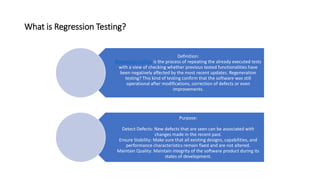
Definition:
Regression testing is the process of repeating the already executed tests
with a view of checking whether previous tested functionalities have
been negatively affected by the most recent updates. Regeneration
testing? This kind of testing confirm that the software was still
operational after modifications, correction of defects or even
improvements.
Purpose:
Detect Defects: New defects that are seen can be associated with
changes made in the recent past.
Ensure Stability: Make sure that all existing designs, capabilities, and
performance characteristics remain fixed and are not altered.
Maintain Quality: Maintain integrity of the software product during its
states of development.
Key Components of Automated Regression Testing
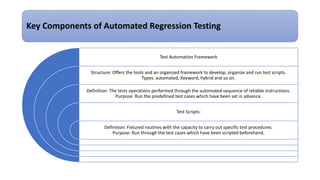
Test Automation Framework
Structure: Offers the tools and an organized framework to develop, organize and run test scripts.
Types: automated, Keyword, hybrid and so on.
Definition: The tests operations performed through the automated sequence of reliable instructions.
Purpose: Run the predefined test cases which have been set in advance.
Test Scripts:
Definition: Fixtured routines with the capacity to carry out specific test procedures.
Purpose: Run through the test cases which have been scripted beforehand.
Popular Tools for Automated Regression Testing
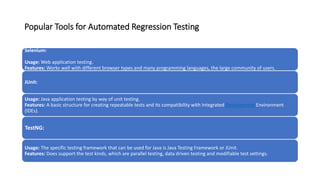
Selenium:
Usage: Web application testing.
Features: Works well with different browser types and many programming languages, the large community of users.
JUnit:
Usage: Java application testing by way of unit testing.
Features: A basic structure for creating repeatable tests and its compatibility with Integrated Development Environment
(IDEs).
TestNG:
Usage: The specific testing framework that can be used for Java is Java Testing Framework or JUnit.
Features: Does support the test kinds, which are parallel testing, data driven testing and modifiable test settings.
Conclusion
Essential for Quality Assurance: The
controlled checking process that is
regression testing is very important
in ensuring the stability and
reliability of software applications
after they have been modified.
Efficiency and Coverage: They
enhance the testing effectivity,
guarantee the coverage, and enable
further integration and delivery.
Best Practices: The following
guidelines help in advancing the
causes of regression testing;
prioritizing the test cases, formatting
the test scripts, and employing
relevant tools.

Regression Testing Ensuring Software Stability and Quality

  • 1.
    Automated Regression Testing EnsuringConsistent Software Quality
  • 2.
    Introduction Overview: One of theimportant kinds of testing is regression testing which is usually performed by means of automated testing tools. Due to this, one is able to detect new faults that may have been incorporated in the previous functionalities. Goal: This presentation’s objective is to present an overview of the concept of automated regression testing, its role in the software development process, advantages, and proven strategies for its successful execution.
  • 3.
    What is RegressionTesting? Definition: Regression testing is the process of repeating the already executed tests with a view of checking whether previous tested functionalities have been negatively affected by the most recent updates. Regeneration testing? This kind of testing confirm that the software was still operational after modifications, correction of defects or even improvements. Purpose: Detect Defects: New defects that are seen can be associated with changes made in the recent past. Ensure Stability: Make sure that all existing designs, capabilities, and performance characteristics remain fixed and are not altered. Maintain Quality: Maintain integrity of the software product during its states of development.
  • 4.
    Key Components ofAutomated Regression Testing Test Automation Framework Structure: Offers the tools and an organized framework to develop, organize and run test scripts. Types: automated, Keyword, hybrid and so on. Definition: The tests operations performed through the automated sequence of reliable instructions. Purpose: Run the predefined test cases which have been set in advance. Test Scripts: Definition: Fixtured routines with the capacity to carry out specific test procedures. Purpose: Run through the test cases which have been scripted beforehand.
  • 5.
    Popular Tools forAutomated Regression Testing Selenium: Usage: Web application testing. Features: Works well with different browser types and many programming languages, the large community of users. JUnit: Usage: Java application testing by way of unit testing. Features: A basic structure for creating repeatable tests and its compatibility with Integrated Development Environment (IDEs). TestNG: Usage: The specific testing framework that can be used for Java is Java Testing Framework or JUnit. Features: Does support the test kinds, which are parallel testing, data driven testing and modifiable test settings.
  • 6.
    Conclusion Essential for QualityAssurance: The controlled checking process that is regression testing is very important in ensuring the stability and reliability of software applications after they have been modified. Efficiency and Coverage: They enhance the testing effectivity, guarantee the coverage, and enable further integration and delivery. Best Practices: The following guidelines help in advancing the causes of regression testing; prioritizing the test cases, formatting the test scripts, and employing relevant tools.