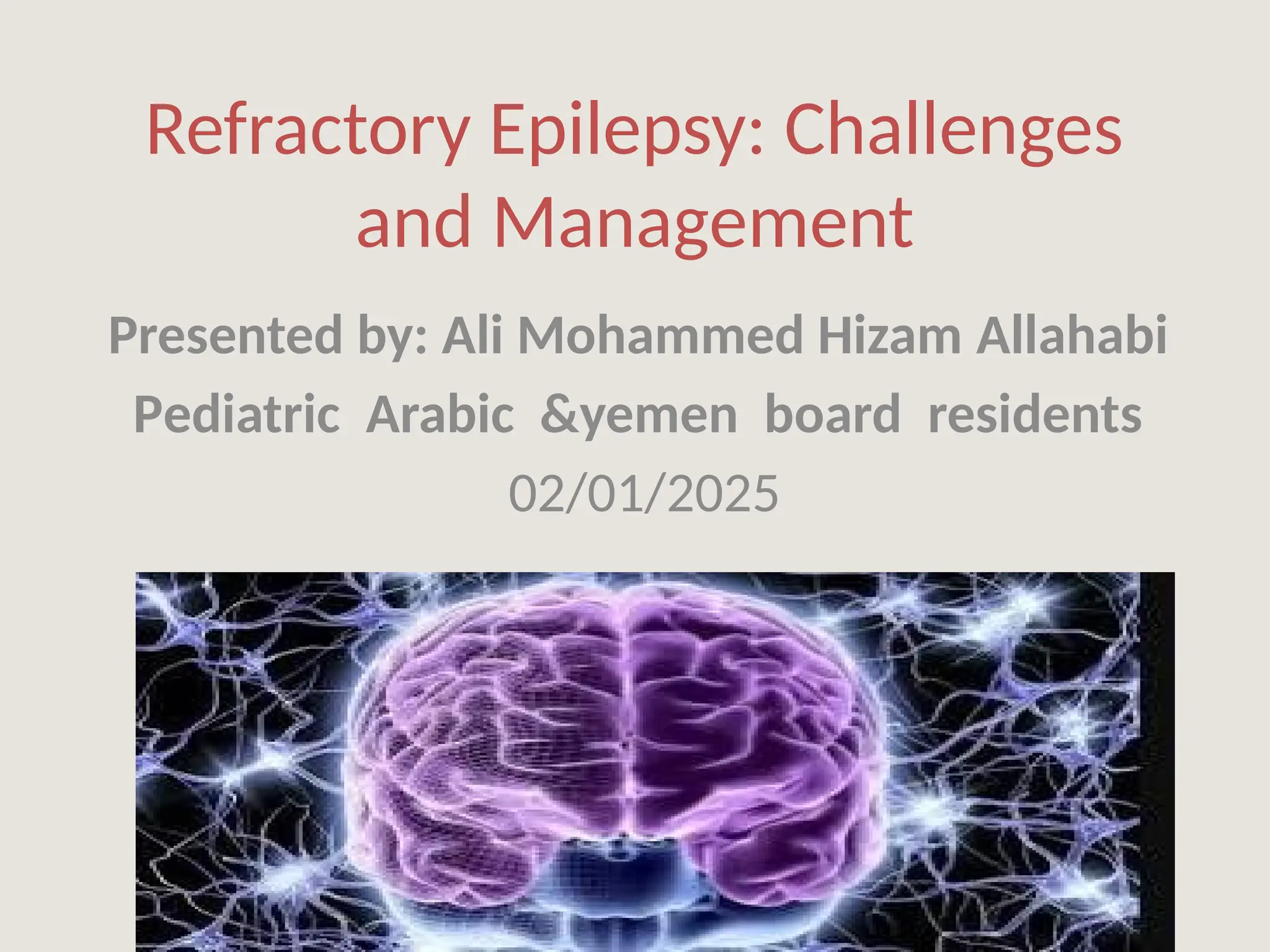
Refractory Epilepsy: Challenges
and Management
Presented by: Ali Mohammed Hizam Allahabi
Pediatric Arabic &yemen board residents
02/01/2025
Objectives
- Define refractory epilepsy.
- Understand its epidemiology and causes.
-pathophysiology.
- Discuss the diagnostic criteria and challenges.
-Management
- Review current treatment options.
-conclusion.
Introduction
Synonyms
-Drug-resistant
-Treatment-resistant
-Intractable
-Difficult-to-control, etc
• Refractory epilepsy, also known as drug-resistant
epilepsy, refers to seizures that persist despite
treatment with two or more appropriately chosen
and tolerated antiepileptic drugs (AEDs).
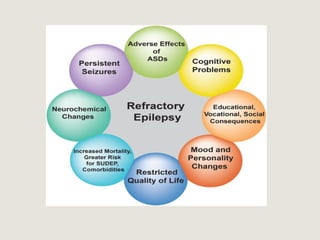
- It significantly affects quality of life, cognitive
function, and increases morbidity and mortality.
Epidemiology
- Epilepsy affects approximately 50 million
people worldwide.
- Around 30% of patients with epilepsy are drug-
resistant.
- Higher prevalence in individuals with structural
or genetic predispositions.
Causes and Risk Factors
- Causes:
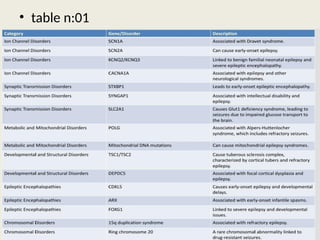
• Structural abnormalities (e.g., cortical dysplasia,
old stroke,tumors).
• Genetic factors (e.g., Dravet syndrome ,
other see table 1).
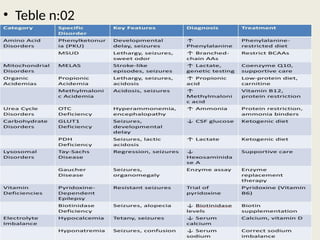
• Metabolic and immune-related causes(see table 2).
• Infectious causes :
(e.g. meningaitis , neurocysticercosis).
- Risk Factors:
• Early onset of seizures..
• High seizure frequency before treatment.
• Inappropriate initial therapy.
• table n:01
• Teble n:02
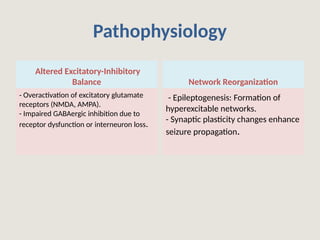
Altered Excitatory-Inhibitory
Balance Network Reorganization
- Epileptogenesis: Formation of
hyperexcitable networks.
- Synaptic plasticity changes enhance
seizure propagation.
Pathophysiology
- Overactivation of excitatory glutamate
receptors (NMDA, AMPA).
- Impaired GABAergic inhibition due to
receptor dysfunction or interneuron loss.
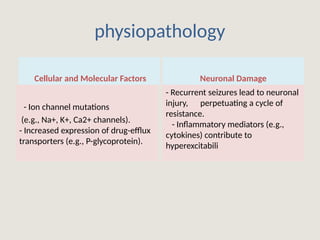
physiopathology
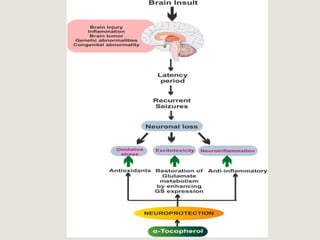
Cellular and Molecular Factors Neuronal Damage
- Recurrent seizures lead to neuronal
injury, perpetuating a cycle of
resistance.
- Inflammatory mediators (e.g.,
cytokines) contribute to
hyperexcitabili
- Ion channel mutations
(e.g., Na+, K+, Ca2+ channels).
- Increased expression of drug-efflux
transporters (e.g., P-glycoprotein).
3. Associated Comorbidities
- Motor dysfunction (e.g.,
spasticity, ataxia).
- Sleep disturbances.
4. Impact on Quality of Life
- Impaired daily functioning.
- Psychosocial challenges
(e.g., anxiety, depression).
Clinical Feature
1. Seizure Characteristics:
- Frequent, prolonged
seizures resistant to standard
AEDs
- Clusters of seizures or status
epilepticus.
2. Neurological Symptoms
- Cognitive decline or
developmental regression.
- Behavioral changes (e.g.,
irritability, hyperactivity).
Diagnostic Criteria
- ILAE Definition: Failure of adequate trials of
two tolerated and appropriately chosen AED
regimens.
- Diagnostic tools:
• intial invstgation (CBC- electrolytes - RBS- csf
analysis, urine tests,LFT, KFT)
• EEG and advanced imaging techniques
(e.g., MRI).
• Genetic and metabolic testing.
Challenges in Management
- Poor seizure control and its implications.
- Associated cognitive and behavioral
comorbidities
- Significant impact on daily life and mental
health.
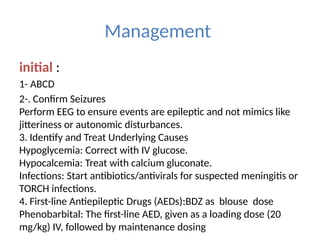
Management
initial :
1- ABCD
2-. Confirm Seizures
Perform EEG to ensure events are epileptic and not mimics like
jitteriness or autonomic disturbances.
3. Identify and Treat Underlying Causes
Hypoglycemia: Correct with IV glucose.
Hypocalcemia: Treat with calcium gluconate.
Infections: Start antibiotics/antivirals for suspected meningitis or
TORCH infections.
4. First-line Antiepileptic Drugs (AEDs):BDZ as blouse dose
Phenobarbital: The first-line AED, given as a loading dose (20
mg/kg) IV, followed by maintenance dosing
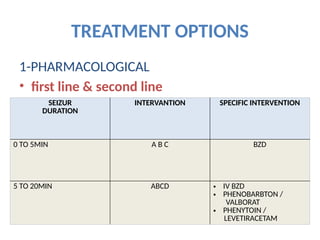
TREATMENT OPTIONS
1-PHARMACOLOGICAL
• first line & second line
SEIZUR
DURATION
INTERVANTION SPECIFIC INTERVENTION
0 TO 5MIN A B C BZD
5 TO 20MIN ABCD • IV BZD
• PHENOBARBTON /
VALBORAT
• PHENYTOIN /
LEVETIRACETAM
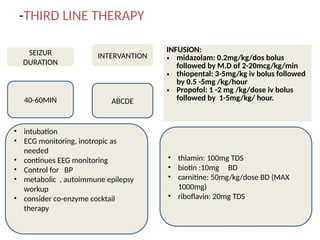
-THIRD LINE THERAPY
SEIZUR
DURATION
INTERVANTION
40-60MIN ABCDE
INFUSION:
• midazolam: 0.2mg/kg/dos bolus
followed by M.D of 2-20mcg/kg/min
• thiopental: 3-5mg/kg iv bolus followed
by 0.5 -5mg /kg/hour
• Propofol: 1 -2 mg /kg/dose iv bolus
followed by 1-5mg/kg/ hour.
• intubation
• ECG monitoring, inotropic as
needed
• continues EEG monitoring
• Control for BP
• metabolic , autoimmune epilepsy
workup
• consider co-enzyme cocktail
therapy
• thiamin: 100mg TDS
• biotin :10mg BD
• carnitine: 50mg/kg/dose BD (MAX
1000mg)
• riboflavin: 20mg TDS
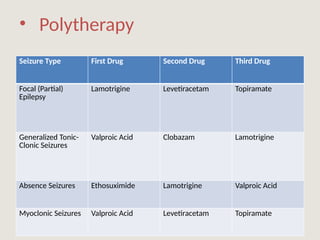
• Polytherapy
Seizure Type First Drug Second Drug Third Drug
Focal (Partial)
Epilepsy
Lamotrigine Levetiracetam Topiramate
Generalized Tonic-
Clonic Seizures
Valproic Acid Clobazam Lamotrigine
Absence Seizures Ethosuximide Lamotrigine Valproic Acid
Myoclonic Seizures Valproic Acid Levetiracetam Topiramate
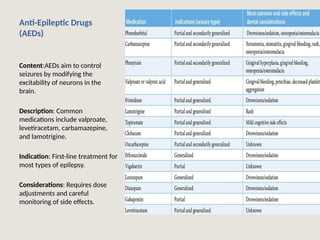
Anti-Epileptic Drugs
(AEDs)
Content:AEDs aim to control
seizures by modifying the
excitability of neurons in the
brain.
Description: Common
medications include valproate,
levetiracetam, carbamazepine,
and lamotrigine.
Indication: First-line treatment for
most types of epilepsy.
Considerations: Requires dose
adjustments and careful
monitoring of side effects.
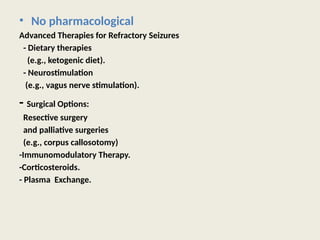
• No pharmacological
Advanced Therapies for Refractory Seizures
- Dietary therapies
(e.g., ketogenic diet).
- Neurostimulation
(e.g., vagus nerve stimulation).
- Surgical Options:
Resective surgery
and palliative surgeries
(e.g., corpus callosotomy)
-Immunomodulatory Therapy.
-Corticosteroids.
- Plasma Exchange.
Advanced Therapies for Refractory
Seizures
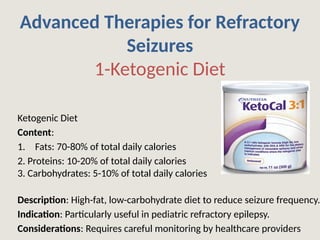
1-Ketogenic Diet
Ketogenic Diet
Content:
1. Fats: 70-80% of total daily calories
2. Proteins: 10-20% of total daily calories
3. Carbohydrates: 5-10% of total daily calories
Description: High-fat, low-carbohydrate diet to reduce seizure frequency.
Indication: Particularly useful in pediatric refractory epilepsy.
Considerations: Requires careful monitoring by healthcare providers
2-Vagus Nerve Stimulation (VNS)
Content: VNS is a medical treatment that involves
delivering electrical impulses to the vagus nerve.
Description: Implantable device that sends electrical
impulses to the vagus nerve.
Indication: For drug-resistant epilepsy.
Considerations: Surgery required; side effects include
hoarseness.
3-Responsive Neurostimulation (RNS)
Responsive Neurostimulation (RNS)
Description: Device that monitors and responds to
brain activity in real-time.
Indication: Intractable focal epilepsy.
Considerations: Involves surgery; results may vary.
4-Surgical Resection
Surgical Resection
Description: Removal of the brain area responsible for
seizures.
Indication: Refractory focal epilepsy.
Considerations: Pre-surgical evaluations and potential
cognitive risks.
5-Laser Ablation
Laser Ablation
Description: Minimally invasive laser technique to
remove seizure foci.
Indication: Focal epilepsy.
Considerations: MRI-guided; risks include tissue injury.
6-Deep Brain Stimulation (DBS)
Description: Electrodes implanted in the brain
to modulate abnormal electrical activity.
Indication: Refractory epilepsy.
Considerations: Requires surgery; may not work
for all patients.
7-Corticosteroids
Corticosteroids:
Description: Used in autoimmune or
inflammatory epilepsy.
Indication: Autoimmune-related epilepsy.
Considerations: Long-term use can cause
significant side effects.
8-Plasma Exchange (PLEX)
Plasma Exchange (PLEX):
Description: Removes harmful antibodies or
substances from the blood.
Indication: Autoimmune epilepsy.
Considerations: Invasive procedure with potential
complications.
9-Immunomodulatory Therapy
Immunomodulatory Therapy
Description: Uses drugs like rituximab or IVIG to
modulate the immune response.
Indication: Autoimmune epilepsy.
Considerations: Requires close monitoring due to
immune suppression.
Conclusion
• - Multidisciplinary approach is essential for
management.
• - Need for patient-specific treatment plans.
• - Emphasis on ongoing research and patient
support systems.
References
• - Fisher RS, et al. Definition of drug-resistant
epilepsy: ILAE consensus.
• - Latest research articles on refractory
epilepsy.
• - Relevant clinical guidelines and textbooks.
• Uptodate
• Medical website
• CHILD NEUROLOGY AND BEYOND2023 )India
academy of pediatric)
Thank you

refractory epilepsy dr ali Allahabi-3.pptx

  • 1.
    Refractory Epilepsy: Challenges andManagement Presented by: Ali Mohammed Hizam Allahabi Pediatric Arabic &yemen board residents 02/01/2025
  • 2.
    Objectives - Define refractoryepilepsy. - Understand its epidemiology and causes. -pathophysiology. - Discuss the diagnostic criteria and challenges. -Management - Review current treatment options. -conclusion.
  • 3.
    Introduction Synonyms -Drug-resistant -Treatment-resistant -Intractable -Difficult-to-control, etc • Refractoryepilepsy, also known as drug-resistant epilepsy, refers to seizures that persist despite treatment with two or more appropriately chosen and tolerated antiepileptic drugs (AEDs). - It significantly affects quality of life, cognitive function, and increases morbidity and mortality.
  • 5.
    Epidemiology - Epilepsy affectsapproximately 50 million people worldwide. - Around 30% of patients with epilepsy are drug- resistant. - Higher prevalence in individuals with structural or genetic predispositions.
  • 6.
    Causes and RiskFactors - Causes: • Structural abnormalities (e.g., cortical dysplasia, old stroke,tumors). • Genetic factors (e.g., Dravet syndrome , other see table 1). • Metabolic and immune-related causes(see table 2). • Infectious causes : (e.g. meningaitis , neurocysticercosis). - Risk Factors: • Early onset of seizures.. • High seizure frequency before treatment. • Inappropriate initial therapy.
  • 7.
  • 8.
  • 9.
    Altered Excitatory-Inhibitory Balance NetworkReorganization - Epileptogenesis: Formation of hyperexcitable networks. - Synaptic plasticity changes enhance seizure propagation. Pathophysiology - Overactivation of excitatory glutamate receptors (NMDA, AMPA). - Impaired GABAergic inhibition due to receptor dysfunction or interneuron loss.
  • 10.
    physiopathology Cellular and MolecularFactors Neuronal Damage - Recurrent seizures lead to neuronal injury, perpetuating a cycle of resistance. - Inflammatory mediators (e.g., cytokines) contribute to hyperexcitabili - Ion channel mutations (e.g., Na+, K+, Ca2+ channels). - Increased expression of drug-efflux transporters (e.g., P-glycoprotein).
  • 12.
    3. Associated Comorbidities -Motor dysfunction (e.g., spasticity, ataxia). - Sleep disturbances. 4. Impact on Quality of Life - Impaired daily functioning. - Psychosocial challenges (e.g., anxiety, depression). Clinical Feature 1. Seizure Characteristics: - Frequent, prolonged seizures resistant to standard AEDs - Clusters of seizures or status epilepticus. 2. Neurological Symptoms - Cognitive decline or developmental regression. - Behavioral changes (e.g., irritability, hyperactivity).
  • 13.
    Diagnostic Criteria - ILAEDefinition: Failure of adequate trials of two tolerated and appropriately chosen AED regimens. - Diagnostic tools: • intial invstgation (CBC- electrolytes - RBS- csf analysis, urine tests,LFT, KFT) • EEG and advanced imaging techniques (e.g., MRI). • Genetic and metabolic testing.
  • 14.
    Challenges in Management -Poor seizure control and its implications. - Associated cognitive and behavioral comorbidities - Significant impact on daily life and mental health.
  • 15.
    Management initial : 1- ABCD 2-.Confirm Seizures Perform EEG to ensure events are epileptic and not mimics like jitteriness or autonomic disturbances. 3. Identify and Treat Underlying Causes Hypoglycemia: Correct with IV glucose. Hypocalcemia: Treat with calcium gluconate. Infections: Start antibiotics/antivirals for suspected meningitis or TORCH infections. 4. First-line Antiepileptic Drugs (AEDs):BDZ as blouse dose Phenobarbital: The first-line AED, given as a loading dose (20 mg/kg) IV, followed by maintenance dosing
  • 17.
    TREATMENT OPTIONS 1-PHARMACOLOGICAL • firstline & second line SEIZUR DURATION INTERVANTION SPECIFIC INTERVENTION 0 TO 5MIN A B C BZD 5 TO 20MIN ABCD • IV BZD • PHENOBARBTON / VALBORAT • PHENYTOIN / LEVETIRACETAM
  • 18.
    -THIRD LINE THERAPY SEIZUR DURATION INTERVANTION 40-60MINABCDE INFUSION: • midazolam: 0.2mg/kg/dos bolus followed by M.D of 2-20mcg/kg/min • thiopental: 3-5mg/kg iv bolus followed by 0.5 -5mg /kg/hour • Propofol: 1 -2 mg /kg/dose iv bolus followed by 1-5mg/kg/ hour. • intubation • ECG monitoring, inotropic as needed • continues EEG monitoring • Control for BP • metabolic , autoimmune epilepsy workup • consider co-enzyme cocktail therapy • thiamin: 100mg TDS • biotin :10mg BD • carnitine: 50mg/kg/dose BD (MAX 1000mg) • riboflavin: 20mg TDS
  • 19.
    • Polytherapy Seizure TypeFirst Drug Second Drug Third Drug Focal (Partial) Epilepsy Lamotrigine Levetiracetam Topiramate Generalized Tonic- Clonic Seizures Valproic Acid Clobazam Lamotrigine Absence Seizures Ethosuximide Lamotrigine Valproic Acid Myoclonic Seizures Valproic Acid Levetiracetam Topiramate
  • 20.
    Anti-Epileptic Drugs (AEDs) Content:AEDs aimto control seizures by modifying the excitability of neurons in the brain. Description: Common medications include valproate, levetiracetam, carbamazepine, and lamotrigine. Indication: First-line treatment for most types of epilepsy. Considerations: Requires dose adjustments and careful monitoring of side effects.
  • 21.
    • No pharmacological AdvancedTherapies for Refractory Seizures - Dietary therapies (e.g., ketogenic diet). - Neurostimulation (e.g., vagus nerve stimulation). - Surgical Options: Resective surgery and palliative surgeries (e.g., corpus callosotomy) -Immunomodulatory Therapy. -Corticosteroids. - Plasma Exchange.
  • 22.
    Advanced Therapies forRefractory Seizures 1-Ketogenic Diet Ketogenic Diet Content: 1. Fats: 70-80% of total daily calories 2. Proteins: 10-20% of total daily calories 3. Carbohydrates: 5-10% of total daily calories Description: High-fat, low-carbohydrate diet to reduce seizure frequency. Indication: Particularly useful in pediatric refractory epilepsy. Considerations: Requires careful monitoring by healthcare providers
  • 23.
    2-Vagus Nerve Stimulation(VNS) Content: VNS is a medical treatment that involves delivering electrical impulses to the vagus nerve. Description: Implantable device that sends electrical impulses to the vagus nerve. Indication: For drug-resistant epilepsy. Considerations: Surgery required; side effects include hoarseness.
  • 24.
    3-Responsive Neurostimulation (RNS) ResponsiveNeurostimulation (RNS) Description: Device that monitors and responds to brain activity in real-time. Indication: Intractable focal epilepsy. Considerations: Involves surgery; results may vary.
  • 25.
    4-Surgical Resection Surgical Resection Description:Removal of the brain area responsible for seizures. Indication: Refractory focal epilepsy. Considerations: Pre-surgical evaluations and potential cognitive risks.
  • 26.
    5-Laser Ablation Laser Ablation Description:Minimally invasive laser technique to remove seizure foci. Indication: Focal epilepsy. Considerations: MRI-guided; risks include tissue injury.
  • 27.
    6-Deep Brain Stimulation(DBS) Description: Electrodes implanted in the brain to modulate abnormal electrical activity. Indication: Refractory epilepsy. Considerations: Requires surgery; may not work for all patients.
  • 28.
    7-Corticosteroids Corticosteroids: Description: Used inautoimmune or inflammatory epilepsy. Indication: Autoimmune-related epilepsy. Considerations: Long-term use can cause significant side effects.
  • 29.
    8-Plasma Exchange (PLEX) PlasmaExchange (PLEX): Description: Removes harmful antibodies or substances from the blood. Indication: Autoimmune epilepsy. Considerations: Invasive procedure with potential complications.
  • 30.
    9-Immunomodulatory Therapy Immunomodulatory Therapy Description:Uses drugs like rituximab or IVIG to modulate the immune response. Indication: Autoimmune epilepsy. Considerations: Requires close monitoring due to immune suppression.
  • 31.
    Conclusion • - Multidisciplinaryapproach is essential for management. • - Need for patient-specific treatment plans. • - Emphasis on ongoing research and patient support systems.
  • 32.
    References • - FisherRS, et al. Definition of drug-resistant epilepsy: ILAE consensus. • - Latest research articles on refractory epilepsy. • - Relevant clinical guidelines and textbooks. • Uptodate • Medical website • CHILD NEUROLOGY AND BEYOND2023 )India academy of pediatric)
  • 33.