R E F L E C T I V E & C R I T I C A L W R I T I N G
Unit 7
Writing
 Teachers read and write regularly, they read content and
write lesson plans and diaries in routine
 The process of writing is as important as the process of
critical thinking and reflective practice
 A practitioner needs to maintain logs, journals, reports
and keep writing reflective notes
 Writing a critical review is another important skill that
teachers need to learn
 Writing a good critical review requires that you
understand the material, and that you know how to
analyze and evaluate that material using appropriate
criteria.
Critical Review
 When you read a text and think deeper, question the
content and seek further information before you accept
the text.
 A critical review evaluates the clarity, quality and
originality of research, as well as its relevance and
presentation.
 Sometimes non-text materials, such as videos, also are
discussed using this formal model of reviewing.
 A critical review is not simply a book report, nor is it a
literary analysis, literary review, movie review, or other
arts review that works with the elements of literature or
art.
 Rather, a critical review is a thorough, usually formal
discussion that uses a variety of critical-thinking tools.
Goals of Critical Review
 The goal of writing a critical review and analysis is to
help others know the value of text, video or any other
content at hand.
 Critical review helps in highlighting the strong and
weak features of a piece of work.
 If you wish to write a simple critical review with all
of its major structural elements in it, you can simply
develop your review in three body sections:
 summary of the work;
 arguments, responses, and/or implications; and
 evaluative judgments.
Steps to writing an effective critical review
Reading:
 Skim the whole text to determine the overall thesis,
structure and methodology. This will help you better
understand how the different elements fit together once
you begin reading carefully.
Read critically: It is not enough to simply understand
what the author is saying; it is essential to challenge it.
Examine how the article is structured, the types of
reasons or evidence used to support the conclusions, and
whether the author is reliant on underlying assumptions
or theoretical frameworks. Take copious notes that
reflect what the text means and what you think about it.
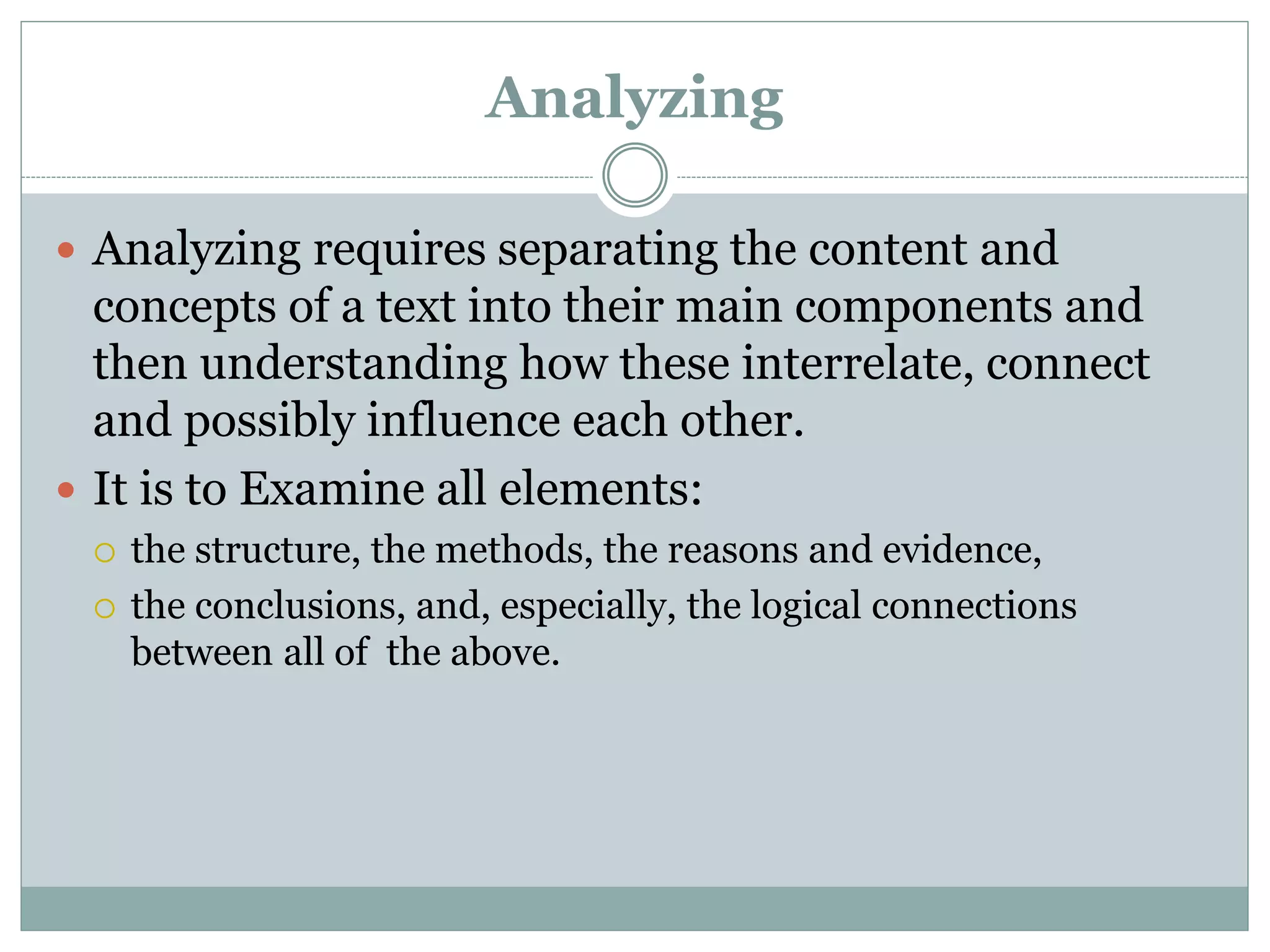
Analyzing
 Analyzing requires separating the content and
concepts of a text into their main components and
then understanding how these interrelate, connect
and possibly influence each other.
 It is to Examine all elements:
 the structure, the methods, the reasons and evidence,
 the conclusions, and, especially, the logical connections
between all of the above.
Structure What type of text is it? (For example: Is it a primary source or secondary
source? Is it original research or a comment on original research?)
What are the different sections and how do they fit together?
Are any of the sections particularly effective (or ineffective)?
Methodology Is the research quantitative or qualitative?
Does the methodology have any weaknesses?
How does the design of the study address the hypothesis?
Reason
/Evidence
What sources does the author use (interviews, peer-reviewed journals, government
reports, journal entries, newspaper accounts, etc.)?
What types of reasoning are employed (inductive, deductive, and abdicative)?
What type of evidence is provided (empirical, statistical, logical, etc.)?
Are there any gaps in the evidence (or reasoning)?
Conclusion Does the data adequately support the conclusion drawn by the
researcher(s)?
Are other interpretations plausible?
Are the conclusions dependent on a particular theoretical formulation?
What does the work contribute to the field?
Logic What assumptions does the author make?
Does the author account for all of the data, or are portions left out?
What alternative perspectives remain unconsidered?
Are there any logical flaws in the construction of the argument?
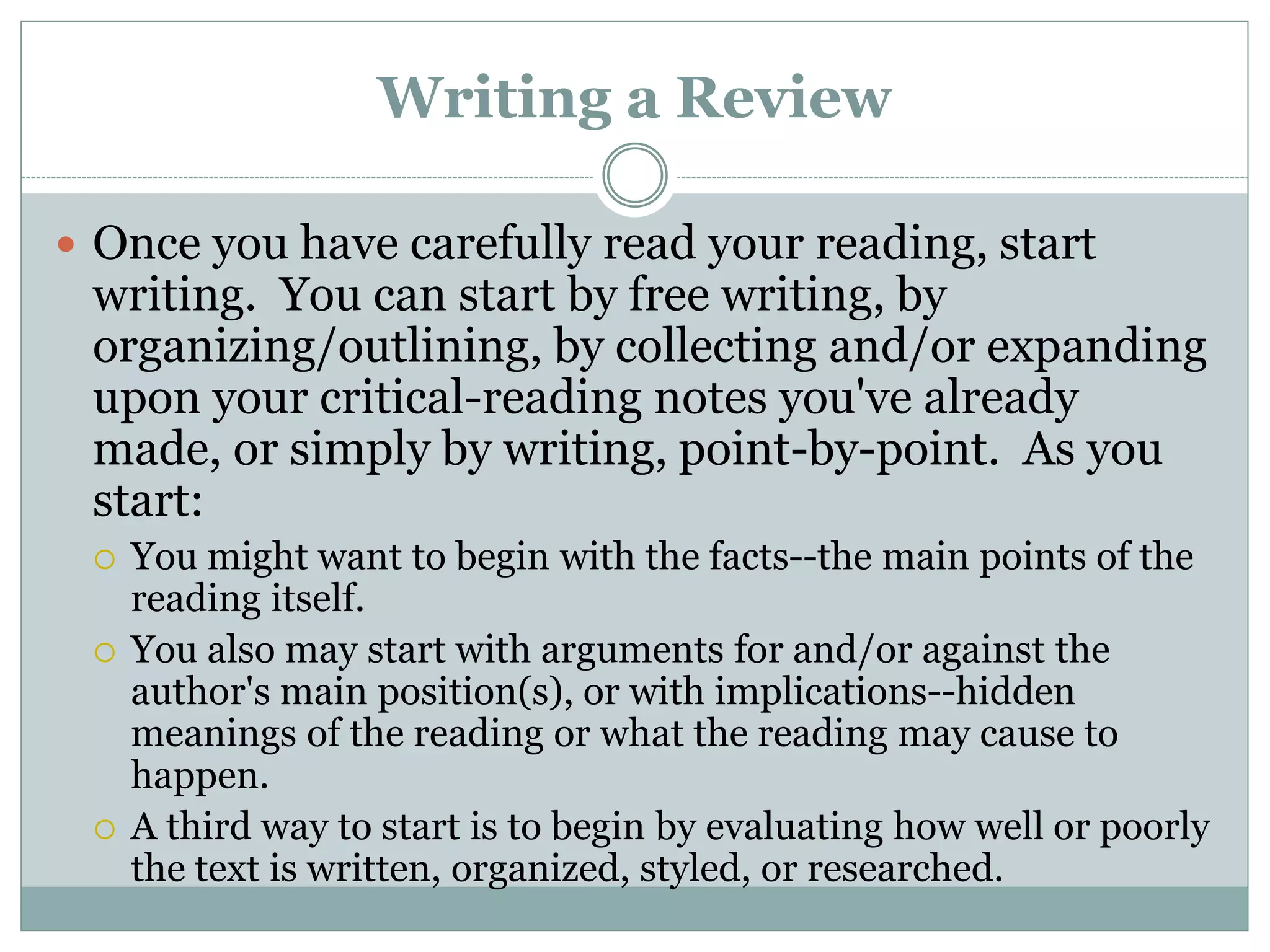
Writing a Review
 Once you have carefully read your reading, start
writing. You can start by free writing, by
organizing/outlining, by collecting and/or expanding
upon your critical-reading notes you've already
made, or simply by writing, point-by-point. As you
start:
 You might want to begin with the facts--the main points of the
reading itself.
 You also may start with arguments for and/or against the
author's main position(s), or with implications--hidden
meanings of the reading or what the reading may cause to
happen.
 A third way to start is to begin by evaluating how well or poorly
the text is written, organized, styled, or researched.
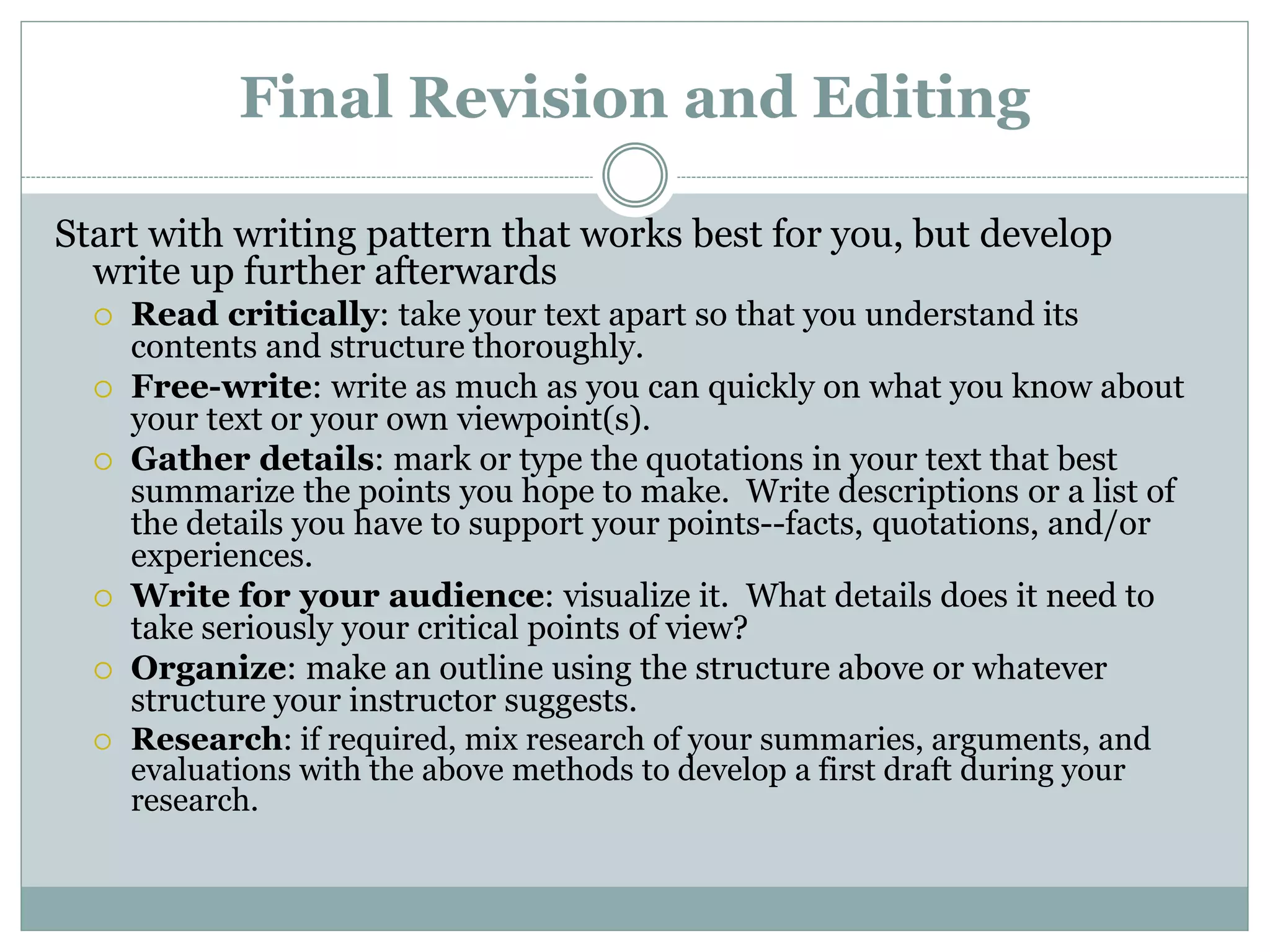
Final Revision and Editing
Start with writing pattern that works best for you, but develop
write up further afterwards
 Read critically: take your text apart so that you understand its
contents and structure thoroughly.
 Free-write: write as much as you can quickly on what you know about
your text or your own viewpoint(s).
 Gather details: mark or type the quotations in your text that best
summarize the points you hope to make. Write descriptions or a list of
the details you have to support your points--facts, quotations, and/or
experiences.
 Write for your audience: visualize it. What details does it need to
take seriously your critical points of view?
 Organize: make an outline using the structure above or whatever
structure your instructor suggests.
 Research: if required, mix research of your summaries, arguments, and
evaluations with the above methods to develop a first draft during your
research.
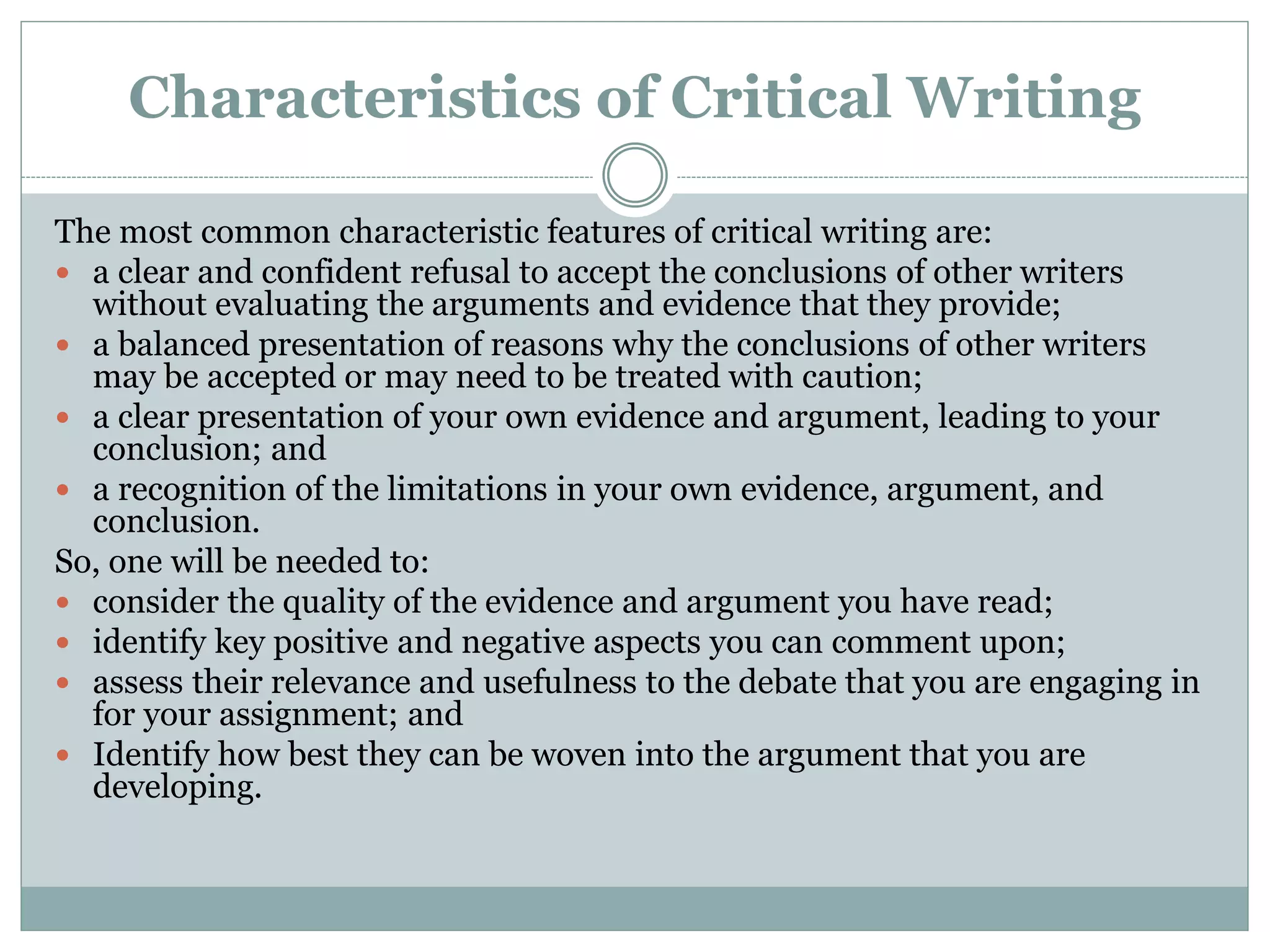
Characteristics of Critical Writing
The most common characteristic features of critical writing are:
 a clear and confident refusal to accept the conclusions of other writers
without evaluating the arguments and evidence that they provide;
 a balanced presentation of reasons why the conclusions of other writers
may be accepted or may need to be treated with caution;
 a clear presentation of your own evidence and argument, leading to your
conclusion; and
 a recognition of the limitations in your own evidence, argument, and
conclusion.
So, one will be needed to:
 consider the quality of the evidence and argument you have read;
 identify key positive and negative aspects you can comment upon;
 assess their relevance and usefulness to the debate that you are engaging in
for your assignment; and
 Identify how best they can be woven into the argument that you are
developing.
Approaches
 Using the "Compare and contrast" approach
 Critiquing two or more pieces of work in comparison
 Trying a give and take of argumentation
 Critiquing an argument with alternate argument
 Talking to an author in your Critical Writing
 Posing questions and finding answers from the work
 Have authors talk to each other in your Critical
Writing
 Having multiple author’s arguments responding to each
other
 Writing a debate of Author and a student
 For student vs for author
Things to remember
 STYLE, TONE, and WRITER'S ROLE: Develop (in
early or late drafts) an academic style and tone of calm,
reasoned, fair, balanced logic. In your role as a writer,
you should remain a neutral observer, simply applying
the analyses in a balanced, logical, consistent manner.
 AUTHENTICITY: Be as real and meaningful as you can
to your audience, your content, and yourself.
 First, respect your audience: try as fully as you can to consider its
own beliefs about your text.
 Second, find the heart of the meaning in both your reading and your
examination of it, and write about them clearly using high-quality
supporting details.
 Third, make your analyses your own: develop them in a way as
meaningful to you as possible.
REFLECTIVE WRITING
 Reflective writing is somewhat different from Critical
writing- it is more directed towards you than others.
 Reflection is a form of personal response to experiences,
situations, events or new information. It is a 'processing'
phase where thinking and learning take place.
 There is neither a right nor a wrong way of reflective
thinking; there are just questions to explore.
 Reflective writing can help you to improve your
analytical skills because it requires you to express what
you think, and more significantly, how and why you think
that way.
What is it about?
 Reflective writing is the writing which involves …
consideration of the larger context, the meaning, and the
implications of an experience or action' (Branch &
Paranjape, 2002). It is:
 One’s response to experiences, opinions, events or new information
 One’s response to thoughts and feelings
 a way of thinking to explore One’s learning
 an opportunity to gain self-knowledge
 a way to achieve clarity and better understanding of what is learning
 a chance to develop and reinforce writing skills
 a way of making meaning out of what One has studied
Forms of Reflective Writing
a. Learning Logs/Journals
 Learning logs can be used in different ways.
Sometimes they may be a formal part of reflective
writing, or sometimes they may form the basis of a
later reflective assignment.
 The aim of a learning journal is more to reflect on
events and your actions as they happen, but also to
chart your development as you learn.
 Journal writing is the process of recording personal
insights, reflections and questions on assigned or
personal topics.
b. Reflective Presentation
 If you have taken part in a practical exercise or a work
placement, either as part of a group or as an individual,
you may be asked to give a presentation on what you
have learnt in practice.
 As a presentation is much more conversational, and
sometimes interactive, than an essay or a learning log, it
might be tempting to make this more about illustrating
what you have done to your audience, rather than only
reflecting upon it.
 This is especially true if you have been on a long work
placement, in which a lot of things have happened!
c. Reflective Essays
 Theoretically, this is probably the type of reflective
writing that you are most used to.
 Much of what is expected of you in a normal academic
essay is still expected of you in a reflective essay.
 You will still be expected to analyze what you are saying,
reference any sources that you have used (and you
should use sources) and have a clear structure to the
essay.
 Thinking about what you want to include in the essay,
and how you will structure it, is often key to getting the
reflection right.
 Think about all of the incidents or events that have most
contributed to your learning.
Questions… Writing
What happens/happened? Recording, expressing, “getting the story down”
How does/did it happen?
Commenting on, attempting to explain: e.g., by
adding more detail or approaching the Type 1
story from another perspective or question
Why does/did it happen? What does
this mean outside the immediate
context of action?
Theorizing on the story and reflection in Types 1
& 2, linking them to personal theories, e.g., of
language, learning, and teaching
Are the earlier reflections
credible/reasonable? Why? Why
not? What do they mean now?
A subsequent written reflection in a developing
sequence of reflective writing, in which writers
continue to question and maybe involve others
Are the earlier reflections still
credible/reasonable? Why? Why
not? What do they mean now in the
light of subsequent experience?
After longer intervals, writers use the developing
spiral of reflection (which again may include other
writers: e.g. as part of an interactive journal) to re-
examine initial theorizing in the light of
intervening events that may have changed their
perspectives.
Practicing Reflective Writing
 Be aware of the purpose of your reflective writing and state if
it is appropriate
 Reflective writing requires practice and constant standing
back from oneself.
 Practice reflecting writing on the same event /incident
through different people’s viewpoints and disciplines.
 Deepen your reflection / reflective writing with the help of
others through discussing issues with individuals and groups,
getting the points of others.
 Always reflect on what you have learnt from an incident, and
how you would do something differently another time.
 Try to develop your reflective writing to include the ethical,
moral, historical and socio-political contexts where these are
relevant.
Thank you
 WRITING IS AS IMPORTANT AS THINKING AND
SPEAKING

Reflective & Critical writing-8611-UNIT 7

  • 1.
    R E FL E C T I V E & C R I T I C A L W R I T I N G Unit 7
  • 2.
    Writing  Teachers readand write regularly, they read content and write lesson plans and diaries in routine  The process of writing is as important as the process of critical thinking and reflective practice  A practitioner needs to maintain logs, journals, reports and keep writing reflective notes  Writing a critical review is another important skill that teachers need to learn  Writing a good critical review requires that you understand the material, and that you know how to analyze and evaluate that material using appropriate criteria.
  • 3.
    Critical Review  Whenyou read a text and think deeper, question the content and seek further information before you accept the text.  A critical review evaluates the clarity, quality and originality of research, as well as its relevance and presentation.  Sometimes non-text materials, such as videos, also are discussed using this formal model of reviewing.  A critical review is not simply a book report, nor is it a literary analysis, literary review, movie review, or other arts review that works with the elements of literature or art.  Rather, a critical review is a thorough, usually formal discussion that uses a variety of critical-thinking tools.
  • 4.
    Goals of CriticalReview  The goal of writing a critical review and analysis is to help others know the value of text, video or any other content at hand.  Critical review helps in highlighting the strong and weak features of a piece of work.  If you wish to write a simple critical review with all of its major structural elements in it, you can simply develop your review in three body sections:  summary of the work;  arguments, responses, and/or implications; and  evaluative judgments.
  • 5.
    Steps to writingan effective critical review Reading:  Skim the whole text to determine the overall thesis, structure and methodology. This will help you better understand how the different elements fit together once you begin reading carefully. Read critically: It is not enough to simply understand what the author is saying; it is essential to challenge it. Examine how the article is structured, the types of reasons or evidence used to support the conclusions, and whether the author is reliant on underlying assumptions or theoretical frameworks. Take copious notes that reflect what the text means and what you think about it.
  • 6.
    Analyzing  Analyzing requiresseparating the content and concepts of a text into their main components and then understanding how these interrelate, connect and possibly influence each other.  It is to Examine all elements:  the structure, the methods, the reasons and evidence,  the conclusions, and, especially, the logical connections between all of the above.
  • 7.
    Structure What typeof text is it? (For example: Is it a primary source or secondary source? Is it original research or a comment on original research?) What are the different sections and how do they fit together? Are any of the sections particularly effective (or ineffective)? Methodology Is the research quantitative or qualitative? Does the methodology have any weaknesses? How does the design of the study address the hypothesis? Reason /Evidence What sources does the author use (interviews, peer-reviewed journals, government reports, journal entries, newspaper accounts, etc.)? What types of reasoning are employed (inductive, deductive, and abdicative)? What type of evidence is provided (empirical, statistical, logical, etc.)? Are there any gaps in the evidence (or reasoning)? Conclusion Does the data adequately support the conclusion drawn by the researcher(s)? Are other interpretations plausible? Are the conclusions dependent on a particular theoretical formulation? What does the work contribute to the field? Logic What assumptions does the author make? Does the author account for all of the data, or are portions left out? What alternative perspectives remain unconsidered? Are there any logical flaws in the construction of the argument?
  • 8.
    Writing a Review Once you have carefully read your reading, start writing. You can start by free writing, by organizing/outlining, by collecting and/or expanding upon your critical-reading notes you've already made, or simply by writing, point-by-point. As you start:  You might want to begin with the facts--the main points of the reading itself.  You also may start with arguments for and/or against the author's main position(s), or with implications--hidden meanings of the reading or what the reading may cause to happen.  A third way to start is to begin by evaluating how well or poorly the text is written, organized, styled, or researched.
  • 9.
    Final Revision andEditing Start with writing pattern that works best for you, but develop write up further afterwards  Read critically: take your text apart so that you understand its contents and structure thoroughly.  Free-write: write as much as you can quickly on what you know about your text or your own viewpoint(s).  Gather details: mark or type the quotations in your text that best summarize the points you hope to make. Write descriptions or a list of the details you have to support your points--facts, quotations, and/or experiences.  Write for your audience: visualize it. What details does it need to take seriously your critical points of view?  Organize: make an outline using the structure above or whatever structure your instructor suggests.  Research: if required, mix research of your summaries, arguments, and evaluations with the above methods to develop a first draft during your research.
  • 10.
    Characteristics of CriticalWriting The most common characteristic features of critical writing are:  a clear and confident refusal to accept the conclusions of other writers without evaluating the arguments and evidence that they provide;  a balanced presentation of reasons why the conclusions of other writers may be accepted or may need to be treated with caution;  a clear presentation of your own evidence and argument, leading to your conclusion; and  a recognition of the limitations in your own evidence, argument, and conclusion. So, one will be needed to:  consider the quality of the evidence and argument you have read;  identify key positive and negative aspects you can comment upon;  assess their relevance and usefulness to the debate that you are engaging in for your assignment; and  Identify how best they can be woven into the argument that you are developing.
  • 11.
    Approaches  Using the"Compare and contrast" approach  Critiquing two or more pieces of work in comparison  Trying a give and take of argumentation  Critiquing an argument with alternate argument  Talking to an author in your Critical Writing  Posing questions and finding answers from the work  Have authors talk to each other in your Critical Writing  Having multiple author’s arguments responding to each other  Writing a debate of Author and a student  For student vs for author
  • 12.
    Things to remember STYLE, TONE, and WRITER'S ROLE: Develop (in early or late drafts) an academic style and tone of calm, reasoned, fair, balanced logic. In your role as a writer, you should remain a neutral observer, simply applying the analyses in a balanced, logical, consistent manner.  AUTHENTICITY: Be as real and meaningful as you can to your audience, your content, and yourself.  First, respect your audience: try as fully as you can to consider its own beliefs about your text.  Second, find the heart of the meaning in both your reading and your examination of it, and write about them clearly using high-quality supporting details.  Third, make your analyses your own: develop them in a way as meaningful to you as possible.
  • 13.
    REFLECTIVE WRITING  Reflectivewriting is somewhat different from Critical writing- it is more directed towards you than others.  Reflection is a form of personal response to experiences, situations, events or new information. It is a 'processing' phase where thinking and learning take place.  There is neither a right nor a wrong way of reflective thinking; there are just questions to explore.  Reflective writing can help you to improve your analytical skills because it requires you to express what you think, and more significantly, how and why you think that way.
  • 14.
    What is itabout?  Reflective writing is the writing which involves … consideration of the larger context, the meaning, and the implications of an experience or action' (Branch & Paranjape, 2002). It is:  One’s response to experiences, opinions, events or new information  One’s response to thoughts and feelings  a way of thinking to explore One’s learning  an opportunity to gain self-knowledge  a way to achieve clarity and better understanding of what is learning  a chance to develop and reinforce writing skills  a way of making meaning out of what One has studied
  • 15.
    Forms of ReflectiveWriting a. Learning Logs/Journals  Learning logs can be used in different ways. Sometimes they may be a formal part of reflective writing, or sometimes they may form the basis of a later reflective assignment.  The aim of a learning journal is more to reflect on events and your actions as they happen, but also to chart your development as you learn.  Journal writing is the process of recording personal insights, reflections and questions on assigned or personal topics.
  • 16.
    b. Reflective Presentation If you have taken part in a practical exercise or a work placement, either as part of a group or as an individual, you may be asked to give a presentation on what you have learnt in practice.  As a presentation is much more conversational, and sometimes interactive, than an essay or a learning log, it might be tempting to make this more about illustrating what you have done to your audience, rather than only reflecting upon it.  This is especially true if you have been on a long work placement, in which a lot of things have happened!
  • 17.
    c. Reflective Essays Theoretically, this is probably the type of reflective writing that you are most used to.  Much of what is expected of you in a normal academic essay is still expected of you in a reflective essay.  You will still be expected to analyze what you are saying, reference any sources that you have used (and you should use sources) and have a clear structure to the essay.  Thinking about what you want to include in the essay, and how you will structure it, is often key to getting the reflection right.  Think about all of the incidents or events that have most contributed to your learning.
  • 18.
    Questions… Writing What happens/happened?Recording, expressing, “getting the story down” How does/did it happen? Commenting on, attempting to explain: e.g., by adding more detail or approaching the Type 1 story from another perspective or question Why does/did it happen? What does this mean outside the immediate context of action? Theorizing on the story and reflection in Types 1 & 2, linking them to personal theories, e.g., of language, learning, and teaching Are the earlier reflections credible/reasonable? Why? Why not? What do they mean now? A subsequent written reflection in a developing sequence of reflective writing, in which writers continue to question and maybe involve others Are the earlier reflections still credible/reasonable? Why? Why not? What do they mean now in the light of subsequent experience? After longer intervals, writers use the developing spiral of reflection (which again may include other writers: e.g. as part of an interactive journal) to re- examine initial theorizing in the light of intervening events that may have changed their perspectives.
  • 19.
    Practicing Reflective Writing Be aware of the purpose of your reflective writing and state if it is appropriate  Reflective writing requires practice and constant standing back from oneself.  Practice reflecting writing on the same event /incident through different people’s viewpoints and disciplines.  Deepen your reflection / reflective writing with the help of others through discussing issues with individuals and groups, getting the points of others.  Always reflect on what you have learnt from an incident, and how you would do something differently another time.  Try to develop your reflective writing to include the ethical, moral, historical and socio-political contexts where these are relevant.
  • 20.
    Thank you  WRITINGIS AS IMPORTANT AS THINKING AND SPEAKING