Instruction as Reference Service ELMT 7130 / Dr. Chung Presented by Andrea Cullers and Kris Kassalen
Instructional Objectives Develop an instruction for students in 8 th  grade that introduces The Big 6 information skills while using technology in curriculum.
Georgia Performance Standards ELA8R1 The student demonstrates comprehension and shows evidence of a warranted and responsible explanation of a variety of literary and informational texts. g. Analyzes and evaluates the effects of sound, form, figurative language, and graphics in order to uncover meaning in literature: i. Sound (e.g., alliteration, onomatopoeia, internal rhyme, rhyme scheme, meter) ii. Figurative language (e.g., simile, metaphor, personification, hyperbole, symbolism, imagery).
Georgia Performance Standards ELA8W1 The student produces writing that establishes an appropriate organizational structure, sets a context and engages the reader, maintains a coherent focus throughout, and signals a satisfying closure. The student a. Selects a focus, organizational structure, and a point of view based on purpose, genre expectations, audience, length, and format requirements.  b. Writes texts of a length appropriate to address the topic or tell the story.
Georgia Performance Standards ELA8LSV2 The student listens to and views various forms of text and media in order to gather and share information, persuade others, and express and understand ideas.  Critical Component: When delivering and responding to presentations, the student: a. Gives oral presentations or dramatic interpretations for various purposes. c. Shows appropriate changes in delivery (e.g., gestures, expression, tone, pace, visuals). d. Uses language for dramatic effect.
Instructional Strategy The Big 6  #1  Task Definition = Create a Poem #2  Information Seeking Strategies #3  Location & Access #4  Use of Information #5  Synthesis #6  Evaluation
Lesson 1: How do you make ordinary words poetic? Task Definition:  Students will create a poem Students will be introduced to poetry by discussing the difference between “ordinary” and “poetic” language. Teacher/Media Specialist will integrate the use of  “ T”chart Thesaurus  Ask students to comment on this process Evaluation: “ticket out the door”- students will reflect and describe how they selected poetic words
Lesson 2: How is imagery used in poetry? Begin with Defining Imagery by using an online resources. Locate & Access online information for Use New Georgia Encyclopedia www.poetry.com   (explain diff. .org vs. .com).
Resources to Achieve Instruction  Lesson Two cont… Six-Room concept in applying imagery to ordinary words in their event to produce a poem Evalution – students share work
Lesson 3: What literary concept are related to poetry? Poetry Toolbox Activity Poetry Glossary New Georgia Encyclopedia Print materials in Poetry section 800’s Graphic organizer Reflection Homework http://music.yahoo.com/lyrics http://www.christianlyricsonline.com/index.html http://www.goodwinmusic.com/lyrics.html
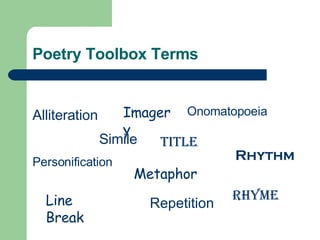
Poetry Toolbox Terms Alliteration Simile Onomatopoeia Metaphor Personification Repetition Rhyme Rhythm Imagery Line Break Title
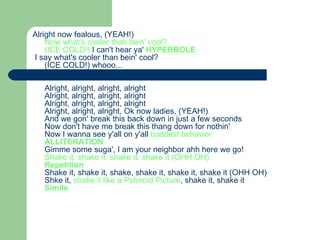
Alright now fealous, (YEAH!)  Now what's cooler than bein' cool?  (ICE COLD!)  I can't hear ya'   HYPERBOLE I say what's cooler than bein' cool?  (ICE COLD!) whooo...  Alright, alright, alright, alright  Alright, alright, alright, alright  Alright, alright, alright, alright  Alright, alright, alright, Ok now ladies, (YEAH!)  And we gon' break this back down in just a few seconds  Now don't have me break this thang down for nothin'  Now I wanna see y'all on y'all  baddest behavior   ALLITERATION Gimme some suga', I am your neighbor ahh here we go!  Shake it, shake it, shake it, shake it (OHH OH)  Repetition Shake it, shake it, shake, shake it, shake it, shake it (OHH OH)  Shke it,  shake it like a Poloroid Picture , shake it, shake it  Simile
Lesson 4: Can you identify Rhyme scheme in the songs you listen to ? Poetry Toolkit Synthesis and Evaluation Apply Rhyming schemes from favorite lyrics. Understand by describing examples
Culminating Activity  Students plan a “poetry slam” for the class and create invitations for family and administrator. OR Students produce their poem using MovieMaker  or PwPt slides and songs that fit “mood” of the poem.
Synthesis and Evaluation Poetry Slam presentations Rubric Evaluation (Quiz)
Assessment Methods Daily evaluation “ Ticket out the Door” evaluations “ T” chart Graphic Organizer Print & Online resources ability Poem Quiz
Assessment Methods for the Instruction Teacher/Media Specialist Observation Participation of student Group/Team participation Assess technology and knowledge of topics discussed Feedback of instruction and methods
Team Collaboration Andrea- How I was able to learn from Kris’ strengths  How I was able to improve  How I plan on using my new found knowledge Kris – Strength in information access How I was able to learn from Andrea’s strengths  How I was able to improve  How I plan on using my new found knowledge
Bibliography Eisenberg, M. (2005).  A Big6 Overview.  Retrieved March 15 th,  2008, from The Big 6  Website:  http://www.big6.com/showcategory.php?cid=6 Flynn, M. & McPhillips, S. (2000).  A note slipped under the door:  Teaching from poems we love.  Portland, ME:  Stenhouse  http://www.georgiastandards.org/SearchResults.aspx http://www.poetry.com http://www.nge.org Oral Presentation Rubric. (2001).  Retrieved   March 15 th , 2008, from  Instruction Website:  http://www.tcet.unt.edu/START/instruct/general/oral.htm

Reference Service Final Draft

  • 1.
    Instruction as ReferenceService ELMT 7130 / Dr. Chung Presented by Andrea Cullers and Kris Kassalen
  • 2.
    Instructional Objectives Developan instruction for students in 8 th grade that introduces The Big 6 information skills while using technology in curriculum.
  • 3.
    Georgia Performance StandardsELA8R1 The student demonstrates comprehension and shows evidence of a warranted and responsible explanation of a variety of literary and informational texts. g. Analyzes and evaluates the effects of sound, form, figurative language, and graphics in order to uncover meaning in literature: i. Sound (e.g., alliteration, onomatopoeia, internal rhyme, rhyme scheme, meter) ii. Figurative language (e.g., simile, metaphor, personification, hyperbole, symbolism, imagery).
  • 4.
    Georgia Performance StandardsELA8W1 The student produces writing that establishes an appropriate organizational structure, sets a context and engages the reader, maintains a coherent focus throughout, and signals a satisfying closure. The student a. Selects a focus, organizational structure, and a point of view based on purpose, genre expectations, audience, length, and format requirements. b. Writes texts of a length appropriate to address the topic or tell the story.
  • 5.
    Georgia Performance StandardsELA8LSV2 The student listens to and views various forms of text and media in order to gather and share information, persuade others, and express and understand ideas. Critical Component: When delivering and responding to presentations, the student: a. Gives oral presentations or dramatic interpretations for various purposes. c. Shows appropriate changes in delivery (e.g., gestures, expression, tone, pace, visuals). d. Uses language for dramatic effect.
  • 6.
    Instructional Strategy TheBig 6 #1 Task Definition = Create a Poem #2 Information Seeking Strategies #3 Location & Access #4 Use of Information #5 Synthesis #6 Evaluation
  • 7.
    Lesson 1: Howdo you make ordinary words poetic? Task Definition: Students will create a poem Students will be introduced to poetry by discussing the difference between “ordinary” and “poetic” language. Teacher/Media Specialist will integrate the use of “ T”chart Thesaurus Ask students to comment on this process Evaluation: “ticket out the door”- students will reflect and describe how they selected poetic words
  • 8.
    Lesson 2: Howis imagery used in poetry? Begin with Defining Imagery by using an online resources. Locate & Access online information for Use New Georgia Encyclopedia www.poetry.com (explain diff. .org vs. .com).
  • 9.
    Resources to AchieveInstruction Lesson Two cont… Six-Room concept in applying imagery to ordinary words in their event to produce a poem Evalution – students share work
  • 10.
    Lesson 3: Whatliterary concept are related to poetry? Poetry Toolbox Activity Poetry Glossary New Georgia Encyclopedia Print materials in Poetry section 800’s Graphic organizer Reflection Homework http://music.yahoo.com/lyrics http://www.christianlyricsonline.com/index.html http://www.goodwinmusic.com/lyrics.html
  • 11.
    Poetry Toolbox TermsAlliteration Simile Onomatopoeia Metaphor Personification Repetition Rhyme Rhythm Imagery Line Break Title
  • 12.
    Alright now fealous,(YEAH!) Now what's cooler than bein' cool? (ICE COLD!) I can't hear ya' HYPERBOLE I say what's cooler than bein' cool? (ICE COLD!) whooo... Alright, alright, alright, alright Alright, alright, alright, alright Alright, alright, alright, alright Alright, alright, alright, Ok now ladies, (YEAH!) And we gon' break this back down in just a few seconds Now don't have me break this thang down for nothin' Now I wanna see y'all on y'all baddest behavior ALLITERATION Gimme some suga', I am your neighbor ahh here we go! Shake it, shake it, shake it, shake it (OHH OH) Repetition Shake it, shake it, shake, shake it, shake it, shake it (OHH OH) Shke it, shake it like a Poloroid Picture , shake it, shake it Simile
  • 13.
    Lesson 4: Canyou identify Rhyme scheme in the songs you listen to ? Poetry Toolkit Synthesis and Evaluation Apply Rhyming schemes from favorite lyrics. Understand by describing examples
  • 14.
    Culminating Activity Students plan a “poetry slam” for the class and create invitations for family and administrator. OR Students produce their poem using MovieMaker or PwPt slides and songs that fit “mood” of the poem.
  • 15.
    Synthesis and EvaluationPoetry Slam presentations Rubric Evaluation (Quiz)
  • 16.
    Assessment Methods Dailyevaluation “ Ticket out the Door” evaluations “ T” chart Graphic Organizer Print & Online resources ability Poem Quiz
  • 17.
    Assessment Methods forthe Instruction Teacher/Media Specialist Observation Participation of student Group/Team participation Assess technology and knowledge of topics discussed Feedback of instruction and methods
  • 18.
    Team Collaboration Andrea-How I was able to learn from Kris’ strengths How I was able to improve How I plan on using my new found knowledge Kris – Strength in information access How I was able to learn from Andrea’s strengths How I was able to improve How I plan on using my new found knowledge
  • 19.
    Bibliography Eisenberg, M.(2005). A Big6 Overview. Retrieved March 15 th, 2008, from The Big 6 Website: http://www.big6.com/showcategory.php?cid=6 Flynn, M. & McPhillips, S. (2000). A note slipped under the door: Teaching from poems we love. Portland, ME: Stenhouse http://www.georgiastandards.org/SearchResults.aspx http://www.poetry.com http://www.nge.org Oral Presentation Rubric. (2001). Retrieved March 15 th , 2008, from Instruction Website: http://www.tcet.unt.edu/START/instruct/general/oral.htm