REFCO Group Ltd.
14 September 2020
Accounting Report
Submitted by:
Muntaha Imraan – 10
Isma Khalid – 31
Yusra Rahim – 33
Fajar Akhtar – 57
Submitted to:
Sir Waqar Hassan Randhawa
Section A
BS 18-22
Introduction
Refco Group Ltd. And Subsidiaries
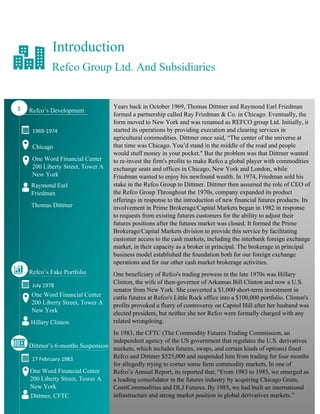
1 Refco’s Development
1969-1974
Chicago
One Word Financial Center
200 Liberty Street, Tower A
New York
Raymond Earl
Friedman
Thomas Dittmer
Refco’s Fake Portfolio
July 1978
One Word Financial Center
200 Liberty Street, Tower A
New York
Hillary Clinton
Dittmer’s 6-months Suspension
17 February 1983
One Word Financial Center
200 Liberty Street, Tower A
New York
Dittmer, CFTC
Years back in October 1969, Thomas Dittmer and Raymond Earl Friedman
formed a partnership called Ray Friedman & Co. in Chicago. Eventually, the
form moved to New York and was renamed as REFCO group Ltd. Initially, it
started its operations by providing execution and clearing services in
agricultural commodities. Dittmer once said, “The center of the universe at
that time was Chicago. You’d stand in the middle of the road and people
would stuff money in your pocket." But the problem was that Dittmer wanted
to re-invest the firm's profits to make Refco a global player with commodities
exchange seats and offices in Chicago, New York and London, while
Friedman wanted to enjoy his newfound wealth. In 1974, Friedman sold his
stake in the Refco Group to Dittmer. Dittmer then assumed the role of CEO of
the Refco Group Throughout the 1970s, company expanded its product
offerings in response to the introduction of new financial futures products. Its
involvement in Prime Brokerage/Capital Markets began in 1982 in response
to requests from existing futures customers for the ability to adjust their
futures positions after the futures market was closed. It formed the Prime
Brokerage/Capital Markets division to provide this service by facilitating
customer access to the cash markets, including the interbank foreign exchange
market, in their capacity as a broker in principal. The brokerage in principal
business model established the foundation both for our foreign exchange
operations and for our other cash market brokerage activities.
One beneficiary of Refco's trading prowess in the late 1970s was Hillary
Clinton, the wife of then-governor of Arkansas Bill Clinton and now a U.S.
senator from New York. She converted a $1,000 short-term investment in
cattle futures at Refco's Little Rock office into a $100,000 portfolio. Clinton's
profits provoked a flurry of controversy on Capitol Hill after her husband was
elected president, but neither she nor Refco were formally charged with any
related wrongdoing.
In 1983, the CFTC (The Commodity Futures Trading Commission, an
independent agency of the US government that regulates the U.S. derivatives
markets, which includes futures, swaps, and certain kinds of options) fined
Refco and Dittmer $525,000 and suspended him from trading for four months
for allegedly trying to corner some farm commodity markets. In one of
Refco’s Annual Report, its reported that, “From 1983 to 1985, we emerged as
a leading consolidator in the futures industry by acquiring Chicago Grain,
ContiCommodities and DLJ Futures. By 1985, we had built an international
infrastructure and strong market position in global derivatives markets.”
Mr. Bennet ,a financial professional educated from Cambridge University
joined REFCO in 1981.At this stage, , Refco has been punished no less than
140 times by regulators for a variety of acts of misconduct, including a pattern
of “sloppy record-keeping, filing false trading reports, inadequately
supervising its traders and other violations. According to the National Futures
Association (“NFA”), Refco was a party in at least 133 Exchange Regulatory
Actions; a Respondent in 24 NFA Arbitration actions; and, involved in almost
150 CFTC Reparations Cases. After 2 years of his joining (1983), Bennet
became the Chief Financial Officer of REFCO.
In 1994, Dittmer moved Refco from Chicago to Wall Street, reflecting his
global ambitions. But the firm's rough-and-tumble regulatory history
accompanied it and grew apace. In September 1998, Mr. Dittmer retired from
post of CEO and Mr. Bennet became new CEO.
In 1999, the CFTC fined Refco $6 million for massive record-keeping
violations and lax internal controls and ordered it to pay $1 million more to
fund an industry study to curtail customer abuses. Under pressure, Dittmer
resigned. In March 1999, Bennett whom Dittmer recently had promoted to
CEO, added the title of chairman. With Bennett at the helm, Refco pushed
harder into fast-growing unregulated markets that served hedge fund and
institutional customers, and further away from its traditional base of buying
and selling agricultural commodities for individuals.
RGHI (REFCO Group Holding Inc. was related party holding company that
controlled Refco, in turn, owned and controlled by Bennett and Grant, the
principal asset of which was stock of Refco. It was being used to hide Refco’s
trading losses and operating expenses by making them appear to be a debt
owed by RGHI to Refco (the “RGHI Receivable”). Refco Group Holdings,
Inc. (RGHI) owed Refco approximately $106 million, and Bennett and his
confederates began to hide the losses through decades long manipulation and
transfers of loans and funds under false pretenses.
Refco Group Limited, LLC was a single member holding company of Refco
Group founded on 1st July 1999, registered with the U.S. Security &
Exchange Commission and incorporated in state of Delaware. A limited
liability company (LLC) is a business structure in the United States whereby
the owners are not personally liable for the company's debts or liabilities.
Limited liability companies are hybrid entities that combine the characteristics
of a corporation with those of a partnership or sole proprietorship. Before the
LBO, RGL was the corporate parent of Refco. RGL was induced to enter into
an improvident LBO based on a false and inaccurate understanding of its
financial condition, causing RGL to saddle itself with $1.4 billion in debt and
to allow its assets to be stripped out and paid to the Refco Insiders while still
owing RCM approximately $2 billion in unpaid IOUs. Financial condition of
RGL not been concealed through the misconduct of the corrupt Refco Insiders
and the other defendants, RGL never would have entered into the LBO.
Before the LBO, RCM was an indirect subsidiary of RGL. RCM was
organized and existed under the laws of Bermuda. At all relevant times, RCM
was an unregulated securities broker and foreign exchange broker, and one of
three principal operating subsidiaries of Refco. RCM traded in over the
counter 10 derivatives and other financial products on behalf of its customers.
Bennett’s Journey to “Chairman”
1981-1999
One Word Financial Center
200 Liberty Street, Tower A
New York
Phillip R. Bennett
Thomas Dittmer
2 RGHI
1990s
Delaware
Chicago
Phillip R. Bennett
Grant Thornton Llp
3 RGL, LLC
1999
Delaware
Phillip R. Bennett
4 Refco Capital Market
1999
Bermuda
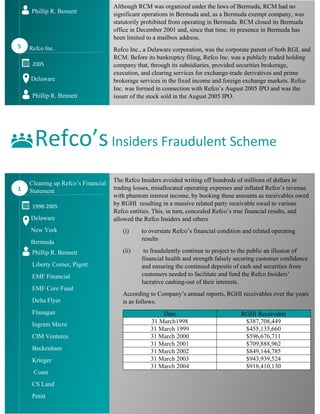
Although RCM was organized under the laws of Bermuda, RCM had no
significant operations in Bermuda and, as a Bermuda exempt company, was
statutorily prohibited from operating in Bermuda. RCM closed its Bermuda
office in December 2001 and, since that time, its presence in Bermuda has
been limited to a mailbox address.
Refco Inc., a Delaware corporation, was the corporate parent of both RGL and
RCM. Before its bankruptcy filing, Refco Inc. was a publicly traded holding
company that, through its subsidiaries, provided securities brokerage,
execution, and clearing services for exchange-trade derivatives and prime
brokerage services in the fixed income and foreign exchange markets. Refco
Inc. was formed in connection with Refco’s August 2005 IPO and was the
issuer of the stock sold in the August 2005 IPO.
The Refco Insiders avoided writing off hundreds of millions of dollars in
trading losses, misallocated operating expenses and inflated Refco’s revenue
with phantom interest income, by booking these amounts as receivables owed
by RGHI resulting in a massive related party receivable owed to various
Refco entities. This, in turn, concealed Refco’s true financial results, and
allowed the Refco Insiders and others
(i) to overstate Refco’s financial condition and related operating
results
(ii) to fraudulently continue to project to the public an illusion of
financial health and strength falsely securing customer confidence
and ensuring the continued deposits of cash and securities from
customers needed to facilitate and fund the Refco Insiders’
lucrative cashing-out of their interests.
According to Company’s annual reports, RGHI receivables over the years
is as follows.
Date RGHI Receivable
31 March1998 $387,708,449
31 March 1999 $455,135,660
31 March 2000 $596,676,711
31 March 2001 $709,888,962
31 March 2002 $849,144,785
31 March 2003 $943,939,524
31 March 2004 $918,410,130
Phillip R. Bennett
5 Refco Inc.
2005
Delaware
Phillip R. Bennett
1
Cleaning up Refco’s Financial
Statement
1998-2005
Delaware
New York
Bermuda
Phillip R. Bennett
Liberty Corner, Pigott
EMF Financial
EMF Core Fund
Delta Flyer
Flanagan
Ingram Micro
CIM Ventures
Beckenham
Krieger
Coast
CS Land
Petitt
Refco’sInsiders Fraudulent Scheme
After the Refco Insiders moved Refco’s losses and operating expenses from
Refco’s books and artificially inflated the company’s operating results and
apparent value, they had to prevent the fictitious nature of the RGHI
Receivable, the trading losses and operating expenses it concealed, and
Refco’s true financial condition from being disclosed. The Refco Insiders
accomplished this through fraudulent RTLs and by funding Refco’s
operations with RCM customer assets. These schemes created the perception
that Refco was robust and financially healthy long enough for the Refco
Insiders to personally enrich themselves through a lucrative cashing out. In
order to further conceal the size of the RGHI Receivable, a number of RTLs
were often employed, temporarily replacing the nearly $1 billion RGHI
Receivable with a number of smaller third-party receivables.
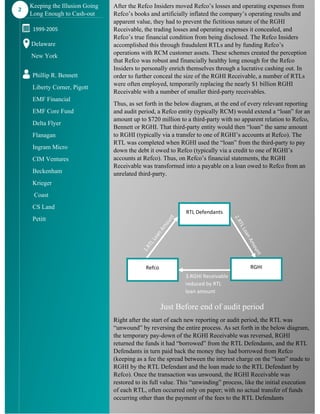
Thus, as set forth in the below diagram, at the end of every relevant reporting
and audit period, a Refco entity (typically RCM) would extend a “loan” for an
amount up to $720 million to a third-party with no apparent relation to Refco,
Bennett or RGHI. That third-party entity would then “loan” the same amount
to RGHI (typically via a transfer to one of RGHI’s accounts at Refco). The
RTL was completed when RGHI used the “loan” from the third-party to pay
down the debt it owed to Refco (typically via a credit to one of RGHI’s
accounts at Refco). Thus, on Refco’s financial statements, the RGHI
Receivable was transformed into a payable on a loan owed to Refco from an
unrelated third-party.
Just Before end of audit period
Right after the start of each new reporting or audit period, the RTL was
“unwound” by reversing the entire process. As set forth in the below diagram,
the temporary pay-down of the RGHI Receivable was reversed, RGHI
returned the funds it had “borrowed” from the RTL Defendants, and the RTL
Defendants in turn paid back the money they had borrowed from Refco
(keeping as a fee the spread between the interest charge on the “loan” made to
RGHI by the RTL Defendant and the loan made to the RTL Defendant by
Refco). Once the transaction was unwound, the RGHI Receivable was
restored to its full value. This “unwinding” process, like the initial execution
of each RTL, often occurred only on paper; with no actual transfer of funds
occurring other than the payment of the fees to the RTL Defendants
2
Keeping the Illusion Going
Long Enough to Cash-out
1999-2005
Delaware
New York
Phillip R. Bennett
Liberty Corner, Pigott
EMF Financial
EMF Core Fund
Delta Flyer
Flanagan
Ingram Micro
CIM Ventures
Beckenham
Krieger
Coast
CS Land
Petitt
RTL Defendants
RGHI
Refco
3.RGHI Receivable
reduced by RTL
loan amount
Just after end of Audit Period
The Refco Insiders, with the active assistance of MB and the RTL
Defendants, engaged in these RTLs at least 18 times from 2000 through 2005,
always at the end of a financial reporting or audit period, and never at any
other time. Instead of owning up to Refco’s true financial condition and
borrowing the money they needed as part of an overall restructuring of
Refco’s operations, the Refco Insiders stole it from RCM and its customers.
The Refco Insiders simply took the money and property entrusted to RCM by
its customers and sent the funds to other Refco entities. None of these entities
provided RCM with assurances of their ability, intent, or obligation to repay
those assets; none provided RCM with 30 security or collateral for the
diverted assets; and none had the financial wherewithal to repay RCM on
demand or otherwise. On a daily basis, assets in the accounts of RCM
customers were transferred out of RCM for use by other Refco entities. The
Refco Insiders caused RCM to keep as little cash as possible on hand. These
transfers, which purportedly took the form of unsecured intercompany “loans”
from RCM to other Refco entities, often occurred without any “loan”
documentation between RCM and the Refco entities that received the funds.
The outside Director and outside alternative Director of RCM, Anthony
Whaley and Charles Collis were partners in the Bermuda law offices of
Conyers Dill & Pearman. The RCM Outside Directors were at all times
unaware of the form, substance, and magnitude of the intercompany transfers
from RCM to the other Refco entities. The RCM Outside Directors were
unaware that RCM customer assets were diverted daily without any loan
documents or collateral or security to other Refco entities that had little, if
any, ability, or intention of repaying the diverted assets. If either Whaley or
Collis had learned of the fraudulent nature of the diversion of RCM’s assets in
daily undocumented and uncollateralized intercompany transactions to other
uncreditworthy Refco entities, they would have taken steps to stop the
misappropriation.
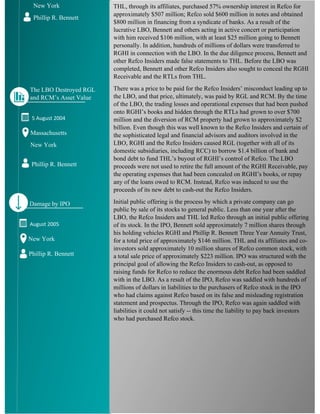
In November 2003, Bennett and others at Refco began negotiations with
Thomas H. Lee Partners (“THL”), a private equity firm headquartered in
Boston, Massachusetts, regarding that entity’s possible purchase of a
controlling stake in Refco as part of a leveraged buyout transaction. The LBO
was ultimately carried out on August 5, 2004, and was structured as follows:
3
RTL Defendants
RGHI
Refco
2.Return of RTL loan
amount plus fee based
on additional interest
charged on loan
between RTL
defendant and RGHI
1.RTL loan
amount
returned to RGHI
November 2003
Delaware
The Cash Out
THL, through its affiliates, purchased 57% ownership interest in Refco for
approximately $507 million; Refco sold $600 million in notes and obtained
$800 million in financing from a syndicate of banks. As a result of the
lucrative LBO, Bennett and others acting in active concert or participation
with him received $106 million, with at least $25 million going to Bennett
personally. In addition, hundreds of millions of dollars were transferred to
RGHI in connection with the LBO. In the due diligence process, Bennett and
other Refco Insiders made false statements to THL. Before the LBO was
completed, Bennett and other Refco Insiders also sought to conceal the RGHI
Receivable and the RTLs from THL.
There was a price to be paid for the Refco Insiders’ misconduct leading up to
the LBO, and that price, ultimately, was paid by RGL and RCM. By the time
of the LBO, the trading losses and operational expenses that had been pushed
onto RGHI’s books and hidden through the RTLs had grown to over $700
million and the diversion of RCM property had grown to approximately $2
billion. Even though this was well known to the Refco Insiders and certain of
the sophisticated legal and financial advisors and auditors involved in the
LBO, RGHI and the Refco Insiders caused RGL (together with all of its
domestic subsidiaries, including RCC) to borrow $1.4 billion of bank and
bond debt to fund THL’s buyout of RGHI’s control of Refco. The LBO
proceeds were not used to retire the full amount of the RGHI Receivable, pay
the operating expenses that had been concealed on RGHI’s books, or repay
any of the loans owed to RCM. Instead, Refco was induced to use the
proceeds of its new debt to cash-out the Refco Insiders.
Initial public offering is the process by which a private company can go
public by sale of its stocks to general public. Less than one year after the
LBO, the Refco Insiders and THL led Refco through an initial public offering
of its stock. In the IPO, Bennett sold approximately 7 million shares through
his holding vehicles RGHI and Phillip R. Bennett Three Year Annuity Trust,
for a total price of approximately $146 million. THL and its affiliates and co-
investors sold approximately 10 million shares of Refco common stock, with
a total sale price of approximately $223 million. IPO was structured with the
principal goal of allowing the Refco Insiders to cash-out, as opposed to
raising funds for Refco to reduce the enormous debt Refco had been saddled
with in the LBO. As a result of the IPO, Refco was saddled with hundreds of
millions of dollars in liabilities to the purchasers of Refco stock in the IPO
who had claims against Refco based on its false and misleading registration
statement and prospectus. Through the IPO, Refco was again saddled with
liabilities it could not satisfy -- this time the liability to pay back investors
who had purchased Refco stock.
New York
Phillip R. Bennett
5 August 2004
Massachusetts
New York
Phillip R. Bennett
The LBO Destroyed RGL
and RCM’s Asset Value
August 2005
New York
Phillip R. Bennett
Damage by IPO
Just two months after becoming a public company, however, REFCO was no
more. The first evidence that the end was night for REFCO came to light on
Monday, October 10, 2005, when the company announced that its CEO and
chairman, Phillip R. Bennett had hidden $430 million in bad debts from the
company’s auditors and investors, and had agreed to take a leave of absence.
REFCO said that through an internal review over the preceding weekend it
discovered a receivable owed to the company by an unnamed entity that
turned out to be controlled by Mr. Bennett, in the amount of approximately
US$430 million. This constituted accounting fraud, and following an
investigation internally it emerged that Mr. Bennett had been buying bad
debts from REFCO in order to prevent the company from needing to write
them off, and was paying for the bad loans with money borrowed by REFCO
itself – effectively a house of cards. Between 2002 and 2005, Mr. Bennet had
arranged at the end of every quarter for a REFCO subsidiary to lend money to
a hedge fund called Liberty Corner Capital Strategy, which then lent the
money to REFCO Group Holdings, an independent offshore company secretly
owned by Phillip Bennett with no legal or official connection to REFCO.
Mr. Bennett’s company then paid the money back to REFCO, leaving Liberty
as the apparent borrower when financial statements were prepared. At the
time, it was not clear if Liberty Corner Capital Strategy knew it was hiding
scam transactions; management of the fund has claimed that they believed it
was borrowing from one REFCO subsidiary and lending to another Refco
subsidiary, and not lending to an entity that Mr. Bennett secretly controlled.
Thus, on October 14, 2005, REFCO sunk, declaring assets of around $49
billion, which would have made it the fourth largest bankruptcy filing in
American history. However, the company subsequently submitted a revised
document, claiming it had $16.5 billion in assets and $16.8 billion in
liabilities. REFCO also announced a tentative agreement to sell its regulated
futures and commodities business, which is not covered by the bankruptcy
filing, to a group led by J.C. Flowers & Co. for about $768 million. However,
other bidders soon emerged, including Interactive Brokers and Dubai
Investments, the investment division of the emirate of Dubai. These offers
were for a time rebuffed, as the Flowers-led group had a right to a break-up
fee if Refco had sold this business to anyone else. Carlos Abadi, involved in
the Dubai bid, said that the Dubai-led group offered $1 billion for all of
REFCO and was rejected. On October 20, Liberty Corner Capital Strategy
announced plans to sue REFCO, and a few months later in April 2006, papers
filed by creditors of REFCO seemed to show that Mr. Bennett had run a
similar scam going back at least to 2000, using Bawag P.S.K. Group in the
place of Liberty Corner Capital Strategy.
Refco’s Bankruptcy
Fraud, hiding $430 million
in bad debt
October 2005
One Word Financial Center
200 Liberty Street, Tower A
New York
Delaware
Phillip Bennet
On March 15, 2006, information leaked by the U.S. prosecutor’s office
revealed that REFCO held offshore accounts holding as much as $525 million
in fake bonds. The company held the “securities” for Bawag P.S.K., the
Austrian bank with which REFCO had a close relationship, discussed in part
above, and for a non-U.S. hedge fund called Liquid Opportunity. Apparently,
Bawag and Liquid Opportunity jointly owned six Anguilla companies, which
in turn owned the fake bonds. Refco’s attorneys have declined to comment.
Apparently, the six Anguilla companies initially responded to Refco’s
bankruptcy filing as a normal customer would have, filing as creditors with a
combined claim of $543 million. However, they failed to follow up with any
legal filings.
Phillip R. Bennett, the former chief executive was known as the closer for
selling deals that turned Refco’s into the nation’s biggest independent future
broker. Refco’s spiral into bankruptcy began with the discovery that an
investment fund controlled by Mr. Bennett owed Refco’s $430 million,
allegedly as a part of a scheme to hide them as bad debt.
The main reasons because of which this particular scandal took place are as
follow:
The main reason of scam is weak administration. The company had to face the
scam because of weak administration because there were not any specific
controlled system and also there were no specific and effective policies and
strong techniques and skills to keep a strong eye on the working of the
company.
Another reason for the scam is improper check and balance of financial
statements. This lack put bad impact on the company' s financial position and
performance. This improper check and balance enabled the Mr. Bennet to do
this heavy scam of $430 million.
Overconfidence in one’s financial knowledge is a significant predictor of the
odds of becoming a victim of financial fraud. As Mr. Bennett thought that
company had also done the frauds in previous history, so now he will be able
to do that fraud and no one will notice him. But ultimately, he was caught.
Responses to Bankruptcy
Filing
15 March 2006
Delaware
New York
Austria
Phillip R. Bennett
Main Character
Phillip R. Bennett
Reasons
Weak Administration
Improper check & balance
Over Confidence of Mr.
Bennet
This is also another reason of scam done by Mr. Bennett, as he misused his
authority because he thought that no one is there to judge and identify his
fraud.
Poor accountability also led this fraud to happen. There was not any proper
and efficient set up of accountability process which gave a way to Mr. Bennett
to do a fraud.
• As Bennett was arrested on suspicion of fraud and Refco was in a
crisis, its share price fell 45% that day, 11% the day after, despite a
five-hour suspension of trading, and 22% the next day. Clients began
deserting the company and its lending banks froze its deposit accounts,
refusing Refco access to its money. Then the following day, when
Refco said it was imposing a 15-day moratorium on customer
withdrawals from its capital markets division, the share price fell a
further 27% and the New York Stock Exchange suspended trading.
• The bankruptcy of REFCO resulted in the unsecured customer
accounts being considered for reimbursement only after the secured
customers in the distribution of whatever funds were left. In effect,
this left Refco’s 17,000 trading account customers with virtually no
return of funds from their accounts.
• Experts said Refco's failure won't threaten global financial markets in
the way Enron's collapse did in 2001 and the demise of hedge fund
Long-Term Capital Management did in 1998. Still, the company's
troubled tentacles stretch far and wide, from pork bellies to futures on
stocks and bonds.
• It also led to the losses connected to customers, investors, financial
firms estimated to be in the millions, and many creditors lost the cases
and could not claim back their money.
• All Refco’s subsidiary had been bankrupted. These entities include
Refco capital market, Refco group Ltd, Refco finance holdings and
Refco finance Inc.
• Within two days of the announcement of the discovered debt, Refco
had to shut its nonregulated capital-markets subsidiary because it lost
liquidity. In other words, people no longer trusted Refco to make good
on trades. Customers began to yank funds, clients started to steer
business elsewhere, and employees began furiously to look around for
new gigs.
• Refco's regulators rushed to try to save the broker or at least soften the
impact if the company collapses. The Wall Street Journal reported that
senior regulators at the Chicago Mercantile Exchange and the
Commodity Futures Trading Commission asked Goldman Sachs and
other banks to buy Refco to calm fears among investors, lenders and
trading partners who have become increasingly concerned about the
future of the company.
Misuse of authority
Poor Accountability
Effects
• In abandoning Refco rapidly, the market proved that creditworthiness
is not an absolute attribute that can be proved by showing you have a
certain amount of cash on hand, or that your equity-to-debt ratio is
above a certain level. Rather, it’s relative. Companies may boast
excellent credit ratings from agencies like Standard & Poor’s. But
ultimately, creditworthiness is in the eye of the beholder. It’s
something that people say you have, based on personal experience,
reputation, and marketplace behavior.
But Refco’s downfall isn’t simply an occasion for a history lesson, or an object
lesson for people who make their living in the commodity pits. The entire global
economy runs on the lubricant of easy credit extended among companies. And
much of that credit depends on trust and reputation. An auto-parts company that
gives its customers 30 days to pay it and has 30 days to pay its suppliers can
function quite well. But if a few suppliers become worried that the company
might have difficulty paying its bills, and demand to be paid in 10 days, that
company could go bankrupt in a matter of days. These days, you don’t have to
be a bank—or even a liquidity-dependent finance firm—to suffer a run on the
bank.
Conclusion
o Refco Estate Complain filed by MARC. S KIRSCHNER as Trustee of
the Refco Litigation Trust
o The Due Diligence Defense and the Refco IPO by Edward Pekarek
published on April 27, 2007
o USA Today published on 11/9/2005
o Refco’s Annual Reports and Company’s Prospectus published on
sec.gov/archives
o Finance feeds article “Today in History” published on 14 October
2016
o The Hedge Fund’s Journal “The Last Days of Refco”
References

Refco group Limited Scam

  • 1.
    REFCO Group Ltd. 14September 2020 Accounting Report Submitted by: Muntaha Imraan – 10 Isma Khalid – 31 Yusra Rahim – 33 Fajar Akhtar – 57 Submitted to: Sir Waqar Hassan Randhawa Section A BS 18-22
  • 2.
    Introduction Refco Group Ltd.And Subsidiaries 1 Refco’s Development 1969-1974 Chicago One Word Financial Center 200 Liberty Street, Tower A New York Raymond Earl Friedman Thomas Dittmer Refco’s Fake Portfolio July 1978 One Word Financial Center 200 Liberty Street, Tower A New York Hillary Clinton Dittmer’s 6-months Suspension 17 February 1983 One Word Financial Center 200 Liberty Street, Tower A New York Dittmer, CFTC Years back in October 1969, Thomas Dittmer and Raymond Earl Friedman formed a partnership called Ray Friedman & Co. in Chicago. Eventually, the form moved to New York and was renamed as REFCO group Ltd. Initially, it started its operations by providing execution and clearing services in agricultural commodities. Dittmer once said, “The center of the universe at that time was Chicago. You’d stand in the middle of the road and people would stuff money in your pocket." But the problem was that Dittmer wanted to re-invest the firm's profits to make Refco a global player with commodities exchange seats and offices in Chicago, New York and London, while Friedman wanted to enjoy his newfound wealth. In 1974, Friedman sold his stake in the Refco Group to Dittmer. Dittmer then assumed the role of CEO of the Refco Group Throughout the 1970s, company expanded its product offerings in response to the introduction of new financial futures products. Its involvement in Prime Brokerage/Capital Markets began in 1982 in response to requests from existing futures customers for the ability to adjust their futures positions after the futures market was closed. It formed the Prime Brokerage/Capital Markets division to provide this service by facilitating customer access to the cash markets, including the interbank foreign exchange market, in their capacity as a broker in principal. The brokerage in principal business model established the foundation both for our foreign exchange operations and for our other cash market brokerage activities. One beneficiary of Refco's trading prowess in the late 1970s was Hillary Clinton, the wife of then-governor of Arkansas Bill Clinton and now a U.S. senator from New York. She converted a $1,000 short-term investment in cattle futures at Refco's Little Rock office into a $100,000 portfolio. Clinton's profits provoked a flurry of controversy on Capitol Hill after her husband was elected president, but neither she nor Refco were formally charged with any related wrongdoing. In 1983, the CFTC (The Commodity Futures Trading Commission, an independent agency of the US government that regulates the U.S. derivatives markets, which includes futures, swaps, and certain kinds of options) fined Refco and Dittmer $525,000 and suspended him from trading for four months for allegedly trying to corner some farm commodity markets. In one of Refco’s Annual Report, its reported that, “From 1983 to 1985, we emerged as a leading consolidator in the futures industry by acquiring Chicago Grain, ContiCommodities and DLJ Futures. By 1985, we had built an international infrastructure and strong market position in global derivatives markets.”
  • 3.
    Mr. Bennet ,afinancial professional educated from Cambridge University joined REFCO in 1981.At this stage, , Refco has been punished no less than 140 times by regulators for a variety of acts of misconduct, including a pattern of “sloppy record-keeping, filing false trading reports, inadequately supervising its traders and other violations. According to the National Futures Association (“NFA”), Refco was a party in at least 133 Exchange Regulatory Actions; a Respondent in 24 NFA Arbitration actions; and, involved in almost 150 CFTC Reparations Cases. After 2 years of his joining (1983), Bennet became the Chief Financial Officer of REFCO. In 1994, Dittmer moved Refco from Chicago to Wall Street, reflecting his global ambitions. But the firm's rough-and-tumble regulatory history accompanied it and grew apace. In September 1998, Mr. Dittmer retired from post of CEO and Mr. Bennet became new CEO. In 1999, the CFTC fined Refco $6 million for massive record-keeping violations and lax internal controls and ordered it to pay $1 million more to fund an industry study to curtail customer abuses. Under pressure, Dittmer resigned. In March 1999, Bennett whom Dittmer recently had promoted to CEO, added the title of chairman. With Bennett at the helm, Refco pushed harder into fast-growing unregulated markets that served hedge fund and institutional customers, and further away from its traditional base of buying and selling agricultural commodities for individuals. RGHI (REFCO Group Holding Inc. was related party holding company that controlled Refco, in turn, owned and controlled by Bennett and Grant, the principal asset of which was stock of Refco. It was being used to hide Refco’s trading losses and operating expenses by making them appear to be a debt owed by RGHI to Refco (the “RGHI Receivable”). Refco Group Holdings, Inc. (RGHI) owed Refco approximately $106 million, and Bennett and his confederates began to hide the losses through decades long manipulation and transfers of loans and funds under false pretenses. Refco Group Limited, LLC was a single member holding company of Refco Group founded on 1st July 1999, registered with the U.S. Security & Exchange Commission and incorporated in state of Delaware. A limited liability company (LLC) is a business structure in the United States whereby the owners are not personally liable for the company's debts or liabilities. Limited liability companies are hybrid entities that combine the characteristics of a corporation with those of a partnership or sole proprietorship. Before the LBO, RGL was the corporate parent of Refco. RGL was induced to enter into an improvident LBO based on a false and inaccurate understanding of its financial condition, causing RGL to saddle itself with $1.4 billion in debt and to allow its assets to be stripped out and paid to the Refco Insiders while still owing RCM approximately $2 billion in unpaid IOUs. Financial condition of RGL not been concealed through the misconduct of the corrupt Refco Insiders and the other defendants, RGL never would have entered into the LBO. Before the LBO, RCM was an indirect subsidiary of RGL. RCM was organized and existed under the laws of Bermuda. At all relevant times, RCM was an unregulated securities broker and foreign exchange broker, and one of three principal operating subsidiaries of Refco. RCM traded in over the counter 10 derivatives and other financial products on behalf of its customers. Bennett’s Journey to “Chairman” 1981-1999 One Word Financial Center 200 Liberty Street, Tower A New York Phillip R. Bennett Thomas Dittmer 2 RGHI 1990s Delaware Chicago Phillip R. Bennett Grant Thornton Llp 3 RGL, LLC 1999 Delaware Phillip R. Bennett 4 Refco Capital Market 1999 Bermuda
  • 4.
    Although RCM wasorganized under the laws of Bermuda, RCM had no significant operations in Bermuda and, as a Bermuda exempt company, was statutorily prohibited from operating in Bermuda. RCM closed its Bermuda office in December 2001 and, since that time, its presence in Bermuda has been limited to a mailbox address. Refco Inc., a Delaware corporation, was the corporate parent of both RGL and RCM. Before its bankruptcy filing, Refco Inc. was a publicly traded holding company that, through its subsidiaries, provided securities brokerage, execution, and clearing services for exchange-trade derivatives and prime brokerage services in the fixed income and foreign exchange markets. Refco Inc. was formed in connection with Refco’s August 2005 IPO and was the issuer of the stock sold in the August 2005 IPO. The Refco Insiders avoided writing off hundreds of millions of dollars in trading losses, misallocated operating expenses and inflated Refco’s revenue with phantom interest income, by booking these amounts as receivables owed by RGHI resulting in a massive related party receivable owed to various Refco entities. This, in turn, concealed Refco’s true financial results, and allowed the Refco Insiders and others (i) to overstate Refco’s financial condition and related operating results (ii) to fraudulently continue to project to the public an illusion of financial health and strength falsely securing customer confidence and ensuring the continued deposits of cash and securities from customers needed to facilitate and fund the Refco Insiders’ lucrative cashing-out of their interests. According to Company’s annual reports, RGHI receivables over the years is as follows. Date RGHI Receivable 31 March1998 $387,708,449 31 March 1999 $455,135,660 31 March 2000 $596,676,711 31 March 2001 $709,888,962 31 March 2002 $849,144,785 31 March 2003 $943,939,524 31 March 2004 $918,410,130 Phillip R. Bennett 5 Refco Inc. 2005 Delaware Phillip R. Bennett 1 Cleaning up Refco’s Financial Statement 1998-2005 Delaware New York Bermuda Phillip R. Bennett Liberty Corner, Pigott EMF Financial EMF Core Fund Delta Flyer Flanagan Ingram Micro CIM Ventures Beckenham Krieger Coast CS Land Petitt Refco’sInsiders Fraudulent Scheme
  • 5.
    After the RefcoInsiders moved Refco’s losses and operating expenses from Refco’s books and artificially inflated the company’s operating results and apparent value, they had to prevent the fictitious nature of the RGHI Receivable, the trading losses and operating expenses it concealed, and Refco’s true financial condition from being disclosed. The Refco Insiders accomplished this through fraudulent RTLs and by funding Refco’s operations with RCM customer assets. These schemes created the perception that Refco was robust and financially healthy long enough for the Refco Insiders to personally enrich themselves through a lucrative cashing out. In order to further conceal the size of the RGHI Receivable, a number of RTLs were often employed, temporarily replacing the nearly $1 billion RGHI Receivable with a number of smaller third-party receivables. Thus, as set forth in the below diagram, at the end of every relevant reporting and audit period, a Refco entity (typically RCM) would extend a “loan” for an amount up to $720 million to a third-party with no apparent relation to Refco, Bennett or RGHI. That third-party entity would then “loan” the same amount to RGHI (typically via a transfer to one of RGHI’s accounts at Refco). The RTL was completed when RGHI used the “loan” from the third-party to pay down the debt it owed to Refco (typically via a credit to one of RGHI’s accounts at Refco). Thus, on Refco’s financial statements, the RGHI Receivable was transformed into a payable on a loan owed to Refco from an unrelated third-party. Just Before end of audit period Right after the start of each new reporting or audit period, the RTL was “unwound” by reversing the entire process. As set forth in the below diagram, the temporary pay-down of the RGHI Receivable was reversed, RGHI returned the funds it had “borrowed” from the RTL Defendants, and the RTL Defendants in turn paid back the money they had borrowed from Refco (keeping as a fee the spread between the interest charge on the “loan” made to RGHI by the RTL Defendant and the loan made to the RTL Defendant by Refco). Once the transaction was unwound, the RGHI Receivable was restored to its full value. This “unwinding” process, like the initial execution of each RTL, often occurred only on paper; with no actual transfer of funds occurring other than the payment of the fees to the RTL Defendants 2 Keeping the Illusion Going Long Enough to Cash-out 1999-2005 Delaware New York Phillip R. Bennett Liberty Corner, Pigott EMF Financial EMF Core Fund Delta Flyer Flanagan Ingram Micro CIM Ventures Beckenham Krieger Coast CS Land Petitt RTL Defendants RGHI Refco 3.RGHI Receivable reduced by RTL loan amount
  • 6.
    Just after endof Audit Period The Refco Insiders, with the active assistance of MB and the RTL Defendants, engaged in these RTLs at least 18 times from 2000 through 2005, always at the end of a financial reporting or audit period, and never at any other time. Instead of owning up to Refco’s true financial condition and borrowing the money they needed as part of an overall restructuring of Refco’s operations, the Refco Insiders stole it from RCM and its customers. The Refco Insiders simply took the money and property entrusted to RCM by its customers and sent the funds to other Refco entities. None of these entities provided RCM with assurances of their ability, intent, or obligation to repay those assets; none provided RCM with 30 security or collateral for the diverted assets; and none had the financial wherewithal to repay RCM on demand or otherwise. On a daily basis, assets in the accounts of RCM customers were transferred out of RCM for use by other Refco entities. The Refco Insiders caused RCM to keep as little cash as possible on hand. These transfers, which purportedly took the form of unsecured intercompany “loans” from RCM to other Refco entities, often occurred without any “loan” documentation between RCM and the Refco entities that received the funds. The outside Director and outside alternative Director of RCM, Anthony Whaley and Charles Collis were partners in the Bermuda law offices of Conyers Dill & Pearman. The RCM Outside Directors were at all times unaware of the form, substance, and magnitude of the intercompany transfers from RCM to the other Refco entities. The RCM Outside Directors were unaware that RCM customer assets were diverted daily without any loan documents or collateral or security to other Refco entities that had little, if any, ability, or intention of repaying the diverted assets. If either Whaley or Collis had learned of the fraudulent nature of the diversion of RCM’s assets in daily undocumented and uncollateralized intercompany transactions to other uncreditworthy Refco entities, they would have taken steps to stop the misappropriation. In November 2003, Bennett and others at Refco began negotiations with Thomas H. Lee Partners (“THL”), a private equity firm headquartered in Boston, Massachusetts, regarding that entity’s possible purchase of a controlling stake in Refco as part of a leveraged buyout transaction. The LBO was ultimately carried out on August 5, 2004, and was structured as follows: 3 RTL Defendants RGHI Refco 2.Return of RTL loan amount plus fee based on additional interest charged on loan between RTL defendant and RGHI 1.RTL loan amount returned to RGHI November 2003 Delaware The Cash Out
  • 7.
    THL, through itsaffiliates, purchased 57% ownership interest in Refco for approximately $507 million; Refco sold $600 million in notes and obtained $800 million in financing from a syndicate of banks. As a result of the lucrative LBO, Bennett and others acting in active concert or participation with him received $106 million, with at least $25 million going to Bennett personally. In addition, hundreds of millions of dollars were transferred to RGHI in connection with the LBO. In the due diligence process, Bennett and other Refco Insiders made false statements to THL. Before the LBO was completed, Bennett and other Refco Insiders also sought to conceal the RGHI Receivable and the RTLs from THL. There was a price to be paid for the Refco Insiders’ misconduct leading up to the LBO, and that price, ultimately, was paid by RGL and RCM. By the time of the LBO, the trading losses and operational expenses that had been pushed onto RGHI’s books and hidden through the RTLs had grown to over $700 million and the diversion of RCM property had grown to approximately $2 billion. Even though this was well known to the Refco Insiders and certain of the sophisticated legal and financial advisors and auditors involved in the LBO, RGHI and the Refco Insiders caused RGL (together with all of its domestic subsidiaries, including RCC) to borrow $1.4 billion of bank and bond debt to fund THL’s buyout of RGHI’s control of Refco. The LBO proceeds were not used to retire the full amount of the RGHI Receivable, pay the operating expenses that had been concealed on RGHI’s books, or repay any of the loans owed to RCM. Instead, Refco was induced to use the proceeds of its new debt to cash-out the Refco Insiders. Initial public offering is the process by which a private company can go public by sale of its stocks to general public. Less than one year after the LBO, the Refco Insiders and THL led Refco through an initial public offering of its stock. In the IPO, Bennett sold approximately 7 million shares through his holding vehicles RGHI and Phillip R. Bennett Three Year Annuity Trust, for a total price of approximately $146 million. THL and its affiliates and co- investors sold approximately 10 million shares of Refco common stock, with a total sale price of approximately $223 million. IPO was structured with the principal goal of allowing the Refco Insiders to cash-out, as opposed to raising funds for Refco to reduce the enormous debt Refco had been saddled with in the LBO. As a result of the IPO, Refco was saddled with hundreds of millions of dollars in liabilities to the purchasers of Refco stock in the IPO who had claims against Refco based on its false and misleading registration statement and prospectus. Through the IPO, Refco was again saddled with liabilities it could not satisfy -- this time the liability to pay back investors who had purchased Refco stock. New York Phillip R. Bennett 5 August 2004 Massachusetts New York Phillip R. Bennett The LBO Destroyed RGL and RCM’s Asset Value August 2005 New York Phillip R. Bennett Damage by IPO
  • 8.
    Just two monthsafter becoming a public company, however, REFCO was no more. The first evidence that the end was night for REFCO came to light on Monday, October 10, 2005, when the company announced that its CEO and chairman, Phillip R. Bennett had hidden $430 million in bad debts from the company’s auditors and investors, and had agreed to take a leave of absence. REFCO said that through an internal review over the preceding weekend it discovered a receivable owed to the company by an unnamed entity that turned out to be controlled by Mr. Bennett, in the amount of approximately US$430 million. This constituted accounting fraud, and following an investigation internally it emerged that Mr. Bennett had been buying bad debts from REFCO in order to prevent the company from needing to write them off, and was paying for the bad loans with money borrowed by REFCO itself – effectively a house of cards. Between 2002 and 2005, Mr. Bennet had arranged at the end of every quarter for a REFCO subsidiary to lend money to a hedge fund called Liberty Corner Capital Strategy, which then lent the money to REFCO Group Holdings, an independent offshore company secretly owned by Phillip Bennett with no legal or official connection to REFCO. Mr. Bennett’s company then paid the money back to REFCO, leaving Liberty as the apparent borrower when financial statements were prepared. At the time, it was not clear if Liberty Corner Capital Strategy knew it was hiding scam transactions; management of the fund has claimed that they believed it was borrowing from one REFCO subsidiary and lending to another Refco subsidiary, and not lending to an entity that Mr. Bennett secretly controlled. Thus, on October 14, 2005, REFCO sunk, declaring assets of around $49 billion, which would have made it the fourth largest bankruptcy filing in American history. However, the company subsequently submitted a revised document, claiming it had $16.5 billion in assets and $16.8 billion in liabilities. REFCO also announced a tentative agreement to sell its regulated futures and commodities business, which is not covered by the bankruptcy filing, to a group led by J.C. Flowers & Co. for about $768 million. However, other bidders soon emerged, including Interactive Brokers and Dubai Investments, the investment division of the emirate of Dubai. These offers were for a time rebuffed, as the Flowers-led group had a right to a break-up fee if Refco had sold this business to anyone else. Carlos Abadi, involved in the Dubai bid, said that the Dubai-led group offered $1 billion for all of REFCO and was rejected. On October 20, Liberty Corner Capital Strategy announced plans to sue REFCO, and a few months later in April 2006, papers filed by creditors of REFCO seemed to show that Mr. Bennett had run a similar scam going back at least to 2000, using Bawag P.S.K. Group in the place of Liberty Corner Capital Strategy. Refco’s Bankruptcy Fraud, hiding $430 million in bad debt October 2005 One Word Financial Center 200 Liberty Street, Tower A New York Delaware Phillip Bennet
  • 9.
    On March 15,2006, information leaked by the U.S. prosecutor’s office revealed that REFCO held offshore accounts holding as much as $525 million in fake bonds. The company held the “securities” for Bawag P.S.K., the Austrian bank with which REFCO had a close relationship, discussed in part above, and for a non-U.S. hedge fund called Liquid Opportunity. Apparently, Bawag and Liquid Opportunity jointly owned six Anguilla companies, which in turn owned the fake bonds. Refco’s attorneys have declined to comment. Apparently, the six Anguilla companies initially responded to Refco’s bankruptcy filing as a normal customer would have, filing as creditors with a combined claim of $543 million. However, they failed to follow up with any legal filings. Phillip R. Bennett, the former chief executive was known as the closer for selling deals that turned Refco’s into the nation’s biggest independent future broker. Refco’s spiral into bankruptcy began with the discovery that an investment fund controlled by Mr. Bennett owed Refco’s $430 million, allegedly as a part of a scheme to hide them as bad debt. The main reasons because of which this particular scandal took place are as follow: The main reason of scam is weak administration. The company had to face the scam because of weak administration because there were not any specific controlled system and also there were no specific and effective policies and strong techniques and skills to keep a strong eye on the working of the company. Another reason for the scam is improper check and balance of financial statements. This lack put bad impact on the company' s financial position and performance. This improper check and balance enabled the Mr. Bennet to do this heavy scam of $430 million. Overconfidence in one’s financial knowledge is a significant predictor of the odds of becoming a victim of financial fraud. As Mr. Bennett thought that company had also done the frauds in previous history, so now he will be able to do that fraud and no one will notice him. But ultimately, he was caught. Responses to Bankruptcy Filing 15 March 2006 Delaware New York Austria Phillip R. Bennett Main Character Phillip R. Bennett Reasons Weak Administration Improper check & balance Over Confidence of Mr. Bennet
  • 10.
    This is alsoanother reason of scam done by Mr. Bennett, as he misused his authority because he thought that no one is there to judge and identify his fraud. Poor accountability also led this fraud to happen. There was not any proper and efficient set up of accountability process which gave a way to Mr. Bennett to do a fraud. • As Bennett was arrested on suspicion of fraud and Refco was in a crisis, its share price fell 45% that day, 11% the day after, despite a five-hour suspension of trading, and 22% the next day. Clients began deserting the company and its lending banks froze its deposit accounts, refusing Refco access to its money. Then the following day, when Refco said it was imposing a 15-day moratorium on customer withdrawals from its capital markets division, the share price fell a further 27% and the New York Stock Exchange suspended trading. • The bankruptcy of REFCO resulted in the unsecured customer accounts being considered for reimbursement only after the secured customers in the distribution of whatever funds were left. In effect, this left Refco’s 17,000 trading account customers with virtually no return of funds from their accounts. • Experts said Refco's failure won't threaten global financial markets in the way Enron's collapse did in 2001 and the demise of hedge fund Long-Term Capital Management did in 1998. Still, the company's troubled tentacles stretch far and wide, from pork bellies to futures on stocks and bonds. • It also led to the losses connected to customers, investors, financial firms estimated to be in the millions, and many creditors lost the cases and could not claim back their money. • All Refco’s subsidiary had been bankrupted. These entities include Refco capital market, Refco group Ltd, Refco finance holdings and Refco finance Inc. • Within two days of the announcement of the discovered debt, Refco had to shut its nonregulated capital-markets subsidiary because it lost liquidity. In other words, people no longer trusted Refco to make good on trades. Customers began to yank funds, clients started to steer business elsewhere, and employees began furiously to look around for new gigs. • Refco's regulators rushed to try to save the broker or at least soften the impact if the company collapses. The Wall Street Journal reported that senior regulators at the Chicago Mercantile Exchange and the Commodity Futures Trading Commission asked Goldman Sachs and other banks to buy Refco to calm fears among investors, lenders and trading partners who have become increasingly concerned about the future of the company. Misuse of authority Poor Accountability Effects
  • 11.
    • In abandoningRefco rapidly, the market proved that creditworthiness is not an absolute attribute that can be proved by showing you have a certain amount of cash on hand, or that your equity-to-debt ratio is above a certain level. Rather, it’s relative. Companies may boast excellent credit ratings from agencies like Standard & Poor’s. But ultimately, creditworthiness is in the eye of the beholder. It’s something that people say you have, based on personal experience, reputation, and marketplace behavior. But Refco’s downfall isn’t simply an occasion for a history lesson, or an object lesson for people who make their living in the commodity pits. The entire global economy runs on the lubricant of easy credit extended among companies. And much of that credit depends on trust and reputation. An auto-parts company that gives its customers 30 days to pay it and has 30 days to pay its suppliers can function quite well. But if a few suppliers become worried that the company might have difficulty paying its bills, and demand to be paid in 10 days, that company could go bankrupt in a matter of days. These days, you don’t have to be a bank—or even a liquidity-dependent finance firm—to suffer a run on the bank. Conclusion
  • 12.
    o Refco EstateComplain filed by MARC. S KIRSCHNER as Trustee of the Refco Litigation Trust o The Due Diligence Defense and the Refco IPO by Edward Pekarek published on April 27, 2007 o USA Today published on 11/9/2005 o Refco’s Annual Reports and Company’s Prospectus published on sec.gov/archives o Finance feeds article “Today in History” published on 14 October 2016 o The Hedge Fund’s Journal “The Last Days of Refco” References