Reducing Smartphone Application
Delay
through Read/Write Isolation
David T. Nguyen
David T. Nguyen 2
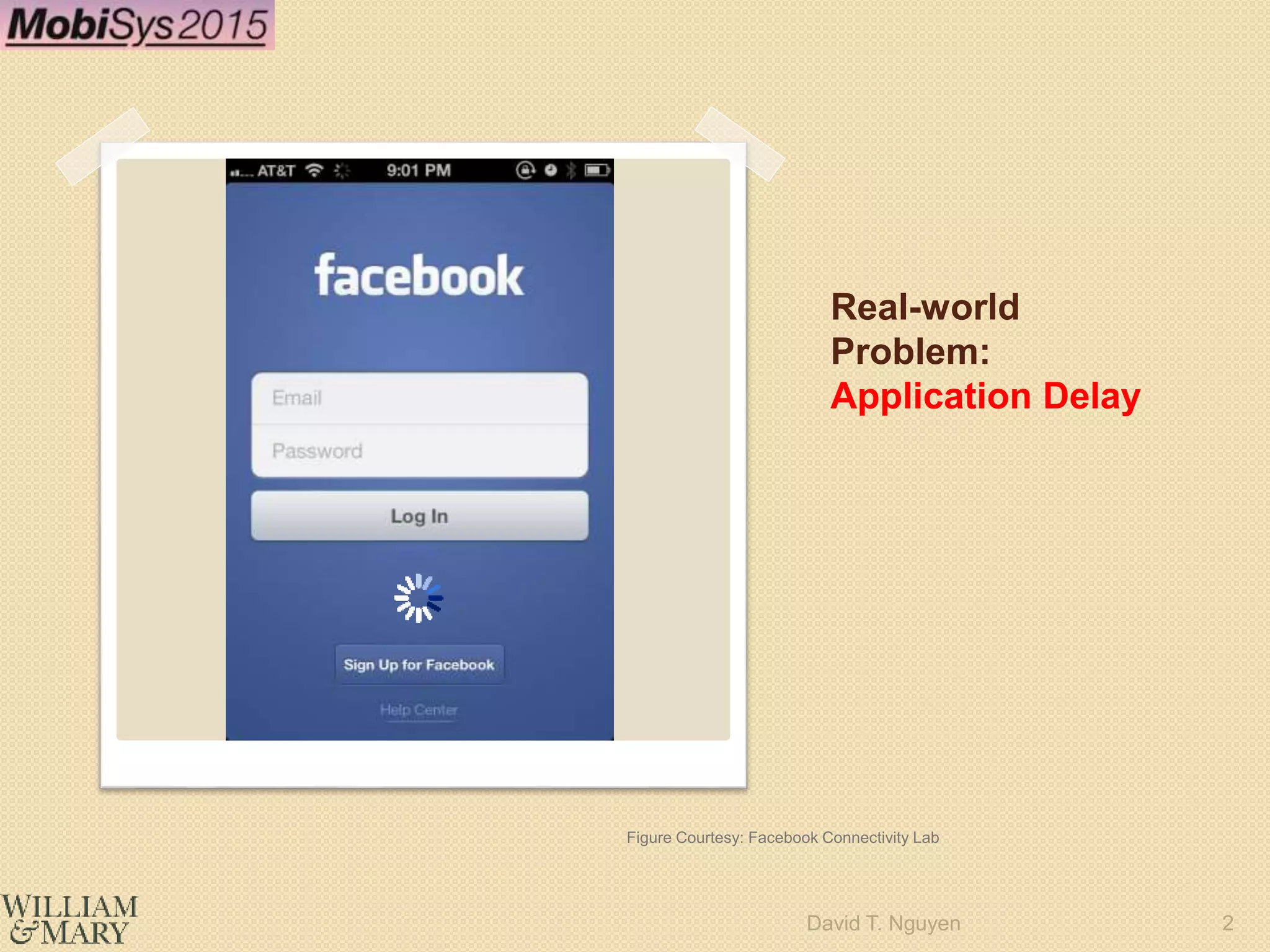
Figure Courtesy: Facebook Connectivity Lab
Real-world
Problem:
Application Delay
Introduction
 Research questions
◦ How does disk I/O affect smartphone application
response time?
◦ How to optimize storage to improve application
performance?
 Contributions
◦ First large-scale Android I/O study on 2611
devices
◦ Proposed SmartIO scheduler that reduces
application delay
◦ Evaluation indicates 21% reduced launch and
17% reduced run-time delay
David T. Nguyen 3
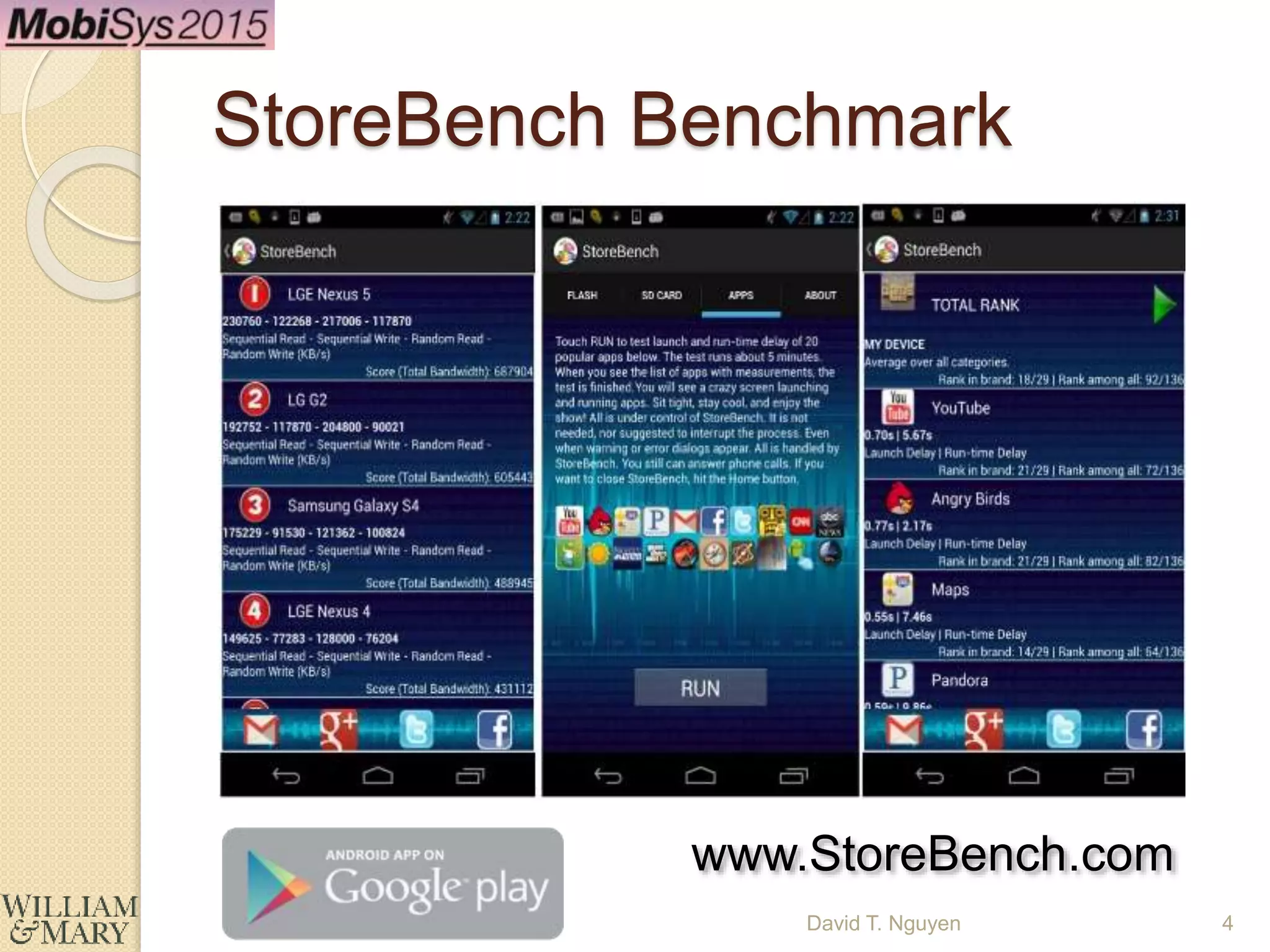
www.StoreBench.com
StoreBench Benchmark
4David T. Nguyen
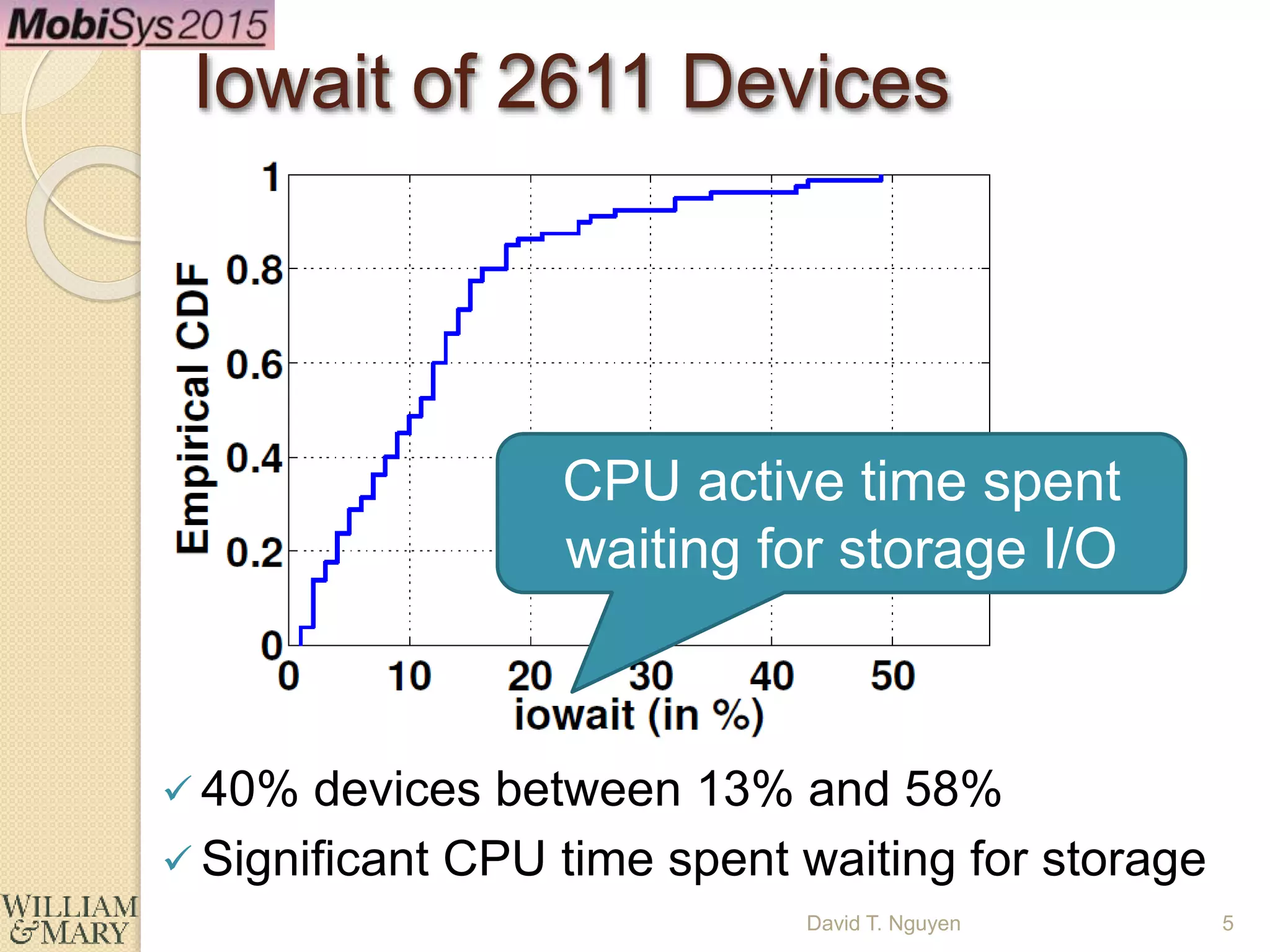
 40% devices between 13% and 58%
 Significant CPU time spent waiting for storage
Iowait of 2611 Devices
CPU active time spent
waiting for storage I/O
5David T. Nguyen
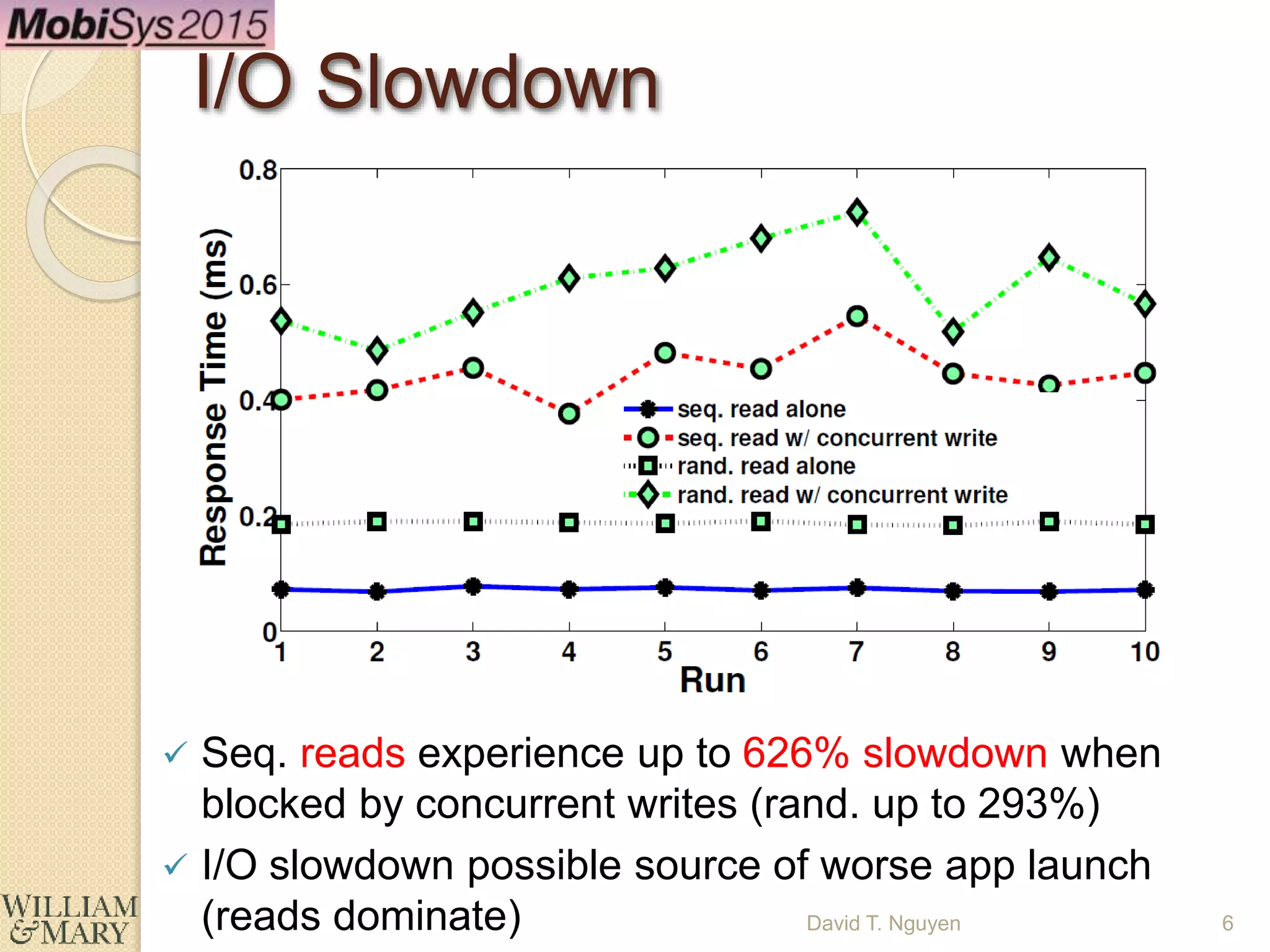
 Seq. reads experience up to 626% slowdown when
blocked by concurrent writes (rand. up to 293%)
 I/O slowdown possible source of worse app launch
(reads dominate)
I/O Slowdown
6David T. Nguyen
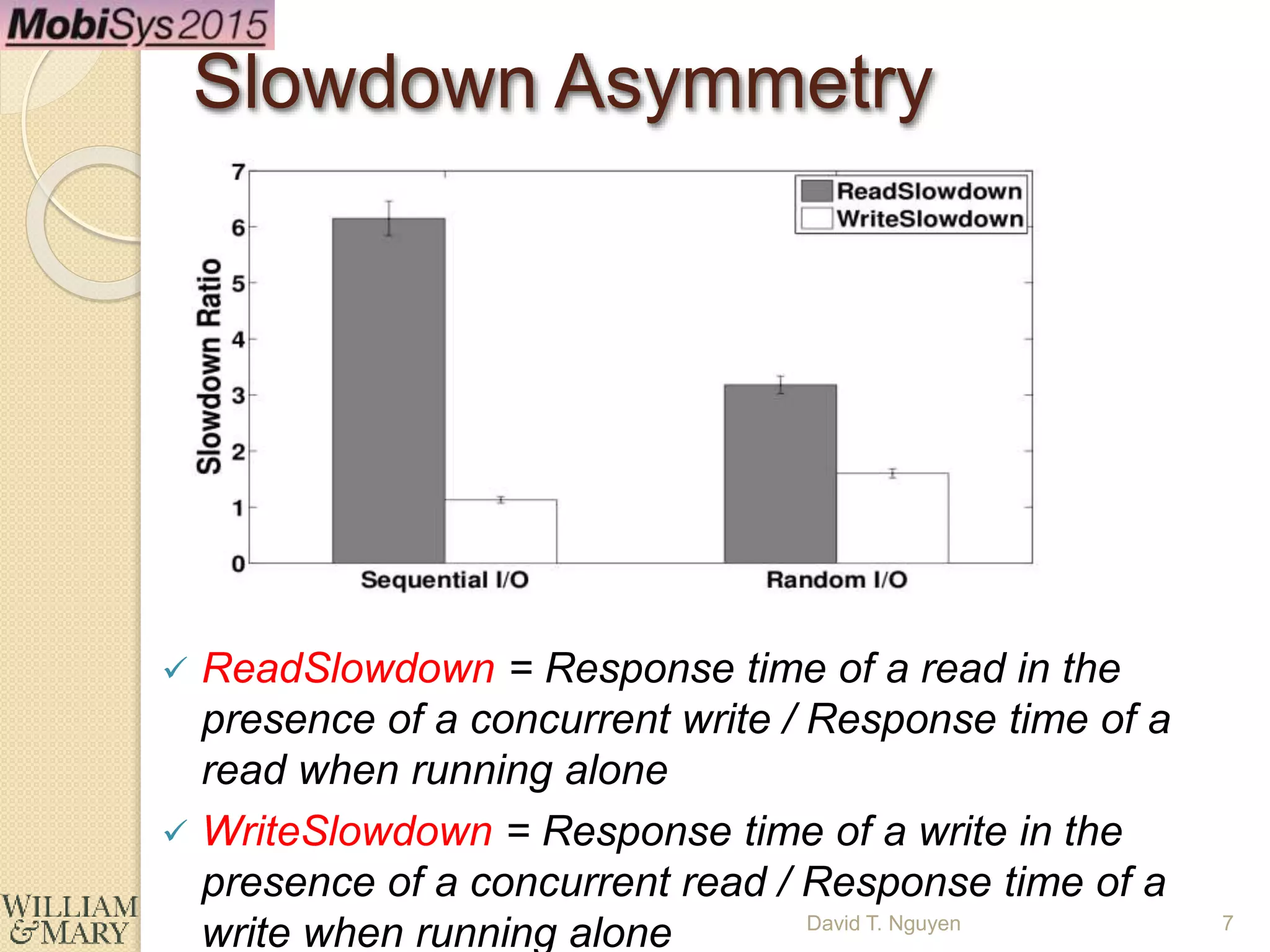
Slowdown Asymmetry
7
 ReadSlowdown = Response time of a read in the
presence of a concurrent write / Response time of a
read when running alone
 WriteSlowdown = Response time of a write in the
presence of a concurrent read / Response time of a
write when running alone David T. Nguyen
Study Summary
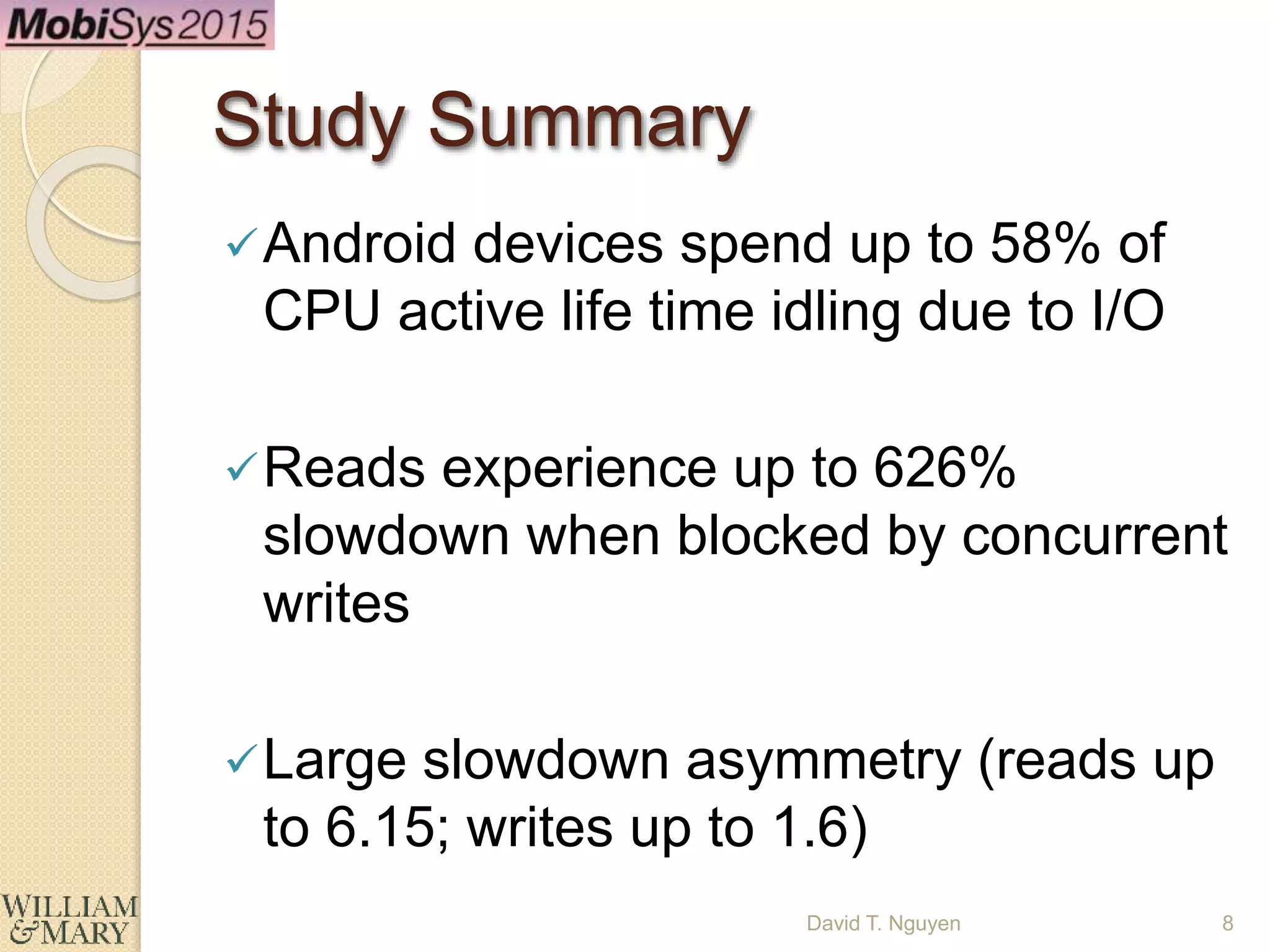
Android devices spend up to 58% of
CPU active life time idling due to I/O
Reads experience up to 626%
slowdown when blocked by concurrent
writes
Large slowdown asymmetry (reads up
to 6.15; writes up to 1.6)
8David T. Nguyen
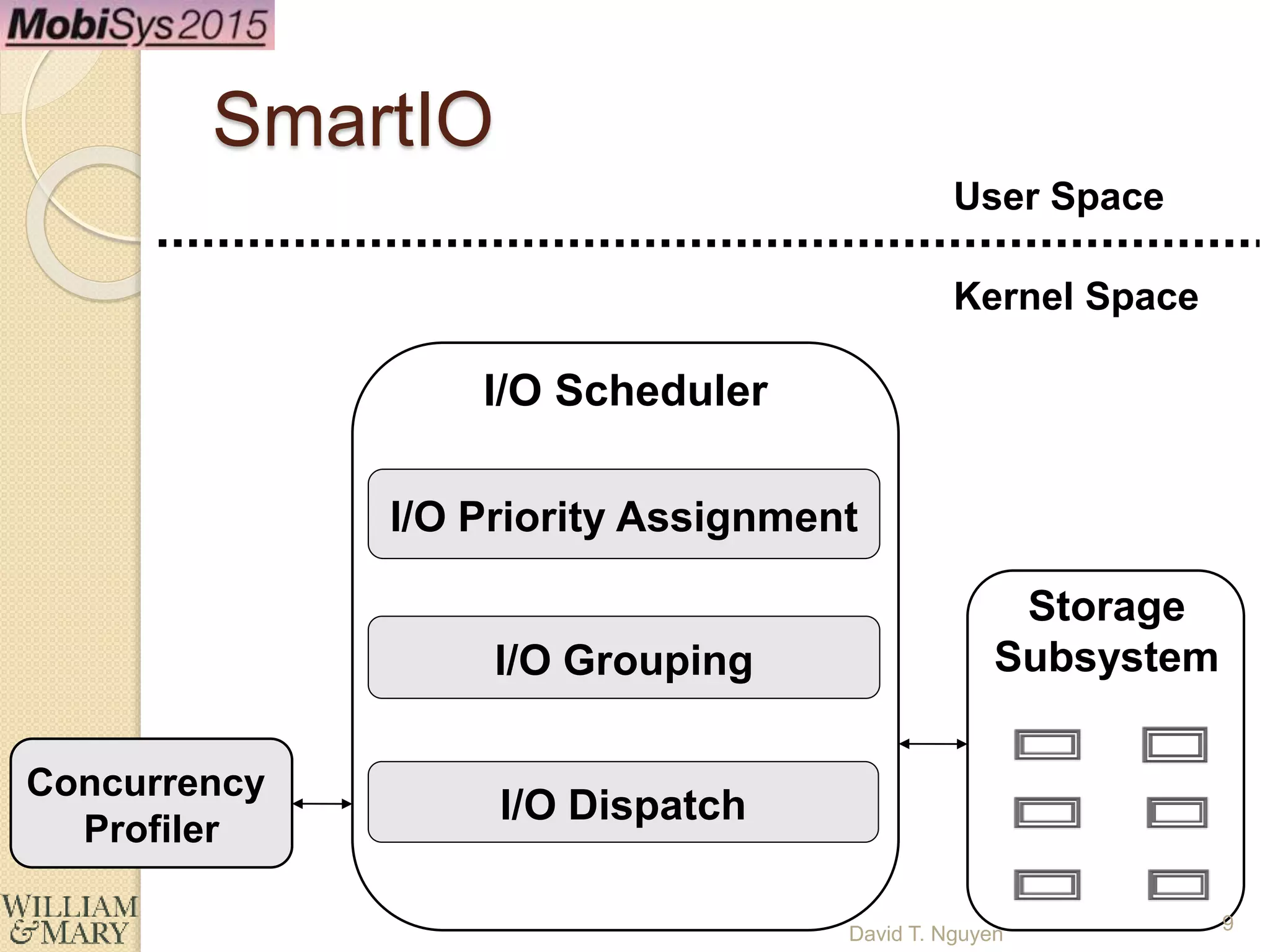
I/O Scheduler
Storage
Subsystem
Concurrency
Profiler
I/O Grouping
I/O Dispatch
I/O Priority Assignment
Kernel Space
User Space
SmartIO
David T. Nguyen 9
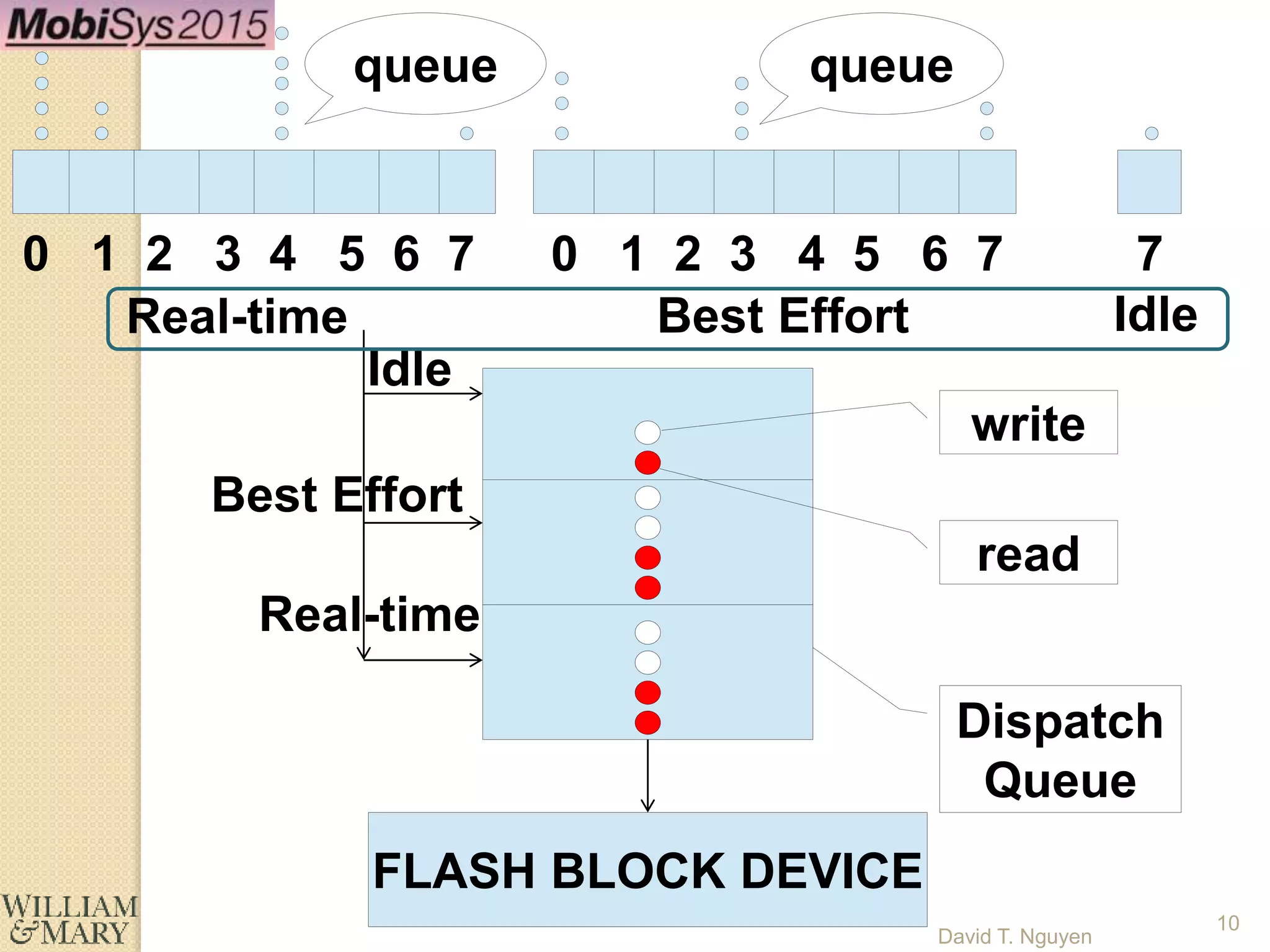
FLASH BLOCK DEVICE
0 1 2 3 4 5 6 7 0 1 2 3 4 5 6 7 7
queue queue
Idle
Best Effort
Real-time
write
read
Dispatch
Queue
Real-time Best Effort Idle
10
David T. Nguyen
11David T. Nguyen
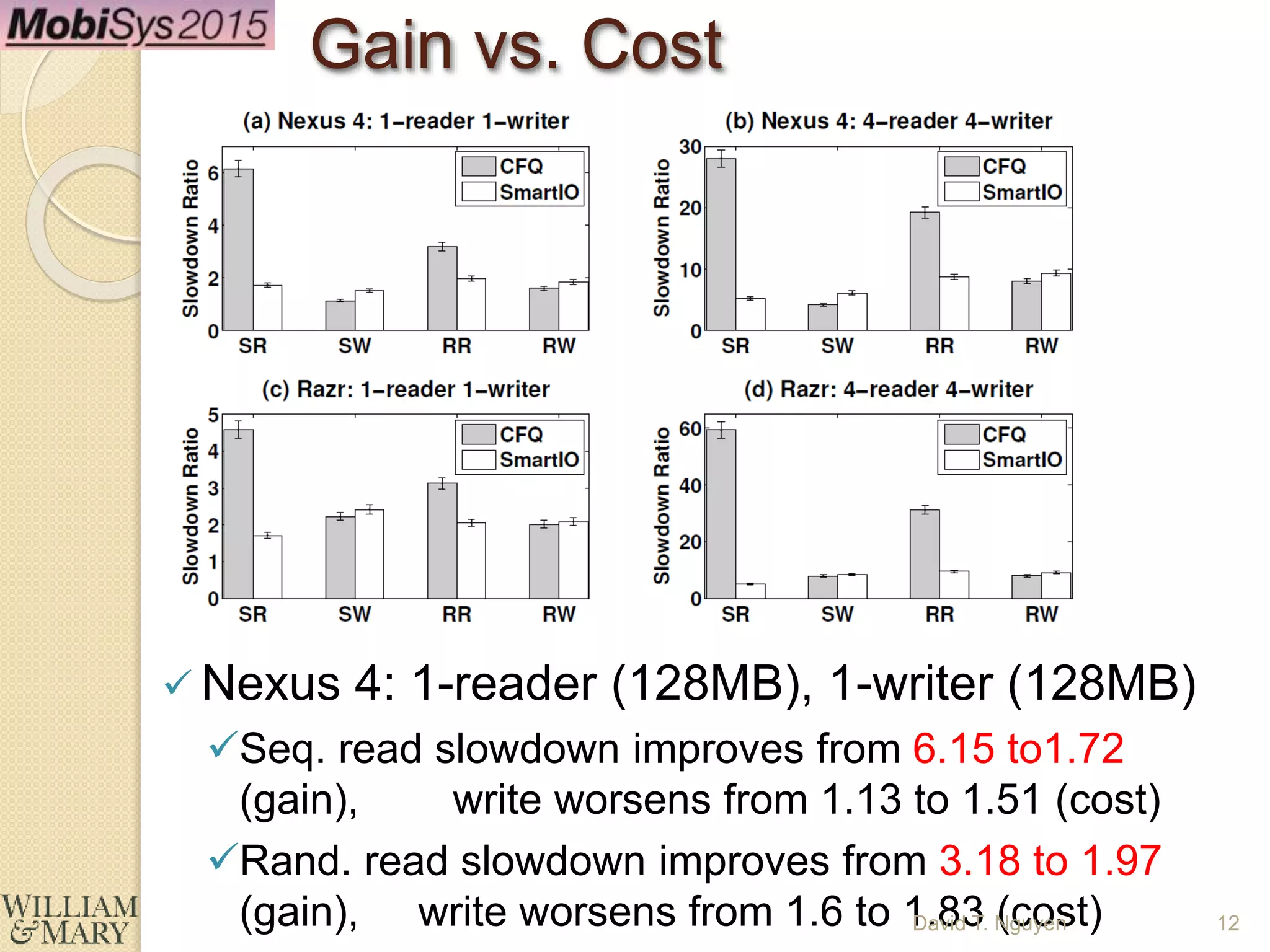
 Nexus 4: 1-reader (128MB), 1-writer (128MB)
Seq. read slowdown improves from 6.15 to1.72
(gain), write worsens from 1.13 to 1.51 (cost)
Rand. read slowdown improves from 3.18 to 1.97
(gain), write worsens from 1.6 to 1.83 (cost)
Gain vs. Cost
12David T. Nguyen
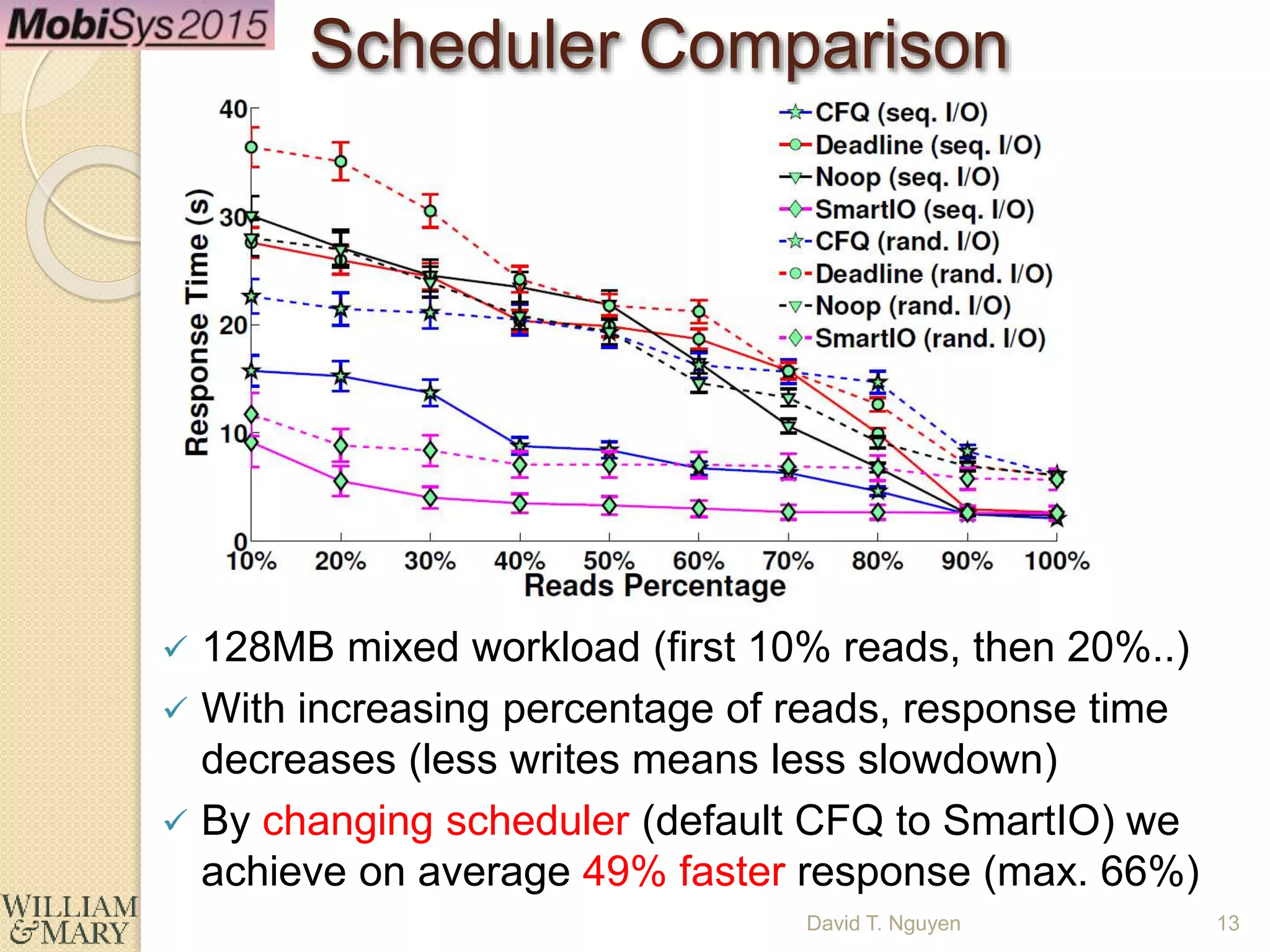
 128MB mixed workload (first 10% reads, then 20%..)
 With increasing percentage of reads, response time
decreases (less writes means less slowdown)
 By changing scheduler (default CFQ to SmartIO) we
achieve on average 49% faster response (max. 66%)
Scheduler Comparison
13David T. Nguyen
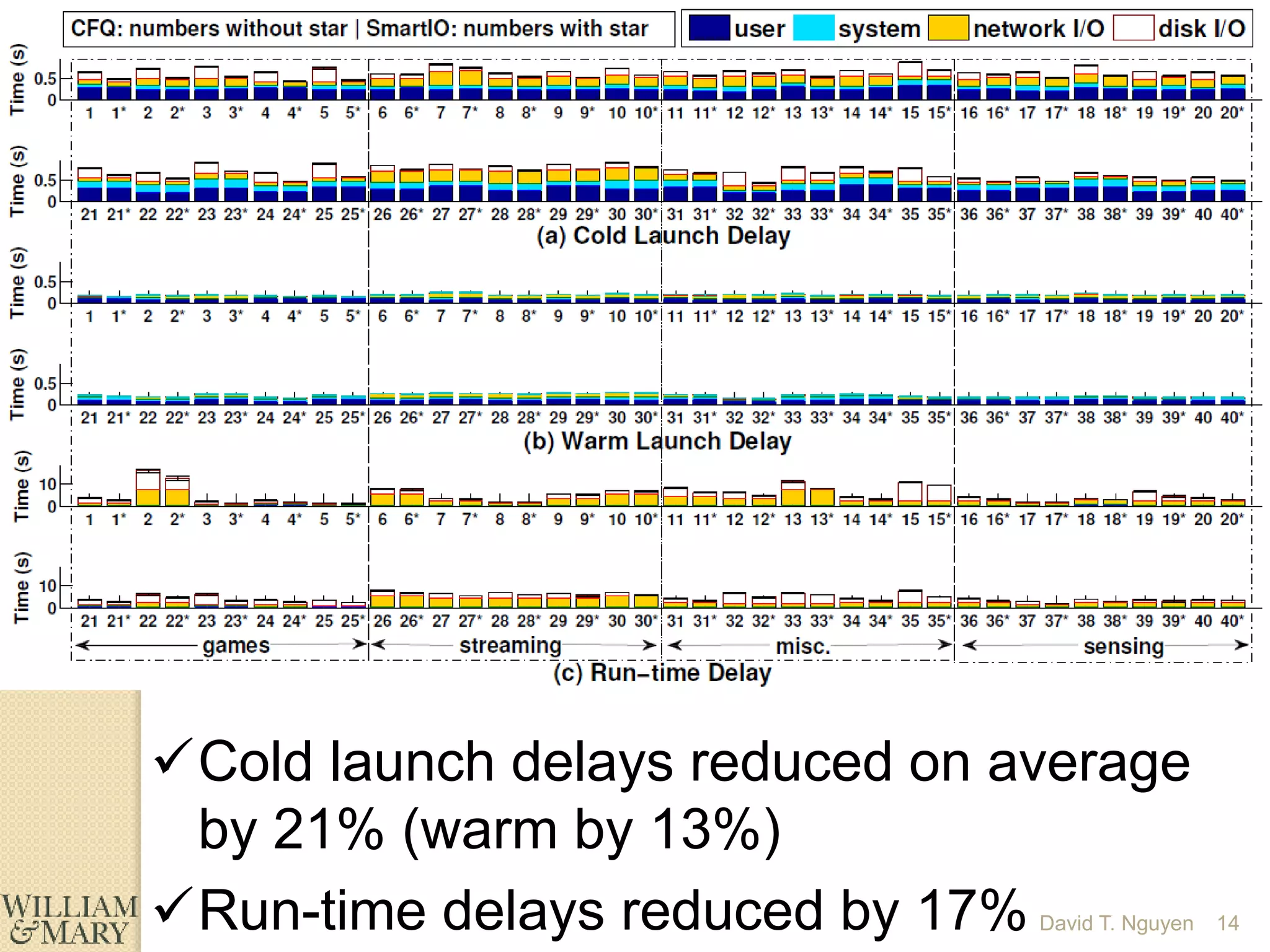
Cold launch delays reduced on average
by 21% (warm by 13%)
Run-time delays reduced by 17% 14David T. Nguyen
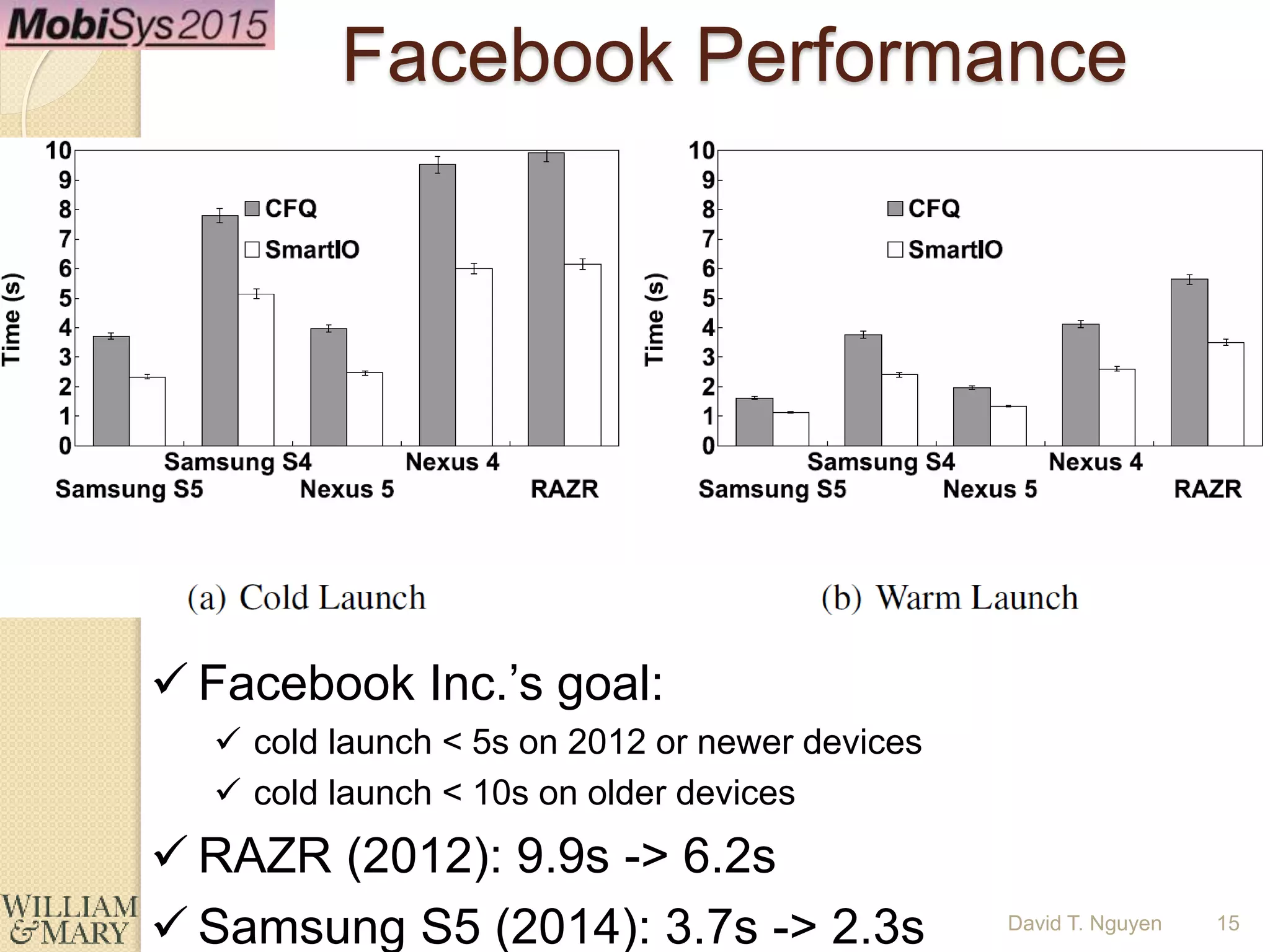
 Facebook Inc.’s goal:
 cold launch < 5s on 2012 or newer devices
 cold launch < 10s on older devices
 RAZR (2012): 9.9s -> 6.2s
 Samsung S5 (2014): 3.7s -> 2.3s
Facebook Performance
15David T. Nguyen
Conclusion & Future Work
SmartIO
Reduces app delays through read/write
isolation and higher read priorities
Study other stages of app life cycle
(install, update, switch, uninstall)
Analyze impact of network I/O
16David T. Nguyen
Acknowledgments
Our shepherd Prof. Mahadev
Satyanarayanan (CMU)
Aaron Carroll (NICTA), Dr. Duy Le
(EMC), Dr. Tommy Nguyen (RPI), Mai
Anh Do (CNU), Daniel Graham (W&M)
17David T. Nguyen
Reducing Smartphone Application
Delay
through Read/Write Isolation
David T. Nguyen

Reducing Smartphone Application Delay through Read/Write Isolation

  • 1.
    Reducing Smartphone Application Delay throughRead/Write Isolation David T. Nguyen
  • 2.
    David T. Nguyen2 Figure Courtesy: Facebook Connectivity Lab Real-world Problem: Application Delay
  • 3.
    Introduction  Research questions ◦How does disk I/O affect smartphone application response time? ◦ How to optimize storage to improve application performance?  Contributions ◦ First large-scale Android I/O study on 2611 devices ◦ Proposed SmartIO scheduler that reduces application delay ◦ Evaluation indicates 21% reduced launch and 17% reduced run-time delay David T. Nguyen 3
  • 4.
  • 5.
     40% devicesbetween 13% and 58%  Significant CPU time spent waiting for storage Iowait of 2611 Devices CPU active time spent waiting for storage I/O 5David T. Nguyen
  • 6.
     Seq. readsexperience up to 626% slowdown when blocked by concurrent writes (rand. up to 293%)  I/O slowdown possible source of worse app launch (reads dominate) I/O Slowdown 6David T. Nguyen
  • 7.
    Slowdown Asymmetry 7  ReadSlowdown= Response time of a read in the presence of a concurrent write / Response time of a read when running alone  WriteSlowdown = Response time of a write in the presence of a concurrent read / Response time of a write when running alone David T. Nguyen
  • 8.
    Study Summary Android devicesspend up to 58% of CPU active life time idling due to I/O Reads experience up to 626% slowdown when blocked by concurrent writes Large slowdown asymmetry (reads up to 6.15; writes up to 1.6) 8David T. Nguyen
  • 9.
    I/O Scheduler Storage Subsystem Concurrency Profiler I/O Grouping I/ODispatch I/O Priority Assignment Kernel Space User Space SmartIO David T. Nguyen 9
  • 10.
    FLASH BLOCK DEVICE 01 2 3 4 5 6 7 0 1 2 3 4 5 6 7 7 queue queue Idle Best Effort Real-time write read Dispatch Queue Real-time Best Effort Idle 10 David T. Nguyen
  • 11.
  • 12.
     Nexus 4:1-reader (128MB), 1-writer (128MB) Seq. read slowdown improves from 6.15 to1.72 (gain), write worsens from 1.13 to 1.51 (cost) Rand. read slowdown improves from 3.18 to 1.97 (gain), write worsens from 1.6 to 1.83 (cost) Gain vs. Cost 12David T. Nguyen
  • 13.
     128MB mixedworkload (first 10% reads, then 20%..)  With increasing percentage of reads, response time decreases (less writes means less slowdown)  By changing scheduler (default CFQ to SmartIO) we achieve on average 49% faster response (max. 66%) Scheduler Comparison 13David T. Nguyen
  • 14.
    Cold launch delaysreduced on average by 21% (warm by 13%) Run-time delays reduced by 17% 14David T. Nguyen
  • 15.
     Facebook Inc.’sgoal:  cold launch < 5s on 2012 or newer devices  cold launch < 10s on older devices  RAZR (2012): 9.9s -> 6.2s  Samsung S5 (2014): 3.7s -> 2.3s Facebook Performance 15David T. Nguyen
  • 16.
    Conclusion & FutureWork SmartIO Reduces app delays through read/write isolation and higher read priorities Study other stages of app life cycle (install, update, switch, uninstall) Analyze impact of network I/O 16David T. Nguyen
  • 17.
    Acknowledgments Our shepherd Prof.Mahadev Satyanarayanan (CMU) Aaron Carroll (NICTA), Dr. Duy Le (EMC), Dr. Tommy Nguyen (RPI), Mai Anh Do (CNU), Daniel Graham (W&M) 17David T. Nguyen
  • 18.
    Reducing Smartphone Application Delay throughRead/Write Isolation David T. Nguyen