Agenda
Introduction
Redis Datatype
Master Slave Replica
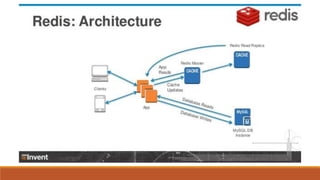
Architecture
Redis Cluster
Introduction
 Redis is an in-memory data structure store.
 Store data in the form of key/value pair.
Consistency is guaranteed by supporting "append-only file" and the
availability of data is guaranteed through cluster and master-slave
replication.
 Can be used as Database, a Caching layer or a Message broker.
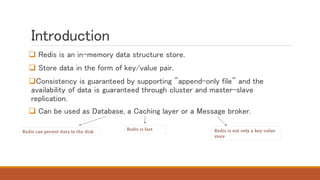
Redis can persist data to the disk
Redis is fast Redis is not only a key-value
store
Redis Datatypes (String)
Starting Redis is very easy, you just need to install the
desired redis package and write $ redis-server to run
the in memory redis server.
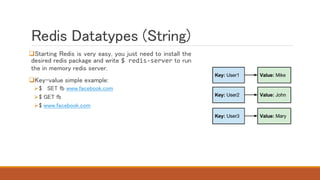
Key-value simple example:
$ SET fb www.facebook.com
$ GET fb
$ www.facebook.com
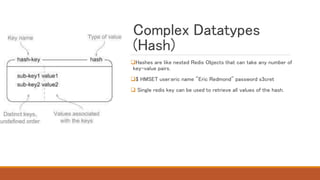
Complex Datatypes
(Hash)
Hashes are like nested Redis Objects that can take any number of
key-value pairs.
$ HMSET user:eric name "Eric Redmond" password s3cret
 Single redis key can be used to retrieve all values of the hash.
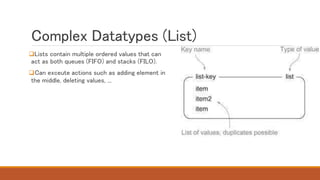
Complex Datatypes (List)
Lists contain multiple ordered values that can
act as both queues (FIFO) and stacks (FILO).
Can exceute actions such as adding element in
the middle, deleting values, ...
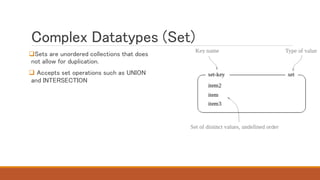
Complex Datatypes (Set)
Sets are unordered collections that does
not allow for duplication.
 Accepts set operations such as UNION
and INTERSECTION
Data Expiry
One of the best uses of Redis key-value store is fast-access cache for
data that's more expensive to retrieve or compute.
 As we know cache should be expired and get updated periodically.
Using Redis you can mark a key for expiration by using EXPIRE command
and give the key time to live in seconds
Durability
 With Redis you can choose between no persistent or save your data.
 No persistent will keep the values in the main-memory.
No persistent is best choice if you run a caching server because durability
will increase the latency.
You can also force storing data to disk by using SAVE command (or
BGSAVE
for asynchronous save)
Durability (Cont.)
Redis also provides append-only file that keeps a record of all write
commands.
 That ensures correct value even if the server craches before value saved.
 The Redis server executes the commands on the startup.
 By append-only file we can be sure that the data is eventually consistent.
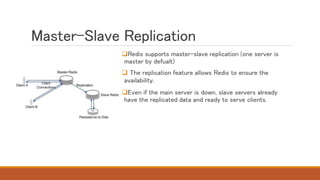
Master-Slave Replication
Redis supports master-slave replication (one server is
master by defualt)
 The replication feature allows Redis to ensure the
availability.
Even if the main server is down, slave servers already
have the replicated data and ready to serve clients.
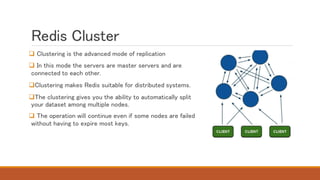
Redis Cluster
 Clustering is the advanced mode of replication
 In this mode the servers are master servers and are
connected to each other.
Clustering makes Redis suitable for distributed systems.
The clustering gives you the ability to automatically split
your dataset among multiple nodes.
 The operation will continue even if some nodes are failed
without having to expire most keys.

redis-demo.pptx

  • 2.
    Agenda Introduction Redis Datatype Master SlaveReplica Architecture Redis Cluster
  • 3.
    Introduction  Redis isan in-memory data structure store.  Store data in the form of key/value pair. Consistency is guaranteed by supporting "append-only file" and the availability of data is guaranteed through cluster and master-slave replication.  Can be used as Database, a Caching layer or a Message broker. Redis can persist data to the disk Redis is fast Redis is not only a key-value store
  • 4.
    Redis Datatypes (String) StartingRedis is very easy, you just need to install the desired redis package and write $ redis-server to run the in memory redis server. Key-value simple example: $ SET fb www.facebook.com $ GET fb $ www.facebook.com
  • 5.
    Complex Datatypes (Hash) Hashes arelike nested Redis Objects that can take any number of key-value pairs. $ HMSET user:eric name "Eric Redmond" password s3cret  Single redis key can be used to retrieve all values of the hash.
  • 6.
    Complex Datatypes (List) Listscontain multiple ordered values that can act as both queues (FIFO) and stacks (FILO). Can exceute actions such as adding element in the middle, deleting values, ...
  • 7.
    Complex Datatypes (Set) Setsare unordered collections that does not allow for duplication.  Accepts set operations such as UNION and INTERSECTION
  • 8.
    Data Expiry One ofthe best uses of Redis key-value store is fast-access cache for data that's more expensive to retrieve or compute.  As we know cache should be expired and get updated periodically. Using Redis you can mark a key for expiration by using EXPIRE command and give the key time to live in seconds
  • 9.
    Durability  With Redisyou can choose between no persistent or save your data.  No persistent will keep the values in the main-memory. No persistent is best choice if you run a caching server because durability will increase the latency. You can also force storing data to disk by using SAVE command (or BGSAVE for asynchronous save)
  • 10.
    Durability (Cont.) Redis alsoprovides append-only file that keeps a record of all write commands.  That ensures correct value even if the server craches before value saved.  The Redis server executes the commands on the startup.  By append-only file we can be sure that the data is eventually consistent.
  • 11.
    Master-Slave Replication Redis supportsmaster-slave replication (one server is master by defualt)  The replication feature allows Redis to ensure the availability. Even if the main server is down, slave servers already have the replicated data and ready to serve clients.
  • 13.
    Redis Cluster  Clusteringis the advanced mode of replication  In this mode the servers are master servers and are connected to each other. Clustering makes Redis suitable for distributed systems. The clustering gives you the ability to automatically split your dataset among multiple nodes.  The operation will continue even if some nodes are failed without having to expire most keys.