01/06/2025
1
REALIST SCHOOL
01/06/2025
2
INTRODUCTIOM
• The realist movement in United States represents the latest branch of
sociological jurisprudence which concentrates on decisions of law courts.
• The realists contend that law has emanated from judges, therefore law is
what courts do and not what they say. For them, Judges are the law-makers.
• Llewellyn has said that realism or realist school is not a school of
jurisprudence. Instead it may be called as a Sociological Jurisprudence. It is
a branch of sociological approach therefore it is also being called as ‘left
wing of sociological or functional school.
01/06/2025
3
THE CENTRAL IDEA OF REALIST SCHOOL OF THOUGHT
• The realist approach in the field of jurisprudence is a relatively modern one.
Its prime home is the US.
• The thesis of realists is based on the notion: “Law is what the psychology of
Courts determines – the aggregate of the item of judicial and official
actions”, “Law is what the judges decide”.
• They emphasis the element of uncertainty in law and apart played by the
personal characteristics of the judge.
• Law is not defined as a set of legal propositions, but in term of the official
action.
01/06/2025
4
• Realists believed that law is not a scientific enterprise in which deductive
reasoning can be applied to reach a determinate outcome in every case.
• Instead, most legal action presents hard questions that judges must resolve
by balancing the interests of the parties and ultimately drawing an arbitrary
line on one side of the dispute.
• This line is typically drawn in accordance with the political, economic, and
psychological inclination of the judge.
01/06/2025
5
EXAMPLE
Example: When a court is asked to decide whether a harmful business activity
is an offence of nuisance, the judge must ascertain whether the particular
activity is reasonable.
The judge does not base this determination on a precise algebraic equation.
Instead, the judge balances the competing economic and social interests of
the parties, and rules in favor of the litigant with the most persuasive case.
Realists would thus contend that judges who are ideologically inclined to foster
business growth will authorize the continuation of a harmful activity, whereas
judges who are ideologically inclined to protect the environment will not.
01/06/2025
6
• Thus, it can be contented that it concentrates on a scientific observation of
law in its making and working.
• The movement is called “realist” as it studies law in its actual working and
rejects the traditional definition of law that it is a body of rules and principles
which are enforced by the Court.
• The advocates of the realist movement concentrate on the decisions given
by law courts.
• They not only study the judgments given by the judges but also the human
factor in the judges and lawyers. They study the forces which influence
judges in reaching their decisions.
01/06/2025
7
JUSTICE K.S. PUTTASWAMY VS. UNION OF INDIA (2017) 10 SCC 1
Facts: Justice K.S. Puttaswamy (Retd.), a retired judge of the Madras High
Court, challenged the constitutional validity of the Aadhaar scheme. He argued
that the scheme violated the right to privacy. A three-judge bench held that a
larger bench should determine whether the Constitution of India guarantees a
right to privacy. A nine-judge bench decided this case.
Held: The Court considered whether the right to privacy is a part of the right to
life and personal liberty under Article 21 of the Constitution.
01/06/2025
8
The Rights Framework
The Court held that privacy is an attribute of human dignity. The right to privacy
safeguards one’s freedom to make personal choices and control significant
aspects of their life.
In addition, it noted that personal intimacies (marriage, procreation and family),
including sexual orientation, are at the core of an individual’s dignity.
Further, the Court described discrimination on the basis of sexual orientation as
“deeply offensive to dignity and self-worth”. It noted that the right to privacy was
at the intersection of Articles 15 and 21 of the constitution, by referring to its
decision in NALSA which grants the right to self-recognition of gender. It stated
that the right to privacy was an expression of individual autonomy, dignity, and
JUSTICE K.S. PUTTASWAMY VS. UNION OF INDIA (2017) 10 SCC 1
01/06/2025
9
Common Cause vs. Union of India MANU/SC/0232/2018
01/06/2025
10
In the landmark case of Common Cause v Union of India (2018), the Supreme
Court of India recognized the right to die with dignity as a fundamental right
under Article 21 of the Constitution. This right establishes the autonomy of
individuals to execute Advanced Medical Directives (AMDs), which are
documents specifying end-of-life instructions when a patient is unable to
communicate their wishes due to terminal illness.
In 2023 the Supreme Court modified the guidelines to make the right to die with
dignity more accessible.
The 2018 judgement established stringent guidelines for the validation of
AMDs, requiring the formation of two medical boards—a hospital-based board
and a district-level board. The doctors serving on these boards were initially
mandated to possess at least 20 years of experience.
01/06/2025
11
Laxmi vs. Union of India Writ petition (Crl.) No. 129 of 2006
01/06/2025
12
Brief facts- A PIL was filed in the Supreme Court as a result of the acid attacks
that were prevalent in the country. Before this PIL was filed, there were no
uniform laws to deal with the victims of the acid attacks, the punishments were
granted by the judges’ disposition and the circumstances of the case.
It was in response to the acids that were thrown inhumanely particularly on
women with the ultimate motive of disfiguring them. The PIL was filed by Laxmi
Agarwal, an acid attack survivor.
Laxmi vs. Union of India Writ petition (Crl.) No. 129 of 2006
01/06/2025
13
Court Ruling- Taking cognizance of the number of cases relating to acid attacks
against women on the rise, the Supreme Court imposed stringent regulations on
the sale of acid in 2013. The ruling banned over the counter sale of acid.
Dealers can sell the acid only if the buyer provides a valid identity proof and
states the need for the purchase. It is mandatory for the dealer to submit the
details of the sale within three days to the police. It also made it illegal to sell
acid to a person below 18 years.
Laxmi vs. Union of India Writ petition (Crl.) No. 129 of 2006
01/06/2025
14
01/06/2025
15
M.C.MEHTA VS UNION OF INDIA & ORS (TAJ TRAPEZIUM CASE) AIR 1997 2
SCC 353
Facts: The Taj Mahal case, also known as The Taj Trapezium Case (TTZ) was fought between
renowned environmentalists and a public interest attorney M.C. Mehta and the Union of India
& Ors in 1985. He is also known as the ‘Green Lawyer of India’ who single-handedly fought
against the polluting industries in India.
The white marble of the Taj Mahal turned into yellow color mostly due to pollution and acid
rain because of the presence of pollutants, like sulphar dioxide combined with oxygen and
moisture, creating a corrosive effect in the atmosphere.
Ruling: Supreme Court directed the industries operating in Taj Trapezium Zone (TTZ), using
coal, coke as industrial fuel must stop functioning in and around Agra and they should be
relocated alternative plots in the industrial estate outside TTZ and directed the Uttar
Pradesh Government to render all assistance to the industries in the process of relocation.
01/06/2025
16
Vishaka and Ors. v. State of Rajasthan AIR 1997 SC 3011
01/06/2025
17
Facts: The case originated from the gang-rape of a social worker in Rajasthan, prompting women's rights
groups to petition the Supreme Court for guidelines to address sexual harassment at the workplace.
Court Ruling:
• Through this decision, legally binding guidelines were laid down to prevent sexual harassment of women
in the workplace.
• These guidelines are to be implemented in all government and private sector workplaces.
• Under these guidelines, the employer or the person in charge of the workplace has to prevent sexual
harassment.
• Under these guidelines, procedures must be provided for conciliation, settlement, or prosecution.
Vishaka and Ors. v. State of Rajasthan AIR 1997 SC 3011
01/06/2025
18
• Facts: Between 1979 and 1980 there were reports that police poured acid
into the eyes of 33 pre-trial detainees in Bhagalpur, Bihar. It was
reportedly the worst case of police torture and has come to be known as
one of the darkest times in independent India’s history. Bhagalpur
Blindings case is another name for this case.
• Court Ruling: Courts are in the constitutional obligation to provide free
legal assistance to the accused at all stages of a trial if the defendant
suffers poverty or hardship to achieve the goals of justice., ruled that it
failed to do so.
01/06/2025
19
• Law as a Good Reason for a Bad Man
Legal Realists often humorously define law as “a good reason for a bad man.”
This phrase underscores the idea that individuals, particularly those with
nefarious intentions, are primarily concerned with the practical consequences
of their actions within the legal system.
In other words, the law serves as a practical guide for individuals to navigate
their behaviour within societal boundaries.
Key Features
01/06/2025
20
• Rejecting the Myth of Objectivity
Legal Realism rejects the notion that the law is objective and impartial. Instead,
it acknowledges that judges’ personal backgrounds, beliefs and experiences
inevitably influence their decisions. This acknowledgement challenges the
traditional belief in the neutrality of the legal system.
• Focus on Judicial Decision-Making
Legal Realism places a significant emphasis on studying judicial decision-
making processes. It seeks to understand how judges arrive at their verdicts,
taking into account factors beyond the mere application of legal rules.
01/06/2025
21
• Movement Rather Than a School
Legal Realism is not a traditional school of thought but rather a movement within
jurisprudence. It encompasses various perspectives and approaches to law.
• Pragmatic Approach
Realism views law as a means to achieve social ends and addresses legal
concepts in a manner that reflects the dynamic nature of society, which
changes more rapidly than the law itself.
01/06/2025
22
• Divorce of ‘Is’ and ‘Ought’
This approach temporarily separates the descriptive aspect (‘is’) from the
prescriptive aspect (‘ought’) of law to facilitate objective analysis. Ethical
considerations are intentionally set aside to maintain objectivity.
• Distrust in Traditional Legal Values
Legal Realism challenges the traditional legal values and concepts, highlighting
that they often describe what courts or common people are doing rather than
prescribing how they should behave.
01/06/2025
23
Focus on Law’s Effects
Realism, in jurisprudence, places significant emphasis on evaluating the
practical effects of legal rules and principles.
01/06/2025
24
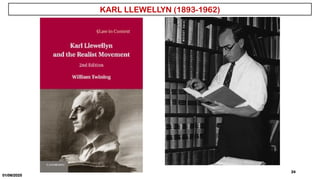
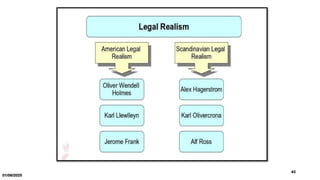
KARL LLEWELLYN (1893-1962)
01/06/2025
25
Karl Llewellyn was a key figure in the American legal realism movement, arguing
that law is best understood by examining how judges and other legal actors
actually behave, rather than focusing solely on abstract legal rules and theories.
•Focus on "Law in Action":
Llewellyn and other legal realists rejected the traditional "legal formalism"
approach, which emphasized deductive reasoning from legal rules and
precedents. Instead, they argued that the true essence of law lies in the
practical outcomes and actions of judges, lawyers, and law enforcement
officials in real-world cases.
KARL LLEWELLYN (1893-1962)
01/06/2025
26
• Judicial Discretion and Human Factors:
Llewellyn emphasized the role of judicial discretion and the human factors that
influence judicial decision-making. He famously stated, "Behind decisions stand
judges; judges are men; as men they have human backgrounds".
• Influence of Social Science:
Llewellyn was influenced by contemporary social science and saw law as a
social phenomenon, shaped by social norms, values, and power dynamics.
• Indeterminacy of Law:
Llewellyn argued that law is often indeterminate, meaning that the meaning of
legal rules can be open to interpretation and that judges have a degree of
discretion in applying them.
01/06/2025
27
• Emphasis on Nonlegal Factors:
He and other realists called attention to the role of nonlegal factors in judicial
decision-making, such as judges' personal biases, political influences, and
social norms.
• Focus on Commercial Culture:
Llewellyn argued that judges often try to enforce the uncodified but prevailing
norms of the commercial culture in which the dispute arose.
• Relevance:
Llewellyn's work remains relevant today as it highlights the importance of
understanding the practical realities of law and legal institutions, rather than
solely focusing on abstract legal doctrines.
01/06/2025
28
• He was initially a practising lawyer.
• He served in the Law Department of the Government for about a decade.
• In 1941, he was appointed as a Judge in the United States Circuit Court.
• He was also a visiting Professor of Law in the Yale Law School.
• Frank explained his views about realistic approach to jurisprudence in his
classic work entitled, Law and the Modern Mind.
Jerome N. Frank (1889-1957)
01/06/2025
29
• He exploded the myth that law is continuous, uniform, certain and invariable
and asserted that the Judges do not make law, instead, they discover it.
• According to him, the individual decision of the Judge is law par excellent. He
reiterated that law consists of decisions and the personal convictions, likes
and dislikes, emotions.
• The temperament of the Judge has an important bearing on the mechanism of
law.
• Thus Frank made 'fact-finding' by the court as the central theme of his realism
in which the personality of the Judge and his past experience play a dominant
role in moulding the law and giving it a concrete shape.
01/06/2025
30
• He emphasised on study of law in action and Court room, not the library,
should be the laboratory.
• For example, facts in a legal case have to be established by witnesses who
may or may not be telling the truth and it is for the Judge to discover and
ascertain what the actual facts are in the case before him.
• Having practically worked as a Judge of the U.S. Circuit Court, Frank did not
completely discard the value and importance of legal rules and precedents.
• He recognised that rules of law provided guidance for a Judge in making
decision as they embody' the policies and ideals of the law-makers. But he
maintained that where such laws are frustrating silly, vicious or idiosyncratic,
the Judge should resort to objective fact finding process to reach his
decision.
01/06/2025
31
The noted American Jurist Oliver Windell Holmes discussed law from the point
of view of "the bad man", i.e., the person who was before the Court as an
accused or a wrongdoer. He pointed out that the accused or the wrongdoer, as
the case may be, had no interest in axioms or deductions but simply wanted a
prediction of what the Court would do (decide) in his particular case.
In most cases, the court is virtually certain to decide in a particular way. Thus
what matters to the person who is standing trial before the Court is whether he
will win or lose, and what are the likely effects of winning or losing the case on
him.
The concern of the Judge is to do justice in the case before him and if that
required a creative interpretation of existing rules, he should certainly resort to
Oliver Windell Holmes (1841-1935)
01/06/2025
32
• The duty of the Judge is to apply the law as he finds it and not to seek to
rectify perceived inadequacies by the use of creative interpretation.
• Holmes asserted that where there is a gap in the law, Judges are required to
take account of precedent but where this is unclear, he must decide the best
way to proceed and the result may be a decision which in some was is
innovative but the fundamental principles are always part of law.
01/06/2025
33
Axel Hagerstorm (1868-1939)
• Hagerstorm is considered to be the founding father of the Realist movement
in Sweden.
• He was a Professor of Philosophy in the Upsala University and was greatly
influenced by the legal philosophy of his contemporary jurists, particularly
that of Olivecrona and Ross.
• He rejected the notions of right-duty relationship and the theory of legal
obligations because they do not have any objective basis.
• For him, these are merely psychological notions.
Scandinavian Legal Realism
01/06/2025
34
He also denounced the notions of good or bad as they simply represent the
subjective attitude of approbation or disapprobation towards certain facts or
situations.
He emphatically stated that idealism in law is a matter of personal evaluation
which cannot be subjected to any scientific process of examination. Therefore,
it is futile to probe into the 'ought' aspect of law and the jurists must confine
themselves to the study of actual functioning of law in the present-day society
01/06/2025
35
• Born in 1897, Professor Olivecrona's views about Scandinavian realism have
been appreciated for their practical implications.
• He emphasised the study of law as a social fact.
• According to him, law is nothing but a 'set of social facts’.
• He rejected the view that laws are a command or an expression of the will of
the State and argued that they are 'independent imperatives' issued by
constitutional agencies of the State from time to time and they 'operate in the
mind of the Judge' while reaching a particular decision.
Karl Olivercrona (1897-1980)
01/06/2025
36
• For him, there is no such thing as the binding force of law; it is a myth. For
instance, a person may break the law and go undetected yet no one would say
that the law is not binding on him.
• In his opinion, the notion of binding force of law only exists in the mind of a
person because of the psychological pressures which exert an influence on
his conduct and motivates him for regularity of behaviour which is an attribute
of a legal system.
01/06/2025
37
• Adopting an acceptable moderate view about the form of scepticism, Karl
Oliverona refrained from defining law and preferred to analyse those facts
which are covered under Rules of law.
• He agreed that law has a binding force and is valid so long as it has a binding
force, and therefore, an invalid law is not binding. Divorcing morality from law,
he observed that law is binding whether or not it is consistent with morality.
He also disagrees with the view that binding force lies in the consent or 'will'
of the State.
01/06/2025
38
He propagated the view that law is a set of independent imperatives prescribed
by law agencies, such as Courts, Parliament etc. producing a set of social facts
based on the application of organized force of the State.
01/06/2025
39
• He was born in 1899 and was a Danish jurist.
• He also asserts also asserts that law or legal notions must be interpreted as
conceptions of social reality which is nothing but the actual behaviour of man
in society. He follows the American line of approach and accepts the authority
of the Court to expound law. In his view, laws are the legal norms in the form
of directives addressed to the courts
Alf Ross (1899-1979)
01/06/2025
40
These norms of conduct, i.e., laws may be of two types, namely (i) norms of
conduct which deal with the behavioural aspect of law; and ii) norms of
competence or procedure which prescribe the mode of procedure to be
followed for determining the norms of conduct.
Ross pointed out that while deciding a case, the actual past behaviour of the
Judge as well as the set of ideals by which he is motivated must be taken into
account in order to determine the predictability of law in future.
01/06/2025
41
• American legal realism has its origins in the US law schools and was a
dominant discourse in 1920s and 1930s.
• The rise of legal realism had coincided with the fact that in the beginning of
the 20th
century, there was explosion of sorts in filing of cases by common
masses. This was encountered by the State with the increase in number of
judges forming art of court system.
• This in turn led to far too many people deciding on varied sets of facts often
having very less or no clue at all about what was done in other part of the
country about a similar situation.
AMERICAL REALISM
01/06/2025
42
• According to Ross, validity of law lies in the predictability of decisions.
• Valid law implies "the abstract set of normative ideas which serve as a
scheme of interpretation for the phenomena of law in action.
• These norms are effectively followed because they are felt to be socially
binding by the Courts and other legal authorities which apply the law.
• Norms are therefore, observed as law because they are felt by the Judge to
be socially binding and therefore, obeyed. A norm is valid if it is predictable
that a Court will apply it.
01/06/2025
43

Realist School.pptx opopopoooooloolpoopooo

  • 1.
  • 2.
    01/06/2025 2 INTRODUCTIOM • The realistmovement in United States represents the latest branch of sociological jurisprudence which concentrates on decisions of law courts. • The realists contend that law has emanated from judges, therefore law is what courts do and not what they say. For them, Judges are the law-makers. • Llewellyn has said that realism or realist school is not a school of jurisprudence. Instead it may be called as a Sociological Jurisprudence. It is a branch of sociological approach therefore it is also being called as ‘left wing of sociological or functional school.
  • 3.
    01/06/2025 3 THE CENTRAL IDEAOF REALIST SCHOOL OF THOUGHT • The realist approach in the field of jurisprudence is a relatively modern one. Its prime home is the US. • The thesis of realists is based on the notion: “Law is what the psychology of Courts determines – the aggregate of the item of judicial and official actions”, “Law is what the judges decide”. • They emphasis the element of uncertainty in law and apart played by the personal characteristics of the judge. • Law is not defined as a set of legal propositions, but in term of the official action.
  • 4.
    01/06/2025 4 • Realists believedthat law is not a scientific enterprise in which deductive reasoning can be applied to reach a determinate outcome in every case. • Instead, most legal action presents hard questions that judges must resolve by balancing the interests of the parties and ultimately drawing an arbitrary line on one side of the dispute. • This line is typically drawn in accordance with the political, economic, and psychological inclination of the judge.
  • 5.
    01/06/2025 5 EXAMPLE Example: When acourt is asked to decide whether a harmful business activity is an offence of nuisance, the judge must ascertain whether the particular activity is reasonable. The judge does not base this determination on a precise algebraic equation. Instead, the judge balances the competing economic and social interests of the parties, and rules in favor of the litigant with the most persuasive case. Realists would thus contend that judges who are ideologically inclined to foster business growth will authorize the continuation of a harmful activity, whereas judges who are ideologically inclined to protect the environment will not.
  • 6.
    01/06/2025 6 • Thus, itcan be contented that it concentrates on a scientific observation of law in its making and working. • The movement is called “realist” as it studies law in its actual working and rejects the traditional definition of law that it is a body of rules and principles which are enforced by the Court. • The advocates of the realist movement concentrate on the decisions given by law courts. • They not only study the judgments given by the judges but also the human factor in the judges and lawyers. They study the forces which influence judges in reaching their decisions.
  • 7.
    01/06/2025 7 JUSTICE K.S. PUTTASWAMYVS. UNION OF INDIA (2017) 10 SCC 1 Facts: Justice K.S. Puttaswamy (Retd.), a retired judge of the Madras High Court, challenged the constitutional validity of the Aadhaar scheme. He argued that the scheme violated the right to privacy. A three-judge bench held that a larger bench should determine whether the Constitution of India guarantees a right to privacy. A nine-judge bench decided this case. Held: The Court considered whether the right to privacy is a part of the right to life and personal liberty under Article 21 of the Constitution.
  • 8.
    01/06/2025 8 The Rights Framework TheCourt held that privacy is an attribute of human dignity. The right to privacy safeguards one’s freedom to make personal choices and control significant aspects of their life. In addition, it noted that personal intimacies (marriage, procreation and family), including sexual orientation, are at the core of an individual’s dignity. Further, the Court described discrimination on the basis of sexual orientation as “deeply offensive to dignity and self-worth”. It noted that the right to privacy was at the intersection of Articles 15 and 21 of the constitution, by referring to its decision in NALSA which grants the right to self-recognition of gender. It stated that the right to privacy was an expression of individual autonomy, dignity, and JUSTICE K.S. PUTTASWAMY VS. UNION OF INDIA (2017) 10 SCC 1
  • 9.
    01/06/2025 9 Common Cause vs.Union of India MANU/SC/0232/2018
  • 10.
    01/06/2025 10 In the landmarkcase of Common Cause v Union of India (2018), the Supreme Court of India recognized the right to die with dignity as a fundamental right under Article 21 of the Constitution. This right establishes the autonomy of individuals to execute Advanced Medical Directives (AMDs), which are documents specifying end-of-life instructions when a patient is unable to communicate their wishes due to terminal illness. In 2023 the Supreme Court modified the guidelines to make the right to die with dignity more accessible. The 2018 judgement established stringent guidelines for the validation of AMDs, requiring the formation of two medical boards—a hospital-based board and a district-level board. The doctors serving on these boards were initially mandated to possess at least 20 years of experience.
  • 11.
    01/06/2025 11 Laxmi vs. Unionof India Writ petition (Crl.) No. 129 of 2006 Laxmi vs. Union of India Writ petition (Crl.) No. 129 of 2006
  • 12.
    01/06/2025 12 Brief facts- APIL was filed in the Supreme Court as a result of the acid attacks that were prevalent in the country. Before this PIL was filed, there were no uniform laws to deal with the victims of the acid attacks, the punishments were granted by the judges’ disposition and the circumstances of the case. It was in response to the acids that were thrown inhumanely particularly on women with the ultimate motive of disfiguring them. The PIL was filed by Laxmi Agarwal, an acid attack survivor. Laxmi vs. Union of India Writ petition (Crl.) No. 129 of 2006
  • 13.
    01/06/2025 13 Court Ruling- Takingcognizance of the number of cases relating to acid attacks against women on the rise, the Supreme Court imposed stringent regulations on the sale of acid in 2013. The ruling banned over the counter sale of acid. Dealers can sell the acid only if the buyer provides a valid identity proof and states the need for the purchase. It is mandatory for the dealer to submit the details of the sale within three days to the police. It also made it illegal to sell acid to a person below 18 years. Laxmi vs. Union of India Writ petition (Crl.) No. 129 of 2006
  • 14.
  • 15.
    01/06/2025 15 M.C.MEHTA VS UNIONOF INDIA & ORS (TAJ TRAPEZIUM CASE) AIR 1997 2 SCC 353 Facts: The Taj Mahal case, also known as The Taj Trapezium Case (TTZ) was fought between renowned environmentalists and a public interest attorney M.C. Mehta and the Union of India & Ors in 1985. He is also known as the ‘Green Lawyer of India’ who single-handedly fought against the polluting industries in India. The white marble of the Taj Mahal turned into yellow color mostly due to pollution and acid rain because of the presence of pollutants, like sulphar dioxide combined with oxygen and moisture, creating a corrosive effect in the atmosphere. Ruling: Supreme Court directed the industries operating in Taj Trapezium Zone (TTZ), using coal, coke as industrial fuel must stop functioning in and around Agra and they should be relocated alternative plots in the industrial estate outside TTZ and directed the Uttar Pradesh Government to render all assistance to the industries in the process of relocation.
  • 16.
    01/06/2025 16 Vishaka and Ors.v. State of Rajasthan AIR 1997 SC 3011
  • 17.
    01/06/2025 17 Facts: The caseoriginated from the gang-rape of a social worker in Rajasthan, prompting women's rights groups to petition the Supreme Court for guidelines to address sexual harassment at the workplace. Court Ruling: • Through this decision, legally binding guidelines were laid down to prevent sexual harassment of women in the workplace. • These guidelines are to be implemented in all government and private sector workplaces. • Under these guidelines, the employer or the person in charge of the workplace has to prevent sexual harassment. • Under these guidelines, procedures must be provided for conciliation, settlement, or prosecution. Vishaka and Ors. v. State of Rajasthan AIR 1997 SC 3011
  • 18.
    01/06/2025 18 • Facts: Between1979 and 1980 there were reports that police poured acid into the eyes of 33 pre-trial detainees in Bhagalpur, Bihar. It was reportedly the worst case of police torture and has come to be known as one of the darkest times in independent India’s history. Bhagalpur Blindings case is another name for this case. • Court Ruling: Courts are in the constitutional obligation to provide free legal assistance to the accused at all stages of a trial if the defendant suffers poverty or hardship to achieve the goals of justice., ruled that it failed to do so.
  • 19.
    01/06/2025 19 • Law asa Good Reason for a Bad Man Legal Realists often humorously define law as “a good reason for a bad man.” This phrase underscores the idea that individuals, particularly those with nefarious intentions, are primarily concerned with the practical consequences of their actions within the legal system. In other words, the law serves as a practical guide for individuals to navigate their behaviour within societal boundaries. Key Features
  • 20.
    01/06/2025 20 • Rejecting theMyth of Objectivity Legal Realism rejects the notion that the law is objective and impartial. Instead, it acknowledges that judges’ personal backgrounds, beliefs and experiences inevitably influence their decisions. This acknowledgement challenges the traditional belief in the neutrality of the legal system. • Focus on Judicial Decision-Making Legal Realism places a significant emphasis on studying judicial decision- making processes. It seeks to understand how judges arrive at their verdicts, taking into account factors beyond the mere application of legal rules.
  • 21.
    01/06/2025 21 • Movement RatherThan a School Legal Realism is not a traditional school of thought but rather a movement within jurisprudence. It encompasses various perspectives and approaches to law. • Pragmatic Approach Realism views law as a means to achieve social ends and addresses legal concepts in a manner that reflects the dynamic nature of society, which changes more rapidly than the law itself.
  • 22.
    01/06/2025 22 • Divorce of‘Is’ and ‘Ought’ This approach temporarily separates the descriptive aspect (‘is’) from the prescriptive aspect (‘ought’) of law to facilitate objective analysis. Ethical considerations are intentionally set aside to maintain objectivity. • Distrust in Traditional Legal Values Legal Realism challenges the traditional legal values and concepts, highlighting that they often describe what courts or common people are doing rather than prescribing how they should behave.
  • 23.
    01/06/2025 23 Focus on Law’sEffects Realism, in jurisprudence, places significant emphasis on evaluating the practical effects of legal rules and principles.
  • 24.
  • 25.
    01/06/2025 25 Karl Llewellyn wasa key figure in the American legal realism movement, arguing that law is best understood by examining how judges and other legal actors actually behave, rather than focusing solely on abstract legal rules and theories. •Focus on "Law in Action": Llewellyn and other legal realists rejected the traditional "legal formalism" approach, which emphasized deductive reasoning from legal rules and precedents. Instead, they argued that the true essence of law lies in the practical outcomes and actions of judges, lawyers, and law enforcement officials in real-world cases. KARL LLEWELLYN (1893-1962)
  • 26.
    01/06/2025 26 • Judicial Discretionand Human Factors: Llewellyn emphasized the role of judicial discretion and the human factors that influence judicial decision-making. He famously stated, "Behind decisions stand judges; judges are men; as men they have human backgrounds". • Influence of Social Science: Llewellyn was influenced by contemporary social science and saw law as a social phenomenon, shaped by social norms, values, and power dynamics. • Indeterminacy of Law: Llewellyn argued that law is often indeterminate, meaning that the meaning of legal rules can be open to interpretation and that judges have a degree of discretion in applying them.
  • 27.
    01/06/2025 27 • Emphasis onNonlegal Factors: He and other realists called attention to the role of nonlegal factors in judicial decision-making, such as judges' personal biases, political influences, and social norms. • Focus on Commercial Culture: Llewellyn argued that judges often try to enforce the uncodified but prevailing norms of the commercial culture in which the dispute arose. • Relevance: Llewellyn's work remains relevant today as it highlights the importance of understanding the practical realities of law and legal institutions, rather than solely focusing on abstract legal doctrines.
  • 28.
    01/06/2025 28 • He wasinitially a practising lawyer. • He served in the Law Department of the Government for about a decade. • In 1941, he was appointed as a Judge in the United States Circuit Court. • He was also a visiting Professor of Law in the Yale Law School. • Frank explained his views about realistic approach to jurisprudence in his classic work entitled, Law and the Modern Mind. Jerome N. Frank (1889-1957)
  • 29.
    01/06/2025 29 • He explodedthe myth that law is continuous, uniform, certain and invariable and asserted that the Judges do not make law, instead, they discover it. • According to him, the individual decision of the Judge is law par excellent. He reiterated that law consists of decisions and the personal convictions, likes and dislikes, emotions. • The temperament of the Judge has an important bearing on the mechanism of law. • Thus Frank made 'fact-finding' by the court as the central theme of his realism in which the personality of the Judge and his past experience play a dominant role in moulding the law and giving it a concrete shape.
  • 30.
    01/06/2025 30 • He emphasisedon study of law in action and Court room, not the library, should be the laboratory. • For example, facts in a legal case have to be established by witnesses who may or may not be telling the truth and it is for the Judge to discover and ascertain what the actual facts are in the case before him. • Having practically worked as a Judge of the U.S. Circuit Court, Frank did not completely discard the value and importance of legal rules and precedents. • He recognised that rules of law provided guidance for a Judge in making decision as they embody' the policies and ideals of the law-makers. But he maintained that where such laws are frustrating silly, vicious or idiosyncratic, the Judge should resort to objective fact finding process to reach his decision.
  • 31.
    01/06/2025 31 The noted AmericanJurist Oliver Windell Holmes discussed law from the point of view of "the bad man", i.e., the person who was before the Court as an accused or a wrongdoer. He pointed out that the accused or the wrongdoer, as the case may be, had no interest in axioms or deductions but simply wanted a prediction of what the Court would do (decide) in his particular case. In most cases, the court is virtually certain to decide in a particular way. Thus what matters to the person who is standing trial before the Court is whether he will win or lose, and what are the likely effects of winning or losing the case on him. The concern of the Judge is to do justice in the case before him and if that required a creative interpretation of existing rules, he should certainly resort to Oliver Windell Holmes (1841-1935)
  • 32.
    01/06/2025 32 • The dutyof the Judge is to apply the law as he finds it and not to seek to rectify perceived inadequacies by the use of creative interpretation. • Holmes asserted that where there is a gap in the law, Judges are required to take account of precedent but where this is unclear, he must decide the best way to proceed and the result may be a decision which in some was is innovative but the fundamental principles are always part of law.
  • 33.
    01/06/2025 33 Axel Hagerstorm (1868-1939) •Hagerstorm is considered to be the founding father of the Realist movement in Sweden. • He was a Professor of Philosophy in the Upsala University and was greatly influenced by the legal philosophy of his contemporary jurists, particularly that of Olivecrona and Ross. • He rejected the notions of right-duty relationship and the theory of legal obligations because they do not have any objective basis. • For him, these are merely psychological notions. Scandinavian Legal Realism
  • 34.
    01/06/2025 34 He also denouncedthe notions of good or bad as they simply represent the subjective attitude of approbation or disapprobation towards certain facts or situations. He emphatically stated that idealism in law is a matter of personal evaluation which cannot be subjected to any scientific process of examination. Therefore, it is futile to probe into the 'ought' aspect of law and the jurists must confine themselves to the study of actual functioning of law in the present-day society
  • 35.
    01/06/2025 35 • Born in1897, Professor Olivecrona's views about Scandinavian realism have been appreciated for their practical implications. • He emphasised the study of law as a social fact. • According to him, law is nothing but a 'set of social facts’. • He rejected the view that laws are a command or an expression of the will of the State and argued that they are 'independent imperatives' issued by constitutional agencies of the State from time to time and they 'operate in the mind of the Judge' while reaching a particular decision. Karl Olivercrona (1897-1980)
  • 36.
    01/06/2025 36 • For him,there is no such thing as the binding force of law; it is a myth. For instance, a person may break the law and go undetected yet no one would say that the law is not binding on him. • In his opinion, the notion of binding force of law only exists in the mind of a person because of the psychological pressures which exert an influence on his conduct and motivates him for regularity of behaviour which is an attribute of a legal system.
  • 37.
    01/06/2025 37 • Adopting anacceptable moderate view about the form of scepticism, Karl Oliverona refrained from defining law and preferred to analyse those facts which are covered under Rules of law. • He agreed that law has a binding force and is valid so long as it has a binding force, and therefore, an invalid law is not binding. Divorcing morality from law, he observed that law is binding whether or not it is consistent with morality. He also disagrees with the view that binding force lies in the consent or 'will' of the State.
  • 38.
    01/06/2025 38 He propagated theview that law is a set of independent imperatives prescribed by law agencies, such as Courts, Parliament etc. producing a set of social facts based on the application of organized force of the State.
  • 39.
    01/06/2025 39 • He wasborn in 1899 and was a Danish jurist. • He also asserts also asserts that law or legal notions must be interpreted as conceptions of social reality which is nothing but the actual behaviour of man in society. He follows the American line of approach and accepts the authority of the Court to expound law. In his view, laws are the legal norms in the form of directives addressed to the courts Alf Ross (1899-1979)
  • 40.
    01/06/2025 40 These norms ofconduct, i.e., laws may be of two types, namely (i) norms of conduct which deal with the behavioural aspect of law; and ii) norms of competence or procedure which prescribe the mode of procedure to be followed for determining the norms of conduct. Ross pointed out that while deciding a case, the actual past behaviour of the Judge as well as the set of ideals by which he is motivated must be taken into account in order to determine the predictability of law in future.
  • 41.
    01/06/2025 41 • American legalrealism has its origins in the US law schools and was a dominant discourse in 1920s and 1930s. • The rise of legal realism had coincided with the fact that in the beginning of the 20th century, there was explosion of sorts in filing of cases by common masses. This was encountered by the State with the increase in number of judges forming art of court system. • This in turn led to far too many people deciding on varied sets of facts often having very less or no clue at all about what was done in other part of the country about a similar situation. AMERICAL REALISM
  • 42.
    01/06/2025 42 • According toRoss, validity of law lies in the predictability of decisions. • Valid law implies "the abstract set of normative ideas which serve as a scheme of interpretation for the phenomena of law in action. • These norms are effectively followed because they are felt to be socially binding by the Courts and other legal authorities which apply the law. • Norms are therefore, observed as law because they are felt by the Judge to be socially binding and therefore, obeyed. A norm is valid if it is predictable that a Court will apply it.

  • 43.