Real time system
performance monitoring
      AMQP and
  CatalystX::JobServer
         Tomas (t0m) Doran
         São Paulo.pm perl workshop 2010
Aka the “my code
doesn’t work yet” talk
• I wrote half the slides for this at 6am Friday
  (São Paulo time)
• The title is a bit misleading, as I wrote the
  talk abstract in March, then wrote entirely
  different software.
• Sorry about that.
Message queueing

• Lets not talk about the (not working) code
  just yet...
• This talk is about Message Queueing.
• What is Message Queueing?
• Why would I want to use it?
What is message
       queueing.
• In it’s simplest form, it’s just a list.
• 1 (or more) ‘producers’ (writers)
• 1 (or more) ‘consumers’ (readers)
• Queue if rate of production > rate of
  consumption
Why do I want it?
• Decouples producers and consumers
  (probably across the network).
• Lets you manage load, and spikes in load
  (only n consumers).
• In a web environment - lets you serve
  more pages, quicker.
Other cases
• View as a list a little simplistic.
• Depending on your application, you may
  want:
 • One to one
 • One to many
 • One to many (broadcast)
 • Many to all of the above
 • More complex topology?
AMQP

• Queuing protocol
• Fast
• Interoperable (maybe?)
AMQP

       AMQP enables complete
    interoperability for messaging
  middleware, both the networking
protocol and the semantics of broker
   services are defined in AMQP.
AMQP


Say what?
AMQP

• Full abstraction of all the mechanics of
  messaging across the network.
• Serialization and framing of messages.
• Wiring of message routing is part of the
  protocol.
AMQP

• So all your clients know (at least half) of
  the wiring.
• Different topologies depending on routing
  configuration.
• Can specify other options such as durability
• Nice when your server dies - no ‘current
  config’
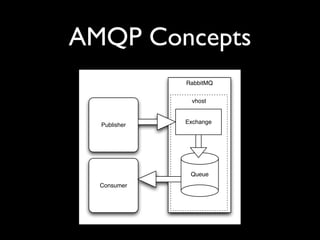
AMQP Concepts
              RabbitMQ


                vhost


  Publisher   Exchange


               Queue
  Consumer
Concepts - Exchanges

• Named
• Messages are published (sent) to one
  exchange
• Can be durable (lasts till deleted), or auto-
  deleted
Queues
• Queues can be named or (or named by the
  server - private queues).
• Queues are bound to one (or more)
  exchanges.
• Queues can have 0 or more clients
• Queues may persist with 0 clients or not.
• FIFO (if you have 1 consumer)
• Message never delivered to > 1 client
Bindings


• Binding is what joins a queue and an
  exchange.
Traditional queue
• Named exchange
• Bound to 1 Named queue
• 0 or more listeners get round-robin
  messages
• Messages queue when nobody listens / if
  consumers are slow
Broadcast
• Named exchange
• Each client creates an anonymous
  ephermeral queue
• Client binds the queue to that exchange
• All clients get all messages
• Messages go to /dev/null if no clients
Others

• Different exchange types - direct, topic,
  fanout
• You can do a lot using just these and a mix
  of named and anonymous queues
• More complex topologies possible
I accidentally wrote
         software

• I try to avoid doing this
• I’m not very good at it ;)
I blame Net::RabbitFoot
• It’s written using AnyEvent and Coro
• Which I hadn’t used before, but looked
  good for this type of thing.
• I felt my way around writing simple things
  standalone.
• Got all the web servers logging into Rabbit
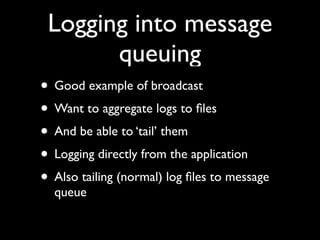
Logging into message
       queuing
• Good example of broadcast
• Want to aggregate logs to files
• And be able to ‘tail’ them
• Logging directly from the application
• Also tailing (normal) log files to message
  queue
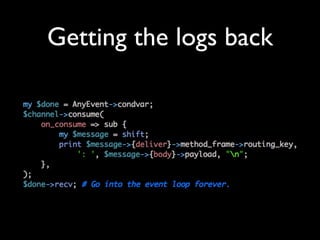
Getting the logs back
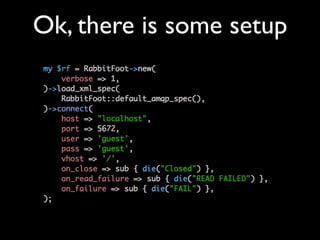
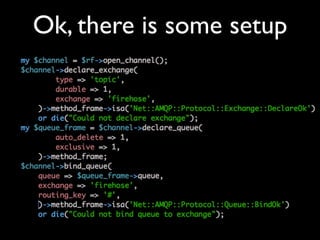
Ok, there is some setup
Dumping them to a file

• That’s pretty simple after that..
• Except:
 • Log rotation
 • Not flushing to disk once per message
 • etc...
Viewing them live

• Someone wrote an AMQP client in flash
• AMQP security model not useful publicly
• Cute prototype
• (Sorry, no demo - refuses to work locally)
Queueing Jobs

• Next application, simple job queue.
• 1 worker, serialized.. (Crap, good enough)
• Log JSON into RabbitMQ (again), inflate,
  call the ->run method.
• Works!
Job Server
• I now have several scripts, all doing bits
  with queuing. All duplicating code.
• I want to aggregate messages
• Send messages of aggregates at regular
  intervals
• Need something more generic
Job server
• Wrote a simple abstraction on getting
  channels, making exchanges and queues, etc
• Was still going to end up with a load of
  scripts/jobs that needed running and
  managing.Yuk.
• Inspecting the state of each job ‘service’
  hard / boring..
But wait
• Each ‘thing’ (timer, listener, logger, emitter,
  worker etc) can be an instance of a class
  with attributes for the state.
• Construct a set from some config file.
• Lets me aggregate jobs together / share
  code (Can use AnyEvent/Coro for threads).
• Less processes to manage. Working out the
  state just got harder still.
But wait
• Make all the classes use MooseX::Storage
• Catalyst makes instances of things from
  config...
• So, I could adapt all these instances into
  Catalyst models, write a controller, done!
• Erm, but Catalyst, and message queueing,
  and what?!?!?
I blame Miyagawa
• For Plack, and Catalyst::Engine::Plack, and
  Corona (the Coro PSGI server).
• I had this INSANE idea one night.
• I tried it.
• IT WORKED.
• WOAH.
I blame clkao

• Next step - browser kicks off a job.
• Status via long poll?
• He did it already!
• With long hair!
Hippie
• Async pipe to the browser.
• Abstracts all the nasty ajax details (also
  does long poll, or websockets)
• Applications:
 • Automatically updated monitor of app
    components
  • Start a job and then get an AJAX update
    screen for the job progress.
Useable?
• The basics work.
• Running it production at work
• (Since WedneThursday....)
• If you need a high volume, simple,
  production ready job scheduler right
  now, use Gearman.
Useable?

• Needs my github versions of
  Catalyst::Engine::PSGI and Web::Hippie
• Running jobs from the web app doesn’t
  work/exist yet.
• All the pieces are there - next week?
Demo?
Next steps?
• Production battle scars ;)
• Hippie for watching jobs run, not just
  component status updates.
• Docs would be good...
• Hippe::Pipe for bidirectional
• More traits / plugins / components
What to go look at

• http://www.rabbitmq.com
• Docs, setup info, FAQ
• Slideshare - lots of good and more detailed
  AMQP introductions.
What to go look at
       (CPAN)
• Net::RabbitFoot
• App::RabbitTail
• Plack
• Web::Hippie
• CatalystX::JobServer (github)
Bonus slide!

• I forgot to mention this originally...
• DO NOT FORK AFTER USING
  Net::RabbitFoot (and then try to use it in
  the child process)
• This will go horribly horribly wrong.
Other solutions

• Gearman
• STOMP
 • ActiveMQ (or Rabbit has a STOMP
    adaptor)
 • Catalyst::Engine::STOMP
Thanks!

• Questions?
• Anyone interested in playing, grab me on irc
• Happy to hand-hold as I need more people
  using this.
• I’ll love you forever if you write docs.

Real time system_performance_mon

  • 1.
    Real time system performancemonitoring AMQP and CatalystX::JobServer Tomas (t0m) Doran São Paulo.pm perl workshop 2010
  • 2.
    Aka the “mycode doesn’t work yet” talk • I wrote half the slides for this at 6am Friday (São Paulo time) • The title is a bit misleading, as I wrote the talk abstract in March, then wrote entirely different software. • Sorry about that.
  • 3.
    Message queueing • Letsnot talk about the (not working) code just yet... • This talk is about Message Queueing. • What is Message Queueing? • Why would I want to use it?
  • 4.
    What is message queueing. • In it’s simplest form, it’s just a list. • 1 (or more) ‘producers’ (writers) • 1 (or more) ‘consumers’ (readers) • Queue if rate of production > rate of consumption
  • 5.
    Why do Iwant it? • Decouples producers and consumers (probably across the network). • Lets you manage load, and spikes in load (only n consumers). • In a web environment - lets you serve more pages, quicker.
  • 6.
    Other cases • Viewas a list a little simplistic. • Depending on your application, you may want: • One to one • One to many • One to many (broadcast) • Many to all of the above • More complex topology?
  • 7.
    AMQP • Queuing protocol •Fast • Interoperable (maybe?)
  • 8.
    AMQP AMQP enables complete interoperability for messaging middleware, both the networking protocol and the semantics of broker services are defined in AMQP.
  • 9.
  • 10.
    AMQP • Full abstractionof all the mechanics of messaging across the network. • Serialization and framing of messages. • Wiring of message routing is part of the protocol.
  • 11.
    AMQP • So allyour clients know (at least half) of the wiring. • Different topologies depending on routing configuration. • Can specify other options such as durability • Nice when your server dies - no ‘current config’
  • 12.
    AMQP Concepts RabbitMQ vhost Publisher Exchange Queue Consumer
  • 13.
    Concepts - Exchanges •Named • Messages are published (sent) to one exchange • Can be durable (lasts till deleted), or auto- deleted
  • 14.
    Queues • Queues canbe named or (or named by the server - private queues). • Queues are bound to one (or more) exchanges. • Queues can have 0 or more clients • Queues may persist with 0 clients or not. • FIFO (if you have 1 consumer) • Message never delivered to > 1 client
  • 15.
    Bindings • Binding iswhat joins a queue and an exchange.
  • 16.
    Traditional queue • Namedexchange • Bound to 1 Named queue • 0 or more listeners get round-robin messages • Messages queue when nobody listens / if consumers are slow
  • 17.
    Broadcast • Named exchange •Each client creates an anonymous ephermeral queue • Client binds the queue to that exchange • All clients get all messages • Messages go to /dev/null if no clients
  • 18.
    Others • Different exchangetypes - direct, topic, fanout • You can do a lot using just these and a mix of named and anonymous queues • More complex topologies possible
  • 19.
    I accidentally wrote software • I try to avoid doing this • I’m not very good at it ;)
  • 20.
    I blame Net::RabbitFoot •It’s written using AnyEvent and Coro • Which I hadn’t used before, but looked good for this type of thing. • I felt my way around writing simple things standalone. • Got all the web servers logging into Rabbit
  • 21.
    Logging into message queuing • Good example of broadcast • Want to aggregate logs to files • And be able to ‘tail’ them • Logging directly from the application • Also tailing (normal) log files to message queue
  • 22.
  • 23.
    Ok, there issome setup
  • 24.
    Ok, there issome setup
  • 25.
    Dumping them toa file • That’s pretty simple after that.. • Except: • Log rotation • Not flushing to disk once per message • etc...
  • 26.
    Viewing them live •Someone wrote an AMQP client in flash • AMQP security model not useful publicly • Cute prototype • (Sorry, no demo - refuses to work locally)
  • 27.
    Queueing Jobs • Nextapplication, simple job queue. • 1 worker, serialized.. (Crap, good enough) • Log JSON into RabbitMQ (again), inflate, call the ->run method. • Works!
  • 28.
    Job Server • Inow have several scripts, all doing bits with queuing. All duplicating code. • I want to aggregate messages • Send messages of aggregates at regular intervals • Need something more generic
  • 29.
    Job server • Wrotea simple abstraction on getting channels, making exchanges and queues, etc • Was still going to end up with a load of scripts/jobs that needed running and managing.Yuk. • Inspecting the state of each job ‘service’ hard / boring..
  • 30.
    But wait • Each‘thing’ (timer, listener, logger, emitter, worker etc) can be an instance of a class with attributes for the state. • Construct a set from some config file. • Lets me aggregate jobs together / share code (Can use AnyEvent/Coro for threads). • Less processes to manage. Working out the state just got harder still.
  • 31.
    But wait • Makeall the classes use MooseX::Storage • Catalyst makes instances of things from config... • So, I could adapt all these instances into Catalyst models, write a controller, done! • Erm, but Catalyst, and message queueing, and what?!?!?
  • 32.
    I blame Miyagawa •For Plack, and Catalyst::Engine::Plack, and Corona (the Coro PSGI server). • I had this INSANE idea one night. • I tried it. • IT WORKED. • WOAH.
  • 33.
    I blame clkao •Next step - browser kicks off a job. • Status via long poll? • He did it already! • With long hair!
  • 34.
    Hippie • Async pipeto the browser. • Abstracts all the nasty ajax details (also does long poll, or websockets) • Applications: • Automatically updated monitor of app components • Start a job and then get an AJAX update screen for the job progress.
  • 35.
    Useable? • The basicswork. • Running it production at work • (Since WedneThursday....) • If you need a high volume, simple, production ready job scheduler right now, use Gearman.
  • 36.
    Useable? • Needs mygithub versions of Catalyst::Engine::PSGI and Web::Hippie • Running jobs from the web app doesn’t work/exist yet. • All the pieces are there - next week?
  • 37.
  • 38.
    Next steps? • Productionbattle scars ;) • Hippie for watching jobs run, not just component status updates. • Docs would be good... • Hippe::Pipe for bidirectional • More traits / plugins / components
  • 39.
    What to golook at • http://www.rabbitmq.com • Docs, setup info, FAQ • Slideshare - lots of good and more detailed AMQP introductions.
  • 40.
    What to golook at (CPAN) • Net::RabbitFoot • App::RabbitTail • Plack • Web::Hippie • CatalystX::JobServer (github)
  • 41.
    Bonus slide! • Iforgot to mention this originally... • DO NOT FORK AFTER USING Net::RabbitFoot (and then try to use it in the child process) • This will go horribly horribly wrong.
  • 42.
    Other solutions • Gearman •STOMP • ActiveMQ (or Rabbit has a STOMP adaptor) • Catalyst::Engine::STOMP
  • 43.
    Thanks! • Questions? • Anyoneinterested in playing, grab me on irc • Happy to hand-hold as I need more people using this. • I’ll love you forever if you write docs.