Messaging using AMQP Rahul Agrawal
Advanced Message Queuing Protocol Why should you care ? Many significant IT efforts include a messaging and integration component  (10%-30% of project cost) .
Why Messaging ? Transfer data from point A to point B. Asynchronous. Decouple publishers and consumers. Queuing for later delivery.
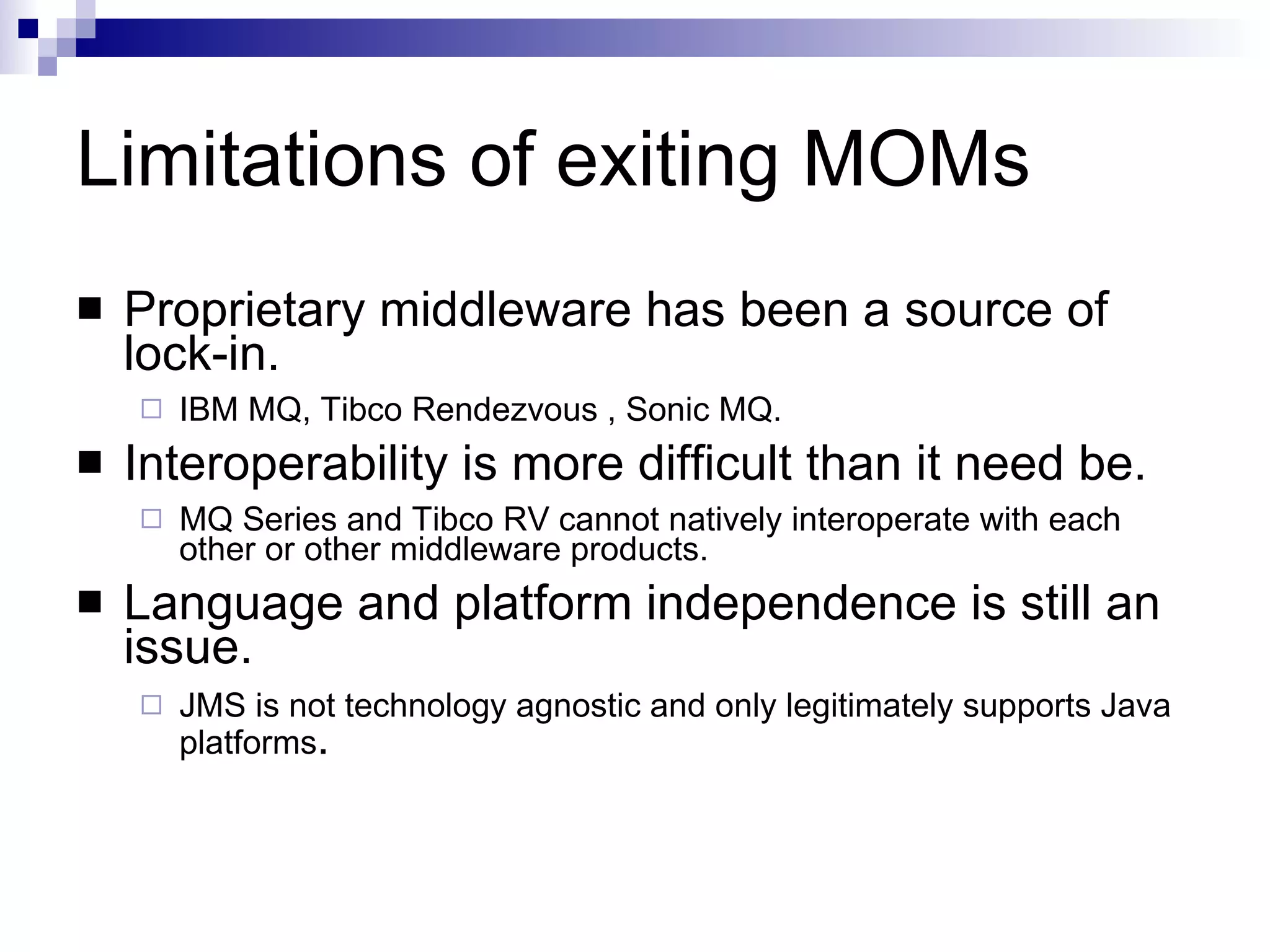
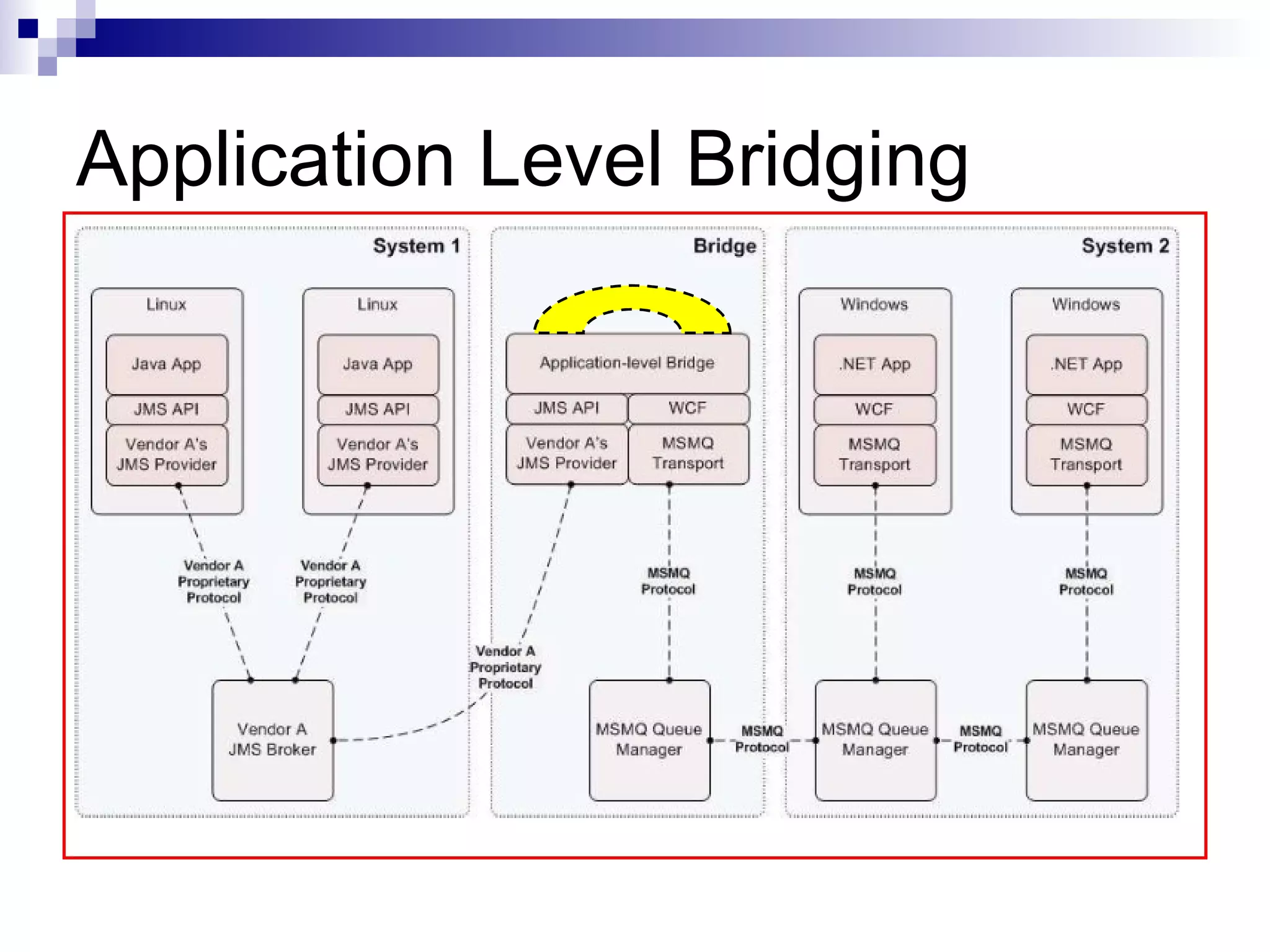
Limitations of exiting MOMs  Proprietary middleware has been a source of lock-in. IBM MQ,  Tibco Rendezvous  , Sonic MQ. Interoperability is more difficult than it need be. MQ Series and Tibco RV cannot natively interoperate with each other or other middleware products. Language and platform independence is still an issue. JMS is not technology agnostic and only legitimately supports Java platforms .
Application Level Bridging
AMQP Conceived by JP Morgan around 2006. Goal was to  provide a vendor-neutral protocol for managing the flow of messages across enterprise's business systems.
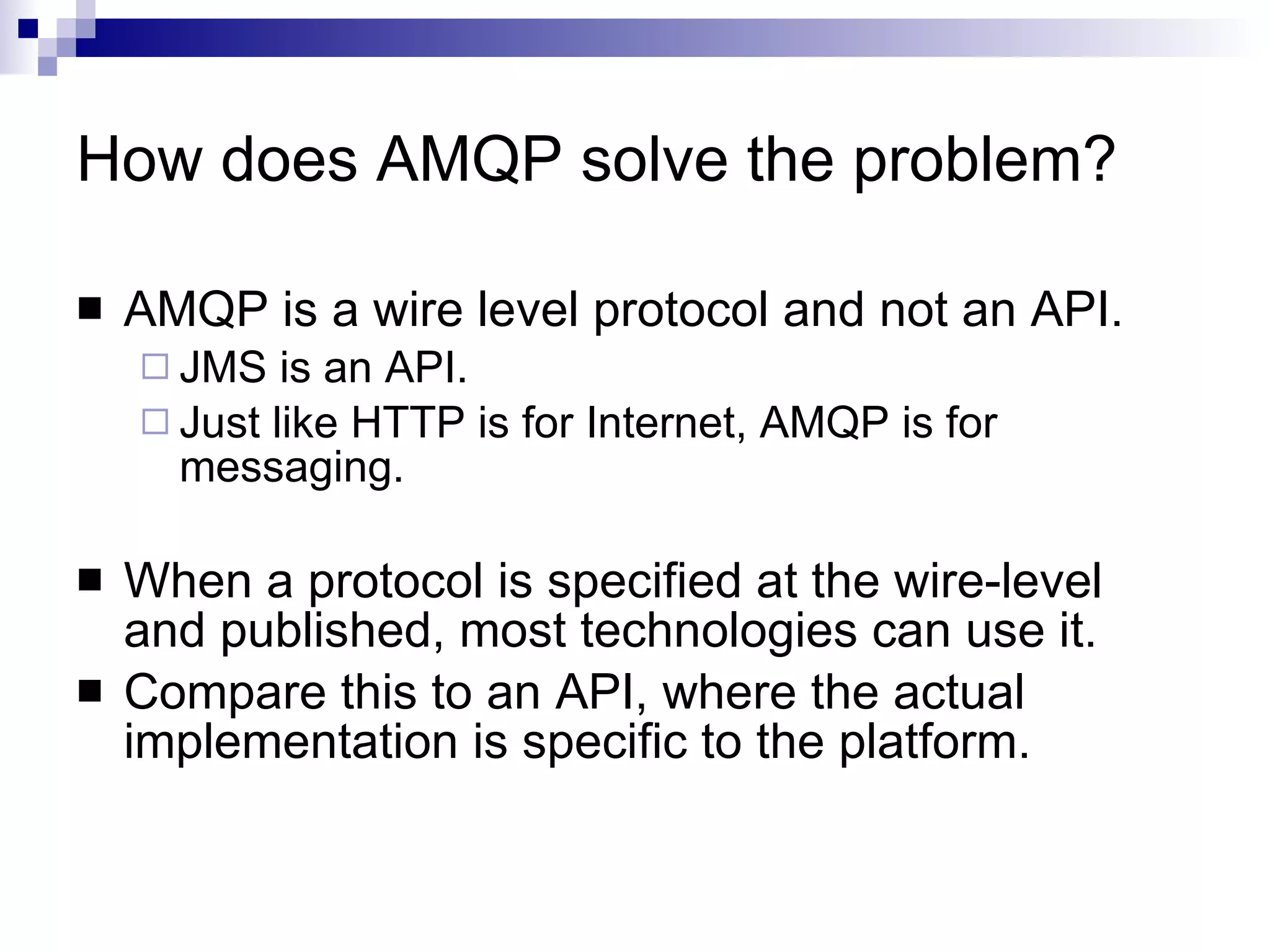
How does AMQP solve the problem? AMQP is a wire level protocol and not an API.  JMS is an API. Just like HTTP is for Internet, AMQP is for messaging. When a protocol is specified at the wire-level and published, most technologies can use it. Compare this to an API, where the actual implementation is specific to the platform.
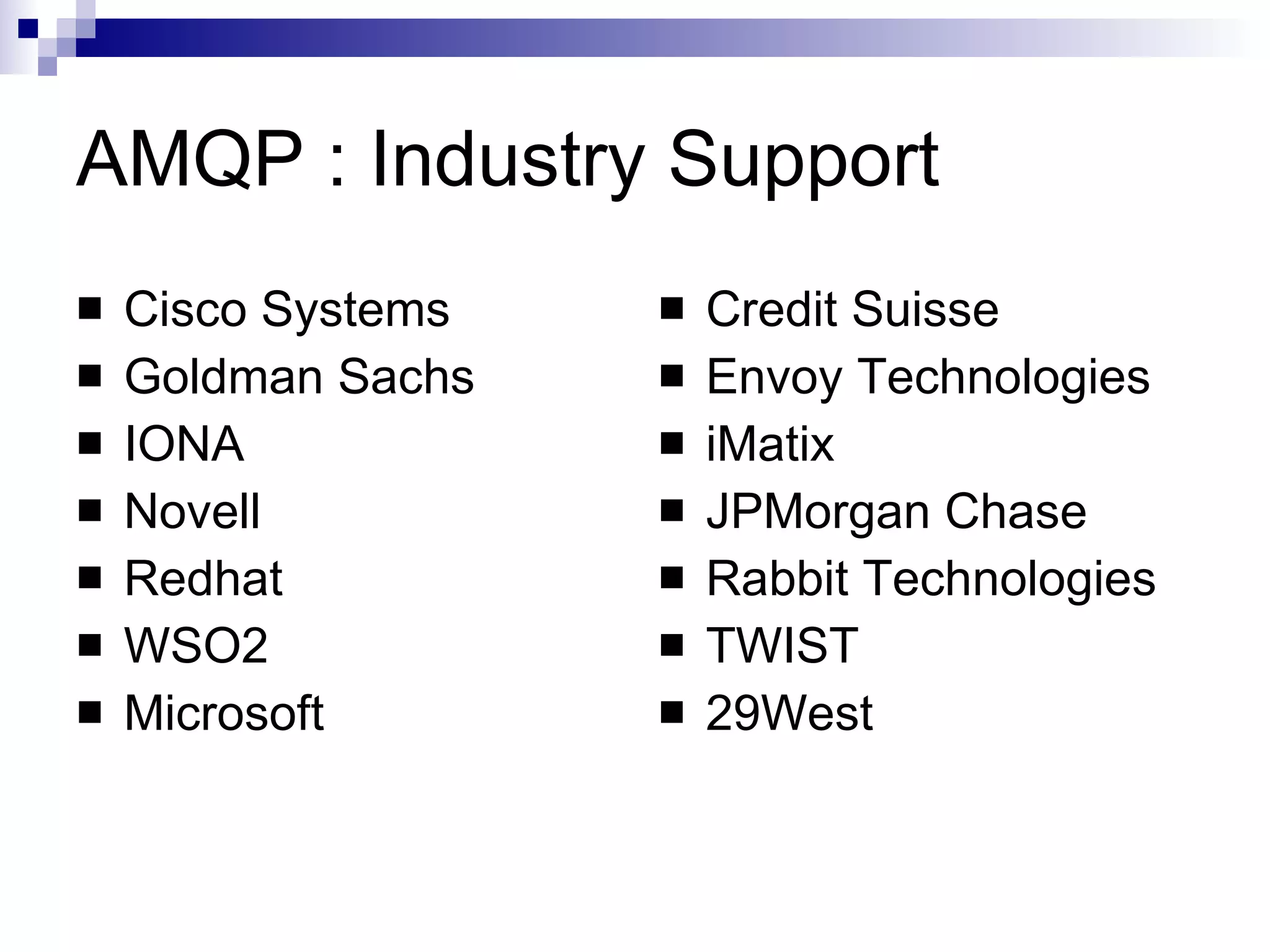
AMQP : Industry Support Cisco Systems Goldman Sachs IONA Novell Redhat WSO2 Microsoft Credit Suisse Envoy Technologies iMatix JPMorgan Chase Rabbit Technologies TWIST 29West
AMQP Concepts
Virtual Hosts
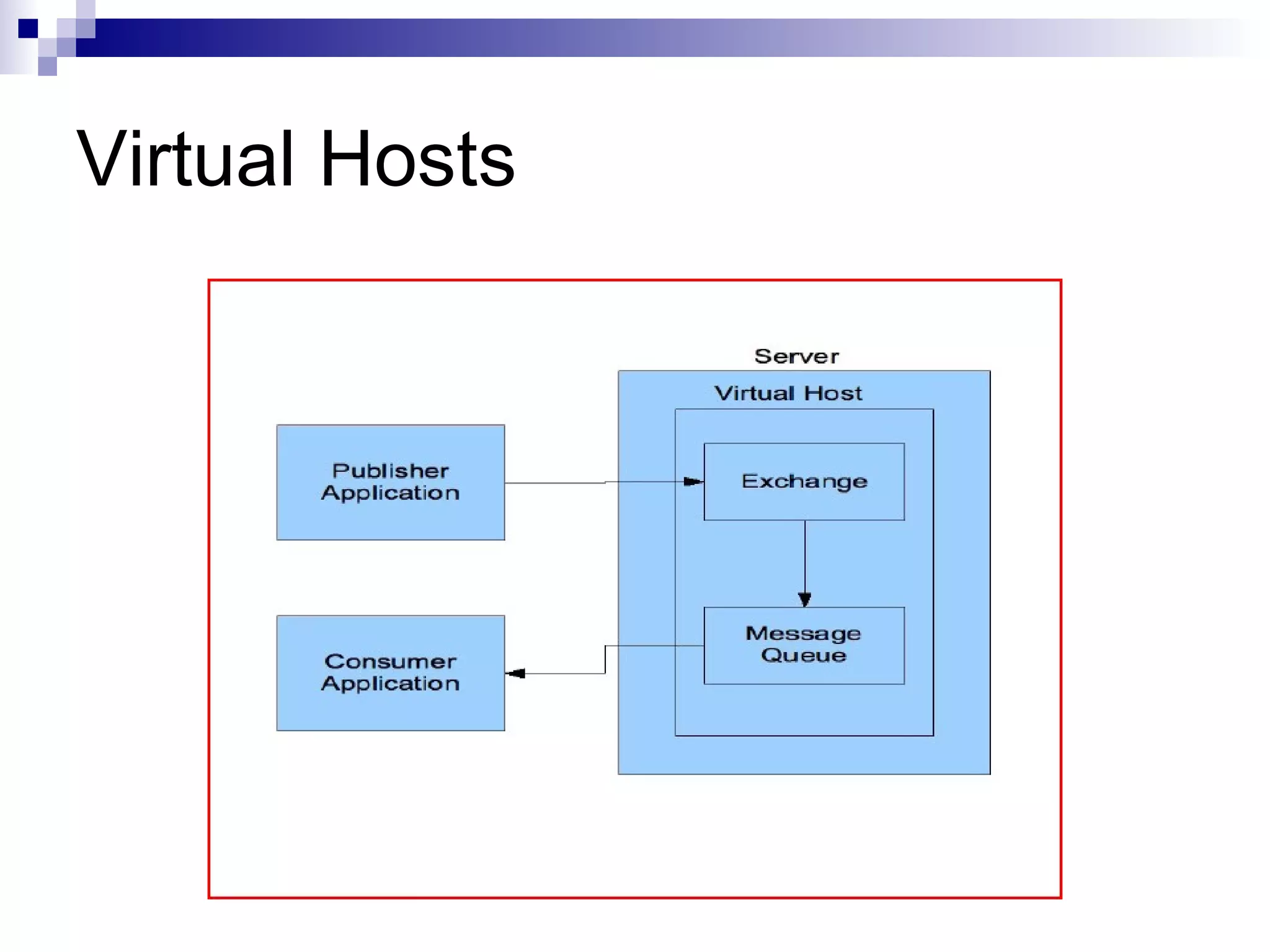
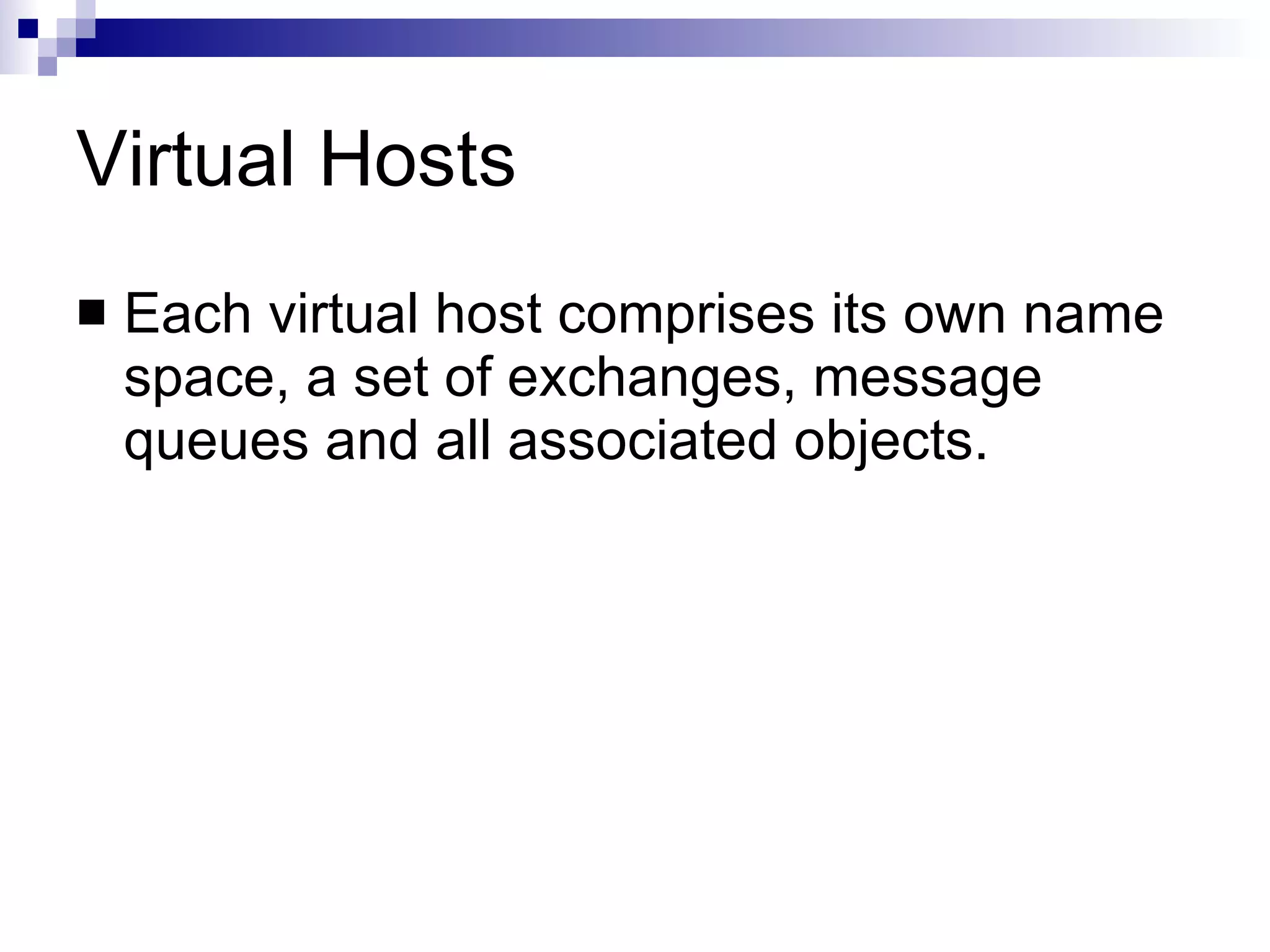
Virtual Hosts Each virtual host comprises its own name space, a set of exchanges, message queues and all associated objects.
AMQP concepts
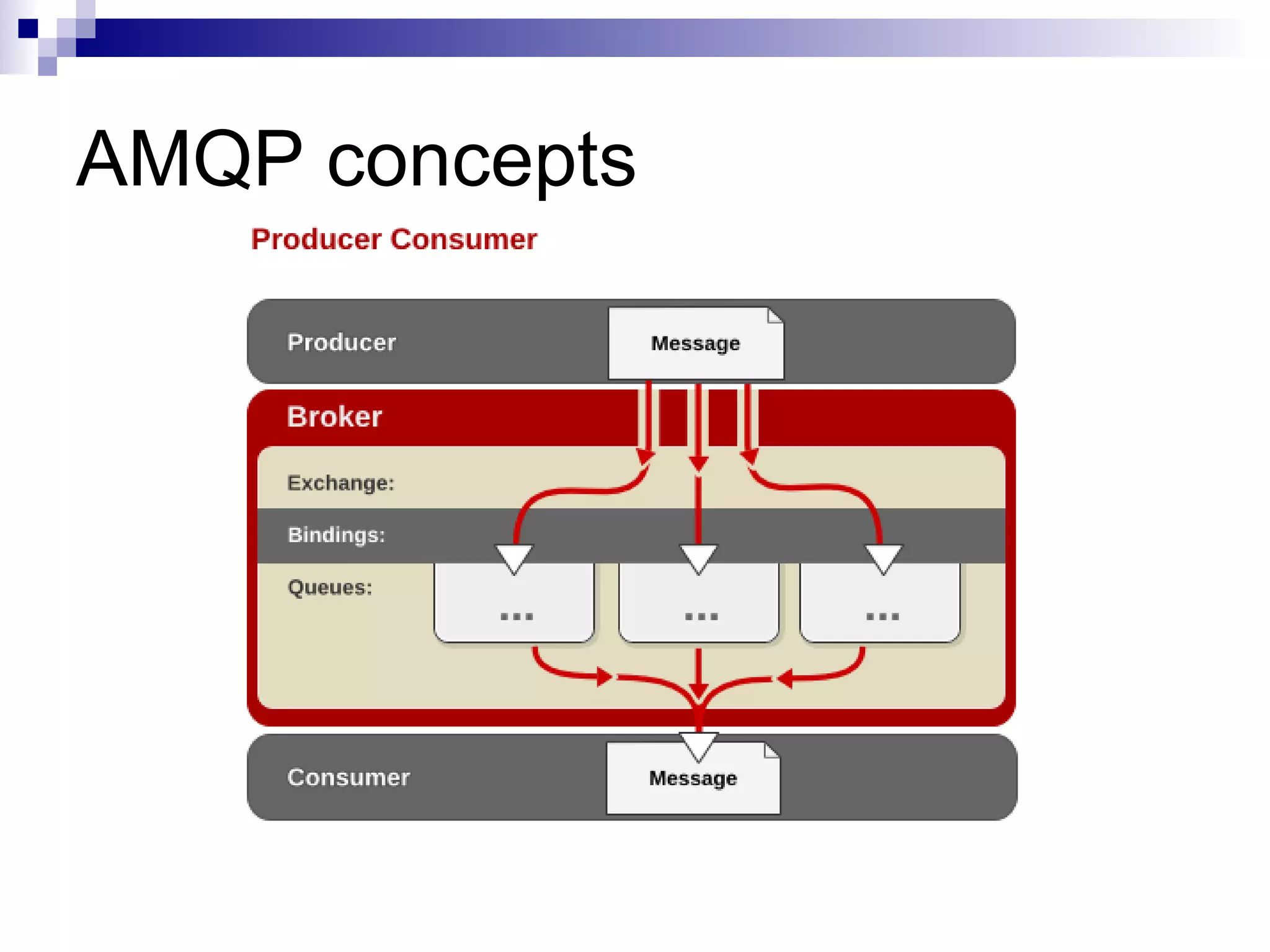
Exchange, Binding and Queues The "exchange" receives messages from publisher and routes these to “Queues". The "binding" defines the relationship between a message queue and an exchange and provides the message routing criteria.
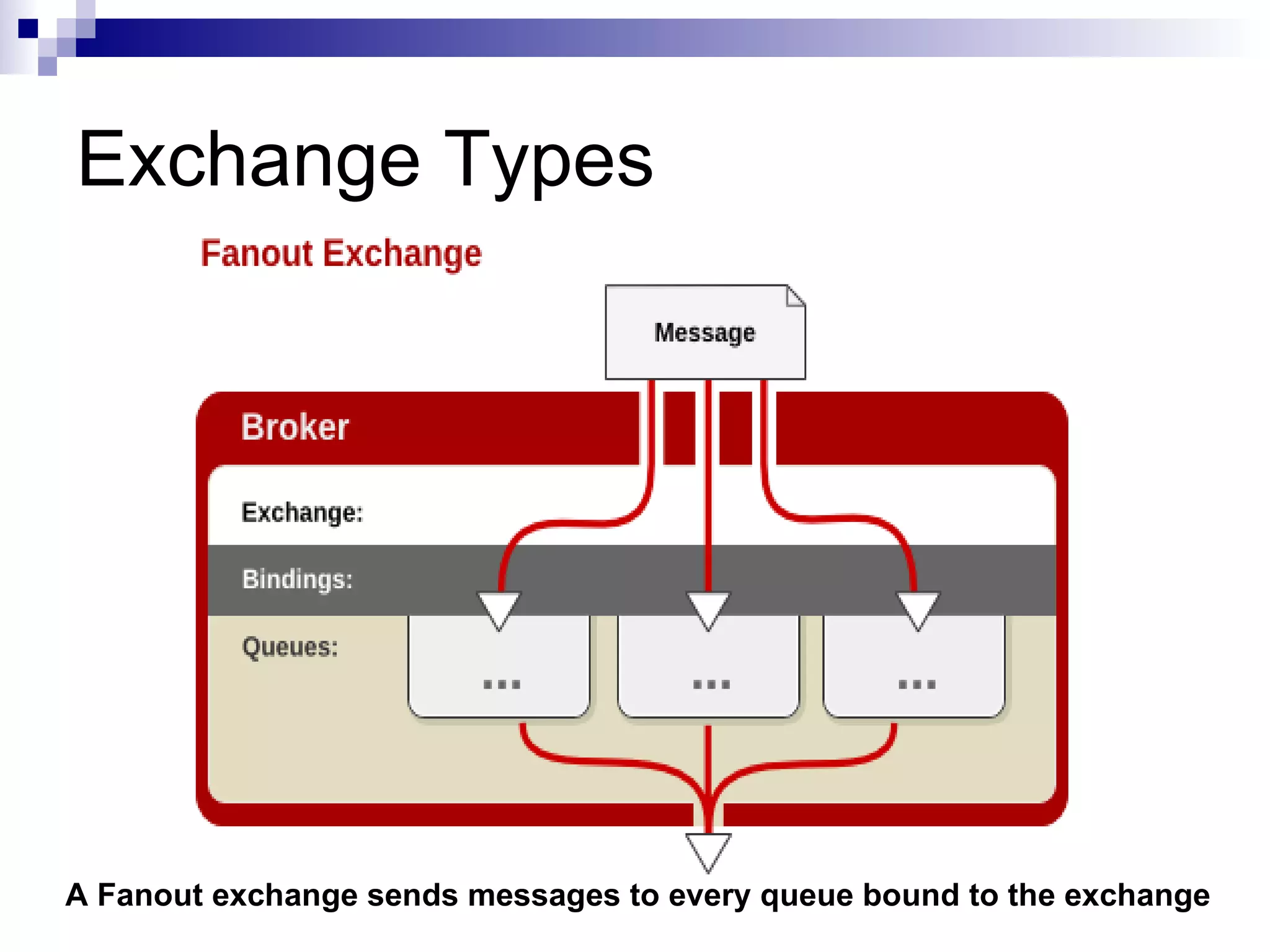
Exchange Types A Fanout exchange sends messages to every queue bound to the exchange
Fanout Exchange Type No routing key. What goes in must go out.
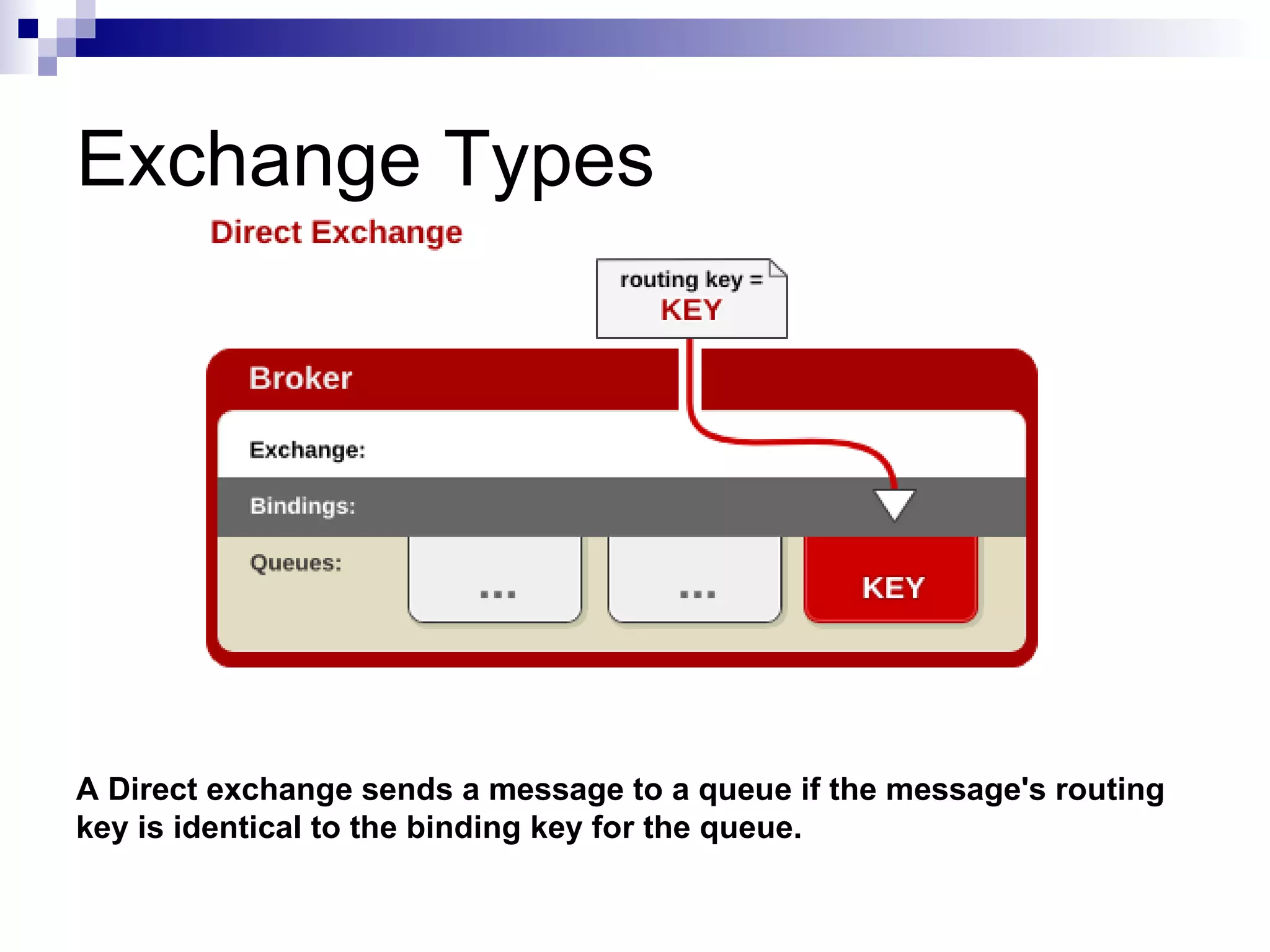
Exchange Types A Direct exchange sends a message to a queue if the message's routing key is identical to the binding key for the queue.
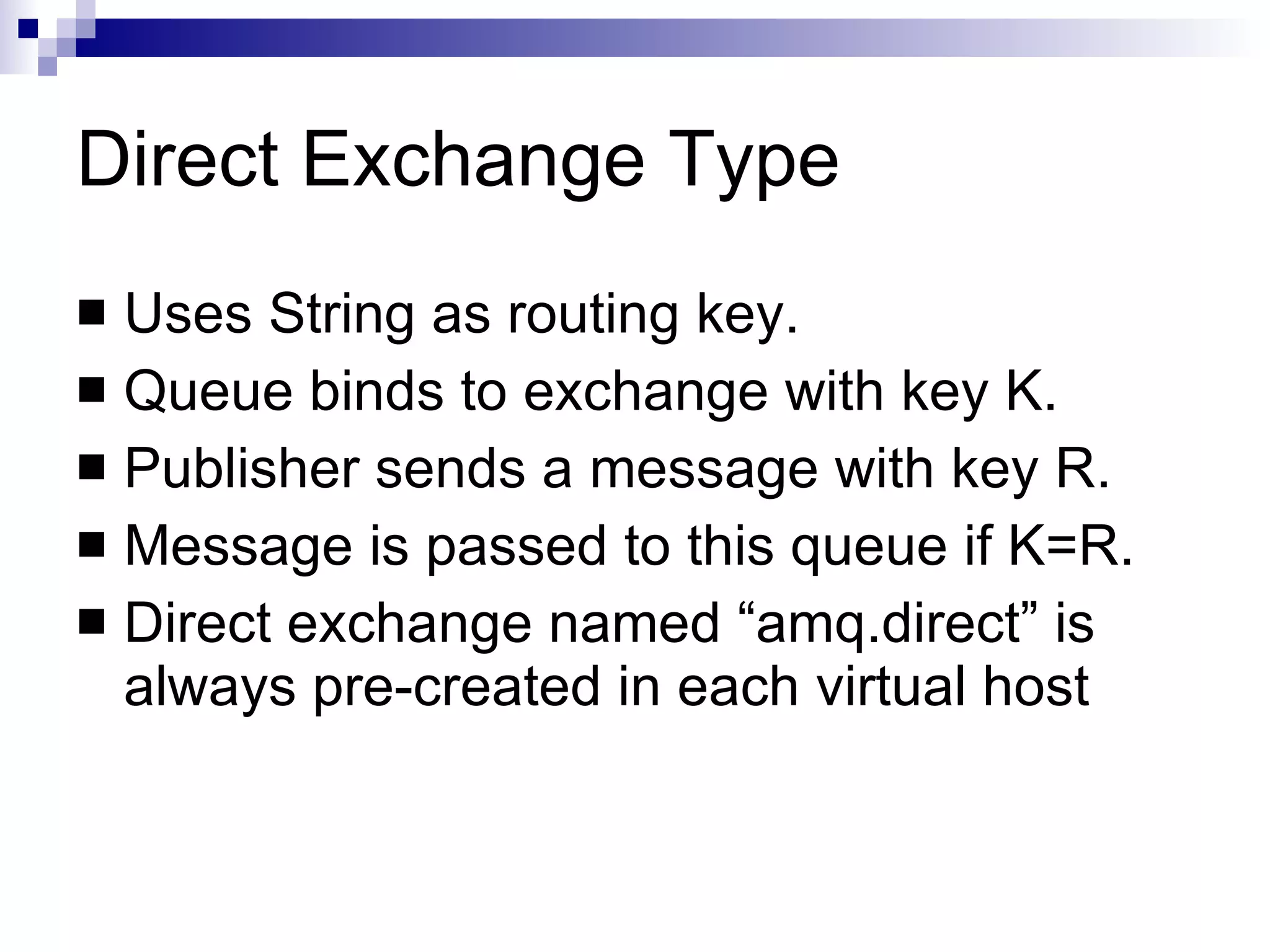
Direct Exchange Type Uses String as routing key. Queue binds to exchange with key K. Publisher sends a message with key R. Message is passed to this queue if K=R. Direct exchange named “amq.direct” is always pre-created in each virtual host
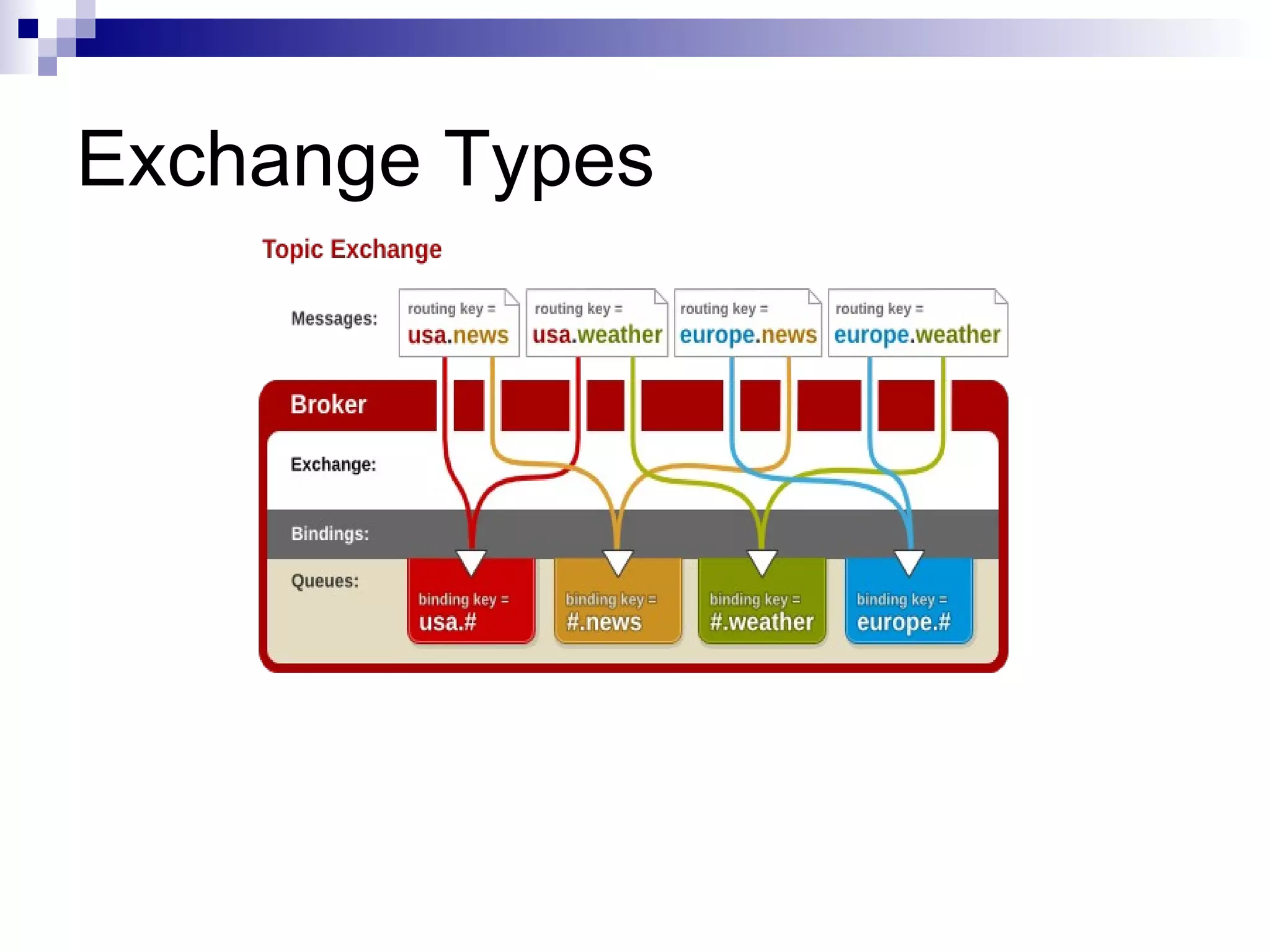
Exchange Types
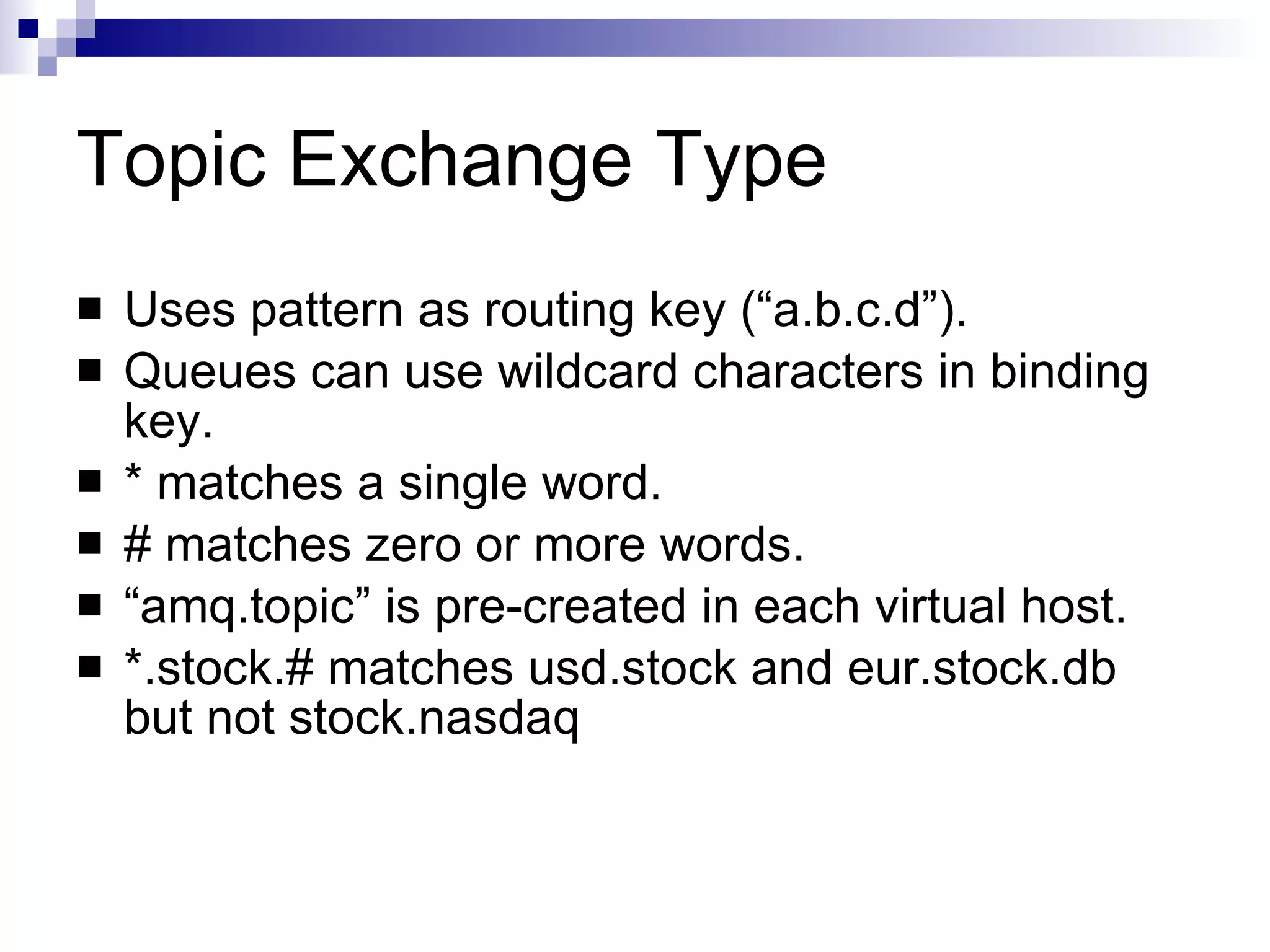
Topic Exchange Type Uses pattern as routing key (“a.b.c.d”). Queues can use wildcard characters in binding key. * matches a single word. # matches zero or more words. “ amq.topic” is pre-created in each virtual host. *.stock.# matches usd.stock and eur.stock.db but not stock.nasdaq
AMQP Broker Implementations Apache Qpid :  http:// qpid.apache.org Java & C++ Implementation. Rabbit MQ :  http://www.rabbitmq.com Erlang Implementation. Red Hat's MRG (Messaging, Realtime & Grid) :  http://www.redhat.com/mrg/ C++ Implementation.
Apache Qpid:  Open Source AMQP Messaging AMQP Messaging Brokers C++ implementation Java implementation AMQP Client APIs: C++, Java, JMS, Ruby, Python, and C#
Demo Java implementation of the broker. JMS clients interacting with Python clients.

Amqp Basic

  • 1.
    Messaging using AMQPRahul Agrawal
  • 2.
    Advanced Message QueuingProtocol Why should you care ? Many significant IT efforts include a messaging and integration component (10%-30% of project cost) .
  • 3.
    Why Messaging ?Transfer data from point A to point B. Asynchronous. Decouple publishers and consumers. Queuing for later delivery.
  • 4.
    Limitations of exitingMOMs Proprietary middleware has been a source of lock-in. IBM MQ, Tibco Rendezvous , Sonic MQ. Interoperability is more difficult than it need be. MQ Series and Tibco RV cannot natively interoperate with each other or other middleware products. Language and platform independence is still an issue. JMS is not technology agnostic and only legitimately supports Java platforms .
  • 5.
  • 6.
    AMQP Conceived byJP Morgan around 2006. Goal was to provide a vendor-neutral protocol for managing the flow of messages across enterprise's business systems.
  • 7.
    How does AMQPsolve the problem? AMQP is a wire level protocol and not an API. JMS is an API. Just like HTTP is for Internet, AMQP is for messaging. When a protocol is specified at the wire-level and published, most technologies can use it. Compare this to an API, where the actual implementation is specific to the platform.
  • 8.
    AMQP : IndustrySupport Cisco Systems Goldman Sachs IONA Novell Redhat WSO2 Microsoft Credit Suisse Envoy Technologies iMatix JPMorgan Chase Rabbit Technologies TWIST 29West
  • 9.
  • 10.
  • 11.
    Virtual Hosts Eachvirtual host comprises its own name space, a set of exchanges, message queues and all associated objects.
  • 12.
  • 13.
    Exchange, Binding andQueues The "exchange" receives messages from publisher and routes these to “Queues". The "binding" defines the relationship between a message queue and an exchange and provides the message routing criteria.
  • 14.
    Exchange Types AFanout exchange sends messages to every queue bound to the exchange
  • 15.
    Fanout Exchange TypeNo routing key. What goes in must go out.
  • 16.
    Exchange Types ADirect exchange sends a message to a queue if the message's routing key is identical to the binding key for the queue.
  • 17.
    Direct Exchange TypeUses String as routing key. Queue binds to exchange with key K. Publisher sends a message with key R. Message is passed to this queue if K=R. Direct exchange named “amq.direct” is always pre-created in each virtual host
  • 18.
  • 19.
    Topic Exchange TypeUses pattern as routing key (“a.b.c.d”). Queues can use wildcard characters in binding key. * matches a single word. # matches zero or more words. “ amq.topic” is pre-created in each virtual host. *.stock.# matches usd.stock and eur.stock.db but not stock.nasdaq
  • 20.
    AMQP Broker ImplementationsApache Qpid : http:// qpid.apache.org Java & C++ Implementation. Rabbit MQ : http://www.rabbitmq.com Erlang Implementation. Red Hat's MRG (Messaging, Realtime & Grid) : http://www.redhat.com/mrg/ C++ Implementation.
  • 21.
    Apache Qpid: Open Source AMQP Messaging AMQP Messaging Brokers C++ implementation Java implementation AMQP Client APIs: C++, Java, JMS, Ruby, Python, and C#
  • 22.
    Demo Java implementationof the broker. JMS clients interacting with Python clients.