Real Life Discipleship
Growing through Effective Discipleship
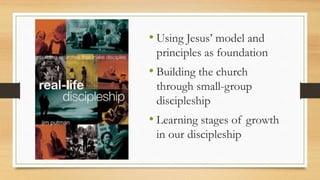
• Using Jesus’ model and
principles as foundation
• Building the church
through small-group
discipleship
• Learning stages of growth
in our discipleship
Jesus’s Model
Go and make disciples of all nations, baptizing them
in the name of the Father and of the Son and of the
Holy Spirit; and teaching them to obey everything I
have commanded you. And surely I am with you
always to the very end of the age.
-Matthew 28:19-20
When Jesus started his ministry,
what did he NOT have?
1) Staff of evangelists, elders, deacons
2) Sunday morning worship service
3) Regular midweek meeting
4) Children’s ministry, campus ministry, worship ministry, ushering ministry,
addiction recovery ministry…
5) Cool website
6) A church building
What did Jesus do/have?
•Focused on a small-group of individuals and
created a reproducible culture of
“discipleship”
•Big-picture vision; small-group focus
Culture of discipleship?
Matthew 4:18-20 - Come follow me, and I
will make you fishers of men.
•Intentional, Relational, Strategic
“Come follow me”
•Discipleship is intentional
•Discipleship means obedience to Christ,
not just agreement/belief (John 8:30-32)
“And I will make you”
• Discipleship is relational
• The disciples were transformed by their relationship with
Christ (John 15:12-17)
• The person you are at the beginning of discipleship is left
behind and the creation of a new person for Christ
begins (Mark 8:34-35)
“Fishers of men”
• Discipleship is strategic
• Jesus had a mission (Luke 19:10) that was reproduced by
the disciples in the Great Commission
• Transformation/change happened by participating in the
purpose of Christ – to save souls. (Luke 6:40)
Culture of Discipleship
By intentionally following Christ, the disciples entered a
transformational relationship with him. They became like
him in his mission, strategically reproducing discipleship
throughout the generations to follow.
Small-groups that are unified around these ideas become
incubators for growth through discipleship!
The Practical Power of Small-Groups
• Relationships reinforce what we are learning and provide models for us to learn
from and emulate
• Relationships that are honest, vulnerable and loving give us safe-space to deal with
weaknesses and sins.
• Relationships inherently challenge us to grow by learning Christ-like love
• Small-groups are easily and naturally reproduced
• Small-groups meet more needs while engaging broader involvement and collective
responsibility
Strengthening Small-Groups
• Stay intentional in our Christianity.
• Be relational in our approach to discipleship.
• Think and act strategically for the Great
Commission and personal growth.
“And I am with you
always, to the very
end of the age…”

Real life discipleship - intro

  • 1.
    Real Life Discipleship Growingthrough Effective Discipleship
  • 2.
    • Using Jesus’model and principles as foundation • Building the church through small-group discipleship • Learning stages of growth in our discipleship
  • 3.
    Jesus’s Model Go andmake disciples of all nations, baptizing them in the name of the Father and of the Son and of the Holy Spirit; and teaching them to obey everything I have commanded you. And surely I am with you always to the very end of the age. -Matthew 28:19-20
  • 4.
    When Jesus startedhis ministry, what did he NOT have? 1) Staff of evangelists, elders, deacons 2) Sunday morning worship service 3) Regular midweek meeting 4) Children’s ministry, campus ministry, worship ministry, ushering ministry, addiction recovery ministry… 5) Cool website 6) A church building
  • 5.
    What did Jesusdo/have? •Focused on a small-group of individuals and created a reproducible culture of “discipleship” •Big-picture vision; small-group focus
  • 6.
    Culture of discipleship? Matthew4:18-20 - Come follow me, and I will make you fishers of men. •Intentional, Relational, Strategic
  • 7.
    “Come follow me” •Discipleshipis intentional •Discipleship means obedience to Christ, not just agreement/belief (John 8:30-32)
  • 8.
    “And I willmake you” • Discipleship is relational • The disciples were transformed by their relationship with Christ (John 15:12-17) • The person you are at the beginning of discipleship is left behind and the creation of a new person for Christ begins (Mark 8:34-35)
  • 9.
    “Fishers of men” •Discipleship is strategic • Jesus had a mission (Luke 19:10) that was reproduced by the disciples in the Great Commission • Transformation/change happened by participating in the purpose of Christ – to save souls. (Luke 6:40)
  • 10.
    Culture of Discipleship Byintentionally following Christ, the disciples entered a transformational relationship with him. They became like him in his mission, strategically reproducing discipleship throughout the generations to follow. Small-groups that are unified around these ideas become incubators for growth through discipleship!
  • 11.
    The Practical Powerof Small-Groups • Relationships reinforce what we are learning and provide models for us to learn from and emulate • Relationships that are honest, vulnerable and loving give us safe-space to deal with weaknesses and sins. • Relationships inherently challenge us to grow by learning Christ-like love • Small-groups are easily and naturally reproduced • Small-groups meet more needs while engaging broader involvement and collective responsibility
  • 12.
    Strengthening Small-Groups • Stayintentional in our Christianity. • Be relational in our approach to discipleship. • Think and act strategically for the Great Commission and personal growth.
  • 13.
    “And I amwith you always, to the very end of the age…”