REACTIVE COMPUTING
W I T H S C A L A E X A M P L E S
Preview
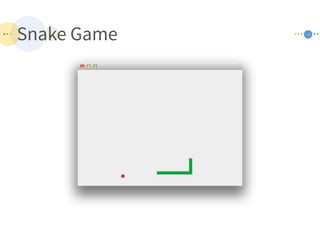
Snake Game 3
Reactive Design 4
State
State
Snake
Apple
Stream
Combinator
Ticker
Input Game
State
Move
Turn
Grow
Game
Definitions
Academia 6
A reactive system is a system that, when switched on,
is able to create desirable effects in its environment
by reacting to events.
Typesafe 7
ReactiveX 8
The Observer pattern done right
ReactiveX is a combination of the best ideas from
the Observer pattern, the Iterator pattern, and
functional programming
Points to Remember 9
1 Events/Messages
2 Observer/Observable
3 Streams
4 Composition
5 Reacting
6 Effects
Computing
Concepts
Overview
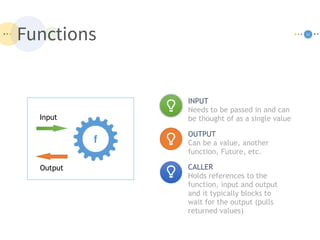
Functions 11
INPUT
Needs to be passed in and can
be thought of as a single value
CALLER
Holds references to the
function, input and output
and it typically blocks to
wait for the output (pulls
returned values)
OUTPUT
Can be a value, another
function, Future, etc.
f
Input
Output
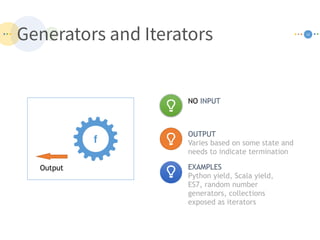
Generators and Iterators 12
NO INPUT
EXAMPLES
Python yield, Scala yield,
ES7, random number
generators, collections
exposed as iterators
OUTPUT
Varies based on some state and
needs to indicate termination
f
Output
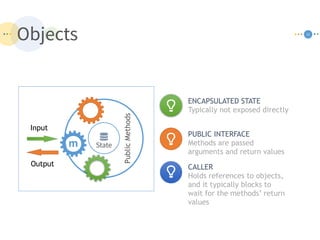
Objects 13
ENCAPSULATED STATE
Typically not exposed directly
CALLER
Holds references to objects,
and it typically blocks to
wait for the methods’ return
values
PUBLIC INTERFACE
Methods are passed
arguments and return values
m
Input
Output
State
PublicMethods
Function/Object Composition 14
Input
Output
f
g
h
PROGRAMS
Can be seen as an
orchestration of functions and
object methods calls
COORDINATION
Function calls need to be
coordinated (think
concurrency, blocking,
synchronicity)
EXECUTION
Sequence of pushing and
pulling values to and from
functions/methods calls
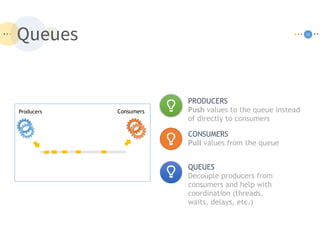
Queues 15
PRODUCERS
Push values to the queue instead
of directly to consumers
QUEUES
Decouple producers from
consumers and help with
coordination (threads,
waits, delays, etc.)
CONSUMERS
Pull values from the queue
Producers Consumers
Actors 16
ACTORS
Receive messages asynchronously
on an internal queue
OUTPUT
Is optionally sent to another
actor
MESSAGES
Are pulled sequentially and
processed by a partial function
State
Observer Pattern 17
OBSERVABLE/SUBJECT
Pushes values to registered
observers/subscribers
NO DECOUPLING QUEUE
Between the observable and
observers, but the observable
could use one internally
OBSERVERS
Process values pushed by
the observable
Observable/Subject
Observers
abstract class SubjectObserver {

type S <: Subject

type O <: Observer


trait Subject {

// self-type annotation

// we can now use "self" as an alias for "this"

self: S =>

private var observers = List[O]()


def addObserver(observer: O) = observers ::= observer


def notifyObservers = observers foreach (_.onUpdate(self))

}


trait Observer {

def onUpdate(subject: S)

}

}
Streams
ReactiveX 19
An API for asynchronous
programming with
observable streams
CREATE
Easily create event streams or data streams.
COMBINE
Compose and transform streams with query-
like operators.
LISTEN
Subscribe to any observable stream to perform
side effects.
Observable Streams 20
OBSERVABLE
Pushes values and errors to
registered observers/subscribers
COMPOSITION
Observables can be composed
with an intuitive DSL
OBSERVERS
Implement onNext, onError and
onCompleted and are registered
with the observable
Observable
Observers
Subscriber API 21
Examples 22
CREATE
COMBINE AND LISTEN
snakeObservable.combineLatest(appleObservable).subscribe(

pair => {

Game.update(pair._1.body, pair._2)

},

(t: Throwable) => t.printStackTrace(),

() => {}

)


tick.subscribe(

_ => events.onNext(Move()),

(t: Throwable) => println("tick error : " + t),

() => {}

)
val tick = Observable.interval(Duration(150, TimeUnit.MILLISECONDS))

val events: PublishSubject[Event] = PublishSubject[Event]()

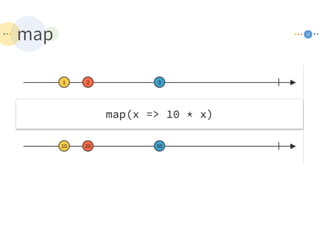
map 23
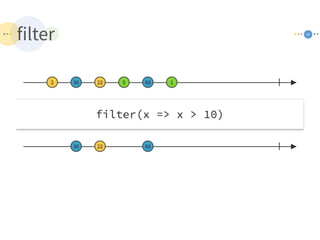
filter 24
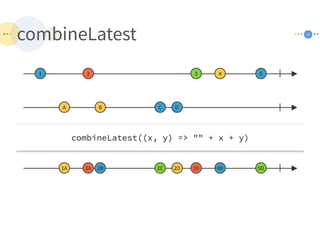
combineLatest 25
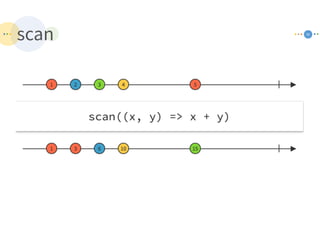
scan 26
Reactive
Snake
Game
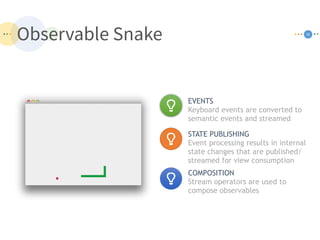
Observable Snake 28
EVENTS
Keyboard events are converted to
semantic events and streamed
COMPOSITION
Stream operators are used to
compose observables
STATE PUBLISHING
Event processing results in internal
state changes that are published/
streamed for view consumption
Scala Code 29
IMMUTABLE SNAKE STATE
SNAKE EVENTS PROCESSING AND STATE PUBLISHING
case class Snake(body: List[WorldLocation], direction: WorldLocation) {

def go(toDirection: WorldLocation): Snake = Snake(body, toDirection)

def moved: Snake = Snake((head + direction) :: body.take(body.size - 1), direction)

def grown: Snake = Snake((head + direction) :: body, direction)

def head: WorldLocation = body.head

}
def createSnake(init: Snake, events: Observable[Event]): Observable[Snake] = {

events

.scan(init)((snake, event) => event match {

case Move() => snake.moved

case Grow() => snake.grown

case Turn(direction) => snake.go(direction)

})

}
APPLE EVENTS PROCESSING AND STATE PUBLISHING
def createApple(init: WorldLocation, snakeObservable: Observable[Snake], 

events: Subject[Event, Event]): Observable[WorldLocation] = {

snakeObservable.scan(randomLocation())((loc: WorldLocation, snake: Snake) => snake.head match {

case head if head == loc =>

events.onNext(Grow())

randomLocation()

case _ => loc

})

}
Industry
Standardization
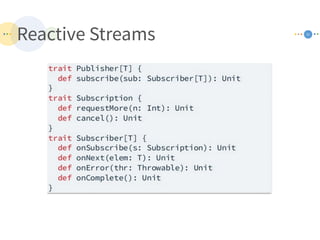
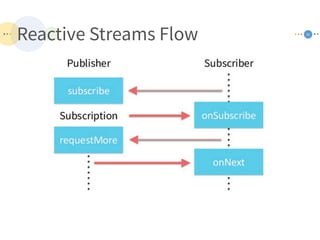
Reactive Streams 31
Reactive Streams Flow 32
State
Subjects
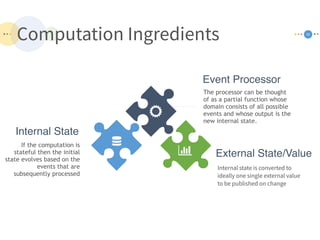
Computation Ingredients 34
Event Processor
The processor can be thought
of as a partial function whose
domain consists of all possible
events and whose output is the
new internal state.
External State/Value
Internal state is converted to
ideally one single external value
to be published on change
Internal State
If the computation is
stateful then the initial
state evolves based on the
events that are
subsequently processed
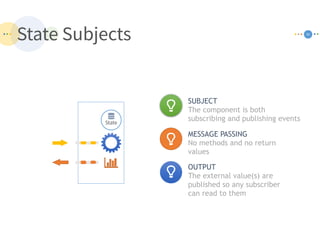
State Subjects 35
SUBJECT
The component is both
subscribing and publishing events
OUTPUT
The external value(s) are
published so any subscriber
can read to them
MESSAGE PASSING
No methods and no return
values
State
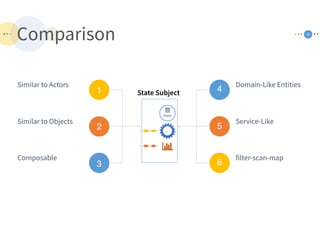
Comparison 36
Domain-Like Entities
Service-Like
filter-scan-map
4
5
63
2
1
Similar to Actors
Similar to Objects
Composable
State Subject
State
Alan Kay 37
It was probably in 1967 when someone asked me what I was doing, and I
said: "It's object-oriented programming”.
I thought of objects being like biological cells and/or individual
computers on a network, only able to communicate with messages.
The key in making great and growable systems is much more to design
how its modules communicate rather than what their internal properties
and behaviors should be.
http://c2.com/cgi/wiki?AlanKayOnMessaging
http://userpage.fu-berlin.de/~ram/pub/pub_jf47ht81Ht/doc_kay_oop_en

Reactive computing

  • 1.
    REACTIVE COMPUTING W IT H S C A L A E X A M P L E S
  • 2.
  • 3.
  • 4.
  • 5.
  • 6.
    Academia 6 A reactivesystem is a system that, when switched on, is able to create desirable effects in its environment by reacting to events.
  • 7.
  • 8.
    ReactiveX 8 The Observerpattern done right ReactiveX is a combination of the best ideas from the Observer pattern, the Iterator pattern, and functional programming
  • 9.
    Points to Remember9 1 Events/Messages 2 Observer/Observable 3 Streams 4 Composition 5 Reacting 6 Effects
  • 10.
  • 11.
    Functions 11 INPUT Needs tobe passed in and can be thought of as a single value CALLER Holds references to the function, input and output and it typically blocks to wait for the output (pulls returned values) OUTPUT Can be a value, another function, Future, etc. f Input Output
  • 12.
    Generators and Iterators12 NO INPUT EXAMPLES Python yield, Scala yield, ES7, random number generators, collections exposed as iterators OUTPUT Varies based on some state and needs to indicate termination f Output
  • 13.
    Objects 13 ENCAPSULATED STATE Typicallynot exposed directly CALLER Holds references to objects, and it typically blocks to wait for the methods’ return values PUBLIC INTERFACE Methods are passed arguments and return values m Input Output State PublicMethods
  • 14.
    Function/Object Composition 14 Input Output f g h PROGRAMS Canbe seen as an orchestration of functions and object methods calls COORDINATION Function calls need to be coordinated (think concurrency, blocking, synchronicity) EXECUTION Sequence of pushing and pulling values to and from functions/methods calls
  • 15.
    Queues 15 PRODUCERS Push valuesto the queue instead of directly to consumers QUEUES Decouple producers from consumers and help with coordination (threads, waits, delays, etc.) CONSUMERS Pull values from the queue Producers Consumers
  • 16.
    Actors 16 ACTORS Receive messagesasynchronously on an internal queue OUTPUT Is optionally sent to another actor MESSAGES Are pulled sequentially and processed by a partial function State
  • 17.
    Observer Pattern 17 OBSERVABLE/SUBJECT Pushesvalues to registered observers/subscribers NO DECOUPLING QUEUE Between the observable and observers, but the observable could use one internally OBSERVERS Process values pushed by the observable Observable/Subject Observers abstract class SubjectObserver {
 type S <: Subject
 type O <: Observer
 
 trait Subject {
 // self-type annotation
 // we can now use "self" as an alias for "this"
 self: S =>
 private var observers = List[O]()
 
 def addObserver(observer: O) = observers ::= observer
 
 def notifyObservers = observers foreach (_.onUpdate(self))
 }
 
 trait Observer {
 def onUpdate(subject: S)
 }
 }
  • 18.
  • 19.
    ReactiveX 19 An APIfor asynchronous programming with observable streams CREATE Easily create event streams or data streams. COMBINE Compose and transform streams with query- like operators. LISTEN Subscribe to any observable stream to perform side effects.
  • 20.
    Observable Streams 20 OBSERVABLE Pushesvalues and errors to registered observers/subscribers COMPOSITION Observables can be composed with an intuitive DSL OBSERVERS Implement onNext, onError and onCompleted and are registered with the observable Observable Observers
  • 21.
  • 22.
    Examples 22 CREATE COMBINE ANDLISTEN snakeObservable.combineLatest(appleObservable).subscribe(
 pair => {
 Game.update(pair._1.body, pair._2)
 },
 (t: Throwable) => t.printStackTrace(),
 () => {}
 )
 
 tick.subscribe(
 _ => events.onNext(Move()),
 (t: Throwable) => println("tick error : " + t),
 () => {}
 ) val tick = Observable.interval(Duration(150, TimeUnit.MILLISECONDS))
 val events: PublishSubject[Event] = PublishSubject[Event]()

  • 23.
  • 24.
  • 25.
  • 26.
  • 27.
  • 28.
    Observable Snake 28 EVENTS Keyboardevents are converted to semantic events and streamed COMPOSITION Stream operators are used to compose observables STATE PUBLISHING Event processing results in internal state changes that are published/ streamed for view consumption
  • 29.
    Scala Code 29 IMMUTABLESNAKE STATE SNAKE EVENTS PROCESSING AND STATE PUBLISHING case class Snake(body: List[WorldLocation], direction: WorldLocation) {
 def go(toDirection: WorldLocation): Snake = Snake(body, toDirection)
 def moved: Snake = Snake((head + direction) :: body.take(body.size - 1), direction)
 def grown: Snake = Snake((head + direction) :: body, direction)
 def head: WorldLocation = body.head
 } def createSnake(init: Snake, events: Observable[Event]): Observable[Snake] = {
 events
 .scan(init)((snake, event) => event match {
 case Move() => snake.moved
 case Grow() => snake.grown
 case Turn(direction) => snake.go(direction)
 })
 } APPLE EVENTS PROCESSING AND STATE PUBLISHING def createApple(init: WorldLocation, snakeObservable: Observable[Snake], 
 events: Subject[Event, Event]): Observable[WorldLocation] = {
 snakeObservable.scan(randomLocation())((loc: WorldLocation, snake: Snake) => snake.head match {
 case head if head == loc =>
 events.onNext(Grow())
 randomLocation()
 case _ => loc
 })
 }
  • 30.
  • 31.
  • 32.
  • 33.
  • 34.
    Computation Ingredients 34 EventProcessor The processor can be thought of as a partial function whose domain consists of all possible events and whose output is the new internal state. External State/Value Internal state is converted to ideally one single external value to be published on change Internal State If the computation is stateful then the initial state evolves based on the events that are subsequently processed
  • 35.
    State Subjects 35 SUBJECT Thecomponent is both subscribing and publishing events OUTPUT The external value(s) are published so any subscriber can read to them MESSAGE PASSING No methods and no return values State
  • 36.
    Comparison 36 Domain-Like Entities Service-Like filter-scan-map 4 5 63 2 1 Similarto Actors Similar to Objects Composable State Subject State
  • 37.
    Alan Kay 37 Itwas probably in 1967 when someone asked me what I was doing, and I said: "It's object-oriented programming”. I thought of objects being like biological cells and/or individual computers on a network, only able to communicate with messages. The key in making great and growable systems is much more to design how its modules communicate rather than what their internal properties and behaviors should be. http://c2.com/cgi/wiki?AlanKayOnMessaging http://userpage.fu-berlin.de/~ram/pub/pub_jf47ht81Ht/doc_kay_oop_en