React vs. Node JS
In the ever-evolving landscape of web development, developers are
constantly faced with the challenge of selecting the right tools for
their projects. Among the myriad of options available, React vs Node
JS stand out as two popular choices, each offering distinct
advantages and use cases. In this blog post, we’ll explore the
differences between React vs Node JS and help you determine
which one is better suited for your web development needs.
+1 9177322215
Choosing the Right Tool for Web Development
React vs. Node JS
React, developed by Facebook, is a JavaScript library for building user
interfaces. It’s known for its component-based architecture, which
allows developers to create reusable UI components and build
complex user interfaces with ease. React utilizes a virtual DOM
(Document Object Model) to efficiently update and render UI
components, resulting in faster performance and better user
experience.
+1 9177322215
React.js: Building User Interfaces with Ease
React vs. Node JS
• Component-Based Architecture: React’s component-based
approach promotes code reusability and modularity, making it
easier to maintain and scale large applications.
• Declarative Syntax: React uses a declarative syntax, allowing
developers to describe how the UI should look based on its current
state. This simplifies the process of building and updating UI
components.
• Virtual DOM: React’s virtual DOM efficiently updates and renders
UI components, resulting in improved performance and faster
page load times.
• Large Ecosystem: React has a vibrant ecosystem with a vast array
of libraries, tools, and community support, making it easier for
developers to find solutions and resources for their projects.
+1 9177322215
Advantages of React.js:
React vs. Node JS
Node.js, on the other hand, is a runtime environment for executing
JavaScript code server-side. It allows developers to build scalable and
high-performance backend services using JavaScript, the same
language used for frontend development with React. Node.js is built
on Chrome’s V8 JavaScript engine and utilizes an event-driven, non-
blocking I/O model, making it well-suited for building real-time
applications and APIs.
+1 9177322215
Node.js: Powering Backend Services with JavaScript
React vs. Node JS
• JavaScript Everywhere: With Node.js, developers can use
JavaScript for both frontend and backend development, enabling
full-stack development with a unified language and ecosystem.
• Scalability: Node.js is highly scalable and can handle a large
number of concurrent connections efficiently, making it ideal for
building real-time applications, microservices, and APIs.
• Non-Blocking I/O: Node.js utilizes a non-blocking, event-driven
architecture, allowing it to handle multiple requests concurrently
without blocking the execution of other code, resulting in better
performance and responsiveness.
• Rich Ecosystem: Node.js has a rich ecosystem of modules and
packages available via npm (Node Package Manager), allowing
developers to easily integrate third-party libraries and tools into
their applications.
+1 9177322215
Advantages of Node.js:
React vs. Node JS
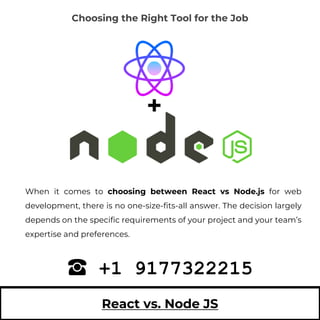
When it comes to choosing between React vs Node.js for web
development, there is no one-size-fits-all answer. The decision largely
depends on the specific requirements of your project and your team’s
expertise and preferences.
+1 9177322215
Choosing the Right Tool for the Job
React vs. Node JS
• You’re building a user interface-intensive web application.
• You prefer a component-based architecture for building UI
components.
• You want to leverage React’s virtual DOM for efficient rendering
and performance optimization.
• You need a large ecosystem of libraries and tools for frontend
development.
+1 9177322215
Use React.js if:
React vs. Node JS
• You’re building a server-side application, API, or real-time service.
• You prefer using JavaScript for both frontend and backend
development.
• You need scalability and high performance for handling
concurrent connections and real-time communication.
• You want to take advantage of Node.js’ non-blocking, event-driven
architecture for building responsive applications.
+1 9177322215
Use React.js if:
React vs. Node JS
In many cases, developers use both React vs Node.js together
to build full-stack web applications, leveraging the strengths of
each technology for frontend and backend development,
respectively. Ultimately, the key is to understand the strengths and
use cases of each tool and choose the one that best aligns with your
project goals and requirements. Whether you opt for React, Node.js,
or a combination of both, you’re sure to find powerful tools that
enable you to build robust and scalable web applications.
+1 9177322215
React vs Node JS
Semiosis Software Private Limited
+1 9177322215
React vs. Node JS

React vs Node js: Which is Better for Web Development? - Semiosis Software Private Limited

  • 2.
    React vs. NodeJS In the ever-evolving landscape of web development, developers are constantly faced with the challenge of selecting the right tools for their projects. Among the myriad of options available, React vs Node JS stand out as two popular choices, each offering distinct advantages and use cases. In this blog post, we’ll explore the differences between React vs Node JS and help you determine which one is better suited for your web development needs. +1 9177322215 Choosing the Right Tool for Web Development
  • 3.
    React vs. NodeJS React, developed by Facebook, is a JavaScript library for building user interfaces. It’s known for its component-based architecture, which allows developers to create reusable UI components and build complex user interfaces with ease. React utilizes a virtual DOM (Document Object Model) to efficiently update and render UI components, resulting in faster performance and better user experience. +1 9177322215 React.js: Building User Interfaces with Ease
  • 4.
    React vs. NodeJS • Component-Based Architecture: React’s component-based approach promotes code reusability and modularity, making it easier to maintain and scale large applications. • Declarative Syntax: React uses a declarative syntax, allowing developers to describe how the UI should look based on its current state. This simplifies the process of building and updating UI components. • Virtual DOM: React’s virtual DOM efficiently updates and renders UI components, resulting in improved performance and faster page load times. • Large Ecosystem: React has a vibrant ecosystem with a vast array of libraries, tools, and community support, making it easier for developers to find solutions and resources for their projects. +1 9177322215 Advantages of React.js:
  • 5.
    React vs. NodeJS Node.js, on the other hand, is a runtime environment for executing JavaScript code server-side. It allows developers to build scalable and high-performance backend services using JavaScript, the same language used for frontend development with React. Node.js is built on Chrome’s V8 JavaScript engine and utilizes an event-driven, non- blocking I/O model, making it well-suited for building real-time applications and APIs. +1 9177322215 Node.js: Powering Backend Services with JavaScript
  • 6.
    React vs. NodeJS • JavaScript Everywhere: With Node.js, developers can use JavaScript for both frontend and backend development, enabling full-stack development with a unified language and ecosystem. • Scalability: Node.js is highly scalable and can handle a large number of concurrent connections efficiently, making it ideal for building real-time applications, microservices, and APIs. • Non-Blocking I/O: Node.js utilizes a non-blocking, event-driven architecture, allowing it to handle multiple requests concurrently without blocking the execution of other code, resulting in better performance and responsiveness. • Rich Ecosystem: Node.js has a rich ecosystem of modules and packages available via npm (Node Package Manager), allowing developers to easily integrate third-party libraries and tools into their applications. +1 9177322215 Advantages of Node.js:
  • 7.
    React vs. NodeJS When it comes to choosing between React vs Node.js for web development, there is no one-size-fits-all answer. The decision largely depends on the specific requirements of your project and your team’s expertise and preferences. +1 9177322215 Choosing the Right Tool for the Job
  • 8.
    React vs. NodeJS • You’re building a user interface-intensive web application. • You prefer a component-based architecture for building UI components. • You want to leverage React’s virtual DOM for efficient rendering and performance optimization. • You need a large ecosystem of libraries and tools for frontend development. +1 9177322215 Use React.js if:
  • 9.
    React vs. NodeJS • You’re building a server-side application, API, or real-time service. • You prefer using JavaScript for both frontend and backend development. • You need scalability and high performance for handling concurrent connections and real-time communication. • You want to take advantage of Node.js’ non-blocking, event-driven architecture for building responsive applications. +1 9177322215 Use React.js if:
  • 10.
    React vs. NodeJS In many cases, developers use both React vs Node.js together to build full-stack web applications, leveraging the strengths of each technology for frontend and backend development, respectively. Ultimately, the key is to understand the strengths and use cases of each tool and choose the one that best aligns with your project goals and requirements. Whether you opt for React, Node.js, or a combination of both, you’re sure to find powerful tools that enable you to build robust and scalable web applications. +1 9177322215 React vs Node JS
  • 11.
    Semiosis Software PrivateLimited +1 9177322215 React vs. Node JS