Angular VS ReactJS
In the realm of web development, choosing the right framework can
be akin to selecting the perfect tool for a craftsman. Among the
plethora of options available, Angular Vs ReactJS stand out as two of
the most prominent choices. Both offer robust features and have
amassed dedicated communities of developers. However, when it
comes to Angular vs ReactJS, which one reigns supreme? Let’s delve
into the intricacies of each framework to find out.
+1 9177322215
Choosing the Right Framework for Web Development
Angular VS ReactJS
Angular, developed and maintained by Google, is a comprehensive
framework for building dynamic web applications. It follows the
Model-View-Controller (MVC) architecture, where the application
logic is separated from the UI. Angular utilizes TypeScript, a superset
of JavaScript, which adds static typing and other advanced features
to the language.
+1 9177322215
Understanding Angular
Angular VS ReactJS
• Full-fledged Framework: Angular is a complete solution that
provides tools and libraries for almost every aspect of web
development, including routing, forms, HTTP client, and more.
• Two-Way Data Binding: With Angular’s two-way data binding,
changes in the model state automatically reflect in the view and
vice versa, simplifying the development process.
• Dependency Injection: Angular’s dependency injection system
facilitates modular development and makes components more
reusable and testable.
+1 9177322215
Pros of Angular:
Angular VS ReactJS
• Steep Learning Curve: Angular’s extensive feature set and
complex concepts such as modules, decorators, and services can
pose a steep learning curve for beginners.
• Performance Overhead: Angular’s robustness comes at a cost of
increased bundle size and rendering overhead, which can impact
performance, especially in smaller projects.
+1 9177322215
Cons of Angular:
Angular VS ReactJS
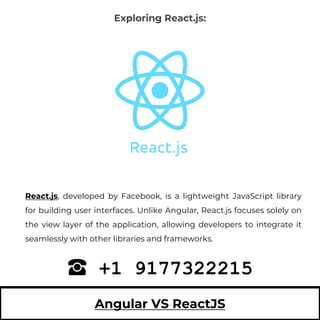
React.js, developed by Facebook, is a lightweight JavaScript library
for building user interfaces. Unlike Angular, React.js focuses solely on
the view layer of the application, allowing developers to integrate it
seamlessly with other libraries and frameworks.
+1 9177322215
Exploring React.js:
Angular VS ReactJS
• Virtual DOM: React.js employs a virtual DOM, which improves
performance by minimizing the number of DOM manipulations
required, resulting in faster rendering.
• Component-Based Architecture: React.js promotes a modular
approach to building UIs through reusable components, enabling
developers to create complex interfaces efficiently.
• Flexibility: React.js is highly flexible and can be integrated into
existing projects without much hassle. It also allows developers to
choose their preferred tools for state management, routing, and
other functionalities.
+1 9177322215
Pros of React.js:
Angular VS ReactJS
• Learning Curve for JSX: React.js uses JSX, a syntax extension that
allows mixing HTML with JavaScript. While JSX enhances code
readability, it might require some time for developers to get
accustomed to it.
• Lack of Official Guidelines: React.js lacks a comprehensive set of
official guidelines, leading to varying coding styles and practices
across different projects.
+1 9177322215
Cons of React.js:
Angular VS ReactJS
The decision between Angular VS ReactJS ultimately depends on the
specific requirements of your project and your team’s expertise. If you
prioritize a comprehensive solution with built-in tools and prefer a structured
framework, Angular might be the way to go. On the other hand, if you value
flexibility, performance, and a more lightweight approach, ReactJS could be
the better choice.
Additionally, consider factors such as the size and complexity of your project,
the scalability requirements, and the skill level of your development team.
Both Angular Vs ReactJS have thriving communities and extensive
documentation, making it easier to find support and resources regardless of
your choice.
In conclusion, there is no one-size-fits-all answer to the Angular VS
ReactJS debate. Each framework has its strengths and weaknesses, and the
best choice is the one that aligns most closely with your project goals and
development philosophy. Whether you opt for the comprehensive ecosystem
of Angular or the flexibility of ReactJS, both frameworks offer powerful tools
to create exceptional web applications.
+1 9177322215
Which One Should You Choose?
Semiosis Software Private Limited
+1 9177322215
Angular VS ReactJS

Angular VS React Js: Which is Better for Web Development?

  • 2.
    Angular VS ReactJS Inthe realm of web development, choosing the right framework can be akin to selecting the perfect tool for a craftsman. Among the plethora of options available, Angular Vs ReactJS stand out as two of the most prominent choices. Both offer robust features and have amassed dedicated communities of developers. However, when it comes to Angular vs ReactJS, which one reigns supreme? Let’s delve into the intricacies of each framework to find out. +1 9177322215 Choosing the Right Framework for Web Development
  • 3.
    Angular VS ReactJS Angular,developed and maintained by Google, is a comprehensive framework for building dynamic web applications. It follows the Model-View-Controller (MVC) architecture, where the application logic is separated from the UI. Angular utilizes TypeScript, a superset of JavaScript, which adds static typing and other advanced features to the language. +1 9177322215 Understanding Angular
  • 4.
    Angular VS ReactJS •Full-fledged Framework: Angular is a complete solution that provides tools and libraries for almost every aspect of web development, including routing, forms, HTTP client, and more. • Two-Way Data Binding: With Angular’s two-way data binding, changes in the model state automatically reflect in the view and vice versa, simplifying the development process. • Dependency Injection: Angular’s dependency injection system facilitates modular development and makes components more reusable and testable. +1 9177322215 Pros of Angular:
  • 5.
    Angular VS ReactJS •Steep Learning Curve: Angular’s extensive feature set and complex concepts such as modules, decorators, and services can pose a steep learning curve for beginners. • Performance Overhead: Angular’s robustness comes at a cost of increased bundle size and rendering overhead, which can impact performance, especially in smaller projects. +1 9177322215 Cons of Angular:
  • 6.
    Angular VS ReactJS React.js,developed by Facebook, is a lightweight JavaScript library for building user interfaces. Unlike Angular, React.js focuses solely on the view layer of the application, allowing developers to integrate it seamlessly with other libraries and frameworks. +1 9177322215 Exploring React.js:
  • 7.
    Angular VS ReactJS •Virtual DOM: React.js employs a virtual DOM, which improves performance by minimizing the number of DOM manipulations required, resulting in faster rendering. • Component-Based Architecture: React.js promotes a modular approach to building UIs through reusable components, enabling developers to create complex interfaces efficiently. • Flexibility: React.js is highly flexible and can be integrated into existing projects without much hassle. It also allows developers to choose their preferred tools for state management, routing, and other functionalities. +1 9177322215 Pros of React.js:
  • 8.
    Angular VS ReactJS •Learning Curve for JSX: React.js uses JSX, a syntax extension that allows mixing HTML with JavaScript. While JSX enhances code readability, it might require some time for developers to get accustomed to it. • Lack of Official Guidelines: React.js lacks a comprehensive set of official guidelines, leading to varying coding styles and practices across different projects. +1 9177322215 Cons of React.js:
  • 9.
    Angular VS ReactJS Thedecision between Angular VS ReactJS ultimately depends on the specific requirements of your project and your team’s expertise. If you prioritize a comprehensive solution with built-in tools and prefer a structured framework, Angular might be the way to go. On the other hand, if you value flexibility, performance, and a more lightweight approach, ReactJS could be the better choice. Additionally, consider factors such as the size and complexity of your project, the scalability requirements, and the skill level of your development team. Both Angular Vs ReactJS have thriving communities and extensive documentation, making it easier to find support and resources regardless of your choice. In conclusion, there is no one-size-fits-all answer to the Angular VS ReactJS debate. Each framework has its strengths and weaknesses, and the best choice is the one that aligns most closely with your project goals and development philosophy. Whether you opt for the comprehensive ecosystem of Angular or the flexibility of ReactJS, both frameworks offer powerful tools to create exceptional web applications. +1 9177322215 Which One Should You Choose?
  • 10.
    Semiosis Software PrivateLimited +1 9177322215 Angular VS ReactJS