React Native VsFlutter
Babasaheb Bhimrao Ambedkar University
Accredited “A++” Grade By NAAC
Presented By:
Name: Anuj Saroj
Roll No.: 223118
Under the Guidance of :
Dr. Ravindra Nath
Co-ordinator Department of CS
Satellite Centre , Amethi
Satellite Centre , Amethi - 227413
Presentation Date: 07 April 2025
Technical Seminar
On
2.
Table of Contents
1)Introduction
2) Key Differences (Comparison Table)
3) Performance Comparison
4) Development Speed
5) Community & Ecosystem
6) Popularity & Job Market
7) Pros & Cons
8) Which One to Choose?
9) Conclusion
10) References
11) Thank You!
3.
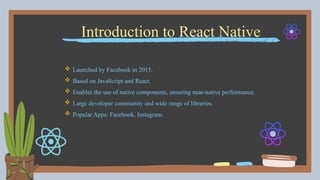
Introduction to ReactNative
Launched by Facebook in 2015.
Based on JavaScript and React.
Enables the use of native components, ensuring near-native performance.
Large developer community and wide range of libraries.
Popular Apps: Facebook, Instagram.
4.
Introduction to Flutter
Developed by Google in 2017.
Uses Dart programming language.
Provides its own rendering engine for consistent UI across platforms.
Growing popularity with modern UI capabilities.
Popular Apps: Google Ads, Alibaba, BMW
5.
Key Differences
Feature ReactNative Flutter
Language JavaScript/React Dart
Performance Good (JS Bridge)
Better (No
Bridge)
UI Components
Native
Components
Custom Widgets
Hot Reload Yes Yes (Faster)
6.
Performance Comparison
React Native:
Uses a JavaScript bridge to communicate between JS code and native
modules.
This can introduce minor latency in UI rendering and complex animations.
Heavy computations can slow down performance due to the bridge
overhead.
Flutter:
No bridge needed – compiles directly to native ARM code (AOT - Ahead
of Time compilation).
Uses Skia engine for rendering, making animations smoother.
Better for CPU-intensive tasks (e.g., gaming, real-time processing).
7.
Development Speed
React Native:
✅Faster setup (if you know JavaScript/React).
✅ Hot Reload (instant UI updates, but slightly slower than Flutter).
✅ Large ecosystem (many pre-built libraries like React Navigation, Redux).
✅ React Native is easier if you already know JavaScript/React.
❌ Dependent on third-party modules (some native features need extra configuration).
Flutter:
✅ Faster Hot Reload (near-instant UI updates).
✅ Single codebase for UI & logic (no separation like React Native’s JSX + Native).
✅ Rich built-in widgets (no need for external UI libraries).
✅ Flutter is more structured but requires learning Dart.
8.
React Native Community& Ecosystem
React Native:
✅ Larger, mature community (since 2015, backed by Facebook)
✅ More Stack Overflow support & GitHub repositories
✅ Widely adopted by startups & enterprises (e.g., Facebook, Shopify)
❌ Relies on third-party libraries (some outdated or unstable)
📉 Fragmented solutions (compatibility issues across versions)
Flutter:
✅ Fast-growing community (strong Google backing since 2017)
✅ Better-organized docs & official tooling (fewer compatibility issues)
✅ Rich built-in widgets (no need for external UI libraries)
❌ Smaller community than React Native (but growing rapidly)
📈 Expanding to desktop & embedded devices (future-proof)
9.
Popularity & JobMarket
React Native:
📊 #1 in cross-platform jobs (LinkedIn, Indeed).
💼 Preferred by startups & scale-ups (cost-effective).
🌎 More global opportunities (especially in US/EU markets).
🔄 Easier transition for web devs (JavaScript advantage).
⚠️Declining hype but steady demand (mature market).
Flutter:
🚀 Fastest-growing framework (GitHub, Stack Overflow).
🏢 Adopted by tech giants (Google, Alibaba, BMW).
📱 Strong in emerging markets (Asia, Africa growth).
🎨 Preferred for beautiful UI apps (design-centric roles).
💵 20% higher freelance rates ( Dart skills).
10.
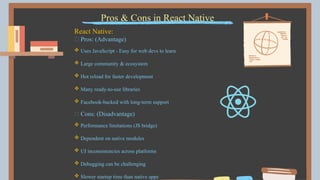
Pros & Consin React Native
React Native:
✅ Pros: (Advantage)
Uses JavaScript - Easy for web devs to learn
Large community & ecosystem
Hot reload for faster development
Many ready-to-use libraries
Facebook-backed with long-term support
❌ Cons: (Disadvantage)
Performance limitations (JS bridge)
Dependent on native modules
UI inconsistencies across platforms
Debugging can be challenging
Slower startup time than native apps
11.
Pros & Consin Flutter
Flutter:
✅ Pros: (Advantage)
Excellent performance (no JS bridge)
Beautiful, consistent UI across platforms
Single codebase for multiple platforms
Fast development with hot reload
Google-backed with strong future
❌ Cons: (Disadvantage)
Dart language has smaller community
Larger app size
Fewer third-party libraries
Steeper learning curve for beginners
Younger ecosystem (still maturing)
12.
Which One toChoose ?
Choose React Native If:
You already know JavaScript/React
Your app needs fast development and quick MVP launch
You want access to more third-party libraries
Your project requires integration with web apps (using React Native Web)
You're building business apps (e-commerce, social media, productivity tools)
Choose Flutter If:
You prioritize high-performance UI (60 FPS animations)
You want custom, pixel-perfect designs (custom widgets)
You're building graphics-heavy apps (games, interactive dashboards)
You prefer Google’s ecosystem (Firebase, Google Cloud integration)
13.
Both Are Powerful– React Native and Flutter are leading frameworks for cross-platform app
development.
React Native :
You need faster development with JavaScript.
Your team already knows React/Web Development.
You want more job opportunities (popular in startups).
Flutter:
You want smooth animations & custom UI.
You prefer one codebase for mobile, web, and desktop.
You’re okay learning Dart (easy for beginners).
Conclusion
Future Trends:
React Native is stable and widely used.
Flutter is growing fast, especially for creative apps.
















![Flutter vs react native head to toe comparison [2021 edition]](https://cdn.slidesharecdn.com/ss_thumbnails/fluttervsreactnativeheadtotoecomparison2021edition-210216110025-thumbnail.jpg?width=640&height=640&fit=bounds)


