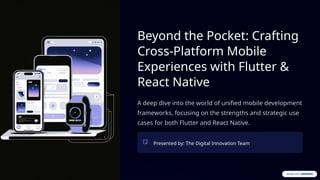
Beyond the Pocket:Crafting
Cross-Platform Mobile
Experiences with Flutter &
React Native
A deep dive into the world of unified mobile development
frameworks, focusing on the strengths and strategic use
cases for both Flutter and React Native.
Presented by: The Digital Innovation Team
2.
The Mobile AppLandscape: Why
Cross-Platform Matters Now
Maximize Reach
Instantly deploy to both iOS and Android from a single codebase, capturing 100% of
the mobile market.
Accelerated Time-to-Market
Develop features faster and release updates simultaneously, giving you a competitive edge.
Cost Efficiency
Reduce resource allocation by eliminating the need for separate native development teams.
3.
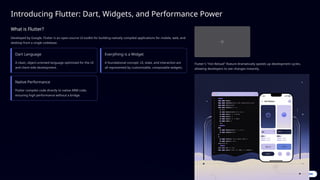
Introducing Flutter: Dart,Widgets, and Performance Power
What is Flutter?
Developed by Google, Flutter is an open-source UI toolkit for building natively compiled applications for mobile, web, and
desktop from a single codebase.
Dart Language
A clean, object-oriented language optimized for the UI
and client-side development.
Everything is a Widget
A foundational concept: UI, state, and interaction are
all represented by customizable, composable widgets.
Native Performance
Flutter compiles code directly to native ARM code,
ensuring high performance without a bridge.
Flutter's "Hot Reload" feature dramatically speeds up development cycles,
allowing developers to see changes instantly.
4.
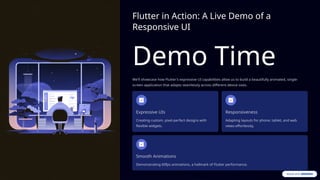
Flutter in Action:A Live Demo of a
Responsive UI
Demo Time
We'll showcase how Flutter's expressive UI capabilities allow us to build a beautifully animated, single-
screen application that adapts seamlessly across different device sizes.
Expressive UIs
Creating custom, pixel-perfect designs with
flexible widgets.
Responsiveness
Adapting layouts for phone, tablet, and web
views effortlessly.
Smooth Animations
Demonstrating 60fps animations, a hallmark of Flutter performance.
5.
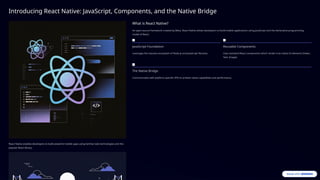
Introducing React Native:JavaScript, Components, and the Native Bridge
React Native enables developers to build powerful mobile apps using familiar web technologies and the
popular React library.
What is React Native?
An open-source framework created by Meta, React Native allows developers to build mobile applications using JavaScript and the declarative programming
model of React.
JavaScript Foundation
Leverages the massive ecosystem of Node.js and JavaScript libraries.
Reusable Components
Uses standard React components which render true native UI elements (Views,
Text, Image).
The Native Bridge
Communicates with platform-specific APIs to achieve native capabilities and performance.
6.
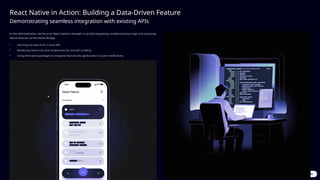
React Native inAction: Building a Data-Driven Feature
Demonstrating seamless integration with existing APIs
In this demonstration, we focus on React Native's strength in quickly integrating complex business logic and accessing
device features via the Native Bridge.
• Fetching live data from a cloud API.
• Rendering native lists and components for smooth scrolling.
• Using third-party packages to integrate features like geolocation or push notifications.
7.
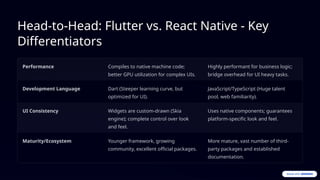
Head-to-Head: Flutter vs.React Native - Key
Differentiators
Performance Compiles to native machine code;
better GPU utilization for complex UIs.
Highly performant for business logic;
bridge overhead for UI heavy tasks.
Development Language Dart (Steeper learning curve, but
optimized for UI).
JavaScript/TypeScript (Huge talent
pool, web familiarity).
UI Consistency Widgets are custom-drawn (Skia
engine); complete control over look
and feel.
Uses native components; guarantees
platform-specific look and feel.
Maturity/Ecosystem Younger framework, growing
community, excellent official packages.
More mature, vast number of third-
party packages and established
documentation.
8.
Best Practices forCross-Platform
Development: Tips for Success
Define Platform Exceptions Early
Identify where native code may still be necessary (e.g., highly specialized sensors) and plan for
native integration.
Invest in State Management
Use robust state management solutions (e.g., Provider/Riverpod for Flutter; Redux/MobX for
RN) to maintain code clarity.
Prioritize Performance Testing
Regularly profile the app, especially for complex animations or large data processing tasks, on
low-end devices.
Establish Strong Design Systems
Create reusable component libraries to enforce visual consistency across all target platforms.
9.
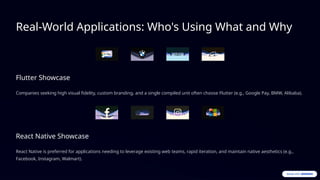
Real-World Applications: Who'sUsing What and Why
Flutter Showcase
Companies seeking high visual fidelity, custom branding, and a single compiled unit often choose Flutter (e.g., Google Pay, BMW, Alibaba).
React Native Showcase
React Native is preferred for applications needing to leverage existing web teams, rapid iteration, and maintain native aesthetics (e.g.,
Facebook, Instagram, Walmart).
10.
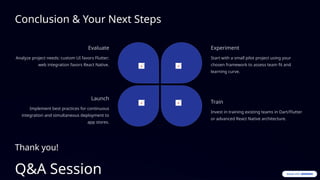
Conclusion & YourNext Steps
Evaluate
Analyze project needs: custom UI favors Flutter;
web integration favors React Native.
Experiment
Start with a small pilot project using your
chosen framework to assess team fit and
learning curve.
Train
Invest in training existing teams in Dart/Flutter
or advanced React Native architecture.
Launch
Implement best practices for continuous
integration and simultaneous deployment to
app stores.
Thank you!
Q&A Session