How and why did the RDA start?
John Wood
2

RIDING THE WAVE
HOW EUROPE CAN GAIN FROM THE
RISING TIDE OF SCIENTIFIC DATA
A VISION FOR 2030
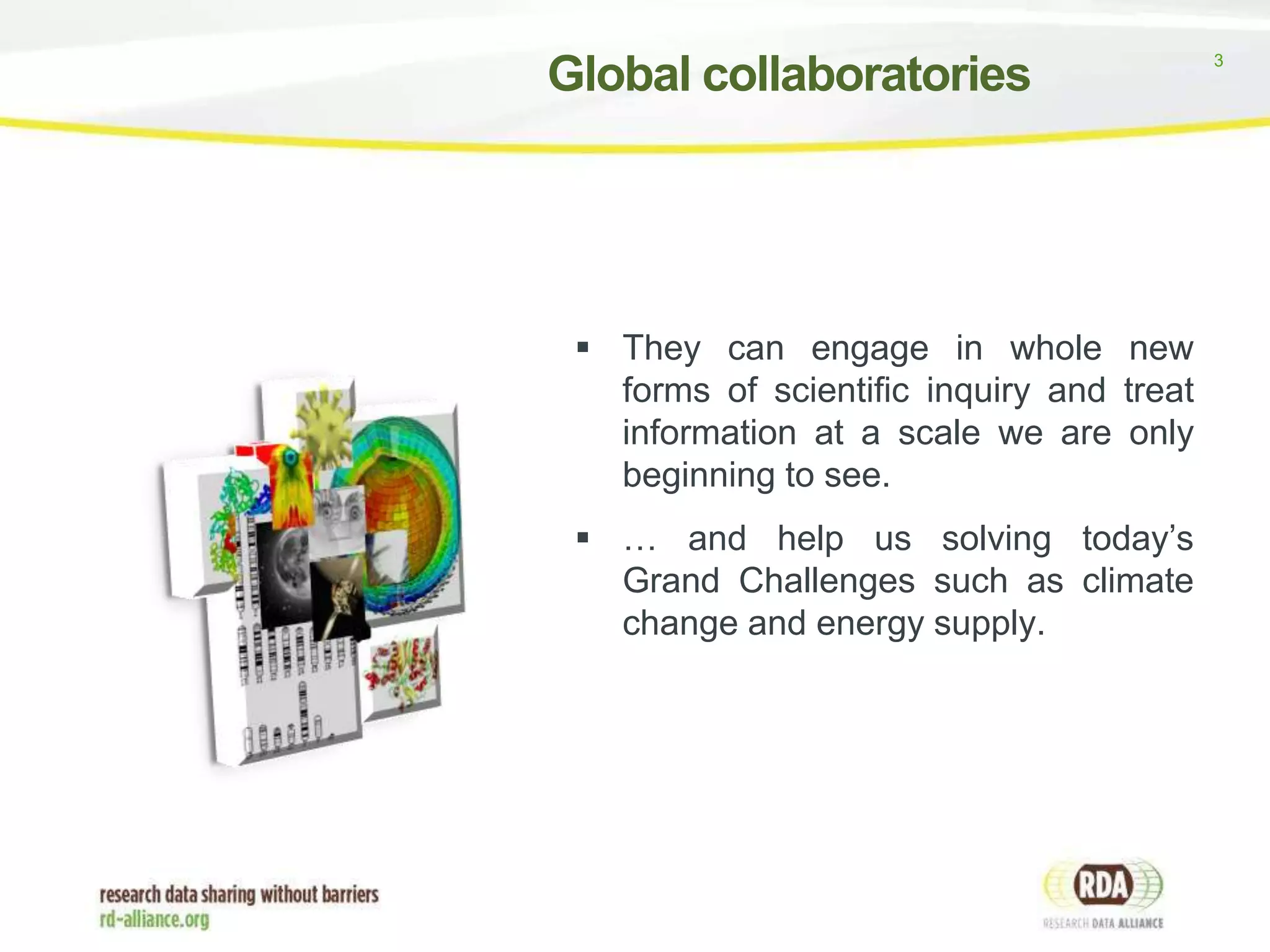
Global collaboratories

 They can engage in whole new
forms of scientific inquiry and treat
information at a scale we are only
beginning to see.
 … and help us solving today’s
Grand Challenges such as climate
change and energy supply.

3
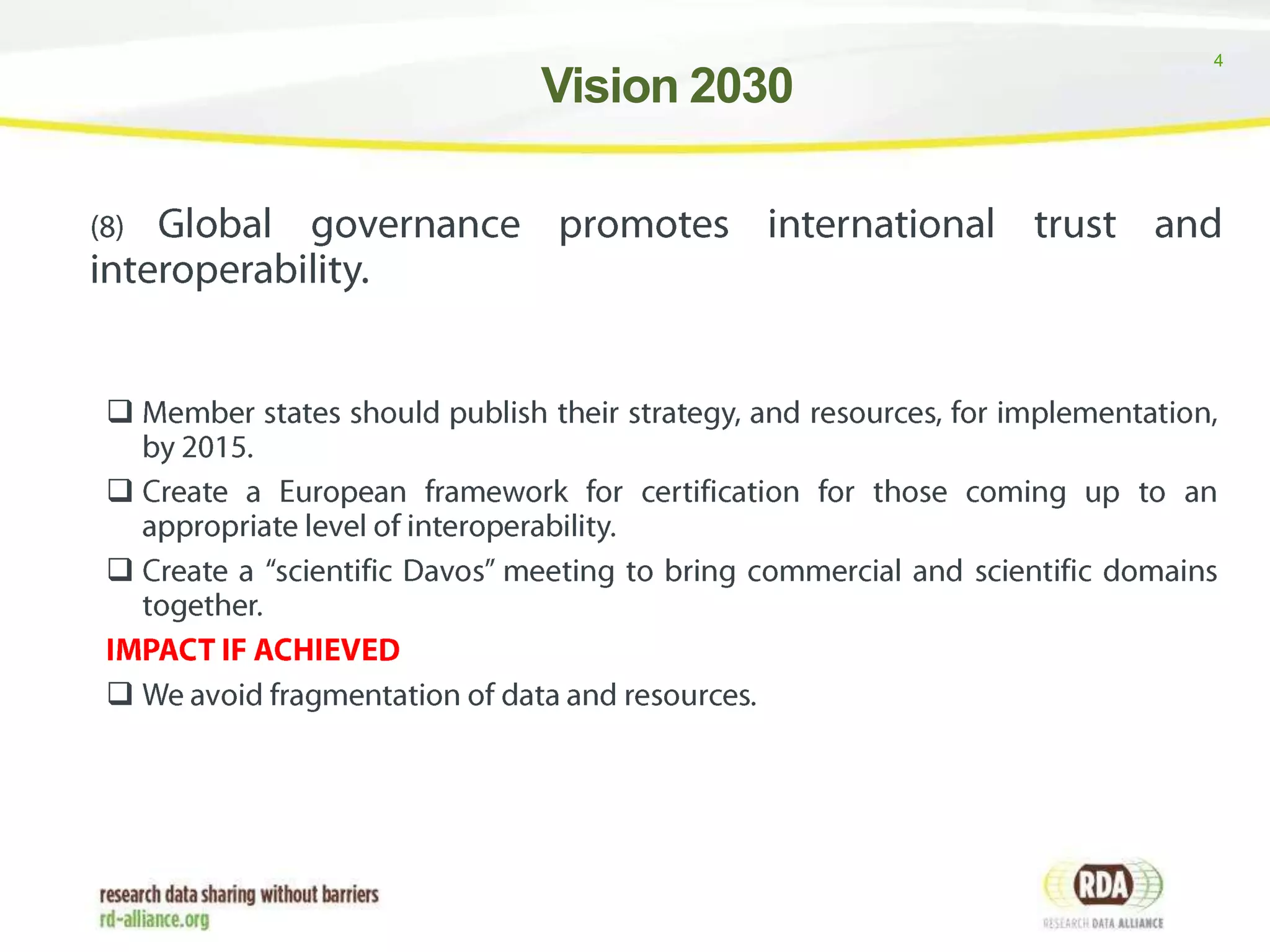
Vision 2030







4
Main drivers
 Grand Challenges facing the world demand
international collaboration across disciplines
 Research Democracy (zooniverse.com)
 Physical and virtual research infrastructures are largely
data driven
 Sheer amount of data being generated
 More value from reuse of data


Eg Australia spends $3B per annum on data collection

 More and more researchers are seeing the value of
sharing
 Many countries developing open research data policies

5
Copenhagen ICRI Meeting
Alan Blatecky (NSF)
“Let’s just get on with it”

European Commission, NSF/NIST, Australia agreed via
different funding schemes encouraged collaboration.
Various meetings in 2012 plus very regular video calls
resulted in deciding on the name “Research Data
Alliance”
Ross Wilkinson, Fran Berman, and John Wood formed
initial council
Huge bottom up activity – community driven

6
Evolving structure
 Definition of Interest and Working Groups
 Focus on concrete deliverables accepted and used by the
community
 Each region contributed to the secretariat (US/EU/Aus)
 Need for secretary-general to bring it all together became
obvious (Australia is funding the first year)
 Not for profit Legal entity developed (Funded by EC)
 Close cooperation between funders (and with RDA Council)
to bring in other regions/countries of the world (RDA-C)
 RDA structure developed including Council, TAB and OAB

7
Big Bang!
 First Plenary and formal start of RDA
Gothenburg March 2013
 Registration filled within a few days
 Community less interested in processes and
organisation – rather wanted more time for BOF, IG and
WG side meetings
 Council adopted methodologies for populating TAB
(initially 6 nominated by Council – remainder elected.
After one year the 6 step down and a further election will
take place).
 Process for selecting Council agreed with RDAC

8
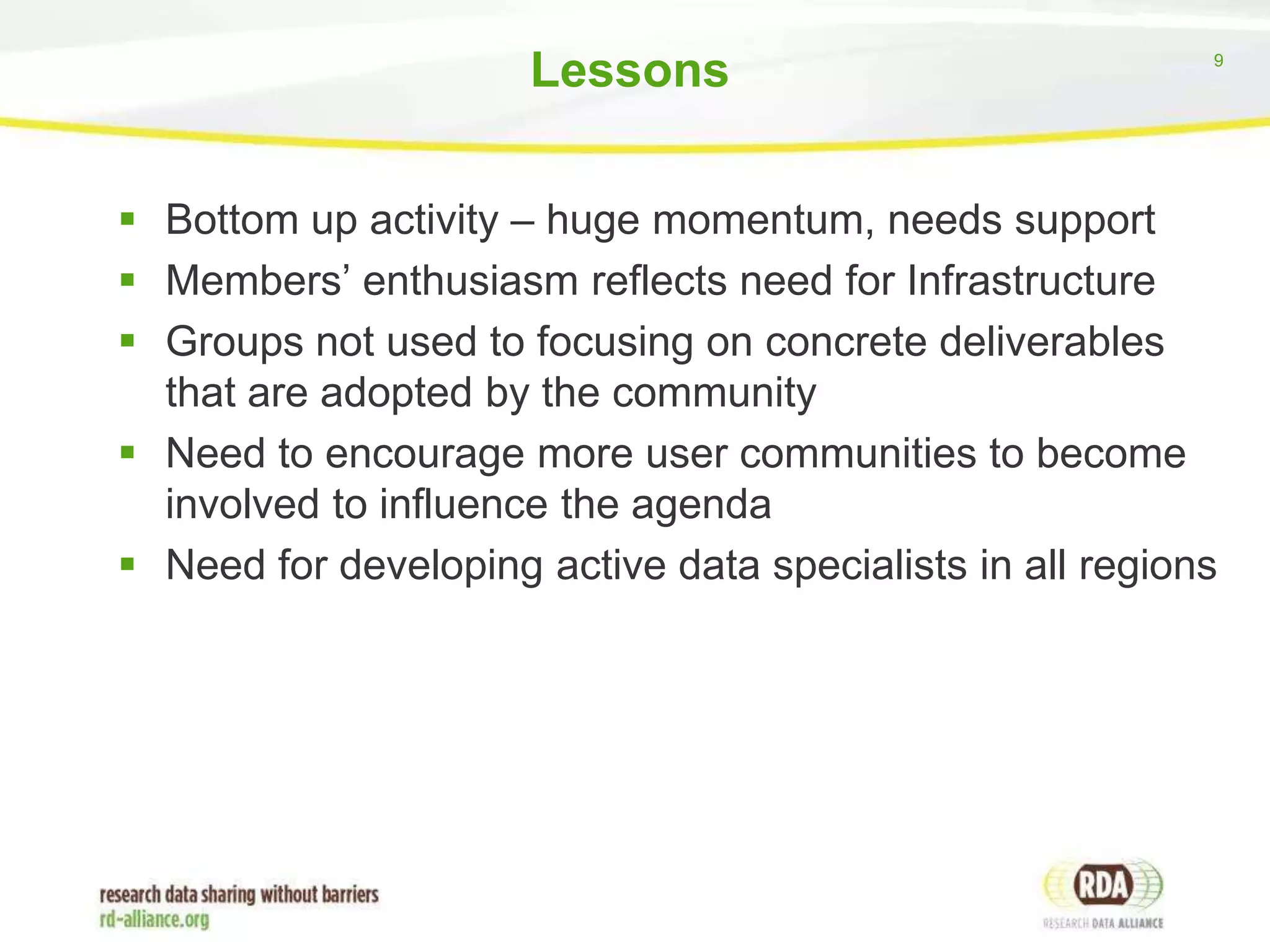
Lessons

9

 Bottom up activity – huge momentum, needs support
 Members’ enthusiasm reflects need for Infrastructure
 Groups not used to focusing on concrete deliverables
that are adopted by the community
 Need to encourage more user communities to become
involved to influence the agenda
 Need for developing active data specialists in all regions
Snapshot of the RDA
Fran Berman
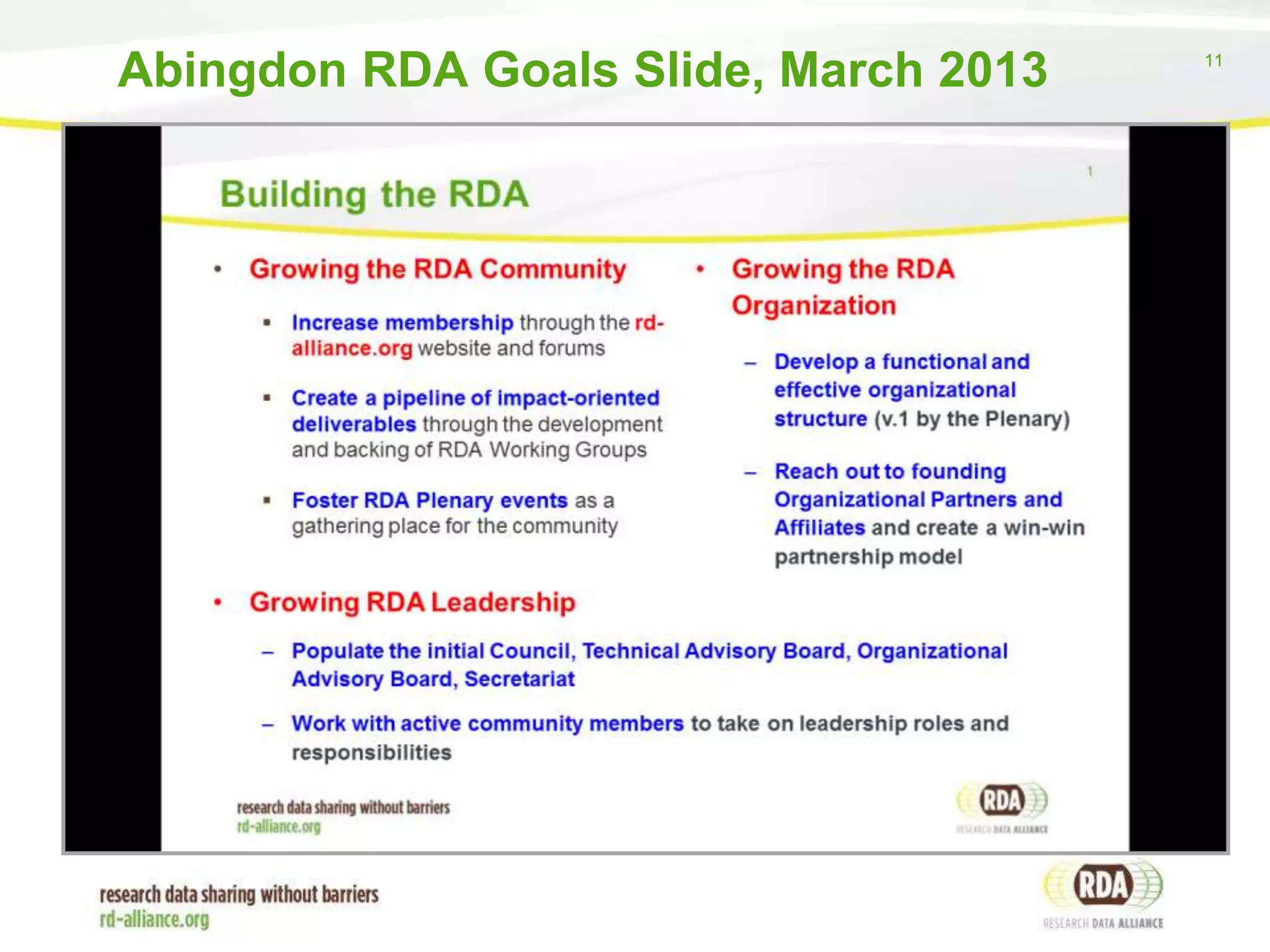
Abingdon RDA Goals Slide, March 2013

11
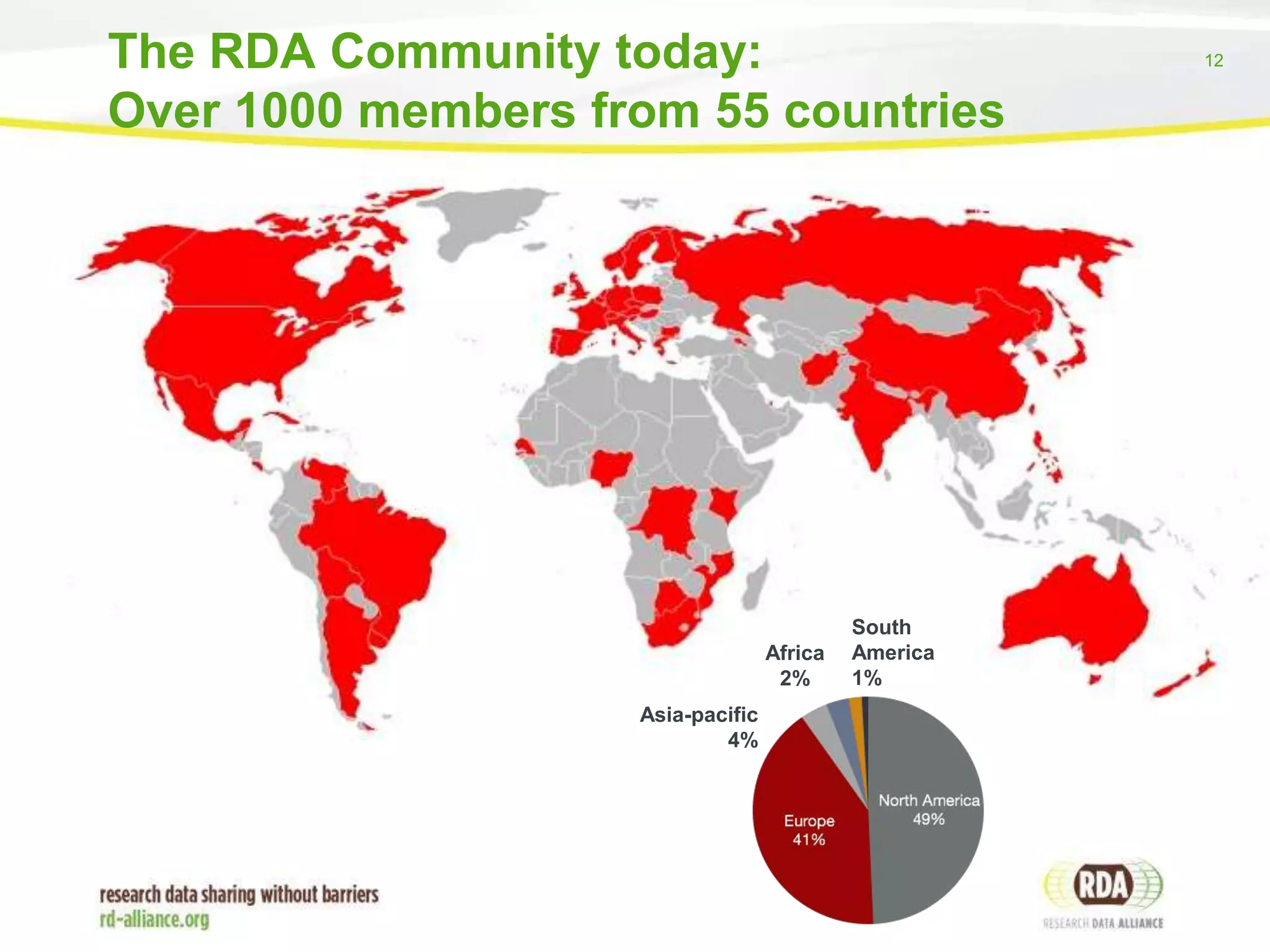
The RDA Community today:
Over 1000 members from 55 countries

Asia
3%

Africa
2%
Asia-pacific
4%

South
America
1%

12
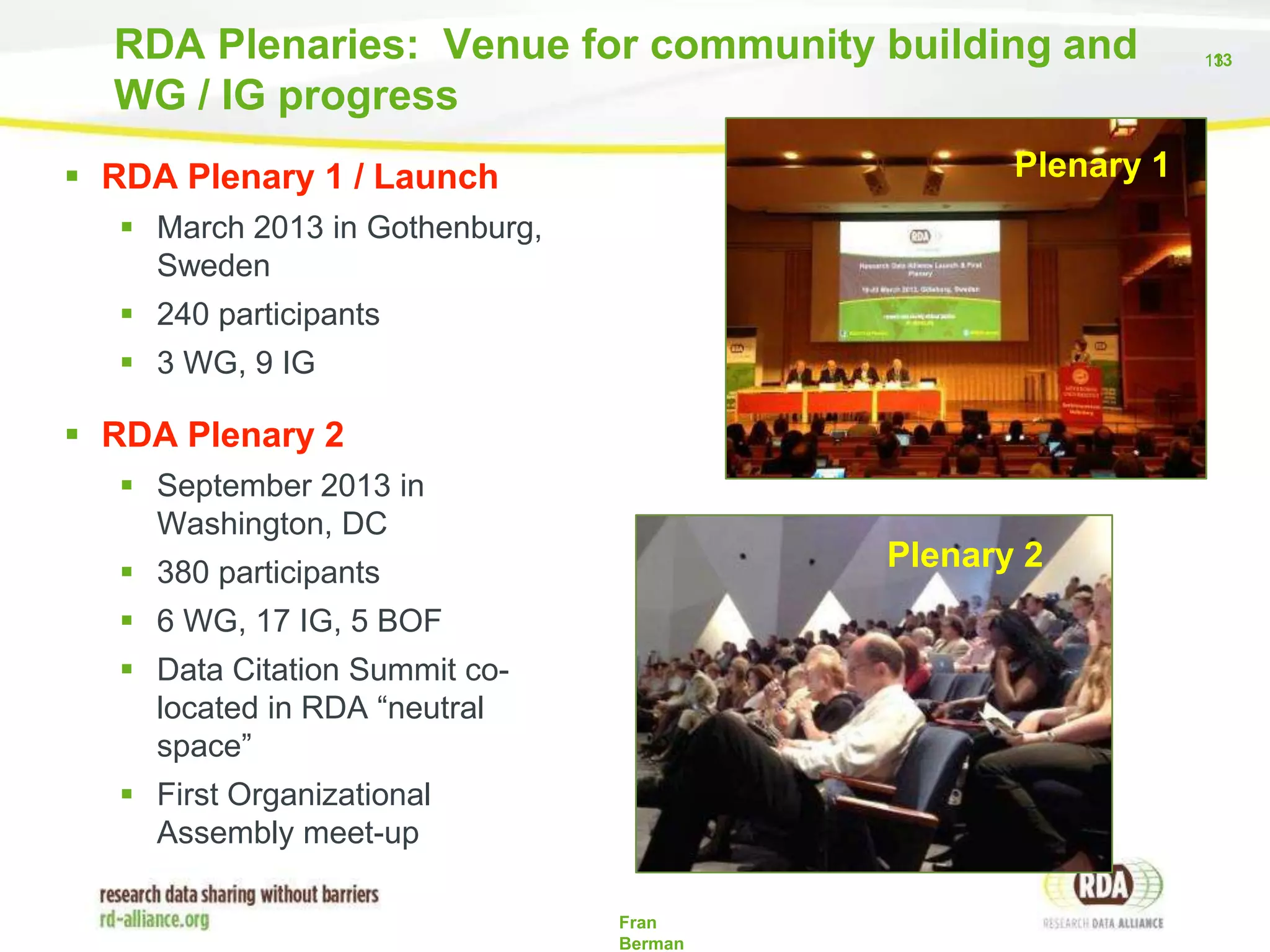
RDA Plenaries: Venue for community building and
WG / IG progress
Plenary 1

 RDA Plenary 1 / Launch
 March 2013 in Gothenburg,
Sweden
 240 participants
 3 WG, 9 IG

 RDA Plenary 2
 September 2013 in
Washington, DC

Plenary 2

 380 participants
 6 WG, 17 IG, 5 BOF

 Data Citation Summit colocated in RDA “neutral
space”
 First Organizational
Assembly meet-up
Fran
Berman

1
133
14

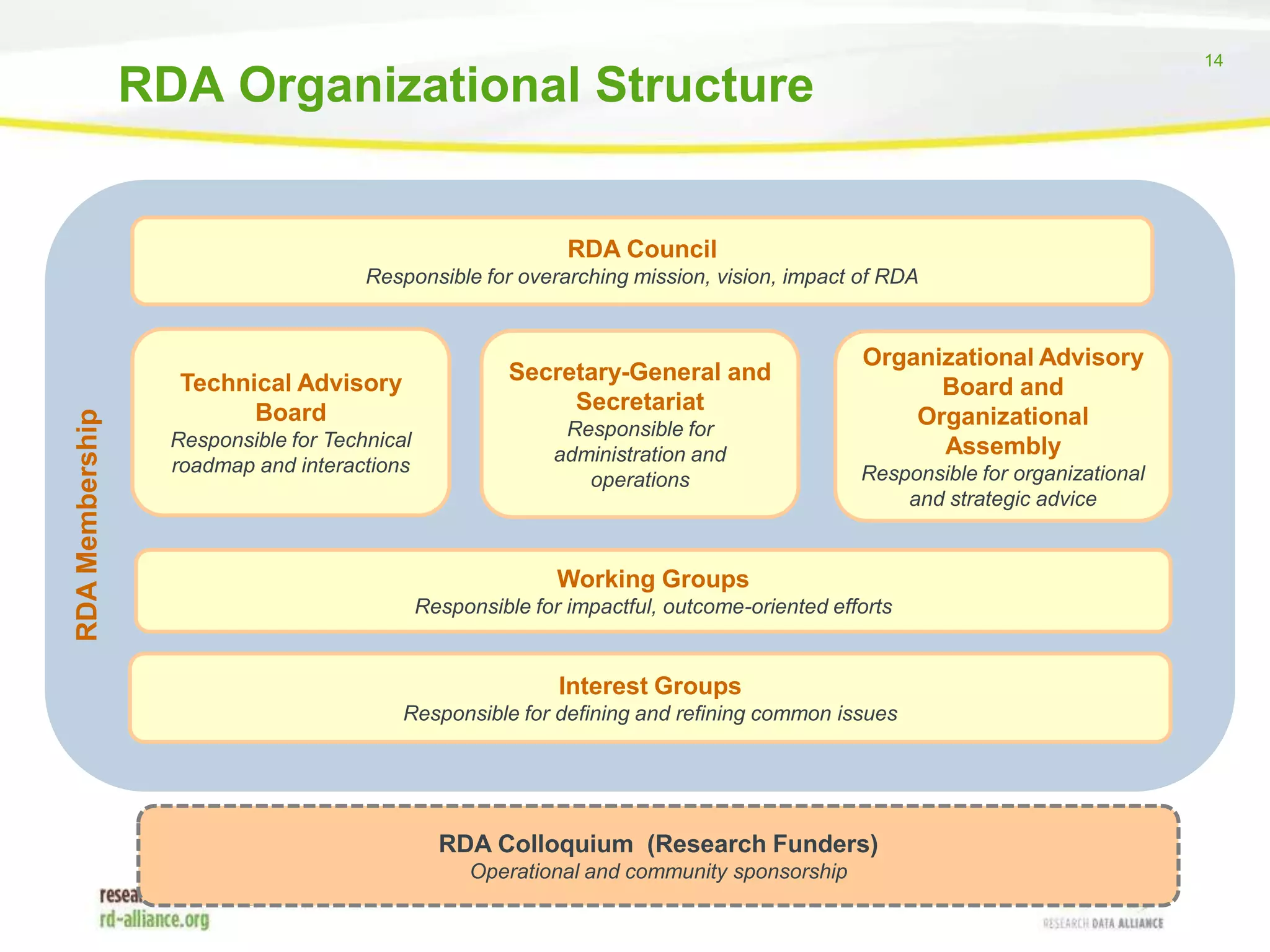
RDA Organizational Structure

RDA Council

RDA Membership

Responsible for overarching mission, vision, impact of RDA

Secretary-General and
Secretariat

Technical Advisory
Board
Responsible for Technical
roadmap and interactions

Responsible for
administration and
operations

Organizational Advisory
Board and
Organizational
Assembly
Responsible for organizational
and strategic advice

Working Groups
Responsible for impactful, outcome-oriented efforts

Interest Groups
Responsible for defining and refining common issues

RDA Colloquium (Research Funders)
Operational and community sponsorship
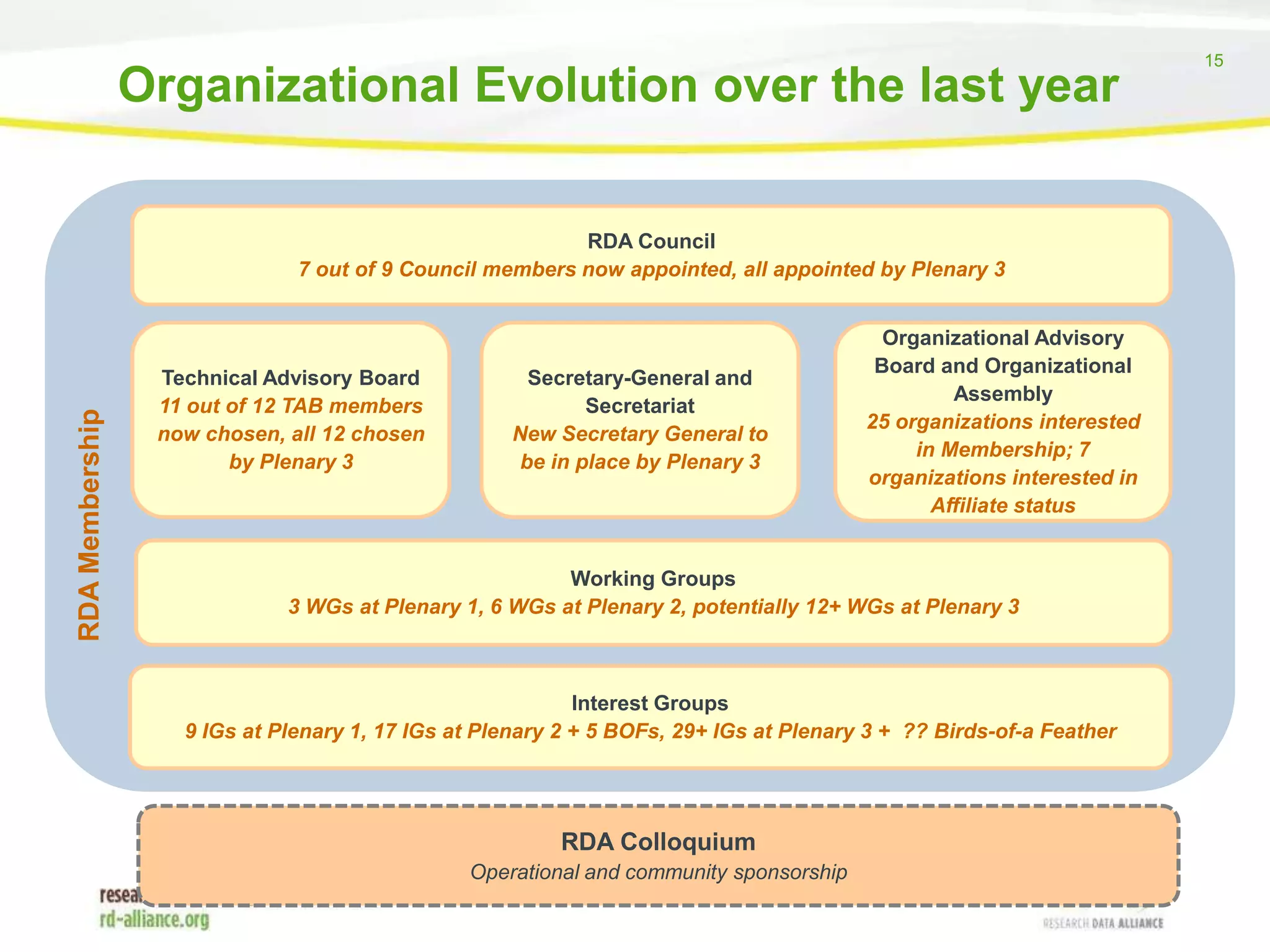
Organizational Evolution over the last year

RDA Membership

RDA Council
7 out of 9 Council members now appointed, all appointed by Plenary 3

Technical Advisory Board
11 out of 12 TAB members
now chosen, all 12 chosen
by Plenary 3

Secretary-General and
Secretariat
New Secretary General to
be in place by Plenary 3

Organizational Advisory
Board and Organizational
Assembly
25 organizations interested
in Membership; 7
organizations interested in
Affiliate status

Working Groups
3 WGs at Plenary 1, 6 WGs at Plenary 2, potentially 12+ WGs at Plenary 3

Interest Groups
9 IGs at Plenary 1, 17 IGs at Plenary 2 + 5 BOFs, 29+ IGs at Plenary 3 + ?? Birds-of-a Feather

RDA Colloquium
Operational and community sponsorship

15
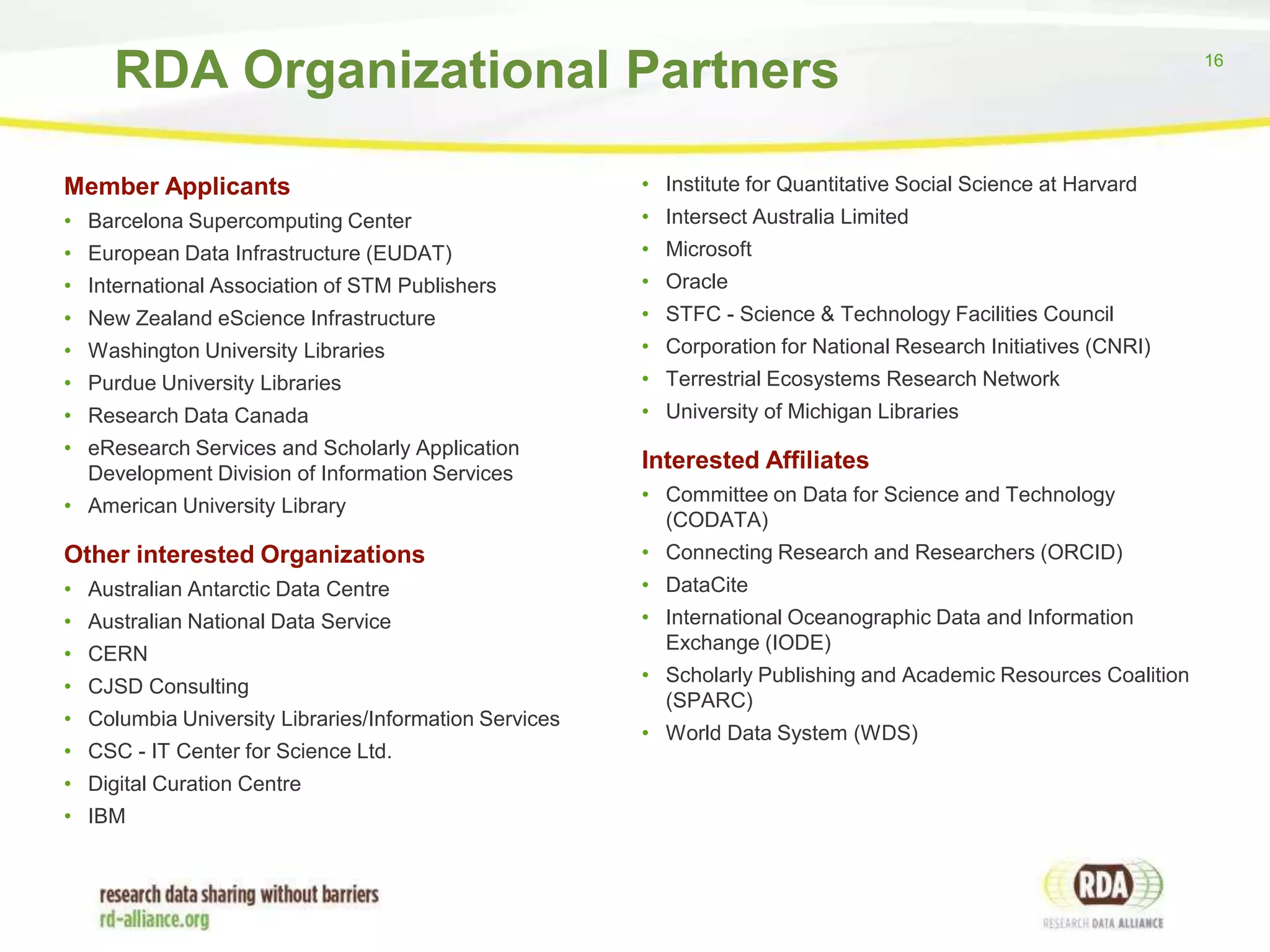
RDA Organizational Partners
Member Applicants

• Institute for Quantitative Social Science at Harvard

• Barcelona Supercomputing Center

• Intersect Australia Limited

• European Data Infrastructure (EUDAT)

• Microsoft

• International Association of STM Publishers

• Oracle

• New Zealand eScience Infrastructure

• STFC - Science & Technology Facilities Council

• Washington University Libraries

• Corporation for National Research Initiatives (CNRI)

• Purdue University Libraries

• Terrestrial Ecosystems Research Network

• Research Data Canada

• University of Michigan Libraries

• eResearch Services and Scholarly Application
Development Division of Information Services

Interested Affiliates

• American University Library

• Committee on Data for Science and Technology
(CODATA)

Other interested Organizations

• Connecting Research and Researchers (ORCID)

• Australian Antarctic Data Centre

• DataCite

• Australian National Data Service

• International Oceanographic Data and Information
Exchange (IODE)

• CERN
• CJSD Consulting
• Columbia University Libraries/Information Services
• CSC - IT Center for Science Ltd.
• Digital Curation Centre
• IBM

• Scholarly Publishing and Academic Resources Coalition
(SPARC)
• World Data System (WDS)

16
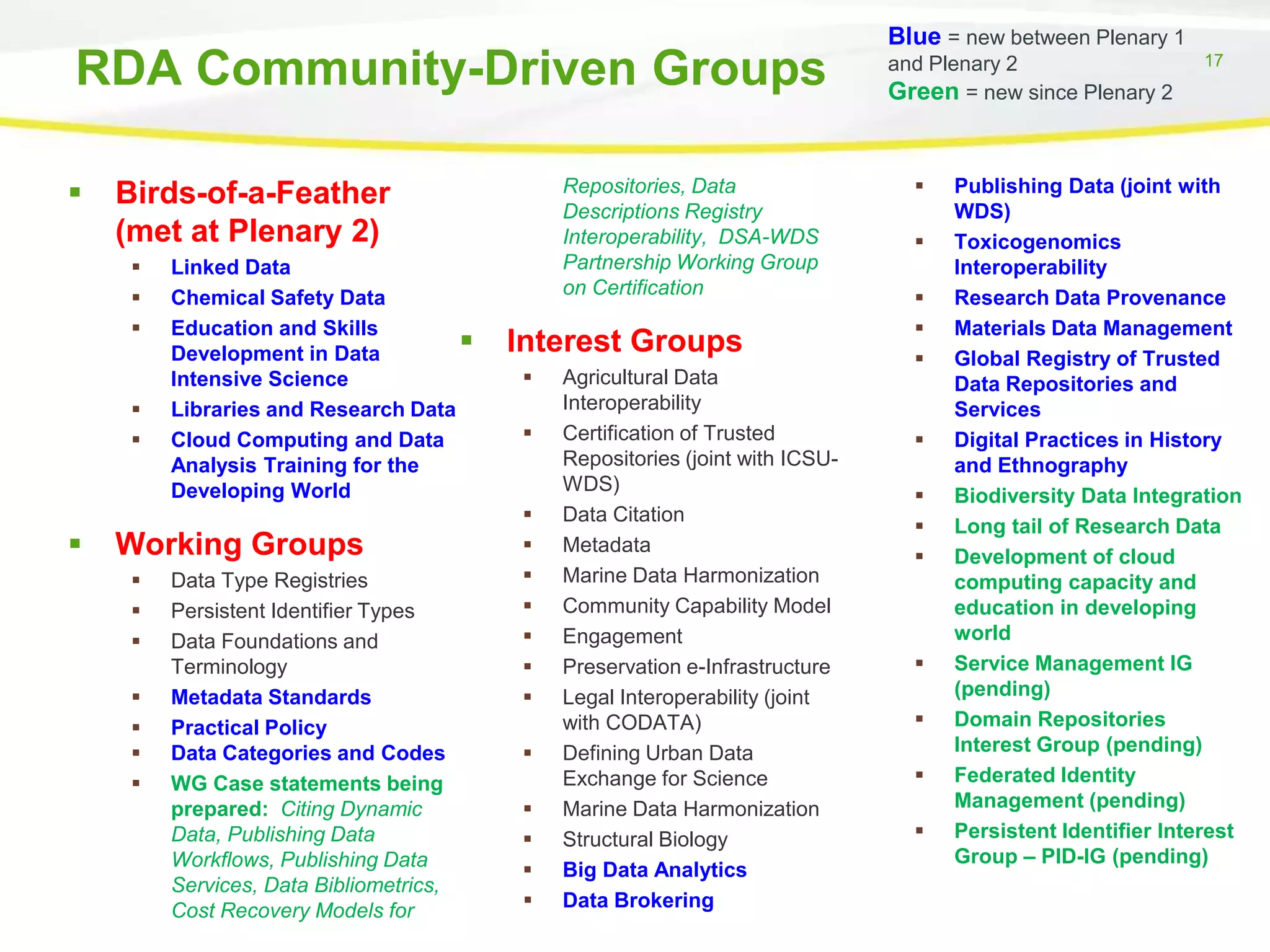
RDA Community-Driven Groups











Repositories, Data
Descriptions Registry
Interoperability, DSA-WDS
Partnership Working Group
on Certification

Birds-of-a-Feather
(met at Plenary 2)
Linked Data
Chemical Safety Data
Education and Skills

Development in Data
Intensive Science
Libraries and Research Data
Cloud Computing and Data
Analysis Training for the
Developing World

Working Groups








Data Type Registries
Persistent Identifier Types
Data Foundations and
Terminology
Metadata Standards
Practical Policy
Data Categories and Codes
WG Case statements being
prepared: Citing Dynamic
Data, Publishing Data
Workflows, Publishing Data
Services, Data Bibliometrics,
Cost Recovery Models for

Interest Groups
















Agricultural Data
Interoperability
Certification of Trusted
Repositories (joint with ICSUWDS)
Data Citation
Metadata
Marine Data Harmonization
Community Capability Model
Engagement
Preservation e-Infrastructure
Legal Interoperability (joint
with CODATA)
Defining Urban Data
Exchange for Science
Marine Data Harmonization
Structural Biology
Big Data Analytics
Data Brokering

Blue = new between Plenary 1
and Plenary 2
Green = new since Plenary 2

















17

Publishing Data (joint with
WDS)
Toxicogenomics
Interoperability
Research Data Provenance
Materials Data Management
Global Registry of Trusted
Data Repositories and
Services
Digital Practices in History
and Ethnography
Biodiversity Data Integration
Long tail of Research Data
Development of cloud
computing capacity and
education in developing
world
Service Management IG
(pending)
Domain Repositories
Interest Group (pending)
Federated Identity
Management (pending)
Persistent Identifier Interest
Group – PID-IG (pending)
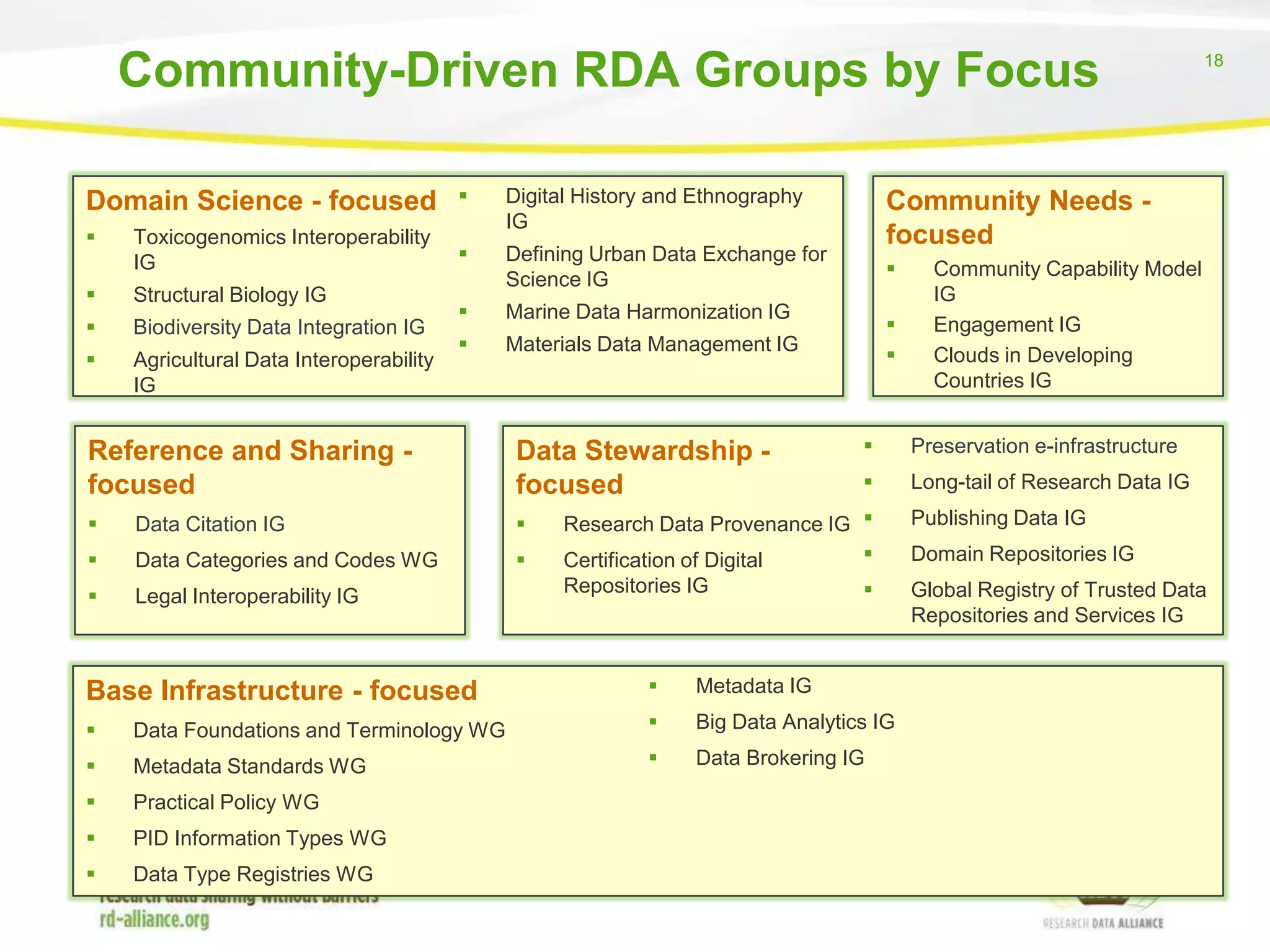
Community-Driven RDA Groups by Focus
Domain Science - focused


Toxicogenomics Interoperability
IG



Structural Biology IG



Biodiversity Data Integration IG



Agricultural Data Interoperability
IG



Digital History and Ethnography
IG



Defining Urban Data Exchange for
Science IG



Marine Data Harmonization IG



Materials Data Management IG

Reference and Sharing focused

Data Stewardship focused



Data Citation IG





Data Categories and Codes WG





Legal Interoperability IG

18

Community Needs focused




Community Capability Model
IG
Engagement IG
Clouds in Developing
Countries IG



Preservation e-infrastructure



Long-tail of Research Data IG

Research Data Provenance IG 

Certification of Digital

Publishing Data IG

Repositories IG

Global Registry of Trusted Data
Repositories and Services IG



Base Infrastructure - focused



Metadata IG



Data Foundations and Terminology WG



Big Data Analytics IG



Metadata Standards WG



Data Brokering IG



Practical Policy WG



PID Information Types WG



Data Type Registries WG

Domain Repositories IG
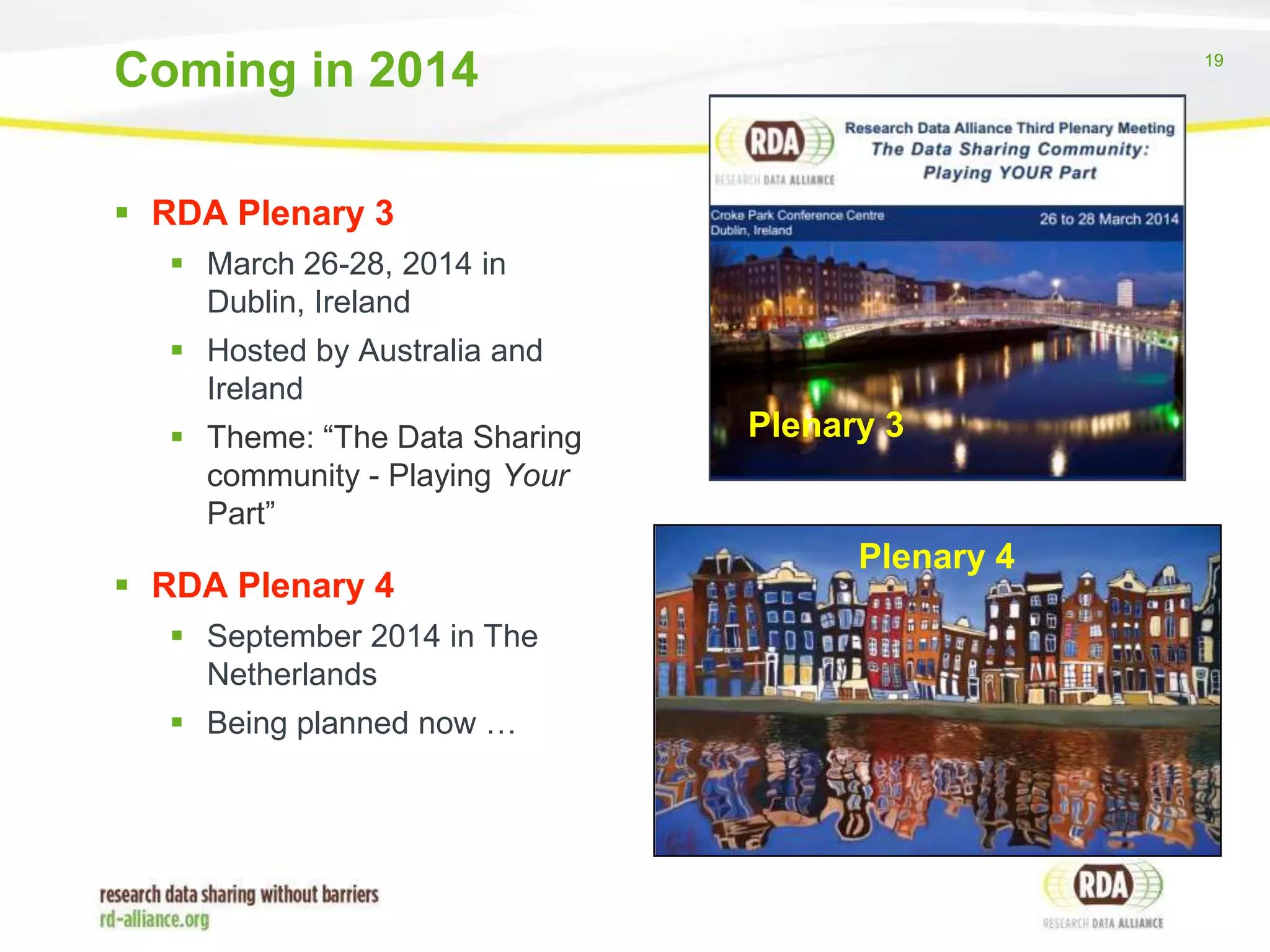
Coming in 2014

19

 RDA Plenary 3
 March 26-28, 2014 in
Dublin, Ireland
 Hosted by Australia and
Ireland
 Theme: “The Data Sharing
community - Playing Your
Part”

 RDA Plenary 4
 September 2014 in The
Netherlands
 Being planned now …

Plenary 3

Plenary 4
Research Data Alliance Action
Ross Wilkinson
Groups that Met at the 2nd RDA Plenary


Birds-of-a-Feather









Working Groups









Linked Data
Chemical Safety Data
Education and Skills
Development in Data
Intensive Science
Libraries and Research
Data
Cloud Computing and
Data Analysis Training
for the Developing
World

Data Type Registries
Metadata Standards
Practical Policy
Persistent Identifier Types
Data Foundations and
Terminology
Language Codes

Interest Groups
















Agricultural Data
Big Data Analytics
Data Brokering
Certification of Trusted
Repositories (joint with
ICSU-WDS)
Long tail of Research
Data
Marine Data
Harmonization
Community Capability
Model
Data Publishing (joint
with WDS)
Toxicogenomics
Interoperability
Research Data
Provenance
Data Citation
Metadata












21

Economic Models and
Infrastructure for
Federated Materials Data
Management
Engagement
Preservation eInfrastructure
Legal Interoperability (joint
with CODATA)
Global Registry of
Trusted Data
Repositories and
Services
Digital Practices in
History and
Ethnography

Data Citation
Harmonization Summit


DataCite,force11,
CODATA/ICST,
ESIP, DCC, etc.
Bridges Under Construction!

22
First RDA Infrastructure Deliverables
in 2014 (1)

23

 Data Type Registries WG


Defining a system of data type registries



Defining a formal model for describing types and
building a working model of a registry.



To be adopted by CNRI, International DOI
Foundation, and used by the Deep Carbon
Observatory and others



(working in conjunction with PID group)



Scheduled to complete Summer, 2014

 Persistent Identifier Information
Types


Defining a minimal set of types that must be
associated with a PID (e.g. checksum, author).
Specifying an API for interaction with PID types



Adopted and used by Data Conservancy and
DKRZ



(working in conjunction with DTR group)



 Metadata Standards

Scheduled to complete Summer, 2014



Creating use cases and prototype
directory of current metadata
standards from starting point of DCC
directory and stakeholder
contributions.



To be hosted and used by JISC,
DataOne and others



Scheduled to complete Fall, 2014
First RDA Infrastructure Deliverables
in 2014 (2)

24

 Language Codes


Operationalization of ISO language
categories for repositories



Adopted and used by the Language Archive,
PARADISEC



Proposal of data categories associated with
the CMDI schema as ISO standards.



Scheduled to complete Fall, 2014

 Data Foundations and
Terminology



Defining a common vocabulary for data
terms based on existing models.
Creating formal definitions in a structured
vocabulary too which also provides an open
registry for data terms.



Scheduled to complete Summer, 2014

Survey of policies in production use
across data management centers. Test
bed of machine-actionable policies
(IRODS, DataVerse, dCache) at RENCI,
DataNet Federation Consortium,
CESNET, Odum Institute.



Deployment of 5 policy sets (integrity,
access control, replication, provenance /
event tracking, publication ) on test beds.
Publication of standard policies for use as
starter kits.



Scheduled to complete Summer, 2014

Tested and adopted by EUDAT, DKRZ,
Deep Carbon Observatory, CLARIN, EPOS,
and others





(active input from all RDA WGs)



 Practical Code policies (rules)
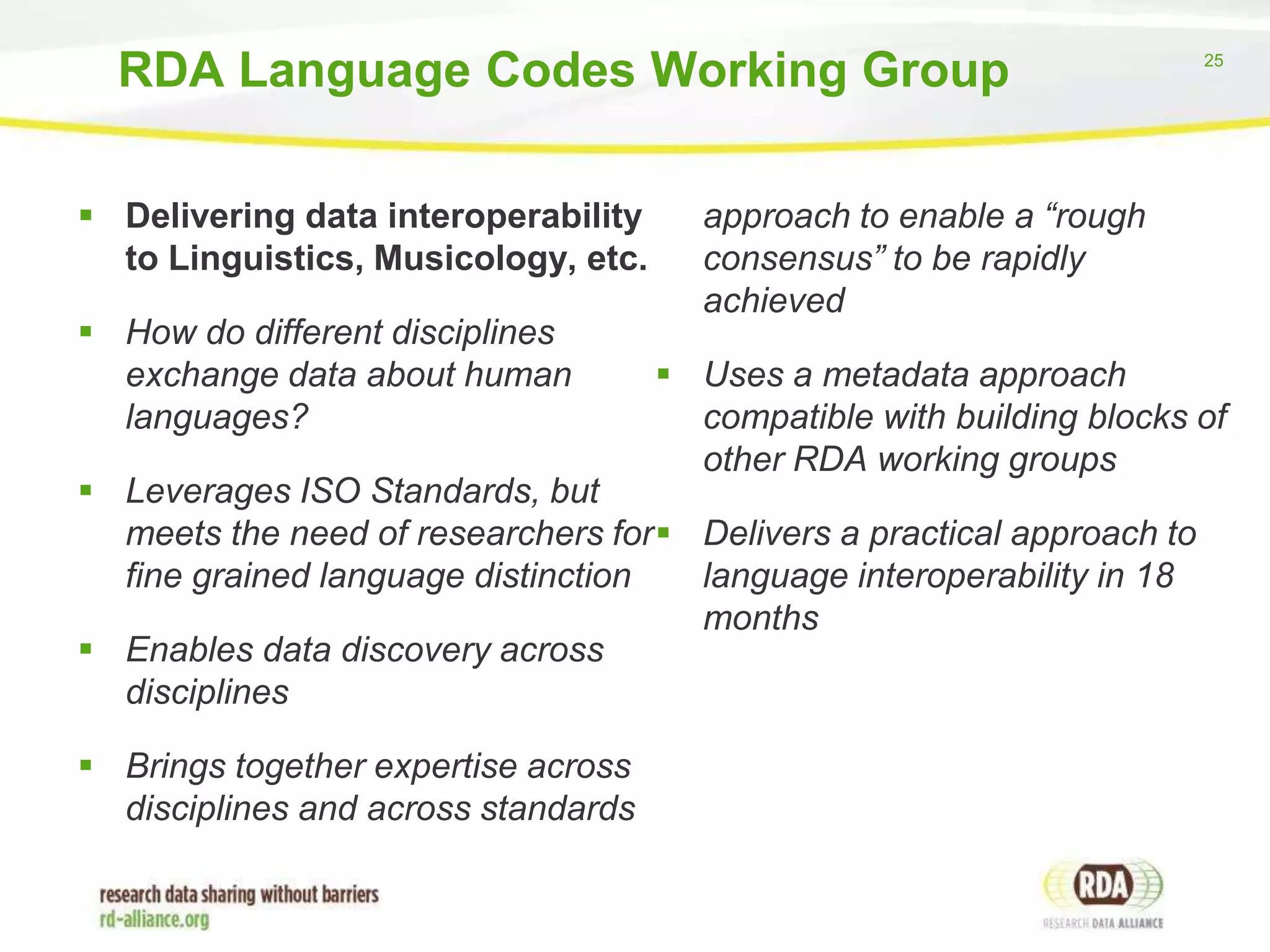
RDA Language Codes Working Group
 Delivering data interoperability
to Linguistics, Musicology, etc.
 How do different disciplines
exchange data about human
languages?

approach to enable a “rough
consensus” to be rapidly
achieved
 Uses a metadata approach
compatible with building blocks of
other RDA working groups

 Leverages ISO Standards, but
meets the need of researchers for  Delivers a practical approach to
fine grained language distinction
language interoperability in 18
months
 Enables data discovery across
disciplines
 Brings together expertise across
disciplines and across standards

25
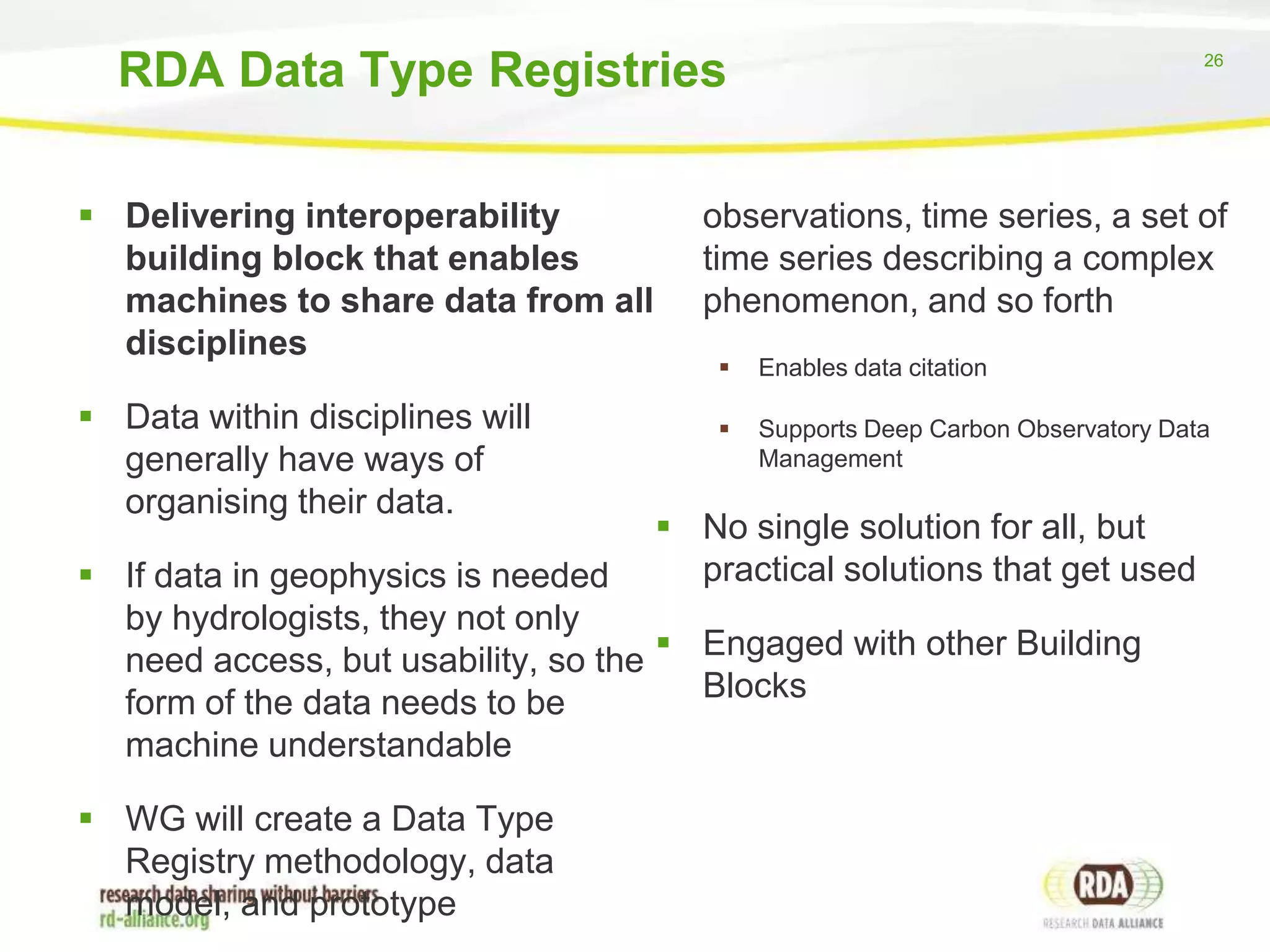
RDA Data Type Registries
 Delivering interoperability
building block that enables
machines to share data from all
disciplines
 Data within disciplines will
generally have ways of
organising their data.

26

observations, time series, a set of
time series describing a complex
phenomenon, and so forth


Enables data citation



Supports Deep Carbon Observatory Data
Management

 No single solution for all, but
practical solutions that get used

 If data in geophysics is needed
by hydrologists, they not only
need access, but usability, so the  Engaged with other Building
Blocks
form of the data needs to be
machine understandable
 WG will create a Data Type
Registry methodology, data
model, and prototype
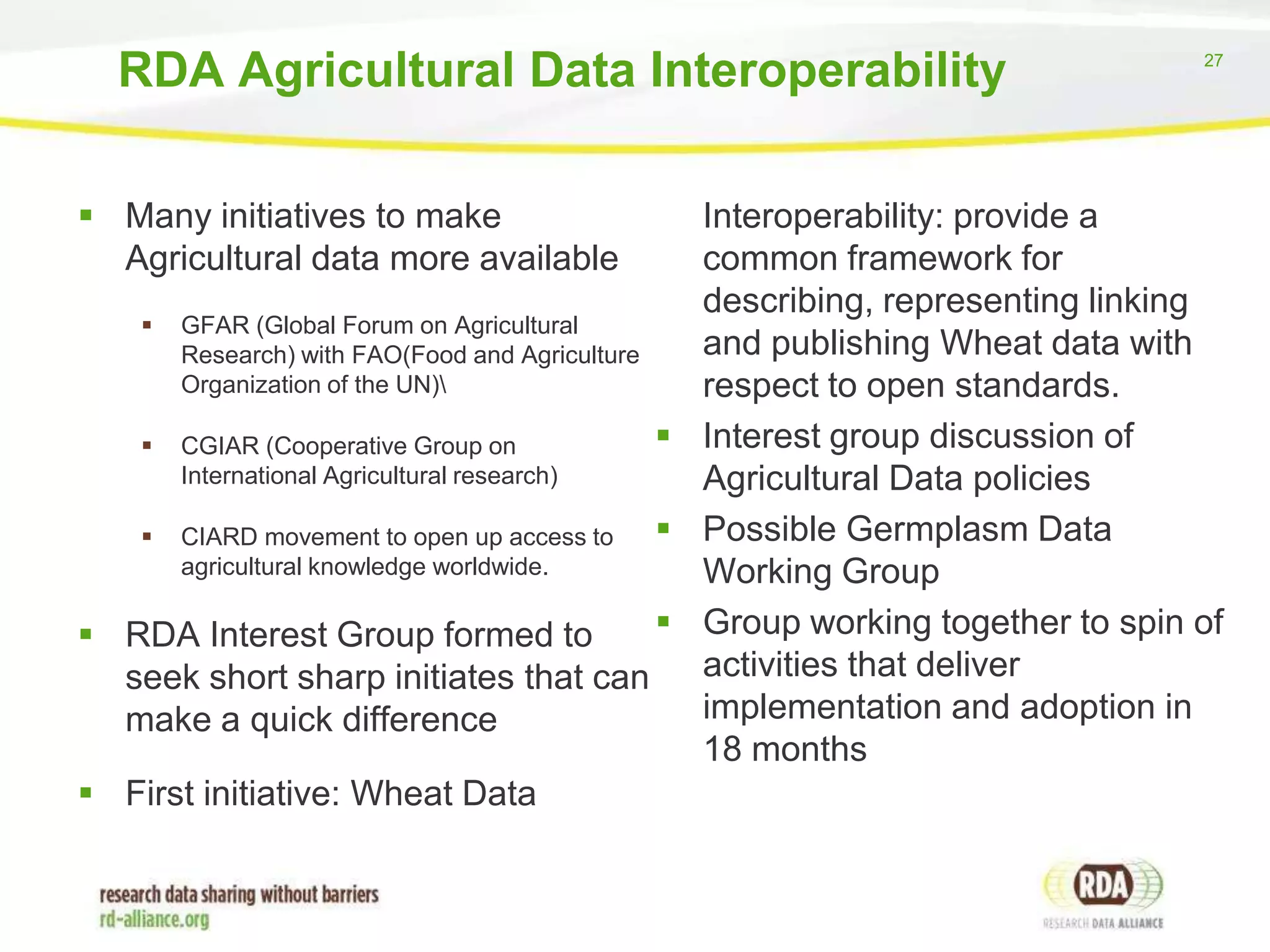
RDA Agricultural Data Interoperability
 Many initiatives to make
Agricultural data more available

27

Interoperability: provide a
common framework for
describing, representing linking
 GFAR (Global Forum on Agricultural
and publishing Wheat data with
Research) with FAO(Food and Agriculture
Organization of the UN)
respect to open standards.
 Interest group discussion of
 CGIAR (Cooperative Group on
International Agricultural research)
Agricultural Data policies
 Possible Germplasm Data
 CIARD movement to open up access to
agricultural knowledge worldwide.
Working Group
 Group working together to spin of
 RDA Interest Group formed to
activities that deliver
seek short sharp initiates that can
implementation and adoption in
make a quick difference
18 months
 First initiative: Wheat Data
RDA Path to Impact

 Variable, but
 Need to work quickly
 Need to be concrete

 All required to demonstrate adoption,
and community support

28
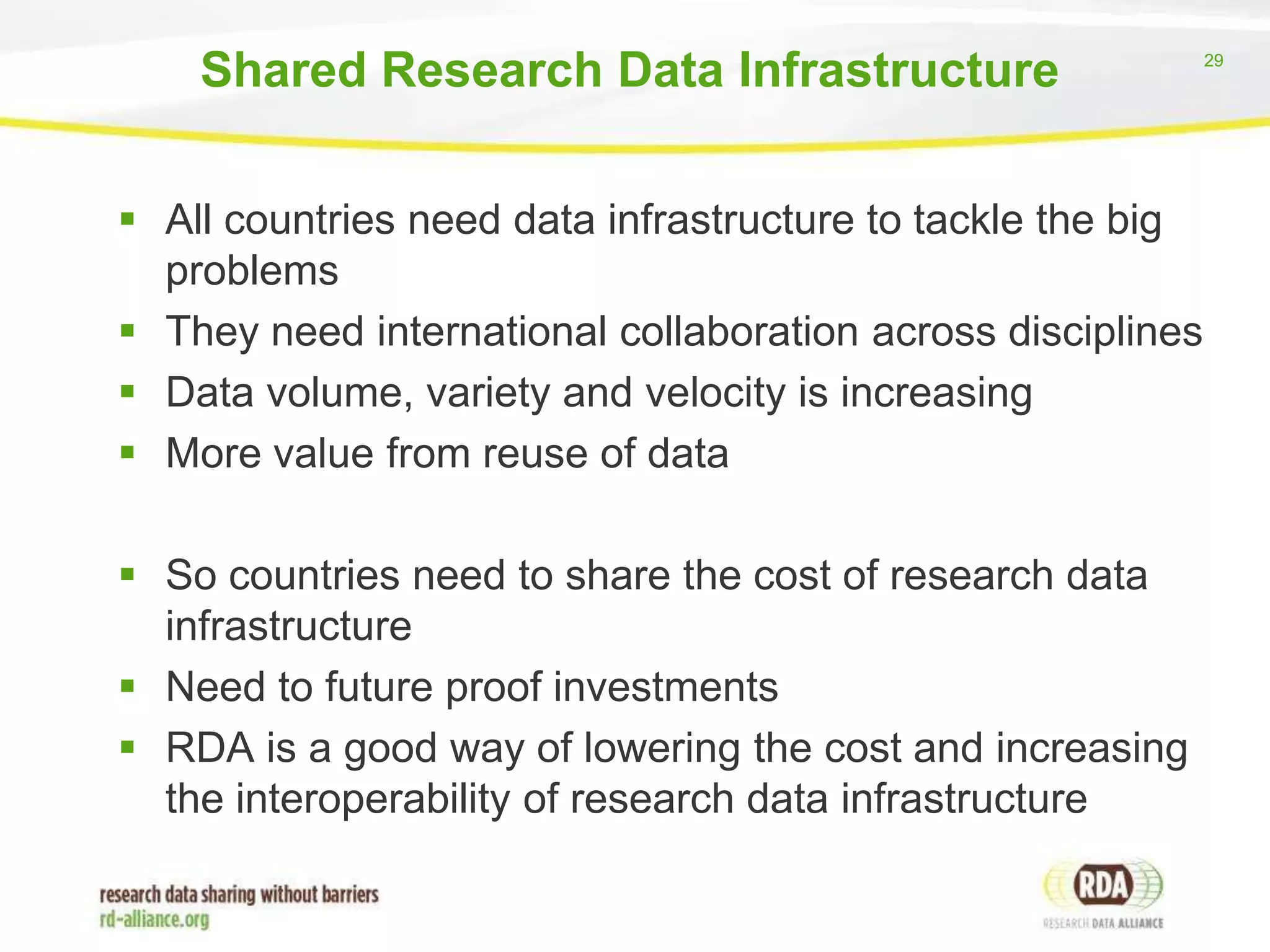
Shared Research Data Infrastructure
 All countries need data infrastructure to tackle the big
problems
 They need international collaboration across disciplines
 Data volume, variety and velocity is increasing
 More value from reuse of data

 So countries need to share the cost of research data
infrastructure
 Need to future proof investments
 RDA is a good way of lowering the cost and increasing
the interoperability of research data infrastructure

29
30

Info:
enquiries@rd-alliance.org

Fran Berman

RDA Presentation to G8

  • 1.
    How and whydid the RDA start? John Wood
  • 2.
    2 RIDING THE WAVE HOWEUROPE CAN GAIN FROM THE RISING TIDE OF SCIENTIFIC DATA A VISION FOR 2030
  • 3.
    Global collaboratories  Theycan engage in whole new forms of scientific inquiry and treat information at a scale we are only beginning to see.  … and help us solving today’s Grand Challenges such as climate change and energy supply. 3
  • 4.
  • 5.
    Main drivers  GrandChallenges facing the world demand international collaboration across disciplines  Research Democracy (zooniverse.com)  Physical and virtual research infrastructures are largely data driven  Sheer amount of data being generated  More value from reuse of data  Eg Australia spends $3B per annum on data collection  More and more researchers are seeing the value of sharing  Many countries developing open research data policies 5
  • 6.
    Copenhagen ICRI Meeting AlanBlatecky (NSF) “Let’s just get on with it” European Commission, NSF/NIST, Australia agreed via different funding schemes encouraged collaboration. Various meetings in 2012 plus very regular video calls resulted in deciding on the name “Research Data Alliance” Ross Wilkinson, Fran Berman, and John Wood formed initial council Huge bottom up activity – community driven 6
  • 7.
    Evolving structure  Definitionof Interest and Working Groups  Focus on concrete deliverables accepted and used by the community  Each region contributed to the secretariat (US/EU/Aus)  Need for secretary-general to bring it all together became obvious (Australia is funding the first year)  Not for profit Legal entity developed (Funded by EC)  Close cooperation between funders (and with RDA Council) to bring in other regions/countries of the world (RDA-C)  RDA structure developed including Council, TAB and OAB 7
  • 8.
    Big Bang!  FirstPlenary and formal start of RDA Gothenburg March 2013  Registration filled within a few days  Community less interested in processes and organisation – rather wanted more time for BOF, IG and WG side meetings  Council adopted methodologies for populating TAB (initially 6 nominated by Council – remainder elected. After one year the 6 step down and a further election will take place).  Process for selecting Council agreed with RDAC 8
  • 9.
    Lessons 9  Bottom upactivity – huge momentum, needs support  Members’ enthusiasm reflects need for Infrastructure  Groups not used to focusing on concrete deliverables that are adopted by the community  Need to encourage more user communities to become involved to influence the agenda  Need for developing active data specialists in all regions
  • 10.
    Snapshot of theRDA Fran Berman
  • 11.
    Abingdon RDA GoalsSlide, March 2013 11
  • 12.
    The RDA Communitytoday: Over 1000 members from 55 countries Asia 3% Africa 2% Asia-pacific 4% South America 1% 12
  • 13.
    RDA Plenaries: Venuefor community building and WG / IG progress Plenary 1  RDA Plenary 1 / Launch  March 2013 in Gothenburg, Sweden  240 participants  3 WG, 9 IG  RDA Plenary 2  September 2013 in Washington, DC Plenary 2  380 participants  6 WG, 17 IG, 5 BOF  Data Citation Summit colocated in RDA “neutral space”  First Organizational Assembly meet-up Fran Berman 1 133
  • 14.
    14 RDA Organizational Structure RDACouncil RDA Membership Responsible for overarching mission, vision, impact of RDA Secretary-General and Secretariat Technical Advisory Board Responsible for Technical roadmap and interactions Responsible for administration and operations Organizational Advisory Board and Organizational Assembly Responsible for organizational and strategic advice Working Groups Responsible for impactful, outcome-oriented efforts Interest Groups Responsible for defining and refining common issues RDA Colloquium (Research Funders) Operational and community sponsorship
  • 15.
    Organizational Evolution overthe last year RDA Membership RDA Council 7 out of 9 Council members now appointed, all appointed by Plenary 3 Technical Advisory Board 11 out of 12 TAB members now chosen, all 12 chosen by Plenary 3 Secretary-General and Secretariat New Secretary General to be in place by Plenary 3 Organizational Advisory Board and Organizational Assembly 25 organizations interested in Membership; 7 organizations interested in Affiliate status Working Groups 3 WGs at Plenary 1, 6 WGs at Plenary 2, potentially 12+ WGs at Plenary 3 Interest Groups 9 IGs at Plenary 1, 17 IGs at Plenary 2 + 5 BOFs, 29+ IGs at Plenary 3 + ?? Birds-of-a Feather RDA Colloquium Operational and community sponsorship 15
  • 16.
    RDA Organizational Partners MemberApplicants • Institute for Quantitative Social Science at Harvard • Barcelona Supercomputing Center • Intersect Australia Limited • European Data Infrastructure (EUDAT) • Microsoft • International Association of STM Publishers • Oracle • New Zealand eScience Infrastructure • STFC - Science & Technology Facilities Council • Washington University Libraries • Corporation for National Research Initiatives (CNRI) • Purdue University Libraries • Terrestrial Ecosystems Research Network • Research Data Canada • University of Michigan Libraries • eResearch Services and Scholarly Application Development Division of Information Services Interested Affiliates • American University Library • Committee on Data for Science and Technology (CODATA) Other interested Organizations • Connecting Research and Researchers (ORCID) • Australian Antarctic Data Centre • DataCite • Australian National Data Service • International Oceanographic Data and Information Exchange (IODE) • CERN • CJSD Consulting • Columbia University Libraries/Information Services • CSC - IT Center for Science Ltd. • Digital Curation Centre • IBM • Scholarly Publishing and Academic Resources Coalition (SPARC) • World Data System (WDS) 16
  • 17.
    RDA Community-Driven Groups        Repositories,Data Descriptions Registry Interoperability, DSA-WDS Partnership Working Group on Certification Birds-of-a-Feather (met at Plenary 2) Linked Data Chemical Safety Data Education and Skills  Development in Data Intensive Science Libraries and Research Data Cloud Computing and Data Analysis Training for the Developing World Working Groups        Data Type Registries Persistent Identifier Types Data Foundations and Terminology Metadata Standards Practical Policy Data Categories and Codes WG Case statements being prepared: Citing Dynamic Data, Publishing Data Workflows, Publishing Data Services, Data Bibliometrics, Cost Recovery Models for Interest Groups               Agricultural Data Interoperability Certification of Trusted Repositories (joint with ICSUWDS) Data Citation Metadata Marine Data Harmonization Community Capability Model Engagement Preservation e-Infrastructure Legal Interoperability (joint with CODATA) Defining Urban Data Exchange for Science Marine Data Harmonization Structural Biology Big Data Analytics Data Brokering Blue = new between Plenary 1 and Plenary 2 Green = new since Plenary 2              17 Publishing Data (joint with WDS) Toxicogenomics Interoperability Research Data Provenance Materials Data Management Global Registry of Trusted Data Repositories and Services Digital Practices in History and Ethnography Biodiversity Data Integration Long tail of Research Data Development of cloud computing capacity and education in developing world Service Management IG (pending) Domain Repositories Interest Group (pending) Federated Identity Management (pending) Persistent Identifier Interest Group – PID-IG (pending)
  • 18.
    Community-Driven RDA Groupsby Focus Domain Science - focused  Toxicogenomics Interoperability IG  Structural Biology IG  Biodiversity Data Integration IG  Agricultural Data Interoperability IG  Digital History and Ethnography IG  Defining Urban Data Exchange for Science IG  Marine Data Harmonization IG  Materials Data Management IG Reference and Sharing focused Data Stewardship focused  Data Citation IG   Data Categories and Codes WG   Legal Interoperability IG 18 Community Needs focused    Community Capability Model IG Engagement IG Clouds in Developing Countries IG  Preservation e-infrastructure  Long-tail of Research Data IG Research Data Provenance IG   Certification of Digital Publishing Data IG Repositories IG Global Registry of Trusted Data Repositories and Services IG  Base Infrastructure - focused  Metadata IG  Data Foundations and Terminology WG  Big Data Analytics IG  Metadata Standards WG  Data Brokering IG  Practical Policy WG  PID Information Types WG  Data Type Registries WG Domain Repositories IG
  • 19.
    Coming in 2014 19 RDA Plenary 3  March 26-28, 2014 in Dublin, Ireland  Hosted by Australia and Ireland  Theme: “The Data Sharing community - Playing Your Part”  RDA Plenary 4  September 2014 in The Netherlands  Being planned now … Plenary 3 Plenary 4
  • 20.
    Research Data AllianceAction Ross Wilkinson
  • 21.
    Groups that Metat the 2nd RDA Plenary  Birds-of-a-Feather       Working Groups        Linked Data Chemical Safety Data Education and Skills Development in Data Intensive Science Libraries and Research Data Cloud Computing and Data Analysis Training for the Developing World Data Type Registries Metadata Standards Practical Policy Persistent Identifier Types Data Foundations and Terminology Language Codes Interest Groups             Agricultural Data Big Data Analytics Data Brokering Certification of Trusted Repositories (joint with ICSU-WDS) Long tail of Research Data Marine Data Harmonization Community Capability Model Data Publishing (joint with WDS) Toxicogenomics Interoperability Research Data Provenance Data Citation Metadata        21 Economic Models and Infrastructure for Federated Materials Data Management Engagement Preservation eInfrastructure Legal Interoperability (joint with CODATA) Global Registry of Trusted Data Repositories and Services Digital Practices in History and Ethnography Data Citation Harmonization Summit  DataCite,force11, CODATA/ICST, ESIP, DCC, etc.
  • 22.
  • 23.
    First RDA InfrastructureDeliverables in 2014 (1) 23  Data Type Registries WG  Defining a system of data type registries  Defining a formal model for describing types and building a working model of a registry.  To be adopted by CNRI, International DOI Foundation, and used by the Deep Carbon Observatory and others  (working in conjunction with PID group)  Scheduled to complete Summer, 2014  Persistent Identifier Information Types  Defining a minimal set of types that must be associated with a PID (e.g. checksum, author). Specifying an API for interaction with PID types  Adopted and used by Data Conservancy and DKRZ  (working in conjunction with DTR group)   Metadata Standards Scheduled to complete Summer, 2014  Creating use cases and prototype directory of current metadata standards from starting point of DCC directory and stakeholder contributions.  To be hosted and used by JISC, DataOne and others  Scheduled to complete Fall, 2014
  • 24.
    First RDA InfrastructureDeliverables in 2014 (2) 24  Language Codes  Operationalization of ISO language categories for repositories  Adopted and used by the Language Archive, PARADISEC  Proposal of data categories associated with the CMDI schema as ISO standards.  Scheduled to complete Fall, 2014  Data Foundations and Terminology   Defining a common vocabulary for data terms based on existing models. Creating formal definitions in a structured vocabulary too which also provides an open registry for data terms.  Scheduled to complete Summer, 2014 Survey of policies in production use across data management centers. Test bed of machine-actionable policies (IRODS, DataVerse, dCache) at RENCI, DataNet Federation Consortium, CESNET, Odum Institute.  Deployment of 5 policy sets (integrity, access control, replication, provenance / event tracking, publication ) on test beds. Publication of standard policies for use as starter kits.  Scheduled to complete Summer, 2014 Tested and adopted by EUDAT, DKRZ, Deep Carbon Observatory, CLARIN, EPOS, and others   (active input from all RDA WGs)   Practical Code policies (rules)
  • 25.
    RDA Language CodesWorking Group  Delivering data interoperability to Linguistics, Musicology, etc.  How do different disciplines exchange data about human languages? approach to enable a “rough consensus” to be rapidly achieved  Uses a metadata approach compatible with building blocks of other RDA working groups  Leverages ISO Standards, but meets the need of researchers for  Delivers a practical approach to fine grained language distinction language interoperability in 18 months  Enables data discovery across disciplines  Brings together expertise across disciplines and across standards 25
  • 26.
    RDA Data TypeRegistries  Delivering interoperability building block that enables machines to share data from all disciplines  Data within disciplines will generally have ways of organising their data. 26 observations, time series, a set of time series describing a complex phenomenon, and so forth  Enables data citation  Supports Deep Carbon Observatory Data Management  No single solution for all, but practical solutions that get used  If data in geophysics is needed by hydrologists, they not only need access, but usability, so the  Engaged with other Building Blocks form of the data needs to be machine understandable  WG will create a Data Type Registry methodology, data model, and prototype
  • 27.
    RDA Agricultural DataInteroperability  Many initiatives to make Agricultural data more available 27 Interoperability: provide a common framework for describing, representing linking  GFAR (Global Forum on Agricultural and publishing Wheat data with Research) with FAO(Food and Agriculture Organization of the UN) respect to open standards.  Interest group discussion of  CGIAR (Cooperative Group on International Agricultural research) Agricultural Data policies  Possible Germplasm Data  CIARD movement to open up access to agricultural knowledge worldwide. Working Group  Group working together to spin of  RDA Interest Group formed to activities that deliver seek short sharp initiates that can implementation and adoption in make a quick difference 18 months  First initiative: Wheat Data
  • 28.
    RDA Path toImpact  Variable, but  Need to work quickly  Need to be concrete  All required to demonstrate adoption, and community support 28
  • 29.
    Shared Research DataInfrastructure  All countries need data infrastructure to tackle the big problems  They need international collaboration across disciplines  Data volume, variety and velocity is increasing  More value from reuse of data  So countries need to share the cost of research data infrastructure  Need to future proof investments  RDA is a good way of lowering the cost and increasing the interoperability of research data infrastructure 29
  • 30.