Title
How Consumer’s Online Feedback Impact Company’s Reputation and Sales
By:
Ravikumar Pinninti
Sudent No.: 10022622
Name of the Supervisor: Enda Kilgallen
Words: 19,800
16/01/2015
Consumer’s Online Feedback ii
Abstract
Now a days the growth in social networks around the globe has created new platform to
communication and sharing the opinions among the people. Its enable everyone to share their
knowledge, experience, views with others. In most cases this feedback may impact on people's
behavior in terms of buying the products. The purpose of this study is to examine customers
online feedback impact on Companiess Reputation and sales.In more preciously the author trying
to find out which steps that do online feedback effect on sales and reputation of the companies.
The researcher investigates a direct link between the consumer’s feedback on internet and its
influence on the company’s reputation.
Subject Terms: Customer’s Online Feedback, Company Reputation and Sales.
Consumer’s Online Feedback iii
Acknowledgement
I sincerely thank my supervisors Enda Kilgallen for giving me continuous guidance and support
to complete my work. I am fortunate to have such supervisors who gave me freedom to explore
independently and guided me to recover if I get faltered. I am grateful to them for their long
discussions and suggestions that helped me to finish this thesis.
I would also like to thank the Dublin business school for providing all the library database for the
completion of the course. I thank Brid Lane who helped me a lot during my course in different
aspects. I am grateful to have lovely friends who gave me their support in different situations. I
also like to thank my family for their love, care, patience and support all the time. Lastly, all
those who took time out to participate in my research.
Consumer’s Online Feedback ii
Contents
CHAPTER 1: INTRODUCTION...............................................................................................................................1
1.1 BACKGROUND OF THE STUDY.................................................................................................................... 1
1.2 Thesis Statement..............................................................................................................................3
1.3 PURPOSE OF THE STUDY ............................................................................................................................ 3
1.4 RESEARCH AIMS AND OBJECTIVES ............................................................................................................ 3
1.5 RESEARCH QUESTIONS .............................................................................................................................. 3
1.6 RATIONALE OF THE STUDY........................................................................................................................ 4
1.7 SIGNIFICANCE OF THE STUDY .................................................................................................................... 4
CHAPTER 2: LITERATURE REVIEW ..................................................................................................................5
2.1 LITERATURE THEME ONE .......................................................................................................................... 5
Literature Theme Two...........................................................................................................................8
Literature Theme Three ......................................................................................................................10
2.1 IMPACT OF ONLINE FEEDBACK FOR A COMPANY..................................................................................... 11
2.2ADAPTIVENESS OF BUSINESSES THROUGH ONLINE FEEDBACK AND SOCIAL MEDIA TOOLS/STRATEGIES 12
2.2.1 Communication..........................................................................................................................12
2.2.2 Monitoring .................................................................................................................................16
2.2.3 Information Sharing...................................................................................................................16
2.2.4 Relationship Marketing..............................................................................................................16
2.2.5 Brand Development ...................................................................................................................17
2.3 INFLUENCE OF SOCIAL MEDIA MARKETING AND ONLINE FEEDBACK ..................................................... 17
2.4 THEORIES OF SOCIAL MEDIA................................................................................................................... 19
2.4.1 Social Presence Theory..............................................................................................................20
2.4.2 Media Richness Theory ............................................................................................................20
2.5 TOOLS FOR CUSTOMER FEEDBACK.......................................................................................................... 20
2.5.1 Alternative Methods Of Obtaining Feedback From Customers.................................................25
2.6 ONLINE FEEDBACK-BASIS FOR DEVELOPING AND MAINTAINING............................................................ 25
CHAPTER 3: METHODOLOGY ...........................................................................................................................27
3.1 METHODOLOGY INTRODUCTION.............................................................................................................. 27
3.2.1 Research Philosophy..................................................................................................................27
Consumer’s Online Feedback iii
3.2.2 Research Approach ....................................................................................................................28
3.2.3 Research Strategy.......................................................................................................................28
3.2.4 Selecting Respondents ...............................................................................................................29
3.2.5 Sample Size................................................................................................................................29
3.2.5 Research Ethics..........................................................................................................................29
3.3 DATA COLLECTION INSTRUMENTS .......................................................................................................... 30
3.4 Data Analysis Procedures .............................................................................................................31
3.5 Limitations of Methodology .........................................................................................................31
CHAPTER 4: FINDINGS AND ANALYSIS ..........................................................................................................33
4.1 DEMOGRAPHY OF PARTICIPANTS............................................................................................................. 33
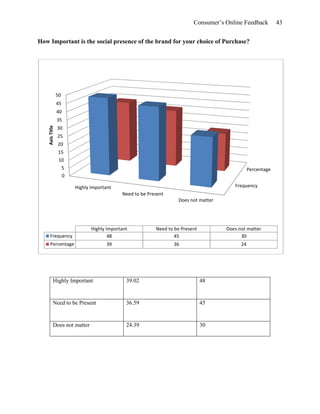
FOR ONE OF THE MOST IMPORTANT QUESTIONS OF THE SURVEY, THE IMPORTANCE OF SOCIAL PRECENCE OF THE BRAND
FOR THE CONSUMER’S CHOICE OF PURCHASE WITH THREE DISTINCT ANSWERS AS “HIGHLY IMPORTANT”, “NEED TO BE
PRESENT”, “DOES NOT MATTER” HAVE4 BEEN THE ANSWERED WITH PERCENTAGES VARING AS 39%, 36%, 24%,
RESULTING IN NUMBERS 48, 45,30 CONSECUTIVELY. .................................................................................... 44
4.2 DESCRIPTIVE ANALYSIS .......................................................................................................................... 44
4.3 DISCUSSION LINKED WITH FINDINGS AND RESEARCH OBJECTIVES.......................................................... 44
CHAPTER 5: CONCLUSION AND RECOMMENDATIONS ............................................................................46
5.1 OVERVIEW OF THE STUDY ...................................................................................................................... 46
5.2 MAJOR FINDINGS OF THE STUDY ............................................................................................................. 47
5.3 IMPACT OF FEEDBACK ON SALES............................................................................................................. 49
5.4 SUMMARY OF THE DISSERTATION ........................................................................................................... 50
6) DISCUSSION AND LIMITATION.....................................................................................................................52
6.1 DISCUSSION:............................................................................................................................................ 52
6.2. LIMITATIONS: ......................................................................................................................................... 53
7.REFLECTION AND SKILL DEVELOPMENT:................................................................................................54
7.1INTRODUCTION:........................................................................................................................................ 54
7.2.REFLECTION ON DISSERTATION FORMULATION: ..................................................................................... 55
7.4. SKILL DEVELOPMENT: ................................................................................................................................55
(A) COGNITIVE SKILLS:.................................................................................................................................. 56
(B) CRITICAL AND ANALYTICAL SKILLS:....................................................................................................... 56
(C) RESEARCH AND INVESTIGATIVE SKILLS:.................................................................................................. 56
(D) COMMUNICATION SKILLS ........................................................................................................................ 56
(E) INTERPERSONAL SKILLS:.......................................................................................................................... 57
Consumer’s Online Feedback iv
(F) PERSONAL MANAGEMENT SKILLS:............................................................................................................ 57
(G) SELF-AWARENESS:................................................................................................................................... 57
(H) COMPUTER SKILLS:.................................................................................................................................. 57
7.5.CONCLUSION:...................................................................................................................................................57
REFERENCES ..........................................................................................................................................................59
COVER LETTER: ............................................................................................................................................ 68
APPENDIX ................................................................................................................................................................69
SURVEY QUESTIONNAIRE.............................................................................................................................. 69
Consumer’s Online Feedback 1
CHAPTER 1: INTRODUCTION
1.1 Background of the Study
Before the advent of the Internet many companies image formed spontaneously and
based on the activities undertaken. Manufacturers could control the situation around your brand.
Interaction with customers was built on the basis of interviews, focus groups and market
research. But to hear the opinion of consumers was problematic, because to do so they had to
write letters or make phone calls. Interaction principle of “producer & consumer” lay in the fact
that the information from the manufacturer aimed at all consumers, the consumer rarely reported
their concerns and wishes because of the difficulty in communication. With the development of
global network capabilities, users gained the freedom to openly discuss any products, services,
brands, manufacturers (Mayzlin & Dina , 2006, pp.155-163). In social networks, media
resources, blogs, portals and other positive and negative feedback are multiplying at a
tremendous rate, despite the fact that previously the main means of communication is the print
media, television and radio. Today, many large companies are turning to developing its own
reputation program to create a positive opinion of himself and product information (Novotny &
Eric , 2004, pp.525–537).
With the advent of the Internet has changed in favour of the consumer, information about the
manufacturer and its competitors is now available to everyone, new tools influence the opinion
of customers: CRM, e-mail newsletters, feedback on the site and others. Information on the
background of today affect more sources to traditional media join online publications, various
Messengers, forums and portals. Internet has opened up tremendous opportunities for expression
and reports it to others. Interaction principle of “producer – consumer” is now reflected in the
fact that the information from the manufacturer is aimed at all consumers, but he gets a point
feedback from its user (Keeney & Ralph, 1999, 533–542). People lack of communication and
social networks allow communicating with more people on any topic, without wasting time on
meetings. With the development of social networks among producers of goods and services, new
problems have also appeared: offset their own reputation on the Internet and provide feedback to
customers (Cui, Lui & Guo, 2012, pp.39-58). Now the consumers rarely rely on the information
disseminated by the manufacturer on the selected advertising platforms. The importance of
feedback is always there in all the organizations. The biggest reason is to convey a message to
the concerned persons either verbally or in written form. The response from the feedback is also
Consumer’s Online Feedback 2
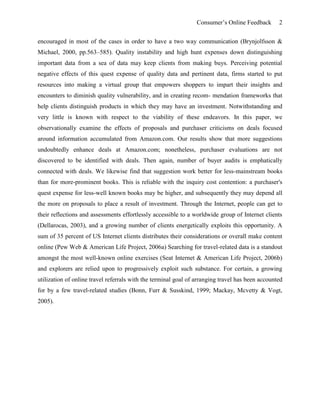
encouraged in most of the cases in order to have a two way communication (Brynjolfsson &
Michael, 2000, pp.563–585). Quality instability and high hunt expenses down distinguishing
important data from a sea of data may keep clients from making buys. Perceiving potential
negative effects of this quest expense of quality data and pertinent data, firms started to put
resources into making a virtual group that empowers shoppers to impart their insights and
encounters to diminish quality vulnerability, and in creating recom- mendation frameworks that
help clients distinguish products in which they may have an investment. Notwithstanding and
very little is known with respect to the viability of these endeavors. In this paper, we
observationally examine the effects of proposals and purchaser criticisms on deals focused
around information accumulated from Amazon.com. Our results show that more suggestions
undoubtedly enhance deals at Amazon.com; nonetheless, purchaser evaluations are not
discovered to be identified with deals. Then again, number of buyer audits is emphatically
connected with deals. We likewise find that suggestion work better for less-mainstream books
than for more-prominent books. This is reliable with the inquiry cost contention: a purchaser's
quest expense for less-well known books may be higher, and subsequently they may depend all
the more on proposals to place a result of investment. Through the Internet, people can get to
their reflections and assessments effortlessly accessible to a worldwide group of Internet clients
(Dellarocas, 2003), and a growing number of clients energetically exploits this opportunity. A
sum of 35 percent of US Internet clients distributes their considerations or overall make content
online (Pew Web & American Life Project, 2006a) Searching for travel-related data is a standout
amongst the most well-known online exercises (Seat Internet & American Life Project, 2006b)
and explorers are relied upon to progressively exploit such substance. For certain, a growing
utilization of online travel referrals with the terminal goal of arranging travel has been accounted
for by a few travel-related studies (Bonn, Furr & Susskind, 1999; Mackay, Mcvetty & Vogt,
2005).
Consumer’s Online Feedback 3
1.2 Thesis Statement
As identified by the title of the study, this research work emphasize on finding How
Consumers Online Feedback Impact on Companies Reputation and Sales.
1.3 Purpose of the Study
The main purpose of carrying out this study is to find out the ways in which feedback
from the consumers has its influence on the reputation and sales of the company. The researcher
investigates a direct link between the consumer’s feedback on internet and its influence on the
company’s reputation. The researcher also investigates if other company recommended factors
are implemented in additional to or as a standalone implementation, would it welcome a chance
for the manger and/or associate to contribute to the goals and objectives to the company.
1.4 Research Aims and Objectives
The main aim of the study is to investigate the impact of consumer’s online feedback on
sales and reputation of company. However, following are the objectives of the study:
 To find out the ways in which a brand's reputation is impacted by Customers
Feedback
 To identify the platforms available for customers to post or convey their feedback
to company or brand
1.5 Research Questions
The main question of the present research work takes into consideration the following
research question:
 How consumers online feedback impact on companies reputation and sales.
Well every company wants to know their customer’s feedback. Now a days with the help
of increasing survey websites and social media, companies are all always allow their consumers
to leave their feedback before the leave and this feedback will be reviewed by many other users
as well. Many of the researches proved that the consumers feedback will be influence the most of
the reaming customers as well. This research will give a clear information on how effective is
Consumer’s Online Feedback 4
this feedback and how it creates impact on companies reputation and sales in the global market.
However, following the main questions, sub questions are:
 What are the ways in which a brand's reputation is impacted by Customers
Feedback?
 Which platforms are available for customers to post or convey their feedback to
company or brand?
1.6 Rationale of the Study
The study was conducted to assess the significance of online feedback for the reputation
and sales of companies and how it can help in achieving competitive advantage. It is highly
imperative for businesses to be more adaptive and willing to use online feedback and social
media marketing. The use of online feedback and social media marketing needs to be studied
from the perspective of both the social media users as well as business owners. This particular
study focused on customer centric and business centric assessment of the significance and impact
of online and social media marketing.
1.7 Significance of the Study
The study intended to explore the significance and impact of online feedback and social
media marketing for businesses. Currently, businesses are facing intense competitive rivalry due
to the large businesses and forces in the environment. The macro and micro forces in the
environment pose critical challenges for local businesses to survive competitively. Hence, the
use of technological innovations if often costly for local businesses but the emergence of online
marketing and social media marketing have given cost effective solutions to businesses to
enhance their presence in the business markets. The study aimed to analyze the impact of online
feedback on the sales and reputation of company. This contributed to the existing literature y
adding more knowledge. The significance of social media was assessed through the perspective
of social media users and the impact of social media for local businesses and how they can
become more adaptive was analyzed through the perspective of local business owners. The study
further helped in understanding how local businesses can become more flexible and efficient in
using online marketing and social media for achieving competitive advantage.
Consumer’s Online Feedback 5
CHAPTER 2: LITERATURE REVIEW
The Internet significantly decreases pursuit costs and empowers the helpful examination
of different choices. Online shoppers and customers with more noteworthy Internet experience
are more prone to utilize online channels to gather item data on the grounds that their expense of
gathering data from the online channel is liable to be lower than that from the logged off channel.
A few field studies affirm that Internet experience is absolutely related with the recurrence of
utilizing the Internet to accumulate data) and inquiry execution. Therefore, the study of influence
of internet in gathering feedback has become one of the important points in competitive markets.
Customers mostly look data online and find that an absence of Internet experience influences
their steadiness and regularly prompts brisk relinquishment of the Internet as a data source. The
studies have recommended that customers with more prominent Internet experience are more
inclined to get to online feedback. Hence, Internet experience may direct the assessment of
online data.
2.1 Literature Theme One
Feng Zhu &Xiaoquan( Micheal ) Zhang’s Impact of Online Consumer Feedback on
Sales: The Moderating Role of Product and Consumer Characteristics Study has got some
interesting Observations to Offer. Though the Study is in light of finding how Product and
Consumer Characteristics moderate the influence of Online Customer Review on Product Sales
using data from Video game Industry; they have offered a view and analysis on the data from
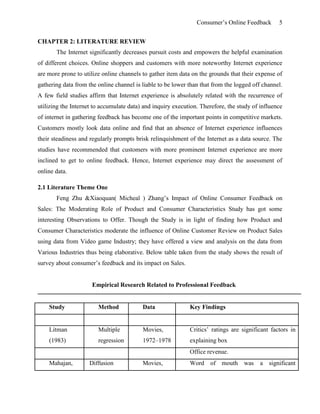
Various Industries thus being elaborative. Below table taken from the study shows the result of
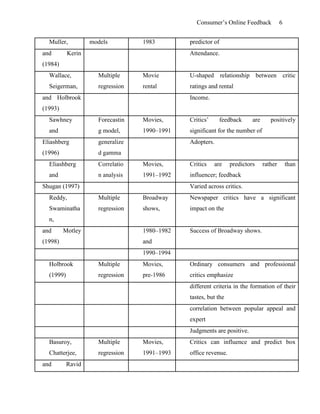
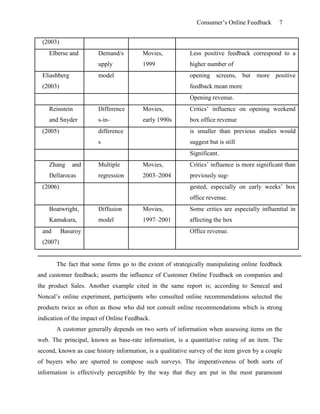
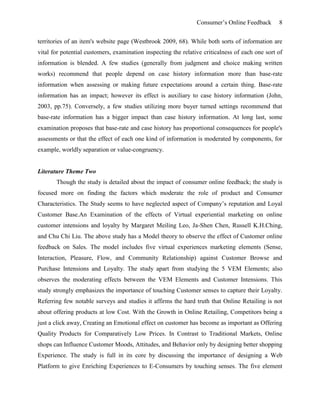
survey about consumer’s feedback and its impact on Sales.
Empirical Research Related to Professional Feedback
Study Method Data Key Findings
Litman
(1983)
Multiple
regression
Movies,
1972–1978
Critics’ ratings are significant factors in
explaining box
Office revenue.
Mahajan, Diffusion Movies, Word of mouth was a significant
Consumer’s Online Feedback 6
Muller, models 1983 predictor of
and Kerin
(1984)
Attendance.
Wallace,
Seigerman,
Multiple
regression
Movie
rental
U-shaped relationship between critic
ratings and rental
and Holbrook
(1993)
Income.
Sawhney
and
Forecastin
g model,
Movies,
1990–1991
Critics’ feedback are positively
significant for the number of
Eliashberg
(1996)
generalize
d gamma
Adopters.
Eliashberg
and
Correlatio
n analysis
Movies,
1991–1992
Critics are predictors rather than
influencer; feedback
Shugan (1997) Varied across critics.
Reddy,
Swaminatha
n,
Multiple
regression
Broadway
shows,
Newspaper critics have a significant
impact on the
and Motley
(1998)
1980–1982
and
Success of Broadway shows.
1990–1994
Holbrook
(1999)
Multiple
regression
Movies,
pre-1986
Ordinary consumers and professional
critics emphasize
different criteria in the formation of their
tastes, but the
correlation between popular appeal and
expert
Judgments are positive.
Basuroy,
Chatterjee,
Multiple
regression
Movies,
1991–1993
Critics can influence and predict box
office revenue.
and Ravid
Consumer’s Online Feedback 7
(2003)
Elberse and Demand/s
upply
Movies,
1999
Less positive feedback correspond to a
higher number of
Eliashberg
(2003)
model opening screens, but more positive
feedback mean more
Opening revenue.
Reinstein
and Snyder
Difference
s-in-
Movies,
early 1990s
Critics’ influence on opening weekend
box office revenue
(2005) difference
s
is smaller than previous studies would
suggest but is still
Significant.
Zhang and
Dellarocas
Multiple
regression
Movies,
2003–2004
Critics’ influence is more significant than
previously sug-
(2006) gested, especially on early weeks’ box
office revenue.
Boatwright,
Kamakura,
Diffusion
model
Movies,
1997–2001
Some critics are especially influential in
affecting the box
and Basuroy
(2007)
Office revenue.
The fact that some firms go to the extent of strategically manipulating online feedback
and customer feedback; asserts the influence of Customer Online Feedback on companies and
the product Sales. Another example cited in the same report is; according to Senecal and
Noncal’s online experiment, participants who consulted online recommendations selected the
products twice as often as those who did not consult online recommendations which is strong
indication of the impact of Online Feedback.
A customer generally depends on two sorts of information when assessing items on the
web. The principal, known as base-rate information, is a quantitative rating of an item. The
second, known as case history information, is a qualitative survey of the item given by a couple
of buyers who are spurred to compose such surveys. The imperativeness of both sorts of
information is effectively perceptible by the way that they are put in the most paramount
Consumer’s Online Feedback 8
territories of an item's website page (Westbrook 2009, 68). While both sorts of information are
vital for potential customers, examination inspecting the relative criticalness of each one sort of
information is blended. A few studies (generally from judgment and choice making written
works) recommend that people depend on case history information more than base-rate
information when assessing or making future expectations around a certain thing. Base-rate
information has an impact; however its effect is auxiliary to case history information (John,
2003, pp.75). Conversely, a few studies utilizing more buyer turned settings recommend that
base-rate information has a bigger impact than case history information. At long last, some
examination proposes that base-rate and case history has proportional consequences for people's
assessments or that the effect of each one kind of information is moderated by components, for
example, worldly separation or value-congruency.
Literature Theme Two
Though the study is detailed about the impact of consumer online feedback; the study is
focused more on finding the factors which moderate the role of product and Consumer
Characteristics. The Study seems to have neglected aspect of Company’s reputation and Loyal
Customer Base.An Examination of the effects of Virtual experiential marketing on online
customer intensions and loyalty by Margaret Meiling Leo, Ja-Shen Chen, Russell K.H.Ching,
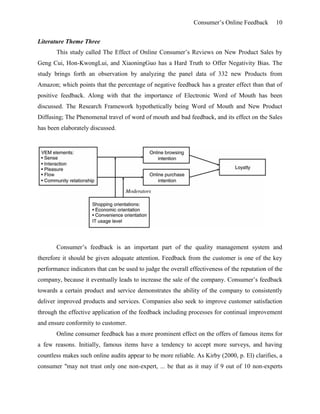
and Chu Chi Liu. The above study has a Model theory to observe the effect of Customer online
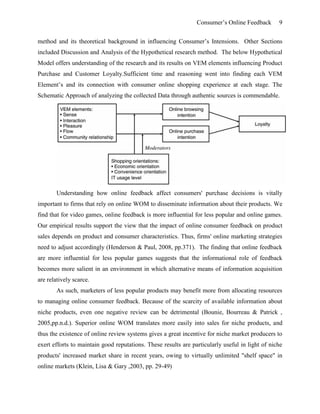
feedback on Sales. The model includes five virtual experiences marketing elements (Sense,
Interaction, Pleasure, Flow, and Community Relationship) against Customer Browse and
Purchase Intensions and Loyalty. The study apart from studying the 5 VEM Elements; also
observes the moderating effects between the VEM Elements and Customer Intensions. This
study strongly emphasizes the importance of touching Customer senses to capture their Loyalty.
Referring few notable surveys and studies it affirms the hard truth that Online Retailing is not
about offering products at low Cost. With the Growth in Online Retailing, Competitors being a
just a click away, Creating an Emotional effect on customer has become as important as Offering
Quality Products for Comparatively Low Prices. In Contrast to Traditional Markets, Online
shops can Influence Customer Moods, Attitudes, and Behavior only by designing better shopping
Experience. The study is full in its core by discussing the importance of designing a Web
Platform to give Enriching Experiences to E-Consumers by touching senses. The five element
Consumer’s Online Feedback 9
method and its theoretical background in influencing Consumer’s Intensions. Other Sections
included Discussion and Analysis of the Hypothetical research method. The below Hypothetical
Model offers understanding of the research and its results on VEM elements influencing Product
Purchase and Customer Loyalty.Sufficient time and reasoning went into finding each VEM
Element’s and its connection with consumer online shopping experience at each stage. The
Schematic Approach of analyzing the collected Data through authentic sources is commendable.
Understanding how online feedback affect consumers' purchase decisions is vitally
important to firms that rely on online WOM to disseminate information about their products. We
find that for video games, online feedback is more influential for less popular and online games.
Our empirical results support the view that the impact of online consumer feedback on product
sales depends on product and consumer characteristics. Thus, firms' online marketing strategies
need to adjust accordingly (Henderson & Paul, 2008, pp.371). The finding that online feedback
are more influential for less popular games suggests that the informational role of feedback
becomes more salient in an environment in which alternative means of information acquisition
are relatively scarce.
As such, marketers of less popular products may benefit more from allocating resources
to managing online consumer feedback. Because of the scarcity of available information about
niche products, even one negative review can be detrimental (Bounie, Bourreau & Patrick ,
2005,pp.n.d.). Superior online WOM translates more easily into sales for niche products, and
thus the existence of online review systems gives a great incentive for niche market producers to
exert efforts to maintain good reputations. These results are particularly useful in light of niche
products' increased market share in recent years, owing to virtually unlimited "shelf space" in
online markets (Klein, Lisa & Gary ,2003, pp. 29-49)
Consumer’s Online Feedback 10
Literature Theme Three
This study called The Effect of Online Consumer’s Reviews on New Product Sales by
Geng Cui, Hon-KwongLui, and XiaoningGuo has a Hard Truth to Offer Negativity Bias. The
study brings forth an observation by analyzing the panel data of 332 new Products from
Amazon; which points that the percentage of negative feedback has a greater effect than that of
positive feedback. Along with that the importance of Electronic Word of Mouth has been
discussed. The Research Framework hypothetically being Word of Mouth and New Product
Diffusing; The Phenomenal travel of word of mouth and bad feedback, and its effect on the Sales
has been elaborately discussed.
Consumer’s feedback is an important part of the quality management system and
therefore it should be given adequate attention. Feedback from the customer is one of the key
performance indicators that can be used to judge the overall effectiveness of the reputation of the
company, because it eventually leads to increase the sale of the company. Consumer’s feedback
towards a certain product and service demonstrates the ability of the company to consistently
deliver improved products and services. Companies also seek to improve customer satisfaction
through the effective application of the feedback including processes for continual improvement
and ensure conformity to customer.
Online consumer feedback has a more prominent effect on the offers of famous items for
a few reasons. Initially, famous items have a tendency to accept more surveys, and having
countless makes such online audits appear to be more reliable. As Kirby (2000, p. El) clarifies, a
consumer "may not trust only one non-expert, ... be that as it may if 9 out of 10 non-experts
Consumer’s Online Feedback 11
concur, it’s likely worth purchasing." Chen, Wu, and Yoon (2004) affirm that a build in data
sources could prompt more trust. They indicate that as the amount of consumer surveys builds,
the general rating joins to the genuine quality. Along these lines, audits of prominent items could
all the more correctly reflect item quality and accordingly could be more persuasive. Second,
given the substantial number of audits prevalent items get, consumers may be surer that they can
discover surveys for a well known item online and consequently are more inclined to hunt down
online audits for prominent items. Eventually, more quests are liable to expand the impact of
these audits. Interestingly, if consumers accept that surveys of less mainstream items are
uncommon and hard to discover, they may not look for such audits whatsoever. Surveys of less
prevalent items would then have little effect on their buy choices
2.1 Impact of Online Feedback for a Company
According to De Vries, Gensler, S and Leeflang (2012), online feedback and social media
have transformed the way businesses carry out their marketing activities. It is worth to note that
both online feedback and social media are innovative marketing strategies which have given an
edge to businesses (p.84). Customers are the most important stakeholders of the business and
marketing strategies are entirely targeted towards customers. Hence, for local businesses have
immense opportunities which can be gained through the use of getting online feedback and social
media.
There is a significant impact of online feedback and social media for any of the business.
In the present-age, organizations face critical challenges in surviving competitively. The
uncertain global markets and changing demands have put immense pressure for organizations.
In such competitive environment, it has become difficult to achieve efficiency and cost
effectiveness while meeting the expectations of customers (Mangold and Faulds, 2009, p.359).
It has become important to focus on innovation excellent so that efficiency and
competitive advantage can be gained simultaneously. Businesses have the opportunity to use
online feedback and social media networking such as Facebook, Twitter and blogging to follow
the feedback obtained from the customers and attract other customers as well towards the
products without bearing heavy marketing expenditures (Stone and Woodcock, 2014, p. 5).
Getting feedback from customers is really a very important aspect of the business. Not all
customers express their attitude to the quality of service or opinion about specific products
directly at the company. Most of them either leave theirr opinions to themself, or express it
Consumer’s Online Feedback 12
remotely - via the company’s website, social networks or forums, as well as orally - talking about
his experiences with the comapny to relatives, friends and colleagues. Collection and analysis of
customer feedback allows time to correct the work of the company, to make the necessary
changes to the service or product line.
The company has been working with feedback. Given the specific and individual
approach to each client, most of the views collected during the personal contact with the
managers of the company. Some customers leave their impressions of cooperation with
company. In many ways, in order to improve our transparency and simplification of the feedback
various companies have opened a page on the popular social network Facebook. In addition,
management regularly monitor the reviews of the company on the Internet as a whole - on
independent sites, such as company online forums and communities. And in the near future is
planned for regular surveys of existing customers, in which everyone will be able to leave as
their views on the current work of the company, as well as suggestions or recommendations for
the future.
2.2Adaptiveness of Businesses through Online Feedback and Social Media Tools/Strategies
2.2.1 Communication
Communication process of businesses improves which helps in building positive and
sustainable relationship with stakeholders especially customers. Customers can be influenced
through online feedback and social media tools which are emerging as highly influencing tools
of communication. Communication is effective when there is feedback which leads towards
interactive and interpersonal contacts and increase adaptiveness in changing global markets. For
local businesses, social presence can influence consumer buying behavior. Online customers are
highly influenced by businesses which have increased social presence on social networking
websites.
One of the most applicable forms of UGC websites with regard to customer manufacturers will
be reviewing websites, exactly where customers write about their own manufacturer ordeals as a
way to assist other folks make more informed buying decisions. A large number of websites are
collected through classification, for instance, electronic devices, car in addition to tourist, to call
several. They are usually nicely moderated in addition to can be extremely manufacturer pleasant
Consumer’s Online Feedback 13
towards corporation which aspects their own traditions and is particularly geared up to play a
role. Within Oct 2007, any Nielsen review discovered which customer referrals are classified as
the many reliable sort of all over the marketing world. More than three-quarters associated with
participants coming from forty seven markets across the world performing referrals coming from
customers as being a dependable form of merchandising. Evaluate which to help 63% with
respect to media forms, 56% with regard to TELLY in addition to journals, in addition to 34%
with regard to internet search engine ads2. Assessment websites are likely to be exactly where
customers visit locate these referrals, generating these individuals an essential position with
regard to marketers to get a tone of voice.
Websites:
The advent associated with websites has been regarded any showing stage with regard to UGC. It
had been the instant when UGC went coming from a smaller but significant percentage of the
World Wide Web experience to some predominant source of leisure, information, in addition to
controversy.
While websites have been around a single style or maybe an additional because the core 1990s, it
had been your 1998 release associated with Wide open Journal which flipped these individuals
into a UGC sensation. The wide open Journal has been one of the very first vendors associated
with blogging and site-building software, and also the very first to help assist in consumer
remarks.
Blog:
Making it possible for visitors to help respond to blog site items helped with paying attention to
the level of freewheeling discussion that's today your characteristic associated with blogging and
site-building in addition to UGC generally speaking.
The weblog will be small with regard to World wide web record, any term which indicates the
right work schedule or maybe log taken care of online. Within its purest style, any blog site ,
which is just the right leg taken care of through somebody, updated usually, in addition to
viewing through everyone in-line. The items usually come with change chronological obtain,
Consumer’s Online Feedback 14
which means the newest will be near the top of your page while others can be found through
scrolling down, having aged items offered as a result of inbound links at the bottom or maybe
features in the page. Blogs possess constantly spanned a broad reach of capacity. A few consist
of bit more when compared with regular changes about one’ azines domestic pets, while other
people get to be hotbeds associated with political discussion, actually affecting controversy on a
country wide level.
Although while “pure” websites accumulated reputation press companies in addition to firms
began to ideal their own design in addition to themes or templates. Magazines like the The big
apple periods in addition to Newsweek presented websites where their own reporters contributed
laid-back findings. Quickly actually CEOs associated with main firms were being blogging and
site-building, commonly while a form of advertising. By November 2006, 19% in the fastest-
growing non-public companies inside the You. Ohydrates. noted utilization of blogging and site-
building while a form of transmission. Possibly the ideal instance will be Gawker any
community associated with websites that is included in a lot of the Web’ azines most in-demand
websites. Its namesake, Gawker.. com, is usually a jogging comments with The big apple press,
famous people, in addition to traditions, composed in an acerbic, generally profane develop, that’
azines be a must-read with regard to The big apple press pros. The Gawker community also
boasts Dead whirl (sports), Consumerist (packaged goods), Wonkette (politics), in addition to
Fleshbot (adult industry).
While it may also be fought which websites including Gawker.. com or maybe your Huffington
Article are not correct UGC given that they make use of salaried contributing factors or maybe
consider submissions coming from press pros, they perform preserve just one characteristic
associated with websites which mark these individuals as being a main UGC platform: consumer
remarks. Due to the fact consumers are invited to help leave reviews below every publish; they
instill freewheeling interactions which usually take on any lifetime with their very own. These
kind of interactions be a long lasting addendum in the unique blog posts, and they are generally
the maximum amount of in the leisure since the publish by itself (some websites, including
Gawker, allow comment through ask simply that allows you to assure a larger level of
discourse). Though these kinds of remarks are generally moderated, in addition to slanderous or
maybe extremely profane substance can be edited out and about, the vast majority of widely used
websites are hesitant to use which power. Any 2007 review discovered which 37. 4% associated
Consumer’s Online Feedback 15
with Internet users believe that providing particular opinions would be the essential element
throughout splitting websites coming from some other online press. Various other elements
include: creating design (28. 2%), content liberty (26. 3%) in addition to structure (25. 8%). In
which similar review discovered which 25. 8% associated with blog site visitors read in excess of
a few websites routinely – in addition to in the websites they read most often, 68. 3% associated
with participants claimed they read these individuals everyday
Reviews Versus Page Views:
Inside the diffusion literary works, first adopters are considered the baseline driving a car push
on the diffusion practice, especially within the first benefits time period Scientific studies of my
space and social finding out, however, claim that people’s decision to have interacted in a very
fresh behavior depends upon the options of people, bringing about a great content rich cascade.
Therefore, the latest study features wondered the particular prominent position of the first
adopters within the diffusion of products and outlined the difficulty throughout discovering and
aimed towards the first adopters A few researchers of my space and social contagion have
discovered latecomers to become additional influential within the diffusion practice. The latest
PC simulation service this check out and show you which they require with regard to products
advances, in part as a perform of sociable verbal exchanges, understanding that social finding out
functions condition require with regard to products. Furthermore, that they know that significant
cascades of effect are influenced not necessarily by means of influential or perhaps first adopters,
but by the important muscle size of quickly swayed overdue comers, confirming the particular
patience model based on my space or Facebook principle and getting in touch with with regard to
higher focus on latecomers within the diffusion practice. Within on-line forums, an important
sign of a review’s effect can be the volume of site opinions by means of readers or perhaps fans
which often signifies the amount of distribution on the on-line reviews and impulses the
particular result of the existing reviews throughout producing client attention and involvement in
an item involving readers. In the framework of e-commerce, on-line reviews are of restricted
worth except people go through these individuals and produce choices based on these kind of
reviews. Therefore, in addition to the variety of on-line reviews, the volume of client parts or
perhaps site opinions on the submitted reviews must have a significant effect on organization
revenue. Pursuing my space or Facebook principle, any patience level can be arrived at following
Consumer’s Online Feedback 16
a enough amount of people create a distinct alternative that's easy for people. In the event worm
is beneficial throughout having an influence on the particular income on the company’s products,
it's likely which the site opinions by means of readers are more significant than the reviews by
themselves. Apart from laboratory studies, more robust facts are necessary to measure the effect
of site opinions with organization revenue.
2.2.2 Monitoring
Online feedback and social media marketing has increased monitoring of activities.
Businesses can build their image and reputation through the use of online marketing and social
media. As per Stone and Woodcock (2014), social networking websites such as Twitter and
Facebook are increasing their social media monitoring so that misuse of information and
defamation activities do not take place (p.5). Social media monitoring is emerging as a key
component of social media marketing for ensuring ethical practices over the internet. The
negative use of online feedback and social media is being monitored which can provide
assurance businesses to use online marketing tools.
2.2.3 Information Sharing
Information is one of the most important parts of online feedback and social media
marketing. According to Kim and Ko (2012), the free access to information and more visibility
of data has led towards customer awareness and retention. Online feedback and social media
have given immense opportunities to businesses to share information and become adaptive in
order to attract and retain larger customers (p.4 ).This becomes an essential element for gaining
sustainable competitive advantage.
2.2.4 Relationship Marketing
In the present-age, the increasing competition has forced businesses to develop
relationships with stakeholders so that more coordination and integration can be achieved.
Zineldin (2000) indicated that relationship marketing has emerged as a marketing practice to
enhance relationships for achieving long term success and competitive advantage (p.10). Online
feedback and social media marketing have enhanced customer relationship marketing. It is
Consumer’s Online Feedback 17
important to note that online marketing and social media marketing have focused on direct
marketing which aims to develop associations with customers. Businesses can easily
communicate with customers through online feedback and social media marketing. This requires
increased social presence and media richness of local businesses.
2.2.5 Brand Development
As per Lim, Chung and Weaver (2012), brand development is the key to achieve incised
customer loyalty. For local businesses, the target market is usually small but with the use of
online marketing and social media marketing, more customers can be targeted and diversification
can take place (p.198). Divol, Edelman and Sarrazin (2012) highlighted that businesses can
compete for larger market share through online marketing and social media marketing through
cost effective and innovative tools such as E-advertising, direct marketing, blogging, and fan
following on social networking websites (p.67). Businesses can gain competitive advantage and
innovation excellence through using online and social media marketing activities more
effectively with customer centric approach (Divol, Edelman and Sarrazin, 2012, p.68).
Hence, these are the key dimensions which have been assessed for understanding the
impact of impact of online marketing and social media for local businesses. Online marketing
and social media have helped in increasing cost effectiveness and enhancing the marketing
efforts of companies through reaching the customers directly, adaptively and interactively.
2.3 Influence of Social Media Marketing and Online Feedback
As per Saravanakumar and Suganthalakshmi (2012), social media marketing can be
defined as the marketing process of gaining awareness and attention through social media
websites. Social media marketing is basically used for attracting customers and promoting
products and services through social media websites. The message is communicated in the form
of advertisements or content. Businesses are using social media marketing to increases sales,
brand awareness, image building, customer relationship and communication. Social media is an
online platform where communication among various stakeholders can take place in a
convenient and cost effective manner (p. 5). It was highlighted in another study that social
media is a platform which assists businesses to share information and reach customers through
Consumer’s Online Feedback 18
Web 2.0. Social media facilitates businesses to engage in less-time consuming and direct
communication with customers as compared to traditional methods of communication. Social
media marketing is not only effective for large businesses but also local businesses. Online
customers can be targeted more easily through various online marketing strategies and tools. It is
worthy to note that both business-to-consumer marketing and business-to-business marketing can
take place through social media marketing. Weinberg et al. (2013) further noted that the
presence of social networking websites such as Twitter and Facebook has helped large and small
businesses to enhance their relationship with customers in order to gain larger customer base and
customer loyalty (p.301). It is worthwhile to know that social media marketing has gained
immense prominence in the present-age and hence it has become important for local businesses
to focus on social media marketing.
The interconnectivity of consumers through social media such as communities, reviews
or recommendations is likely to demonstrate faith in e-commercialism. In SNSs, the social
interaction of consumers helps their peers to acquire or reject trust in a supplier. Consumer
socialization occurs through social media directly by social interactions among consumers, and
indirectly by supporting product involvement. The social relationship of consumers generated
through social media significantly affects the perceived confidence of consumers. The
interactions on these platforms generate social support. Social support generated through social
media therefore influences trust. In addition, more positive comments, feedback and higher
ratings lead to a higher level of trust in a vendor. Inspections are perceived to be useful, and
affect attitude and intention to buy in consumers through the impression created about a product
or service. The answers of previous research indicate that the tone and quantity of data produced
by customer reviews influence intention to buy through increased trust. Today, customers prefer
to look for products and services online so that they can get more information through social
media. The use of blogs and social media websites has increased dramatically in recent years
and can be used effectively by businesses to pursue their objectives. Customer awareness,
customer retention and brand development process can be successfully carried out through social
media marketing.
The study by Mangold and Faulds (2009) indicated that social media marketing makes
use of social networking websites mainly twitter and Facebook where fan following is increased
through word of mouth advertisements and online presence. For local businesses, gaining online
Consumer’s Online Feedback 19
presence has become highly important in order to create awareness and build relationship with
customers. It was further highlighted that social media is mainly he technologies which are based
on web 2.0 where communication and information sharing takes place (p.358).The major tools of
social media are blogs, wikis, tagging and social networking system. For local businesses, there
are several tools of social media which can be used to gain customer attention. It is worthy to
highlight that there is a immense significance of online and social media marketing in the
present-age. Local businesses can make effective use of online and social media marketing to
gain competitive advantage.
The online and social media can be highly effective for local businesses because it helps
in targeting a large number of customers online. It gives a platform to local business to increase
the engagement with customers in an interactive manner. Social media creates an interactive
environment where communication and participation leads towards strong association.
Customers purchasing behavior is influenced through the online marketing actives of businesses.
The increasing social presence of businesses has become a key factor in influencing the customer
purchasing behavior. Credibility, richness of content and social presence is the three factors
which determine the purchasing decisions of customers in an online environment. It becomes
important for local businesses to enhance their presence online through online marketing
strategies which are aimed to gain competitive advantage (Berthon, Pitt, Plangger and Shapiro,
2012, p. 264).
2.4 Theories of Social Media
There are various tools of social media which are used for social media marketing.
However, the technological innovations are increasing the ways through which marketing
activities can be carried out by businesses through online marketing and social media. According
to the study by Kaplan & Haenlein (2010), there is no organized way through which social media
tools can be categorized. New websites appear which increase the channels of social media. For
classifying the tools of social media, Kaplan & Haenlein (2010) relied on a set of theories which
are considered as major elements of social media (p.60).
Consumer’s Online Feedback 20
2.4.1 Social Presence Theory
The first theory is the social presence theory which highlights that social presence is
defined as the visual, acoustic and physical contact between two or more people or partners.
Social presence enhances through intimacy and immediacy of the medium of communication.
Intimacy is based on the interpersonal relationships whereas immediacy is based asynchronous
and synchronous aspect of the medium of communication. He further highlighted that social
presence is higher when there is more social influence of the partners on each others’ views and
behaviours (McCarthy, Rowley, Ashworth and Pioch, 2014, p.4).
2.4.2 Media Richness Theory
The second theory is the media richness theory which is based on the effectiveness of
communication through richness of content. The proponents of this theory believe that
communication is effective when there is less ambiguity and less uncertainty. Chan and Guillet
(2011) observed that the richness of the medium holds immense significance for influencing the
behaviour and opinions of people (p.345). It is important to understand that social media tools
can be classified in terms of social presence and media richness.
The effectiveness of social media tools such as blogs, forums, and social networking
websites can be accessed through social presence theory and media richness theory. For
businesses, it is important to assess the significance and impact of both online marketing and
social media marketing through these theories.
2.5 Tools for Customer Feedback
The process of customer feedback is an important part of the quality management system
(hereinafter - QMS), and it should be given adequate attention. Feedback from the customer is
one of the key performance indicators that can be used to judge the overall effectiveness be
QMS. The Internet greatly enhances people’s ability to interact and communicate with each
other, the online brand community has become the dominant venue in the marketplace through
which to share individual information and experience with products and services, solve problems
that consumers encounter, and interact with other consumers and company representatives in
providing their feedback directly to the company personnel’s. In particular, the dramatic rise of
Consumer’s Online Feedback 21
social media has triggered companies to build online brand communities from where they can
also get the feedback that eventually builds up their reputation. Consequently, brand
communities established on social network sites have become pervasive in recent years. Along
with the popularity of brand communities on social network sites, studies relating to this area
have also increased in number. If company management consider the matter from the point of
view of ISO 9001, the overall goal, is to establish the requirements for a quality management
system for those cases where an organization:
 Needs to demonstrate its ability to to consistently provide products moiety
Answer to customer and applicable statutory and regulatory requirements;
 To improve customer satisfaction through the effective application of the
system, including processes for continual improvement and to ensure conformity
to customer and applicable statutory and regulatory requirements.
The exchange of information with customers requires that the organization to establish
and implement effective arrangements for the exchange of information with customers regarding
customer feedback, including customer complaints.
Customer satisfaction refers to one of the ways to measure the functioning of the systems
s quality management, the organization shall monitor information about the perception of the
consumer and it performs its ppendices organizational requirements. Should be established ods
for obtaining and using this information. However, there is no specific requirement that
organizations have formal repetition of customer satisfaction, or other activities on the
measurement of customer satisfaction. Therefore important that the organization was trying to
see the provision of services from the point of view of the client and monitored his perceptions.
Online brand communities are generally classified into marketer-created and consumer-
created communities. As the online brand community is considered an important forum through
which to interact with consumers, most companies have established marketer-created online
brand communities for the purpose of building long-term relationships with consumers in order
to have their feedback for their products and services. Due to the popularity, online brand
communities, empowered consumers also have built consumer-created online brand communities
for information sharing. Though there are numerous studies on the online brand community,
most have focused on how to build and manage communities, but few have explored the
differences in consumer behaviours exhibited with respect to different types of online brand
Consumer’s Online Feedback 22
community. Thus, this study was designed to investigate consumer perceptions, attitudes and
behaviours at two major types of social network based brand communities: marketer-created and
consumer-created brand communities.
As predictors of attitudes toward the online brand community, several consumer
psychological and social factors have been studied. Consumers‫׳‬ participation in the brand
community depends on consumers‫׳‬ need for information. It has been observed from the review
of the literature that consumers‫׳‬ experience-and-search determined decisions dictate their
participation in an online brand community (Mayzlin & Dina , 2006, pp.155-163). The premise
that consumers who prefer consumer-created online brand communities tends to be influential
participants in the social interaction within the brand community. Some of the researchers have
stated that consumers‫׳‬ attitudes toward each type of online brand community depend on
consumers‫׳‬ needs and benefits. Although studies identifying the predictors of consumers‫׳‬
attitudes toward different types of online brand communities have been rare, several studies have
revealed that the online brand community provides consumers a venue primarily for social
interaction and information exchange to satisfy their consumer needs. The present study
therefore focused on the consumers’ social and informational benefits.
Researchers have found that individual interactions in the online brand community
ultimately improve long-term relationships of brands and consumers. As one decisive factor
driving the long-term relationship, researchers have focused on consumer trust, and trust is
particularly important in the online market due to its role in reducing consumers’ perceived risk;
further, and most importantly it is critical in its potential as a factor in driving company sales and
profits, and in compelling consumer loyalty. In addition, revisit intention is a second important
outcome variable of a customer’s experience in the online brand community. Attracting
consumers toward repeat behaviour is considered an efficient marketing method to reduce costs,
and is also considered an important driver of long-term relationships with consumers based on
consumer satisfaction and loyalty.
Sophisticated system communication is also important because it allows company
management as no other as soon as possible to find all the new opportunities to increase sales,
providing high-quality services through the central and peripheral service customers. The
system of customer feedback plays a crucial role in expanding the concept of "quality service"
because most often it is confined only to the satisfaction of customers, which is expressed in a
Consumer’s Online Feedback 23
simple and wrong formula. The main thing that the customers did not complain , but just
immediate communication with the client directly allow more precisely than by a conventional
marketing research to analyze a way to organize the service of the company, and service in one
of the main competitive advantages.
People often think not logic and feelings. Pleasant manners of the world production is
just as important, how important they are in the service sector. Pleasant manners in the world of
production is the ease of information transfer from the customer to company management, ease
of communication (while waiting on the phone), the presence of contact information, a sense of
the consumer, that his opinion is important to company and listen to it. Customer Feedback
allows to learn from consumers about our products and services is what has the company itself
does not know. For it is a decision one way or another problems and whittling consumer needs,
in fact, is a specification of expectations customers.
With this in mind, management should make every effort to ensure that consumers have
to know the opinion of the services provided by the company. Need to put s consumers aware of
desire to learn about the problems their problems, in which case they will be more of in high
regard and more willing to tell about their difficulties. Listening to customers is a very important
part of the strategy of behavior of any company. All methods of feedback may be divided into
"legal" and "creative".
The first type includes book of comments and suggestions, as well as the treatment of
citizens and legal entities both in writing and orally. Basic requirements for record keeping, the
order of consideration of appeals and left directions of the responses of citizens are regulated at
the legislative level. In addition, each client request is necessary to be subjecting to scrutiny, in
the preparation of the response to the client to fully disclose the nature of his problem. The client
needs to feel the impact from the organization must understand that his opinion is important for
the development of the company, in view of this it is advisable in its reply to the appeal of the
customer to thank him for expressing an opinion, etc., and confirming the error of it is advisable
to bring the customer apologize for the inconvenience, and some cases and offer various kinds of
payment. In addition, all appeals must be analyzed (quarterly, monthly) with the group for
reasons of appeals, the number of requests received by the company, the number of explanations
(company might want to change in the policy of promoting the product (service) for a large
number of clients misinterpretation of certain conditions ) amounts am positive reviews, etc.
Consumer’s Online Feedback 24
The use of so-called "creative" ways depends on the capabilities of the organization, scale, scope,
and many other factors that influence the choice of an instrument customer feedback. The least
expensive methods include:
 Evaluation of "face to face", which may be appropriate in many service organizations
such as hotels ("How would you rate your stay with us?") or restaurants ("I hope you
like dinner?");
 Telephone calls or visits are periodically made to or after delivery of products and
services;
 Questionnaires or surveys carried out by the organization itself or by independent market
researchers;
 Other contacts with customers, for example, through the service personnel or installation;
 Internal staff surveys organization, which is in contact with consumers;
 Estimation of repeat visits;
 Monitoring of the claims on the basis of warranty;
 Analysis Int e rnet sites on which users can post reviews about the service, the goods.
Surveys and questionnaires are one of the most effective tools to gather marketing
information. Questionnaires or surveys can be divided into two groups during the provision of
services, the sale of goods and after-sales survey. For such shares is stated objective of the study
and prepared a questionnaire in a simple and accessible to the consumer formulation. Also
clearly define the target audience and the optimal number of respondents respondents. However,
in the absence of skills training profiles, questions are perceived differently by respondents.
Therefore, the most effective is to conduct a survey at the time of service of the consumer, as the
staff can advise the client on emerging issues.
This method is also advisable to apply for feedback in advertising. Responsible for the
analysis of the effectiveness of advertising prepared questionnaire questionnaires, which are
distributed to all employees, which receives incoming inquiries to listen (calls or visits).
Typically, these include the following questions: What are the sources of the received
information about the company, product, product category that interest clients (wide range).
Later profiles are subjected to detailed analysis, Performan tabulated. It usually indicates how
many references were made this week. Given the distribution of these appeals. Separately by
source, broken down by type of requested goods and services. Statistics may also be used, which
Consumer’s Online Feedback 25
this week committed sales to new clients who have come to incoming inquiries. On the basis of
this report is a progress report on the use of advertising to attract to lientov and strengthen the
company's sales.
2.5.1 Alternative Methods Of Obtaining Feedback From Customers
If a company have an online service, it can create a special form of feedback, where users
can write their proposals. Maybe wait for brilliant ideas and it is not necessary, but useful
information is quite real, especially the little things that often escape attention. Collection and
analysis of customer feedback can make service better. At first glance it may seem that such an
interaction takes a lot of time, especially if the resource is popular, and the posts will be a lot, but
it will always pay off in the future. Virtually any business there are always customers who refuse
services or goods. This negative experience is also possible to use - just ask people why they go
away. Make it pretty simple, a company just add to the site survey forms failure. It can specify
several options to offer ready-made answers and write its own. There is a need to keep a
particular user is unlikely to succeed, but, knowing the cause of failure, company will be able not
to lose the next one. Possible answers can be many, but some are formulated as follows:
"We're experiencing technical problems";
"I do not need right now in this service";
"Too high a price."
Such surveys will help company to predict customer churn, correct functional site or
service, and improve quality of service. Also worth a try to collect opinions and feedback from
users in social networks. Methods can be very much, for example, direct interviews. In addition,
excess activity in the community of company or service does not hurt, it might help him to
engage in new people.
2.6 Online Feedback-Basis for Developing and Maintaining
W ithout the presence of feedback between interrelated and interacting elements, parts or
systems cannot effectively manage the organization on scientific principles. All organized
systems are open, and their isolation is provided only through the loop forward and reverse links.
Necessary for their effective functioning is the presence of feedback signaling the achieved
Consumer’s Online Feedback 26
results. Based on this information, corrected manipulated. In simplified form, it is shown in the
figure. Input the value of acts on the controlled process, and in accordance with a transfer
function characteristic of the object, and determines the ratio between input and output signals is
converted into an output value from. This value, using the feedback channel is input, adjust the
input value r, and as a control signal m acts, but in a new way, on the subject. The resulting link
thus forms a closed loop.
There are two types of feedback: negative, which reduces the effect of the input to the
output of r s (in other words, seeks to establish and maintain a stable dynamic equilibrium) and
positive, increasing this effect and thereby create a delicate balance. Similar regulatory processes
occur in biological, engineering and socio-economic systems. Thus, the first important role of
feedback - the restoration of normal operation, disturbed by external and internal factors, ie.
Systems ability to self-regulation and self-organization (adaptation). Economic systems are
under constant influence of natural and social factors. These external influences, tend to be
random in nature. However, the complexity and variability of the system in time lead to the fact
that the behavior of the system is to some extent uncertain, probabilistic. The impact of these
multiple uncertainties leads to the fact that economic systems are always with incomplete
information systems and management is always carried out under conditions of uncertainty.
Therefore, the second important role of feedback is that telling a management body of
information about the real state of the object, it allows for regulation under incomplete
information about the disturbing influences.
Consumer’s Online Feedback 27
CHAPTER 3: METHODOLOGY
3.1 Methodology Introduction
This study is conducted to analyze how customer’s online feedback influences the buyers
and effect on companie's sales and growth of the company. In this chapter you will see the
methodology used to conduct the research on the impact of online feedback impact on companies
reputation and sales. In this research the philosophy of positivism is being used and gaining
knowledge by the observations. To find out the objective various instruments are used in this
research like the surveys. This survey comes under the quantitative methods of research which is
followed in finding the information. The topic which we have chosen is more of general and
further it narrowed down to specific research so the deductive approach is conducted in the
research.The respondents for the survey are the people who do shopping and leave their feedback
online. It is easy to get the respondents as there is no age restriction for the research conducted.
While conducting the research there is code of conduct which is followed with the ethics
required (Vaitkevicius, Kazokiene, 2013). It has been followed by keeping the privacy of the
people and holding to the confidentiality of them. The information collected from them will be
accessed only by the researcher. This quantitative methods is used as the topic states to know the
different thinking of the people and not just few of them by using qualitative. By the information
collected the graphs are prepared and explanation is given accordingly. Every method of research
has its own limitations and the research which is conducted for this topic is non experimental
which doesn’t harm anyone but there is a cost of something to someone in any research. In this
research people’s time and energy is being used when the survey is conducted (Vaitkevicius,
Kazokiene, 2013). So it contains in detail information about the subjects related to methodology.
3.2.1 Research Philosophy
To address a particular philosophy it is necessary to evaluate the theory and identify the
role of it. From the research made about the topic, logically the philosophy used is positivism.
Positivism is partly emerged with the reaction given by the metaphysical explanations; by which
only an essence of it can be distinguished by its appearance. Therefore it is believed that from the
heart of positivism there is a possibility to obtain the knowledge through observation and that
knowledge can be verified by the statements which are true from the circumstances. Under the
title objectivism says that ‘evaluation information is considered to be scientifically objective’.
Consumer’s Online Feedback 28
This positivism and observation theory is used to conduct this research to find the correct
objective. To find this objective various instruments are used like the tests or questionnaire and
these results are reproducible. In this research a questionnaire will be used to analyze the data
using the quantitative techniques. So this philosophy of positivism and observation theory is used
to evaluate this research as it supports the research which is conducted on the consumers’
perception and their desire to purchase.
3.2.2 Research Approach
Since it’s all relates to online consumers, the approach used in this research is by
deductive approach. This approach works on reasoning the work from the more general to a
more specific. It is also called as ‘top-down’ approach. The deductive approach is more of
narrow in nature and is concerned with testing or confirming hypotheses. The research topic is
all about customers online feedback influence on companies sales and its brand value. So this
deductive approach allows us to create the hypotheses which can be tested and narrowed down
further by having an observation so that we can address the hypotheses. In this research a
questionnaire will be given online by which observations are made regarding the hypotheses and
analyses the data and ultimately get the confirmation about the theory which will be conducted.
3.2.3 Research Strategy
The research strategy is mainly about collecting and analyzing the data effects of online
feedback about the brand products and its influence on company sales. To analyze this research
in different points of view I would be using quantitative research methods. This research method
will help me enrich and confirm about the research area. The data collection for the research will
be from survey, journals, reports and websites. Here survey comes under the quantitative method
and the journal, reports and websites are the secondary support for fulfilling the required
information which will be collected by the survey. The information will be acquired using both
these primary and secondary data which can be valid and reliable (Venkatesh, Brown and Bala,
2013). This survey will be conducted by posting questionnaires’ on online. The information
which will be collected from the survey is interpreted using descriptive analysis.
Consumer’s Online Feedback 29
3.2.4 Selecting Respondents
Sampling is a process of selecting different elements which is required for the research.
In this research our samples would be the people who are very much interested in shopping
different products. I have targeted between 18 to 50 years and above age group people for the
sample to whom the questionnaire will be given, because this age people are more often spend
their time on social media and follow the products updates. If the people provide their personal
details like the age, it would make this research very useful in differentiating the needs of
different age group people and confirm which age group thinks the packaging as a marketing
tool and their desire to buy that product. The sample size for the research is hundred and eighteen
that is sufficient to collect the information required. This method of questionnaire uses the
quantitative models which gives the statistical information which will be conducted in a written
format. So this choice of respondents are selected to conduct the research. According to the
research questions and topic this choice of sample which are general public is the best to get the
fairly results.
3.2.5 Sample Size
The initial sample size for the research was hundreds but it was observed that the results
obtained were not providing significant results in analyzing the data, therefore the sample size
was increase to 400 online participants. However, the rightly filled questionnaires that were
obtained were 384. This method of questionnaire uses the quantitative models which gives the
statistical information which has to be conducted in a written format. So this choice of
respondents is selected to conduct the research. According to the research questions and topic
this choice of sample which are general public is the best to get the fairly results.
3.2.5 Research Ethics
During the research there will be a number of times that defines the system with ethical
protections that are current social and medical research which are established to create the rights
to protect information of the research participants. It is of utmost important that we the
researcher are to respect the rights, privacy, dignity and sensitivities of the research population
and the institutions within which we will be conducting the research. Since the research
conducted is non-experimental not many ethical issues are faced. Even though the ethical issues
Consumer’s Online Feedback 30
are less complex or harmful than experimental studies. It is necessary for us to be aware of the
basic principles for protecting the participants, including the full disclosure and consent. We are
responsible to inform the participant demographics about the purpose of the study and the
confidentiality of the response given by them and how the result will be intended to be used and
will inform about the access to the information is restricted to the other people, it can be accessed
only by the researcher (McCarron, 2013). The attitude of Voluntary participation from the people
is not forced into the research participation.
Mostly students and working people participate in this survey. So before I ask them to
participate in this survey, the purpose of this survey will be explained to participants very
clearly. Since survey is all about their opinion, I would be able to follow all ethics values trough
out the research. It’s a positive sign to this study. A letter from a college will be taken to make
sure people know that I’m conducting this survey for the use of our research which will not
affect them in anyways and it will be used only for the academic purpose only. The other issue is
that providing the proper information to the participants while communicating in an effective
manner based on both substance and manner. The information should be well presented and
make them understand so that they participate in the research. It is our responsibility to make
sure that this is accomplished, because this perspective places a great responsibility to gather
information required for the research. To get over this ethical issue we have to pre plan the way
it must be presented so that the participants understands the information clearly.
3.3 Data Collection Instruments
The consent on how the information is collected for most of the research is by two data
collection. Data is effectively another word for information which can be found through two
ways that is primary and secondary data collection. To collect this data in this research the
method used to gather information is by using quantitative data methods. It is the collections of
numbers and statistics which are converted into information and explained. The information is
collected using the methods such as survey, which will be done by uploading the questionnaire in
the websites where the collection of data is fulfilled. This approach mainly concentrates on
counting and analyzing the numerical data into written format. This particular method is used to
collect information and not others because the information required is something more specific
Consumer’s Online Feedback 31
and not general. This survey will tell us how people think and considering the online reviews
before they buy the products.
Through which the data can be collected using a quantitative research. If we use the
qualitative research utmost we will be able to collect the data by conducting interviews of a less
sample size by that we would get the information on the basis of their knowledge and not the
exact information on how each person thinks. So conducting a survey on hundreds of
participants is better for getting the best results. Sampling is concerned when the data is collected
in the survey methodology. It is related with the selection of subset of individuals from within a
statistical population to estimate which represents of the whole population. This research is
conducted online and people from Dublin and my home city will be participated in this survey.
so the results at the end is implemented towards the thinking how the online feedback influence
on people in two different countries.
3.4 Data Analysis Procedures
The data collected in this research is using quantitative method by the help of survey. This
information of numerical and stats can be converted into descriptive and can be used to describe
the best features of the data in the study. By coding the results of the questionnaire the data can
be explained with a simple descriptive analysis which forms a basis of virtually every
quantitative analysis of data. It is which summarizes the frequency of the individual values or a
range of values for a variable. If the participants provide the personal information like the age, it
would be easier for us to describe the information using the frequency distribution table.
3.5 Limitations of Methodology
Quantitative research has its own limitations. There has to be a large sample size to
conduct the research and the logistical difficulties inherent in gathering that large sample can
interrupt before it even gets off the ground. It would be more expensive to tend a large sample.
Sometimes the participants are careless in reading the questions and just fill the questionnaire for
the heck of it. The misuse of sampling and weighting can completely undermine the accuracy,
validity, and project ability of a quantitative research study.
Consumer’s Online Feedback 32
To overcome such limitations and need to spend lot of money and we can make use of
the internet and get an online survey done with the different people using different survey
websites which are quite expensive and but there are chances to get required results. Since the
usage of internet has been increased day to day it would be easy to target more people online and
increase sample accordingly to the required information.
Consumer’s Online Feedback 33
CHAPTER 4: FINDINGS AND ANALYSIS
In this chapter, the findings of the study have been presented. The results have been
presented in the form of tables which helped in making better interpretations. The demography
of the participant’s i.e. online users of the products and services of the company and their
feedback is provided as well as descriptive analysis. Then, the discussion is presented based on
the research aims and objectives of the study.
4.1 Demography of Participants
Gender
Male 90 73.17
Female 33 26.82
Male
Female
0
10
20
30
40
50
60
70
80
90
Frequency
Percentage
AxisTitle
Frequency Percentage
Male 90 73
Female 33 26
Consumer’s Online Feedback 34
The above table showed the gender of the participants of the study i.e. online consumers. It was
found that there were 73.17 males and 26.82 were females respectively. Consumers Therefore,
the majority of the participants were male in the study.
Age Group
Age group Frequency Percentage
18-24 year 40 32.52
25-34 years 38 30.89
35-44 years 26 21.13
45-54 years 15 12.19
55 and above 4 3.25
Consumer’s Online Feedback 35
The above table shows the age level of the participants of the study. It was found that there were
32.52 % online users who belonged to the age group of 18-24 years, 30.89 online users who
belonged to the age group of 25-34 years, 21.13% online users owners who belonged to the age
group 35-44 years and only 12.19% online users belonged to the age group of 45-54 years and
3.25% of online users who belonged to 55 and above. Therefore, the majority of the participants
belonged to the age group of 18-24 year age group.
Frequency
Percentage
0
5
10
15
20
25
30
35
40
18-24 year
25-34 years
35-44 years
45-54 years
55 and above
AxisTitle
18-24 year 25-34 years 35-44 years 45-54 years 55 and above
Frequency 40 38 26 15 4
Percentage 32.52 30.89 21.13 12.19 3.25
Age Group
Consumer’s Online Feedback 36
To Analyze the Impact of Package Design as Marketing Tool and Consumers Desire to
Purchase :
Student 35 28.45
Part time employee 20 16.26
Full time employee 60 48.78
Unemployee 8 6.5
As per the above table, among all the 123 participants, there are 48% are employed full time and
their number is 60, The number of students who participated in the survey are also high 28.45%
of them make it upto 35 members, 16.26% of people i.e. 20 members of total participants are
working part time and the rest are unemployed who are of 6.5% i.e. 8 members.
As per the findings in the above table we can easily conclude that the majority of the people who
have participated in the survey are employed full time, hence it goes without saying that the
majority are educated as well that inherently has improves the chances of the survey results
being at their authentic best.
Frequency
Percentage0
10
20
30
40
50
60
Student
Part time
employee Full time
employee Unemployee
AxisTitle
Student Part time employee Full time employee Unemployee
Frequency 35 20 60 8
Percentage 28 16 48 6
Consumer’s Online Feedback 37
How often do you give feedback when you purchase something online
Never 26.83% 33
Quite 14.63% 18
Once in a while 58.54% 72
The question how often do you give feedback online when you tend to purchase something has
garnered an overall 123 responses, among the responses Once in a while has acquired as many as
58.54% responses which makes it to 72, the number of people who responded as never is of
26.83% which make it to 33 and the number of people who admitted to have done this quite
often are of 14.63% which makes it up to 18 members.
Frequency
Percentage
0
10
20
30
40
50
60
70
80
Never
Quite
Once in a while
AxisTitle
Never Quite Once in a while
Frequency 33 18 72
Percentage 26 14 58
Consumer’s Online Feedback 38
How often do you buy products online?
Extremely often 2.44% 3
Quite often 36.59% 45
Moderately often 31.71% 39
Slightly often 17.07% 20
Not often at all 12.20% 15
Among the 123 people who have been surveyed for the question of do you look for products and
services on line 12.20% i.e. 15 people have stated that they have never looked for products
online, which is quite demotivating, but the percentage of people who said they do it quite often
is 36.59 which in number is 45, those who mentioned they do it moderately often are of 31.71%,
which in number is 39, the percentage of people who mentioned that they do it slightly often are
of 17.07% which in number it is 20, and the most positive response among all this is extremely
often for which there were 2.44% responders, that consists of 3 number of people.
Frequency
Percentage
0
5
10
15
20
25
30
35
40
45
Extremely
often Quite often
Moderately
often Slightly often
Not at all
often
AxisTitle
Extremely often Quite often Moderately often Slightly often Not at all often
Frequency 3 45 39 20 15
Percentage 2 36 31 17 12
Consumer’s Online Feedback 39
During the online purchases; how often do you like the unique offerings ?
Never 14.63% 18
Sometimes 60.98% 75
Often 19.51% 24
Very Often 4.88% 6
Most of the participants of this survey apparently have chosen to be moderate on the question
How often have you liked the businesses with unique offerings while making online purchases.
60.98% participants have chosen the answer "sometimes" despite having Often and very often as
options to choose from, Often and very often consequently are of 19.51% and 4.88% which
makes it to 24 and 6, the other category of answers is never which has been chosen by 14.63% of
people i.e. 18 members.
Frequency
Percentage0
10
20
30
40
50
60
70
80
Never
Sometimes
Often
Very Often
AxisTitle
Never Sometimes Often Very Often
Frequency 18 75 24 6
Percentage 14 60 19 4
Consumer’s Online Feedback 40
Does the content generated by businesses on social networking websites influence your
purchasing decision?
Yes 68.29% 84
No 31.71% 39
An interesting observation about the next question of the survey is that 68.29 % people agreed
that content generated in the social networking sites influence their purchasing decision. While
31.71% people have disagreed with it.
Yes
No
0
10
20
30
40
50
60
70
80
90
Frequency
Percentage
AxisTitle
Frequency Percentage
Yes 84 68.29
No 39 31.71
Consumer’s Online Feedback 41
Do you seek opinions from other social users regarding the products and services offered
by businesses on social media websites? Or Do you believe on Word of Mouth?
Seek Reference 51.22% 63
Word of Mouth 48.78% 60
The result of the question about their relevance of the word of mouth or opinion of other social
users found almost equal number of responses, 51.22% have chosen to seek references from
other social networking users, where the remaining 48.78% of people have chosen word of
Mouth.
Seek Reference
Word of Mouth
0
10
20
30
40
50
60
70
Frequency
Percentage
AxisTitle
Frequency Percentage
Seek Reference 63 51
Word of Mouth 60 48
Word of Mouth- Seek Reference
Consumer’s Online Feedback 42
9) Are you Brand Conscious?
Yes 75.61 93
No 24.39 30
The question reveals that 75.61% of participants of survey are Brand concious and the rest of
24.39% are not.
Yes
No
0
10
20
30
40
50
60
70
80
90
Frequency
Percentage
AxisTitle
Frequency Percentage
Yes 84 68.29
No 39 31.71
Consumer’s Online Feedback 43
How Important is the social presence of the brand for your choice of Purchase?
Frequency
Percentage
0
5
10
15
20
25
30
35
40
45
50
Highly Important
Need to be Present
Does not matter
AxisTitle
Highly Important Need to be Present Does not matter
Frequency 48 45 30
Percentage 39 36 24
Highly Important 39.02 48
Need to be Present 36.59 45
Does not matter 24.39 30
Consumer’s Online Feedback 44
For one of the most important questions of the survey, the importance of social precence of the
brand for the consumer’s choice of purchase with three distinct answers as “highly important”,
“need to be present”, “does not matter” have4 been the answered with percentages varing as
39%, 36%, 24%, resulting in numbers 48, 45,30 consecutively.
4.2 Descriptive Analysis
This showed that the majority of the participants responded frequently/ often or agreed
with the statements. Thus, the responses related to the significance and impact of online feedback
and social media marketing were believed to be significant. The data revealed that participants
were willing to use online feedback and social media marketing for their businesses. Moreover,
the values of standard deviation also highlight that there is some level of variability in the data
but most of the responses for the statements were similar.
4.3 Discussion linked with Findings and Research Objectives
The research findings of the study showed that there is significance of online feedback
and social media marketing for businesses. It was found that both the online consumers as well
as business owners found online feedback and marketing to be highly influential tools in building
reputation of the company and boosting up the sales of the company. It is worthy to note that
several previous studies have also highlighted the importance of getting consumers feedback for
the success of businesses. The study by McCarthy, Rowley, Ashworth and Pioch (2014) showed
that online marketing has brought effective marketing opportunities for organizations. However,
the online marketing has opened newer ways to reach customers in more efficient and effective
manner through websites, content marketing, m-marketing, E-advertising and social media
networking (p.5). Likewise, another study indicated that online feedback has become a key
driver of success for organizations around the world due to its availability to consumers through
marketing that has large scope and effectiveness in reaching the customers (Saravanakumar and
Suganthalakshmi, 2012, p. 3).
The research findings further highlighted that relationship building and customer loyalty
have increased through getting regular feedback and social media marketing. Similarly, previous
studies underlined that online feedback and social media tools have facilitated the businesses in
engaging directly with stakeholders and developing positive relationships. Therefore, it is
Consumer’s Online Feedback 45
evident that online feedback and social media marketing holds immense significance for
businesses today in achieving competitive advantage (Kirtis and Karahan, 2011, p. 265;
Weinberg et al., 2013, p. 300).
Based on the findings of the study, it was found that business owners have improved their
marketing strategies through getting quick feedback from their consumers and social media
tools. Local businesses are more competent in reaching the target markets effectively. It was
found that more than 50% of the business owners are making use of online marketing and
obtaining feedback at the time of their sale . However, more emphasis is needed for enhancing
social presence and media richness in online marketing activities.
As per the findings of the study, it was found that the majority of the companies indicated
that they are willing to expand their online feedback and social media marketing to reach more
customers and ultimately generate customer loyalty. The study by Khang, Ki and Ye (2012)
indicated that there are effective marketing tools which can be used by organizations for
attracting new customers and retaining old ones through online advertising, PR and direct selling
(p.281). It was argued by Kirtis and Karahan (2011) further that online feedback has become an
effective tool which has helped in gaining larger customer base and market share through
enhancing the relationship with customers (p. 263). Businesses can gain larger market share
through focusing on the use of online marketing and social media marketing (Kirtis and Karahan,
2011, p.265).
Consumer’s Online Feedback 46
CHAPTER 5: CONCLUSION AND RECOMMENDATIONS
5.1 Overview of the Study
The study was conducted to assess the significance and impact of customer online
feedback on the sales of the company. The first chapter of the study introduced the research
through background, statement of the problem, research aim and objectives, research questions,
rationale and significance of the study and overview of the methodology.
The second chapter reviewed the existing literature where the concept of online
marketing and social media marketing were explored. Also, theories of various researchers were
reviewed were mainly social presence theory and media richness theory were provided. This
chapter also analyzed the impact of online marketing and social media for local businesses based
on dimensions such as communication, monitoring, information sharing and brand development.
The third chapter presented the methodology of the study where the quantitative research
design was selected for the study. The quantitative research design focused on the collection of
primary data through questionnaire survey. The data were collected using questionnaires where
one was distributed to the online user and other was distributed to the company owners. The
research instrument i.e. the questionnaire was designed in alignment with the research questions
of the study. Then, the data collected by the researcher were analyzed using statistical tools. The
data were analyzed and findings were generated based on frequency distribution and descriptive
analysis. The validity and reliability of the research instrument were assessed so that it could
generate reliable and credible data. The chapter ended with the ethical considerations of the
study,which were ensured through the study.
The fourth chapter of the study presented the findings, analysis and discussion of the
study. The findings were presented in tables generated from SPSS. The findings were analyzed
using descriptive analysis in order to assess the overall responses of the participants, which
helped in assessing the significance and impact of online marketing and social media for local
businesses.
Input is more than an amiable word for evaluating. It's a key component in the learning
procedure, and its vital in web educating. To be successful, online input needs to be fantastic and
something understudies utilization. In what manner Can I Enhance the Impact of Feedback in
Online Classes? Will help you meet both these criteria—in less time and with more noteworthy
Consumer’s Online Feedback 47
effectiveness. You'll take in four element input techniques to help you associate with your
understudies:
Feed forward— providing understudies with the assets they have to achieve learning targets,
when making the task One-to-a lot of people Streamlining summed up online criticism and
conveying it to all understudies. Distributed harnessing the force of understudy correspondence
to help web instructing objectives. Mixed media Engaging understudies with diverse learning
styles and improving exchanges through sound, activity, feature, and screen catch to help you
execute these criticism techniques, you'll likewise get:
 Example reports
 Agendas
 Exchange guides
 Arrangements of extra assets, including free programming to help distribute online
criticism and advancement of mixed media assets
5.2 Major Findings of the Study
The major findings of the study were based on the research questions of the study which
revolved around the finding the impact of online consumer feedback on the reputation and sales
of the company. Therefore, the findings of the study showed that:
 There is significance of online feedback and social media for enhancing company’s
reputation and sales.
 There is an impact of online feedback and social media marketing for businesses.
The research findings of the study were consistent with previous studies which have
highlighted that there is immense significance of online feedback and social media for local
businesses in the present-age. As per McCarthy, Rowley, Ashworth and Pioch (2014), the
changing and dynamic global environment has posed pressure on businesses to pursue their
goals. The need to become more competitive and efficient has led towards the adoption of E-
commerce and social media tools. Moreover, several studies such as Mohan, Rao and Rao
(2014) and Andersson and Alehammar (2011) underlined that online feddback and social media
marketing have become highly important tools of communication and marketing for
contemporary organizations. It is worthy to note that online marketing and social media has
Consumer’s Online Feedback 48
helped businesses to achieve competitive advantage and efficiency through reaching larger
customer base around the world.
It was also found from the research findings that there is an impact of online feedback
and social media marketing for local businesses. The findings showed that online feedback and
social media enhances information sharing, monitoring, effective communication and online
customer relationship which lead towards the achievement of sustainable competitive advantage
in the competitive and uncertain global environment. Likewise, studies such as Khang, Ki and
Ye (2012) and Briones, Kuch, Liu and Jin (2011) and indicated that there is an impact of online
marketing and social media marketing for businesses whether small, medium or large.
Businesses are increasing their social media presence and richness in order to connect with more
and more customers. Effective marketing strategies are being designed through the use of online
marketing and social media tools.
However, from the above findings it can be concluded that in the 21st
century, the
technological advancements have brought a revolution in our lives. Marketing has emerged as an
effective tool which has transformed the marketing activities of businesses. In today’s
competitive global market, reaching and retaining customers has become the key to achieve
competitive advantage and hence online marketing has greatly helped in achieving this objective.
Another study highlighted that online feedback or digital marketing is the science of
using the Internet to deliver messages to the mass audience. Online feedback is highly important
in the present-age where attracting customers through effective channels is the key to achieve
competence. Attracting and retaining a larger customer base has become easier for organizations
which have utilized online marketing channels (Stone and Woodcock, 2014, p.5).
There are several channels of online feedback which are being used by organizations
around the world to reach millions of customers. These are websites, search engine
optimization, social media marketing, content marketing, email marketing, mobile marketing and
online advertising. Online feedback has brought a revolution by expanding E-commerce
activities of the organization. E-marketing or online marketing are terms which are used
interchangeably and referred to as marketing activities conducted over the Internet (McCarthy,
Rowley, Ashworth and Pioch, 2014, p.4).
Consumer’s Online Feedback 49
5.3 Impact of Feedback on Sales
Big enough role in the promotion of the site and increase sales is given feedback
forms. With an established feedback from its customers, the company secures the rapid growth
of loyal customers. If the feedback works through time, there is a risk of losing attracted by a
promotion clients. However, despite this, today, many resources do not pay enough attention to
the feedback form. In the best case of 40 sites, the response to an email request from a client
comes in 3-4 hours. But this is not what the client expects. Not seeing that interested in it, he
would rather turn to another service provider, rather than wait for reply for weeks. And if the
answer is on the phone from the company can be found instantly in some cases, company via e-
mail or order form the answer has to wait sometimes for months.
When promoting the site visitors came to the site from search engines, often prefer to e-
mail for a number of reasons. And without waiting for a response, they just go to another service
provider. In the first place, because the company simply forget about e-mail from the site. As a
result, customers get a letter in the mailbox of the company and there are lost in tons of
correspondence, and sometimes even fall in spam. This is due to the absence of the person who
would supervise delivery of letters from customers from the site. Appoint such a position may
not be possible for several reasons. And sometimes the company just does not want to do it and
forgets about the feedback forms on the website. Sometimes this position is set, but the person to
be charged with this duty is so overloaded other activities that just do not have time to respond to
customers.
According to statistics, it is 2-3 people out of 10 are on the site prefer to contact the
company via email. Contact company numbers by phone they ignore, for various reasons,
including because of the desire to better express question, and simply because of the lack of
opportunity to talk on the phone at a specific moment. In the case of the system not regulated
forms of feedback the company loses not only the client, but also suffers and its reputation. And
it is very expensive in the time of heightened competition. Change this situation can only head
of the company. To do this, there is simply need to assign control of the incoming e-mails to one
of the employees, while explaining to him how electronic communication is important in
replenishing the customer base. To make this work was done correctly and in a timely manner, it
is necessary to control it the first time. If desired management communication via the feedback
form will get better very quickly, and after some time will bear fruit.
Consumer’s Online Feedback 50
Therefore, the company should develop a product or a special device to provide
feedback, through which customers can evaluate their service experience, pressing with smiles.
Share their opinion is now easy and convenient, and can make huge amounts of information
about the experiences of their customers every day. Constant feedback motivates employees and
helps them to maintain the quality of service at a high level. In addition, a higher level of
customer satisfaction good effect on their perception of your company and loyalty to her. Guide
can always be sure that the quality of service in each unit is at the required level. Through
choosing an online consumer solution for organizing customer feedback can get the ability to
easily integrate it with other important data, such as waiting times. For example, you can ask the
visitor how he assesses the waiting time, and to compare its response to the actual data on
waiting times.
Mandernach calls attention to that regular practice in eye to eye and online criticism can
undercut the fundamental objective of input, which is to help understudies comprehend, and gain
from, their stumbles and oversights.
She imparts a more comprehensive methodology to help you update your online input, making it
more particular, opportune, and compelling in less time than you may use to evaluate one paper.
You'll learn functional criticism procedures to aid you:
 Advertise understudy accomplishment with feed forward, or preemptive criticism
 Change understudies into dynamic buyers of online criticism with one-too-numerous
presentation
 Help understudies better comprehend criteria through distributed discourse
 Upgrade understudy engagement through interactive media online input
To exploit this chance to begin shutting the criticism circle
5.4 Summary of the Dissertation
This dissertation has focused on investigating the impact of online customer feedback on
the sales of the company. However, it has been found out that one of the conditions of a
successful business is a well-built customer feedback. That it forms a kind of image of the
company, helping to eliminate the negative and retain customers. But the most important value
Consumer’s Online Feedback 51
feedback - useful information. This is what has been discussed the current study. The company
should value customer feedback for the development of dissatisfied customers that can cause
serious damage to almost any business, because one can lose not only them, but also the
potential, which will go to the competitors. Therefore, it is very important to know their wishes
and give them exactly what they want. To gather the views of users, one can use different
methods of feedback, and then use them to improve the performance of company or service.
Moreover, there are also several trends in the development of the company that should be linked
with the wishes of users, that is, management need to go to meet them, the only way to achieve
success. Scrutinizing and analyzing customer feedback, management cannot only find and fix
minor bugs, but also to take the decision to launch major innovations. There are also several
ways to provide feedback, among them one of the most obvious channels of communication with
users - it support or customer service department. This is in demand in almost any business -
there are always people who need help, whether it is an online service or an online store.
Therefore, it is important to organize the proper operation of the service, so that customers can
almost always get detailed information. The basic rules of the support can be summarized as
follows:
 Prompt and complete answers;
 Friendly tone and interest in solving problems;
 Identifying the needs of the client.
For detailed information in many large companies use more complex circuit. Employees of
the department of quality control, service call back customers to assess the work of technical
support. This method is more efficient, but requires a much higher cost. The type of interaction
with customers, which brings a lot of useful information is surveys. Virtually any business can
find the cause of their conduct. Many marketers use an approach in which the survey is made
before the launch of a new project or function. On the one hand this is correct, but it is better to
conduct surveys on a regular basis: this will allow companies to monitor all the time to be aware
of feelings among members. Constantly finds out what customers want and what they do not
understand on the company’s site. If the company does not have a blog, it may make sense to
start it? It is possible to generate user community, to write posts and benefit from comments to
them directly benefit that company. In addition, before starting the new features to create
Consumer’s Online Feedback 52
projects or something else, one can directly ask the user: "How do you react to the fact that we
will have something else?" Or "We want to change something something". Dialogue with our
customers to help find the best solution.
Another source of customer feedback about company, it's user reviews that are published on
social networks, blogs and other sites. They can be about company products and services, or the
company as a whole. Look, if customers write their friends about a company, share any
experiences of working with companies, tell whether maintenance. Make it a rule to
continuously monitor the sources of this important information, so company will always be
aware of what customers think of it. A great chance to find new ideas for the development of the
company is to communicate with customers in person. If the management of the company
participates in exhibitions or other events, they are ideally suited for feedback and comments. Do
not keep distance with customers, communicate more with them: it is not only to provide useful
information, but also help to increase their loyalty towards the company.
6) DISCUSSION AND LIMITATION
6.1 Discussion:
The quantitative research method was used in the empirical part of the study. The
quantitative results were acquired from the questionnaire. Using this method it assisted in getting
a comprehensive view on the customers online feedback impact on company sales and
reputation. It also provided information about consumer perception on different online
promotions, brand influence and other elements. The main research findings were described and
concluded. From the information it is known that compaines are getting effected by this online
feedback. In the quantitative research of the current study the consumer perception and attention
were investigated and certain results were obtained.
The quantitative results were collected through the questionnaire where 11 questions are
posted online. The research provided reliable figures and numbers as well as the opinions about
the respective question in the questonnaier.
Based on the findings of the study, it was found that business owners have improved their
marketing strategies through getting quick feedback from their consumers and social media
tools. Local businesses are more competent in reaching the target markets effectively. It was
Consumer’s Online Feedback 53
found that more than 50% of the business owners are making use of online marketing and
obtaining feedback at the time of their sale . However, more emphasis is needed for enhancing
social presence and media richness in online marketing activities.
As per the findings of the study, it was found that the majority of the companies indicated
that they are willing to expand their online feedback and social media marketing to reach more
customers and ultimately generate customer loyalty.
6.2. Limitations:
Every research tends to have limitations. A researcher can try to eliminate them to make the
study more reliable and valid. Reliability of a study refers to the reproducibility of the outcomes
whereas validity is the extent to which findings are precise (Anderson, 2010). External validity
can be a limitation for this research. The sample size for this research was 123, which means
these 123 were representing the whole of the people who participated in the survey and this can
be a small ‘non representative’ sample. Hence, the case of external validity can come in. This is
also referred to as generalizability (Saunders et al, 2007). The results of this study should be
interpreted with several unavoidable limitations in mind. First of all, the outcomes of this study
may not have represented the entire population, due to the detail that a convenient sampling
method was used to collect the data. Furthermore, the study was conducted on 123
questionnaires received duly filled from respondents who had showed casual approach in filling
the questionnaire. Reliability can be tested by doing follow up research using different methods.
This process is also known as triangulation. Other limitation also includes the researchers’ skill
as it can affect the quality of the research on the basis of approach. Sometimes the respondents
try to keep their identity confidential like the age when asked in the survey, it would be
necessary for the researcher to present the findings in a comprehensive manner. (Venkatesh,
Brown and Bala, 2013). The researcher’s skills were very crucial while taking a survey and it
was conducted online. Experience of the researcher in conducting research also affects the
credibility and quality of the research (Anderson, 2010).
Consumer’s Online Feedback 54
7.Reflection and skill development:
7.1Introduction:
Reflection is a process that helps the researches to stop his flow of documenting the information
he has gathered and take a keen look at a particular occasion to reevaluate its accuracy. This
report will the researcher look back at his work in reflection to understand his thesis, his learning
from thesis and what is being carried to the future generations. The researcher is going to reflect
about 4 key parts i.e. Process, sources, forming the thesis itself and the most essential part of the
whole thesis according to the researcher’s personal assessment.
Reflection on the process:
The researcher’s liking for the subject of marketing could be the prominent reason for
him to take it up as the stream for the MBA program. Though he comes from the background of
mathematics in bachelor degree, he could catch up with the terminology and essence of the
marketing stream so well that throughout the thesis he could constantly make us think about
Marketing. His immense knowledge about the marketing concepts immensely impresses us.
As the researcher has got an experience in Customer support background, his fascination for
customer support appears in the way he compiled information knowing that the topic was
extremely vast and needed to specifically elaborate on finding the impact of consumer’s e-
feedback on sales.
As per the given limited timing for the research, the researcher kept the survey to the
optimal level, as he knows he would be requiring more than 100 respondents, he cut through it.
He could collect all the data he needed from all 123 respondents.
The researcher also used more relevant information using the DBS database and at the same time
Google Scholar was also used to get relevant material. Considering this as an important tool,
Researcher found all the relevant data from the journals, articles and few books which were
asked to be referred.
Reflection on Sources:
The topic areas have been researched in detail with most of the literature being present.
The researcher made sure that notes were taken down relevant to the topic. This helped the
Consumer’s Online Feedback 55
researcher to write the literature in a comprehensive manner. Notes which were used are cited
then and there so that no time is wasted in referring back the journals. The researcher could
enough data for the literature part in accordance to the research questions. Once the research
questions were formed it was clear for the researcher to explore more on the topic.After
considering relevant literature to the possible extent, the researcher designed the survey so
clearly and concisely so as to get the intended results.
7.2.Reflection on Dissertation Formulation:
The resources which were used supported the dissertation in many ways which formed the
foundation thesis. The major part of the thesis is dependent on the knowledge generated by
theseresources. Once the research questions were formulated, the survey could be done. The
findings were a mixture of insights and had information which confirmed in the literature.
Based on the analysis of findings of the survey; he could derive the appropriate conclusion for
his research, to come up with solution, researcher has gone throughprocedure of transcribing the
data, followed by coding and analyzing it in order to come up with the common pattern. Even
then the procedure was helpful for the researcher as it allowed to become immensely familiar
with the information, making handling and balancing the finding easier.
7.3.Reflection on your own learning:
The phase of report is regarded as the one of the important part as the researcher takes this
learning into the future. When seen in the retrospect the graph of learning has been
improvingfrom the beginning of the MBA program. During the course of dissertation, the
researcher tried to analyse and apply different concepts on the social networking where
customers could give feedback this MBA program also helped the researcher to move towards a
new style of learning which is solitary style, working alone was always preferred to that of
groups or social and various interactions with fellow students discussed their topics. And the
topic he has chosen has given him the freedom to work on his own and on e platform.
7.4. Skill Development:
Consumer’s Online Feedback 56
This research has enabled the researcher to develop skills to a great extent, some of the skills that
were acquired or enhanced are mentioned below:
(a) Cognitive skills:
There was a lot of learning obtaining all through the course of this thesis. Learning and perusing
deeply about packaging, its design, consumer perception and Ireland itself expanded the learning
base of the researcher enormously.
(b) Critical and Analytical skills:
Handling so much data allowed to researcher to judge the estimation of data as everything
couldn’t have been incorporated because of the word limit. This helped the researcher in picking
up critical abilities which will be useful later on. Essential data gathered from the survey and the
literature must be analyzed, and conclusions must be drawn which needed great analytic abilities.
to gain them the analyst even read a considerable measure of material about investigating
information. This examination have none the less certainly brought about a significant
improvement in analyzing information. These aptitudes will be useful later on as the researcher
would like to work in the field of marketing.
(c) Research and investigative skills:
During the process the of a quantitative research, reading the journals and literature for relevant
information and searching for the Irish consumption level have enhanced in investigative skills
which will also be helpful in the future research?
(d) Communication skills:
Communication skills have improved a lot while conducting survey and talking to people about
the project the researcher is doing. It has positively affected in oral skills as the researcher did
not talk much to the new people, by this thesis it has helped in improving his skills.
Consumer’s Online Feedback 57
(e) Interpersonal skills:
During the course of conducting the survey, the researcher had to explain the research to the
respondents to make them participate in the survey and be a part of the research. All these
experiences of talking to different people have increased the researcher’s interpersonal skills.
these skills will be useful in the future and professional period.
(f) Personal management skills:
The researcher had good management skills from a long time which helped in keeping up to the
time period and managing his things in advance. The researcher still learnt a lot by doing more
tasks during the dissertation and has been improving much better.
(g) Self-awareness:
One should always be aware of all the aspects of emotions before conducting a survey so that the
researcher does not hurt his/her feeling. The researcher should be aware of the situation and
handle it well. This awareness should be enhanced by oneself.
(h) Computer skills:
The researcher had a good numeric and quantitative skills which was used to analyzed the survey
and with the use technology the researched could use graphs in the thesis which helped him in
improving his skills by presenting them.
7.5.Conclusion:
The researcher, in content with the way the research has been conducted in the given resources
and time availability he would not change much if given a chance at this point. The main thing
that could be enhanced for future is how the researcher could have managed is by even doing
interviews and gotten more information. For e.g. the process of taking surveys could have been
begun prior, however since the researcher was not experienced the researcher couldn't
understand that it might be an exceptionally time consuming procedure. Moreover, the researcher
was done on time and he takes this as a lesson for the future to lead a lot of people more research
in an extensive way.
Consumer’s Online Feedback 58
Consumer’s Online Feedback 59
REFERENCES
Ambler, T. (2003), Marketing and the Bottom Line: The Marketing Metrics to Pump up Cash
Flow. Second edition, FT Prentice Hall.
Anderson (2010),' Presenting and evaluating quantitative research ' 78(8) PP.141. Available at:
Bagozzi, R.P, (2007) ‘The legacy of the technology acceptance model and a proposal for a
paradigm shift’, Journal of the Association of Information System, Vol. 8, Nr 4, n.d
Bagozzi, R.P, (2007) ‘The legacy of the technology acceptance model and a proposal for a
paradigm shift’, Journal of the Association of Information System, Vol. 8, Nr 4, n.d
Bansal, Harvir S. and Peter A. Voyer (2000), "Word-of-Mouth Processes Within a Services
Purchase Decision Context," Jour-nal of Service Research, 3 (2), 166-77.
Bart, Yakov, Venkatesh Shankar, Fareena Sultan, and Glen L. Urban (2005), "Are the Drivers
and Role of Online Trust the Same for All Web Sites and Consumers? A Large-Scale
Exploratory Empirical Study," Journal of Marketing, 69 (October), 133-52.
Blythe J. (2008) ‘Consumer Behaviour’, Thomson, n.d
Boatwright, Peter H., Wagner Kamakura, and Suman Basuroy (2007), "Reviewing the
Reviewers: The Impact of Individual Film Critics on Box Office Performance,"
Quantitative Marketing and Economics, 5 (4), 401--425.
Bolton, Gary E., Elena Katok, and Axel Ockenfels (2004), "How Effective Are Electronic
Reputation Mechanisms? An Experimental Investigation," Management Science, 50 (11),
1587-1602.
Consumer’s Online Feedback 60
Bounie, David, Marc Bourreau, Michel Gensollen, and Patrick Waelbroeck (2005), "Do Online
Customer Reviews Matter? Evidence from the Video Game Industry," Telecom Paris
Tech Working Paper No. ESS-08-02.
Boyd, D.M., Ellison, N.M. (2008) ‘Social network sites: Definition, history, and scholarship’,
Journal of Computer-Mediated Communication, 13: pp. 210-230
Brown J, Amanda J. Broderick, and Nick Lee (2007) ‘Word of Mouth Communication within
online communities: Conceptualizing the Online Social Network’, Journal of Interactive
Marketing, Vol. 21, Nr. 21, pp. 2-20
Brown J, Amanda J. Broderick, and Nick Lee (2007) ‘Word of Mouth Communication within
online communities: Conceptualizing the Online Social Network,’ Journal of Interactive
Marketing, Vol. 21, Nr. 21, pp.2-20
Buttle, F. & Maklan, S. (2008), Customer Relationship Management, Taylor & Francis; 2nd
edition, Pp. 425-431
Chatterjee, Patrali (2001), "Online Reviews: Do Consumers Use Them?" in Advances in
Consumer Research, Mary C. Gilly and Joan Myers-Levy, eds. Provo, UT: Association
for Consumer Research, 129-34
Cheema, A., & Kaikati, A. (2009). The effect of need for uniqueness on word of mouth. Journal
of Marketing Research, XLVII(June), 553–563. Retrieved from
http://papers.ssrn.com/sol3/papers.cfm?abstract_id=1394517
Chekitan S. Dev & Don E. Schultz, (2005), “In the Mix: A Customer-Focused Approach Can
Bring the Current Marketing Mix into the 21st Century”, Marketing Management vol. 14
n.1 January/February
Consumer’s Online Feedback 61
Cheung, C. M.K. & Lee, M. K.O. (2010) ‘A theoretical model of intentional social action in
online social networks’, Decision support system, Vol. 49, pp. 24-30
Cheung, C.M.K., Lei Zhu, Timothy, K, Gloria, W.W. Chan, M. L. (2003) ‘Online Consumer
Behaviour: A Review and Agenda for Future Research’, 16thBled ecommerce
Conference eTransformation, n.d
Cheung, M. Y., Luo, C., Sia, C. L., & Chen, H. (2009). Credibility of Electronic Word-of-
Mouth: Informational and Normative Determinants of On-line Consumer
Recommendations. International Journal of Electronic Commerce, 13(4), 9–38.
doi:10.2753/JEC1086-4415130402.
Clark, B. (2001), “A Summary of Thinking on Measuring the Value of Marketing”, Journal of
Targeting, Measurement, and Analysis for Marketing, Vol. 9, No. 4, pp. 357-369.
Clarkson, K. (2013), Critical Success Factors of Online Marketing Campaign, Waterstone's
publisher.
Constantinides, Efthymios and Fountain, Stefan J. (2008) ‘Web 2.0: Conceptual foundation and
marketing issues’, Journal of Direct, Data and Digital Marketing Practice, 9 (3), pp. 231-
244
Data Retrieved from: http://www.minxclothing.co.uk/pages/about-minx.html, Data Retrieved on:
20th
. November, 2013
Denegri-Knott J, (2006) ‘Consumers behaving badly: deviation or innovation? Power struggles
on the web’ Journal of Consumer Behaviour, Vol 5, pp. 82-94
Dholakia, U. M. (2005), “Concept discovery, process explanation, and theory deepening in e-
marketing research: The case of online auctions” Marketing Theory commentaries vol.5 p
117-124, SAGE publications
Consumer’s Online Feedback 62
Dholakia, Utpal M. & Soltysinski, K. (2001) “Coveted or overlooked? The psychology of
bidding for comparable listings in digital auctions” Marketing Letters 12:3 p 225-237,
2001 Kluwer Adademic Publishers
Drury, G. (2008) ‘Social Media: Should marketers engage and how can it be done effectively’,
Journal of Direct, Data and Digital Marketing Practice, (9), pp.274-277
Dubois, D., Rucker, D. D., & Tormala, Z. L. (2011). From Rumors to Facts, and Facts to
Rumors: The Role of Certainty Decay in Consumer Communications. Journal of
Marketing Research, 48(6), 1020–1032. doi:10.1509/jmr.09.0018
East, R., Hammond, K., and Lomax, W. (2007) ‘Measuring the impact of positive and negative
word of mouth on brand purchase probability’, International Journal of Research in
Marketing 25, pp. 215–224
Easterby-Smith, M., Thorpe, R., and Lowe, A. (2002) ‘Management research: an introduction’,
2nd ed. London: SAGE Publication Inc., n.d
Evans M, Jamal A, Foxall G, (2009)‘Consumer behaviour’, 2nd ed. John Wiley & Sons Ltd, n.d
Evans, D. (2008) ‘Social Media Marketing: an Hour a Day ’, John Wiley and Sons, Hoboken,
NJ, USA, n.d
Foux, G. (2006) ‘Consumer-generated media: Get your customers involve’, Brand Strategy, pp.
38-39
George M. (2005), “The marketplace, emerging technology and marketing theory “Marketing
Theory commentaries ver. 5 p 105-115, SAGE publications
Ghauri, P.N. and Gronhaug, k. (2005) ‘Research Methods in Business Studies: a Practical
Guide’, p.1, retrieved from
Consumer’s Online Feedback 63
http://www.waterstones.com/waterstonesweb/products/pervez+n+ghauri/kjell+gronhaug/
research+methods+in+business+studies/3879436/
Glatthorn, A. A., & Joyner, R. L. (2005) ‘Writing the winning thesis or dissertation: A step by
step guide’, Thousand Oaks, CA: Corwin Press, n.d
Godes, David and Dina Mayzlin (2004), "Using Online Conversations to Study Word-of-Mouth
Communication," Marketing Science, 23 (4),545-60
Grbich, C. (2007) ‘Qualitative data analysis: an introduction’, London: SAGE Publication Inc,
n.d
Harris, L and Rae, A. (2010) ‘the online connection: transforming marketing strategy for small
businesses’, Journal of Business Strategy, Vol 31, nr 2, n.d
Hearn, G., Foth, M. and Gray, H. (2009) ‘Applications and Implementations of New Media in
Corporate Communications’, Corporate Communications: and International Journal:
Emerald Group Publishing Limited, pp. 49-61
Hedges, T., & Chung, S. (2009). Word-of-Mouth Marketing Will Change Your Business. GCI
Magazine, (September), 48–50.
Heinonen K, (2011) ‘Consumer activity in social media: Managerial approaches to consumers’
social media behaviour’, Journal of Consumer Behaviour, Vol. 10, pp. 356-364
Heinrichs J.H, Jeen-SU L., Kee S. L. (2011) ‘Influence of social networking site and user access
method on social media evaluation’, Journal of Consumer Behaviour, Vol. 10 pp. 347
355
Henderson, C. & Paul, N. (2008), “Influence of Decision Style on Decision Making Behavior,”
Management Science, Pp. 371-386
Consumer’s Online Feedback 64
Hollensen, S. (2001), “Global marketing a market-responsive approach”, 2nd edition, Prentice
Hall.
John, J. (2003), “Fundamentals of Customer-Focused Management: Competing Through
Service,” Westport, Conn.: Praeger, Pp. 75-109
Kaplan, A.M and Haenlein, M. (2010) ‘User of the world, unite! The challenges and
opportunities of Social Media’, Business Horizons, p.53
Kardes F.R, Cronley M.L, Cline T.W, (2011) ‘Consumer Behaviour’, South-Western, n.d
Keeney, Ralph L. (1999), “The Value of Internet Commerce to the Customer,” Management
Science, 45 (4), 533–42.
Keller, E. (2007). Unleashing the power of word of mouth: Creating brand advocacy to drive
growth. Journal of Advertising Research, 47(4), 448–452. Retrieved from
http://ebiz.bm.nsysu.edu.tw/2013/yen/comments/1006wordOfMouth.pdf
Keller, E., & Berry, J. (2006). Word-of-mouth: The real action is offline. Advertising Age.
Retrieved from http://dkcommunication.com/samples/Viewpoint column, Ad Age, on
Word of Mouth Marketing.pdf
Klapdor, S. (2013), Effectiveness of Online Marketing Campaigns: An investigation into online
multichannel and search engine advertising, Springer Gabler.
Klein, Lisa R. and Gary T. Ford (2003), "Consumer Search for Information in the Digital Age:
An Empirical Study of Pre¬Purchase Search for Automobiles," Journal of Interactive
Marketing, 17 (3), 29-49.
Kuada, J & O.J Sørensen (2000), “Internationalization of Companies from Developing
Countries”, International Business Press.
Consumer’s Online Feedback 65
Lantos, G.P. (2011) ‘Consumer Behaviour: in action real-life application for marketing
managers’, M.E. Sharp, Inc. n.d
Lantos, G.P. (2011) ‘Consumer Behaviour: in action real-life application for marketing
managers’, M.E. Sharp, Inc. n.d
Levy, P. S., & Lemeshow, S. (2008) ‘sampling of populations: Methods and applications’, New
York: Wiley & Sons, n.d
Malhotra, N. & Birks, D. (2007) ‘Marketing research. An applied approach’, Prentice Hall:
London, n.d
Mangold, W. G. and Faulds, David, J. (2009) ‘Social media: the new hybrid element of the
promotion mix’, Business Horizons, 52 (4), pp.357-65
Merry, M. (2008) ‘Multi-media Communication Strategies: Interest Groups, Information and the
Public. Ann Arbor,’ MI: Published by author through ProQuest LLC, n.d
Nicosia, F. (2006), “Consumer Decision Processes,” Prentice Hall, Englewood Cliffs, Pp. 63-98
Neuman, W.L. (2005) ‘Social Research Methods: Qualitative and Quantitative Approaches’, p.1,
retrieved from http://www.amazon.com/Social-Research-Methods-Qualitative-
Quantitative/dp/0205457932
OTX research (2008) ‘Impact of social media on purchasing behaviour’, n.d, Retrieved from
http://174.133.170.120/files/DEIStudyEngaging%20ConsumersOnline-Summary.pdf
Ratchford, B.T., Talukdar, D. and Lee, M.S. (2001) ‘A model of consumer choice of the Internet
as an information source’, International Journal of Electronic Commerce, Vol. 5 No. 3,
pp. 7-22
Riegner C, (2007) ‘Word of mouth on the web: The impact of web 2.0 on consumer purchase
decisions, Journal of advertising research, VOL 47(4). pp. 36-447
Consumer’s Online Feedback 66
Robinson, H. Wysocka, A. & Hand, C. (2007), “Internet advertising effectiveness” International
Journal of Advertising p 527-541, World Advertising Research Center Limited.
Rogers E, M (2003) ‘Diffusion of innovations’, The Free Press, n.d
Safko, L. and Brake, D. K. (2009) ‘The Social Media Bible’, Tactics, Tools and Strategies for
business Success, John Wiley and Sons, Hoboken, NJ, USA, n.d
Saunders, M.; Lewis, P. and Thornhill, A. (2009) ‘Research Methods for Business Students
Pearson Education,’ pp. 24-62, retrieved from http://www.amazon.com/Research-
Methods-Business-Students-Edition/dp/0273716867
Schiffman L.G, Kamk L.L, Hansen H. (2008) ‘Consumer behaviour: A European Outlook’,
Prentice Hall, n.d
Silverman, G. (2001) ‘The Secrets of Word-of-Mouth Marketing: How to Trigger Exponential
Sales through Runaway Word-of-Mouth’, New York: American Marketing Association,
n.d
Sinclaire, J. K., & Vogus, C. E. (2011) ‘Adoption of social networking sites: an exploratory
adaptive structuration perspective for global organizations’, Information Technology and
Management, 12(4), pp. 293-314
Sing, T., Veron-Jackson, L. and Cullinane, J. (2008) ‘Blogging: A new play in your marketing
game plan’, Business Horizons 51, pp. 281-292
Solomon, M., Bamossy, G., Askegaard, S., and Hogg, M. (2010) ‘Consumer Behavior: Buying: a
European Perspective ’, 4th ed., Financial Times Press, n.d
Sterne, J. Social Media Metrics (2010) ‘How to measure and optimize your marketing
investment’, John Wiley and Sons, Hoboken, NJ, USA, n.d
Consumer’s Online Feedback 67
Stewart, D.W., & Pavlou, P.A. (2002) ‘from consumer response to active consumer: Measuring
the effectiveness of interactive media’, Journal of the Academy of Marketing Science,
30(4), pp. 376-396
Subramani, M.R, Rajagopalan B, (2003) ‘Knowledge-sharing and influence in online networks
via virtual marketing’, communication of the ACM, n.d
Vaitkevicius, S, & Kazokiene, L (2013), 'The Quantitative Content Processing Methodology:
Coding of Narratives and Their Statistical Analysis', Engineering Economics, 24, 1, pp.
28-35, Business Source Complete, EBSCOhost, [Accessed 3 dec 2014].
Venkatesh, V, Brown, S, & Bala, H 2013, 'BRIDGING THE QUALITATIVE-
QUANTITATIVE DIVIDE: GUIDELINES FOR CONDUCTING MIXED METHODS
RESEARCH IN INFORMATION SYSTEMS', MIS Quarterly, 37, 1, pp. 21-54, Business
Source Complete, EBSCOhost, [Accessed on 18 dec 2014].
Vollmer, C. and Precourt, G. (2008) ‘Always on: Advertising, marketing, and media in an era of
consumer control’, New York: McGraw-Hill, n.d
Weber, L. (2009) ‘Marketing to the Social Web’, How digital customer communities build your
business,’ John Wiley and Sons, Hoboken, NJ, USA, n.d
Westbrook, Robert A. (2009), “A Rating Scale for Measuring Product/Service Satisfaction,”
Journal of Marketing, Pp.
Consumer’s Online Feedback 68
Cover Letter:
Dear Participant:
You are invited to participate in a research study titled “Effect of consumer's e-
feedback on Business”. This study is being conducted by Ravikumar Pinninti and for
his MBA study at Dublin Business School. The purpose of this study is to understand
how customers e feedback impact on business. In this study, you will be asked to
complete a survey. Your participation in this study is voluntary and you are free
to withdraw your participation from this study at any time. The survey should take
only 5-10 min minutes to complete. The Institution, Dublin Business School, has
approved this survey. There are no risks associated with participating in this study.
The survey collects no identifying information of any respondent. All of the response
in the survey will be recorded anonymously.
If you have any questions regarding the survey or this research project in general,
please contact
Ravikumar Pinninti
pinnintiravikumar9@gmail.com
Consumer’s Online Feedback 69
APPENDIX
Survey Questionnaire
Part 1-Demography of Participants
1. Gender
o Male
o Female
2. What is your age?
o 18-30
o 31-40
o 41-50
o 50 and above
3. Education: Circle the highest level of education you have completed.
o School
o College
o Bachelors Degree
o Masters Degree
4. Job Position: Circle the right option
o Student
o Unemployed
o Employed-Part time
o Employed-Full time
5. How often do you give feedback when you purchase something online
o Never
o Once in a While
o Quite Often
Consumer’s Online Feedback 70
6. How often do you buy products online?
o Extremely often
o Quite often
o Moderately often
7. During the online purchases; how often do you like the unique offerings
o Never
o Sometimes
o Often
8. Does the content generated by businesses on social networking websites influence your
purchasing decision?
o Yes
o No
9. Do you seek opinion from other social users regarding the products and services offered
by businesses on social media websites? Or Do you believe on Word of Mouth?
o Seek Reference
o Word of Mouth
10. Are you Brand Conscious?
o Yes
o No
11. How Important is the social presence of the brand for your choice of Purchase?
o Highly Important
o Need to be Present
o Does not matter

Ravi's Dissertation

  • 1.
    Title How Consumer’s OnlineFeedback Impact Company’s Reputation and Sales By: Ravikumar Pinninti Sudent No.: 10022622 Name of the Supervisor: Enda Kilgallen Words: 19,800 16/01/2015
  • 2.
    Consumer’s Online Feedbackii Abstract Now a days the growth in social networks around the globe has created new platform to communication and sharing the opinions among the people. Its enable everyone to share their knowledge, experience, views with others. In most cases this feedback may impact on people's behavior in terms of buying the products. The purpose of this study is to examine customers online feedback impact on Companiess Reputation and sales.In more preciously the author trying to find out which steps that do online feedback effect on sales and reputation of the companies. The researcher investigates a direct link between the consumer’s feedback on internet and its influence on the company’s reputation. Subject Terms: Customer’s Online Feedback, Company Reputation and Sales.
  • 3.
    Consumer’s Online Feedbackiii Acknowledgement I sincerely thank my supervisors Enda Kilgallen for giving me continuous guidance and support to complete my work. I am fortunate to have such supervisors who gave me freedom to explore independently and guided me to recover if I get faltered. I am grateful to them for their long discussions and suggestions that helped me to finish this thesis. I would also like to thank the Dublin business school for providing all the library database for the completion of the course. I thank Brid Lane who helped me a lot during my course in different aspects. I am grateful to have lovely friends who gave me their support in different situations. I also like to thank my family for their love, care, patience and support all the time. Lastly, all those who took time out to participate in my research.
  • 4.
    Consumer’s Online Feedbackii Contents CHAPTER 1: INTRODUCTION...............................................................................................................................1 1.1 BACKGROUND OF THE STUDY.................................................................................................................... 1 1.2 Thesis Statement..............................................................................................................................3 1.3 PURPOSE OF THE STUDY ............................................................................................................................ 3 1.4 RESEARCH AIMS AND OBJECTIVES ............................................................................................................ 3 1.5 RESEARCH QUESTIONS .............................................................................................................................. 3 1.6 RATIONALE OF THE STUDY........................................................................................................................ 4 1.7 SIGNIFICANCE OF THE STUDY .................................................................................................................... 4 CHAPTER 2: LITERATURE REVIEW ..................................................................................................................5 2.1 LITERATURE THEME ONE .......................................................................................................................... 5 Literature Theme Two...........................................................................................................................8 Literature Theme Three ......................................................................................................................10 2.1 IMPACT OF ONLINE FEEDBACK FOR A COMPANY..................................................................................... 11 2.2ADAPTIVENESS OF BUSINESSES THROUGH ONLINE FEEDBACK AND SOCIAL MEDIA TOOLS/STRATEGIES 12 2.2.1 Communication..........................................................................................................................12 2.2.2 Monitoring .................................................................................................................................16 2.2.3 Information Sharing...................................................................................................................16 2.2.4 Relationship Marketing..............................................................................................................16 2.2.5 Brand Development ...................................................................................................................17 2.3 INFLUENCE OF SOCIAL MEDIA MARKETING AND ONLINE FEEDBACK ..................................................... 17 2.4 THEORIES OF SOCIAL MEDIA................................................................................................................... 19 2.4.1 Social Presence Theory..............................................................................................................20 2.4.2 Media Richness Theory ............................................................................................................20 2.5 TOOLS FOR CUSTOMER FEEDBACK.......................................................................................................... 20 2.5.1 Alternative Methods Of Obtaining Feedback From Customers.................................................25 2.6 ONLINE FEEDBACK-BASIS FOR DEVELOPING AND MAINTAINING............................................................ 25 CHAPTER 3: METHODOLOGY ...........................................................................................................................27 3.1 METHODOLOGY INTRODUCTION.............................................................................................................. 27 3.2.1 Research Philosophy..................................................................................................................27
  • 5.
    Consumer’s Online Feedbackiii 3.2.2 Research Approach ....................................................................................................................28 3.2.3 Research Strategy.......................................................................................................................28 3.2.4 Selecting Respondents ...............................................................................................................29 3.2.5 Sample Size................................................................................................................................29 3.2.5 Research Ethics..........................................................................................................................29 3.3 DATA COLLECTION INSTRUMENTS .......................................................................................................... 30 3.4 Data Analysis Procedures .............................................................................................................31 3.5 Limitations of Methodology .........................................................................................................31 CHAPTER 4: FINDINGS AND ANALYSIS ..........................................................................................................33 4.1 DEMOGRAPHY OF PARTICIPANTS............................................................................................................. 33 FOR ONE OF THE MOST IMPORTANT QUESTIONS OF THE SURVEY, THE IMPORTANCE OF SOCIAL PRECENCE OF THE BRAND FOR THE CONSUMER’S CHOICE OF PURCHASE WITH THREE DISTINCT ANSWERS AS “HIGHLY IMPORTANT”, “NEED TO BE PRESENT”, “DOES NOT MATTER” HAVE4 BEEN THE ANSWERED WITH PERCENTAGES VARING AS 39%, 36%, 24%, RESULTING IN NUMBERS 48, 45,30 CONSECUTIVELY. .................................................................................... 44 4.2 DESCRIPTIVE ANALYSIS .......................................................................................................................... 44 4.3 DISCUSSION LINKED WITH FINDINGS AND RESEARCH OBJECTIVES.......................................................... 44 CHAPTER 5: CONCLUSION AND RECOMMENDATIONS ............................................................................46 5.1 OVERVIEW OF THE STUDY ...................................................................................................................... 46 5.2 MAJOR FINDINGS OF THE STUDY ............................................................................................................. 47 5.3 IMPACT OF FEEDBACK ON SALES............................................................................................................. 49 5.4 SUMMARY OF THE DISSERTATION ........................................................................................................... 50 6) DISCUSSION AND LIMITATION.....................................................................................................................52 6.1 DISCUSSION:............................................................................................................................................ 52 6.2. LIMITATIONS: ......................................................................................................................................... 53 7.REFLECTION AND SKILL DEVELOPMENT:................................................................................................54 7.1INTRODUCTION:........................................................................................................................................ 54 7.2.REFLECTION ON DISSERTATION FORMULATION: ..................................................................................... 55 7.4. SKILL DEVELOPMENT: ................................................................................................................................55 (A) COGNITIVE SKILLS:.................................................................................................................................. 56 (B) CRITICAL AND ANALYTICAL SKILLS:....................................................................................................... 56 (C) RESEARCH AND INVESTIGATIVE SKILLS:.................................................................................................. 56 (D) COMMUNICATION SKILLS ........................................................................................................................ 56 (E) INTERPERSONAL SKILLS:.......................................................................................................................... 57
  • 6.
    Consumer’s Online Feedbackiv (F) PERSONAL MANAGEMENT SKILLS:............................................................................................................ 57 (G) SELF-AWARENESS:................................................................................................................................... 57 (H) COMPUTER SKILLS:.................................................................................................................................. 57 7.5.CONCLUSION:...................................................................................................................................................57 REFERENCES ..........................................................................................................................................................59 COVER LETTER: ............................................................................................................................................ 68 APPENDIX ................................................................................................................................................................69 SURVEY QUESTIONNAIRE.............................................................................................................................. 69
  • 7.
    Consumer’s Online Feedback1 CHAPTER 1: INTRODUCTION 1.1 Background of the Study Before the advent of the Internet many companies image formed spontaneously and based on the activities undertaken. Manufacturers could control the situation around your brand. Interaction with customers was built on the basis of interviews, focus groups and market research. But to hear the opinion of consumers was problematic, because to do so they had to write letters or make phone calls. Interaction principle of “producer & consumer” lay in the fact that the information from the manufacturer aimed at all consumers, the consumer rarely reported their concerns and wishes because of the difficulty in communication. With the development of global network capabilities, users gained the freedom to openly discuss any products, services, brands, manufacturers (Mayzlin & Dina , 2006, pp.155-163). In social networks, media resources, blogs, portals and other positive and negative feedback are multiplying at a tremendous rate, despite the fact that previously the main means of communication is the print media, television and radio. Today, many large companies are turning to developing its own reputation program to create a positive opinion of himself and product information (Novotny & Eric , 2004, pp.525–537). With the advent of the Internet has changed in favour of the consumer, information about the manufacturer and its competitors is now available to everyone, new tools influence the opinion of customers: CRM, e-mail newsletters, feedback on the site and others. Information on the background of today affect more sources to traditional media join online publications, various Messengers, forums and portals. Internet has opened up tremendous opportunities for expression and reports it to others. Interaction principle of “producer – consumer” is now reflected in the fact that the information from the manufacturer is aimed at all consumers, but he gets a point feedback from its user (Keeney & Ralph, 1999, 533–542). People lack of communication and social networks allow communicating with more people on any topic, without wasting time on meetings. With the development of social networks among producers of goods and services, new problems have also appeared: offset their own reputation on the Internet and provide feedback to customers (Cui, Lui & Guo, 2012, pp.39-58). Now the consumers rarely rely on the information disseminated by the manufacturer on the selected advertising platforms. The importance of feedback is always there in all the organizations. The biggest reason is to convey a message to the concerned persons either verbally or in written form. The response from the feedback is also
  • 8.
    Consumer’s Online Feedback2 encouraged in most of the cases in order to have a two way communication (Brynjolfsson & Michael, 2000, pp.563–585). Quality instability and high hunt expenses down distinguishing important data from a sea of data may keep clients from making buys. Perceiving potential negative effects of this quest expense of quality data and pertinent data, firms started to put resources into making a virtual group that empowers shoppers to impart their insights and encounters to diminish quality vulnerability, and in creating recom- mendation frameworks that help clients distinguish products in which they may have an investment. Notwithstanding and very little is known with respect to the viability of these endeavors. In this paper, we observationally examine the effects of proposals and purchaser criticisms on deals focused around information accumulated from Amazon.com. Our results show that more suggestions undoubtedly enhance deals at Amazon.com; nonetheless, purchaser evaluations are not discovered to be identified with deals. Then again, number of buyer audits is emphatically connected with deals. We likewise find that suggestion work better for less-mainstream books than for more-prominent books. This is reliable with the inquiry cost contention: a purchaser's quest expense for less-well known books may be higher, and subsequently they may depend all the more on proposals to place a result of investment. Through the Internet, people can get to their reflections and assessments effortlessly accessible to a worldwide group of Internet clients (Dellarocas, 2003), and a growing number of clients energetically exploits this opportunity. A sum of 35 percent of US Internet clients distributes their considerations or overall make content online (Pew Web & American Life Project, 2006a) Searching for travel-related data is a standout amongst the most well-known online exercises (Seat Internet & American Life Project, 2006b) and explorers are relied upon to progressively exploit such substance. For certain, a growing utilization of online travel referrals with the terminal goal of arranging travel has been accounted for by a few travel-related studies (Bonn, Furr & Susskind, 1999; Mackay, Mcvetty & Vogt, 2005).
  • 9.
    Consumer’s Online Feedback3 1.2 Thesis Statement As identified by the title of the study, this research work emphasize on finding How Consumers Online Feedback Impact on Companies Reputation and Sales. 1.3 Purpose of the Study The main purpose of carrying out this study is to find out the ways in which feedback from the consumers has its influence on the reputation and sales of the company. The researcher investigates a direct link between the consumer’s feedback on internet and its influence on the company’s reputation. The researcher also investigates if other company recommended factors are implemented in additional to or as a standalone implementation, would it welcome a chance for the manger and/or associate to contribute to the goals and objectives to the company. 1.4 Research Aims and Objectives The main aim of the study is to investigate the impact of consumer’s online feedback on sales and reputation of company. However, following are the objectives of the study:  To find out the ways in which a brand's reputation is impacted by Customers Feedback  To identify the platforms available for customers to post or convey their feedback to company or brand 1.5 Research Questions The main question of the present research work takes into consideration the following research question:  How consumers online feedback impact on companies reputation and sales. Well every company wants to know their customer’s feedback. Now a days with the help of increasing survey websites and social media, companies are all always allow their consumers to leave their feedback before the leave and this feedback will be reviewed by many other users as well. Many of the researches proved that the consumers feedback will be influence the most of the reaming customers as well. This research will give a clear information on how effective is
  • 10.
    Consumer’s Online Feedback4 this feedback and how it creates impact on companies reputation and sales in the global market. However, following the main questions, sub questions are:  What are the ways in which a brand's reputation is impacted by Customers Feedback?  Which platforms are available for customers to post or convey their feedback to company or brand? 1.6 Rationale of the Study The study was conducted to assess the significance of online feedback for the reputation and sales of companies and how it can help in achieving competitive advantage. It is highly imperative for businesses to be more adaptive and willing to use online feedback and social media marketing. The use of online feedback and social media marketing needs to be studied from the perspective of both the social media users as well as business owners. This particular study focused on customer centric and business centric assessment of the significance and impact of online and social media marketing. 1.7 Significance of the Study The study intended to explore the significance and impact of online feedback and social media marketing for businesses. Currently, businesses are facing intense competitive rivalry due to the large businesses and forces in the environment. The macro and micro forces in the environment pose critical challenges for local businesses to survive competitively. Hence, the use of technological innovations if often costly for local businesses but the emergence of online marketing and social media marketing have given cost effective solutions to businesses to enhance their presence in the business markets. The study aimed to analyze the impact of online feedback on the sales and reputation of company. This contributed to the existing literature y adding more knowledge. The significance of social media was assessed through the perspective of social media users and the impact of social media for local businesses and how they can become more adaptive was analyzed through the perspective of local business owners. The study further helped in understanding how local businesses can become more flexible and efficient in using online marketing and social media for achieving competitive advantage.
  • 11.
    Consumer’s Online Feedback5 CHAPTER 2: LITERATURE REVIEW The Internet significantly decreases pursuit costs and empowers the helpful examination of different choices. Online shoppers and customers with more noteworthy Internet experience are more prone to utilize online channels to gather item data on the grounds that their expense of gathering data from the online channel is liable to be lower than that from the logged off channel. A few field studies affirm that Internet experience is absolutely related with the recurrence of utilizing the Internet to accumulate data) and inquiry execution. Therefore, the study of influence of internet in gathering feedback has become one of the important points in competitive markets. Customers mostly look data online and find that an absence of Internet experience influences their steadiness and regularly prompts brisk relinquishment of the Internet as a data source. The studies have recommended that customers with more prominent Internet experience are more inclined to get to online feedback. Hence, Internet experience may direct the assessment of online data. 2.1 Literature Theme One Feng Zhu &Xiaoquan( Micheal ) Zhang’s Impact of Online Consumer Feedback on Sales: The Moderating Role of Product and Consumer Characteristics Study has got some interesting Observations to Offer. Though the Study is in light of finding how Product and Consumer Characteristics moderate the influence of Online Customer Review on Product Sales using data from Video game Industry; they have offered a view and analysis on the data from Various Industries thus being elaborative. Below table taken from the study shows the result of survey about consumer’s feedback and its impact on Sales. Empirical Research Related to Professional Feedback Study Method Data Key Findings Litman (1983) Multiple regression Movies, 1972–1978 Critics’ ratings are significant factors in explaining box Office revenue. Mahajan, Diffusion Movies, Word of mouth was a significant
  • 12.
    Consumer’s Online Feedback6 Muller, models 1983 predictor of and Kerin (1984) Attendance. Wallace, Seigerman, Multiple regression Movie rental U-shaped relationship between critic ratings and rental and Holbrook (1993) Income. Sawhney and Forecastin g model, Movies, 1990–1991 Critics’ feedback are positively significant for the number of Eliashberg (1996) generalize d gamma Adopters. Eliashberg and Correlatio n analysis Movies, 1991–1992 Critics are predictors rather than influencer; feedback Shugan (1997) Varied across critics. Reddy, Swaminatha n, Multiple regression Broadway shows, Newspaper critics have a significant impact on the and Motley (1998) 1980–1982 and Success of Broadway shows. 1990–1994 Holbrook (1999) Multiple regression Movies, pre-1986 Ordinary consumers and professional critics emphasize different criteria in the formation of their tastes, but the correlation between popular appeal and expert Judgments are positive. Basuroy, Chatterjee, Multiple regression Movies, 1991–1993 Critics can influence and predict box office revenue. and Ravid
  • 13.
    Consumer’s Online Feedback7 (2003) Elberse and Demand/s upply Movies, 1999 Less positive feedback correspond to a higher number of Eliashberg (2003) model opening screens, but more positive feedback mean more Opening revenue. Reinstein and Snyder Difference s-in- Movies, early 1990s Critics’ influence on opening weekend box office revenue (2005) difference s is smaller than previous studies would suggest but is still Significant. Zhang and Dellarocas Multiple regression Movies, 2003–2004 Critics’ influence is more significant than previously sug- (2006) gested, especially on early weeks’ box office revenue. Boatwright, Kamakura, Diffusion model Movies, 1997–2001 Some critics are especially influential in affecting the box and Basuroy (2007) Office revenue. The fact that some firms go to the extent of strategically manipulating online feedback and customer feedback; asserts the influence of Customer Online Feedback on companies and the product Sales. Another example cited in the same report is; according to Senecal and Noncal’s online experiment, participants who consulted online recommendations selected the products twice as often as those who did not consult online recommendations which is strong indication of the impact of Online Feedback. A customer generally depends on two sorts of information when assessing items on the web. The principal, known as base-rate information, is a quantitative rating of an item. The second, known as case history information, is a qualitative survey of the item given by a couple of buyers who are spurred to compose such surveys. The imperativeness of both sorts of information is effectively perceptible by the way that they are put in the most paramount
  • 14.
    Consumer’s Online Feedback8 territories of an item's website page (Westbrook 2009, 68). While both sorts of information are vital for potential customers, examination inspecting the relative criticalness of each one sort of information is blended. A few studies (generally from judgment and choice making written works) recommend that people depend on case history information more than base-rate information when assessing or making future expectations around a certain thing. Base-rate information has an impact; however its effect is auxiliary to case history information (John, 2003, pp.75). Conversely, a few studies utilizing more buyer turned settings recommend that base-rate information has a bigger impact than case history information. At long last, some examination proposes that base-rate and case history has proportional consequences for people's assessments or that the effect of each one kind of information is moderated by components, for example, worldly separation or value-congruency. Literature Theme Two Though the study is detailed about the impact of consumer online feedback; the study is focused more on finding the factors which moderate the role of product and Consumer Characteristics. The Study seems to have neglected aspect of Company’s reputation and Loyal Customer Base.An Examination of the effects of Virtual experiential marketing on online customer intensions and loyalty by Margaret Meiling Leo, Ja-Shen Chen, Russell K.H.Ching, and Chu Chi Liu. The above study has a Model theory to observe the effect of Customer online feedback on Sales. The model includes five virtual experiences marketing elements (Sense, Interaction, Pleasure, Flow, and Community Relationship) against Customer Browse and Purchase Intensions and Loyalty. The study apart from studying the 5 VEM Elements; also observes the moderating effects between the VEM Elements and Customer Intensions. This study strongly emphasizes the importance of touching Customer senses to capture their Loyalty. Referring few notable surveys and studies it affirms the hard truth that Online Retailing is not about offering products at low Cost. With the Growth in Online Retailing, Competitors being a just a click away, Creating an Emotional effect on customer has become as important as Offering Quality Products for Comparatively Low Prices. In Contrast to Traditional Markets, Online shops can Influence Customer Moods, Attitudes, and Behavior only by designing better shopping Experience. The study is full in its core by discussing the importance of designing a Web Platform to give Enriching Experiences to E-Consumers by touching senses. The five element
  • 15.
    Consumer’s Online Feedback9 method and its theoretical background in influencing Consumer’s Intensions. Other Sections included Discussion and Analysis of the Hypothetical research method. The below Hypothetical Model offers understanding of the research and its results on VEM elements influencing Product Purchase and Customer Loyalty.Sufficient time and reasoning went into finding each VEM Element’s and its connection with consumer online shopping experience at each stage. The Schematic Approach of analyzing the collected Data through authentic sources is commendable. Understanding how online feedback affect consumers' purchase decisions is vitally important to firms that rely on online WOM to disseminate information about their products. We find that for video games, online feedback is more influential for less popular and online games. Our empirical results support the view that the impact of online consumer feedback on product sales depends on product and consumer characteristics. Thus, firms' online marketing strategies need to adjust accordingly (Henderson & Paul, 2008, pp.371). The finding that online feedback are more influential for less popular games suggests that the informational role of feedback becomes more salient in an environment in which alternative means of information acquisition are relatively scarce. As such, marketers of less popular products may benefit more from allocating resources to managing online consumer feedback. Because of the scarcity of available information about niche products, even one negative review can be detrimental (Bounie, Bourreau & Patrick , 2005,pp.n.d.). Superior online WOM translates more easily into sales for niche products, and thus the existence of online review systems gives a great incentive for niche market producers to exert efforts to maintain good reputations. These results are particularly useful in light of niche products' increased market share in recent years, owing to virtually unlimited "shelf space" in online markets (Klein, Lisa & Gary ,2003, pp. 29-49)
  • 16.
    Consumer’s Online Feedback10 Literature Theme Three This study called The Effect of Online Consumer’s Reviews on New Product Sales by Geng Cui, Hon-KwongLui, and XiaoningGuo has a Hard Truth to Offer Negativity Bias. The study brings forth an observation by analyzing the panel data of 332 new Products from Amazon; which points that the percentage of negative feedback has a greater effect than that of positive feedback. Along with that the importance of Electronic Word of Mouth has been discussed. The Research Framework hypothetically being Word of Mouth and New Product Diffusing; The Phenomenal travel of word of mouth and bad feedback, and its effect on the Sales has been elaborately discussed. Consumer’s feedback is an important part of the quality management system and therefore it should be given adequate attention. Feedback from the customer is one of the key performance indicators that can be used to judge the overall effectiveness of the reputation of the company, because it eventually leads to increase the sale of the company. Consumer’s feedback towards a certain product and service demonstrates the ability of the company to consistently deliver improved products and services. Companies also seek to improve customer satisfaction through the effective application of the feedback including processes for continual improvement and ensure conformity to customer. Online consumer feedback has a more prominent effect on the offers of famous items for a few reasons. Initially, famous items have a tendency to accept more surveys, and having countless makes such online audits appear to be more reliable. As Kirby (2000, p. El) clarifies, a consumer "may not trust only one non-expert, ... be that as it may if 9 out of 10 non-experts
  • 17.
    Consumer’s Online Feedback11 concur, it’s likely worth purchasing." Chen, Wu, and Yoon (2004) affirm that a build in data sources could prompt more trust. They indicate that as the amount of consumer surveys builds, the general rating joins to the genuine quality. Along these lines, audits of prominent items could all the more correctly reflect item quality and accordingly could be more persuasive. Second, given the substantial number of audits prevalent items get, consumers may be surer that they can discover surveys for a well known item online and consequently are more inclined to hunt down online audits for prominent items. Eventually, more quests are liable to expand the impact of these audits. Interestingly, if consumers accept that surveys of less mainstream items are uncommon and hard to discover, they may not look for such audits whatsoever. Surveys of less prevalent items would then have little effect on their buy choices 2.1 Impact of Online Feedback for a Company According to De Vries, Gensler, S and Leeflang (2012), online feedback and social media have transformed the way businesses carry out their marketing activities. It is worth to note that both online feedback and social media are innovative marketing strategies which have given an edge to businesses (p.84). Customers are the most important stakeholders of the business and marketing strategies are entirely targeted towards customers. Hence, for local businesses have immense opportunities which can be gained through the use of getting online feedback and social media. There is a significant impact of online feedback and social media for any of the business. In the present-age, organizations face critical challenges in surviving competitively. The uncertain global markets and changing demands have put immense pressure for organizations. In such competitive environment, it has become difficult to achieve efficiency and cost effectiveness while meeting the expectations of customers (Mangold and Faulds, 2009, p.359). It has become important to focus on innovation excellent so that efficiency and competitive advantage can be gained simultaneously. Businesses have the opportunity to use online feedback and social media networking such as Facebook, Twitter and blogging to follow the feedback obtained from the customers and attract other customers as well towards the products without bearing heavy marketing expenditures (Stone and Woodcock, 2014, p. 5). Getting feedback from customers is really a very important aspect of the business. Not all customers express their attitude to the quality of service or opinion about specific products directly at the company. Most of them either leave theirr opinions to themself, or express it
  • 18.
    Consumer’s Online Feedback12 remotely - via the company’s website, social networks or forums, as well as orally - talking about his experiences with the comapny to relatives, friends and colleagues. Collection and analysis of customer feedback allows time to correct the work of the company, to make the necessary changes to the service or product line. The company has been working with feedback. Given the specific and individual approach to each client, most of the views collected during the personal contact with the managers of the company. Some customers leave their impressions of cooperation with company. In many ways, in order to improve our transparency and simplification of the feedback various companies have opened a page on the popular social network Facebook. In addition, management regularly monitor the reviews of the company on the Internet as a whole - on independent sites, such as company online forums and communities. And in the near future is planned for regular surveys of existing customers, in which everyone will be able to leave as their views on the current work of the company, as well as suggestions or recommendations for the future. 2.2Adaptiveness of Businesses through Online Feedback and Social Media Tools/Strategies 2.2.1 Communication Communication process of businesses improves which helps in building positive and sustainable relationship with stakeholders especially customers. Customers can be influenced through online feedback and social media tools which are emerging as highly influencing tools of communication. Communication is effective when there is feedback which leads towards interactive and interpersonal contacts and increase adaptiveness in changing global markets. For local businesses, social presence can influence consumer buying behavior. Online customers are highly influenced by businesses which have increased social presence on social networking websites. One of the most applicable forms of UGC websites with regard to customer manufacturers will be reviewing websites, exactly where customers write about their own manufacturer ordeals as a way to assist other folks make more informed buying decisions. A large number of websites are collected through classification, for instance, electronic devices, car in addition to tourist, to call several. They are usually nicely moderated in addition to can be extremely manufacturer pleasant
  • 19.
    Consumer’s Online Feedback13 towards corporation which aspects their own traditions and is particularly geared up to play a role. Within Oct 2007, any Nielsen review discovered which customer referrals are classified as the many reliable sort of all over the marketing world. More than three-quarters associated with participants coming from forty seven markets across the world performing referrals coming from customers as being a dependable form of merchandising. Evaluate which to help 63% with respect to media forms, 56% with regard to TELLY in addition to journals, in addition to 34% with regard to internet search engine ads2. Assessment websites are likely to be exactly where customers visit locate these referrals, generating these individuals an essential position with regard to marketers to get a tone of voice. Websites: The advent associated with websites has been regarded any showing stage with regard to UGC. It had been the instant when UGC went coming from a smaller but significant percentage of the World Wide Web experience to some predominant source of leisure, information, in addition to controversy. While websites have been around a single style or maybe an additional because the core 1990s, it had been your 1998 release associated with Wide open Journal which flipped these individuals into a UGC sensation. The wide open Journal has been one of the very first vendors associated with blogging and site-building software, and also the very first to help assist in consumer remarks. Blog: Making it possible for visitors to help respond to blog site items helped with paying attention to the level of freewheeling discussion that's today your characteristic associated with blogging and site-building in addition to UGC generally speaking. The weblog will be small with regard to World wide web record, any term which indicates the right work schedule or maybe log taken care of online. Within its purest style, any blog site , which is just the right leg taken care of through somebody, updated usually, in addition to viewing through everyone in-line. The items usually come with change chronological obtain,
  • 20.
    Consumer’s Online Feedback14 which means the newest will be near the top of your page while others can be found through scrolling down, having aged items offered as a result of inbound links at the bottom or maybe features in the page. Blogs possess constantly spanned a broad reach of capacity. A few consist of bit more when compared with regular changes about one’ azines domestic pets, while other people get to be hotbeds associated with political discussion, actually affecting controversy on a country wide level. Although while “pure” websites accumulated reputation press companies in addition to firms began to ideal their own design in addition to themes or templates. Magazines like the The big apple periods in addition to Newsweek presented websites where their own reporters contributed laid-back findings. Quickly actually CEOs associated with main firms were being blogging and site-building, commonly while a form of advertising. By November 2006, 19% in the fastest- growing non-public companies inside the You. Ohydrates. noted utilization of blogging and site- building while a form of transmission. Possibly the ideal instance will be Gawker any community associated with websites that is included in a lot of the Web’ azines most in-demand websites. Its namesake, Gawker.. com, is usually a jogging comments with The big apple press, famous people, in addition to traditions, composed in an acerbic, generally profane develop, that’ azines be a must-read with regard to The big apple press pros. The Gawker community also boasts Dead whirl (sports), Consumerist (packaged goods), Wonkette (politics), in addition to Fleshbot (adult industry). While it may also be fought which websites including Gawker.. com or maybe your Huffington Article are not correct UGC given that they make use of salaried contributing factors or maybe consider submissions coming from press pros, they perform preserve just one characteristic associated with websites which mark these individuals as being a main UGC platform: consumer remarks. Due to the fact consumers are invited to help leave reviews below every publish; they instill freewheeling interactions which usually take on any lifetime with their very own. These kind of interactions be a long lasting addendum in the unique blog posts, and they are generally the maximum amount of in the leisure since the publish by itself (some websites, including Gawker, allow comment through ask simply that allows you to assure a larger level of discourse). Though these kinds of remarks are generally moderated, in addition to slanderous or maybe extremely profane substance can be edited out and about, the vast majority of widely used websites are hesitant to use which power. Any 2007 review discovered which 37. 4% associated
  • 21.
    Consumer’s Online Feedback15 with Internet users believe that providing particular opinions would be the essential element throughout splitting websites coming from some other online press. Various other elements include: creating design (28. 2%), content liberty (26. 3%) in addition to structure (25. 8%). In which similar review discovered which 25. 8% associated with blog site visitors read in excess of a few websites routinely – in addition to in the websites they read most often, 68. 3% associated with participants claimed they read these individuals everyday Reviews Versus Page Views: Inside the diffusion literary works, first adopters are considered the baseline driving a car push on the diffusion practice, especially within the first benefits time period Scientific studies of my space and social finding out, however, claim that people’s decision to have interacted in a very fresh behavior depends upon the options of people, bringing about a great content rich cascade. Therefore, the latest study features wondered the particular prominent position of the first adopters within the diffusion of products and outlined the difficulty throughout discovering and aimed towards the first adopters A few researchers of my space and social contagion have discovered latecomers to become additional influential within the diffusion practice. The latest PC simulation service this check out and show you which they require with regard to products advances, in part as a perform of sociable verbal exchanges, understanding that social finding out functions condition require with regard to products. Furthermore, that they know that significant cascades of effect are influenced not necessarily by means of influential or perhaps first adopters, but by the important muscle size of quickly swayed overdue comers, confirming the particular patience model based on my space or Facebook principle and getting in touch with with regard to higher focus on latecomers within the diffusion practice. Within on-line forums, an important sign of a review’s effect can be the volume of site opinions by means of readers or perhaps fans which often signifies the amount of distribution on the on-line reviews and impulses the particular result of the existing reviews throughout producing client attention and involvement in an item involving readers. In the framework of e-commerce, on-line reviews are of restricted worth except people go through these individuals and produce choices based on these kind of reviews. Therefore, in addition to the variety of on-line reviews, the volume of client parts or perhaps site opinions on the submitted reviews must have a significant effect on organization revenue. Pursuing my space or Facebook principle, any patience level can be arrived at following
  • 22.
    Consumer’s Online Feedback16 a enough amount of people create a distinct alternative that's easy for people. In the event worm is beneficial throughout having an influence on the particular income on the company’s products, it's likely which the site opinions by means of readers are more significant than the reviews by themselves. Apart from laboratory studies, more robust facts are necessary to measure the effect of site opinions with organization revenue. 2.2.2 Monitoring Online feedback and social media marketing has increased monitoring of activities. Businesses can build their image and reputation through the use of online marketing and social media. As per Stone and Woodcock (2014), social networking websites such as Twitter and Facebook are increasing their social media monitoring so that misuse of information and defamation activities do not take place (p.5). Social media monitoring is emerging as a key component of social media marketing for ensuring ethical practices over the internet. The negative use of online feedback and social media is being monitored which can provide assurance businesses to use online marketing tools. 2.2.3 Information Sharing Information is one of the most important parts of online feedback and social media marketing. According to Kim and Ko (2012), the free access to information and more visibility of data has led towards customer awareness and retention. Online feedback and social media have given immense opportunities to businesses to share information and become adaptive in order to attract and retain larger customers (p.4 ).This becomes an essential element for gaining sustainable competitive advantage. 2.2.4 Relationship Marketing In the present-age, the increasing competition has forced businesses to develop relationships with stakeholders so that more coordination and integration can be achieved. Zineldin (2000) indicated that relationship marketing has emerged as a marketing practice to enhance relationships for achieving long term success and competitive advantage (p.10). Online feedback and social media marketing have enhanced customer relationship marketing. It is
  • 23.
    Consumer’s Online Feedback17 important to note that online marketing and social media marketing have focused on direct marketing which aims to develop associations with customers. Businesses can easily communicate with customers through online feedback and social media marketing. This requires increased social presence and media richness of local businesses. 2.2.5 Brand Development As per Lim, Chung and Weaver (2012), brand development is the key to achieve incised customer loyalty. For local businesses, the target market is usually small but with the use of online marketing and social media marketing, more customers can be targeted and diversification can take place (p.198). Divol, Edelman and Sarrazin (2012) highlighted that businesses can compete for larger market share through online marketing and social media marketing through cost effective and innovative tools such as E-advertising, direct marketing, blogging, and fan following on social networking websites (p.67). Businesses can gain competitive advantage and innovation excellence through using online and social media marketing activities more effectively with customer centric approach (Divol, Edelman and Sarrazin, 2012, p.68). Hence, these are the key dimensions which have been assessed for understanding the impact of impact of online marketing and social media for local businesses. Online marketing and social media have helped in increasing cost effectiveness and enhancing the marketing efforts of companies through reaching the customers directly, adaptively and interactively. 2.3 Influence of Social Media Marketing and Online Feedback As per Saravanakumar and Suganthalakshmi (2012), social media marketing can be defined as the marketing process of gaining awareness and attention through social media websites. Social media marketing is basically used for attracting customers and promoting products and services through social media websites. The message is communicated in the form of advertisements or content. Businesses are using social media marketing to increases sales, brand awareness, image building, customer relationship and communication. Social media is an online platform where communication among various stakeholders can take place in a convenient and cost effective manner (p. 5). It was highlighted in another study that social media is a platform which assists businesses to share information and reach customers through
  • 24.
    Consumer’s Online Feedback18 Web 2.0. Social media facilitates businesses to engage in less-time consuming and direct communication with customers as compared to traditional methods of communication. Social media marketing is not only effective for large businesses but also local businesses. Online customers can be targeted more easily through various online marketing strategies and tools. It is worthy to note that both business-to-consumer marketing and business-to-business marketing can take place through social media marketing. Weinberg et al. (2013) further noted that the presence of social networking websites such as Twitter and Facebook has helped large and small businesses to enhance their relationship with customers in order to gain larger customer base and customer loyalty (p.301). It is worthwhile to know that social media marketing has gained immense prominence in the present-age and hence it has become important for local businesses to focus on social media marketing. The interconnectivity of consumers through social media such as communities, reviews or recommendations is likely to demonstrate faith in e-commercialism. In SNSs, the social interaction of consumers helps their peers to acquire or reject trust in a supplier. Consumer socialization occurs through social media directly by social interactions among consumers, and indirectly by supporting product involvement. The social relationship of consumers generated through social media significantly affects the perceived confidence of consumers. The interactions on these platforms generate social support. Social support generated through social media therefore influences trust. In addition, more positive comments, feedback and higher ratings lead to a higher level of trust in a vendor. Inspections are perceived to be useful, and affect attitude and intention to buy in consumers through the impression created about a product or service. The answers of previous research indicate that the tone and quantity of data produced by customer reviews influence intention to buy through increased trust. Today, customers prefer to look for products and services online so that they can get more information through social media. The use of blogs and social media websites has increased dramatically in recent years and can be used effectively by businesses to pursue their objectives. Customer awareness, customer retention and brand development process can be successfully carried out through social media marketing. The study by Mangold and Faulds (2009) indicated that social media marketing makes use of social networking websites mainly twitter and Facebook where fan following is increased through word of mouth advertisements and online presence. For local businesses, gaining online
  • 25.
    Consumer’s Online Feedback19 presence has become highly important in order to create awareness and build relationship with customers. It was further highlighted that social media is mainly he technologies which are based on web 2.0 where communication and information sharing takes place (p.358).The major tools of social media are blogs, wikis, tagging and social networking system. For local businesses, there are several tools of social media which can be used to gain customer attention. It is worthy to highlight that there is a immense significance of online and social media marketing in the present-age. Local businesses can make effective use of online and social media marketing to gain competitive advantage. The online and social media can be highly effective for local businesses because it helps in targeting a large number of customers online. It gives a platform to local business to increase the engagement with customers in an interactive manner. Social media creates an interactive environment where communication and participation leads towards strong association. Customers purchasing behavior is influenced through the online marketing actives of businesses. The increasing social presence of businesses has become a key factor in influencing the customer purchasing behavior. Credibility, richness of content and social presence is the three factors which determine the purchasing decisions of customers in an online environment. It becomes important for local businesses to enhance their presence online through online marketing strategies which are aimed to gain competitive advantage (Berthon, Pitt, Plangger and Shapiro, 2012, p. 264). 2.4 Theories of Social Media There are various tools of social media which are used for social media marketing. However, the technological innovations are increasing the ways through which marketing activities can be carried out by businesses through online marketing and social media. According to the study by Kaplan & Haenlein (2010), there is no organized way through which social media tools can be categorized. New websites appear which increase the channels of social media. For classifying the tools of social media, Kaplan & Haenlein (2010) relied on a set of theories which are considered as major elements of social media (p.60).
  • 26.
    Consumer’s Online Feedback20 2.4.1 Social Presence Theory The first theory is the social presence theory which highlights that social presence is defined as the visual, acoustic and physical contact between two or more people or partners. Social presence enhances through intimacy and immediacy of the medium of communication. Intimacy is based on the interpersonal relationships whereas immediacy is based asynchronous and synchronous aspect of the medium of communication. He further highlighted that social presence is higher when there is more social influence of the partners on each others’ views and behaviours (McCarthy, Rowley, Ashworth and Pioch, 2014, p.4). 2.4.2 Media Richness Theory The second theory is the media richness theory which is based on the effectiveness of communication through richness of content. The proponents of this theory believe that communication is effective when there is less ambiguity and less uncertainty. Chan and Guillet (2011) observed that the richness of the medium holds immense significance for influencing the behaviour and opinions of people (p.345). It is important to understand that social media tools can be classified in terms of social presence and media richness. The effectiveness of social media tools such as blogs, forums, and social networking websites can be accessed through social presence theory and media richness theory. For businesses, it is important to assess the significance and impact of both online marketing and social media marketing through these theories. 2.5 Tools for Customer Feedback The process of customer feedback is an important part of the quality management system (hereinafter - QMS), and it should be given adequate attention. Feedback from the customer is one of the key performance indicators that can be used to judge the overall effectiveness be QMS. The Internet greatly enhances people’s ability to interact and communicate with each other, the online brand community has become the dominant venue in the marketplace through which to share individual information and experience with products and services, solve problems that consumers encounter, and interact with other consumers and company representatives in providing their feedback directly to the company personnel’s. In particular, the dramatic rise of
  • 27.
    Consumer’s Online Feedback21 social media has triggered companies to build online brand communities from where they can also get the feedback that eventually builds up their reputation. Consequently, brand communities established on social network sites have become pervasive in recent years. Along with the popularity of brand communities on social network sites, studies relating to this area have also increased in number. If company management consider the matter from the point of view of ISO 9001, the overall goal, is to establish the requirements for a quality management system for those cases where an organization:  Needs to demonstrate its ability to to consistently provide products moiety Answer to customer and applicable statutory and regulatory requirements;  To improve customer satisfaction through the effective application of the system, including processes for continual improvement and to ensure conformity to customer and applicable statutory and regulatory requirements. The exchange of information with customers requires that the organization to establish and implement effective arrangements for the exchange of information with customers regarding customer feedback, including customer complaints. Customer satisfaction refers to one of the ways to measure the functioning of the systems s quality management, the organization shall monitor information about the perception of the consumer and it performs its ppendices organizational requirements. Should be established ods for obtaining and using this information. However, there is no specific requirement that organizations have formal repetition of customer satisfaction, or other activities on the measurement of customer satisfaction. Therefore important that the organization was trying to see the provision of services from the point of view of the client and monitored his perceptions. Online brand communities are generally classified into marketer-created and consumer- created communities. As the online brand community is considered an important forum through which to interact with consumers, most companies have established marketer-created online brand communities for the purpose of building long-term relationships with consumers in order to have their feedback for their products and services. Due to the popularity, online brand communities, empowered consumers also have built consumer-created online brand communities for information sharing. Though there are numerous studies on the online brand community, most have focused on how to build and manage communities, but few have explored the differences in consumer behaviours exhibited with respect to different types of online brand
  • 28.
    Consumer’s Online Feedback22 community. Thus, this study was designed to investigate consumer perceptions, attitudes and behaviours at two major types of social network based brand communities: marketer-created and consumer-created brand communities. As predictors of attitudes toward the online brand community, several consumer psychological and social factors have been studied. Consumers‫׳‬ participation in the brand community depends on consumers‫׳‬ need for information. It has been observed from the review of the literature that consumers‫׳‬ experience-and-search determined decisions dictate their participation in an online brand community (Mayzlin & Dina , 2006, pp.155-163). The premise that consumers who prefer consumer-created online brand communities tends to be influential participants in the social interaction within the brand community. Some of the researchers have stated that consumers‫׳‬ attitudes toward each type of online brand community depend on consumers‫׳‬ needs and benefits. Although studies identifying the predictors of consumers‫׳‬ attitudes toward different types of online brand communities have been rare, several studies have revealed that the online brand community provides consumers a venue primarily for social interaction and information exchange to satisfy their consumer needs. The present study therefore focused on the consumers’ social and informational benefits. Researchers have found that individual interactions in the online brand community ultimately improve long-term relationships of brands and consumers. As one decisive factor driving the long-term relationship, researchers have focused on consumer trust, and trust is particularly important in the online market due to its role in reducing consumers’ perceived risk; further, and most importantly it is critical in its potential as a factor in driving company sales and profits, and in compelling consumer loyalty. In addition, revisit intention is a second important outcome variable of a customer’s experience in the online brand community. Attracting consumers toward repeat behaviour is considered an efficient marketing method to reduce costs, and is also considered an important driver of long-term relationships with consumers based on consumer satisfaction and loyalty. Sophisticated system communication is also important because it allows company management as no other as soon as possible to find all the new opportunities to increase sales, providing high-quality services through the central and peripheral service customers. The system of customer feedback plays a crucial role in expanding the concept of "quality service" because most often it is confined only to the satisfaction of customers, which is expressed in a
  • 29.
    Consumer’s Online Feedback23 simple and wrong formula. The main thing that the customers did not complain , but just immediate communication with the client directly allow more precisely than by a conventional marketing research to analyze a way to organize the service of the company, and service in one of the main competitive advantages. People often think not logic and feelings. Pleasant manners of the world production is just as important, how important they are in the service sector. Pleasant manners in the world of production is the ease of information transfer from the customer to company management, ease of communication (while waiting on the phone), the presence of contact information, a sense of the consumer, that his opinion is important to company and listen to it. Customer Feedback allows to learn from consumers about our products and services is what has the company itself does not know. For it is a decision one way or another problems and whittling consumer needs, in fact, is a specification of expectations customers. With this in mind, management should make every effort to ensure that consumers have to know the opinion of the services provided by the company. Need to put s consumers aware of desire to learn about the problems their problems, in which case they will be more of in high regard and more willing to tell about their difficulties. Listening to customers is a very important part of the strategy of behavior of any company. All methods of feedback may be divided into "legal" and "creative". The first type includes book of comments and suggestions, as well as the treatment of citizens and legal entities both in writing and orally. Basic requirements for record keeping, the order of consideration of appeals and left directions of the responses of citizens are regulated at the legislative level. In addition, each client request is necessary to be subjecting to scrutiny, in the preparation of the response to the client to fully disclose the nature of his problem. The client needs to feel the impact from the organization must understand that his opinion is important for the development of the company, in view of this it is advisable in its reply to the appeal of the customer to thank him for expressing an opinion, etc., and confirming the error of it is advisable to bring the customer apologize for the inconvenience, and some cases and offer various kinds of payment. In addition, all appeals must be analyzed (quarterly, monthly) with the group for reasons of appeals, the number of requests received by the company, the number of explanations (company might want to change in the policy of promoting the product (service) for a large number of clients misinterpretation of certain conditions ) amounts am positive reviews, etc.
  • 30.
    Consumer’s Online Feedback24 The use of so-called "creative" ways depends on the capabilities of the organization, scale, scope, and many other factors that influence the choice of an instrument customer feedback. The least expensive methods include:  Evaluation of "face to face", which may be appropriate in many service organizations such as hotels ("How would you rate your stay with us?") or restaurants ("I hope you like dinner?");  Telephone calls or visits are periodically made to or after delivery of products and services;  Questionnaires or surveys carried out by the organization itself or by independent market researchers;  Other contacts with customers, for example, through the service personnel or installation;  Internal staff surveys organization, which is in contact with consumers;  Estimation of repeat visits;  Monitoring of the claims on the basis of warranty;  Analysis Int e rnet sites on which users can post reviews about the service, the goods. Surveys and questionnaires are one of the most effective tools to gather marketing information. Questionnaires or surveys can be divided into two groups during the provision of services, the sale of goods and after-sales survey. For such shares is stated objective of the study and prepared a questionnaire in a simple and accessible to the consumer formulation. Also clearly define the target audience and the optimal number of respondents respondents. However, in the absence of skills training profiles, questions are perceived differently by respondents. Therefore, the most effective is to conduct a survey at the time of service of the consumer, as the staff can advise the client on emerging issues. This method is also advisable to apply for feedback in advertising. Responsible for the analysis of the effectiveness of advertising prepared questionnaire questionnaires, which are distributed to all employees, which receives incoming inquiries to listen (calls or visits). Typically, these include the following questions: What are the sources of the received information about the company, product, product category that interest clients (wide range). Later profiles are subjected to detailed analysis, Performan tabulated. It usually indicates how many references were made this week. Given the distribution of these appeals. Separately by source, broken down by type of requested goods and services. Statistics may also be used, which
  • 31.
    Consumer’s Online Feedback25 this week committed sales to new clients who have come to incoming inquiries. On the basis of this report is a progress report on the use of advertising to attract to lientov and strengthen the company's sales. 2.5.1 Alternative Methods Of Obtaining Feedback From Customers If a company have an online service, it can create a special form of feedback, where users can write their proposals. Maybe wait for brilliant ideas and it is not necessary, but useful information is quite real, especially the little things that often escape attention. Collection and analysis of customer feedback can make service better. At first glance it may seem that such an interaction takes a lot of time, especially if the resource is popular, and the posts will be a lot, but it will always pay off in the future. Virtually any business there are always customers who refuse services or goods. This negative experience is also possible to use - just ask people why they go away. Make it pretty simple, a company just add to the site survey forms failure. It can specify several options to offer ready-made answers and write its own. There is a need to keep a particular user is unlikely to succeed, but, knowing the cause of failure, company will be able not to lose the next one. Possible answers can be many, but some are formulated as follows: "We're experiencing technical problems"; "I do not need right now in this service"; "Too high a price." Such surveys will help company to predict customer churn, correct functional site or service, and improve quality of service. Also worth a try to collect opinions and feedback from users in social networks. Methods can be very much, for example, direct interviews. In addition, excess activity in the community of company or service does not hurt, it might help him to engage in new people. 2.6 Online Feedback-Basis for Developing and Maintaining W ithout the presence of feedback between interrelated and interacting elements, parts or systems cannot effectively manage the organization on scientific principles. All organized systems are open, and their isolation is provided only through the loop forward and reverse links. Necessary for their effective functioning is the presence of feedback signaling the achieved
  • 32.
    Consumer’s Online Feedback26 results. Based on this information, corrected manipulated. In simplified form, it is shown in the figure. Input the value of acts on the controlled process, and in accordance with a transfer function characteristic of the object, and determines the ratio between input and output signals is converted into an output value from. This value, using the feedback channel is input, adjust the input value r, and as a control signal m acts, but in a new way, on the subject. The resulting link thus forms a closed loop. There are two types of feedback: negative, which reduces the effect of the input to the output of r s (in other words, seeks to establish and maintain a stable dynamic equilibrium) and positive, increasing this effect and thereby create a delicate balance. Similar regulatory processes occur in biological, engineering and socio-economic systems. Thus, the first important role of feedback - the restoration of normal operation, disturbed by external and internal factors, ie. Systems ability to self-regulation and self-organization (adaptation). Economic systems are under constant influence of natural and social factors. These external influences, tend to be random in nature. However, the complexity and variability of the system in time lead to the fact that the behavior of the system is to some extent uncertain, probabilistic. The impact of these multiple uncertainties leads to the fact that economic systems are always with incomplete information systems and management is always carried out under conditions of uncertainty. Therefore, the second important role of feedback is that telling a management body of information about the real state of the object, it allows for regulation under incomplete information about the disturbing influences.
  • 33.
    Consumer’s Online Feedback27 CHAPTER 3: METHODOLOGY 3.1 Methodology Introduction This study is conducted to analyze how customer’s online feedback influences the buyers and effect on companie's sales and growth of the company. In this chapter you will see the methodology used to conduct the research on the impact of online feedback impact on companies reputation and sales. In this research the philosophy of positivism is being used and gaining knowledge by the observations. To find out the objective various instruments are used in this research like the surveys. This survey comes under the quantitative methods of research which is followed in finding the information. The topic which we have chosen is more of general and further it narrowed down to specific research so the deductive approach is conducted in the research.The respondents for the survey are the people who do shopping and leave their feedback online. It is easy to get the respondents as there is no age restriction for the research conducted. While conducting the research there is code of conduct which is followed with the ethics required (Vaitkevicius, Kazokiene, 2013). It has been followed by keeping the privacy of the people and holding to the confidentiality of them. The information collected from them will be accessed only by the researcher. This quantitative methods is used as the topic states to know the different thinking of the people and not just few of them by using qualitative. By the information collected the graphs are prepared and explanation is given accordingly. Every method of research has its own limitations and the research which is conducted for this topic is non experimental which doesn’t harm anyone but there is a cost of something to someone in any research. In this research people’s time and energy is being used when the survey is conducted (Vaitkevicius, Kazokiene, 2013). So it contains in detail information about the subjects related to methodology. 3.2.1 Research Philosophy To address a particular philosophy it is necessary to evaluate the theory and identify the role of it. From the research made about the topic, logically the philosophy used is positivism. Positivism is partly emerged with the reaction given by the metaphysical explanations; by which only an essence of it can be distinguished by its appearance. Therefore it is believed that from the heart of positivism there is a possibility to obtain the knowledge through observation and that knowledge can be verified by the statements which are true from the circumstances. Under the title objectivism says that ‘evaluation information is considered to be scientifically objective’.
  • 34.
    Consumer’s Online Feedback28 This positivism and observation theory is used to conduct this research to find the correct objective. To find this objective various instruments are used like the tests or questionnaire and these results are reproducible. In this research a questionnaire will be used to analyze the data using the quantitative techniques. So this philosophy of positivism and observation theory is used to evaluate this research as it supports the research which is conducted on the consumers’ perception and their desire to purchase. 3.2.2 Research Approach Since it’s all relates to online consumers, the approach used in this research is by deductive approach. This approach works on reasoning the work from the more general to a more specific. It is also called as ‘top-down’ approach. The deductive approach is more of narrow in nature and is concerned with testing or confirming hypotheses. The research topic is all about customers online feedback influence on companies sales and its brand value. So this deductive approach allows us to create the hypotheses which can be tested and narrowed down further by having an observation so that we can address the hypotheses. In this research a questionnaire will be given online by which observations are made regarding the hypotheses and analyses the data and ultimately get the confirmation about the theory which will be conducted. 3.2.3 Research Strategy The research strategy is mainly about collecting and analyzing the data effects of online feedback about the brand products and its influence on company sales. To analyze this research in different points of view I would be using quantitative research methods. This research method will help me enrich and confirm about the research area. The data collection for the research will be from survey, journals, reports and websites. Here survey comes under the quantitative method and the journal, reports and websites are the secondary support for fulfilling the required information which will be collected by the survey. The information will be acquired using both these primary and secondary data which can be valid and reliable (Venkatesh, Brown and Bala, 2013). This survey will be conducted by posting questionnaires’ on online. The information which will be collected from the survey is interpreted using descriptive analysis.
  • 35.
    Consumer’s Online Feedback29 3.2.4 Selecting Respondents Sampling is a process of selecting different elements which is required for the research. In this research our samples would be the people who are very much interested in shopping different products. I have targeted between 18 to 50 years and above age group people for the sample to whom the questionnaire will be given, because this age people are more often spend their time on social media and follow the products updates. If the people provide their personal details like the age, it would make this research very useful in differentiating the needs of different age group people and confirm which age group thinks the packaging as a marketing tool and their desire to buy that product. The sample size for the research is hundred and eighteen that is sufficient to collect the information required. This method of questionnaire uses the quantitative models which gives the statistical information which will be conducted in a written format. So this choice of respondents are selected to conduct the research. According to the research questions and topic this choice of sample which are general public is the best to get the fairly results. 3.2.5 Sample Size The initial sample size for the research was hundreds but it was observed that the results obtained were not providing significant results in analyzing the data, therefore the sample size was increase to 400 online participants. However, the rightly filled questionnaires that were obtained were 384. This method of questionnaire uses the quantitative models which gives the statistical information which has to be conducted in a written format. So this choice of respondents is selected to conduct the research. According to the research questions and topic this choice of sample which are general public is the best to get the fairly results. 3.2.5 Research Ethics During the research there will be a number of times that defines the system with ethical protections that are current social and medical research which are established to create the rights to protect information of the research participants. It is of utmost important that we the researcher are to respect the rights, privacy, dignity and sensitivities of the research population and the institutions within which we will be conducting the research. Since the research conducted is non-experimental not many ethical issues are faced. Even though the ethical issues
  • 36.
    Consumer’s Online Feedback30 are less complex or harmful than experimental studies. It is necessary for us to be aware of the basic principles for protecting the participants, including the full disclosure and consent. We are responsible to inform the participant demographics about the purpose of the study and the confidentiality of the response given by them and how the result will be intended to be used and will inform about the access to the information is restricted to the other people, it can be accessed only by the researcher (McCarron, 2013). The attitude of Voluntary participation from the people is not forced into the research participation. Mostly students and working people participate in this survey. So before I ask them to participate in this survey, the purpose of this survey will be explained to participants very clearly. Since survey is all about their opinion, I would be able to follow all ethics values trough out the research. It’s a positive sign to this study. A letter from a college will be taken to make sure people know that I’m conducting this survey for the use of our research which will not affect them in anyways and it will be used only for the academic purpose only. The other issue is that providing the proper information to the participants while communicating in an effective manner based on both substance and manner. The information should be well presented and make them understand so that they participate in the research. It is our responsibility to make sure that this is accomplished, because this perspective places a great responsibility to gather information required for the research. To get over this ethical issue we have to pre plan the way it must be presented so that the participants understands the information clearly. 3.3 Data Collection Instruments The consent on how the information is collected for most of the research is by two data collection. Data is effectively another word for information which can be found through two ways that is primary and secondary data collection. To collect this data in this research the method used to gather information is by using quantitative data methods. It is the collections of numbers and statistics which are converted into information and explained. The information is collected using the methods such as survey, which will be done by uploading the questionnaire in the websites where the collection of data is fulfilled. This approach mainly concentrates on counting and analyzing the numerical data into written format. This particular method is used to collect information and not others because the information required is something more specific
  • 37.
    Consumer’s Online Feedback31 and not general. This survey will tell us how people think and considering the online reviews before they buy the products. Through which the data can be collected using a quantitative research. If we use the qualitative research utmost we will be able to collect the data by conducting interviews of a less sample size by that we would get the information on the basis of their knowledge and not the exact information on how each person thinks. So conducting a survey on hundreds of participants is better for getting the best results. Sampling is concerned when the data is collected in the survey methodology. It is related with the selection of subset of individuals from within a statistical population to estimate which represents of the whole population. This research is conducted online and people from Dublin and my home city will be participated in this survey. so the results at the end is implemented towards the thinking how the online feedback influence on people in two different countries. 3.4 Data Analysis Procedures The data collected in this research is using quantitative method by the help of survey. This information of numerical and stats can be converted into descriptive and can be used to describe the best features of the data in the study. By coding the results of the questionnaire the data can be explained with a simple descriptive analysis which forms a basis of virtually every quantitative analysis of data. It is which summarizes the frequency of the individual values or a range of values for a variable. If the participants provide the personal information like the age, it would be easier for us to describe the information using the frequency distribution table. 3.5 Limitations of Methodology Quantitative research has its own limitations. There has to be a large sample size to conduct the research and the logistical difficulties inherent in gathering that large sample can interrupt before it even gets off the ground. It would be more expensive to tend a large sample. Sometimes the participants are careless in reading the questions and just fill the questionnaire for the heck of it. The misuse of sampling and weighting can completely undermine the accuracy, validity, and project ability of a quantitative research study.
  • 38.
    Consumer’s Online Feedback32 To overcome such limitations and need to spend lot of money and we can make use of the internet and get an online survey done with the different people using different survey websites which are quite expensive and but there are chances to get required results. Since the usage of internet has been increased day to day it would be easy to target more people online and increase sample accordingly to the required information.
  • 39.
    Consumer’s Online Feedback33 CHAPTER 4: FINDINGS AND ANALYSIS In this chapter, the findings of the study have been presented. The results have been presented in the form of tables which helped in making better interpretations. The demography of the participant’s i.e. online users of the products and services of the company and their feedback is provided as well as descriptive analysis. Then, the discussion is presented based on the research aims and objectives of the study. 4.1 Demography of Participants Gender Male 90 73.17 Female 33 26.82 Male Female 0 10 20 30 40 50 60 70 80 90 Frequency Percentage AxisTitle Frequency Percentage Male 90 73 Female 33 26
  • 40.
    Consumer’s Online Feedback34 The above table showed the gender of the participants of the study i.e. online consumers. It was found that there were 73.17 males and 26.82 were females respectively. Consumers Therefore, the majority of the participants were male in the study. Age Group Age group Frequency Percentage 18-24 year 40 32.52 25-34 years 38 30.89 35-44 years 26 21.13 45-54 years 15 12.19 55 and above 4 3.25
  • 41.
    Consumer’s Online Feedback35 The above table shows the age level of the participants of the study. It was found that there were 32.52 % online users who belonged to the age group of 18-24 years, 30.89 online users who belonged to the age group of 25-34 years, 21.13% online users owners who belonged to the age group 35-44 years and only 12.19% online users belonged to the age group of 45-54 years and 3.25% of online users who belonged to 55 and above. Therefore, the majority of the participants belonged to the age group of 18-24 year age group. Frequency Percentage 0 5 10 15 20 25 30 35 40 18-24 year 25-34 years 35-44 years 45-54 years 55 and above AxisTitle 18-24 year 25-34 years 35-44 years 45-54 years 55 and above Frequency 40 38 26 15 4 Percentage 32.52 30.89 21.13 12.19 3.25 Age Group
  • 42.
    Consumer’s Online Feedback36 To Analyze the Impact of Package Design as Marketing Tool and Consumers Desire to Purchase : Student 35 28.45 Part time employee 20 16.26 Full time employee 60 48.78 Unemployee 8 6.5 As per the above table, among all the 123 participants, there are 48% are employed full time and their number is 60, The number of students who participated in the survey are also high 28.45% of them make it upto 35 members, 16.26% of people i.e. 20 members of total participants are working part time and the rest are unemployed who are of 6.5% i.e. 8 members. As per the findings in the above table we can easily conclude that the majority of the people who have participated in the survey are employed full time, hence it goes without saying that the majority are educated as well that inherently has improves the chances of the survey results being at their authentic best. Frequency Percentage0 10 20 30 40 50 60 Student Part time employee Full time employee Unemployee AxisTitle Student Part time employee Full time employee Unemployee Frequency 35 20 60 8 Percentage 28 16 48 6
  • 43.
    Consumer’s Online Feedback37 How often do you give feedback when you purchase something online Never 26.83% 33 Quite 14.63% 18 Once in a while 58.54% 72 The question how often do you give feedback online when you tend to purchase something has garnered an overall 123 responses, among the responses Once in a while has acquired as many as 58.54% responses which makes it to 72, the number of people who responded as never is of 26.83% which make it to 33 and the number of people who admitted to have done this quite often are of 14.63% which makes it up to 18 members. Frequency Percentage 0 10 20 30 40 50 60 70 80 Never Quite Once in a while AxisTitle Never Quite Once in a while Frequency 33 18 72 Percentage 26 14 58
  • 44.
    Consumer’s Online Feedback38 How often do you buy products online? Extremely often 2.44% 3 Quite often 36.59% 45 Moderately often 31.71% 39 Slightly often 17.07% 20 Not often at all 12.20% 15 Among the 123 people who have been surveyed for the question of do you look for products and services on line 12.20% i.e. 15 people have stated that they have never looked for products online, which is quite demotivating, but the percentage of people who said they do it quite often is 36.59 which in number is 45, those who mentioned they do it moderately often are of 31.71%, which in number is 39, the percentage of people who mentioned that they do it slightly often are of 17.07% which in number it is 20, and the most positive response among all this is extremely often for which there were 2.44% responders, that consists of 3 number of people. Frequency Percentage 0 5 10 15 20 25 30 35 40 45 Extremely often Quite often Moderately often Slightly often Not at all often AxisTitle Extremely often Quite often Moderately often Slightly often Not at all often Frequency 3 45 39 20 15 Percentage 2 36 31 17 12
  • 45.
    Consumer’s Online Feedback39 During the online purchases; how often do you like the unique offerings ? Never 14.63% 18 Sometimes 60.98% 75 Often 19.51% 24 Very Often 4.88% 6 Most of the participants of this survey apparently have chosen to be moderate on the question How often have you liked the businesses with unique offerings while making online purchases. 60.98% participants have chosen the answer "sometimes" despite having Often and very often as options to choose from, Often and very often consequently are of 19.51% and 4.88% which makes it to 24 and 6, the other category of answers is never which has been chosen by 14.63% of people i.e. 18 members. Frequency Percentage0 10 20 30 40 50 60 70 80 Never Sometimes Often Very Often AxisTitle Never Sometimes Often Very Often Frequency 18 75 24 6 Percentage 14 60 19 4
  • 46.
    Consumer’s Online Feedback40 Does the content generated by businesses on social networking websites influence your purchasing decision? Yes 68.29% 84 No 31.71% 39 An interesting observation about the next question of the survey is that 68.29 % people agreed that content generated in the social networking sites influence their purchasing decision. While 31.71% people have disagreed with it. Yes No 0 10 20 30 40 50 60 70 80 90 Frequency Percentage AxisTitle Frequency Percentage Yes 84 68.29 No 39 31.71
  • 47.
    Consumer’s Online Feedback41 Do you seek opinions from other social users regarding the products and services offered by businesses on social media websites? Or Do you believe on Word of Mouth? Seek Reference 51.22% 63 Word of Mouth 48.78% 60 The result of the question about their relevance of the word of mouth or opinion of other social users found almost equal number of responses, 51.22% have chosen to seek references from other social networking users, where the remaining 48.78% of people have chosen word of Mouth. Seek Reference Word of Mouth 0 10 20 30 40 50 60 70 Frequency Percentage AxisTitle Frequency Percentage Seek Reference 63 51 Word of Mouth 60 48 Word of Mouth- Seek Reference
  • 48.
    Consumer’s Online Feedback42 9) Are you Brand Conscious? Yes 75.61 93 No 24.39 30 The question reveals that 75.61% of participants of survey are Brand concious and the rest of 24.39% are not. Yes No 0 10 20 30 40 50 60 70 80 90 Frequency Percentage AxisTitle Frequency Percentage Yes 84 68.29 No 39 31.71
  • 49.
    Consumer’s Online Feedback43 How Important is the social presence of the brand for your choice of Purchase? Frequency Percentage 0 5 10 15 20 25 30 35 40 45 50 Highly Important Need to be Present Does not matter AxisTitle Highly Important Need to be Present Does not matter Frequency 48 45 30 Percentage 39 36 24 Highly Important 39.02 48 Need to be Present 36.59 45 Does not matter 24.39 30
  • 50.
    Consumer’s Online Feedback44 For one of the most important questions of the survey, the importance of social precence of the brand for the consumer’s choice of purchase with three distinct answers as “highly important”, “need to be present”, “does not matter” have4 been the answered with percentages varing as 39%, 36%, 24%, resulting in numbers 48, 45,30 consecutively. 4.2 Descriptive Analysis This showed that the majority of the participants responded frequently/ often or agreed with the statements. Thus, the responses related to the significance and impact of online feedback and social media marketing were believed to be significant. The data revealed that participants were willing to use online feedback and social media marketing for their businesses. Moreover, the values of standard deviation also highlight that there is some level of variability in the data but most of the responses for the statements were similar. 4.3 Discussion linked with Findings and Research Objectives The research findings of the study showed that there is significance of online feedback and social media marketing for businesses. It was found that both the online consumers as well as business owners found online feedback and marketing to be highly influential tools in building reputation of the company and boosting up the sales of the company. It is worthy to note that several previous studies have also highlighted the importance of getting consumers feedback for the success of businesses. The study by McCarthy, Rowley, Ashworth and Pioch (2014) showed that online marketing has brought effective marketing opportunities for organizations. However, the online marketing has opened newer ways to reach customers in more efficient and effective manner through websites, content marketing, m-marketing, E-advertising and social media networking (p.5). Likewise, another study indicated that online feedback has become a key driver of success for organizations around the world due to its availability to consumers through marketing that has large scope and effectiveness in reaching the customers (Saravanakumar and Suganthalakshmi, 2012, p. 3). The research findings further highlighted that relationship building and customer loyalty have increased through getting regular feedback and social media marketing. Similarly, previous studies underlined that online feedback and social media tools have facilitated the businesses in engaging directly with stakeholders and developing positive relationships. Therefore, it is
  • 51.
    Consumer’s Online Feedback45 evident that online feedback and social media marketing holds immense significance for businesses today in achieving competitive advantage (Kirtis and Karahan, 2011, p. 265; Weinberg et al., 2013, p. 300). Based on the findings of the study, it was found that business owners have improved their marketing strategies through getting quick feedback from their consumers and social media tools. Local businesses are more competent in reaching the target markets effectively. It was found that more than 50% of the business owners are making use of online marketing and obtaining feedback at the time of their sale . However, more emphasis is needed for enhancing social presence and media richness in online marketing activities. As per the findings of the study, it was found that the majority of the companies indicated that they are willing to expand their online feedback and social media marketing to reach more customers and ultimately generate customer loyalty. The study by Khang, Ki and Ye (2012) indicated that there are effective marketing tools which can be used by organizations for attracting new customers and retaining old ones through online advertising, PR and direct selling (p.281). It was argued by Kirtis and Karahan (2011) further that online feedback has become an effective tool which has helped in gaining larger customer base and market share through enhancing the relationship with customers (p. 263). Businesses can gain larger market share through focusing on the use of online marketing and social media marketing (Kirtis and Karahan, 2011, p.265).
  • 52.
    Consumer’s Online Feedback46 CHAPTER 5: CONCLUSION AND RECOMMENDATIONS 5.1 Overview of the Study The study was conducted to assess the significance and impact of customer online feedback on the sales of the company. The first chapter of the study introduced the research through background, statement of the problem, research aim and objectives, research questions, rationale and significance of the study and overview of the methodology. The second chapter reviewed the existing literature where the concept of online marketing and social media marketing were explored. Also, theories of various researchers were reviewed were mainly social presence theory and media richness theory were provided. This chapter also analyzed the impact of online marketing and social media for local businesses based on dimensions such as communication, monitoring, information sharing and brand development. The third chapter presented the methodology of the study where the quantitative research design was selected for the study. The quantitative research design focused on the collection of primary data through questionnaire survey. The data were collected using questionnaires where one was distributed to the online user and other was distributed to the company owners. The research instrument i.e. the questionnaire was designed in alignment with the research questions of the study. Then, the data collected by the researcher were analyzed using statistical tools. The data were analyzed and findings were generated based on frequency distribution and descriptive analysis. The validity and reliability of the research instrument were assessed so that it could generate reliable and credible data. The chapter ended with the ethical considerations of the study,which were ensured through the study. The fourth chapter of the study presented the findings, analysis and discussion of the study. The findings were presented in tables generated from SPSS. The findings were analyzed using descriptive analysis in order to assess the overall responses of the participants, which helped in assessing the significance and impact of online marketing and social media for local businesses. Input is more than an amiable word for evaluating. It's a key component in the learning procedure, and its vital in web educating. To be successful, online input needs to be fantastic and something understudies utilization. In what manner Can I Enhance the Impact of Feedback in Online Classes? Will help you meet both these criteria—in less time and with more noteworthy
  • 53.
    Consumer’s Online Feedback47 effectiveness. You'll take in four element input techniques to help you associate with your understudies: Feed forward— providing understudies with the assets they have to achieve learning targets, when making the task One-to-a lot of people Streamlining summed up online criticism and conveying it to all understudies. Distributed harnessing the force of understudy correspondence to help web instructing objectives. Mixed media Engaging understudies with diverse learning styles and improving exchanges through sound, activity, feature, and screen catch to help you execute these criticism techniques, you'll likewise get:  Example reports  Agendas  Exchange guides  Arrangements of extra assets, including free programming to help distribute online criticism and advancement of mixed media assets 5.2 Major Findings of the Study The major findings of the study were based on the research questions of the study which revolved around the finding the impact of online consumer feedback on the reputation and sales of the company. Therefore, the findings of the study showed that:  There is significance of online feedback and social media for enhancing company’s reputation and sales.  There is an impact of online feedback and social media marketing for businesses. The research findings of the study were consistent with previous studies which have highlighted that there is immense significance of online feedback and social media for local businesses in the present-age. As per McCarthy, Rowley, Ashworth and Pioch (2014), the changing and dynamic global environment has posed pressure on businesses to pursue their goals. The need to become more competitive and efficient has led towards the adoption of E- commerce and social media tools. Moreover, several studies such as Mohan, Rao and Rao (2014) and Andersson and Alehammar (2011) underlined that online feddback and social media marketing have become highly important tools of communication and marketing for contemporary organizations. It is worthy to note that online marketing and social media has
  • 54.
    Consumer’s Online Feedback48 helped businesses to achieve competitive advantage and efficiency through reaching larger customer base around the world. It was also found from the research findings that there is an impact of online feedback and social media marketing for local businesses. The findings showed that online feedback and social media enhances information sharing, monitoring, effective communication and online customer relationship which lead towards the achievement of sustainable competitive advantage in the competitive and uncertain global environment. Likewise, studies such as Khang, Ki and Ye (2012) and Briones, Kuch, Liu and Jin (2011) and indicated that there is an impact of online marketing and social media marketing for businesses whether small, medium or large. Businesses are increasing their social media presence and richness in order to connect with more and more customers. Effective marketing strategies are being designed through the use of online marketing and social media tools. However, from the above findings it can be concluded that in the 21st century, the technological advancements have brought a revolution in our lives. Marketing has emerged as an effective tool which has transformed the marketing activities of businesses. In today’s competitive global market, reaching and retaining customers has become the key to achieve competitive advantage and hence online marketing has greatly helped in achieving this objective. Another study highlighted that online feedback or digital marketing is the science of using the Internet to deliver messages to the mass audience. Online feedback is highly important in the present-age where attracting customers through effective channels is the key to achieve competence. Attracting and retaining a larger customer base has become easier for organizations which have utilized online marketing channels (Stone and Woodcock, 2014, p.5). There are several channels of online feedback which are being used by organizations around the world to reach millions of customers. These are websites, search engine optimization, social media marketing, content marketing, email marketing, mobile marketing and online advertising. Online feedback has brought a revolution by expanding E-commerce activities of the organization. E-marketing or online marketing are terms which are used interchangeably and referred to as marketing activities conducted over the Internet (McCarthy, Rowley, Ashworth and Pioch, 2014, p.4).

  • 55.
    Consumer’s Online Feedback49 5.3 Impact of Feedback on Sales Big enough role in the promotion of the site and increase sales is given feedback forms. With an established feedback from its customers, the company secures the rapid growth of loyal customers. If the feedback works through time, there is a risk of losing attracted by a promotion clients. However, despite this, today, many resources do not pay enough attention to the feedback form. In the best case of 40 sites, the response to an email request from a client comes in 3-4 hours. But this is not what the client expects. Not seeing that interested in it, he would rather turn to another service provider, rather than wait for reply for weeks. And if the answer is on the phone from the company can be found instantly in some cases, company via e- mail or order form the answer has to wait sometimes for months. When promoting the site visitors came to the site from search engines, often prefer to e- mail for a number of reasons. And without waiting for a response, they just go to another service provider. In the first place, because the company simply forget about e-mail from the site. As a result, customers get a letter in the mailbox of the company and there are lost in tons of correspondence, and sometimes even fall in spam. This is due to the absence of the person who would supervise delivery of letters from customers from the site. Appoint such a position may not be possible for several reasons. And sometimes the company just does not want to do it and forgets about the feedback forms on the website. Sometimes this position is set, but the person to be charged with this duty is so overloaded other activities that just do not have time to respond to customers. According to statistics, it is 2-3 people out of 10 are on the site prefer to contact the company via email. Contact company numbers by phone they ignore, for various reasons, including because of the desire to better express question, and simply because of the lack of opportunity to talk on the phone at a specific moment. In the case of the system not regulated forms of feedback the company loses not only the client, but also suffers and its reputation. And it is very expensive in the time of heightened competition. Change this situation can only head of the company. To do this, there is simply need to assign control of the incoming e-mails to one of the employees, while explaining to him how electronic communication is important in replenishing the customer base. To make this work was done correctly and in a timely manner, it is necessary to control it the first time. If desired management communication via the feedback form will get better very quickly, and after some time will bear fruit.
  • 56.
    Consumer’s Online Feedback50 Therefore, the company should develop a product or a special device to provide feedback, through which customers can evaluate their service experience, pressing with smiles. Share their opinion is now easy and convenient, and can make huge amounts of information about the experiences of their customers every day. Constant feedback motivates employees and helps them to maintain the quality of service at a high level. In addition, a higher level of customer satisfaction good effect on their perception of your company and loyalty to her. Guide can always be sure that the quality of service in each unit is at the required level. Through choosing an online consumer solution for organizing customer feedback can get the ability to easily integrate it with other important data, such as waiting times. For example, you can ask the visitor how he assesses the waiting time, and to compare its response to the actual data on waiting times. Mandernach calls attention to that regular practice in eye to eye and online criticism can undercut the fundamental objective of input, which is to help understudies comprehend, and gain from, their stumbles and oversights. She imparts a more comprehensive methodology to help you update your online input, making it more particular, opportune, and compelling in less time than you may use to evaluate one paper. You'll learn functional criticism procedures to aid you:  Advertise understudy accomplishment with feed forward, or preemptive criticism  Change understudies into dynamic buyers of online criticism with one-too-numerous presentation  Help understudies better comprehend criteria through distributed discourse  Upgrade understudy engagement through interactive media online input To exploit this chance to begin shutting the criticism circle 5.4 Summary of the Dissertation This dissertation has focused on investigating the impact of online customer feedback on the sales of the company. However, it has been found out that one of the conditions of a successful business is a well-built customer feedback. That it forms a kind of image of the company, helping to eliminate the negative and retain customers. But the most important value
  • 57.
    Consumer’s Online Feedback51 feedback - useful information. This is what has been discussed the current study. The company should value customer feedback for the development of dissatisfied customers that can cause serious damage to almost any business, because one can lose not only them, but also the potential, which will go to the competitors. Therefore, it is very important to know their wishes and give them exactly what they want. To gather the views of users, one can use different methods of feedback, and then use them to improve the performance of company or service. Moreover, there are also several trends in the development of the company that should be linked with the wishes of users, that is, management need to go to meet them, the only way to achieve success. Scrutinizing and analyzing customer feedback, management cannot only find and fix minor bugs, but also to take the decision to launch major innovations. There are also several ways to provide feedback, among them one of the most obvious channels of communication with users - it support or customer service department. This is in demand in almost any business - there are always people who need help, whether it is an online service or an online store. Therefore, it is important to organize the proper operation of the service, so that customers can almost always get detailed information. The basic rules of the support can be summarized as follows:  Prompt and complete answers;  Friendly tone and interest in solving problems;  Identifying the needs of the client. For detailed information in many large companies use more complex circuit. Employees of the department of quality control, service call back customers to assess the work of technical support. This method is more efficient, but requires a much higher cost. The type of interaction with customers, which brings a lot of useful information is surveys. Virtually any business can find the cause of their conduct. Many marketers use an approach in which the survey is made before the launch of a new project or function. On the one hand this is correct, but it is better to conduct surveys on a regular basis: this will allow companies to monitor all the time to be aware of feelings among members. Constantly finds out what customers want and what they do not understand on the company’s site. If the company does not have a blog, it may make sense to start it? It is possible to generate user community, to write posts and benefit from comments to them directly benefit that company. In addition, before starting the new features to create
  • 58.
    Consumer’s Online Feedback52 projects or something else, one can directly ask the user: "How do you react to the fact that we will have something else?" Or "We want to change something something". Dialogue with our customers to help find the best solution. Another source of customer feedback about company, it's user reviews that are published on social networks, blogs and other sites. They can be about company products and services, or the company as a whole. Look, if customers write their friends about a company, share any experiences of working with companies, tell whether maintenance. Make it a rule to continuously monitor the sources of this important information, so company will always be aware of what customers think of it. A great chance to find new ideas for the development of the company is to communicate with customers in person. If the management of the company participates in exhibitions or other events, they are ideally suited for feedback and comments. Do not keep distance with customers, communicate more with them: it is not only to provide useful information, but also help to increase their loyalty towards the company. 6) DISCUSSION AND LIMITATION 6.1 Discussion: The quantitative research method was used in the empirical part of the study. The quantitative results were acquired from the questionnaire. Using this method it assisted in getting a comprehensive view on the customers online feedback impact on company sales and reputation. It also provided information about consumer perception on different online promotions, brand influence and other elements. The main research findings were described and concluded. From the information it is known that compaines are getting effected by this online feedback. In the quantitative research of the current study the consumer perception and attention were investigated and certain results were obtained. The quantitative results were collected through the questionnaire where 11 questions are posted online. The research provided reliable figures and numbers as well as the opinions about the respective question in the questonnaier. Based on the findings of the study, it was found that business owners have improved their marketing strategies through getting quick feedback from their consumers and social media tools. Local businesses are more competent in reaching the target markets effectively. It was
  • 59.
    Consumer’s Online Feedback53 found that more than 50% of the business owners are making use of online marketing and obtaining feedback at the time of their sale . However, more emphasis is needed for enhancing social presence and media richness in online marketing activities. As per the findings of the study, it was found that the majority of the companies indicated that they are willing to expand their online feedback and social media marketing to reach more customers and ultimately generate customer loyalty. 6.2. Limitations: Every research tends to have limitations. A researcher can try to eliminate them to make the study more reliable and valid. Reliability of a study refers to the reproducibility of the outcomes whereas validity is the extent to which findings are precise (Anderson, 2010). External validity can be a limitation for this research. The sample size for this research was 123, which means these 123 were representing the whole of the people who participated in the survey and this can be a small ‘non representative’ sample. Hence, the case of external validity can come in. This is also referred to as generalizability (Saunders et al, 2007). The results of this study should be interpreted with several unavoidable limitations in mind. First of all, the outcomes of this study may not have represented the entire population, due to the detail that a convenient sampling method was used to collect the data. Furthermore, the study was conducted on 123 questionnaires received duly filled from respondents who had showed casual approach in filling the questionnaire. Reliability can be tested by doing follow up research using different methods. This process is also known as triangulation. Other limitation also includes the researchers’ skill as it can affect the quality of the research on the basis of approach. Sometimes the respondents try to keep their identity confidential like the age when asked in the survey, it would be necessary for the researcher to present the findings in a comprehensive manner. (Venkatesh, Brown and Bala, 2013). The researcher’s skills were very crucial while taking a survey and it was conducted online. Experience of the researcher in conducting research also affects the credibility and quality of the research (Anderson, 2010).
  • 60.
    Consumer’s Online Feedback54 7.Reflection and skill development: 7.1Introduction: Reflection is a process that helps the researches to stop his flow of documenting the information he has gathered and take a keen look at a particular occasion to reevaluate its accuracy. This report will the researcher look back at his work in reflection to understand his thesis, his learning from thesis and what is being carried to the future generations. The researcher is going to reflect about 4 key parts i.e. Process, sources, forming the thesis itself and the most essential part of the whole thesis according to the researcher’s personal assessment. Reflection on the process: The researcher’s liking for the subject of marketing could be the prominent reason for him to take it up as the stream for the MBA program. Though he comes from the background of mathematics in bachelor degree, he could catch up with the terminology and essence of the marketing stream so well that throughout the thesis he could constantly make us think about Marketing. His immense knowledge about the marketing concepts immensely impresses us. As the researcher has got an experience in Customer support background, his fascination for customer support appears in the way he compiled information knowing that the topic was extremely vast and needed to specifically elaborate on finding the impact of consumer’s e- feedback on sales. As per the given limited timing for the research, the researcher kept the survey to the optimal level, as he knows he would be requiring more than 100 respondents, he cut through it. He could collect all the data he needed from all 123 respondents. The researcher also used more relevant information using the DBS database and at the same time Google Scholar was also used to get relevant material. Considering this as an important tool, Researcher found all the relevant data from the journals, articles and few books which were asked to be referred. Reflection on Sources: The topic areas have been researched in detail with most of the literature being present. The researcher made sure that notes were taken down relevant to the topic. This helped the
  • 61.
    Consumer’s Online Feedback55 researcher to write the literature in a comprehensive manner. Notes which were used are cited then and there so that no time is wasted in referring back the journals. The researcher could enough data for the literature part in accordance to the research questions. Once the research questions were formed it was clear for the researcher to explore more on the topic.After considering relevant literature to the possible extent, the researcher designed the survey so clearly and concisely so as to get the intended results. 7.2.Reflection on Dissertation Formulation: The resources which were used supported the dissertation in many ways which formed the foundation thesis. The major part of the thesis is dependent on the knowledge generated by theseresources. Once the research questions were formulated, the survey could be done. The findings were a mixture of insights and had information which confirmed in the literature. Based on the analysis of findings of the survey; he could derive the appropriate conclusion for his research, to come up with solution, researcher has gone throughprocedure of transcribing the data, followed by coding and analyzing it in order to come up with the common pattern. Even then the procedure was helpful for the researcher as it allowed to become immensely familiar with the information, making handling and balancing the finding easier. 7.3.Reflection on your own learning: The phase of report is regarded as the one of the important part as the researcher takes this learning into the future. When seen in the retrospect the graph of learning has been improvingfrom the beginning of the MBA program. During the course of dissertation, the researcher tried to analyse and apply different concepts on the social networking where customers could give feedback this MBA program also helped the researcher to move towards a new style of learning which is solitary style, working alone was always preferred to that of groups or social and various interactions with fellow students discussed their topics. And the topic he has chosen has given him the freedom to work on his own and on e platform. 7.4. Skill Development:
  • 62.
    Consumer’s Online Feedback56 This research has enabled the researcher to develop skills to a great extent, some of the skills that were acquired or enhanced are mentioned below: (a) Cognitive skills: There was a lot of learning obtaining all through the course of this thesis. Learning and perusing deeply about packaging, its design, consumer perception and Ireland itself expanded the learning base of the researcher enormously. (b) Critical and Analytical skills: Handling so much data allowed to researcher to judge the estimation of data as everything couldn’t have been incorporated because of the word limit. This helped the researcher in picking up critical abilities which will be useful later on. Essential data gathered from the survey and the literature must be analyzed, and conclusions must be drawn which needed great analytic abilities. to gain them the analyst even read a considerable measure of material about investigating information. This examination have none the less certainly brought about a significant improvement in analyzing information. These aptitudes will be useful later on as the researcher would like to work in the field of marketing. (c) Research and investigative skills: During the process the of a quantitative research, reading the journals and literature for relevant information and searching for the Irish consumption level have enhanced in investigative skills which will also be helpful in the future research? (d) Communication skills: Communication skills have improved a lot while conducting survey and talking to people about the project the researcher is doing. It has positively affected in oral skills as the researcher did not talk much to the new people, by this thesis it has helped in improving his skills.
  • 63.
    Consumer’s Online Feedback57 (e) Interpersonal skills: During the course of conducting the survey, the researcher had to explain the research to the respondents to make them participate in the survey and be a part of the research. All these experiences of talking to different people have increased the researcher’s interpersonal skills. these skills will be useful in the future and professional period. (f) Personal management skills: The researcher had good management skills from a long time which helped in keeping up to the time period and managing his things in advance. The researcher still learnt a lot by doing more tasks during the dissertation and has been improving much better. (g) Self-awareness: One should always be aware of all the aspects of emotions before conducting a survey so that the researcher does not hurt his/her feeling. The researcher should be aware of the situation and handle it well. This awareness should be enhanced by oneself. (h) Computer skills: The researcher had a good numeric and quantitative skills which was used to analyzed the survey and with the use technology the researched could use graphs in the thesis which helped him in improving his skills by presenting them. 7.5.Conclusion: The researcher, in content with the way the research has been conducted in the given resources and time availability he would not change much if given a chance at this point. The main thing that could be enhanced for future is how the researcher could have managed is by even doing interviews and gotten more information. For e.g. the process of taking surveys could have been begun prior, however since the researcher was not experienced the researcher couldn't understand that it might be an exceptionally time consuming procedure. Moreover, the researcher was done on time and he takes this as a lesson for the future to lead a lot of people more research in an extensive way.
  • 64.
  • 65.
    Consumer’s Online Feedback59 REFERENCES Ambler, T. (2003), Marketing and the Bottom Line: The Marketing Metrics to Pump up Cash Flow. Second edition, FT Prentice Hall. Anderson (2010),' Presenting and evaluating quantitative research ' 78(8) PP.141. Available at: Bagozzi, R.P, (2007) ‘The legacy of the technology acceptance model and a proposal for a paradigm shift’, Journal of the Association of Information System, Vol. 8, Nr 4, n.d Bagozzi, R.P, (2007) ‘The legacy of the technology acceptance model and a proposal for a paradigm shift’, Journal of the Association of Information System, Vol. 8, Nr 4, n.d Bansal, Harvir S. and Peter A. Voyer (2000), "Word-of-Mouth Processes Within a Services Purchase Decision Context," Jour-nal of Service Research, 3 (2), 166-77. Bart, Yakov, Venkatesh Shankar, Fareena Sultan, and Glen L. Urban (2005), "Are the Drivers and Role of Online Trust the Same for All Web Sites and Consumers? A Large-Scale Exploratory Empirical Study," Journal of Marketing, 69 (October), 133-52. Blythe J. (2008) ‘Consumer Behaviour’, Thomson, n.d Boatwright, Peter H., Wagner Kamakura, and Suman Basuroy (2007), "Reviewing the Reviewers: The Impact of Individual Film Critics on Box Office Performance," Quantitative Marketing and Economics, 5 (4), 401--425. Bolton, Gary E., Elena Katok, and Axel Ockenfels (2004), "How Effective Are Electronic Reputation Mechanisms? An Experimental Investigation," Management Science, 50 (11), 1587-1602.
  • 66.
    Consumer’s Online Feedback60 Bounie, David, Marc Bourreau, Michel Gensollen, and Patrick Waelbroeck (2005), "Do Online Customer Reviews Matter? Evidence from the Video Game Industry," Telecom Paris Tech Working Paper No. ESS-08-02. Boyd, D.M., Ellison, N.M. (2008) ‘Social network sites: Definition, history, and scholarship’, Journal of Computer-Mediated Communication, 13: pp. 210-230 Brown J, Amanda J. Broderick, and Nick Lee (2007) ‘Word of Mouth Communication within online communities: Conceptualizing the Online Social Network’, Journal of Interactive Marketing, Vol. 21, Nr. 21, pp. 2-20 Brown J, Amanda J. Broderick, and Nick Lee (2007) ‘Word of Mouth Communication within online communities: Conceptualizing the Online Social Network,’ Journal of Interactive Marketing, Vol. 21, Nr. 21, pp.2-20 Buttle, F. & Maklan, S. (2008), Customer Relationship Management, Taylor & Francis; 2nd edition, Pp. 425-431 Chatterjee, Patrali (2001), "Online Reviews: Do Consumers Use Them?" in Advances in Consumer Research, Mary C. Gilly and Joan Myers-Levy, eds. Provo, UT: Association for Consumer Research, 129-34 Cheema, A., & Kaikati, A. (2009). The effect of need for uniqueness on word of mouth. Journal of Marketing Research, XLVII(June), 553–563. Retrieved from http://papers.ssrn.com/sol3/papers.cfm?abstract_id=1394517 Chekitan S. Dev & Don E. Schultz, (2005), “In the Mix: A Customer-Focused Approach Can Bring the Current Marketing Mix into the 21st Century”, Marketing Management vol. 14 n.1 January/February
  • 67.
    Consumer’s Online Feedback61 Cheung, C. M.K. & Lee, M. K.O. (2010) ‘A theoretical model of intentional social action in online social networks’, Decision support system, Vol. 49, pp. 24-30 Cheung, C.M.K., Lei Zhu, Timothy, K, Gloria, W.W. Chan, M. L. (2003) ‘Online Consumer Behaviour: A Review and Agenda for Future Research’, 16thBled ecommerce Conference eTransformation, n.d Cheung, M. Y., Luo, C., Sia, C. L., & Chen, H. (2009). Credibility of Electronic Word-of- Mouth: Informational and Normative Determinants of On-line Consumer Recommendations. International Journal of Electronic Commerce, 13(4), 9–38. doi:10.2753/JEC1086-4415130402. Clark, B. (2001), “A Summary of Thinking on Measuring the Value of Marketing”, Journal of Targeting, Measurement, and Analysis for Marketing, Vol. 9, No. 4, pp. 357-369. Clarkson, K. (2013), Critical Success Factors of Online Marketing Campaign, Waterstone's publisher. Constantinides, Efthymios and Fountain, Stefan J. (2008) ‘Web 2.0: Conceptual foundation and marketing issues’, Journal of Direct, Data and Digital Marketing Practice, 9 (3), pp. 231- 244 Data Retrieved from: http://www.minxclothing.co.uk/pages/about-minx.html, Data Retrieved on: 20th . November, 2013 Denegri-Knott J, (2006) ‘Consumers behaving badly: deviation or innovation? Power struggles on the web’ Journal of Consumer Behaviour, Vol 5, pp. 82-94 Dholakia, U. M. (2005), “Concept discovery, process explanation, and theory deepening in e- marketing research: The case of online auctions” Marketing Theory commentaries vol.5 p 117-124, SAGE publications
  • 68.
    Consumer’s Online Feedback62 Dholakia, Utpal M. & Soltysinski, K. (2001) “Coveted or overlooked? The psychology of bidding for comparable listings in digital auctions” Marketing Letters 12:3 p 225-237, 2001 Kluwer Adademic Publishers Drury, G. (2008) ‘Social Media: Should marketers engage and how can it be done effectively’, Journal of Direct, Data and Digital Marketing Practice, (9), pp.274-277 Dubois, D., Rucker, D. D., & Tormala, Z. L. (2011). From Rumors to Facts, and Facts to Rumors: The Role of Certainty Decay in Consumer Communications. Journal of Marketing Research, 48(6), 1020–1032. doi:10.1509/jmr.09.0018 East, R., Hammond, K., and Lomax, W. (2007) ‘Measuring the impact of positive and negative word of mouth on brand purchase probability’, International Journal of Research in Marketing 25, pp. 215–224 Easterby-Smith, M., Thorpe, R., and Lowe, A. (2002) ‘Management research: an introduction’, 2nd ed. London: SAGE Publication Inc., n.d Evans M, Jamal A, Foxall G, (2009)‘Consumer behaviour’, 2nd ed. John Wiley & Sons Ltd, n.d Evans, D. (2008) ‘Social Media Marketing: an Hour a Day ’, John Wiley and Sons, Hoboken, NJ, USA, n.d Foux, G. (2006) ‘Consumer-generated media: Get your customers involve’, Brand Strategy, pp. 38-39 George M. (2005), “The marketplace, emerging technology and marketing theory “Marketing Theory commentaries ver. 5 p 105-115, SAGE publications Ghauri, P.N. and Gronhaug, k. (2005) ‘Research Methods in Business Studies: a Practical Guide’, p.1, retrieved from
  • 69.
    Consumer’s Online Feedback63 http://www.waterstones.com/waterstonesweb/products/pervez+n+ghauri/kjell+gronhaug/ research+methods+in+business+studies/3879436/ Glatthorn, A. A., & Joyner, R. L. (2005) ‘Writing the winning thesis or dissertation: A step by step guide’, Thousand Oaks, CA: Corwin Press, n.d Godes, David and Dina Mayzlin (2004), "Using Online Conversations to Study Word-of-Mouth Communication," Marketing Science, 23 (4),545-60 Grbich, C. (2007) ‘Qualitative data analysis: an introduction’, London: SAGE Publication Inc, n.d Harris, L and Rae, A. (2010) ‘the online connection: transforming marketing strategy for small businesses’, Journal of Business Strategy, Vol 31, nr 2, n.d Hearn, G., Foth, M. and Gray, H. (2009) ‘Applications and Implementations of New Media in Corporate Communications’, Corporate Communications: and International Journal: Emerald Group Publishing Limited, pp. 49-61 Hedges, T., & Chung, S. (2009). Word-of-Mouth Marketing Will Change Your Business. GCI Magazine, (September), 48–50. Heinonen K, (2011) ‘Consumer activity in social media: Managerial approaches to consumers’ social media behaviour’, Journal of Consumer Behaviour, Vol. 10, pp. 356-364 Heinrichs J.H, Jeen-SU L., Kee S. L. (2011) ‘Influence of social networking site and user access method on social media evaluation’, Journal of Consumer Behaviour, Vol. 10 pp. 347 355 Henderson, C. & Paul, N. (2008), “Influence of Decision Style on Decision Making Behavior,” Management Science, Pp. 371-386
  • 70.
    Consumer’s Online Feedback64 Hollensen, S. (2001), “Global marketing a market-responsive approach”, 2nd edition, Prentice Hall. John, J. (2003), “Fundamentals of Customer-Focused Management: Competing Through Service,” Westport, Conn.: Praeger, Pp. 75-109 Kaplan, A.M and Haenlein, M. (2010) ‘User of the world, unite! The challenges and opportunities of Social Media’, Business Horizons, p.53 Kardes F.R, Cronley M.L, Cline T.W, (2011) ‘Consumer Behaviour’, South-Western, n.d Keeney, Ralph L. (1999), “The Value of Internet Commerce to the Customer,” Management Science, 45 (4), 533–42. Keller, E. (2007). Unleashing the power of word of mouth: Creating brand advocacy to drive growth. Journal of Advertising Research, 47(4), 448–452. Retrieved from http://ebiz.bm.nsysu.edu.tw/2013/yen/comments/1006wordOfMouth.pdf Keller, E., & Berry, J. (2006). Word-of-mouth: The real action is offline. Advertising Age. Retrieved from http://dkcommunication.com/samples/Viewpoint column, Ad Age, on Word of Mouth Marketing.pdf Klapdor, S. (2013), Effectiveness of Online Marketing Campaigns: An investigation into online multichannel and search engine advertising, Springer Gabler. Klein, Lisa R. and Gary T. Ford (2003), "Consumer Search for Information in the Digital Age: An Empirical Study of Pre¬Purchase Search for Automobiles," Journal of Interactive Marketing, 17 (3), 29-49. Kuada, J & O.J Sørensen (2000), “Internationalization of Companies from Developing Countries”, International Business Press.
  • 71.
    Consumer’s Online Feedback65 Lantos, G.P. (2011) ‘Consumer Behaviour: in action real-life application for marketing managers’, M.E. Sharp, Inc. n.d Lantos, G.P. (2011) ‘Consumer Behaviour: in action real-life application for marketing managers’, M.E. Sharp, Inc. n.d Levy, P. S., & Lemeshow, S. (2008) ‘sampling of populations: Methods and applications’, New York: Wiley & Sons, n.d Malhotra, N. & Birks, D. (2007) ‘Marketing research. An applied approach’, Prentice Hall: London, n.d Mangold, W. G. and Faulds, David, J. (2009) ‘Social media: the new hybrid element of the promotion mix’, Business Horizons, 52 (4), pp.357-65 Merry, M. (2008) ‘Multi-media Communication Strategies: Interest Groups, Information and the Public. Ann Arbor,’ MI: Published by author through ProQuest LLC, n.d Nicosia, F. (2006), “Consumer Decision Processes,” Prentice Hall, Englewood Cliffs, Pp. 63-98 Neuman, W.L. (2005) ‘Social Research Methods: Qualitative and Quantitative Approaches’, p.1, retrieved from http://www.amazon.com/Social-Research-Methods-Qualitative- Quantitative/dp/0205457932 OTX research (2008) ‘Impact of social media on purchasing behaviour’, n.d, Retrieved from http://174.133.170.120/files/DEIStudyEngaging%20ConsumersOnline-Summary.pdf Ratchford, B.T., Talukdar, D. and Lee, M.S. (2001) ‘A model of consumer choice of the Internet as an information source’, International Journal of Electronic Commerce, Vol. 5 No. 3, pp. 7-22 Riegner C, (2007) ‘Word of mouth on the web: The impact of web 2.0 on consumer purchase decisions, Journal of advertising research, VOL 47(4). pp. 36-447
  • 72.
    Consumer’s Online Feedback66 Robinson, H. Wysocka, A. & Hand, C. (2007), “Internet advertising effectiveness” International Journal of Advertising p 527-541, World Advertising Research Center Limited. Rogers E, M (2003) ‘Diffusion of innovations’, The Free Press, n.d Safko, L. and Brake, D. K. (2009) ‘The Social Media Bible’, Tactics, Tools and Strategies for business Success, John Wiley and Sons, Hoboken, NJ, USA, n.d Saunders, M.; Lewis, P. and Thornhill, A. (2009) ‘Research Methods for Business Students Pearson Education,’ pp. 24-62, retrieved from http://www.amazon.com/Research- Methods-Business-Students-Edition/dp/0273716867 Schiffman L.G, Kamk L.L, Hansen H. (2008) ‘Consumer behaviour: A European Outlook’, Prentice Hall, n.d Silverman, G. (2001) ‘The Secrets of Word-of-Mouth Marketing: How to Trigger Exponential Sales through Runaway Word-of-Mouth’, New York: American Marketing Association, n.d Sinclaire, J. K., & Vogus, C. E. (2011) ‘Adoption of social networking sites: an exploratory adaptive structuration perspective for global organizations’, Information Technology and Management, 12(4), pp. 293-314 Sing, T., Veron-Jackson, L. and Cullinane, J. (2008) ‘Blogging: A new play in your marketing game plan’, Business Horizons 51, pp. 281-292 Solomon, M., Bamossy, G., Askegaard, S., and Hogg, M. (2010) ‘Consumer Behavior: Buying: a European Perspective ’, 4th ed., Financial Times Press, n.d Sterne, J. Social Media Metrics (2010) ‘How to measure and optimize your marketing investment’, John Wiley and Sons, Hoboken, NJ, USA, n.d
  • 73.
    Consumer’s Online Feedback67 Stewart, D.W., & Pavlou, P.A. (2002) ‘from consumer response to active consumer: Measuring the effectiveness of interactive media’, Journal of the Academy of Marketing Science, 30(4), pp. 376-396 Subramani, M.R, Rajagopalan B, (2003) ‘Knowledge-sharing and influence in online networks via virtual marketing’, communication of the ACM, n.d Vaitkevicius, S, & Kazokiene, L (2013), 'The Quantitative Content Processing Methodology: Coding of Narratives and Their Statistical Analysis', Engineering Economics, 24, 1, pp. 28-35, Business Source Complete, EBSCOhost, [Accessed 3 dec 2014]. Venkatesh, V, Brown, S, & Bala, H 2013, 'BRIDGING THE QUALITATIVE- QUANTITATIVE DIVIDE: GUIDELINES FOR CONDUCTING MIXED METHODS RESEARCH IN INFORMATION SYSTEMS', MIS Quarterly, 37, 1, pp. 21-54, Business Source Complete, EBSCOhost, [Accessed on 18 dec 2014]. Vollmer, C. and Precourt, G. (2008) ‘Always on: Advertising, marketing, and media in an era of consumer control’, New York: McGraw-Hill, n.d Weber, L. (2009) ‘Marketing to the Social Web’, How digital customer communities build your business,’ John Wiley and Sons, Hoboken, NJ, USA, n.d Westbrook, Robert A. (2009), “A Rating Scale for Measuring Product/Service Satisfaction,” Journal of Marketing, Pp.
  • 74.
    Consumer’s Online Feedback68 Cover Letter: Dear Participant: You are invited to participate in a research study titled “Effect of consumer's e- feedback on Business”. This study is being conducted by Ravikumar Pinninti and for his MBA study at Dublin Business School. The purpose of this study is to understand how customers e feedback impact on business. In this study, you will be asked to complete a survey. Your participation in this study is voluntary and you are free to withdraw your participation from this study at any time. The survey should take only 5-10 min minutes to complete. The Institution, Dublin Business School, has approved this survey. There are no risks associated with participating in this study. The survey collects no identifying information of any respondent. All of the response in the survey will be recorded anonymously. If you have any questions regarding the survey or this research project in general, please contact Ravikumar Pinninti pinnintiravikumar9@gmail.com
  • 75.
    Consumer’s Online Feedback69 APPENDIX Survey Questionnaire Part 1-Demography of Participants 1. Gender o Male o Female 2. What is your age? o 18-30 o 31-40 o 41-50 o 50 and above 3. Education: Circle the highest level of education you have completed. o School o College o Bachelors Degree o Masters Degree 4. Job Position: Circle the right option o Student o Unemployed o Employed-Part time o Employed-Full time 5. How often do you give feedback when you purchase something online o Never o Once in a While o Quite Often
  • 76.
    Consumer’s Online Feedback70 6. How often do you buy products online? o Extremely often o Quite often o Moderately often 7. During the online purchases; how often do you like the unique offerings o Never o Sometimes o Often 8. Does the content generated by businesses on social networking websites influence your purchasing decision? o Yes o No 9. Do you seek opinion from other social users regarding the products and services offered by businesses on social media websites? Or Do you believe on Word of Mouth? o Seek Reference o Word of Mouth 10. Are you Brand Conscious? o Yes o No 11. How Important is the social presence of the brand for your choice of Purchase? o Highly Important o Need to be Present o Does not matter