Rapid Visualisation of Emergency Data
Presenter
The
Peak
of
Data
Integration
20
23
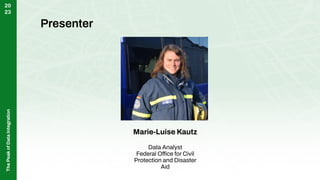
Marie-Luise Kautz
Data Analyst
Federal Office for Civil
Protection and Disaster
Aid
The
Peak
of
Data
Integration
20
23
Agenda
1. Use case - CEMS
2. Data processing – FME
3. Visualisation – GIS
4. Key take aways – Standardisation
The
Peak
of
Data
Integration
20
23
Introduction
The
Peak
of
Data
Integration
20
23
‘A map says to you. Read me
carefully, follow me closely,
doubt me not …… […]’
Beryl Markham
The
Peak
of
Data
Integration
20
23
Synchronizing information
Data integration is key to:
• Utilize heterogenous data sources
• Synchronize data
• Generate meaningful and timely information
• -> easy to read map
The
Peak
of
Data
Integration
20
23
Fast delivery of reliable information during an
emergency event
● Heterogenous and asynchronous data
● Mixed visualisation of similar data
● Time consuming layouts
● Which information is key
● Display comprehensive information
The
Peak
of
Data
Integration
20
23
Copernicus Emergency
Management Service
The
Peak
of
Data
Integration
20
23
Use case: EMS – Mapping
− Operational since April 2012
− Provides information for emergency response
− Product based on a portfolio
− Deliverables: Maps (ready-to-print) and vector package
(geographic dataset)
The
Peak
of
Data
Integration
20
23
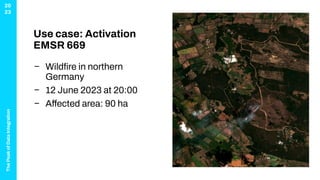
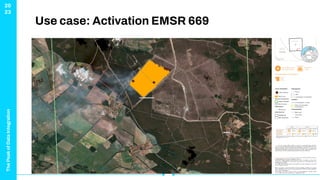
Use case: Activation
EMSR 669
− Wildfire in northern
Germany
− 12 June 2023 at 20:00
− Affected area: 90 ha
The
Peak
of
Data
Integration
20
23
Use case: Activation EMSR 669
The
Peak
of
Data
Integration
20
23
Data processing: data sources
● CEMS → vector package
● DWD WFS
○ → Windspeed
○ → Precipitation
○ → Temperature
● Copernicus Open Access Hub → Satellite image
The
Peak
of
Data
Integration
20
23
Data processing: FME - Pipeline
Trigger
• CEMS
GeoRSS
Feed
Data Collection
• Vector data
• WFS
• Raster data
Processing
• Information
extraction
• Standardised
styling
Publishing
• Near
real-time web
application
The
Peak
of
Data
Integration
20
23
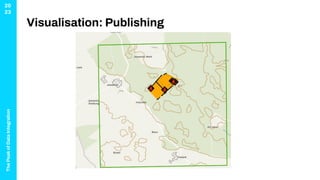
Visualisation: Publishing
The
Peak
of
Data
Integration
20
23
Conclusion
The
Peak
of
Data
Integration
20
23
key takeaways – standardization
● Integrating data is key to gain a comprehensive
spatiotemporal view
● Standardization is essential for data
○ Especially during time sensitive events
● Visualisation standards, guidelines create confidence in
maps and the depicted information
The
Peak
of
Data
Integration
20
23
Resources
● Include resources for attendees to get started with
● Copernicus Emergency Management Service
● Copernicus Open Access Hub
ThankYou!
davis@bbk.bund.de

Rapid Visualization of Emergency Data