MUSA AL-HAWAMDAH / 128129001011
          15-10-2012
What is random forests
 An ensemble classifier using many
 decision tree models.
 Can be used for classification or
 Regression.
 Accuracy and variable importance
 information is provided with the results.
The Algorithm
 Let the number of training cases be N, and the number of
  variables in the classifier be M.

 The number m of input variables are used to determine the
  decision at a node of the tree; m should be much less than M.

 Choose a training set for this tree by choosing N times with
  replacement from all N available training cases. Use the rest of the
  cases to estimate the error of the tree, by predicting their classes.

 For each node of the tree, randomly choose m variables on which
  to base the decision at that node. Calculate the best split based on
  these m variables in the training set.

 Each tree is fully grown and not pruned.
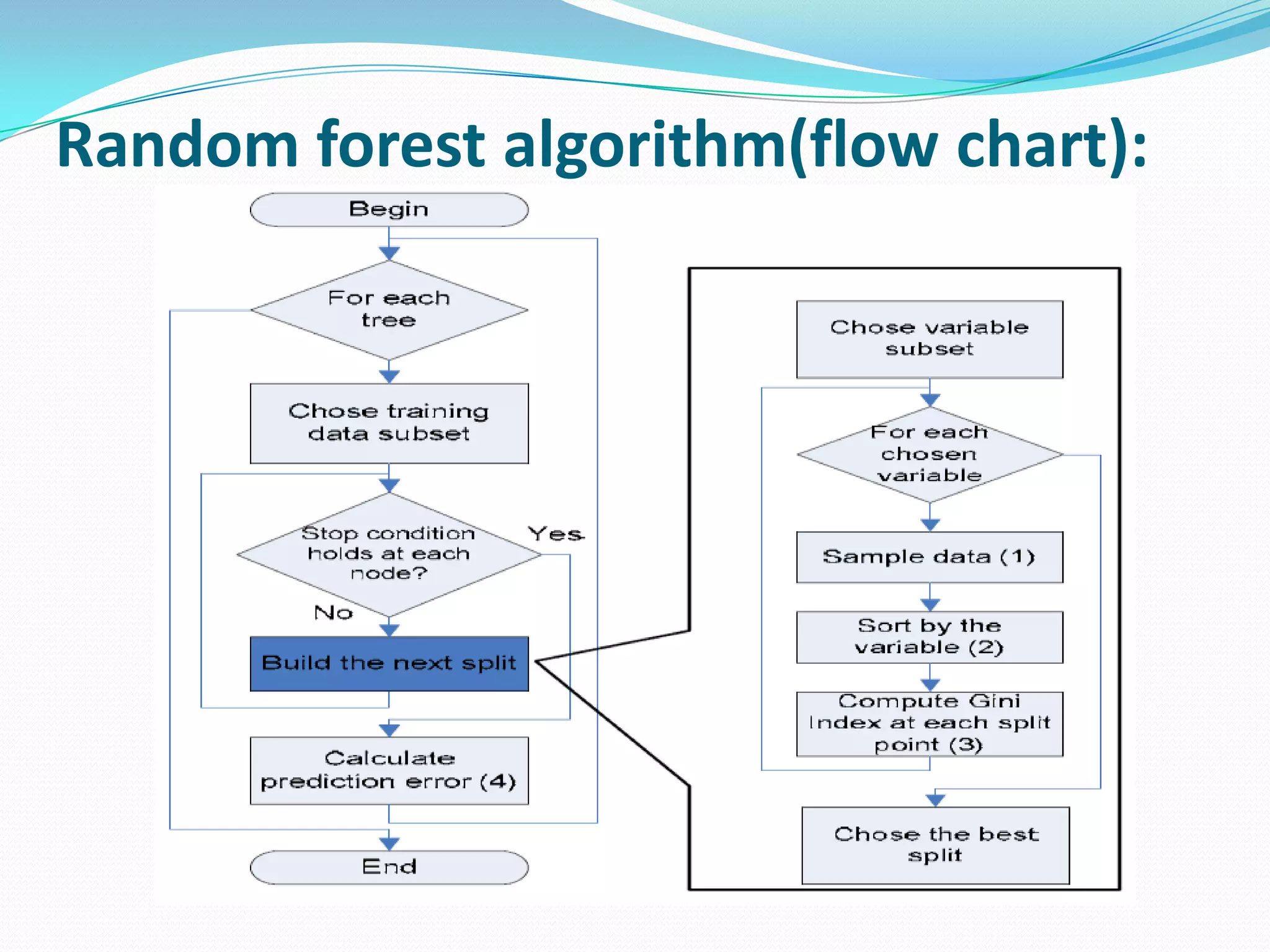
Random forest algorithm(flow chart):
Advantages
 It produces a highly accurate classifier and learning is fast

 It runs efficiently on large data bases.

 It can handle thousands of input variables without
variable deletion.

 It computes proximities between pairs of cases that
can be used in clustering, locating outliers or (by scaling)
give interesting views of the data.

 It offers an experimental method for detecting
variable interactions.
 A Random Forest is a classifier consisting of a
 collection of tree-structured classifiers {h(x, Θk ), k =
 1....}where the Θk are independently, identically
 distributed random trees and each tree casts a unit
 vote for the final classification of input x. Like
 CART, Random Forest uses the gini index for
 determining the final class in each tree.

 The final class of each tree is aggregated and voted by
 weighted values to construct the final classifier.
Gini Index
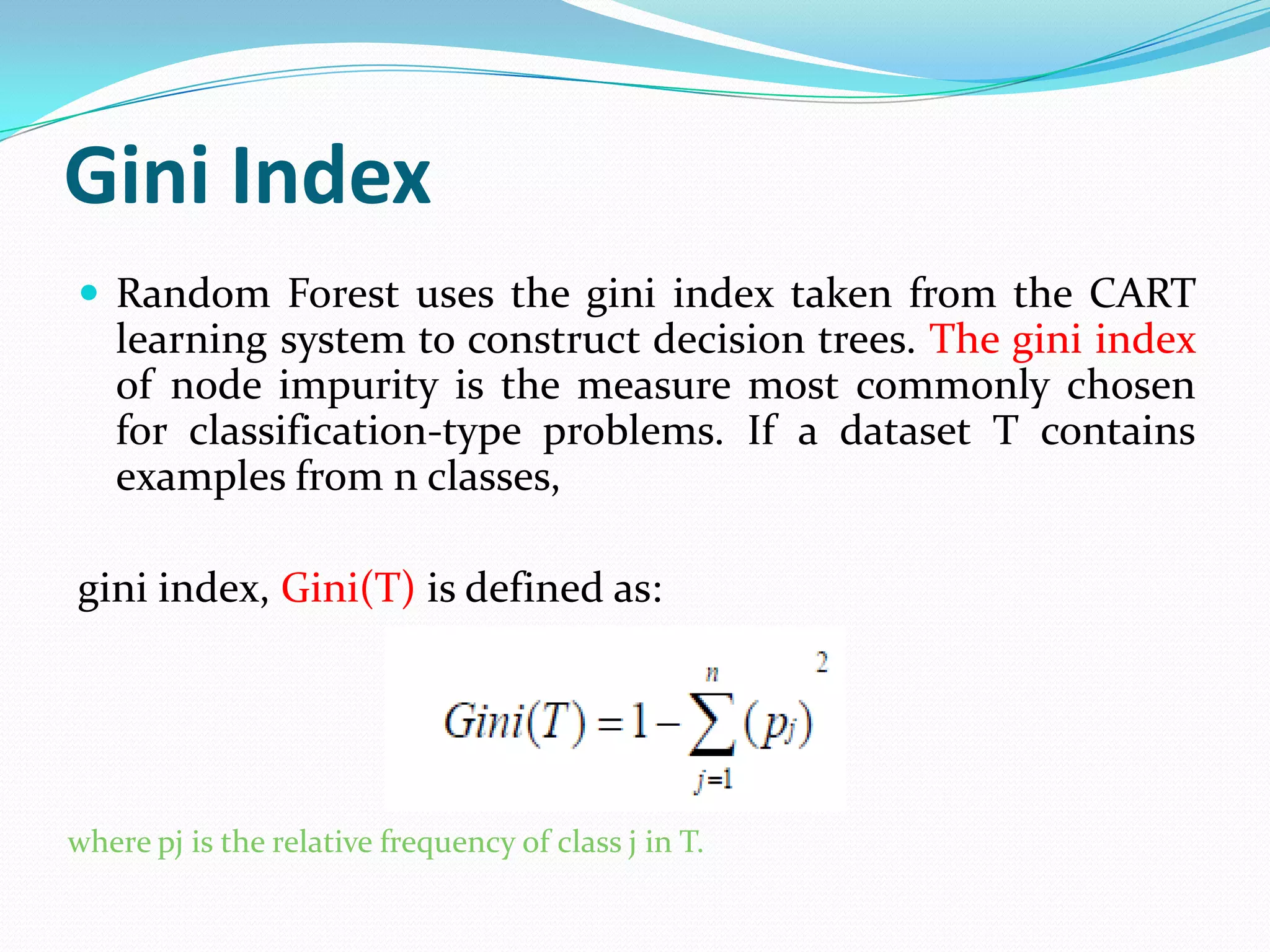
 Random Forest uses the gini index taken from the CART
   learning system to construct decision trees. The gini index
   of node impurity is the measure most commonly chosen
   for classification-type problems. If a dataset T contains
   examples from n classes,

gini index, Gini(T) is defined as:


where pj is the relative frequency of class j in T.
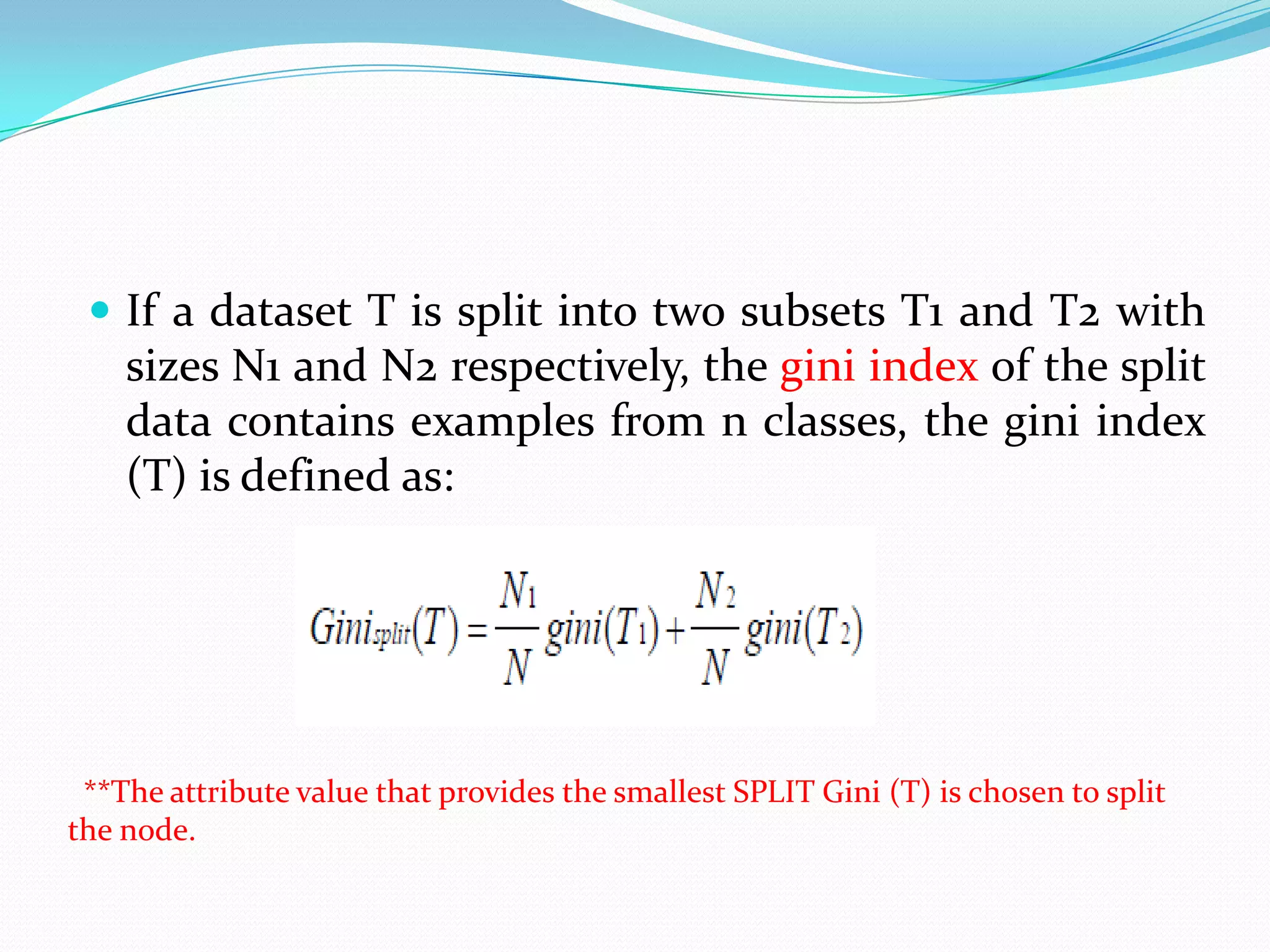
 If a dataset T is split into two subsets T1 and T2 with
    sizes N1 and N2 respectively, the gini index of the split
    data contains examples from n classes, the gini index
    (T) is defined as:


 **The attribute value that provides the smallest SPLIT Gini (T) is chosen to split
the node.
Operation of Random Forest
 The working of random forest algorithm is as follows.

1. A random seed is chosen which pulls out at random a
   collection of samples from the training dataset while
   maintaining the class distribution.

2. With this selected data set, a random set of attributes
  from the original data set is chosen based on user
  defined values. All the input variables are not
  considered because of enormous computation and
  high chances of over fitting.
3. In a dataset where M is the total number of input
 attributes in the dataset, only R attributes are chosen
 at random for each tree where R< M.

4. The attributes from this set creates the best possible
 split using the gini index to develop a decision tree
 model. The process repeats for each of the branches
 until the termination condition stating that leaves are
 the nodes that are too small to split.
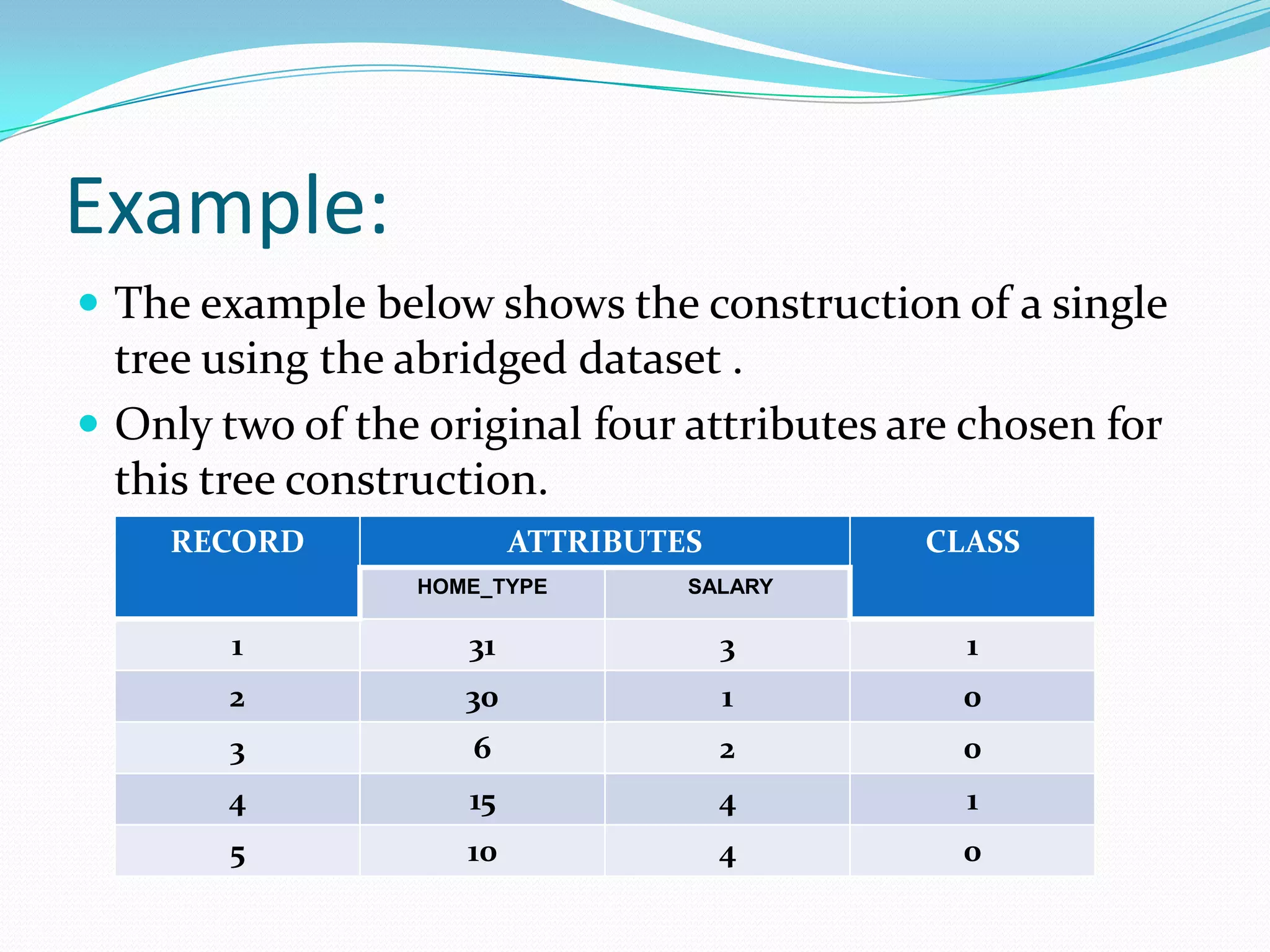
Example:
 The example below shows the construction of a single
  tree using the abridged dataset .
 Only two of the original four attributes are chosen for
  this tree construction.
    RECORD               ATTRIBUTES         CLASS
                 HOME_TYPE        SALARY

        1           31                3       1
        2           30                1       0
        3           6                 2       0
        4           15                4       1
        5           10                4       0
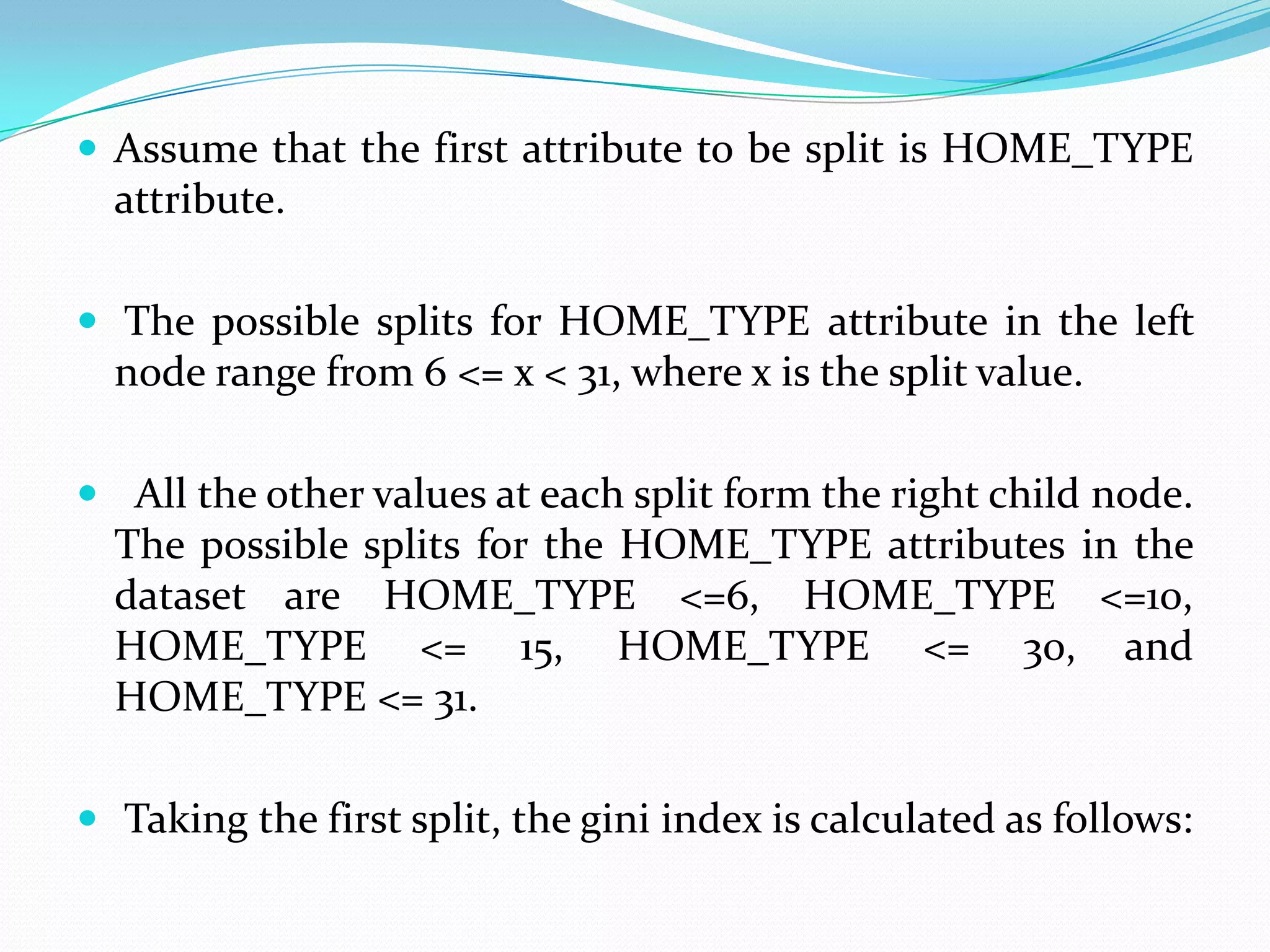
 Assume that the first attribute to be split is HOME_TYPE
  attribute.

 The possible splits for HOME_TYPE attribute in the left
  node range from 6 <= x < 31, where x is the split value.

 All the other values at each split form the right child node.
  The possible splits for the HOME_TYPE attributes in the
  dataset are HOME_TYPE <=6, HOME_TYPE <=10,
  HOME_TYPE <= 15, HOME_TYPE <= 30, and
  HOME_TYPE <= 31.

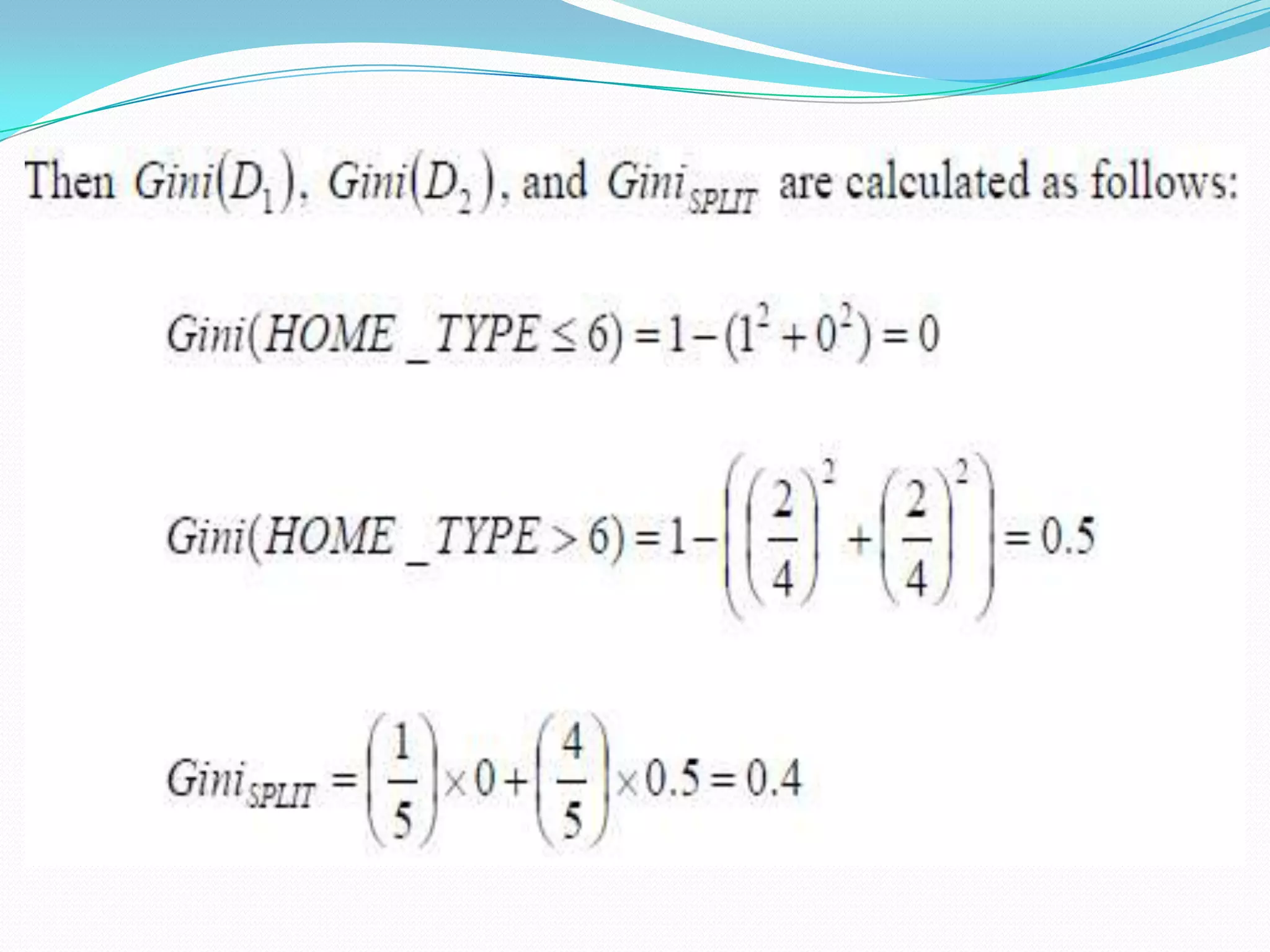
 Taking the first split, the gini index is calculated as follows:
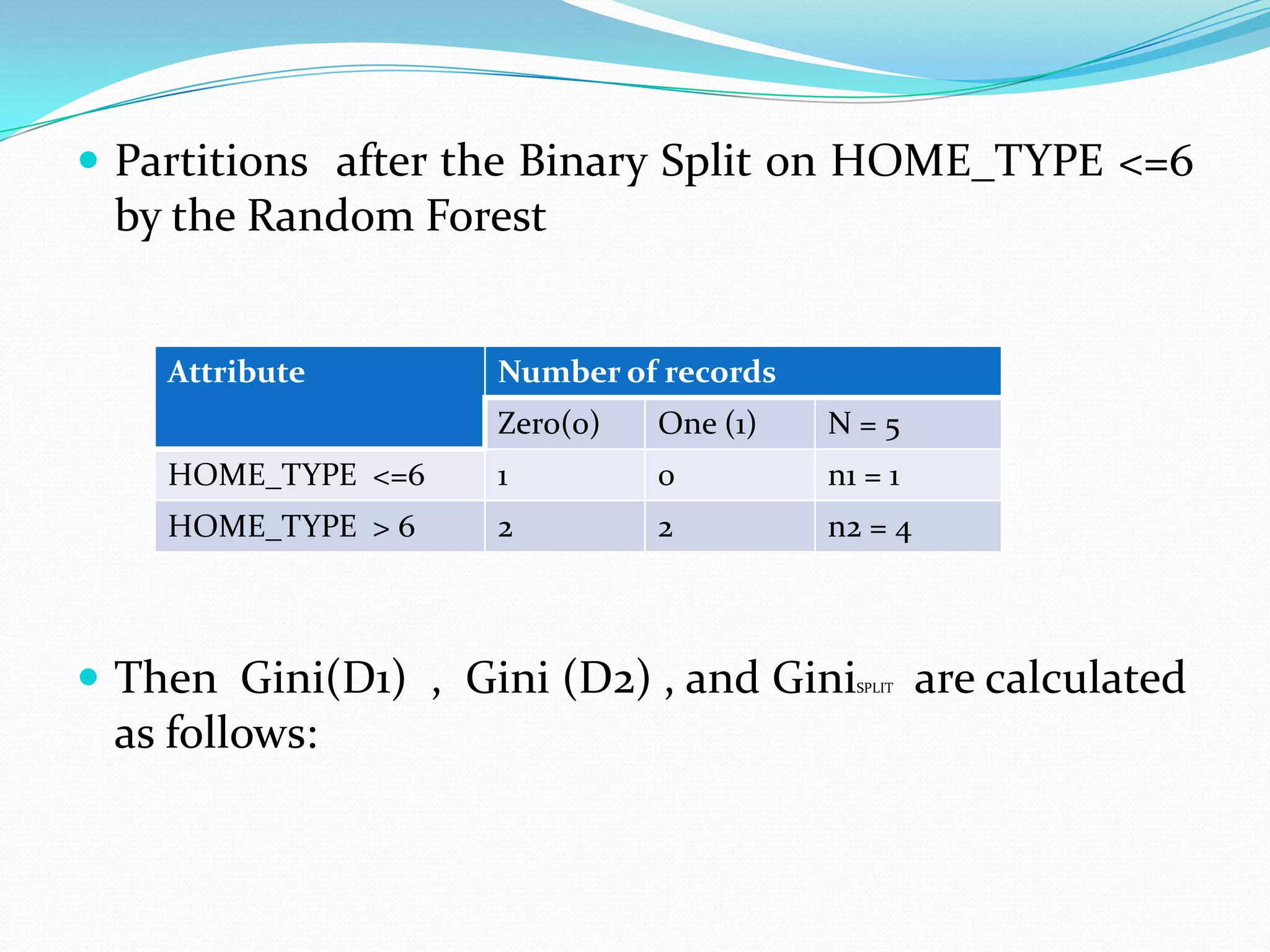
 Partitions after the Binary Split on HOME_TYPE <=6
 by the Random Forest


    Attribute       Number of records
                    Zero(0)   One (1)   N=5
    HOME_TYPE <=6   1         0         n1 = 1
    HOME_TYPE > 6   2         2         n2 = 4


 Then Gini(D1) , Gini (D2) , and Gini    SPLIT   are calculated
 as follows:
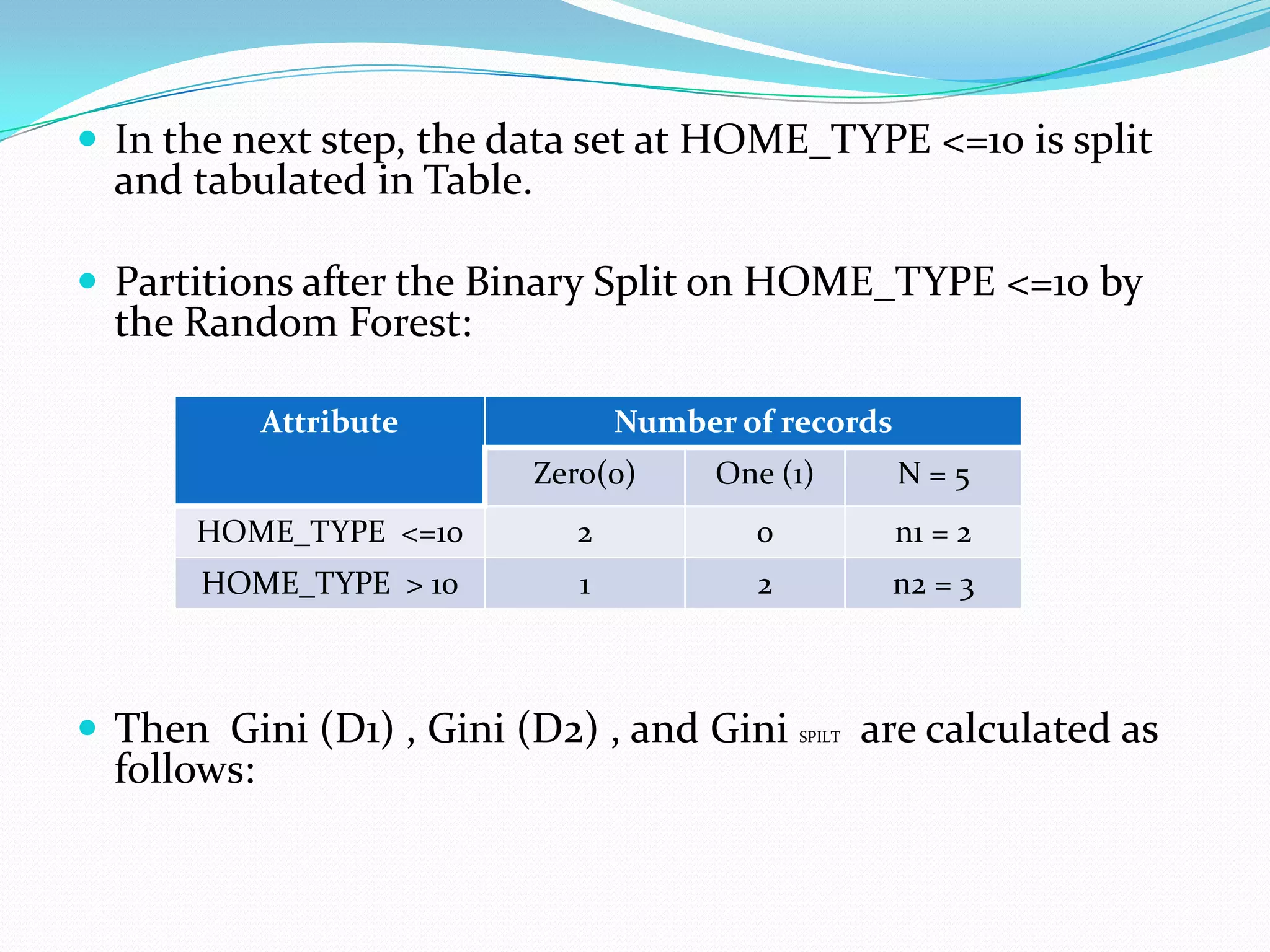
 In the next step, the data set at HOME_TYPE <=10 is split
  and tabulated in Table.

 Partitions after the Binary Split on HOME_TYPE <=10 by
  the Random Forest:

             Attribute             Number of records
                            Zero(0)      One (1)         N=5
      HOME_TYPE <=10          2            0            n1 = 2
      HOME_TYPE > 10           1           2            n2 = 3


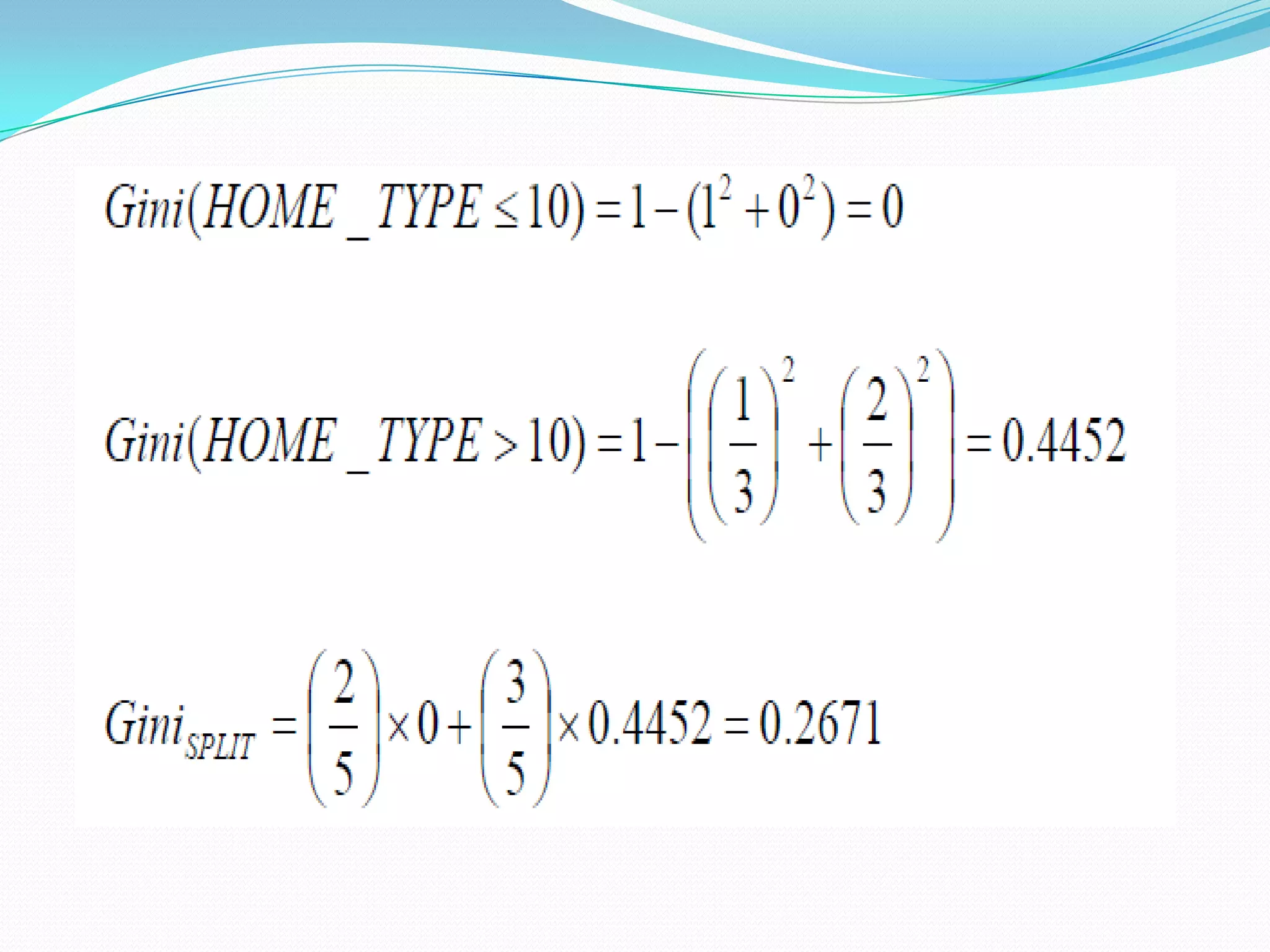
 Then Gini (D1) , Gini (D2) , and Gini        SPILT   are calculated as
  follows:
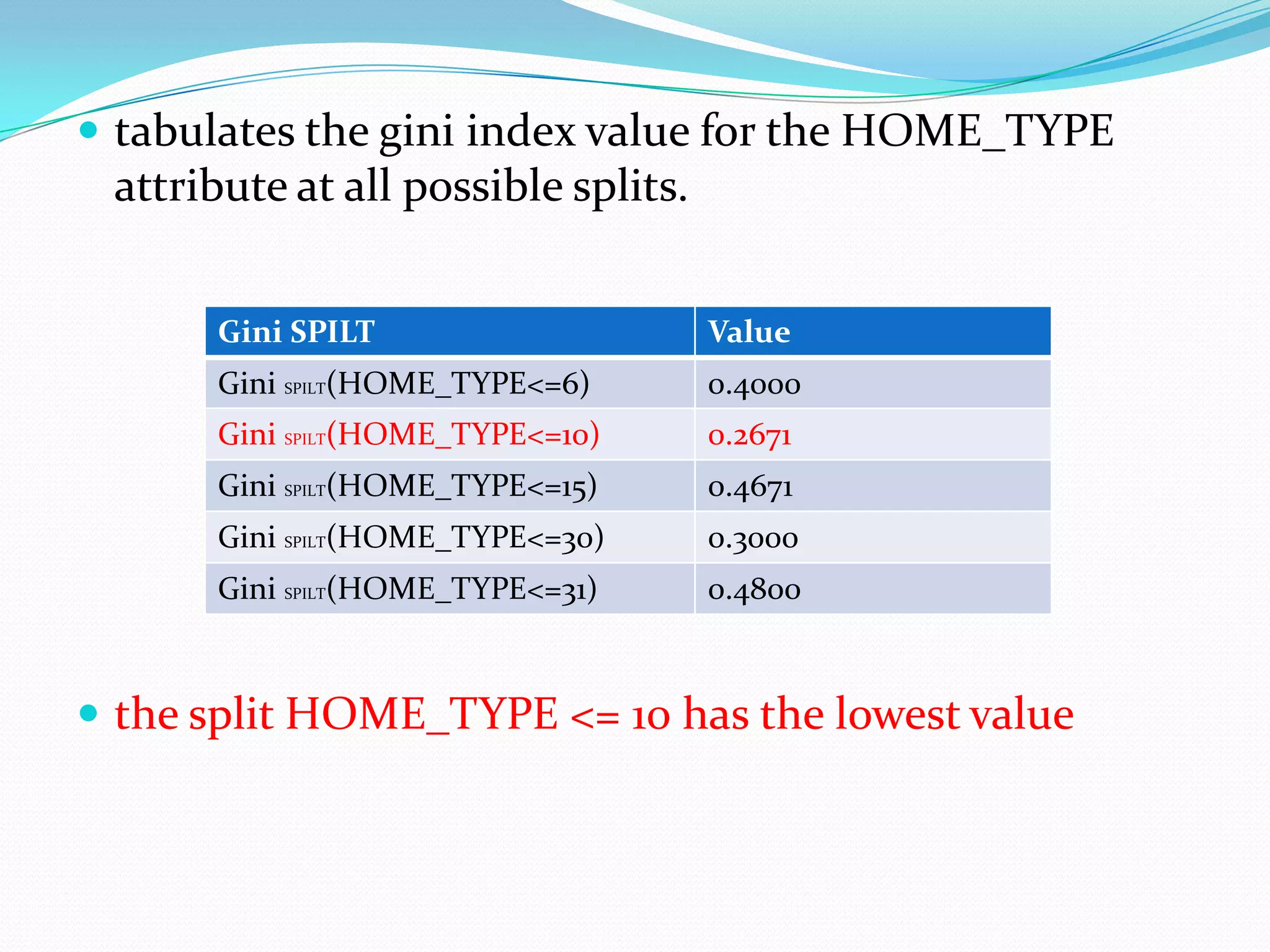
 tabulates the gini index value for the HOME_TYPE
 attribute at all possible splits.


      Gini SPILT                     Value
      Gini SPILT(HOME_TYPE<=6)       0.4000
      Gini SPILT(HOME_TYPE<=10)      0.2671
      Gini SPILT(HOME_TYPE<=15)      0.4671
      Gini SPILT(HOME_TYPE<=30)      0.3000
      Gini SPILT(HOME_TYPE<=31)      0.4800


 the split HOME_TYPE <= 10 has the lowest value
 In Random Forest, the split at which
  the gini index is lowest is chosen at
  the split value.

 However, since the values of the
  HOME_TYPE           attribute     are
  continuous in nature, the midpoint
  of every pair of consecutive values is
  chosen as the best split point.

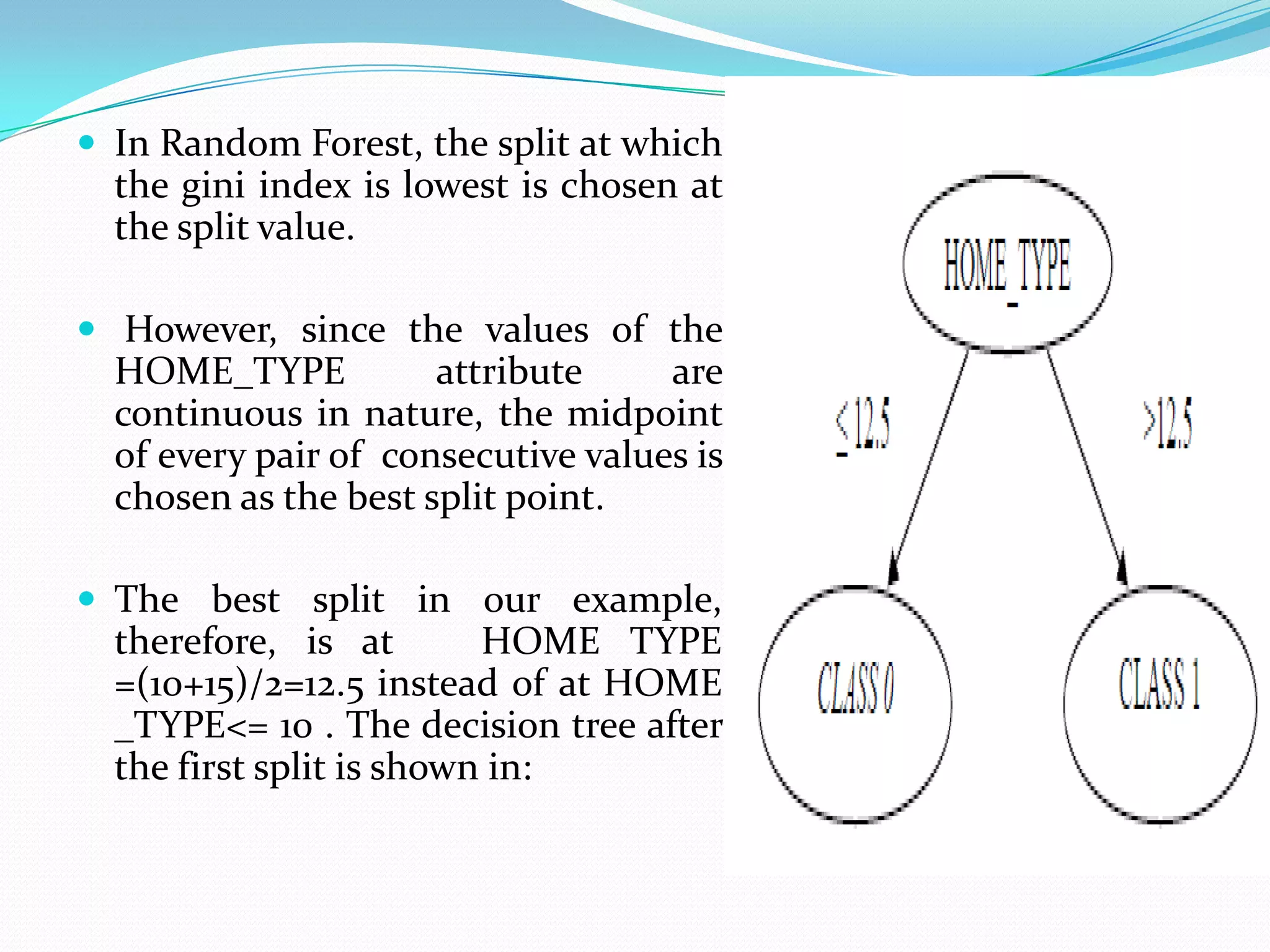
 The best split in our example,
  therefore, is at        HOME TYPE
  =(10+15)/2=12.5 instead of at HOME
  _TYPE<= 10 . The decision tree after
  the first split is shown in:
 This procedure is repeated for the remaining attributes
 in the dataset.

 In this example, the gini index values of the second
 attribute SALARY are calculated.

 The lowest value of the gini index is chosen as the best
 split for the attribute.

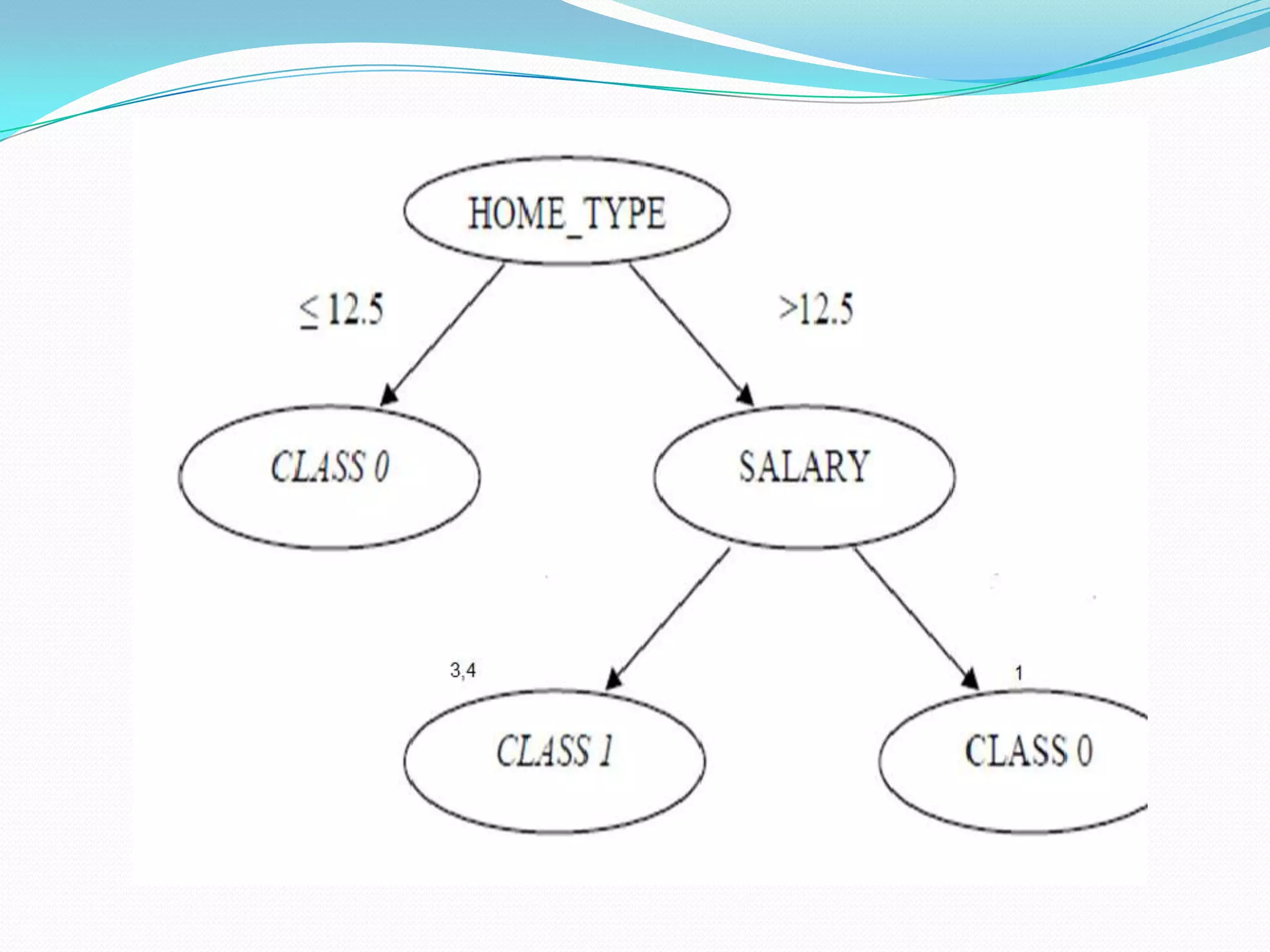
 The final decision trees shown in:
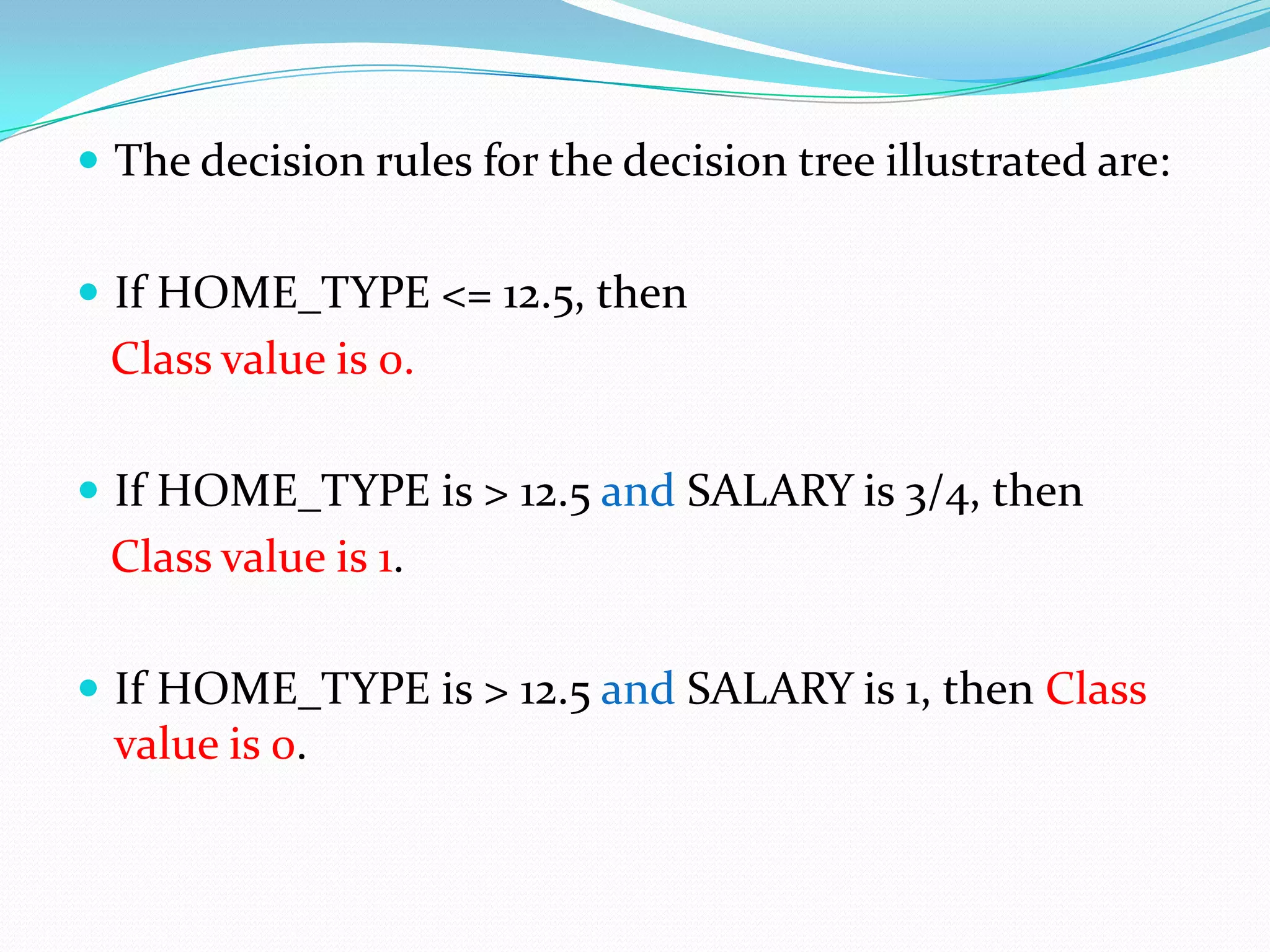
 The decision rules for the decision tree illustrated are:


 If HOME_TYPE <= 12.5, then
 Class value is 0.

 If HOME_TYPE is > 12.5 and SALARY is 3/4, then
 Class value is 1.

 If HOME_TYPE is > 12.5 and SALARY is 1, then Class
  value is 0.
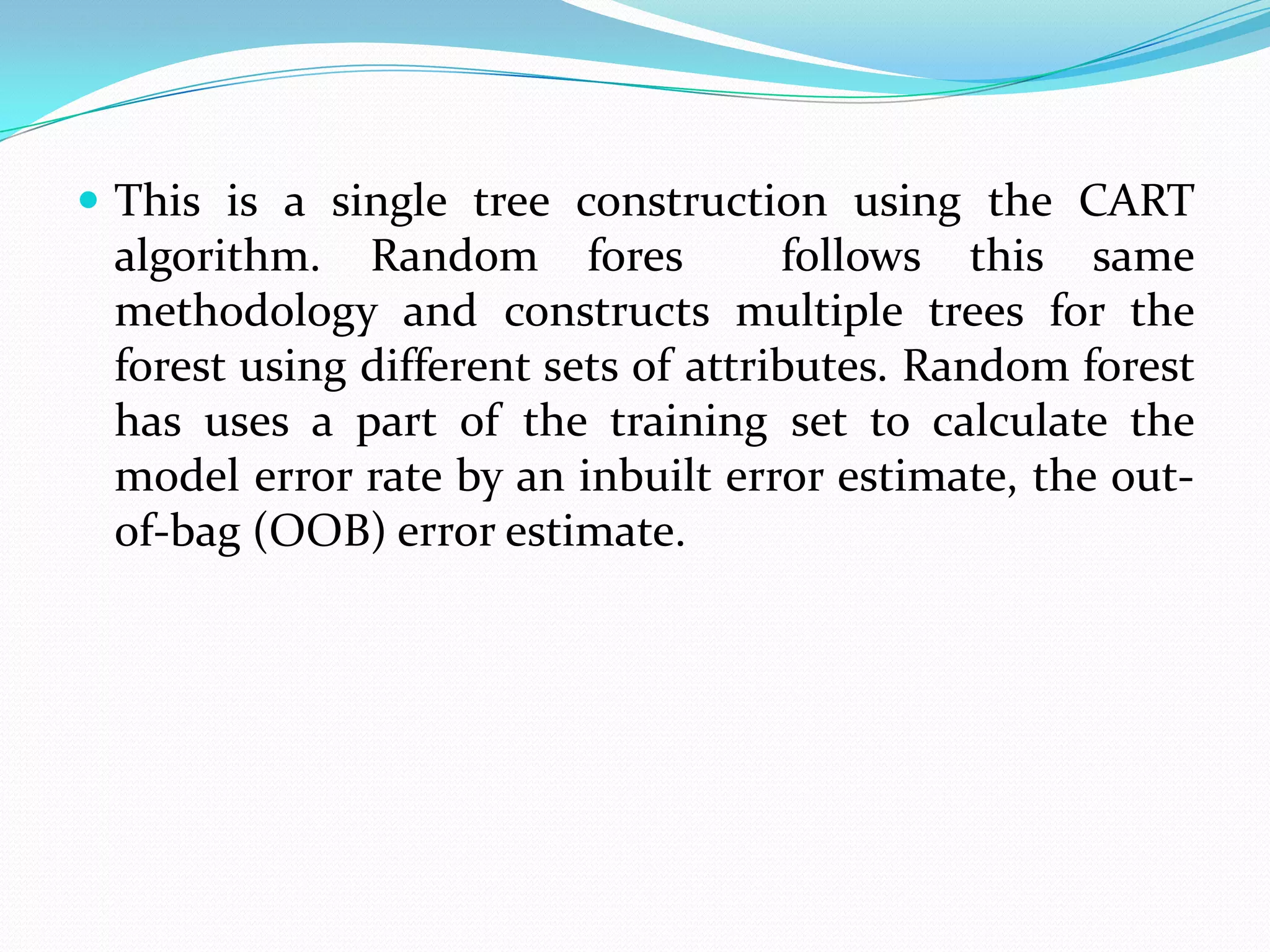
 This is a single tree construction using the CART
 algorithm. Random fores             follows this same
 methodology and constructs multiple trees for the
 forest using different sets of attributes. Random forest
 has uses a part of the training set to calculate the
 model error rate by an inbuilt error estimate, the out-
 of-bag (OOB) error estimate.
THANK YOU

Random forest

  • 1.
    MUSA AL-HAWAMDAH /128129001011 15-10-2012
  • 2.
    What is randomforests  An ensemble classifier using many decision tree models.  Can be used for classification or Regression.  Accuracy and variable importance information is provided with the results.
  • 3.
    The Algorithm  Letthe number of training cases be N, and the number of variables in the classifier be M.  The number m of input variables are used to determine the decision at a node of the tree; m should be much less than M.  Choose a training set for this tree by choosing N times with replacement from all N available training cases. Use the rest of the cases to estimate the error of the tree, by predicting their classes.  For each node of the tree, randomly choose m variables on which to base the decision at that node. Calculate the best split based on these m variables in the training set.  Each tree is fully grown and not pruned.
  • 4.
  • 5.
    Advantages  It producesa highly accurate classifier and learning is fast  It runs efficiently on large data bases.  It can handle thousands of input variables without variable deletion.  It computes proximities between pairs of cases that can be used in clustering, locating outliers or (by scaling) give interesting views of the data.  It offers an experimental method for detecting variable interactions.
  • 6.
     A RandomForest is a classifier consisting of a collection of tree-structured classifiers {h(x, Θk ), k = 1....}where the Θk are independently, identically distributed random trees and each tree casts a unit vote for the final classification of input x. Like CART, Random Forest uses the gini index for determining the final class in each tree.  The final class of each tree is aggregated and voted by weighted values to construct the final classifier.
  • 7.
    Gini Index  RandomForest uses the gini index taken from the CART learning system to construct decision trees. The gini index of node impurity is the measure most commonly chosen for classification-type problems. If a dataset T contains examples from n classes, gini index, Gini(T) is defined as: where pj is the relative frequency of class j in T.
  • 8.
     If adataset T is split into two subsets T1 and T2 with sizes N1 and N2 respectively, the gini index of the split data contains examples from n classes, the gini index (T) is defined as: **The attribute value that provides the smallest SPLIT Gini (T) is chosen to split the node.
  • 9.
    Operation of RandomForest  The working of random forest algorithm is as follows. 1. A random seed is chosen which pulls out at random a collection of samples from the training dataset while maintaining the class distribution. 2. With this selected data set, a random set of attributes from the original data set is chosen based on user defined values. All the input variables are not considered because of enormous computation and high chances of over fitting.
  • 10.
    3. In adataset where M is the total number of input attributes in the dataset, only R attributes are chosen at random for each tree where R< M. 4. The attributes from this set creates the best possible split using the gini index to develop a decision tree model. The process repeats for each of the branches until the termination condition stating that leaves are the nodes that are too small to split.
  • 11.
    Example:  The examplebelow shows the construction of a single tree using the abridged dataset .  Only two of the original four attributes are chosen for this tree construction. RECORD ATTRIBUTES CLASS HOME_TYPE SALARY 1 31 3 1 2 30 1 0 3 6 2 0 4 15 4 1 5 10 4 0
  • 12.
     Assume thatthe first attribute to be split is HOME_TYPE attribute.  The possible splits for HOME_TYPE attribute in the left node range from 6 <= x < 31, where x is the split value.  All the other values at each split form the right child node. The possible splits for the HOME_TYPE attributes in the dataset are HOME_TYPE <=6, HOME_TYPE <=10, HOME_TYPE <= 15, HOME_TYPE <= 30, and HOME_TYPE <= 31.  Taking the first split, the gini index is calculated as follows:
  • 13.
     Partitions afterthe Binary Split on HOME_TYPE <=6 by the Random Forest Attribute Number of records Zero(0) One (1) N=5 HOME_TYPE <=6 1 0 n1 = 1 HOME_TYPE > 6 2 2 n2 = 4  Then Gini(D1) , Gini (D2) , and Gini SPLIT are calculated as follows:
  • 15.
     In thenext step, the data set at HOME_TYPE <=10 is split and tabulated in Table.  Partitions after the Binary Split on HOME_TYPE <=10 by the Random Forest: Attribute Number of records Zero(0) One (1) N=5 HOME_TYPE <=10 2 0 n1 = 2 HOME_TYPE > 10 1 2 n2 = 3  Then Gini (D1) , Gini (D2) , and Gini SPILT are calculated as follows:
  • 17.
     tabulates thegini index value for the HOME_TYPE attribute at all possible splits. Gini SPILT Value Gini SPILT(HOME_TYPE<=6) 0.4000 Gini SPILT(HOME_TYPE<=10) 0.2671 Gini SPILT(HOME_TYPE<=15) 0.4671 Gini SPILT(HOME_TYPE<=30) 0.3000 Gini SPILT(HOME_TYPE<=31) 0.4800  the split HOME_TYPE <= 10 has the lowest value
  • 18.
     In RandomForest, the split at which the gini index is lowest is chosen at the split value.  However, since the values of the HOME_TYPE attribute are continuous in nature, the midpoint of every pair of consecutive values is chosen as the best split point.  The best split in our example, therefore, is at HOME TYPE =(10+15)/2=12.5 instead of at HOME _TYPE<= 10 . The decision tree after the first split is shown in:
  • 19.
     This procedureis repeated for the remaining attributes in the dataset.  In this example, the gini index values of the second attribute SALARY are calculated.  The lowest value of the gini index is chosen as the best split for the attribute.  The final decision trees shown in:
  • 21.
     The decisionrules for the decision tree illustrated are:  If HOME_TYPE <= 12.5, then Class value is 0.  If HOME_TYPE is > 12.5 and SALARY is 3/4, then Class value is 1.  If HOME_TYPE is > 12.5 and SALARY is 1, then Class value is 0.
  • 22.
     This isa single tree construction using the CART algorithm. Random fores follows this same methodology and constructs multiple trees for the forest using different sets of attributes. Random forest has uses a part of the training set to calculate the model error rate by an inbuilt error estimate, the out- of-bag (OOB) error estimate.
  • 23.