Introduction To Composite
Materials
Ramkaran yadav
Introduction to Composites
1. What is the matrix in a composite and what materials are commonly
used as a matrix?
2. What is reinforcement in composites ?
3. Be able to decide different factors responsible for properties of
composite.
4. Know the equation for the critical length (Lc) of a fiber..
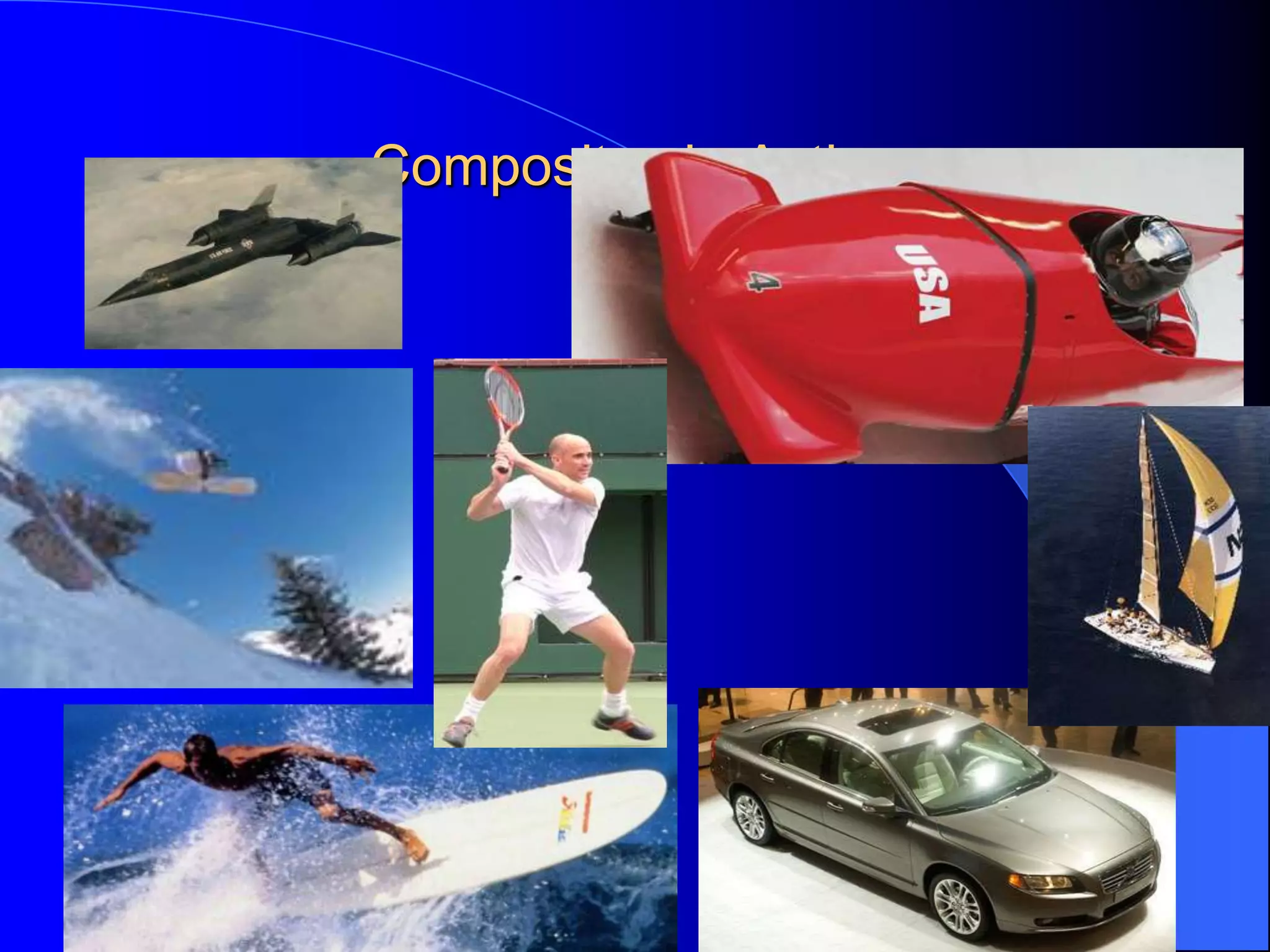
Composites in Action
Composite Material
Two inherently different materials
that when combined together produce
a material with properties that exceed
the constituent materials.
Fiber Reinforced Polymer Matrix
Matrix
•Transfer Load to Reinforcement
•Temperature Resistance
•Chemical Resistance
Reinforcement
•Tensile Properties
•Stiffness
•Impact Resistance
Matrix Considerations
 End Use Temperature
Toughness
Cosmetic Issues
Flame Retardant
Processing Method
Adhesion Requirements
Matrix Materials
 Functions of the matrix
– Transmit force between fibers
– arrest cracks from spreading between fibers
 do not carry most of the load
– hold fibers in proper orientation
– protect fibers from environment
 mechanical forces can cause cracks that allow environment to
affect fibers
 Demands on matrix
– Interlaminar shear strength
– Toughness
– Moisture/environmental resistance
– Temperature properties
– Cost
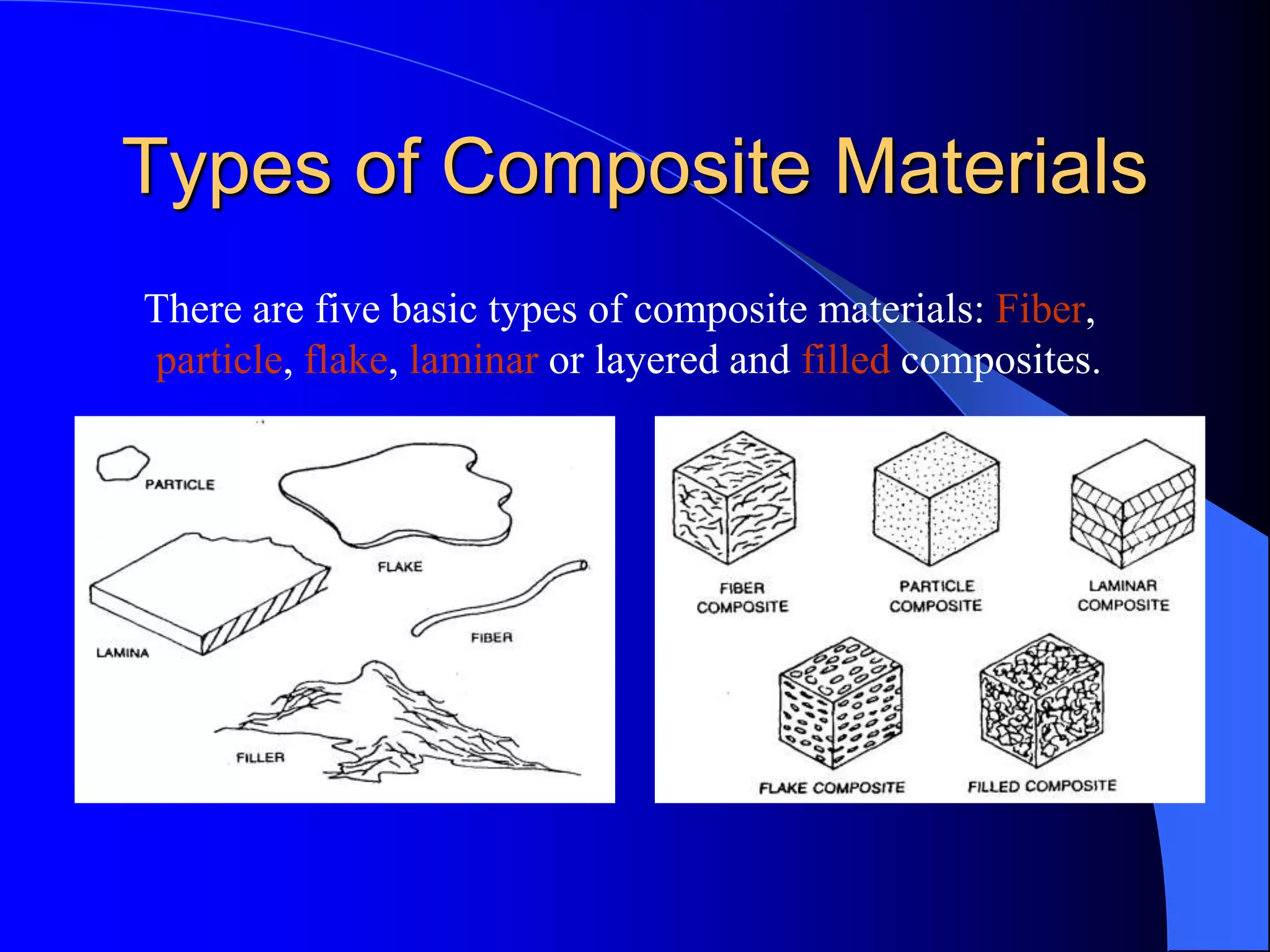
Types of Composite Materials
There are five basic types of composite materials: Fiber,
particle, flake, laminar or layered and filled composites.
A. Fiber Composites
In fiber composites, the fibers reinforce along the line of their
length. Reinforcement may be mainly 1-D, 2-D or 3-D. Figure
shows the three basic types of fiber orientation.
 1-D gives maximum strength in one
direction.
 2-D gives strength in two directions.
 Isotropic gives strength equally in all
directions.
B. Particle Composites
 Particles usually reinforce a composite equally in all directions (called
isotropic). Plastics, cermets and metals are examples of particles.
 Particles used to strengthen a matrix do not do so in the same way as
fibers. For one thing, particles are not directional like fibers. Spread at
random through out a matrix, particles tend to reinforce in all
directions equally.
 Cermets
(1) Oxide–Based cermets
(e.g. Combination of Al2O3 with Cr)
(2) Carbide–Based Cermets
(e.g. Tungsten–carbide, titanium–carbide)
 Metal–plastic particle composites
(e.g. Aluminum, iron & steel, copper particles)
 Metal–in–metal Particle Composites and Dispersion
Hardened Alloys
(e.g. Ceramic–oxide particles)
C. Laminar Composites - 1
Laminar composites involve two or more layers of
the same or different materials. The layers can be
arranged in different directions to give strength
where needed. Speedboat hulls are among the very
many products of this kind.
D. Combined Composites
 It is possible to combine several
different materials into a single
composite. It is also possible to
combine several different
composites into a single
product. A good example is a
modern ski. (combination of
wood as natural fiber, and layers
as laminar composites)
E. Filled Composites
 There are two types of filled composites. In one,
filler materials are added to a normal composite
result in strengthening the composite and reducing
weight. The second type of filled composite
consists of a skeletal 3-D matrix holding a second
material. The most widely used composites of this
kind are sandwich structures and honeycombs.
Types of Composites
Matrix
phase/Reinforc
ement Phase
Metal Ceramic Polymer
Metal Powder metallurgy
parts – combining
immiscible metals
Cermets (ceramic-
metal composite)
Brake pads
Ceramic Cermets, TiC, TiCN
Cemented carbides –
used in tools
Fiber-reinforced
metals
SiC reinforced
Al2O3
Tool materials
Fiberglass
Polymer Kevlar fibers in
an epoxy matrix
Elemental
(Carbon,
Boron, etc.)
Fiber reinforced
metals
Auto parts
aerospace
Rubber with
carbon (tires)
Boron, Carbon
reinforced plastics
MMC’s CMC’s PMC’s
Metal Matrix Composites Ceramic Matrix Comp’s. Polymer Matrix Comp’s
Ken Youssefi Mechanical Engineering Dept. 15
Composites – Metal Matrix
The metal matrix composites offer higher modulus of
elasticity, ductility, and resistance to elevated temperature
than polymer matrix composites. But, they are heavier
and more difficult to process.
Design Objective
Performance: Strength, Temperature, Stiffness
Manufacturing Techniques
Life Cycle Considerations
Cost
Matrix Types
Epoxy
Epoxies have improved strength and stiffness properties
over polyesters. Epoxies offer excellent corrosion
resistance and resistance to solvents and alkalis. Cure
cycles are usually longer than polyesters, however no
by-products are produced.
Flexibility and improved performance is also achieved
by the utilization of additives and fillers.
Reinforcement
Fiber Type
Fiberglass
Carbon
Aramid
Textile Structure
Unidirectional
Woven
Braid
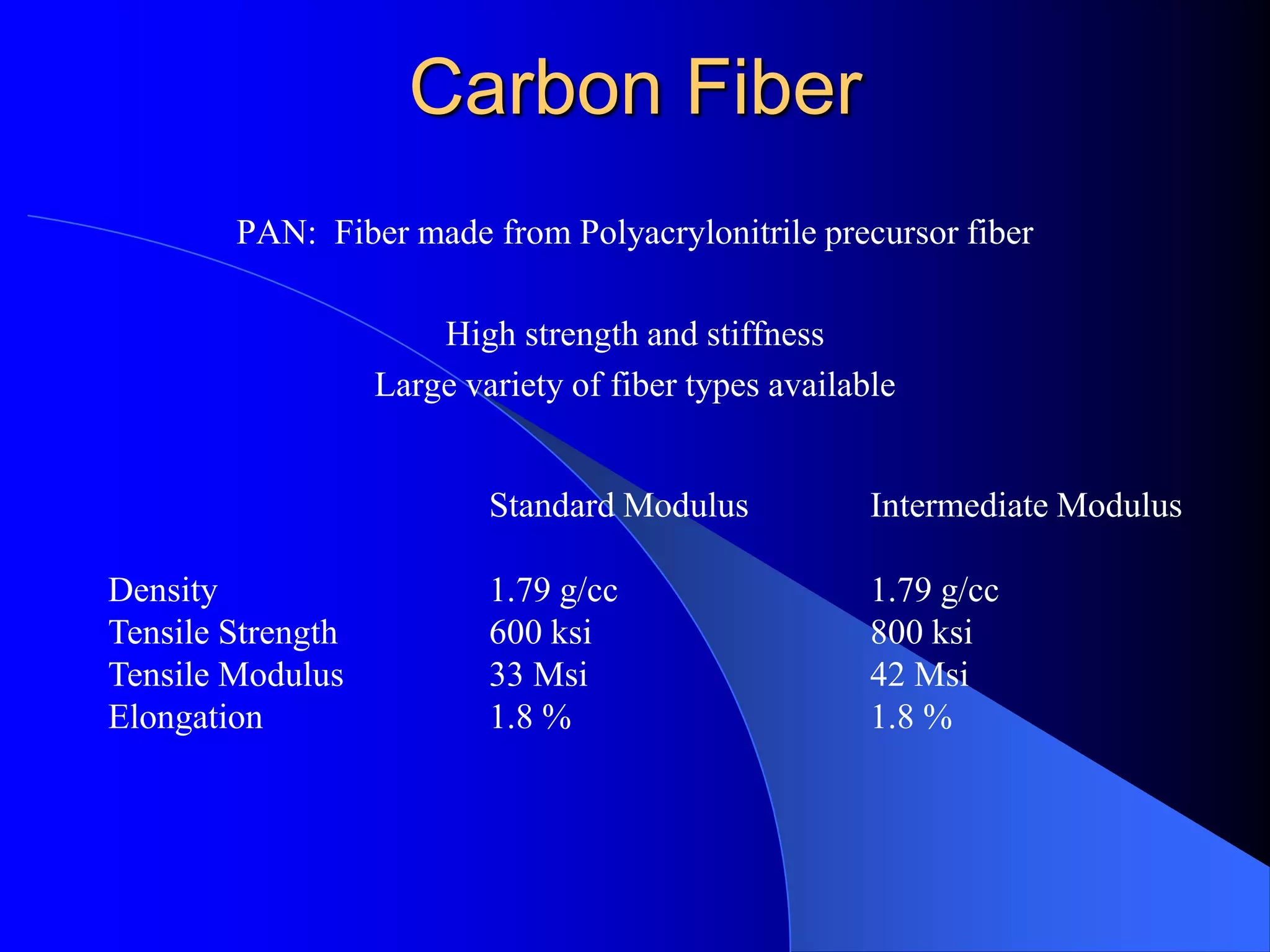
Carbon Fiber
PAN: Fiber made from Polyacrylonitrile precursor fiber
High strength and stiffness
Large variety of fiber types available
Standard Modulus Intermediate Modulus
Density 1.79 g/cc 1.79 g/cc
Tensile Strength 600 ksi 800 ksi
Tensile Modulus 33 Msi 42 Msi
Elongation 1.8 % 1.8 %
Mechanical Engineering Dept. 20
Composites – Ceramic Matrix
Ceramic matrix composites (CMC) are used in applications where
resistance to high temperature and corrosive environment is desired.
CMCs are strong and stiff but they lack toughness (ductility)
Matrix materials are usually silicon carbide, silicon nitride and
aluminum oxide, and mullite (compound of aluminum, silicon and
oxygen). They retain their strength up to 3000 o
F.
Fiber materials used commonly are carbon and aluminum oxide.
Applications are in jet and automobile engines, deep-see mining,
cutting tools, dies and pressure vessels.
Ken Youssefi Mechanical Engineering Dept. 21
Application of Composites
Pedestrian bridge in
Denmark, 130 feet
long (1997)
Swedish Navy,
Stealth (2005)
Lance Armstrong’s
2-lb. Trek bike,
2004 Tour de
France
Ken Youssefi Mechanical Engineering Dept. 22
Application of Composites in
Aircraft Industry
20% more fuel
efficiency and
35,000 lbs. lighter
23
Advantages of Composites
Composites have a higher specific strength than many other materials. A distinct
advantage of composites over other materials is the ability to use many
combinations of resins and reinforcements, and therefore custom tailor the
mechanical and physical properties of a structure.
Higher Specific Strength (strength-to-weight ratio)
The lowest properties for each material are associated with simple manufacturing processes
and material forms (e.g. spray lay-up glass fibre), and the higher properties are associated
with higher technology manufacture (e.g. autoclave moulding of unidirectional glass fibre),
the aerospace industry.
Mechanical Engineering Dept. 24
Advantages of Composites
Composites have an advantage over other materials because they can be
molded into complex shapes at relatively low cost. This gives designers the
freedom to create any shape or configuration. Boats are a good example of
the success of composites.
Design flexibility
Composites products provide long-term resistance to severe chemical and
temperature environments. Composites are the material of choice for
outdoor exposure, chemical handling applications, and severe environment
service.
Corrosion Resistance
Mechanical Engineering Dept. 25
Advantages of Composites
One reason the composites industry has been successful is because of
the low relative investment in setting-up a composites manufacturing
facility. This has resulted in many creative and innovative companies in
the field.
Low Relative Investment
Composite products and structures have an exceedingly long life span.
Coupled with low maintenance requirements, the longevity of composites is a
benefit in critical applications. In a half-century of composites development,
well-designed composite structures have yet to wear out.
Durability
In 1947 the U.S. Coast Guard built a series of forty-foot patrol boats,
using polyester resin and glass fiber. These boats were used until the
early 1970s when they were taken out of service because the design was
outdated. Extensive testing was done on the laminates after
decommissioning, and it was found that only 2-3% of the original
strength was lost after twenty-five years of hard service.
Mechanical Engineering Dept. 26
Disadvantages of Composites
The experience and intuition gained over the years about the behavior of
metallic materials does not apply to composite materials.
properties in composites vary from point to point in the material.
Most engineering structural materials are homogeneous.
Composites are heterogeneous
Composites are highly anisotropic
The strength in composites vary as the direction along which we
measure changes (most engineering structural materials are isotropic).
As a result, all other properties such as, stiffness, thermal expansion,
thermal and electrical conductivity and creep resistance are also
anisotropic. The relationship between stress and strain (force and
deformation) is much more complicated than in isotropic materials.
Mechanical Engineering Dept. 27
Disadvantages of Composites
Composites materials are difficult to inspect with conventional ultrasonic,
eddy current and visual NDI methods such as radiography.
American Airlines Flight 587, broke apart over
New York on Nov. 12, 2001 (265 people died).
Airbus A300’s 27-foot-high tail fin tore off.
Much of the tail fin, including the so-called
tongues that fit in grooves on the fuselage and
connect the tail to the jet, were made of a
graphite composite. The plane crashed because
of damage at the base of the tail that had gone
undetected despite routine nondestructive
testing and visual inspections.
Mechanical Engineering Dept. 28
Disadvantages of Composites
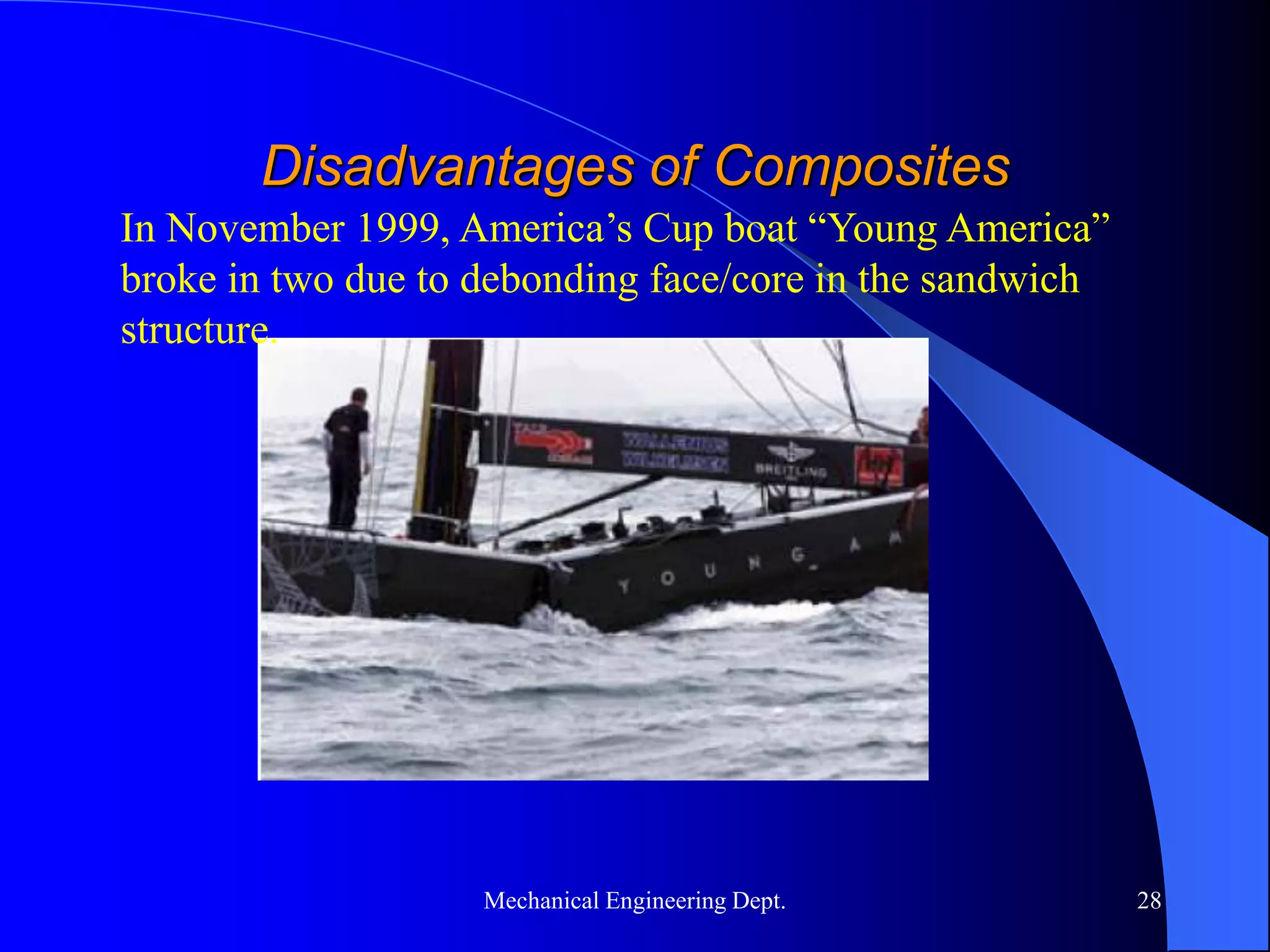
In November 1999, America’s Cup boat “Young America”
broke in two due to debonding face/core in the sandwich
structure.

Ramkaran ppt

  • 1.
  • 2.
    Introduction to Composites 1.What is the matrix in a composite and what materials are commonly used as a matrix? 2. What is reinforcement in composites ? 3. Be able to decide different factors responsible for properties of composite. 4. Know the equation for the critical length (Lc) of a fiber..
  • 3.
  • 4.
    Composite Material Two inherentlydifferent materials that when combined together produce a material with properties that exceed the constituent materials.
  • 5.
    Fiber Reinforced PolymerMatrix Matrix •Transfer Load to Reinforcement •Temperature Resistance •Chemical Resistance Reinforcement •Tensile Properties •Stiffness •Impact Resistance
  • 6.
    Matrix Considerations  EndUse Temperature Toughness Cosmetic Issues Flame Retardant Processing Method Adhesion Requirements
  • 7.
    Matrix Materials  Functionsof the matrix – Transmit force between fibers – arrest cracks from spreading between fibers  do not carry most of the load – hold fibers in proper orientation – protect fibers from environment  mechanical forces can cause cracks that allow environment to affect fibers  Demands on matrix – Interlaminar shear strength – Toughness – Moisture/environmental resistance – Temperature properties – Cost
  • 8.
    Types of CompositeMaterials There are five basic types of composite materials: Fiber, particle, flake, laminar or layered and filled composites.
  • 9.
    A. Fiber Composites Infiber composites, the fibers reinforce along the line of their length. Reinforcement may be mainly 1-D, 2-D or 3-D. Figure shows the three basic types of fiber orientation.  1-D gives maximum strength in one direction.  2-D gives strength in two directions.  Isotropic gives strength equally in all directions.
  • 10.
    B. Particle Composites Particles usually reinforce a composite equally in all directions (called isotropic). Plastics, cermets and metals are examples of particles.  Particles used to strengthen a matrix do not do so in the same way as fibers. For one thing, particles are not directional like fibers. Spread at random through out a matrix, particles tend to reinforce in all directions equally.  Cermets (1) Oxide–Based cermets (e.g. Combination of Al2O3 with Cr) (2) Carbide–Based Cermets (e.g. Tungsten–carbide, titanium–carbide)  Metal–plastic particle composites (e.g. Aluminum, iron & steel, copper particles)  Metal–in–metal Particle Composites and Dispersion Hardened Alloys (e.g. Ceramic–oxide particles)
  • 11.
    C. Laminar Composites- 1 Laminar composites involve two or more layers of the same or different materials. The layers can be arranged in different directions to give strength where needed. Speedboat hulls are among the very many products of this kind.
  • 12.
    D. Combined Composites It is possible to combine several different materials into a single composite. It is also possible to combine several different composites into a single product. A good example is a modern ski. (combination of wood as natural fiber, and layers as laminar composites)
  • 13.
    E. Filled Composites There are two types of filled composites. In one, filler materials are added to a normal composite result in strengthening the composite and reducing weight. The second type of filled composite consists of a skeletal 3-D matrix holding a second material. The most widely used composites of this kind are sandwich structures and honeycombs.
  • 14.
    Types of Composites Matrix phase/Reinforc ementPhase Metal Ceramic Polymer Metal Powder metallurgy parts – combining immiscible metals Cermets (ceramic- metal composite) Brake pads Ceramic Cermets, TiC, TiCN Cemented carbides – used in tools Fiber-reinforced metals SiC reinforced Al2O3 Tool materials Fiberglass Polymer Kevlar fibers in an epoxy matrix Elemental (Carbon, Boron, etc.) Fiber reinforced metals Auto parts aerospace Rubber with carbon (tires) Boron, Carbon reinforced plastics MMC’s CMC’s PMC’s Metal Matrix Composites Ceramic Matrix Comp’s. Polymer Matrix Comp’s
  • 15.
    Ken Youssefi MechanicalEngineering Dept. 15 Composites – Metal Matrix The metal matrix composites offer higher modulus of elasticity, ductility, and resistance to elevated temperature than polymer matrix composites. But, they are heavier and more difficult to process.
  • 16.
    Design Objective Performance: Strength,Temperature, Stiffness Manufacturing Techniques Life Cycle Considerations Cost
  • 17.
    Matrix Types Epoxy Epoxies haveimproved strength and stiffness properties over polyesters. Epoxies offer excellent corrosion resistance and resistance to solvents and alkalis. Cure cycles are usually longer than polyesters, however no by-products are produced. Flexibility and improved performance is also achieved by the utilization of additives and fillers.
  • 18.
  • 19.
    Carbon Fiber PAN: Fibermade from Polyacrylonitrile precursor fiber High strength and stiffness Large variety of fiber types available Standard Modulus Intermediate Modulus Density 1.79 g/cc 1.79 g/cc Tensile Strength 600 ksi 800 ksi Tensile Modulus 33 Msi 42 Msi Elongation 1.8 % 1.8 %
  • 20.
    Mechanical Engineering Dept.20 Composites – Ceramic Matrix Ceramic matrix composites (CMC) are used in applications where resistance to high temperature and corrosive environment is desired. CMCs are strong and stiff but they lack toughness (ductility) Matrix materials are usually silicon carbide, silicon nitride and aluminum oxide, and mullite (compound of aluminum, silicon and oxygen). They retain their strength up to 3000 o F. Fiber materials used commonly are carbon and aluminum oxide. Applications are in jet and automobile engines, deep-see mining, cutting tools, dies and pressure vessels.
  • 21.
    Ken Youssefi MechanicalEngineering Dept. 21 Application of Composites Pedestrian bridge in Denmark, 130 feet long (1997) Swedish Navy, Stealth (2005) Lance Armstrong’s 2-lb. Trek bike, 2004 Tour de France
  • 22.
    Ken Youssefi MechanicalEngineering Dept. 22 Application of Composites in Aircraft Industry 20% more fuel efficiency and 35,000 lbs. lighter
  • 23.
    23 Advantages of Composites Compositeshave a higher specific strength than many other materials. A distinct advantage of composites over other materials is the ability to use many combinations of resins and reinforcements, and therefore custom tailor the mechanical and physical properties of a structure. Higher Specific Strength (strength-to-weight ratio) The lowest properties for each material are associated with simple manufacturing processes and material forms (e.g. spray lay-up glass fibre), and the higher properties are associated with higher technology manufacture (e.g. autoclave moulding of unidirectional glass fibre), the aerospace industry.
  • 24.
    Mechanical Engineering Dept.24 Advantages of Composites Composites have an advantage over other materials because they can be molded into complex shapes at relatively low cost. This gives designers the freedom to create any shape or configuration. Boats are a good example of the success of composites. Design flexibility Composites products provide long-term resistance to severe chemical and temperature environments. Composites are the material of choice for outdoor exposure, chemical handling applications, and severe environment service. Corrosion Resistance
  • 25.
    Mechanical Engineering Dept.25 Advantages of Composites One reason the composites industry has been successful is because of the low relative investment in setting-up a composites manufacturing facility. This has resulted in many creative and innovative companies in the field. Low Relative Investment Composite products and structures have an exceedingly long life span. Coupled with low maintenance requirements, the longevity of composites is a benefit in critical applications. In a half-century of composites development, well-designed composite structures have yet to wear out. Durability In 1947 the U.S. Coast Guard built a series of forty-foot patrol boats, using polyester resin and glass fiber. These boats were used until the early 1970s when they were taken out of service because the design was outdated. Extensive testing was done on the laminates after decommissioning, and it was found that only 2-3% of the original strength was lost after twenty-five years of hard service.
  • 26.
    Mechanical Engineering Dept.26 Disadvantages of Composites The experience and intuition gained over the years about the behavior of metallic materials does not apply to composite materials. properties in composites vary from point to point in the material. Most engineering structural materials are homogeneous. Composites are heterogeneous Composites are highly anisotropic The strength in composites vary as the direction along which we measure changes (most engineering structural materials are isotropic). As a result, all other properties such as, stiffness, thermal expansion, thermal and electrical conductivity and creep resistance are also anisotropic. The relationship between stress and strain (force and deformation) is much more complicated than in isotropic materials.
  • 27.
    Mechanical Engineering Dept.27 Disadvantages of Composites Composites materials are difficult to inspect with conventional ultrasonic, eddy current and visual NDI methods such as radiography. American Airlines Flight 587, broke apart over New York on Nov. 12, 2001 (265 people died). Airbus A300’s 27-foot-high tail fin tore off. Much of the tail fin, including the so-called tongues that fit in grooves on the fuselage and connect the tail to the jet, were made of a graphite composite. The plane crashed because of damage at the base of the tail that had gone undetected despite routine nondestructive testing and visual inspections.
  • 28.
    Mechanical Engineering Dept.28 Disadvantages of Composites In November 1999, America’s Cup boat “Young America” broke in two due to debonding face/core in the sandwich structure.