Presented By : Asim Farooq
farooq9284682@gmail.com
Department Bsc Engg Tech Chemical
(SUIT) Peshawar
Radiation Heat Transfer
Contents
 Heat Transfer
 Heat transfer by Radiation
 Stefan Boltzmann law
 Examples on Stefan Boltzmann Law
Heat Transfer
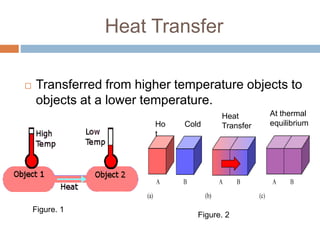
 Transferred from higher temperature objects to
objects at a lower temperature.
Figure. 1
Figure. 2
Ho
t
Cold
Heat
Transfer
At thermal
equilibrium
How Heat Can Be Transferred
 Conduction
 Convection
 a
The above are the modes of heat transfer
but we have to focus on only.
Radiation
Radiation
Radiation Heat Transfer
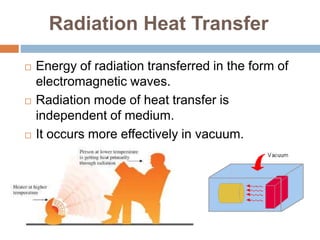
 Energy of radiation transferred in the form of
electromagnetic waves.
 Radiation mode of heat transfer is
independent of medium.
 It occurs more effectively in vacuum.
Radiation continues….
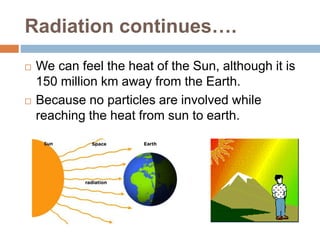
 We can feel the heat of the Sun, although it is
150 million km away from the Earth.
 Because no particles are involved while
reaching the heat from sun to earth.
Thermal Radiations
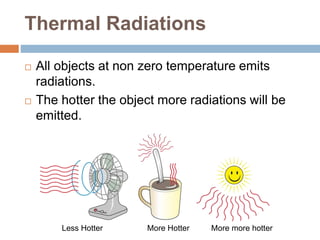
 All objects at non zero temperature emits
radiations.
 The hotter the object more radiations will be
emitted.
More more hotter
Less Hotter More Hotter
Stefan-Boltzmann Law
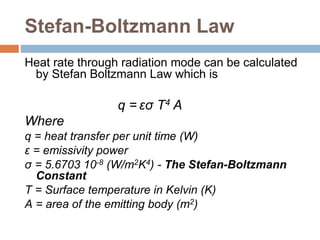
Heat rate through radiation mode can be calculated
by Stefan Boltzmann Law which is
q = εσ T4 A
Where
q = heat transfer per unit time (W)
ε = emissivity power
σ = 5.6703 10-8 (W/m2K4) - The Stefan-Boltzmann
Constant
T = Surface temperature in Kelvin (K)
A = area of the emitting body (m2)
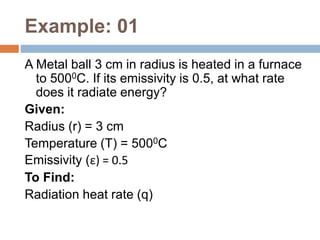
Example: 01
A Metal ball 3 cm in radius is heated in a furnace
to 5000C. If its emissivity is 0.5, at what rate
does it radiate energy?
Given:
Radius (r) = 3 cm
Temperature (T) = 5000C
Emissivity (ε) = 0.5
To Find:
Radiation heat rate (q)
Example continuous….
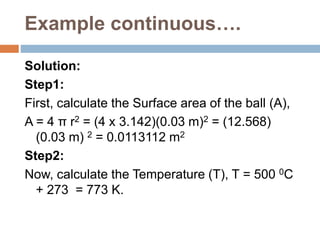
Solution:
Step1:
First, calculate the Surface area of the ball (A),
A = 4 π r2 = (4 x 3.142)(0.03 m)2 = (12.568)
(0.03 m) 2 = 0.0113112 m2
Step2:
Now, calculate the Temperature (T), T = 500 0C
+ 273 = 773 K.
Example continuous….
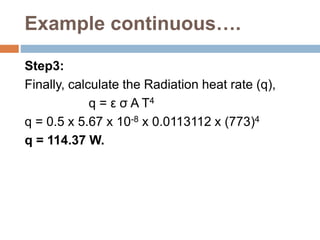
Step3:
Finally, calculate the Radiation heat rate (q),
q = ε σ A T4
q = 0.5 x 5.67 x 10-8 x 0.0113112 x (773)4
q = 114.37 W.
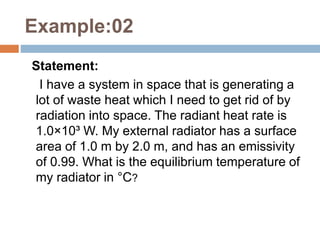
Example:02
Statement:
I have a system in space that is generating a
lot of waste heat which I need to get rid of by
radiation into space. The radiant heat rate is
1.0×10³ W. My external radiator has a surface
area of 1.0 m by 2.0 m, and has an emissivity
of 0.99. What is the equilibrium temperature of
my radiator in °C?
Example continuous…..
Solution:
Since I am given the amount of radiation that I
need to emit, I can determine Qemitted without
having to worry about Qincoming.
From the equation
Qemitted = q/A = 1.0×10³ W/(1.0 m × 2.0 m) =
500W/m²
Example continuous…..
Qemitted = q/A = ε σ T4
So that,
T = [Qemitted/ ε σ ] = {500 W/m²/[0.99 × 5.67×10-
8 W/(m²·K4)]} = 307.2 K
We were asked for °C, so convert from K to
°C:
T = 307.2 - 273.15 = 34°C
radiation-heat-transfer-160217191810.pdf

radiation-heat-transfer-160217191810.pdf

  • 1.
    Presented By :Asim Farooq farooq9284682@gmail.com Department Bsc Engg Tech Chemical (SUIT) Peshawar Radiation Heat Transfer
  • 2.
    Contents  Heat Transfer Heat transfer by Radiation  Stefan Boltzmann law  Examples on Stefan Boltzmann Law
  • 3.
    Heat Transfer  Transferredfrom higher temperature objects to objects at a lower temperature. Figure. 1 Figure. 2 Ho t Cold Heat Transfer At thermal equilibrium
  • 4.
    How Heat CanBe Transferred  Conduction  Convection  a The above are the modes of heat transfer but we have to focus on only. Radiation Radiation
  • 5.
    Radiation Heat Transfer Energy of radiation transferred in the form of electromagnetic waves.  Radiation mode of heat transfer is independent of medium.  It occurs more effectively in vacuum.
  • 6.
    Radiation continues….  Wecan feel the heat of the Sun, although it is 150 million km away from the Earth.  Because no particles are involved while reaching the heat from sun to earth.
  • 7.
    Thermal Radiations  Allobjects at non zero temperature emits radiations.  The hotter the object more radiations will be emitted. More more hotter Less Hotter More Hotter
  • 8.
    Stefan-Boltzmann Law Heat ratethrough radiation mode can be calculated by Stefan Boltzmann Law which is q = εσ T4 A Where q = heat transfer per unit time (W) ε = emissivity power σ = 5.6703 10-8 (W/m2K4) - The Stefan-Boltzmann Constant T = Surface temperature in Kelvin (K) A = area of the emitting body (m2)
  • 9.
    Example: 01 A Metalball 3 cm in radius is heated in a furnace to 5000C. If its emissivity is 0.5, at what rate does it radiate energy? Given: Radius (r) = 3 cm Temperature (T) = 5000C Emissivity (ε) = 0.5 To Find: Radiation heat rate (q)
  • 10.
    Example continuous…. Solution: Step1: First, calculatethe Surface area of the ball (A), A = 4 π r2 = (4 x 3.142)(0.03 m)2 = (12.568) (0.03 m) 2 = 0.0113112 m2 Step2: Now, calculate the Temperature (T), T = 500 0C + 273 = 773 K.
  • 11.
    Example continuous…. Step3: Finally, calculatethe Radiation heat rate (q), q = ε σ A T4 q = 0.5 x 5.67 x 10-8 x 0.0113112 x (773)4 q = 114.37 W.
  • 12.
    Example:02 Statement: I have asystem in space that is generating a lot of waste heat which I need to get rid of by radiation into space. The radiant heat rate is 1.0×10³ W. My external radiator has a surface area of 1.0 m by 2.0 m, and has an emissivity of 0.99. What is the equilibrium temperature of my radiator in °C?
  • 13.
    Example continuous….. Solution: Since Iam given the amount of radiation that I need to emit, I can determine Qemitted without having to worry about Qincoming. From the equation Qemitted = q/A = 1.0×10³ W/(1.0 m × 2.0 m) = 500W/m²
  • 14.
    Example continuous….. Qemitted =q/A = ε σ T4 So that, T = [Qemitted/ ε σ ] = {500 W/m²/[0.99 × 5.67×10- 8 W/(m²·K4)]} = 307.2 K We were asked for °C, so convert from K to °C: T = 307.2 - 273.15 = 34°C