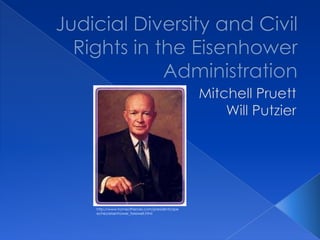
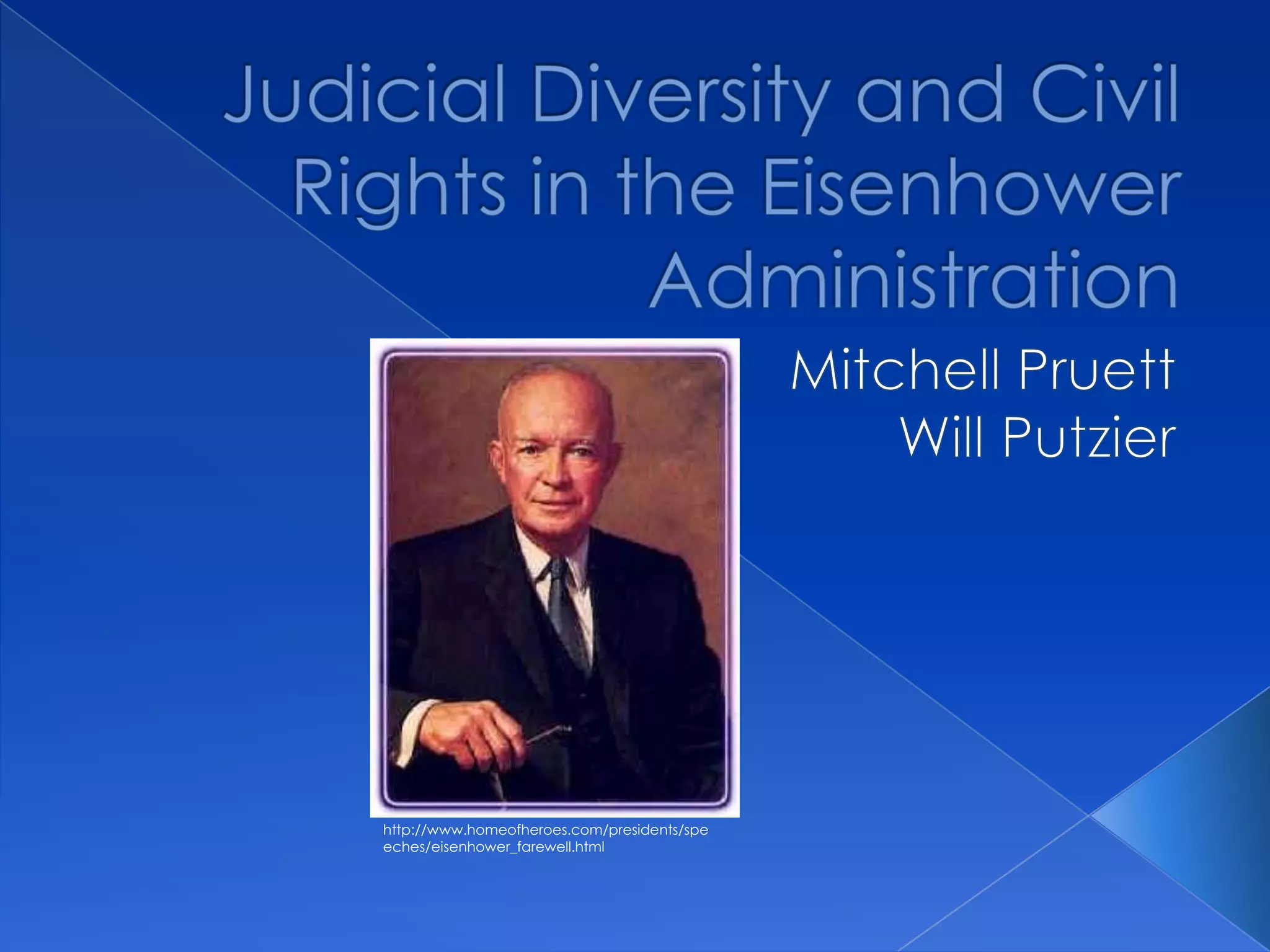
Judicial Diversity and Civil Rights in the Eisenhower AdministrationMitchell PruettWill Putzierhttp://www.homeofheroes.com/presidents/speeches/eisenhower_farewell.html
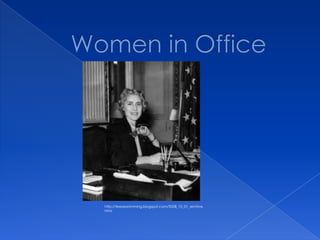
Women in Officehttp://texasswimming.blogspot.com/2008_10_01_archive.html
Miss Helen Irwin, National Federation of Business and Professional Women’s Club’s president “To date we are well content with the women, competent and trained, whom President Eisenhower has appointed to high office.  They reflect credit to all women, and are bringing to their new posts fresh enthusiasm and idealism, which coupled with industry are bound to make their work effective.  We want more of them, however.”http://www.onlineauction.com/index.php?page=auction:view_item&auction_id=1073466&title=National_Federation_of_Business_and_Professional_Women's_Clubs_Pin_FREE_Shipping
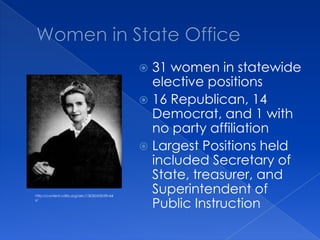
Women in State Office31 women in statewide elective positions16 Republican, 14 Democrat, and 1 with no party affiliationLargest Positions held included Secretary of State, treasurer, and Superintendent of Public Instructionhttp://content.cdlib.org/ark:/13030/kt0r29n44z/
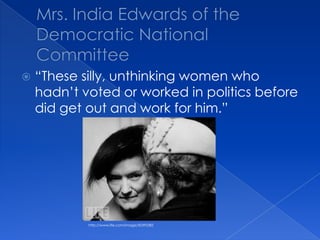
Mrs. India Edwards of the Democratic National Committee“These silly, unthinking women who hadn’t voted or worked in politics before did get out and work for him.”http://www.life.com/image/50395382
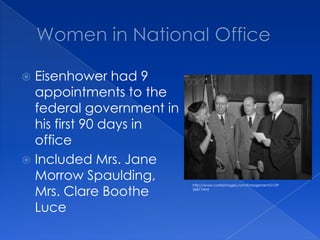
Women in National OfficeEisenhower had 9 appointments to the federal government in his first 90 days in officeIncluded Mrs. Jane Morrow Spaulding, Mrs. Clare Boothe Lucehttp://www.corbisimages.com/Enlargement/U1092687.html
Mrs. Jane Morrow SpauldingFrom Charleston, West VirginiaFirst black woman appointed to Eisenhower’s administrationAssistant to the Secretary of Department of Health, Education, and Human Services
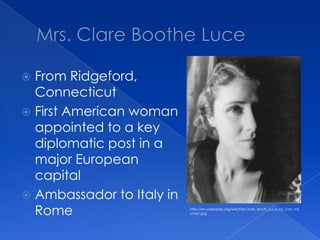
Mrs. Clare Boothe LuceFrom Ridgeford, ConnecticutFirst American woman appointed to a key diplomatic post in a major European capitalAmbassador to Italy in Romehttp://en.wikipedia.org/wiki/File:Clare_Booth_Luce_by_Van_Vechten.jpg
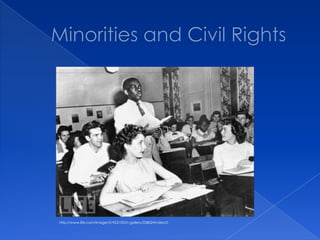
Minorities and Civil Rightshttp://www.life.com/image/51952105/in-gallery/22802#index/0
History of Public Thoughts on African-American EducationMany considered it unnecessary to educate African-Americans at the same caliber as White students“…some senators wanted to require the ‘grade of the schools’ for white and colored students to be the same but… it was widely recognized that the generally inferior elementary and secondary schools for Negroes… made it necessary to operate land-grant colleges for Negroes at ‘lower grade’…”
State of African-American Schooling Prior to EisenhowerThere were 17 “Negro Land Grant Colleges” before WWIThese were used mainly as secondary schoolsTwo of these enrolled no black students prior to 1924From 1921-1922 these schools only enrolled about 1000 colleges studentsMost of these schools did not develop standard college programs prior to 1940
Brown V. Board PositivesEisenhower used Washington D.C. as a model for desegregationIn the first week of desegregation, Eisenhower stated, “I am pleased to report that the initial transition has taken place smoothly and that no disturbances or incidents have occurred.”
Brown V. Board NegativesEisenhower lost support of prominent Southern conservative Democrats who actively supported him prior to the decisionTexarkana Junior College experienced riots after Judge Joe W. Seehy ordered it to admit black students as if they were white
Mrs. Lyle H. Webb to Eisenhower“What has happened to your model city of segregation?  Don’t you realize that the communistic [sic] ruling of the supreme court can not be forced on one hundred forty million good white people.  We want to be segregated from the black Negro.”
NAACP to Eisenhower“We feel a public appeal by you to the people of the District of Columbia and the South asking for compliance with the law and for the respect of the constitution and its interpretation by the Supreme Court on school integration could prevent further and more serious evidence of mob rule.  We hope you will lend the dignity of your personal prestige and office to help prevent acts of injustice for which all Americans feel a sense of shame.  Immediate action is urgent.”
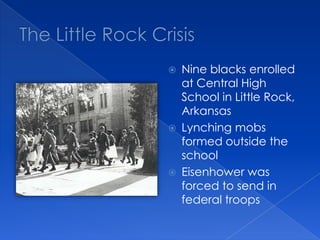
The Little Rock CrisisNine blacks enrolled at Central High School in Little Rock, ArkansasLynching mobs formed outside the schoolEisenhower was forced to send in federal troops
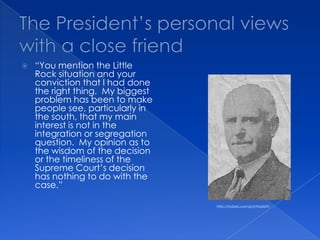
The President’s personal views with a close friend“You mention the Little Rock situation and your conviction that I had done the right thing.  My biggest problem has been to make people see, particularly in the south, that my main interest is not in the integration or segregation question.  My opinion as to the wisdom of the decision or the timeliness of the Supreme Court’s decision has nothing to do with the case.”http://radaris.com/p/I/Hazlett/
The National GuardPushed for desegregation in National Guard for reasons including:Showing the Administration's dedication to Civil RightsThe need for extra manpower in case of warDisbanding units in the south would enable more funding for northern unitsFurther dividing the Democratic party
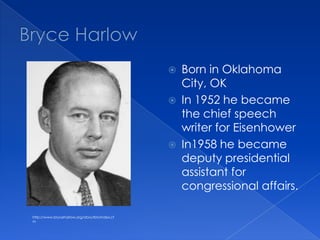
Bryce HarlowBorn in Oklahoma City, OKIn 1952 he became the chief speech writer for EisenhowerIn1958 he became deputy presidential assistant for congressional affairs. http://www.bryceharlow.org/aboutbh/index.cfm
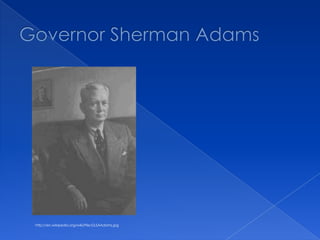
Governor Sherman Adamshttp://en.wikipedia.org/wiki/File:GLSAAdams.jpg
To Governor Adams from Bryce Harlow on desegregation of the National Guard	“Therefore, unless there are specific and cogent military reasons to the contrary (I am having these explored now) I think we are foolish to oppose legislation to abolish segregation in the National Guard.  Instead, I think we can and should reply to the Congress that by direction of the President, the Department of Defense will, effective July 1, 1956, require non-segregation in National Guard units as one of the many requirements for Federal recognition of such units.  This action will remove a defense incongruity, sharply reinforce the Administration’s leadership on racial progress, and, as a not inconsequential by-product, will cascade salt into the racial sores festering the Democratic Party.”
cont.“… the Vice President all think there is merit in the proposal and consider it a delectable infernal device to be timed to detonate in the middle of the State of the Union Message.”He goes on to say there were concerns with the plan including further agitating the south, and playing politics with the national defense.”“Non-segregation in the Guard would strengthen not weaken the national defense.”  Says disbanding units in the south would enable more money to go to northern units, making the guard stronger overall.  Also, southerners who have already experienced integration will be more accepting of it when they get home.  If there is another world struggle, manpower needs will be “overwhelming.”
cont. “We must clearly appreciate that what is here suggested has truly major political proportions.  Major gains are obtainable through exploitation of Democrat racial divisions and through influencing the negro vote in northern cities; possibly major Republican losses can result in the South.”“Properly exploited, this move, combined with Administration process already made in other racial areas, should pay substantial dividends in 1956 both in Republican votes and in a bitterly divided Democratic Party.”
Eisenhower’s sister-in-law’s opinion on Civil Rights“I am personally convinced that knowingly, or unknowingly, organized labor and the NAACP are front organizations for the communist’[sic] cause, and are the most traitorous groups towards our American ideals in this country.”“It is a disgrace that the NAACP is even allowed to exist!  If we in America are to be considered strong and intelligent, then we must act that way.”
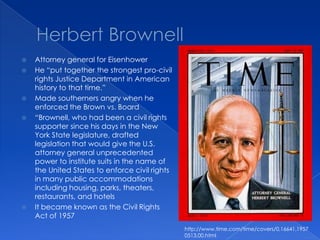
Herbert BrownellAttorney general for EisenhowerHe “put together the strongest pro-civil rights Justice Department in American history to that time.”Made southerners angry when he enforced the Brown vs. Board“Brownell, who had been a civil rights supporter since his days in the New York State legislature, drafted legislation that would give the U.S. attorney general unprecedented power to institute suits in the name of the United States to enforce civil rights in many public accommodations including housing, parks, theaters, restaurants, and hotelsIt became known as the Civil Rights Act of 1957http://www.time.com/time/covers/0,16641,19570513,00.html
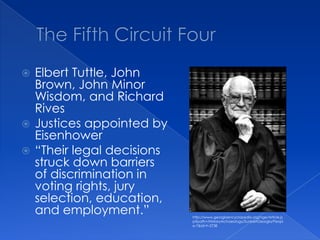
The Fifth Circuit FourElbert Tuttle, John Brown, John Minor Wisdom, and Richard RivesJustices appointed by Eisenhower“Their legal decisions struck down barriers of discrimination in voting rights, jury selection, education, and employment.”http://www.georgiaencyclopedia.org/nge/Article.jsp?path=/HistoryArchaeology/SunbeltGeorgia/People-7&id=h-2738
Minorities in the Judiciary 1957:  Scovel Richardson was the second African-American appointed to the U.S. Customs CourtGrowing number of African-American lawyers in the late 1950sMany more appointments made during the 1960s
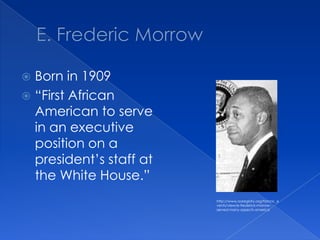
E. Frederic MorrowBorn in 1909“First African American to serve in an executive position on a president’s staff at the White House.”http://www.aaregistry.org/historic_events/view/e-frederick-morrow-served-many-aspects-america
Conclusion“Eisenhower’s great contribution to civil rights during his presidency was his bold support for the courts, their judges, and their decisions, with Little Rock the symbol.  In 1861, Abraham Lincoln preached preservation of the Union, not ending slavery, as a justification for making war on the South.  Eisenhower argued for obeying the federal courts, not integration, as justification for intervention in Little Rock, as he addressed the nation ‘from the house of Lincoln’ on September 24, 1957.  Neither said what the activists of his day wanted to hear, but both led the nation in a new direction.”
SourcesAdkins, Bertha S: Papers, 1907-1989.  Box 21.  Women in Politics:  Bulletin of Women’s Activities, Republican National Committee, 1953-1962.  New bulletin to Women’s RNC members.  27 March, 1953.Adkins, Bertha S: Papers, 1907-1989.  Box 21.  Women in Politics:  Bulletin of Women’s Activities, Republican National Committee, 1953-1962.  New bulletin to Women’s RNC members.  21 April, 1953.Adkins, Bertha S: Papers, 1907-1989.  Box 21.  Women in Politics:  Bulletin of Women’s Activities, Republican National Committee, 1953-1962.  New bulletin to Women’s RNC members.  28 May, 1953.Central Files.  Official File, 1953- 1961. Box 321.  United States Court of Appeals( Circuit Courts).  Fifth Judicial Circuit.Eisenhower, Dwight D:  Papers as President of the United States, 1953-1961.  (Ann Whitman File) Name Series. Box 18.  Hazlett, Swede  Jan. 1956-Nov. 1958 (3).  18 Nov. 1957.Eisenhower, Dwight D:  Papers as President of the United States, 1953-1961.  (Ann Whitman File) Name Series.  Box 12.  Eisenhower, Edgar.  1959-1960 (2).Eisenhower, Dwight D:  Records as President, 1952-1961 Official File.  Box 731.  Negro Matters- Colored Questions (1).  Memo to Secretary Grisby.  24 Sept. 1953.Eisenhower, Dwight D:  Records as President, 1952-1961 Official File.  Box 731.  Negro Matters- Colored Question Integration Program for Public Schools, Colleges, and Universities (1).  Letter from Spencer to Eisenhower. 20 Sept. 1954.Eisenhower, Dwight D:  Records as President, 1952-1961 Official File.  Box 731.  Negro Matters- Colored Question Integration Program for Public Schools, Colleges, and Universities (1).  Memo, Mrs. Lyle H. Webb to Eisenhower.  5 Oct. 1954.Eisenhower, Dwight D:  Records as President, 1952-1961 Official File.  Box 731.  Negro Matters- Colored Question Integration Program for Public Schools, Colleges, and Universities (1).  Memo, Newark NAACP to Eisenhower.  5 Oct. 1954.Eisenhower, Dwight D:  Records as President, 1952-1961 Official File.  Box 731.  Negro Matters- Colored Question Integration Program for Public Schools, Colleges, and Universities (2).  Press conference.  25 Jan. 1956.Eisenhower, Dwight D:  Records as President, 1952-1961 Official File.  Box 731.  Negro Matters- Colored Question Integration Program for Public Schools, Colleges, and Universities (2).  Letter from U. Simpson Tate to Eisenhower.  10 Sept. 1956.“Herbert Brownell.”  law.jrank.org/pages/4903/Brownell-Herbert-Jr.html“Harlow, Bryce N.”  digital.library.okstate.edu/encyclopedia/entries/H/HA022.html“E Frederic Morrow.”aaregistry.org/historic_events/view/e-frederick-morrow-served-many-aspects-americaNichols, David A. A Matter of Justice: Eisenhower and the Beginning of the Civil Rights Revolution. New York: Simon & Schuster, 2007. Print.

Racial diversity power point (boys)

  • 1.
    Judicial Diversity andCivil Rights in the Eisenhower AdministrationMitchell PruettWill Putzierhttp://www.homeofheroes.com/presidents/speeches/eisenhower_farewell.html
  • 2.
  • 3.
    Miss Helen Irwin,National Federation of Business and Professional Women’s Club’s president “To date we are well content with the women, competent and trained, whom President Eisenhower has appointed to high office. They reflect credit to all women, and are bringing to their new posts fresh enthusiasm and idealism, which coupled with industry are bound to make their work effective. We want more of them, however.”http://www.onlineauction.com/index.php?page=auction:view_item&auction_id=1073466&title=National_Federation_of_Business_and_Professional_Women's_Clubs_Pin_FREE_Shipping
  • 4.
    Women in StateOffice31 women in statewide elective positions16 Republican, 14 Democrat, and 1 with no party affiliationLargest Positions held included Secretary of State, treasurer, and Superintendent of Public Instructionhttp://content.cdlib.org/ark:/13030/kt0r29n44z/
  • 5.
    Mrs. India Edwardsof the Democratic National Committee“These silly, unthinking women who hadn’t voted or worked in politics before did get out and work for him.”http://www.life.com/image/50395382
  • 6.
    Women in NationalOfficeEisenhower had 9 appointments to the federal government in his first 90 days in officeIncluded Mrs. Jane Morrow Spaulding, Mrs. Clare Boothe Lucehttp://www.corbisimages.com/Enlargement/U1092687.html
  • 7.
    Mrs. Jane MorrowSpauldingFrom Charleston, West VirginiaFirst black woman appointed to Eisenhower’s administrationAssistant to the Secretary of Department of Health, Education, and Human Services
  • 8.
    Mrs. Clare BootheLuceFrom Ridgeford, ConnecticutFirst American woman appointed to a key diplomatic post in a major European capitalAmbassador to Italy in Romehttp://en.wikipedia.org/wiki/File:Clare_Booth_Luce_by_Van_Vechten.jpg
  • 9.
    Minorities and CivilRightshttp://www.life.com/image/51952105/in-gallery/22802#index/0
  • 10.
    History of PublicThoughts on African-American EducationMany considered it unnecessary to educate African-Americans at the same caliber as White students“…some senators wanted to require the ‘grade of the schools’ for white and colored students to be the same but… it was widely recognized that the generally inferior elementary and secondary schools for Negroes… made it necessary to operate land-grant colleges for Negroes at ‘lower grade’…”
  • 11.
    State of African-AmericanSchooling Prior to EisenhowerThere were 17 “Negro Land Grant Colleges” before WWIThese were used mainly as secondary schoolsTwo of these enrolled no black students prior to 1924From 1921-1922 these schools only enrolled about 1000 colleges studentsMost of these schools did not develop standard college programs prior to 1940
  • 12.
    Brown V. BoardPositivesEisenhower used Washington D.C. as a model for desegregationIn the first week of desegregation, Eisenhower stated, “I am pleased to report that the initial transition has taken place smoothly and that no disturbances or incidents have occurred.”
  • 13.
    Brown V. BoardNegativesEisenhower lost support of prominent Southern conservative Democrats who actively supported him prior to the decisionTexarkana Junior College experienced riots after Judge Joe W. Seehy ordered it to admit black students as if they were white
  • 14.
    Mrs. Lyle H.Webb to Eisenhower“What has happened to your model city of segregation? Don’t you realize that the communistic [sic] ruling of the supreme court can not be forced on one hundred forty million good white people. We want to be segregated from the black Negro.”
  • 15.
    NAACP to Eisenhower“Wefeel a public appeal by you to the people of the District of Columbia and the South asking for compliance with the law and for the respect of the constitution and its interpretation by the Supreme Court on school integration could prevent further and more serious evidence of mob rule. We hope you will lend the dignity of your personal prestige and office to help prevent acts of injustice for which all Americans feel a sense of shame. Immediate action is urgent.”
  • 16.
    The Little RockCrisisNine blacks enrolled at Central High School in Little Rock, ArkansasLynching mobs formed outside the schoolEisenhower was forced to send in federal troops
  • 17.
    The President’s personalviews with a close friend“You mention the Little Rock situation and your conviction that I had done the right thing. My biggest problem has been to make people see, particularly in the south, that my main interest is not in the integration or segregation question. My opinion as to the wisdom of the decision or the timeliness of the Supreme Court’s decision has nothing to do with the case.”http://radaris.com/p/I/Hazlett/
  • 18.
    The National GuardPushedfor desegregation in National Guard for reasons including:Showing the Administration's dedication to Civil RightsThe need for extra manpower in case of warDisbanding units in the south would enable more funding for northern unitsFurther dividing the Democratic party
  • 19.
    Bryce HarlowBorn inOklahoma City, OKIn 1952 he became the chief speech writer for EisenhowerIn1958 he became deputy presidential assistant for congressional affairs. http://www.bryceharlow.org/aboutbh/index.cfm
  • 20.
  • 21.
    To Governor Adamsfrom Bryce Harlow on desegregation of the National Guard “Therefore, unless there are specific and cogent military reasons to the contrary (I am having these explored now) I think we are foolish to oppose legislation to abolish segregation in the National Guard. Instead, I think we can and should reply to the Congress that by direction of the President, the Department of Defense will, effective July 1, 1956, require non-segregation in National Guard units as one of the many requirements for Federal recognition of such units. This action will remove a defense incongruity, sharply reinforce the Administration’s leadership on racial progress, and, as a not inconsequential by-product, will cascade salt into the racial sores festering the Democratic Party.”
  • 22.
    cont.“… the VicePresident all think there is merit in the proposal and consider it a delectable infernal device to be timed to detonate in the middle of the State of the Union Message.”He goes on to say there were concerns with the plan including further agitating the south, and playing politics with the national defense.”“Non-segregation in the Guard would strengthen not weaken the national defense.” Says disbanding units in the south would enable more money to go to northern units, making the guard stronger overall. Also, southerners who have already experienced integration will be more accepting of it when they get home. If there is another world struggle, manpower needs will be “overwhelming.”
  • 23.
    cont. “We mustclearly appreciate that what is here suggested has truly major political proportions. Major gains are obtainable through exploitation of Democrat racial divisions and through influencing the negro vote in northern cities; possibly major Republican losses can result in the South.”“Properly exploited, this move, combined with Administration process already made in other racial areas, should pay substantial dividends in 1956 both in Republican votes and in a bitterly divided Democratic Party.”
  • 24.
    Eisenhower’s sister-in-law’s opinionon Civil Rights“I am personally convinced that knowingly, or unknowingly, organized labor and the NAACP are front organizations for the communist’[sic] cause, and are the most traitorous groups towards our American ideals in this country.”“It is a disgrace that the NAACP is even allowed to exist! If we in America are to be considered strong and intelligent, then we must act that way.”
  • 25.
    Herbert BrownellAttorney generalfor EisenhowerHe “put together the strongest pro-civil rights Justice Department in American history to that time.”Made southerners angry when he enforced the Brown vs. Board“Brownell, who had been a civil rights supporter since his days in the New York State legislature, drafted legislation that would give the U.S. attorney general unprecedented power to institute suits in the name of the United States to enforce civil rights in many public accommodations including housing, parks, theaters, restaurants, and hotelsIt became known as the Civil Rights Act of 1957http://www.time.com/time/covers/0,16641,19570513,00.html
  • 26.
    The Fifth CircuitFourElbert Tuttle, John Brown, John Minor Wisdom, and Richard RivesJustices appointed by Eisenhower“Their legal decisions struck down barriers of discrimination in voting rights, jury selection, education, and employment.”http://www.georgiaencyclopedia.org/nge/Article.jsp?path=/HistoryArchaeology/SunbeltGeorgia/People-7&id=h-2738
  • 27.
    Minorities in theJudiciary 1957: Scovel Richardson was the second African-American appointed to the U.S. Customs CourtGrowing number of African-American lawyers in the late 1950sMany more appointments made during the 1960s
  • 28.
    E. Frederic MorrowBornin 1909“First African American to serve in an executive position on a president’s staff at the White House.”http://www.aaregistry.org/historic_events/view/e-frederick-morrow-served-many-aspects-america
  • 29.
    Conclusion“Eisenhower’s great contributionto civil rights during his presidency was his bold support for the courts, their judges, and their decisions, with Little Rock the symbol. In 1861, Abraham Lincoln preached preservation of the Union, not ending slavery, as a justification for making war on the South. Eisenhower argued for obeying the federal courts, not integration, as justification for intervention in Little Rock, as he addressed the nation ‘from the house of Lincoln’ on September 24, 1957. Neither said what the activists of his day wanted to hear, but both led the nation in a new direction.”
  • 30.
    SourcesAdkins, Bertha S:Papers, 1907-1989. Box 21. Women in Politics: Bulletin of Women’s Activities, Republican National Committee, 1953-1962. New bulletin to Women’s RNC members. 27 March, 1953.Adkins, Bertha S: Papers, 1907-1989. Box 21. Women in Politics: Bulletin of Women’s Activities, Republican National Committee, 1953-1962. New bulletin to Women’s RNC members. 21 April, 1953.Adkins, Bertha S: Papers, 1907-1989. Box 21. Women in Politics: Bulletin of Women’s Activities, Republican National Committee, 1953-1962. New bulletin to Women’s RNC members. 28 May, 1953.Central Files. Official File, 1953- 1961. Box 321. United States Court of Appeals( Circuit Courts). Fifth Judicial Circuit.Eisenhower, Dwight D: Papers as President of the United States, 1953-1961. (Ann Whitman File) Name Series. Box 18. Hazlett, Swede Jan. 1956-Nov. 1958 (3). 18 Nov. 1957.Eisenhower, Dwight D: Papers as President of the United States, 1953-1961. (Ann Whitman File) Name Series. Box 12. Eisenhower, Edgar. 1959-1960 (2).Eisenhower, Dwight D: Records as President, 1952-1961 Official File. Box 731. Negro Matters- Colored Questions (1). Memo to Secretary Grisby. 24 Sept. 1953.Eisenhower, Dwight D: Records as President, 1952-1961 Official File. Box 731. Negro Matters- Colored Question Integration Program for Public Schools, Colleges, and Universities (1). Letter from Spencer to Eisenhower. 20 Sept. 1954.Eisenhower, Dwight D: Records as President, 1952-1961 Official File. Box 731. Negro Matters- Colored Question Integration Program for Public Schools, Colleges, and Universities (1). Memo, Mrs. Lyle H. Webb to Eisenhower. 5 Oct. 1954.Eisenhower, Dwight D: Records as President, 1952-1961 Official File. Box 731. Negro Matters- Colored Question Integration Program for Public Schools, Colleges, and Universities (1). Memo, Newark NAACP to Eisenhower. 5 Oct. 1954.Eisenhower, Dwight D: Records as President, 1952-1961 Official File. Box 731. Negro Matters- Colored Question Integration Program for Public Schools, Colleges, and Universities (2). Press conference. 25 Jan. 1956.Eisenhower, Dwight D: Records as President, 1952-1961 Official File. Box 731. Negro Matters- Colored Question Integration Program for Public Schools, Colleges, and Universities (2). Letter from U. Simpson Tate to Eisenhower. 10 Sept. 1956.“Herbert Brownell.” law.jrank.org/pages/4903/Brownell-Herbert-Jr.html“Harlow, Bryce N.” digital.library.okstate.edu/encyclopedia/entries/H/HA022.html“E Frederic Morrow.”aaregistry.org/historic_events/view/e-frederick-morrow-served-many-aspects-americaNichols, David A. A Matter of Justice: Eisenhower and the Beginning of the Civil Rights Revolution. New York: Simon & Schuster, 2007. Print.