Responsibility charting (RACI)
What Is RACI ?

                  Responsibility Charting

         Is a technique for identifying functional areas, key activities, and
         decision points where ambiguities exist; differences can be
         brought into the open and resolved through team effort.


         The approach enables management to actively participate in the
         process of systematically describing activities, decisions that have
         to be accomplished, and to clarify the responsibility that each
         plays in relation to those activities and decisions.


2
Objectives/Benefits
         • Assist natural work teams in charting roles and responsibilities
           in a consistent manner
         • Assist natural work teams with development of implementation
           tool kits
         • Clarify individual/departmental roles and responsibilities
         • Identify accountabilities
         • Eliminate misunderstandings, encourage teamwork
         • Reduce duplication of effort
         • Establish “consults” and “informs” resulting in better
           communication


3
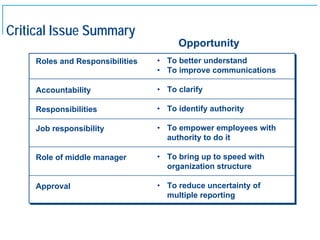
Critical Issue Summary
                                           Opportunity
         Roles and Responsibilities   • To better understand
                                      • To improve communications

         Accountability               • To clarify

         Responsibilities             • To identify authority

         Job responsibility           • To empower employees with
                                        authority to do it

         Role of middle manager       • To bring up to speed with
                                        organization structure

         Approval                     • To reduce uncertainty of
                                        multiple reporting


4
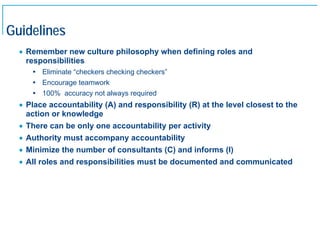
Guidelines
      • Remember new culture philosophy when defining roles and
        responsibilities
         ! Eliminate “checkers checking checkers”
         ! Encourage teamwork
         ! 100% accuracy not always required
      • Place accountability (A) and responsibility (R) at the level closest to the
        action or knowledge
      • There can be only one accountability per activity
      • Authority must accompany accountability
      • Minimize the number of consultants (C) and informs (I)
      • All roles and responsibilities must be documented and communicated


5
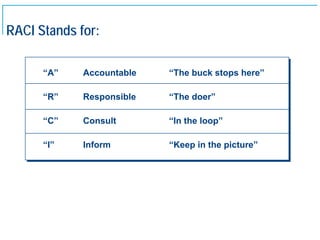
RACI Stands for:

          “A”    Accountable   “The buck stops here”

          “R”    Responsible   “The doer”

          “C”    Consult       “In the loop”

          “I”    Inform        “Keep in the picture”


6
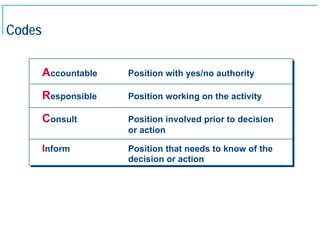
Codes

            Accountable   Position with yes/no authority

            Responsible   Position working on the activity

            Consult       Position involved prior to decision
                          or action

            Inform        Position that needs to know of the
                          decision or action


7
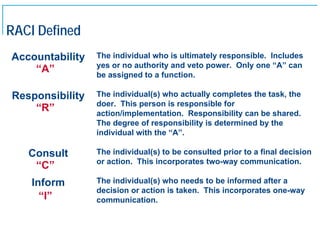
RACI Defined
    Accountability   The individual who is ultimately responsible. Includes
                     yes or no authority and veto power. Only one “A” can
        “A”          be assigned to a function.

    Responsibility   The individual(s) who actually completes the task, the
                     doer. This person is responsible for
        “R”          action/implementation. Responsibility can be shared.
                     The degree of responsibility is determined by the
                     individual with the “A”.

       Consult       The individual(s) to be consulted prior to a final decision
                     or action. This incorporates two-way communication.
        “C”
        Inform       The individual(s) who needs to be informed after a
                     decision or action is taken. This incorporates one-way
          “I”        communication.


8
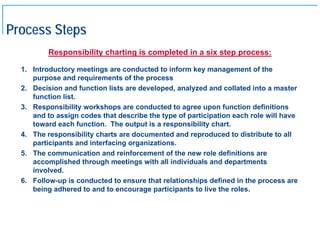
Process Steps
              Responsibility charting is completed in a six step process:

      1. Introductory meetings are conducted to inform key management of the
         purpose and requirements of the process
      2. Decision and function lists are developed, analyzed and collated into a master
         function list.
      3. Responsibility workshops are conducted to agree upon function definitions
         and to assign codes that describe the type of participation each role will have
         toward each function. The output is a responsibility chart.
      4. The responsibility charts are documented and reproduced to distribute to all
         participants and interfacing organizations.
      5. The communication and reinforcement of the new role definitions are
         accomplished through meetings with all individuals and departments
         involved.
      6. Follow-up is conducted to ensure that relationships defined in the process are
         being adhered to and to encourage participants to live the roles.


9
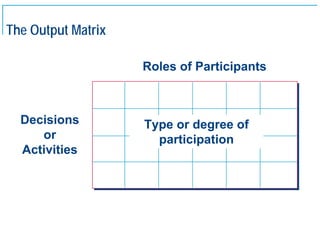
The Output Matrix

                     Roles of Participants


     Decisions       Type or degree of
        or             participation
     Activities


10
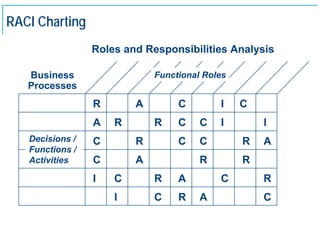
RACI Charting
                   Roles and Responsibilities Analysis

     Business                  Functional Roles
     Processes
                   R       A        C        I    C
                   A   R       R    C    C   I        I
     Decisions /   C       R        C    C        R   A
     Functions /
     Activities    C       A             R        R
                   I   C       R    A        C        R
                       I       C    R    A            C


11
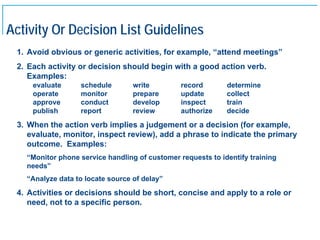
Activity Or Decision List Guidelines
     1. Avoid obvious or generic activities, for example, “attend meetings”
     2. Each activity or decision should begin with a good action verb.
        Examples:
         evaluate     schedule        write         record       determine
         operate      monitor         prepare       update       collect
         approve      conduct         develop       inspect      train
         publish      report          review        authorize    decide
     3. When the action verb implies a judgement or a decision (for example,
        evaluate, monitor, inspect review), add a phrase to indicate the primary
        outcome. Examples:
       “Monitor phone service handling of customer requests to identify training
       needs”
       “Analyze data to locate source of delay”
     4. Activities or decisions should be short, concise and apply to a role or
        need, not to a specific person.


12
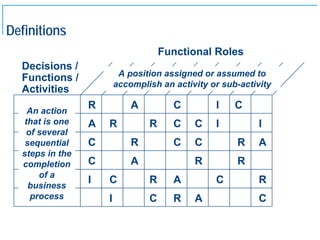
Definitions
                                        Functional Roles
     Decisions /
                             A position assigned or assumed to
     Functions /
                            accomplish an activity or sub-activity
     Activities
       An action
                    R           A         C         I    C
      that is one   A   R           R     C    C    I          I
      of several
      sequential    C           R         C    C         R     A
     steps in the
     completion     C           A              R         R
         of a
       business
                    I   C           R     A         C          R
       process          I           C     R    A               C


13
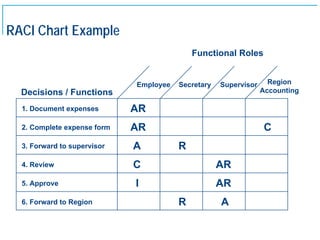
RACI Chart Example
                                               Functional Roles


                                Employee   Secretary   Supervisor     Region
     Decisions / Functions                                          Accounting

     1. Document expenses       AR
     2. Complete expense form   AR                                   C
     3. Forward to supervisor   A          R
     4. Review                  C                      AR
     5. Approve                 I                      AR
     6. Forward to Region                  R           A

14
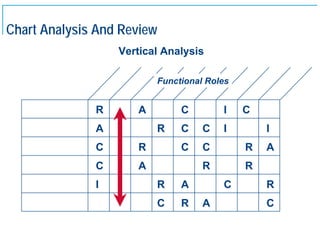
Chart Analysis And Review
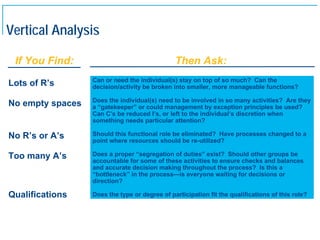
                   Vertical Analysis

                          Functional Roles


               R      A        C        I    C
               A          R    C    C   I        I
               C      R        C    C        R   A
               C      A             R        R
               I          R    A        C        R
                          C    R    A            C

15
Vertical Analysis

      If You Find:                                  Then Ask:
                       Can or need the individual(s) stay on top of so much? Can the
     Lots of R’s       decision/activity be broken into smaller, more manageable functions?

                       Does the individual(s) need to be involved in so many activities? Are they
     No empty spaces   a “gatekeeper” or could management by exception principles be used?
                       Can C’s be reduced I’s, or left to the individual’s discretion when
                       something needs particular attention?

     No R’s or A’s     Should this functional role be eliminated? Have processes changed to a
                       point where resources should be re-utilized?

     Too many A’s      Does a proper “segregation of duties” exist? Should other groups be
                       accountable for some of these activities to ensure checks and balances
                       and accurate decision making throughout the process? Is this a
                       “bottleneck” in the process—is everyone waiting for decisions or
                       direction?

     Qualifications    Does the type or degree of participation fit the qualifications of this role?


16
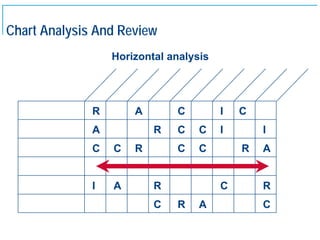
Chart Analysis And Review
                   Horizontal analysis


               R       A       C         I   C
               A           R   C    C    I       I
               C   C   R       C    C        R   A


               I   A       R             C       R
                           C   R    A            C

17
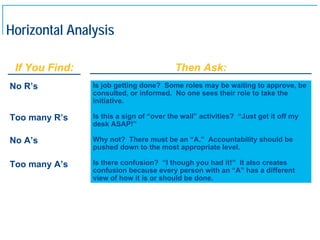
Horizontal Analysis

      If You Find:                            Then Ask:
     No R’s          Is job getting done? Some roles may be waiting to approve, be
                     consulted, or informed. No one sees their role to take the
                     initiative.

     Too many R’s    Is this a sign of “over the wall” activities? “Just get it off my
                     desk ASAP!”

     No A’s          Why not? There must be an “A.” Accountability should be
                     pushed down to the most appropriate level.

     Too many A’s    Is there confusion? “I though you had it!” It also creates
                     confusion because every person with an “A” has a different
                     view of how it is or should be done.


18
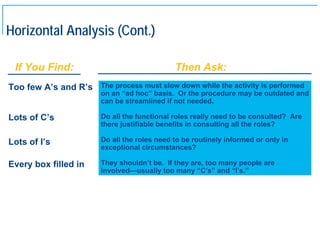
Horizontal Analysis (Cont.)

      If You Find:                                 Then Ask:
     Too few A’s and R’s The process must slow down while the activity is performed
                             on an “ad hoc” basis. Or the procedure may be outdated and
                             can be streamlined if not needed.

     Lots of C’s             Do all the functional roles really need to be consulted? Are
                             there justifiable benefits in consulting all the roles?

     Lots of I’s             Do all the roles need to be routinely informed or only in
                             exceptional circumstances?

     Every box filled in     They shouldn’t be. If they are, too many people are
                             involved—usually too many “C’s” and “I’s.”


19
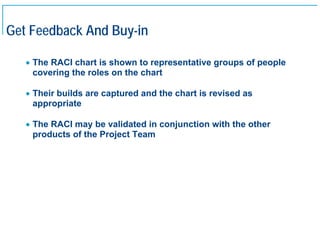
Get Feedback And Buy-in

     • The RACI chart is shown to representative groups of people
       covering the roles on the chart

     • Their builds are captured and the chart is revised as
       appropriate

     • The RACI may be validated in conjunction with the other
       products of the Project Team


20
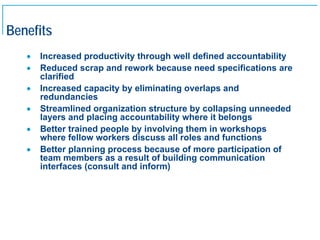
Benefits
     •   Increased productivity through well defined accountability
     •   Reduced scrap and rework because need specifications are
         clarified
     •   Increased capacity by eliminating overlaps and
         redundancies
     •   Streamlined organization structure by collapsing unneeded
         layers and placing accountability where it belongs
     •   Better trained people by involving them in workshops
         where fellow workers discuss all roles and functions
     •   Better planning process because of more participation of
         team members as a result of building communication
         interfaces (consult and inform)


21
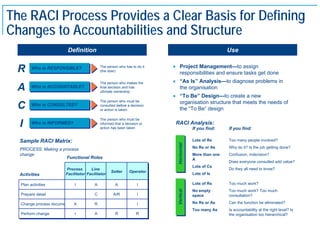
The RACI Process Provides a Clear Basis for Defining
 Changes to Accountabilities and Structure
                          Definition                                                                      Use

                                                                           • Project Management—to assign
     R     Who is RESPONSIBLE?
           Who is RESPONSIBLE?
                                             The person who has to do it
                                             (the doer)
                                                                             responsibilities and ensure tasks get done
                                             The person who makes the      • “As Is” Analysis—to diagnose problems in
     A     Who is ACCOUNTABLE?
           Who is ACCOUNTABLE?               final decision and has
                                             ultimate ownership
                                                                             the organisation
                                                                           • “To Be” Design—to create a new
                                             The person who must be          organisation structure that meets the needs of
     C     Who is CONSULTED?
           Who is CONSULTED?                 consulted before a decision
                                             or action is taken              the “To Be” design
                                             The person who must be
     I     Who is INFORMED?
           Who is INFORMED?                  informed that a decision or
                                             action has been taken
                                                                            RACI Analysis:
                                                                                          If you find:    If you find:

     Sample RACI Matrix:                                                                  Lots of Rs      Too many people involved?


                                                                             Horizontal
                                                                             Horizontal
     PROCESS: Making a process                                                            No Rs or As     Why do it? Is the job getting done?
     change                                                                               More than one   Confusion, indecision?
                         Functional Roles                                                 A
                                                                                                          Does everyone consulted add value?
                                                                                          Lots of Cs
                         Process
                          Process      Line
                                       Line                                                               Do they all need to know?
                                                   Setter
                                                   Setter      Operator
                                                               Operator
     Activities          Facilitator Facilitator
                         Facilitator Facilitator                                          Lots of Is

     Plan activities          II         A            A             II                    Lots of Rs      Too much work?
     Plan activities                     A            A
                                                                             Vertical

                                                                                          No empty        Too much work? Too much
                                                                             Vertical

     Prepare detail
     Prepare detail                      C
                                         C           A/R
                                                     A/R            II                    space           consultation?

     Change process documents A          R                          II                    No Rs or As     Can the function be eliminated?
     Change process documents A          R
                                                                                          Too many As     Is accountability at the right level? Is
     Perform change
     Perform change           II         A
                                         A            R
                                                      R             R
                                                                    R                                     the organisation too hierarchical?


22

RACI Approach

  • 1.
  • 2.
    What Is RACI? Responsibility Charting Is a technique for identifying functional areas, key activities, and decision points where ambiguities exist; differences can be brought into the open and resolved through team effort. The approach enables management to actively participate in the process of systematically describing activities, decisions that have to be accomplished, and to clarify the responsibility that each plays in relation to those activities and decisions. 2
  • 3.
    Objectives/Benefits • Assist natural work teams in charting roles and responsibilities in a consistent manner • Assist natural work teams with development of implementation tool kits • Clarify individual/departmental roles and responsibilities • Identify accountabilities • Eliminate misunderstandings, encourage teamwork • Reduce duplication of effort • Establish “consults” and “informs” resulting in better communication 3
  • 4.
    Critical Issue Summary Opportunity Roles and Responsibilities • To better understand • To improve communications Accountability • To clarify Responsibilities • To identify authority Job responsibility • To empower employees with authority to do it Role of middle manager • To bring up to speed with organization structure Approval • To reduce uncertainty of multiple reporting 4
  • 5.
    Guidelines • Remember new culture philosophy when defining roles and responsibilities ! Eliminate “checkers checking checkers” ! Encourage teamwork ! 100% accuracy not always required • Place accountability (A) and responsibility (R) at the level closest to the action or knowledge • There can be only one accountability per activity • Authority must accompany accountability • Minimize the number of consultants (C) and informs (I) • All roles and responsibilities must be documented and communicated 5
  • 6.
    RACI Stands for: “A” Accountable “The buck stops here” “R” Responsible “The doer” “C” Consult “In the loop” “I” Inform “Keep in the picture” 6
  • 7.
    Codes Accountable Position with yes/no authority Responsible Position working on the activity Consult Position involved prior to decision or action Inform Position that needs to know of the decision or action 7
  • 8.
    RACI Defined Accountability The individual who is ultimately responsible. Includes yes or no authority and veto power. Only one “A” can “A” be assigned to a function. Responsibility The individual(s) who actually completes the task, the doer. This person is responsible for “R” action/implementation. Responsibility can be shared. The degree of responsibility is determined by the individual with the “A”. Consult The individual(s) to be consulted prior to a final decision or action. This incorporates two-way communication. “C” Inform The individual(s) who needs to be informed after a decision or action is taken. This incorporates one-way “I” communication. 8
  • 9.
    Process Steps Responsibility charting is completed in a six step process: 1. Introductory meetings are conducted to inform key management of the purpose and requirements of the process 2. Decision and function lists are developed, analyzed and collated into a master function list. 3. Responsibility workshops are conducted to agree upon function definitions and to assign codes that describe the type of participation each role will have toward each function. The output is a responsibility chart. 4. The responsibility charts are documented and reproduced to distribute to all participants and interfacing organizations. 5. The communication and reinforcement of the new role definitions are accomplished through meetings with all individuals and departments involved. 6. Follow-up is conducted to ensure that relationships defined in the process are being adhered to and to encourage participants to live the roles. 9
  • 10.
    The Output Matrix Roles of Participants Decisions Type or degree of or participation Activities 10
  • 11.
    RACI Charting Roles and Responsibilities Analysis Business Functional Roles Processes R A C I C A R R C C I I Decisions / C R C C R A Functions / Activities C A R R I C R A C R I C R A C 11
  • 12.
    Activity Or DecisionList Guidelines 1. Avoid obvious or generic activities, for example, “attend meetings” 2. Each activity or decision should begin with a good action verb. Examples: evaluate schedule write record determine operate monitor prepare update collect approve conduct develop inspect train publish report review authorize decide 3. When the action verb implies a judgement or a decision (for example, evaluate, monitor, inspect review), add a phrase to indicate the primary outcome. Examples: “Monitor phone service handling of customer requests to identify training needs” “Analyze data to locate source of delay” 4. Activities or decisions should be short, concise and apply to a role or need, not to a specific person. 12
  • 13.
    Definitions Functional Roles Decisions / A position assigned or assumed to Functions / accomplish an activity or sub-activity Activities An action R A C I C that is one A R R C C I I of several sequential C R C C R A steps in the completion C A R R of a business I C R A C R process I C R A C 13
  • 14.
    RACI Chart Example Functional Roles Employee Secretary Supervisor Region Decisions / Functions Accounting 1. Document expenses AR 2. Complete expense form AR C 3. Forward to supervisor A R 4. Review C AR 5. Approve I AR 6. Forward to Region R A 14
  • 15.
    Chart Analysis AndReview Vertical Analysis Functional Roles R A C I C A R C C I I C R C C R A C A R R I R A C R C R A C 15
  • 16.
    Vertical Analysis If You Find: Then Ask: Can or need the individual(s) stay on top of so much? Can the Lots of R’s decision/activity be broken into smaller, more manageable functions? Does the individual(s) need to be involved in so many activities? Are they No empty spaces a “gatekeeper” or could management by exception principles be used? Can C’s be reduced I’s, or left to the individual’s discretion when something needs particular attention? No R’s or A’s Should this functional role be eliminated? Have processes changed to a point where resources should be re-utilized? Too many A’s Does a proper “segregation of duties” exist? Should other groups be accountable for some of these activities to ensure checks and balances and accurate decision making throughout the process? Is this a “bottleneck” in the process—is everyone waiting for decisions or direction? Qualifications Does the type or degree of participation fit the qualifications of this role? 16
  • 17.
    Chart Analysis AndReview Horizontal analysis R A C I C A R C C I I C C R C C R A I A R C R C R A C 17
  • 18.
    Horizontal Analysis If You Find: Then Ask: No R’s Is job getting done? Some roles may be waiting to approve, be consulted, or informed. No one sees their role to take the initiative. Too many R’s Is this a sign of “over the wall” activities? “Just get it off my desk ASAP!” No A’s Why not? There must be an “A.” Accountability should be pushed down to the most appropriate level. Too many A’s Is there confusion? “I though you had it!” It also creates confusion because every person with an “A” has a different view of how it is or should be done. 18
  • 19.
    Horizontal Analysis (Cont.) If You Find: Then Ask: Too few A’s and R’s The process must slow down while the activity is performed on an “ad hoc” basis. Or the procedure may be outdated and can be streamlined if not needed. Lots of C’s Do all the functional roles really need to be consulted? Are there justifiable benefits in consulting all the roles? Lots of I’s Do all the roles need to be routinely informed or only in exceptional circumstances? Every box filled in They shouldn’t be. If they are, too many people are involved—usually too many “C’s” and “I’s.” 19
  • 20.
    Get Feedback AndBuy-in • The RACI chart is shown to representative groups of people covering the roles on the chart • Their builds are captured and the chart is revised as appropriate • The RACI may be validated in conjunction with the other products of the Project Team 20
  • 21.
    Benefits • Increased productivity through well defined accountability • Reduced scrap and rework because need specifications are clarified • Increased capacity by eliminating overlaps and redundancies • Streamlined organization structure by collapsing unneeded layers and placing accountability where it belongs • Better trained people by involving them in workshops where fellow workers discuss all roles and functions • Better planning process because of more participation of team members as a result of building communication interfaces (consult and inform) 21
  • 22.
    The RACI ProcessProvides a Clear Basis for Defining Changes to Accountabilities and Structure Definition Use • Project Management—to assign R Who is RESPONSIBLE? Who is RESPONSIBLE? The person who has to do it (the doer) responsibilities and ensure tasks get done The person who makes the • “As Is” Analysis—to diagnose problems in A Who is ACCOUNTABLE? Who is ACCOUNTABLE? final decision and has ultimate ownership the organisation • “To Be” Design—to create a new The person who must be organisation structure that meets the needs of C Who is CONSULTED? Who is CONSULTED? consulted before a decision or action is taken the “To Be” design The person who must be I Who is INFORMED? Who is INFORMED? informed that a decision or action has been taken RACI Analysis: If you find: If you find: Sample RACI Matrix: Lots of Rs Too many people involved? Horizontal Horizontal PROCESS: Making a process No Rs or As Why do it? Is the job getting done? change More than one Confusion, indecision? Functional Roles A Does everyone consulted add value? Lots of Cs Process Process Line Line Do they all need to know? Setter Setter Operator Operator Activities Facilitator Facilitator Facilitator Facilitator Lots of Is Plan activities II A A II Lots of Rs Too much work? Plan activities A A Vertical No empty Too much work? Too much Vertical Prepare detail Prepare detail C C A/R A/R II space consultation? Change process documents A R II No Rs or As Can the function be eliminated? Change process documents A R Too many As Is accountability at the right level? Is Perform change Perform change II A A R R R R the organisation too hierarchical? 22