IT Governance Methodology Author William Cox, MBA, QPM, PMP Partners
PMO IT Governance IT Governance consists of the leadership and organizational structures, processes and relational mechanisms that ensure that the organization’s IT sustains and extends the organization’s strategy and objectives
COBIT®   Stands for ‘Control Objectives for Information and related Technology Internationally accepted as good practice for control over information, IT and related risks   It is a governance and control framework with guidance for IT controls that focuses on "What needs to be achieved" rather than "How to achieve."
COBIT®   COBIT is closely linked to COSO, the most common control framework to deal with Regulatory requirements.   COBIT is widely accepted as the IT control framework that can be used to meet regulatory compliance requirements such as Sarbanes Oxley, Basel II, etc.
Model for Enterprise-based Internal Control Controls can be classified by: nature  functional area  action or objective
Model for Enterprise-based Internal Control  Controls are classified by nature as: management controls  physical controls  technical controls
Model for Enterprise-based Internal Control  Controls are classified by functional area as: application controls  network controls  development controls  operations controls  security controls integrity controls
Model for Enterprise-based Internal Control Controls are classified by action or objective as: directive controls ... management actions, policies, guidelines that cause or encourage a desired event  preventive controls ... standards, methods, practices, tools, technology to ensure quality and reliability  detective controls ... give feedback regarding the effectiveness of directive and preventive controls  corrective controls ... provide information, procedures, instructions for correcting errors, omissions, etc. detected  recovery controls ... facilitate backup, restoration, recovery of a system following interruption of services
Model for Enterprise-based Internal Control Internal control includes those mechanisms within an enterprise which have been designed to provide reasonable assurance regarding the achievement of objectives for: effective and efficient operations  reliability of financial reporting  compliance with applicable laws and regulations
Model for Enterprise-based Internal Control Internal controls in and of themselves cannot: ensure the corporation's success or survival  ensure the reliability of financial reporting  ensure compliance with laws and regulations
Model for Enterprise-based Internal Control Internal control systems have 5 components: Control Environment  ... human resource controls ... competence levels and cost ... etc.  Risk Assessment  ...objective setting & risk assessment integrated throughout operations  Control Activities  ... policies and procedures which define business processes  Information/Communication  ... internal and external information and reporting ... financial ... customers ... etc.  Monitoring  ... look for emphasis of "building in" rather than "adding on" of controls
Controls  for Information Technology Preventive Controls policies, procedures, standards  mission/vision statements  TQM programs  short-range planning  long-range planning   portfolio management approach to computer investments  establishment of benchmarks and best practice standards  establishment of self-management teams  establishment of electronic commerce guidelines
Controls for Information Technology  Detective Controls project management tools  control parameter definitions  review of operating and capital budgets  establishment of tolerance limits  establishment of sampling techniques
Controls for Information Technology Corrective Controls exception reports  progress reports  control reports  error reports  statistical reports  special reports
Controls for Operations Management Preventive Controls establish and enforce computer center policies, procedures and standards  establish a problem, change and configuration management structure  install and empower help-desk staff to support system users  require periodic audits of the computer center  install automated job scheduling system  discourage printing of hardcopy reports and encourage on-line viewing  install automate tape and disk management systems  develop partnership relationships with customers and suppliers  install program library management software
Controls for Operations Management Detective Controls require system logging of transactions  reduce computer operator intervention by installing automated console management system  review system activity logs, journals and exception reports  rotate key employees in the computer center  acquire or develop automated job accounting information system
Controls for Operations Management Detective Controls (continued) require employees to take vacations ensure running of correct version of production programs  implement run-to-run program controls  compare production resource usage statistics  install hardware and software monitors
IT Governance is a strategy Market leaders typically spend more on  strategic initiatives  and infrastructure to support those initiatives, while market followers will want to spend more on transactional systems
IT Governance is a strategy In order to collect information required for good governance, you need to have the right  processes, tools and resources .
IT Governance is a strategy As important as knowing how much and where, is having the systems to  support the effective management of your IT Portfolio   Decisions need to be made as business strategies change.  The better information your executives receive, the better decisions they are able to make .
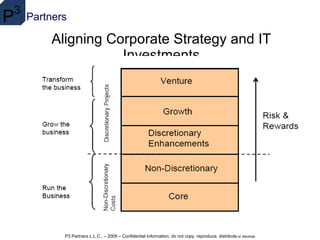
Aligning Corporate Strategy and IT Investments The corporate IT project portfolio is similar to a portfolio of stocks and options - managing this portfolio  requires an understanding of risks and return and tools  to make informed decisions given scarce resources   Technology Portfolio Management -
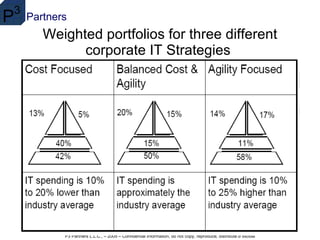
Weighted portfolios for three different corporate IT Strategies
Aligning Corporate Strategy and IT Investments Cost Focused  The ‘Cost Focused’ IT Strategy is a characteristic of industries with high volume and low margin  The technology investment focus is on transactional systems and related infrastructure
Aligning Corporate Strategy and IT Investments Balanced Cost & Agility Typically for fast follower organizations: Technology investments are approved as needed to enable specific strategic objectives. The company has a balanced mix of IT investments.
Aligning Corporate Strategy and IT Investments Agility Focused Companies in this category have advanced technology infrastructures that can easily be leveraged to implement new strategies.  These companies tend to be market leaders and are not necessary technology industry companies.  The technology infrastructure of Agility Focused companies effectively enables their strategy.  IT investments are weighted towards infrastructure and strategic initiatives.
Aligning Corporate Strategy and IT Investments
Aligning IT investment with  business goals and strategies  An integral part of IT investment alignment and IT Governance is the deployment of a strong portfolio management solution. At the foundation of successful portfolio management solutions are methodologies and mature robust PPM / IT Governance Tools
Why invest in portfolio management?  Alignment of People and Projects With Strategic Objectives Maximize resource utilization by allocating   your best resources to the highest priority initiatives  Provide accurate reports to the Executive Committee   Create faster and more accurate business value assessments that prioritize projects  Balanced scorecards with key performance indicators and key goal indicators from which to base decisions Smooth Collaboration and Participation   Strategic Hiring   ROI

It Governance Methodology Cox

  • 1.
    IT Governance MethodologyAuthor William Cox, MBA, QPM, PMP Partners
  • 2.
    PMO IT GovernanceIT Governance consists of the leadership and organizational structures, processes and relational mechanisms that ensure that the organization’s IT sustains and extends the organization’s strategy and objectives
  • 3.
    COBIT® Stands for ‘Control Objectives for Information and related Technology Internationally accepted as good practice for control over information, IT and related risks It is a governance and control framework with guidance for IT controls that focuses on "What needs to be achieved" rather than "How to achieve."
  • 4.
    COBIT® COBIT is closely linked to COSO, the most common control framework to deal with Regulatory requirements. COBIT is widely accepted as the IT control framework that can be used to meet regulatory compliance requirements such as Sarbanes Oxley, Basel II, etc.
  • 5.
    Model for Enterprise-basedInternal Control Controls can be classified by: nature functional area action or objective
  • 6.
    Model for Enterprise-basedInternal Control Controls are classified by nature as: management controls physical controls technical controls
  • 7.
    Model for Enterprise-basedInternal Control Controls are classified by functional area as: application controls network controls development controls operations controls security controls integrity controls
  • 8.
    Model for Enterprise-basedInternal Control Controls are classified by action or objective as: directive controls ... management actions, policies, guidelines that cause or encourage a desired event preventive controls ... standards, methods, practices, tools, technology to ensure quality and reliability detective controls ... give feedback regarding the effectiveness of directive and preventive controls corrective controls ... provide information, procedures, instructions for correcting errors, omissions, etc. detected recovery controls ... facilitate backup, restoration, recovery of a system following interruption of services
  • 9.
    Model for Enterprise-basedInternal Control Internal control includes those mechanisms within an enterprise which have been designed to provide reasonable assurance regarding the achievement of objectives for: effective and efficient operations reliability of financial reporting compliance with applicable laws and regulations
  • 10.
    Model for Enterprise-basedInternal Control Internal controls in and of themselves cannot: ensure the corporation's success or survival ensure the reliability of financial reporting ensure compliance with laws and regulations
  • 11.
    Model for Enterprise-basedInternal Control Internal control systems have 5 components: Control Environment ... human resource controls ... competence levels and cost ... etc. Risk Assessment ...objective setting & risk assessment integrated throughout operations Control Activities ... policies and procedures which define business processes Information/Communication ... internal and external information and reporting ... financial ... customers ... etc. Monitoring ... look for emphasis of "building in" rather than "adding on" of controls
  • 12.
    Controls forInformation Technology Preventive Controls policies, procedures, standards mission/vision statements TQM programs short-range planning long-range planning portfolio management approach to computer investments establishment of benchmarks and best practice standards establishment of self-management teams establishment of electronic commerce guidelines
  • 13.
    Controls for InformationTechnology Detective Controls project management tools control parameter definitions review of operating and capital budgets establishment of tolerance limits establishment of sampling techniques
  • 14.
    Controls for InformationTechnology Corrective Controls exception reports progress reports control reports error reports statistical reports special reports
  • 15.
    Controls for OperationsManagement Preventive Controls establish and enforce computer center policies, procedures and standards establish a problem, change and configuration management structure install and empower help-desk staff to support system users require periodic audits of the computer center install automated job scheduling system discourage printing of hardcopy reports and encourage on-line viewing install automate tape and disk management systems develop partnership relationships with customers and suppliers install program library management software
  • 16.
    Controls for OperationsManagement Detective Controls require system logging of transactions reduce computer operator intervention by installing automated console management system review system activity logs, journals and exception reports rotate key employees in the computer center acquire or develop automated job accounting information system
  • 17.
    Controls for OperationsManagement Detective Controls (continued) require employees to take vacations ensure running of correct version of production programs implement run-to-run program controls compare production resource usage statistics install hardware and software monitors
  • 18.
    IT Governance isa strategy Market leaders typically spend more on strategic initiatives and infrastructure to support those initiatives, while market followers will want to spend more on transactional systems
  • 19.
    IT Governance isa strategy In order to collect information required for good governance, you need to have the right processes, tools and resources .
  • 20.
    IT Governance isa strategy As important as knowing how much and where, is having the systems to support the effective management of your IT Portfolio Decisions need to be made as business strategies change. The better information your executives receive, the better decisions they are able to make .
  • 21.
    Aligning Corporate Strategyand IT Investments The corporate IT project portfolio is similar to a portfolio of stocks and options - managing this portfolio requires an understanding of risks and return and tools to make informed decisions given scarce resources Technology Portfolio Management -
  • 22.
    Weighted portfolios forthree different corporate IT Strategies
  • 23.
    Aligning Corporate Strategyand IT Investments Cost Focused The ‘Cost Focused’ IT Strategy is a characteristic of industries with high volume and low margin The technology investment focus is on transactional systems and related infrastructure
  • 24.
    Aligning Corporate Strategyand IT Investments Balanced Cost & Agility Typically for fast follower organizations: Technology investments are approved as needed to enable specific strategic objectives. The company has a balanced mix of IT investments.
  • 25.
    Aligning Corporate Strategyand IT Investments Agility Focused Companies in this category have advanced technology infrastructures that can easily be leveraged to implement new strategies. These companies tend to be market leaders and are not necessary technology industry companies. The technology infrastructure of Agility Focused companies effectively enables their strategy. IT investments are weighted towards infrastructure and strategic initiatives.
  • 26.
    Aligning Corporate Strategyand IT Investments
  • 27.
    Aligning IT investmentwith business goals and strategies An integral part of IT investment alignment and IT Governance is the deployment of a strong portfolio management solution. At the foundation of successful portfolio management solutions are methodologies and mature robust PPM / IT Governance Tools
  • 28.
    Why invest inportfolio management? Alignment of People and Projects With Strategic Objectives Maximize resource utilization by allocating your best resources to the highest priority initiatives Provide accurate reports to the Executive Committee Create faster and more accurate business value assessments that prioritize projects Balanced scorecards with key performance indicators and key goal indicators from which to base decisions Smooth Collaboration and Participation Strategic Hiring ROI