Occupational radiation safety
in Radiological imaging
Dr Roshan S Livingstone
Associate Professor
Department of Radiology
Christian Medical College, Vellore
Concerns
• Increased use of man-made radiation globally
• Increase in the purchase of radiation based high-end modalities
• Lack of orientation/training of staff – technique and radiation safety
• Lack of awareness among the staff and public
Occupational radiation workers
order of dose severity
• Cardiology cath lab
• Radiology cath lab
• Endovascular surgery – operation theatre
• Operation theatre procedures (ortho, uro..)
• Barium and ERCP (Radiology and Gastro)
• Conventional Radiography (Radiology)
• Dental
• Lithotripsy
• Mobile radiography
• Dual energy xray absorptiometry (DEXA)
• CT
OUTLINE
• Factors influencing radiation dose to staff in Radiology
• Principles of radiation safety
• Monitoring radiation dose to staff and radiation safety accessories
• Conclusion
Early x-ray imaging
• Discovery of x-rays by Wilhelm C Roentgen in 1895
• Medical imaging specialty to visualize internal anatomy
of a human body without surgical exploration.
• Early imaging modalities
• Fluorescent screens
• Film-screen cassettes
• Image intensifier
• CT scanner
Early days
Factors influencing radiation dose to staff from
x-ray modalities
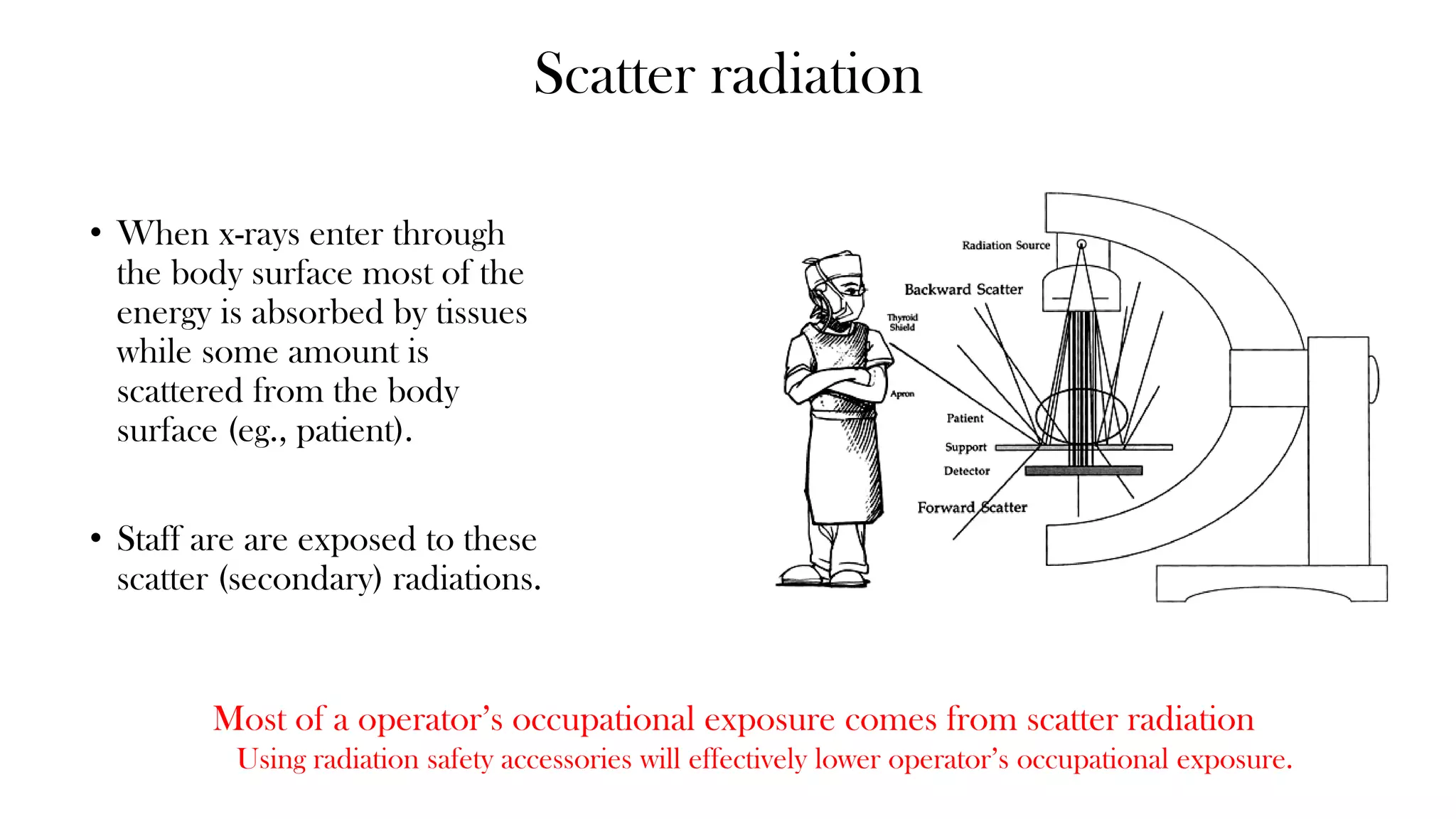
Scatter radiation
• When x-rays enter through
the body surface most of the
energy is absorbed by tissues
while some amount is
scattered from the body
surface (eg., patient).
• Staff are are exposed to these
scatter (secondary) radiations.
Most of a operator’s occupational exposure comes from scatter radiation
Using radiation safety accessories will effectively lower operator’s occupational exposure.
Loss of hair among interventionalists
• Duration of fluoroscopic
screening – reduce
wherever possible
Courtesy: Wagner, Biomed Imaging Interv J 2007
Wiper et al., Heart, 91 (11); 1432, 2005
Loss of hair among
interventionalists from cath labs
Ill-effects
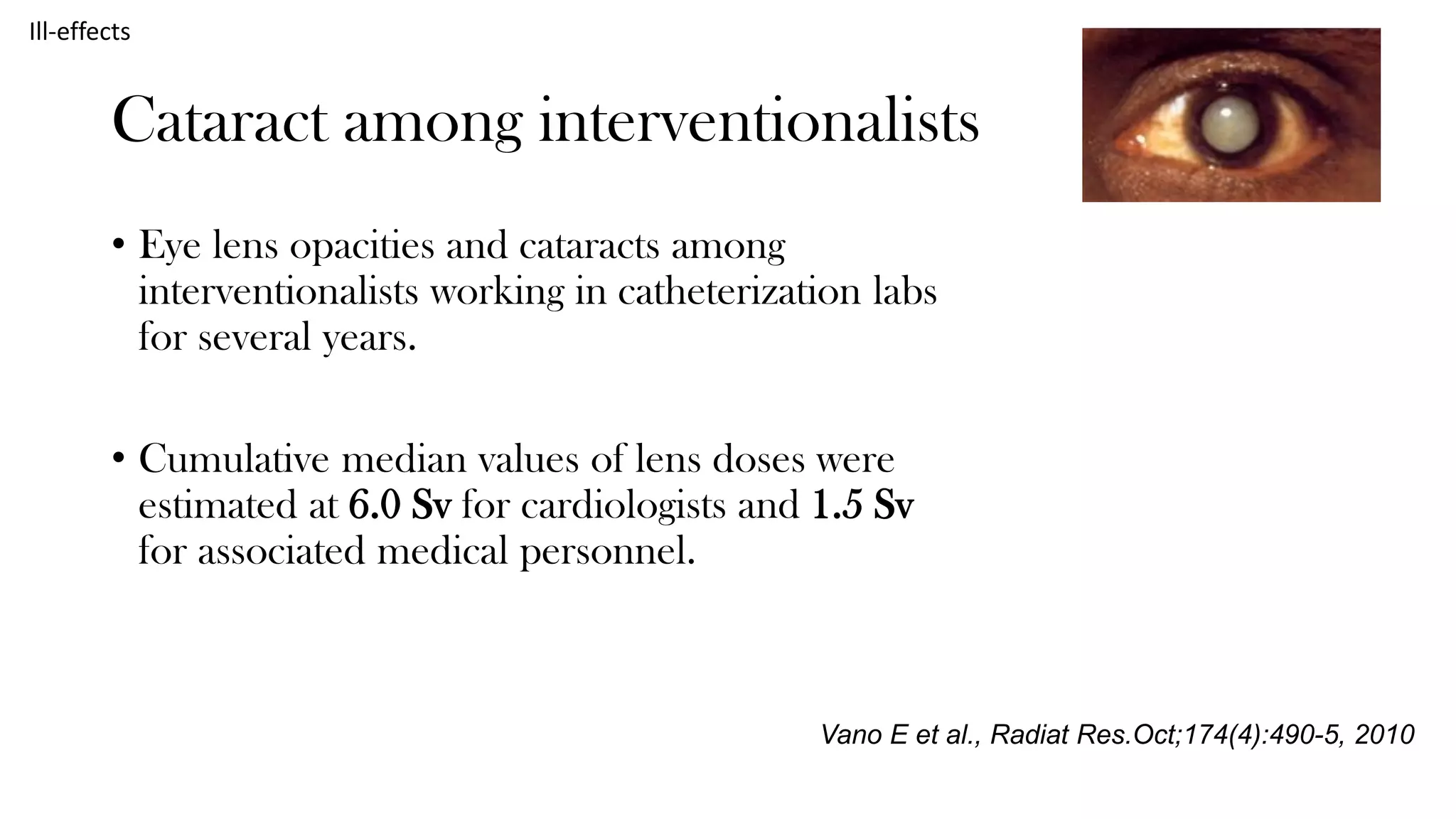
Cataract among interventionalists
• Eye lens opacities and cataracts among
interventionalists working in catheterization labs
for several years.
• Cumulative median values of lens doses were
estimated at 6.0 Sv for cardiologists and 1.5 Sv
for associated medical personnel.
Vano E et al., Radiat Res.Oct;174(4):490-5, 2010
Ill-effects
Work practices
• Tube Angulation
• Steep angulations –
LAO 45o CAU 35o
• Demands more
radiation for imaging
• Increases staff dose
• Increases patient dose
Less radiation dose More radiation dose
Factors influencing radiation dose to staff
Work practices..
X-ray
tube
X-ray
tube
Image
detector
The distance between
patient and image
detector should be
minimum and
maximum between
patient and the source.
Image
detector
Low dose
High dose
Factors influencing radiation dose to staff
Work practices..
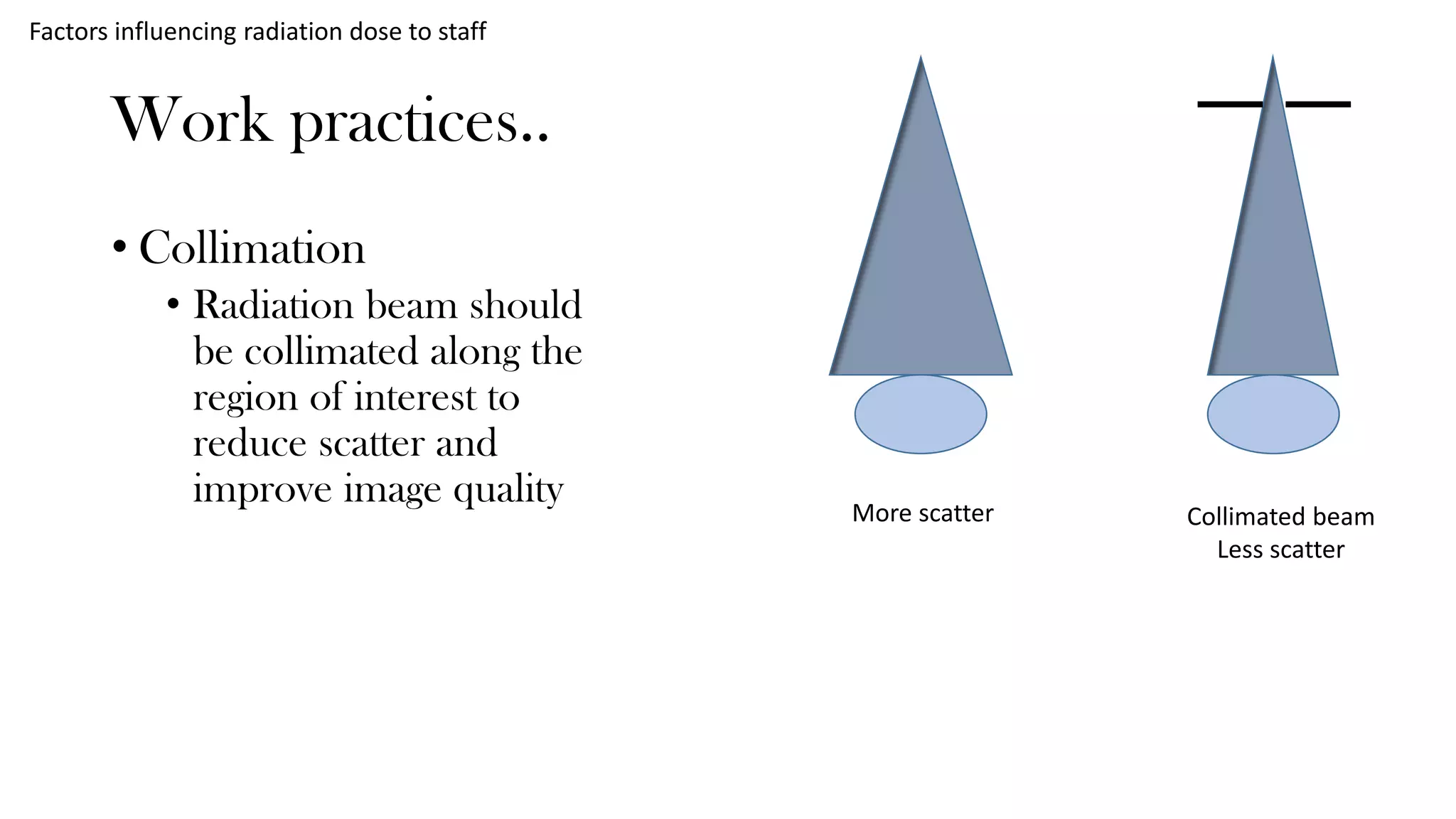
• Collimation
• Radiation beam should
be collimated along the
region of interest to
reduce scatter and
improve image quality
Collimated beam
Less scatter
More scatter
Factors influencing radiation dose to staff
Work practices…
• Excessive use of image
magnification increases
radiation doses
• Use image magnification modes
judiciously
Normal view Magnified view
Factors influencing radiation dose to staff
Work practices..
• Use of radiation safety accessories is
mandatory in all x-ray rooms
• Lead rubber aprons / lead free aprons
• Lead goggles
• Thyroid shield
• Ceiling mounted lead glass
• Lead drapes
• Shield barrier
Factors influencing radiation dose to staff
Basic principles of radiation protection
Time
• Radiation dose is directly proportional to
time of x-ray exposure.
• Examination time should be minimum
• Lesser the time spent lesser is the dose.
• Increasing the screening time will increase the radiation dose
• Do not depress the footswitch continually for long periods;
• Use last image hold options
• Use pulsed fluoroscopy modes
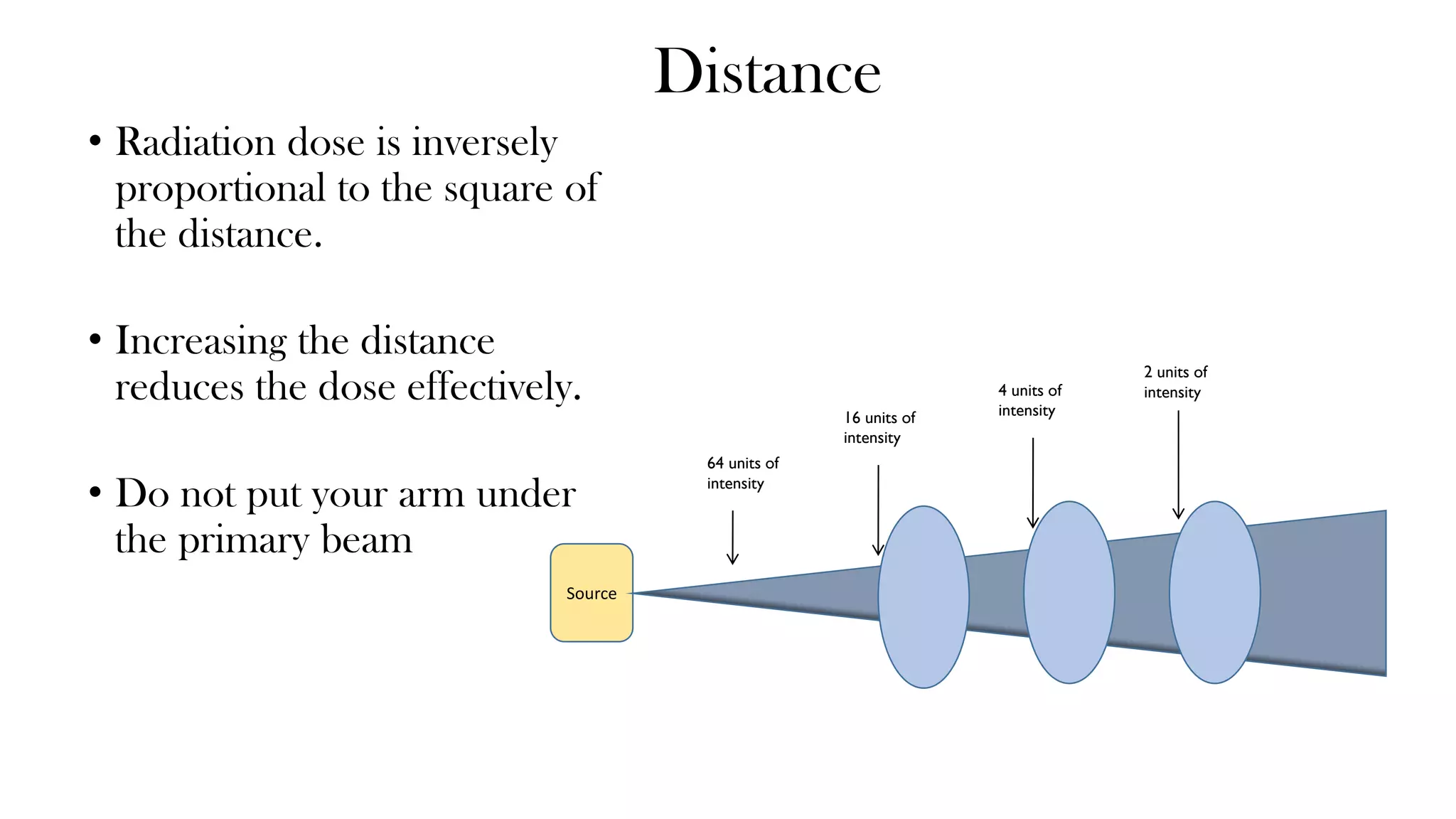
• Radiation dose is inversely
proportional to the square of
the distance.
• Increasing the distance
reduces the dose effectively.
• Do not put your arm under
the primary beam
Source
64 units of
intensity
16 units of
intensity
4 units of
intensity
2 units of
intensity
Distance
• Shielding is warranted for all
staff working in radiation
areas.
• Use of lead aprons (0.25-
0.5mm), ceiling mounted lead
barriers, lead glass goggles,
lead drapes.
• Always work behind the
barriers .
Shielding
Practice: As Low As Reasonably Achievable principle
Am I
protected?
MONITORING STAFF DOSES AND
SAFETY ACCESSORIES
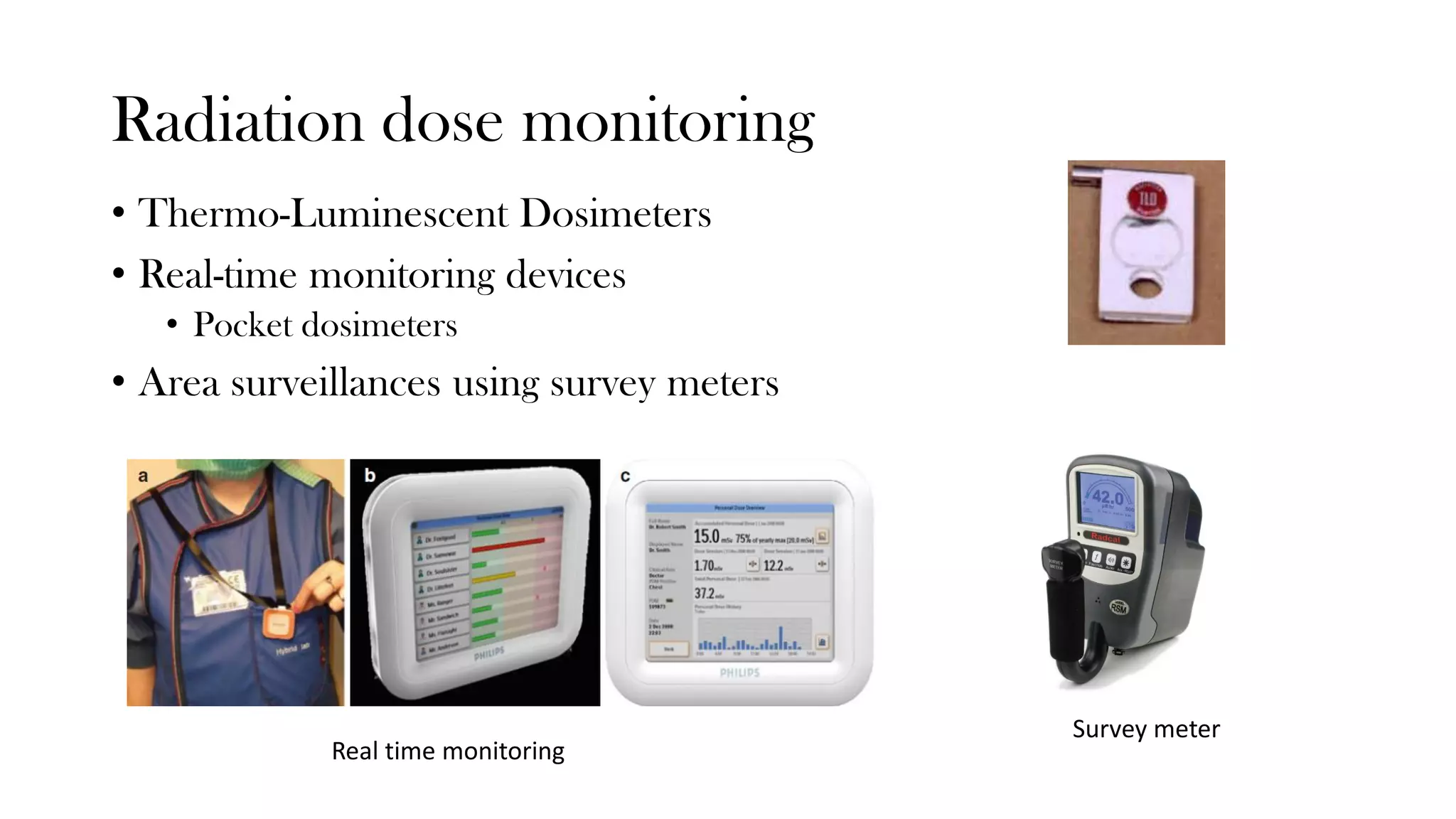
Radiation dose monitoring
• Thermo-Luminescent Dosimeters
• Real-time monitoring devices
• Pocket dosimeters
• Area surveillances using survey meters
Survey meter
Real time monitoring
INSTRUCTION TO USERS -
Do’S
• Use TLD card of the valid service period
• Handle the TLD badge with care
• Store the badge in a radiation free place when not in use
• Report any unusual radiation incident to your Supervisor/RSO/
Head of the Institution
• Return the TLD card on or before 5th of every fourth month
(quarter)
Don’ts…
• Don’t wear the TLD badge outside
the apron
• Don’t leave the TLD badge in the
washing machine or in the vicinity
of hot plate, ovens
• Don’t leave the badge in the
radiation area when it is not in use
• Don’t share your TLD badge with
someone else. Your badge is your
own
Ceiling mounted lead glass
There can be a reduction of
about 50% of dose savings
to the operator with the use
of articulated lead screen
between the patient and the
operator
Safety accessories (fixed/movable) in cath lab
With the use of 0.5 and 1
mm over-couch and
under-couch shielding, it
is possible to reduce the
mean operator radiation
exposure to 14% and 6%,
respectively
Other personal safety accessories
Implementation
Periodic screening of aprons
Awareness among patients and public
Follow low dose protocols for angiography procedures to avoid
complication
(a) 6-8 weeks after multiple coronary angiography and angioplasty procedures.
(b) 16-21 weeks
(c) 18-21 months after the procedures showing tissue necrosis .
(d) Close-up photograph of the lesion shown in (c).
(e) Photograph after skin grafting.
(d) (e)
(a) (c)(b)
(Photographs courtesy of T. Shope & ICRP).
Radiation Dose in MDCT
Y Imanishi et al. Eur Radiol (2005) 15:41-46
Patient relatives waiting inside the x-ray rooms should
be avoided
50 mR/hr
CONCLUSION
• Use radiation safety accessories when required.
• Use personal monitoring devices
• Follow the basic principles of radiation safety
• Follow radiation dose reduction techniques
• Radiation safety awareness and training program
For safe practice of radiation in health care
ALARA is still “WAY FORWARD”
Thank You

Occupational radiation safety in Radiological imaging, Dr. Roshan S Livingstone

  • 1.
    Occupational radiation safety inRadiological imaging Dr Roshan S Livingstone Associate Professor Department of Radiology Christian Medical College, Vellore
  • 2.
    Concerns • Increased useof man-made radiation globally • Increase in the purchase of radiation based high-end modalities • Lack of orientation/training of staff – technique and radiation safety • Lack of awareness among the staff and public
  • 3.
    Occupational radiation workers orderof dose severity • Cardiology cath lab • Radiology cath lab • Endovascular surgery – operation theatre • Operation theatre procedures (ortho, uro..) • Barium and ERCP (Radiology and Gastro) • Conventional Radiography (Radiology) • Dental • Lithotripsy • Mobile radiography • Dual energy xray absorptiometry (DEXA) • CT
  • 4.
    OUTLINE • Factors influencingradiation dose to staff in Radiology • Principles of radiation safety • Monitoring radiation dose to staff and radiation safety accessories • Conclusion
  • 5.
    Early x-ray imaging •Discovery of x-rays by Wilhelm C Roentgen in 1895 • Medical imaging specialty to visualize internal anatomy of a human body without surgical exploration. • Early imaging modalities • Fluorescent screens • Film-screen cassettes • Image intensifier • CT scanner
  • 6.
  • 7.
    Factors influencing radiationdose to staff from x-ray modalities
  • 8.
    Scatter radiation • Whenx-rays enter through the body surface most of the energy is absorbed by tissues while some amount is scattered from the body surface (eg., patient). • Staff are are exposed to these scatter (secondary) radiations. Most of a operator’s occupational exposure comes from scatter radiation Using radiation safety accessories will effectively lower operator’s occupational exposure.
  • 9.
    Loss of hairamong interventionalists • Duration of fluoroscopic screening – reduce wherever possible Courtesy: Wagner, Biomed Imaging Interv J 2007 Wiper et al., Heart, 91 (11); 1432, 2005 Loss of hair among interventionalists from cath labs Ill-effects
  • 10.
    Cataract among interventionalists •Eye lens opacities and cataracts among interventionalists working in catheterization labs for several years. • Cumulative median values of lens doses were estimated at 6.0 Sv for cardiologists and 1.5 Sv for associated medical personnel. Vano E et al., Radiat Res.Oct;174(4):490-5, 2010 Ill-effects
  • 11.
    Work practices • TubeAngulation • Steep angulations – LAO 45o CAU 35o • Demands more radiation for imaging • Increases staff dose • Increases patient dose Less radiation dose More radiation dose Factors influencing radiation dose to staff
  • 12.
    Work practices.. X-ray tube X-ray tube Image detector The distancebetween patient and image detector should be minimum and maximum between patient and the source. Image detector Low dose High dose Factors influencing radiation dose to staff
  • 13.
    Work practices.. • Collimation •Radiation beam should be collimated along the region of interest to reduce scatter and improve image quality Collimated beam Less scatter More scatter Factors influencing radiation dose to staff
  • 14.
    Work practices… • Excessiveuse of image magnification increases radiation doses • Use image magnification modes judiciously Normal view Magnified view Factors influencing radiation dose to staff
  • 15.
    Work practices.. • Useof radiation safety accessories is mandatory in all x-ray rooms • Lead rubber aprons / lead free aprons • Lead goggles • Thyroid shield • Ceiling mounted lead glass • Lead drapes • Shield barrier Factors influencing radiation dose to staff
  • 16.
    Basic principles ofradiation protection
  • 17.
    Time • Radiation doseis directly proportional to time of x-ray exposure. • Examination time should be minimum • Lesser the time spent lesser is the dose. • Increasing the screening time will increase the radiation dose • Do not depress the footswitch continually for long periods; • Use last image hold options • Use pulsed fluoroscopy modes
  • 18.
    • Radiation doseis inversely proportional to the square of the distance. • Increasing the distance reduces the dose effectively. • Do not put your arm under the primary beam Source 64 units of intensity 16 units of intensity 4 units of intensity 2 units of intensity Distance
  • 19.
    • Shielding iswarranted for all staff working in radiation areas. • Use of lead aprons (0.25- 0.5mm), ceiling mounted lead barriers, lead glass goggles, lead drapes. • Always work behind the barriers . Shielding
  • 20.
    Practice: As LowAs Reasonably Achievable principle Am I protected?
  • 21.
    MONITORING STAFF DOSESAND SAFETY ACCESSORIES
  • 22.
    Radiation dose monitoring •Thermo-Luminescent Dosimeters • Real-time monitoring devices • Pocket dosimeters • Area surveillances using survey meters Survey meter Real time monitoring
  • 23.
    INSTRUCTION TO USERS- Do’S • Use TLD card of the valid service period • Handle the TLD badge with care • Store the badge in a radiation free place when not in use • Report any unusual radiation incident to your Supervisor/RSO/ Head of the Institution • Return the TLD card on or before 5th of every fourth month (quarter)
  • 24.
    Don’ts… • Don’t wearthe TLD badge outside the apron • Don’t leave the TLD badge in the washing machine or in the vicinity of hot plate, ovens • Don’t leave the badge in the radiation area when it is not in use • Don’t share your TLD badge with someone else. Your badge is your own
  • 25.
    Ceiling mounted leadglass There can be a reduction of about 50% of dose savings to the operator with the use of articulated lead screen between the patient and the operator
  • 26.
    Safety accessories (fixed/movable)in cath lab With the use of 0.5 and 1 mm over-couch and under-couch shielding, it is possible to reduce the mean operator radiation exposure to 14% and 6%, respectively
  • 27.
    Other personal safetyaccessories Implementation
  • 28.
  • 29.
  • 30.
    Follow low doseprotocols for angiography procedures to avoid complication (a) 6-8 weeks after multiple coronary angiography and angioplasty procedures. (b) 16-21 weeks (c) 18-21 months after the procedures showing tissue necrosis . (d) Close-up photograph of the lesion shown in (c). (e) Photograph after skin grafting. (d) (e) (a) (c)(b) (Photographs courtesy of T. Shope & ICRP).
  • 31.
    Radiation Dose inMDCT Y Imanishi et al. Eur Radiol (2005) 15:41-46
  • 32.
    Patient relatives waitinginside the x-ray rooms should be avoided 50 mR/hr
  • 33.
    CONCLUSION • Use radiationsafety accessories when required. • Use personal monitoring devices • Follow the basic principles of radiation safety • Follow radiation dose reduction techniques • Radiation safety awareness and training program
  • 34.
    For safe practiceof radiation in health care ALARA is still “WAY FORWARD”
  • 35.