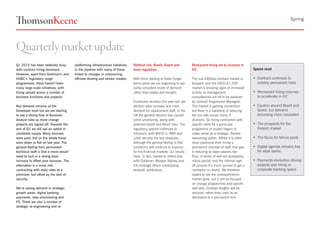
Q1 2015 has been relatively busy
with contract hiring dominant.
However, apart from Goldman’s and
HSBC’s ‘regulatory surge’
programmes, there haven’t been
many large-scale initiatives, with
hiring spread across a number of
business functions and projects.
Key demand remains at the
Developer level but we are starting
to see a strong flow of Business
Analyst roles as more change
projects are signed off. Towards the
end of Q1 we did see an uptick in
candidate supply. Many bonuses
were paid, but on the whole these
were down or flat on last year. The
general feeling from permanent
technical staff is that a move would
need to lock in a strong base
increase to offset poor bonuses. The
alternative is a move into
contracting with daily rates at a
premium, but offset by the lack of
security.
We’re seeing demand in strategic
growth areas: digital banking,
payments, data provisioning and
FX. There are also a number of
strategic re-engineering and re-
platforming infrastructure initiatives
in the pipeline with many of these
linked to changes in outsourcing,
off/near-shoring and vendor models.
Political risk, Brexit, Grexit and
more regulation.
With firms starting to foster longer
terms plans we are beginning to see
some consistent levels of demand
rather than peaks and troughs.
Continued recovery this year will see
attrition rates increase and more
demand for replacement staff. In the
UK the general election has caused
some uncertainty, along with
potential Grexit and Brexit risks. The
regulatory spectre continues to
influence, with MiFID II, BRR and
cyber security the key obstacles,
although the general feeling is that
conditions will continue to improve
for the financial markets. Q1 results
have, in fact, started to reflect that,
with Goldman, Morgan Stanley and
Citi amongst others outstripping
analysts’ predictions.
Permanent hiring set to increase in
H2.
The sub £800pd contract market is
buoyant, and the £800-£1,500
market is showing signs of increased
activity as management
consultancies roll off to be replaced
by contract Programme Managers.
The market is gaining momentum
but there is a backdrop of reducing
the run rate across many IT
divisions. So hiring contractors with
specific skills for a particular
programme or project begins to
make sense as a strategic, flexible
resourcing option. Whilst it is often
more expensive than hiring a
permanent member of staff, that gap
is reducing as base salaries rise.
Plus, in terms of skill-set availability,
notice period, and the internal sign-
off process it’s much quicker to get a
contractor on board. We therefore
expect to see the contract/interim
market grow, but it will be focused
on change programmes and specific
skill-sets. Contract lengths will be
reduced, rather than used as an
alternative to a permanent hire.
Speed read
• Contract continues to
outstrip permanent hires
• Permanent hiring volumes
to accelerate in H2
• Caution around Brexit and
Grexit, but demand
becoming more consistent
• The prospects for the
Fintech market
• The focus for bonus pools
• Digital agenda remains key
for retail banks
• Payments-revolution driving
projects and hiring in
corporate banking space
Quarterlymarket update
Spring
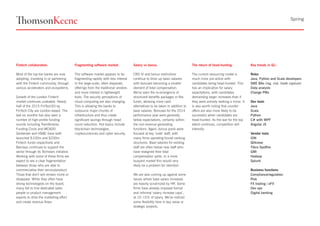
Fintech collaboration.
Most of the top-tier banks are now
adopting, investing in or partnering
with the Fintech community, through
various accelerators and ecosystems.
Growth of the London Fintech
market continues unabated. Nearly
half of the 2015 FinTech50 by
FinTech City are London-based. The
last six months has also seen a
number of high-profile funding
rounds including Transferwise,
Funding Circle and MCADO.
Santander and HSBC have both
launched $100m and $200m
Fintech funds respectively and
Barclays continues to support the
sector through its Techstars initiative.
Working with some of these firms we
expect to see a clear fragmentation
between those who are able to
commercialise their service/product.
Those that don’t will remain niche or
disappear. While they often have
strong technologists on the board,
many fail to hire dedicated sales
people or product management
experts to drive the marketing effort
and create revenue flows.
Fragmenting software market.
The software market appears to be
fragmenting rapidly with less interest
in the large-scale, often disparate,
offerings from the traditional vendors
and more interest in lightweight
tools. The security perceptions of
cloud computing are also changing.
This is allowing the banks to
outsource major chunks of
infrastructure and thus create
significant savings through head-
count reduction. Hot topics include
blockchain technologies,
cryptocurrencies and cyber security.
Salary vs bonus.
CRD IV and bonus restrictions
continue to drive up basic salaries
with bonuses becoming a smaller
element of total compensation.
We’ve seen the re-emergence of
structured benefits packages or flex
funds, allowing more cash
alternatives to be taken in addition to
base salaries. Bonuses for the 2014
performance year were generally
below expectations, certainly within
the non-revenue generating
functions. Again, bonus pools were
focused at key ‘code’ staff, with
many firms operating forced ranking
structures. Base salaries for existing
staff are often below new staff who
have realigned their total
compensation splits. In a more
buoyant market this would very
likely be a problem for retention.
We are also coming up against some
issues where base salary increases
are heavily scrutinized by HR. Some
firms have already imposed formal
and informal ‘salary increase caps’,
at 10–15% of salary. We’ve noticed
some flexibility here in key areas or
strategic projects.
The return of head-hunting.
The current resourcing model is
much more pro-active with
candidates being head-hunted. This
has an implication for salary
expectations, with candidates
demanding larger increases than if
they were actively seeking a move. It
is also worth noting that counter-
offers are also more likely to be
successful when candidates are
head-hunted. As the war for the top
talent continues, competition will
intensify.
Key trends in Q1:
Roles
Java, Python and Scala developers
SME BAs (reg, risk, trade capture)
Data analysts
Change PMs
Dev tools
Java
Scala
Python
C# with WPF
Angular JS
Vendor tools
ION
Qlikview
Tibco Spotfire
GMI
Hadoop
Splunk
Business functions
Compliance/regulation
Risk
FX trading / eFX
Dev ops
Digital banking
Spring
Thomson Keene is a Technology and
Change recruitment firm. We partner
with a range of firms across the
financial markets, from Global Banks
to Fintech start-ups.
Please contact Andrew Keene to
discuss working together.
Andrew Keene
akeene@thomsonkeene.com
020 3434 1212
London
12 Appold Street
EC2A 2AW
New York
535 Fifth Avenue
4th Floor
NY10017
www.thomsonkeene.com

Quarterly

  • 1.
    Q1 2015 hasbeen relatively busy with contract hiring dominant. However, apart from Goldman’s and HSBC’s ‘regulatory surge’ programmes, there haven’t been many large-scale initiatives, with hiring spread across a number of business functions and projects. Key demand remains at the Developer level but we are starting to see a strong flow of Business Analyst roles as more change projects are signed off. Towards the end of Q1 we did see an uptick in candidate supply. Many bonuses were paid, but on the whole these were down or flat on last year. The general feeling from permanent technical staff is that a move would need to lock in a strong base increase to offset poor bonuses. The alternative is a move into contracting with daily rates at a premium, but offset by the lack of security. We’re seeing demand in strategic growth areas: digital banking, payments, data provisioning and FX. There are also a number of strategic re-engineering and re- platforming infrastructure initiatives in the pipeline with many of these linked to changes in outsourcing, off/near-shoring and vendor models. Political risk, Brexit, Grexit and more regulation. With firms starting to foster longer terms plans we are beginning to see some consistent levels of demand rather than peaks and troughs. Continued recovery this year will see attrition rates increase and more demand for replacement staff. In the UK the general election has caused some uncertainty, along with potential Grexit and Brexit risks. The regulatory spectre continues to influence, with MiFID II, BRR and cyber security the key obstacles, although the general feeling is that conditions will continue to improve for the financial markets. Q1 results have, in fact, started to reflect that, with Goldman, Morgan Stanley and Citi amongst others outstripping analysts’ predictions. Permanent hiring set to increase in H2. The sub £800pd contract market is buoyant, and the £800-£1,500 market is showing signs of increased activity as management consultancies roll off to be replaced by contract Programme Managers. The market is gaining momentum but there is a backdrop of reducing the run rate across many IT divisions. So hiring contractors with specific skills for a particular programme or project begins to make sense as a strategic, flexible resourcing option. Whilst it is often more expensive than hiring a permanent member of staff, that gap is reducing as base salaries rise. Plus, in terms of skill-set availability, notice period, and the internal sign- off process it’s much quicker to get a contractor on board. We therefore expect to see the contract/interim market grow, but it will be focused on change programmes and specific skill-sets. Contract lengths will be reduced, rather than used as an alternative to a permanent hire. Speed read • Contract continues to outstrip permanent hires • Permanent hiring volumes to accelerate in H2 • Caution around Brexit and Grexit, but demand becoming more consistent • The prospects for the Fintech market • The focus for bonus pools • Digital agenda remains key for retail banks • Payments-revolution driving projects and hiring in corporate banking space Quarterlymarket update Spring
  • 2.
    Fintech collaboration. Most ofthe top-tier banks are now adopting, investing in or partnering with the Fintech community, through various accelerators and ecosystems. Growth of the London Fintech market continues unabated. Nearly half of the 2015 FinTech50 by FinTech City are London-based. The last six months has also seen a number of high-profile funding rounds including Transferwise, Funding Circle and MCADO. Santander and HSBC have both launched $100m and $200m Fintech funds respectively and Barclays continues to support the sector through its Techstars initiative. Working with some of these firms we expect to see a clear fragmentation between those who are able to commercialise their service/product. Those that don’t will remain niche or disappear. While they often have strong technologists on the board, many fail to hire dedicated sales people or product management experts to drive the marketing effort and create revenue flows. Fragmenting software market. The software market appears to be fragmenting rapidly with less interest in the large-scale, often disparate, offerings from the traditional vendors and more interest in lightweight tools. The security perceptions of cloud computing are also changing. This is allowing the banks to outsource major chunks of infrastructure and thus create significant savings through head- count reduction. Hot topics include blockchain technologies, cryptocurrencies and cyber security. Salary vs bonus. CRD IV and bonus restrictions continue to drive up basic salaries with bonuses becoming a smaller element of total compensation. We’ve seen the re-emergence of structured benefits packages or flex funds, allowing more cash alternatives to be taken in addition to base salaries. Bonuses for the 2014 performance year were generally below expectations, certainly within the non-revenue generating functions. Again, bonus pools were focused at key ‘code’ staff, with many firms operating forced ranking structures. Base salaries for existing staff are often below new staff who have realigned their total compensation splits. In a more buoyant market this would very likely be a problem for retention. We are also coming up against some issues where base salary increases are heavily scrutinized by HR. Some firms have already imposed formal and informal ‘salary increase caps’, at 10–15% of salary. We’ve noticed some flexibility here in key areas or strategic projects. The return of head-hunting. The current resourcing model is much more pro-active with candidates being head-hunted. This has an implication for salary expectations, with candidates demanding larger increases than if they were actively seeking a move. It is also worth noting that counter- offers are also more likely to be successful when candidates are head-hunted. As the war for the top talent continues, competition will intensify. Key trends in Q1: Roles Java, Python and Scala developers SME BAs (reg, risk, trade capture) Data analysts Change PMs Dev tools Java Scala Python C# with WPF Angular JS Vendor tools ION Qlikview Tibco Spotfire GMI Hadoop Splunk Business functions Compliance/regulation Risk FX trading / eFX Dev ops Digital banking Spring
  • 3.
    Thomson Keene isa Technology and Change recruitment firm. We partner with a range of firms across the financial markets, from Global Banks to Fintech start-ups. Please contact Andrew Keene to discuss working together. Andrew Keene akeene@thomsonkeene.com 020 3434 1212 London 12 Appold Street EC2A 2AW New York 535 Fifth Avenue 4th Floor NY10017 www.thomsonkeene.com