Quantitative Methods For Business Management John Buglear
Quantitative Methods For Business Management John Buglear
Quantitative Methods For Business Management John Buglear
Quantitative Methods For Business Management John Buglear
Quantitative Methods For Business Management John Buglear
1.
Quantitative Methods ForBusiness Management
John Buglear download
https://ebookbell.com/product/quantitative-methods-for-business-
management-john-buglear-10887676
Explore and download more ebooks at ebookbell.com
2.
Here are somerecommended products that we believe you will be
interested in. You can click the link to download.
Quantitative Methods For Business Management An Entrepreneurial
Perspective Stuart Wall
https://ebookbell.com/product/quantitative-methods-for-business-
management-an-entrepreneurial-perspective-stuart-wall-10887668
Quantitative Methods An Introduction For Business Management 1st
Edition Paolo Brandimarte
https://ebookbell.com/product/quantitative-methods-an-introduction-
for-business-management-1st-edition-paolo-brandimarte-2442692
Quantitative Methods For Business Management And Finance Louise Swift
Sally Piff
https://ebookbell.com/product/quantitative-methods-for-business-
management-and-finance-louise-swift-sally-piff-42098434
Quantitative Methods For Business 5th Ed Waters C Donald J
https://ebookbell.com/product/quantitative-methods-for-business-5th-
ed-waters-c-donald-j-21973182
3.
Quantitative Methods ForBusiness 4th Edition 4th Edition Donald
Waters
https://ebookbell.com/product/quantitative-methods-for-business-4th-
edition-4th-edition-donald-waters-2372868
Quantitative Methods For Business 12th Edition David R Anderson
https://ebookbell.com/product/quantitative-methods-for-business-12th-
edition-david-r-anderson-4446382
Quantitative Methods For Business Decisions 7th Revised Edition Roger
Slater
https://ebookbell.com/product/quantitative-methods-for-business-
decisions-7th-revised-edition-roger-slater-5030226
Quantitative Methods Mathematics For Business 4th Edition 4th Mark
Cleary
https://ebookbell.com/product/quantitative-methods-mathematics-for-
business-4th-edition-4th-mark-cleary-51140368
Qualitative Research Methods In Business Techniques For Data
Collection And Analysis 2024th Edition De Sordi
https://ebookbell.com/product/qualitative-research-methods-in-
business-techniques-for-data-collection-and-analysis-2024th-edition-
de-sordi-58260064
CHAPTER XIII
HOSPITAL FUNDS
“Tothe which hospitals the founders have given largely of their moveable goods
for the building of the same, and a great part of their lands and tenements
therewith to sustain impotent men and women.”
(Parliament of Leicester.)
E N D O W M E N T S were to a certain extent supplied by the pat
‐
ron, but were sup
ple
ment
ed by pub
lic charity. The emol
u
ments in
‐
clud
ed gifts of money, food and fuel, grants of prop
erty, admis
sion
fees, the profits of fairs, and col
lec
tions. Receipts in kind are seldom
recorded, and the changing scale of values would involve points
beyond the scope of this volume. Par
ticu
lars may be found in the ex
‐
tant man
us
cripts of cer
tain hos
pitals and abbeys, in Valor
Ecclesiasticus, etc. Extracts from the account-books of St. Leonard’s,
York, have been pub
lished in a lecture by Canon Raine. The finance
of such an in
sti
tu
tion, with scat
tered and extensive property, neces
‐
si
tated a depart
ment which required a special clerk to super
in
tend it,
and the ex
che
quer had its par
tic
ular seal. Reports of the His
tori
cal
MSS. Com
mis
sion give details of the working expenses of hos
pitals
at South
ampton and Win
chester.
10.
♦
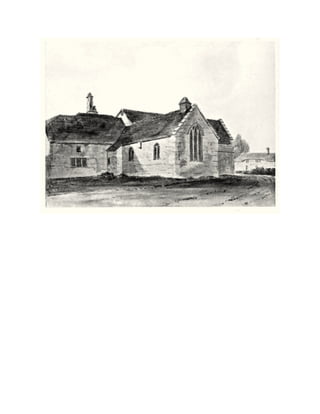
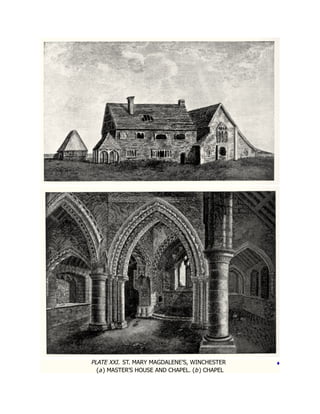
PLATE XXI. ST.MARY MAGDALENE’S, WINCHESTER
(a) MASTER’S HOUSE AND CHAPEL. (b) CHAPEL
11.
1. ENDOWMENTS
(a) Endowmentsin money.—The earliest subscriptions are
recorded in the Pipe Rolls, consisting of royal alms p179
(Eleemosynæ Constitutæ) paid by the Sheriff of the county from the
profits of Crown lands. Three entries in the year 1158 will serve as
specimens:—
Infirmis de Dudstan. xxs. Infirmis super Montem. lxs. Infirmis de Lundon.
lxs.
At first sight this seems not to concern hospitals; but a closer
examination proves that sums are being paid to sick communities—
in fact to lazar-houses. For the lepers of Gloucester dwelt in the
suburb of Dudstan, and the infected inmates of St. Mary
Magdalene’s, Winchester, were known locally as “the infirm people
upon the hill”—now Maun Hill. The grant was paid out of the farm of
the city until, in 1442, the citizens were unable to contribute that
and other sums on account of pestilence and depopulation. The
infirm of London were the lepers of St. Giles’; and the sixty shillings,
originally granted by Henry I and Maud, was still paid in Henry VII’s
reign, for a writ of 1486 refers “to the hospitallers of St. Giles for
their annuity of lxs.” Between the years 1158 and 1178
subscriptions were paid to infirmi at the following places:—
Regular payments—
“Dudstan,” Hecham, Hereford, Lincoln, London, Maldon, Newport,
Richmond, Rochester, St. Albans, St. Edmunds, Shrewsbury, “Super
Montem.”
Occasional payments—
Barnstaple, Barnwell or Stourbridge, Bradley, Burton Lazars,
Chichester, Clattercot, Derby, Canterbury and Harbledown, Ely,
Ilford, Leicester, Liteport, Newark, Northampton, Oxford, Saltwood,
and Windsor.
12.
♦
27. DOCUMENT ANDSEAL OF THE
LEPERS OF LINCOLN
Of the latter, some were grants on
account of a vacant bishopric. In
ad
di
tion to the above, sums were
given to p180 lep
rosi of South
amp
‐
ton and Peter
bo
rough, and to hos
‐
pi
tals of Grave
send, of Nor
wich,
and “of the Queen.” These con
tri
‐
bu
tions vary from 12d. paid to
Here
ford up to £6 given to Hecham
(Higham Ferrers). In some cases
corn and clothing were also con
tri
‐
bu
ted. There is a con
tem
po
rary
rep
re
sen
ta
tion of one of these
“infirm” persons on the seal of the
lepers of Lincoln, dating from the
days of Henry II and St. Hugh. The
doc
u
ment to which it is at
tached
con
tains a cov
e
nant be
tween Bul
‐
ling
ton Priory and the hos
pi
tal of
the Holy In
no
cents, Lin
coln, con
‐
cern
ing a rent of three shil
lings
from the hos
pi
tal.
Revenues also consisted largely in annual rents arising from land
and house property, some being appropriated to specific works. An
early grant to St. Bartholomew’s, Gloucester (circa 1210), was to be
expended upon the maintenance of a lamp in the chapel, and shoes
for inmates, whilst the sum of 5d. was to go towards the provision
of five beds.
(b) Endowments in kind.—The kings were generous in grants from
royal forests. Henry III granted one old oak from Windsor to the sick
of St. Bartholomew’s, London (1224). He afterwards gave to St.
Leonard’s, p181 York, “licence to take what they need in the forest of
Yorkshire for building and burning, and also of herbage and pasture
13.
for flocks andanything needful for their ease, as they had in the
time of Henry II.” Food was also supplied by patrons, especially in
what might be termed manorial hospitals, consisting generally of a
grant of tithes on produce. Another form of endowment was to
impropriate livings. St. Giles’, Norwich, owned six manors and the
advowson of eleven churches. When funds were low at Harbledown,
the archbishop impropriated Reculver church, thus augmenting the
income by parochial tithes. This disgusted the parishioners who
sought redress, thinking it “ill to be subject to lepers.”
2. BEQUESTS
The money chest, larder and wardrobe were replenished largely
by legacies. Amongst the earliest recorded are those of Henry II and
his son, William Longespée. Henry left a large sum to religious
houses in England and Normandy, and particularly to lepers.
Longespée bequeathed cows to lepers in the hospitals of Salisbury,
Maiden Bradley and Wilton, as well as to St. John’s, Wilton, and St.
Bartholomew’s, Smithfield (1225). Men in humbler circumstances
were likewise generous. A certain William de Paveli left 12d. each to
eight hospitals in Northampton, Brackley, Towcester, Newport
Pagnell, Hocclive and Stra[t]ford (circa 1240).107
Wills abound in
references of a similar character. Early legacies were made to the
hospital as a body, but when the renunciation of individual property
by the staff ceased, money was given to individuals; a benefactor of
St. p182 Giles’, Norwich, left 20 marks to the master and brethren,
40d. each to other officials, and 2s. to each bed (1357).108
Gifts
were frequently made to patients; Stephen Forster desired that
100s. should be given away in five city hospitals, besides five marks
in pence to inmates of St. Bartholomew’s, Bristol (1458). An
endowment of penny doles was provided by Lady Maud Courtenay in
Exeter, namely thirteen pence annually for twenty years “to xiii pore
men of Symon Grendon is hous” (1464). Testamentary gifts were
also made in the form of clothes, bedding, utensils, etc. The founder
14.
of St. Giles’,Norwich, left to it “the cup out of which the poor
children drank,” probably some vessel of his own hitherto lent for the
scholars daily meal.
3. PROFITS BY TRADING
The fair was a great institution in mediæval England, and the
funds of privileged charities were assisted in this way. At Maiden
Bradley the leprous women and their prior held a weekly market and
an annual fair. The Chesterfield fair was exchanged for a yearly
payment of six pounds of silver from the royal Exchequer, which
indicates the value set upon it. The most notable hospital-fairs were
that of the leper-house near Cambridge (originally held in the close
and still held on Stourbridge Common), and those connected with
St. Bartholomew’s and St. James’ near London. The story of the
former has been told by H. Morley; and the “May-Fair” of St. James’
leper-house was also famous. These galas were usually at the
patronal festival and lasted two or three days, but occasionally these
profitable festivities were carried on for a fortnight. Fairs were held
at the following hospitals:— p183
Aynho, Bath (Holloway), Bury (St. Nicholas, St. Saviour), Baldock,
Colchester (St. Mary Magdalene), Devizes (St. James & St. Denys), Dover
(Buckland), Harting, Ipswich, Lingerscroft, Newbury, Newport, Newton
Garth, Racheness, Royston (St. Nicholas), Swinestre near Sittingbourne,
Thetford (St. John), Wycomb (2), etc.
This curious and interesting custom survives in connection with St.
Bartholomew’s, Newbury. The fair, originally granted by charter of
King John (1215),109
still takes place annually on the day and
morrow of St. Bartholomew (Old Style), upon lands belonging to the
hospital. A “Court of Pie Powder” is held on the morrow of St.
Bartholomew’s day; the proctor of this ancient charity with the
steward and bailiff attend, and proclamation is made opening the
Court. Tolls derived from stallages are collected, together with an
impost of 2d. on every publican in Newbury (the latter due being
15.
resisted in afew cases). The following day the Court meets again,
when the proceeds are divided amongst the almsmen.110
4. ADMISSION FEES
A considerable pecuniary benefit accrued to hospitals by the
custom of receiving contributions from newly-admitted members of
the household. In some cases a benefaction was made when
persons were received into a community; thus Archbishop Wichwane
as patron granted permission for a certain Gilbert and his wife to
bestow their goods upon Bawtry hospital and dwell there (1281).111
p184
5. INVOLUNTARY CONTRIBUTIONS
Rates were levied for hospital maintenance on an organized
system in some foreign countries. Sometimes a compulsory Hospital
Sunday Fund was instituted, one penny being demanded from the
richer, one halfpenny from the middle-class, and a loaf from lesser
folk. In England, however, the only obligatory support was an
occasional toll on produce, perhaps first ordered by the feudal lord,
but afterwards granted by custom. The Bishop of Exeter (1163)
confirmed to lepers their ancient right to collect food twice a week in
the market, and alms on two other days,—a custom resented by the
citizens. (See p. 54.) King John conferred upon Shrewsbury lazars
the privilege of taking handfuls of corn and flour from sacks exposed
in the market (1204). By charter of the Earls, the Chester lepers
were entitled to extensive tolls—upon salt, fish, grain, malt, fruit and
vegetables, to a cheese or salmon from every load, and even one
horse from the horse-fair. The lepers of St. Mary Magdalene’s,
Southampton, received “from time immemorial” a penny upon every
tun of wine imported.
The mayor and commonalty of Carlisle granted every Sunday to
the lepers a pottle of ale from each brew-house of the city, and a
farthing loaf from every baker who displayed his bread for sale on
Saturday. Their hospital was also endowed “time out of mind” with a
16.
corn-tax known asthe “thraves of St. Nicholas” from every carucate
of land in Cumberland. (The thrave is variously computed at twelve,
twenty or twenty-four sheaves.) This county had a heavy poor-rate,
for the great York hospital collected likewise from every plough
working in p185 the northern Archiepiscopate (Cumberland,
Westmorland, Lancashire and Yorkshire). These “thraves of St.
Leonard,” or “Petercorn,” belonged to the hospital by virtue of
Athelstan’s gift, which had been originally granted to him by his
northern subjects in recognition of his destruction of wolves. The
lands of the Durham Bishopric contributed “thraves of St. Giles” to
Kepier hospital. The collection of such tolls was a constant difficulty,
for it was resented by landowners, who had also the ordinary tithes
to pay.
(6) VOLUNTARY CONTRIBUTIONS
(a) Donations.—At first, freewill-offerings were mainly in kind. The
earliest collector whose name occurs is Alfune, Rahere’s friend.
While the founder was occupied at St. Bartholomew’s, Alfune was
wont “to cumpasse and go abowte the nye placys of the chirche
besily to seke and prouyde necessaries to the nede of the poer men,
that lay in the hospitall.” It fell on a day that as Alfune visited the
meat-market, he came to a butcher whose persistent refusal of help
grieved him. After working what was regarded as a miracle, Alfune
won him over, and departed with flesh in his vessel: henceforth
butchers were more prompt to give their alms. Almsmen used
sometimes to collect in person. It was customary for some of the
brothers of St. John’s House to “attend the churches in Sandwich
every Sunday, with a pewter dish, soliciting money to buy meat for
dinner on that day.” Another brother was deputed to travel on an ass
through Kent asking alms—“and he collects sometimes ten shillings a
year, sometimes a mark, above his expenses.”
All save richly-endowed houses were dependent upon p186 casual
charity. In St. Mary’s, Yarmouth, it is recorded “live a multitude of
17.
poor brethren andsisters, for whose sustenance a daily quest has to
be made.” One of the London statutes, enrolled in Liber Albus,
directs that lepers shall have a common attorney to go every Sunday
into the parish-churches to gather alms for their sustenance. Lest
charitable offerings should diminish when lepers were removed from
sight, a clause was added to the proclamation of 1348:—“it is the
king’s intention that all who wish to give alms to lepers shall do so
freely, and the sheriff shall incite the men of his bailiwick to give
alms to those so expelled from the communion of men.” It would
appear from a London will of 1369, that special chests were
afterwards provided; for bequests are then made to the alms-boxes
(pixidibus) for lepers around London. Alms-boxes were carried about
by collectors, and also hung at the gate or within the hospital. The
proctor of the staff went on his mission with a portable money-box;
upon one occasion, a false proctor was convicted of pretending to
collect for St. Mary of Bethlehem, for which fraud he was pilloried,
the iron-bound box with which he had paraded the streets being tied
round his neck. Boxes of this kind, sometimes having a chain
attached, remain in almshouses at Canterbury, Leicester and
Stamford. It was directed by the statutes of Higham Ferrers that a
common box with a hole in the top should be set in the midst of the
dormitory so that well-disposed people might put in their charity; at
certain times also two of the poor men were to “go abroad to gather
up the devotions of the brotherhood,” the contents being afterwards
divided.
(b) Small Subscriptions.—Some fraternities formed p187
associations for the maintenance of charities. That of St. John
Baptist, Winchester, helped to support St. John’s hospital with the
shillings contributed by its 107 members. The modern hospital of St.
Leonard, Bedford, is kept up on this principle.
(c) Appeals authorized by the King.—The work of the proctor was
not confined to the neighbourhood. Having first possessed himself of
letters-testimonial, he journeyed in England, or even in Wales and
18.
Ireland. A “protection”or warrant was necessary, for unauthorized
collectors were liable to arrest; it was in the form of a royal letter
addressed to the archbishops, bishops, abbots, priors, bailiffs, lieges,
etc. Henry III pleads with his subjects the cause of St. Giles’,
Shrewsbury:—“that when the brethren come to you to beg alms, you
will favourably admit them, and mercifully impart to them your alms
of the goods conferred by God upon you.” Many letters-patent
license the proctors, messengers or attorneys to collect in churches,
or, as at St. Anthony’s, Lenton (1332), in towns, fairs and markets.
Sometimes the collector went forth supported by Church and State;
as when the king issued mandates (1317, 1331) to welcome the
proctor of the Romsey lepers “authorized by John, Bishop of
Winchester and other prelates.”
(d) Appeals authorized by the Church, as Briefs, Indulgences, etc.
—Bishops likewise issued briefs, or letters of recommendation, on
behalf of institutions in their own dioceses or beyond. The infirm of
Holy Innocents’, Lincoln, received from their diocesan a mandate
(1294), ordering the parochial clergy to allow their agent to solicit
alms after mass on three Sundays or festivals each year; later, the
stipulation was added, that the Cathedral p188 fabric fund should not
suffer thereby. A typical document is found in the Winchester
Register in favour of St. Leonard’s, Bedford (1321). The mandate
was addressed to the archdeacons, deans, rectors, vicars and
chaplains, commanding them to receive accredited messengers of
that needy hospital, to cause their business to be expounded by the
priest during mass, after which the collection should be delivered
without deduction. The brief was in force for two years and the
clergy were bidden to help effectually by word and example at least
once a year.
Episcopal Registers include many such documents, some being
granted on special occasions, to make good losses by murrain, to
enlarge premises, or to rebuild after fire, flood or invasion. Some
briefs were not unlike modern appeals, with their lists of presidents
19.
and patrons; forthat on behalf of Romney hospital (1380) was
signed by both archbishops and eleven bishops. It was a recognized
source of raising funds. John de Plumptre in making arrangements
for his almshouse at Nottingham (1414), provided that the widows,
for the bettering of their sustenance, should “have and hold an
episcopal bull and indulgence . . . procured from the archbishops
and bishops of England, Wales and Ireland.”112
It is curious to watch the increase of the privileges offered. The
earlier bishops remitted penance for seven or thirteen days, those of
a later period, for forty days. Roman indulgences knew no such
limits. The form of a papal brief (1392) was as follows:—
“Relaxation of seven years and seven quadragene to penitents who on the
principal feasts of the year and those of p189 St. James in the month of July and
the dedication, the usual octaves and six days; and of a hundred days to those
who during the said octaves and days visit and give alms for the sustentation and
recreation of the chapel of St. James’ poor hospital without the walls, London.”
William, Lord Berkeley directed the executors of his will (1492):—
“to purchase a pardon from the court of Rome, as large as may be had, for this
Chapple [Longbridge], from evensonge to evensonge, in the feast of Trinity for
ever, for pleyne remission to them that will be confessed and contrite.”
Offerings stimulated by such pardons were in money or in kind. A
deed belonging to the Bridport Corporation sets forth that the writer
has seen letters from famous ecclesiastics—including St. Thomas
and St. Edmund of Canterbury—in favour of Allington leper-house,
one being an indulgence of Alexander IV:—
“Item, to alle thos that gevyn broche, rynge, boke, belle, candell, vestimente,
bordclothe, towelle, pygge, lambe, wolle, peny, or penyworthe, be whiche the
sayde hows and hospitale is amended and mentaynde, the sayd Pope grauntethe
the remission of the vijth parte of penance injunct[ed].”
Thus the questionable trade of the pardoner113
was often carried on
by the hospital proctor; moreover, spurious bulls were circulated.
The abuses to which the practice gave rise were recognized by
Bishop Grandisson, who announced that questors collecting alms in
the diocese of Exeter were forbidden to preach, or to sell fictitious
20.
privileges, or unauthorizedpardons. A papal exhortation p190 on
behalf of St. Anne’s, Colchester (1402), forbids these presents to be
sent by pardoners (questuarii). Those who bought a pardon from
the proctor of St. John’s, Canterbury, were informed that the benefit
of 30,000 Paternosters and Ave Marias was freely imparted to them.
But although indulgences were liable to abuse, it must be
remembered that authorized pardons extended to penitents only—to
those who, being contrite, had already confessed and received
absolution and penance. Upon the indulgenced feast of St. Michael,
so many people flocked to St. Mary’s, Leicester, that a special staff of
confessors became necessary.
7. ALMS OF PILGRIMS
Such visits to hospitals lead to the further consideration of
pilgrimage and devotion to relics, which directly affected charity. An
indulgence was offered to penitents visiting Yarmouth hospital and
the sacred relics therein and giving a helping hand to the poor
inhabitants. The Maison Dieu at Dunwich possessed a holy cross of
great reputation “whither many resorted to adore it, who bestowed
much alms.” When the precious relic was carried away and detained
“by certain evil-wishers” connected with St. Osith’s Abbey, the
inmates were greatly impoverished.114
The abbot having been
prosecuted, came into chancery in person and rendered the cross to
the king, who restored it to the master and brethren “to remain in
the hospital for ever.” Holy Cross, Colchester, claimed to keep a
portion of the true Cross; an indulgence was offered by various
bishops to those paying pilgrimage visits and contributing to the
hospital. (See pp. 248–9.) p191
Other treasures visitedby pilgrims were of a more personal
character. Anthony à Wood found records of choice things formerly
preserved in St. Bartholomew’s, Oxford, whereby it was enriched:
—“they were possest of St. Edmund the Confessor’s combe, St.
Barthelmew’s skin, the bones of St. Stephen, and one of the ribbes
of St. Andrew.” The first and foremost of the sacred relics was
evidently a personal possession of the local saint, Archbishop
Edmund Rich, a native of Abingdon:—“Those that were troubled with
continuall headaches,” (University students, perhaps) “frenzies, or
light-headed, were by kembing their heads with St. Edmund’s combe
restored to their former health.” On high days and holy days these
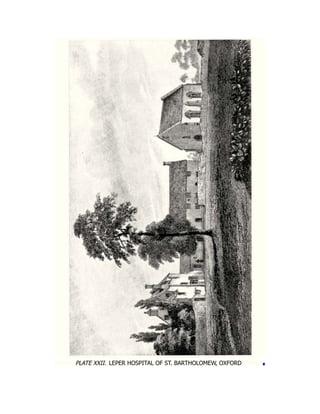
treasures were exposed to view in the chapel. (Pl. XXII.) They were
of so great value that the authorities of Oriel College, having
acquired the patronage, appropriated them, “which caused great
complaints from these hospitalliers.”
23.
♦
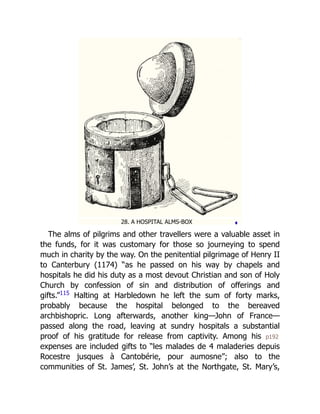
28. A HOSPITALALMS-BOX
The alms of pilgrims and other travellers were a valuable asset in
the funds, for it was customary for those so journeying to spend
much in charity by the way. On the penitential pilgrimage of Henry II
to Canterbury (1174) “as he passed on his way by chapels and
hospitals he did his duty as a most devout Christian and son of Holy
Church by confession of sin and distribution of offerings and
gifts.”115
Halting at Harbledown he left the sum of forty marks,
probably because the hospital belonged to the bereaved
archbishopric. Long afterwards, another king—John of France—
passed along the road, leaving at sundry hospitals a substantial
proof of his gratitude for release from captivity. Among his p192
expenses are included gifts to “les malades de 4 maladeries depuis
Rocestre jusques à Cantobérie, pour aumosne”; also to the
communities of St. James’, St. John’s at the Northgate, St. Mary’s,
24.
and Harbledown, andto the brethren of Ospringe; whilst the king
gave as much as twenty nobles to the Maison Dieu, Dover, where he
was received as a guest.116
Situated close to the highway, on the hill
which eager travellers were about to climb to catch their first sight
of the grand tower of Canterbury, the Harbledown lepers benefited
by the gifts of pilgrims for three and a half centuries. Treasured in
the hospital (Pl. V) was a relic of “the glorious martyr” to whose
shrine they wended. “This fragment of his p193 shoe supports this
little community of poor men,” says Ogygius in the Colloquy on
Pilgrimages,117
where Erasmus describes his visit to Canterbury with
Dean Colet sometime before the year 1519. Shortly after leaving the
city, where the road becomes steep and narrow, there is, he says, a
hospital of a few old men. One of the brethren runs out, sprinkles
the travellers with holy water, and presently offers them the upper
part of a shoe, set with a piece of glass resembling a jewel. This the
strangers are invited to kiss. (Bale satirizes this custom where he
says, “here ys the lachett of swett seynt Thomas shewe.”) Colet is
indignant, but Erasmus, to appease the injured brother, drops a coin
into his alms-box. The quaint old box is still kept at Harbledown, and
is figured above.
25.
Notes — ChapterXIII
107 Madox, Formulare Ang., p. 424.
108 P.R.O. Ancient Deeds, A 11562.
109 Charter Roll 17 John, m. 8.
110 Communicated by the Town Clerk.
111 Surtees Soc., 114, p. 278.
112 Records of Nottingham, ii. 99.
113 The word was retained after the Reformation, e.g.
1573, “paid to a pardoner that gathered for the hospital
of Plympton” (T. N. Brushfield, Devonshire Briefs).
114 Prynne, Usurpation of Popes, p. 1137, and Close 34
Edw. I, m. 1.
115 Chron. and Mem., 67, i. 487.
116 Soc. de l’Histoire de France, 1851, p. 194.
117 Pilgrimages of Walsingham and Canterbury—Ed.
Nichols, 1849, p. 63.
CHAPTER XIV
RELATIONS WITHCHURCH AND
STATE
“As to other hospitals, which he of another foundation and patronage than of the
King, the Ordinaries shall enquire of the manner of the foundation, estate
and governance of the same . . . and make thereof correction and
reformation according to the laws of Holy Church, as to them belongeth.”
(Parliament of Leicester.)
A T T E N T I O N having been already called to the internal cons
ti
‐
tu
tion of hos
pi
tals, we must now con
sider their rela
tion to those in
author
ity. The position of such a house was neces
sarily com
pli
cated;
there arose a dif
ficul
ty in recon
ciling its subord
inate, yet partly
indepen
dent char
acter. We must see, first, how its welfare de
pended
to a cer
tain extent on king and bishop; secondly, its posi
tion with
regard to the parochial system; and thirdly, how far it was af
fected
by monas
ticism.
(i) RELATIONS WITH THE KING AND THE BISHOP
The hospitals of England have never been exclusively in the hands
of Church or State. The relations which they bore to each may be
subdivided under the headings of Constitution, Jurisdiction and
Finance.
(a) Constitution.—As we have seen, the Church, usually
represented by the diocesan bishop, was responsible for the rule and
statutes by which a hospital was guided.
(b) Jurisdiction.—In the province of administration, visitation and
reform, king and bishop played their p195 respective parts. Speaking
generally, the bishop was administrator, and the king protector; to
the former, matters of religious observance and conduct were
referred, to the latter, questions of temporal privilege, immunity from
28.
taxation, etc. Bothhad rights as “visitors.” Faithfully conducted,
ecclesiastical visitation might be of great use, but owing to the huge
extent of dioceses, it was infrequent and inadequate, and where the
king was patron, the diocesan bishop’s visitation was prohibited.
Under Henry III, the royal almoner undertook the keeping of Crown
hospitals, but afterwards this duty fell to the Chancellor, who alone
had the right of visitation; the diocesan bishop had no jurisdiction in
such houses except by special arrangement, as in the Statute
directing that ordinaries “by virtue of the king’s commission to them
directed” shall take inquisitions and return them into chancery. Royal
interposition was not customary unless the king were patron; thus
an order to inquire into waste at certain hospitals was cancelled
because the king had erred in believing that they were founded by
his progenitors. When investigations were commanded, they were
committed to a local jury, who were to find by inquisition on oath of
the good men of the county how far rules had been observed, and
they possessed full power “to deal with the hospital as well in the
head as in the members.” Detailed accounts of such special
visitations may be found among Chancery Miscellanea in the Record
Office.
(c) Finance.—The Lateran Council of 1179 decreed that leper-
communities should not pay tithe from gardens and orchards, nor of
the increase of cattle, and this was ratified in the Provincial Council
of Westminster in 1200. The p196 Church wished to go a step further
and ordain that neither lazar-house, Domus Dei nor poor hospital
should pay taxes, which was set forth by Gregory X; entries upon
Papal Registers in 1278 declare that certain English houses, including
Ospringe, should share this immunity. But the decree was not
necessarily accepted in England, remission of taxation being a royal
prerogative; Ospringe was a Crown hospital to which exemption was
renewed from time to time of the king’s grace. In the cases of lazar-
houses, a curious distinction was made, witnessing incidentally to
national independence—“And let not the goods of lepers be taxed
29.
where they aregoverned by a leper” (par Sovereyn meseal). This
rule occurs in the First Statute of Westminster (3 Edw. I),118
and
afterwards in rolls and writs dated 1297, 1307, etc.119
It was
evidently in allusion to this custom that, in remitting a wool-tax, it is
stated that St. Bartholomew’s, Rochester, was governed by a leprous
prior (1342), but a few years later the king granted it freedom from
taxation for ever. Many houses were freed by charter from local and
general contributions and tolls.
Land-tenure may be included under finance. Before the enactment
of the Statute De Religiosis, benefactors met with no hindrance in
promoting any plan for endowment, but after 1279 permission was
sought “to alienate land in mortmain.” On payment of a small fine,
communities were empowered to accept property to a certain value.
This developed into the “licence to found” named in fourteenth-
century rolls, and subsequently into incorporation. p197
(ii) RELATIONS WITH THE PARISH PRIEST
Before the foundation of a hospital chapel, special permission was
required from the bishop, with a guarantee that it should not
interfere with the parochial system. It was necessary clearly to
define privileges, lest friction should arise. Grants in civil and
ecclesiastical registers include “a chapel, bell and chaplain,”
oblations, sepulture and “the cure of souls.”
(a) Oblations.—One quarter of the offerings received at St.
Katharine’s, Ledbury, was reserved for parochial use. Unless some
definite scheme was arranged, disputes quickly arose. A serious
collision of interests occurred at Brough. The tiny hostel, founded
with the sanction of bishop and archbishop (1506), developed into a
pilgrimage-place. The injured vicar, with solemn ritual, cursed with
bell, book and candle all concerned with such oblations as were
made in the chapel. The founder, however, called forth upon his
parson the archbishop’s censure “as an abandoned wretch and
inflated with diabolical venom for opposing so good a work.” The
30.
priest in turnappealed to the Pope. At length it was agreed that 20s.
yearly should be paid to the mother-church.120
(b) Public and private Worship, Bells, etc.—Agreements as to
public worship on certain occasions were made between the parish
and institutions within its boundary. The biographer of the Berkeley
family, quoting from the episcopal register (1255), records:—
“That all the seculars in the hospitall of Longbridge, exceptinge a Cooke, and one
person to kepe sick folkes, should in the spetiall solemne dayes, come to Berkeley
Church and there p198 should receive all the ecclesiasticall Sacraments, (except
holy bread and holy water) unles it bee by the dispensation and leave of the Vicar
of Berkeley.”121
31.
♦
29. GLASTONBURY
To infringesuch rules meant
trouble. One Easter (1439), the
chaplain of St. Leonard’s, Leicester,
permitted two of the warden’s
servants to receive the Sacrament
from him there, instead of repairing
to the parish church; but the
following Sunday he was forced to
do public penance.
The curious restriction of
repeating divine service with closed
doors and in an undertone was
made at St. John’s, Nottingham,
when the patronal feasts were
being celebrated in the parish. The
rule for ordinary days was that of
St. James’ near Canterbury (1414),
namely, that the canonical hours be
said audibly after the sounding of
the handbells or bells according to
ancient custom.
The possession of a bell in a
turret required a special licence,
lest outside worshippers should
attend. A chapel being added to St.
Mary Magdalene’s, Bristol (1226),
the stipulation was made p199 “but
the leprous women shall have no
bells except handbells, and these shall not be hung up.” It was
agreed at Portsmouth (1229) that the two bells in God’s House
should not exceed the weight of those of the parish church, and
should only ring at set hours. The Annals of Dunstable Monastery
show how important the matter was considered:—
32.
“In the sameyear (1293) the lepers of Dunstaple set up a mighty bell outside
the precincts of their house on two timbers; but the prior . . . brought that bell
within our jurisdiction; which afterwards he restored to them yet so that they
should by no means use that or any other bell for calling together our parishioners
or other people.”
(c) Burial Rights.—The privilege of sepulture rendered the
community more independent, and secured to it certain fees and
legacies. A popular institution like St. Leonard’s, York, or St. John’s,
Exeter, derived benefits from the burial of benefactors. There is a will
entered on the Patent Roll of 1341 whereby a certain Vincent de
Barnastapolia requested to be interred in the cemetery of St. Mark’s,
Bristol, to which house he left a considerable legacy.122
The
conferring or denial of a place of sepulture seems to have been
without rule, and was a matter of favour and circumstance. Thus St.
Oswald’s, Worcester, had a cemetery (probably because it was
originally a leper-house), whilst St. Wulstan’s had none.
(d) Worship and Burial of Lepers.—To lepers both chapel and
graveyard were willingly granted. This was an early custom in
England, as the Norman architecture of several chapels shows (e.g.
Rochester, circa 1100). The p200 Gloucester lazars were granted
burial rights before 1160, when they already possessed a chapel, the
chancel of which still stands; the bishop’s licence made the usual
stipulation that none but lepers should be interred.123
A fresh
impetus was given to spiritual provision for outcasts by the Lateran
Council of 1179. Pope Alexander III decreed as follows:—
“Seeing that it is very remote from Christian piety that those who seek their own
and not the things of Jesus Christ do not permit lepers . . . to have churches or
burial places of their own, nor to be assisted by the ministry of a priest of their
own, we ordain that these lepers be permitted to have the same without any
contradiction.”
This privilege, it was declared, must not be prejudicial to the rights
of ancient churches.
33.
Digressing from theimmediate subject of spiritual provision for the
outcast, one point must be made clear. It is sometimes thought that
the strict parochial discipline of mediæval England would insist upon
the attendance of the leper at his parish church on certain
occasions; others on the contrary suppose that the leper was
excommunicate. The popular belief is that the Church provided for
his worship the so-called “leper’s window,” frequently shown in old
edifices. The existence of low-side-windows at such places as
Bridgnorth and Spondon, where there were leper-colonies, is
considered circumstantial evidence of their origin and purpose. But
name and idea alike are of entirely modern growth, arising from a
misinterpretation of a wall-painting at Windsor, which Mr. Street took
to represent the p201 communicating of a leper through an aperture.
Administration would have been both difficult and irreverent; the
opening, moreover, is often so situated that any such act would be
physically impossible. A manuscript chronicle, indeed, records how
Blase Tupton, who was dwelling near St. Chad’s, Shrewsbury, about
the year 1409, had a gallery made so that she might join in public
worship:—
“Blase . . . cam by chance to be a leeper, and made the oryell which goythe
allong the west side of the churche-yarde, throughe which she cam aloft to heare
serveys throughe a doore made in the churche wale, and so passyd usually uppon
the leades unto a glasse wyndowe, throughe which she dayly sawe and hard dayly
serveys as longe as shee lyvyd.”124
Now Blase was doubtless a privileged person, being the daughter of
the well-known townsman who had founded the almshouse
adjoining St. Chad’s; and though now and again a lazar might make
his way to a churchyard to gaze upon the holy mysteries, it is certain
that only those living in a community with a chapel and priest could
be confessed and receive the Blessed Sacrament. Most antiquaries
are of opinion that the popular theory of the object of lowside-
windows is untenable.
34.
Careful provision wasmade for the religious observances of the
untainted inmates of a hospital as well as for the leprous. They
might use the chapel except on the greater festivals when they were
required to attend the parish church and make oblations there. At St.
Mary Magdalene’s, Bristol, the infected confessed to their chaplain,
but the rest to the parish priest. No parishioner of Bedminster might
attend the chapel on Sundays or p202 festivals to receive the blessed
bread and holy water, the distribution of which to other than inmates
would infringe parochial rights.125
It was provided by the founder’s
statutes at Sherburn that on Sundays the lepers should receive “the
sprinkling of holy water, blessed bread, and other things which are
fitting.”
(e) Free Chapels.—These were “places of worship exempted from
all relation to the mother church and also from episcopal jurisdiction,
an exemption which was an equivocal privilege, obtained
immediately from the Crown, or appended to ancient manors
originally belonging to the Crown.”126
St. John’s, Oxford, was a
privileged proprietary chapel. The king withheld the right of visitation
from the bishop of the diocese, who, in turn, seems to have refused
to sanction and consecrate a graveyard. Henry III called in the
Roman Pontiff to arbitrate; whereupon “the pope at the instance of
the king commanded the Bishop of Lincoln to provide a burial
ground for the hospital of Oxford, for the brethren of the hospital
and for the poor dying therein, the indemnity of the mother church
and of the king as patron being provided for.”127
The kings contrived
to evade the Bishop of Lincoln’s rightful authority. Edward I wrote to
request Bishop Giffard of Worcester to confer holy orders upon a
brother “because the same hospital is the king’s free chapel where
the diocesan ought to exercise no jurisdiction.” The Close Roll of
1304 emphasizes the fact that the house was wholly independent
and therefore “quit of payments, procurations and other exactions of
the ordinary.”128
p203
35.
A few royalhospitals were subordinate to the Crown and the papal
see. That of Basingstoke, with its “free chapel of the king”, was
granted immunity from episcopal control by Cardinal Ottobon
(1268). The Maison Dieu, Dover, was taken under immediate papal
protection by a bull of Nicholas III (1277). A unique case occurs
where the lay founder of an almshouse at Nottingham gained for it
freedom from the jurisdiction of the ordinary or judges, and
subjection alone “to St. Peter and the Apostolic See” (1402).129
(f) “The Cure of Souls.”—Whereas the “free chapel” had no
parochial obligations, there were hospital churches to which full
parochial rights were attached. How or why such houses as St.
Paul’s, Norwich, and Armiston came to possess “the cure of souls” is
uncertain; the little chapel of St. Mary Magdalene, Durham (now a
ruin), was also a rectorial parish church. More curious is the fact that
several leper-hospitals acquired this peculiar advantage. Thus in
Northampton, although St. John’s was “no parish church, but only
for the company there inhabiting,” St. Leonard’s was a “liberty”
having parochial rights, not only of burial, but of Baptism. St.
Nicholas’, York, required as master, “a fit clerk who shall be able to
answer for the cure of souls belonging to the parish church of that
hospital.” The Lincoln leper-house had similar rights.
(g) Almshouses and the Parish Church.—Many of the later
almshouses were closely connected with the parish. At Ewelme, for
example, the almsmen resorted to the church constantly, and their
presence was regarded as so important that even absence on
pilgrimage was p204 deprecated. Those institutions which had no
chaplain of their own were brought into close touch with the parish
priest, as at Croydon, where the poor men went every day to the
church to “here all manner divine service there to be songe and
saide.”
(h) Collegiate Foundations.—Several large almshouses possessed
collegiate rights or formed part of a college (e.g. St. Mary’s,
Leicester; Shrewsbury, Tong, Heringby). Sometimes, as at Higham
36.
Ferrers, there existedside by side a parish church, a bede-house for
pensioners, and a college for the priests and clerks.
(iii) RELATIONS WITH MONK, KNIGHT AND FRIAR
Inquiry must now be made concerning the relation between
hospitals and monastic life. Although the religious orders directly
influenced certain houses, others were totally unconnected with
them. Canon Raine says that St. Leonard’s, York, was more of a
secular than an ecclesiastical establishment; he regards it as
principally a lay institution, although religion was, of course, a strong
element in its working. In this hospital “which is of no order” (says a
Papal Letter, 1429) the master might be a layman.
Welcome to ourwebsite – the perfect destination for book lovers and
knowledge seekers. We believe that every book holds a new world,
offering opportunities for learning, discovery, and personal growth.
That’s why we are dedicated to bringing you a diverse collection of
books, ranging from classic literature and specialized publications to
self-development guides and children's books.
More than just a book-buying platform, we strive to be a bridge
connecting you with timeless cultural and intellectual values. With an
elegant, user-friendly interface and a smart search system, you can
quickly find the books that best suit your interests. Additionally,
our special promotions and home delivery services help you save time
and fully enjoy the joy of reading.
Join us on a journey of knowledge exploration, passion nurturing, and
personal growth every day!
ebookbell.com









![for flocks and anything needful for their ease, as they had in the
time of Henry II.” Food was also supplied by patrons, especially in
what might be termed manorial hospitals, consisting generally of a
grant of tithes on produce. Another form of endowment was to
impropriate livings. St. Giles’, Norwich, owned six manors and the
advowson of eleven churches. When funds were low at Harbledown,
the archbishop impropriated Reculver church, thus augmenting the
income by parochial tithes. This disgusted the parishioners who
sought redress, thinking it “ill to be subject to lepers.”
2. BEQUESTS
The money chest, larder and wardrobe were replenished largely
by legacies. Amongst the earliest recorded are those of Henry II and
his son, William Longespée. Henry left a large sum to religious
houses in England and Normandy, and particularly to lepers.
Longespée bequeathed cows to lepers in the hospitals of Salisbury,
Maiden Bradley and Wilton, as well as to St. John’s, Wilton, and St.
Bartholomew’s, Smithfield (1225). Men in humbler circumstances
were likewise generous. A certain William de Paveli left 12d. each to
eight hospitals in Northampton, Brackley, Towcester, Newport
Pagnell, Hocclive and Stra[t]ford (circa 1240).107
Wills abound in
references of a similar character. Early legacies were made to the
hospital as a body, but when the renunciation of individual property
by the staff ceased, money was given to individuals; a benefactor of
St. p182 Giles’, Norwich, left 20 marks to the master and brethren,
40d. each to other officials, and 2s. to each bed (1357).108
Gifts
were frequently made to patients; Stephen Forster desired that
100s. should be given away in five city hospitals, besides five marks
in pence to inmates of St. Bartholomew’s, Bristol (1458). An
endowment of penny doles was provided by Lady Maud Courtenay in
Exeter, namely thirteen pence annually for twenty years “to xiii pore
men of Symon Grendon is hous” (1464). Testamentary gifts were
also made in the form of clothes, bedding, utensils, etc. The founder](https://image.slidesharecdn.com/5443838-250529221314-7c39de01/85/Quantitative-Methods-For-Business-Management-John-Buglear-13-320.jpg)
![and patrons; for that on behalf of Romney hospital (1380) was
signed by both archbishops and eleven bishops. It was a recognized
source of raising funds. John de Plumptre in making arrangements
for his almshouse at Nottingham (1414), provided that the widows,
for the bettering of their sustenance, should “have and hold an
episcopal bull and indulgence . . . procured from the archbishops
and bishops of England, Wales and Ireland.”112
It is curious to watch the increase of the privileges offered. The
earlier bishops remitted penance for seven or thirteen days, those of
a later period, for forty days. Roman indulgences knew no such
limits. The form of a papal brief (1392) was as follows:—
“Relaxation of seven years and seven quadragene to penitents who on the
principal feasts of the year and those of p189 St. James in the month of July and
the dedication, the usual octaves and six days; and of a hundred days to those
who during the said octaves and days visit and give alms for the sustentation and
recreation of the chapel of St. James’ poor hospital without the walls, London.”
William, Lord Berkeley directed the executors of his will (1492):—
“to purchase a pardon from the court of Rome, as large as may be had, for this
Chapple [Longbridge], from evensonge to evensonge, in the feast of Trinity for
ever, for pleyne remission to them that will be confessed and contrite.”
Offerings stimulated by such pardons were in money or in kind. A
deed belonging to the Bridport Corporation sets forth that the writer
has seen letters from famous ecclesiastics—including St. Thomas
and St. Edmund of Canterbury—in favour of Allington leper-house,
one being an indulgence of Alexander IV:—
“Item, to alle thos that gevyn broche, rynge, boke, belle, candell, vestimente,
bordclothe, towelle, pygge, lambe, wolle, peny, or penyworthe, be whiche the
sayde hows and hospitale is amended and mentaynde, the sayd Pope grauntethe
the remission of the vijth parte of penance injunct[ed].”
Thus the questionable trade of the pardoner113
was often carried on
by the hospital proctor; moreover, spurious bulls were circulated.
The abuses to which the practice gave rise were recognized by
Bishop Grandisson, who announced that questors collecting alms in
the diocese of Exeter were forbidden to preach, or to sell fictitious](https://image.slidesharecdn.com/5443838-250529221314-7c39de01/85/Quantitative-Methods-For-Business-Management-John-Buglear-19-320.jpg)