QUALITY
ASSURANCE IN
PHARMACY
SERVICES
Ensuring Excellence and Patient Safety
INTRODUCTION TO QUALITY
ASSURANCE
• Quality assurance in pharmacy
services encompasses the processes
and procedures implemented to
ensure that medications and
healthcare products meet stringent
quality standards.
IMPORTANCE OF QUALITY ASSURANCE
IN PHARMACY SERVICES
• Quality assurance plays a pivotal role in pharmacy
services due to its critical implications for patient
safety, regulatory compliance, and overall
healthcare quality.
REGULATORY FRAMEWORKS AND
COMPLIANCE
• Pharmaceutical quality assurance is governed by a government and international
regulatory bodies such as the FDA, EMA, and WHO, ensuring that pharmacies
adhere to strict quality standards and guidelines.
QUALITY CONTROL
MEASURES
Quality control involves:
rigorous testing
inspection of pharmaceutical products at
various stages of production and
distribution to identify
rectify any deviations from predetermined
quality standards.
GOOD MANUFACTURING
PRACTICES (GMP)
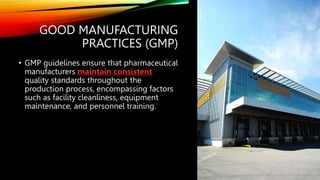
• GMP guidelines ensure that pharmaceutical
manufacturers maintain consistent
quality standards throughout the
production process, encompassing factors
such as facility cleanliness, equipment
maintenance, and personnel training.
QUALITY
ASSURANCE
SYSTEMS AND
DOCUMENTATION
Effective quality assurance
systems rely on meticulous
documentation of
processes, procedures, and
quality control measures to
facilitate traceability,
accountability, and
continuous improvement.
RISK MANAGEMENT
IN PHARMACY
SERVICES
Proactive risk
management strategies
are integral to quality
assurance in pharmacy
services, mitigating
potential risks associated
with medication errors,
adverse drug reactions,
and regulatory non-
compliance.
CONTINUOUS QUALITY
IMPROVEMENT (CQI)
• CQI initiatives involve ongoing
evaluation, feedback, and refinement of
pharmacy processes and practices to
enhance efficiency, effectiveness, and
overall quality of care.
TRAINING AND EDUCATION IN
QUALITY ASSURANCE
• Comprehensive training programs ensure that
pharmacy staff are equipped with the
necessary knowledge and skills to implement
quality assurance protocols effectively,
fostering a culture of excellence and
accountability.
TECHNOLOGY AND
AUTOMATION IN
QUALITY ASSURANCE
Innovative technologies and
automation solutions
streamline quality assurance
processes in pharmacy
services, minimizing human
error, enhancing efficiency,
and improving overall
medication safety.
CASE STUDIES IN
QUALITY
ASSURANCE
SUCCESS
Exploring real-world examples
of successful quality assurance
implementations in pharmacy
settings highlights the
tangible benefits of adherence
to rigorous quality standards
and best practices.
FUTURE
TRENDS AND
INNOVATIONS
IN QUALITY
ASSURANCE
Anticipated advancements in quality
assurance technologies,
methodologies, and regulatory
frameworks are poised to
revolutionize pharmacy services,
paving the way for enhanced patient
outcomes and healthcare quality.
CHALLENGES AND
BARRIERS TO
QUALITY
ASSURANCE
Despite its paramount
importance, quality
assurance in pharmacy
services faces various
challenges and barriers,
including resource
constraints, regulatory
complexities, and resistance
to change.
COLLABORATION AND
INTERDISCIPLINARY APPROACH
Effective quality assurance necessitates
collaboration among pharmacists, healthcare
providers, regulators, and other stakeholders,
fostering an interdisciplinary approach to
optimize patient care and safety.

CONCLUSION
In conclusion, quality assurance is indispensable in ensuring
the safety, efficacy, and reliability of pharmaceutical
products and services, serving as a cornerstone of
excellence in pharmacy practice and patient care.
Thank You! Q&A….
HTTPS://WWW.YOUTUBE.COM/WATCH?V=PW
CJSWRNXNW
LETS HAVE A BREAK…..
STANDBY FOR QUIZZ…….
• https://quizizz.com/admin/quiz/661e8b06f81863aad62b1dec

Quality Assurance in Pharmacy Services.pptx

  • 1.
  • 2.
    INTRODUCTION TO QUALITY ASSURANCE •Quality assurance in pharmacy services encompasses the processes and procedures implemented to ensure that medications and healthcare products meet stringent quality standards.
  • 3.
    IMPORTANCE OF QUALITYASSURANCE IN PHARMACY SERVICES • Quality assurance plays a pivotal role in pharmacy services due to its critical implications for patient safety, regulatory compliance, and overall healthcare quality.
  • 4.
    REGULATORY FRAMEWORKS AND COMPLIANCE •Pharmaceutical quality assurance is governed by a government and international regulatory bodies such as the FDA, EMA, and WHO, ensuring that pharmacies adhere to strict quality standards and guidelines.
  • 5.
    QUALITY CONTROL MEASURES Quality controlinvolves: rigorous testing inspection of pharmaceutical products at various stages of production and distribution to identify rectify any deviations from predetermined quality standards.
  • 6.
    GOOD MANUFACTURING PRACTICES (GMP) •GMP guidelines ensure that pharmaceutical manufacturers maintain consistent quality standards throughout the production process, encompassing factors such as facility cleanliness, equipment maintenance, and personnel training.
  • 7.
    QUALITY ASSURANCE SYSTEMS AND DOCUMENTATION Effective qualityassurance systems rely on meticulous documentation of processes, procedures, and quality control measures to facilitate traceability, accountability, and continuous improvement.
  • 8.
    RISK MANAGEMENT IN PHARMACY SERVICES Proactiverisk management strategies are integral to quality assurance in pharmacy services, mitigating potential risks associated with medication errors, adverse drug reactions, and regulatory non- compliance.
  • 9.
    CONTINUOUS QUALITY IMPROVEMENT (CQI) •CQI initiatives involve ongoing evaluation, feedback, and refinement of pharmacy processes and practices to enhance efficiency, effectiveness, and overall quality of care.
  • 10.
    TRAINING AND EDUCATIONIN QUALITY ASSURANCE • Comprehensive training programs ensure that pharmacy staff are equipped with the necessary knowledge and skills to implement quality assurance protocols effectively, fostering a culture of excellence and accountability.
  • 11.
    TECHNOLOGY AND AUTOMATION IN QUALITYASSURANCE Innovative technologies and automation solutions streamline quality assurance processes in pharmacy services, minimizing human error, enhancing efficiency, and improving overall medication safety.
  • 12.
    CASE STUDIES IN QUALITY ASSURANCE SUCCESS Exploringreal-world examples of successful quality assurance implementations in pharmacy settings highlights the tangible benefits of adherence to rigorous quality standards and best practices.
  • 13.
    FUTURE TRENDS AND INNOVATIONS IN QUALITY ASSURANCE Anticipatedadvancements in quality assurance technologies, methodologies, and regulatory frameworks are poised to revolutionize pharmacy services, paving the way for enhanced patient outcomes and healthcare quality.
  • 14.
    CHALLENGES AND BARRIERS TO QUALITY ASSURANCE Despiteits paramount importance, quality assurance in pharmacy services faces various challenges and barriers, including resource constraints, regulatory complexities, and resistance to change.
  • 15.
    COLLABORATION AND INTERDISCIPLINARY APPROACH Effectivequality assurance necessitates collaboration among pharmacists, healthcare providers, regulators, and other stakeholders, fostering an interdisciplinary approach to optimize patient care and safety.
  • 16.
    CONCLUSION In conclusion, qualityassurance is indispensable in ensuring the safety, efficacy, and reliability of pharmaceutical products and services, serving as a cornerstone of excellence in pharmacy practice and patient care. Thank You! Q&A….
  • 17.
  • 18.
    LETS HAVE ABREAK…..
  • 19.
    STANDBY FOR QUIZZ……. •https://quizizz.com/admin/quiz/661e8b06f81863aad62b1dec