Qualitative analysis using NVivo the five level QDA
method 1st Edition Nicholas H. Woolf - PDF Download
(2025)
https://ebookultra.com/download/qualitative-analysis-using-nvivo-
the-five-level-qda-method-1st-edition-nicholas-h-woolf/
Visit ebookultra.com today to download the complete set of
ebooks or textbooks
We have selected some products that you may be interested in
Click the link to download now or visit ebookultra.com
for more options!.
The Five Giants New Edition Nicholas Timmins
https://ebookultra.com/download/the-five-giants-new-edition-nicholas-
timmins/
Qualitative Text Analysis A Guide to Methods Practice
Using Software Udo Kuckartz
https://ebookultra.com/download/qualitative-text-analysis-a-guide-to-
methods-practice-using-software-udo-kuckartz/
SEISMIC ANALYSIS AND DESIGN USING THE ENDURANCE TIME
METHOD 2nd Edition Homayoon E. Estekanchi
https://ebookultra.com/download/seismic-analysis-and-design-using-the-
endurance-time-method-2nd-edition-homayoon-e-estekanchi/
Using R for Data Management Statistical Analysis and
Graphics 1st Edition Nicholas J. Horton
https://ebookultra.com/download/using-r-for-data-management-
statistical-analysis-and-graphics-1st-edition-nicholas-j-horton/
Qualitative Research Theory Method and Practice 2nd
Edition David Silverman (Ed.)
https://ebookultra.com/download/qualitative-research-theory-method-
and-practice-2nd-edition-david-silverman-ed/
Graffiti World Street Art From Five Continents First
Edition Nicholas Ganz
https://ebookultra.com/download/graffiti-world-street-art-from-five-
continents-first-edition-nicholas-ganz/
Computational thermodynamics the CALPHAD method 1st
Edition H L Lukas
https://ebookultra.com/download/computational-thermodynamics-the-
calphad-method-1st-edition-h-l-lukas/
Internationalization and Localization Using Microsoft NET
1st Edition Nicholas Symmonds (Auth.)
https://ebookultra.com/download/internationalization-and-localization-
using-microsoft-net-1st-edition-nicholas-symmonds-auth/
Qualitative Data Analysis An Introduction 2nd Edition
Carol Grbich
https://ebookultra.com/download/qualitative-data-analysis-an-
introduction-2nd-edition-carol-grbich/
Qualitative analysis using NVivo the five level QDA
method 1st Edition Nicholas H. Woolf Digital Instant
Download
Author(s): Nicholas H. Woolf, Christina Silver
ISBN(s): 9781315181660, 1315181665
Edition: 1
File Details: PDF, 13.41 MB
Year: 2017
Language: english
Software is cut and dried—every button you press has a predictable effect—but qualitative analysis
is open ended and unfolds in unpredictable ways. This contradiction is best resolved by separating
analytic strategies—what you plan to do—from software tactics—how you plan to do it. Expert NVivo
users have unconsciously learned to do this. The Five-Level QDA®
method unpacks the process so
that you can learn it consciously and efficiently.
The first part of the book explains how the contradiction between analytic strategies and soft-
ware tactics is reconciled by “translating”between them. The second part provides both an in-depth
description of how NVivo works and comprehensive instruction in the five steps of “translation.”
These steps are illustrated with examples from a variety of research projects. The third part contains
real-world qualitative research projects from a variety of disciplines, methodologies, and kinds of
qualitative analysis, all illustrated in NVivo using the Five-Level QDA method. The book is accom-
panied by three sets of video demonstrations on the companion website.
The book and accompanying videos illustrate the Windows version of NVivo. As there are
some differences in screen and interface design between the Mac and Windows versions please
watch the video ‘The NVivo Mac Interface’ in the Component Orientation series of videos (avail-
able on the companion website).
The Five-Level QDA method is based on the authors’ combined 40 years of experience teaching
NVivo and other software packages used as platforms for conducting qualitative analysis. After many
years observing their students’ challenges, they developed the Five-Level QDA method to describe the
process that long-time NVivo experts unconsciously adopt. The Five-Level QDA method is independ-
ent of software program or methodology,and the principles apply to any type of qualitative project.
Nicholas H. Woolf has worked as an independent qualitative research consultant, coach, and
trainer since 1998. He has conducted or consulted on numerous research studies, from single-site
to multinational studies in various fields in the behavioral sciences using a wide range of meth-
odologies, from highly structured content analyses, to evaluations, grounded theory-style projects,
and interpretive phenomenology. As a trainer Nick specializes in teaching qualitative analysis using
ATLAS.ti. He has conducted 285 workshops at over 100 universities and other institutions, pri-
marily in the USA and Canada, for more than 3,000 PhD students, professors, and research and
evaluation consultants. In 2013 Nick introduced Five-Level QDA in his keynote address at the first
ATLAS.ti user’s conference in Berlin (Woolf, 2014).
Christina Silver has worked at the CAQDAS Networking Project at the University of Surrey,
UK,since 1998. She is responsible for capacity-building activities and has designed and led training
in all the major qualitative software programs, including ATLAS.ti, Dedoose, MAXQDA, NVivo,
Transana, QDA Miner, Qualrus, and Quirkos. Christina also works as an independent researcher,
consultant, and trainer, supporting researchers to plan and implement computer-assisted analysis
and contributing to doctoral research programs in several UK universities.
QUALITATIVE ANALYSIS USING NVivo
Books in the Developing Qualitative Inquiry series, written by leaders in qualitative inquiry, address
important topics in qualitative methods. Targeted to a broad multi-disciplinary readership, the
books are intended for mid-level to advanced researchers and advanced students. The series for-
wards the field of qualitative inquiry by describing new methods or developing particular aspects
of established methods.
Other Volumes in This Series Include
Mixed Methods in Ethnographic Research
Historical Perspectives
Pertti J. Pelto
Engaging in Narrative Inquiries with Children and Youth
Jean Clandinin,Vera Caine, Sean Lessard, Janice Huber
Interpretive Description
Qualitative Research for Applied Practice, 2nd Edition
Sally Thorne
Qualitative Ethics in Practice
Martin Tolich
For a full list of titles in this series, please visit www.routledge.com
Developing Qualitative Inquiry
Series Editor: Janice Morse
University of Utah
QUALITATIVE ANALYSIS
USING NVivo
The Five-Level QDA®
Method
Nicholas H. Woolf and Christina Silver
First published 2018
by Routledge
711 Third Avenue, New York, NY 10017
and by Routledge
2 Park Square, Milton Park, Abingdon, Oxon, OX14 4RN
Routledge is an imprint of the Taylor & Francis Group, an informa business
© 2018 Taylor & Francis
The right of Nicholas H. Woolf and Christina Silver to be identified as authors of
this work has been asserted by them in accordance with sections 77 and 78 of the
Copyright, Designs and Patents Act 1988.
All rights reserved. No part of this book may be reprinted or reproduced or utilised
in any form or by any electronic, mechanical, or other means, now known or
hereafter invented, including photocopying and recording, or in any information
storage or retrieval system, without permission in writing from the publishers.
Trademark notice: Product or corporate names may be trademarks or registered
trademarks, and are used only for identification and explanation without intent to
infringe.
Five-Level QDA is a trademark owned by Christina Teal and Nicholas H. Woolf,
registered as European Community Trademark Registration Number 015596976,
and United States Trademark Serial Number 87080134.
Library of Congress Cataloging-in-Publication Data
A catalog record for this book has been requested
ISBN: 978-1-138-74366-3 (hbk)
ISBN: 978-1-138-74367-0 (pbk)
ISBN: 978-1-315-18166-0 (ebk)
Typeset in Bembo
by Apex CoVantage, LLC
Visit the companion website: www.routledgetextbooks.com/textbooks/5LQDA
Dedicated to Ben Woolf,
who fearlessly overcame
seemingly insurmountable obstacles
with grace and humor.
1980–2015
List of Figures xiv
List of Tables xvi
List of Boxes xviii
Acknowledgments xix
Case Contributors xxi
Orientation 1
PART I
The Principles of the Five-Level QDA Method 11
1 Strategies and Tactics 13
2 Developing Objectives and Analytic Plans (Levels 1 and 2) 26
3 Translating Analytic Tasks Into Software Tools (Levels 3, 4, and 5) 44
PART II
The Five-Level QDA Method in Practice 59
4 Orientation to NVivo 61
5 The Architecture of NVivo 66
6 Mastering the Process of Translation 111
CONTENTS
viii Contents
PART III
Case Illustrations 153
7 Orientation to Case Illustrations 155
8 Case Illustration — An Exploratory Literature Review: Exploring
the Literature on Interfaith Dialogue 164
Elizabeth M. Pope
9 Case Illustration — A Program Evaluation: Violence Prevention Initiative 178
Kristi Jackson
Appendices 195
Appendix 1: Three Levels of Detail of Analytic Tasks 197
Appendix 2: Five Analytic Activities 198
Appendix 3: Examples of Units in Analytic Tasks 201
Appendix 4: Identifying the Units of Analytic Tasks 202
Appendix 5: Identifying the Purpose of Analytic Tasks 205
Index 208
List of Figures xiv
List of Tables xvi
List of Boxes xviii
Acknowledgments xix
Case Contributors xxi
Orientation 1
PART I
The Principles of the Five-Level QDA Method 11
1 Strategies and Tactics 13
The Contradictions Between Strategies and Tactics 13
Different Ways to Reconcile Contradictions 18
One-Level QDA 19
Three-Level QDA 19
Five-Level QDA 22
References 24
2 Developing Objectives and Analytic Plans (Levels 1 and 2) 26
Level 1: Objectives 28
Clear Objectives 28
Adopting a Methodology 29
An Everyday Illustration 33
Level 2: Analytic Plan 35
The Conceptual Framework 37
Analytic Tasks 38
Knowing What You Plan to Do Next 41
References 42
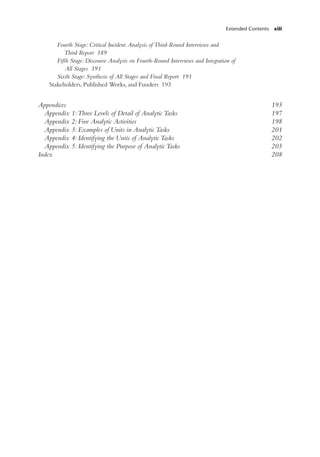
EXTENDED CONTENTS
x Extended Contents
3 Translating Analytic Tasks Into Software Tools (Levels 3, 4, and 5) 44
Level 3: Translation 44
The Framing of Analytic Tasks 45
The Framing of Software Features 46
The Process of Translation 48
Level 4: Selected-Tools 50
Level 5: Constructed-Tools 53
The Sequence of Tasks 54
References 56
PART II
The Five-Level QDA Method in Practice 59
4 Orientation to NVivo 61
The Different Versions and Editions of NVivo 61
Working in Teams 62
Delegation 62
Leadership Style 63
Constraints 63
Frequency of Integration When Working With the Single-UserVersions of NVivo 64
Using NVivo for Teams 65
5 The Architecture of NVivo 66
The Different Versions of NVivo 66
Component Orientation Videos 66
The Organization of the Program 66
Components 67
Components Are Not the Same as Project Items 67
Actions 67
Tools 68
The NVivo Interface 68
The NVivo Project 69
Importing Data to an NVIVO-PROJECT 69
Backing Up an NVIVO-PROJECT 72
One NVIVO-PROJECT per Research Project 72
Providing Data 72
Sources 73
Folders 76
Cases 78
Attribute-Values 79
Conceptualizing Data 81
References 83
Nodes 84
Coded-References 91
Query-Results 94
Sets & Search-Folders 96
Extended Contents xi
Writing 99
Annotations 99
Memos 100
Visualizing 101
Maps 101
Charts 103
The NVIVO-PROJECT as a Whole 105
Interrogating 105
Outputting 106
Keeping Up to Date 107
Backing Up and Moving Projects 107
Working in Teams Using NVivo 108
Everyone on the Same Cycle 108
What Happens When You Merge 109
Principles of the Foolproof Method 109
Procedures of the Foolproof Method 110
Inter-rater Reliability 110
References 110
6 Mastering the Process of Translation 111
Translation as a Heuristic Process 112
Writing Analytic Tasks 113
The Analytic Planning Worksheet 114
The Format of the Analytic Planning Worksheet 114
Analytic Planning Worksheet for the Sample Analytic Task 116
The Five Steps of Translation 116
Step 1: Identifying Units 116
Units of Analysis 118
Units of Data 119
Units of Meaning 119
The Rule of Thumb of Two Units 120
Step 2: Describing Purposes 122
The Difference Between a Purpose and an Action 122
The Rule of Thumb of One Purpose 123
Step 3: Identifying Possible Components 123
Possible Components for the First Unit 125
Possible Components for the Second Unit 127
Additional Possible Components When Purposes Require Writing orVisualizing 129
Step 4: Choosing Appropriate Components 130
Illustrations for Steps 4 and 5 130
Actions That Can Be Taken on Components 130
The Context of Analytic Tasks 133
Step 5: Finalizing Selected- or Constructed-Tools 138
The Distinction Between Selected- and Constructed-Tools 138
When to Use a Selected-Tool 140
When to Use Constructed-Tools 144
References 151
xii Extended Contents
PART III
Case Illustrations 153
7 Orientation to Case Illustrations 155
Learning From Case Illustrations 155
Learning by Analogy 156
Authentic Learning 157
Learning From Multiple Illustrations 157
Video Demonstrations of Case Illustrations 158
Case IllustrationVideos 158
Harnessing ComponentsVideos 160
AccessingVideo Demonstrations 160
The Two Full-Case Illustrations 160
Case Illustration 1: A Literature Review 161
Case Illustration 2: A Program Evaluation 162
References 163
8 Case Illustration — An Exploratory Literature Review: Exploring
the Literature on Interfaith Dialogue 164
Elizabeth M. Pope
Analytic Strategies 164
Background 165
Focus of This Case Illustration 165
Guiding Methodology 166
Stages of the Analysis 167
First Stage: Preliminary Partial Literature Review 168
Second Stage: Review and Rationalize the First Stage 171
Third Stage: Expand the Scope of the Literature Review 172
Fourth Stage: Identify Major Themes in the Literature 172
Fifth Stage: Rewrite the Literature Review 175
Sixth Stage: Ongoing Expansion of the Literature Review 175
Acknowledgments 176
References 176
9 Case Illustration — A Program Evaluation: Violence Prevention Initiative 178
Kristi Jackson
Project In Brief 178
Analytic Strategies 179
Overall Project Objectives 179
Focus of This Case Illustration 180
Guiding Methodology 181
Stages of the Analysis 181
First Stage: Planning the Analysis of First-Round Interviews 182
Second Stage: Descriptive Thematic Analysis of First-Round Interviews and
First Report 183
Third Stage: Concept Sensitizing and Descriptive Thematic Analysis of Second-Round
Interviews and Second Report 187
Extended Contents xiii
Fourth Stage: Critical Incident Analysis of Third-Round Interviews and
Third Report 189
Fifth Stage: Discourse Analysis on Fourth-Round Interviews and Integration of
All Stages 191
Sixth Stage: Synthesis of All Stages and Final Report 191
Stakeholders, Published Works, and Funders 193
Appendices 195
Appendix 1: Three Levels of Detail of Analytic Tasks 197
Appendix 2: Five Analytic Activities 198
Appendix 3: Examples of Units in Analytic Tasks 201
Appendix 4: Identifying the Units of Analytic Tasks 202
Appendix 5: Identifying the Purpose of Analytic Tasks 205
Index 208
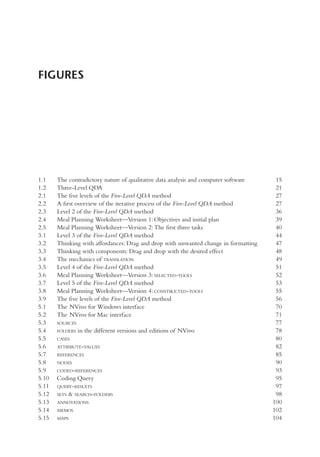
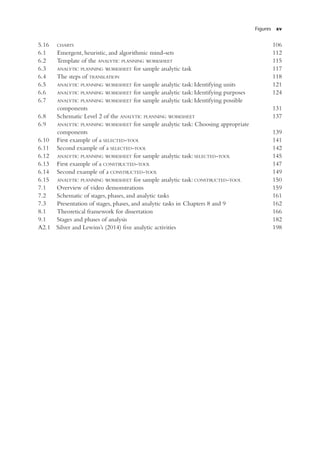
1.1 The contradictory nature of qualitative data analysis and computer software 15
1.2 Three-Level QDA 21
2.1 The five levels of the Five-Level QDA method 27
2.2 A first overview of the iterative process of the Five-Level QDA method 27
2.3 Level 2 of the Five-Level QDA method 36
2.4 Meal Planning Worksheet—Version 1: Objectives and initial plan 39
2.5 Meal Planning Worksheet—Version 2: The first three tasks 40
3.1 Level 3 of the Five-Level QDA method 44
3.2 Thinking with affordances: Drag and drop with unwanted change in formatting 47
3.3 Thinking with components: Drag and drop with the desired effect 48
3.4 The mechanics of TRANSLATION 49
3.5 Level 4 of the Five-Level QDA method 51
3.6 Meal Planning Worksheet—Version 3: SELECTED-TOOLS 52
3.7 Level 5 of the Five-Level QDA method 53
3.8 Meal Planning Worksheet—Version 4: CONSTRUCTED-TOOLS 55
3.9 The five levels of the Five-Level QDA method 56
5.1 The NVivo for Windows interface 70
5.2 The NVivo for Mac interface 71
5.3 SOURCES 77
5.4 FOLDERS in the different versions and editions of NVivo 78
5.5 CASES 80
5.6 ATTRIBUTE-VALUES 82
5.7 REFERENCES 85
5.8 NODES 90
5.9 CODED-REFERENCES 93
5.10 Coding Query 95
5.11 QUERY-RESULTS 97
5.12 SETS & SEARCH-FOLDERS 98
5.13 ANNOTATIONS 100
5.14 MEMOS 102
5.15 MAPS 104
FIGURES
Figures xv
5.16 CHARTS 106
6.1 Emergent, heuristic, and algorithmic mind-sets 112
6.2 Template of the ANALYTIC PLANNING WORKSHEET 115
6.3 ANALYTIC PLANNING WORKSHEET for sample analytic task 117
6.4 The steps of TRANSLATION 118
6.5 ANALYTIC PLANNING WORKSHEET for sample analytic task: Identifying units 121
6.6 ANALYTIC PLANNING WORKSHEET for sample analytic task: Identifying purposes 124
6.7 ANALYTIC PLANNING WORKSHEET for sample analytic task: Identifying possible
components 131
6.8 Schematic Level 2 of the ANALYTIC PLANNING WORKSHEET 137
6.9 ANALYTIC PLANNING WORKSHEET for sample analytic task: Choosing appropriate
components 139
6.10 First example of a SELECTED-TOOL 141
6.11 Second example of a SELECTED-TOOL 142
6.12 ANALYTIC PLANNING WORKSHEET for sample analytic task: SELECTED-TOOL 145
6.13 First example of a CONSTRUCTED-TOOL 147
6.14 Second example of a CONSTRUCTED-TOOL 149
6.15 ANALYTIC PLANNING WORKSHEET for sample analytic task: CONSTRUCTED-TOOL 150
7.1 Overview of video demonstrations 159
7.2 Schematic of stages, phases, and analytic tasks 161
7.3 Presentation of stages, phases, and analytic tasks in Chapters 8 and 9 162
8.1 Theoretical framework for dissertation 166
9.1 Stages and phases of analysis 182
A2.1 Silver and Lewins’s (2014) five analytic activities 198
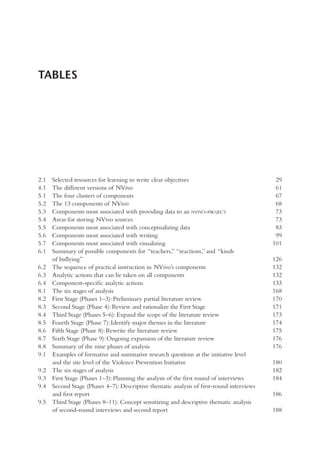
2.1 Selected resources for learning to write clear objectives 29
4.1 The different versions of NVivo 61
5.1 The four clusters of components 67
5.2 The 13 components of NVivo 68
5.3 Components most associated with providing data to an NVIVO-PROJECT 73
5.4 Areas for storing NVivo sources 73
5.5 Components most associated with conceptualizing data 83
5.6 Components most associated with writing 99
5.7 Components most associated with visualizing 101
6.1 Summary of possible components for “teachers,” “reactions,” and “kinds
of bullying” 126
6.2 The sequence of practical instruction in NVivo’s components 132
6.3 Analytic actions that can be taken on all components 132
6.4 Component-specific analytic actions 133
8.1 The six stages of analysis 168
8.2 First Stage (Phases 1–3): Preliminary partial literature review 170
8.3 Second Stage (Phase 4): Review and rationalize the First Stage 171
8.4 Third Stage (Phases 5–6): Expand the scope of the literature review 173
8.5 Fourth Stage (Phase 7): Identify major themes in the literature 174
8.6 Fifth Stage (Phase 8): Rewrite the literature review 175
8.7 Sixth Stage (Phase 9): Ongoing expansion of the literature review 176
8.8 Summary of the nine phases of analysis 176
9.1 Examples of formative and summative research questions at the initiative level
and the site level of the Violence Prevention Initiative 180
9.2 The six stages of analysis 182
9.3 First Stage (Phases 1–3): Planning the analysis of the first round of interviews 184
9.4 Second Stage (Phases 4–7): Descriptive thematic analysis of first-round interviews
and first report 186
9.5 Third Stage (Phases 8–11): Concept sensitizing and descriptive thematic analysis
of second-round interviews and second report 188
TABLES
Tables xvii
9.6 Fourth Stage (Phases 12–14): Critical incident analysis of third-round interviews
and second report 190
9.7 Fifth Stage (Phases 15–17): Discourse, critical incident, and thematic descriptive
analysis on all rounds of interviews 192
9.8 Sixth Stage (Phases 18–19): Synthesis of all rounds of analysis and preparation
of the final report 193
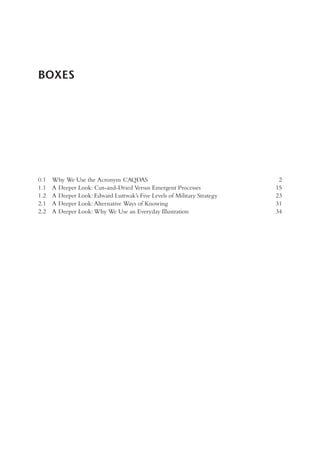
0.1 Why We Use the Acronym CAQDAS 2
1.1 A Deeper Look: Cut-and-Dried Versus Emergent Processes 15
1.2 A Deeper Look: Edward Luttwak’s Five Levels of Military Strategy 23
2.1 A Deeper Look: Alternative Ways of Knowing 31
2.2 A Deeper Look: Why We Use an Everyday Illustration 34
BOXES
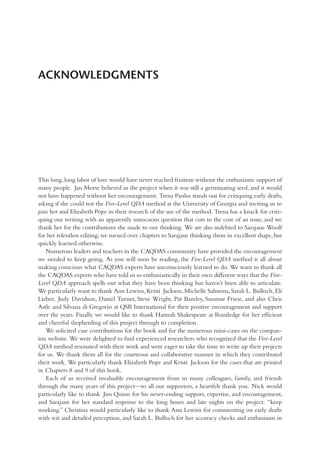
This long,long labor of love would have never reached fruition without the enthusiastic support of
many people. Jan Morse believed in the project when it was still a germinating seed, and it would
not have happened without her encouragement. Trena Paulus stands out for critiquing early drafts,
asking if she could test the Five-Level QDA method at the University of Georgia and inviting us to
join her and Elizabeth Pope in their research of the use of the method. Trena has a knack for criti-
quing our writing with an apparently innocuous question that cuts to the core of an issue, and we
thank her for the contributions she made to our thinking. We are also indebted to Sarajane Woolf
for her relentless editing; we turned over chapters to Sarajane thinking them in excellent shape, but
quickly learned otherwise.
Numerous leaders and teachers in the CAQDAS community have provided the encouragement
we needed to keep going. As you will soon be reading, the Five-Level QDA method is all about
making conscious what CAQDAS experts have unconsciously learned to do. We want to thank all
the CAQDAS experts who have told us so enthusiastically in their own different ways that the Five-
Level QDA approach spells out what they have been thinking but haven’t been able to articulate.
We particularly want to thank Ann Lewins,Kristi Jackson,Michelle Salmona,Sarah L. Bulloch,Eli
Lieber, Judy Davidson, Daniel Turner, Steve Wright, Pat Bazeley, Susanne Friese, and also Chris
Astle and Silvana di Gregorio at QSR International for their positive encouragement and support
over the years. Finally we would like to thank Hannah Shakespeare at Routledge for her efficient
and cheerful shepherding of this project through to completion.
We solicited case contributions for the book and for the numerous mini-cases on the compan-
ion website. We were delighted to find experienced researchers who recognized that the Five-Level
QDA method resonated with their work and were eager to take the time to write up their projects
for us. We thank them all for the courteous and collaborative manner in which they contributed
their work. We particularly thank Elizabeth Pope and Kristi Jackson for the cases that are printed
in Chapters 8 and 9 of this book.
Each of us received invaluable encouragement from so many colleagues, family, and friends
through the many years of this project—to all our supporters, a heartfelt thank you. Nick would
particularly like to thank Jim Quinn for his never-ending support, expertise, and encouragement,
and Sarajane for her standard response to the long hours and late nights on the project: “keep
working.” Christina would particularly like to thank Ann Lewins for commenting on early drafts
with wit and detailed perception, and Sarah L. Bulloch for her accuracy checks and enthusiasm in
ACKNOWLEDGMENTS
Other documents randomly have
different content
V.
(WHITTIER)
My native land, thy Puritanic stock
Stills finds its roots firm-bound in Plymouth Rock,
And all thy sons unite in one grand wish—
To keep the virtues of Preservéd Fish.
Preservéd Fish the Deacon stern and true
Told our New England what her sons should do,
And should they swerve from loyalty and right,
Then the whole land were lost indeed in night.
VI.
(HOLMES)
A diagnosis of our hist'ry proves
Our native land a land its native loves;
Its birth a deed obstetric without peer,
Its growth a source of wonder far and near.
To love it more behold, how foreign shores
Sink into nothingness beside its stores;
Hyde Park at best—though counted ultra-grand—
The 'Boston Common' of Victoria's land.
VII.
(STODDARD)
Behold the flag! Is it not a flag?
Deny it, man, if you dare;
And midway spread, 'twixt earth and sky,
It hangs like a written prayer.
Would impious hand of foe disturb
Its memories' holy spell,
And blight it with a dew of blood?
Ha, tr-r-aitor!!.... It is well.
Ha, tr r aitor!!.... It is well.
VIII.
(ALDRICH)
The little brown squirrel hops in the corn
The cricket quaintly sings;
The emerald pigeon nods his head,
And the shad in the river springs,
The dainty sunflower hangs its head
On the shore of the summer sea;
And better far that I were dead,
If Maud did not love me.
I love the squirrel that hops in the corn,
And the cricket that quaintly sings;
And the emerald pigeon that nods his head,
And the shad that gaily springs.
I love the dainty sunflower, too,
And Maud with her snowy breast;
I love them all;—but I love—I love—
I love my country best.
ALGERNON CHARLES SWINBURNE.
THE POET AND THE WOODLOUSE
(E. B. BROWNING)
Said a poet to a woodlouse—'Thou art certainly my brother;
I discern in thee the markings of the fingers of the Whole;
And I recognize, in spite of all the terrene smut and smother,
In the colours shaded off thee, the suggestions of a soul.
'Yea,' the poet said, 'I smell thee by some passive divination,
I am satisfied with insight of the measure of thine house;
What had happened I conjecture, in a blank and rhythmic
passion,
Had the æons thought of making thee a man, and me a
louse.
'The broad lives of upper planets, their absorption and
digestion,
Food and famine, health and sickness, I can scrutinize and
test;
Through a shiver of the senses comes a resonance of question,
And by proof of balanced answer I decide that I am best.
'Man, the fleshly marvel, alway feels a certain kind of awe stick
To the skirts of contemplation, cramped with nympholeptic
weight:
Feels his faint sense charred and branded by the touch of solar
caustic,
On the forehead of his spirit feels the footprint of a Fate.'
'Notwithstanding which, O poet,' spake the woodlouse, very
blandly,
'I am likewise the created,—I the equipoise of thee;
I the particle, the atom, I behold on either hand lie
The inane of measured ages that were embryos of me.
'I am fed with intimations, I am clothed with consequences,
And the air I breathe is coloured with apocalyptic blush:
Ripest-budded odours blossom out of dim chaotic stenches,
And the Soul plants spirit-lilies in sick leagues of human
slush.
'I am thrilled half cosmically through by cryptophantic surgings,
Till the rhythmic hills roar silent through a spongious kind of
blee:
And earth's soul yawns disembowelled of her pancreatic
organs,
Like a madrepore if mesmerized, in rapt catalepsy.
'And I sacrifice, a Levite—and I palpitate, a poet;—
Can I close dead ears against the rush and resonance of
things?
Symbols in me breathe and flicker up the heights of the heroic;
Earth's worst spawn, you said, and cursèd me? look!
approve me! I have wings.
'Ah, men's poets! men's conventions crust you round and
swathe you mist-like,
And the world's wheels grind your spirits down the dust ye
overtrod:
We stand sinlessly stark-naked in effulgence of the Christlight,
And our polecat chokes not cherubs; and our skunk smells
sweet to God.
'For He grasps the pale Created by some thousand vital
handles,
Till a Godshine, bluely winnowed through the sieve of
thunderstorms,
Shimmers up the non-existent round the churning feet of
angels;
And the atoms of that glory may be seraphs, being worms.
'Friends, your nature underlies us and your pulses overplay us;
Ye, with social sores unbandaged, can ye sing right and
steer wrong?
For the transient cosmic, rooted in imperishable chaos,
Must be kneaded into drastics as material for a song.
ust be eaded to d ast cs as ate a o a so g
'Eyes once purged from homebred vapours through
humanitarian passion
See that monochrome a despot through a democratic prism;
Hands that rip the soul up, reeking from divine evisceration,
Not with priestlike oil anoint him, but a stronger-smelling
chrism.
'Pass, O poet, retransfigured! God, the psychometric rhapsode,
Fills with fiery rhythms the silence, stings the dark with stars
that blink;
All eternities hang round him like an old man's clothes
collapsèd,
While he makes his mundane music—and he will not stop, I
think.'
THE PERSON OF THE HOUSE.
Idyl CCCLXVI. The Kid.
(PATMORE)
My spirit, in the doorway's pause,
Fluttered with fancies in my breast;
Obsequious to all decent laws,
I felt exceedingly distressed.
I knew it rude to enter there
With Mrs. V. in such a state;
And, 'neath a magisterial air,
Felt actually indelicate.
I knew the nurse began to grin;
I turned to greet my Love. Said she—
'Confound your modesty, come in!
—What shall we call the darling, V.?'
(There are so many charming names!
Girls'—Peg, Moll, Doll, Fan, Kate, Blanche, Bab:
Boys'—Mahershalal-hashbaz, James,
Luke, Nick, Dick, Mark, Aminadab.)
Lo, as the acorn to the oak,
As well-heads to the river's height,
As to the chicken the moist yolk,
As to high noon the day's first white—
Such is the baby to the man.
There, straddling one red arm and leg,
Lay my last work, in length a span,
Half hatched, and conscious of the egg.
A creditable child, I hoped;
And half a score of joys to be
Through sunny lengths of prospect sloped
Smooth to the bland futurity.
O, fate surpassing other dooms,
O, hope above all wrecks of time!
O, light that fills all vanquished glooms,
O, silent song o'ermastering rhyme!
I covered either little foot,
I drew the strings about its waist;
Pi k th h ll'd i f it
Pink as the unshell'd inner fruit,
But barely decent, hardly chaste,
Its nudity had startled me;
But when the petticoats were on,
'I know,' I said; 'its name shall be
Paul Cyril Athanasius John.'
'Why,' said my wife, 'the child's a girl.'
My brain swooned, sick with failing sense;
With all perception in a whirl,
How could I tell the difference?
'Nay,' smiled the nurse, 'the child's a boy.'
And all my soul was soothed to hear
That so it was: then startled Joy
Mocked Sorrow with a doubtful tear.
And I was glad as one who sees
For sensual optics things unmeet:
As purity makes passion freeze,
So faith warns science off her beat.
Blessed are they that have not seen,
And yet, not seeing, have believed:
To walk by faith, as preached the Dean,
And not by sight, have I achieved.
Let love, that does not look, believe;
Let knowledge, that believes not, look:
Truth pins her trust on falsehood's sleeve,
While reason blunders by the book.
Then Mrs. Prig addressed me thus:
'Sir, if you'll be advised by me,
You'll leave the blessed babe to us;
It's my belief he wants his tea.'
NEPHELIDIA.
(SWINBURNE)
From the depth of the dreamy decline of the dawn through a
notable nimbus of nebulous noonshine,
Pallid and pink as the palm of the flag-flower that flickers
with fear of the flies as they float,
Are they looks of our lovers that lustrously lean from a marvel
of mystic miraculous moonshine,
These that we feel in the blood of our blushes that thicken
and threaten with throbs through the throat?
Thicken and thrill as a theatre thronged at appeal of an actor's
appalled agitation,
Fainter with fear of the fires of the future than pale with the
promise of pride in the past;
Flushed with the famishing fullness of fever that reddens with
radiance of rathe recreation,
Gaunt as the ghastliest of glimpses that gleam through the
gloom of the gloaming when ghosts go aghast?
Nay, for the nick of the tick of the time is a tremulous touch on
the temples of terror,
Strained as the sinews yet strenuous with strife of the dead
who is dumb as the dust-heaps of death:
Surely no soul is it, sweet as the spasm of erotic emotional
exquisite error,
Bathed in the balms of beatified bliss, beatific itself by
beatitude's breath.
Surely no spirit or sense of a soul that was soft to the spirit
and soul of our senses
Sweetens the stress of suspiring suspicion that sobs in the
semblance and sound of a sigh;
Only this oracle opens Olympian, in mystical moods and
triangular tenses—
'Life is the lust of a lamp for the light that is dark till the
dawn of the day when we die.'
Mild is the mirk and monotonous music of memory,
melodiously mute as it may be,
While the hope in the heart of a hero is bruised by the
breach of men's rapiers, resigned to the rod;
Made meek as a mother whose bosom-beats bound with the
bliss-bringing bulk of a balm-breathing baby,
As they grope through the graveyard of creeds, under skies
growing green at a groan for the grimness of God.
Blank is the book of his bounty beholden of old, and its binding
is blacker than bluer:
Out of blue into black is the scheme of the skies, and their
dews are the wine of the bloodshed of things;
Till the darkling desire of delight shall be free as a fawn that is
freed from the fangs that pursue her,
Till the heart-beats of hell shall be hushed by a hymn from
the hunt that has harried the kennel of kings.
FRANCIS BRET HARTE.
A GEOLOGICAL MADRIGAL.
(SHENSTONE)
I have found out a sift for my fair;
I know where the fossils abound,
Where the footprints of Aves declare
The birds that once walked on the ground;
Oh, come, and—in technical speech—
We'll walk this Devonian shore,
Or on some Silurian beach
We'll wander, my love, evermore.
I will show thee the sinuous track
By the slow-moving annelid made,
Or the Trilobite that, farther back,
In the old Potsdam sandstone was laid;
Thou shalt see, in his Jurassic tomb,
The Plesiosaurus embalmed;
In his Oolitic prime and his bloom,
Iguanodon safe and unharmed!
You wished—I remember it well,
And I loved you the more for that wish—
For a perfect cystedian shell,
And a whole holocephalic fish.
And oh, if Earth's strata contains
In its lowest Silurian drift,
Or palæozoic remains
The same,—'tis your lover's free gift!
Than come, love, and never say nay,
But calm all your maidenly fears;
We'll note, love, in one summer's day
The record of millions of years;
And though the Darwinian plan
Your sensitive feelings may shock,
We'll find the beginning of man,—
Our fossil ancestors, in rock!
MRS. JUDGE JENKINS.
[Being the only genuine sequel to 'Maud Muller.']
(WHITTIER)
Maud Muller all that summer day
Raked the meadows sweet with hay;
Yet, looking down the distant lane,
She hoped the judge would come again.
But when he came, with smile and bow,
Maud only blushed, and stammered, 'Ha-ow?'
And spoke of her 'pa,' and wondered whether
He'd give consent they should wed together.
Old Muller burst in tears, and then
Begged that the judge would lend him 'ten';
For trade was dull, and wages low,
And the 'craps' this year were somewhat slow.
And ere the languid summer died,
Sweet Maud became the judge's bride.
But on the day that they were mated
Maud's brother Bob was intoxicated;
And Maud's relations, twelve in all,
Were very drunk at the judge's hall.
And when the summer came again,
The young bride bore him babies twain.
And the judge was blest, but thought it strange
That bearing children made such a change:
For Maud grew broad and red and stout:
And the waist that his arm once clasped about
Was more than he now could span; and he
Sighed as he pondered, ruefully,
How that which in Maud was native grace
In Mrs. Jenkins was out of place;
And thought of the twins, and wished that they
Looked less like the man who raked the hay
On Muller's farm, and dreamed with pain
Of the day he wandered down the lane,
And, looking down that dreary track,
He half regretted that he came back.
For, had he waited, he might have wed
Some maiden fair and thoroughbred;
For there be women fair as she,
Whose verbs and nouns do more agree.
Alas for maiden! alas for judge!
And the sentimental,—that's one-half 'fudge';
For Maud soon thought the judge a bore,
With all his learning and all his lore.
And the judge would have bartered Maud's fair face
For more refinement and social grace.
If, of all words of tongue and pen,
The saddest are, 'It might have been,'
More sad are these we daily see:
'It is, but hadn't ought to be.'
THE WILLOWS.
(POE)
The skies they were ashen and sober,
The streets they were dirty and drear;
It was night in the month of October,
Of my most immemorial year;
Like the skies I was perfectly sober,
As I stopped at the mansion of Shear,—
At the Nightingale,—perfectly sober,
And the willowy woodland, down here.
Here, once in an alley Titanic
Of Ten-pins, I roamed with my soul,—
Of Ten-pins,—with Mary, my soul;
They were days when my heart was volcanic,
And impelled me to frequently roll,
And make me resistlessly roll,
Till my ten-strikes created a panic
In the realms of the Boreal pole,
Till my ten-strikes created a panic
With the monkey atop of his pole.
I repeat, I was perfectly sober,
But my thoughts they were palsied and sere,—
My thoughts were decidedly queer;
For I knew not the month was October,
And I marked not the night of the year,
I forgot that sweet morceau of Auber
That the band oft performed down here,
And I mixed the sweet music of Auber
With the Nightingale's music by Shear.
And now as the night was senescent,
And the star-dials pointed to morn,
And car-drivers hinted of morn,
At the end of the path a liquescent
And bibulous lustre was born;
'Twas made by the bar-keeper present
Twas made by the bar keeper present,
Who mixéd a duplicate horn,—
His two hands describing a crescent
Distinct with a duplicate horn.
And I said: 'This looks perfectly regal,
For it's warm, and I know I feel dry,—
I am confident that I feel dry;
We have come past the emu and eagle,
And watched the gay monkey on high;
Let us drink to the emu and eagle,—
To the swan and the monkey on high,—
To the eagle and monkey on high;
For this bar-keeper will not inveigle,—
Bully boy with the vitreous eye;
He surely would never inveigle,—
Sweet youth with the crystalline eye.'
But Mary, uplifting her finger,
Said, 'Sadly this bar I mistrust,—
I fear that this bar does not trust.
O hasten! O let us not linger!
O fly,—let us fly,—ere we must!'
In terror she cried, letting sink her
Parasol till it trailed in the dust,—
In agony sobbed, letting sink her
Parasol till it trailed in the dust,—
Till it sorrowfully trailed in the dust.
Then I pacified Mary and kissed her,
And tempted her into the room,
And conquered her scruples and gloom;
And we passed to the end of the vista,
But were stopped by the warning of doom,—
By some words that were warning of doom;
And I said, 'What is written, sweet sister,
At the opposite end of the room?'
She sobbed, as she answered, 'All liquors
Must be paid for ere leaving the room.'
Then my heart it grew ashen and sober,
As the streets were deserted and drear,—
For my pockets were empty and drear;
And I cried, 'It was surely October,
On this very night of last year,
That I journeyed—I journeyed down here,—
That I brought a fair maiden down here,
On this night of all nights in the year.
Ah! to me that inscription is clear;
Well I know now, I'm perfectly sober,
Why no longer they credit me here,—
Well I know now that music of Auber,
And this Nightingale, kept by one Shear.'
HENRY DUFF TRAILL.
VERS DE SOCIÉTÉ.
(LOCKER-LAMPSON)
There, pay it, James! 'tis cheaply earned;
My conscience! how one's cabman charges!
But never mind, so I'm returned
Safe to my native street of Clarges.
I've just an hour for one cigar
(What style these Reinas have, and what ash!)
One hour to watch the evening star
With just one Curaçao-and-potash.
Ah me! that face beneath the leaves
And blossoms of its piquant bonnet!
Who would have thought that forty thieves
Of years had laid their fingers on it!
Could you have managed to enchant
At Lord's to-day old lovers simple,
Had Robber Time not played gallant,
And spared you every youthful dimple!
That Robber bold, like courtier Claude,
Who danced the gay coranto jesting,
By your bright beauty charmed and awed,
Has bowed and passed you unmolesting.
No feet of many-wintered crows
Have traced about your eyes a wrinkle;
Your sunny hair has thawed the snows
That other heads with silver sprinkle.
I wonder if that pair of gloves
I won of you you'll ever pay me!
I wonder if our early loves
Were wise or foolish, cousin Amy?
I wonder if our childish tiff
Now seems to you, like me, a blunder!
I wonder if you wonder if
I ever wonder if you wonder.
I wonder if you'd think it bliss
Once more to be the fashion's leader!
I wonder if the trick of this
Escapes the unsuspecting reader!
And as for him who does or can
Delight in it, I wonder whether
He knows that almost any man
Could reel it off by yards together!
I wonder if— What's that? a knock?
Is that you, James? Eh? What? God bless me!
How time has flown! It's eight o'clock,
And here's my fellow come to dress me.
Be quick, or I shall be the guest
Whom Lady Mary never pardons;
I trust you, James, to do your best
To save the soup at Grosvenor Gardens.
FROM 'THE PUSS AND THE BOOTS.'
(BROWNING)
Put case I circumvent and kill him: good.
Good riddance—wipes at least from book o' th' world
The ugly admiration-note-like blot—
Gives honesty more elbow-room by just
The three dimensions of one wicked knave.
But then slips in the plaguy After-voice.
'Wicked? Holloa! my friend, whither away
So fast? Who made you, Moses-like, a judge
And ruler over men to spare or slay?
A blot wiped off forsooth! Produce forthwith
Credentials of your mission to erase
The ink-spots of mankind—t' abolish ill
For being what it is, is bound to be,
Its nature being so—cut wizards off
In flower of their necromantic lives
For being wizards, when 'tis plain enough
That they have no more wrought their wizardship
Than cats their cathood.' Thus the plaguy Voice,
Puzzling withal not overmuch, for thus
I turn the enemy's flank: 'Meseems, my friend,
Your argument's a thought too fine of mesh,
And catches what you would not. Every mouse
Trapped i' the larder by the kitchen wench
Might reason so—but scarcely with effect.
Methinks 'twould little serve the captured thief
To plead, "The fault's Dame Nature's, guiltless I.
Am I to blame that in the parcelling-out
Of my ingredients the Great Chemist set
Just so much here, there so much, and no more
(Since 'tis but question, after all is said,
Of mere proportion 'twixt the part that feels
And that which guides), so much proclivity
To nightly cupboard-breaking, so much lust
Of bacon-scraps, such tendency to think
Old Stilton-rind the noblest thing on earth?
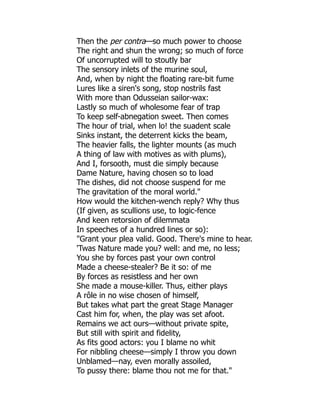
Then the per contra—so much power to choose
The right and shun the wrong; so much of force
Of uncorrupted will to stoutly bar
The sensory inlets of the murine soul,
And, when by night the floating rare-bit fume
Lures like a siren's song, stop nostrils fast
With more than Odusseian sailor-wax:
Lastly so much of wholesome fear of trap
To keep self-abnegation sweet. Then comes
The hour of trial, when lo! the suadent scale
Sinks instant, the deterrent kicks the beam,
The heavier falls, the lighter mounts (as much
A thing of law with motives as with plums),
And I, forsooth, must die simply because
Dame Nature, having chosen so to load
The dishes, did not choose suspend for me
The gravitation of the moral world."
How would the kitchen-wench reply? Why thus
(If given, as scullions use, to logic-fence
And keen retorsion of dilemmata
In speeches of a hundred lines or so):
"Grant your plea valid. Good. There's mine to hear.
'Twas Nature made you? well: and me, no less;
You she by forces past your own control
Made a cheese-stealer? Be it so: of me
By forces as resistless and her own
She made a mouse-killer. Thus, either plays
A rôle in no wise chosen of himself,
But takes what part the great Stage Manager
Cast him for, when, the play was set afoot.
Remains we act ours—without private spite,
But still with spirit and fidelity,
As fits good actors: you I blame no whit
For nibbling cheese—simply I throw you down
Unblamed—nay, even morally assoiled,
To pussy there: blame thou not me for that."
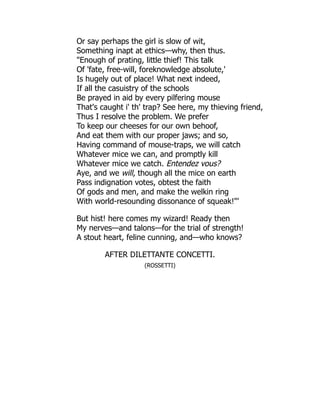
Or say perhaps the girl is slow of wit,
Something inapt at ethics—why, then thus.
"Enough of prating, little thief! This talk
Of 'fate, free-will, foreknowledge absolute,'
Is hugely out of place! What next indeed,
If all the casuistry of the schools
Be prayed in aid by every pilfering mouse
That's caught i' th' trap? See here, my thieving friend,
Thus I resolve the problem. We prefer
To keep our cheeses for our own behoof,
And eat them with our proper jaws; and so,
Having command of mouse-traps, we will catch
Whatever mice we can, and promptly kill
Whatever mice we catch. Entendez vous?
Aye, and we will, though all the mice on earth
Pass indignation votes, obtest the faith
Of gods and men, and make the welkin ring
With world-resounding dissonance of squeak!"'
But hist! here comes my wizard! Ready then
My nerves—and talons—for the trial of strength!
A stout heart, feline cunning, and—who knows?
AFTER DILETTANTE CONCETTI.
(ROSSETTI)
Welcome to our website – the ideal destination for book lovers and
knowledge seekers. With a mission to inspire endlessly, we offer a
vast collection of books, ranging from classic literary works to
specialized publications, self-development books, and children's
literature. Each book is a new journey of discovery, expanding
knowledge and enriching the soul of the reade
Our website is not just a platform for buying books, but a bridge
connecting readers to the timeless values of culture and wisdom. With
an elegant, user-friendly interface and an intelligent search system,
we are committed to providing a quick and convenient shopping
experience. Additionally, our special promotions and home delivery
services ensure that you save time and fully enjoy the joy of reading.
Let us accompany you on the journey of exploring knowledge and
personal growth!
ebookultra.com

Qualitative analysis using NVivo the five level QDA method 1st Edition Nicholas H. Woolf
  • 1.
    Qualitative analysis usingNVivo the five level QDA method 1st Edition Nicholas H. Woolf - PDF Download (2025) https://ebookultra.com/download/qualitative-analysis-using-nvivo- the-five-level-qda-method-1st-edition-nicholas-h-woolf/ Visit ebookultra.com today to download the complete set of ebooks or textbooks
  • 2.
    We have selectedsome products that you may be interested in Click the link to download now or visit ebookultra.com for more options!. The Five Giants New Edition Nicholas Timmins https://ebookultra.com/download/the-five-giants-new-edition-nicholas- timmins/ Qualitative Text Analysis A Guide to Methods Practice Using Software Udo Kuckartz https://ebookultra.com/download/qualitative-text-analysis-a-guide-to- methods-practice-using-software-udo-kuckartz/ SEISMIC ANALYSIS AND DESIGN USING THE ENDURANCE TIME METHOD 2nd Edition Homayoon E. Estekanchi https://ebookultra.com/download/seismic-analysis-and-design-using-the- endurance-time-method-2nd-edition-homayoon-e-estekanchi/ Using R for Data Management Statistical Analysis and Graphics 1st Edition Nicholas J. Horton https://ebookultra.com/download/using-r-for-data-management- statistical-analysis-and-graphics-1st-edition-nicholas-j-horton/
  • 3.
    Qualitative Research TheoryMethod and Practice 2nd Edition David Silverman (Ed.) https://ebookultra.com/download/qualitative-research-theory-method- and-practice-2nd-edition-david-silverman-ed/ Graffiti World Street Art From Five Continents First Edition Nicholas Ganz https://ebookultra.com/download/graffiti-world-street-art-from-five- continents-first-edition-nicholas-ganz/ Computational thermodynamics the CALPHAD method 1st Edition H L Lukas https://ebookultra.com/download/computational-thermodynamics-the- calphad-method-1st-edition-h-l-lukas/ Internationalization and Localization Using Microsoft NET 1st Edition Nicholas Symmonds (Auth.) https://ebookultra.com/download/internationalization-and-localization- using-microsoft-net-1st-edition-nicholas-symmonds-auth/ Qualitative Data Analysis An Introduction 2nd Edition Carol Grbich https://ebookultra.com/download/qualitative-data-analysis-an- introduction-2nd-edition-carol-grbich/
  • 5.
    Qualitative analysis usingNVivo the five level QDA method 1st Edition Nicholas H. Woolf Digital Instant Download Author(s): Nicholas H. Woolf, Christina Silver ISBN(s): 9781315181660, 1315181665 Edition: 1 File Details: PDF, 13.41 MB Year: 2017 Language: english

  • 7.
    Software is cutand dried—every button you press has a predictable effect—but qualitative analysis is open ended and unfolds in unpredictable ways. This contradiction is best resolved by separating analytic strategies—what you plan to do—from software tactics—how you plan to do it. Expert NVivo users have unconsciously learned to do this. The Five-Level QDA® method unpacks the process so that you can learn it consciously and efficiently. The first part of the book explains how the contradiction between analytic strategies and soft- ware tactics is reconciled by “translating”between them. The second part provides both an in-depth description of how NVivo works and comprehensive instruction in the five steps of “translation.” These steps are illustrated with examples from a variety of research projects. The third part contains real-world qualitative research projects from a variety of disciplines, methodologies, and kinds of qualitative analysis, all illustrated in NVivo using the Five-Level QDA method. The book is accom- panied by three sets of video demonstrations on the companion website. The book and accompanying videos illustrate the Windows version of NVivo. As there are some differences in screen and interface design between the Mac and Windows versions please watch the video ‘The NVivo Mac Interface’ in the Component Orientation series of videos (avail- able on the companion website). The Five-Level QDA method is based on the authors’ combined 40 years of experience teaching NVivo and other software packages used as platforms for conducting qualitative analysis. After many years observing their students’ challenges, they developed the Five-Level QDA method to describe the process that long-time NVivo experts unconsciously adopt. The Five-Level QDA method is independ- ent of software program or methodology,and the principles apply to any type of qualitative project. Nicholas H. Woolf has worked as an independent qualitative research consultant, coach, and trainer since 1998. He has conducted or consulted on numerous research studies, from single-site to multinational studies in various fields in the behavioral sciences using a wide range of meth- odologies, from highly structured content analyses, to evaluations, grounded theory-style projects, and interpretive phenomenology. As a trainer Nick specializes in teaching qualitative analysis using ATLAS.ti. He has conducted 285 workshops at over 100 universities and other institutions, pri- marily in the USA and Canada, for more than 3,000 PhD students, professors, and research and evaluation consultants. In 2013 Nick introduced Five-Level QDA in his keynote address at the first ATLAS.ti user’s conference in Berlin (Woolf, 2014). Christina Silver has worked at the CAQDAS Networking Project at the University of Surrey, UK,since 1998. She is responsible for capacity-building activities and has designed and led training in all the major qualitative software programs, including ATLAS.ti, Dedoose, MAXQDA, NVivo, Transana, QDA Miner, Qualrus, and Quirkos. Christina also works as an independent researcher, consultant, and trainer, supporting researchers to plan and implement computer-assisted analysis and contributing to doctoral research programs in several UK universities. QUALITATIVE ANALYSIS USING NVivo
  • 8.
    Books in theDeveloping Qualitative Inquiry series, written by leaders in qualitative inquiry, address important topics in qualitative methods. Targeted to a broad multi-disciplinary readership, the books are intended for mid-level to advanced researchers and advanced students. The series for- wards the field of qualitative inquiry by describing new methods or developing particular aspects of established methods. Other Volumes in This Series Include Mixed Methods in Ethnographic Research Historical Perspectives Pertti J. Pelto Engaging in Narrative Inquiries with Children and Youth Jean Clandinin,Vera Caine, Sean Lessard, Janice Huber Interpretive Description Qualitative Research for Applied Practice, 2nd Edition Sally Thorne Qualitative Ethics in Practice Martin Tolich For a full list of titles in this series, please visit www.routledge.com Developing Qualitative Inquiry Series Editor: Janice Morse University of Utah
  • 9.
    QUALITATIVE ANALYSIS USING NVivo TheFive-Level QDA® Method Nicholas H. Woolf and Christina Silver
  • 10.
    First published 2018 byRoutledge 711 Third Avenue, New York, NY 10017 and by Routledge 2 Park Square, Milton Park, Abingdon, Oxon, OX14 4RN Routledge is an imprint of the Taylor & Francis Group, an informa business © 2018 Taylor & Francis The right of Nicholas H. Woolf and Christina Silver to be identified as authors of this work has been asserted by them in accordance with sections 77 and 78 of the Copyright, Designs and Patents Act 1988. All rights reserved. No part of this book may be reprinted or reproduced or utilised in any form or by any electronic, mechanical, or other means, now known or hereafter invented, including photocopying and recording, or in any information storage or retrieval system, without permission in writing from the publishers. Trademark notice: Product or corporate names may be trademarks or registered trademarks, and are used only for identification and explanation without intent to infringe. Five-Level QDA is a trademark owned by Christina Teal and Nicholas H. Woolf, registered as European Community Trademark Registration Number 015596976, and United States Trademark Serial Number 87080134. Library of Congress Cataloging-in-Publication Data A catalog record for this book has been requested ISBN: 978-1-138-74366-3 (hbk) ISBN: 978-1-138-74367-0 (pbk) ISBN: 978-1-315-18166-0 (ebk) Typeset in Bembo by Apex CoVantage, LLC Visit the companion website: www.routledgetextbooks.com/textbooks/5LQDA

  • 11.
    Dedicated to BenWoolf, who fearlessly overcame seemingly insurmountable obstacles with grace and humor. 1980–2015
  • 13.
    List of Figuresxiv List of Tables xvi List of Boxes xviii Acknowledgments xix Case Contributors xxi Orientation 1 PART I The Principles of the Five-Level QDA Method 11 1 Strategies and Tactics 13 2 Developing Objectives and Analytic Plans (Levels 1 and 2) 26 3 Translating Analytic Tasks Into Software Tools (Levels 3, 4, and 5) 44 PART II The Five-Level QDA Method in Practice 59 4 Orientation to NVivo 61 5 The Architecture of NVivo 66 6 Mastering the Process of Translation 111 CONTENTS
  • 14.
    viii Contents PART III CaseIllustrations 153 7 Orientation to Case Illustrations 155 8 Case Illustration — An Exploratory Literature Review: Exploring the Literature on Interfaith Dialogue 164 Elizabeth M. Pope 9 Case Illustration — A Program Evaluation: Violence Prevention Initiative 178 Kristi Jackson Appendices 195 Appendix 1: Three Levels of Detail of Analytic Tasks 197 Appendix 2: Five Analytic Activities 198 Appendix 3: Examples of Units in Analytic Tasks 201 Appendix 4: Identifying the Units of Analytic Tasks 202 Appendix 5: Identifying the Purpose of Analytic Tasks 205 Index 208
  • 15.
    List of Figuresxiv List of Tables xvi List of Boxes xviii Acknowledgments xix Case Contributors xxi Orientation 1 PART I The Principles of the Five-Level QDA Method 11 1 Strategies and Tactics 13 The Contradictions Between Strategies and Tactics 13 Different Ways to Reconcile Contradictions 18 One-Level QDA 19 Three-Level QDA 19 Five-Level QDA 22 References 24 2 Developing Objectives and Analytic Plans (Levels 1 and 2) 26 Level 1: Objectives 28 Clear Objectives 28 Adopting a Methodology 29 An Everyday Illustration 33 Level 2: Analytic Plan 35 The Conceptual Framework 37 Analytic Tasks 38 Knowing What You Plan to Do Next 41 References 42 EXTENDED CONTENTS
  • 16.
    x Extended Contents 3Translating Analytic Tasks Into Software Tools (Levels 3, 4, and 5) 44 Level 3: Translation 44 The Framing of Analytic Tasks 45 The Framing of Software Features 46 The Process of Translation 48 Level 4: Selected-Tools 50 Level 5: Constructed-Tools 53 The Sequence of Tasks 54 References 56 PART II The Five-Level QDA Method in Practice 59 4 Orientation to NVivo 61 The Different Versions and Editions of NVivo 61 Working in Teams 62 Delegation 62 Leadership Style 63 Constraints 63 Frequency of Integration When Working With the Single-UserVersions of NVivo 64 Using NVivo for Teams 65 5 The Architecture of NVivo 66 The Different Versions of NVivo 66 Component Orientation Videos 66 The Organization of the Program 66 Components 67 Components Are Not the Same as Project Items 67 Actions 67 Tools 68 The NVivo Interface 68 The NVivo Project 69 Importing Data to an NVIVO-PROJECT 69 Backing Up an NVIVO-PROJECT 72 One NVIVO-PROJECT per Research Project 72 Providing Data 72 Sources 73 Folders 76 Cases 78 Attribute-Values 79 Conceptualizing Data 81 References 83 Nodes 84 Coded-References 91 Query-Results 94 Sets & Search-Folders 96
  • 17.
    Extended Contents xi Writing99 Annotations 99 Memos 100 Visualizing 101 Maps 101 Charts 103 The NVIVO-PROJECT as a Whole 105 Interrogating 105 Outputting 106 Keeping Up to Date 107 Backing Up and Moving Projects 107 Working in Teams Using NVivo 108 Everyone on the Same Cycle 108 What Happens When You Merge 109 Principles of the Foolproof Method 109 Procedures of the Foolproof Method 110 Inter-rater Reliability 110 References 110 6 Mastering the Process of Translation 111 Translation as a Heuristic Process 112 Writing Analytic Tasks 113 The Analytic Planning Worksheet 114 The Format of the Analytic Planning Worksheet 114 Analytic Planning Worksheet for the Sample Analytic Task 116 The Five Steps of Translation 116 Step 1: Identifying Units 116 Units of Analysis 118 Units of Data 119 Units of Meaning 119 The Rule of Thumb of Two Units 120 Step 2: Describing Purposes 122 The Difference Between a Purpose and an Action 122 The Rule of Thumb of One Purpose 123 Step 3: Identifying Possible Components 123 Possible Components for the First Unit 125 Possible Components for the Second Unit 127 Additional Possible Components When Purposes Require Writing orVisualizing 129 Step 4: Choosing Appropriate Components 130 Illustrations for Steps 4 and 5 130 Actions That Can Be Taken on Components 130 The Context of Analytic Tasks 133 Step 5: Finalizing Selected- or Constructed-Tools 138 The Distinction Between Selected- and Constructed-Tools 138 When to Use a Selected-Tool 140 When to Use Constructed-Tools 144 References 151
  • 18.
    xii Extended Contents PARTIII Case Illustrations 153 7 Orientation to Case Illustrations 155 Learning From Case Illustrations 155 Learning by Analogy 156 Authentic Learning 157 Learning From Multiple Illustrations 157 Video Demonstrations of Case Illustrations 158 Case IllustrationVideos 158 Harnessing ComponentsVideos 160 AccessingVideo Demonstrations 160 The Two Full-Case Illustrations 160 Case Illustration 1: A Literature Review 161 Case Illustration 2: A Program Evaluation 162 References 163 8 Case Illustration — An Exploratory Literature Review: Exploring the Literature on Interfaith Dialogue 164 Elizabeth M. Pope Analytic Strategies 164 Background 165 Focus of This Case Illustration 165 Guiding Methodology 166 Stages of the Analysis 167 First Stage: Preliminary Partial Literature Review 168 Second Stage: Review and Rationalize the First Stage 171 Third Stage: Expand the Scope of the Literature Review 172 Fourth Stage: Identify Major Themes in the Literature 172 Fifth Stage: Rewrite the Literature Review 175 Sixth Stage: Ongoing Expansion of the Literature Review 175 Acknowledgments 176 References 176 9 Case Illustration — A Program Evaluation: Violence Prevention Initiative 178 Kristi Jackson Project In Brief 178 Analytic Strategies 179 Overall Project Objectives 179 Focus of This Case Illustration 180 Guiding Methodology 181 Stages of the Analysis 181 First Stage: Planning the Analysis of First-Round Interviews 182 Second Stage: Descriptive Thematic Analysis of First-Round Interviews and First Report 183 Third Stage: Concept Sensitizing and Descriptive Thematic Analysis of Second-Round Interviews and Second Report 187
  • 19.
    Extended Contents xiii FourthStage: Critical Incident Analysis of Third-Round Interviews and Third Report 189 Fifth Stage: Discourse Analysis on Fourth-Round Interviews and Integration of All Stages 191 Sixth Stage: Synthesis of All Stages and Final Report 191 Stakeholders, Published Works, and Funders 193 Appendices 195 Appendix 1: Three Levels of Detail of Analytic Tasks 197 Appendix 2: Five Analytic Activities 198 Appendix 3: Examples of Units in Analytic Tasks 201 Appendix 4: Identifying the Units of Analytic Tasks 202 Appendix 5: Identifying the Purpose of Analytic Tasks 205 Index 208
  • 20.
    1.1 The contradictorynature of qualitative data analysis and computer software 15 1.2 Three-Level QDA 21 2.1 The five levels of the Five-Level QDA method 27 2.2 A first overview of the iterative process of the Five-Level QDA method 27 2.3 Level 2 of the Five-Level QDA method 36 2.4 Meal Planning Worksheet—Version 1: Objectives and initial plan 39 2.5 Meal Planning Worksheet—Version 2: The first three tasks 40 3.1 Level 3 of the Five-Level QDA method 44 3.2 Thinking with affordances: Drag and drop with unwanted change in formatting 47 3.3 Thinking with components: Drag and drop with the desired effect 48 3.4 The mechanics of TRANSLATION 49 3.5 Level 4 of the Five-Level QDA method 51 3.6 Meal Planning Worksheet—Version 3: SELECTED-TOOLS 52 3.7 Level 5 of the Five-Level QDA method 53 3.8 Meal Planning Worksheet—Version 4: CONSTRUCTED-TOOLS 55 3.9 The five levels of the Five-Level QDA method 56 5.1 The NVivo for Windows interface 70 5.2 The NVivo for Mac interface 71 5.3 SOURCES 77 5.4 FOLDERS in the different versions and editions of NVivo 78 5.5 CASES 80 5.6 ATTRIBUTE-VALUES 82 5.7 REFERENCES 85 5.8 NODES 90 5.9 CODED-REFERENCES 93 5.10 Coding Query 95 5.11 QUERY-RESULTS 97 5.12 SETS & SEARCH-FOLDERS 98 5.13 ANNOTATIONS 100 5.14 MEMOS 102 5.15 MAPS 104 FIGURES
  • 21.
    Figures xv 5.16 CHARTS106 6.1 Emergent, heuristic, and algorithmic mind-sets 112 6.2 Template of the ANALYTIC PLANNING WORKSHEET 115 6.3 ANALYTIC PLANNING WORKSHEET for sample analytic task 117 6.4 The steps of TRANSLATION 118 6.5 ANALYTIC PLANNING WORKSHEET for sample analytic task: Identifying units 121 6.6 ANALYTIC PLANNING WORKSHEET for sample analytic task: Identifying purposes 124 6.7 ANALYTIC PLANNING WORKSHEET for sample analytic task: Identifying possible components 131 6.8 Schematic Level 2 of the ANALYTIC PLANNING WORKSHEET 137 6.9 ANALYTIC PLANNING WORKSHEET for sample analytic task: Choosing appropriate components 139 6.10 First example of a SELECTED-TOOL 141 6.11 Second example of a SELECTED-TOOL 142 6.12 ANALYTIC PLANNING WORKSHEET for sample analytic task: SELECTED-TOOL 145 6.13 First example of a CONSTRUCTED-TOOL 147 6.14 Second example of a CONSTRUCTED-TOOL 149 6.15 ANALYTIC PLANNING WORKSHEET for sample analytic task: CONSTRUCTED-TOOL 150 7.1 Overview of video demonstrations 159 7.2 Schematic of stages, phases, and analytic tasks 161 7.3 Presentation of stages, phases, and analytic tasks in Chapters 8 and 9 162 8.1 Theoretical framework for dissertation 166 9.1 Stages and phases of analysis 182 A2.1 Silver and Lewins’s (2014) five analytic activities 198
  • 22.
    2.1 Selected resourcesfor learning to write clear objectives 29 4.1 The different versions of NVivo 61 5.1 The four clusters of components 67 5.2 The 13 components of NVivo 68 5.3 Components most associated with providing data to an NVIVO-PROJECT 73 5.4 Areas for storing NVivo sources 73 5.5 Components most associated with conceptualizing data 83 5.6 Components most associated with writing 99 5.7 Components most associated with visualizing 101 6.1 Summary of possible components for “teachers,” “reactions,” and “kinds of bullying” 126 6.2 The sequence of practical instruction in NVivo’s components 132 6.3 Analytic actions that can be taken on all components 132 6.4 Component-specific analytic actions 133 8.1 The six stages of analysis 168 8.2 First Stage (Phases 1–3): Preliminary partial literature review 170 8.3 Second Stage (Phase 4): Review and rationalize the First Stage 171 8.4 Third Stage (Phases 5–6): Expand the scope of the literature review 173 8.5 Fourth Stage (Phase 7): Identify major themes in the literature 174 8.6 Fifth Stage (Phase 8): Rewrite the literature review 175 8.7 Sixth Stage (Phase 9): Ongoing expansion of the literature review 176 8.8 Summary of the nine phases of analysis 176 9.1 Examples of formative and summative research questions at the initiative level and the site level of the Violence Prevention Initiative 180 9.2 The six stages of analysis 182 9.3 First Stage (Phases 1–3): Planning the analysis of the first round of interviews 184 9.4 Second Stage (Phases 4–7): Descriptive thematic analysis of first-round interviews and first report 186 9.5 Third Stage (Phases 8–11): Concept sensitizing and descriptive thematic analysis of second-round interviews and second report 188 TABLES
  • 23.
    Tables xvii 9.6 FourthStage (Phases 12–14): Critical incident analysis of third-round interviews and second report 190 9.7 Fifth Stage (Phases 15–17): Discourse, critical incident, and thematic descriptive analysis on all rounds of interviews 192 9.8 Sixth Stage (Phases 18–19): Synthesis of all rounds of analysis and preparation of the final report 193
  • 24.
    0.1 Why WeUse the Acronym CAQDAS 2 1.1 A Deeper Look: Cut-and-Dried Versus Emergent Processes 15 1.2 A Deeper Look: Edward Luttwak’s Five Levels of Military Strategy 23 2.1 A Deeper Look: Alternative Ways of Knowing 31 2.2 A Deeper Look: Why We Use an Everyday Illustration 34 BOXES
  • 25.
    This long,long laborof love would have never reached fruition without the enthusiastic support of many people. Jan Morse believed in the project when it was still a germinating seed, and it would not have happened without her encouragement. Trena Paulus stands out for critiquing early drafts, asking if she could test the Five-Level QDA method at the University of Georgia and inviting us to join her and Elizabeth Pope in their research of the use of the method. Trena has a knack for criti- quing our writing with an apparently innocuous question that cuts to the core of an issue, and we thank her for the contributions she made to our thinking. We are also indebted to Sarajane Woolf for her relentless editing; we turned over chapters to Sarajane thinking them in excellent shape, but quickly learned otherwise. Numerous leaders and teachers in the CAQDAS community have provided the encouragement we needed to keep going. As you will soon be reading, the Five-Level QDA method is all about making conscious what CAQDAS experts have unconsciously learned to do. We want to thank all the CAQDAS experts who have told us so enthusiastically in their own different ways that the Five- Level QDA approach spells out what they have been thinking but haven’t been able to articulate. We particularly want to thank Ann Lewins,Kristi Jackson,Michelle Salmona,Sarah L. Bulloch,Eli Lieber, Judy Davidson, Daniel Turner, Steve Wright, Pat Bazeley, Susanne Friese, and also Chris Astle and Silvana di Gregorio at QSR International for their positive encouragement and support over the years. Finally we would like to thank Hannah Shakespeare at Routledge for her efficient and cheerful shepherding of this project through to completion. We solicited case contributions for the book and for the numerous mini-cases on the compan- ion website. We were delighted to find experienced researchers who recognized that the Five-Level QDA method resonated with their work and were eager to take the time to write up their projects for us. We thank them all for the courteous and collaborative manner in which they contributed their work. We particularly thank Elizabeth Pope and Kristi Jackson for the cases that are printed in Chapters 8 and 9 of this book. Each of us received invaluable encouragement from so many colleagues, family, and friends through the many years of this project—to all our supporters, a heartfelt thank you. Nick would particularly like to thank Jim Quinn for his never-ending support, expertise, and encouragement, and Sarajane for her standard response to the long hours and late nights on the project: “keep working.” Christina would particularly like to thank Ann Lewins for commenting on early drafts with wit and detailed perception, and Sarah L. Bulloch for her accuracy checks and enthusiasm in ACKNOWLEDGMENTS
  • 26.
    Other documents randomlyhave different content
  • 27.
    V. (WHITTIER) My native land,thy Puritanic stock Stills finds its roots firm-bound in Plymouth Rock, And all thy sons unite in one grand wish— To keep the virtues of Preservéd Fish. Preservéd Fish the Deacon stern and true Told our New England what her sons should do, And should they swerve from loyalty and right, Then the whole land were lost indeed in night. VI. (HOLMES) A diagnosis of our hist'ry proves Our native land a land its native loves; Its birth a deed obstetric without peer, Its growth a source of wonder far and near. To love it more behold, how foreign shores Sink into nothingness beside its stores; Hyde Park at best—though counted ultra-grand— The 'Boston Common' of Victoria's land. VII. (STODDARD) Behold the flag! Is it not a flag? Deny it, man, if you dare; And midway spread, 'twixt earth and sky, It hangs like a written prayer. Would impious hand of foe disturb Its memories' holy spell, And blight it with a dew of blood? Ha, tr-r-aitor!!.... It is well.
  • 28.
    Ha, tr raitor!!.... It is well. VIII. (ALDRICH) The little brown squirrel hops in the corn The cricket quaintly sings; The emerald pigeon nods his head, And the shad in the river springs, The dainty sunflower hangs its head On the shore of the summer sea; And better far that I were dead, If Maud did not love me. I love the squirrel that hops in the corn, And the cricket that quaintly sings; And the emerald pigeon that nods his head, And the shad that gaily springs. I love the dainty sunflower, too, And Maud with her snowy breast; I love them all;—but I love—I love— I love my country best.
  • 30.
    ALGERNON CHARLES SWINBURNE. THEPOET AND THE WOODLOUSE (E. B. BROWNING)
  • 31.
    Said a poetto a woodlouse—'Thou art certainly my brother; I discern in thee the markings of the fingers of the Whole; And I recognize, in spite of all the terrene smut and smother, In the colours shaded off thee, the suggestions of a soul. 'Yea,' the poet said, 'I smell thee by some passive divination, I am satisfied with insight of the measure of thine house; What had happened I conjecture, in a blank and rhythmic passion, Had the æons thought of making thee a man, and me a louse. 'The broad lives of upper planets, their absorption and digestion, Food and famine, health and sickness, I can scrutinize and test; Through a shiver of the senses comes a resonance of question, And by proof of balanced answer I decide that I am best. 'Man, the fleshly marvel, alway feels a certain kind of awe stick To the skirts of contemplation, cramped with nympholeptic weight: Feels his faint sense charred and branded by the touch of solar caustic, On the forehead of his spirit feels the footprint of a Fate.' 'Notwithstanding which, O poet,' spake the woodlouse, very blandly, 'I am likewise the created,—I the equipoise of thee; I the particle, the atom, I behold on either hand lie The inane of measured ages that were embryos of me. 'I am fed with intimations, I am clothed with consequences, And the air I breathe is coloured with apocalyptic blush: Ripest-budded odours blossom out of dim chaotic stenches, And the Soul plants spirit-lilies in sick leagues of human
  • 32.
    slush. 'I am thrilledhalf cosmically through by cryptophantic surgings, Till the rhythmic hills roar silent through a spongious kind of blee: And earth's soul yawns disembowelled of her pancreatic organs, Like a madrepore if mesmerized, in rapt catalepsy. 'And I sacrifice, a Levite—and I palpitate, a poet;— Can I close dead ears against the rush and resonance of things? Symbols in me breathe and flicker up the heights of the heroic; Earth's worst spawn, you said, and cursèd me? look! approve me! I have wings. 'Ah, men's poets! men's conventions crust you round and swathe you mist-like, And the world's wheels grind your spirits down the dust ye overtrod: We stand sinlessly stark-naked in effulgence of the Christlight, And our polecat chokes not cherubs; and our skunk smells sweet to God. 'For He grasps the pale Created by some thousand vital handles, Till a Godshine, bluely winnowed through the sieve of thunderstorms, Shimmers up the non-existent round the churning feet of angels; And the atoms of that glory may be seraphs, being worms. 'Friends, your nature underlies us and your pulses overplay us; Ye, with social sores unbandaged, can ye sing right and steer wrong? For the transient cosmic, rooted in imperishable chaos, Must be kneaded into drastics as material for a song.

  • 33.
    ust be eadedto d ast cs as ate a o a so g 'Eyes once purged from homebred vapours through humanitarian passion See that monochrome a despot through a democratic prism; Hands that rip the soul up, reeking from divine evisceration, Not with priestlike oil anoint him, but a stronger-smelling chrism. 'Pass, O poet, retransfigured! God, the psychometric rhapsode, Fills with fiery rhythms the silence, stings the dark with stars that blink; All eternities hang round him like an old man's clothes collapsèd, While he makes his mundane music—and he will not stop, I think.' THE PERSON OF THE HOUSE. Idyl CCCLXVI. The Kid. (PATMORE)
  • 34.
    My spirit, inthe doorway's pause, Fluttered with fancies in my breast; Obsequious to all decent laws, I felt exceedingly distressed. I knew it rude to enter there With Mrs. V. in such a state; And, 'neath a magisterial air, Felt actually indelicate. I knew the nurse began to grin; I turned to greet my Love. Said she— 'Confound your modesty, come in! —What shall we call the darling, V.?' (There are so many charming names! Girls'—Peg, Moll, Doll, Fan, Kate, Blanche, Bab: Boys'—Mahershalal-hashbaz, James, Luke, Nick, Dick, Mark, Aminadab.) Lo, as the acorn to the oak, As well-heads to the river's height, As to the chicken the moist yolk, As to high noon the day's first white— Such is the baby to the man. There, straddling one red arm and leg, Lay my last work, in length a span, Half hatched, and conscious of the egg. A creditable child, I hoped; And half a score of joys to be Through sunny lengths of prospect sloped Smooth to the bland futurity. O, fate surpassing other dooms, O, hope above all wrecks of time! O, light that fills all vanquished glooms, O, silent song o'ermastering rhyme! I covered either little foot, I drew the strings about its waist; Pi k th h ll'd i f it
  • 35.
    Pink as theunshell'd inner fruit, But barely decent, hardly chaste, Its nudity had startled me; But when the petticoats were on, 'I know,' I said; 'its name shall be Paul Cyril Athanasius John.' 'Why,' said my wife, 'the child's a girl.' My brain swooned, sick with failing sense; With all perception in a whirl, How could I tell the difference? 'Nay,' smiled the nurse, 'the child's a boy.' And all my soul was soothed to hear That so it was: then startled Joy Mocked Sorrow with a doubtful tear. And I was glad as one who sees For sensual optics things unmeet: As purity makes passion freeze, So faith warns science off her beat. Blessed are they that have not seen, And yet, not seeing, have believed: To walk by faith, as preached the Dean, And not by sight, have I achieved. Let love, that does not look, believe; Let knowledge, that believes not, look: Truth pins her trust on falsehood's sleeve, While reason blunders by the book. Then Mrs. Prig addressed me thus: 'Sir, if you'll be advised by me, You'll leave the blessed babe to us; It's my belief he wants his tea.' NEPHELIDIA. (SWINBURNE)
  • 36.
    From the depthof the dreamy decline of the dawn through a notable nimbus of nebulous noonshine, Pallid and pink as the palm of the flag-flower that flickers with fear of the flies as they float, Are they looks of our lovers that lustrously lean from a marvel of mystic miraculous moonshine, These that we feel in the blood of our blushes that thicken and threaten with throbs through the throat? Thicken and thrill as a theatre thronged at appeal of an actor's appalled agitation, Fainter with fear of the fires of the future than pale with the promise of pride in the past; Flushed with the famishing fullness of fever that reddens with radiance of rathe recreation, Gaunt as the ghastliest of glimpses that gleam through the gloom of the gloaming when ghosts go aghast? Nay, for the nick of the tick of the time is a tremulous touch on the temples of terror, Strained as the sinews yet strenuous with strife of the dead who is dumb as the dust-heaps of death: Surely no soul is it, sweet as the spasm of erotic emotional exquisite error, Bathed in the balms of beatified bliss, beatific itself by beatitude's breath. Surely no spirit or sense of a soul that was soft to the spirit and soul of our senses Sweetens the stress of suspiring suspicion that sobs in the semblance and sound of a sigh; Only this oracle opens Olympian, in mystical moods and triangular tenses— 'Life is the lust of a lamp for the light that is dark till the dawn of the day when we die.' Mild is the mirk and monotonous music of memory, melodiously mute as it may be, While the hope in the heart of a hero is bruised by the
  • 37.
    breach of men'srapiers, resigned to the rod; Made meek as a mother whose bosom-beats bound with the bliss-bringing bulk of a balm-breathing baby, As they grope through the graveyard of creeds, under skies growing green at a groan for the grimness of God. Blank is the book of his bounty beholden of old, and its binding is blacker than bluer: Out of blue into black is the scheme of the skies, and their dews are the wine of the bloodshed of things; Till the darkling desire of delight shall be free as a fawn that is freed from the fangs that pursue her, Till the heart-beats of hell shall be hushed by a hymn from the hunt that has harried the kennel of kings.
  • 39.
    FRANCIS BRET HARTE. AGEOLOGICAL MADRIGAL. (SHENSTONE)
  • 40.
    I have foundout a sift for my fair; I know where the fossils abound, Where the footprints of Aves declare The birds that once walked on the ground; Oh, come, and—in technical speech— We'll walk this Devonian shore, Or on some Silurian beach We'll wander, my love, evermore. I will show thee the sinuous track By the slow-moving annelid made, Or the Trilobite that, farther back, In the old Potsdam sandstone was laid; Thou shalt see, in his Jurassic tomb, The Plesiosaurus embalmed; In his Oolitic prime and his bloom, Iguanodon safe and unharmed! You wished—I remember it well, And I loved you the more for that wish— For a perfect cystedian shell, And a whole holocephalic fish. And oh, if Earth's strata contains In its lowest Silurian drift, Or palæozoic remains The same,—'tis your lover's free gift! Than come, love, and never say nay, But calm all your maidenly fears; We'll note, love, in one summer's day The record of millions of years; And though the Darwinian plan Your sensitive feelings may shock, We'll find the beginning of man,— Our fossil ancestors, in rock!
  • 41.
    MRS. JUDGE JENKINS. [Beingthe only genuine sequel to 'Maud Muller.'] (WHITTIER)
  • 42.
    Maud Muller allthat summer day Raked the meadows sweet with hay; Yet, looking down the distant lane, She hoped the judge would come again. But when he came, with smile and bow, Maud only blushed, and stammered, 'Ha-ow?' And spoke of her 'pa,' and wondered whether He'd give consent they should wed together. Old Muller burst in tears, and then Begged that the judge would lend him 'ten'; For trade was dull, and wages low, And the 'craps' this year were somewhat slow. And ere the languid summer died, Sweet Maud became the judge's bride. But on the day that they were mated Maud's brother Bob was intoxicated; And Maud's relations, twelve in all, Were very drunk at the judge's hall. And when the summer came again, The young bride bore him babies twain. And the judge was blest, but thought it strange That bearing children made such a change: For Maud grew broad and red and stout: And the waist that his arm once clasped about Was more than he now could span; and he
  • 43.
    Sighed as hepondered, ruefully, How that which in Maud was native grace In Mrs. Jenkins was out of place; And thought of the twins, and wished that they Looked less like the man who raked the hay On Muller's farm, and dreamed with pain Of the day he wandered down the lane, And, looking down that dreary track, He half regretted that he came back. For, had he waited, he might have wed Some maiden fair and thoroughbred; For there be women fair as she, Whose verbs and nouns do more agree. Alas for maiden! alas for judge! And the sentimental,—that's one-half 'fudge'; For Maud soon thought the judge a bore, With all his learning and all his lore. And the judge would have bartered Maud's fair face For more refinement and social grace. If, of all words of tongue and pen, The saddest are, 'It might have been,' More sad are these we daily see: 'It is, but hadn't ought to be.' THE WILLOWS. (POE)
  • 44.
    The skies theywere ashen and sober, The streets they were dirty and drear; It was night in the month of October, Of my most immemorial year; Like the skies I was perfectly sober, As I stopped at the mansion of Shear,— At the Nightingale,—perfectly sober, And the willowy woodland, down here. Here, once in an alley Titanic Of Ten-pins, I roamed with my soul,— Of Ten-pins,—with Mary, my soul; They were days when my heart was volcanic, And impelled me to frequently roll, And make me resistlessly roll, Till my ten-strikes created a panic In the realms of the Boreal pole, Till my ten-strikes created a panic With the monkey atop of his pole. I repeat, I was perfectly sober, But my thoughts they were palsied and sere,— My thoughts were decidedly queer; For I knew not the month was October, And I marked not the night of the year, I forgot that sweet morceau of Auber That the band oft performed down here, And I mixed the sweet music of Auber With the Nightingale's music by Shear. And now as the night was senescent, And the star-dials pointed to morn, And car-drivers hinted of morn, At the end of the path a liquescent And bibulous lustre was born; 'Twas made by the bar-keeper present
  • 45.
    Twas made bythe bar keeper present, Who mixéd a duplicate horn,— His two hands describing a crescent Distinct with a duplicate horn. And I said: 'This looks perfectly regal, For it's warm, and I know I feel dry,— I am confident that I feel dry; We have come past the emu and eagle, And watched the gay monkey on high; Let us drink to the emu and eagle,— To the swan and the monkey on high,— To the eagle and monkey on high; For this bar-keeper will not inveigle,— Bully boy with the vitreous eye; He surely would never inveigle,— Sweet youth with the crystalline eye.' But Mary, uplifting her finger, Said, 'Sadly this bar I mistrust,— I fear that this bar does not trust. O hasten! O let us not linger! O fly,—let us fly,—ere we must!' In terror she cried, letting sink her Parasol till it trailed in the dust,— In agony sobbed, letting sink her Parasol till it trailed in the dust,— Till it sorrowfully trailed in the dust. Then I pacified Mary and kissed her, And tempted her into the room, And conquered her scruples and gloom; And we passed to the end of the vista, But were stopped by the warning of doom,— By some words that were warning of doom; And I said, 'What is written, sweet sister, At the opposite end of the room?'
  • 46.
    She sobbed, asshe answered, 'All liquors Must be paid for ere leaving the room.' Then my heart it grew ashen and sober, As the streets were deserted and drear,— For my pockets were empty and drear; And I cried, 'It was surely October, On this very night of last year, That I journeyed—I journeyed down here,— That I brought a fair maiden down here, On this night of all nights in the year. Ah! to me that inscription is clear; Well I know now, I'm perfectly sober, Why no longer they credit me here,— Well I know now that music of Auber, And this Nightingale, kept by one Shear.'
  • 48.
    HENRY DUFF TRAILL. VERSDE SOCIÉTÉ. (LOCKER-LAMPSON)
  • 49.
    There, pay it,James! 'tis cheaply earned; My conscience! how one's cabman charges! But never mind, so I'm returned Safe to my native street of Clarges. I've just an hour for one cigar (What style these Reinas have, and what ash!) One hour to watch the evening star With just one Curaçao-and-potash. Ah me! that face beneath the leaves And blossoms of its piquant bonnet! Who would have thought that forty thieves Of years had laid their fingers on it! Could you have managed to enchant At Lord's to-day old lovers simple, Had Robber Time not played gallant, And spared you every youthful dimple! That Robber bold, like courtier Claude, Who danced the gay coranto jesting, By your bright beauty charmed and awed, Has bowed and passed you unmolesting. No feet of many-wintered crows Have traced about your eyes a wrinkle; Your sunny hair has thawed the snows That other heads with silver sprinkle. I wonder if that pair of gloves I won of you you'll ever pay me! I wonder if our early loves Were wise or foolish, cousin Amy? I wonder if our childish tiff Now seems to you, like me, a blunder! I wonder if you wonder if I ever wonder if you wonder.
  • 50.
    I wonder ifyou'd think it bliss Once more to be the fashion's leader! I wonder if the trick of this Escapes the unsuspecting reader! And as for him who does or can Delight in it, I wonder whether He knows that almost any man Could reel it off by yards together! I wonder if— What's that? a knock? Is that you, James? Eh? What? God bless me! How time has flown! It's eight o'clock, And here's my fellow come to dress me. Be quick, or I shall be the guest Whom Lady Mary never pardons; I trust you, James, to do your best To save the soup at Grosvenor Gardens. FROM 'THE PUSS AND THE BOOTS.' (BROWNING)
  • 51.
    Put case Icircumvent and kill him: good. Good riddance—wipes at least from book o' th' world The ugly admiration-note-like blot— Gives honesty more elbow-room by just The three dimensions of one wicked knave. But then slips in the plaguy After-voice. 'Wicked? Holloa! my friend, whither away So fast? Who made you, Moses-like, a judge And ruler over men to spare or slay? A blot wiped off forsooth! Produce forthwith Credentials of your mission to erase The ink-spots of mankind—t' abolish ill For being what it is, is bound to be, Its nature being so—cut wizards off In flower of their necromantic lives For being wizards, when 'tis plain enough That they have no more wrought their wizardship Than cats their cathood.' Thus the plaguy Voice, Puzzling withal not overmuch, for thus I turn the enemy's flank: 'Meseems, my friend, Your argument's a thought too fine of mesh, And catches what you would not. Every mouse Trapped i' the larder by the kitchen wench Might reason so—but scarcely with effect. Methinks 'twould little serve the captured thief To plead, "The fault's Dame Nature's, guiltless I. Am I to blame that in the parcelling-out Of my ingredients the Great Chemist set Just so much here, there so much, and no more (Since 'tis but question, after all is said, Of mere proportion 'twixt the part that feels And that which guides), so much proclivity To nightly cupboard-breaking, so much lust Of bacon-scraps, such tendency to think Old Stilton-rind the noblest thing on earth?
  • 52.
    Then the percontra—so much power to choose The right and shun the wrong; so much of force Of uncorrupted will to stoutly bar The sensory inlets of the murine soul, And, when by night the floating rare-bit fume Lures like a siren's song, stop nostrils fast With more than Odusseian sailor-wax: Lastly so much of wholesome fear of trap To keep self-abnegation sweet. Then comes The hour of trial, when lo! the suadent scale Sinks instant, the deterrent kicks the beam, The heavier falls, the lighter mounts (as much A thing of law with motives as with plums), And I, forsooth, must die simply because Dame Nature, having chosen so to load The dishes, did not choose suspend for me The gravitation of the moral world." How would the kitchen-wench reply? Why thus (If given, as scullions use, to logic-fence And keen retorsion of dilemmata In speeches of a hundred lines or so): "Grant your plea valid. Good. There's mine to hear. 'Twas Nature made you? well: and me, no less; You she by forces past your own control Made a cheese-stealer? Be it so: of me By forces as resistless and her own She made a mouse-killer. Thus, either plays A rôle in no wise chosen of himself, But takes what part the great Stage Manager Cast him for, when, the play was set afoot. Remains we act ours—without private spite, But still with spirit and fidelity, As fits good actors: you I blame no whit For nibbling cheese—simply I throw you down Unblamed—nay, even morally assoiled, To pussy there: blame thou not me for that."
  • 53.
    Or say perhapsthe girl is slow of wit, Something inapt at ethics—why, then thus. "Enough of prating, little thief! This talk Of 'fate, free-will, foreknowledge absolute,' Is hugely out of place! What next indeed, If all the casuistry of the schools Be prayed in aid by every pilfering mouse That's caught i' th' trap? See here, my thieving friend, Thus I resolve the problem. We prefer To keep our cheeses for our own behoof, And eat them with our proper jaws; and so, Having command of mouse-traps, we will catch Whatever mice we can, and promptly kill Whatever mice we catch. Entendez vous? Aye, and we will, though all the mice on earth Pass indignation votes, obtest the faith Of gods and men, and make the welkin ring With world-resounding dissonance of squeak!"' But hist! here comes my wizard! Ready then My nerves—and talons—for the trial of strength! A stout heart, feline cunning, and—who knows? AFTER DILETTANTE CONCETTI. (ROSSETTI)
  • 54.
    Welcome to ourwebsite – the ideal destination for book lovers and knowledge seekers. With a mission to inspire endlessly, we offer a vast collection of books, ranging from classic literary works to specialized publications, self-development books, and children's literature. Each book is a new journey of discovery, expanding knowledge and enriching the soul of the reade Our website is not just a platform for buying books, but a bridge connecting readers to the timeless values of culture and wisdom. With an elegant, user-friendly interface and an intelligent search system, we are committed to providing a quick and convenient shopping experience. Additionally, our special promotions and home delivery services ensure that you save time and fully enjoy the joy of reading. Let us accompany you on the journey of exploring knowledge and personal growth! ebookultra.com