Dealing with
Colors
Computer Science II
Second Quarter
and Layout Design
Topics to Cover
• The Elements and
Principles of Layout
Design
• Proper Combination
of Colors
Layout Design
• It is the process of
arranging visual elements
• It is important for any
project that conveys a
message.
Principles of Layout Design
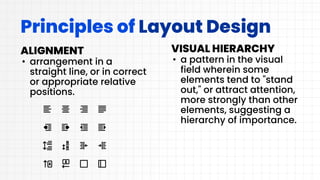
ALIGNMENT
• arrangement in a
straight line, or in correct
or appropriate relative
positions.
VISUAL HIERARCHY
• a pattern in the visual
field wherein some
elements tend to "stand
out," or attract attention,
more strongly than other
elements, suggesting a
hierarchy of importance.
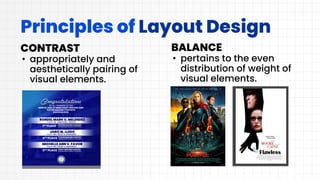
CONTRAST
• appropriately and
aesthetically pairing of
visual elements.
BALANCE
• pertains to the even
distribution of weight of
visual elements.
Principles of Layout Design
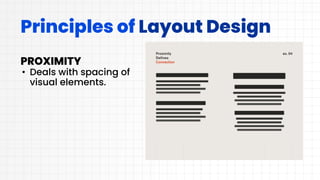
PROXIMITY
• Deals with spacing of
visual elements.
Principles of Layout Design
Elements of Layout Design
• COLOR - Probably the most striking art element
that catches the eye is color. It is a sensation
created by visible wavelengths of light caught in a
prism.
• LINE - Extension of a point, a short or long mark
drawn or carved on a surface.
• VALUE - the degree of lightness and darkness of a
color.
Elements of Layout Design
• SPACE - a void, an emptiness which can either be
positive or negative.
• TEXTURE - Extension of a point, a short or long
mark drawn or carved on a surface.
• SHAPE & FORM – Shape (two-dimensional); Form
(three-dimensional)
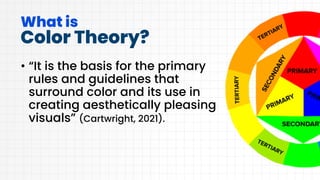
What is
Color Theory?
• “It is the basis for the primary
rules and guidelines that
surround color and its use in
creating aesthetically pleasing
visuals” (Cartwright, 2021).
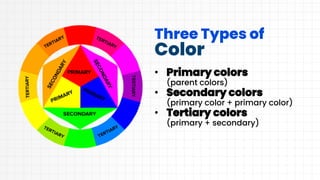
Three Types of
Color
• Primary colors
(parent colors)
• Secondary colors
(primary color + primary color)
• Tertiary colors
(primary + secondary)
• Red + Purple = Red-Purple (magenta)
• Red + Orange = Red-Orange (vermilion)
• Blue + Purple = Blue-Purple (violet)
• Blue + Green = Blue-Green (teal)
• Yellow + Orange = Yellow-Orange (amber)
• Yellow + Green = Yellow-Green (chartreuse)
Hue (pure color)
Tint (hue + white)
Tone
(hue + white & black)
Shade (hue + black)
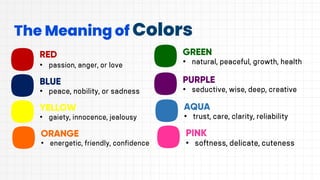
. • passion, anger, or love
. • peace, nobility, or sadness
. • gaiety, innocence, jealousy
. • energetic, friendly, confidence
. • natural, peaceful, growth, health
. • seductive, wise, deep, creative
. • trust, care, clarity, reliability
. • softness, delicate, cuteness
The Meaning of Colors
Color Schemes
• Monochromatic – use of single color with
varying shades and tints.
Color Schemes
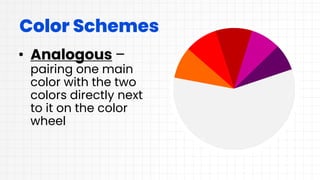
• Analogous –
pairing one main
color with the two
colors directly next
to it on the color
wheel
Color Schemes
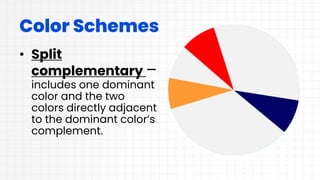
• Split
complementary –
includes one dominant
color and the two
colors directly adjacent
to the dominant color’s
complement.
Color Schemes
• Triadic color
scheme – created
by choosing three
colors that are
equally placed in
lines around color
wheel.
Color Schemes
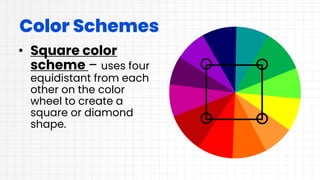
• Square color
scheme – uses four
equidistant from each
other on the color
wheel to create a
square or diamond
shape.
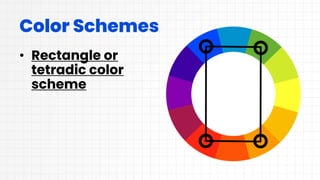
Color Schemes
• Rectangle or
tetradic color
scheme
Color Schemes
• Rectangle or
tetradic color
scheme
How to Choose a
Color Scheme?
• Prioritize the user experience, first.
• Set a mood for your color scheme.
• Consider color context
• Use the 60-30-10 rule.
• Draft multiple designs
Q2_Lesson_Dealing-with-Colors.pdf.quarter2

Q2_Lesson_Dealing-with-Colors.pdf.quarter2

  • 1.
    Dealing with Colors Computer ScienceII Second Quarter and Layout Design
  • 2.
    Topics to Cover •The Elements and Principles of Layout Design • Proper Combination of Colors
  • 3.
    Layout Design • Itis the process of arranging visual elements • It is important for any project that conveys a message.
  • 4.
    Principles of LayoutDesign ALIGNMENT • arrangement in a straight line, or in correct or appropriate relative positions. VISUAL HIERARCHY • a pattern in the visual field wherein some elements tend to "stand out," or attract attention, more strongly than other elements, suggesting a hierarchy of importance.
  • 5.
    CONTRAST • appropriately and aestheticallypairing of visual elements. BALANCE • pertains to the even distribution of weight of visual elements. Principles of Layout Design
  • 6.
    PROXIMITY • Deals withspacing of visual elements. Principles of Layout Design
  • 7.
    Elements of LayoutDesign • COLOR - Probably the most striking art element that catches the eye is color. It is a sensation created by visible wavelengths of light caught in a prism. • LINE - Extension of a point, a short or long mark drawn or carved on a surface. • VALUE - the degree of lightness and darkness of a color.
  • 8.
    Elements of LayoutDesign • SPACE - a void, an emptiness which can either be positive or negative. • TEXTURE - Extension of a point, a short or long mark drawn or carved on a surface. • SHAPE & FORM – Shape (two-dimensional); Form (three-dimensional)
  • 9.
    What is Color Theory? •“It is the basis for the primary rules and guidelines that surround color and its use in creating aesthetically pleasing visuals” (Cartwright, 2021).
  • 10.
    Three Types of Color •Primary colors (parent colors) • Secondary colors (primary color + primary color) • Tertiary colors (primary + secondary)
  • 11.
    • Red +Purple = Red-Purple (magenta) • Red + Orange = Red-Orange (vermilion) • Blue + Purple = Blue-Purple (violet) • Blue + Green = Blue-Green (teal) • Yellow + Orange = Yellow-Orange (amber) • Yellow + Green = Yellow-Green (chartreuse)
  • 12.
    Hue (pure color) Tint(hue + white) Tone (hue + white & black) Shade (hue + black)
  • 13.
    . • passion,anger, or love . • peace, nobility, or sadness . • gaiety, innocence, jealousy . • energetic, friendly, confidence . • natural, peaceful, growth, health . • seductive, wise, deep, creative . • trust, care, clarity, reliability . • softness, delicate, cuteness The Meaning of Colors
  • 14.
    Color Schemes • Monochromatic– use of single color with varying shades and tints.
  • 15.
    Color Schemes • Analogous– pairing one main color with the two colors directly next to it on the color wheel
  • 16.
    Color Schemes • Split complementary– includes one dominant color and the two colors directly adjacent to the dominant color’s complement.
  • 17.
    Color Schemes • Triadiccolor scheme – created by choosing three colors that are equally placed in lines around color wheel.
  • 18.
    Color Schemes • Squarecolor scheme – uses four equidistant from each other on the color wheel to create a square or diamond shape.
  • 19.
    Color Schemes • Rectangleor tetradic color scheme
  • 20.
    Color Schemes • Rectangleor tetradic color scheme
  • 21.
    How to Choosea Color Scheme? • Prioritize the user experience, first. • Set a mood for your color scheme. • Consider color context • Use the 60-30-10 rule. • Draft multiple designs