



Python-ENCAPSULATION
Basics about Encapsulation?
Encapsulation is one of the critical features of object-oriented
programming, which involves the bundling of data members and
functions inside a single class. Bundling similar data members and
functions inside a class also helps in data hiding. Encapsulation also
ensures that objects are self-sufficient functioning pieces and can work
independently.
What is Encapsulation?
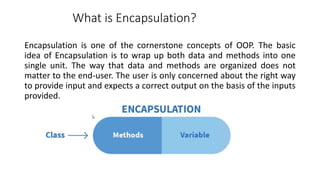
Encapsulation is one of the cornerstone concepts of OOP. The basic
idea of Encapsulation is to wrap up both data and methods into one
single unit. The way that data and methods are organized does not
matter to the end-user. The user is only concerned about the right way
to provide input and expects a correct output on the basis of the inputs
provided.
Why do we need encapsulation in python?
1. Encapsulation provides well-defined, readable code
2. Prevents Accidental Modification or Deletion
3. Encapsulation provides security
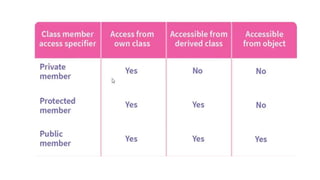
Access Modifier in Python Encapsulation
Sometimes there might be a need to restrict or limit access to certain
variables or functions while programming. There we need an Access
Modifier.
1. Public Member
2. Private Member
3. Protected Member
Encapsulation in Python using Public Members
the public modifier allows variables and functions to be accessible from
anywhere within the class and from any part of the program. All
member variables have the access modifier as public by default.
Encapsulation in Python using Private Members
The private access modifier allows member methods and variables to
be accessed only within the class. To specify a private access modifier
for a member, we make use of the double underscore __.
Encapsulation in Python Using Protected Members
What sets protected members apart from private members is that they
allow the members to be accessed within the class and allow them to
be accessed by the sub-classes involved. In Python, we demonstrate a
protected member by prefixing with an underscore _ before its name.

Python-Encapsulation.pptx

  • 1.
  • 2.
    Basics about Encapsulation? Encapsulationis one of the critical features of object-oriented programming, which involves the bundling of data members and functions inside a single class. Bundling similar data members and functions inside a class also helps in data hiding. Encapsulation also ensures that objects are self-sufficient functioning pieces and can work independently.
  • 3.
    What is Encapsulation? Encapsulationis one of the cornerstone concepts of OOP. The basic idea of Encapsulation is to wrap up both data and methods into one single unit. The way that data and methods are organized does not matter to the end-user. The user is only concerned about the right way to provide input and expects a correct output on the basis of the inputs provided.
  • 4.
    Why do weneed encapsulation in python? 1. Encapsulation provides well-defined, readable code 2. Prevents Accidental Modification or Deletion 3. Encapsulation provides security
  • 5.
    Access Modifier inPython Encapsulation Sometimes there might be a need to restrict or limit access to certain variables or functions while programming. There we need an Access Modifier. 1. Public Member 2. Private Member 3. Protected Member
  • 7.
    Encapsulation in Pythonusing Public Members the public modifier allows variables and functions to be accessible from anywhere within the class and from any part of the program. All member variables have the access modifier as public by default.
  • 8.
    Encapsulation in Pythonusing Private Members The private access modifier allows member methods and variables to be accessed only within the class. To specify a private access modifier for a member, we make use of the double underscore __.
  • 9.
    Encapsulation in PythonUsing Protected Members What sets protected members apart from private members is that they allow the members to be accessed within the class and allow them to be accessed by the sub-classes involved. In Python, we demonstrate a protected member by prefixing with an underscore _ before its name.