Object Oriented Programming Concept in
Python
OOP
Object Oriented programming is a programming style that is associated with the concept of Class,
Objects and various other concepts revolving around these two, like Inheritance, Polymorphism,
Abstraction, Encapsulation etc
.
Object-oriented programming aims to implement real-world entities like inheritance, hiding,
polymorphism etc in programming. The main aim of OOP is to bind together the data and the
functions that operate on them so that no other part of the code can access this data except that
function.
-:OOPs:-
OOPs Concept Definitions
Now, let us discuss some of the main features of Object
Oriented Programming which you will be using in Python.
-:OOPs:-
Objects
Classes
Abstraction
Encapsulation
Inheritance
Polymorphism
Objects
It is a basic unit of Object Oriented Programming and represents the
real life entities
The object is an entity that has state and behavior. It may be any real-
world object like the mouse, keyboard, chair, table, pen, etc.
Everything in Python is an object, and almost everything has
attributes and methods.
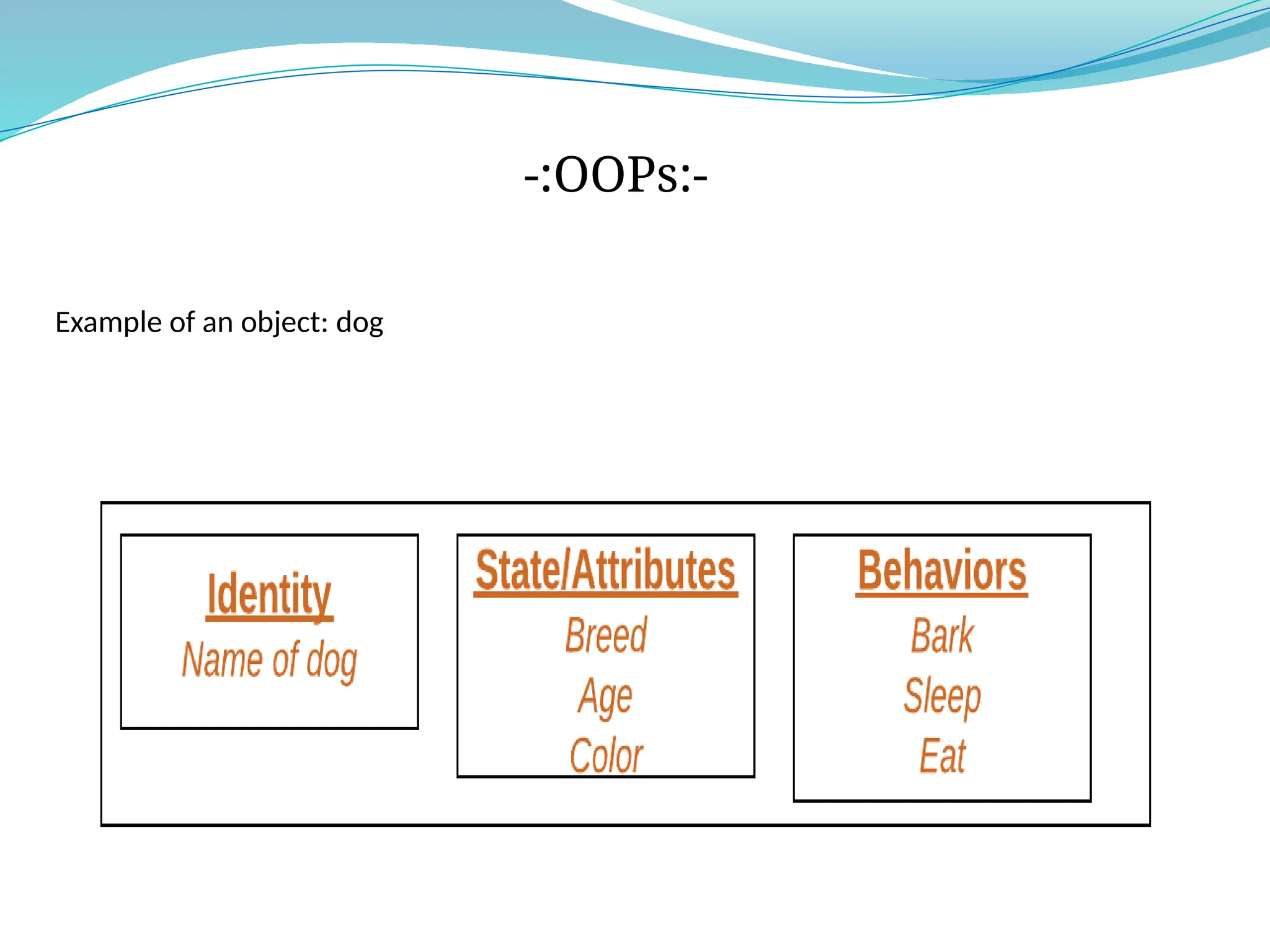
all Objects shares two characteristics, they all have attributes and they all have
behaviors. for example dogs have attributes like (name, color, type) and
behaviors like (Running, barking, fetching etc).
Another Example: Pen is an object. Its name is Reynolds, color is white
etc. known as its state. It is used to write, so writing is its behavior.
-:OOPs:-
Object is a real world entity.
Object is a run time entity.
Object is an entity which has state and behavior.
Object is an instance of a class.
Object is group of data and functions.
Object is minimal identifiable component in OOPS
program.
-:OOPs:-
An object consists of:
State : It is represented by attributes of an object. It also reflects the properties of an object.
Behavior : It is represented by methods of an object. It also reflects the response of an
object with other objects.
Identity : It gives a unique name to an object and enables one object to interact with other
objects.
Object
Example of an object: dog
-:OOPs:-
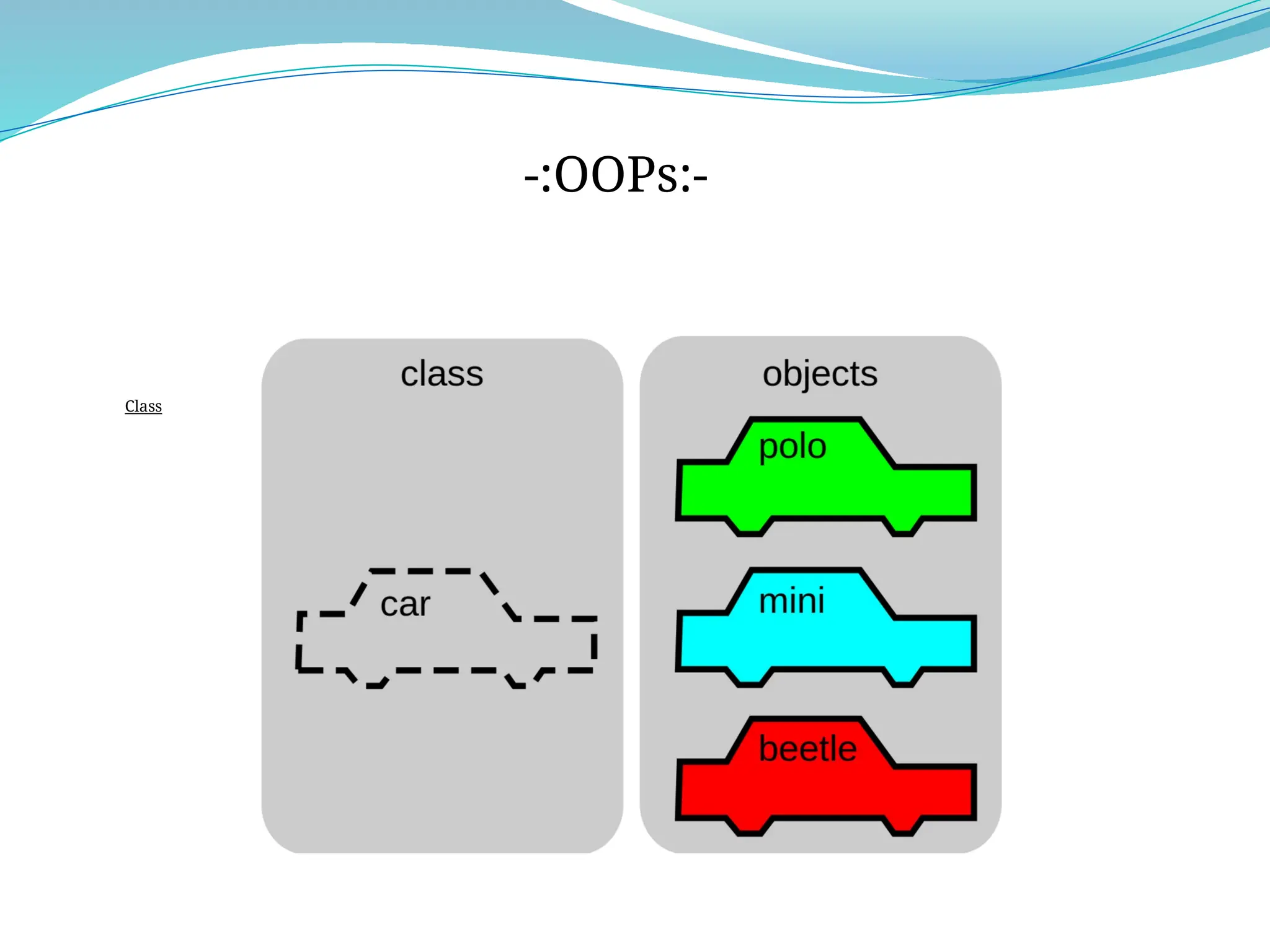
Class-
A class is a user defined blueprint or prototype from which objects are created.
It represents the set of properties or methods that are common to all objects of
one type. In general, class declarations can include these components, in order:
-:OOPs:-
Class-
Modifiers: A class can be public or has default access (Refer this for details).
Class name: The name should begin with a initial letter (capitalized by convention).
Superclass(if any): The name of the class’s parent (superclass), if any, preceded by the keyword extends. A class can only extend
(subclass) one parent.
Body: The class body surrounded by braces, { }.
-:OOPs:-
Class
-:OOPs:-
-:OOPs:-
Method
 The method is a function that is associated with an object.
In Python, a method is not unique to class instances. Any
object type can have methods.
 The methods are used to implement the
functionalities of an object.
 For example if we created ”start()” and ”stop()” methods
for the ”Car” class
-:OOPs:-
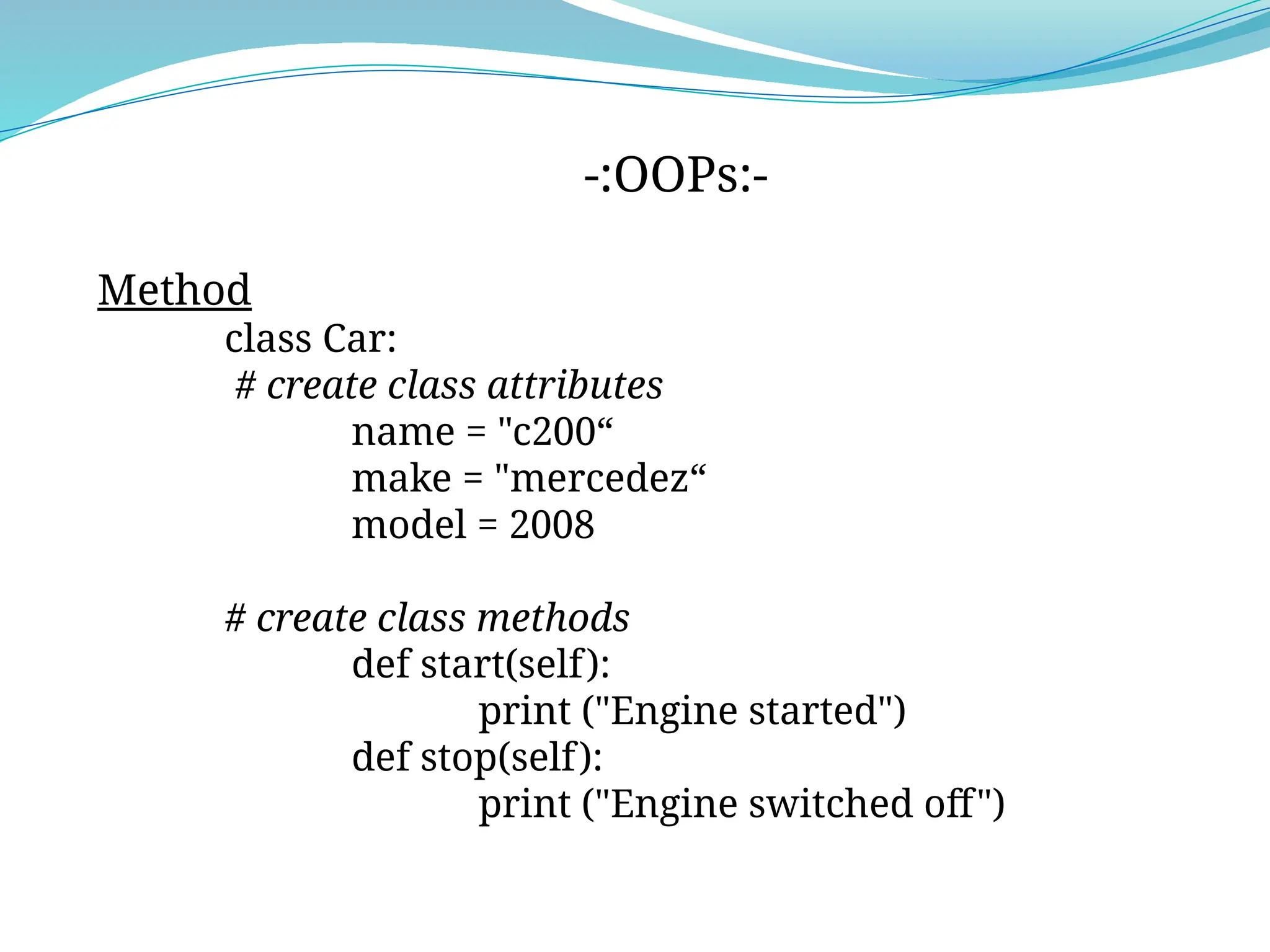
Method
class Car:
# create class attributes
name = "c200“
make = "mercedez“
model = 2008
# create class methods
def start(self):
print ("Engine started")
def stop(self):
print ("Engine switched off")
-:OOPs:-
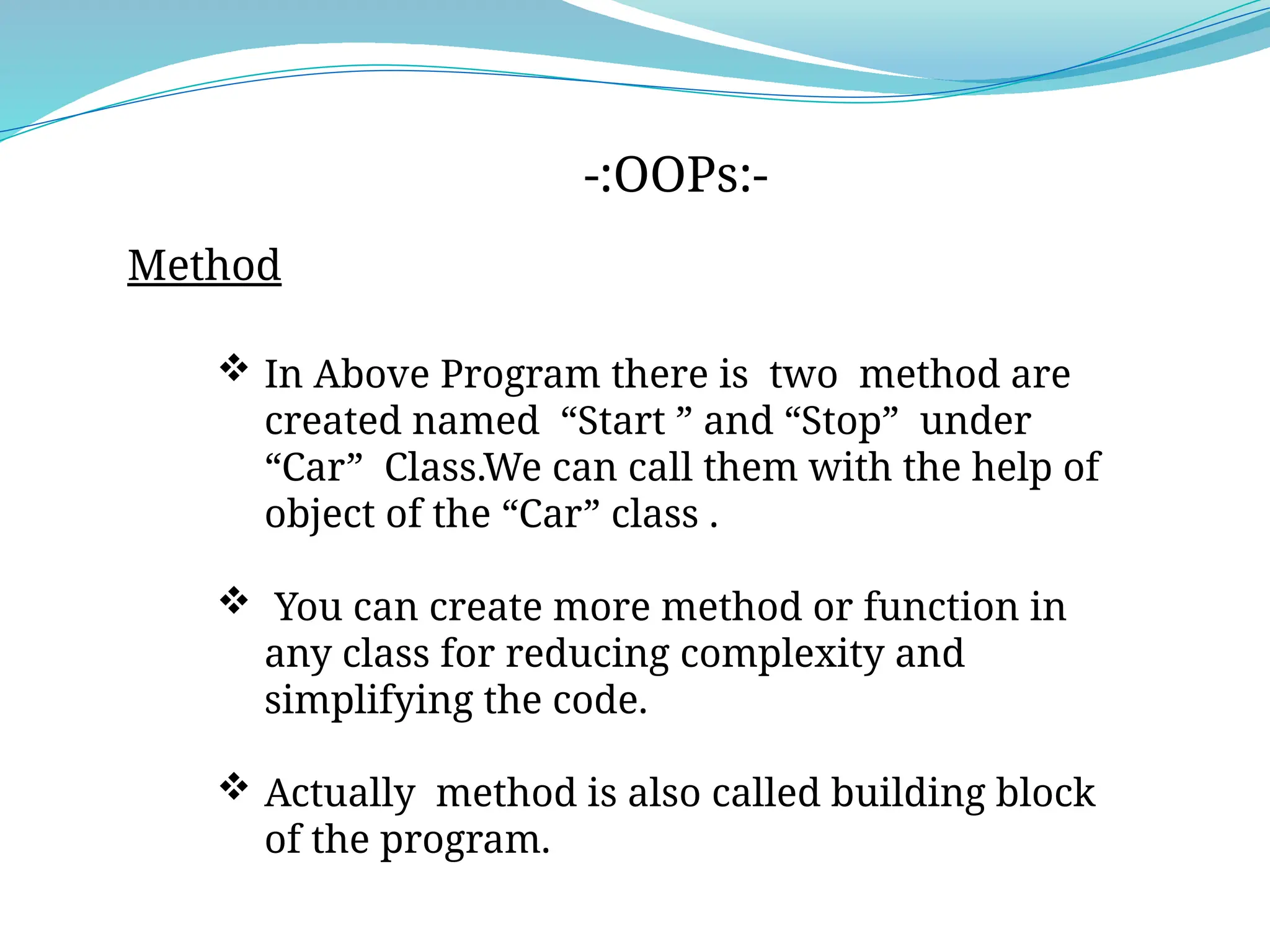
Method
 In Above Program there is two method are
created named “Start ” and “Stop” under
“Car” Class.We can call them with the help of
object of the “Car” class .
 You can create more method or function in
any class for reducing complexity and
simplifying the code.
 Actually method is also called building block
of the program.
-:OOPs:-
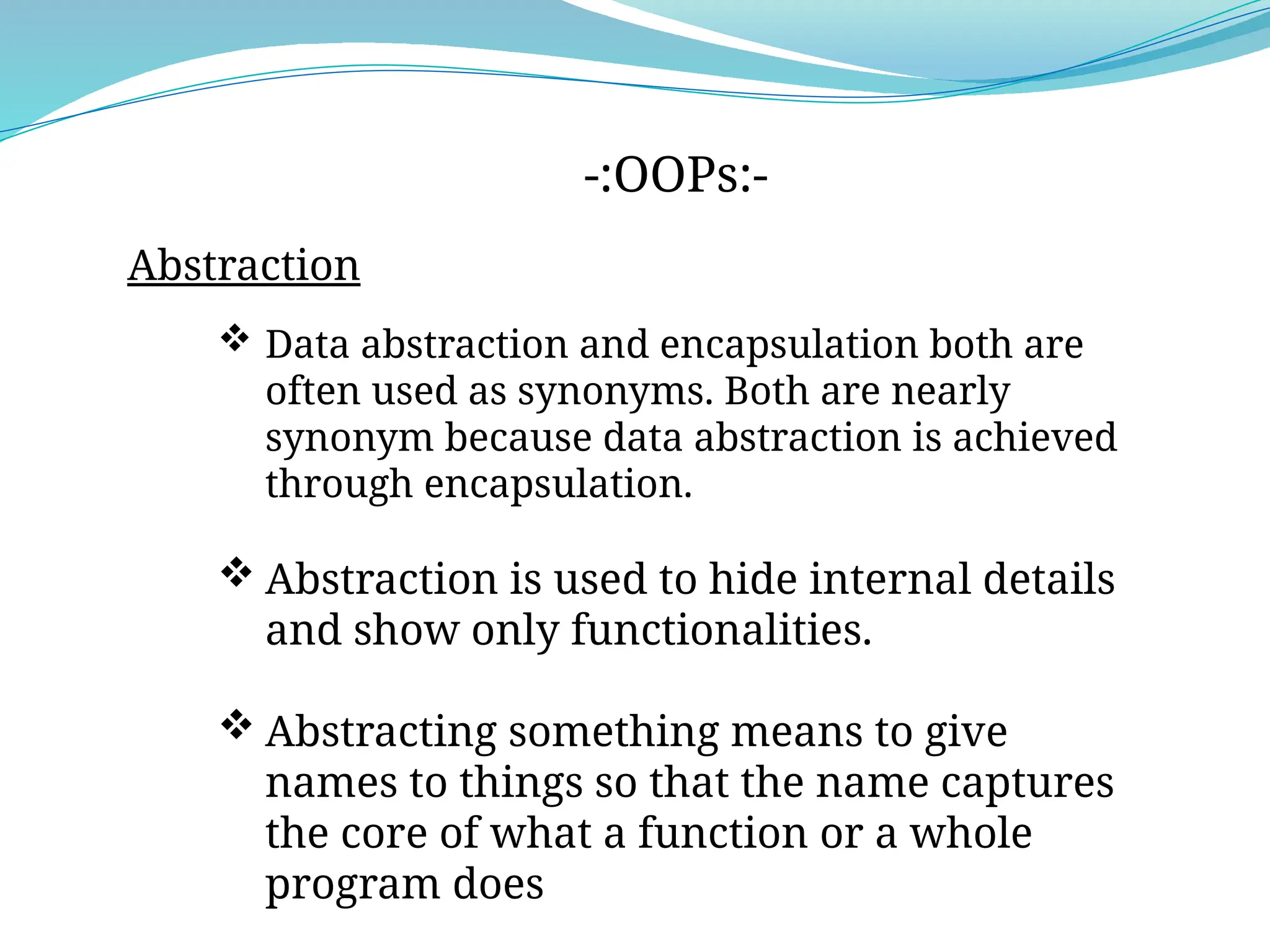
Abstraction
 Data abstraction and encapsulation both are
often used as synonyms. Both are nearly
synonym because data abstraction is achieved
through encapsulation.
 Abstraction is used to hide internal details
and show only functionalities.
 Abstracting something means to give
names to things so that the name captures
the core of what a function or a whole
program does
-:OOPs:-
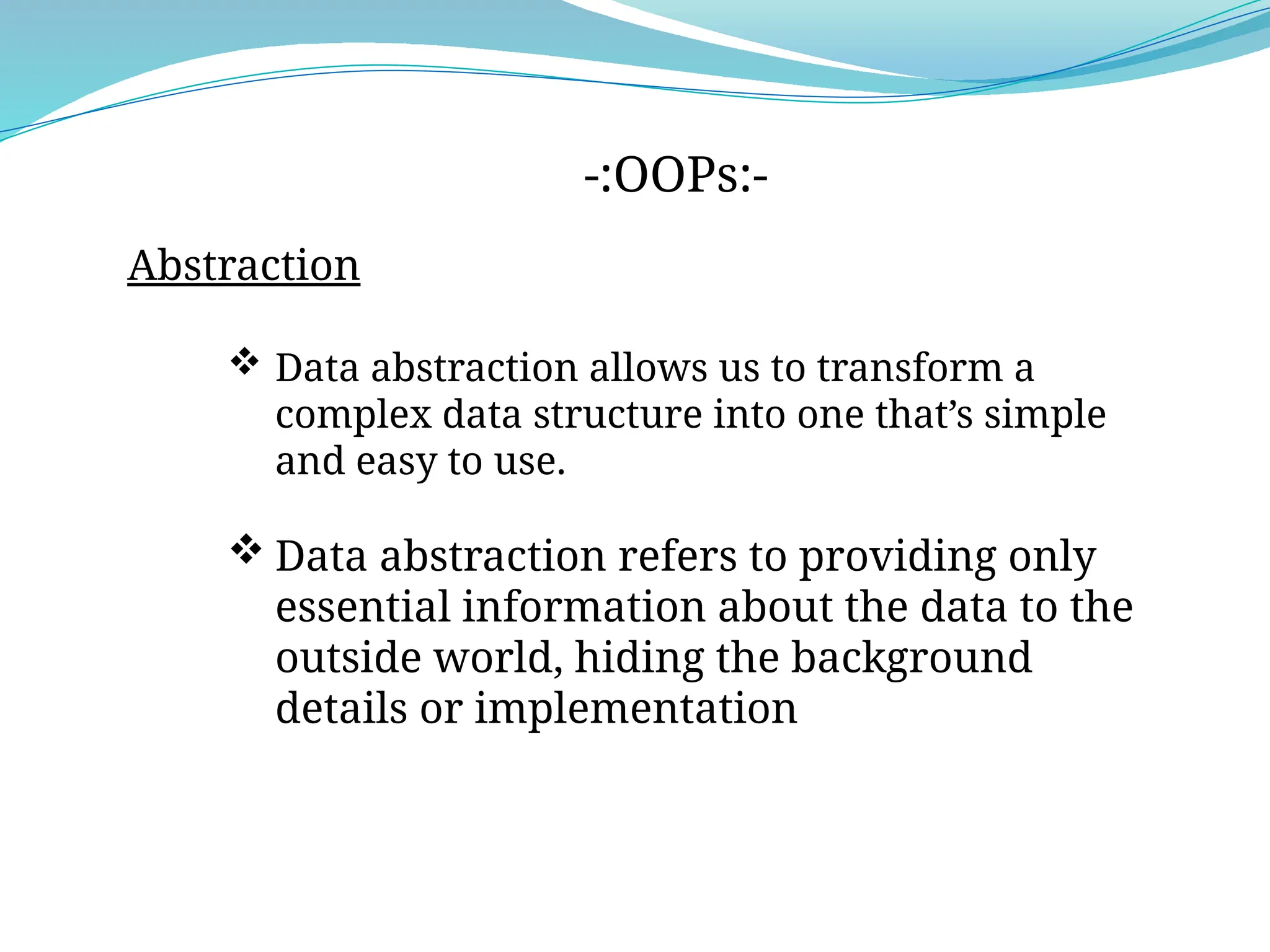
Abstraction
 Data abstraction allows us to transform a
complex data structure into one that’s simple
and easy to use.
 Data abstraction refers to providing only
essential information about the data to the
outside world, hiding the background
details or implementation
-:OOPs:-
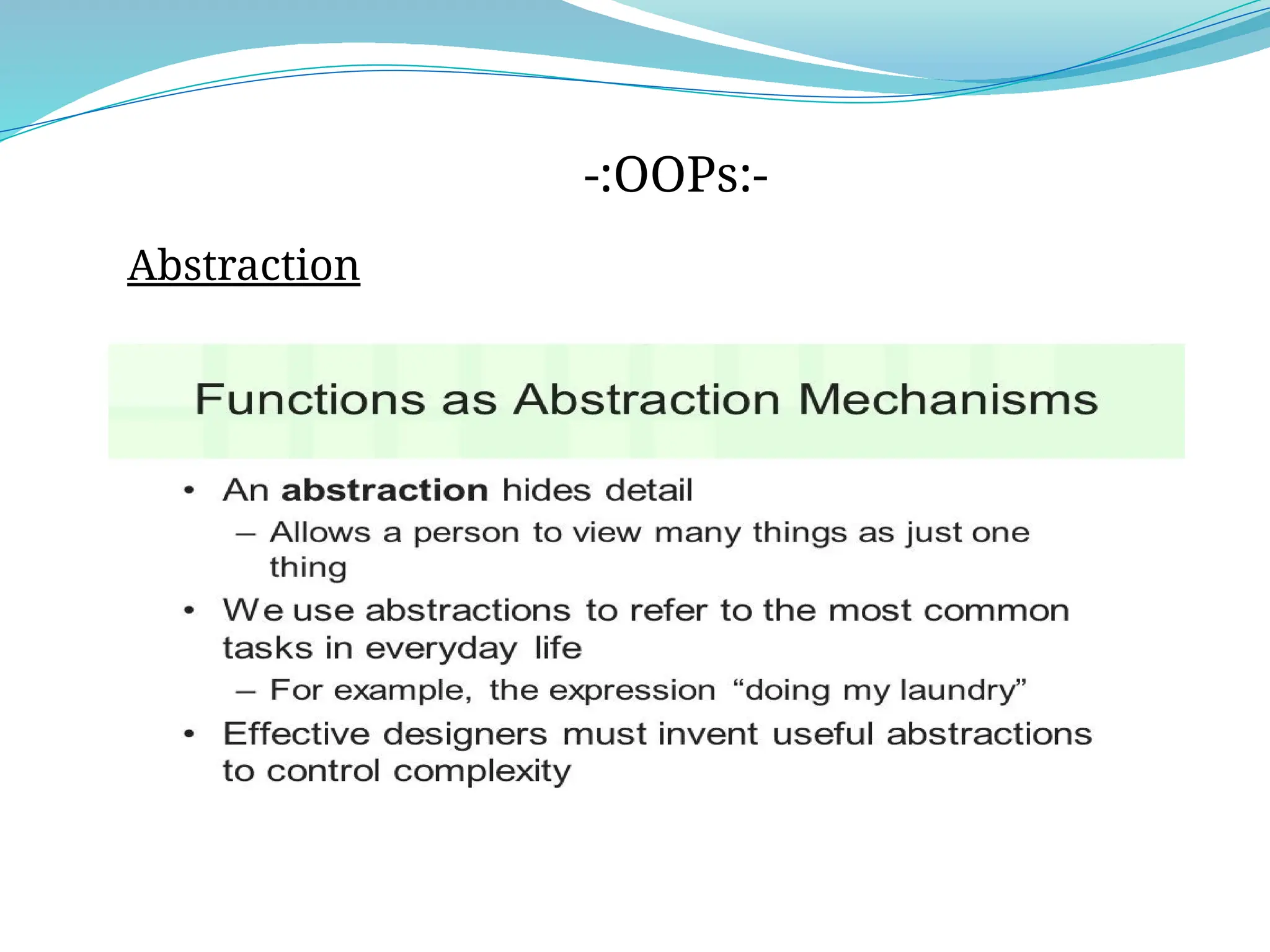
Abstraction
-:OOPs:-
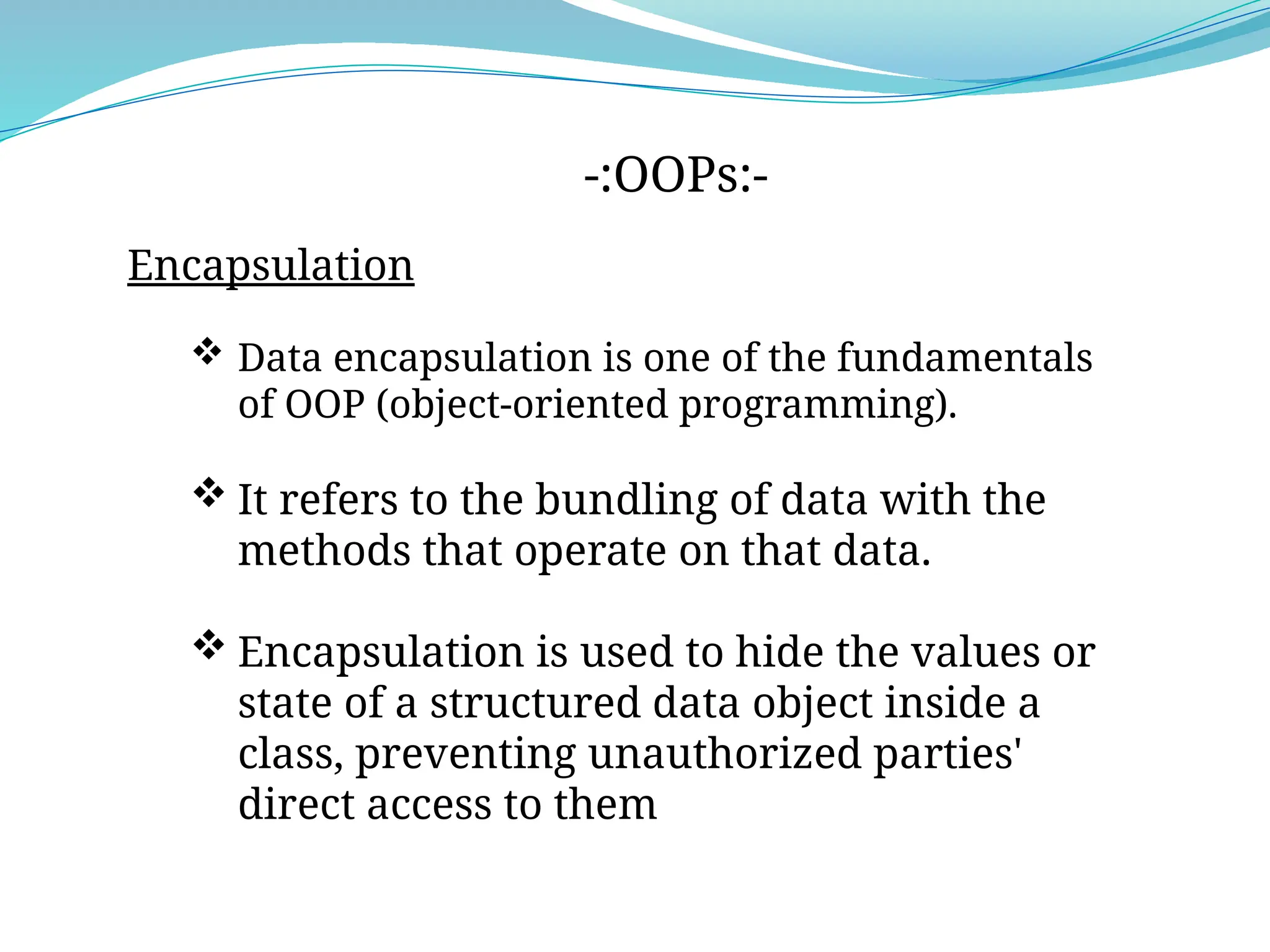
Encapsulation
 Data encapsulation is one of the fundamentals
of OOP (object-oriented programming).
 It refers to the bundling of data with the
methods that operate on that data.
 Encapsulation is used to hide the values or
state of a structured data object inside a
class, preventing unauthorized parties'
direct access to them
-:OOPs:-
Encapsulation
 Abstraction and Encapsulation are two important
Object Oriented Programming (OOPS) concepts.
Encapsulation and Abstraction both are
interrelated terms.
 Real Life Difference Between Encapsulation and
Abstraction is that Encapsulate means to hide.
Encapsulation is also called data hiding.
 You can think Encapsulation like a capsule
(medicine tablet) which hides medicine inside it
-:OOPs:-
Basic Different Between Abstraction and
Encapsulation
 Encapsulation is used for hide the code and data
in a single unit to protect the data from the
outside the world. Class is the best example of
encapsulation.
 Abstraction refers to showing only the necessary
details to the intended user.
 . Abstraction is implemented using interface and
abstract class
 Encapsulation is implemented using private and
protected access modifier
Inheritance
-:OOPs:-
 Inheritance is an important pillar of OOP(Object
Oriented Programming). It is the mechanism in
Python by which one class is allow to inherit the
features(fields and methods) of another class. T
 Inheritance is an OOPS concept in which one object
acquires the properties and behaviors of the parent
object. It’s creating a parent-child relationship
between two classes. It offers robust and natural
mechanism for organizing and structure of any
software.
Inheritance
-:OOPs:-
Important terminology:
Super Class: The class whose features are inherited is
known as superclass(or a base class or a parent class).
Sub Class: The class that inherits the other class is
known as subclass(or a derived class, extended class,
or child class). The subclass can add its own fields and
methods in addition to the superclass fields and
methods.
Reusability: Inheritance supports the concept of
“reusability”, i.e. when we want to create a new class
and there is already a class that includes some of the
code that we want, we can derive our new class from
the existing class. By doing this, we are reusing the
fields and methods of the existing class.
Inheritance
-:OOPs:-
 Inheritance allows us to inherit attributes and
methods from the base/parent class.
 This is useful as we can create sub-classes and get all
of the functionality from our parent class.
 Then we can overwrite and add new
functionalities without affecting the parent
class.
Inheritance
-:OOPs:-
 A class which inherits the properties is
known as Child Class.
 A class whose properties are inherited is
known as Parent class.
 Inheritance refers to the ability to
create Sub-classes that contain
specializations of their parents.
Inheritance
-:OOPs:-
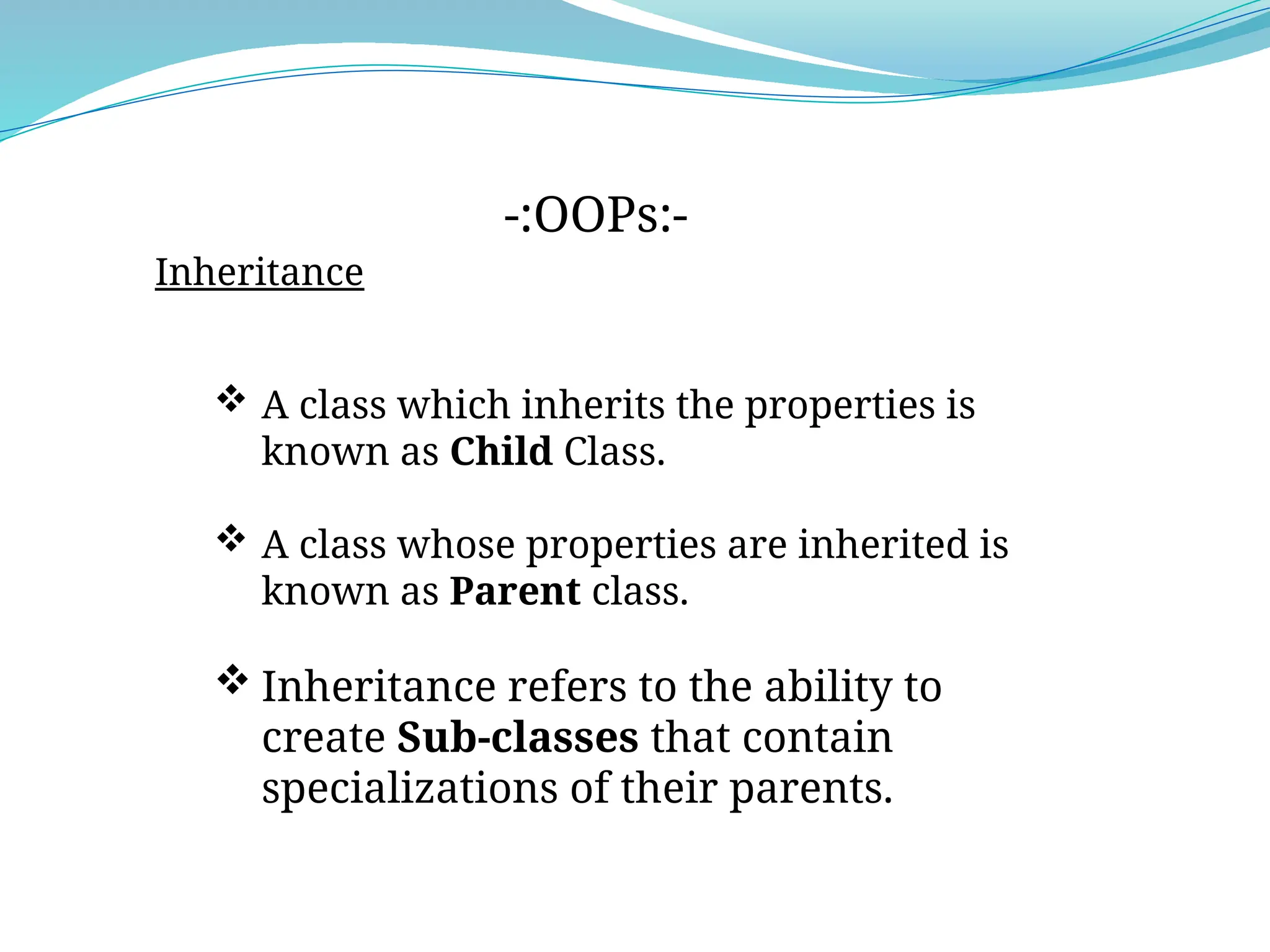
Inheritance
-:OOPs:-
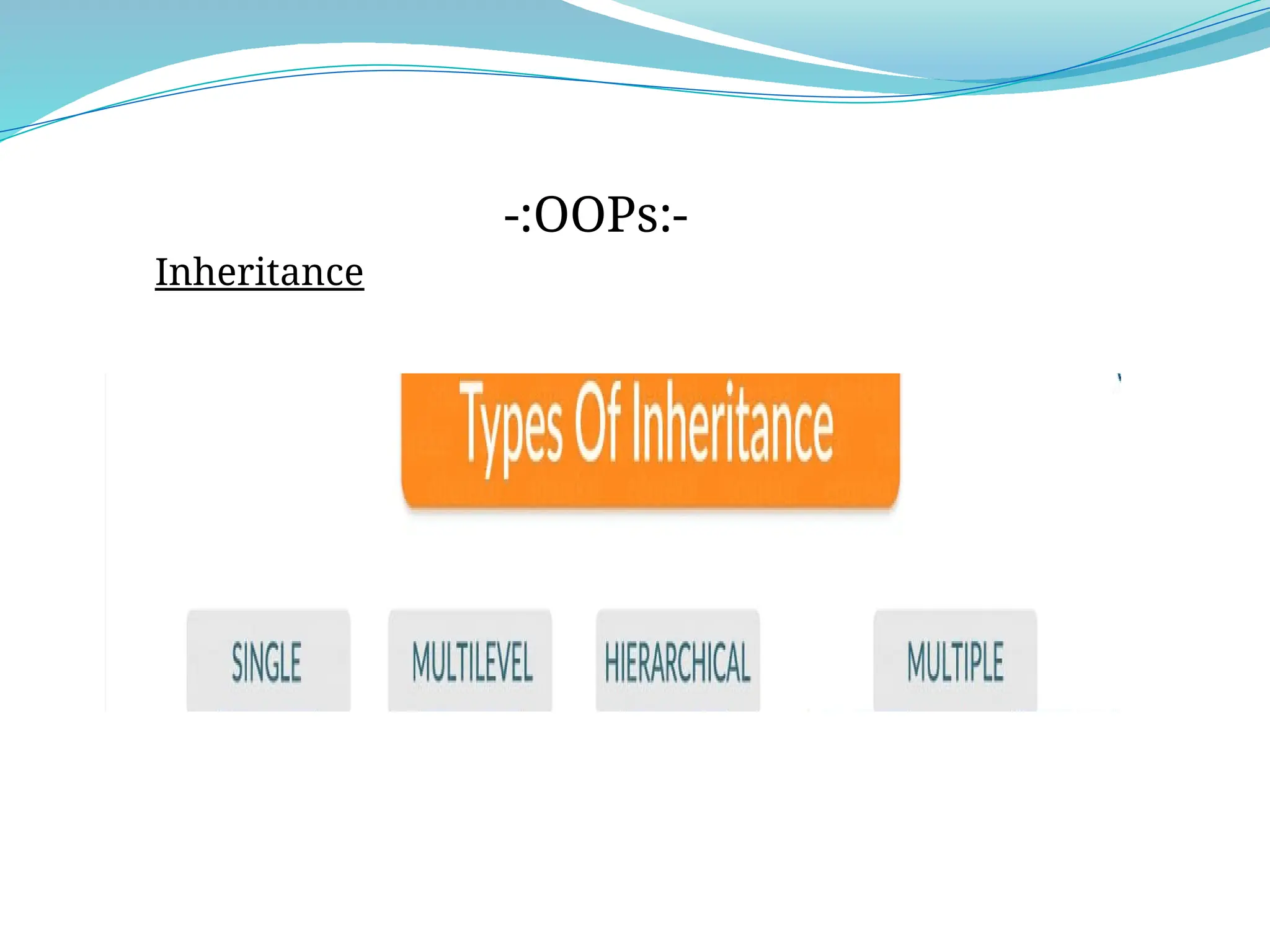
Single inheritance: When a child class inherits from only
one parent class, it is called as single inheritance.
Inheritance
-:OOPs:-
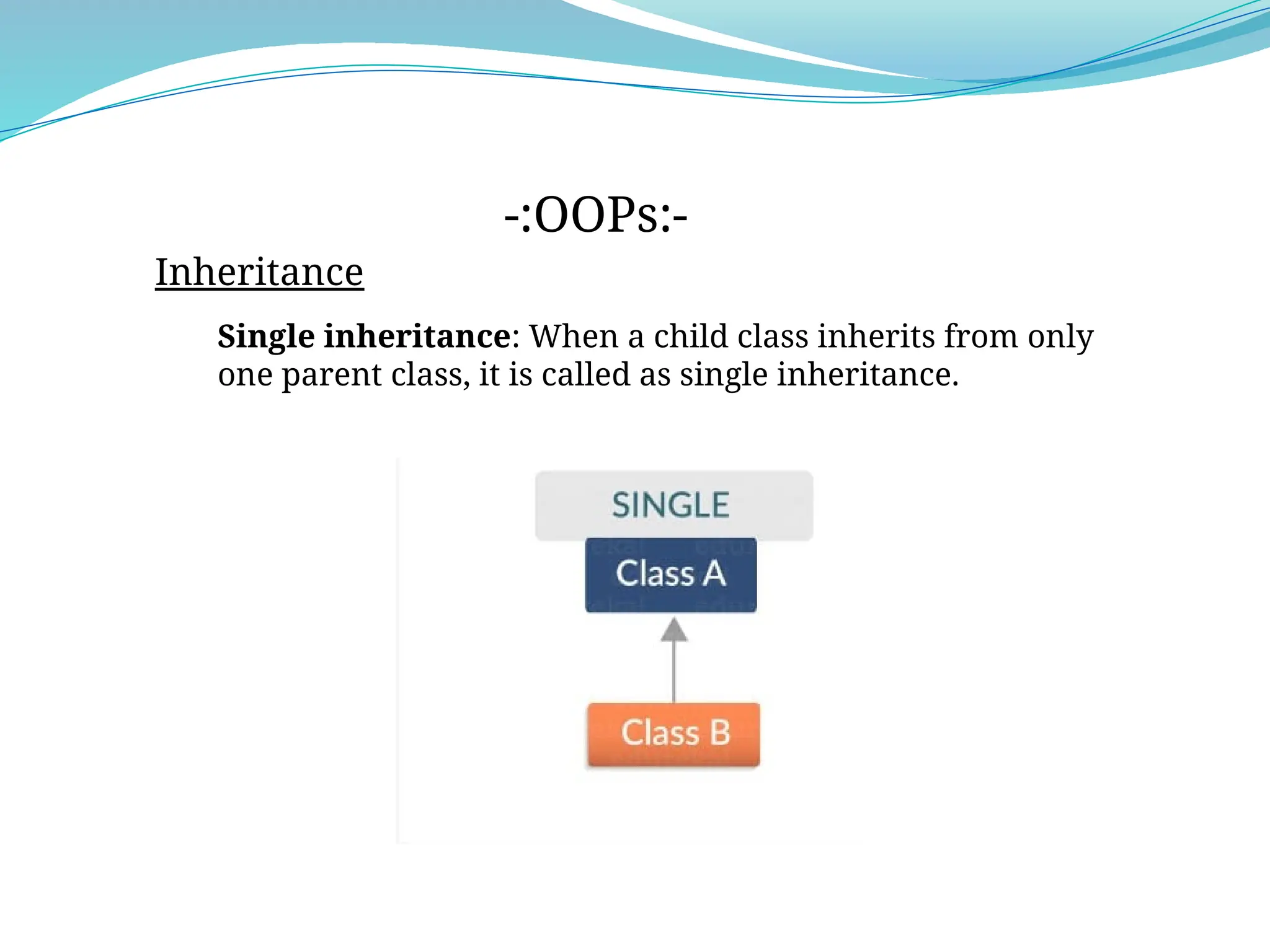
Multi-level inheritance :is archived when a
derived class inherits another derived class.
There is no limit on the number of levels up to
which, the multi-level inheritance is archived in
python.
Inheritance
-:OOPs:-
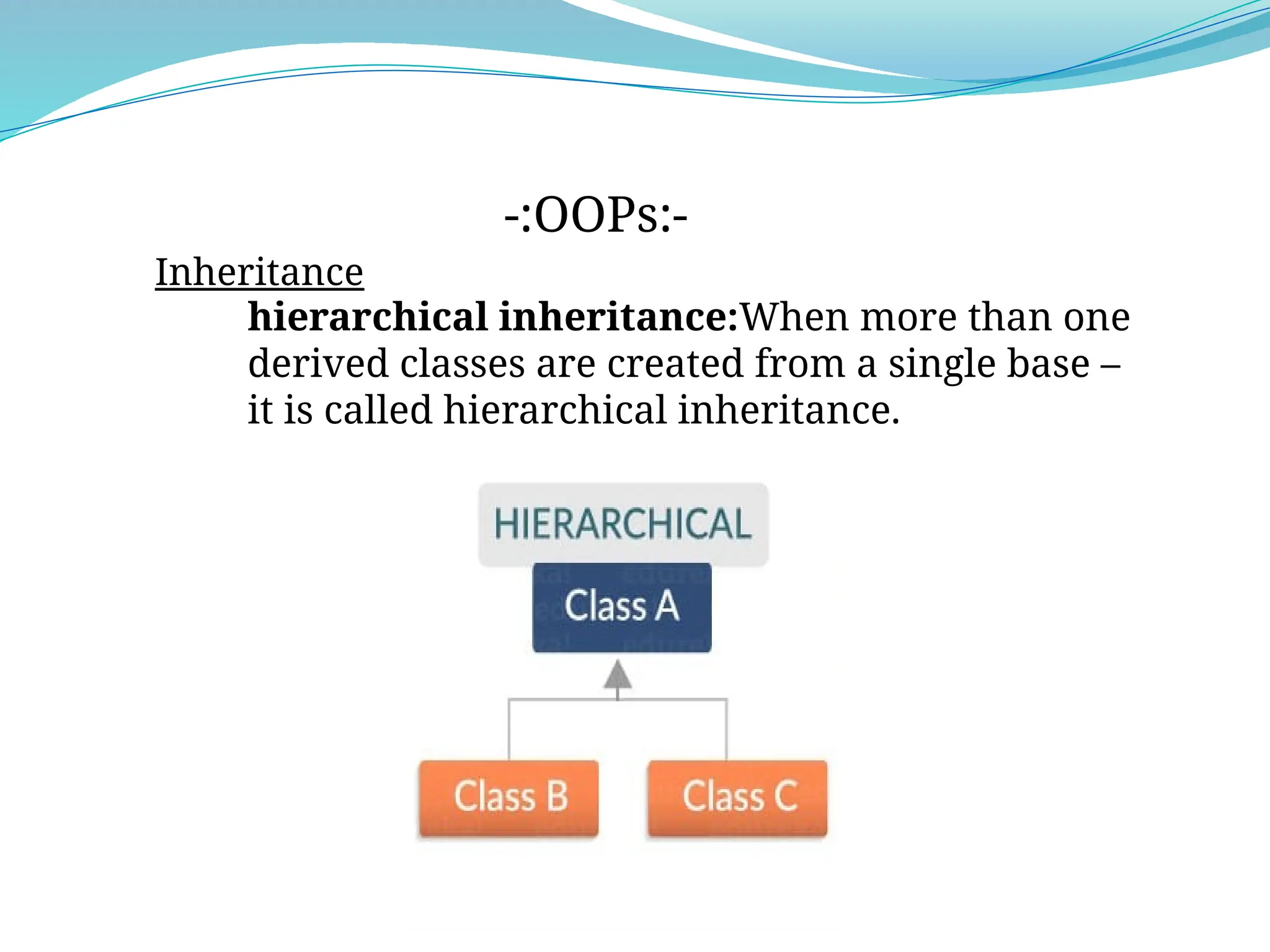
hierarchical inheritance:When more than one
derived classes are created from a single base –
it is called hierarchical inheritance.
Inheritance
-:OOPs:-
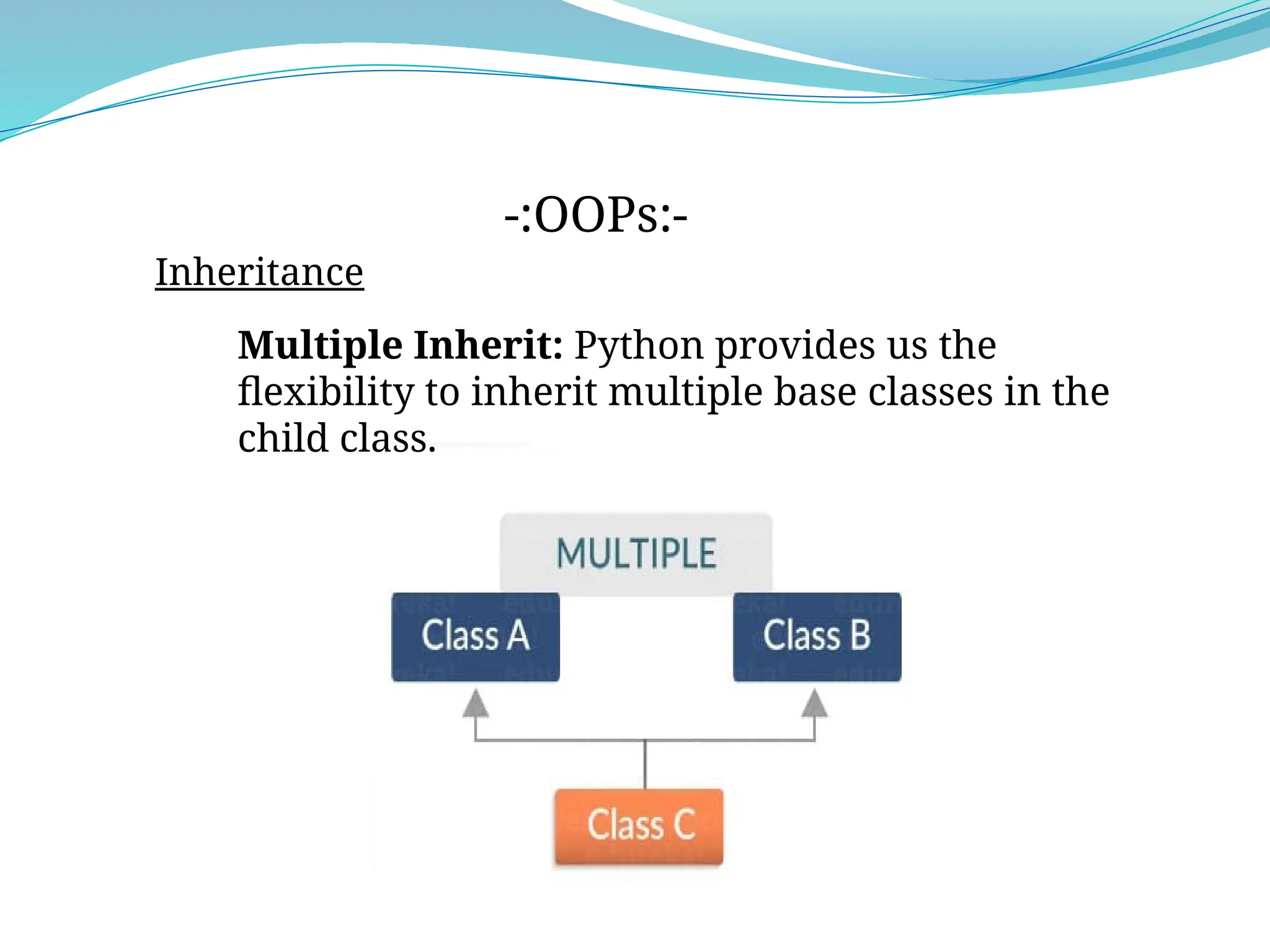
Multiple Inherit: Python provides us the
flexibility to inherit multiple base classes in the
child class.
Polymorphism
-:OOPs:-
 Polymorphism is an ability (in OOP) to use
common interface for multiple form (data
types).
 Suppose, we need to color a shape, there
are multiple shape option (rectangle,
square, circle). However we could use
same method to color any shape. This
concept is called Polymorphism.
Polymorphism
-:OOPs:-
 Polymorphism is an ability (in OOP) to use
common interface for multiple form (data
types).
 Suppose, we need to color a shape, there
are multiple shape option (rectangle,
square, circle). However we could use
same method to color any shape. This
concept is called Polymorphism.
Advantage of OOPs
-:OOPs:-
 OOP offers easy to understand and a clear
modular structure for programs.
 Objects created for Object-Oriented Programs can
be reused in other programs. Thus it saves
significant development cost.
 Large programs are difficult to write, but if the
development and designing team follow OOPS
concept then they can better design with
minimum flaws.
 It also enhances program modularity because
every object exists independently.
 class Add:


 def input(self, c, d):
 self.a = c
 self.b = d
 def process(self):
 self.sum = self.a + self.b
 def show(self) :
 print(self.sum)
 p1 = Add()
 p1.input(10,20)
 p1.process()
 p1.show()
Sample program
Python – Access Specifier
Various object-oriented languages like C++, Java,
Python control access modifications which are used to
restrict access to the variables and methods of the
class. Most programming languages has three forms of
access modifiers, which are Public, Protected and
Private in a class.
Python uses ‘_’ symbol to determine the access control
for a specific data member or a member function of a
class. Access specifiers in Python have an important
role to play in securing data from unauthorized access
and in preventing it from being exploited.
Python - public, private and protected
A Class in Python has three types of access
modifiers –
 Public Access Modifier
 Private Access Modifier
 Protected Access Modifier
Public Access Modifier
The members of a class that are declared public are
easily accessible from any part of the program. All
data members and member functions of a class are
public by default.
Example1:
class employee:
def __init__(self, name, sal):
self.name=name
self.salary=sal
e1=employee("Shiv",12000)
print(e1.name)
print(e1.salary)
Python – Access Specifier
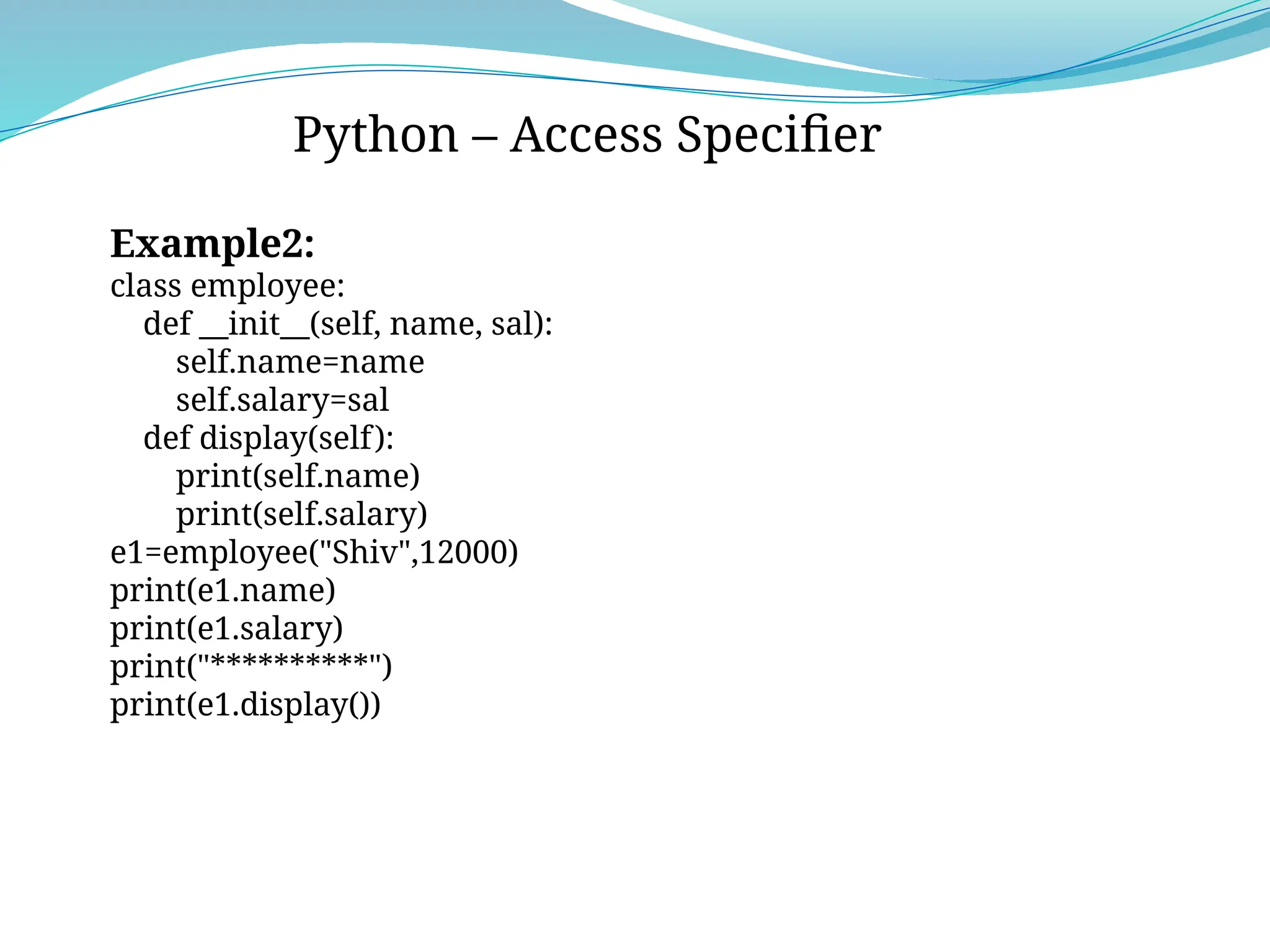
Example2:
class employee:
def __init__(self, name, sal):
self.name=name
self.salary=sal
def display(self):
print(self.name)
print(self.salary)
e1=employee("Shiv",12000)
print(e1.name)
print(e1.salary)
print("**********")
print(e1.display())
Python – Access Specifier
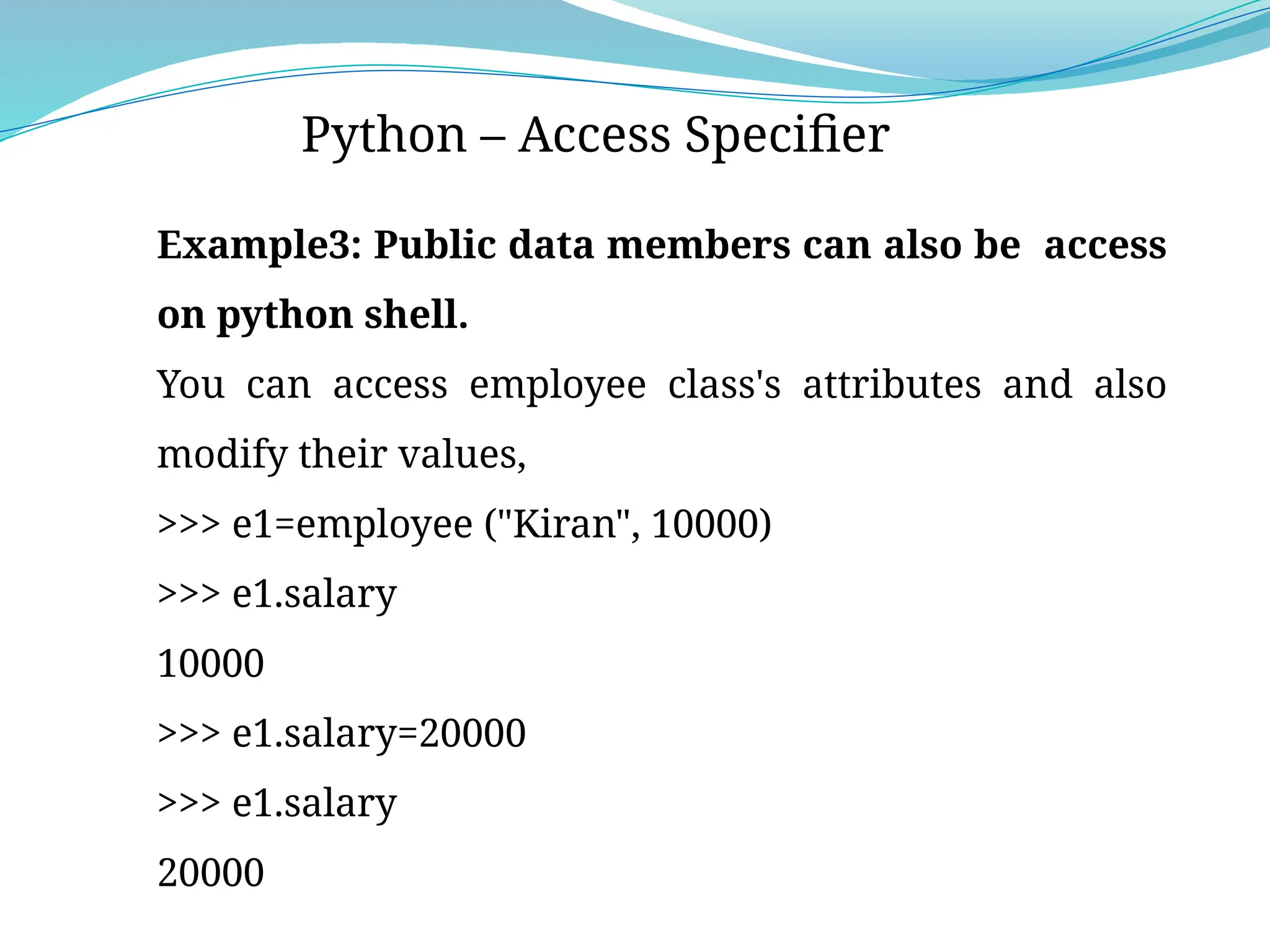
Example3: Public data members can also be access
on python shell.
You can access employee class's attributes and also
modify their values,
>>> e1=employee ("Kiran", 10000)
>>> e1.salary
10000
>>> e1.salary=20000
>>> e1.salary
20000
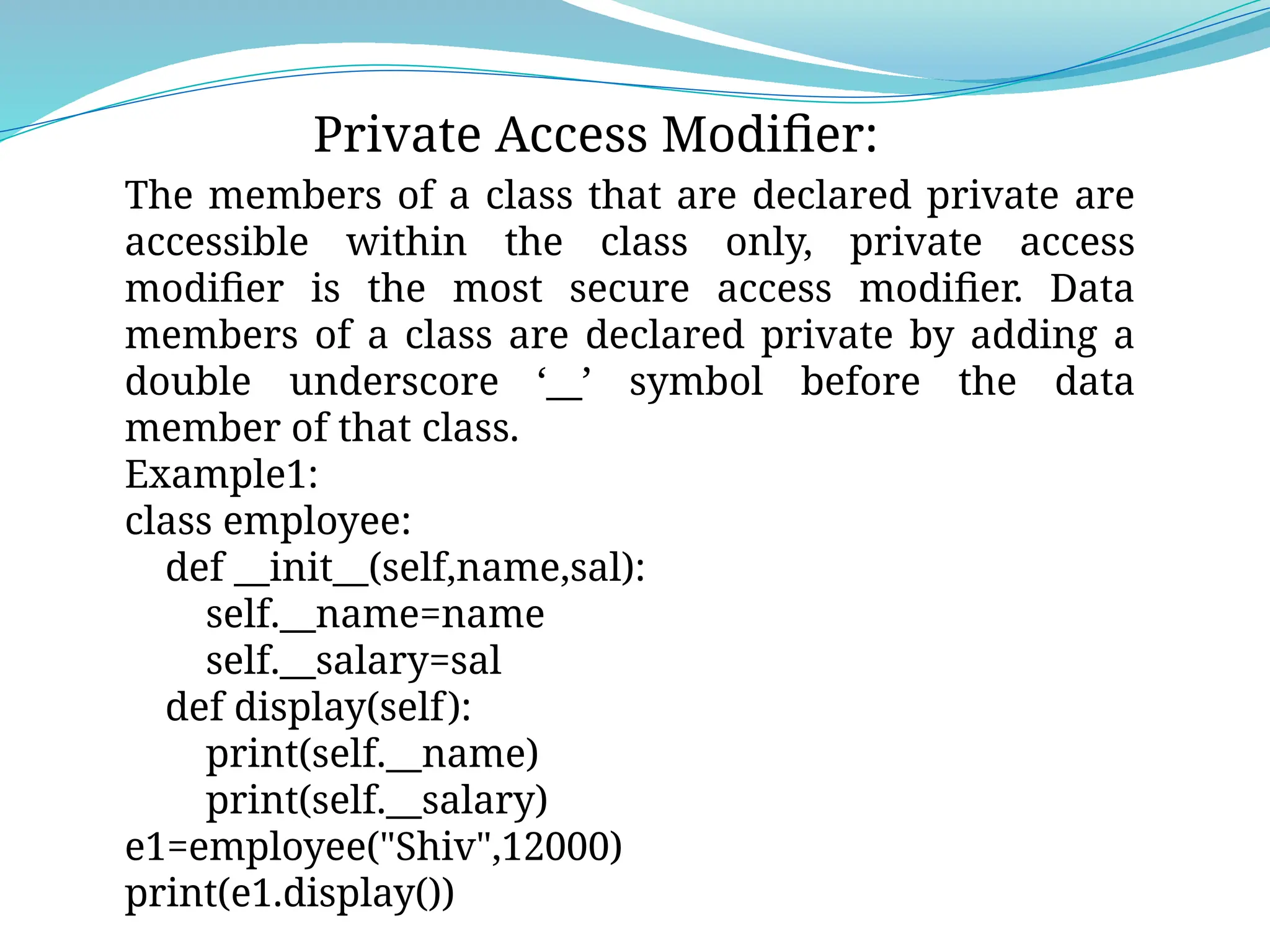
Private Access Modifier:
The members of a class that are declared private are
accessible within the class only, private access
modifier is the most secure access modifier. Data
members of a class are declared private by adding a
double underscore ‘__’ symbol before the data
member of that class.
Example1:
class employee:
def __init__(self,name,sal):
self.__name=name
self.__salary=sal
def display(self):
print(self.__name)
print(self.__salary)
e1=employee("Shiv",12000)
print(e1.display())
Private Access Modifier:
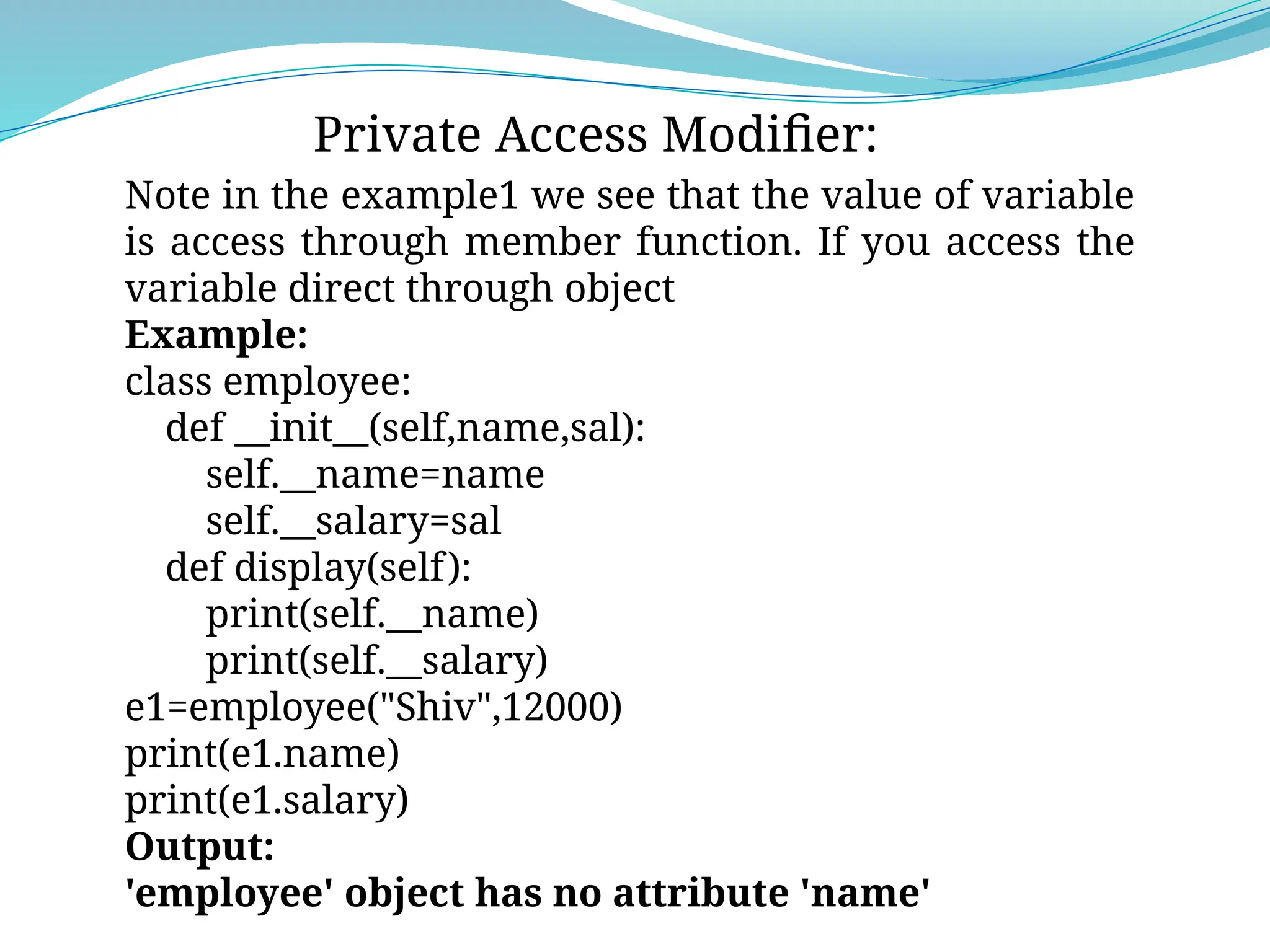
Note in the example1 we see that the value of variable
is access through member function. If you access the
variable direct through object
Example:
class employee:
def __init__(self,name,sal):
self.__name=name
self.__salary=sal
def display(self):
print(self.__name)
print(self.__salary)
e1=employee("Shiv",12000)
print(e1.name)
print(e1.salary)
Output:
'employee' object has no attribute 'name'
Private Access Modifier:
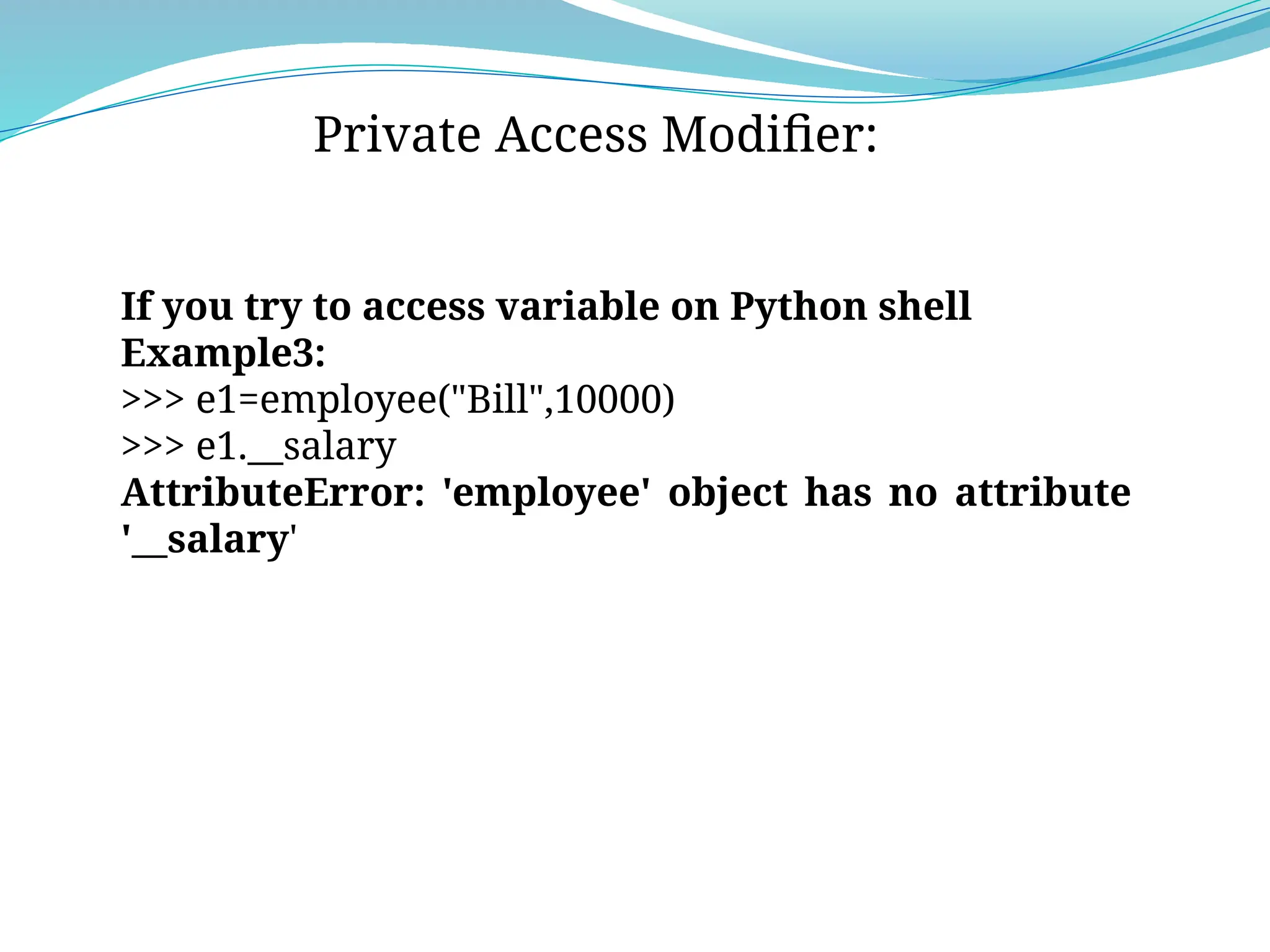
If you try to access variable on Python shell
Example3:
>>> e1=employee("Bill",10000)
>>> e1.__salary
AttributeError: 'employee' object has no attribute
'__salary'
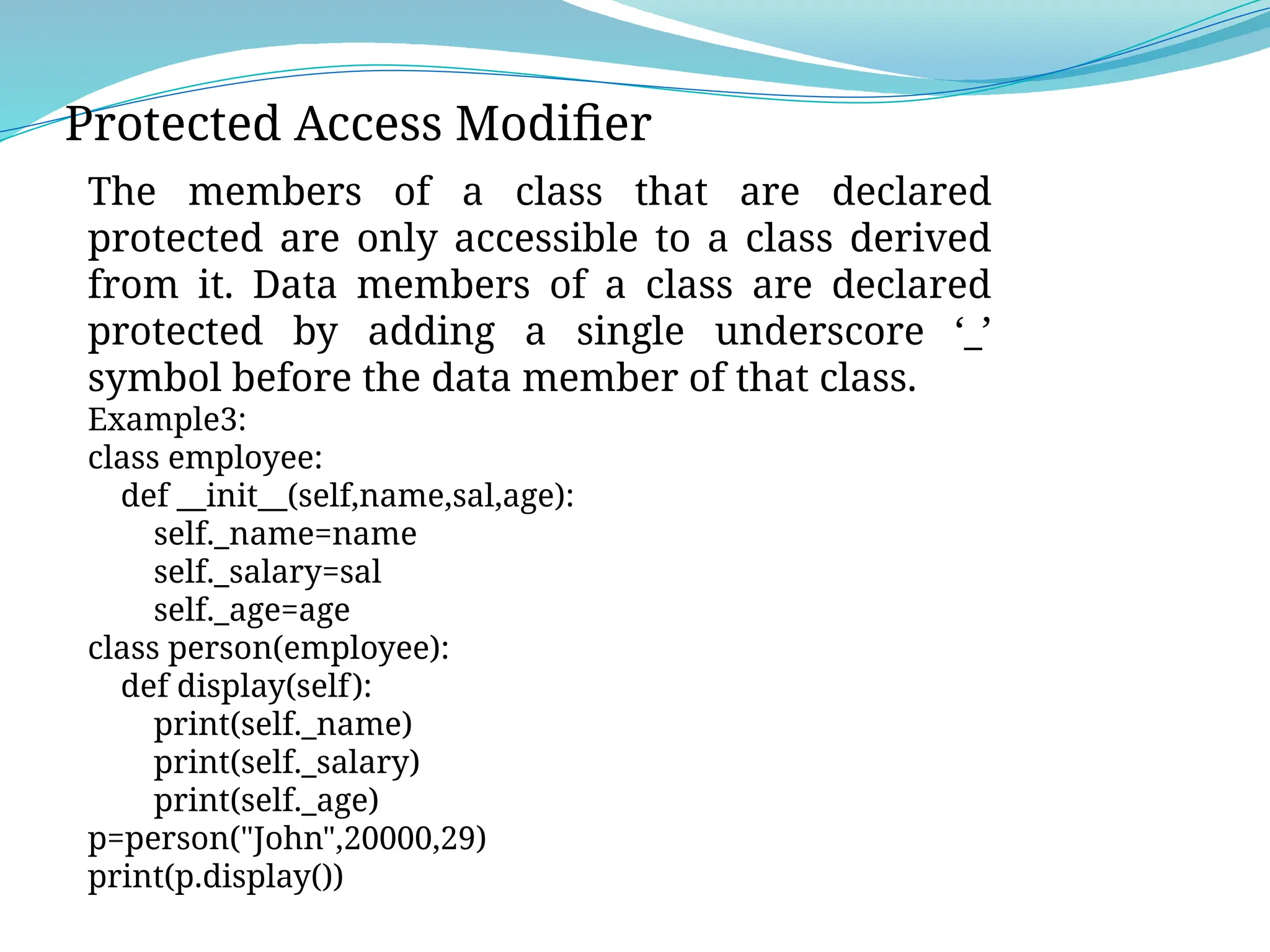
Protected Access Modifier
The members of a class that are declared
protected are only accessible to a class derived
from it. Data members of a class are declared
protected by adding a single underscore ‘_’
symbol before the data member of that class.
Example3:
class employee:
def __init__(self,name,sal,age):
self._name=name
self._salary=sal
self._age=age
class person(employee):
def display(self):
print(self._name)
print(self._salary)
print(self._age)
p=person("John",20000,29)
print(p.display())
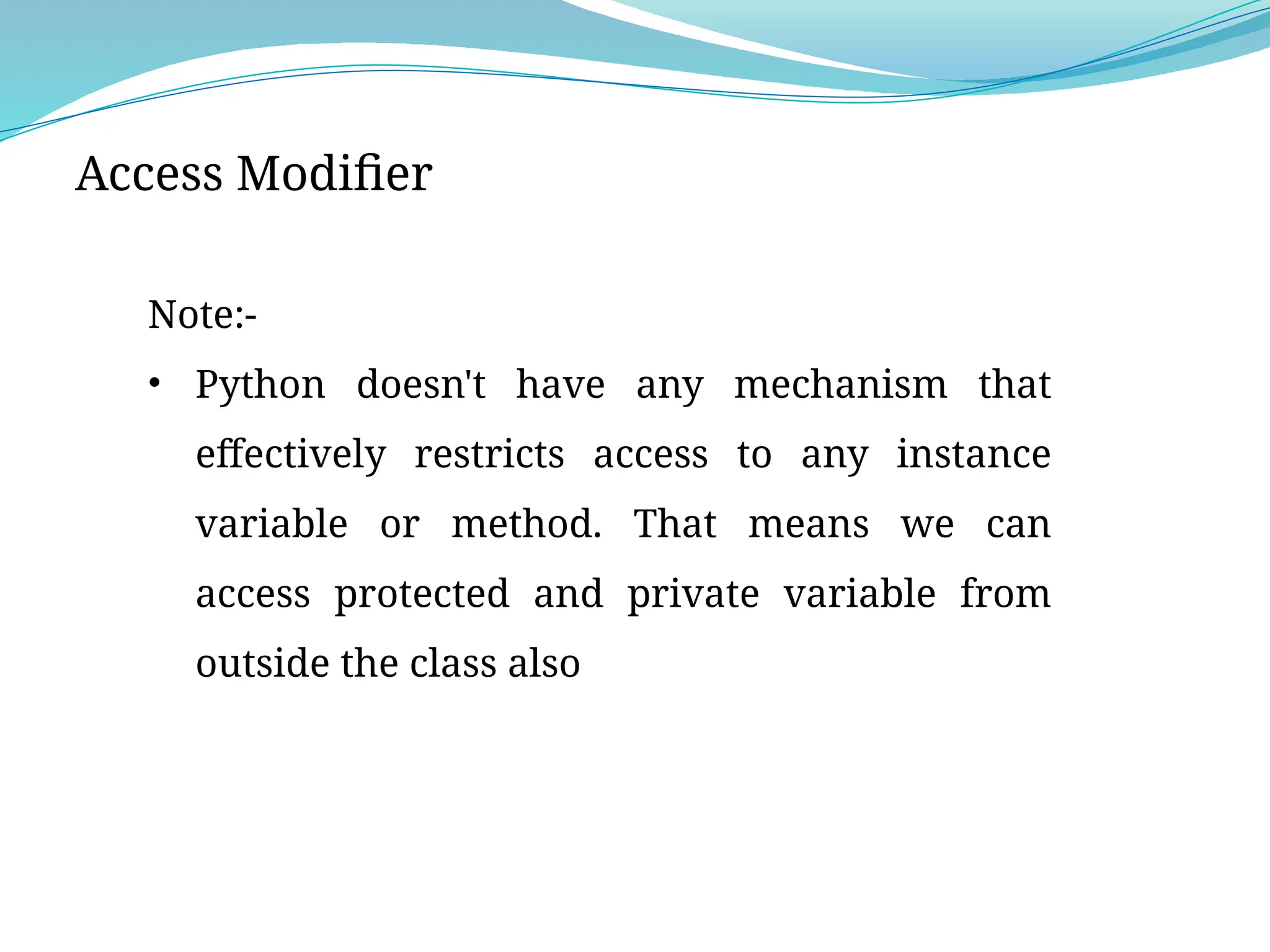
Access Modifier
Note:-
• Python doesn't have any mechanism that
effectively restricts access to any instance
variable or method. That means we can
access protected and private variable from
outside the class also
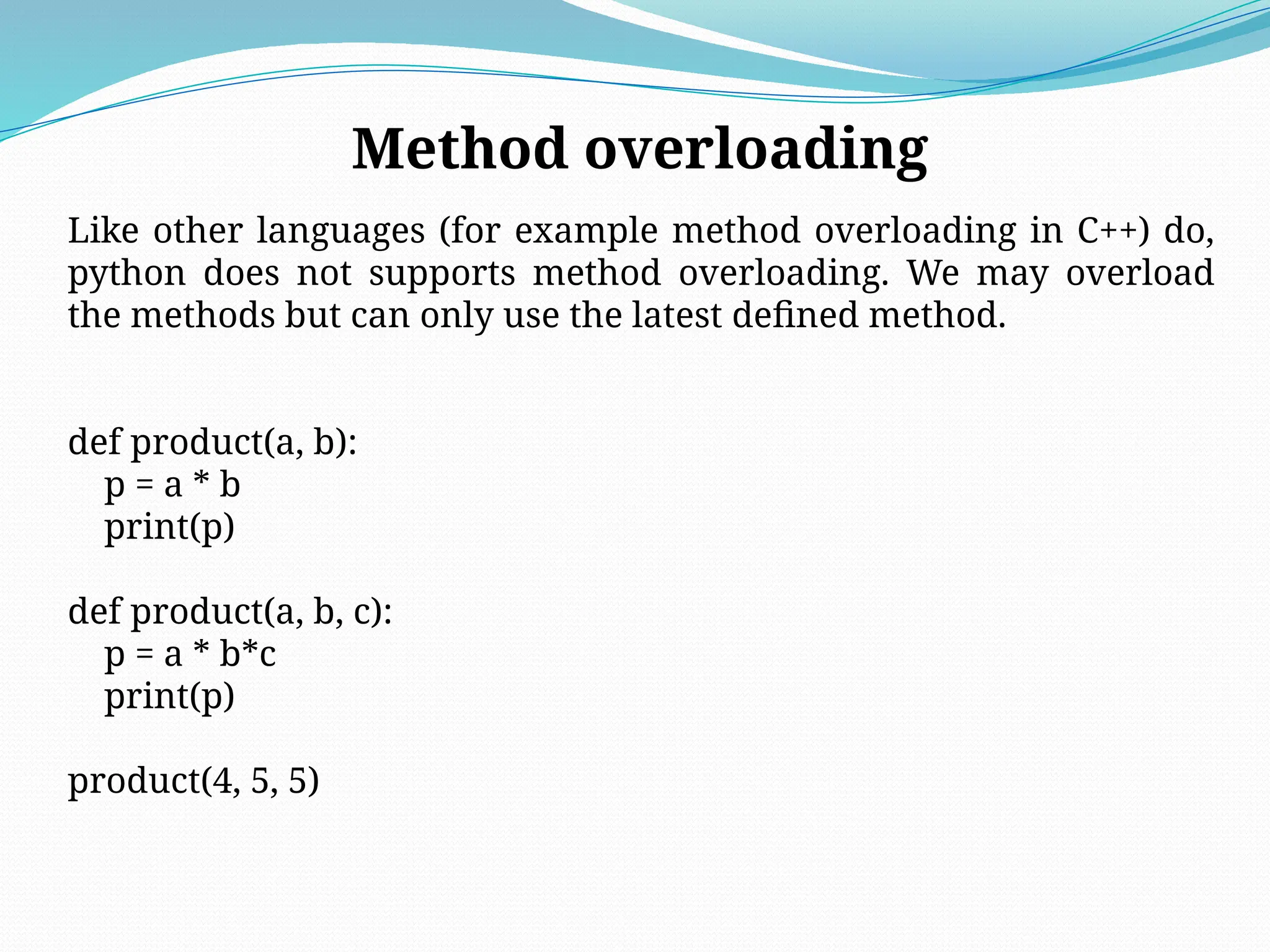
Method overloading
Like other languages (for example method overloading in C++) do,
python does not supports method overloading. We may overload
the methods but can only use the latest defined method.
def product(a, b):
p = a * b
print(p)
def product(a, b, c):
p = a * b*c
print(p)
product(4, 5, 5)
Method overloading
In Python you can define a method in such a way that there are multiple
ways to call it. Depending on the function definition, it can be called with
zero, one, two or more parameters. This is known as method overloading.
In the given code, there is a class with one method sayHello(). We rewrite as
shown below. The first parameter of this method is set to None, this gives us
the option to call it with or without a parameter.
An object is created based on the class, and we call its method using zero
and one parameter. To implement method overloading, we call the method
sayHello() in two ways: 1. obj.sayHello() and 2.obj.sayHello('Rambo')
class Human:
def sayHello(self, name=None):
if name is not None:
print 'Hello ' + name
else:
print 'Hello '
obj = Human()
print(obj.sayHello())
print(obj.sayHello('Rambo'))
Output
Hello
None
Hello Rambo
None
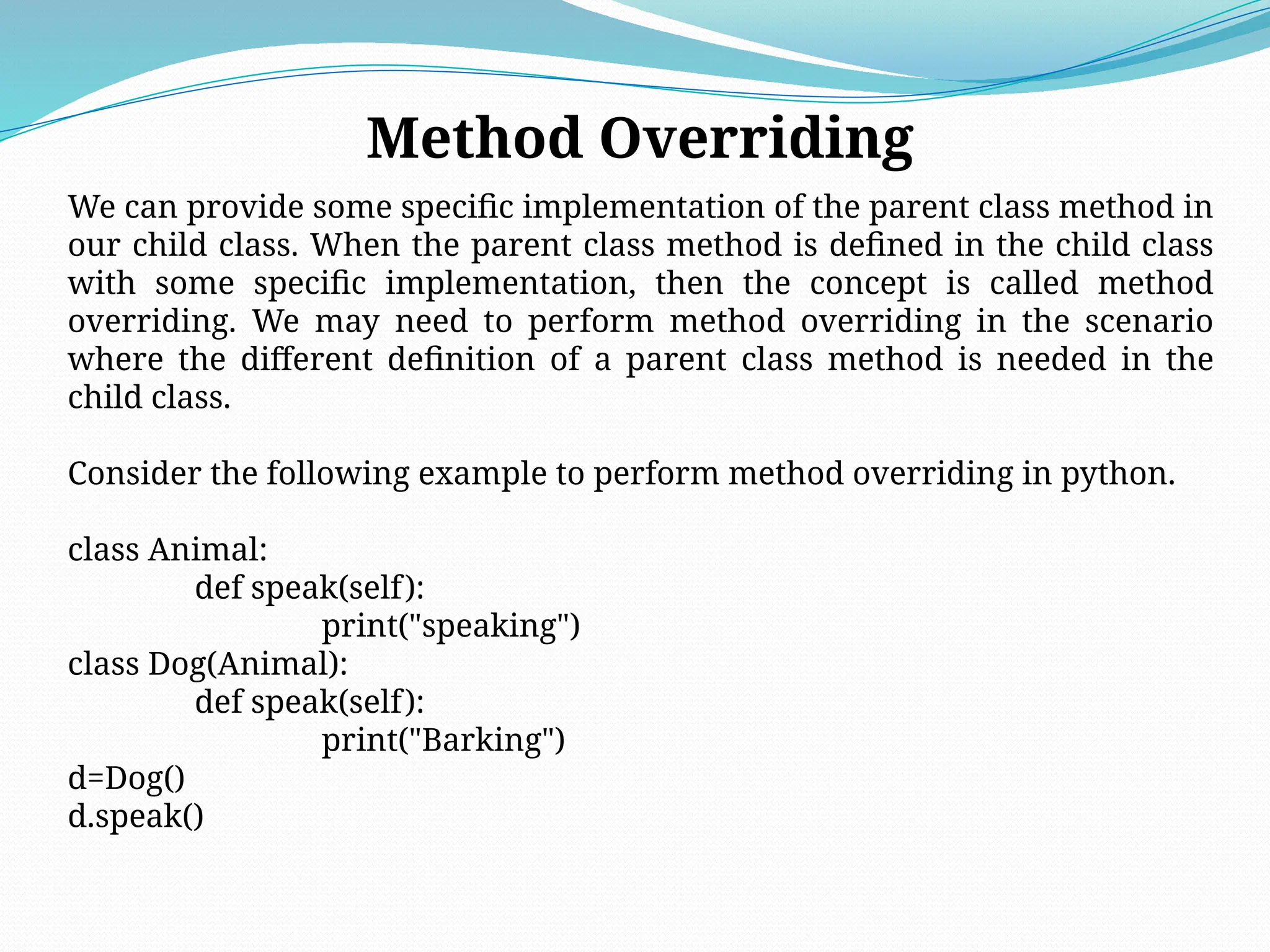
Method Overriding
We can provide some specific implementation of the parent class method in
our child class. When the parent class method is defined in the child class
with some specific implementation, then the concept is called method
overriding. We may need to perform method overriding in the scenario
where the different definition of a parent class method is needed in the
child class.
Consider the following example to perform method overriding in python.
class Animal:
def speak(self):
print("speaking")
class Dog(Animal):
def speak(self):
print("Barking")
d=Dog()
d.speak()
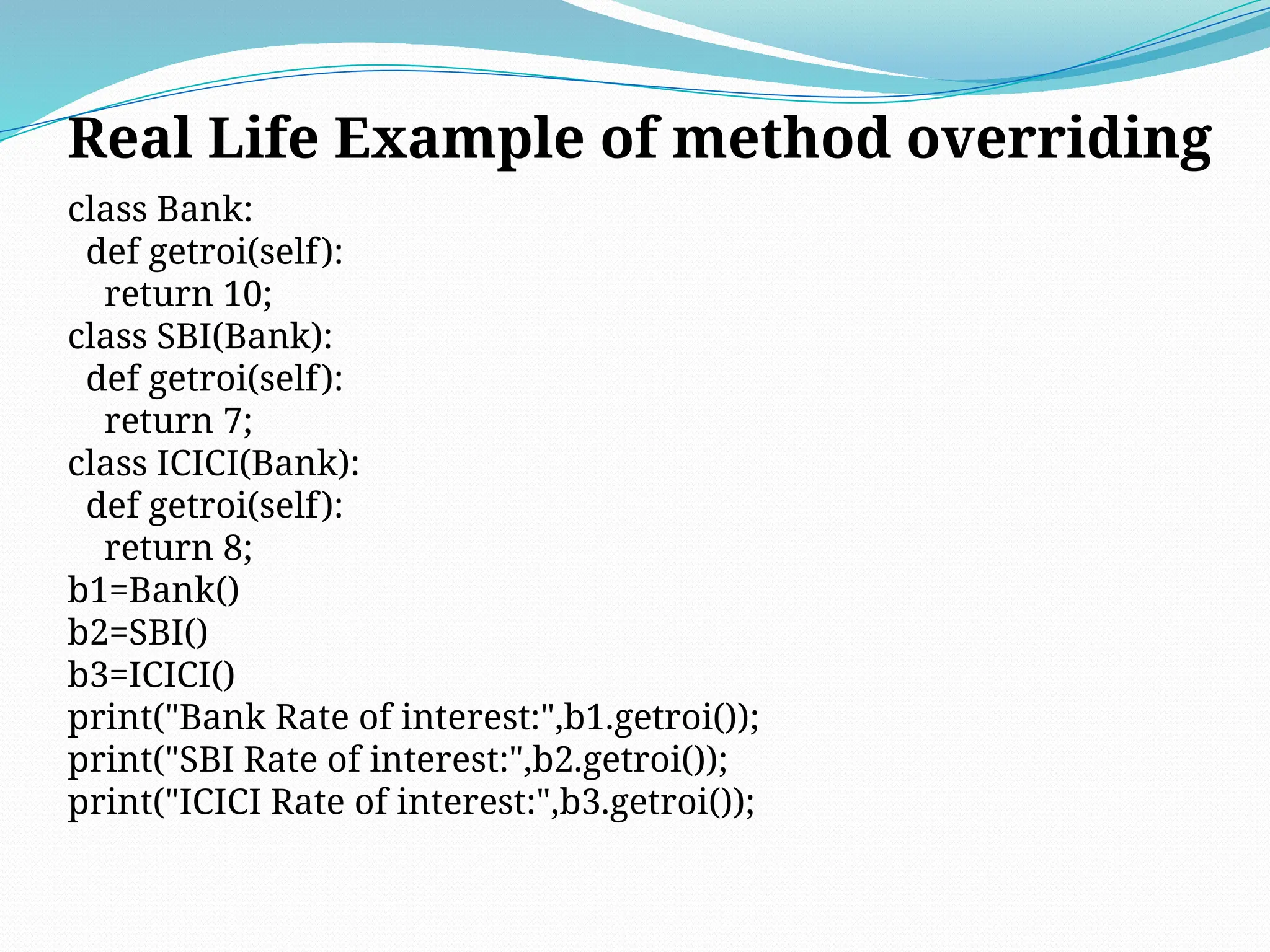
Real Life Example of method overriding
class Bank:
def getroi(self):
return 10;
class SBI(Bank):
def getroi(self):
return 7;
class ICICI(Bank):
def getroi(self):
return 8;
b1=Bank()
b2=SBI()
b3=ICICI()
print("Bank Rate of interest:",b1.getroi());
print("SBI Rate of interest:",b2.getroi());
print("ICICI Rate of interest:",b3.getroi());
End
Thank You

OOPS 46 slide Python concepts .pptx

  • 1.
    Object Oriented ProgrammingConcept in Python OOP
  • 2.
    Object Oriented programmingis a programming style that is associated with the concept of Class, Objects and various other concepts revolving around these two, like Inheritance, Polymorphism, Abstraction, Encapsulation etc . Object-oriented programming aims to implement real-world entities like inheritance, hiding, polymorphism etc in programming. The main aim of OOP is to bind together the data and the functions that operate on them so that no other part of the code can access this data except that function. -:OOPs:-
  • 3.
    OOPs Concept Definitions Now,let us discuss some of the main features of Object Oriented Programming which you will be using in Python. -:OOPs:- Objects Classes Abstraction Encapsulation Inheritance Polymorphism
  • 4.
    Objects It is abasic unit of Object Oriented Programming and represents the real life entities The object is an entity that has state and behavior. It may be any real- world object like the mouse, keyboard, chair, table, pen, etc. Everything in Python is an object, and almost everything has attributes and methods. all Objects shares two characteristics, they all have attributes and they all have behaviors. for example dogs have attributes like (name, color, type) and behaviors like (Running, barking, fetching etc). Another Example: Pen is an object. Its name is Reynolds, color is white etc. known as its state. It is used to write, so writing is its behavior. -:OOPs:-
  • 5.
    Object is areal world entity. Object is a run time entity. Object is an entity which has state and behavior. Object is an instance of a class. Object is group of data and functions. Object is minimal identifiable component in OOPS program. -:OOPs:-
  • 6.
    An object consistsof: State : It is represented by attributes of an object. It also reflects the properties of an object. Behavior : It is represented by methods of an object. It also reflects the response of an object with other objects. Identity : It gives a unique name to an object and enables one object to interact with other objects. Object
  • 7.
    Example of anobject: dog -:OOPs:-
  • 8.
    Class- A class isa user defined blueprint or prototype from which objects are created. It represents the set of properties or methods that are common to all objects of one type. In general, class declarations can include these components, in order: -:OOPs:-
  • 9.
    Class- Modifiers: A classcan be public or has default access (Refer this for details). Class name: The name should begin with a initial letter (capitalized by convention). Superclass(if any): The name of the class’s parent (superclass), if any, preceded by the keyword extends. A class can only extend (subclass) one parent. Body: The class body surrounded by braces, { }. -:OOPs:-
  • 10.
  • 11.
    -:OOPs:- Method  The methodis a function that is associated with an object. In Python, a method is not unique to class instances. Any object type can have methods.  The methods are used to implement the functionalities of an object.  For example if we created ”start()” and ”stop()” methods for the ”Car” class
  • 12.
    -:OOPs:- Method class Car: # createclass attributes name = "c200“ make = "mercedez“ model = 2008 # create class methods def start(self): print ("Engine started") def stop(self): print ("Engine switched off")
  • 13.
    -:OOPs:- Method  In AboveProgram there is two method are created named “Start ” and “Stop” under “Car” Class.We can call them with the help of object of the “Car” class .  You can create more method or function in any class for reducing complexity and simplifying the code.  Actually method is also called building block of the program.
  • 14.
    -:OOPs:- Abstraction  Data abstractionand encapsulation both are often used as synonyms. Both are nearly synonym because data abstraction is achieved through encapsulation.  Abstraction is used to hide internal details and show only functionalities.  Abstracting something means to give names to things so that the name captures the core of what a function or a whole program does
  • 15.
    -:OOPs:- Abstraction  Data abstractionallows us to transform a complex data structure into one that’s simple and easy to use.  Data abstraction refers to providing only essential information about the data to the outside world, hiding the background details or implementation
  • 16.
  • 17.
    -:OOPs:- Encapsulation  Data encapsulationis one of the fundamentals of OOP (object-oriented programming).  It refers to the bundling of data with the methods that operate on that data.  Encapsulation is used to hide the values or state of a structured data object inside a class, preventing unauthorized parties' direct access to them
  • 18.
    -:OOPs:- Encapsulation  Abstraction andEncapsulation are two important Object Oriented Programming (OOPS) concepts. Encapsulation and Abstraction both are interrelated terms.  Real Life Difference Between Encapsulation and Abstraction is that Encapsulate means to hide. Encapsulation is also called data hiding.  You can think Encapsulation like a capsule (medicine tablet) which hides medicine inside it
  • 19.
    -:OOPs:- Basic Different BetweenAbstraction and Encapsulation  Encapsulation is used for hide the code and data in a single unit to protect the data from the outside the world. Class is the best example of encapsulation.  Abstraction refers to showing only the necessary details to the intended user.  . Abstraction is implemented using interface and abstract class  Encapsulation is implemented using private and protected access modifier
  • 20.
    Inheritance -:OOPs:-  Inheritance isan important pillar of OOP(Object Oriented Programming). It is the mechanism in Python by which one class is allow to inherit the features(fields and methods) of another class. T  Inheritance is an OOPS concept in which one object acquires the properties and behaviors of the parent object. It’s creating a parent-child relationship between two classes. It offers robust and natural mechanism for organizing and structure of any software.
  • 21.
    Inheritance -:OOPs:- Important terminology: Super Class:The class whose features are inherited is known as superclass(or a base class or a parent class). Sub Class: The class that inherits the other class is known as subclass(or a derived class, extended class, or child class). The subclass can add its own fields and methods in addition to the superclass fields and methods. Reusability: Inheritance supports the concept of “reusability”, i.e. when we want to create a new class and there is already a class that includes some of the code that we want, we can derive our new class from the existing class. By doing this, we are reusing the fields and methods of the existing class.
  • 22.
    Inheritance -:OOPs:-  Inheritance allowsus to inherit attributes and methods from the base/parent class.  This is useful as we can create sub-classes and get all of the functionality from our parent class.  Then we can overwrite and add new functionalities without affecting the parent class.
  • 23.
    Inheritance -:OOPs:-  A classwhich inherits the properties is known as Child Class.  A class whose properties are inherited is known as Parent class.  Inheritance refers to the ability to create Sub-classes that contain specializations of their parents.
  • 24.
  • 25.
    Inheritance -:OOPs:- Single inheritance: Whena child class inherits from only one parent class, it is called as single inheritance.
  • 26.
    Inheritance -:OOPs:- Multi-level inheritance :isarchived when a derived class inherits another derived class. There is no limit on the number of levels up to which, the multi-level inheritance is archived in python.
  • 27.
    Inheritance -:OOPs:- hierarchical inheritance:When morethan one derived classes are created from a single base – it is called hierarchical inheritance.
  • 28.
    Inheritance -:OOPs:- Multiple Inherit: Pythonprovides us the flexibility to inherit multiple base classes in the child class.
  • 29.
    Polymorphism -:OOPs:-  Polymorphism isan ability (in OOP) to use common interface for multiple form (data types).  Suppose, we need to color a shape, there are multiple shape option (rectangle, square, circle). However we could use same method to color any shape. This concept is called Polymorphism.
  • 30.
    Polymorphism -:OOPs:-  Polymorphism isan ability (in OOP) to use common interface for multiple form (data types).  Suppose, we need to color a shape, there are multiple shape option (rectangle, square, circle). However we could use same method to color any shape. This concept is called Polymorphism.
  • 31.
    Advantage of OOPs -:OOPs:- OOP offers easy to understand and a clear modular structure for programs.  Objects created for Object-Oriented Programs can be reused in other programs. Thus it saves significant development cost.  Large programs are difficult to write, but if the development and designing team follow OOPS concept then they can better design with minimum flaws.  It also enhances program modularity because every object exists independently.
  • 32.
     class Add:   def input(self, c, d):  self.a = c  self.b = d  def process(self):  self.sum = self.a + self.b  def show(self) :  print(self.sum)  p1 = Add()  p1.input(10,20)  p1.process()  p1.show() Sample program
  • 33.
    Python – AccessSpecifier Various object-oriented languages like C++, Java, Python control access modifications which are used to restrict access to the variables and methods of the class. Most programming languages has three forms of access modifiers, which are Public, Protected and Private in a class. Python uses ‘_’ symbol to determine the access control for a specific data member or a member function of a class. Access specifiers in Python have an important role to play in securing data from unauthorized access and in preventing it from being exploited.
  • 34.
    Python - public,private and protected A Class in Python has three types of access modifiers –  Public Access Modifier  Private Access Modifier  Protected Access Modifier
  • 35.
    Public Access Modifier Themembers of a class that are declared public are easily accessible from any part of the program. All data members and member functions of a class are public by default. Example1: class employee: def __init__(self, name, sal): self.name=name self.salary=sal e1=employee("Shiv",12000) print(e1.name) print(e1.salary)
  • 36.
    Python – AccessSpecifier Example2: class employee: def __init__(self, name, sal): self.name=name self.salary=sal def display(self): print(self.name) print(self.salary) e1=employee("Shiv",12000) print(e1.name) print(e1.salary) print("**********") print(e1.display())
  • 37.
    Python – AccessSpecifier Example3: Public data members can also be access on python shell. You can access employee class's attributes and also modify their values, >>> e1=employee ("Kiran", 10000) >>> e1.salary 10000 >>> e1.salary=20000 >>> e1.salary 20000
  • 38.
    Private Access Modifier: Themembers of a class that are declared private are accessible within the class only, private access modifier is the most secure access modifier. Data members of a class are declared private by adding a double underscore ‘__’ symbol before the data member of that class. Example1: class employee: def __init__(self,name,sal): self.__name=name self.__salary=sal def display(self): print(self.__name) print(self.__salary) e1=employee("Shiv",12000) print(e1.display())
  • 39.
    Private Access Modifier: Notein the example1 we see that the value of variable is access through member function. If you access the variable direct through object Example: class employee: def __init__(self,name,sal): self.__name=name self.__salary=sal def display(self): print(self.__name) print(self.__salary) e1=employee("Shiv",12000) print(e1.name) print(e1.salary) Output: 'employee' object has no attribute 'name'
  • 40.
    Private Access Modifier: Ifyou try to access variable on Python shell Example3: >>> e1=employee("Bill",10000) >>> e1.__salary AttributeError: 'employee' object has no attribute '__salary'
  • 41.
    Protected Access Modifier Themembers of a class that are declared protected are only accessible to a class derived from it. Data members of a class are declared protected by adding a single underscore ‘_’ symbol before the data member of that class. Example3: class employee: def __init__(self,name,sal,age): self._name=name self._salary=sal self._age=age class person(employee): def display(self): print(self._name) print(self._salary) print(self._age) p=person("John",20000,29) print(p.display())
  • 42.
    Access Modifier Note:- • Pythondoesn't have any mechanism that effectively restricts access to any instance variable or method. That means we can access protected and private variable from outside the class also
  • 43.
    Method overloading Like otherlanguages (for example method overloading in C++) do, python does not supports method overloading. We may overload the methods but can only use the latest defined method. def product(a, b): p = a * b print(p) def product(a, b, c): p = a * b*c print(p) product(4, 5, 5)
  • 44.
    Method overloading In Pythonyou can define a method in such a way that there are multiple ways to call it. Depending on the function definition, it can be called with zero, one, two or more parameters. This is known as method overloading. In the given code, there is a class with one method sayHello(). We rewrite as shown below. The first parameter of this method is set to None, this gives us the option to call it with or without a parameter. An object is created based on the class, and we call its method using zero and one parameter. To implement method overloading, we call the method sayHello() in two ways: 1. obj.sayHello() and 2.obj.sayHello('Rambo') class Human: def sayHello(self, name=None): if name is not None: print 'Hello ' + name else: print 'Hello ' obj = Human() print(obj.sayHello()) print(obj.sayHello('Rambo')) Output Hello None Hello Rambo None
  • 45.
    Method Overriding We canprovide some specific implementation of the parent class method in our child class. When the parent class method is defined in the child class with some specific implementation, then the concept is called method overriding. We may need to perform method overriding in the scenario where the different definition of a parent class method is needed in the child class. Consider the following example to perform method overriding in python. class Animal: def speak(self): print("speaking") class Dog(Animal): def speak(self): print("Barking") d=Dog() d.speak()
  • 46.
    Real Life Exampleof method overriding class Bank: def getroi(self): return 10; class SBI(Bank): def getroi(self): return 7; class ICICI(Bank): def getroi(self): return 8; b1=Bank() b2=SBI() b3=ICICI() print("Bank Rate of interest:",b1.getroi()); print("SBI Rate of interest:",b2.getroi()); print("ICICI Rate of interest:",b3.getroi());
  • 47.