PYTHON
WHAT IS PYTHON?
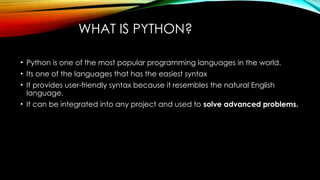
• Python is one of the most popular programming languages in the world.
• Its one of the languages that has the easiest syntax
• It provides user-friendly syntax because it resembles the natural English
language.
• It can be integrated into any project and used to solve advanced problems.
APPLICATIONS OF PYTHON PROGRAMMING
PYTHON SYNTAX
• Python Indentation
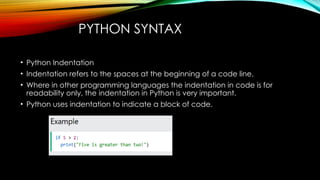
• Indentation refers to the spaces at the beginning of a code line.
• Where in other programming languages the indentation in code is for
readability only, the indentation in Python is very important.
• Python uses indentation to indicate a block of code.
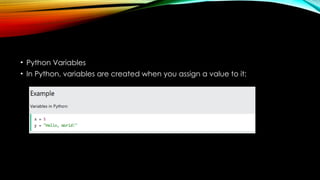
• Python Variables
• In Python, variables are created when you assign a value to it:
• Comments
• Comments can be used to explain Python code.
• Comments can be used to make the code more readable.
• Comments can be used to prevent execution when testing code.
• Python has commenting capability for the purpose of in-code
documentation.
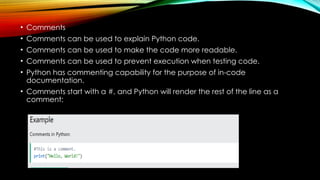
• Comments start with a #, and Python will render the rest of the line as a
comment:
•Variables
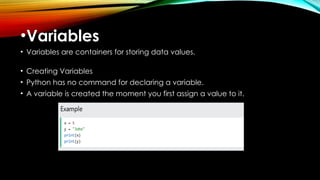
• Variables are containers for storing data values.
• Creating Variables
• Python has no command for declaring a variable.
• A variable is created the moment you first assign a value to it.
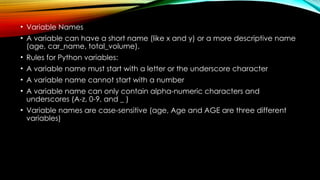
• Variable Names
• A variable can have a short name (like x and y) or a more descriptive name
(age, car_name, total_volume).
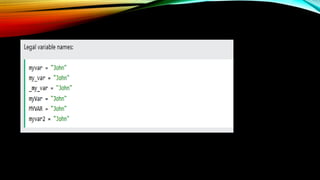
• Rules for Python variables:
• A variable name must start with a letter or the underscore character
• A variable name cannot start with a number
• A variable name can only contain alpha-numeric characters and
underscores (A-z, 0-9, and _ )
• Variable names are case-sensitive (age, Age and AGE are three different
variables)
Python programming in simple terms..pptx

Python programming in simple terms..pptx

  • 1.
  • 2.
    WHAT IS PYTHON? •Python is one of the most popular programming languages in the world. • Its one of the languages that has the easiest syntax • It provides user-friendly syntax because it resembles the natural English language. • It can be integrated into any project and used to solve advanced problems.
  • 3.
  • 4.
    PYTHON SYNTAX • PythonIndentation • Indentation refers to the spaces at the beginning of a code line. • Where in other programming languages the indentation in code is for readability only, the indentation in Python is very important. • Python uses indentation to indicate a block of code.
  • 5.
    • Python Variables •In Python, variables are created when you assign a value to it:
  • 6.
    • Comments • Commentscan be used to explain Python code. • Comments can be used to make the code more readable. • Comments can be used to prevent execution when testing code. • Python has commenting capability for the purpose of in-code documentation. • Comments start with a #, and Python will render the rest of the line as a comment:
  • 7.
    •Variables • Variables arecontainers for storing data values. • Creating Variables • Python has no command for declaring a variable. • A variable is created the moment you first assign a value to it.
  • 8.
    • Variable Names •A variable can have a short name (like x and y) or a more descriptive name (age, car_name, total_volume). • Rules for Python variables: • A variable name must start with a letter or the underscore character • A variable name cannot start with a number • A variable name can only contain alpha-numeric characters and underscores (A-z, 0-9, and _ ) • Variable names are case-sensitive (age, Age and AGE are three different variables)