PYTHION
Certainly! Python is a high-level, interpreted
programming language known for its simplicity and
readability. Let's delve into some key aspects in detail:
Syntax: Python's syntax is designed to be clear and
readable, resembling pseudo-code in many cases. It uses
indentation to define code blocks, which is a departure
from languages that use curly braces or keywords like
"begin" and "end".
• Interpreted: Python is an interpreted language, which means that
code is executed line by line by an interpreter rather than
compiled into machine code beforehand. This makes
development and debugging faster but can result in slower
execution compared to compiled languages.
• Dynamic Typing: Python is dynamically typed, meaning you don't
need to declare the type of a variable explicitly. The type of a
variable is determined at runtime based on the value assigned to
it. This can lead to flexibility but also requires careful attention to
variable types to avoid errors.
• Object-Oriented: Python supports object-oriented programming
paradigms, allowing you to define classes and create objects
with properties and methods. Inheritance, polymorphism, and
encapsulation are key concepts in Python's object-oriented
approach.
• Extensive Standard Library: Python comes with a vast standard
library that provides modules and packages for a wide range of
tasks, from working with data structures and files to network
programming and web development. This extensive library
reduces the need for external dependencies for many common
tasks.
• Dynamic Memory Management: Python uses automatic memory
management via garbage collection. This means that memory
allocation and deallocation are handled by the Python runtime,
making memory management easier for developers compared to
languages where manual memory management is required.
• Platform Independence: Python is highly portable and runs on
virtually every platform, including Windows, macOS, Linux, and
various UNIX systems. This makes it an excellent choice for
cross-platform development.
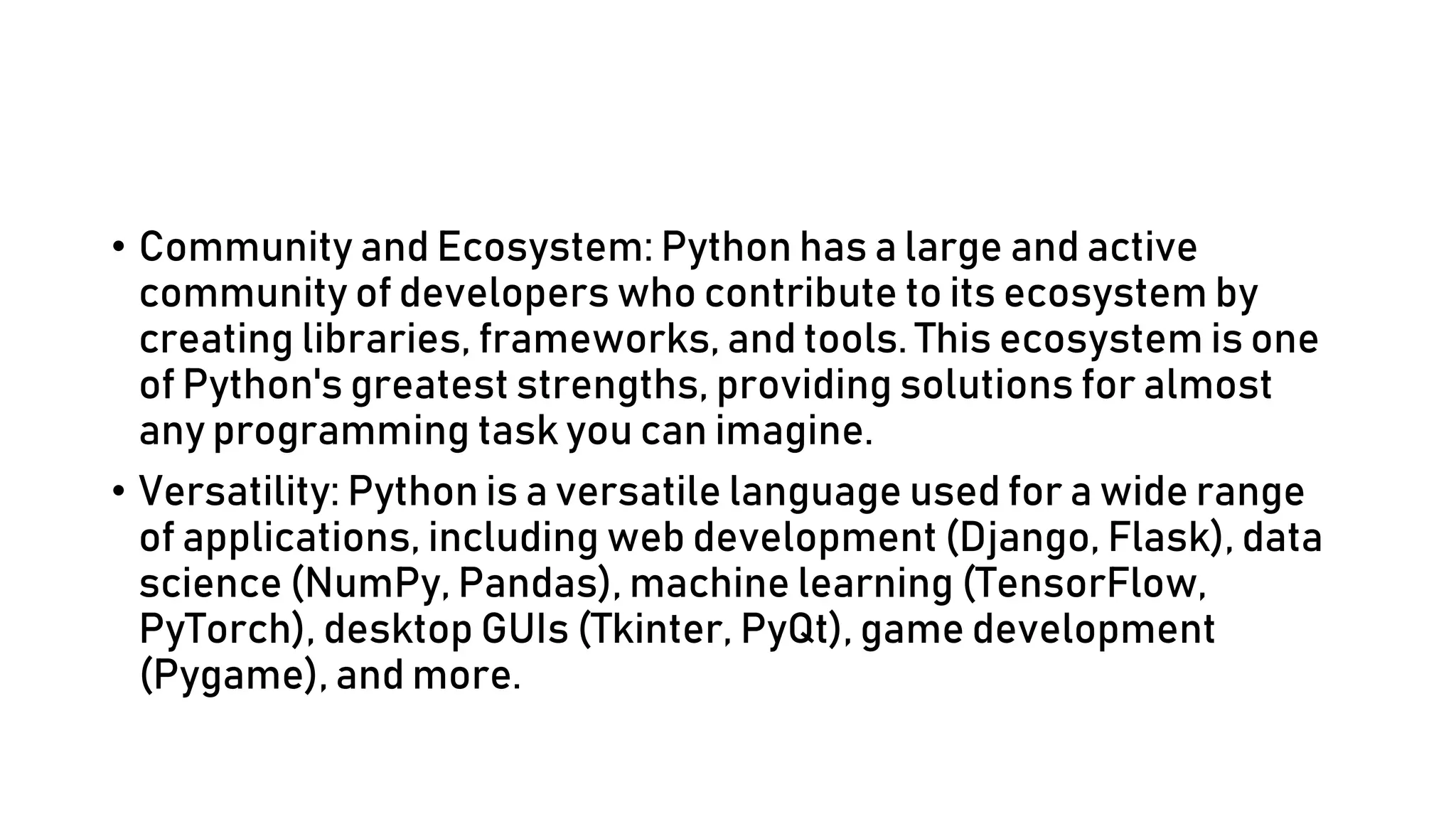
• Community and Ecosystem: Python has a large and active
community of developers who contribute to its ecosystem by
creating libraries, frameworks, and tools. This ecosystem is one
of Python's greatest strengths, providing solutions for almost
any programming task you can imagine.
• Versatility: Python is a versatile language used for a wide range
of applications, including web development (Django, Flask), data
science (NumPy, Pandas), machine learning (TensorFlow,
PyTorch), desktop GUIs (Tkinter, PyQt), game development
(Pygame), and more.

PYTHON IN DETAIL INFORMATION EDUCATIONAL

  • 1.
    PYTHION Certainly! Python isa high-level, interpreted programming language known for its simplicity and readability. Let's delve into some key aspects in detail: Syntax: Python's syntax is designed to be clear and readable, resembling pseudo-code in many cases. It uses indentation to define code blocks, which is a departure from languages that use curly braces or keywords like "begin" and "end".
  • 2.
    • Interpreted: Pythonis an interpreted language, which means that code is executed line by line by an interpreter rather than compiled into machine code beforehand. This makes development and debugging faster but can result in slower execution compared to compiled languages. • Dynamic Typing: Python is dynamically typed, meaning you don't need to declare the type of a variable explicitly. The type of a variable is determined at runtime based on the value assigned to it. This can lead to flexibility but also requires careful attention to variable types to avoid errors.
  • 3.
    • Object-Oriented: Pythonsupports object-oriented programming paradigms, allowing you to define classes and create objects with properties and methods. Inheritance, polymorphism, and encapsulation are key concepts in Python's object-oriented approach. • Extensive Standard Library: Python comes with a vast standard library that provides modules and packages for a wide range of tasks, from working with data structures and files to network programming and web development. This extensive library reduces the need for external dependencies for many common tasks.
  • 4.
    • Dynamic MemoryManagement: Python uses automatic memory management via garbage collection. This means that memory allocation and deallocation are handled by the Python runtime, making memory management easier for developers compared to languages where manual memory management is required. • Platform Independence: Python is highly portable and runs on virtually every platform, including Windows, macOS, Linux, and various UNIX systems. This makes it an excellent choice for cross-platform development.
  • 5.
    • Community andEcosystem: Python has a large and active community of developers who contribute to its ecosystem by creating libraries, frameworks, and tools. This ecosystem is one of Python's greatest strengths, providing solutions for almost any programming task you can imagine. • Versatility: Python is a versatile language used for a wide range of applications, including web development (Django, Flask), data science (NumPy, Pandas), machine learning (TensorFlow, PyTorch), desktop GUIs (Tkinter, PyQt), game development (Pygame), and more.