Python. Finance. Excel.
• The Thalesians, Zürich
June 9th, 2016 Felix Zumstein, CFA
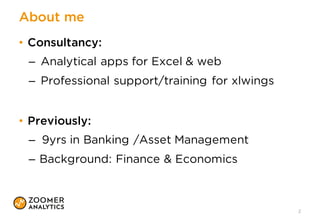
About me
• Consultancy:
– Analytical apps for Excel & web
– Professional support/training for xlwings
• Previously:
– 9yrs in Banking /Asset Management
– Background: Finance & Economics
2
About this talk
3
This talk is NOT about sophisticated models that
make you rich.
This talk is about HOW to implement classic
financial models using Python and Excel.
Download the material from:
https://github.com/ZoomerAnalytics/talks
Agenda
4
1) Portfolio Optimization
• Intro to fundamental packages for finance
• xlwings: Interactive use
2) Monte Carlo Simulation
• Simulation with NumPy
• xlwings: From Excel macros to web apps
3) Option Pricing and Implied Volatility
• Introduction to QuantLib
• xlwings: User Defined Functions (UDFs)
4) Save the Spreadsheet
1 Portfolio Optimization
xlwings: Interactive use
Jupyter Notebook
6
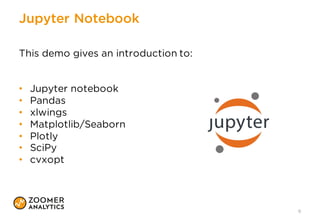
This demo gives an introduction to:
• Jupyter notebook
• Pandas
• xlwings
• Matplotlib/Seaborn
• Plotly
• SciPy
• cvxopt
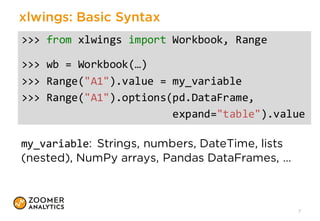
xlwings: Basic Syntax
7
>>>  from  xlwings import  Workbook,  Range
>>>  wb =  Workbook(…)
>>>  Range("A1").value  =  my_variable
>>>  Range("A1").options(pd.DataFrame,
expand="table").value
my_variable: Strings, numbers, DateTime, lists
(nested), NumPy arrays, Pandas DataFrames, …
cvxopt
8
• GPL license (SciPy: BSD)
• Installation:
- Mac/Linux: conda install  cvxopt
- Windows: Download wheel from
http://www.lfd.uci.edu/~gohlke/pythonlibs/#cvxopt
then pip install it
• CVXPY: Python-embedded modeling language
for convex optimization problems. It wraps the
solvers cvxopt, ECOS and SCS (cvxpy.org).
2 Monte Carlo Simulation
xlwings: Excel Macros
10
Random walk
𝑑𝑆# = 	
   𝜇 𝑆# 𝑑𝑡	
   + 	
   𝜎 𝑆# 𝑑𝑊#
In the Black-Scholes model, asset prices 𝑆# are assumed to follow a
geometric Brownian motion (GBM), as defined by this stochastic
differential equation (SDE):
𝜇: drift, 𝜎: volatility, 𝑊#: brownian motion
Discrete time version:
𝑆# = 𝑆#+,# exp 𝜇 −
𝜎1
2
Δ𝑡	
   + 	
   𝜎 𝜀# Δ𝑡
S[0,  :]  =  starting_price
for t  in range(n_timesteps):
rand_nums =  np.random.randn(n_simulations)
S[t  + 1,  :]  =  S[t,  :]  * np.exp((mu  -­‐ 0.5  * vol ** 2)  * dt +
vol * rand_nums * np.sqrt(dt))
Python: (for full context look at the repo as mentioned on slide 13)
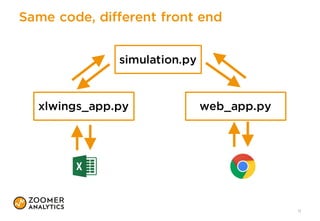
Same code, different front end
11
simulation.py
xlwings_app.py web_app.py
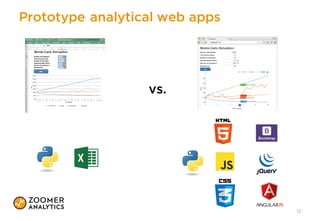
Prototype analytical web apps
12
vs.
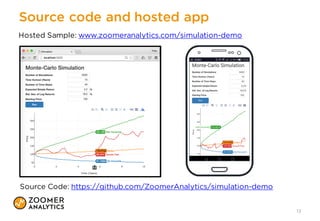
Source code and hosted app
13
Hosted Sample: www.zoomeranalytics.com/simulation-demo
Source Code: https://github.com/ZoomerAnalytics/simulation-demo
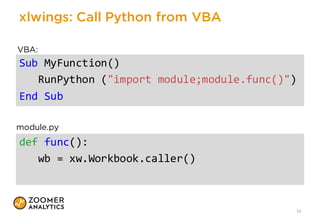
xlwings: Call Python from VBA
14
Sub MyFunction()
RunPython ("import  module;module.func()")
End  Sub
def func():
wb =  xw.Workbook.caller()
module.py
VBA:
3 Option Pricing &
Implied Volatility
xlwings: UDFs
QuantLib
16
• Open-source framework for quant finance. Released in
2000 and written in C++ with bindings for many languages.
• ”Offers […] features such as market conventions, yield curve
models, solvers, PDEs, Monte Carlo (low-discrepancy
included), exotic options, VAR, and so on.” (quantlib.org)
• Installation
- Windows: Download the Python wheel from
http://www.lfd.uci.edu/~gohlke/pythonlibs/#quantlib
and pip-install it
- Linux: apt-­‐get  install  quantlib-­‐python  quantlib-­‐swig
- Mac: Err…Right now, no binaries (wheels or conda
package) and building it is not exactly fun
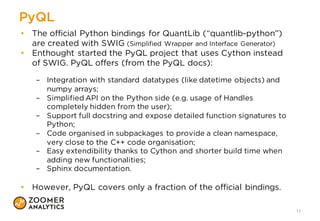
PyQL
17
• The official Python bindings for QuantLib (“quantlib-python”)
are created with SWIG (Simplified Wrapper and Interface Generator)
• Enthought started the PyQL project that uses Cython instead
of SWIG. PyQL offers (from the PyQL docs):
- Integration with standard datatypes (like datetime objects) and
numpy arrays;
- Simplified API on the Python side (e.g. usage of Handles
completely hidden from the user);
- Support full docstring and expose detailed function signatures to
Python;
- Code organised in subpackages to provide a clean namespace,
very close to the C++ code organisation;
- Easy extendibility thanks to Cython and shorter build time when
adding new functionalities;
- Sphinx documentation.
• However, PyQL covers only a fraction of the official bindings.
Options: Implied Volatility
18
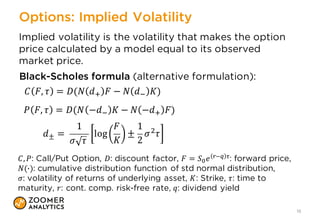
Implied volatility is the volatility that makes the option
price calculated by a model equal to its observed
market price.
𝐶 𝐹, 𝜏 = 𝐷(𝑁 𝑑< 𝐹 − 𝑁 𝑑+ 𝐾)
𝑑± =	
  
1
𝜎 𝜏	
  
log
𝐹
𝐾
±
1
2
𝜎1
𝜏
Black-Scholes formula (alternative formulation):
𝑃 𝐹, 𝜏 = 𝐷(𝑁 −𝑑+ 𝐾 − 𝑁 −𝑑< 𝐹)
𝐶, 𝑃: Call/Put Option, 𝐷: discount factor, 𝐹 = 𝑆E 𝑒 G+H I: forward price,
𝑁(J): cumulative distribution function of std normal distribution,
𝜎: volatility of returns of underlying asset, 𝐾: Strike, 𝜏: time to
maturity, 𝑟: cont. comp. risk-free rate, 𝑞: dividend yield
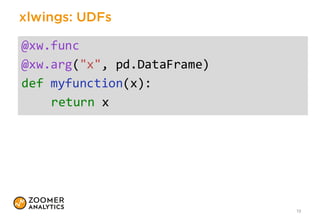
xlwings: UDFs
19
@xw.func
@xw.arg("x",  pd.DataFrame)
def myfunction(x):
return x
4 Save the Spreadsheet
xlwings: VBA unit tests
Tough times for spreadsheet models
21
"Where a bank relies on manual processes and
desktop applications (e.g. spreadsheets, databases)
and has specific risk units that use these applications
for software development, it should have effective
mitigants in place (e.g. end-user computing policies
and procedures) and other effective controls that are
consistently applied across the bank's processes. "
– Basel Committee on Banking Supervision, Principle 3
Unit Tests
22
• Automated unit tests are a cornerstone of modern
software development (”test-driven development”)
• Excel: doesn’t offer any means to create unit tests
(there’s Debug.Assert, but that doesn’t really help)
• Python: has a built-in unit test module
• Unit testing with xlwings is unintrusive:
- No add-in to be installed
- No changes to the original VBA code base
- Python standard lib + xlwings is all you need
• It’s a great way to verify & debug legacy VBA code
Running VBA code with xlwings
23
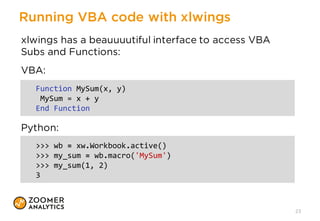
xlwings has a beauuuutiful interface to access VBA
Subs and Functions:
VBA:
Function MySum(x,  y)
MySum =  x  +  y
End  Function
Python:
>>>  wb = xw.Workbook.active()
>>>  my_sum = wb.macro('MySum')
>>>  my_sum(1,  2)
3
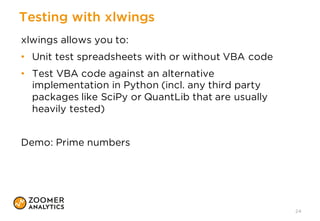
Testing with xlwings
24
xlwings allows you to:
• Unit test spreadsheets with or without VBA code
• Test VBA code against an alternative
implementation in Python (incl. any third party
packages like SciPy or QuantLib that are usually
heavily tested)
Demo: Prime numbers
Questions?

Python. Finance. Excel. - The Thalesians

  • 1.
    Python. Finance. Excel. •The Thalesians, Zürich June 9th, 2016 Felix Zumstein, CFA
  • 2.
    About me • Consultancy: –Analytical apps for Excel & web – Professional support/training for xlwings • Previously: – 9yrs in Banking /Asset Management – Background: Finance & Economics 2
  • 3.
    About this talk 3 Thistalk is NOT about sophisticated models that make you rich. This talk is about HOW to implement classic financial models using Python and Excel. Download the material from: https://github.com/ZoomerAnalytics/talks
  • 4.
    Agenda 4 1) Portfolio Optimization •Intro to fundamental packages for finance • xlwings: Interactive use 2) Monte Carlo Simulation • Simulation with NumPy • xlwings: From Excel macros to web apps 3) Option Pricing and Implied Volatility • Introduction to QuantLib • xlwings: User Defined Functions (UDFs) 4) Save the Spreadsheet
  • 5.
  • 6.
    Jupyter Notebook 6 This demogives an introduction to: • Jupyter notebook • Pandas • xlwings • Matplotlib/Seaborn • Plotly • SciPy • cvxopt
  • 7.
    xlwings: Basic Syntax 7 >>> from  xlwings import  Workbook,  Range >>>  wb =  Workbook(…) >>>  Range("A1").value  =  my_variable >>>  Range("A1").options(pd.DataFrame, expand="table").value my_variable: Strings, numbers, DateTime, lists (nested), NumPy arrays, Pandas DataFrames, …
  • 8.
    cvxopt 8 • GPL license(SciPy: BSD) • Installation: - Mac/Linux: conda install  cvxopt - Windows: Download wheel from http://www.lfd.uci.edu/~gohlke/pythonlibs/#cvxopt then pip install it • CVXPY: Python-embedded modeling language for convex optimization problems. It wraps the solvers cvxopt, ECOS and SCS (cvxpy.org).
  • 9.
    2 Monte CarloSimulation xlwings: Excel Macros
  • 10.
    10 Random walk 𝑑𝑆# =   𝜇 𝑆# 𝑑𝑡   +   𝜎 𝑆# 𝑑𝑊# In the Black-Scholes model, asset prices 𝑆# are assumed to follow a geometric Brownian motion (GBM), as defined by this stochastic differential equation (SDE): 𝜇: drift, 𝜎: volatility, 𝑊#: brownian motion Discrete time version: 𝑆# = 𝑆#+,# exp 𝜇 − 𝜎1 2 Δ𝑡   +   𝜎 𝜀# Δ𝑡 S[0,  :]  =  starting_price for t  in range(n_timesteps): rand_nums =  np.random.randn(n_simulations) S[t  + 1,  :]  =  S[t,  :]  * np.exp((mu  -­‐ 0.5  * vol ** 2)  * dt + vol * rand_nums * np.sqrt(dt)) Python: (for full context look at the repo as mentioned on slide 13)
  • 11.
    Same code, differentfront end 11 simulation.py xlwings_app.py web_app.py
  • 12.
  • 13.
    Source code andhosted app 13 Hosted Sample: www.zoomeranalytics.com/simulation-demo Source Code: https://github.com/ZoomerAnalytics/simulation-demo
  • 14.
    xlwings: Call Pythonfrom VBA 14 Sub MyFunction() RunPython ("import  module;module.func()") End  Sub def func(): wb =  xw.Workbook.caller() module.py VBA:
  • 15.
    3 Option Pricing& Implied Volatility xlwings: UDFs
  • 16.
    QuantLib 16 • Open-source frameworkfor quant finance. Released in 2000 and written in C++ with bindings for many languages. • ”Offers […] features such as market conventions, yield curve models, solvers, PDEs, Monte Carlo (low-discrepancy included), exotic options, VAR, and so on.” (quantlib.org) • Installation - Windows: Download the Python wheel from http://www.lfd.uci.edu/~gohlke/pythonlibs/#quantlib and pip-install it - Linux: apt-­‐get  install  quantlib-­‐python  quantlib-­‐swig - Mac: Err…Right now, no binaries (wheels or conda package) and building it is not exactly fun
  • 17.
    PyQL 17 • The officialPython bindings for QuantLib (“quantlib-python”) are created with SWIG (Simplified Wrapper and Interface Generator) • Enthought started the PyQL project that uses Cython instead of SWIG. PyQL offers (from the PyQL docs): - Integration with standard datatypes (like datetime objects) and numpy arrays; - Simplified API on the Python side (e.g. usage of Handles completely hidden from the user); - Support full docstring and expose detailed function signatures to Python; - Code organised in subpackages to provide a clean namespace, very close to the C++ code organisation; - Easy extendibility thanks to Cython and shorter build time when adding new functionalities; - Sphinx documentation. • However, PyQL covers only a fraction of the official bindings.
  • 18.
    Options: Implied Volatility 18 Impliedvolatility is the volatility that makes the option price calculated by a model equal to its observed market price. 𝐶 𝐹, 𝜏 = 𝐷(𝑁 𝑑< 𝐹 − 𝑁 𝑑+ 𝐾) 𝑑± =   1 𝜎 𝜏   log 𝐹 𝐾 ± 1 2 𝜎1 𝜏 Black-Scholes formula (alternative formulation): 𝑃 𝐹, 𝜏 = 𝐷(𝑁 −𝑑+ 𝐾 − 𝑁 −𝑑< 𝐹) 𝐶, 𝑃: Call/Put Option, 𝐷: discount factor, 𝐹 = 𝑆E 𝑒 G+H I: forward price, 𝑁(J): cumulative distribution function of std normal distribution, 𝜎: volatility of returns of underlying asset, 𝐾: Strike, 𝜏: time to maturity, 𝑟: cont. comp. risk-free rate, 𝑞: dividend yield
  • 19.
  • 20.
    4 Save theSpreadsheet xlwings: VBA unit tests
  • 21.
    Tough times forspreadsheet models 21 "Where a bank relies on manual processes and desktop applications (e.g. spreadsheets, databases) and has specific risk units that use these applications for software development, it should have effective mitigants in place (e.g. end-user computing policies and procedures) and other effective controls that are consistently applied across the bank's processes. " – Basel Committee on Banking Supervision, Principle 3
  • 22.
    Unit Tests 22 • Automatedunit tests are a cornerstone of modern software development (”test-driven development”) • Excel: doesn’t offer any means to create unit tests (there’s Debug.Assert, but that doesn’t really help) • Python: has a built-in unit test module • Unit testing with xlwings is unintrusive: - No add-in to be installed - No changes to the original VBA code base - Python standard lib + xlwings is all you need • It’s a great way to verify & debug legacy VBA code
  • 23.
    Running VBA codewith xlwings 23 xlwings has a beauuuutiful interface to access VBA Subs and Functions: VBA: Function MySum(x,  y) MySum =  x  +  y End  Function Python: >>>  wb = xw.Workbook.active() >>>  my_sum = wb.macro('MySum') >>>  my_sum(1,  2) 3
  • 24.
    Testing with xlwings 24 xlwingsallows you to: • Unit test spreadsheets with or without VBA code • Test VBA code against an alternative implementation in Python (incl. any third party packages like SciPy or QuantLib that are usually heavily tested) Demo: Prime numbers
  • 25.