PYROTECHNICS
GENERAL OBJECTIVE
At the end of the session,
students will be able to
understand the use and
importance of Pyrotechnics
1. Identify the different kinds of
Pyrotechnics.
2. Differentiate types of Pyrotechnics.
3. Proper use of each type.
4. Proper handling and Maintenance of
Pyrotechnics
DEFINITIONS
Pyrotechnics - Pyrotechnics is
the science of using materials capable
of undergoing self-contained and self-
sustained exothermic chemical
reactions for the production of heat,
light, gas, smoke and/or sound.
Kinds of Pyrotechnics
Rocket Parachute flare
Hand flare
Orange smoke signal
Line throwing apparatus
 A Pyrotechnic signal flare that is carried up
into the air by a rocket and floats
suspended from a small parachute.
What is Rocket Parachute flare?
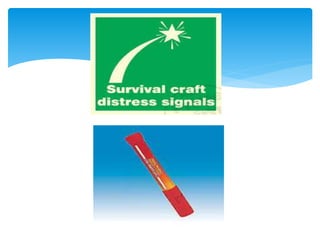
 A pyrotechnic signal flare that is
handheld use for signaling or visual
distress signals
What is Hand Flare?
 Orange Smoke Signal is a compact, flat top,
day time distress signal designed to be
easy and safe to handle. It provides
effective position marking during rescue
operations and can be used to indicate
wind direction, producing dense orange
smoke for a minimum of 3 minutes.
What is Orange Smoke Signal?
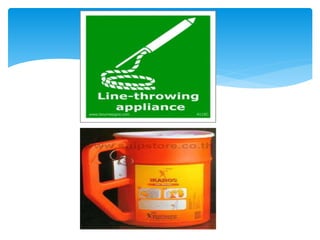
 line throwing device serves to create
line connections in emergencies at
sea, as well as for line and bridge
construction.
What is Line Throwing Apparatus?
PYROTECHNICS and their
characteristics and as per
SOLAS Requirements.
ROCKET PARACHUTE FLARE
 The minimum vertical height of rocket, when
fired from the operating point must be 300
meters or 1000 feet.
 A Parachute must be activated when it reaches
top or near to the top of it’s trajectory level.
 Validity of 3yrs from manufactured date
Rocket Parachute flare – The minimum
Requirements for rocket parachute flare as per
SOLAS Chapter III Regulation 26 are:
 It must burn for a period not less than 40 sec.
with minimum luminous intensity of 30,000
candelas.
 The rate of decent after opening of the
parachute must be minimum 5m/sec.
 Arrangement must be such that it must not
damage or burn parachute when the flare is
activated.
HAND FLARE
 Must be contained in a water tight casing.
 Must have self ignition system.
 It must not harm the survival craft if used while
boarding the same.
 It must illuminate with a bright red color.
 A simple & brief operating instruction diagram
must be their on it’s casing
Hand flare - The minimum requirement as per
SOLAS Chapter III Regulation 25 are:
ORANGE SMOKE SIGNAL
 Contained in water resistance buoyant
container with clear diagram for operating
instruction.
 It should not ignite or explode if used as per
the describe operating instruction.
Orange smoke signal or Buoyant smoke signal
- The minimum Requirements as per SOLAS
Chapter III Regulation 37 are:
 Smoke emitted must be of high visible color
with a uniform rate and minimum period of
3min.
 It must emit only smoke and not flame when
floating in calm water.
 If immersed in water it must emit smoke for
a period of 10 seconds.
 Validity of 3yrs from manufactured date
LINE THROWING
APPARATUS
 Must have good accuracy.
 A brief instruction with diagram must be present in
the container.
 Must have minimum 4 projectiles each carrying line
to at least 230m in calm water.
 Must have 4 lines with breaking strength not less
than kilo Newton.
Line Throwing Apparatus - The minimum
Requirements as per SOLAS Chapter III
Regulation 49 are:
 Properly keep on safe storage
 Maintenance schedule Weekly and Monthly
checked by an Officer in-charge (Safety Officer)
Proper Handling of Pyrotechnics
 Bridge
- Orange smoke signals (1 Port and 1 Star board wings)
attached in lifebuoy with light
- Rocket Parachute Flares (12pcs)
- Hand Flares ( 6pcs)
 Lifeboat
- Orange smoke signals (2pcs)
- Rocket Parachute Flares (4pcs)
- Hand Flares ( 6pcs)
Location of Pyrotechnics
Maritime distress signals are used in case of
extreme emergency situations at the sea.
Also known as pyrotechnics, these
emergency flare and signals are the best way
to inform a nearby ship for immediate help.
IMPORTANCE OF
PYROTECHNICS

Pyrotechnics

  • 1.
  • 2.
    GENERAL OBJECTIVE At theend of the session, students will be able to understand the use and importance of Pyrotechnics
  • 3.
    1. Identify thedifferent kinds of Pyrotechnics. 2. Differentiate types of Pyrotechnics. 3. Proper use of each type. 4. Proper handling and Maintenance of Pyrotechnics
  • 4.
  • 5.
    Pyrotechnics - Pyrotechnicsis the science of using materials capable of undergoing self-contained and self- sustained exothermic chemical reactions for the production of heat, light, gas, smoke and/or sound.
  • 6.
    Kinds of Pyrotechnics RocketParachute flare Hand flare Orange smoke signal Line throwing apparatus
  • 7.
     A Pyrotechnicsignal flare that is carried up into the air by a rocket and floats suspended from a small parachute. What is Rocket Parachute flare?
  • 8.
     A pyrotechnicsignal flare that is handheld use for signaling or visual distress signals What is Hand Flare?
  • 9.
     Orange SmokeSignal is a compact, flat top, day time distress signal designed to be easy and safe to handle. It provides effective position marking during rescue operations and can be used to indicate wind direction, producing dense orange smoke for a minimum of 3 minutes. What is Orange Smoke Signal?
  • 10.
     line throwingdevice serves to create line connections in emergencies at sea, as well as for line and bridge construction. What is Line Throwing Apparatus?
  • 11.
    PYROTECHNICS and their characteristicsand as per SOLAS Requirements.
  • 12.
  • 14.
     The minimumvertical height of rocket, when fired from the operating point must be 300 meters or 1000 feet.  A Parachute must be activated when it reaches top or near to the top of it’s trajectory level.  Validity of 3yrs from manufactured date Rocket Parachute flare – The minimum Requirements for rocket parachute flare as per SOLAS Chapter III Regulation 26 are:
  • 15.
     It mustburn for a period not less than 40 sec. with minimum luminous intensity of 30,000 candelas.  The rate of decent after opening of the parachute must be minimum 5m/sec.  Arrangement must be such that it must not damage or burn parachute when the flare is activated.
  • 16.
  • 18.
     Must becontained in a water tight casing.  Must have self ignition system.  It must not harm the survival craft if used while boarding the same.  It must illuminate with a bright red color.  A simple & brief operating instruction diagram must be their on it’s casing Hand flare - The minimum requirement as per SOLAS Chapter III Regulation 25 are:
  • 19.
  • 21.
     Contained inwater resistance buoyant container with clear diagram for operating instruction.  It should not ignite or explode if used as per the describe operating instruction. Orange smoke signal or Buoyant smoke signal - The minimum Requirements as per SOLAS Chapter III Regulation 37 are:
  • 22.
     Smoke emittedmust be of high visible color with a uniform rate and minimum period of 3min.  It must emit only smoke and not flame when floating in calm water.  If immersed in water it must emit smoke for a period of 10 seconds.  Validity of 3yrs from manufactured date
  • 23.
  • 25.
     Must havegood accuracy.  A brief instruction with diagram must be present in the container.  Must have minimum 4 projectiles each carrying line to at least 230m in calm water.  Must have 4 lines with breaking strength not less than kilo Newton. Line Throwing Apparatus - The minimum Requirements as per SOLAS Chapter III Regulation 49 are:
  • 26.
     Properly keepon safe storage  Maintenance schedule Weekly and Monthly checked by an Officer in-charge (Safety Officer) Proper Handling of Pyrotechnics
  • 27.
     Bridge - Orangesmoke signals (1 Port and 1 Star board wings) attached in lifebuoy with light - Rocket Parachute Flares (12pcs) - Hand Flares ( 6pcs)  Lifeboat - Orange smoke signals (2pcs) - Rocket Parachute Flares (4pcs) - Hand Flares ( 6pcs) Location of Pyrotechnics
  • 28.
    Maritime distress signalsare used in case of extreme emergency situations at the sea. Also known as pyrotechnics, these emergency flare and signals are the best way to inform a nearby ship for immediate help. IMPORTANCE OF PYROTECHNICS