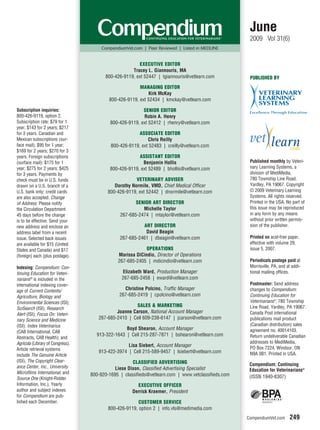
Compendium
                     CompendiumVet.com | Peer Reviewed | Listed in MEDLINE      Vol 31(6) June 2009


                      3 CE Contact Hours     CONTI N U I NG EDUCATION FOR VETERI NARIANS ®


                                                                   FREE
                                                                   CE     Feline
                                                                          Obesity
                                                                          Clinical Recognition
                                                                          and Management


NEW
SERIES


         A
         AAFP Retrovirus
         Guidelines
                                                                                                               al y
                                                                                                             rn lit
                                                                                                                   *


         Surgical Views
                                                                                                           ou a
                                                                                                                 s!
                                                                                                Ve e ium

                                                                                                         yJ u
                                                                                                       ar l Q


         Laparoscopic Cryptorchidectomy
                                                                                             m O nd

                                                                                                    rin l
                                                                                                  te ra
                                                                                                      pe


         Understanding Behavior
                                                                                              al v
                                                                                      m # om


         Addi B h i S i
         Adding Behavior Services
                                                                                           ni n
                                                                                                C
                                                                                         lA i
                                                                                       al 1
                                                                                    rS d
                                                                                  fo te
                                                                                Ra
Everycat
                                                                                            needs calicivirus
                                                                                                protection.
                                                                                                                 Everycat
                                                                                                                        deserves
                                                                                                                        CaliciVax.
                                                                                                                        Bivalent for
                                                                                                                            broader
                                                                                                                        protection.
                                                                                               The AAFP recommends calicivirus vaccine as
                                                                                             a core antigen for all cats.1 Bivalent CaliciVax TM
                                                                                                cross-neutralizes a broader range of strains
                                                                                           than an older, first-generation vaccine.2 Multiple
                                                                                        combinations make it easy to update your protocol
                                                                                       and customize protection for every patient. Contact
                                                                                       your Fort Dodge Animal Health representative today
                                                                                           and ask for the bivalent protection of CaliciVax.

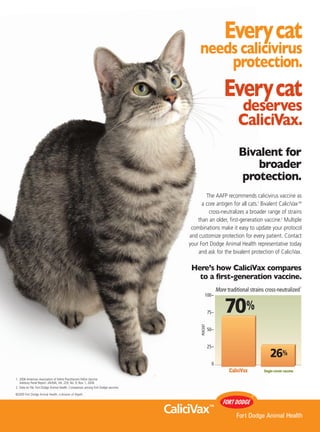
                                                                                        Here’s how CaliciVax compares
                                                                                          to a first-generation vaccine.
                                                                                                                                                             2
                                                                                                             More traditional strains cross-neutralized
                                                                                                  100–


                                                                                                       75–       70%
                                                                                             PERCENT


                                                                                                       50–


                                                                                                       25–
                                                                                                                                         26%
                                                                                                         0
                                                                                                                   CaliciVax         Single-strain vaccine

1. 2006 American Association of Feline Practitioners Feline Vaccine
   Advisory Panel Report. JAVMA, Vol. 229, No. 9, Nov. 1, 2006.
2. Data on file, Fort Dodge Animal Health. Comparison among Fort Dodge vaccines.
©2009 Fort Dodge Animal Health, a division of Wyeth.


                                                                                   CaliciVax            ™
June
                                                                                                      2009 Vol 31(6)
                                       CompendiumVet.com | Peer Reviewed | Listed in MEDLINE


                                                       EXECUTIVE EDITOR
                                                    Tracey L. Giannouris, MA
                                        800-426-9119, ext 52447 | tgiannouris@vetlearn.com            PUBLISHED BY
                                                        MANAGING EDITOR
                                                            Kirk McKay
                                          800-426-9119, ext 52434 | kmckay@vetlearn.com

Subscription inquiries:                                   SENIOR EDITOR
800-426-9119, option 2.                                   Robin A. Henry
Subscription rate: $79 for 1               800-426-9119, ext 52412 | rhenry@vetlearn.com
year; $143 for 2 years; $217
for 3 years. Canadian and                               ASSOCIATE EDITOR
Mexican subscriptions (sur-                                 Chris Reilly
face mail): $95 for 1 year;                800-426-9119, ext 52483 | creilly@vetlearn.com
$169 for 2 years; $270 for 3
years. Foreign subscriptions                            ASSISTANT EDITOR
(surface mail): $175 for 1                                Benjamin Hollis                             Published monthly by Veteri-
year; $275 for 2 years; $425               800-426-9119, ext 52489 | bhollis@vetlearn.com             nary Learning Systems, a
for 3 years. Payments by                                                                              division of MediMedia,
check must be in U.S. funds                            VETERINARY ADVISER                             780 Township Line Road,
drawn on a U.S. branch of a                  Dorothy Normile, VMD, Chief Medical Officer              Yardley, PA 19067. Copyright
U.S. bank only; credit cards              800-426-9119, ext 52442 | dnormile@vetlearn.com             © 2009 Veterinary Learning
are also accepted. Change                                                                             Systems. All rights reserved.
of Address: Please notify                             SENIOR ART DIRECTOR                             Printed in the USA. No part of
the Circulation Department                               Michelle Taylor                              this issue may be reproduced
45 days before the change                      267-685-2474 | mtaylor@vetlearn.com                    in any form by any means
is to be effective. Send your                                                                         without prior written permis-
new address and enclose an                               ART DIRECTOR                                 sion of the publisher.
address label from a recent                               David Beagin
issue. Selected back issues                    267-685-2461 | dbeagin@vetlearn.com                    Printed on acid-free paper,
are available for $15 (United                                                                         effective with volume 29,
States and Canada) and $17                                 OPERATIONS                                 issue 5, 2007.
(foreign) each (plus postage).                Marissa DiCindio, Director of Operations
                                              267-685-2405 | mdicindio@vetlearn.com                   Periodicals postage paid at
Indexing: Compendium: Con-                                                                            Morrisville, PA, and at addi-
tinuing Education for Veteri-                   Elizabeth Ward, Production Manager                    tional mailing offices.
narians® is included in the                     267-685-2458 | eward@vetlearn.com
international indexing cover-                                                                         Postmaster: Send address
age of Current Contents/                         Christine Polcino, Traffic Manager                    changes to Compendium:
Agriculture, Biology and                       267-685-2419 | cpolcino@vetlearn.com                   Continuing Education for
Environmental Sciences (ISI);                                                                         Veterinarians®, 780 Township
                                                      SALES & MARKETING                               Line Road, Yardley, PA 19067.
SciSearch (ISI); Research
                                             Joanne Carson, National Account Manager                  Canada Post international
Alert (ISI); Focus On: Veteri-
nary Science and Medicine            267-685-2410 | Cell 609-238-6147 | jcarson@vetlearn.com          publications mail product
(ISI); Index Veterinarius                                                                             (Canadian distribution) sales
                                                 Boyd Shearon, Account Manager                        agreement no. 40014103.
(CAB International, CAB
                                    913-322-1643 | Cell 215-287-7871 | bshearon@vetlearn.com          Return undeliverable Canadian
Abstracts, CAB Health); and
Agricola (Library of Congress).                                                                       addresses to MediMedia,
                                                  Lisa Siebert, Account Manager                       PO Box 7224, Windsor, ON
Article retrieval systems
                                     913-422-3974 | Cell 215-589-9457 | lsiebert@vetlearn.com         N9A 0B1. Printed in USA.
include The Genuine Article
(ISI), The Copyright Clear-                          CLASSIFIED ADVERTISING
ance Center, Inc., University                                                                         Compendium: Continuing
                                             Liese Dixon, Classified Advertising Specialist           Education for Veterinarians®
Microfilms International, and     800-920-1695 | classifieds@vetlearn.com | www.vetclassifieds.com
Source One (Knight-Ridder                                                                             (ISSN 1940-8307)
Information, Inc.). Yearly                             EXECUTIVE OFFICER
author and subject indexes                           Derrick Kraemer, President
for Compendium are pub-
lished each December.                                   CUSTOMER SERVICE
                                          800-426-9119, option 2 | info.vls@medimedia.com
                                                                                                     CompendiumVet.com      249
June
2009 Vol 31(6)
                                          CompendiumVet.com | Peer Reviewed | Listed in MEDLINE


                                                            EDITORIAL BOARD
                                  Anesthesia                              Internal Medicine
                                  Nora S. Matthews, DVM, DACVA            Dana G. Allen, DVM, MSc, DACVIM           AMERICAN
                                  Texas A&M University                    Ontario Veterinary College                BOARD OF
                                  Cardiology                              Internal Medicine and Emergency/          VETERINARY
                                  Bruce Keene, DVM, MSc, DACVIM           Critical Care                             PRACTITIONERS
                                  North Carolina State University         Alison R. Gaynor, DVM, DACVIM
                                                                          (Internal Medicine), DACVECC
                                                                                                                    (ABVP) REVIEW
                                  Clinical Chemistry, Hematology,
                                                                          North Grafton, Massachusetts              BOARD
                                  and Urinalysis
                                  Betsy Welles, DVM, PhD, DACVP           Nephrology                                Kurt Blaicher, DVM, DABVP
                                  Auburn University                       Catherine E. Langston, DVM, ACVIM         (Canine/Feline)
                                  Dentistry                               Animal Medical Center
                                                                                                                    Plainfield Animal Hospital
                                  Gary B. Beard, DVM, DAVDC               New York, New York
                                                                                                                    Plainfield, New Jersey
                                  Auburn University                       Neurology                                 Canine and Feline Medicine
EDITOR IN CHIEF                   R. Michael Peak, DVM, DAVDC             Curtis W. Dewey, DVM, MS, DACVIM
                                  The Pet Dentist—Tampa Bay Veterinary    (Neurology), DACVS                        Eric Chafetz, DVM, DABVP
Douglass K. Macintire,                                                    Cornell University Hospital for Animals
                                    Dentistry                                                                       (Canine/Feline)
DVM, MS, DACVIM, DACVECC
                                  Largo, Florida                                                                    Vienna Animal Hospital
                                                                          Oncology
Department of Clinical Sciences   Emergency/Critical Care and             Ann E. Hohenhaus, DVM, DACVIM             Vienna, Virginia
College of Veterinary Medicine    Respiratory Medicine                    (Oncology and Internal Medicine)          Canine and Feline Medicine
Auburn University, AL 36849       Lesley King, MVB, MRCVS, DACVECC,       Animal Medical Center
                                  DACVIM                                  New York, New York                        Henry E. Childers, DVM,
                                  University of Pennsylvania                                                        DABVP (Canine/Feline)
                                                                          Gregory K. Ogilvie, DVM, DACVIM
                                  Endocrinology and Metabolic Disorders   (Internal Medicine, Oncology),            Cranston Animal Hospital
                                  Marie E. Kerl, DVM, ACVIM, ACVECC       DECVIM-CA (Oncology)                      Cranston, Rhode Island
                                  University of Missouri-Columbia         CVS Angel Care Cancer Center              Canine and Feline Medicine
EXECUTIVE                         Epidemiology
                                                                            and Special Care Foundation
                                                                            for Companion Animals
ADVISORY                          Philip H. Kass, DVM, MPVM, MS, PhD,     Carlsbad, California
                                                                                                                    David E. Harling, DVM,
BOARD                             DACVPM                                                                            DABVP (Canine/Feline),
                                  University of California, Davis         Ophthalmology                             DACVO
MEMBERS                                                                   David A. Wilkie, DVM, MS, DACVO           Reidsville Veterinary Hospital
                                  Exotics
                                  Avian
                                                                          The Ohio State University                 Reidsville, North Carolina
Behavior                                                                                                            Canine and Feline Medicine,
                                  Thomas N. Tully, Jr, DVM, MS, DABVP     Parasitology
Sharon L. Crowell-Davis,          (Avian), ECAMS                                                                     Ophthalmology
                                                                          Byron L. Blagburn, MS, PhD
DVM, PhD, DACVB                   Louisiana State University              Auburn University
The University of Georgia                                                                                           Jeffrey Katuna, DVM, DABVP
                                  Reptiles                                David S. Lindsay, PhD
                                  Douglas R. Mader, MS, DVM, DABVP (DC)
                                                                                                                    Wellesley-Natick Veterinary
                                                                          Virginia Polytechnic Institute              Hospital
Dermatology                       Marathon Veterinary Hospital              and State University
Craig E. Griffin, DVM,             Marathon, Florida                                                                 Natick, Massachusetts
DACVD                                                                     Pharmacology                              Canine and Feline Medicine
                                  Small Mammals
Animal Dermatology Clinic                                                 Katrina L. Mealey, DVM, PhD, DACVIM,
                                  Karen Rosenthal, DVM, MS, DABVP
                                                                          DACVCP                                    Robert J. Neunzig, DVM,
San Diego, California             (Avian)
                                                                          Washington State University
                                  University of Pennsylvania                                                        DABVP (Canine/Feline)
                                                                          Rehabilitation and Physical Therapy       The Pet Hospital
Wayne S. Rosenkrantz,             Feline Medicine                                                                   Bessemer City, North Carolina
                                                                          Darryl Millis, MS, DVM, DACVS
DVM, DACVD                        Michael R. Lappin, DVM, PhD,
                                                                          University of Tennessee                   Canine and Feline Medicine
Animal Dermatology Clinic         DACVIM (Internal Medicine)
                                  Colorado State University
Tustin, California                                                        Surgery
                                                                                                                    Compendium is a
                                  Margie Scherk, DVM, DABVP               Philipp Mayhew, BVM&S, MRCVS,
                                  (Feline Medicine)                       DACVS                                     refereed journal. Articles
Nutrition
                                  Cats Only Veterinary Clinic             Columbia River Veterinary Specialists     published herein have
Kathryn E. Michel, DVM,           Vancouver, British Columbia             Vancouver, Washington
MS, DACVN                                                                                                           been reviewed by at least
University of Pennsylvania        Gastroenterology                        C. Thomas Nelson, DVM                     two academic experts on
                                  Debra L. Zoran, DVM, MS, PhD,           Animal Medical Center
                                                                                                                    the respective topic and
                                  DACVIM (Internal Medicine)              Anniston, Alabama
Surgery                           Texas A&M University                                                              by an ABVP practitioner.
Elizabeth M. Hardie,                                                      Toxicology
                                  Infectious Disease                      Tina Wismer, DVM, DABVT, DABT             Any statements, claims, or product
DVM, PhD, DACVS                   Derek P. Burney, PhD, DVM               ASPCA National Animal Poison Control      endorsements made in Compendium
North Carolina State              Gulf Coast Veterinary Specialists         Center                                  are solely the opinions of our authors
                                                                                                                    and advertisers and do not necessarily
University                        Houston, Texas                          Urbana, Illinois
                                                                                                                    reflect the views of the Publisher or
                                                                                                                    Editorial Board.

    250     CompendiumVet.com
Coming Events                                                          Canadian News
July 16
Ontario Veterinary Medical Association:
Career Planning for Associate
Veterinarians & Potential Practice Owners
                                                 Canadian Government Invests in
Ontario Veterinary Medical Association
Milton, Ontario
This course will present the benefits and
                                                 Western College of Veterinary Medicine
downsides of owning a practice as well as
                                                 T
                                                    he government of Canada is invest-              The construction of a two-story addi-
the practical aspects of practice ownership.        ing $2.7 million in the infrastructure      tion and basement will add 3000 m2 of
Web www.ovma.info/Meetings/
                                                 of the University of Saskatchewan’s            additional space to the diagnostics facil-
August 8–13                                      Western College of Veterinary Medicine         ity. Once completed, the centre will
World Association for the Advancement            (WCVM). The funding, coming from the           be a major western Canadian hub for
of Veterinary Parasitology: 22nd                 Canadian Western Economic Diversifica-          veterinary diagnostics services, ani-
International Conference
Calgary, Alberta                                 tion program, will be used on upgrades         mal health research, and specialized
This conference will discuss current issues      to the large animal clinic and the diag-       training in diagnostic pathology, virol-
in parasitology.                                 nostics laboratory at the college.             ogy, bacteriology, immunology, and
Web waavp.org                                       The upgraded facilities will make           a range of biomedical sciences.
September 9                                      the college, province, and country                 “The expansion of the college’s
Calgary Academy of Veterinary                    more competitive, according to Minister        diagnostics area and the renovation of
Medicine: Ophthalmology                          of State Lynne Yelich. “Investments            our large animal clinical services will
Clara Christie Theatre, Health Sciences          such as these will lead to new diag-           provide our staff and students with
University of Calgary, Alberta
This seminar will offer 1.5 hours of scientific   nostic tests that will protect Canada’s        specialized, biosecure facilities where
CE and will be presented by Dr. Cheryl Cullen.   livestock industry and the health and          they’ll have access to a full range of
Phone 403-863-7160                               safety of Canadians, their families, and       new technologies,” says WCVM Dean
E-mail info@cavm.ab.ca                           communities.”                                  Dr. Charles Rhodes.
Web cavm.ab.ca/ce_calendar.html

September 15
Toronto Academy of Veterinary Medicine:          Animal Health Network Announced
Update on Clinical Gastroenterology

                                                 T
Dave and Buster’s                                   he Canadian Food Inspection Agency          our ability to understand and respond
Toronto, Ontario                                    and the Atlantic Veterinary College         to animal health and zoonotic disease
This seminar will provide an update on           (AVC) at the University of Prince              challenges in a world of ever-changing
gastrointestinal disorders of cats and           Edward Island have joined together             risks,” said Dr. Brian Evans, chief vet-
dogs, with an emphasis on diagnosis and
treatment. It will offer 5.5 CE credits.         in a $1.2-million partnership to create        erinary officer of Canada.
Phone 800-670-1702                               the Canadian Regulatory Veterinary
Web tavm.org                                     Epidemiology Network. This network
                                                 will link the five Canadian veterinary              SPREAD YOUR GOOD NEWS
October 13                                                                                        Have any interesting news to
Toronto Academy of Veterinary                    colleges and enhance animal health
                                                 expertise by contributing to research            share? Send it in! We would like
Medicine: Early Resuscitation and
Stabilization of the Emergency Patient           and training programs. In addition to            to provide more recognition of
Dave and Buster’s                                                                                 veterinarians doing great things in
                                                 strengthening Canada’s animal disease
Toronto, Ontario                                                                                  their professional or personal lives.
This seminar will focus on practical             prevention and control efforts, the pro-
                                                                                                  If you have news about yourself or
emergency management using case                  gram will also help meet national and            a colleague or about some other
examples. It will offer 5.5 CE credits.          international demands for animal and             newsworthy topic that would be of
Phone 800-670-1702                               veterinary health experts.                       interest to others in the profession,
Web tavm.org
                                                    The initial phase of the project will         send it (along with a picture if you
October 18                                       establish a research chair in regulatory         have one) to:
Calgary Academy of Veterinary                    veterinary epidemiology at the AVC as
Medicine: Hematology                                                                              Canadian News
                                                 well as related graduate positions. The          c/o Veterinary Learning Systems
Clara Christie Theatre, Health Sciences
                                                 network will be led by the Centre for            780 Township Line Road
University of Calgary, Alberta
This seminar will offer 6 hours of scientific     Veterinary Epidemiological Research at           Yardley, PA 19067 USA
                                                                                                                   ,
CE and be presented by Dr. Marjorie Brooks.      the AVC, which is considered one of
                                                                                                  E-MAIL editor@CompendiumVet.com
Phone 403-863-7160                               the leading centres for animal health
E-mail info@cavm.ab.ca                                                                            FAX 800-556-3288
                                                 epidemiologic research in the world.             WEB CompendiumVet.com
Web cavm.ab.ca/ce_calendar.html
                                                    “This network will further strengthen

                                                  CompendiumVet.com | June 2009 | Compendium: Continuing Education for Veterinarians®   251
E
                                                                                  Each CE article is accredited for 3 contact hours by
                   June 2009 Vol 31(6)
                                                                           CE     A
                                                                                  Auburn University College of Veterinary Medicine.


 CompendiumVet.com | Peer Reviewed | Listed in MEDLINE                    Features
                                                                          258 Understanding
284     Feline Obesity: Clinical                    FREE
                                                                              Behavior
                                 t
        Recognition and Management                  CE
                                                                                 Incorporating Behavioral
        ❯❯ Debra L. Zoran
                                                                                 Medicine Into General
        Obesity is a common problem in cats that
        is compounded by most cats’ sedentary                                    Practice
        lifestyles and many owners’ feeding tech-                                ❯❯ Lisa Radosta
        niques. Recognition of the risk factors for                              Learn how—and why—to
        obesity and early education of owners to                                 include basic behavioral
        prevent excessive weight gain are crucial to                             medicine into your day-
        feline health. Further information on feline                             to-day practice.
        obesity is available on CompendiumVet.com.

                                                                          264 Feline Focus                    NEW
                                                                                                              SERIES
                                                                                 2008 Feline Retrovirus
                                                                                                      s
                                                                                 Management Guidelines
                                                                                 In the debut of this quarterly
                                                                                 series devoted to feline
                                                                                 medicine, the American
                                                                                 Association of Feline
                                                                                 Practitioners shares an
                                                                                 abridged version of its
                                                                                 most recent guidelines.


                                                                          274 Surgical Views
                                                                                 Laparoscopic and Laparoscopic-Assisted
                                                                                 Cryptorchidectomy in Dogs and Cats
                                                                                 ❯❯ Philipp Mayhew
                                                                                 Surgical removal is the standard of care for
                                                                                 cryptorchid testicles. Laparoscopy can help
                                                                                 reduce incision sizes and postoperative pain in
                                                                                 these patients. Watch videos of some aspects of
                                                                                 these procedures on CompendiumVet.com.


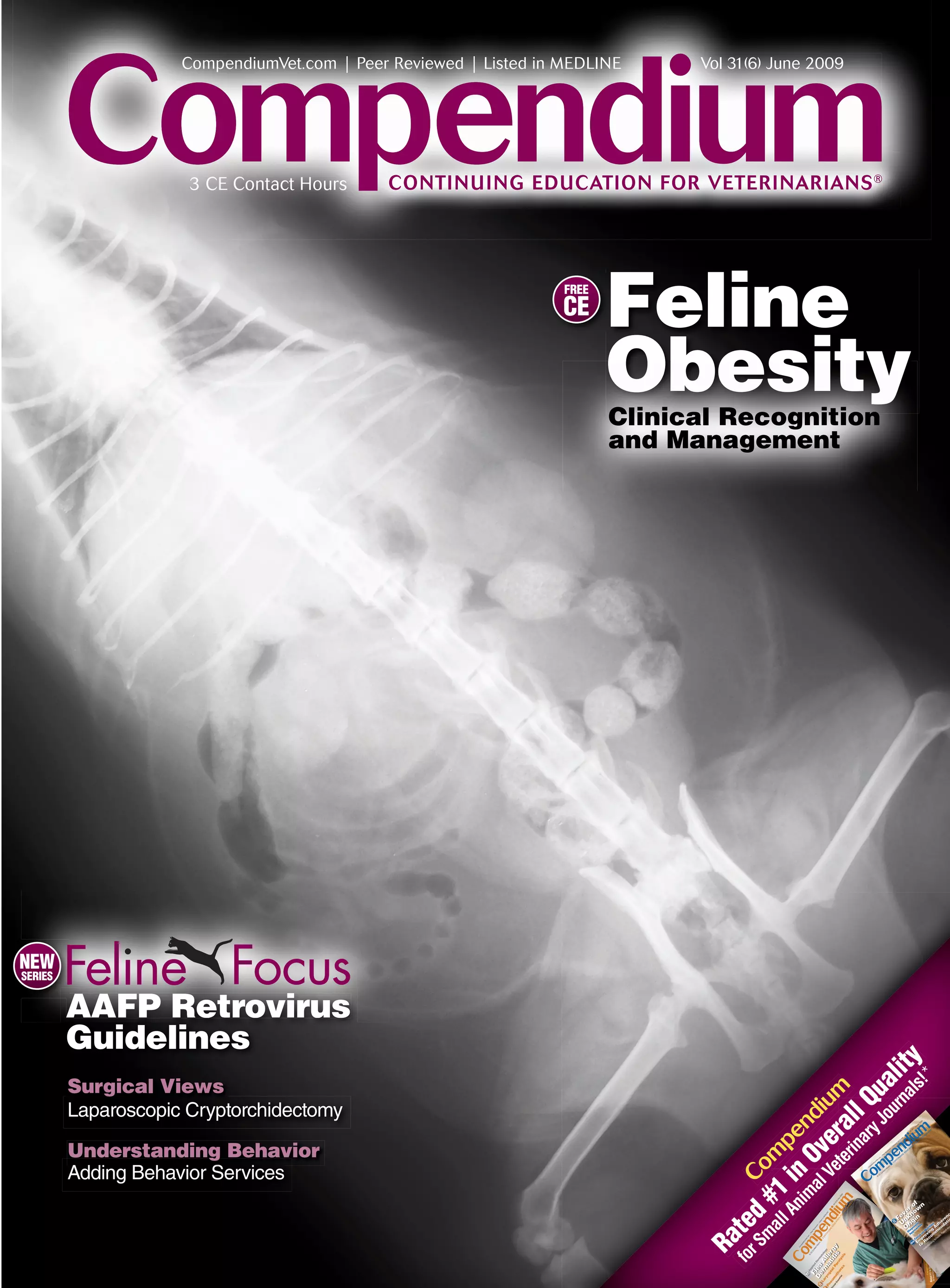
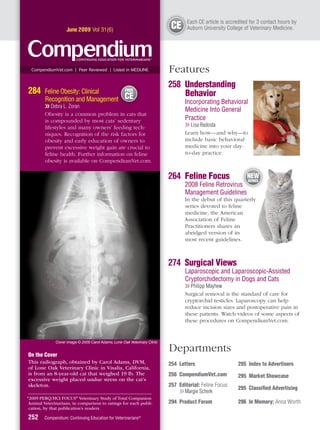
             Cover image © 2009 Carol Adams, Lone Oak Veterinary Clinic


On the Cover
                                                                          Departments
This radiograph, obtained by Carol Adams, DVM,                            254 Letters                     295 Index to Advertisers
of Lone Oak Veterinary Clinic in Visalia, California,
is from an 8-year-old cat that weighed 19 lb. The                         256 CompendiumVet.com           295 Market Showcase
excessive weight placed undue stress on the cat’s
skeleton.                                                                 257 Editorial: Feline Focus
                                                                                                          295 Classified Advertising
                                                                              ❯❯ Margie Scherk
*2009 PERQ/HCI FOCUS® Veterinary Study of Total Companion
Animal Veterinarians, in comparison to ratings for each publi-            294 Product Forum               296 In Memory: Anna Worth
cation, by that publication’s readers.

252     Compendium: Continuing Education for Veterinarians®
Gentle
           on his ears


The Latest Generation in Otitis Externa Treatment.
Mometasone furoate
                                                                                                                      1


Clotrimazole
                                               Malassezia pachydermatis

Gentamicin
                                                                                                       2


                                                                         Once-a-day for ease of compliance

               ®
Mometamax                                                                                                                                    Malassezia pachydermatis)
                   Pseudomonas                         P. aeruginosa                                                Enterococcus faecalis, Proteus mirabilis


                                                                                                                              See Page 254 for Product Information Summary

                                                                       1. Reeder CJ, Griffin CE, Polissar NL, et al. Comparative adrenocortical suppression in dogs with otitis externa following
                                                                          topical otic administration of four different glucocorticoid-containing medications. Vet Therap. 2008;9:111-121.
                                                                       2. Rubin J, Walker RD, Blickenstaff K, Bodies-Jones S, Zhao S., Antimicrobial resistance and genetic characterization
                                                                          of fluoroquinolone resistance of Pseudomonas aeruginosa isolated from canine infections., Vet microbiol.
Mometamax is a registered trademark of Intervet Inc. or an affiliate.      2008 Mar 4; [Epub ahead of print]
© 2009 Intervet Inc. All rights reserved.                                                                                                                                                SPAH-MO-96
Letters
Feline Hyperesthesia Syndrome                                                       Understanding
                                                                                    Behavior                                 Feline Hyperesthesia
                                                                                                                             Syndrome*
I read with interest the March 2009 Understanding                                   About This Column
                                                                                    Behavior problems are a signifi-
                                                                                                                             ❯❯ John Ciribassi, DVM, DACVB
                                                                                                                               Chicagoland Veterinary Behavior Consultants
                                                                                                                               Carol Stream, Illinois
                                                                                    cant cause of death (euthanasia)


Behavior article on feline hyperesthesia syndrome
                                                                                    in companion animals. While most
                                                                                    veterinary practices are necessarily
                                                                                    geared toward the medical aspect
                                                                                                                             F    eline hyperesthesia syndrome (FHS) is known by several names, including
                                                                                                                                  rolling skin disease, neurodermatitis, neuritis, psychomotor epilepsy, and pru-
                                                                                                                             ritic dermatitis of Siamese.1,2 As evidenced by these names and by the use of
                                                                                    of care, there are many opportuni-       the term syndrome, FHS is not characterized as having a single etiology. In fact,
                                                                                    ties to bring behavior awareness         it is often a diagnosis of exclusion. The differential diagnosis for FHS includes
                                                                                    into the clinic for the benefit of        diseases related to the fields of dermatology, neurology, and behavior. Only after


(FHS), a poorly understood clinical entity. To me, it is                            the pet, the owner, and ourselves.
                                                                                    This column acknowledges the
                                                                                    importance of behavior as part of
                                                                                    veterinary medicine and speaks
                                                                                                                             conditions relating to skin and the nervous system have been ruled out can this
                                                                                                                             condition be labeled a behavior disorder.

                                                                                                                             Signalment
                                                                                                                             FHS can occur in cats of any age, but it is commonly seen in cats aged 1 to 5
                                                                                    practically about using it effectively
                                                                                                                             years. Males and females are equally affected. While all breeds can be affected,


plausible that some cats with clinical signs compatible                             in daily practice.                       Siamese, Burmese, Persian, and Abyssinian cats are more commonly afflicted.3

                                                                                                                             Clinical Signs
                                                                                                                             As indicated by the name rolling skin disease, affected
                                                                                                                             cats often show rippling or rolling skin along the lum-
                                                                                                                             bar spine. Palpation of the lumbar musculature may


with FHS may truly experience bouts of breakthrough                                 QuickNotes
                                                                                                                             elicit signs of pain. Mydriasis is common during bouts
                                                                                                                             of FHS. Affected cats commonly
                                                                                                                             stare at their tail, then attack
                                                                                                                             the tail and/or flanks. Biting
                                                                                                                             of the tail base, forelegs, and
                                                                                    FHS can occur in cats                    paws is common. These cats


neuropathic pain leading to allodynia (sensation of                                 of any age, but it is
                                                                                    commonly seen in
                                                                                    cats aged 1 to 5 years.
                                                                                                                             often run wildly around the
                                                                                                                             home, vocalizing at the same
                                                                                                                             time. Normally calm cats
                                                                                                                             may display aggression
                                                                                                                             toward people or other
                                                                                                                             cats in the household,


pain resulting from non-noxious stimuli, such as a                                                                           while aggressive cats
                                                                                                                             may display increased
                                                                                                                             affection. The behavior
                                                                                                                             may be induced by pet-
                                                                                                                             ting or stroking the cat’s
                                                                                                                             fur and most commonly


light touch), regardless of whether higher brain func-                                                                       occurs in the morning


                                                                                                                                                                                                                    ©2009 Kelpfish/Shutterstock.com
                                                                                                                             or later in the evening.2

                                                                                                                             Diagnosis
                                                                                                                             The differential diagnosis for FHS
                                                                                    *Adapted with permission from John
                                                                                                                             can be categorized by the type of


tions are involved (e.g., displacement behavior).
                                                                                    Ciribassi, DVM, and the Veterinary
                                                                                    Information Network (VIN).               clinical signs displayed:

                                                                                    116     CompendiumVet.com | March 2009


If this is the case, it could partly explain                to neuropathic pain. As indicated in my
why some cats appear to improve with                        article, some believe that myopathic
certain centrally acting therapies, such as                 disorders can result in the clinical signs
the anticonvulsant gabapentin. This drug                    seen with FHS. An underlying neuropa-
binds to a subunit of the voltage-gated                     thy may certainly account for these signs.
calcium channels in the dorsal horn and is                  Gabapentin, while often used in treating
commonly used for conditions associated                     seizure disorders, is also well known for
with neuropathic pain or with chronic                       its use in human and veterinary medi-
pain when central sensitization is sus-                     cine for treating neuropathic pain.1,2 As
pected, even though clinical studies are                    a result, it can be difficult to distinguish,
lacking in veterinary medicine.1 As such,                   in patients responding to treatment with
a clinical response to gabapentin should                    gabapentin for FHS, whether the response
not necessarily lead the practitioner to                    is managing a seizure disorder centrally or
conclude that the patient was experienc-                    is exerting peripheral neuropathic effects.
ing seizures, as is suggested in this article               The advantage of initially using pheno-
(p.118), but may instead be the result of a                 barbital in managing cases in which sei-
true neuropathic pain syndrome respond-                     zures are suspected as the etiology is that
ing to an adjuvant analgesic drug. The                      phenobarbital would not be expected to
same reasoning could apply to other                         act peripherally. As a result, improvement
drugs, such as tricyclic antidepressants                    with phenobarbital would provide a pre-
and selective serotonin reuptake inhibitors,                sumptive diagnosis of seizure. If pheno-
often considered as first-line therapies in                  barbital proves to be ineffective, turning
people with neuropathic pain.2                              to gabapentin can help distinguish seizure
            Louis-Philippe de Lorimier, DVM,                from neuropathy. This being said, diagno-
                          DACVIM (Oncology)                 sis by drug trial does not truly provide a
                Hôpital Vétérinaire Rive-Sud                secure diagnosis. Instead, it merely gives
                            Brossard, Québec                circumstantial evidence of an etiology
                                       Canada               based on the assumption of a known and
                                                            specific mode of action of the drug that is
References                                                  providing relief of the signs.
1. Backonja M, Glanzman RL. Gabapentin dosing for
neuropathic pain: evidence from randomized, placebo-                                  Dr. John Ciribassi
controlled clinical trials. Clin Ther 2003;25:81-104.                 Chicagoland Veterinary Behavior
2. Verdu B, Decosterd I, Buclin T, et al. Antidepressants
for the treatment of chronic pain. Drugs 2008;68:2611-
                                                                                             Consultants
2632.                                                                              Carol Stream, Illinois

                                                            References
                                                            1. Kumar B, Kalita J, Kumar G, Misra UK. Central post-
The Author’s Reply                                          stroke pain: a review of pathophysiology and treatment.
Thank you for your comments regard-                         Anesth Analg 2009;108(5):1645-1657.
                                                            2. Clivatti J, Sakata RK, Issy AM. Review of the use of
ing my article on FHS. It is plausible that                 gabapentin in the control of postoperative pain. Rev Bras
at least some cases of FHS are related                      Anestesiol 2009;59(1):92-8, 87-92.


254       Compendium: Continuing Education for Veterinarians® | June 2009 | CompendiumVet.com
What do dogs who takee
VETORYL (trilostane)
                                     ®


have in common?
                                                                                          Prior to VETO
                                                                                                        RYL
Results like these.                                                                           treatment


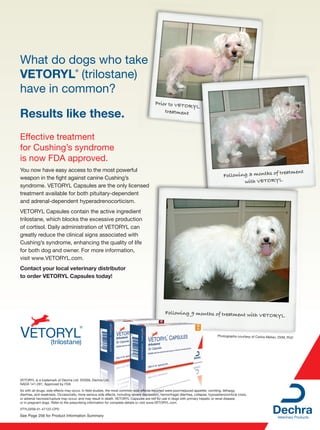
Effective treatment
for Cushing’s syndrome
is now FDA approved.
You now have easy access to the most powerful                                                                                                                 treatment
weapon in the fight against canine Cushing’s                                                                                             Following 3 months of
                                                                                                                                                with VETORYL
syndrome. VETORYL Capsules are the only licensed
treatment available for both pituitary-dependent
and adrenal-dependent hyperadrenocorticism.
VETORYL Capsules contain the active ingredient
trilostane, which blocks the excessive production
of cortisol. Daily administration of VETORYL can
greatly reduce the clinical signs associated with
Cushing’s syndrome, enhancing the quality of life
for both dog and owner. For more information,
visit www.VETORYL.com.
Contact your local veterinary distributor
to order VETORYL Capsules today!


                                                                                                 Following 9 months of treatment with VETO
                                                                                                                                           RYL


                                                                                                                                    Photographs courtesy of Carlos Melian, DVM, PhD

                    (trilostane)


VETORYL is a trademark of Dechra Ltd. ©2009, Dechra Ltd.
NADA 141-291, Approved by FDA
As with all drugs, side effects may occur. In field studies, the most common side effects reported were poor/reduced appetite, vomiting, lethargy,
diarrhea, and weakness. Occasionally, more serious side effects, including severe depression, hemorrhagic diarrhea, collapse, hypoadrenocortical crisis,
or adrenal necrosis/rupture may occur, and may result in death. VETORYL Capsules are not for use in dogs with primary hepatic or renal disease,
or in pregnant dogs. Refer to the prescribing information for complete details or visit www.VETORYL.com.
VTYL0209-01-47122-CPD

See Page 256 for Product Information Summary
WEB EXCLUSIVES                     June 2009        Vol 31(6)
VETORYL Capsules (trilostane)
                ®


30 mg and 60 mg strengths
Adrenocortical suppressant for oral use in dogs only
                                                                                                                                    on
BRIEF SUMMARY (For Full Prescribing Information,
see package insert.)

CAUTION: Federal (USA) law restricts this drug
to use by or on the order of a licensed veterinarian.
                                                         CE ARTICLES
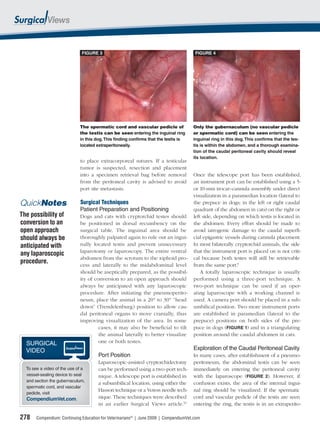
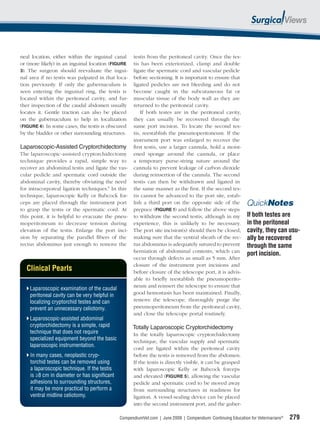
                                                                                                             normal testicle
DESCRIPTION: VETORYL is an orally active
synthetic steroid analogue that blocks production       ❯❯ Renal Secondary                                   is located on
of hormones produced in the adrenal cortex of dogs.
                                                           Hyperparathyroidism                               the right or the
INDICATIONS: VETORYL Capsules are
                                                           ❯❯ Jenefer R. Stillion and Michelle G. Ritt       left side (in this
indicated or the treatment of pituitary-dependent
                                                                                                             case the normal
hyperadrenocorticism in dogs. VETORYL
                                                           The parathyroid glands secrete parathyroid
Capsules are indicated for the treatment                                                                     testicle is the
of hyperadrenocorticism due to adrenocortical              hormone (PTH), which is important for main-
tumor in dogs.                                                                                               right testicle).
                                                           taining calcium homeostasis. Parathyroid
                                                                                                             The cryptorchid
CONTRAINDICATIONS: The use of VETORYL
                                                           gland hyperplasia and subsequent hyper-                               ❯❯ Cryptorchidectomy Video 1
Capsules is contraindicated in dogs that have                                                                testicle should
demonstrated hypersensitivity to trilostane.               parathyroidism can occur secondary to
Do not use VETORYL Capsules in animals with                                                                  be located on the contralateral side.
primary hepatic disease or renal insufficiency.            chronic renal failure in dogs, resulting in
Do not use in pregnant dogs. Studies conducted
with trilostane in laboratory animals have shown
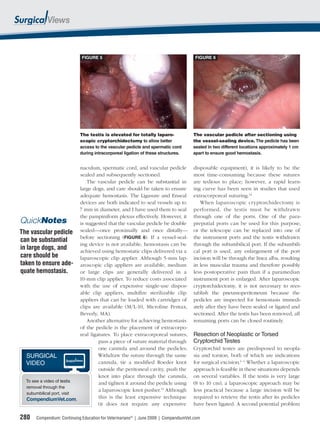
                                                           significant alterations in calcium metabolism.     VIDEO 2
teratogenic effects and early pregnancy loss.              Renal secondary hyperparathyroidism is            demonstrates
WARNINGS: In case of overdosage,                           a complex, multifactorial syndrome that           use of the
symptomatic treatment of hypoadrenocorticism with
corticosteroids, mineralocorticoids and intravenous
                                                           involves changes in circulating levels of         vessel-sealing
fluids may be required. Angiotensin-converting             calcium, PTH, phosphorus, and 1,25-dihy-          device to seal
enzyme (ACE) inhibitors should be used with caution
with VETORYL Capsules, as both drugs have                  droxycholecalciferol (calcitriol).                and section the
aldosterone-lowering effects which may be additive,
impairing the patient’s ability to maintain normal
                                                                                                             gubernaculum,
electrolytes, blood volume and renal perfusion.                                                              spermatic cord,
Potassium-sparing diuretics (e.g., spironolactone)       WEB-EXCLUSIVE VIDEOS                                                   ❯❯ Cryptorchidectomy Video 2
should not be used with VETORYL Capsules as                                                                  and, finally, the
both drugs have the potential to inhibit aldosterone,
                                                                                                             vascular pedicle
increasing the likelihood of hyperkalemia.              ❯❯ Laparoscopic and Laparoscopic-
                                                                                                             of an abdominally cryptorchid testicle.
HUMAN WARNINGS: Keep out of reach of children.             Assisted Cryptorchidectomy Videos
Not for human use. Wash hands after use. Do not
empty capsule contents and do not attempt to divide        The June 2009 Surgical Views column,              If a totally
the capsules. Do not handle the capsules if pregnant
or if trying to conceive. Trilostane is associated        “Laparoscopic and Laporoscopic-Assisted            laparoscopic
with teratogenic effects and early pregnancy loss          Cryptorchidectomy in Dogs and Cats,”              cryptorchidec-
in laboratory animals. In the event of accidental
ingestion/overdose, seek medical advice immediately        by Dr. Philipp Mayhew, discusses the              tomy is per-
and take the labeled container with you.
                                                           advantages and disadvantages of these             formed (VIDEO
PRECAUTIONS: Hypoadrenocorticism can                       techniques. Three videos, contributed             3), the testicle
develop at any dose of VETORYL Capsules.
A small percentage of dogs may develop                     by Dr. Mayhew, demonstrate some of the            can be removed
corticosteroid withdrawal syndrome within 10 days
of starting treatment. Mitotane (o,p’-DDD) treatment       techniques discussed in this column.              through the          ❯❯ Cryptorchidectomy Video 3
will reduce adrenal function. Experience in foreign                                                          subumbilical
markets suggests that when mitotane therapy is
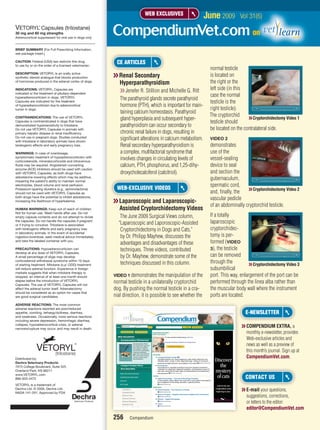
stopped, an interval of at least one month should       VIDEO 1 demonstrates the manipulation of the         port. This way, enlargement of the port can be
elapse before the introduction of VETORYL
Capsules. The use of VETORYL Capsules will not
                                                        normal testicle in a unilaterally cryptorchid        performed through the linea alba rather than
affect the adrenal tumor itself. Adrenalectomy          dog. By pushing the normal testicle in a cra-        the muscular body wall where the instrument
should be considered as an option for cases that
are good surgical candidates.                           nial direction, it is possible to see whether the    ports are located.
ADVERSE REACTIONS: The most common
adverse reactions reported are poor/reduced
appetite, vomiting, lethargy/dullness, diarrhea,                                                                                E-NEWSLETTER
and weakness. Occasionally, more serious reactions
including severe depression, hemorrhagic diarrhea,
collapse, hypoadrenocortical crisis, or adrenal
necrosis/rupture may occur, and may result in death.
                                                                                                                              ❯❯ COMPENDIUM EXTRA, a
                                                                                                                                 monthly e-newsletter, provides
                                                                                                                                 Web-exclusive articles and
                                                                                                                                 news as well as a preview of
                                                                                                                                 this month’s journal. Sign up at
                            (trilostane)
Distributed by:                                                                                                                  CompendiumVet.com.
Dechra Veterinary Products
7015 College Boulevard, Suite 525
Overland Park, KS 66211
www.VETORYL.com
866-933-2472                                                                                                                    CONTACT US
VETORYL is a trademark of
Dechra Ltd. © 2009, Dechra Ltd.
NADA 141-291, Approved by FDA
                                                                                                                              ❯❯ E-mail your questions,
                                                                                                                                 suggestions, corrections,
                                                                                                                                 or letters to the editor:
                                                                                                                                 editor@CompendiumVet.com
                                                        256     Compendium
Editorial
                                                                                                                                                                                                                                                                    AMERICAN
                                                                                                                                                                                                                                                                ASSOCIATION OF FELINE

                                                                                                                                                                                                                              Contributed by:                  PRACTITIONERS


                                                                                                                                                                                                                                                       About AAFP
                                                                                                                                                                                                                                                       The American Association of


  2008 Feline                                                     F
                                                                         eLV and FIV are among the most common infectious
                                                                         diseases of cats. Risk factors for infection include male
                                                                         gender, adulthood, and outdoor access, whereas indoor
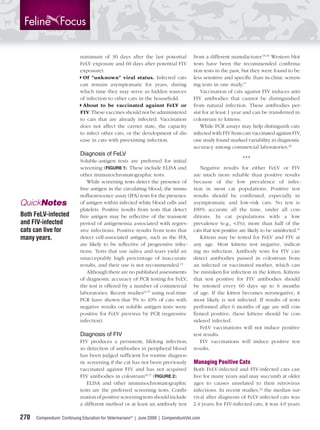
                                                                                                                                          In a study of more than 18,000 cats tested
                                                                                                                                       in 2004, 2.3% were positive for FeLV and 2.5%
                                                                                                                                       were positive for FIV.1 Infection rates for FeLV
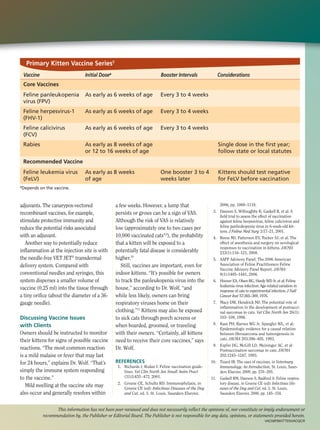
                                                                                                                                                                                            FeLV Vaccination
                                                                                                                                                                                            The decision to vaccinate an individual cat
                                                                                                                                                                                            against FeLV should be based on the cat’s risk
                                                                                                                                                                                                                                                       Feline Practitioners improves
                                                                                                                                                                                                                                                       the health and well-being of
                                                                                                                                                                                                                                                       cats by supporting high stan-
                                                                                                                                                                                                                                                       dards of practice, continuing

  Retrovirus                                                      lifestyle and sterilization are associated with reduced infec-
                                                                  tion rates.1–5
                                                                      The retroviral status of all cats should be known. Cats
                                                                                                                                       and FIV (TABLE 1) varied among subpopula-
                                                                                                                                       tions and sources of cats.
                                                                                                                                                                                            of exposure. Cats that live in a FeLV-negative,
                                                                                                                                                                                            indoor environment are at minimal risk.
                                                                                                                                                                                               FeLV vaccination is recommended for:
                                                                                                                                                                                                                                                       education, and scientific inves-
                                                                                                                                                                                                                                                       tigation. Feline Practitioners
                                                                                                                                                                                                                                                       are veterinary professionals


  Management
                                                                                                                                                                                                                                                       who belong to this association
                                                                  may require retrovirus testing at different times in their lives.    Preventing FeLV and FIV Infection
                                                                                                                                                                                                                                                       because they are “passionate
                                                                  Here are some general principles for retrovirus testing:             Vaccines are available for both retroviruses.         All kittens because the lifestyles of kittens fre-        about the care of cats”!
                                                                                                                                       Both FeLV and FIV vaccines are non-core. Risk        quently change after acquisition and they may              American Association of Feline


  Guidelines*                                                      A cat with a confi rmed-positive test result should be
                                                                  diagnosed as having a retroviral infection—not clinical dis-
                                                                  ease. Diseases in cats infected with FeLV or FIV may not
                                                                                                                                       assessment of the individual animal should
                                                                                                                                       dictate their use. No vaccine is 100% effec-
                                                                                                                                       tive, and repeat testing should be performed
                                                                                                                                                                                            subsequently be at risk for FeLV exposure
                                                                                                                                                                                             Cats that go outdoors
                                                                                                                                                                                              Cats that have direct contact with cats of
                                                                                                                                                                                                                                                           Practitioners
                                                                                                                                                                                                                                                       203 Towne Centre Drive
                                                                                                                                                                                                                                                       Hillsborough, NJ 08844-4693
                                                                                                                                                                                                                                                       phone: 800-874-0498
                                                                  necessarily be the result of the retrovirus infection.               as warranted.                                        unknown status or in high-turnover situations              phone: 908-359-9351

  Members of the                                                   Cats infected with FeLV or FIV may live for many years.
                                                                                                                                                                                                                                                       fax: 908-292-1188
                                                                                                                                                                                                                                                       e-mail: info@catvets.com
  Advisory Panel                                                  A decision for euthanasia should never be made solely on the
                                                                  basis of whether the cat is infected.
                                                                                                                                       TABLE 1
                                                                                                                                                                                                                                                       Media contact: Valerie Creighton,
                                                                                                                                                                                                                                                         DVM, ABVP
  ❯❯ Julie Levy, DVM, PhD, DACVIM, Chair                           No test is 100% accurate at all times under all conditions.         Risk Factors for FeLV and FIV Seropositivity in 18,038 Cats Tested
  ❯❯ Cynda Crawford, DVM, PhD                                     All test results should be interpreted along with the patient’s      at Veterinary Clinics and Animal Shelters in North America1
     University of Florida                                        health and prior likelihood of infection. All positive results
                                                                                                                                                                                                         Number of Cats          Number of Cats
  ❯❯ Katrin Hartmann, Dr. Med. Vet., Dr. Habil., DECVIN-CA        should be confirmed by another test method.                                                                         Number of Cats
                                                                                                                                       Factor           Categories                                    with Positive Results   with Positive Results
     Ludwig Maximilian University Munich | Munich, Germany                                                                                                                              Tested
                                                                   While FeLV and FIV can be life-threatening viruses, proper                                                                              for FeLV(%)             for FIV (%)
  ❯❯ Susan Little, DVM, DABVP (feline practice)                   management can give infected cats longer, healthier lives.           Study site       Animal shelter                    8068             124 (1.5)                141 (17)
     Winn Feline Foundation | Manasquan, New Jersey               The following article reflects the recommendations of the
                                                                                                                                                        Veterinary clinic                 9970             285 (2.9)               305 (3.1)
  ❯❯ Eliza Sundahl, DVM, DABVP (Feline Practice)                  AAFP on managing these infections.
     KC Cat Clinic | Kansas City, Missouri                                                                                             Region           West                              3737              39 (1.0)                72 (1.9)
                                                                  Epidemiology
  ❯❯ Vicki Thayer, DVM, DABVP (Feline Practice)                                                                                                         Canada                            325                8 (2.5)                10 (3.1)
     Purrfect Practice | Lebanon, Oregon                          The prevalence of FeLV infection has reportedly decreased
                                                                  during the past 20 years, presumably as a result of implemen-                         South                             6359             144 (2.3)               183 (2.9)
  ❯❯ Regina Hoffmann-Lehmann, Dr. Med. Vet.,Dr. Habil, FVH
                                                                  tation of widespread testing programs and development of                              Northeast                         3747             107 (2.9)                79 (2.1)
     University of Zurich | Zurich, Switzerland
                                                                  effective vaccines.1,2,6 In contrast, the prevalence of FIV has
                                                                  not changed since the virus was discovered in 1986.                                   Midwest                           3870             111 (2.9)               102 (2.6)

  At a Glance                                                                                                                          Source           Clinic (indoors only)             3613              53 (1.5)                32 (0.9)

     Epidemiology                                                                                                                                       Clinic (outdoors access)          6357             232 (3.6)               273 (4.3)            Disclaimer
     Page XXX
                                                                    About These Guidelines                                                                                                                                                              These guidelines
                                                                                                                                                        Shelter (relinquished pet)        2809              41 (1.5)                38 (1.4)
                                                                    This report is an abridged version of the Retrovirus Guidelines                                                                                                                     are not exclusive.
     Preventing FeLV and FIV Infection
     Page XXX
                                                                    of the American Association of Feline Practitioners (AAFP) to                       Shelter (stray)                   4550              71 (1.6)                75 (1.6)            Other techniques and
                                                                    guide veterinary practitioners who want to optimize the care                        Shelter (feral)                   709               12 (1.7)                28 (3.9)            procedures may be
     Limiting Transmission in the Veterinary Practice               and management of feline patients. It represents a consensus                                                                                                                        available. The AAFP
     Page XXX
                                                                    of current information compiled by the researchers and             Age              Juvenile                          9556             131 (1.4)               100 (1.0)            expressly disclaim
     Diagnosing FeLV and FIV                                        practitioners on the panel.                                                         Adult                             8482             278 (3.3)               346 (4.1)            any warranties or
     Page XXX                                                           The guidelines in this report are based on the best research                                                                                                                    guarantees, express
     Managing Positive Cats                                         data, clinical experience and technical judgments available at     Sex              Spayed female                     2611              45 (1.7)                82 (1.2)            or implied, and shall


                                                                                                                                                                                                                                                                                                                      ❯❯ Margie Scherk, DVM,
     Page XXX                                                       the time of preparation. While the guidelines are as accurate                       Neutered male                     2984              88 (2.9)               127 (4.3)            not be liable for any
                                                                    and comprehensive as possible, they are subject to change                                                                                                                           damages of any kind
                                                                    should new insights become available from additional                                Sexually intact female            6588             128 (1.9)                44 (1.7)            in connection with
  *This is an abridged version of the full guidelines (Levy JC,     research or technological updates.                                                  Sexually intact male              5855             148 (2.5)               193 (3.3)            the material, informa-
   Crawford C, Hartmann K, et al. 2008 American Associa-
                                                                        The AAFP is a professional organization of practitioners and                                                                                                                    tion, techniques, or
   tion of Feline Practitioners’ feline retrovirus management


                                                                                                                                                                                                                                                                                                                         DABVP (Feline Medicine)
   guidelines. J Feline Med Surg 2008;10[3]:300-316), available     board-certified specialists who seek to raise the standards of      Health status    Healthy                         15,312             238 (1.6)               280 (1.8)            procedures set forth
   at Catvets.com from the American Association of Feline           feline medicine and surgery among practitioners.                                    Sick                              2726             171 (6.3)               166 (6.1)            in these guidelines.
   Practitioners (AAFP). Adapted with permission of AAFP.

  472      Compendium | June 2009 | CompendiumVet.com                                                                                                                                CompendiumVet.com | June 2009 | Compendium: Continuing Education for Veterinarians®          473

                                                                                                                                                                                                                                                                                                                         Vancouver, British Columbia
The new Feline Focus series begins on page 264.


                                                                                                   Feline Focus
                                                                                                 B
                                                                                                         y now, you know that Compendium is launch-                                                                                                                                        the cornerstone to management and prevention
                                                                                                         ing several new series this year, and excite-                                                                                                                                     of the spread of FeLV and FIV and that all cats
                                                                                                         ment is building! So what’s new in the                                                                                                                                            should be tested, especially when they are ill?
                                                                                                  journal for you and your feline patients? The                                                                                                                                            Vaccination should be considered only in adult
                                                                                                  American Association of Feline Practitioners (AAFP)                                                                                                                                      cats that are deemed to live in an at-risk environ-
                                                                                                  is partnering with Compendium to shine the                                                                                                                                               ment (i.e., FeLV and FIV vaccines are not core
                                                                                                  spotlight on cats on a quarterly basis in Feline                                                                                                                                         for adult cats). However, FeLV vaccination is now
                                                                                                  Focus! This series will provide you with pertinent                                                                                                                                       recommended as core for cats younger than 1
                                                                                                  and timely updates in feline medicine, covering                                                                                                                                          year. Do you know what the risk for FeLV or FIV
                                                                                                  a myriad of useful and useable facts to help you                                                                                                                                         is in your region?
                                                                                                  help cats in your practice. It will include brief                                                                                                                                            In addition to providing recommendations on
                                                                                                  abstracts and conference pearls; how-to articles                                                                                                                                         preventing retrovirus infections, the guidelines are
                                                                                                  about approaching specific problems in cats, as                                                                                                                                           an excellent source of information about caring for
                                                                                                  well as handling and working more peacefully                                                                                                                                             retrovirus-positive cats—not only pet cats but also
                                                                                                  and effectively with the more difficult members of                                                                                                                                        those in cattery, shelter, and rescue situations. Do
                                                                                                  this species; and summaries of AAFP guidelines.                                                                                                                                          clients ask you whether fencing is adequate for iso-
                                                                                                                                                                                                                                                                                           lation of retrovirus-positive cats from uninfected
                                   While FIV and FeLV vaccines are not                                                                                                                                                                                                                     cats, or what kinds of disinfectant they need to use?
                                                                                                                                                                                                                                                                                           Do you know how often a cat with FeLV should
                                   considered core for adult cats, FeLV is a                                                                                                                                                                                                               be examined and which tests should be conducted
                                   core vaccine for cats younger than 1 year.                                                                                                                                                                                                              at each visit, or what drugs have been shown to
                                                                                                                                                                                                                                                                                           be effective in the treatment of FeLV or FIV? If
                                                                                                  Every column will be peer-reviewed by a dip-                                                                                                                                             the answers to any of these questions intrigue you,
                                                                                                  lomate specialist and approved by a representa-                                                                                                                                          the practical, scientifically solid article in this issue
                                                                                                  tive of the AAFP. Together, Compendium and the                                                                                                                                           should be a useful clinic resource.
                                                                                                  AAFP want to provide more access to informa-                                                                                                                                                 Welcome to Feline Focus! We look forward to
                                                                                                  tion about feline medicine, brought to you by                                                                                                                                            growing a relationship with you based on solid,
                                                                                                  sources you know you can trust.                                                                                                                                                          practical feline facts.
                                                                                                     In this premiere offering of Feline Focus, we
                                                                                                  are pleased to share with you the 2008 AAFP                                                                                                                                              Cheers!
                                                                                                  Feline Retrovirus Management Guidelines. Not                                                                                                                                             Margie
                                                                                                  excited yet? Let me whet your appetite. For exam-
                                                                                                  ple, did you know that testing, not vaccination, is

                                                                                                                                                                                                        CompendiumVet.com | June 2009 | Compendium: Continuing Education for Veterinarians®                                                  257
Understanding
Behavior                                   Incorporating
                                           Behavioral Medicine
About This Series
Behavior problems are a signifi-
cant cause of death (euthanasia)
                                           Into General Practice
in companion animals. While most           ❯❯ Lisa Radosta, DVM, DACVBa
veterinary practices are necessarily         Florida Veterinary Behavior Service | Royal Palm Beach, Florida
geared toward the medical aspect
of care, there are many opportuni-
ties to bring behavior awareness
into the clinic for the benefit of
                                           B   ehavior issues affect almost every aspect of veterinary medicine (BOX 1). The
                                               most obvious, such as aggression, fears, and phobias, may be serious enough
                                           to prompt consultation with a behavior specialist. Others, however, may simply
the pet, the owner, and ourselves.         be considered “normal,” such as stress during office visits or avoidance of a carrier.
This series acknowledges the               Although they may not be dramatic, these behaviors can cause clients to limit the
importance of behavior as part of          number of nonemergency veterinary visits they make, ultimately affecting a prac-
                                           tice’s bottom line. Therefore, providing basic behavioral services, such as social-
veterinary medicine and speaks
                                           ization or habituation, can not only help increase revenue in general practices but
practically about using it effectively
                                           also improve patient health.
in daily practice.
                                           Why Provide Behavioral Services?
 SERIES EDITOR Sharon Crowell-             Many general practices do not offer behavioral services for several reasons. The
 Davis, DVM, PhD, DACVB
                                           appointments are assumed to be too time-consuming to be profitable (1½ to 3
 The University of Georgia
                                           hours), and add-on services and products are not obvious to practices. In addition,
                                           many veterinarians are not comfortable with treating behavior problems. However,
                                           many behavior services can be provided within a 20- to 30-minute appointment,
                                           and although adding a new profit center and retraining employees is a large
                                           investment, the return on investing in behavioral services is sizable. Adding these
                                           services can not only increase client compliance (e.g., medication administration,
                                           scheduling recheck appointments),
                                           retention, and satisfaction but also     BOX 1
                                           improve your patients’ quality of
                                           life and decrease the likelihood of       Common Circumstances
   QuickNotes                              relinquishment. Clients are often         in Which Behavioral Issues
   Providing basic                         embarrassed to share their pet’s          Affect General Practice
   behavioral services                     behavior problems or their decision
                                           to relinquish their pet with their vet-    Avoidance of cat carrier
   can help increase
                                           erinarian. You may not know how            Stress during veterinary visit
   revenue and improve                     many patients you lose to behavior
   patient health.                                                                    Difficult handling during veterinary visit
                                           problems each year, but behavior
                                                                                      Intolerance of regular injections/
                                           problems are the leading cause of
                                                                                      medication
                                           relinquishment and euthanasia of
                                           dogs and cats.1–3 Offering behav-
                                                                                      Anxiety during boarding
                                           ioral services is, therefore, a great      Aggression in the waiting room
                                           way to attract and retain clients,         Lack of compliance with postoperative
                                           reduce stress and euthanasia in your       rest recommendations
                                           practice, and even make a profit. By        Resistance to nail trimming
a
  Dr. Radosta discloses that she has re-
                                           improving a pet’s behavior, you ulti-      Relinquishment of pets for treatable
ceived financial support from Eli Lilly     mately help the pet, the client, and       problems
and Company and Virbac Animal Health.      the practice.

258     CompendiumVet.com | June 2009
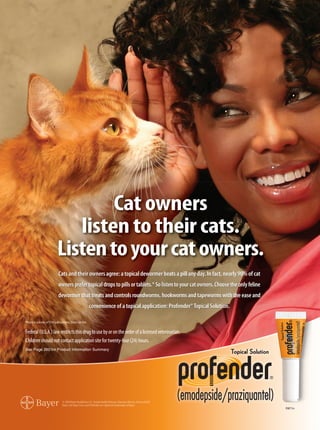
Cat owners
                           listen to their cats.
                        Listen to your cat owners.
                         Cats and their owners agree: a topical dewormer beats a pill any day. In fact, nearly 90% of cat
                         owners prefer topical drops to pills or tablets.* So listen to your cat owners. Choose the only feline
                         dewormer that treats and controls roundworms, hookworms and tapeworms with the ease and
                                                  convenience of a topical application: Profender® Topical Solution.

*From a survey of 736 cat owners. Data on file.


Federal (U.S.A.) law restricts this drug to use by or on the order of a licensed veterinarian.
Children should not contact application site for twenty-four (24) hours.
See Page 260 for Product Information Summary


                                                                                                                                  P08711n
Understanding
Behavior
Where to Begin
Planning for New Services
First, decide which levels of care
your practice can provide. Examples
include prepurchase counseling,
doggie day care, preventive medicine,
behavior modification for simple or
major problems, basic obedience
classes, behavioral consultation for
major problems, and referral to a
behavior specialist.
   Next, decide how you will del-
egate the responsibilities to your
team. Your role as the veterinar-
ian is to diagnose the problem and
write a treatment plan. Just as you
would not ask a technician to make
the treatment plan for a dog with
acute pancreatitis, you should not
turn the responsibility to diagnose
and treat behavior problems over
to a technician. So, what will the
technician’s role be? Will he or she
implement the treatment plan for
you or be responsible for phone
follow-up and follow-up appoint-
ments? What will the receptionist’s
role be? All members of the prac-
tice should be on board with the
plan for it to be effective.
   Next, think about how you will
train your staff. Some resources for
education are textbooks, continuing
education courses, and professional
organizations (BOX 2). Contact your
nearest board-certified veterinary
behaviorist and ask which text-
books and conferences he or she
recommends or whether he or she
would be willing to talk to your
staff to get the ball rolling.
   Finally, consider how to make
behavioral services simple and acces-
sible for clients. Easy-to-understand
client handouts explaining the
diagnosis and treatment should
be used to help keep appoint-
ments to a reasonable length of
time. Handouts can be written by
staff and edited by the veterinar-
ian, or prewritten handouts can be
found in a number of textbooks
(BOX 2). Handouts can also be inte-

260    Compendium
Understanding
                                                                                                                Behavior
grated into a computer-generated                                              behavior at each appointment. By
discharge sheet so that all client                                            incorporating behavioral issues
instructions are in the same place.                                           into routine wellness visits, you
The number of handouts and the                                                foster the idea that behavior is
topics to be covered will depend                                              just another aspect of the patient
on the services offered at the prac-                                          to be examined.
tice. Also, decide which behavior-                                               Similarly, the practice should
related products the practice will                                            support the message that behav-
carry, as this will be an important                                           ioral problems should be treated
part of completely integrating                                                as promptly as medical illnesses.
behavior services.                                                            For example, when you write
                                                                              a medical treatment plan, the
Integrating New Services                                                      practice pharmacy dispenses
Into the Practice                                                             the necessary medications (e.g.,
For any service to be a successful                                            an antibiotic for superficial pyo-
practice builder, it must be inte-                                            derma). Although other phar-
grated into the practice, from the                                            macies may dispense the same
receptionist to the veterinarian. From the moment        medication at a lower price, dispensing from the
that clients enter the waiting room, they should be      practice pharmacy allows clients to begin treatment
aware that you provide behavioral services. Signs        immediately and conveniently. Behavior cases are
unique to the practice or supplied by toy manufac-       no different. Behavioral supplies (e.g., food toys,
turers or pharmaceutical companies are one way of        collars, clickers) should be displayed prominently in
achieving this goal. The receptionist should men-        the lobby. Although clients can pur-
tion the addition of behavioral services to the prac-    chase these products elsewhere at           QuickNotes
tice when clients book appointments and should           a later time, they are more likely to
give each arriving client a short behavior checklist     initially purchase them from the vet-       Behavioral medicine
(BOX 3) to be filled out while waiting. The client can    erinarian at the time of the appoint-       can be a profit cen-
then give the completed form to the technician at        ment because the product is unique          ter for primary care
the beginning of the visit. Using a form is the most     to the veterinarian’s office (e.g., Blue     practices.
efficient way of collecting information about a pet’s     Kong) or was “prescribed” as part of
                                                         the treatment plan.

  BOX 2                                                  What to Offer
                                                         Prepurchase Counseling
   Resources                                             Prepurchase counseling helps owners avoid prob-
                                                         lems of incompatibility by suggesting a pet that
   Textbooks                                             matches their lifestyle. These appointments typi-
    Horwitz D, Mills D, Heath S, eds. BSAVA Manual       cally take 20 to 30 minutes and can be conducted
    of Canine and Feline Behavioural Medicine.           by a veterinary technician. Technicians can educate
    Gloucester, England: BSAVA; 2002.                    themselves by using Internet resources (e.g., akc.
                                                         org, iams.com, purina.com), attending continu-
    Landsberg G, Ackerman L, Hunthausen W.
                                                         ing education classes, and familiarizing themselves
    Handbook of Behavior Problems of the Dog
                                                         with breed handbooks. Before the appointment,
    and Cat. Philadelphia: Elsevier; 2003.
                                                         the owner fills out a 1- to 2-page questionnaire list-
   Organizations                                         ing his or her expectations for a pet (e.g., groom-
    American College of Veterinary Behaviorists:         ing, exercise, energy level). The technician should
    www.dacvb.org                                        consider the owner’s ability to exercise the pet, the
                                                         amount of time available for training, the presence
    American Veterinary Society of Animal                of children in the household, grooming require-
    Behavior: www.avsabonline.org                        ments, and the owner’s travel/work schedule. The
    Society of Veterinary Behavior Technicians:          client should be sent home with a summary of rec-
    www.svbt.org                                         ommendations, which can be as simple as a list of
                                                         breeds with the suitable candidates checked off.

                                            CompendiumVet.com | June 2009 | Compendium: Continuing Education for Veterinarians®   261
Understanding
Behavior
               Doggie Day Care                                                 training, crate training, and socialization to people
             In today’s busy society, many owners do not have                  and other animals can be conducted. While this
             the time to adequately exercise their dogs, which                 may seem like a large task, it requires little more
             can contribute to several behavior problems. By                   time and commitment than boarding patients. Crate
             instituting a doggie day care program, your prac-                 training and housetraining of dogs include walk-
             tice can offer your clients several benefits. To clients           ing them on a schedule and teaching them that the
            who pick up their dog after a long day of work, the                crate is a fun place to be. Socialization to people
             most obvious benefit will be the dog’s reduced need                takes roughly 5 to 10 minutes, three times a day.
             for activity. This aspect of the service will build cli-          Clients who are in your clinic waiting for their own
             ent loyalty and encourage clients to continue to use              pets can help by playing with puppies and kittens
             the day care. Another benefit of a good doggie day                 in a clean, safe area, adding to socialization with-
             care program is screening for common infectious                   out placing a drain on the practice. However, these
             diseases and aggression (via a questionnaire), which              services require a separate puppy/kitten area that is
             should be required for all dogs before they are per-              kept clean and free of any pets with infectious dis-
             mitted to participate.                                            eases, and owners of pets with infectious diseases
                Doggie day care requires a significant commit-                  should not participate.
             ment of space and dedicated staff. A medium-to-                      Clients may want to complete the socialization of
             large room or yard is necessary. Outdoor yards                    their pet themselves but not know how to do so. In
             should have secured fencing of adequate height to                 these cases, the veterinarian can customize a plan,
             contain large dogs. Agility equipment, beds, crates,              based on the pet’s strengths and weaknesses, for the
             and toys can also be provided. Ideally, there should              client to implement at home. Appointments gener-
             be at least three separate areas for small dogs, large            ally last 20 to 30 minutes. The client should leave the
                            dogs, and older dogs. Dogs should                  appointment with a summary and a handout on which
QuickNotes                  be rotated between rest and play in                the appropriate recommendations are checked off.
                            appropriate groups, depending on                      Puppy and kitten socialization classes are vitally
Behavioral issues           their play style. All interactions should          important in preventing behavioral disorders.4
affect almost every         be supervised by at least one person               Because the classes should be limited in size and
aspect of veterinary        for every four or five dogs. Upgrades               the patients are small, there is no need for a large
medicine.                   such as baths and viewing by webcam                space. During these classes, pets are socialized to
                            can also be offered.                               people and other pets, habituated to sounds and
                                                                               handling, and taught to tolerate nail trims and tooth
               Preventive Medicine                                             brushing. Finally, they are taught basic obedience
               Veterinarians practice preventive medicine every day,           behaviors. These positive-reinforcement classes can
               but behavioral advice is frequently left out. Puppies           be taught by a veterinarian or a member of the staff.
               and kittens have sensitive periods for socialization            Puppies and kittens should be enrolled when they
               in which a relatively small amount of effort can have           are as close to 8 weeks of age as possible to offer
               a very large effect. Unfortunately, if their experi-            the greatest benefit to the pet and client.
               ences during these periods are stressful, or if they
               are not exposed to new people and situations dur-                  BOX 3
               ing this time, they often become fearful or anxious.
               Fears and anxieties are the most common causes of                    Waiting-Room Behavior Checklist
               behavior problems, including aggression, in animals.
               Therefore, each new puppy or kitten appointment                      Have your pet’s elimination habits changed since
               should include counseling about socialization and                    his/her last appointment?
               habituation. In addition, the practice can offer in-                 Has your pet growled at or bitten someone since
               house socialization/habituation services, kitten and                 his/her last appointment?
               puppy classes, obedience classes, and counseling                     Has your pet had an increase in anxiety or fear
               services for life/schedule changes.                                  since his/her last appointment?
                   In-house socialization/habituation services for                  Has your pet’s personality changed since his/her
               puppies and kittens reduce clients’ time commit-                     last appointment?
               ment to this type of training. Instead, clients bring                Are any of your pet’s behaviors of concern to
               their pets to the clinic, where habituation to star-                 you?
               tling noises (e.g., thunderstorms, fireworks), house-

262    Compendium: Continuing Education for Veterinarians® | June 2009 | CompendiumVet.com
Understanding
                                                                                                                          Behavior
                                                            a standard part of treating a medical disorder. Some
                                                            examples are muzzle training for veterinarian-aggres-
                                                            sive dogs, behavior modification for cats that will not
                                                            enter their carriers, and counterconditioning for pets
                                                            that do not tolerate medication administration. When
                                                            topical, oral, or injectable medications are prescribed,
                                                            the client should be asked if he or she will be able
                                                            to administer the medication for the duration of the
                                                            treatment plan. If the answer is “no,” a behavior modi-
                                                            fication appointment should be recommended.

                                                            Problem Behavior Referrals
                                                          Appointments for problem behaviors typically last
                                                          1½ to 3 hours. Most general practices choose not to
                                                          offer these appointments because of their length and
                                                          profitability compared with other services. If this is
                                                          the case in your practice, you can offer an initial
                                                          30-minute consult preceding a referral to a board-
                                                          certified veterinary behaviorist. These visits include
                                                          a physical examination, screening laboratory tests
                                                          (e.g., complete blood count, serum chemistry pro-
                                                          file, thyroxine, urinalysis), and a short list of five to
    Obedience classes can be offered at the clinic. 10 safety recommendations specific to the case (e.g.,
A member of the staff can teach the class, or the avoidance of provocative situations, discontinuation
clinic can partner with a dog trainer. Such classes of physical corrections or confrontational interac-
can be a good way to supplement income, increase tions). By offering this service, you ensure that the
employee job satisfaction and retention, and intro- patient has had a recent medical workup before it
duce new clients to your practice. However, these goes to the behavior specialist and that this income
classes should be undertaken with care because the stays in your practice. In addition, screening tests
practice may be legally responsible for the advice may help identify, and allow you to start treatment
given. Regardless of who you employ to teach obe- for, an underlying medical disorder that may be con-
dience or puppy classes, observe them teaching first. tributing to the behavior problem.
Ask them what methods they use and how much
experience they have. Lay down guidelines for pos- Conclusion
itive-reinforcement training in writing so that there There are many ways to integrate behavioral medi-
is no confusion about what is permitted.                  cine into the general veterinary practice. Change is
    Counseling services can help clients transition their never easy or comfortable, but by adding behav-
pets in circumstances such as moving, marriage, loss ioral services to your practice, you can improve your
of a family member (animal or human), or arrival of patients’ quality of life; increase patient, client, and
a baby. Even the best pet can become agitated by employee retention; and positively affect your prac-
major life changes. Appointments generally last 20 to tice’s bottom line.
30 minutes. As with a medical appointment, the tech-
nician takes the history and presents the case to the References
veterinarian. The veterinarian examines the pet and 1. Patronek FJ, Glickman LT, Beck AM,an al. Risk
                                                          factors for relinquishment of dogs to
                                                                                                  et
                                                                                                     animal
makes an assessment and a treatment plan. After pre- shelter. JAVMA 1996;209:572-581.
senting the plan to the client, the technician teaches 2. Patronek GJ, Glickman LT, Beck AM, et al.          TO LEARN
                                                          Risk factors for relinquishment of cats to an ani-
the client how to implement it and sends him or her mal shelter. JAVMA 1996;209:582-598.
                                                                                                             MORE
home with an appropriate handout.                         3. Salman MD, Hutchinson J, Ruch-Gallie R, et al.
                                                            Behavioral reasons for relinquishment of dogs and
                                                            cats to 12 shelters. J Appl Anim Welf Sci 2000;3(2):
Basic Behavior Modification                                 93-106.                                                For a sample waiting room
Basic behavior modification appointments last 20 to          4. Duxbury MM, Jackson JA, Line SW, Anderson           questionnaire, please visit
                                                            RK. Evaluation of association between retention in     flvetbehavior.com.
30 minutes and are conducted either by the techni-          the home and attendance at puppy socialization
cian after the veterinarian has examined the pet or as      classes. JAVMA 2003;223:62-66.


                                               CompendiumVet.com | June 2009 | Compendium: Continuing Education for Veterinarians®           263
2008 Feline
                                                                 F
                                                                        eLV and FIV are among the most common infectious
                                                                        diseases of cats. Risk factors for infection include male

Retrovirus                                                              gender, adulthood, and outdoor access, whereas indoor
                                                                 lifestyle and sterilization are associated with reduced infec-
                                                                 tion rates.1–5


Management                                                           The retroviral status of all cats should be known. Cats
                                                                 may require retrovirus testing at different times in their lives.
                                                                 Here are some general principles for retrovirus testing:


Guidelines*                                                       A cat with a confi rmed-positive test result should be
                                                                 diagnosed as having a retroviral infection—not clinical dis-
                                                                 ease. Diseases in cats infected with FeLV or FIV may not
Members of the                                                   necessarily be the result of the retrovirus infection.
                                                                  Cats infected with FeLV or FIV may live for many years.
Advisory Panel                                                   A decision for euthanasia should never be made solely on the
❯❯ Julie Levy, DVM, PhD, DACVIM, Chair                           basis of whether the cat is infected.
❯❯ Cynda Crawford, DVM, PhD                                       No test is 100% accurate at all times under all conditions.
   University of Florida                                         All test results should be interpreted along with the patient’s
❯❯ Katrin Hartmann, Dr. Med. Vet., Dr. Habil., DECVIN-CA         health and prior likelihood of infection. All positive results
   Ludwig Maximilian University Munich | Munich, Germany         should be confirmed by another test method.
❯❯ Regina Hoffmann-Lehmann, Dr. Med. Vet., Dr. Habil, FVH
   University of Zurich | Zurich, Switzerland                      While FeLV and FIV can be life-threatening viruses, proper
❯❯ Susan Little, DVM, DABVP (Feline Practice)                    management can give infected cats longer, healthier lives.
   Winn Feline Foundation | Manasquan, New Jersey                The following article reflects the recommendations of the
                                                                 AAFP on managing these infections.
❯❯ Eliza Sundahl, DVM, DABVP (Feline Practice)
   KC Cat Clinic | Kansas City, Missouri
❯❯ Vicki Thayer, DVM, DABVP (Feline Practice)
   Purrfect Practice | Lebanon, Oregon                             About These Guidelines
                                                                   This report represents a consensus of current information
At a Glance                                                        compiled by the researchers and practitioners on the panel.
                                                                   These guidelines are based on the best research data, clinical
   Epidemiology                                                    experience and technical judgments available at the time
   Page 265                                                        of preparation. While the guidelines are as accurate and
   Preventing FeLV and FIV Infection                               comprehensive as possible, they are subject to change should
   Page 265                                                        new insights become available from additional research or
   Limiting Transmission in the Veterinary Practice                technological updates.
   Page 268                                                           The American Association of Feline Practitioners is a
                                                                   professional organization of practitioners and board-certified
   Diagnosing FeLV and FIV                                         specialists who seek to raise the standards of feline medicine
   Page 269
                                                                   and surgery among practitioners.
   Managing Positive Cats
   Page 270


* This is an abridged version of the full guidelines (Levy JC,
                                                                  MORE ON               Compendium grants permission to
 Crawford C, Hartmann K, et al. 2008 American Associa-            THE WEB               reproduce this article for educational
 tion of Feline Practitioners’ feline retrovirus management                             purposes. A downloadable version
 guidelines. J Feline Med Surg 2008;10[3]:300-316) available                            of this article is available on
 at catvets.com from the American Association of Feline                                 CompendiumVet.com.
 Practitioners (AAFP). Adapted with permission from AAFP.

264      Compendium | June 2009 | CompendiumVet.com
AMERICAN
                                                                                                                          ASSOCIATION OF FELINE

                                                                                          Contributed by                 PRACTITIONERS


                                                                                                                 About AAFP
                                                                                                                 The American Association of
Epidemiology                                           FeLV Vaccination                                          Feline Practitioners improves
The prevalence of FeLV infection has report-           The decision to vaccinate an individual cat               the health and well-being of
                                                                                                                 cats by supporting high stan-
edly decreased during the past 20 years, pre-          against FeLV should be based on the cat’s risk
                                                                                                                 dards of practice, continuing
sumably as a result of implementation of               of exposure. Cats that live in an FeLV-negative,          education, and scientific inves-
widespread testing programs and develop-               indoor environment are at minimal risk.                   tigation. Feline Practitioners
ment of effective vaccines.1,2,6 In contrast, the         FeLV vaccination is recommended for:                   are veterinary professionals
                                                                                                                 who belong to this association
prevalence of FIV has not changed since the
                                                                                                                 because they are “passionate
virus was discovered in 1986.                            All kittens because the lifestyles of kittens           about the care of cats”!
   In a study of more than 18,000 cats tested          frequently change after acquisition, and kittens          American Association of Feline
in 2004, 2.3% were positive for FeLV and 2.5%          may subsequently be at risk for FeLV exposure                 Practitioners
                                                                                                                 203 Towne Centre Drive
were positive for FIV.1 Infection rates for FeLV         Cats that go outdoors                                   Hillsborough, NJ 08844-4693
and FIV (TABLE 1) varied among subpopula-                Cats that have direct contact with cats of              phone: 800-874-0498
tions and sources of cats.                             unknown status or in high-turnover situations             phone: 908-359-9351
                                                                                                                 fax: 908-292-1188
                                                       such as foster homes or other group housing
                                                                                                                 e-mail: info@catvets.com
Preventing FeLV and FIV Infection                        Cats that live with FeLV-positive cats
                                                                                                                 Media contact: Valerie Creighton,
Vaccines are available for both retroviruses. Both                                                                 DVM, DABVP
FeLV and FIV vaccines are non-core. Risk assess-          Because sufficient protection is not induced
ment of the individual animal should dictate their     in all vaccinates, vaccination against FeLV does
use. No vaccine is 100% effective, and repeat          not diminish the importance of testing cats to
testing should be performed as warranted.              identify and isolate those that are viremic. In

 TABLE 1

Risk Factors for FeLV and FIV Seropositivity in 18,038 Cats Tested
at Veterinary Clinics and Animal Shelters in North America1
                                                                   Number of Cats          Number of Cats
                                               Number of Cats
Factor            Categories                                    With Positive Results   With Positive Results
                                                  Tested
                                                                    for FeLV (%)             for FIV (%)
Study site        Animal shelter                     8068            124 (1.5)               141 (1.7)
                  Veterinary clinic                  9970            285 (2.9)               305 (3.1)
Region            West                               3737             39 (1.0)                72 (1.9)
                  Canada                             325               8 (2.5)                10 (3.1)
                  South                              6359            144 (2.3)               183 (2.9)
                  Northeast                          3747            107 (2.9)                79 (2.1)            Disclaimer
                  Midwest                            3870            111 (2.9)               102 (2.6)            These guidelines
Source            Clinic (indoors only)              3613             53 (1.5)                32 (0.9)
                                                                                                                  are not exclusive.
                                                                                                                  Other techniques and
                  Clinic (outdoors access)           6357            232 (3.6)               273 (4.3)
                                                                                                                  procedures may be
                  Shelter (relinquished pet)         2809             41 (1.5)                38 (1.4)            available. The AAFP
                  Shelter (stray)                    4550             71 (1.6)                75 (1.6)            expressly disclaims
                  Shelter (feral)                    709              12 (1.7)                28 (3.9)            any warranties or
Age               Juvenile                           9556            131 (1.4)               100 (1.0)            guarantees, express
                  Adult                              8482            278 (3.3)               346 (4.1)
                                                                                                                  or implied, and shall
                                                                                                                  not be liable for any
Sex               Spayed female                      2611             45 (1.7)                44 (1.7)
                                                                                                                  damages of any kind
                  Neutered male                      2984             88 (2.9)               127 (4.3)            in connection with
                  Sexually intact female             6588            128 (1.9)                82 (1.2)            the material, informa-
                  Sexually intact male               5855            148 (2.5)               193 (3.3)            tion, techniques, or
Health status     Healthy                         15,312             238 (1.6)               280 (1.8)            procedures set forth
                  Sick                               2726            171 (6.3)               166 (6.1)
                                                                                                                  in these guidelines.


                                               CompendiumVet.com | June 2009 | Compendium: Continuing Education for Veterinarians®          265
addition, cats should be tested for FeLV infec-                  Current FIV antibody tests cannot dis-
                               tion before initial vaccination and whenever                  tinguish vaccinated cats from infected
                               the possibility exists that they have been                    cats. Clients should be informed that vacci-
QuickNotes                     exposed to FeLV since they were last tested.                  nated cats will have positive FIV test results,
The retroviral status          Administering FeLV vaccines to cats confirmed                  and the decision to vaccinate should be
of all cats should             to be FeLV infected is of no value.                           reached only after careful consideration of
                                                                                             this implication. If the decision falls in favor
be known because
                               FIV Vaccination                                               of vaccination, cats should test negative
the serious health             The decision to vaccinate a cat for FIV is com-               immediately before vaccination.
consequences of                plicated. FIV vaccines may be considered for                     A permanently placed identification micro-
infection influence             cats with lifestyles that put them at high risk               chip and collar are recommended for all cats
patient manage-                for infection, such as outdoor cats that fight or              to increase the chance of returning lost cats to
ment both in illness           cats living with FIV-infected cats. Because FIV               their owners. Microchip databases can also
and wellness care.             infection is more often spread by unfriendly                  record FIV vaccination histories. This infor-
                               exchanges (usually biting), cats in households                mation can be used by animal shelters to help
                               with a stable social structure are at lower risk              assess the significance of positive FIV test
                               for acquiring FIV infection.                                  results when screening cats before adoption.


                                                                                                                                               BOX 1
 General Recommendations for Testing for and Controlling
 Transmission of FeLV and FIV in Shelters and Breeding Catteries

  Testing                                             tiple samples for use in a single test            status, vaccination against FeLV and
   As for pet cats, it is ideal for all cats in       reduce test sensitivity and should not            FIV is not necessary.
   shelters and catteries to be tested for            be performed.                                     Vaccination is not 100% effective and
   FeLV and FIV.*                                     Foster families and adopters should               should never be used in place of a
   Testing at admission is optional for               have their own resident cats tested               test-and-segregate program.
   singly housed cats.                                before fostering or adopting a new cat.           In contrast to feline panleukopenia,
   Testing is highly recommended for                  Testing is optional in feral cat trap–            herpesvirus, and calicivirus vaccines,
   group-housed cats.                                 neuter–return programs.                           the value of a single FeLV vaccine for
   If not performed before adoption,                                                                    feral cats has not been determined.
   testing should be recommended to                 Controlling Transmission                            Therefore, FeLV vaccination is not rec-
   the new owner before exposure to                  FeLV vaccination is optional for singly            ommended for feral cat trap–neuter–
   other cats.                                       housed cats.                                       return programs if program resources
   Testing should be repeated 60 days af-            FeLV vaccination is highly recom-                  are needed for higher priorities.
   ter the initial test and annually for cats        mended for all cats housed in groups               FIV vaccination is not recommended
   kept in long-term group housing.                  and for foster cats and permanent                  for use in shelters or feral cats.
   Each cat should be individually tested.           residents in foster homes.                         Strict adherence to universal precau-
   Testing representative kittens in a litter        Cats should test negative before vac-              tions is required to prevent iatrogenic
   or colony and extrapolating results to            cination.                                          transmission of retroviruses in the
   other cats in the group is unreliable.            In catteries that follow testing guide-            shelter environment via contaminated
   Procedures such as pooling mul-                   lines and maintain retrovirus-negative             equipment and secretions.

 *Currently, no test can distinguish FIV antibodies induced by infection from those induced by vaccination. Therefore, shelters have the difficult
  task of determining the true infection status of stray cats that are admitted without medical histories and that test positive for FIV antibodies.
  If the cat is microchipped, the history of FIV vaccination may be recorded in an accessible database. However, even if cats are known to have
  been vaccinated against FIV, determining whether they are also infected is not usually possible. This is a challenge for shelters for which no
  solution currently exists.

266    Compendium: Continuing Education for Veterinarians® | June 2009 | CompendiumVet.com
Exceeding client
                                     expectations
“ No matter you are such ahave been in thisin the human–animal bond. to
  know that
            how long you
                           trusted partner
                                            profession, it’s always humbling

  Knowing that my clients can access their Pet Portal® to find good medical advice,
  review their pet’s medical records, and receive medication reminders allows
  me to consistently meet their needs — and exceed their expectations —
  even when I have no extra time.
  Vetstreet ensures client satisfaction and compliance without
  additional work for me or my staff.
                                                    ”


 Gary Edlin, DVM
 Owner, East Louisville
 Animal Hospital
 Louisville, KY


                  Easy to set up and easy to use, Vetstreet® is a powerful practice communication and
            management tool that keeps you in touch with your clients via Pet Portals. To discover how
  Vetstreet can help you increase client satisfaction, build compliance, and enhance your bottom line,
                           visit Vetstreet.com, call toll-free 888-799-8387 or email info@vetstreet.com.
                                                                           ,


                                                                                                 Vetstreet and Pet Portal are registered trademarks of VetInsite.com, Inc.
Limiting Transmission                                                                                                            BOX 2
                            in the Veterinary Practice                                            FeLV and FIV Diseases
                            Retroviruses are unstable outside their host
                            animals and can be quickly inactivated by                             Although many FeLV-/FIV-infected cats
                            detergents and routine disinfectants.7–11 Simple                      experience prolonged survival, retroviral
                            precautions and routine cleaning procedures                           infections can be associated with:
                            prevent transmission of these agents in veteri-
                                                                                                      Anemia
                            nary hospitals.
                                                                                                      Secondary and opportunistic infections
                               As a guide:
                                                                                                      Neoplasia
                                                                                                      Chronic inflammatory conditions
                              All infected patients should be housed in                               Ocular disorders
                            individual cages when hospitalized and not in                             Hematologic disorders
                            isolation/contagious wards where they may be
                            exposed to infectious agents.                                         Specific diseases associated with very high
                              Hospital staff should wash their hands                              rate of infection:
                            between patients and after cleaning cages.                                Cutaneous abscesses (FeLV: 8.8%, FIV:
                              Because FeLV and FIV can be transmitted in                              12.7%)12
                            blood transfusions, donors should be tested                               Oral inflammation (FeLV: 7.3%, FIV: 7.9%)a
                            before donating. A real-time polymerase chain
                            reaction (PCR) test for FeLV is recommended                           a
                                                                                                   Bellows J, Lachtara JL. Feline retroviruses and
QuickNotes                  for blood donors because proviral elements in
                                                                                                  oral disease [unpublished]. Reported in: Veterinary
                            seronegative cats with regressive FeLV infection                      Medicine, “Spotlight on Research”; 2006.
Retroviruses can            may cause infection in transfusion recipients.
be quickly inac-
tivated by deter-            FIGURE 2
                                    1
gents and routine                                                                     FeLV
disinfectants.
                                                                                     Antigen test


                                                 FeLV antigen positive                                         FeLV antigen negative
                                          All positive results should be confirmed.                      Negative screening test results are highly
                                                                                                        reliable. However, if results are negative but
                                                                                                        recent infection cannot be ruled out, testing
                                                                                                        should be repeated a minimum of 30 days
                                                  Retest immediately with IFA.                          after the last potential exposure.


                                                                                       IFA test


                                              FeLV IFA positive                                                     FeLV IFA negative

                                    Consider FeLV infected and start appropriate             Discordant results may be due to the stage of infection, the
                                    management program.                                      variability of host responses, or technical problems with
                                                                                             testing. It is not usually possible to determine the true FeLV
                                                                                             infection status of cats with persistently discordant test results.

                                                                                                           If resolving is desired, retest in 60 days
                                                                                                                     using antigen and IFA.


                            FeLV test interpretation algorithm—all cats. IFA = immunofluorescence assay


268   Compendium: Continuing Education for Veterinarians® | June 2009 | CompendiumVet.com
Dental and surgical instruments, endotracheal                           Cats should be tested when they are:
tubes, and other items potentially contami-
nated with body fluids should be thoroughly                              Sick, regardless of age, despite previ-
cleaned and sterilized between uses.                                  ous negative test results or previous vac-
 Fluid lines, multidose medication containers,                        cination. FeLV and FIV are associated with
and food can become contaminated with body                            a wide variety of health disorders4,5 (BOX 2).
fluids (especially blood or saliva) and should                         Identification of retroviral infection as a com-
not be shared among patients.                                         plicating factor can assist in the development
                                                                      of optimal management plans.
   Recommendations on testing for and control-                          About to be adopted or brought into a
ling transmission of FeLV and FIV in shelters                         new household, regardless of age. Even
and catteries are listed in BOX 1.                                    if no other cats are present in the household,
                                                                      testing will protect future cats that may join the
Diagnosing FeLV and FIV                                               family as well as neighborhood cats, should
The retroviral status of all cats should be known                     the pet escape or be allowed outside.
because the serious health consequences of                              At risk of exposure, even if their most
infection influence patient management both                            recent test was negative. As an example,
in illness and wellness care. Failure to identify                     a 2008 study12 showed that more than 19%
infected cats may lead to inadvertent exposure                        of cats with cutaneous abscesses were FIV
and transmission to uninfected cats. Misdiagnosis                     or FeLV positive at the time of presentation.
of infection in uninfected cats may lead to inap-                     Because of delay in seroconversion after initial                    QuickNotes
propriate changes in lifestyle or even euthanasia.                    infection, these cats should also be retested (a
                                                                                                                                          ELISA and other
                                                                                                                                          immunochromato-
FIGURE 2
                                                                 FIV                                                                      graphic tests are the
                                                                                                                                          preferred screening
                                                              Antibody test                                                               tests for FeLV and
                                                                                                                                          FIV.
                     FIV antibody positive                                             FIV antibody negative
              All positive results should be confirmed.                        Negative screening test results are highly
              Cats vaccinated with a whole-virus vaccine                      reliable. However, if results are negative but
              will test antibody positive.                                    recent infection cannot be ruled out, testing
                                                                              should be repeated a minimum of 60 days
                   Retest with another antibody test.                         after the last potential exposure.


              < 6 Months of age                               > 6 Months of age


           Retest at 60-day intervals                                             Retest immediately with different test


   FIV antibody positive          FIV antibody negative                  FIV antibody positive              FIV antibody negative
   If positive after kitten        If negative at any                     Consider FIV infected              Consider free of infection
   reaches 6 months of age,        interval, consider free                and continue appropriate           and begin a wellness
   consider FIV infected.          of infection and begin a               management program.                program.
                                   wellness program.
                                                                          Note: False-positive results
                                                                          will exist in vaccinated cats.


FIV test interpretation algorithm—all cats.


                                                               CompendiumVet.com | June 2009 | Compendium: Continuing Education for Veterinarians®        269
minimum of 30 days after the last potential              from a different manufacturer.18,19 Western blot
                            FeLV exposure and 60 days after potential FIV            tests have been the recommended confirma-
                            exposure).                                               tion tests in the past, but they were found to be
                             Of “unknown” viral status. Infected cats                less sensitive and specific than in-clinic screen-
                            can remain asymptomatic for years, during                ing tests in one study.17
                            which time they may serve as hidden sources                 Vaccination of cats against FIV induces anti-
                            of infection to other cats in the household.             FIV antibodies that cannot be distinguished
                             About to be vaccinated against FeLV or                  from natural infection. These antibodies per-
                            FIV. These vaccines should not be administered           sist for at least 1 year and can be transferred in
                            to cats that are already infected. Vaccination           colostrum to kittens.
                            does not affect the carrier state, the capacity             While PCR assays may help distinguish cats
                            to infect other cats, or the development of dis-         infected with FIV from cats vaccinated against FIV,
                            ease in cats with preexisting infection.                 one study found marked variability in diagnostic
                                                                                     accuracy among commercial laboratories.20
                            Diagnosis of FeLV
                                                                                                        ***
                            Soluble-antigen tests are preferred for initial
                            screening (FIGURE 1). These include ELISA and         Negative results for either FeLV or FIV
                            other immunochromatographic tests.                 are much more reliable than positive results
                                While screening tests detect the presence of because of the low prevalence of infec-
                            free antigen in the circulating blood, the immu- tion in most cat populations. Positive test
                            nofluorescence assay (IFA) tests for the presence results should be confirmed, especially in
QuickNotes                  of antigen within infected white blood cells and asymptomatic and low-risk cats. No test is
                            platelets. Positive results from tests that detect 100% accurate all the time, under all con-
Both FeLV-infected          free antigen may be reflective of the transient ditions. In cat populations with a low
and FIV-infected            period of antigenemia associated with regres- prevalence (e.g., <1%), more than half of the
cats can live for           sive infections. Positive results from tests that cats that test positive are likely to be uninfected.21
many years.                 detect cell-associated antigen, such as the IFA,      Kittens may be tested for FeLV and FIV at
                            are likely to be reflective of progressive infec- any age. Most kittens test negative, indicat-
                            tions. Tests that use saliva and tears yield an ing no infection. Antibody tests for FIV can
                            unacceptably high percentage of inaccurate detect antibodies passed in colostrum from
                            results, and their use is not recommended.13       an infected or vaccinated mother, which can
                                Although there are no published assessments be mistaken for infection in the kitten. Kittens
                            of diagnostic accuracy of PCR testing for FeLV, that test positive for FIV antibodies should
                            the test is offered by a number of commercial be retested every 60 days up to 6 months
                            laboratories. Recent studies14,15 using real-time of age. If the kitten becomes seronegative, it
                            PCR have shown that 5% to 10% of cats with most likely is not infected. If results of tests
                            negative results on soluble antigen tests were performed after 6 months of age are still con-
                            positive for FeLV provirus by PCR (regressive firmed positive, these kittens should be con-
                            infection).                                        sidered infected.
                                                                                  FeLV vaccinations will not induce positive
                            Diagnosis of FIV                                   test results.
                            FIV produces a persistent, lifelong infection,        FIV vaccinations will induce positive test
                            so detection of antibodies in peripheral blood results.
                            has been judged sufficient for routine diagnos-
                            tic screening if the cat has not been previously Managing Positive Cats
                            vaccinated against FIV and has not acquired Both FeLV-infected and FIV-infected cats can
                            FIV antibodies in colostrum16,17 (FIGURE 2).       live for many years and may succumb at older
                                ELISA and other immunochromatographic ages to causes unrelated to their retrovirus
                            tests are the preferred screening tests. Confir- infections. In recent studies,22 the median sur-
                            mation of positive screening tests should include vival after diagnosis of FeLV-infected cats was
                            a different method or at least an antibody test 2.4 years; for FIV-infected cats, it was 4.9 years.

270   Compendium: Continuing Education for Veterinarians® | June 2009 | CompendiumVet.com
September 9-13, 2009            • Basic to specialist level
                                             sessions


 IVECCS
                                           • 14 continuous daily tracks of
                                             instruction

                                           • Small Animal, Large Animal
                                             and Exotics programs


    2009
                                           • Features over 125 of the
                                             profession’s top speakers
                                             from the clinical disciplines

                                           • Specialist-level information
                                             on surgery, internal
                                             medicine, anesthesia
FIFTEENTH INTERNATIONAL VETERINARY           and nursing, as well as
EMERGENCY & CRITICAL CARE SYMPOSIUM          emergency medicine

                                           • Over 40 labs and workshops
Hyatt Regency • Chicago, Illinois            to choose from to focus your
                                             educational experience

                                           • Over 40 CE credits available


 Registration Available                    • Research abstracts, case
                                             reports, interactive sessions

                                           • Outstanding Technician


Online at www.veccs.org.
                                             program - 4 1/2 days and 3
                                             continuous tracks

                                           • ACVA program to be held at
                                             IVECCS

Offering over 40 hours of comprehensive,   • IVECCS Job Fair
                                             Wednesday, September 9
progressive and innovative CE that saves
                                           • Expanded exhibit hall – over
Lives! Call 800-948-3227 or logon to the     145 exhibits
IVECCS website at http://2009.iveccs.      • Lunch coupons, receptions,
org for complete details.                    exhibit hall happy hour
Thus, a decision for treatment or for euthana-               Infected queens should not be bred and
                            sia should never be based solely on the pres-             should be spayed if their condition is suf-
                            ence of a retrovirus infection.                           ficiently stable to permit them to undergo
                                                                                      surgery.
                            Managing Healthy Positive Cats
                            Examinations should be performed at least                 Managing Clinically Ill Positive Cats
                            twice a year. At each visit:                              Prompt and accurate diagnosis is essential to
                                                                                      allow early therapeutic intervention and a suc-
                              Update medical history. Monitor for any signs           cessful treatment outcome. Therefore, inten-
                            of weight loss.                                           sive diagnostic testing should proceed early in
                              Perform a thorough physical examination; pay            the course of illness for infected cats. Many
                            close attention to the lymph nodes, eyes, and             cats infected with FeLV or FIV respond as well
                            oral cavity.                                              as their uninfected counterparts to appro-
                              Conduct a complete blood count, biochemi-               priate medications and treatment strategies,
                            cal analysis, urinalysis, and fecal examination           although a longer or more aggressive course
                            at least once a year. FeLV-positive cats may              of treatment may be needed.
                            need a complete blood count twice a year.                    Few attempts have been made to evaluate
                              Spay or neuter intact cats.                             antiviral drugs, immunomodulators, or alter-
                              Control internal and external parasites.                native therapies in large controlled studies of
                              Vaccinate as lifestyle indicates. Most retrovirus-      naturally infected cats. To date, no treatment
                            infected cats mount adequate immune responses             has been shown to reverse well-established
                            when vaccinated, and there is no need to modify           retrovirus infection in cats.
                            standard vaccination intervals.23 There is controversy       Clients with a healthy or ill retrovirus-
                            about the use of inactivated versus modified-live          positive cat may be frightened by the initial
                            vaccines. Current recommendations are to use inac-        diagnosis. It is important to alleviate these
                            tivated vaccine products due to the theoretical risk of   fears when appropriate and offer encouraging
                            a modified-live product regaining its pathogenic-          advice on the proper care and management of
                            ity in cats with compromised immune systems.              the cat (BOX 3).


                                                                                                                                    BOX 3
                              Advice for Owners of Infected Cats

                              Limiting Transmission at Home                            Don’t Introduce—If separation is not possible,
                               Confine—Infected cats should be confined                  no new cats should be introduced in the house-
                               indoors so they do not pose a risk of                   hold to reduce the risk of territorial aggression.
                               infection to other cats and so they are
                               protected against infectious hazards in                   If owners choose not to separate retrovirus-
                               the environment.                                       infected housemates from their other cats,
                               Isolate—The best method of preventing                  the uninfected cats should be considered for
                               spread to other cats in the household is to            vaccination. Vaccinated cats should be isolated
                               isolate the infected cat from interacting with         from infected cats for at least 2 months after
                               its housemates. Isolation in a separate room           the vaccine series.
                               is recommended, but a simple screen or
                               chain-link barrier is adequate. Generally, FeLV        Managing Positive Cats
                               transmission is low in households with stable           Watch closely for behavioral changes in the cat.
                               social structures where housemates do not               Feed a nutritionally balanced diet. Avoid raw
                               fight, but FeLV can still be transmitted via             diets because of the risk of food-borne bacte-
                               friendly interactions.                                  rial and parasitic infections.


272   Compendium: Continuing Education for Veterinarians® | June 2009 | CompendiumVet.com
References
 1. Levy JK, Scott HM, Lachtara JL, Crawford PC. Seroprevalence of feline                rus testing. JAVMA 2008;232:1152-1158.
 leukemia virus and feline immunodeficiency virus infection among cats in                 13. Panel report on the colloquium on feline leukemia virus/feline immunodefi-
 North America and risk factors for seropositivity. JAVMA 2006;228:371-                  ciency virus: tests and vaccination. JAVMA 1991;199:1273-1277.
 376.                                                                                    14. Hofmann-Lehmann R, Huder JB, Gruber S, et al. Feline leukemia provi-
 2. O’Connor TP Jr, Tonelli QJ, Scarlett JM. Report of the National FeLV/FIV             rus load during the course of experimental infection and in naturally infected
 Awareness Project. JAVMA 1991;199:1348-1353.                                            cats. J Gen Virol 2001;82:1589-1596.
 3. Levy JK, Crawford PC. Feline leukemia virus. In: Ettinger SJ, Feldman                15. Gomes-Keller MA, Go¨nczi E, Tandon R, et al. Detection of feline leu-
 EC, eds. Textbook of Veterinary Internal Medicine. 6th ed. Philadelphia: WB             kemia virus RNA in saliva from naturally infected cats and correlation of
 Saunders; 2005:653-659.                                                                 PCR results with those of current diagnostic methods. J Clin Microbiol
 4. Hoover EA, Mullins JI. Feline leukemia virus infection and diseases. JAV-            2006;44:916-922.
 MA 1991;199:1287-1297.                                                                  16. Hartmann K. Feline immunodeficiency virus infection: an overview. Vet J
 5. Levy JK. Feline immunodeficiency virus update. In: Bonagura J, ed. Current Veteri-   1998;155:123-137.
 nary Therapy XIII. Philadelphia: WB Saunders; 2000:284-288.                             17. Levy JK, Crawford PC, Slater MR. Effect of vaccination against fe-
 6. Moore GE, Ward MP, Dhariwal J, Al E. Use of a primary care veterinary                line immunodeficiency virus on results of serologic testing in cats. JAVMA
 medical database for surveillance of syndromes and diseases in dogs and                 2004;225:1558-1561.
 cats. J Vet Intern Med 2004;18:386.                                                     18. Barr MC. FIV, FeLV, and FIPV: interpretation and misinterpretation of sero-
 7. Francis DP, Essex M, Gayzagian D. Feline leukemia virus: survival under home         logical test results. Semin Vet Med Surg Small Anim 1996;11:144-153.
 and laboratory conditions. J Clin Microbiol 1979;9:154-156.                             19. Hartmann K, Werner RM, Egberink H, Jarrett O. Comparison of six in-
 8. van Engelenburg FA, Terpstra FG, Schuitemaker H, Moorer WR. The                      house tests for the rapid diagnosis of feline immunodeficiency and feline leu-
 virucidal spectrum of a high concentration alcohol mixture. J Hosp Infect               kemia virus infections. Vet Rec 2001;149:317-320.
 2002;51:121-125.                                                                        20. Bienzle D, Reggeti F, Wen X, et al. The variability of serological and
 9. Moorer WR. Antiviral activity of alcohol for surface disinfection. Int J             molecular diagnosis of feline immunodeficiency virus infection. Can Vet J
 Dent Hyg 2003;1:138-142.                                                                2004;45:753-757.
 10. Kramer A, Schwebke I, Kampf G. How long do nosocomial pathogens per-                21. Jacobson RH. How well do serodiagnostic tests predict the infection or
 sist on inanimate surfaces? A systematic review. BMC Infect Dis 2006;6:130.             disease status of cats? JAVMA 1991;199:1343-1347.
 11. Terpstra FG, Van Den Blink AE, Bos LM, et al. Resistance of surface-dried           22. Levy JK, Lorentzen L, Shields J, Lewis H. Long-term outcome of cats with
 virus to common disinfection procedures. J Hosp Infect 2007;66:332-338.                 natural FeLV and FIV infection. In: 8th Int Feline Retrovirus Res Symp 2006.
 12. Goldkamp CE, Levy JK, Edinboro CH, Lachtara JL. Seroprevalences of feline           23. Richards JR, Elston TH, Ford RB, et al. The 2006 American Associa-
 leukemia virus and feline immunodeficiency virus in cats with abscesses or bite          tion of Feline Practitioners Feline Vaccine Advisory Panel Report. JAVMA
 wounds and rate of veterinarian compliance with current guidelines for retrovi-         2006;229:1405-1441.


                                                                                                                                  OCTOBER 12–15, 2009
                                                                                                                               Atlantic City Convention Center


Atlantic Coast Veterinary Conference
Offering the best value in veterinary
continuing education — plus the excitement of Atlantic City!
Check out everything that's included in your registration fee:
• WORLD CLASS CE in a relaxed, smoke-free environment,                                               • We provide over 330 hours of stimulating education in an
  featuring more than 40 of the foremost veterinary speakers                                           environment that emphasizes the entire veterinary team
  across the United States                                                                           • 23 RACE approved Continuing Education credits
• Breakfast and lunch included Tuesday, Wednesday & Thursday                                         • Wet labs for veterinarians: Ultrasound, Rigid Endoscopy, Ear
• “Ask The Professor” Lunch Sessions                                                                   Therapeutics, Stifle Procedures, Tibial Tuberosity Advancement,
• Proceedings on-line (pre-conference) and provided on CD-ROM                                          and more!
  (also available in printed version)                                                                • Wet labs for technicians: Animal Behavior, Canine CPR, Dental
• Access to over 200 of the leading suppliers of veterinary goods                                      Radiography, Clinical Chemistry, Instrument Care, and more!
  and services will be exhibited
                                                                                                        Wet Lab Space is Limited!
                                                                                                        Be sure to register early!


       www.acvc.org
       390 Amwell Road, Suite 403, Hillsborough, NJ 08844
       p 908.359.1184 | f 908.450.1340 | CompendiumVet.com | June 2009 | Compendium: Continuing Education for Veterinarians®
                                         e info@acvc.org                                                                                                                   273
In collaboration with the American College of Veterinary Surgeons


                   Laparoscopic and Laparoscopic-Assisted
                   Cryptorchidectomy in Dogs and Cats
                                                                                       ❯❯ Philipp Mayhew, BVM&S, MRCVS, DACVS
                                                                                                                 Columbia River Veterinary Specialists
                                                                                                                 Vancouver, Washington


                                                                                      Abstract: There are many applications for laparoscopy in small animal surgery. A relatively simple
                                                                                      one is abdominal cryptorchid castration. Laparoscopic examination of the peritoneal cavity can both
                                                                                      aid in the diagnosis of abdominal cryptorchidism and allow treatment using either a totally laparo-
                                                                                      scopic or a laparoscopic-assisted technique. Minimally invasive cryptorchid castration obviates the
                                                                                      need for “open” celiotomy and may thereby reduce postoperative discomfort and wound-related
 At a Glance                                                                          complications in these patients.
   Advantages
   Page 275


                                                                               D
                                                                                               uring embryonic development in                                          Testicular tumors develop much more fre-
   Disadvantages                                                                               male dogs and cats, contraction of                                      quently in cryptorchid testes than in scrotal
   Page 275                                                                                    the gubernaculum causes progres-                                        testes. In one study, the risk of tumor devel-
   Preoperative                                                                         sive migration of the testes from a location                                   opment in cryptorchid testes was 13.6 times
   Assessment                                                                           just caudal to the kidney to their normal                                      the risk in scrotal testes.2 Inguinally retained
   Page 275                                                                             position in the scrotum.1 This migration is                                    testes appear to be at even higher risk of
   Instrumentation                                                                      typically complete by 2 months of age but                                      developing neoplasia than abdominally
   Page 276                                                                             can take place as late as 6 months of age in                                   retained testes.3 The risk of testicular torsion
                                                                                        some breeds.1 The cause of cryptorchidism                                      is also increased for cryptorchid testes, with
   Surgical Techniques
   Page 278                                                                             has not been completely elucidated but is                                      torsed testes often being neoplastic.4
                                                                                        likely multifactorial.1 Migration of the testis                                   If, on physical examination, one or both
                                                                                        can cease at any time, with the result that                                    testes are not present inguinally or scrotally,
                                                                                        one or both testes can remain in the perito-                                   the missing testis is most likely within the
                                                                                        neal cavity, within the inguinal rings, or in                                  peritoneal cavity. Palpation should be per-
                                                                                                       the inguinal area cranial to                                    formed carefully because cryptorchid testes
                                                                                                       the scrotum.                                                    are often smaller than descended testes and
   TO LEARN MORE                                                                                          Owners should be advised                                     can be difficult to find. Traditionally, abdom-
                                                                                                       that there are several impor-                                   inal testes have been removed through either
                                                                                                       tant reasons to castrate a                                      a ventral midline celiotomy or a paraprepu-
                                                                                                       cryptorchid pet. First, cryp-                                   tial laparotomy.5 Totally laparoscopic or
    For a description of                                                                                                                       CE Article #1


                                                   Cryptorchidism                                      torchidism is thought to be a                                   laparoscopic-assisted techniques now exist,
    conventional surgical                          Stephen J. Birchard, DVM, MS, DACVS
                                                   Michael Nappier, DVM
                                                   The Ohio State University


    approaches to cryptorchid
                                                                                                       sex-linked autosomal recessive
                                                   ABSTRACT: Cryptorchidism is a common clinical problem in dogs and cats. Retained testes can
                                                   be unilateral or bilateral, are usually small and atrophied, and vary in location.These factors make
                                                   diagnosis and surgical removal challenging in some animals. Diagnosis is confirmed using a variety of
                                                   modalities, including diagnostic imaging in difficult cases. Surgical removal of the affected and normal
                                                   testes is the treatment of choice.The surgical approach and technique used depend on the location
                                                                                                                                                                       allowing removal of intraabdominal testes
                                                   of the retained testis.


    testes, see the June 2008                     C
                                                              ryptorchidism is one of the most com-
                                                              mon congenital defects seen in small ani-
                                                              mal practice. In dogs, the reported
                                                      prevalence of cryptorchidism ranges from 0.8%
                                                      to 10%.1 The defect is a sex-linked autosomal
                                                                                                       trait in dogs. Further breeding
                                                      recessive trait that is common in certain breeds,2
                                                                                                              ficult in some animals. A thorough and systematic
                                                                                                              approach to patient evaluation is necessary to effi-
                                                                                                              ciently find and remove the abnormal testis.
                                                                                                              Although surgery for removal of cryptorchid
                                                                                                              testes is well described in the veterinary literature,
                                                                                                              approaches to diagnosis and localization of ectopic
                                                                                                                                                                       through much smaller incisions. Neoplastic
                                                      such as Chihuahuas, miniature schnauzers,               testes have not been extensively described. This
                                                      Pomeranians, poodles, Shetland sheepdogs, and           lack, coupled with the increasing number of ani-


                                                                                                       could lead to propagation of                                    cryptorchid testes can also be removed
                                                      Yorkshire terriers. Smaller breeds are 2.7 times        mals that present with an unknown neutering his-


    article “Cryptorchidism,”
                                                      more likely to be cryptorchid than larger breeds.3      tory (e.g., rescue animals), emphasizes the need for
                                                      In cats, one study found Persians to be predis-         a discussion of a thorough clinical approach to
                                                      posed to cryptorchidism.4 Due to the thermal            cryptorchidism.
                                                      suppression of sperm production, bilaterally               This article describes a systematic approach
                                                      cryptorchid animals are sterile, while unilaterally     to the diagnosis and surgical treatment of cryp-
                                                      cryptorchid animals are usually fertile.5 Unde-         torchidism in dogs and cats, including the inte-
                                                      scended testes are 13.6 times more likely to            gration of the history; physical examination;
                                                      develop neoplasia (Figure 1) than normal testes         blood tests, including hormone assays; and


                                                                                                       this undesirable trait. Second,                                 laparoscopically, although if the tumor is
                                                      and are at increased risk of torsion.6,7                diagnostic imaging to make a definitive


    available at
                                                         Undescended testes vary in their anatomic posi-      anatomic diagnosis. Various options for surgical
                                                      tion. They may be located in the prescrotal area,       removal of the retained testis are also described.
                                                      inguinal region, or abdominal cavity. In a study of
                                                                          240 cryptorchid dogs and 50         DIAGNOSIS
                                                                          cryptorchid cats, retained testes   History
                                                                          were most commonly found in           Most authors agree that if one or both testes
                                • Take CE tests                           the right inguinal region in        are not present in the scrotum by 2 months of
                                • See full-text articles                  dogs and in the left or right       age, the animal is cryptorchid. 2 It is highly


    CompendiumVet.com.
                                                                          inguinal region in cats.8 Locat-    unlikely that the testes will descend into the
                                CompendiumVet.com


                                                                                                       cryptorchid testes are prone                                    very large, open surgery may remain more
                                                                          ing an ectopic testis can be dif-   scrotum after this age. The clinical signs of


                                June 2008                                                        325                                              COMPENDIUM


                                                                                                       to several pathologic states.                                   practical.

 274     Compendium: Continuing Education for Veterinarians® | June 2009 | CompendiumVet.com
Advantages
A minimally invasive approach to abdomi-        -
nal cryptorchid testis removal reduces tissue            It is with great pleasure that I announce the new
trauma and is likely to reduce postoperative             partnership of the American College of Veterinary
pain and wound healing complications com-       -        Surgeons (ACVS) with Compendium in the
pared with open laparotomy. If localization             “Surgical Views” series. The expertise and experi-
                                                         ence of the ACVS Diplomates will add greatly to
of a cryptorchid testis is challenging, laparo- -
                                                         the value of the series.
scopic examination of the caudal peritoneal
                                                                         Elizabeth M. Hardie, DVM, PhD, DACVS
cavity and the entrance to the inguinal rings
                                                                                  North Carolina State University
provides excellent visualization and can help to
rule out the diagnosis of abdominal cryptorchid--        The ACVS is proud to enter into this new coop-
ism. This may help to minimize iatrogenic dam-  -        erative venture with Compendium and series edi-
age to surrounding structures, which has been            tor Elizabeth Hardie. The ACVS is well known as
attributed in some cases to inadequate visual-  -        a world leader in developing innovative surgical             QuickNotes
ization when small paramedian laparotomies               procedures and disease research, yet continuing
                                                         education is also one of the pillars of the College.         Generally, a male
are performed. Such damage includes inad-       -
vertent prostatectomy and ureteral or urethral
                                                         In addition to presenting at our yearly sympo-               dog or cat in which
                                                         sium, ACVS Diplomates host and produce much                  one or both testes
trauma.6–8                                               of the continuing education in veterinary surgery
                                                         in the United States. Now, with this collaboration,          are absent from
Disadvantages                                            we are expanding our education outreach to a                 the scrotum at 6
The principal disadvantage of laparoscopy is the         new venue. The ACVS hopes you will enjoy and                 months of age is
                                                         profit from our Diplomates’ contributions to this
need for specialized equipment and the associ-    -                                                                   classified as cryp-
                                                         distinct continuing education effort.
ated costs. Adequate training is also necessary  y                                                                    torchid because
to perform laparoscopic procedures and to use                              Larry R. Bramlage, DVM, MS, DACVS
                                                                                  Chair, ACVS Board of Regents        scrotal migration
the equipment appropriately. Although surgi-      -
                                                                                                                      of a testis after this
cal time can initially be longer than that for an
open procedure, with experience, laparoscopic            To locate a Diplomate, ACVS has an online directory that     time is extremely
cryptorchidectomy is likely to become as effi-
                                                         includes practice setting, species emphasis, and research
                                                         interests (acvs.org/VeterinaryProfessionals/FindaSurgeon).
                                                                                                                      unlikely.
cient, if not faster than, its open counterpart.

Preoperative Assessment                               within the peritoneal cavity. This can be done
A careful history should be taken for any male        by gentle manipulation of the scrotal testis in
cat or dog in which two testes cannot be pal-         a cranial direction, which will usually reveal
pated in the inguinal area to ensure that one         the side on which it is located.
or both testes have not been removed previ-              If no inguinal testes are palpated, it can be
ously. Generally, a male dog or cat in which          assumed that the missing testes are in either
one or both testes are absent from the scrotum        the inguinal canal (which is uncommon) or the
at 6 months of age is classified as cryptorchid       abdomen. Abdominal ultrasound
because scrotal migration of a testis after this      can be used to confirm the presence
time is extremely unlikely.1 It is important to       of abdominal or inguinal canal testes       SURGICAL
assess the inguinal area carefully with the           in most cases. If doubt still remains       VIDEO
animal under heavy sedation or general anes-          about the presence or absence of tes-
thesia so as not to miss the presence of an           tes, a human chorionic gonadotropin
                                                                                                  To see a video of manipulation to
inguinal testis. If one testis is present scrotally   stimulation test can be performed to        identify which testis is cryptorchid,
and one abdominally, it is also helpful to iden-      confirm the presence of testicular tis-      visit CompendiumVet.com.
tify whether the right or left testis is present      sue.5 For this test, serum samples are

                                               CompendiumVet.com | June 2009 | Compendium: Continuing Education for Veterinarians®      275
FIGURE 1                                                                               FIGURE 2


                                                                                      In many cases, the cryptorchid testis is
                                                                                      readily visible during initial visualization of the
                                                                                      peritoneal cavity. In this case, the testis can be
                                                                                      seen on the right side, lateral to the descending
                                                                                      colon and bladder.


                                                                                         Laparoscopic examination of the caudal
                                                                                      abdomen is a minimally invasive modality for
Port position for a totally laparoscopic approach for abdominal cryp-
                                                                                      confirming the presence or absence of abdom-
torchidectomy in a dog. The subumbilical telescope port is placed first, followed     inal testes, and laparoscopic or laparoscopic-
by two paramedian instrument ports.                                                   assisted techniques have been described for
                                                                                      removal of abdominally cryptorchid testes.

                             collected before and 2 hours after administra- Instrumentation
                             tion of human chorionic gonadotropin (50 IU/ As well as the basic components of an endo-
QuickNotes                   kg IM) and submitted for testosterone assay. scopic tower,10 other equipment required to
                             Unilateral or bilateral monorchidism is very perform laparoscopic and laparoscopic-assisted
Laparoscopic                 rare; therefore, it is most likely that abdomi- cryptorchidectomy includes a laparoscope, two
examination of the           nal testes are present,7,9 making exploration of or three trocar–cannula assemblies, and lap-
caudal abdomen               the peritoneal cavity a reasonable next step. aroscopic surgical instruments. The most com-
is a minimally               Typically, exploration is accomplished via open monly used laparoscope size is 5 or 10 mm, and
                             surgery through a ventral midline celiotomy or the most common lens angles are 0° and 30°.
invasive modal-
                             a paramedian laparotomy.5 In cats, a standard Trocar–cannula assemblies can be disposable or
ity for confirming            ventral midline laparotomy that must usually reusable and are usually 6 mm in diameter to
the presence or              extend caudally to the pubis is performed.       fit 5-mm instrumentation. Typically, sterilizable,
absence of abdomi-                                                            reusable cannulas are more cost-effective than
nal testes.                                                                   single-use devices for veterinary use.
                                TO LEARN MORE                                    Instruments essential for laparoscopic cryp-
                                                                              torchidectomy include a blunt probe for tissue
                                                                              manipulation and Kelly or Babcock forceps
                                Basic laparoscopic equipment and the Hasson   for grasping the testis, spermatic cord, and
                                and Veress needle techniques are described in gubernaculum. For hemostasis during totally
                                the August 2008 article, “Canine Laparoscopic laparoscopic cryptorchidectomy, either a ves-
                                and Laparoscopic-Assisted                     sel-sealing device (e.g., Ligasure [Valleylab Inc.,
                                Ovariohysterectomy and
                                                                              Boulder, CO], Enseal [Ethicon Endosurgery,
                                Ovariectomy,” available at
                                                                              Cincinnati, OH], Harmonic Scalpel [Ethicon
                                CompendiumVet.com.
                                A video demonstrating
                                                                              Endosurgery, Cincinnati, OH]) can be used.
                                the Hasson technique                          If these devices are not available, hemostasis
                                is also available at                          can be achieved using either hemostatic clips
                                CompendiumVet.com.                            dispensed by a laparoscopic clip applier or
                                                                              extracorporeal suturing. A knot pusher is used

276    Compendium: Continuing Education for Veterinarians® | June 2009 | CompendiumVet.com
Whether dogs live in a condo or in the backyard, more of them than ever are at risk for
                               leptospirosis – a deadly, zoonotic disease spread by rats, raccoons, squirrels and other wildlife.1,2,3
                               Protect your patients with LeptoVax™ Its unique subunit purification process is designed to reduce
                                                                     .
                               cellular debris for enhanced safety. And with six convenient combinations to choose from, LeptoVax
                               easily accommodates your canine patients and protocols. Contact your Fort Dodge Animal Health
                               representative. Because, wild as it seems, chances are lepto is in your neighborhood, too.


                                                                                                        LeptoVax                                  ™


©2008 Fort Dodge Animal Health, a division of Wyeth.


                               1. Michael P. Ward, et al. Prevalence of and risk factors for leptospirosis among dogs in the United States and Canada: 677 cases (1970-1998). JAVMA, Vol. 220, No. 1, January 1, 2002.
                               2. George E. Moore, et al. Canine Leptospirosis, United States, 2002-2004. Emerging Infectious Diseases, www.cdc.gov/ncidod/eid/vol12no03/05-0809.htm. Vol. 12, No. 3, March 2006.
                               3. Michael P. Ward, et al. Evaluation of environmental risk factors for leptospirosis in dogs: 36 cases (1997-2002). JAVMA, Vol. 225, No. 1, July 1, 2004.
FIGURE 3                                                 FIGURE 4


                             The spermatic cord and vascular pedicle of               Only the gubernaculum (no vascular pedicle
                             the testis can be seen entering the inguinal ring        or spermatic cord) can be seen entering the
                             in this dog. This finding confirms that the testis is    inguinal ring in this dog. This confirms that the tes-
                             located extraperitoneally.                               tis is within the abdomen, and a thorough examina-
                                                                                      tion of the caudal peritoneal cavity should reveal
                                                                                      its location.
                             to place extracorporeal sutures. If a testicular
                             tumor is suspected, resection and placement
                             into a specimen retrieval bag before removal             Once the telescope port has been established,
                             from the peritoneal cavity is advised to avoid           an instrument port can be established using a 5-
                             port site metastasis.                                    or 10-mm trocar–cannula assembly under direct
                                                                                      visualization in a paramedian location (lateral to
QuickNotes                   Surgical Techniques                                      the prepuce in dogs; in the left or right caudal
                             Patient Preparation and Positioning                      quadrant of the abdomen in cats) on the right or
The possibility of           Dogs and cats with cryptorchid testes should             left side, depending on which testis is located in
conversion to an             be positioned in dorsal recumbency on the                the abdomen. Every effort should be made to
open approach                surgical table. The inguinal area should be              avoid iatrogenic damage to the caudal superfi-
should always be             thoroughly palpated again to rule out an ingui-          cial epigastric vessels during cannula placement.
anticipated with             nally located testis and prevent unnecessary             In most bilaterally cryptorchid animals, the side
                             laparotomy or laparoscopy. The entire ventral            that the instrument port is placed on is not criti-
any laparoscopic
                             abdomen from the scrotum to the xiphoid pro-             cal because both testes will still be retrievable
procedure.                   cess and laterally to the midabdominal level             from the same port.9
                             should be aseptically prepared, as the possibil-             A totally laparoscopic technique is usually
                             ity of conversion to an open approach should             performed using a three-port technique. A
                             always be anticipated with any laparoscopic              two-port technique can be used if an oper-
                             procedure. After initiating the pneumoperito-            ating laparoscope with a working channel is
                             neum, place the animal in a 20° to 30° “head             used. A camera port should be placed in a sub-
                             down” (Trendelenburg) position to allow cau-             umbilical position. Two more instrument ports
                             dal peritoneal organs to move cranially, thus            are established in paramedian (lateral to the
                             improving visualization of the area. In some             prepuce) positions on both sides of the pre-
                                      cases, it may also be beneficial to tilt         puce in dogs (FIGURE 1) and in a triangulating
                                      the animal laterally to better visualize        position around the caudal abdomen in cats.
  SURGICAL                            one or both testes.
  VIDEO                                                                               Exploration of the Caudal Peritoneal Cavity
                                      Port Position                                   In many cases, after establishment of a pneumo-
                                      Laparoscopic-assisted cryptorchidectomy         peritoneum, the abdominal testis can be seen
  To see a video of the use of a      can be performed using a two-port tech-         immediately on entering the peritoneal cavity
  vessel-sealing device to seal       nique. A telescope port is established in       with the laparoscope (FIGURE 2). However, if
  and section the gubernaculum,
                                      a subumbilical location, using either the       confusion exists, the area of the internal ingui-
  spermatic cord, and vascular
                                      Hasson technique or a Veress needle tech-       nal ring should be visualized. If the spermatic
  pedicle, visit
  CompendiumVet.com.                  nique. These techniques were described          cord and vascular pedicle of the testis are seen
                                      in an earlier Surgical Views article.10         entering the ring, the testis is in an extraperito-

278    Compendium: Continuing Education for Veterinarians® | June 2009 | CompendiumVet.com
neal location, either within the inguinal canal      testis from the peritoneal cavity. Once the tes-
or (more likely) in an inguinal location (FIGURE     tis has been exteriorized, clamp and double
3). The surgeon should reevaluate the ingui-         ligate the spermatic cord and vascular pedicle
nal area if no testis was palpated in that loca-     before sectioning. It is important to ensure that
tion previously. If only the gubernaculum is         ligated pedicles are not bleeding and do not
seen entering the inguinal ring, the testis is       become caught in the subcutaneous fat or
located within the peritoneal cavity, and fur-       muscular tissue of the body wall as they are
ther inspection of the caudal abdomen usually        returned to the peritoneal cavity.
locates it. Gentle traction can also be placed           If both testes are in the peritoneal cavity,
on the gubernaculum to help in localization          they can usually be recovered through the
(FIGURE 4). In some cases, the testis is obscured    same port incision. To locate the second tes-
by the bladder or other surrounding structures.      tis, reestablish the pneumoperitoneum. If the
                                                     instrument port was enlarged to recover the
Laparoscopic-Assisted Cryptorchidectomy              first testis, use a larger cannula, hold a moist-
The laparoscopic-assisted cryptorchidectomy          ened sponge around the cannula, or place
technique provides a rapid, simple way to            a temporary purse-string suture around the
recover an abdominal testis and ligate the vas-      cannula to prevent leakage of carbon dioxide
cular pedicle and spermatic cord outside the         during reinsertion of the cannula. The second
abdominal cavity, thereby obviating the need         testis can then be withdrawn and ligated in
for intracorporeal ligation techniques.9 In this     the same manner as the first. If the second tes-
technique, laparoscopic Kelly or Babcock for-        tis cannot be advanced to the port site, estab-
ceps are placed through the instrument port          lish a third port on the opposite side of the             QuickNotes
to grasp the testis or the spermatic cord. At        prepuce (FIGURE 1) and follow the above steps
this point, it is helpful to evacuate the pneu-      to withdraw the second testis, although in my             If both testes are
moperitoneum to decrease tension during              experience, this is unlikely to be necessary.             in the peritoneal
elevation of the testis. Enlarge the port inci-      The port site incision(s) should then be closed,          cavity, they can usu-
sion by separating the parallel fibers of the         making sure that the ventral sheath of the rec-           ally be recovered
rectus abdominus just enough to remove the           tus abdominus is adequately sutured to prevent            through the same
                                                     herniation of abdominal contents, which can
                                                                                                               port incision.
                                                     occur through defects as small as 5 mm. After
                                                     closure of the instrument port incisions and
   Clinical Pearls                                   before closure of the telescope port, it is advis-
                                                     able to briefly reestablish the pneumoperito-
                                                     neum and reinsert the telescope to ensure that
    Laparoscopic examination of the caudal
    peritoneal cavity can be very helpful in         good hemostasis has been maintained. Finally,
    localizing cryptorchid testes and can            remove the telescope, thoroughly purge the
    prevent an unnecessary celiotomy.                pneumoperitoneum from the peritoneal cavity,
                                                     and close the telescope portal routinely.
    Laparoscopic-assisted abdominal
    cryptorchidectomy is a simple, rapid             Totally Laparoscopic Cryptorchidectomy
    technique that does not require                  In the totally laparoscopic cryptorchidectomy
    specialized equipment beyond the basic           technique, the vascular supply and spermatic
    laparoscopic instrumentation.
                                                     cord are ligated within the peritoneal cavity
    In many cases, neoplastic cryp-                  before the testis is removed from the abdomen.
    torchid testes can be removed using              If the testis is directly visible, it can be grasped
    a laparoscopic technique. If the testis          with laparoscopic Kelly or Babcock forceps
    is ≥8 cm in diameter or has significant           and elevated (FIGURE 5), allowing the vascular
    adhesions to surrounding structures,             pedicle and spermatic cord to be moved away
    it may be more practical to perform a            from surrounding structures in readiness for
    ventral midline celiotomy.                       ligation. A vessel-sealing device can be placed
                                                     into the second instrument port, and the guber-

                                               CompendiumVet.com | June 2009 | Compendium: Continuing Education for Veterinarians®   279
FIGURE 5                                                 FIGURE 6


                             The testis is elevated for totally laparo-               The vascular pedicle after sectioning using
                             scopic cryptorchidectomy to allow better                 the vessel-sealing device. The pedicle has been
                             access to the vascular pedicle and spermatic cord        sealed in two different locations approximately 1 cm
                             during intracorporeal ligation of these structures.      apart to ensure good hemostasis.


                            naculum, spermatic cord, and vascular pedicle             disposable equipment), it is likely to be the
                            sealed and subsequently sectioned.                        most time-consuming because these sutures
                                The vascular pedicle can be substantial in            are tedious to place; however, a rapid learn-
                            large dogs, and care should be taken to ensure            ing curve has been seen in studies that used
                            adequate hemostasis. The Ligasure and Enseal              extracorporeal suturing.12
                            devices are both indicated to seal vessels up to             When laparoscopic cryptorchidectomy is
                            7 mm in diameter, and I have used them to seal            performed, the testis must be withdrawn
                            the pampiniform plexus effectively. However, it           through one of the ports. One of the para-
QuickNotes                  is suggested that the vascular pedicle be double          preputial ports can be used for this purpose,
The vascular pedicle sealed—once proximally and once distally—                        or the telescope can be replaced into one of
                            before sectioning (FIGURE 6). If a vessel-seal-           the instrument ports and the testis withdrawn
can be substantial
                            ing device is not available, hemostasis can be            through the subumbilical port. If the subumbili-
in large dogs, and          achieved using hemostatic clips delivered via a           cal port is used, any enlargement of the port
care should be              laparoscopic clip applier. Although 5-mm lap-             incision will be through the linea alba, resulting
taken to ensure ade- aroscopic clip appliers are available, medium                    in less muscular trauma and therefore possibly
quate hemostasis.           or large clips are generally delivered in a               less postoperative pain than if a paramedian
                            10-mm clip applier. To reduce costs associated            instrument port is enlarged. After laparoscopic
                            with the use of expensive single-use dispos-              cryptorchidectomy, it is not necessary to rees-
                            able clip appliers, multifire sterilizable clip            tablish the pneumoperitoneum because the
                            appliers that can be loaded with cartridges of            pedicles are inspected for hemostasis immedi-
                            clips are available (M/L-10, Microline Pentax,            ately after they have been sealed or ligated and
                            Beverly, MA).                                             sectioned. After the testis has been removed, all
                                Another alternative for achieving hemostasis          remaining ports can be closed routinely.
                            of the pedicle is the placement of extracorpo-
                            real ligatures. To place extracorporeal sutures,          Resection of Neoplastic or Torsed
                                     pass a piece of suture material through          Cryptorchid Testes
                                     one cannula and around the pedicles.             Cryptorchid testes are predisposed to neopla-
   SURGICAL                          Withdraw the suture through the same             sia and torsion, both of which are indications
   VIDEO                             cannula, tie a modified Roeder knot               for surgical excision.1–4 Whether a laparoscopic
                                     outside the peritoneal cavity, push the          approach is feasible in these situations depends
                                     knot into place through the cannula,             on several variables. If the testis is very large
   To see a video of testis          and tighten it around the pedicle using          (8 to 10 cm), a laparoscopic approach may be
   removal through the
                                     a laparoscopic knot pusher.11 Although           less practical because a large incision will be
   subumbilical port, visit
   CompendiumVet.com.                this is the least expensive technique            required to retrieve the testis after its pedicles
                                     (it does not require any expensive               have been ligated. A second potential problem

280    Compendium: Continuing Education for Veterinarians® | June 2009 | CompendiumVet.com
is the presence of adhesions to other struc-                                         literature.13 In my experience, most neoplastic
tures, specifically the bladder, ureters, prostate,                                   abdominally cryptorchid testes remain small
and lower gastrointestinal tract. If the surgeon                                     and mobile enough to be resected laparoscopi-
has any concern about the involvement of                                             cally in a manner similar to those described
these structures or encounters technical diffi-                                       above for removal of nonneoplastic testes. If
culties while dissecting adhesions, conversion                                       a testis is suspected to be neoplastic, it should
to an open approach should be considered.                                            be placed in a specimen retrieval bag before
However, laparoscopic resection of a neoplas-                                        being pulled through the instrument port to
tic testis has been reported in the veterinary                                       reduce the possibility of port-site metastasis.

References
1. Romagnoli SE. Canine cryptorchidism. Vet Clin North Am Small                      my as a complication of cryptorchidectomy in four dogs. JAAHA
Anim Pract 1991;21:533-544.                                                          1996;32:211-214.
2. Hayes HM, Pendergrass TW. Canine testicular tumors: epide-                        9. Miller NA, Van Lue SJ, Rawlings CA. Use of laparoscopic-as-
miological features of 410 dogs. Int J Cancer 1976;18:482-487.                       sisted cryptorchidectomy in dogs and cats. JAVMA 2004;224:875-
3. Reif JS, Maguire TG, Kenney RM, et al. A cohort study of canine                   878.
testicular neoplasia. JAVMA 1979;175:719-723.                                        10. Gower S, Mayhew PD. Canine laparoscopic and laparoscopic-
4. Pearson H, Kelly DF. Testicular torsion in the dog: a review of 13                assisted ovariohysterectomy and ovariectomy. Compend Contin
cases. Vet Rec 1975;97:200-204.                                                      Educ Pract Vet 2008;30:430-440.
5. Birchard SJ, Nappier M. Cryptorchidism. Compend Contin                            11. Stoloff DR. Laparoscopic suturing and knot tying techniques.
Educ Pract Vet 2008;30:325-336.                                                      In: Freeman LJ, ed. Veterinary Endosurgery. St. Louis: Mosby;
6. Bellah JR, Spencer CP, Salmeri KR. Hemiprostatic urethral avul-                   1999:85.
sion during cryptorchid orchiectomy in a dog. JAAHA 1989;25:553-                     12. Mayhew PD, Brown DC. Comparison of three techniques for
556.                                                                                 ovarian pedicle hemostasis during laparoscopic-assisted ovari-
7. Millis DL, Hauptman JG, Johnson CA. Cryptorchidism and                            ohysterectomy. Vet Surg 2007;36:541-547.
monorchidism in cats: 25 cases (1980-1989). JAVMA 1992;200:                          13. Pena FJ, Anel L, Dominguez JC, et al. Laparoscopic surgery
1128-1130.                                                                           in a clinical case of seminoma in a cryptorchid dog. Vet Rec
8. Schultz KS, Waldron DR, Smith MM. Inadvertant prostatecto-                        1998;142:671-672.


Looking for new team members?
                                                                                      1
Reach over 56,800 total qualified subscribers —
plus the virtually unlimited Internet audience —
with your classified ad in COMPENDIUM.

Reserve your space today!
Toll-free: 800-920-1695
Email: CompendiumClassifieds@vetlearn.com
Web: www.VetClassifieds.com/placeanad
Fax: 201-231-6373


                   Y!
               HURR nds
                   E
              Offer n!
                 Soo

         SPECIAL OFFER                                                                                                                                   Web exclusives
         Buy 2 Ads,                                                                                                                                      Articles
         Get 1 FREE!*                                                                                                                                    News
1
 Source: December 2008 BPA Statement.                                                                                                                    Video
*Restrictions apply; call or see website for details. Limited time offer valid for new/
                                                   s
                                                                                                      Yo r gate a
                                                                                                      Your gateway to trusted reso rces
                                                                                                              t        tr sted resources
                                                                                                                                e      s
renewing classified advertising orders placed in or prior to August 2009 issue only.                   for your veterinary team:                          VLS online store
Indicate promo code 1E0405 to receive free ad placement.
                                                                                                      June 2009 | Compendium: Continuing Education for Veterinarians®   281
Quick Course

                                                     Factors to Consider When
                                                      Choosing Kitten Vaccines
At no time are cats at greater risk for         of age.3 Studies have also shown that         for adult cats, the AAFP strongly
disease than in the first few months of         maternal antibody interference may            recommends vaccinating kittens against
life.1 That’s why it’s important to vaccinate   persist beyond 14 weeks of age.2–4            this disease. In an experimental study,
kittens early to induce immunity before            To compensate for variations in            susceptibility to FeLV decreased with
they are exposed to pathogens.                  maternal immunity, initial kitten             age, but young kittens were most
   “Maternal antibodies can block the           vaccinations should begin at 6 to 8           vulnerable.6 Persistent viremia occurred
kitten’s ability to respond to a vaccine,”2     weeks of age and continue at 3- to 4-         with 100% of cats infected with FeLV as
according to Alice Wolf, DVM, DACVIM,           week intervals until the kitten is at least   newborns, 85% of cats exposed between
DABVP, emeritus/adjunct professor               16 weeks of age.5 Practitioners are           2 weeks and 2 months of age, and 15%
at Texas A&M University College of              encouraged to consult the 2006                of cats infected at 4 months to 1 year of
Veterinary Medicine and chief medical           American Association of Feline                age.6 Even though owners may claim a
consultant for the Veterinary                   Practitioners (AAFP) feline vaccination       kitten is a strictly indoor pet, kittens can
Information Network. “Every kitten has          guidelines for complete vaccine               escape or owners may eventually allow
a different level of maternal antibodies—       recommendations.                              them outdoors.
even kittens from the same litter—and
these antibodies can persist for different      The Case for FeLV Vaccination                 Choosing the Right Vaccines
periods of time.” Some kittens have very        Although vaccination for feline leukemia      Some vaccine components, such as
low or no maternal antibodies at 6 weeks        virus (FeLV) is considered noncore            preservatives, adjuvants, or pH, can
                                                                                              contribute to local inflammation.2
                                                                                              Chronic inflammation has been
 POSTINJECTION LUMPS: THE 3-2-1 RULE                                                          implicated as a potential factor in the
 Most postvaccination lumps                                                                   development of vaccine-associated
 usually resolve within a few weeks.                                                          sarcomas (VAS).7 Although the precise
 However, lumps that persist for more                                                         cause of VAS is not known, the AAFP
 than 3 months after the injection,                                                           Feline Vaccine Advisory Panel suggests
 are larger than 2 cm in diameter,
                                                                                              using less inflammatory products
 or continue to increase in size
 1 month after injection should be
                                                                                              whenever possible.5
 investigated.5 In these cases, a                                                               Most products today are killed,
 biopsy and chest radiographs can                                                             modified-live virus (MLV), or recombinant
 help determine the diagnosis and                                                             canarypox-vectored vaccines. Killed virus
 prognosis. Cats with vaccine-associated                                                      vaccines generally require an adjuvant to
 sarcomas require aggressive treatment,                                                       bolster the immune response. Most MLV
 and, if possible, injectable vaccines                                                        and recombinant feline vaccines, on the
 should be discontinued in the future
                                                                                              other hand, are capable of stimulating
 in these cats.5
                                                                                              an effective immune response without


         Sponsored by an educational grant from Merial                      © 2009 Merial Limited, Duluth, GA. All rights reserved.
                                                                                   ® VET JET is a registered trademark of Merial.
Primary Kitten Vaccine Series5
 Vaccine                          Initial Dosea                            Booster Intervals              Considerations
 Core Vaccines
 Feline panleukopenia             As early as 6 weeks of age               Every 3 to 4 weeks
 virus (FPV)
 Feline herpesvirus-1             As early as 6 weeks of age               Every 3 to 4 weeks
 (FHV-1)
 Feline calicivirus               As early as 6 weeks of age               Every 3 to 4 weeks
 (FCV)
 Rabies                           As early as 8 weeks of age                                               Single dose in the first year;
                                  or 12 to 16 weeks of age                                                 follow state or local statutes
 Recommended Vaccine
 Feline leukemia virus            As early as 8 weeks                      One booster 3 to 4              Kittens should test negative
 (FeLV)                           of age                                   weeks later                     for FeLV before vaccination
aDepends   on the vaccine.


adjuvants. The canarypox-vectored                 a few weeks. However, a lump that                         2006, pp. 1069–1119.

recombinant vaccines, for example,                persists or grows can be a sign of VAS.               3. Dawson S, Willoughby K, Gaskell R, et al: A
                                                                                                           field trial to assess the effect of vaccination
stimulate protective immunity and                 Although the risk of VAS is relatively                   against feline herpesvirus, feline calicivirus and
reduce the potential risks associated             low (approximately one to two cases per                  feline panleukopenia virus in 6-week-old kit-
                                                                                                           tens. J Feline Med Surg 3:17–21, 2001.
with an adjuvant.                                 10,000 vaccinated cats 8,9), the probability          4. Reese MJ, Patterson EV, Tucker SJ, et al: The
   Another way to potentially reduce              that a kitten will be exposed to a                       effect of anesthesia and surgery on serological
                                                                                                           responses to vaccination in kittens. JAVMA
inflammation at the injection site is with        potentially fatal disease is considerably                233(1):116–121, 2008.
the needle-free VET JET® transdermal              higher.10                                             5. AAFP Advisory Panel: The 2006 American
delivery system. Compared with                       Still, vaccines are important, even for               Association of Feline Practitioners Feline
                                                                                                           Vaccine Advisory Panel Report. JAVMA
conventional needles and syringes, this           indoor kittens. “It’s possible for owners                9(1):1405–1441, 2006.
system disperses a smaller volume of              to track the panleukopenia virus into the             6. Hoover EA, Olsen RG, Hardy WD Jr, et al: Feline
                                                                                                           leukemia virus infection: Age-related variation in
vaccine (0.25 ml) into the tissue through         house,” according to Dr. Wolf, “and                      response of cats to experimental infection. J Natl
a tiny orifice (about the diameter of a 36-       while less likely, owners can bring                      Cancer Inst 57:365–369, 1976.
gauge needle).                                    respiratory viruses home on their                     7. Macy DW, Hendrick MJ: The potential role of
                                                                                                           inflammation in the development of postvacci-
                                                  clothing.”11 Kittens may also be exposed                 nal sarcomas in cats. Vet Clin North Am 26(1):
Discussing Vaccine Issues                         to sick cats through porch screens or                    103–108, 1996.

with Clients                                      when boarded, groomed, or traveling                   8. Kass PH, Barnes WG Jr, Spangler WL, et al:
                                                                                                           Epidemiologic evidence for a causal relation
Owners should be instructed to monitor            with their owners. “Certainly, all kittens               between fibrosarcoma and tumorgenesis in
their kittens for signs of possible vaccine       need to receive their core vaccines,” says               cats. JAVMA 203:396–405, 1993.
                                                                                                        9. Esplin DG, McGill LD, Meininger AC, et al:
reactions. “The most common reaction              Dr. Wolf.                                                Postvaccination sarcomas in cats. JAVMA
is a mild malaise or fever that may last                                                                   202:1245–1247, 1993.
for 24 hours,” explains Dr. Wolf. “That’s         REFERENCES                                           10. Tizard IR: The uses of vaccines, in Veterinary
                                                   1. Richards J, Rodan I: Feline vaccination guide-       Immunology: An Introduction, St. Louis, Saun-
simply the immune system responding                   lines. Vet Clin North Am Small Anim Pract            ders Elsevier, 2009, pp. 270−285.
to the vaccine.”                                      (31)3:455−472, 2001.                             11. Gaskell RM, Dawson S, Radford A: Feline respira-
                                                   2. Greene CE, Schultz RD: Immunophylaxis, in            tory disease, in Greene CE (ed): Infectious Dis-
   Mild swelling at the vaccine site may              Greene CE (ed): Infectious Diseases of the Dog       eases of the Dog and Cat, ed. 3. St. Louis,
also occur and generally resolves within              and Cat, ed. 3. St. Louis, Saunders Elsevier,        Saunders Elsevier, 2006, pp. 145−154.


                  This information has not been peer reviewed and does not necessarily reflect the opinions of, nor constitute or imply endorsement or
            recommendation by, the Publisher or Editorial Board. The Publisher is not responsible for any data, opinions, or statements provided herein.
                                                                                                                                        VAC08PBKITTENVACQCR
3 CE
CREDITS   CE Article 1


                                                                                                                                                      Courtesy of Carol Adams, Lone Oak Veterinary Clinic
   Feline Obesity:
   Clinical Recognition and Management
   ❯❯ Debra L. Zoran, DVM, MS,             Abstract: Obesity is one of the most common clinical problems in cats presenting to veterinary
      PhD, DACVIMa                         practitioners. Because it is a risk factor for other conditions, such as diabetes mellitus and hepatic
      Texas A&M University
                                           lipidosis, it not only increases the morbidity of affected cats but may also shorten their life span. In
                                           cats, a body weight of greater than 20% over the ideal weight of the animal is generally accepted
                                           as obese. The goal of this article is to help all members of the health care team understand how to
                                           prevent the development of obesity in young cats and, when confronted with an obese adult cat,
                                           how to develop a safe and effective weight-loss program.


                                          D
                                                                                                 Preventing Obesity
   At a Glance                                        epending on the study cited, the
                                                      number of obese or overweight              The commonly stated reason for devel-
     Preventing Obesity                               cats in Western societies ranges           opment of obesity is that an animal
     Page 284                              from 15% to 35%, with practitioners estimat-          is consuming more energy than it is
     Steps in a Weight-Loss                ing even higher numbers in some areas.1–5             expending.12 This energy imbalance can
     Program for an Obese Cat              A body weight of greater than 20% over                be due to excessive dietary intake of calo-
     Page 286                              the ideal weight of the animal is generally           ries or a reduction in energy expenditure.
     Clinical Evaluation                   accepted as obese for cats, which means               However, obesity is not just a simple mat-
     of Obese Cats                         that a 4-kg (9-lb) cat that gains 1 kg (2 lb) is      ter of intake or output. Many other fac-
     Page 287                              considered obese. Obesity in cats not only            tors that can influence or control appetite,
     Methods of Assessing                  is a cosmetic problem but also increases              metabolism, and homeostasis, including
     Body Condition                        the risk of development of diabetes6 and              genetic predisposition, sex, neuter status,
     Page 288                              hepatic lipidosis7 and is associated with             and hormonal disturbances, may play sig-
                                           increased incidences of many other condi-             nificant roles in the development of obe-
     Obesity and Diet
     Page 289                              tions, such as lower urinary tract disease            sity.5,8,12 As a result, it is important to make
                                           and osteoarthritis.8 Presuming that obesity           a concentrated effort to recognize risk fac-
     Creating a Treatment Plan             in cats is similar to that in dogs and humans,        tors, monitor young and middle-aged cats
     Page 291
                                           this condition will also shorten the life             carefully to detect excess weight gain early,
                                           span of affected cats.8–11 Considering the            promote the importance of obesity pre-
                                           number of cats already affected and the               vention and the health benefits of weight
   a
                                           great difficulty in getting a 12-kg (25-lb) cat        control from the first veterinary visit, and
     Dr. Zoran discloses that she has
                                           to weigh 4.5 kg (10 lb) again, it is clear that       be actively involved in body assessment
   received financial support from
   Nestlé Purina Petcare and Pfizer         the situation demands veterinarians’ full             (weight and body condition score [BCS])
   Animal Health.                          attention.                                            of all cats at every visit. In other words,

   284     Compendium: Continuing Education for Veterinarians® | June 2009 | CompendiumVet.com
FREE
                                                                                                                                    Feline Obesity CE

obesity prevention must start early, and the              Even when owners measure the amount of
veterinary team is essential to recognition, food they give their cats, feeding recommen-
early intervention, and success.                      dations based on the label recommendations
    There is now ample evidence that neutering for a particular food or traditional maintenance
is an important risk factor for obesity in male energy calculations are likely to result in sig-
and female cats.13–19 For some time, it has been nificant overfeeding. These recommendations
recognized that many cats have significant are based on feeding trials in intact, young,
weight gain after neutering or during their ado- active cats—not neutered, indoor (sedentary)
lescent years, but most clinicians believed this cats—and as a result, they are approximately
was due entirely to the type or amount of food 30% higher than most housecats need. While
fed. However, several recent studies13–18 have the appropriate number of calories proposed
shown that multiple hormonal changes that sig- in the veterinary literature for the maintenance
nificantly affect feline metabolism immediately energy requirement in cats ranges from 20 to
follow removal of the gonads.a These changes 100 kcal metabolizable energy (ME)/kg/day,
affect food intake and energy metabolism and multiple papers have suggested that 70(BWkg)0.75
result in an increase in body fat mass that is represents the resting energy requirement and
almost inevitable unless appropriate measures 94 to 125(BWkg)0.75 the accepted range for the
to limit intake are taken immediately.14–19           maintenance energy requirement for cats.
                                                          However, in 2006, the National Research
Controlling Food Intake                               Council recommended maintenance amounts
Because gonadectomy is now recognized as a of 130(BWkg)0.40 for obese cats and 100(BW)0.67
risk factor for obesity,13–18 the key factor for pre- for lean cats,21 and several recent studies of neu-
vention of obesity in neutered animals appears tered cats have shown that feeding cats typical
to be careful control of intake immediately after maintenance amounts of food results in weight                                      QuickNotes
neutering (e.g., no free-choice feeding) and and (more importantly) fat mass gain.22 Kienzle
close monitoring of body weight and BCS to and colleagues23 analyzed the caloric needs in                                            Obesity is a com-
allow adjustments in intake if needed.14,16,18 As a                                                                                  mon, serious medi-
                                                       BOX 1
rule of thumb, intake recommendations based                                                                                          cal problem in cats.
on commercial food labels should be reduced              Free-Choice Feeding and
by 30% for neutered animals to account for the
hormonal changes resulting in reduced energy             Feline Health
needs.14,16,18 Several studies have evaluated the
role of different amounts of dietary components          Free-choice feeding of dry food affects
(e.g., fat, carbohydrates) in the development of         overall feline health in many ways, including:
obesity after neutering, but the key factors that           Inadequate water intake, which can lead to an
result in increase in body weight are gonadec-              increased risk of constipation and urolithsa,b
tomy and free-choice access to food.17,19 Free-
                                                            Learned preference for dry food, which
choice access to dry food is not an appropriate
                                                            may make it difficult to change to a
method of feeding for many cats—particularly
                                                            therapeutic canned dietc
indoor, neutered, inactive cats—for many rea-
sons (BOX 1). The most important with regard to             Inability of owners to monitor the amount
obesity is the risk of overfeeding (or overeating),         of food being eaten, which may lead them
which even in very small amounts can exceed                 to miss subtle signs of illnessd
appropriate caloric intake and result in weight
gain. Further, due to the feline preference (and,        a
                                                           Seefeldt SL, Chapman TE. Body content and turnover in cats fed
                                                         dry and canned rations. Am J Vet Res 1979;40:183-185.
when eating small meals such as mice, physi-             b
                                                           Finco DR, Adams DD, Crowell WA, et al. Food and water intake
ologic need) for eating multiple meals a day, it         and urine composition in cats: influence of continuous versus
is best to provide cats’ caloric requirements in         periodic feeding. Am J Vet Res 1986;47:1638-1642.
                                                         c
two to four meals/day.    20                               Horowitz D, Soulard Y, Junien-Castagna A. The feeding behavior
                                                                 of the cat. In: Pibot P, Biourge V, Elliott D, eds. Encyclopedia
                                                                 of Feline Clinical Nutrition. Aniwa SAS, Aimargues, France;
                                                                 2008:339-378.
a
  For an overview of some of the metabolic changes related       d
                                                                  Houpt KA. Feeding and drinking behavior problems. Vet Clin
to obesity, see the companion article on CompendiumVet.          North Am Small Anim Pract 1991;21:281-298.
com.

                                                      CompendiumVet.com | June 2009 | Compendium: Continuing Education for Veterinarians®            285
FREE
CE Feline Obesity
                            colony cats and reported that neutered females               for cats—one that will be extremely difficult to
                            required 100(BW kg ) 0.40 and neutered males                 achieve in cats being fed a calorie-dense (high-
                            required 120(BWkg ) 0.40 to maintain ideal body              fat) food or allowed free access to dry food.
                            condition. In two other feeding studies,24,b inves-
                            tigators determined that neutered cats consum-               Increasing Exercise
                            ing more than 50 to 60(BWkg)0.67 gained weight               Like many people, indoor cats are sedentary,
                            and underwent a change in BCS from ideal to                  which has detrimental effects on their physiologic
                            obese in just 3 months.                                      and psychologic health and well-being. Therefore,
                               In simple terms, an intake of 30% less than               increasing activity and energy expenditure are
                            maintenance requirements means that most                     very important aspects of weight management
                            average-sized, indoor, neutered cats weighing                in indoor cats. However, it is not easy to induce
                            4 to 5 kg (9 to 11 lb) need to eat less than 200             cats to exercise. Lifestyle alteration is, then, one
                            kcal/day, and many may need even less than                   of the most important additions to any program
                            180 kcal/day to maintain lean body condition                 of obesity prevention or management.25
                            (BOX 2). This is a significantly smaller amount of                Exercise is a key factor in health for several
                            food than is often recommended and represents                reasons: (1) it helps maintain and strengthen
                            a critical change in feeding recommendations                 lean muscle tissues, (2) it promotes cardiovas-
                                                                                         cular health, (3) it provides mental stimula-
 QuickNotes                  b
                               Bauer JE. Texas A&M University. Personal communication.   tion and improves overall quality of life, (4)
 Indoor, neutered            2009.                                                       it increases energy expenditure and fat oxida-
 cats are at greatest
                              BOX 2
 risk of becoming
 obese if their intake          Steps in a Weight-Loss Program for an Obese Cat19,23,38,a
 is not carefully lim-
 ited soon after they           1. Determine ideal body weight: Set a                        If the cat is considered to be 60% above its
 achieve adult size.               target goal for weight loss.                              ideal weight, the ideal BW would be 6.25 kg
                                      A record of the cat’s ideal weight at an               (13.75 lb).
                                      earlier age is the most accurate guide.
                                                                                          2. Determine the amount to feed: Energy
                                      If you have no previous record of ideal                allocation.
                                      weight, you must estimate an ideal from
                                      the current weight. This can be done by                  If possible, determine how much the cat is
                                      using the body condition score (BCS):                    currently consuming. This may be difficult
                                      On a 9-point scale, each point above a 5                 if the cat is being fed free-choice or lives
                                      represents a 10% to 15% increase in                      in a multicat household without careful
                                      body weight (BW).                                        observation of intake.
                                      Using this approach, a cat weighing                      If the amount is known, an intake reduction
                                      10 kg (22 lb) and having a BCS of 9/9                    of 20% to 40% from the calculated
                                      is 40% to 60% above its ideal weight.                    maintenance requirements for a cat of ideal
                                      Using an equation with both BW and                       body condition is a good starting point for
                                      the percentage over BCS can provide an                   weight loss. The diet fed should contain
                                      estimate of ideal BW:                                    >45% metabolizable energy of protein and
                                                                                               be low in fat.
                                                100% (normal BCS)
                               Ideal BW =                             × current weight         The current National Research Council
                                            100% + % above normal BCS
                                                                                               recommendations for maintenance require-
                                                                                               ments in lean and obese cats are as follows:
                                   If the cat is considered to be 40% above its              Lean cat: 100 kcal(BW)0.67 or 60 kcal/kg/
                                   ideal weight, the ideal BW is calculated as               day. For a 4-kg cat, this equals 240 kcal/day
                                   follows:                                                  (4 kg × 60 kcal/kg/day = 240 kcal/day). Note
                                            100%                                             that many indoor, neutered cats, even if they
                                                 × 10 kg = 7.1 kg (15 lb)                    are lean, need 20% to 30% less than this
                                            140%
                                                                                             amount, or less than 200 kcal/day.


 286   Compendium: Continuing Education for Veterinarians® | June 2009 | CompendiumVet.com
FREE
                                                                                                                             Feline Obesity CE

tion, and (5) it increases the metabolic rate.26 If    for indoor cats to increase their muscle mass
feasible, protected outdoor activity should be         and reduce their risk of obesity.
encouraged, as it is a great stimulus for play or
exercise activity. Cats that are unable to engage      Clinical Evaluation of Obese Cats
in outdoor hunting or play behavior need other        The first step in identifying and correcting obe-
opportunities to fulfill their physiologic needs       sity is recognizing it. Obviously, it is not diffi-
for climbing, balancing, scratching, and exer-        cult to recognize a severely obese animal, but
cise.25,27,28 These requirements can be met in        the veterinarian’s goal is to recognize changes
many ways and can be tailored to the cat and          in body weight and condition early so that cor-
its situation. Toys may work well for some cats,      rections in diet, intake, and exercise can be ini-
cat trees or play stations are excellent for oth-     tiated to prevent progression to obesity, with
ers, and some cats respond well to interactive        all of its associated hormonal changes and
toys that reward them with food. Clients do           comorbid conditions.
not need to turn mice loose in their house to             For assessment purposes, body composition
encourage activity or play, but they do have to       is typically separated into fat mass and fat-free
engage their cats to create play opportunities.       mass (FFM). The FFM is the largest, heaviest
The most important message about exercise             portion and includes protein (muscle mass),
that veterinarians should give cat owners is          minerals (bones), and water (intracellular and
that play and activity are essential components       extracellular). Measuring or assessing the FFM                          QuickNotes
of a healthy feline lifestyle and are necessary       provides essential information about an animal’s
                                                                                                                              Play and activity are
                                                                                                                              essential compo-
                                                                                                                              nents of a healthy
                                                                                                                              feline lifestyle
                                                                                                                              and are necessary
   Obese cat: 130 kcal(BW)0.40 or 37 kcal/kg/              are essential to continued success.                                for indoor cats
   day. For an 8-kg cat, this equals 296 kcal/             Adjustments in the weight-loss program are                         to increase their
   day (8 kg × 37 kcal/kg/day = 296 kcal/day).             based on results. If the cat is not losing weight                  muscle mass and
    However, to achieve weight loss in an                  at a rate of 1% per week, the amount of food                       reduce their risk of
    obese cat, its intake must be decreased                intake should be decreased by 5% to 10%.
    to 60% of the maintenance requirements:                                                                                   obesity.
                                                           Weight loss should be monitored frequently
    0.60 × 296 = 178 kcal/day. In practice, this           (every 2 to 4 weeks) and, to avoid discrep-
    can be rounded up to 180 kcal/day.                     ancies, always using the same scale.
    Some obese cats may need to consume                    Other recommended monitoring tools in-
    as little as 20 to 30 kcal/kg/day to achieve           clude BCS, morphometric measurements,
    weight loss. This amount of food is very               and photographs.
    small, and the greatest concern is to
    maintain adequate protein intake.                      As with any chronic disease, weight
                                                           management requires a good veterinarian–
                                                           client–patient relationship to achieve
3. Monitor the weight-loss program and                     optimal care and results.
   make adjustments.                                       It may be helpful to give owners an
    The goal of weight loss is 1% to 2% of                 estimated time line for weight loss so
    BW per week. At this rate, the cat is less             that they have realistic expectations for
    likely to lose lean muscle mass or develop             results. In general, for a cat to have a 30%
    hepatic lipidosis.                                     decrease in BW, it takes approximately
    Typically, cats lose weight more quickly at            12 months if the cat is losing 0.5%/week,
    the start of the program, but metabolic and            7 months if the cat is losing 1%/week,
    physiologic responses to weight loss result            or 4 months if the cat is losing 2%/week.
    in significant slowing or even cessation of         a
                                                        Hashimoto M, Funaba M, Abe M, et al. Dietary protein levels affect
    weight loss over a short period of time. Thus,     water intake and urinary excretion of magnesium and phosphorus,
    monitoring progress and making adjustments         in laboratory cats. Exp Anim 1995;44:29-35.


                                                CompendiumVet.com | June 2009 | Compendium: Continuing Education for Veterinarians®           287
FREE
CE Feline Obesity
                             metabolic and physiologic status.29 Cats in thin         be performed on an awake cat. They include
                             body condition with loss of muscle mass are              BCS, morphometric measurements, and body
                             known to have higher morbidity and mortality             mass index (BMI).29 Tools used in clinical or
                             and should be evaluated to determine the cause           basic research also exist; detailed informa-
                             of the loss.30 By contrast, obesity is the accumu-       tion on these techniques has been published
                             lation of body fat or an increase in the fat mass.       elsewhere.8,29,31
                             In most cats, obesity represents an increase in
                             fat mass that causes increases in body weight            Body Condition Scoring
                             and changes in body composition.                         BCS is perhaps the most widely accepted and
                                 Measurement of body weight is the simplest           well-known technique for assessing increased
                             technique for determining increased fat mass.            fat mass.31–33 The two most common scoring
                             However, there are two main concerns with                systems are the 5-point system (in which a
                             using only body weight monitoring: (1) mea-              score of 3 is ideal) and the 9-point system
                             surement of body weight alone does not dis-              (in which 5 is considered ideal).8,32 However,
                             tinguish the loss of FFM from the loss of fat            because half points are often used in the
                             mass, and (2) scales are notoriously inaccurate          5-point system, resulting in a total of 9 catego-
                             or variable—measurements made on different               ries, the systems are essentially identical, and
                             scales can vary significantly. When weighing              clinical use is based on preference.
                             cats, it is important to use a reliable, well-              One disadvantage of using BCS to assess
                             maintained scale intended for small animals              fat mass is that physical palpation cannot dis-
                             (pediatric scales are excellent) and to use the          tinguish loss of FFM from gain of fat mass. So
                             same scale for all weight tracking to minimize           although BCS can provide a subjective assess-
                             variability and maximize accuracy. However, to           ment of an increase or decrease in fat mass in
 QuickNotes                  better assess body condition, most nutritionists         obese patients, it is not helpful in overall body
                             recommend that techniques for specific assess-            condition assessment of FFM. For example, a cat
 Clinicians should           ment of fat mass be incorporated in the physi-           with diabetes may be obese but have also lost
 familiarize them-           cal examination in addition to measuring body            muscle mass due to the lack of insulin result-
 selves with at least        weight. In general, the techniques available to          ing in muscle wasting. Simple assessment of BCS
 one of the clinical         clinical practitioners (BOX 3) are easy to use,          by palpation cannot accurately distinguish these
 techniques for              require no special instrumentation, and can              changes. Another disadvantage of BCS is its
 assessment of body                                                                   lack of repeatability in inexperienced observ-
                              BOX 3                                                   ers. However, for estimating body fat mass in
 composition and
 use it daily.                  Methods of Assessing Body                             a clinical setting, BCS is an important tool. It
                                                                                      provides owners with tangible information
                                Condition8                                            about their pets and, when used repeatedly so
                                                                                      that familiarity and comfort are achieved, can
                                Clinically useful methods                             provide highly reproducible results.8,32,33
                                 Serial body weight
                                                                                      Morphometry and Body Mass Index
                                 Body condition score
                                                                                      Morphometric measurements and determina-
                                 Morphometric measurements                            tion of BMI are also easy to use in a clinical
                                 Bioelectric impedance                                setting; however, they are less well known and
                                 Body mass index                                      require more time. Morphometric analysis uses
                                Research methods                                      measured parameters to provide an estimate of
                                 Dual energy x-ray absorptiometry (DEXA)              body composition. The simplest measurements
                                                                                      are dimensional evaluations, whereby a tape
                                 Dilution/isotope techniques
                                                                                      measure is used to obtain specific dimensions
                                 Ultrasonography, computed tomography,                of the animal. In general, length measurements
                                 or magnetic resonance imaging
                                                                                      of the head, thorax, and limbs correlate well
                                 Electrical conductance                               with lean body mass,34 while circumference
                                 Chemical analysis                                    measurements (truncal/ribcage) correlate with
                                 Neutron activation analysis                          fat mass.35 By using a measurement of lean
                                                                                      body mass (leg index) with a measurement of

 288   Compendium: Continuing Education for Veterinarians® | June 2009 | CompendiumVet.com
FREE
                                                                                                              Feline Obesity CE

fat mass (ribcage circumference) in the follow-               acids and fatty acids that they are unable to
ing equation, BMI can be predicted28:                         synthesize from other food sources as omnivo-
                                                                                       rous species do.38 The
                       1.5 (ribcage circumference [cm] – leg index measurement [cm])   most commonly used
  Feline BMI (% fat) =
                                                     9                                 foods for cats are dry,
                                                                                       extruded diets. These
In this equation, the ribcage circumference is foods meet the minimum requirements of the
measured at the ninth cranial rib, and the leg National Research Council and are nutritionally
index is the distance from the patella to the complete and balanced, readily available, easy
calcaneal tuber of one hindlimb.36                            to use and store, and quite palatable. However,
    Other morphometric measurements of body they bear little resemblance to a diet of a natu-
composition use specific tools to assess fat ral carnivore. Therefore, the distinctive nutri-
composition, such as ultrasonography (this ent requirements of cats should be taken into
technique has not been validated in cats) or account when designing a weight-loss or main-
bioelectric impedance analysis (BIA). In BIA, tenance diet.
the conductance of an applied electric current
in the patient is measured and used to calculate Protein
body composition.29,35,37 Because body fluids As obligate carnivores, cats use protein as an
and electrolytes are responsible for the highest energy source even when other energy sources                    QuickNotes
conductance and adipose tissue is dehydrated, such as fat or carbohydrates are available.38
increased adipose tissue results in lower con- However, most researchers have focused on
                                                                                                                 Successful weight
ductance and greater impedance.29 Although fat and carbohydrate energy sources as having                         loss in cats requires
several BIA systems exist, none are widely the primary roles in the prevention and man-                          preservation of lean
available, and there are few reports of their agement of obesity. While it is critically impor-                  muscle tissue and
use in cats. BIA can be affected by electrode tant to reduce caloric intake in cats to achieve                   concurrent loss of
position, hydration status, consumption of food successful weight loss, this approach has over-                  fat mass, which is
or water, physical activity, conductance of the looked the important role of protein in feline                   best achieved using
examination table, and other variables.37 Thus, metabolism. Hoenig and colleagues39 showed
                                                                                                                 high-protein (>45%
further evaluation of this technique is needed that cats consuming high-protein diets (>45%
before it can be recommended for routine use ME) had increased energy metabolism, higher
                                                                                                                 ME), low-energy
in the assessment of fat mass in cats.                        fat oxidation, and improved glucose tolerance,     diets.
                          ***                                 while cats consuming high-carbohydrate diets
    Clinicians should familiarize themselves with had lower energy metabolism, required fewer
at least one of the clinical techniques for assess- calories to meet their needs, and gained fat
ment of body composition and use it daily so mass. Others40–43 have also shown that in obese
that it becomes not only a normal part of every cats, diets containing high levels of protein
physical examination but also a more reliable result in greater loss of fat mass and improved
and repeatable tool for assessing fat mass. preservation of muscle mass. This is important
Routine use of BCS also shows clients that their because muscle mass is a major determinant
veterinarian considers body condition assess- of metabolism. Muscle mass loss provokes a
ment to be an important part of their cat’s “starvation” response as the body seeks to pre-
physical examination and health evaluation. serve itself either through energy metabolism
Perception is reality: owners need to know that changes or increased intake. Therefore, loss of
obesity is important not only from what veteri- muscle mass increases the likelihood of weight
narians say but also from what we do.                         regain, and, particularly in cats, maintaining
                                                              muscle mass may be a key to successful weight
Obesity and Diet                                              loss.44 Research has shown that even cats con-
Diet must be considered in any prevention or suming protein at 45% ME lost some muscle
treatment plan for feline obesity. Unlike most mass during diet restriction. This finding sug-
domestic species, cats are true carnivores. They gests that >45% ME of protein may be needed
must consume animal flesh and fat to meet their during weight loss due to the severe restric-
nutritional needs, or their diets must be supple- tion of intake necessary to achieve reduction
mented appropriately with the necessary amino in calories and loss of weight.40,41

                                                 CompendiumVet.com | June 2009 | Compendium: Continuing Education for Veterinarians®   289
FREE
CE Feline Obesity
                                 Obese cats appear to adapt to lower-                  drates; on the contrary, they can digest, absorb,
                              protein, higher-carbohydrate diets; however,             and use them quite well. Nevertheless, the type
                              obese cats on high-protein diets have not only           of carbohydrate is important, as there are signif-
                              improved insulin sensitivity but also greater            icant differences in glycemia, postprandial glu-
                              energy and fat metabolism, resulting in great            cose levels, insulin secretion, and food intake
                              loss of fat mass during calorie restriction and          between normal-weight and obese cats.47,48
                              weight loss.39 Increased protein intake may be
                              particularly important in cats after weight loss,        Fat
                              as research also shows that energy expendi-              The role of dietary fat is also very important
                              ture remains decreased.44                                in feline obesity, as fat provides the greatest
                                 In summary, high protein levels are essen-            amount of energy per gram of diet. As a result,
                              tial for preservation of lean body mass dur-             there are a number of commercially available
                              ing calorie restriction and weight loss in obese         low-fat feline diets for calorie control. Further,
                              cats and are important for increasing insulin            several recent studies show that controlling
                              sensitivity, thereby preventing further devel-           calories from fat in weight-loss programs
                              opment of glucose intolerance. In addition,              is essential to achieving successful weight
     TO LEARN MORE            high-protein diets (>45% protein ME) allow a             loss.19,21 Nevertheless, dietary fat has many
                              more optimum metabolic status in lean cats.              roles in metabolism beyond being a power-
                                                                                       ful source of energy, and there are key differ-
                              Carbohydrates                                            ences in feline requirements for fat that must
                              While protein is a very important component of           be considered when choosing a diet.
                              the feline diet, it is only one part. Carbohydrates         As carnivores, cats require additional sup-
                              serve two major purposes: as an energy source            plementation of fatty acids (especially arachi-
 Your gateway to
 trusted resources for        (simple carbohydrates, such as starches) or as           donic acid) and fat-soluble vitamins in their
 your veterinary team:        dietary fiber (complex carbohydrates). The role           diet that normally would come from the fat
                              of fiber is discussed in a separate section below.        stores of prey. Also, fat is a major palatabil-
  Web exclusives                  Carbohydrates are a major part of most dry and       ity enhancer, and cats often reject diets with
  Articles                    some canned commercial feline and canine diets           too little fat or in which the fat is oxidized.
  News                        due to issues of processing, preservation, and cost.      BOX 4
  Video                       The digestibility and glycemic index of dietary car-
  VLS online store            bohydrate varies by source: highly digestible car-          Major Metabolic/Anatomic
                              bohydrates include cooked white rice and potato;            Differences in Feline
 Compendium...                less digestible sources include complex grains (e.g.,
    and so much more!
                                                                                          Carbohydrate Handling
                              barley, wheat, whole corn). Carbohydrates in high-
                              quality commercial pet foods are generally highly           Compared With Omnivoresa
                              digestible and provide a readily available energy
                              source. If the pet is active and needs energy, car-             Lack of a sweet taste receptor and gene
                              bohydrates are used efficiently; however, if the                 for sweet taste
                              pet is sedentary, any carbohydrates that are not                Lack of salivary amylase (enzyme that
                              used for energy are stored as fat.                              initiates digestion of starches)
                                  The amount and type of carbohydrate in the                  Low levels (5% to 10%) of intestinal
                              feline diet are of considerable importance for                  amylase and intestinal disaccharidases
                              several reasons: (1) cats’ ability to handle dietary            Minimally functioning levels of hepatic
                              carbohydrate loads are very different from those                glucokinase (inducible enzyme that affects
                                                                                              glucose uptake)
                              of omnivores38,45 (BOX 4); (2) because cats use
                              protein for energy, even when excess energy                     Minimally functioning levels of hepatic
                                                                                              glycogen synthetase (enzyme that
                              is available in their diet, sedentary indoor cats
                                                                                              converts glucose to glycogen)
                              often do not use the carbohydrate energy pres-
                                                                                              Lack of fructokinase and ability to
                              ent in a diet38,46; and (3) high-carbohydrate diets
                                                                                              metabolize fructose sugars
                              result in a reduced resting energy metabolism,
                              so cats must consume less food to maintain                  a
                                                                                           Zoran DL. The unique nutritional needs of the cat. In: Ettinger
                              appropriate body weight.39                                  S, Feldman E, eds. Textbook of Veterinary Internal Medicine. 7th
                                                                                          ed. 2009, in press.
                                  However, cats are not unable to use carbohy-

 290    Compendium: Continuing Education for Veterinarians® | June 2009 | CompendiumVet.com
FREE
                                                                                                            Feline Obesity CE

However, while reducing fat is an important           energy metabolism. Ideally, weight-loss diets
method of controlling calories in feline diets,       should contain protein levels >45% ME and
there are no studies in cats showing the ideal        be low in fat and carbohydrates. The number
amount of fat in the diet. And as with protein        of dry diet choices that meet this profile is
and carbohydrates, it is essential to consider        extremely small, primarily because most high-
the whole: diets for weight loss in cats should       protein, low-carbohydrate dry foods are for-
ideally be higher in protein (at least >45% ME),      mulated as either diabetic or kitten diets and
lower in fat (to control calories) but contain-       thus contain a large number of calories due
ing enough essential fatty acids to meet feline       to a high fat content. For example, a typical
requirements, and lower in carbohydrates (to          dry diabetic or kitten food contains 500 to 600
prevent reduction in energy metabolism and            kcal/cup of food. As a result, it is extremely
conversion of excess carbohydrate to fat).            difficult to feed an appropriate amount to a
                                                      cat that requires weight loss, which, in an
Fiber                                                 obese cat, may be as low as 130 to 150 kcal/
The fi nal dietary component to consider in            day. In this scenario, the amount of the high-
weight-loss diets is fiber. Most weight-loss diets     calorie diabetic dry food fed at a meal will be
add insoluble or mixed sources of fiber, such          small (< 1/8 cup twice daily)—likely too small
as cellulose or beet pulp. Dietary fibers have         to achieve any sense of “fullness” and result-
been used in weight-loss diets for many years         ing in annoying begging behavior that makes              QuickNotes
because of their ability to dilute calories and       owner compliance with feeding recommenda-
                                                                                                               Weight loss in
provide bulk to the diet so that larger volumes       tions very difficult.
of food can be eaten during energy restriction.          This point cannot be overstated: too many
                                                                                                               obese cats is dif-
Fiber aids in glycemic and weight control by          calories of any kind, including protein calories,        ficult and requires
promoting slow, sustained absorption of glu-          will cause weight gain or failure to lose weight.        appropriate dietary
cose (and other nutrients) from the gastroin-         Thus, at this time, the best commercial diets            intervention to pre-
testinal tract and by increasing the speed of         for achieving a high-protein, low-carbohydrate,          serve muscle mass,
passage of food through the small intestine.          low- to moderate-fat profile that can provide             careful control of
However, this effect, while beneficial for weight      reasonable portion sizes are canned cat foods.           intake, and frequent
loss, results in reduced digestibility of protein49   For example, a typical diabetic (high-protein/           monitoring to make
and may have other untoward effects, such             low-carbohydrate) canned diet contains 165 to
                                                                                                               adjustments as
as increased fecal volume, constipation, food         190 kcal/5.5-oz can. Thus, when the target for
refusal, and dry skin.50 As a result, many own-       caloric intake is 180 kcal or less, it can be easier
                                                                                                               needed.
ers and cats do not tolerate diets with moder-        to achieve the high protein necessary to pre-
ate to high levels of dietary fiber (>15% dry          serve muscle mass in a portion-controlled diet
matter). No studies demonstrate an optimum            with these foods. However, canned foods can
amount or type of dietary fiber for use in cat         also be high in carbohydrate or low in protein
foods for any purpose; however, a moderate            or have poor-quality ingredients, resulting in
amount (5% to 12% dry matter) of mixed fiber           ineffective or unhealthy weight loss. One size
may be best.50                                        does not fit all in cat foods, and careful read-
   If a moderate- to high-fiber diet is cho-           ing of the label can help determine the protein,
sen, the effects on protein digestibility must        carbohydrate, and fat levels, which is the start
be considered and an appropriate amount of            of the process.
protein added to the food to prevent a reduc-
tion in protein availability. As with any dietary     Creating a Treatment Plan
strategy, increased fiber in the diet should           Successful weight loss in an obese cat requires
not be considered a “cure-all” for weight loss,       patience, setting goals, frequent monitoring
but it can be included as part of the overall         and readjustment of strategy, and an under-
approach to controlling caloric intake.               standing that reversing obesity is a challenge
                                                      similar to the management of any chronic
Choosing a Weight-Loss Diet                           medical condition. Persistence and diligence
Healthy weight loss requires loss of adipose          are essential. The key is to set a target calorie
tissue along with maintenance of lean body            intake, weigh the cat monthly, and adjust the
mass, which is an important arbiter of basal          amount of food based on weight loss. While

                                               CompendiumVet.com | June 2009 | Compendium: Continuing Education for Veterinarians®   291
FREE
CE Feline Obesity
                                           the most appropriate rate of weight loss is                                   tered cats are at risk for becoming obese due
                                           debated, most sources agree that a goal of 1%                                 to the changes in their hormonal balance that
                                           weight loss per week or 3% to 4% per month                                    affect appetite, energy balance, and fat metab-
                                           is a safe target.8,12,29 If, during periods of moni-                          olism. Because of these changes, food intake
                                           toring, this goal is not being achieved, calories                             must be carefully restricted following gonadec-
                                           must be reduced by 5% to 10% and the effects                                  tomy in all cats, and free-choice feeding of dry
                                           of the new amount monitored.                                                  foods should be strongly discouraged.
                                               To achieve loss of fat mass, the weight-loss                                 In indoor cats, for which exercise is reduced
                                           program must consider the cat’s body condition                                by the nature of their lifestyle, energy restric-
                                           at the start of weight loss, the degree of calorie                            tion also becomes paramount to preventing or
                                           restriction required, the desired rate of weight                              correcting obesity. Energy restriction can be
                                           loss, and the cat’s environment and ability to                                achieved by low-fat, high-fiber diets, but many
                                           increase exercise.29 BOX 2 provides a step-by-                                of these diets are not high enough in protein to
                                           step overview of the process. Although this strat-                            preserve muscle and thus result in loss of mus-
                                           egy is relatively straightforward (reduce energy                              cle mass, unhealthy weight loss, and a strong
                                           intake), it requires patience; careful, long-term                             tendency to regain weight. High-protein, low-
                                           monitoring; encouragement and support for the                                 carbohydrate, low-fat diets are ideal for weight
                                           owner; and frequent assessment and readjust-                                  loss in cats because they preserve muscle mass
                                           ment to meet the needs of the cat.                                            while restricting energy sources to induce fat
                                                                                                                         loss. However, portion control is ultimately the
                                                     Conclusion                                                          key to controlling energy intake and is most
    TO LEARN
                                                     The key to obesity prevention (or cor-                              easily achieved by feeding canned food with a
    MORE
                                                     rection) is balancing the energy intake/                            protein content of >45% ME and a carbohydrate
                                                     energy expenditure equation. Because                                content of <10% ME. The key to any success-
    For a more detailed                              obesity is incredibly difficult to reverse                           ful weight-loss program is patience, persistence,
    discussion of how free-choice                    in adult cats and, in many cases, requires                          frequent and careful monitoring and assessment,
    feeding negatively affects
                                                     lifelong management because of changes                              and readjustment of the caloric intake and diet
    cats’ health, please visit
                                                     in energy metabolism and hormone status,                            as needed to achieve fat loss and preserve lean
    CompendiumVet.com.
                                                     prevention is an essential goal. All neu-                           muscle tissue.


 References
 1. Scarlett JM, Donoghue S, Saidle S, et al. Overweight cats:     11. Wisse BE. The inflammatory syndrome: the role of adi-         20. Beata CA. Feline behavior: can nutrition really make
 prevention and risk factors. Int J Obes 1994;18:522-528.          pose tissue cytokines in metabolic disorders linked to obe-      the difference. Royal Canin Feline Symp 2007:30-33.
 2. Armstrong PJ, Lund EM. Changes in body condition and           sity. J Am Soc Nephrol 2004;15:2792-2800.                        21. National Research Council. Nutrient Requirements
 energy balance with aging. Vet Clin Nutr 1996;3:83-87.            12. Laflamme DP. Understanding and managing obesity.              of Dogs and Cats. Washington, DC: National Academy
 3. Lund EM, Armstrong PJ, Kirk CA, et al. Health status           Vet Clin North Am Small Anim Pract 2006;36:1283-1295.            Press; 2006.
 and population characteristics of dogs and cats examined          13. Fettman MJ, Stanton CA, Banks LL, et al. Effects of          22. Hill RC. Challenges in measuring energy expenditure
 at private veterinary practices in the United States. JAVMA       neutering on body weight, metabolic rate, and glucose in-        in companion animals: a clinician’s perspective. J Nutr
 1999;214:1336-1341.                                               tolerance of domestic cats. Res Vet Sci 1997;62:131-136.         2006;136:1967S-1972S.
 4. Robertson ID. The influence of diet and other fac-              14. Martin L, Siliart B, Dumon H, et al. Leptin, body fat con-   23. Kienzle E, Edstadtler-Pietsch G, Rudnick R. Retrospec-
 tors on owner perceived obesity in privately owned cats           tent and energy expenditure in intact and gonadectomized         tive study on the energy requirements of adult colony cats.
 from metropolitan Perth, Western Australia. Prev Vet Med          adult cats: a preliminary study. J Anim Phys Anim Nutr           J Nutr 2006;136:1973S-1975S.
 1999;40:75-85.                                                    2001;85:195-199.                                                 24. Belsito KR, Vester BM, Keel T, et al. Impact of ovariohys-
 5. Diez M, Nguyen P. The epidemiology of canine and               15. Harper EJ, Stack DM, Watson TDG, et al. Effects of           terectomy and food intake on body composition, physical
 feline obesity. Waltham Focus 2006;16:2-8.                        feeding regimen on body weight, composition, and con-            activity, and adipose gene expression in cats. J Anim Sci
 6. Prahl A, Guptill L, Glickman NW, et al. Time trends and        dition score in cats following ovariohysterectomy. J Small       2009;87:594-602.
 risk factors for diabetes mellitus in cats presented to veteri-   Anim Pract 2001;42:433-438.                                      25. Buffington CAT. Dry food and risk of disease in cats.
 nary teaching hospitals. J Feline Med Surg 2007;9:351-358.        16. Hoenig M, Ferguson DC. Effects of neutering on hor-          Can Vet J 2008;49:561-563.
 7. Biourge VC, Massat B, Groff JM, et al. Effects of pro-         monal concentrations and energy requirements in male             26. Patterson CM, Levin BE. Role of exercise in the cen-
 tein, lipid, or carbohydrate supplementation on hepatic lipid     and female cats. Am J Vet Res 2002;63:634-639.                   tral regulation of energy homeostasis and in prevention of
 accumulation during rapid weight loss in obese cats. Am J         17. Nguyen PG, Dumon HJ, Siliart B, et al. Effects of dietary    obesity. Neuroendocrinology 2008;87:65-70.
 Vet Res 1994;55:1406-1415.                                        fat and energy on body weight and composition after go-          27. Indoor cat needs. The Indoor Cat Initiative. Accessed
 8. German AJ. The growing problem of obesity in dogs              nadectomy in cats. Am J Vet Res 2004;65:1708-1713.               May 2009 at vet.ohio-state.edu/ 747.htm.
 and cats. J Nutr 2006;136:1940S-1946S.                            18. Martin LJM, Siliart B, Dumon HJ, et al. Spontaneous          28. Roudebush P, Schoenherr WD, Delaney SJ. An evi-
 9. Kealy RD, Lawler Dr, Ballam JM, et al. Effects of diet         hormonal variations in male cats following gonadectomy.          dence based review of the use of therapeutic foods, own-
 restriction on life span and age–related changes in dogs.         J Feline Med Surg 2006;8:309-314.                                er education, exercise, and drugs for the management of
 JAVMA 2002;220:1315-1320.                                         19. Backus RC, Cave NJ, Keister DH. Gonadectomy and              obese and overweight pets. JAVMA 2008;233:717-725.
 10. Staiger H, Häring HU. Adipocytokines: fat derived             high dietary fat but not high dietary carbohydrate induce        29. German AJ, Martin L. Feline obesity: epidemiology,
 humoral mediators of metabolic homeostasis. Exp Clin              gains in body weight and fat of domestic cats. Br J Nutr         pathophysiology, and management. In: Pibot P, Biourge V,
 Endocrinol Diabetes 2005;113:67-79.                               2007;98:641-650.                                                 Elliott D, eds. Encyclopedia of Feline Clinical Nutrition. Aim-


 292        Compendium: Continuing Education for Veterinarians® | June 2009 | CompendiumVet.com
FREE
                                                                                                                                                    Feline Obesity CE

 argues, France: Aniwa SAS; 2008:4-43.                          38. Morris JG. Idiosyncratic nutrient requirements of cats      expenditure in cats that is maintained after weight regain.
 30. Scarlett JM, Donoghue S. Associations between body         appear to be diet-induced evolutionary adaptations. Nutr        J Nutr 2008;138:856-860.
 condition and disease in cats. JAVMA 1998;212:1725-1731.       Res Rev 2002;15:153-168.                                        45. Cave NJ, Monro JA, Bridges JP. Dietary variables that
 31. German AJ, Holden SL, Moxham G, et al. A simple, re-       39. Hoenig M, Thomaseth K, Waldron M, et al. Insulin            predict the glycemic responses to food in cats [abstract].
 liable tool for owners to assess the body condition of their   sensitivity, fat distribution, and adipocytokine response       Proc Nestle Purina Forum 2007:73.
 dog or cat. J Nutr 2006;136:2031S-2033S.                       to different diets in lean and obese cats before and af-        46. Morris JG, Rogers QR. Metabolic basis for some of
 32. Laflamme DP. Development and validation of a body           ter weight loss. Am J Physiol Regul Integr Comp Physiol         the nutritional peculiarities of the cat. J Small Anim Pract
 condition score system for cats: a clinical tool. Feline       2007;292:R227-R234.                                             1982;23:599-613.
 Pract 1997;25:13-18.                                           40. Laflamme DP, Hannah SS. Increased dietary protein            47. Bouchard GF, Sunvold GD. Effect of dietary carbohy-
 33. Burkholder WJ. Use of body condition scores in the         promotes fat loss and reduces loss of lean body mass            drate source on post prandial plasma glucose and insulin
 clinical assessment of the provision of optimal nutrition.     during weight loss in cats. Intern J Appl Res Vet Med           concentrations in cats. In: Reinhert GA, Carey DP, eds. Re-
 JAVMA 2000;217:650-654.                                        2005;3:62-68.                                                   cent Advances in Canine and Feline Nutrition, Iams Nutri-
 34. Hawthorne A, Butterwick RB. Predicting the body            41. German AJ, Holden S, Bissot T, et al. Changes in body       tion Symposium. Wilmington, OH: Orange Frazier Press;
 composition of cats: development of a zoometric mea-           composition during weight loss in obese client owned cats:      2000:91-105.
 surement for estimation of percentage body fat in cats         loss of lean tissue mass correlates with overall percentage     48. Appleton DJ, Rand JS, Priest J, et al. Dietary car-
 [abstract]. J Vet Intern Med 2000;14:365.                      of weight loss. J Feline Med Surg 2008;10:452-459.              bohydrate source affects glucose control, insulin se-
 35. Burkholder WJ. Precision and practicality of methods       42. Szabo J, Ibraham WH, Sunvold GD, et al. Influence            cretion, and food intake in overweight cats. Nutr Res
 assessing body composition of dogs and cats. Compend           of dietary protein and lipid on weight loss in obese ovari-     2004;24:447-467.
 Contin Educ Pract Vet 2001;23:1-10.                            ohysterectomized cats. J Vet Med Res 2000;61:559-565.           49. De-Oliveira LD, Carciolfi AC, Oliveira MCC, et al. Ef-
 36. Elliott D. Is my cat fat? Proc Nestle Purina Nutr Forum    43. Michel KE, Bader A, Shofer PS, et al. Impact of time lim-   fects of six carbohydrate sources on diet digestibility and
 2007:28-32.                                                    ited feeding and dietary carbohydrate content on weight loss    postprandial glucose and insulin responses in cats. J
 37. Stone RA, Berghoff N, Steiner J. The use of a bioelec-     in group housed cats. J Feline Med Surg 2005;7:349-355.         Anim Sci 2008;86:2237-2246.
 tric impedance device in lean and obese dogs to estimate       44. Villaverde D, Ramsey JJ, Green AS, et al. Energy re-        50. Kirk CA. High protein, low carbohydrate diets: are
 body fat percentage. Vet Ther in press, 2009.                  striction results in a mass-adjusted decrease in energy         they for all cats? Royal Canin Feline Symp 2007:4-7.


3 CE
CREDITS       CE TEST 1 This article qualifies for 3 contact hours of continuing education credit from the Auburn University College of Veterinary
           Medicine. Subscribers may take individual CE tests online and get real-time scores at CompendiumVet.com. Those who wish to apply this
       credit to fulfill state relicensure requirements should consult their respective state authorities regarding the applicability of this program.

 1. A cat with an ideal weight of ____lb and an                       hormonal imbalances after neutering.                      8. In neutered cats, energy intake recommen-
    actual weight of ____lb would meet the cur-                    b. a sedentary, indoor lifestyle.                               dations on commercial food labels must be
    rently accepted definition of obese.                            c. overfeeding.                                                 decreased by approximately ________ to
    a. 9; 9.9                                                      d. all of the above                                             prevent the development of obesity.
    b. 7; 8.2                                                                                                                      a. 20%
    c. 11; 13.5                                                 5. Successful weight loss in obese cats is                         b. 25%
    d. 14; 16.4                                                    characterized by all of the following except                    c. 30%
                                                                   a. preservation of lean muscle mass by                          d. 35%
 2. Cats digest carbohydrates differently from                        feeding a high-protein diet.
    omnivores because they                                         b. loss of fat mass at a rate of 1% to 2%                    9. Which statement regarding label recom-
    a. have high levels of intestinal amylase.                        per week.                                                    mendations for feeding cats is true?
    b. lack salivary amylase.                                      c. control of caloric intake by meal feeding                    a. They are based on twice the mainte-
    c. have increased function of hepatic                             and portion control.                                            nance energy requirement.
       glucokinase.                                                d. activity restriction.                                        b. They are based on the needs of intact,
    d. have high levels of fructokinase.                                                                                              active cats.
                                                                6. Which condition has not been associated                         c. Pet food manufacturers overestimate
 3. Which feeding approach is most likely to                       with obesity in cats?                                              energy needs to avoid underfeeding
    lead to healthy weight loss?                                   a. hepatic lipidosis                                               cats.
    a. meal feeding of high-carbohydrate dry                       b. hypertrophic cardiomyopathy                                  d. They are based on the needs of neu-
       food only                                                   c. diabetes mellitus                                               tered cats.
    b. free-choice feeding of high-carbohydrate                    d. osteoarthritis
       canned food only                                                                                                         10. Weight-loss diets for obese cats
    c. free-choice feeding of high-protein dry                  7. Which clinical method of evaluating                              should contain _______ ME of protein
       food only                                                   body fat mass in cats is most likely to be                       to promote fat loss and prevent loss of
    d. meal feeding of high-protein canned                         affected by technical issues?                                    muscle mass.
       food only                                                   a. BCS                                                           a. >30%
                                                                   b. morphometric measurement                                      b. >35%
 4. Risk factors for obesity in cats include                       c. BIA                                                           c. >40%
    a. appetite and energy changes caused by                       d. BMI                                                           d. >45%


                                                                  CompendiumVet.com | June 2009 | Compendium: Continuing Education for Veterinarians®                               293
Product Forum
Digital Radiography                                                       Veterinary Dental Equipment
Quantum Medical Imaging has                                               The VetPro 5000 Dental Delivery Sys-
partnered with Agfa Healthcare                                            tem is designed by Midmark specifi-
to release the CR30-Oracle vet-                                           cally for veterinary use. The unit
erinary system. The CR30-Oracle                                           features a whip-style delivery head to
can perform multiple functions,                                           allow more positioning options, and
including image acquisition,                                              the handpieces automatically activate
processing, and distribution.                                             when removed from their holders.
With the veterinary configuration,                                         The VetPro 5000 has a small foot-
the system has a custom                                                   print to save floor space and operates
splash screen, has all veteri-                                            at less than 50 decibels.
nary DICOM attributes, and excludes all human exam trees.                 Keeler Instruments | 610-353-4350 | www.keelerusa.com
Quantum Medical Imaging | 631-567-5800 | www.quantumvet.net

                                                                          Telemedicine Services
Topical Flea Protection                                                   IDEXX Telemedicine services are now available on vetconnect.com
Summit VetPharm has released                                              for faster responses and greater efficiency. The service simplifies the
Vectra for Dogs and Puppies, a                                            process of getting a second opinion from IDEXX specialists and
topical, monthly flea control                                              allows telemedicine consult requests to be processed before the
product. This newest addition to                                          patient visit. Veterinarians can use the service to submit diagnostic
the Vectra line contains dinote-                                          criteria such as electrocardiograms and radiographs.
furan and pyriproxyfen combined in a single-dose product. Vectra for      IDEXX Reference Laboratories | 888-433-9987 | www.idexx.com
Dogs and Puppies can be used on dogs as young as 8 weeks and
provides protection against all stages of fleas.
Summit VetPharm | 800-999-0297 | www.summitvetpharm.com                   Mange Protection
                                                                          The EPA has approved a new label claim for ProMeris for Dogs, adding
                                                                          protection against demodectic mange mites and control of chewing lice.
IV Line Tracing Labels                                                    ProMeris is a low-volume, topical spot-on that controls flea and tick
EPS’ customizable line tracing                                            infestations and prevents reinfestations on dogs and puppies aged 8
labels help prevent medical errors                                        weeks and older. ProMeris for Dogs is waterproof and available in five
by making it easy to label and trace                                      different sizes to accurately dose dogs of different body weights.
IV lines. With one label on the IV infusion                               Fort Dodge Animal Health | 888-776-6374 | www.promeris.com
container and another on the end of the tubing,
IV lines can be quickly located and identified. The
customizable labels are available for laser or thermal printers and can   Client Services
be designed using MILT 3.0 software.                                      Lifelearn has launched
EPS, Inc. | 800-523-8966 | www.medidose.com                               ClientEd Online, a
                                                                          new Web-based client
                                                                          education service at
Feline Herpes Treatment                                                   lifelearncliented.com.
Enisyl-F Lysine treats are formulated to help regulate signs of feline    ClientEd automatically
herpesvirus infection and lessen the frequency of flare-ups. The           organizes a practice’s
treats contain L-lysine, which has been shown to lessen the severity      client education articles
of signs and reduce viral shedding associated with herpesvirus            online for easy acces-
infection. Designed to be palatable, the treats can be administered       sibility. ClientEd is compatible with Macs and PCs, is accessible at
routinely or during active flare-ups.                                      any time, and offers three different library series.
Vétoquinol | 800-267-5707 | www.vetoquinolusa.com                         Lifelearn, Inc. | 800-375-7994 | www.lifelearncliented.com


      The product information presented here is provided by the manufacturers and does not reflect endorsement by Compendium.


294     Compendium: Continuing Education for Veterinarians® | June 2009 | CompendiumVet.com
MARKET SHOWCASE                                                                                                 CLASSIFIED ADVERTISING

                   Northgate                                    VETERINARIANS WANTED                                                     VETERINARIANS WANTED
GLASS DOORS
          Veterinary Supply,
              the makers of
             Ultra Cage and                              CALIFORNIA – Incredible opportunity, great lifestyle. Make
                 Econocage,                              over $125K/year—work a flexible schedule. No after-hours, no                                 TEXAS
          now offers choice                              emergencies, no night calls, no on-call responsibility. Work in
               of glass door                             close proximity to LA, Palm Springs, Big Bear, and coastal living
                                                                                                                                              Associate Veterinarian
                or rod gates.                            in a fully equipped, progressive, multi-doctor small animal prac-           Full-time position for enthusiastic individual with
                 Available in                            tice that cares about you. We offer compensation packages with                excellent work ethic. Busy small animal clinic
               standard and                              perks. APPLY NOW — there’s no limit to your earning potential!              located in thriving West Texas has full diagnostic
              custom sizes.                              Contact Steven Butchko, DVM: 5488 Mission Blvd., Riverside,                   and surgical capabilities, including ultrasound,
                                                         CA 92509; phone 951-686-2242; fax 951-686-7681.                                       endoscopy, and neurosurgery.
                                4140 Redwood Highway                                                                                         All interested applicants welcome.
                                  San Rafael, CA 94903
                                      1-888-DOGCAGE
                                                         GEORGIA – Associate veterinarian wanted at three-doctor                                    Call 432-332-5782.
                                                         small animal practice located on Georgia’s beautiful coast in
                                    FAX (415) 499-5738
                                                         historic Savannah. Workweek averages 34 hours; alternating
              www.northgatevetsupply.com                 Saturdays; no emergencies. Great clients and staff. Nearby
                                                         surgeon and ophthalmologist for referrals. Base pay plus pro-                   CONTINUING EDUCATION
                                                         duction. Email resume to Dr. Kicklighter at dbk204@comcast.
               Need Techs?                               net or fax to 912-920-1970. Phone: 912-920-4204.

              Support Staff?                             NEW JERSEY – Enthusiastic, hard-working, and motivated
                                                         part-time veterinarian needed at our well-equipped small
                                                         animal hospital in Mercer County (central New Jersey). Our
                                                         outstanding client base has continued to grow with the practice
                                                         over the past 10 years. Work with a highly trained staff in a
                                                         very comfortable and laid-back practice atmosphere. No after-
                                                         hours emergencies. New graduates welcome. Please contact
                                                         Dr. Cruz: 609-468-7116 or mcruzdvm@gmail.com.

                                                         NORTH CAROLINA – Well-established, 24-hour, AAHA-
                                                         accredited small animal hospital in central North Carolina needs an
                                                         emergency/critical care veterinarian and an associate veterinarian.
                                                         Located only hours from the mountains and coastlines, our busy,
                                                         progressive, and expanding five-doctor practice is fully equipped
                                                         and staffed by 25 highly motivated veterinarians, technicians, and
                                                         lay staff. Established more than 27 years, our hospital has an ex-
                                                         cellent client base and strong emphasis on quality care. Work in a
   Fast. Easy. Inexpensive.                              great practice environment with an excellent opportunity for career
                                                         development. Competitive salary and benefits include 401(k), profit
        WhereTechsConnect.com                            sharing, CE, and insurance. Experience preferred. Send resume to
            is your answer!                              Dr. Karl B. Milliren, 303 National Highway, Thomasville, NC 27360;
                                                         email tvh303@cs.com; fax 336-475-0140.

                                                              For classified advertising information,
                 EXCEPTIONAL                                 call Liese Dixon at 800-920-1695.
                  DISCOUNTS
                                                         Index to Advertisers
               in Market Showcase                        For free information about products advertised in this issue, e-mail the product names to productinfo@compendiumvet.com.
                  now available!                           Company                                                  Product                                 Page
                                                          Atlantic Coast Veterinary Conference                      2009 Conference                         273

   Call today to lock in savings                          Bayer Animal Health                                       Profender                               259, 260
                                                          Dechra Veterinary Products                                Vetoryl                                 255, 256
        for the entire year.                              Fort Dodge Animal Health                                  CaliciVax                               Inside front cover (US only)
                                                                                                                    LeptoVax                                277
                                                          Hill’s Pet Nutrition                                      Prescription Diet r/d Canine            Inside front cover (Canada only)
                                                          IDEXX Laboratories, Inc.                                  Real Time Care                          Back cover
                                                          Intervet/Schering-Plough Animal Health                    Mometamax                               253, 254
                                                                                                                    Tri-Heart Plus                          296, inside back cover
                                                          Merial                                                    Quick Course: Kitten Vaccinations       282–283
                                                          Northgate Veterinary Supply                               Glass cage doors and rod gates          295
                                                          Novartis Animal Health                                    CEforVetsandTechs.com                   251 (US only)
                                                          Veterinary Emergency and Critical Care Society            IVECCS 2009 Symposium                   271
                                                          Veterinary Learning Systems                               VetLearn.com                            281
    Contact Lisa Siebert to place your ad today.          Vetstreet                                                 Pet Portal Service                      267
Call 215-589-9457 or email lsiebert@vetlearn.com.
                                                          WhereTechsConnect.com                                     Job Marketplace                         295
                                                                                                                                                                           HUR
                                                                                                                                                                         Offe RY!
                                                                                                                                                                             r  E
 Looking for new team members?                                                                                                                                              Soo nds
                                                                                                                                                                               n!
             Buy 2 Ads, Get 1 FREE!*                                                                                                                        *
                                                                                                                                                            *See Page 281 for details.
                                                                                                                                                                            r
In Memory
Chewable Tablets
Brief Summary: Please consult full
package insert for more information.
INDICATIONS: Tri-Heart® Plus chewable
tablets are indicated for use in prevention
of canine heartworm caused by Dirofilaria
immitis and for the treatment and control
of ascarids (Toxocara canis, Toxascaris
leonina) and hookworms (Ancylostoma
caninum, Uncinaria stenocephala,
Ancylostoma braziliense) in dogs and in
puppies 6 weeks of age and older.
PRECAUTIONS: All dogs should be
tested for existing heartworm infection
before starting treatment with Tri-Heart®


                                                                   Anna Worth
Plus chewable tablets. A mild hypersen-
sitivity-type reaction, presumably due
to dead or dying microfilariae and
particularly involving a transient
diarrhea has been observed in clinical
trials with ivermectin alone after
treatment of some dogs that have
circulating microfilariae.
                                                      Past President of AAHA
Keep this and all drugs out of the
reach of children. In case of ingestion

                                                A
                                                          nna Elizabeth Worth, VMD, an outstanding leader and talented
by humans, clients should be advised                      veterinarian, passed away on Saturday, May 16, following a long
to contact a physician immediately.
Physicians may contact a Poison                           and valiant battle with cancer. She was 55 years old.
Control Center for advice concerning               “It is with heavy hearts and deep sadness that we say goodbye to such
cases of ingestion by humans.                   a compassionate and talented individual,” said John Albers, DVM, execu-
ADVERSE REACTIONS: The following                tive director of AAHA. “AAHA will forever be indebted to Anna’s unwav-
adverse reactions have been reported
following the use of ivermectin at the          ering devotion and leadership to the association and to our profession.”
recommended dose: depression/                      A 1978 graduate of the University of Pennsylvania School of Veterinary
lethargy, vomiting, anorexia, diarrhea,         Medicine, Worth, with her husband, served as a director and owner of West
mydriasis, ataxia, staggering,
convulsions and hypersalivation.                Mountain Animal Hospital, an AAHA-accredited practice in Shaftsbury,
Caution: Federal (U.S.A.) law restricts         Vermont, for more than 25 years.
this drug to use by or on the order of             Worth was AAHA president from 2008 to 2009 and had served on the
a licensed veterinarian.                        association’s board of directors since 2002. She was also heavily involved
HOW SUPPLIED: Tri-Heart® Plus                   in other aspects of the association. Worth was instrumental in the creation
chewable tablets are available in three
                                                of the AAHA Helping Pets Fund.
dosage strengths for dogs of different
weights. Each strength comes in                    Worth had an active interest in animal welfare and was a past presi-
convenient packs of 6 chewable tablets.         dent of the Society for Veterinary Medical Ethics, as well as past chair
Store at controlled room temperature            to the Vermont Animal Cruelty Task Force, the Vermont Animal Welfare
of 59-86˚ F (15-30˚ C). Protect product         Committee, and the Euthanasia Board for Animals. The Massachusetts
from light.
                                                Society for the Prevention of Cruelty to Animals presented her with the
For technical assistance, call
Schering-Plough Animal Health Corporation       Veterinarian of the Year Award in 1992.
1-800-224-5318                                     She was also active in her state association and within her local
Manufactured for: Schering-Plough Animal        community.
Health Corporation, Summit NJ 07901                Worth is survived by her husband, Bob Bergman, VMD; son, Bo Bergman,
Manufactured by: Heska Corporation,             DVM, his wife, Megan, and their newborn daughter, Anna Frasier; and
Des Moines, IA 50327
                                                daughter, Sarah M. Bergman.
©2006 Heska Corporation, all rights reserved.      In lieu of flowers, contributions in memory of Anna Worth can be made
ANADA 200-338, Approved by FDA
                                                to the AAHA Helping Pets Fund online at www.aahahelpingpets.org or to
Tri-Heart is a registered trademark of
Schering-Plough Animal Health Corporation.      the Southwestern Vermont Regional Cancer Center.

                                                                                         Adapted with permission from AAHA.


                                                296   Compendium: Continuing Education for Veterinarians® | June 2009
“We’ve moved
all our clients to
Tri-Heart Plus.”                                    ®


Easy affordability improves compliance for heartworm prevention.
                 The value and protection of Tri-Heart Plus makes it possible to protect               ®


                more patients and support a 12-month protocol. Building your heartworm
                   practice around Tri-Heart Plus adds value for you and your clients.
                                                                                ®


                                                                                                               Tri-Heart® Plus provides proven protection
                                                                                                           against heartworms, roundworms and hookworms.


 All dogs should be tested for heartworm infection before starting a preventive program.                                                                   SPAH-THP-114R
 In a small percentage of ivermectin/pyrantel treated dogs, digestive and neurological side effects may occur.
 Tri-Heart is registered trademark of Intervet Inc. or an affiliate. © 2009 Intervet Inc. All rights reserved.              See Page 296 for Product Information Summary
Real. Time. Care.TM
© 2009 IDEXX Laboratories, Inc. All rights reserved. All ®/TM marks are owned by IDEXX Laboratories, Inc. or its affiliates in the United States and/or other countries. 8336-01


                                                                                                                                                                                   Positive
                                                                                                                                                                                                                                       Real-time care lets you give your clients what they
                                                                                                                                                                                                                                       expect: answers now. Your ability to handle cases
                                                                                                                                                                                                                                       efficiently and thoroughly, with confidence and empathy,


                                                                                                                                                                                   outcomes                                            sets you apart. For them, that makes all the difference.
                                                                                                                                                                                                                                       That’s real-time care. That’s IDEXX in-house diagnostics.

                                                                                                                                                                                                                                       Learn more. Join us for our Client Value Webinar
                                                                                                                                                                                   regardless of results                               Series. www.idexx.com/ihd


                                                                                                                                                                                   IDEXX In-House Diagnostics
                                                                                                                                                                                   IDEXX VetLab® Analyzers | IDEXX SNAP® Immunoassay Tests | IDEXX Digital Imaging

Pv0609

  • 1.
    Compendium CompendiumVet.com | Peer Reviewed | Listed in MEDLINE Vol 31(6) June 2009 3 CE Contact Hours CONTI N U I NG EDUCATION FOR VETERI NARIANS ® FREE CE Feline Obesity Clinical Recognition and Management NEW SERIES A AAFP Retrovirus Guidelines al y rn lit * Surgical Views ou a s! Ve e ium yJ u ar l Q Laparoscopic Cryptorchidectomy m O nd rin l te ra pe Understanding Behavior al v m # om Addi B h i S i Adding Behavior Services ni n C lA i al 1 rS d fo te Ra
  • 2.
    Everycat needs calicivirus protection. Everycat deserves CaliciVax. Bivalent for broader protection. The AAFP recommends calicivirus vaccine as a core antigen for all cats.1 Bivalent CaliciVax TM cross-neutralizes a broader range of strains than an older, first-generation vaccine.2 Multiple combinations make it easy to update your protocol and customize protection for every patient. Contact your Fort Dodge Animal Health representative today and ask for the bivalent protection of CaliciVax. Here’s how CaliciVax compares to a first-generation vaccine. 2 More traditional strains cross-neutralized 100– 75– 70% PERCENT 50– 25– 26% 0 CaliciVax Single-strain vaccine 1. 2006 American Association of Feline Practitioners Feline Vaccine Advisory Panel Report. JAVMA, Vol. 229, No. 9, Nov. 1, 2006. 2. Data on file, Fort Dodge Animal Health. Comparison among Fort Dodge vaccines. ©2009 Fort Dodge Animal Health, a division of Wyeth. CaliciVax ™
  • 3.
    June 2009 Vol 31(6) CompendiumVet.com | Peer Reviewed | Listed in MEDLINE EXECUTIVE EDITOR Tracey L. Giannouris, MA 800-426-9119, ext 52447 | tgiannouris@vetlearn.com PUBLISHED BY MANAGING EDITOR Kirk McKay 800-426-9119, ext 52434 | kmckay@vetlearn.com Subscription inquiries: SENIOR EDITOR 800-426-9119, option 2. Robin A. Henry Subscription rate: $79 for 1 800-426-9119, ext 52412 | rhenry@vetlearn.com year; $143 for 2 years; $217 for 3 years. Canadian and ASSOCIATE EDITOR Mexican subscriptions (sur- Chris Reilly face mail): $95 for 1 year; 800-426-9119, ext 52483 | creilly@vetlearn.com $169 for 2 years; $270 for 3 years. Foreign subscriptions ASSISTANT EDITOR (surface mail): $175 for 1 Benjamin Hollis Published monthly by Veteri- year; $275 for 2 years; $425 800-426-9119, ext 52489 | bhollis@vetlearn.com nary Learning Systems, a for 3 years. Payments by division of MediMedia, check must be in U.S. funds VETERINARY ADVISER 780 Township Line Road, drawn on a U.S. branch of a Dorothy Normile, VMD, Chief Medical Officer Yardley, PA 19067. Copyright U.S. bank only; credit cards 800-426-9119, ext 52442 | dnormile@vetlearn.com © 2009 Veterinary Learning are also accepted. Change Systems. All rights reserved. of Address: Please notify SENIOR ART DIRECTOR Printed in the USA. No part of the Circulation Department Michelle Taylor this issue may be reproduced 45 days before the change 267-685-2474 | mtaylor@vetlearn.com in any form by any means is to be effective. Send your without prior written permis- new address and enclose an ART DIRECTOR sion of the publisher. address label from a recent David Beagin issue. Selected back issues 267-685-2461 | dbeagin@vetlearn.com Printed on acid-free paper, are available for $15 (United effective with volume 29, States and Canada) and $17 OPERATIONS issue 5, 2007. (foreign) each (plus postage). Marissa DiCindio, Director of Operations 267-685-2405 | mdicindio@vetlearn.com Periodicals postage paid at Indexing: Compendium: Con- Morrisville, PA, and at addi- tinuing Education for Veteri- Elizabeth Ward, Production Manager tional mailing offices. narians® is included in the 267-685-2458 | eward@vetlearn.com international indexing cover- Postmaster: Send address age of Current Contents/ Christine Polcino, Traffic Manager changes to Compendium: Agriculture, Biology and 267-685-2419 | cpolcino@vetlearn.com Continuing Education for Environmental Sciences (ISI); Veterinarians®, 780 Township SALES & MARKETING Line Road, Yardley, PA 19067. SciSearch (ISI); Research Joanne Carson, National Account Manager Canada Post international Alert (ISI); Focus On: Veteri- nary Science and Medicine 267-685-2410 | Cell 609-238-6147 | jcarson@vetlearn.com publications mail product (ISI); Index Veterinarius (Canadian distribution) sales Boyd Shearon, Account Manager agreement no. 40014103. (CAB International, CAB 913-322-1643 | Cell 215-287-7871 | bshearon@vetlearn.com Return undeliverable Canadian Abstracts, CAB Health); and Agricola (Library of Congress). addresses to MediMedia, Lisa Siebert, Account Manager PO Box 7224, Windsor, ON Article retrieval systems 913-422-3974 | Cell 215-589-9457 | lsiebert@vetlearn.com N9A 0B1. Printed in USA. include The Genuine Article (ISI), The Copyright Clear- CLASSIFIED ADVERTISING ance Center, Inc., University Compendium: Continuing Liese Dixon, Classified Advertising Specialist Education for Veterinarians® Microfilms International, and 800-920-1695 | classifieds@vetlearn.com | www.vetclassifieds.com Source One (Knight-Ridder (ISSN 1940-8307) Information, Inc.). Yearly EXECUTIVE OFFICER author and subject indexes Derrick Kraemer, President for Compendium are pub- lished each December. CUSTOMER SERVICE 800-426-9119, option 2 | info.vls@medimedia.com CompendiumVet.com 249
  • 4.
    June 2009 Vol 31(6) CompendiumVet.com | Peer Reviewed | Listed in MEDLINE EDITORIAL BOARD Anesthesia Internal Medicine Nora S. Matthews, DVM, DACVA Dana G. Allen, DVM, MSc, DACVIM AMERICAN Texas A&M University Ontario Veterinary College BOARD OF Cardiology Internal Medicine and Emergency/ VETERINARY Bruce Keene, DVM, MSc, DACVIM Critical Care PRACTITIONERS North Carolina State University Alison R. Gaynor, DVM, DACVIM (Internal Medicine), DACVECC (ABVP) REVIEW Clinical Chemistry, Hematology, North Grafton, Massachusetts BOARD and Urinalysis Betsy Welles, DVM, PhD, DACVP Nephrology Kurt Blaicher, DVM, DABVP Auburn University Catherine E. Langston, DVM, ACVIM (Canine/Feline) Dentistry Animal Medical Center Plainfield Animal Hospital Gary B. Beard, DVM, DAVDC New York, New York Plainfield, New Jersey Auburn University Neurology Canine and Feline Medicine EDITOR IN CHIEF R. Michael Peak, DVM, DAVDC Curtis W. Dewey, DVM, MS, DACVIM The Pet Dentist—Tampa Bay Veterinary (Neurology), DACVS Eric Chafetz, DVM, DABVP Douglass K. Macintire, Cornell University Hospital for Animals Dentistry (Canine/Feline) DVM, MS, DACVIM, DACVECC Largo, Florida Vienna Animal Hospital Oncology Department of Clinical Sciences Emergency/Critical Care and Ann E. Hohenhaus, DVM, DACVIM Vienna, Virginia College of Veterinary Medicine Respiratory Medicine (Oncology and Internal Medicine) Canine and Feline Medicine Auburn University, AL 36849 Lesley King, MVB, MRCVS, DACVECC, Animal Medical Center DACVIM New York, New York Henry E. Childers, DVM, University of Pennsylvania DABVP (Canine/Feline) Gregory K. Ogilvie, DVM, DACVIM Endocrinology and Metabolic Disorders (Internal Medicine, Oncology), Cranston Animal Hospital Marie E. Kerl, DVM, ACVIM, ACVECC DECVIM-CA (Oncology) Cranston, Rhode Island University of Missouri-Columbia CVS Angel Care Cancer Center Canine and Feline Medicine EXECUTIVE Epidemiology and Special Care Foundation for Companion Animals ADVISORY Philip H. Kass, DVM, MPVM, MS, PhD, Carlsbad, California David E. Harling, DVM, BOARD DACVPM DABVP (Canine/Feline), University of California, Davis Ophthalmology DACVO MEMBERS David A. Wilkie, DVM, MS, DACVO Reidsville Veterinary Hospital Exotics Avian The Ohio State University Reidsville, North Carolina Behavior Canine and Feline Medicine, Thomas N. Tully, Jr, DVM, MS, DABVP Parasitology Sharon L. Crowell-Davis, (Avian), ECAMS Ophthalmology Byron L. Blagburn, MS, PhD DVM, PhD, DACVB Louisiana State University Auburn University The University of Georgia Jeffrey Katuna, DVM, DABVP Reptiles David S. Lindsay, PhD Douglas R. Mader, MS, DVM, DABVP (DC) Wellesley-Natick Veterinary Virginia Polytechnic Institute Hospital Dermatology Marathon Veterinary Hospital and State University Craig E. Griffin, DVM, Marathon, Florida Natick, Massachusetts DACVD Pharmacology Canine and Feline Medicine Small Mammals Animal Dermatology Clinic Katrina L. Mealey, DVM, PhD, DACVIM, Karen Rosenthal, DVM, MS, DABVP DACVCP Robert J. Neunzig, DVM, San Diego, California (Avian) Washington State University University of Pennsylvania DABVP (Canine/Feline) Rehabilitation and Physical Therapy The Pet Hospital Wayne S. Rosenkrantz, Feline Medicine Bessemer City, North Carolina Darryl Millis, MS, DVM, DACVS DVM, DACVD Michael R. Lappin, DVM, PhD, University of Tennessee Canine and Feline Medicine Animal Dermatology Clinic DACVIM (Internal Medicine) Colorado State University Tustin, California Surgery Compendium is a Margie Scherk, DVM, DABVP Philipp Mayhew, BVM&S, MRCVS, (Feline Medicine) DACVS refereed journal. Articles Nutrition Cats Only Veterinary Clinic Columbia River Veterinary Specialists published herein have Kathryn E. Michel, DVM, Vancouver, British Columbia Vancouver, Washington MS, DACVN been reviewed by at least University of Pennsylvania Gastroenterology C. Thomas Nelson, DVM two academic experts on Debra L. Zoran, DVM, MS, PhD, Animal Medical Center the respective topic and DACVIM (Internal Medicine) Anniston, Alabama Surgery Texas A&M University by an ABVP practitioner. Elizabeth M. Hardie, Toxicology Infectious Disease Tina Wismer, DVM, DABVT, DABT Any statements, claims, or product DVM, PhD, DACVS Derek P. Burney, PhD, DVM ASPCA National Animal Poison Control endorsements made in Compendium North Carolina State Gulf Coast Veterinary Specialists Center are solely the opinions of our authors and advertisers and do not necessarily University Houston, Texas Urbana, Illinois reflect the views of the Publisher or Editorial Board. 250 CompendiumVet.com
  • 5.
    Coming Events Canadian News July 16 Ontario Veterinary Medical Association: Career Planning for Associate Veterinarians & Potential Practice Owners Canadian Government Invests in Ontario Veterinary Medical Association Milton, Ontario This course will present the benefits and Western College of Veterinary Medicine downsides of owning a practice as well as T he government of Canada is invest- The construction of a two-story addi- the practical aspects of practice ownership. ing $2.7 million in the infrastructure tion and basement will add 3000 m2 of Web www.ovma.info/Meetings/ of the University of Saskatchewan’s additional space to the diagnostics facil- August 8–13 Western College of Veterinary Medicine ity. Once completed, the centre will World Association for the Advancement (WCVM). The funding, coming from the be a major western Canadian hub for of Veterinary Parasitology: 22nd Canadian Western Economic Diversifica- veterinary diagnostics services, ani- International Conference Calgary, Alberta tion program, will be used on upgrades mal health research, and specialized This conference will discuss current issues to the large animal clinic and the diag- training in diagnostic pathology, virol- in parasitology. nostics laboratory at the college. ogy, bacteriology, immunology, and Web waavp.org The upgraded facilities will make a range of biomedical sciences. September 9 the college, province, and country “The expansion of the college’s Calgary Academy of Veterinary more competitive, according to Minister diagnostics area and the renovation of Medicine: Ophthalmology of State Lynne Yelich. “Investments our large animal clinical services will Clara Christie Theatre, Health Sciences such as these will lead to new diag- provide our staff and students with University of Calgary, Alberta This seminar will offer 1.5 hours of scientific nostic tests that will protect Canada’s specialized, biosecure facilities where CE and will be presented by Dr. Cheryl Cullen. livestock industry and the health and they’ll have access to a full range of Phone 403-863-7160 safety of Canadians, their families, and new technologies,” says WCVM Dean E-mail info@cavm.ab.ca communities.” Dr. Charles Rhodes. Web cavm.ab.ca/ce_calendar.html September 15 Toronto Academy of Veterinary Medicine: Animal Health Network Announced Update on Clinical Gastroenterology T Dave and Buster’s he Canadian Food Inspection Agency our ability to understand and respond Toronto, Ontario and the Atlantic Veterinary College to animal health and zoonotic disease This seminar will provide an update on (AVC) at the University of Prince challenges in a world of ever-changing gastrointestinal disorders of cats and Edward Island have joined together risks,” said Dr. Brian Evans, chief vet- dogs, with an emphasis on diagnosis and treatment. It will offer 5.5 CE credits. in a $1.2-million partnership to create erinary officer of Canada. Phone 800-670-1702 the Canadian Regulatory Veterinary Web tavm.org Epidemiology Network. This network will link the five Canadian veterinary SPREAD YOUR GOOD NEWS October 13 Have any interesting news to Toronto Academy of Veterinary colleges and enhance animal health expertise by contributing to research share? Send it in! We would like Medicine: Early Resuscitation and Stabilization of the Emergency Patient and training programs. In addition to to provide more recognition of Dave and Buster’s veterinarians doing great things in strengthening Canada’s animal disease Toronto, Ontario their professional or personal lives. This seminar will focus on practical prevention and control efforts, the pro- If you have news about yourself or emergency management using case gram will also help meet national and a colleague or about some other examples. It will offer 5.5 CE credits. international demands for animal and newsworthy topic that would be of Phone 800-670-1702 veterinary health experts. interest to others in the profession, Web tavm.org The initial phase of the project will send it (along with a picture if you October 18 establish a research chair in regulatory have one) to: Calgary Academy of Veterinary veterinary epidemiology at the AVC as Medicine: Hematology Canadian News well as related graduate positions. The c/o Veterinary Learning Systems Clara Christie Theatre, Health Sciences network will be led by the Centre for 780 Township Line Road University of Calgary, Alberta This seminar will offer 6 hours of scientific Veterinary Epidemiological Research at Yardley, PA 19067 USA , CE and be presented by Dr. Marjorie Brooks. the AVC, which is considered one of E-MAIL editor@CompendiumVet.com Phone 403-863-7160 the leading centres for animal health E-mail info@cavm.ab.ca FAX 800-556-3288 epidemiologic research in the world. WEB CompendiumVet.com Web cavm.ab.ca/ce_calendar.html “This network will further strengthen CompendiumVet.com | June 2009 | Compendium: Continuing Education for Veterinarians® 251
  • 6.
    E Each CE article is accredited for 3 contact hours by June 2009 Vol 31(6) CE A Auburn University College of Veterinary Medicine. CompendiumVet.com | Peer Reviewed | Listed in MEDLINE Features 258 Understanding 284 Feline Obesity: Clinical FREE Behavior t Recognition and Management CE Incorporating Behavioral ❯❯ Debra L. Zoran Medicine Into General Obesity is a common problem in cats that is compounded by most cats’ sedentary Practice lifestyles and many owners’ feeding tech- ❯❯ Lisa Radosta niques. Recognition of the risk factors for Learn how—and why—to obesity and early education of owners to include basic behavioral prevent excessive weight gain are crucial to medicine into your day- feline health. Further information on feline to-day practice. obesity is available on CompendiumVet.com. 264 Feline Focus NEW SERIES 2008 Feline Retrovirus s Management Guidelines In the debut of this quarterly series devoted to feline medicine, the American Association of Feline Practitioners shares an abridged version of its most recent guidelines. 274 Surgical Views Laparoscopic and Laparoscopic-Assisted Cryptorchidectomy in Dogs and Cats ❯❯ Philipp Mayhew Surgical removal is the standard of care for cryptorchid testicles. Laparoscopy can help reduce incision sizes and postoperative pain in these patients. Watch videos of some aspects of these procedures on CompendiumVet.com. Cover image © 2009 Carol Adams, Lone Oak Veterinary Clinic On the Cover Departments This radiograph, obtained by Carol Adams, DVM, 254 Letters 295 Index to Advertisers of Lone Oak Veterinary Clinic in Visalia, California, is from an 8-year-old cat that weighed 19 lb. The 256 CompendiumVet.com 295 Market Showcase excessive weight placed undue stress on the cat’s skeleton. 257 Editorial: Feline Focus 295 Classified Advertising ❯❯ Margie Scherk *2009 PERQ/HCI FOCUS® Veterinary Study of Total Companion Animal Veterinarians, in comparison to ratings for each publi- 294 Product Forum 296 In Memory: Anna Worth cation, by that publication’s readers. 252 Compendium: Continuing Education for Veterinarians®
  • 7.
    Gentle on his ears The Latest Generation in Otitis Externa Treatment. Mometasone furoate 1 Clotrimazole Malassezia pachydermatis Gentamicin 2 Once-a-day for ease of compliance ® Mometamax Malassezia pachydermatis) Pseudomonas P. aeruginosa Enterococcus faecalis, Proteus mirabilis See Page 254 for Product Information Summary 1. Reeder CJ, Griffin CE, Polissar NL, et al. Comparative adrenocortical suppression in dogs with otitis externa following topical otic administration of four different glucocorticoid-containing medications. Vet Therap. 2008;9:111-121. 2. Rubin J, Walker RD, Blickenstaff K, Bodies-Jones S, Zhao S., Antimicrobial resistance and genetic characterization of fluoroquinolone resistance of Pseudomonas aeruginosa isolated from canine infections., Vet microbiol. Mometamax is a registered trademark of Intervet Inc. or an affiliate. 2008 Mar 4; [Epub ahead of print] © 2009 Intervet Inc. All rights reserved. SPAH-MO-96
  • 8.
    Letters Feline Hyperesthesia Syndrome Understanding Behavior Feline Hyperesthesia Syndrome* I read with interest the March 2009 Understanding About This Column Behavior problems are a signifi- ❯❯ John Ciribassi, DVM, DACVB Chicagoland Veterinary Behavior Consultants Carol Stream, Illinois cant cause of death (euthanasia) Behavior article on feline hyperesthesia syndrome in companion animals. While most veterinary practices are necessarily geared toward the medical aspect F eline hyperesthesia syndrome (FHS) is known by several names, including rolling skin disease, neurodermatitis, neuritis, psychomotor epilepsy, and pru- ritic dermatitis of Siamese.1,2 As evidenced by these names and by the use of of care, there are many opportuni- the term syndrome, FHS is not characterized as having a single etiology. In fact, ties to bring behavior awareness it is often a diagnosis of exclusion. The differential diagnosis for FHS includes into the clinic for the benefit of diseases related to the fields of dermatology, neurology, and behavior. Only after (FHS), a poorly understood clinical entity. To me, it is the pet, the owner, and ourselves. This column acknowledges the importance of behavior as part of veterinary medicine and speaks conditions relating to skin and the nervous system have been ruled out can this condition be labeled a behavior disorder. Signalment FHS can occur in cats of any age, but it is commonly seen in cats aged 1 to 5 practically about using it effectively years. Males and females are equally affected. While all breeds can be affected, plausible that some cats with clinical signs compatible in daily practice. Siamese, Burmese, Persian, and Abyssinian cats are more commonly afflicted.3 Clinical Signs As indicated by the name rolling skin disease, affected cats often show rippling or rolling skin along the lum- bar spine. Palpation of the lumbar musculature may with FHS may truly experience bouts of breakthrough QuickNotes elicit signs of pain. Mydriasis is common during bouts of FHS. Affected cats commonly stare at their tail, then attack the tail and/or flanks. Biting of the tail base, forelegs, and FHS can occur in cats paws is common. These cats neuropathic pain leading to allodynia (sensation of of any age, but it is commonly seen in cats aged 1 to 5 years. often run wildly around the home, vocalizing at the same time. Normally calm cats may display aggression toward people or other cats in the household, pain resulting from non-noxious stimuli, such as a while aggressive cats may display increased affection. The behavior may be induced by pet- ting or stroking the cat’s fur and most commonly light touch), regardless of whether higher brain func- occurs in the morning ©2009 Kelpfish/Shutterstock.com or later in the evening.2 Diagnosis The differential diagnosis for FHS *Adapted with permission from John can be categorized by the type of tions are involved (e.g., displacement behavior). Ciribassi, DVM, and the Veterinary Information Network (VIN). clinical signs displayed: 116 CompendiumVet.com | March 2009 If this is the case, it could partly explain to neuropathic pain. As indicated in my why some cats appear to improve with article, some believe that myopathic certain centrally acting therapies, such as disorders can result in the clinical signs the anticonvulsant gabapentin. This drug seen with FHS. An underlying neuropa- binds to a subunit of the voltage-gated thy may certainly account for these signs. calcium channels in the dorsal horn and is Gabapentin, while often used in treating commonly used for conditions associated seizure disorders, is also well known for with neuropathic pain or with chronic its use in human and veterinary medi- pain when central sensitization is sus- cine for treating neuropathic pain.1,2 As pected, even though clinical studies are a result, it can be difficult to distinguish, lacking in veterinary medicine.1 As such, in patients responding to treatment with a clinical response to gabapentin should gabapentin for FHS, whether the response not necessarily lead the practitioner to is managing a seizure disorder centrally or conclude that the patient was experienc- is exerting peripheral neuropathic effects. ing seizures, as is suggested in this article The advantage of initially using pheno- (p.118), but may instead be the result of a barbital in managing cases in which sei- true neuropathic pain syndrome respond- zures are suspected as the etiology is that ing to an adjuvant analgesic drug. The phenobarbital would not be expected to same reasoning could apply to other act peripherally. As a result, improvement drugs, such as tricyclic antidepressants with phenobarbital would provide a pre- and selective serotonin reuptake inhibitors, sumptive diagnosis of seizure. If pheno- often considered as first-line therapies in barbital proves to be ineffective, turning people with neuropathic pain.2 to gabapentin can help distinguish seizure Louis-Philippe de Lorimier, DVM, from neuropathy. This being said, diagno- DACVIM (Oncology) sis by drug trial does not truly provide a Hôpital Vétérinaire Rive-Sud secure diagnosis. Instead, it merely gives Brossard, Québec circumstantial evidence of an etiology Canada based on the assumption of a known and specific mode of action of the drug that is References providing relief of the signs. 1. Backonja M, Glanzman RL. Gabapentin dosing for neuropathic pain: evidence from randomized, placebo- Dr. John Ciribassi controlled clinical trials. Clin Ther 2003;25:81-104. Chicagoland Veterinary Behavior 2. Verdu B, Decosterd I, Buclin T, et al. Antidepressants for the treatment of chronic pain. Drugs 2008;68:2611- Consultants 2632. Carol Stream, Illinois References 1. Kumar B, Kalita J, Kumar G, Misra UK. Central post- The Author’s Reply stroke pain: a review of pathophysiology and treatment. Thank you for your comments regard- Anesth Analg 2009;108(5):1645-1657. 2. Clivatti J, Sakata RK, Issy AM. Review of the use of ing my article on FHS. It is plausible that gabapentin in the control of postoperative pain. Rev Bras at least some cases of FHS are related Anestesiol 2009;59(1):92-8, 87-92. 254 Compendium: Continuing Education for Veterinarians® | June 2009 | CompendiumVet.com
  • 9.
    What do dogswho takee VETORYL (trilostane) ® have in common? Prior to VETO RYL Results like these. treatment Effective treatment for Cushing’s syndrome is now FDA approved. You now have easy access to the most powerful treatment weapon in the fight against canine Cushing’s Following 3 months of with VETORYL syndrome. VETORYL Capsules are the only licensed treatment available for both pituitary-dependent and adrenal-dependent hyperadrenocorticism. VETORYL Capsules contain the active ingredient trilostane, which blocks the excessive production of cortisol. Daily administration of VETORYL can greatly reduce the clinical signs associated with Cushing’s syndrome, enhancing the quality of life for both dog and owner. For more information, visit www.VETORYL.com. Contact your local veterinary distributor to order VETORYL Capsules today! Following 9 months of treatment with VETO RYL Photographs courtesy of Carlos Melian, DVM, PhD (trilostane) VETORYL is a trademark of Dechra Ltd. ©2009, Dechra Ltd. NADA 141-291, Approved by FDA As with all drugs, side effects may occur. In field studies, the most common side effects reported were poor/reduced appetite, vomiting, lethargy, diarrhea, and weakness. Occasionally, more serious side effects, including severe depression, hemorrhagic diarrhea, collapse, hypoadrenocortical crisis, or adrenal necrosis/rupture may occur, and may result in death. VETORYL Capsules are not for use in dogs with primary hepatic or renal disease, or in pregnant dogs. Refer to the prescribing information for complete details or visit www.VETORYL.com. VTYL0209-01-47122-CPD See Page 256 for Product Information Summary
  • 10.
    WEB EXCLUSIVES June 2009 Vol 31(6) VETORYL Capsules (trilostane) ® 30 mg and 60 mg strengths Adrenocortical suppressant for oral use in dogs only on BRIEF SUMMARY (For Full Prescribing Information, see package insert.) CAUTION: Federal (USA) law restricts this drug to use by or on the order of a licensed veterinarian. CE ARTICLES normal testicle DESCRIPTION: VETORYL is an orally active synthetic steroid analogue that blocks production ❯❯ Renal Secondary is located on of hormones produced in the adrenal cortex of dogs. Hyperparathyroidism the right or the INDICATIONS: VETORYL Capsules are ❯❯ Jenefer R. Stillion and Michelle G. Ritt left side (in this indicated or the treatment of pituitary-dependent case the normal hyperadrenocorticism in dogs. VETORYL The parathyroid glands secrete parathyroid Capsules are indicated for the treatment testicle is the of hyperadrenocorticism due to adrenocortical hormone (PTH), which is important for main- tumor in dogs. right testicle). taining calcium homeostasis. Parathyroid The cryptorchid CONTRAINDICATIONS: The use of VETORYL gland hyperplasia and subsequent hyper- ❯❯ Cryptorchidectomy Video 1 Capsules is contraindicated in dogs that have testicle should demonstrated hypersensitivity to trilostane. parathyroidism can occur secondary to Do not use VETORYL Capsules in animals with be located on the contralateral side. primary hepatic disease or renal insufficiency. chronic renal failure in dogs, resulting in Do not use in pregnant dogs. Studies conducted with trilostane in laboratory animals have shown significant alterations in calcium metabolism. VIDEO 2 teratogenic effects and early pregnancy loss. Renal secondary hyperparathyroidism is demonstrates WARNINGS: In case of overdosage, a complex, multifactorial syndrome that use of the symptomatic treatment of hypoadrenocorticism with corticosteroids, mineralocorticoids and intravenous involves changes in circulating levels of vessel-sealing fluids may be required. Angiotensin-converting calcium, PTH, phosphorus, and 1,25-dihy- device to seal enzyme (ACE) inhibitors should be used with caution with VETORYL Capsules, as both drugs have droxycholecalciferol (calcitriol). and section the aldosterone-lowering effects which may be additive, impairing the patient’s ability to maintain normal gubernaculum, electrolytes, blood volume and renal perfusion. spermatic cord, Potassium-sparing diuretics (e.g., spironolactone) WEB-EXCLUSIVE VIDEOS ❯❯ Cryptorchidectomy Video 2 should not be used with VETORYL Capsules as and, finally, the both drugs have the potential to inhibit aldosterone, vascular pedicle increasing the likelihood of hyperkalemia. ❯❯ Laparoscopic and Laparoscopic- of an abdominally cryptorchid testicle. HUMAN WARNINGS: Keep out of reach of children. Assisted Cryptorchidectomy Videos Not for human use. Wash hands after use. Do not empty capsule contents and do not attempt to divide The June 2009 Surgical Views column, If a totally the capsules. Do not handle the capsules if pregnant or if trying to conceive. Trilostane is associated “Laparoscopic and Laporoscopic-Assisted laparoscopic with teratogenic effects and early pregnancy loss Cryptorchidectomy in Dogs and Cats,” cryptorchidec- in laboratory animals. In the event of accidental ingestion/overdose, seek medical advice immediately by Dr. Philipp Mayhew, discusses the tomy is per- and take the labeled container with you. advantages and disadvantages of these formed (VIDEO PRECAUTIONS: Hypoadrenocorticism can techniques. Three videos, contributed 3), the testicle develop at any dose of VETORYL Capsules. A small percentage of dogs may develop by Dr. Mayhew, demonstrate some of the can be removed corticosteroid withdrawal syndrome within 10 days of starting treatment. Mitotane (o,p’-DDD) treatment techniques discussed in this column. through the ❯❯ Cryptorchidectomy Video 3 will reduce adrenal function. Experience in foreign subumbilical markets suggests that when mitotane therapy is stopped, an interval of at least one month should VIDEO 1 demonstrates the manipulation of the port. This way, enlargement of the port can be elapse before the introduction of VETORYL Capsules. The use of VETORYL Capsules will not normal testicle in a unilaterally cryptorchid performed through the linea alba rather than affect the adrenal tumor itself. Adrenalectomy dog. By pushing the normal testicle in a cra- the muscular body wall where the instrument should be considered as an option for cases that are good surgical candidates. nial direction, it is possible to see whether the ports are located. ADVERSE REACTIONS: The most common adverse reactions reported are poor/reduced appetite, vomiting, lethargy/dullness, diarrhea, E-NEWSLETTER and weakness. Occasionally, more serious reactions including severe depression, hemorrhagic diarrhea, collapse, hypoadrenocortical crisis, or adrenal necrosis/rupture may occur, and may result in death. ❯❯ COMPENDIUM EXTRA, a monthly e-newsletter, provides Web-exclusive articles and news as well as a preview of this month’s journal. Sign up at (trilostane) Distributed by: CompendiumVet.com. Dechra Veterinary Products 7015 College Boulevard, Suite 525 Overland Park, KS 66211 www.VETORYL.com 866-933-2472 CONTACT US VETORYL is a trademark of Dechra Ltd. © 2009, Dechra Ltd. NADA 141-291, Approved by FDA ❯❯ E-mail your questions, suggestions, corrections, or letters to the editor: editor@CompendiumVet.com 256 Compendium
  • 11.
    Editorial AMERICAN ASSOCIATION OF FELINE Contributed by: PRACTITIONERS About AAFP The American Association of 2008 Feline F eLV and FIV are among the most common infectious diseases of cats. Risk factors for infection include male gender, adulthood, and outdoor access, whereas indoor In a study of more than 18,000 cats tested in 2004, 2.3% were positive for FeLV and 2.5% were positive for FIV.1 Infection rates for FeLV FeLV Vaccination The decision to vaccinate an individual cat against FeLV should be based on the cat’s risk Feline Practitioners improves the health and well-being of cats by supporting high stan- dards of practice, continuing Retrovirus lifestyle and sterilization are associated with reduced infec- tion rates.1–5 The retroviral status of all cats should be known. Cats and FIV (TABLE 1) varied among subpopula- tions and sources of cats. of exposure. Cats that live in a FeLV-negative, indoor environment are at minimal risk. FeLV vaccination is recommended for: education, and scientific inves- tigation. Feline Practitioners are veterinary professionals Management who belong to this association may require retrovirus testing at different times in their lives. Preventing FeLV and FIV Infection because they are “passionate Here are some general principles for retrovirus testing: Vaccines are available for both retroviruses. All kittens because the lifestyles of kittens fre- about the care of cats”! Both FeLV and FIV vaccines are non-core. Risk quently change after acquisition and they may American Association of Feline Guidelines* A cat with a confi rmed-positive test result should be diagnosed as having a retroviral infection—not clinical dis- ease. Diseases in cats infected with FeLV or FIV may not assessment of the individual animal should dictate their use. No vaccine is 100% effec- tive, and repeat testing should be performed subsequently be at risk for FeLV exposure Cats that go outdoors Cats that have direct contact with cats of Practitioners 203 Towne Centre Drive Hillsborough, NJ 08844-4693 phone: 800-874-0498 necessarily be the result of the retrovirus infection. as warranted. unknown status or in high-turnover situations phone: 908-359-9351 Members of the Cats infected with FeLV or FIV may live for many years. fax: 908-292-1188 e-mail: info@catvets.com Advisory Panel A decision for euthanasia should never be made solely on the basis of whether the cat is infected. TABLE 1 Media contact: Valerie Creighton, DVM, ABVP ❯❯ Julie Levy, DVM, PhD, DACVIM, Chair No test is 100% accurate at all times under all conditions. Risk Factors for FeLV and FIV Seropositivity in 18,038 Cats Tested ❯❯ Cynda Crawford, DVM, PhD All test results should be interpreted along with the patient’s at Veterinary Clinics and Animal Shelters in North America1 University of Florida health and prior likelihood of infection. All positive results Number of Cats Number of Cats ❯❯ Katrin Hartmann, Dr. Med. Vet., Dr. Habil., DECVIN-CA should be confirmed by another test method. Number of Cats Factor Categories with Positive Results with Positive Results Ludwig Maximilian University Munich | Munich, Germany Tested While FeLV and FIV can be life-threatening viruses, proper for FeLV(%) for FIV (%) ❯❯ Susan Little, DVM, DABVP (feline practice) management can give infected cats longer, healthier lives. Study site Animal shelter 8068 124 (1.5) 141 (17) Winn Feline Foundation | Manasquan, New Jersey The following article reflects the recommendations of the Veterinary clinic 9970 285 (2.9) 305 (3.1) ❯❯ Eliza Sundahl, DVM, DABVP (Feline Practice) AAFP on managing these infections. KC Cat Clinic | Kansas City, Missouri Region West 3737 39 (1.0) 72 (1.9) Epidemiology ❯❯ Vicki Thayer, DVM, DABVP (Feline Practice) Canada 325 8 (2.5) 10 (3.1) Purrfect Practice | Lebanon, Oregon The prevalence of FeLV infection has reportedly decreased during the past 20 years, presumably as a result of implemen- South 6359 144 (2.3) 183 (2.9) ❯❯ Regina Hoffmann-Lehmann, Dr. Med. Vet.,Dr. Habil, FVH tation of widespread testing programs and development of Northeast 3747 107 (2.9) 79 (2.1) University of Zurich | Zurich, Switzerland effective vaccines.1,2,6 In contrast, the prevalence of FIV has not changed since the virus was discovered in 1986. Midwest 3870 111 (2.9) 102 (2.6) At a Glance Source Clinic (indoors only) 3613 53 (1.5) 32 (0.9) Epidemiology Clinic (outdoors access) 6357 232 (3.6) 273 (4.3) Disclaimer Page XXX About These Guidelines These guidelines Shelter (relinquished pet) 2809 41 (1.5) 38 (1.4) This report is an abridged version of the Retrovirus Guidelines are not exclusive. Preventing FeLV and FIV Infection Page XXX of the American Association of Feline Practitioners (AAFP) to Shelter (stray) 4550 71 (1.6) 75 (1.6) Other techniques and guide veterinary practitioners who want to optimize the care Shelter (feral) 709 12 (1.7) 28 (3.9) procedures may be Limiting Transmission in the Veterinary Practice and management of feline patients. It represents a consensus available. The AAFP Page XXX of current information compiled by the researchers and Age Juvenile 9556 131 (1.4) 100 (1.0) expressly disclaim Diagnosing FeLV and FIV practitioners on the panel. Adult 8482 278 (3.3) 346 (4.1) any warranties or Page XXX The guidelines in this report are based on the best research guarantees, express Managing Positive Cats data, clinical experience and technical judgments available at Sex Spayed female 2611 45 (1.7) 82 (1.2) or implied, and shall ❯❯ Margie Scherk, DVM, Page XXX the time of preparation. While the guidelines are as accurate Neutered male 2984 88 (2.9) 127 (4.3) not be liable for any and comprehensive as possible, they are subject to change damages of any kind should new insights become available from additional Sexually intact female 6588 128 (1.9) 44 (1.7) in connection with *This is an abridged version of the full guidelines (Levy JC, research or technological updates. Sexually intact male 5855 148 (2.5) 193 (3.3) the material, informa- Crawford C, Hartmann K, et al. 2008 American Associa- The AAFP is a professional organization of practitioners and tion, techniques, or tion of Feline Practitioners’ feline retrovirus management DABVP (Feline Medicine) guidelines. J Feline Med Surg 2008;10[3]:300-316), available board-certified specialists who seek to raise the standards of Health status Healthy 15,312 238 (1.6) 280 (1.8) procedures set forth at Catvets.com from the American Association of Feline feline medicine and surgery among practitioners. Sick 2726 171 (6.3) 166 (6.1) in these guidelines. Practitioners (AAFP). Adapted with permission of AAFP. 472 Compendium | June 2009 | CompendiumVet.com CompendiumVet.com | June 2009 | Compendium: Continuing Education for Veterinarians® 473 Vancouver, British Columbia The new Feline Focus series begins on page 264. Feline Focus B y now, you know that Compendium is launch- the cornerstone to management and prevention ing several new series this year, and excite- of the spread of FeLV and FIV and that all cats ment is building! So what’s new in the should be tested, especially when they are ill? journal for you and your feline patients? The Vaccination should be considered only in adult American Association of Feline Practitioners (AAFP) cats that are deemed to live in an at-risk environ- is partnering with Compendium to shine the ment (i.e., FeLV and FIV vaccines are not core spotlight on cats on a quarterly basis in Feline for adult cats). However, FeLV vaccination is now Focus! This series will provide you with pertinent recommended as core for cats younger than 1 and timely updates in feline medicine, covering year. Do you know what the risk for FeLV or FIV a myriad of useful and useable facts to help you is in your region? help cats in your practice. It will include brief In addition to providing recommendations on abstracts and conference pearls; how-to articles preventing retrovirus infections, the guidelines are about approaching specific problems in cats, as an excellent source of information about caring for well as handling and working more peacefully retrovirus-positive cats—not only pet cats but also and effectively with the more difficult members of those in cattery, shelter, and rescue situations. Do this species; and summaries of AAFP guidelines. clients ask you whether fencing is adequate for iso- lation of retrovirus-positive cats from uninfected While FIV and FeLV vaccines are not cats, or what kinds of disinfectant they need to use? Do you know how often a cat with FeLV should considered core for adult cats, FeLV is a be examined and which tests should be conducted core vaccine for cats younger than 1 year. at each visit, or what drugs have been shown to be effective in the treatment of FeLV or FIV? If Every column will be peer-reviewed by a dip- the answers to any of these questions intrigue you, lomate specialist and approved by a representa- the practical, scientifically solid article in this issue tive of the AAFP. Together, Compendium and the should be a useful clinic resource. AAFP want to provide more access to informa- Welcome to Feline Focus! We look forward to tion about feline medicine, brought to you by growing a relationship with you based on solid, sources you know you can trust. practical feline facts. In this premiere offering of Feline Focus, we are pleased to share with you the 2008 AAFP Cheers! Feline Retrovirus Management Guidelines. Not Margie excited yet? Let me whet your appetite. For exam- ple, did you know that testing, not vaccination, is CompendiumVet.com | June 2009 | Compendium: Continuing Education for Veterinarians® 257
  • 12.
    Understanding Behavior Incorporating Behavioral Medicine About This Series Behavior problems are a signifi- cant cause of death (euthanasia) Into General Practice in companion animals. While most ❯❯ Lisa Radosta, DVM, DACVBa veterinary practices are necessarily Florida Veterinary Behavior Service | Royal Palm Beach, Florida geared toward the medical aspect of care, there are many opportuni- ties to bring behavior awareness into the clinic for the benefit of B ehavior issues affect almost every aspect of veterinary medicine (BOX 1). The most obvious, such as aggression, fears, and phobias, may be serious enough to prompt consultation with a behavior specialist. Others, however, may simply the pet, the owner, and ourselves. be considered “normal,” such as stress during office visits or avoidance of a carrier. This series acknowledges the Although they may not be dramatic, these behaviors can cause clients to limit the importance of behavior as part of number of nonemergency veterinary visits they make, ultimately affecting a prac- tice’s bottom line. Therefore, providing basic behavioral services, such as social- veterinary medicine and speaks ization or habituation, can not only help increase revenue in general practices but practically about using it effectively also improve patient health. in daily practice. Why Provide Behavioral Services? SERIES EDITOR Sharon Crowell- Many general practices do not offer behavioral services for several reasons. The Davis, DVM, PhD, DACVB appointments are assumed to be too time-consuming to be profitable (1½ to 3 The University of Georgia hours), and add-on services and products are not obvious to practices. In addition, many veterinarians are not comfortable with treating behavior problems. However, many behavior services can be provided within a 20- to 30-minute appointment, and although adding a new profit center and retraining employees is a large investment, the return on investing in behavioral services is sizable. Adding these services can not only increase client compliance (e.g., medication administration, scheduling recheck appointments), retention, and satisfaction but also BOX 1 improve your patients’ quality of life and decrease the likelihood of Common Circumstances QuickNotes relinquishment. Clients are often in Which Behavioral Issues Providing basic embarrassed to share their pet’s Affect General Practice behavioral services behavior problems or their decision to relinquish their pet with their vet- Avoidance of cat carrier can help increase erinarian. You may not know how Stress during veterinary visit revenue and improve many patients you lose to behavior patient health. Difficult handling during veterinary visit problems each year, but behavior Intolerance of regular injections/ problems are the leading cause of medication relinquishment and euthanasia of dogs and cats.1–3 Offering behav- Anxiety during boarding ioral services is, therefore, a great Aggression in the waiting room way to attract and retain clients, Lack of compliance with postoperative reduce stress and euthanasia in your rest recommendations practice, and even make a profit. By Resistance to nail trimming a Dr. Radosta discloses that she has re- improving a pet’s behavior, you ulti- Relinquishment of pets for treatable ceived financial support from Eli Lilly mately help the pet, the client, and problems and Company and Virbac Animal Health. the practice. 258 CompendiumVet.com | June 2009
  • 13.
    Cat owners listen to their cats. Listen to your cat owners. Cats and their owners agree: a topical dewormer beats a pill any day. In fact, nearly 90% of cat owners prefer topical drops to pills or tablets.* So listen to your cat owners. Choose the only feline dewormer that treats and controls roundworms, hookworms and tapeworms with the ease and convenience of a topical application: Profender® Topical Solution. *From a survey of 736 cat owners. Data on file. Federal (U.S.A.) law restricts this drug to use by or on the order of a licensed veterinarian. Children should not contact application site for twenty-four (24) hours. See Page 260 for Product Information Summary P08711n
  • 14.
    Understanding Behavior Where to Begin Planningfor New Services First, decide which levels of care your practice can provide. Examples include prepurchase counseling, doggie day care, preventive medicine, behavior modification for simple or major problems, basic obedience classes, behavioral consultation for major problems, and referral to a behavior specialist. Next, decide how you will del- egate the responsibilities to your team. Your role as the veterinar- ian is to diagnose the problem and write a treatment plan. Just as you would not ask a technician to make the treatment plan for a dog with acute pancreatitis, you should not turn the responsibility to diagnose and treat behavior problems over to a technician. So, what will the technician’s role be? Will he or she implement the treatment plan for you or be responsible for phone follow-up and follow-up appoint- ments? What will the receptionist’s role be? All members of the prac- tice should be on board with the plan for it to be effective. Next, think about how you will train your staff. Some resources for education are textbooks, continuing education courses, and professional organizations (BOX 2). Contact your nearest board-certified veterinary behaviorist and ask which text- books and conferences he or she recommends or whether he or she would be willing to talk to your staff to get the ball rolling. Finally, consider how to make behavioral services simple and acces- sible for clients. Easy-to-understand client handouts explaining the diagnosis and treatment should be used to help keep appoint- ments to a reasonable length of time. Handouts can be written by staff and edited by the veterinar- ian, or prewritten handouts can be found in a number of textbooks (BOX 2). Handouts can also be inte- 260 Compendium
  • 15.
    Understanding Behavior grated into a computer-generated behavior at each appointment. By discharge sheet so that all client incorporating behavioral issues instructions are in the same place. into routine wellness visits, you The number of handouts and the foster the idea that behavior is topics to be covered will depend just another aspect of the patient on the services offered at the prac- to be examined. tice. Also, decide which behavior- Similarly, the practice should related products the practice will support the message that behav- carry, as this will be an important ioral problems should be treated part of completely integrating as promptly as medical illnesses. behavior services. For example, when you write a medical treatment plan, the Integrating New Services practice pharmacy dispenses Into the Practice the necessary medications (e.g., For any service to be a successful an antibiotic for superficial pyo- practice builder, it must be inte- derma). Although other phar- grated into the practice, from the macies may dispense the same receptionist to the veterinarian. From the moment medication at a lower price, dispensing from the that clients enter the waiting room, they should be practice pharmacy allows clients to begin treatment aware that you provide behavioral services. Signs immediately and conveniently. Behavior cases are unique to the practice or supplied by toy manufac- no different. Behavioral supplies (e.g., food toys, turers or pharmaceutical companies are one way of collars, clickers) should be displayed prominently in achieving this goal. The receptionist should men- the lobby. Although clients can pur- tion the addition of behavioral services to the prac- chase these products elsewhere at QuickNotes tice when clients book appointments and should a later time, they are more likely to give each arriving client a short behavior checklist initially purchase them from the vet- Behavioral medicine (BOX 3) to be filled out while waiting. The client can erinarian at the time of the appoint- can be a profit cen- then give the completed form to the technician at ment because the product is unique ter for primary care the beginning of the visit. Using a form is the most to the veterinarian’s office (e.g., Blue practices. efficient way of collecting information about a pet’s Kong) or was “prescribed” as part of the treatment plan. BOX 2 What to Offer Prepurchase Counseling Resources Prepurchase counseling helps owners avoid prob- lems of incompatibility by suggesting a pet that Textbooks matches their lifestyle. These appointments typi- Horwitz D, Mills D, Heath S, eds. BSAVA Manual cally take 20 to 30 minutes and can be conducted of Canine and Feline Behavioural Medicine. by a veterinary technician. Technicians can educate Gloucester, England: BSAVA; 2002. themselves by using Internet resources (e.g., akc. org, iams.com, purina.com), attending continu- Landsberg G, Ackerman L, Hunthausen W. ing education classes, and familiarizing themselves Handbook of Behavior Problems of the Dog with breed handbooks. Before the appointment, and Cat. Philadelphia: Elsevier; 2003. the owner fills out a 1- to 2-page questionnaire list- Organizations ing his or her expectations for a pet (e.g., groom- American College of Veterinary Behaviorists: ing, exercise, energy level). The technician should www.dacvb.org consider the owner’s ability to exercise the pet, the amount of time available for training, the presence American Veterinary Society of Animal of children in the household, grooming require- Behavior: www.avsabonline.org ments, and the owner’s travel/work schedule. The Society of Veterinary Behavior Technicians: client should be sent home with a summary of rec- www.svbt.org ommendations, which can be as simple as a list of breeds with the suitable candidates checked off. CompendiumVet.com | June 2009 | Compendium: Continuing Education for Veterinarians® 261
  • 16.
    Understanding Behavior Doggie Day Care training, crate training, and socialization to people In today’s busy society, many owners do not have and other animals can be conducted. While this the time to adequately exercise their dogs, which may seem like a large task, it requires little more can contribute to several behavior problems. By time and commitment than boarding patients. Crate instituting a doggie day care program, your prac- training and housetraining of dogs include walk- tice can offer your clients several benefits. To clients ing them on a schedule and teaching them that the who pick up their dog after a long day of work, the crate is a fun place to be. Socialization to people most obvious benefit will be the dog’s reduced need takes roughly 5 to 10 minutes, three times a day. for activity. This aspect of the service will build cli- Clients who are in your clinic waiting for their own ent loyalty and encourage clients to continue to use pets can help by playing with puppies and kittens the day care. Another benefit of a good doggie day in a clean, safe area, adding to socialization with- care program is screening for common infectious out placing a drain on the practice. However, these diseases and aggression (via a questionnaire), which services require a separate puppy/kitten area that is should be required for all dogs before they are per- kept clean and free of any pets with infectious dis- mitted to participate. eases, and owners of pets with infectious diseases Doggie day care requires a significant commit- should not participate. ment of space and dedicated staff. A medium-to- Clients may want to complete the socialization of large room or yard is necessary. Outdoor yards their pet themselves but not know how to do so. In should have secured fencing of adequate height to these cases, the veterinarian can customize a plan, contain large dogs. Agility equipment, beds, crates, based on the pet’s strengths and weaknesses, for the and toys can also be provided. Ideally, there should client to implement at home. Appointments gener- be at least three separate areas for small dogs, large ally last 20 to 30 minutes. The client should leave the dogs, and older dogs. Dogs should appointment with a summary and a handout on which QuickNotes be rotated between rest and play in the appropriate recommendations are checked off. appropriate groups, depending on Puppy and kitten socialization classes are vitally Behavioral issues their play style. All interactions should important in preventing behavioral disorders.4 affect almost every be supervised by at least one person Because the classes should be limited in size and aspect of veterinary for every four or five dogs. Upgrades the patients are small, there is no need for a large medicine. such as baths and viewing by webcam space. During these classes, pets are socialized to can also be offered. people and other pets, habituated to sounds and handling, and taught to tolerate nail trims and tooth Preventive Medicine brushing. Finally, they are taught basic obedience Veterinarians practice preventive medicine every day, behaviors. These positive-reinforcement classes can but behavioral advice is frequently left out. Puppies be taught by a veterinarian or a member of the staff. and kittens have sensitive periods for socialization Puppies and kittens should be enrolled when they in which a relatively small amount of effort can have are as close to 8 weeks of age as possible to offer a very large effect. Unfortunately, if their experi- the greatest benefit to the pet and client. ences during these periods are stressful, or if they are not exposed to new people and situations dur- BOX 3 ing this time, they often become fearful or anxious. Fears and anxieties are the most common causes of Waiting-Room Behavior Checklist behavior problems, including aggression, in animals. Therefore, each new puppy or kitten appointment Have your pet’s elimination habits changed since should include counseling about socialization and his/her last appointment? habituation. In addition, the practice can offer in- Has your pet growled at or bitten someone since house socialization/habituation services, kitten and his/her last appointment? puppy classes, obedience classes, and counseling Has your pet had an increase in anxiety or fear services for life/schedule changes. since his/her last appointment? In-house socialization/habituation services for Has your pet’s personality changed since his/her puppies and kittens reduce clients’ time commit- last appointment? ment to this type of training. Instead, clients bring Are any of your pet’s behaviors of concern to their pets to the clinic, where habituation to star- you? tling noises (e.g., thunderstorms, fireworks), house- 262 Compendium: Continuing Education for Veterinarians® | June 2009 | CompendiumVet.com
  • 17.
    Understanding Behavior a standard part of treating a medical disorder. Some examples are muzzle training for veterinarian-aggres- sive dogs, behavior modification for cats that will not enter their carriers, and counterconditioning for pets that do not tolerate medication administration. When topical, oral, or injectable medications are prescribed, the client should be asked if he or she will be able to administer the medication for the duration of the treatment plan. If the answer is “no,” a behavior modi- fication appointment should be recommended. Problem Behavior Referrals Appointments for problem behaviors typically last 1½ to 3 hours. Most general practices choose not to offer these appointments because of their length and profitability compared with other services. If this is the case in your practice, you can offer an initial 30-minute consult preceding a referral to a board- certified veterinary behaviorist. These visits include a physical examination, screening laboratory tests (e.g., complete blood count, serum chemistry pro- file, thyroxine, urinalysis), and a short list of five to Obedience classes can be offered at the clinic. 10 safety recommendations specific to the case (e.g., A member of the staff can teach the class, or the avoidance of provocative situations, discontinuation clinic can partner with a dog trainer. Such classes of physical corrections or confrontational interac- can be a good way to supplement income, increase tions). By offering this service, you ensure that the employee job satisfaction and retention, and intro- patient has had a recent medical workup before it duce new clients to your practice. However, these goes to the behavior specialist and that this income classes should be undertaken with care because the stays in your practice. In addition, screening tests practice may be legally responsible for the advice may help identify, and allow you to start treatment given. Regardless of who you employ to teach obe- for, an underlying medical disorder that may be con- dience or puppy classes, observe them teaching first. tributing to the behavior problem. Ask them what methods they use and how much experience they have. Lay down guidelines for pos- Conclusion itive-reinforcement training in writing so that there There are many ways to integrate behavioral medi- is no confusion about what is permitted. cine into the general veterinary practice. Change is Counseling services can help clients transition their never easy or comfortable, but by adding behav- pets in circumstances such as moving, marriage, loss ioral services to your practice, you can improve your of a family member (animal or human), or arrival of patients’ quality of life; increase patient, client, and a baby. Even the best pet can become agitated by employee retention; and positively affect your prac- major life changes. Appointments generally last 20 to tice’s bottom line. 30 minutes. As with a medical appointment, the tech- nician takes the history and presents the case to the References veterinarian. The veterinarian examines the pet and 1. Patronek FJ, Glickman LT, Beck AM,an al. Risk factors for relinquishment of dogs to et animal makes an assessment and a treatment plan. After pre- shelter. JAVMA 1996;209:572-581. senting the plan to the client, the technician teaches 2. Patronek GJ, Glickman LT, Beck AM, et al. TO LEARN Risk factors for relinquishment of cats to an ani- the client how to implement it and sends him or her mal shelter. JAVMA 1996;209:582-598. MORE home with an appropriate handout. 3. Salman MD, Hutchinson J, Ruch-Gallie R, et al. Behavioral reasons for relinquishment of dogs and cats to 12 shelters. J Appl Anim Welf Sci 2000;3(2): Basic Behavior Modification 93-106. For a sample waiting room Basic behavior modification appointments last 20 to 4. Duxbury MM, Jackson JA, Line SW, Anderson questionnaire, please visit RK. Evaluation of association between retention in flvetbehavior.com. 30 minutes and are conducted either by the techni- the home and attendance at puppy socialization cian after the veterinarian has examined the pet or as classes. JAVMA 2003;223:62-66. CompendiumVet.com | June 2009 | Compendium: Continuing Education for Veterinarians® 263
  • 18.
    2008 Feline F eLV and FIV are among the most common infectious diseases of cats. Risk factors for infection include male Retrovirus gender, adulthood, and outdoor access, whereas indoor lifestyle and sterilization are associated with reduced infec- tion rates.1–5 Management The retroviral status of all cats should be known. Cats may require retrovirus testing at different times in their lives. Here are some general principles for retrovirus testing: Guidelines* A cat with a confi rmed-positive test result should be diagnosed as having a retroviral infection—not clinical dis- ease. Diseases in cats infected with FeLV or FIV may not Members of the necessarily be the result of the retrovirus infection. Cats infected with FeLV or FIV may live for many years. Advisory Panel A decision for euthanasia should never be made solely on the ❯❯ Julie Levy, DVM, PhD, DACVIM, Chair basis of whether the cat is infected. ❯❯ Cynda Crawford, DVM, PhD No test is 100% accurate at all times under all conditions. University of Florida All test results should be interpreted along with the patient’s ❯❯ Katrin Hartmann, Dr. Med. Vet., Dr. Habil., DECVIN-CA health and prior likelihood of infection. All positive results Ludwig Maximilian University Munich | Munich, Germany should be confirmed by another test method. ❯❯ Regina Hoffmann-Lehmann, Dr. Med. Vet., Dr. Habil, FVH University of Zurich | Zurich, Switzerland While FeLV and FIV can be life-threatening viruses, proper ❯❯ Susan Little, DVM, DABVP (Feline Practice) management can give infected cats longer, healthier lives. Winn Feline Foundation | Manasquan, New Jersey The following article reflects the recommendations of the AAFP on managing these infections. ❯❯ Eliza Sundahl, DVM, DABVP (Feline Practice) KC Cat Clinic | Kansas City, Missouri ❯❯ Vicki Thayer, DVM, DABVP (Feline Practice) Purrfect Practice | Lebanon, Oregon About These Guidelines This report represents a consensus of current information At a Glance compiled by the researchers and practitioners on the panel. These guidelines are based on the best research data, clinical Epidemiology experience and technical judgments available at the time Page 265 of preparation. While the guidelines are as accurate and Preventing FeLV and FIV Infection comprehensive as possible, they are subject to change should Page 265 new insights become available from additional research or Limiting Transmission in the Veterinary Practice technological updates. Page 268 The American Association of Feline Practitioners is a professional organization of practitioners and board-certified Diagnosing FeLV and FIV specialists who seek to raise the standards of feline medicine Page 269 and surgery among practitioners. Managing Positive Cats Page 270 * This is an abridged version of the full guidelines (Levy JC, MORE ON Compendium grants permission to Crawford C, Hartmann K, et al. 2008 American Associa- THE WEB reproduce this article for educational tion of Feline Practitioners’ feline retrovirus management purposes. A downloadable version guidelines. J Feline Med Surg 2008;10[3]:300-316) available of this article is available on at catvets.com from the American Association of Feline CompendiumVet.com. Practitioners (AAFP). Adapted with permission from AAFP. 264 Compendium | June 2009 | CompendiumVet.com
  • 19.
    AMERICAN ASSOCIATION OF FELINE Contributed by PRACTITIONERS About AAFP The American Association of Epidemiology FeLV Vaccination Feline Practitioners improves The prevalence of FeLV infection has report- The decision to vaccinate an individual cat the health and well-being of cats by supporting high stan- edly decreased during the past 20 years, pre- against FeLV should be based on the cat’s risk dards of practice, continuing sumably as a result of implementation of of exposure. Cats that live in an FeLV-negative, education, and scientific inves- widespread testing programs and develop- indoor environment are at minimal risk. tigation. Feline Practitioners ment of effective vaccines.1,2,6 In contrast, the FeLV vaccination is recommended for: are veterinary professionals who belong to this association prevalence of FIV has not changed since the because they are “passionate virus was discovered in 1986. All kittens because the lifestyles of kittens about the care of cats”! In a study of more than 18,000 cats tested frequently change after acquisition, and kittens American Association of Feline in 2004, 2.3% were positive for FeLV and 2.5% may subsequently be at risk for FeLV exposure Practitioners 203 Towne Centre Drive were positive for FIV.1 Infection rates for FeLV Cats that go outdoors Hillsborough, NJ 08844-4693 and FIV (TABLE 1) varied among subpopula- Cats that have direct contact with cats of phone: 800-874-0498 tions and sources of cats. unknown status or in high-turnover situations phone: 908-359-9351 fax: 908-292-1188 such as foster homes or other group housing e-mail: info@catvets.com Preventing FeLV and FIV Infection Cats that live with FeLV-positive cats Media contact: Valerie Creighton, Vaccines are available for both retroviruses. Both DVM, DABVP FeLV and FIV vaccines are non-core. Risk assess- Because sufficient protection is not induced ment of the individual animal should dictate their in all vaccinates, vaccination against FeLV does use. No vaccine is 100% effective, and repeat not diminish the importance of testing cats to testing should be performed as warranted. identify and isolate those that are viremic. In TABLE 1 Risk Factors for FeLV and FIV Seropositivity in 18,038 Cats Tested at Veterinary Clinics and Animal Shelters in North America1 Number of Cats Number of Cats Number of Cats Factor Categories With Positive Results With Positive Results Tested for FeLV (%) for FIV (%) Study site Animal shelter 8068 124 (1.5) 141 (1.7) Veterinary clinic 9970 285 (2.9) 305 (3.1) Region West 3737 39 (1.0) 72 (1.9) Canada 325 8 (2.5) 10 (3.1) South 6359 144 (2.3) 183 (2.9) Northeast 3747 107 (2.9) 79 (2.1) Disclaimer Midwest 3870 111 (2.9) 102 (2.6) These guidelines Source Clinic (indoors only) 3613 53 (1.5) 32 (0.9) are not exclusive. Other techniques and Clinic (outdoors access) 6357 232 (3.6) 273 (4.3) procedures may be Shelter (relinquished pet) 2809 41 (1.5) 38 (1.4) available. The AAFP Shelter (stray) 4550 71 (1.6) 75 (1.6) expressly disclaims Shelter (feral) 709 12 (1.7) 28 (3.9) any warranties or Age Juvenile 9556 131 (1.4) 100 (1.0) guarantees, express Adult 8482 278 (3.3) 346 (4.1) or implied, and shall not be liable for any Sex Spayed female 2611 45 (1.7) 44 (1.7) damages of any kind Neutered male 2984 88 (2.9) 127 (4.3) in connection with Sexually intact female 6588 128 (1.9) 82 (1.2) the material, informa- Sexually intact male 5855 148 (2.5) 193 (3.3) tion, techniques, or Health status Healthy 15,312 238 (1.6) 280 (1.8) procedures set forth Sick 2726 171 (6.3) 166 (6.1) in these guidelines. CompendiumVet.com | June 2009 | Compendium: Continuing Education for Veterinarians® 265
  • 20.
    addition, cats shouldbe tested for FeLV infec- Current FIV antibody tests cannot dis- tion before initial vaccination and whenever tinguish vaccinated cats from infected the possibility exists that they have been cats. Clients should be informed that vacci- QuickNotes exposed to FeLV since they were last tested. nated cats will have positive FIV test results, The retroviral status Administering FeLV vaccines to cats confirmed and the decision to vaccinate should be of all cats should to be FeLV infected is of no value. reached only after careful consideration of this implication. If the decision falls in favor be known because FIV Vaccination of vaccination, cats should test negative the serious health The decision to vaccinate a cat for FIV is com- immediately before vaccination. consequences of plicated. FIV vaccines may be considered for A permanently placed identification micro- infection influence cats with lifestyles that put them at high risk chip and collar are recommended for all cats patient manage- for infection, such as outdoor cats that fight or to increase the chance of returning lost cats to ment both in illness cats living with FIV-infected cats. Because FIV their owners. Microchip databases can also and wellness care. infection is more often spread by unfriendly record FIV vaccination histories. This infor- exchanges (usually biting), cats in households mation can be used by animal shelters to help with a stable social structure are at lower risk assess the significance of positive FIV test for acquiring FIV infection. results when screening cats before adoption. BOX 1 General Recommendations for Testing for and Controlling Transmission of FeLV and FIV in Shelters and Breeding Catteries Testing tiple samples for use in a single test status, vaccination against FeLV and As for pet cats, it is ideal for all cats in reduce test sensitivity and should not FIV is not necessary. shelters and catteries to be tested for be performed. Vaccination is not 100% effective and FeLV and FIV.* Foster families and adopters should should never be used in place of a Testing at admission is optional for have their own resident cats tested test-and-segregate program. singly housed cats. before fostering or adopting a new cat. In contrast to feline panleukopenia, Testing is highly recommended for Testing is optional in feral cat trap– herpesvirus, and calicivirus vaccines, group-housed cats. neuter–return programs. the value of a single FeLV vaccine for If not performed before adoption, feral cats has not been determined. testing should be recommended to Controlling Transmission Therefore, FeLV vaccination is not rec- the new owner before exposure to FeLV vaccination is optional for singly ommended for feral cat trap–neuter– other cats. housed cats. return programs if program resources Testing should be repeated 60 days af- FeLV vaccination is highly recom- are needed for higher priorities. ter the initial test and annually for cats mended for all cats housed in groups FIV vaccination is not recommended kept in long-term group housing. and for foster cats and permanent for use in shelters or feral cats. Each cat should be individually tested. residents in foster homes. Strict adherence to universal precau- Testing representative kittens in a litter Cats should test negative before vac- tions is required to prevent iatrogenic or colony and extrapolating results to cination. transmission of retroviruses in the other cats in the group is unreliable. In catteries that follow testing guide- shelter environment via contaminated Procedures such as pooling mul- lines and maintain retrovirus-negative equipment and secretions. *Currently, no test can distinguish FIV antibodies induced by infection from those induced by vaccination. Therefore, shelters have the difficult task of determining the true infection status of stray cats that are admitted without medical histories and that test positive for FIV antibodies. If the cat is microchipped, the history of FIV vaccination may be recorded in an accessible database. However, even if cats are known to have been vaccinated against FIV, determining whether they are also infected is not usually possible. This is a challenge for shelters for which no solution currently exists. 266 Compendium: Continuing Education for Veterinarians® | June 2009 | CompendiumVet.com
  • 21.
    Exceeding client expectations “ No matter you are such ahave been in thisin the human–animal bond. to know that how long you trusted partner profession, it’s always humbling Knowing that my clients can access their Pet Portal® to find good medical advice, review their pet’s medical records, and receive medication reminders allows me to consistently meet their needs — and exceed their expectations — even when I have no extra time. Vetstreet ensures client satisfaction and compliance without additional work for me or my staff. ” Gary Edlin, DVM Owner, East Louisville Animal Hospital Louisville, KY Easy to set up and easy to use, Vetstreet® is a powerful practice communication and management tool that keeps you in touch with your clients via Pet Portals. To discover how Vetstreet can help you increase client satisfaction, build compliance, and enhance your bottom line, visit Vetstreet.com, call toll-free 888-799-8387 or email info@vetstreet.com. , Vetstreet and Pet Portal are registered trademarks of VetInsite.com, Inc.
  • 22.
    Limiting Transmission BOX 2 in the Veterinary Practice FeLV and FIV Diseases Retroviruses are unstable outside their host animals and can be quickly inactivated by Although many FeLV-/FIV-infected cats detergents and routine disinfectants.7–11 Simple experience prolonged survival, retroviral precautions and routine cleaning procedures infections can be associated with: prevent transmission of these agents in veteri- Anemia nary hospitals. Secondary and opportunistic infections As a guide: Neoplasia Chronic inflammatory conditions All infected patients should be housed in Ocular disorders individual cages when hospitalized and not in Hematologic disorders isolation/contagious wards where they may be exposed to infectious agents. Specific diseases associated with very high Hospital staff should wash their hands rate of infection: between patients and after cleaning cages. Cutaneous abscesses (FeLV: 8.8%, FIV: Because FeLV and FIV can be transmitted in 12.7%)12 blood transfusions, donors should be tested Oral inflammation (FeLV: 7.3%, FIV: 7.9%)a before donating. A real-time polymerase chain reaction (PCR) test for FeLV is recommended a Bellows J, Lachtara JL. Feline retroviruses and QuickNotes for blood donors because proviral elements in oral disease [unpublished]. Reported in: Veterinary seronegative cats with regressive FeLV infection Medicine, “Spotlight on Research”; 2006. Retroviruses can may cause infection in transfusion recipients. be quickly inac- tivated by deter- FIGURE 2 1 gents and routine FeLV disinfectants. Antigen test FeLV antigen positive FeLV antigen negative All positive results should be confirmed. Negative screening test results are highly reliable. However, if results are negative but recent infection cannot be ruled out, testing should be repeated a minimum of 30 days Retest immediately with IFA. after the last potential exposure. IFA test FeLV IFA positive FeLV IFA negative Consider FeLV infected and start appropriate Discordant results may be due to the stage of infection, the management program. variability of host responses, or technical problems with testing. It is not usually possible to determine the true FeLV infection status of cats with persistently discordant test results. If resolving is desired, retest in 60 days using antigen and IFA. FeLV test interpretation algorithm—all cats. IFA = immunofluorescence assay 268 Compendium: Continuing Education for Veterinarians® | June 2009 | CompendiumVet.com
  • 23.
    Dental and surgicalinstruments, endotracheal Cats should be tested when they are: tubes, and other items potentially contami- nated with body fluids should be thoroughly Sick, regardless of age, despite previ- cleaned and sterilized between uses. ous negative test results or previous vac- Fluid lines, multidose medication containers, cination. FeLV and FIV are associated with and food can become contaminated with body a wide variety of health disorders4,5 (BOX 2). fluids (especially blood or saliva) and should Identification of retroviral infection as a com- not be shared among patients. plicating factor can assist in the development of optimal management plans. Recommendations on testing for and control- About to be adopted or brought into a ling transmission of FeLV and FIV in shelters new household, regardless of age. Even and catteries are listed in BOX 1. if no other cats are present in the household, testing will protect future cats that may join the Diagnosing FeLV and FIV family as well as neighborhood cats, should The retroviral status of all cats should be known the pet escape or be allowed outside. because the serious health consequences of At risk of exposure, even if their most infection influence patient management both recent test was negative. As an example, in illness and wellness care. Failure to identify a 2008 study12 showed that more than 19% infected cats may lead to inadvertent exposure of cats with cutaneous abscesses were FIV and transmission to uninfected cats. Misdiagnosis or FeLV positive at the time of presentation. of infection in uninfected cats may lead to inap- Because of delay in seroconversion after initial QuickNotes propriate changes in lifestyle or even euthanasia. infection, these cats should also be retested (a ELISA and other immunochromato- FIGURE 2 FIV graphic tests are the preferred screening Antibody test tests for FeLV and FIV. FIV antibody positive FIV antibody negative All positive results should be confirmed. Negative screening test results are highly Cats vaccinated with a whole-virus vaccine reliable. However, if results are negative but will test antibody positive. recent infection cannot be ruled out, testing should be repeated a minimum of 60 days Retest with another antibody test. after the last potential exposure. < 6 Months of age > 6 Months of age Retest at 60-day intervals Retest immediately with different test FIV antibody positive FIV antibody negative FIV antibody positive FIV antibody negative If positive after kitten If negative at any Consider FIV infected Consider free of infection reaches 6 months of age, interval, consider free and continue appropriate and begin a wellness consider FIV infected. of infection and begin a management program. program. wellness program. Note: False-positive results will exist in vaccinated cats. FIV test interpretation algorithm—all cats. CompendiumVet.com | June 2009 | Compendium: Continuing Education for Veterinarians® 269
  • 24.
    minimum of 30days after the last potential from a different manufacturer.18,19 Western blot FeLV exposure and 60 days after potential FIV tests have been the recommended confirma- exposure). tion tests in the past, but they were found to be Of “unknown” viral status. Infected cats less sensitive and specific than in-clinic screen- can remain asymptomatic for years, during ing tests in one study.17 which time they may serve as hidden sources Vaccination of cats against FIV induces anti- of infection to other cats in the household. FIV antibodies that cannot be distinguished About to be vaccinated against FeLV or from natural infection. These antibodies per- FIV. These vaccines should not be administered sist for at least 1 year and can be transferred in to cats that are already infected. Vaccination colostrum to kittens. does not affect the carrier state, the capacity While PCR assays may help distinguish cats to infect other cats, or the development of dis- infected with FIV from cats vaccinated against FIV, ease in cats with preexisting infection. one study found marked variability in diagnostic accuracy among commercial laboratories.20 Diagnosis of FeLV *** Soluble-antigen tests are preferred for initial screening (FIGURE 1). These include ELISA and Negative results for either FeLV or FIV other immunochromatographic tests. are much more reliable than positive results While screening tests detect the presence of because of the low prevalence of infec- free antigen in the circulating blood, the immu- tion in most cat populations. Positive test nofluorescence assay (IFA) tests for the presence results should be confirmed, especially in QuickNotes of antigen within infected white blood cells and asymptomatic and low-risk cats. No test is platelets. Positive results from tests that detect 100% accurate all the time, under all con- Both FeLV-infected free antigen may be reflective of the transient ditions. In cat populations with a low and FIV-infected period of antigenemia associated with regres- prevalence (e.g., <1%), more than half of the cats can live for sive infections. Positive results from tests that cats that test positive are likely to be uninfected.21 many years. detect cell-associated antigen, such as the IFA, Kittens may be tested for FeLV and FIV at are likely to be reflective of progressive infec- any age. Most kittens test negative, indicat- tions. Tests that use saliva and tears yield an ing no infection. Antibody tests for FIV can unacceptably high percentage of inaccurate detect antibodies passed in colostrum from results, and their use is not recommended.13 an infected or vaccinated mother, which can Although there are no published assessments be mistaken for infection in the kitten. Kittens of diagnostic accuracy of PCR testing for FeLV, that test positive for FIV antibodies should the test is offered by a number of commercial be retested every 60 days up to 6 months laboratories. Recent studies14,15 using real-time of age. If the kitten becomes seronegative, it PCR have shown that 5% to 10% of cats with most likely is not infected. If results of tests negative results on soluble antigen tests were performed after 6 months of age are still con- positive for FeLV provirus by PCR (regressive firmed positive, these kittens should be con- infection). sidered infected. FeLV vaccinations will not induce positive Diagnosis of FIV test results. FIV produces a persistent, lifelong infection, FIV vaccinations will induce positive test so detection of antibodies in peripheral blood results. has been judged sufficient for routine diagnos- tic screening if the cat has not been previously Managing Positive Cats vaccinated against FIV and has not acquired Both FeLV-infected and FIV-infected cats can FIV antibodies in colostrum16,17 (FIGURE 2). live for many years and may succumb at older ELISA and other immunochromatographic ages to causes unrelated to their retrovirus tests are the preferred screening tests. Confir- infections. In recent studies,22 the median sur- mation of positive screening tests should include vival after diagnosis of FeLV-infected cats was a different method or at least an antibody test 2.4 years; for FIV-infected cats, it was 4.9 years. 270 Compendium: Continuing Education for Veterinarians® | June 2009 | CompendiumVet.com
  • 25.
    September 9-13, 2009 • Basic to specialist level sessions IVECCS • 14 continuous daily tracks of instruction • Small Animal, Large Animal and Exotics programs 2009 • Features over 125 of the profession’s top speakers from the clinical disciplines • Specialist-level information on surgery, internal medicine, anesthesia FIFTEENTH INTERNATIONAL VETERINARY and nursing, as well as EMERGENCY & CRITICAL CARE SYMPOSIUM emergency medicine • Over 40 labs and workshops Hyatt Regency • Chicago, Illinois to choose from to focus your educational experience • Over 40 CE credits available Registration Available • Research abstracts, case reports, interactive sessions • Outstanding Technician Online at www.veccs.org. program - 4 1/2 days and 3 continuous tracks • ACVA program to be held at IVECCS Offering over 40 hours of comprehensive, • IVECCS Job Fair Wednesday, September 9 progressive and innovative CE that saves • Expanded exhibit hall – over Lives! Call 800-948-3227 or logon to the 145 exhibits IVECCS website at http://2009.iveccs. • Lunch coupons, receptions, org for complete details. exhibit hall happy hour
  • 26.
    Thus, a decisionfor treatment or for euthana- Infected queens should not be bred and sia should never be based solely on the pres- should be spayed if their condition is suf- ence of a retrovirus infection. ficiently stable to permit them to undergo surgery. Managing Healthy Positive Cats Examinations should be performed at least Managing Clinically Ill Positive Cats twice a year. At each visit: Prompt and accurate diagnosis is essential to allow early therapeutic intervention and a suc- Update medical history. Monitor for any signs cessful treatment outcome. Therefore, inten- of weight loss. sive diagnostic testing should proceed early in Perform a thorough physical examination; pay the course of illness for infected cats. Many close attention to the lymph nodes, eyes, and cats infected with FeLV or FIV respond as well oral cavity. as their uninfected counterparts to appro- Conduct a complete blood count, biochemi- priate medications and treatment strategies, cal analysis, urinalysis, and fecal examination although a longer or more aggressive course at least once a year. FeLV-positive cats may of treatment may be needed. need a complete blood count twice a year. Few attempts have been made to evaluate Spay or neuter intact cats. antiviral drugs, immunomodulators, or alter- Control internal and external parasites. native therapies in large controlled studies of Vaccinate as lifestyle indicates. Most retrovirus- naturally infected cats. To date, no treatment infected cats mount adequate immune responses has been shown to reverse well-established when vaccinated, and there is no need to modify retrovirus infection in cats. standard vaccination intervals.23 There is controversy Clients with a healthy or ill retrovirus- about the use of inactivated versus modified-live positive cat may be frightened by the initial vaccines. Current recommendations are to use inac- diagnosis. It is important to alleviate these tivated vaccine products due to the theoretical risk of fears when appropriate and offer encouraging a modified-live product regaining its pathogenic- advice on the proper care and management of ity in cats with compromised immune systems. the cat (BOX 3). BOX 3 Advice for Owners of Infected Cats Limiting Transmission at Home Don’t Introduce—If separation is not possible, Confine—Infected cats should be confined no new cats should be introduced in the house- indoors so they do not pose a risk of hold to reduce the risk of territorial aggression. infection to other cats and so they are protected against infectious hazards in If owners choose not to separate retrovirus- the environment. infected housemates from their other cats, Isolate—The best method of preventing the uninfected cats should be considered for spread to other cats in the household is to vaccination. Vaccinated cats should be isolated isolate the infected cat from interacting with from infected cats for at least 2 months after its housemates. Isolation in a separate room the vaccine series. is recommended, but a simple screen or chain-link barrier is adequate. Generally, FeLV Managing Positive Cats transmission is low in households with stable Watch closely for behavioral changes in the cat. social structures where housemates do not Feed a nutritionally balanced diet. Avoid raw fight, but FeLV can still be transmitted via diets because of the risk of food-borne bacte- friendly interactions. rial and parasitic infections. 272 Compendium: Continuing Education for Veterinarians® | June 2009 | CompendiumVet.com
  • 27.
    References 1. LevyJK, Scott HM, Lachtara JL, Crawford PC. Seroprevalence of feline rus testing. JAVMA 2008;232:1152-1158. leukemia virus and feline immunodeficiency virus infection among cats in 13. Panel report on the colloquium on feline leukemia virus/feline immunodefi- North America and risk factors for seropositivity. JAVMA 2006;228:371- ciency virus: tests and vaccination. JAVMA 1991;199:1273-1277. 376. 14. Hofmann-Lehmann R, Huder JB, Gruber S, et al. Feline leukemia provi- 2. O’Connor TP Jr, Tonelli QJ, Scarlett JM. Report of the National FeLV/FIV rus load during the course of experimental infection and in naturally infected Awareness Project. JAVMA 1991;199:1348-1353. cats. J Gen Virol 2001;82:1589-1596. 3. Levy JK, Crawford PC. Feline leukemia virus. In: Ettinger SJ, Feldman 15. Gomes-Keller MA, Go¨nczi E, Tandon R, et al. Detection of feline leu- EC, eds. Textbook of Veterinary Internal Medicine. 6th ed. Philadelphia: WB kemia virus RNA in saliva from naturally infected cats and correlation of Saunders; 2005:653-659. PCR results with those of current diagnostic methods. J Clin Microbiol 4. Hoover EA, Mullins JI. Feline leukemia virus infection and diseases. JAV- 2006;44:916-922. MA 1991;199:1287-1297. 16. Hartmann K. Feline immunodeficiency virus infection: an overview. Vet J 5. Levy JK. Feline immunodeficiency virus update. In: Bonagura J, ed. Current Veteri- 1998;155:123-137. nary Therapy XIII. Philadelphia: WB Saunders; 2000:284-288. 17. Levy JK, Crawford PC, Slater MR. Effect of vaccination against fe- 6. Moore GE, Ward MP, Dhariwal J, Al E. Use of a primary care veterinary line immunodeficiency virus on results of serologic testing in cats. JAVMA medical database for surveillance of syndromes and diseases in dogs and 2004;225:1558-1561. cats. J Vet Intern Med 2004;18:386. 18. Barr MC. FIV, FeLV, and FIPV: interpretation and misinterpretation of sero- 7. Francis DP, Essex M, Gayzagian D. Feline leukemia virus: survival under home logical test results. Semin Vet Med Surg Small Anim 1996;11:144-153. and laboratory conditions. J Clin Microbiol 1979;9:154-156. 19. Hartmann K, Werner RM, Egberink H, Jarrett O. Comparison of six in- 8. van Engelenburg FA, Terpstra FG, Schuitemaker H, Moorer WR. The house tests for the rapid diagnosis of feline immunodeficiency and feline leu- virucidal spectrum of a high concentration alcohol mixture. J Hosp Infect kemia virus infections. Vet Rec 2001;149:317-320. 2002;51:121-125. 20. Bienzle D, Reggeti F, Wen X, et al. The variability of serological and 9. Moorer WR. Antiviral activity of alcohol for surface disinfection. Int J molecular diagnosis of feline immunodeficiency virus infection. Can Vet J Dent Hyg 2003;1:138-142. 2004;45:753-757. 10. Kramer A, Schwebke I, Kampf G. How long do nosocomial pathogens per- 21. Jacobson RH. How well do serodiagnostic tests predict the infection or sist on inanimate surfaces? A systematic review. BMC Infect Dis 2006;6:130. disease status of cats? JAVMA 1991;199:1343-1347. 11. Terpstra FG, Van Den Blink AE, Bos LM, et al. Resistance of surface-dried 22. Levy JK, Lorentzen L, Shields J, Lewis H. Long-term outcome of cats with virus to common disinfection procedures. J Hosp Infect 2007;66:332-338. natural FeLV and FIV infection. In: 8th Int Feline Retrovirus Res Symp 2006. 12. Goldkamp CE, Levy JK, Edinboro CH, Lachtara JL. Seroprevalences of feline 23. Richards JR, Elston TH, Ford RB, et al. The 2006 American Associa- leukemia virus and feline immunodeficiency virus in cats with abscesses or bite tion of Feline Practitioners Feline Vaccine Advisory Panel Report. JAVMA wounds and rate of veterinarian compliance with current guidelines for retrovi- 2006;229:1405-1441. OCTOBER 12–15, 2009 Atlantic City Convention Center Atlantic Coast Veterinary Conference Offering the best value in veterinary continuing education — plus the excitement of Atlantic City! Check out everything that's included in your registration fee: • WORLD CLASS CE in a relaxed, smoke-free environment, • We provide over 330 hours of stimulating education in an featuring more than 40 of the foremost veterinary speakers environment that emphasizes the entire veterinary team across the United States • 23 RACE approved Continuing Education credits • Breakfast and lunch included Tuesday, Wednesday & Thursday • Wet labs for veterinarians: Ultrasound, Rigid Endoscopy, Ear • “Ask The Professor” Lunch Sessions Therapeutics, Stifle Procedures, Tibial Tuberosity Advancement, • Proceedings on-line (pre-conference) and provided on CD-ROM and more! (also available in printed version) • Wet labs for technicians: Animal Behavior, Canine CPR, Dental • Access to over 200 of the leading suppliers of veterinary goods Radiography, Clinical Chemistry, Instrument Care, and more! and services will be exhibited Wet Lab Space is Limited! Be sure to register early! www.acvc.org 390 Amwell Road, Suite 403, Hillsborough, NJ 08844 p 908.359.1184 | f 908.450.1340 | CompendiumVet.com | June 2009 | Compendium: Continuing Education for Veterinarians® e info@acvc.org 273
  • 28.
    In collaboration withthe American College of Veterinary Surgeons Laparoscopic and Laparoscopic-Assisted Cryptorchidectomy in Dogs and Cats ❯❯ Philipp Mayhew, BVM&S, MRCVS, DACVS Columbia River Veterinary Specialists Vancouver, Washington Abstract: There are many applications for laparoscopy in small animal surgery. A relatively simple one is abdominal cryptorchid castration. Laparoscopic examination of the peritoneal cavity can both aid in the diagnosis of abdominal cryptorchidism and allow treatment using either a totally laparo- scopic or a laparoscopic-assisted technique. Minimally invasive cryptorchid castration obviates the need for “open” celiotomy and may thereby reduce postoperative discomfort and wound-related At a Glance complications in these patients. Advantages Page 275 D uring embryonic development in Testicular tumors develop much more fre- Disadvantages male dogs and cats, contraction of quently in cryptorchid testes than in scrotal Page 275 the gubernaculum causes progres- testes. In one study, the risk of tumor devel- Preoperative sive migration of the testes from a location opment in cryptorchid testes was 13.6 times Assessment just caudal to the kidney to their normal the risk in scrotal testes.2 Inguinally retained Page 275 position in the scrotum.1 This migration is testes appear to be at even higher risk of Instrumentation typically complete by 2 months of age but developing neoplasia than abdominally Page 276 can take place as late as 6 months of age in retained testes.3 The risk of testicular torsion some breeds.1 The cause of cryptorchidism is also increased for cryptorchid testes, with Surgical Techniques Page 278 has not been completely elucidated but is torsed testes often being neoplastic.4 likely multifactorial.1 Migration of the testis If, on physical examination, one or both can cease at any time, with the result that testes are not present inguinally or scrotally, one or both testes can remain in the perito- the missing testis is most likely within the neal cavity, within the inguinal rings, or in peritoneal cavity. Palpation should be per- the inguinal area cranial to formed carefully because cryptorchid testes the scrotum. are often smaller than descended testes and TO LEARN MORE Owners should be advised can be difficult to find. Traditionally, abdom- that there are several impor- inal testes have been removed through either tant reasons to castrate a a ventral midline celiotomy or a paraprepu- cryptorchid pet. First, cryp- tial laparotomy.5 Totally laparoscopic or For a description of CE Article #1 Cryptorchidism torchidism is thought to be a laparoscopic-assisted techniques now exist, conventional surgical Stephen J. Birchard, DVM, MS, DACVS Michael Nappier, DVM The Ohio State University approaches to cryptorchid sex-linked autosomal recessive ABSTRACT: Cryptorchidism is a common clinical problem in dogs and cats. Retained testes can be unilateral or bilateral, are usually small and atrophied, and vary in location.These factors make diagnosis and surgical removal challenging in some animals. Diagnosis is confirmed using a variety of modalities, including diagnostic imaging in difficult cases. Surgical removal of the affected and normal testes is the treatment of choice.The surgical approach and technique used depend on the location allowing removal of intraabdominal testes of the retained testis. testes, see the June 2008 C ryptorchidism is one of the most com- mon congenital defects seen in small ani- mal practice. In dogs, the reported prevalence of cryptorchidism ranges from 0.8% to 10%.1 The defect is a sex-linked autosomal trait in dogs. Further breeding recessive trait that is common in certain breeds,2 ficult in some animals. A thorough and systematic approach to patient evaluation is necessary to effi- ciently find and remove the abnormal testis. Although surgery for removal of cryptorchid testes is well described in the veterinary literature, approaches to diagnosis and localization of ectopic through much smaller incisions. Neoplastic such as Chihuahuas, miniature schnauzers, testes have not been extensively described. This Pomeranians, poodles, Shetland sheepdogs, and lack, coupled with the increasing number of ani- could lead to propagation of cryptorchid testes can also be removed Yorkshire terriers. Smaller breeds are 2.7 times mals that present with an unknown neutering his- article “Cryptorchidism,” more likely to be cryptorchid than larger breeds.3 tory (e.g., rescue animals), emphasizes the need for In cats, one study found Persians to be predis- a discussion of a thorough clinical approach to posed to cryptorchidism.4 Due to the thermal cryptorchidism. suppression of sperm production, bilaterally This article describes a systematic approach cryptorchid animals are sterile, while unilaterally to the diagnosis and surgical treatment of cryp- cryptorchid animals are usually fertile.5 Unde- torchidism in dogs and cats, including the inte- scended testes are 13.6 times more likely to gration of the history; physical examination; develop neoplasia (Figure 1) than normal testes blood tests, including hormone assays; and this undesirable trait. Second, laparoscopically, although if the tumor is and are at increased risk of torsion.6,7 diagnostic imaging to make a definitive available at Undescended testes vary in their anatomic posi- anatomic diagnosis. Various options for surgical tion. They may be located in the prescrotal area, removal of the retained testis are also described. inguinal region, or abdominal cavity. In a study of 240 cryptorchid dogs and 50 DIAGNOSIS cryptorchid cats, retained testes History were most commonly found in Most authors agree that if one or both testes • Take CE tests the right inguinal region in are not present in the scrotum by 2 months of • See full-text articles dogs and in the left or right age, the animal is cryptorchid. 2 It is highly CompendiumVet.com. inguinal region in cats.8 Locat- unlikely that the testes will descend into the CompendiumVet.com cryptorchid testes are prone very large, open surgery may remain more ing an ectopic testis can be dif- scrotum after this age. The clinical signs of June 2008 325 COMPENDIUM to several pathologic states. practical. 274 Compendium: Continuing Education for Veterinarians® | June 2009 | CompendiumVet.com
  • 29.
    Advantages A minimally invasiveapproach to abdomi- - nal cryptorchid testis removal reduces tissue It is with great pleasure that I announce the new trauma and is likely to reduce postoperative partnership of the American College of Veterinary pain and wound healing complications com- - Surgeons (ACVS) with Compendium in the pared with open laparotomy. If localization “Surgical Views” series. The expertise and experi- ence of the ACVS Diplomates will add greatly to of a cryptorchid testis is challenging, laparo- - the value of the series. scopic examination of the caudal peritoneal Elizabeth M. Hardie, DVM, PhD, DACVS cavity and the entrance to the inguinal rings North Carolina State University provides excellent visualization and can help to rule out the diagnosis of abdominal cryptorchid-- The ACVS is proud to enter into this new coop- ism. This may help to minimize iatrogenic dam- - erative venture with Compendium and series edi- age to surrounding structures, which has been tor Elizabeth Hardie. The ACVS is well known as attributed in some cases to inadequate visual- - a world leader in developing innovative surgical QuickNotes ization when small paramedian laparotomies procedures and disease research, yet continuing education is also one of the pillars of the College. Generally, a male are performed. Such damage includes inad- - vertent prostatectomy and ureteral or urethral In addition to presenting at our yearly sympo- dog or cat in which sium, ACVS Diplomates host and produce much one or both testes trauma.6–8 of the continuing education in veterinary surgery in the United States. Now, with this collaboration, are absent from Disadvantages we are expanding our education outreach to a the scrotum at 6 The principal disadvantage of laparoscopy is the new venue. The ACVS hopes you will enjoy and months of age is profit from our Diplomates’ contributions to this need for specialized equipment and the associ- - classified as cryp- distinct continuing education effort. ated costs. Adequate training is also necessary y torchid because to perform laparoscopic procedures and to use Larry R. Bramlage, DVM, MS, DACVS Chair, ACVS Board of Regents scrotal migration the equipment appropriately. Although surgi- - of a testis after this cal time can initially be longer than that for an open procedure, with experience, laparoscopic To locate a Diplomate, ACVS has an online directory that time is extremely cryptorchidectomy is likely to become as effi- includes practice setting, species emphasis, and research interests (acvs.org/VeterinaryProfessionals/FindaSurgeon). unlikely. cient, if not faster than, its open counterpart. Preoperative Assessment within the peritoneal cavity. This can be done A careful history should be taken for any male by gentle manipulation of the scrotal testis in cat or dog in which two testes cannot be pal- a cranial direction, which will usually reveal pated in the inguinal area to ensure that one the side on which it is located. or both testes have not been removed previ- If no inguinal testes are palpated, it can be ously. Generally, a male dog or cat in which assumed that the missing testes are in either one or both testes are absent from the scrotum the inguinal canal (which is uncommon) or the at 6 months of age is classified as cryptorchid abdomen. Abdominal ultrasound because scrotal migration of a testis after this can be used to confirm the presence time is extremely unlikely.1 It is important to of abdominal or inguinal canal testes SURGICAL assess the inguinal area carefully with the in most cases. If doubt still remains VIDEO animal under heavy sedation or general anes- about the presence or absence of tes- thesia so as not to miss the presence of an tes, a human chorionic gonadotropin To see a video of manipulation to inguinal testis. If one testis is present scrotally stimulation test can be performed to identify which testis is cryptorchid, and one abdominally, it is also helpful to iden- confirm the presence of testicular tis- visit CompendiumVet.com. tify whether the right or left testis is present sue.5 For this test, serum samples are CompendiumVet.com | June 2009 | Compendium: Continuing Education for Veterinarians® 275
  • 30.
    FIGURE 1 FIGURE 2 In many cases, the cryptorchid testis is readily visible during initial visualization of the peritoneal cavity. In this case, the testis can be seen on the right side, lateral to the descending colon and bladder. Laparoscopic examination of the caudal abdomen is a minimally invasive modality for Port position for a totally laparoscopic approach for abdominal cryp- confirming the presence or absence of abdom- torchidectomy in a dog. The subumbilical telescope port is placed first, followed inal testes, and laparoscopic or laparoscopic- by two paramedian instrument ports. assisted techniques have been described for removal of abdominally cryptorchid testes. collected before and 2 hours after administra- Instrumentation tion of human chorionic gonadotropin (50 IU/ As well as the basic components of an endo- QuickNotes kg IM) and submitted for testosterone assay. scopic tower,10 other equipment required to Unilateral or bilateral monorchidism is very perform laparoscopic and laparoscopic-assisted Laparoscopic rare; therefore, it is most likely that abdomi- cryptorchidectomy includes a laparoscope, two examination of the nal testes are present,7,9 making exploration of or three trocar–cannula assemblies, and lap- caudal abdomen the peritoneal cavity a reasonable next step. aroscopic surgical instruments. The most com- is a minimally Typically, exploration is accomplished via open monly used laparoscope size is 5 or 10 mm, and surgery through a ventral midline celiotomy or the most common lens angles are 0° and 30°. invasive modal- a paramedian laparotomy.5 In cats, a standard Trocar–cannula assemblies can be disposable or ity for confirming ventral midline laparotomy that must usually reusable and are usually 6 mm in diameter to the presence or extend caudally to the pubis is performed. fit 5-mm instrumentation. Typically, sterilizable, absence of abdomi- reusable cannulas are more cost-effective than nal testes. single-use devices for veterinary use. TO LEARN MORE Instruments essential for laparoscopic cryp- torchidectomy include a blunt probe for tissue manipulation and Kelly or Babcock forceps Basic laparoscopic equipment and the Hasson for grasping the testis, spermatic cord, and and Veress needle techniques are described in gubernaculum. For hemostasis during totally the August 2008 article, “Canine Laparoscopic laparoscopic cryptorchidectomy, either a ves- and Laparoscopic-Assisted sel-sealing device (e.g., Ligasure [Valleylab Inc., Ovariohysterectomy and Boulder, CO], Enseal [Ethicon Endosurgery, Ovariectomy,” available at Cincinnati, OH], Harmonic Scalpel [Ethicon CompendiumVet.com. A video demonstrating Endosurgery, Cincinnati, OH]) can be used. the Hasson technique If these devices are not available, hemostasis is also available at can be achieved using either hemostatic clips CompendiumVet.com. dispensed by a laparoscopic clip applier or extracorporeal suturing. A knot pusher is used 276 Compendium: Continuing Education for Veterinarians® | June 2009 | CompendiumVet.com
  • 31.
    Whether dogs livein a condo or in the backyard, more of them than ever are at risk for leptospirosis – a deadly, zoonotic disease spread by rats, raccoons, squirrels and other wildlife.1,2,3 Protect your patients with LeptoVax™ Its unique subunit purification process is designed to reduce . cellular debris for enhanced safety. And with six convenient combinations to choose from, LeptoVax easily accommodates your canine patients and protocols. Contact your Fort Dodge Animal Health representative. Because, wild as it seems, chances are lepto is in your neighborhood, too. LeptoVax ™ ©2008 Fort Dodge Animal Health, a division of Wyeth. 1. Michael P. Ward, et al. Prevalence of and risk factors for leptospirosis among dogs in the United States and Canada: 677 cases (1970-1998). JAVMA, Vol. 220, No. 1, January 1, 2002. 2. George E. Moore, et al. Canine Leptospirosis, United States, 2002-2004. Emerging Infectious Diseases, www.cdc.gov/ncidod/eid/vol12no03/05-0809.htm. Vol. 12, No. 3, March 2006. 3. Michael P. Ward, et al. Evaluation of environmental risk factors for leptospirosis in dogs: 36 cases (1997-2002). JAVMA, Vol. 225, No. 1, July 1, 2004.
  • 32.
    FIGURE 3 FIGURE 4 The spermatic cord and vascular pedicle of Only the gubernaculum (no vascular pedicle the testis can be seen entering the inguinal ring or spermatic cord) can be seen entering the in this dog. This finding confirms that the testis is inguinal ring in this dog. This confirms that the tes- located extraperitoneally. tis is within the abdomen, and a thorough examina- tion of the caudal peritoneal cavity should reveal its location. to place extracorporeal sutures. If a testicular tumor is suspected, resection and placement into a specimen retrieval bag before removal Once the telescope port has been established, from the peritoneal cavity is advised to avoid an instrument port can be established using a 5- port site metastasis. or 10-mm trocar–cannula assembly under direct visualization in a paramedian location (lateral to QuickNotes Surgical Techniques the prepuce in dogs; in the left or right caudal Patient Preparation and Positioning quadrant of the abdomen in cats) on the right or The possibility of Dogs and cats with cryptorchid testes should left side, depending on which testis is located in conversion to an be positioned in dorsal recumbency on the the abdomen. Every effort should be made to open approach surgical table. The inguinal area should be avoid iatrogenic damage to the caudal superfi- should always be thoroughly palpated again to rule out an ingui- cial epigastric vessels during cannula placement. anticipated with nally located testis and prevent unnecessary In most bilaterally cryptorchid animals, the side laparotomy or laparoscopy. The entire ventral that the instrument port is placed on is not criti- any laparoscopic abdomen from the scrotum to the xiphoid pro- cal because both testes will still be retrievable procedure. cess and laterally to the midabdominal level from the same port.9 should be aseptically prepared, as the possibil- A totally laparoscopic technique is usually ity of conversion to an open approach should performed using a three-port technique. A always be anticipated with any laparoscopic two-port technique can be used if an oper- procedure. After initiating the pneumoperito- ating laparoscope with a working channel is neum, place the animal in a 20° to 30° “head used. A camera port should be placed in a sub- down” (Trendelenburg) position to allow cau- umbilical position. Two more instrument ports dal peritoneal organs to move cranially, thus are established in paramedian (lateral to the improving visualization of the area. In some prepuce) positions on both sides of the pre- cases, it may also be beneficial to tilt puce in dogs (FIGURE 1) and in a triangulating the animal laterally to better visualize position around the caudal abdomen in cats. SURGICAL one or both testes. VIDEO Exploration of the Caudal Peritoneal Cavity Port Position In many cases, after establishment of a pneumo- Laparoscopic-assisted cryptorchidectomy peritoneum, the abdominal testis can be seen To see a video of the use of a can be performed using a two-port tech- immediately on entering the peritoneal cavity vessel-sealing device to seal nique. A telescope port is established in with the laparoscope (FIGURE 2). However, if and section the gubernaculum, a subumbilical location, using either the confusion exists, the area of the internal ingui- spermatic cord, and vascular Hasson technique or a Veress needle tech- nal ring should be visualized. If the spermatic pedicle, visit CompendiumVet.com. nique. These techniques were described cord and vascular pedicle of the testis are seen in an earlier Surgical Views article.10 entering the ring, the testis is in an extraperito- 278 Compendium: Continuing Education for Veterinarians® | June 2009 | CompendiumVet.com
  • 33.
    neal location, eitherwithin the inguinal canal testis from the peritoneal cavity. Once the tes- or (more likely) in an inguinal location (FIGURE tis has been exteriorized, clamp and double 3). The surgeon should reevaluate the ingui- ligate the spermatic cord and vascular pedicle nal area if no testis was palpated in that loca- before sectioning. It is important to ensure that tion previously. If only the gubernaculum is ligated pedicles are not bleeding and do not seen entering the inguinal ring, the testis is become caught in the subcutaneous fat or located within the peritoneal cavity, and fur- muscular tissue of the body wall as they are ther inspection of the caudal abdomen usually returned to the peritoneal cavity. locates it. Gentle traction can also be placed If both testes are in the peritoneal cavity, on the gubernaculum to help in localization they can usually be recovered through the (FIGURE 4). In some cases, the testis is obscured same port incision. To locate the second tes- by the bladder or other surrounding structures. tis, reestablish the pneumoperitoneum. If the instrument port was enlarged to recover the Laparoscopic-Assisted Cryptorchidectomy first testis, use a larger cannula, hold a moist- The laparoscopic-assisted cryptorchidectomy ened sponge around the cannula, or place technique provides a rapid, simple way to a temporary purse-string suture around the recover an abdominal testis and ligate the vas- cannula to prevent leakage of carbon dioxide cular pedicle and spermatic cord outside the during reinsertion of the cannula. The second abdominal cavity, thereby obviating the need testis can then be withdrawn and ligated in for intracorporeal ligation techniques.9 In this the same manner as the first. If the second tes- technique, laparoscopic Kelly or Babcock for- tis cannot be advanced to the port site, estab- ceps are placed through the instrument port lish a third port on the opposite side of the QuickNotes to grasp the testis or the spermatic cord. At prepuce (FIGURE 1) and follow the above steps this point, it is helpful to evacuate the pneu- to withdraw the second testis, although in my If both testes are moperitoneum to decrease tension during experience, this is unlikely to be necessary. in the peritoneal elevation of the testis. Enlarge the port inci- The port site incision(s) should then be closed, cavity, they can usu- sion by separating the parallel fibers of the making sure that the ventral sheath of the rec- ally be recovered rectus abdominus just enough to remove the tus abdominus is adequately sutured to prevent through the same herniation of abdominal contents, which can port incision. occur through defects as small as 5 mm. After closure of the instrument port incisions and Clinical Pearls before closure of the telescope port, it is advis- able to briefly reestablish the pneumoperito- neum and reinsert the telescope to ensure that Laparoscopic examination of the caudal peritoneal cavity can be very helpful in good hemostasis has been maintained. Finally, localizing cryptorchid testes and can remove the telescope, thoroughly purge the prevent an unnecessary celiotomy. pneumoperitoneum from the peritoneal cavity, and close the telescope portal routinely. Laparoscopic-assisted abdominal cryptorchidectomy is a simple, rapid Totally Laparoscopic Cryptorchidectomy technique that does not require In the totally laparoscopic cryptorchidectomy specialized equipment beyond the basic technique, the vascular supply and spermatic laparoscopic instrumentation. cord are ligated within the peritoneal cavity In many cases, neoplastic cryp- before the testis is removed from the abdomen. torchid testes can be removed using If the testis is directly visible, it can be grasped a laparoscopic technique. If the testis with laparoscopic Kelly or Babcock forceps is ≥8 cm in diameter or has significant and elevated (FIGURE 5), allowing the vascular adhesions to surrounding structures, pedicle and spermatic cord to be moved away it may be more practical to perform a from surrounding structures in readiness for ventral midline celiotomy. ligation. A vessel-sealing device can be placed into the second instrument port, and the guber- CompendiumVet.com | June 2009 | Compendium: Continuing Education for Veterinarians® 279
  • 34.
    FIGURE 5 FIGURE 6 The testis is elevated for totally laparo- The vascular pedicle after sectioning using scopic cryptorchidectomy to allow better the vessel-sealing device. The pedicle has been access to the vascular pedicle and spermatic cord sealed in two different locations approximately 1 cm during intracorporeal ligation of these structures. apart to ensure good hemostasis. naculum, spermatic cord, and vascular pedicle disposable equipment), it is likely to be the sealed and subsequently sectioned. most time-consuming because these sutures The vascular pedicle can be substantial in are tedious to place; however, a rapid learn- large dogs, and care should be taken to ensure ing curve has been seen in studies that used adequate hemostasis. The Ligasure and Enseal extracorporeal suturing.12 devices are both indicated to seal vessels up to When laparoscopic cryptorchidectomy is 7 mm in diameter, and I have used them to seal performed, the testis must be withdrawn the pampiniform plexus effectively. However, it through one of the ports. One of the para- QuickNotes is suggested that the vascular pedicle be double preputial ports can be used for this purpose, The vascular pedicle sealed—once proximally and once distally— or the telescope can be replaced into one of before sectioning (FIGURE 6). If a vessel-seal- the instrument ports and the testis withdrawn can be substantial ing device is not available, hemostasis can be through the subumbilical port. If the subumbili- in large dogs, and achieved using hemostatic clips delivered via a cal port is used, any enlargement of the port care should be laparoscopic clip applier. Although 5-mm lap- incision will be through the linea alba, resulting taken to ensure ade- aroscopic clip appliers are available, medium in less muscular trauma and therefore possibly quate hemostasis. or large clips are generally delivered in a less postoperative pain than if a paramedian 10-mm clip applier. To reduce costs associated instrument port is enlarged. After laparoscopic with the use of expensive single-use dispos- cryptorchidectomy, it is not necessary to rees- able clip appliers, multifire sterilizable clip tablish the pneumoperitoneum because the appliers that can be loaded with cartridges of pedicles are inspected for hemostasis immedi- clips are available (M/L-10, Microline Pentax, ately after they have been sealed or ligated and Beverly, MA). sectioned. After the testis has been removed, all Another alternative for achieving hemostasis remaining ports can be closed routinely. of the pedicle is the placement of extracorpo- real ligatures. To place extracorporeal sutures, Resection of Neoplastic or Torsed pass a piece of suture material through Cryptorchid Testes one cannula and around the pedicles. Cryptorchid testes are predisposed to neopla- SURGICAL Withdraw the suture through the same sia and torsion, both of which are indications VIDEO cannula, tie a modified Roeder knot for surgical excision.1–4 Whether a laparoscopic outside the peritoneal cavity, push the approach is feasible in these situations depends knot into place through the cannula, on several variables. If the testis is very large To see a video of testis and tighten it around the pedicle using (8 to 10 cm), a laparoscopic approach may be removal through the a laparoscopic knot pusher.11 Although less practical because a large incision will be subumbilical port, visit CompendiumVet.com. this is the least expensive technique required to retrieve the testis after its pedicles (it does not require any expensive have been ligated. A second potential problem 280 Compendium: Continuing Education for Veterinarians® | June 2009 | CompendiumVet.com
  • 35.
    is the presenceof adhesions to other struc- literature.13 In my experience, most neoplastic tures, specifically the bladder, ureters, prostate, abdominally cryptorchid testes remain small and lower gastrointestinal tract. If the surgeon and mobile enough to be resected laparoscopi- has any concern about the involvement of cally in a manner similar to those described these structures or encounters technical diffi- above for removal of nonneoplastic testes. If culties while dissecting adhesions, conversion a testis is suspected to be neoplastic, it should to an open approach should be considered. be placed in a specimen retrieval bag before However, laparoscopic resection of a neoplas- being pulled through the instrument port to tic testis has been reported in the veterinary reduce the possibility of port-site metastasis. References 1. Romagnoli SE. Canine cryptorchidism. Vet Clin North Am Small my as a complication of cryptorchidectomy in four dogs. JAAHA Anim Pract 1991;21:533-544. 1996;32:211-214. 2. Hayes HM, Pendergrass TW. Canine testicular tumors: epide- 9. Miller NA, Van Lue SJ, Rawlings CA. Use of laparoscopic-as- miological features of 410 dogs. Int J Cancer 1976;18:482-487. sisted cryptorchidectomy in dogs and cats. JAVMA 2004;224:875- 3. Reif JS, Maguire TG, Kenney RM, et al. A cohort study of canine 878. testicular neoplasia. JAVMA 1979;175:719-723. 10. Gower S, Mayhew PD. Canine laparoscopic and laparoscopic- 4. Pearson H, Kelly DF. Testicular torsion in the dog: a review of 13 assisted ovariohysterectomy and ovariectomy. Compend Contin cases. Vet Rec 1975;97:200-204. Educ Pract Vet 2008;30:430-440. 5. Birchard SJ, Nappier M. Cryptorchidism. Compend Contin 11. Stoloff DR. Laparoscopic suturing and knot tying techniques. Educ Pract Vet 2008;30:325-336. In: Freeman LJ, ed. Veterinary Endosurgery. St. Louis: Mosby; 6. Bellah JR, Spencer CP, Salmeri KR. Hemiprostatic urethral avul- 1999:85. sion during cryptorchid orchiectomy in a dog. JAAHA 1989;25:553- 12. Mayhew PD, Brown DC. Comparison of three techniques for 556. ovarian pedicle hemostasis during laparoscopic-assisted ovari- 7. Millis DL, Hauptman JG, Johnson CA. Cryptorchidism and ohysterectomy. Vet Surg 2007;36:541-547. monorchidism in cats: 25 cases (1980-1989). JAVMA 1992;200: 13. Pena FJ, Anel L, Dominguez JC, et al. Laparoscopic surgery 1128-1130. in a clinical case of seminoma in a cryptorchid dog. Vet Rec 8. Schultz KS, Waldron DR, Smith MM. Inadvertant prostatecto- 1998;142:671-672. Looking for new team members? 1 Reach over 56,800 total qualified subscribers — plus the virtually unlimited Internet audience — with your classified ad in COMPENDIUM. Reserve your space today! Toll-free: 800-920-1695 Email: CompendiumClassifieds@vetlearn.com Web: www.VetClassifieds.com/placeanad Fax: 201-231-6373 Y! HURR nds E Offer n! Soo SPECIAL OFFER Web exclusives Buy 2 Ads, Articles Get 1 FREE!* News 1 Source: December 2008 BPA Statement. Video *Restrictions apply; call or see website for details. Limited time offer valid for new/ s Yo r gate a Your gateway to trusted reso rces t tr sted resources e s renewing classified advertising orders placed in or prior to August 2009 issue only. for your veterinary team: VLS online store Indicate promo code 1E0405 to receive free ad placement. June 2009 | Compendium: Continuing Education for Veterinarians® 281
  • 36.
    Quick Course Factors to Consider When Choosing Kitten Vaccines At no time are cats at greater risk for of age.3 Studies have also shown that for adult cats, the AAFP strongly disease than in the first few months of maternal antibody interference may recommends vaccinating kittens against life.1 That’s why it’s important to vaccinate persist beyond 14 weeks of age.2–4 this disease. In an experimental study, kittens early to induce immunity before To compensate for variations in susceptibility to FeLV decreased with they are exposed to pathogens. maternal immunity, initial kitten age, but young kittens were most “Maternal antibodies can block the vaccinations should begin at 6 to 8 vulnerable.6 Persistent viremia occurred kitten’s ability to respond to a vaccine,”2 weeks of age and continue at 3- to 4- with 100% of cats infected with FeLV as according to Alice Wolf, DVM, DACVIM, week intervals until the kitten is at least newborns, 85% of cats exposed between DABVP, emeritus/adjunct professor 16 weeks of age.5 Practitioners are 2 weeks and 2 months of age, and 15% at Texas A&M University College of encouraged to consult the 2006 of cats infected at 4 months to 1 year of Veterinary Medicine and chief medical American Association of Feline age.6 Even though owners may claim a consultant for the Veterinary Practitioners (AAFP) feline vaccination kitten is a strictly indoor pet, kittens can Information Network. “Every kitten has guidelines for complete vaccine escape or owners may eventually allow a different level of maternal antibodies— recommendations. them outdoors. even kittens from the same litter—and these antibodies can persist for different The Case for FeLV Vaccination Choosing the Right Vaccines periods of time.” Some kittens have very Although vaccination for feline leukemia Some vaccine components, such as low or no maternal antibodies at 6 weeks virus (FeLV) is considered noncore preservatives, adjuvants, or pH, can contribute to local inflammation.2 Chronic inflammation has been POSTINJECTION LUMPS: THE 3-2-1 RULE implicated as a potential factor in the Most postvaccination lumps development of vaccine-associated usually resolve within a few weeks. sarcomas (VAS).7 Although the precise However, lumps that persist for more cause of VAS is not known, the AAFP than 3 months after the injection, Feline Vaccine Advisory Panel suggests are larger than 2 cm in diameter, using less inflammatory products or continue to increase in size 1 month after injection should be whenever possible.5 investigated.5 In these cases, a Most products today are killed, biopsy and chest radiographs can modified-live virus (MLV), or recombinant help determine the diagnosis and canarypox-vectored vaccines. Killed virus prognosis. Cats with vaccine-associated vaccines generally require an adjuvant to sarcomas require aggressive treatment, bolster the immune response. Most MLV and, if possible, injectable vaccines and recombinant feline vaccines, on the should be discontinued in the future other hand, are capable of stimulating in these cats.5 an effective immune response without Sponsored by an educational grant from Merial © 2009 Merial Limited, Duluth, GA. All rights reserved. ® VET JET is a registered trademark of Merial.
  • 37.
    Primary Kitten VaccineSeries5 Vaccine Initial Dosea Booster Intervals Considerations Core Vaccines Feline panleukopenia As early as 6 weeks of age Every 3 to 4 weeks virus (FPV) Feline herpesvirus-1 As early as 6 weeks of age Every 3 to 4 weeks (FHV-1) Feline calicivirus As early as 6 weeks of age Every 3 to 4 weeks (FCV) Rabies As early as 8 weeks of age Single dose in the first year; or 12 to 16 weeks of age follow state or local statutes Recommended Vaccine Feline leukemia virus As early as 8 weeks One booster 3 to 4 Kittens should test negative (FeLV) of age weeks later for FeLV before vaccination aDepends on the vaccine. adjuvants. The canarypox-vectored a few weeks. However, a lump that 2006, pp. 1069–1119. recombinant vaccines, for example, persists or grows can be a sign of VAS. 3. Dawson S, Willoughby K, Gaskell R, et al: A field trial to assess the effect of vaccination stimulate protective immunity and Although the risk of VAS is relatively against feline herpesvirus, feline calicivirus and reduce the potential risks associated low (approximately one to two cases per feline panleukopenia virus in 6-week-old kit- tens. J Feline Med Surg 3:17–21, 2001. with an adjuvant. 10,000 vaccinated cats 8,9), the probability 4. Reese MJ, Patterson EV, Tucker SJ, et al: The Another way to potentially reduce that a kitten will be exposed to a effect of anesthesia and surgery on serological responses to vaccination in kittens. JAVMA inflammation at the injection site is with potentially fatal disease is considerably 233(1):116–121, 2008. the needle-free VET JET® transdermal higher.10 5. AAFP Advisory Panel: The 2006 American delivery system. Compared with Still, vaccines are important, even for Association of Feline Practitioners Feline Vaccine Advisory Panel Report. JAVMA conventional needles and syringes, this indoor kittens. “It’s possible for owners 9(1):1405–1441, 2006. system disperses a smaller volume of to track the panleukopenia virus into the 6. Hoover EA, Olsen RG, Hardy WD Jr, et al: Feline leukemia virus infection: Age-related variation in vaccine (0.25 ml) into the tissue through house,” according to Dr. Wolf, “and response of cats to experimental infection. J Natl a tiny orifice (about the diameter of a 36- while less likely, owners can bring Cancer Inst 57:365–369, 1976. gauge needle). respiratory viruses home on their 7. Macy DW, Hendrick MJ: The potential role of inflammation in the development of postvacci- clothing.”11 Kittens may also be exposed nal sarcomas in cats. Vet Clin North Am 26(1): Discussing Vaccine Issues to sick cats through porch screens or 103–108, 1996. with Clients when boarded, groomed, or traveling 8. Kass PH, Barnes WG Jr, Spangler WL, et al: Epidemiologic evidence for a causal relation Owners should be instructed to monitor with their owners. “Certainly, all kittens between fibrosarcoma and tumorgenesis in their kittens for signs of possible vaccine need to receive their core vaccines,” says cats. JAVMA 203:396–405, 1993. 9. Esplin DG, McGill LD, Meininger AC, et al: reactions. “The most common reaction Dr. Wolf. Postvaccination sarcomas in cats. JAVMA is a mild malaise or fever that may last 202:1245–1247, 1993. for 24 hours,” explains Dr. Wolf. “That’s REFERENCES 10. Tizard IR: The uses of vaccines, in Veterinary 1. Richards J, Rodan I: Feline vaccination guide- Immunology: An Introduction, St. Louis, Saun- simply the immune system responding lines. Vet Clin North Am Small Anim Pract ders Elsevier, 2009, pp. 270−285. to the vaccine.” (31)3:455−472, 2001. 11. Gaskell RM, Dawson S, Radford A: Feline respira- 2. Greene CE, Schultz RD: Immunophylaxis, in tory disease, in Greene CE (ed): Infectious Dis- Mild swelling at the vaccine site may Greene CE (ed): Infectious Diseases of the Dog eases of the Dog and Cat, ed. 3. St. Louis, also occur and generally resolves within and Cat, ed. 3. St. Louis, Saunders Elsevier, Saunders Elsevier, 2006, pp. 145−154. This information has not been peer reviewed and does not necessarily reflect the opinions of, nor constitute or imply endorsement or recommendation by, the Publisher or Editorial Board. The Publisher is not responsible for any data, opinions, or statements provided herein. VAC08PBKITTENVACQCR
  • 38.
    3 CE CREDITS CE Article 1 Courtesy of Carol Adams, Lone Oak Veterinary Clinic Feline Obesity: Clinical Recognition and Management ❯❯ Debra L. Zoran, DVM, MS, Abstract: Obesity is one of the most common clinical problems in cats presenting to veterinary PhD, DACVIMa practitioners. Because it is a risk factor for other conditions, such as diabetes mellitus and hepatic Texas A&M University lipidosis, it not only increases the morbidity of affected cats but may also shorten their life span. In cats, a body weight of greater than 20% over the ideal weight of the animal is generally accepted as obese. The goal of this article is to help all members of the health care team understand how to prevent the development of obesity in young cats and, when confronted with an obese adult cat, how to develop a safe and effective weight-loss program. D Preventing Obesity At a Glance epending on the study cited, the number of obese or overweight The commonly stated reason for devel- Preventing Obesity cats in Western societies ranges opment of obesity is that an animal Page 284 from 15% to 35%, with practitioners estimat- is consuming more energy than it is Steps in a Weight-Loss ing even higher numbers in some areas.1–5 expending.12 This energy imbalance can Program for an Obese Cat A body weight of greater than 20% over be due to excessive dietary intake of calo- Page 286 the ideal weight of the animal is generally ries or a reduction in energy expenditure. Clinical Evaluation accepted as obese for cats, which means However, obesity is not just a simple mat- of Obese Cats that a 4-kg (9-lb) cat that gains 1 kg (2 lb) is ter of intake or output. Many other fac- Page 287 considered obese. Obesity in cats not only tors that can influence or control appetite, Methods of Assessing is a cosmetic problem but also increases metabolism, and homeostasis, including Body Condition the risk of development of diabetes6 and genetic predisposition, sex, neuter status, Page 288 hepatic lipidosis7 and is associated with and hormonal disturbances, may play sig- increased incidences of many other condi- nificant roles in the development of obe- Obesity and Diet Page 289 tions, such as lower urinary tract disease sity.5,8,12 As a result, it is important to make and osteoarthritis.8 Presuming that obesity a concentrated effort to recognize risk fac- Creating a Treatment Plan in cats is similar to that in dogs and humans, tors, monitor young and middle-aged cats Page 291 this condition will also shorten the life carefully to detect excess weight gain early, span of affected cats.8–11 Considering the promote the importance of obesity pre- number of cats already affected and the vention and the health benefits of weight a great difficulty in getting a 12-kg (25-lb) cat control from the first veterinary visit, and Dr. Zoran discloses that she has to weigh 4.5 kg (10 lb) again, it is clear that be actively involved in body assessment received financial support from Nestlé Purina Petcare and Pfizer the situation demands veterinarians’ full (weight and body condition score [BCS]) Animal Health. attention. of all cats at every visit. In other words, 284 Compendium: Continuing Education for Veterinarians® | June 2009 | CompendiumVet.com
  • 39.
    FREE Feline Obesity CE obesity prevention must start early, and the Even when owners measure the amount of veterinary team is essential to recognition, food they give their cats, feeding recommen- early intervention, and success. dations based on the label recommendations There is now ample evidence that neutering for a particular food or traditional maintenance is an important risk factor for obesity in male energy calculations are likely to result in sig- and female cats.13–19 For some time, it has been nificant overfeeding. These recommendations recognized that many cats have significant are based on feeding trials in intact, young, weight gain after neutering or during their ado- active cats—not neutered, indoor (sedentary) lescent years, but most clinicians believed this cats—and as a result, they are approximately was due entirely to the type or amount of food 30% higher than most housecats need. While fed. However, several recent studies13–18 have the appropriate number of calories proposed shown that multiple hormonal changes that sig- in the veterinary literature for the maintenance nificantly affect feline metabolism immediately energy requirement in cats ranges from 20 to follow removal of the gonads.a These changes 100 kcal metabolizable energy (ME)/kg/day, affect food intake and energy metabolism and multiple papers have suggested that 70(BWkg)0.75 result in an increase in body fat mass that is represents the resting energy requirement and almost inevitable unless appropriate measures 94 to 125(BWkg)0.75 the accepted range for the to limit intake are taken immediately.14–19 maintenance energy requirement for cats. However, in 2006, the National Research Controlling Food Intake Council recommended maintenance amounts Because gonadectomy is now recognized as a of 130(BWkg)0.40 for obese cats and 100(BW)0.67 risk factor for obesity,13–18 the key factor for pre- for lean cats,21 and several recent studies of neu- vention of obesity in neutered animals appears tered cats have shown that feeding cats typical to be careful control of intake immediately after maintenance amounts of food results in weight QuickNotes neutering (e.g., no free-choice feeding) and and (more importantly) fat mass gain.22 Kienzle close monitoring of body weight and BCS to and colleagues23 analyzed the caloric needs in Obesity is a com- allow adjustments in intake if needed.14,16,18 As a mon, serious medi- BOX 1 rule of thumb, intake recommendations based cal problem in cats. on commercial food labels should be reduced Free-Choice Feeding and by 30% for neutered animals to account for the hormonal changes resulting in reduced energy Feline Health needs.14,16,18 Several studies have evaluated the role of different amounts of dietary components Free-choice feeding of dry food affects (e.g., fat, carbohydrates) in the development of overall feline health in many ways, including: obesity after neutering, but the key factors that Inadequate water intake, which can lead to an result in increase in body weight are gonadec- increased risk of constipation and urolithsa,b tomy and free-choice access to food.17,19 Free- Learned preference for dry food, which choice access to dry food is not an appropriate may make it difficult to change to a method of feeding for many cats—particularly therapeutic canned dietc indoor, neutered, inactive cats—for many rea- sons (BOX 1). The most important with regard to Inability of owners to monitor the amount obesity is the risk of overfeeding (or overeating), of food being eaten, which may lead them which even in very small amounts can exceed to miss subtle signs of illnessd appropriate caloric intake and result in weight gain. Further, due to the feline preference (and, a Seefeldt SL, Chapman TE. Body content and turnover in cats fed dry and canned rations. Am J Vet Res 1979;40:183-185. when eating small meals such as mice, physi- b Finco DR, Adams DD, Crowell WA, et al. Food and water intake ologic need) for eating multiple meals a day, it and urine composition in cats: influence of continuous versus is best to provide cats’ caloric requirements in periodic feeding. Am J Vet Res 1986;47:1638-1642. c two to four meals/day. 20 Horowitz D, Soulard Y, Junien-Castagna A. The feeding behavior of the cat. In: Pibot P, Biourge V, Elliott D, eds. Encyclopedia of Feline Clinical Nutrition. Aniwa SAS, Aimargues, France; 2008:339-378. a For an overview of some of the metabolic changes related d Houpt KA. Feeding and drinking behavior problems. Vet Clin to obesity, see the companion article on CompendiumVet. North Am Small Anim Pract 1991;21:281-298. com. CompendiumVet.com | June 2009 | Compendium: Continuing Education for Veterinarians® 285
  • 40.
    FREE CE Feline Obesity colony cats and reported that neutered females for cats—one that will be extremely difficult to required 100(BW kg ) 0.40 and neutered males achieve in cats being fed a calorie-dense (high- required 120(BWkg ) 0.40 to maintain ideal body fat) food or allowed free access to dry food. condition. In two other feeding studies,24,b inves- tigators determined that neutered cats consum- Increasing Exercise ing more than 50 to 60(BWkg)0.67 gained weight Like many people, indoor cats are sedentary, and underwent a change in BCS from ideal to which has detrimental effects on their physiologic obese in just 3 months. and psychologic health and well-being. Therefore, In simple terms, an intake of 30% less than increasing activity and energy expenditure are maintenance requirements means that most very important aspects of weight management average-sized, indoor, neutered cats weighing in indoor cats. However, it is not easy to induce 4 to 5 kg (9 to 11 lb) need to eat less than 200 cats to exercise. Lifestyle alteration is, then, one kcal/day, and many may need even less than of the most important additions to any program 180 kcal/day to maintain lean body condition of obesity prevention or management.25 (BOX 2). This is a significantly smaller amount of Exercise is a key factor in health for several food than is often recommended and represents reasons: (1) it helps maintain and strengthen a critical change in feeding recommendations lean muscle tissues, (2) it promotes cardiovas- cular health, (3) it provides mental stimula- QuickNotes b Bauer JE. Texas A&M University. Personal communication. tion and improves overall quality of life, (4) Indoor, neutered 2009. it increases energy expenditure and fat oxida- cats are at greatest BOX 2 risk of becoming obese if their intake Steps in a Weight-Loss Program for an Obese Cat19,23,38,a is not carefully lim- ited soon after they 1. Determine ideal body weight: Set a If the cat is considered to be 60% above its achieve adult size. target goal for weight loss. ideal weight, the ideal BW would be 6.25 kg A record of the cat’s ideal weight at an (13.75 lb). earlier age is the most accurate guide. 2. Determine the amount to feed: Energy If you have no previous record of ideal allocation. weight, you must estimate an ideal from the current weight. This can be done by If possible, determine how much the cat is using the body condition score (BCS): currently consuming. This may be difficult On a 9-point scale, each point above a 5 if the cat is being fed free-choice or lives represents a 10% to 15% increase in in a multicat household without careful body weight (BW). observation of intake. Using this approach, a cat weighing If the amount is known, an intake reduction 10 kg (22 lb) and having a BCS of 9/9 of 20% to 40% from the calculated is 40% to 60% above its ideal weight. maintenance requirements for a cat of ideal Using an equation with both BW and body condition is a good starting point for the percentage over BCS can provide an weight loss. The diet fed should contain estimate of ideal BW: >45% metabolizable energy of protein and be low in fat. 100% (normal BCS) Ideal BW = × current weight The current National Research Council 100% + % above normal BCS recommendations for maintenance require- ments in lean and obese cats are as follows: If the cat is considered to be 40% above its Lean cat: 100 kcal(BW)0.67 or 60 kcal/kg/ ideal weight, the ideal BW is calculated as day. For a 4-kg cat, this equals 240 kcal/day follows: (4 kg × 60 kcal/kg/day = 240 kcal/day). Note 100% that many indoor, neutered cats, even if they × 10 kg = 7.1 kg (15 lb) are lean, need 20% to 30% less than this 140% amount, or less than 200 kcal/day. 286 Compendium: Continuing Education for Veterinarians® | June 2009 | CompendiumVet.com
  • 41.
    FREE Feline Obesity CE tion, and (5) it increases the metabolic rate.26 If for indoor cats to increase their muscle mass feasible, protected outdoor activity should be and reduce their risk of obesity. encouraged, as it is a great stimulus for play or exercise activity. Cats that are unable to engage Clinical Evaluation of Obese Cats in outdoor hunting or play behavior need other The first step in identifying and correcting obe- opportunities to fulfill their physiologic needs sity is recognizing it. Obviously, it is not diffi- for climbing, balancing, scratching, and exer- cult to recognize a severely obese animal, but cise.25,27,28 These requirements can be met in the veterinarian’s goal is to recognize changes many ways and can be tailored to the cat and in body weight and condition early so that cor- its situation. Toys may work well for some cats, rections in diet, intake, and exercise can be ini- cat trees or play stations are excellent for oth- tiated to prevent progression to obesity, with ers, and some cats respond well to interactive all of its associated hormonal changes and toys that reward them with food. Clients do comorbid conditions. not need to turn mice loose in their house to For assessment purposes, body composition encourage activity or play, but they do have to is typically separated into fat mass and fat-free engage their cats to create play opportunities. mass (FFM). The FFM is the largest, heaviest The most important message about exercise portion and includes protein (muscle mass), that veterinarians should give cat owners is minerals (bones), and water (intracellular and that play and activity are essential components extracellular). Measuring or assessing the FFM QuickNotes of a healthy feline lifestyle and are necessary provides essential information about an animal’s Play and activity are essential compo- nents of a healthy feline lifestyle and are necessary Obese cat: 130 kcal(BW)0.40 or 37 kcal/kg/ are essential to continued success. for indoor cats day. For an 8-kg cat, this equals 296 kcal/ Adjustments in the weight-loss program are to increase their day (8 kg × 37 kcal/kg/day = 296 kcal/day). based on results. If the cat is not losing weight muscle mass and However, to achieve weight loss in an at a rate of 1% per week, the amount of food reduce their risk of obese cat, its intake must be decreased intake should be decreased by 5% to 10%. to 60% of the maintenance requirements: obesity. Weight loss should be monitored frequently 0.60 × 296 = 178 kcal/day. In practice, this (every 2 to 4 weeks) and, to avoid discrep- can be rounded up to 180 kcal/day. ancies, always using the same scale. Some obese cats may need to consume Other recommended monitoring tools in- as little as 20 to 30 kcal/kg/day to achieve clude BCS, morphometric measurements, weight loss. This amount of food is very and photographs. small, and the greatest concern is to maintain adequate protein intake. As with any chronic disease, weight management requires a good veterinarian– client–patient relationship to achieve 3. Monitor the weight-loss program and optimal care and results. make adjustments. It may be helpful to give owners an The goal of weight loss is 1% to 2% of estimated time line for weight loss so BW per week. At this rate, the cat is less that they have realistic expectations for likely to lose lean muscle mass or develop results. In general, for a cat to have a 30% hepatic lipidosis. decrease in BW, it takes approximately Typically, cats lose weight more quickly at 12 months if the cat is losing 0.5%/week, the start of the program, but metabolic and 7 months if the cat is losing 1%/week, physiologic responses to weight loss result or 4 months if the cat is losing 2%/week. in significant slowing or even cessation of a Hashimoto M, Funaba M, Abe M, et al. Dietary protein levels affect weight loss over a short period of time. Thus, water intake and urinary excretion of magnesium and phosphorus, monitoring progress and making adjustments in laboratory cats. Exp Anim 1995;44:29-35. CompendiumVet.com | June 2009 | Compendium: Continuing Education for Veterinarians® 287
  • 42.
    FREE CE Feline Obesity metabolic and physiologic status.29 Cats in thin be performed on an awake cat. They include body condition with loss of muscle mass are BCS, morphometric measurements, and body known to have higher morbidity and mortality mass index (BMI).29 Tools used in clinical or and should be evaluated to determine the cause basic research also exist; detailed informa- of the loss.30 By contrast, obesity is the accumu- tion on these techniques has been published lation of body fat or an increase in the fat mass. elsewhere.8,29,31 In most cats, obesity represents an increase in fat mass that causes increases in body weight Body Condition Scoring and changes in body composition. BCS is perhaps the most widely accepted and Measurement of body weight is the simplest well-known technique for assessing increased technique for determining increased fat mass. fat mass.31–33 The two most common scoring However, there are two main concerns with systems are the 5-point system (in which a using only body weight monitoring: (1) mea- score of 3 is ideal) and the 9-point system surement of body weight alone does not dis- (in which 5 is considered ideal).8,32 However, tinguish the loss of FFM from the loss of fat because half points are often used in the mass, and (2) scales are notoriously inaccurate 5-point system, resulting in a total of 9 catego- or variable—measurements made on different ries, the systems are essentially identical, and scales can vary significantly. When weighing clinical use is based on preference. cats, it is important to use a reliable, well- One disadvantage of using BCS to assess maintained scale intended for small animals fat mass is that physical palpation cannot dis- (pediatric scales are excellent) and to use the tinguish loss of FFM from gain of fat mass. So same scale for all weight tracking to minimize although BCS can provide a subjective assess- variability and maximize accuracy. However, to ment of an increase or decrease in fat mass in QuickNotes better assess body condition, most nutritionists obese patients, it is not helpful in overall body recommend that techniques for specific assess- condition assessment of FFM. For example, a cat Clinicians should ment of fat mass be incorporated in the physi- with diabetes may be obese but have also lost familiarize them- cal examination in addition to measuring body muscle mass due to the lack of insulin result- selves with at least weight. In general, the techniques available to ing in muscle wasting. Simple assessment of BCS one of the clinical clinical practitioners (BOX 3) are easy to use, by palpation cannot accurately distinguish these techniques for require no special instrumentation, and can changes. Another disadvantage of BCS is its assessment of body lack of repeatability in inexperienced observ- BOX 3 ers. However, for estimating body fat mass in composition and use it daily. Methods of Assessing Body a clinical setting, BCS is an important tool. It provides owners with tangible information Condition8 about their pets and, when used repeatedly so that familiarity and comfort are achieved, can Clinically useful methods provide highly reproducible results.8,32,33 Serial body weight Morphometry and Body Mass Index Body condition score Morphometric measurements and determina- Morphometric measurements tion of BMI are also easy to use in a clinical Bioelectric impedance setting; however, they are less well known and Body mass index require more time. Morphometric analysis uses Research methods measured parameters to provide an estimate of Dual energy x-ray absorptiometry (DEXA) body composition. The simplest measurements are dimensional evaluations, whereby a tape Dilution/isotope techniques measure is used to obtain specific dimensions Ultrasonography, computed tomography, of the animal. In general, length measurements or magnetic resonance imaging of the head, thorax, and limbs correlate well Electrical conductance with lean body mass,34 while circumference Chemical analysis measurements (truncal/ribcage) correlate with Neutron activation analysis fat mass.35 By using a measurement of lean body mass (leg index) with a measurement of 288 Compendium: Continuing Education for Veterinarians® | June 2009 | CompendiumVet.com
  • 43.
    FREE Feline Obesity CE fat mass (ribcage circumference) in the follow- acids and fatty acids that they are unable to ing equation, BMI can be predicted28: synthesize from other food sources as omnivo- rous species do.38 The 1.5 (ribcage circumference [cm] – leg index measurement [cm]) most commonly used Feline BMI (% fat) = 9 foods for cats are dry, extruded diets. These In this equation, the ribcage circumference is foods meet the minimum requirements of the measured at the ninth cranial rib, and the leg National Research Council and are nutritionally index is the distance from the patella to the complete and balanced, readily available, easy calcaneal tuber of one hindlimb.36 to use and store, and quite palatable. However, Other morphometric measurements of body they bear little resemblance to a diet of a natu- composition use specific tools to assess fat ral carnivore. Therefore, the distinctive nutri- composition, such as ultrasonography (this ent requirements of cats should be taken into technique has not been validated in cats) or account when designing a weight-loss or main- bioelectric impedance analysis (BIA). In BIA, tenance diet. the conductance of an applied electric current in the patient is measured and used to calculate Protein body composition.29,35,37 Because body fluids As obligate carnivores, cats use protein as an and electrolytes are responsible for the highest energy source even when other energy sources QuickNotes conductance and adipose tissue is dehydrated, such as fat or carbohydrates are available.38 increased adipose tissue results in lower con- However, most researchers have focused on Successful weight ductance and greater impedance.29 Although fat and carbohydrate energy sources as having loss in cats requires several BIA systems exist, none are widely the primary roles in the prevention and man- preservation of lean available, and there are few reports of their agement of obesity. While it is critically impor- muscle tissue and use in cats. BIA can be affected by electrode tant to reduce caloric intake in cats to achieve concurrent loss of position, hydration status, consumption of food successful weight loss, this approach has over- fat mass, which is or water, physical activity, conductance of the looked the important role of protein in feline best achieved using examination table, and other variables.37 Thus, metabolism. Hoenig and colleagues39 showed high-protein (>45% further evaluation of this technique is needed that cats consuming high-protein diets (>45% before it can be recommended for routine use ME) had increased energy metabolism, higher ME), low-energy in the assessment of fat mass in cats. fat oxidation, and improved glucose tolerance, diets. *** while cats consuming high-carbohydrate diets Clinicians should familiarize themselves with had lower energy metabolism, required fewer at least one of the clinical techniques for assess- calories to meet their needs, and gained fat ment of body composition and use it daily so mass. Others40–43 have also shown that in obese that it becomes not only a normal part of every cats, diets containing high levels of protein physical examination but also a more reliable result in greater loss of fat mass and improved and repeatable tool for assessing fat mass. preservation of muscle mass. This is important Routine use of BCS also shows clients that their because muscle mass is a major determinant veterinarian considers body condition assess- of metabolism. Muscle mass loss provokes a ment to be an important part of their cat’s “starvation” response as the body seeks to pre- physical examination and health evaluation. serve itself either through energy metabolism Perception is reality: owners need to know that changes or increased intake. Therefore, loss of obesity is important not only from what veteri- muscle mass increases the likelihood of weight narians say but also from what we do. regain, and, particularly in cats, maintaining muscle mass may be a key to successful weight Obesity and Diet loss.44 Research has shown that even cats con- Diet must be considered in any prevention or suming protein at 45% ME lost some muscle treatment plan for feline obesity. Unlike most mass during diet restriction. This finding sug- domestic species, cats are true carnivores. They gests that >45% ME of protein may be needed must consume animal flesh and fat to meet their during weight loss due to the severe restric- nutritional needs, or their diets must be supple- tion of intake necessary to achieve reduction mented appropriately with the necessary amino in calories and loss of weight.40,41 CompendiumVet.com | June 2009 | Compendium: Continuing Education for Veterinarians® 289
  • 44.
    FREE CE Feline Obesity Obese cats appear to adapt to lower- drates; on the contrary, they can digest, absorb, protein, higher-carbohydrate diets; however, and use them quite well. Nevertheless, the type obese cats on high-protein diets have not only of carbohydrate is important, as there are signif- improved insulin sensitivity but also greater icant differences in glycemia, postprandial glu- energy and fat metabolism, resulting in great cose levels, insulin secretion, and food intake loss of fat mass during calorie restriction and between normal-weight and obese cats.47,48 weight loss.39 Increased protein intake may be particularly important in cats after weight loss, Fat as research also shows that energy expendi- The role of dietary fat is also very important ture remains decreased.44 in feline obesity, as fat provides the greatest In summary, high protein levels are essen- amount of energy per gram of diet. As a result, tial for preservation of lean body mass dur- there are a number of commercially available ing calorie restriction and weight loss in obese low-fat feline diets for calorie control. Further, cats and are important for increasing insulin several recent studies show that controlling sensitivity, thereby preventing further devel- calories from fat in weight-loss programs opment of glucose intolerance. In addition, is essential to achieving successful weight TO LEARN MORE high-protein diets (>45% protein ME) allow a loss.19,21 Nevertheless, dietary fat has many more optimum metabolic status in lean cats. roles in metabolism beyond being a power- ful source of energy, and there are key differ- Carbohydrates ences in feline requirements for fat that must While protein is a very important component of be considered when choosing a diet. the feline diet, it is only one part. Carbohydrates As carnivores, cats require additional sup- serve two major purposes: as an energy source plementation of fatty acids (especially arachi- Your gateway to trusted resources for (simple carbohydrates, such as starches) or as donic acid) and fat-soluble vitamins in their your veterinary team: dietary fiber (complex carbohydrates). The role diet that normally would come from the fat of fiber is discussed in a separate section below. stores of prey. Also, fat is a major palatabil- Web exclusives Carbohydrates are a major part of most dry and ity enhancer, and cats often reject diets with Articles some canned commercial feline and canine diets too little fat or in which the fat is oxidized. News due to issues of processing, preservation, and cost. BOX 4 Video The digestibility and glycemic index of dietary car- VLS online store bohydrate varies by source: highly digestible car- Major Metabolic/Anatomic bohydrates include cooked white rice and potato; Differences in Feline Compendium... less digestible sources include complex grains (e.g., and so much more! Carbohydrate Handling barley, wheat, whole corn). Carbohydrates in high- quality commercial pet foods are generally highly Compared With Omnivoresa digestible and provide a readily available energy source. If the pet is active and needs energy, car- Lack of a sweet taste receptor and gene bohydrates are used efficiently; however, if the for sweet taste pet is sedentary, any carbohydrates that are not Lack of salivary amylase (enzyme that used for energy are stored as fat. initiates digestion of starches) The amount and type of carbohydrate in the Low levels (5% to 10%) of intestinal feline diet are of considerable importance for amylase and intestinal disaccharidases several reasons: (1) cats’ ability to handle dietary Minimally functioning levels of hepatic carbohydrate loads are very different from those glucokinase (inducible enzyme that affects glucose uptake) of omnivores38,45 (BOX 4); (2) because cats use protein for energy, even when excess energy Minimally functioning levels of hepatic glycogen synthetase (enzyme that is available in their diet, sedentary indoor cats converts glucose to glycogen) often do not use the carbohydrate energy pres- Lack of fructokinase and ability to ent in a diet38,46; and (3) high-carbohydrate diets metabolize fructose sugars result in a reduced resting energy metabolism, so cats must consume less food to maintain a Zoran DL. The unique nutritional needs of the cat. In: Ettinger appropriate body weight.39 S, Feldman E, eds. Textbook of Veterinary Internal Medicine. 7th ed. 2009, in press. However, cats are not unable to use carbohy- 290 Compendium: Continuing Education for Veterinarians® | June 2009 | CompendiumVet.com
  • 45.
    FREE Feline Obesity CE However, while reducing fat is an important energy metabolism. Ideally, weight-loss diets method of controlling calories in feline diets, should contain protein levels >45% ME and there are no studies in cats showing the ideal be low in fat and carbohydrates. The number amount of fat in the diet. And as with protein of dry diet choices that meet this profile is and carbohydrates, it is essential to consider extremely small, primarily because most high- the whole: diets for weight loss in cats should protein, low-carbohydrate dry foods are for- ideally be higher in protein (at least >45% ME), mulated as either diabetic or kitten diets and lower in fat (to control calories) but contain- thus contain a large number of calories due ing enough essential fatty acids to meet feline to a high fat content. For example, a typical requirements, and lower in carbohydrates (to dry diabetic or kitten food contains 500 to 600 prevent reduction in energy metabolism and kcal/cup of food. As a result, it is extremely conversion of excess carbohydrate to fat). difficult to feed an appropriate amount to a cat that requires weight loss, which, in an Fiber obese cat, may be as low as 130 to 150 kcal/ The fi nal dietary component to consider in day. In this scenario, the amount of the high- weight-loss diets is fiber. Most weight-loss diets calorie diabetic dry food fed at a meal will be add insoluble or mixed sources of fiber, such small (< 1/8 cup twice daily)—likely too small as cellulose or beet pulp. Dietary fibers have to achieve any sense of “fullness” and result- been used in weight-loss diets for many years ing in annoying begging behavior that makes QuickNotes because of their ability to dilute calories and owner compliance with feeding recommenda- Weight loss in provide bulk to the diet so that larger volumes tions very difficult. of food can be eaten during energy restriction. This point cannot be overstated: too many obese cats is dif- Fiber aids in glycemic and weight control by calories of any kind, including protein calories, ficult and requires promoting slow, sustained absorption of glu- will cause weight gain or failure to lose weight. appropriate dietary cose (and other nutrients) from the gastroin- Thus, at this time, the best commercial diets intervention to pre- testinal tract and by increasing the speed of for achieving a high-protein, low-carbohydrate, serve muscle mass, passage of food through the small intestine. low- to moderate-fat profile that can provide careful control of However, this effect, while beneficial for weight reasonable portion sizes are canned cat foods. intake, and frequent loss, results in reduced digestibility of protein49 For example, a typical diabetic (high-protein/ monitoring to make and may have other untoward effects, such low-carbohydrate) canned diet contains 165 to adjustments as as increased fecal volume, constipation, food 190 kcal/5.5-oz can. Thus, when the target for refusal, and dry skin.50 As a result, many own- caloric intake is 180 kcal or less, it can be easier needed. ers and cats do not tolerate diets with moder- to achieve the high protein necessary to pre- ate to high levels of dietary fiber (>15% dry serve muscle mass in a portion-controlled diet matter). No studies demonstrate an optimum with these foods. However, canned foods can amount or type of dietary fiber for use in cat also be high in carbohydrate or low in protein foods for any purpose; however, a moderate or have poor-quality ingredients, resulting in amount (5% to 12% dry matter) of mixed fiber ineffective or unhealthy weight loss. One size may be best.50 does not fit all in cat foods, and careful read- If a moderate- to high-fiber diet is cho- ing of the label can help determine the protein, sen, the effects on protein digestibility must carbohydrate, and fat levels, which is the start be considered and an appropriate amount of of the process. protein added to the food to prevent a reduc- tion in protein availability. As with any dietary Creating a Treatment Plan strategy, increased fiber in the diet should Successful weight loss in an obese cat requires not be considered a “cure-all” for weight loss, patience, setting goals, frequent monitoring but it can be included as part of the overall and readjustment of strategy, and an under- approach to controlling caloric intake. standing that reversing obesity is a challenge similar to the management of any chronic Choosing a Weight-Loss Diet medical condition. Persistence and diligence Healthy weight loss requires loss of adipose are essential. The key is to set a target calorie tissue along with maintenance of lean body intake, weigh the cat monthly, and adjust the mass, which is an important arbiter of basal amount of food based on weight loss. While CompendiumVet.com | June 2009 | Compendium: Continuing Education for Veterinarians® 291
  • 46.
    FREE CE Feline Obesity the most appropriate rate of weight loss is tered cats are at risk for becoming obese due debated, most sources agree that a goal of 1% to the changes in their hormonal balance that weight loss per week or 3% to 4% per month affect appetite, energy balance, and fat metab- is a safe target.8,12,29 If, during periods of moni- olism. Because of these changes, food intake toring, this goal is not being achieved, calories must be carefully restricted following gonadec- must be reduced by 5% to 10% and the effects tomy in all cats, and free-choice feeding of dry of the new amount monitored. foods should be strongly discouraged. To achieve loss of fat mass, the weight-loss In indoor cats, for which exercise is reduced program must consider the cat’s body condition by the nature of their lifestyle, energy restric- at the start of weight loss, the degree of calorie tion also becomes paramount to preventing or restriction required, the desired rate of weight correcting obesity. Energy restriction can be loss, and the cat’s environment and ability to achieved by low-fat, high-fiber diets, but many increase exercise.29 BOX 2 provides a step-by- of these diets are not high enough in protein to step overview of the process. Although this strat- preserve muscle and thus result in loss of mus- egy is relatively straightforward (reduce energy cle mass, unhealthy weight loss, and a strong intake), it requires patience; careful, long-term tendency to regain weight. High-protein, low- monitoring; encouragement and support for the carbohydrate, low-fat diets are ideal for weight owner; and frequent assessment and readjust- loss in cats because they preserve muscle mass ment to meet the needs of the cat. while restricting energy sources to induce fat loss. However, portion control is ultimately the Conclusion key to controlling energy intake and is most TO LEARN The key to obesity prevention (or cor- easily achieved by feeding canned food with a MORE rection) is balancing the energy intake/ protein content of >45% ME and a carbohydrate energy expenditure equation. Because content of <10% ME. The key to any success- For a more detailed obesity is incredibly difficult to reverse ful weight-loss program is patience, persistence, discussion of how free-choice in adult cats and, in many cases, requires frequent and careful monitoring and assessment, feeding negatively affects lifelong management because of changes and readjustment of the caloric intake and diet cats’ health, please visit in energy metabolism and hormone status, as needed to achieve fat loss and preserve lean CompendiumVet.com. prevention is an essential goal. All neu- muscle tissue. References 1. Scarlett JM, Donoghue S, Saidle S, et al. Overweight cats: 11. Wisse BE. The inflammatory syndrome: the role of adi- 20. Beata CA. Feline behavior: can nutrition really make prevention and risk factors. Int J Obes 1994;18:522-528. pose tissue cytokines in metabolic disorders linked to obe- the difference. Royal Canin Feline Symp 2007:30-33. 2. Armstrong PJ, Lund EM. Changes in body condition and sity. J Am Soc Nephrol 2004;15:2792-2800. 21. National Research Council. Nutrient Requirements energy balance with aging. Vet Clin Nutr 1996;3:83-87. 12. Laflamme DP. Understanding and managing obesity. of Dogs and Cats. Washington, DC: National Academy 3. Lund EM, Armstrong PJ, Kirk CA, et al. Health status Vet Clin North Am Small Anim Pract 2006;36:1283-1295. Press; 2006. and population characteristics of dogs and cats examined 13. Fettman MJ, Stanton CA, Banks LL, et al. Effects of 22. Hill RC. Challenges in measuring energy expenditure at private veterinary practices in the United States. JAVMA neutering on body weight, metabolic rate, and glucose in- in companion animals: a clinician’s perspective. J Nutr 1999;214:1336-1341. tolerance of domestic cats. Res Vet Sci 1997;62:131-136. 2006;136:1967S-1972S. 4. Robertson ID. The influence of diet and other fac- 14. Martin L, Siliart B, Dumon H, et al. Leptin, body fat con- 23. Kienzle E, Edstadtler-Pietsch G, Rudnick R. Retrospec- tors on owner perceived obesity in privately owned cats tent and energy expenditure in intact and gonadectomized tive study on the energy requirements of adult colony cats. from metropolitan Perth, Western Australia. Prev Vet Med adult cats: a preliminary study. J Anim Phys Anim Nutr J Nutr 2006;136:1973S-1975S. 1999;40:75-85. 2001;85:195-199. 24. Belsito KR, Vester BM, Keel T, et al. Impact of ovariohys- 5. Diez M, Nguyen P. The epidemiology of canine and 15. Harper EJ, Stack DM, Watson TDG, et al. Effects of terectomy and food intake on body composition, physical feline obesity. Waltham Focus 2006;16:2-8. feeding regimen on body weight, composition, and con- activity, and adipose gene expression in cats. J Anim Sci 6. Prahl A, Guptill L, Glickman NW, et al. Time trends and dition score in cats following ovariohysterectomy. J Small 2009;87:594-602. risk factors for diabetes mellitus in cats presented to veteri- Anim Pract 2001;42:433-438. 25. Buffington CAT. Dry food and risk of disease in cats. nary teaching hospitals. J Feline Med Surg 2007;9:351-358. 16. Hoenig M, Ferguson DC. Effects of neutering on hor- Can Vet J 2008;49:561-563. 7. Biourge VC, Massat B, Groff JM, et al. Effects of pro- monal concentrations and energy requirements in male 26. Patterson CM, Levin BE. Role of exercise in the cen- tein, lipid, or carbohydrate supplementation on hepatic lipid and female cats. Am J Vet Res 2002;63:634-639. tral regulation of energy homeostasis and in prevention of accumulation during rapid weight loss in obese cats. Am J 17. Nguyen PG, Dumon HJ, Siliart B, et al. Effects of dietary obesity. Neuroendocrinology 2008;87:65-70. Vet Res 1994;55:1406-1415. fat and energy on body weight and composition after go- 27. Indoor cat needs. The Indoor Cat Initiative. Accessed 8. German AJ. The growing problem of obesity in dogs nadectomy in cats. Am J Vet Res 2004;65:1708-1713. May 2009 at vet.ohio-state.edu/ 747.htm. and cats. J Nutr 2006;136:1940S-1946S. 18. Martin LJM, Siliart B, Dumon HJ, et al. Spontaneous 28. Roudebush P, Schoenherr WD, Delaney SJ. An evi- 9. Kealy RD, Lawler Dr, Ballam JM, et al. Effects of diet hormonal variations in male cats following gonadectomy. dence based review of the use of therapeutic foods, own- restriction on life span and age–related changes in dogs. J Feline Med Surg 2006;8:309-314. er education, exercise, and drugs for the management of JAVMA 2002;220:1315-1320. 19. Backus RC, Cave NJ, Keister DH. Gonadectomy and obese and overweight pets. JAVMA 2008;233:717-725. 10. Staiger H, Häring HU. Adipocytokines: fat derived high dietary fat but not high dietary carbohydrate induce 29. German AJ, Martin L. Feline obesity: epidemiology, humoral mediators of metabolic homeostasis. Exp Clin gains in body weight and fat of domestic cats. Br J Nutr pathophysiology, and management. In: Pibot P, Biourge V, Endocrinol Diabetes 2005;113:67-79. 2007;98:641-650. Elliott D, eds. Encyclopedia of Feline Clinical Nutrition. Aim- 292 Compendium: Continuing Education for Veterinarians® | June 2009 | CompendiumVet.com
  • 47.
    FREE Feline Obesity CE argues, France: Aniwa SAS; 2008:4-43. 38. Morris JG. Idiosyncratic nutrient requirements of cats expenditure in cats that is maintained after weight regain. 30. Scarlett JM, Donoghue S. Associations between body appear to be diet-induced evolutionary adaptations. Nutr J Nutr 2008;138:856-860. condition and disease in cats. JAVMA 1998;212:1725-1731. Res Rev 2002;15:153-168. 45. Cave NJ, Monro JA, Bridges JP. Dietary variables that 31. German AJ, Holden SL, Moxham G, et al. A simple, re- 39. Hoenig M, Thomaseth K, Waldron M, et al. Insulin predict the glycemic responses to food in cats [abstract]. liable tool for owners to assess the body condition of their sensitivity, fat distribution, and adipocytokine response Proc Nestle Purina Forum 2007:73. dog or cat. J Nutr 2006;136:2031S-2033S. to different diets in lean and obese cats before and af- 46. Morris JG, Rogers QR. Metabolic basis for some of 32. Laflamme DP. Development and validation of a body ter weight loss. Am J Physiol Regul Integr Comp Physiol the nutritional peculiarities of the cat. J Small Anim Pract condition score system for cats: a clinical tool. Feline 2007;292:R227-R234. 1982;23:599-613. Pract 1997;25:13-18. 40. Laflamme DP, Hannah SS. Increased dietary protein 47. Bouchard GF, Sunvold GD. Effect of dietary carbohy- 33. Burkholder WJ. Use of body condition scores in the promotes fat loss and reduces loss of lean body mass drate source on post prandial plasma glucose and insulin clinical assessment of the provision of optimal nutrition. during weight loss in cats. Intern J Appl Res Vet Med concentrations in cats. In: Reinhert GA, Carey DP, eds. Re- JAVMA 2000;217:650-654. 2005;3:62-68. cent Advances in Canine and Feline Nutrition, Iams Nutri- 34. Hawthorne A, Butterwick RB. Predicting the body 41. German AJ, Holden S, Bissot T, et al. Changes in body tion Symposium. Wilmington, OH: Orange Frazier Press; composition of cats: development of a zoometric mea- composition during weight loss in obese client owned cats: 2000:91-105. surement for estimation of percentage body fat in cats loss of lean tissue mass correlates with overall percentage 48. Appleton DJ, Rand JS, Priest J, et al. Dietary car- [abstract]. J Vet Intern Med 2000;14:365. of weight loss. J Feline Med Surg 2008;10:452-459. bohydrate source affects glucose control, insulin se- 35. Burkholder WJ. Precision and practicality of methods 42. Szabo J, Ibraham WH, Sunvold GD, et al. Influence cretion, and food intake in overweight cats. Nutr Res assessing body composition of dogs and cats. Compend of dietary protein and lipid on weight loss in obese ovari- 2004;24:447-467. Contin Educ Pract Vet 2001;23:1-10. ohysterectomized cats. J Vet Med Res 2000;61:559-565. 49. De-Oliveira LD, Carciolfi AC, Oliveira MCC, et al. Ef- 36. Elliott D. Is my cat fat? Proc Nestle Purina Nutr Forum 43. Michel KE, Bader A, Shofer PS, et al. Impact of time lim- fects of six carbohydrate sources on diet digestibility and 2007:28-32. ited feeding and dietary carbohydrate content on weight loss postprandial glucose and insulin responses in cats. J 37. Stone RA, Berghoff N, Steiner J. The use of a bioelec- in group housed cats. J Feline Med Surg 2005;7:349-355. Anim Sci 2008;86:2237-2246. tric impedance device in lean and obese dogs to estimate 44. Villaverde D, Ramsey JJ, Green AS, et al. Energy re- 50. Kirk CA. High protein, low carbohydrate diets: are body fat percentage. Vet Ther in press, 2009. striction results in a mass-adjusted decrease in energy they for all cats? Royal Canin Feline Symp 2007:4-7. 3 CE CREDITS CE TEST 1 This article qualifies for 3 contact hours of continuing education credit from the Auburn University College of Veterinary Medicine. Subscribers may take individual CE tests online and get real-time scores at CompendiumVet.com. Those who wish to apply this credit to fulfill state relicensure requirements should consult their respective state authorities regarding the applicability of this program. 1. A cat with an ideal weight of ____lb and an hormonal imbalances after neutering. 8. In neutered cats, energy intake recommen- actual weight of ____lb would meet the cur- b. a sedentary, indoor lifestyle. dations on commercial food labels must be rently accepted definition of obese. c. overfeeding. decreased by approximately ________ to a. 9; 9.9 d. all of the above prevent the development of obesity. b. 7; 8.2 a. 20% c. 11; 13.5 5. Successful weight loss in obese cats is b. 25% d. 14; 16.4 characterized by all of the following except c. 30% a. preservation of lean muscle mass by d. 35% 2. Cats digest carbohydrates differently from feeding a high-protein diet. omnivores because they b. loss of fat mass at a rate of 1% to 2% 9. Which statement regarding label recom- a. have high levels of intestinal amylase. per week. mendations for feeding cats is true? b. lack salivary amylase. c. control of caloric intake by meal feeding a. They are based on twice the mainte- c. have increased function of hepatic and portion control. nance energy requirement. glucokinase. d. activity restriction. b. They are based on the needs of intact, d. have high levels of fructokinase. active cats. 6. Which condition has not been associated c. Pet food manufacturers overestimate 3. Which feeding approach is most likely to with obesity in cats? energy needs to avoid underfeeding lead to healthy weight loss? a. hepatic lipidosis cats. a. meal feeding of high-carbohydrate dry b. hypertrophic cardiomyopathy d. They are based on the needs of neu- food only c. diabetes mellitus tered cats. b. free-choice feeding of high-carbohydrate d. osteoarthritis canned food only 10. Weight-loss diets for obese cats c. free-choice feeding of high-protein dry 7. Which clinical method of evaluating should contain _______ ME of protein food only body fat mass in cats is most likely to be to promote fat loss and prevent loss of d. meal feeding of high-protein canned affected by technical issues? muscle mass. food only a. BCS a. >30% b. morphometric measurement b. >35% 4. Risk factors for obesity in cats include c. BIA c. >40% a. appetite and energy changes caused by d. BMI d. >45% CompendiumVet.com | June 2009 | Compendium: Continuing Education for Veterinarians® 293
  • 48.
    Product Forum Digital Radiography Veterinary Dental Equipment Quantum Medical Imaging has The VetPro 5000 Dental Delivery Sys- partnered with Agfa Healthcare tem is designed by Midmark specifi- to release the CR30-Oracle vet- cally for veterinary use. The unit erinary system. The CR30-Oracle features a whip-style delivery head to can perform multiple functions, allow more positioning options, and including image acquisition, the handpieces automatically activate processing, and distribution. when removed from their holders. With the veterinary configuration, The VetPro 5000 has a small foot- the system has a custom print to save floor space and operates splash screen, has all veteri- at less than 50 decibels. nary DICOM attributes, and excludes all human exam trees. Keeler Instruments | 610-353-4350 | www.keelerusa.com Quantum Medical Imaging | 631-567-5800 | www.quantumvet.net Telemedicine Services Topical Flea Protection IDEXX Telemedicine services are now available on vetconnect.com Summit VetPharm has released for faster responses and greater efficiency. The service simplifies the Vectra for Dogs and Puppies, a process of getting a second opinion from IDEXX specialists and topical, monthly flea control allows telemedicine consult requests to be processed before the product. This newest addition to patient visit. Veterinarians can use the service to submit diagnostic the Vectra line contains dinote- criteria such as electrocardiograms and radiographs. furan and pyriproxyfen combined in a single-dose product. Vectra for IDEXX Reference Laboratories | 888-433-9987 | www.idexx.com Dogs and Puppies can be used on dogs as young as 8 weeks and provides protection against all stages of fleas. Summit VetPharm | 800-999-0297 | www.summitvetpharm.com Mange Protection The EPA has approved a new label claim for ProMeris for Dogs, adding protection against demodectic mange mites and control of chewing lice. IV Line Tracing Labels ProMeris is a low-volume, topical spot-on that controls flea and tick EPS’ customizable line tracing infestations and prevents reinfestations on dogs and puppies aged 8 labels help prevent medical errors weeks and older. ProMeris for Dogs is waterproof and available in five by making it easy to label and trace different sizes to accurately dose dogs of different body weights. IV lines. With one label on the IV infusion Fort Dodge Animal Health | 888-776-6374 | www.promeris.com container and another on the end of the tubing, IV lines can be quickly located and identified. The customizable labels are available for laser or thermal printers and can Client Services be designed using MILT 3.0 software. Lifelearn has launched EPS, Inc. | 800-523-8966 | www.medidose.com ClientEd Online, a new Web-based client education service at Feline Herpes Treatment lifelearncliented.com. Enisyl-F Lysine treats are formulated to help regulate signs of feline ClientEd automatically herpesvirus infection and lessen the frequency of flare-ups. The organizes a practice’s treats contain L-lysine, which has been shown to lessen the severity client education articles of signs and reduce viral shedding associated with herpesvirus online for easy acces- infection. Designed to be palatable, the treats can be administered sibility. ClientEd is compatible with Macs and PCs, is accessible at routinely or during active flare-ups. any time, and offers three different library series. Vétoquinol | 800-267-5707 | www.vetoquinolusa.com Lifelearn, Inc. | 800-375-7994 | www.lifelearncliented.com The product information presented here is provided by the manufacturers and does not reflect endorsement by Compendium. 294 Compendium: Continuing Education for Veterinarians® | June 2009 | CompendiumVet.com
  • 49.
    MARKET SHOWCASE CLASSIFIED ADVERTISING Northgate VETERINARIANS WANTED VETERINARIANS WANTED GLASS DOORS Veterinary Supply, the makers of Ultra Cage and CALIFORNIA – Incredible opportunity, great lifestyle. Make Econocage, over $125K/year—work a flexible schedule. No after-hours, no TEXAS now offers choice emergencies, no night calls, no on-call responsibility. Work in of glass door close proximity to LA, Palm Springs, Big Bear, and coastal living Associate Veterinarian or rod gates. in a fully equipped, progressive, multi-doctor small animal prac- Full-time position for enthusiastic individual with Available in tice that cares about you. We offer compensation packages with excellent work ethic. Busy small animal clinic standard and perks. APPLY NOW — there’s no limit to your earning potential! located in thriving West Texas has full diagnostic custom sizes. Contact Steven Butchko, DVM: 5488 Mission Blvd., Riverside, and surgical capabilities, including ultrasound, CA 92509; phone 951-686-2242; fax 951-686-7681. endoscopy, and neurosurgery. 4140 Redwood Highway All interested applicants welcome. San Rafael, CA 94903 1-888-DOGCAGE GEORGIA – Associate veterinarian wanted at three-doctor Call 432-332-5782. small animal practice located on Georgia’s beautiful coast in FAX (415) 499-5738 historic Savannah. Workweek averages 34 hours; alternating www.northgatevetsupply.com Saturdays; no emergencies. Great clients and staff. Nearby surgeon and ophthalmologist for referrals. Base pay plus pro- CONTINUING EDUCATION duction. Email resume to Dr. Kicklighter at dbk204@comcast. Need Techs? net or fax to 912-920-1970. Phone: 912-920-4204. Support Staff? NEW JERSEY – Enthusiastic, hard-working, and motivated part-time veterinarian needed at our well-equipped small animal hospital in Mercer County (central New Jersey). Our outstanding client base has continued to grow with the practice over the past 10 years. Work with a highly trained staff in a very comfortable and laid-back practice atmosphere. No after- hours emergencies. New graduates welcome. Please contact Dr. Cruz: 609-468-7116 or mcruzdvm@gmail.com. NORTH CAROLINA – Well-established, 24-hour, AAHA- accredited small animal hospital in central North Carolina needs an emergency/critical care veterinarian and an associate veterinarian. Located only hours from the mountains and coastlines, our busy, progressive, and expanding five-doctor practice is fully equipped and staffed by 25 highly motivated veterinarians, technicians, and lay staff. Established more than 27 years, our hospital has an ex- cellent client base and strong emphasis on quality care. Work in a Fast. Easy. Inexpensive. great practice environment with an excellent opportunity for career development. Competitive salary and benefits include 401(k), profit WhereTechsConnect.com sharing, CE, and insurance. Experience preferred. Send resume to is your answer! Dr. Karl B. Milliren, 303 National Highway, Thomasville, NC 27360; email tvh303@cs.com; fax 336-475-0140. For classified advertising information, EXCEPTIONAL call Liese Dixon at 800-920-1695. DISCOUNTS Index to Advertisers in Market Showcase For free information about products advertised in this issue, e-mail the product names to productinfo@compendiumvet.com. now available! Company Product Page Atlantic Coast Veterinary Conference 2009 Conference 273 Call today to lock in savings Bayer Animal Health Profender 259, 260 Dechra Veterinary Products Vetoryl 255, 256 for the entire year. Fort Dodge Animal Health CaliciVax Inside front cover (US only) LeptoVax 277 Hill’s Pet Nutrition Prescription Diet r/d Canine Inside front cover (Canada only) IDEXX Laboratories, Inc. Real Time Care Back cover Intervet/Schering-Plough Animal Health Mometamax 253, 254 Tri-Heart Plus 296, inside back cover Merial Quick Course: Kitten Vaccinations 282–283 Northgate Veterinary Supply Glass cage doors and rod gates 295 Novartis Animal Health CEforVetsandTechs.com 251 (US only) Veterinary Emergency and Critical Care Society IVECCS 2009 Symposium 271 Veterinary Learning Systems VetLearn.com 281 Contact Lisa Siebert to place your ad today. Vetstreet Pet Portal Service 267 Call 215-589-9457 or email lsiebert@vetlearn.com. WhereTechsConnect.com Job Marketplace 295 HUR Offe RY! r E Looking for new team members? Soo nds n! Buy 2 Ads, Get 1 FREE!* * *See Page 281 for details. r
  • 50.
    In Memory Chewable Tablets BriefSummary: Please consult full package insert for more information. INDICATIONS: Tri-Heart® Plus chewable tablets are indicated for use in prevention of canine heartworm caused by Dirofilaria immitis and for the treatment and control of ascarids (Toxocara canis, Toxascaris leonina) and hookworms (Ancylostoma caninum, Uncinaria stenocephala, Ancylostoma braziliense) in dogs and in puppies 6 weeks of age and older. PRECAUTIONS: All dogs should be tested for existing heartworm infection before starting treatment with Tri-Heart® Anna Worth Plus chewable tablets. A mild hypersen- sitivity-type reaction, presumably due to dead or dying microfilariae and particularly involving a transient diarrhea has been observed in clinical trials with ivermectin alone after treatment of some dogs that have circulating microfilariae. Past President of AAHA Keep this and all drugs out of the reach of children. In case of ingestion A nna Elizabeth Worth, VMD, an outstanding leader and talented by humans, clients should be advised veterinarian, passed away on Saturday, May 16, following a long to contact a physician immediately. Physicians may contact a Poison and valiant battle with cancer. She was 55 years old. Control Center for advice concerning “It is with heavy hearts and deep sadness that we say goodbye to such cases of ingestion by humans. a compassionate and talented individual,” said John Albers, DVM, execu- ADVERSE REACTIONS: The following tive director of AAHA. “AAHA will forever be indebted to Anna’s unwav- adverse reactions have been reported following the use of ivermectin at the ering devotion and leadership to the association and to our profession.” recommended dose: depression/ A 1978 graduate of the University of Pennsylvania School of Veterinary lethargy, vomiting, anorexia, diarrhea, Medicine, Worth, with her husband, served as a director and owner of West mydriasis, ataxia, staggering, convulsions and hypersalivation. Mountain Animal Hospital, an AAHA-accredited practice in Shaftsbury, Caution: Federal (U.S.A.) law restricts Vermont, for more than 25 years. this drug to use by or on the order of Worth was AAHA president from 2008 to 2009 and had served on the a licensed veterinarian. association’s board of directors since 2002. She was also heavily involved HOW SUPPLIED: Tri-Heart® Plus in other aspects of the association. Worth was instrumental in the creation chewable tablets are available in three of the AAHA Helping Pets Fund. dosage strengths for dogs of different weights. Each strength comes in Worth had an active interest in animal welfare and was a past presi- convenient packs of 6 chewable tablets. dent of the Society for Veterinary Medical Ethics, as well as past chair Store at controlled room temperature to the Vermont Animal Cruelty Task Force, the Vermont Animal Welfare of 59-86˚ F (15-30˚ C). Protect product Committee, and the Euthanasia Board for Animals. The Massachusetts from light. Society for the Prevention of Cruelty to Animals presented her with the For technical assistance, call Schering-Plough Animal Health Corporation Veterinarian of the Year Award in 1992. 1-800-224-5318 She was also active in her state association and within her local Manufactured for: Schering-Plough Animal community. Health Corporation, Summit NJ 07901 Worth is survived by her husband, Bob Bergman, VMD; son, Bo Bergman, Manufactured by: Heska Corporation, DVM, his wife, Megan, and their newborn daughter, Anna Frasier; and Des Moines, IA 50327 daughter, Sarah M. Bergman. ©2006 Heska Corporation, all rights reserved. In lieu of flowers, contributions in memory of Anna Worth can be made ANADA 200-338, Approved by FDA to the AAHA Helping Pets Fund online at www.aahahelpingpets.org or to Tri-Heart is a registered trademark of Schering-Plough Animal Health Corporation. the Southwestern Vermont Regional Cancer Center. Adapted with permission from AAHA. 296 Compendium: Continuing Education for Veterinarians® | June 2009
  • 51.
    “We’ve moved all ourclients to Tri-Heart Plus.” ® Easy affordability improves compliance for heartworm prevention. The value and protection of Tri-Heart Plus makes it possible to protect ® more patients and support a 12-month protocol. Building your heartworm practice around Tri-Heart Plus adds value for you and your clients. ® Tri-Heart® Plus provides proven protection against heartworms, roundworms and hookworms. All dogs should be tested for heartworm infection before starting a preventive program. SPAH-THP-114R In a small percentage of ivermectin/pyrantel treated dogs, digestive and neurological side effects may occur. Tri-Heart is registered trademark of Intervet Inc. or an affiliate. © 2009 Intervet Inc. All rights reserved. See Page 296 for Product Information Summary
  • 52.
    Real. Time. Care.TM ©2009 IDEXX Laboratories, Inc. All rights reserved. All ®/TM marks are owned by IDEXX Laboratories, Inc. or its affiliates in the United States and/or other countries. 8336-01 Positive Real-time care lets you give your clients what they expect: answers now. Your ability to handle cases efficiently and thoroughly, with confidence and empathy, outcomes sets you apart. For them, that makes all the difference. That’s real-time care. That’s IDEXX in-house diagnostics. Learn more. Join us for our Client Value Webinar regardless of results Series. www.idexx.com/ihd IDEXX In-House Diagnostics IDEXX VetLab® Analyzers | IDEXX SNAP® Immunoassay Tests | IDEXX Digital Imaging