12 • THE PULSE • MARCH 7-13, 2013 • CHATTANOOGAPULSE.COM
/ohn Wheel-
er’s “Cadil-
lac Dave”
books must
be unique in
the annals of Chattanooga non-
fiction.
If you took all the histories
and memoirs ever published
about Chattanooga and brought
them all together in one hypo-
thetical and impossibly com-
plete library, not only would
the “Cadillac Dave” books in-
clude one of the only first-hand
accounts of 1960’s campus
radicalism at the University of
Chattanooga (and later UTC),
they would surely be the only
history or memoir to be cross-
referenced in both the “Sex,
Drugs and Rock ‘n’ Roll” and
“Religion” categories.
“The ‘Cadillac Dave’ books
are a story of redemption,” ac-
cording to Wheeler. The book
covers—there are four volumes,
plus a new collected “reader”—
show they are authored by Dave
Jackson, an alias he used when
he was a marijuana and cocaine
distributor, but he revealed his
identity during book promo-
tions last year.
Wheeler first told his story
in the four volumes published
in 2011 and 2012. Fearing that
four 200-page books might be
too much for some, he published
a one-volume “Chronicles of Ca-
dillac Dave” this month that
comes in it at 500 pages. Much
of the original Chattanooga ma-
terial was abbreviated but can
be found in Volume One, which
remains in print (all four vol-
umes and the collected chron-
icles are available at Winder
Binder Gallery & Bookstore).
“They deal with topics rang-
ing from the drug and rock ‘n’
roll counterculture of the late
’60s and the entire 1970s to
marijuana smuggling in Ari-
zona and Texas, large-scale
marijuana distribution all over
the Southeast, and dealings
with Colombian cocaine dealers
in Miami and L.A.,” he added.
“They cover a wide range of ex-
periences. A lot of them are il-
legal. Some of them aren’t very
commendable, but they’re all
true.”
Wheeler’s story begins in
1966 when he was in high
school sniffing glue, doing small
burglaries and roaring around
Chattanooga in a black Chevelle
SS396 with Maltese crosses on
the windows and a “Rebels” li-
cense plate up front.
At the University of Chatta-
nooga and then UTC, he was at
the center of a small but tumul-
tuous swirl of late-60’s campus
protest. Former Chattanooga
Times Free Press executive edi-
tor Tom Griscom was Wheeler’s
editor at The Echo, the UTC stu-
dent newspaper. He remembers
Wheeler as a part of an anti-war
group.
“It was a very conspicuous
group of people,” Griscom re-
called. “Some of them were
clearly anti-war. Some were into
drug culture, the peace-love
type thing. There were some
that were just anti-whatever.
There were others who I think
were looking for a place to fit in,
they might have been little bit
off the beaten path. John was a
great writer. He would sit there
out in front of the student center
with them and sometimes read
poetry, sing with guitars and
stuff.”
When UT trustees were
meeting in Chattanooga one
cold winter day, campus po-
lice sprayed Cardiac Hill with
water, creating a sheet of ice to
keep student protesters away.
Wheeler was one of two student
observers invited to attend the
trustees’ meeting.
Wheeler was the student
newspaper’s star columnist and
a stringer for the Chattanooga
Times. He somehow managed
to get a column into print in The
Echo that was not only politi-
cally radical, but also included
an ever-popular but seldom-
published four-letter word for
carnal congress. That impropri-
ety—unignorable because the
!"#
$%&&%'()
*%'+&&%,
-%.#
!"#
()
*%'+&&%,
-%.#FEAR&LOATHING IN
CHATTANOOGA
A Saga of Journalism, Drugs & Redemption
BYRICHBAILEY
»P14
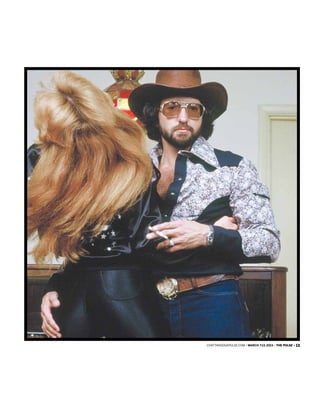
John “Cadillac Dave”
Wheeler and friend, circa
1970s.
Photo courtesyJohn Wheeler
“John really was a
badass. I’m trying
not to say that, but
that’s what he was
and he wanted to be
seen that way.”
Tom Griscom
Former executive editor of
the Times Free Press and
Wheeler’s editor at The Echo,
the UTC student newspaper
CHATTANOOGAPULSE.COM • MARCH 7-13, 2013 • THE PULSE • 13
14 • THE PULSE • MARCH 7-13, 2013 • CHATTANOOGAPULSE.COM
newspaper was taxpayer-funded—stirred
up far more controversy than his radical
politics. Griscom resigned in protest, but
came back the following year as editor.
“He looked like somebody you wouldn’t
want to tangle with ... John really was a ba-
dass,” added Griscom. “I’m trying not to say
that, but that’s what he was and he wanted
to be seen that way.”
Wheeler paints a vivid scene of his bud-
dies spiriting him out the back door of the
UTC student center incognito to avoid the
campus and city cops staking out his car,
which they knew from an informant had
dope in its trunk. Despite that narrow es-
cape, expulsion soon followed and Wheeler
went on to become a major player in the
Southeastern drug trade.
Both Griscom and Wheeler graduated
from Chattanooga to conservative national
politics. While Wheeler was distributing
cocaine, Griscom was serving as press sec-
retary for then-U.S. Sen. Howard Baker
and later as communications director for
President Ronald Reagan. Wheeler eventu-
ally made it to conservative D.C., too, after
detouring through three jail terms, more
than a few years as a wanted fugitive and
an unfinished assignment as ghost writer
for a self-described “mafia whore.”
Looking back in print 30 years later,
Wheeler doesn’t exactly wallow in what he
has now left behind. From the first page it’s
clear that he’s putting some distance into
his you-are-there retelling. But there’s not a
bit of preaching while he’s telling tales on
his earlier self. He takes the reader vividly
through some harrowing experiences, as
seen from his catbird seat at the epicenter
of late-70’s drug culture—and in the cross
hairs of every level of law enforcement.
After many recounted episodes of deal-
ing, doping and carnal congress, Wheeler’s
bumpy road to Damascus begins with some
spontaneous and heartfelt appeals to God,
even while he remained deeply embedded
in a drug-fueled career as a bigtime coke
dealer. This nascent religious awakening
helps him make it through—barely—what
he sees even 30 years later as a satanic en-
counter, even though he admits there was
a lot of “rocket fuel” (25 percent PCP, 75
percent cocaine) in his system at the time.
Were the neighbors at his safe house try-
ing to kill him? Was he trying to throw his
girlfriend off a bridge, or was she really the
devil?
His final conversion comes a few weeks
later. He’s gotten out of the mental hospital
he checked himself into to avoid an invol-
untary commitment after the bridge epi-
sode, but he’s still in “the life.”
“I got saved down in Miami in a biker’s
duplex with a chopper sittin’ in the living
room and a naked go-go girl on the couch
beside me, all the drugs spread out on the
table, and a picture of the devil on the wall.
That was March 18, 1981,” Wheeler said.
After his conversion, facing federal gun
charges, he stares down the temptation to
let his Colombian cartel amigos make the
legal problems go away. Instead he stays
clean and argues his case in court.
“Thanksgiving 1982, I was standing be-
fore a federal judge in Norfolk [Va.]. Every
lawyer had told me. ‘It’s impossible; you’re
going to federal prison.’ The judge stopped
the witness on the way to the [witness]
stand, halted the proceedings and said, ‘I
don’t know why I’m doing this, but I’m go-
ing to let you go. I’m going to give you pro-
bation.’ If that’s not God, I don’t know what
is.”
Ten years later Wheeler made it to Wash-
ington, D.C.
“Flash forward to 1992, August. I’m driv-
ing my own car through Secret Service se-
curity clearance at the White House to walk
inside and interview Vice President Dan
Quayle” as the founding editor of the Chris-
tian American, a national newspaper pub-
lished by Pat Robertson of The 700 Club.
“God did that, I didn’t,” he said.
“What happened to put me in that mental
hospital and what happened as a result of
that—which brought me to that deliverance
moment in Miami—that’s the whole reason
the books were written. Everything else is
back story,” he said.
“It’s a long story. Some of it is degenerate.
A lot of it makes me look kind of foolish,”
Wheeler said. “If I were going to portray
myself as a hero, I probably didn’t do a very
good job, because I did a lot of stupid things.
Most of them are right there in the book.”
He’s been gratified by response to the
books at book-signings last year and at his
45th reunions at the three high schools he
attended: Baylor, Brainerd and Central.
“Some people think it’s reprehensible,
some people are scandalized,” he said. “One
pastor told me that it was a celebration of
carnality and I should repent and take the
books off the market. Four of five pastors
that I’ve talked to about it disagreed with
that.”
For more information or to purchase
Wheeler’s books, visit cadillac-dave.com.
«P12
“IgotsaveddowninMiamiinabiker’sduplexwithachopper
sittin’inthelivingroomandanakedgo-gogirlonthecouchbeside
me,allthedrugsspreadoutonthetable,andapictureofthedevil
onthewall.ThatwasMarch18,1981.”John Wheeler, aka “Cadillac Dave”
“If I were going to portray
myself as a hero, I probably
didn’t do a very good job,
because I did a lot of stupid
things. Most of them are
right there in the book.”
John Wheeler

Pulse_pg12-14

  • 1.
    12 • THEPULSE • MARCH 7-13, 2013 • CHATTANOOGAPULSE.COM /ohn Wheel- er’s “Cadil- lac Dave” books must be unique in the annals of Chattanooga non- fiction. If you took all the histories and memoirs ever published about Chattanooga and brought them all together in one hypo- thetical and impossibly com- plete library, not only would the “Cadillac Dave” books in- clude one of the only first-hand accounts of 1960’s campus radicalism at the University of Chattanooga (and later UTC), they would surely be the only history or memoir to be cross- referenced in both the “Sex, Drugs and Rock ‘n’ Roll” and “Religion” categories. “The ‘Cadillac Dave’ books are a story of redemption,” ac- cording to Wheeler. The book covers—there are four volumes, plus a new collected “reader”— show they are authored by Dave Jackson, an alias he used when he was a marijuana and cocaine distributor, but he revealed his identity during book promo- tions last year. Wheeler first told his story in the four volumes published in 2011 and 2012. Fearing that four 200-page books might be too much for some, he published a one-volume “Chronicles of Ca- dillac Dave” this month that comes in it at 500 pages. Much of the original Chattanooga ma- terial was abbreviated but can be found in Volume One, which remains in print (all four vol- umes and the collected chron- icles are available at Winder Binder Gallery & Bookstore). “They deal with topics rang- ing from the drug and rock ‘n’ roll counterculture of the late ’60s and the entire 1970s to marijuana smuggling in Ari- zona and Texas, large-scale marijuana distribution all over the Southeast, and dealings with Colombian cocaine dealers in Miami and L.A.,” he added. “They cover a wide range of ex- periences. A lot of them are il- legal. Some of them aren’t very commendable, but they’re all true.” Wheeler’s story begins in 1966 when he was in high school sniffing glue, doing small burglaries and roaring around Chattanooga in a black Chevelle SS396 with Maltese crosses on the windows and a “Rebels” li- cense plate up front. At the University of Chatta- nooga and then UTC, he was at the center of a small but tumul- tuous swirl of late-60’s campus protest. Former Chattanooga Times Free Press executive edi- tor Tom Griscom was Wheeler’s editor at The Echo, the UTC stu- dent newspaper. He remembers Wheeler as a part of an anti-war group. “It was a very conspicuous group of people,” Griscom re- called. “Some of them were clearly anti-war. Some were into drug culture, the peace-love type thing. There were some that were just anti-whatever. There were others who I think were looking for a place to fit in, they might have been little bit off the beaten path. John was a great writer. He would sit there out in front of the student center with them and sometimes read poetry, sing with guitars and stuff.” When UT trustees were meeting in Chattanooga one cold winter day, campus po- lice sprayed Cardiac Hill with water, creating a sheet of ice to keep student protesters away. Wheeler was one of two student observers invited to attend the trustees’ meeting. Wheeler was the student newspaper’s star columnist and a stringer for the Chattanooga Times. He somehow managed to get a column into print in The Echo that was not only politi- cally radical, but also included an ever-popular but seldom- published four-letter word for carnal congress. That impropri- ety—unignorable because the !"# $%&&%'() *%'+&&%, -%.# !"# () *%'+&&%, -%.#FEAR&LOATHING IN CHATTANOOGA A Saga of Journalism, Drugs & Redemption BYRICHBAILEY »P14 John “Cadillac Dave” Wheeler and friend, circa 1970s. Photo courtesyJohn Wheeler “John really was a badass. I’m trying not to say that, but that’s what he was and he wanted to be seen that way.” Tom Griscom Former executive editor of the Times Free Press and Wheeler’s editor at The Echo, the UTC student newspaper
  • 2.
    CHATTANOOGAPULSE.COM • MARCH7-13, 2013 • THE PULSE • 13
  • 3.
    14 • THEPULSE • MARCH 7-13, 2013 • CHATTANOOGAPULSE.COM newspaper was taxpayer-funded—stirred up far more controversy than his radical politics. Griscom resigned in protest, but came back the following year as editor. “He looked like somebody you wouldn’t want to tangle with ... John really was a ba- dass,” added Griscom. “I’m trying not to say that, but that’s what he was and he wanted to be seen that way.” Wheeler paints a vivid scene of his bud- dies spiriting him out the back door of the UTC student center incognito to avoid the campus and city cops staking out his car, which they knew from an informant had dope in its trunk. Despite that narrow es- cape, expulsion soon followed and Wheeler went on to become a major player in the Southeastern drug trade. Both Griscom and Wheeler graduated from Chattanooga to conservative national politics. While Wheeler was distributing cocaine, Griscom was serving as press sec- retary for then-U.S. Sen. Howard Baker and later as communications director for President Ronald Reagan. Wheeler eventu- ally made it to conservative D.C., too, after detouring through three jail terms, more than a few years as a wanted fugitive and an unfinished assignment as ghost writer for a self-described “mafia whore.” Looking back in print 30 years later, Wheeler doesn’t exactly wallow in what he has now left behind. From the first page it’s clear that he’s putting some distance into his you-are-there retelling. But there’s not a bit of preaching while he’s telling tales on his earlier self. He takes the reader vividly through some harrowing experiences, as seen from his catbird seat at the epicenter of late-70’s drug culture—and in the cross hairs of every level of law enforcement. After many recounted episodes of deal- ing, doping and carnal congress, Wheeler’s bumpy road to Damascus begins with some spontaneous and heartfelt appeals to God, even while he remained deeply embedded in a drug-fueled career as a bigtime coke dealer. This nascent religious awakening helps him make it through—barely—what he sees even 30 years later as a satanic en- counter, even though he admits there was a lot of “rocket fuel” (25 percent PCP, 75 percent cocaine) in his system at the time. Were the neighbors at his safe house try- ing to kill him? Was he trying to throw his girlfriend off a bridge, or was she really the devil? His final conversion comes a few weeks later. He’s gotten out of the mental hospital he checked himself into to avoid an invol- untary commitment after the bridge epi- sode, but he’s still in “the life.” “I got saved down in Miami in a biker’s duplex with a chopper sittin’ in the living room and a naked go-go girl on the couch beside me, all the drugs spread out on the table, and a picture of the devil on the wall. That was March 18, 1981,” Wheeler said. After his conversion, facing federal gun charges, he stares down the temptation to let his Colombian cartel amigos make the legal problems go away. Instead he stays clean and argues his case in court. “Thanksgiving 1982, I was standing be- fore a federal judge in Norfolk [Va.]. Every lawyer had told me. ‘It’s impossible; you’re going to federal prison.’ The judge stopped the witness on the way to the [witness] stand, halted the proceedings and said, ‘I don’t know why I’m doing this, but I’m go- ing to let you go. I’m going to give you pro- bation.’ If that’s not God, I don’t know what is.” Ten years later Wheeler made it to Wash- ington, D.C. “Flash forward to 1992, August. I’m driv- ing my own car through Secret Service se- curity clearance at the White House to walk inside and interview Vice President Dan Quayle” as the founding editor of the Chris- tian American, a national newspaper pub- lished by Pat Robertson of The 700 Club. “God did that, I didn’t,” he said. “What happened to put me in that mental hospital and what happened as a result of that—which brought me to that deliverance moment in Miami—that’s the whole reason the books were written. Everything else is back story,” he said. “It’s a long story. Some of it is degenerate. A lot of it makes me look kind of foolish,” Wheeler said. “If I were going to portray myself as a hero, I probably didn’t do a very good job, because I did a lot of stupid things. Most of them are right there in the book.” He’s been gratified by response to the books at book-signings last year and at his 45th reunions at the three high schools he attended: Baylor, Brainerd and Central. “Some people think it’s reprehensible, some people are scandalized,” he said. “One pastor told me that it was a celebration of carnality and I should repent and take the books off the market. Four of five pastors that I’ve talked to about it disagreed with that.” For more information or to purchase Wheeler’s books, visit cadillac-dave.com. «P12 “IgotsaveddowninMiamiinabiker’sduplexwithachopper sittin’inthelivingroomandanakedgo-gogirlonthecouchbeside me,allthedrugsspreadoutonthetable,andapictureofthedevil onthewall.ThatwasMarch18,1981.”John Wheeler, aka “Cadillac Dave” “If I were going to portray myself as a hero, I probably didn’t do a very good job, because I did a lot of stupid things. Most of them are right there in the book.” John Wheeler