Aspects of pulmonary function:
Perfusion- Blood flow.
Diffusion- Movement of O2 & CO2.
Ventilation- Air exchange btwn alveolar
spaces & the atmosphere.
Tidal Volume(TV)
Inspiratory Reserve Volume(IRV)
Inspiratory Capacity(IC)
Functional Residual Capacity(FRC)
Expiratory Reserve Volume(ERV)
Residual Volume(RV)
Vital Capacity(VC)
Alveolar Ventilation
 Assessment of various aspects of pulmonary
physiology.
 Detect & quantify the respiratory disease.
 Evaluation of the disease & its response to
therapy.
 Provide valuable clinical information.
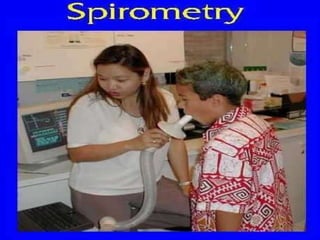
Spirometry
Bronchial provocation test
Static lung volumes
Carbon monoxide diffusing capacity
Alveolar arterial oxygen gradient
Exercise testing
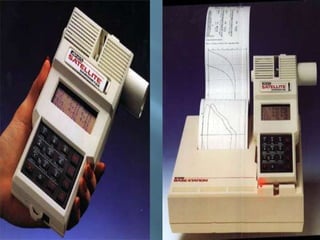
Measures the volume of air inspired or expired &
records the time –the volume change occurs.
Mechanical signal →electrical signal→records the
amt of gas breathed in & out→ SPIROGRAM.
2 major categories:-
mechanical electronic or flow sensing
or
volume-displacement
o Determines the effectiveness of various
mechanical forces involved in lung & chest
wall movement.
o The values obtained provide quantitative
information abt the degree of obstruction to
expiratory airflow or the degree of restriction
of inspired air.
Metal container with 2 chambers.
Outer chamber(water chamber) has a floating
drum.
Drum is counter balanced by weight-string.
Pen attached to counter wt-writes on calibrated
paper , fixed to a recording device.
Inner chamber inverted with small hole at the
top& long metal tube passes through it.
Top end of the tube penetrates into outer
chamber above level of water & other end is
mouthpiece.
Respiration-closed nose by nose clip(5-30min).
 The forced expiratory volumes exhaled within
1,2,3 seconds – timed vital
capacities(FEV1,FEV2 & FEV3 res).
 FEF25-75 –forced expiratory flow btwn 25%
&75%.
 Measurements are useful for evaluating a
patient’s response to bronchodilators.
 If FEV1 <80% of predicted or FEF25-75% is
<60% of predicted, bronchodilators are
administered –nebulizer; spirometry is
repeated.
 Measured (actual) spirometry values are
compared with predicted values- age , height,
weight & gender; expressed as a % of predicted
value.(>80% normal limits).
 During expiration floating drum moves up ,
counter wt comes down , downward deflection
on the graph.
 Inspiration the drum moves down, counter wt
comes up, upward deflection on the graph.
 Spirometry test –measured twice both before
and after given a bronchodilator.
 Improvement in measurements means patient
will respond well.
DISADVANTAGE
• Only for single use due to CO2 accumulation &
O2 cannot be supplied.
• Residual Volume, Functional Residual
Capacity and Total Lung Capacity cannot be
measured.
 To establish baseline ventilatory function.
 To detect disease.
 To follow course of disease.
 Monitoring treatment.
 Evaluation of impairment.
 Pre-operative evaluation.
 Occupational surveys.
 Provocative material is given by inhalation &
bronchospasm provoked in the laboratory.
 3 Types of provocative materials used:
1) Nonspecific pharmacologic- Histamine,
Methacholine.
2) Nonspecific irritant- Sulphurdioxide , smoke,
citric acid.
3) Specific-Individual allergen.
 20% fall in FEV1 from basal values – positive
response.
 Histamine solution by nebulisation - 8mg/ml.
INDICATIONS FOR TESTING:-
 To identify patients with hypersensitive or
hyper reactive airways- diagnosing asthma.
 To identify specific provocative factors.
 Research tool to study pathophysiology of
acute reversible bronchospasm.
3 Basic techniques for measurement of lung
volumes:-
 Gas dilution methods.
 Body plethysmography.
 Radiographic techniques.
INDICATIONS FOR STATIC LUNG VOLUMES:-
 Restrictive lung diseases –
 Confirming diagnosis.
 Establishing baseline & quantitating the level
of impairment.
 Evaluating response to therapy & following
the course of the disease.
 Obstructive lung diseases –
 To assess severity of disease.
 Assess clinical course and response to therapy.
 Diffusing capacity –the rate at which gas enters
the blood divided by the driving pressure of
the gas.
FACTORS AFFECTING DIFFUSING
CAPACITY-
 Changes in alveolar capillary membrane.
 Ventilation to perfusion distribution.
 Hemoglobin concentration.
 Pulmonary circulation.
Reduced diffusing capacity is seen in:-
Anemia, multiple pulmonary emboli, emphysema,
pulmonary resection interstitial lung disease
&severe bronchospasm.
INDICATIONS FOR CO DIFFUSING
CAPACITY:-
Unexplained dyspnoea due to early interstitial
lung disease.
Differentiating emphysema from chronic
bronchitis & asthma.
Diagnosis & follow up of patients with interstitial
lung disease.
Diagnosis of recurrent multiple pulmonary emboli.
Alveolar oxygen tension is calculated & arterial
oxygen tension measured by blood gas
estimation.
Difference btwn the two gives a measurement
of alveolar to arterial oxygen gradient. In
normal →5-15 mm Hg.
Increased AAOG is due to 3 mechanisms:-
i. Ventilation perfusion mismatch.
ii. Increased right to left shunt.
iii. Diffusion block.
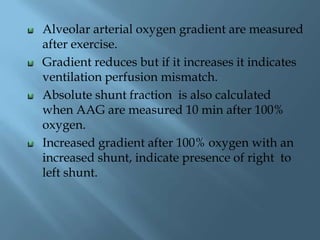
Alveolar arterial oxygen gradient are measured
after exercise.
Gradient reduces but if it increases it indicates
ventilation perfusion mismatch.
Absolute shunt fraction is also calculated
when AAG are measured 10 min after 100%
oxygen.
Increased gradient after 100% oxygen with an
increased shunt, indicate presence of right to
left shunt.
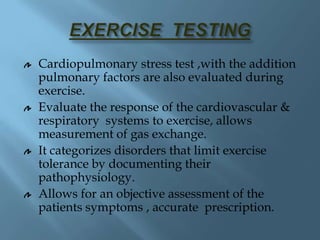
Cardiopulmonary stress test ,with the addition
pulmonary factors are also evaluated during
exercise.
Evaluate the response of the cardiovascular &
respiratory systems to exercise, allows
measurement of gas exchange.
It categorizes disorders that limit exercise
tolerance by documenting their
pathophysiology.
Allows for an objective assessment of the
patients symptoms , accurate prescription.
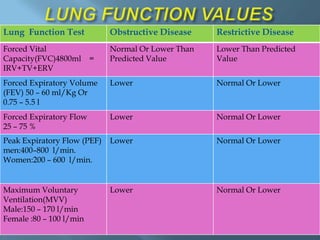
Lung Function Test Obstructive Disease Restrictive Disease
Forced Vital
Capacity(FVC)4800ml =
IRV+TV+ERV
Normal Or Lower Than
Predicted Value
Lower Than Predicted
Value
Forced Expiratory Volume
(FEV) 50 – 60 ml/Kg Or
0.75 – 5.5 l
Lower Normal Or Lower
Forced Expiratory Flow
25 – 75 %
Lower Normal Or Lower
Peak Expiratory Flow (PEF)
men:400–800 l/min.
Women:200 – 600 l/min.
Lower Normal Or Lower
Maximum Voluntary
Ventilation(MVV)
Male:150 – 170 l/min
Female :80 – 100 l/min
Lower Normal Or Lower
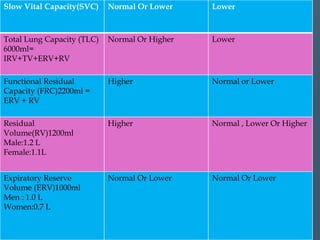
Slow Vital Capacity(SVC) Normal Or Lower Lower
Total Lung Capacity (TLC)
6000ml=
IRV+TV+ERV+RV
Normal Or Higher Lower
Functional Residual
Capacity (FRC)2200ml =
ERV + RV
Higher Normal or Lower
Residual
Volume(RV)1200ml
Male:1.2 L
Female:1.1L
Higher Normal , Lower Or Higher
Expiratory Reserve
Volume (ERV)1000ml
Men : 1.0 L
Women:0.7 L
Normal Or Lower Normal Or Lower
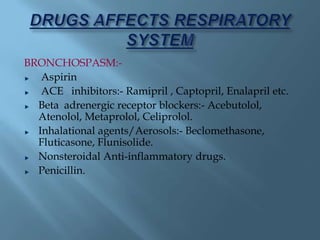
BRONCHOSPASM:-
Aspirin
ACE inhibitors:- Ramipril , Captopril, Enalapril etc.
Beta adrenergic receptor blockers:- Acebutolol,
Atenolol, Metaprolol, Celiprolol.
Inhalational agents/Aerosols:- Beclomethasone,
Fluticasone, Flunisolide.
Nonsteroidal Anti-inflammatory drugs.
Penicillin.
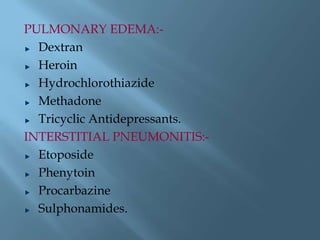
PULMONARY EDEMA:-
Dextran
Heroin
Hydrochlorothiazide
Methadone
Tricyclic Antidepressants.
INTERSTITIAL PNEUMONITIS:-
Etoposide
Phenytoin
Procarbazine
Sulphonamides.
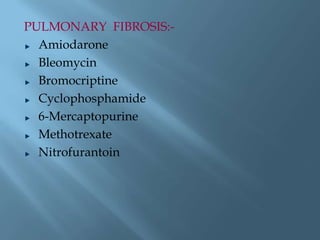
PULMONARY FIBROSIS:-
Amiodarone
Bleomycin
Bromocriptine
Cyclophosphamide
6-Mercaptopurine
Methotrexate
Nitrofurantoin
A MANUAL OF LBORATORY &
DIAGNOSTIC TESTS ,8th EDITION.
A PATHOPHYSIOLOGIC APPROACH BY
JOSEPH .T. DIPIRO.
APPLIED THERAPEUTICS,8th EDITION.
PULMONARY FUNCTION TESTS BY RAJIV
.S. MATHUR
M.D(Med),D.N.B.(Resp.Med),CHEST
PHYSICIAN,JASLOK HOSPITAL,BOMBAY.
http://www.webmed.com/asthma/guide/lun
g-function-tests-asthma.
Pulmonary function test

Pulmonary function test

  • 2.
    Aspects of pulmonaryfunction: Perfusion- Blood flow. Diffusion- Movement of O2 & CO2. Ventilation- Air exchange btwn alveolar spaces & the atmosphere.
  • 3.
    Tidal Volume(TV) Inspiratory ReserveVolume(IRV) Inspiratory Capacity(IC) Functional Residual Capacity(FRC) Expiratory Reserve Volume(ERV) Residual Volume(RV) Vital Capacity(VC) Alveolar Ventilation
  • 4.
     Assessment ofvarious aspects of pulmonary physiology.  Detect & quantify the respiratory disease.  Evaluation of the disease & its response to therapy.  Provide valuable clinical information.
  • 5.
    Spirometry Bronchial provocation test Staticlung volumes Carbon monoxide diffusing capacity Alveolar arterial oxygen gradient Exercise testing
  • 7.
    Measures the volumeof air inspired or expired & records the time –the volume change occurs. Mechanical signal →electrical signal→records the amt of gas breathed in & out→ SPIROGRAM. 2 major categories:- mechanical electronic or flow sensing or volume-displacement
  • 8.
    o Determines theeffectiveness of various mechanical forces involved in lung & chest wall movement. o The values obtained provide quantitative information abt the degree of obstruction to expiratory airflow or the degree of restriction of inspired air.
  • 9.
    Metal container with2 chambers. Outer chamber(water chamber) has a floating drum. Drum is counter balanced by weight-string. Pen attached to counter wt-writes on calibrated paper , fixed to a recording device. Inner chamber inverted with small hole at the top& long metal tube passes through it. Top end of the tube penetrates into outer chamber above level of water & other end is mouthpiece. Respiration-closed nose by nose clip(5-30min).
  • 11.
     The forcedexpiratory volumes exhaled within 1,2,3 seconds – timed vital capacities(FEV1,FEV2 & FEV3 res).  FEF25-75 –forced expiratory flow btwn 25% &75%.  Measurements are useful for evaluating a patient’s response to bronchodilators.  If FEV1 <80% of predicted or FEF25-75% is <60% of predicted, bronchodilators are administered –nebulizer; spirometry is repeated.
  • 12.
     Measured (actual)spirometry values are compared with predicted values- age , height, weight & gender; expressed as a % of predicted value.(>80% normal limits).  During expiration floating drum moves up , counter wt comes down , downward deflection on the graph.  Inspiration the drum moves down, counter wt comes up, upward deflection on the graph.  Spirometry test –measured twice both before and after given a bronchodilator.  Improvement in measurements means patient will respond well.
  • 13.
    DISADVANTAGE • Only forsingle use due to CO2 accumulation & O2 cannot be supplied. • Residual Volume, Functional Residual Capacity and Total Lung Capacity cannot be measured.
  • 14.
     To establishbaseline ventilatory function.  To detect disease.  To follow course of disease.  Monitoring treatment.  Evaluation of impairment.  Pre-operative evaluation.  Occupational surveys.
  • 15.
     Provocative materialis given by inhalation & bronchospasm provoked in the laboratory.  3 Types of provocative materials used: 1) Nonspecific pharmacologic- Histamine, Methacholine. 2) Nonspecific irritant- Sulphurdioxide , smoke, citric acid. 3) Specific-Individual allergen.
  • 16.
     20% fallin FEV1 from basal values – positive response.  Histamine solution by nebulisation - 8mg/ml. INDICATIONS FOR TESTING:-  To identify patients with hypersensitive or hyper reactive airways- diagnosing asthma.  To identify specific provocative factors.  Research tool to study pathophysiology of acute reversible bronchospasm.
  • 17.
    3 Basic techniquesfor measurement of lung volumes:-  Gas dilution methods.  Body plethysmography.  Radiographic techniques.
  • 18.
    INDICATIONS FOR STATICLUNG VOLUMES:-  Restrictive lung diseases –  Confirming diagnosis.  Establishing baseline & quantitating the level of impairment.  Evaluating response to therapy & following the course of the disease.  Obstructive lung diseases –  To assess severity of disease.  Assess clinical course and response to therapy.
  • 19.
     Diffusing capacity–the rate at which gas enters the blood divided by the driving pressure of the gas. FACTORS AFFECTING DIFFUSING CAPACITY-  Changes in alveolar capillary membrane.  Ventilation to perfusion distribution.  Hemoglobin concentration.  Pulmonary circulation.
  • 20.
    Reduced diffusing capacityis seen in:- Anemia, multiple pulmonary emboli, emphysema, pulmonary resection interstitial lung disease &severe bronchospasm. INDICATIONS FOR CO DIFFUSING CAPACITY:- Unexplained dyspnoea due to early interstitial lung disease. Differentiating emphysema from chronic bronchitis & asthma. Diagnosis & follow up of patients with interstitial lung disease. Diagnosis of recurrent multiple pulmonary emboli.
  • 21.
    Alveolar oxygen tensionis calculated & arterial oxygen tension measured by blood gas estimation. Difference btwn the two gives a measurement of alveolar to arterial oxygen gradient. In normal →5-15 mm Hg. Increased AAOG is due to 3 mechanisms:- i. Ventilation perfusion mismatch. ii. Increased right to left shunt. iii. Diffusion block.
  • 22.
    Alveolar arterial oxygengradient are measured after exercise. Gradient reduces but if it increases it indicates ventilation perfusion mismatch. Absolute shunt fraction is also calculated when AAG are measured 10 min after 100% oxygen. Increased gradient after 100% oxygen with an increased shunt, indicate presence of right to left shunt.
  • 23.
    Cardiopulmonary stress test,with the addition pulmonary factors are also evaluated during exercise. Evaluate the response of the cardiovascular & respiratory systems to exercise, allows measurement of gas exchange. It categorizes disorders that limit exercise tolerance by documenting their pathophysiology. Allows for an objective assessment of the patients symptoms , accurate prescription.
  • 24.
    Lung Function TestObstructive Disease Restrictive Disease Forced Vital Capacity(FVC)4800ml = IRV+TV+ERV Normal Or Lower Than Predicted Value Lower Than Predicted Value Forced Expiratory Volume (FEV) 50 – 60 ml/Kg Or 0.75 – 5.5 l Lower Normal Or Lower Forced Expiratory Flow 25 – 75 % Lower Normal Or Lower Peak Expiratory Flow (PEF) men:400–800 l/min. Women:200 – 600 l/min. Lower Normal Or Lower Maximum Voluntary Ventilation(MVV) Male:150 – 170 l/min Female :80 – 100 l/min Lower Normal Or Lower
  • 25.
    Slow Vital Capacity(SVC)Normal Or Lower Lower Total Lung Capacity (TLC) 6000ml= IRV+TV+ERV+RV Normal Or Higher Lower Functional Residual Capacity (FRC)2200ml = ERV + RV Higher Normal or Lower Residual Volume(RV)1200ml Male:1.2 L Female:1.1L Higher Normal , Lower Or Higher Expiratory Reserve Volume (ERV)1000ml Men : 1.0 L Women:0.7 L Normal Or Lower Normal Or Lower
  • 26.
    BRONCHOSPASM:- Aspirin ACE inhibitors:- Ramipril, Captopril, Enalapril etc. Beta adrenergic receptor blockers:- Acebutolol, Atenolol, Metaprolol, Celiprolol. Inhalational agents/Aerosols:- Beclomethasone, Fluticasone, Flunisolide. Nonsteroidal Anti-inflammatory drugs. Penicillin.
  • 27.
  • 28.
  • 29.
    A MANUAL OFLBORATORY & DIAGNOSTIC TESTS ,8th EDITION. A PATHOPHYSIOLOGIC APPROACH BY JOSEPH .T. DIPIRO. APPLIED THERAPEUTICS,8th EDITION. PULMONARY FUNCTION TESTS BY RAJIV .S. MATHUR M.D(Med),D.N.B.(Resp.Med),CHEST PHYSICIAN,JASLOK HOSPITAL,BOMBAY. http://www.webmed.com/asthma/guide/lun g-function-tests-asthma.