SPIROMETRY
By Monnaf Ali
1st year MOTAT
24MOTAT002
OBJECTIVES
• Definition
• Lung volumes & Capacities
• Indications
• Contraindications
• Procedure
• Recommendations
DEFINITION
• The word spirometry means
spiro
means respiration/breathing
metry means measure
• It is derived from latin.
• It is a physiological test that measures how an individual inhales
& exhales volumes of air as a function of time.
• Its assesses the mechanical function of the lung ,chest wall,& respiratory
muscles by measuring total vol.of.air exhaled from a full lung [TLC] to
maximal expiration [RV].
LUNG VOLUMES & CAPACITIES
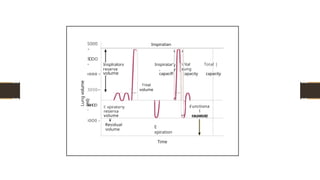
> 4 VOLUMES
• Inspiratory Reserve Volume [IRV]
• Tidal volume [TV]
• Expiratory Reserve Volume [ERV]
• Residual Volume [RV]
o 2 OR More volumes comprise a Capacity
> 4 CAPACITIES
• Vital Capacity [VC]
• Inspiratory Capacity [IC]
• Functional Residual Capacity [FRC]
• Total Lung Capacity [TLC].
LUNG VOLUMES
 TIDAL VOLUME [TV] : Vol. of. Air inhaled or exhaled with each breath during
quite respiration.
400-500 ml [10ml/kg ].
> INSPIRATORY RESERVE VOLUME [IRV] : Max. vol. of. Air inhaled from the end
inspiratory position.
2400-2600 ml.
> EXPIRATORY RESERVE VOLUME [ERV] : Max. vol. of. Air that can be exhaled after
normal expiration.
1200-1500 ml
> RESIDUAL VOLUME [RV] : Vol. of. Air remaining in lungs after maximum
exhalation.
• Indirectly measured [ FRC – ERV ] not by spirometry.
1200-1500 ml.
LUNG CAPACITY
TOTAL LUNG CAPACITY [TLC] : Sum of all volume compartments OR
vol.of.air in the lungs after maximum inspiration.
TLC = TV+IRV+ERV+RV. [5500- 6000ml].
> VITAL CAPACITY [VC] : Max. vol. of air exhaled from maximal inspiratory
level.
VC= TV+IRV+ERV. [4200-4500ml]. 75-80ml/kg.
> INSPIRATORY CAPACITY [IC] : Max. vol. of air that can be inhaled from the
end expiratory position.
IC= TV+IRV. [3000ml].
> FUNCTIONAL RESIDUAL CAPACITY [FRC] : Vol. of.air in the lungs at the
end expiration.
FRC= ERV+RV. [2400-2600ml].
Lung
volume
(ml)
SOOO
-
S
O
OO
-
‹ooo -
Insplralorv
reserve
volume
3000-
W
H
OO
-
E xpirator•y
reserva
volume
¥
i0O0 -
Residual
volume
Inspiratian
Tldal
volume
Inspiratar'
,
capacifl
'ital Total |
ung
:apacity capacity
E
xpiration
Time
Functiona
l
rs siclual
INDICATIONS
1. To confirm lung disease by symptoms,signs,& laboratory
findings.
> Symptoms
• Dyspnea,wheezing.
• Cough,phlegm production.
• Chest discomfort,orthopnea.
> Signs
• Abnormal breathing sounds.
• Decreased breathing sounds.
• Chest wall abnormalities.
• Cyanosis,finger clubbing.
> Abnormal LABORATORY findings
• Chest x-ray,CT scan.
• Arterial blood gases,pulse oximetry
2. The impact of known disease on lung function.
> Pulmonary diseases
• Chronic obstructive pulmonary disease.
• Asthma
• Cystic fibrosis
• Interstitial diseases
> Cardiac disseases
• Congestive heart failure
• Congenital heart diseases
• Pulmonary hypertention
> Neuromuscular diseases
• Guillian barre syndrome
• Amyotrophic lateral sclerosis
• Multiple sclerosis
• Mystenia
3. To measure the effects of noxious exposures.
• Smoking
• Environmental pollution
• Occupational agents
4.To assess the risk for surgical procedures known to affect lung function.
• Lung resection
• Thoracotomy
• Cardiac surgery
• Upper abdominal surgery.
5. To perform pre operative assessment.
CONTRAINDICATIONS
1. Absolute
• Myocardial infraction within the previous month.
2. Relative
• Hemoptysis of unknown origin
• Pneumothorax
• Unstable cardiovascular status,recent myocardial infraction/pulmonary embolus
• Thoracis,abdominal/cerebral aneurysms
• Recent eye surgery
• Presence of acute disease that might interfere test performance
• Recent thoracic/abdominal surgery
• Dementia/confusinal state
3. Adverse effect –head ache,fainting –due to decreased venous return.
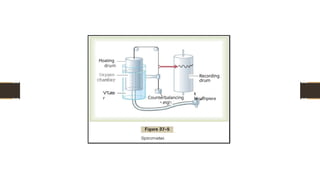
Floating
drum
Oxygen
chamber
'vӢate
r Counterbalancing
•.eigh
Recording
drum
k
Mouthpiece
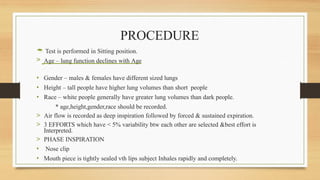
PROCEDURE
 Test is performed in Sitting position.
> Age – lung function declines with Age
• Gender – males & females have different sized lungs
• Height – tall people have higher lung volumes than short people
• Race – white people generally have greater lung volumes than dark people.
* age,height,gender,race should be recorded.
> Air flow is recorded as deep inspiration followed by forced & sustained expiration.
> 3 EFFORTS which have < 5% variability btw each other are selected &best effort is
Interpreted.
> PHASE INSPIRATION
• Nose clip
• Mouth piece is tightly sealed vth lips subject Inhales rapidly and completely.
> PHASE OF EXHALATION
• Subject should be prompted to BLAST not just to BLOW,the air from their lungs .
• Exhalation should be forced & sustained
> Subject should try to exhale for
 ADULT >= 6 sec [ age > 10 yrs ]
 CHILDREN >= 3sec [ age < 10 yrs ]
D TWO IMPORTANT PARAMETERS :
 FORCED VITAL CAPACITY ( FVC ) – Vol.of.air that can be forcefully exhaled after a maximal
inhalation.
• Majority of FVC can be exhaled in < 3sec of exhalation in normal people, whereas it is
prolonged in people vth Obstructive lung diseases.
 FORCED EXPIRATORY VOLUME in 1 Sec ( FEV 1) vol. of. Air exhaled in first second
of FVC.
> NORMAL subject can exhale 75-80%of their FVC in 1st second
 FEV1/FVC ratio is an important determinant in assessing lung disease.
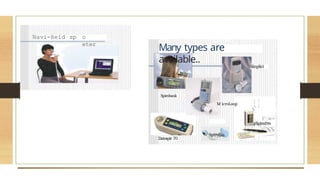
Navi-Reid sp o
eter
Many types are
available..
Spirobank
Datospir 70
Siinplici
M icroLoop
-
ySpiroPro
SpiroSia
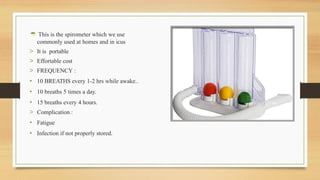
 This is the spirometer which we use
commonly used at homes and in icus
> It is portable
> Effortable cost
> FREQUENCY :
• 10 BREATHS every 1-2 hrs while awake..
• 10 breaths 5 times a day.
• 15 breaths every 4 hours.
> Complication :
• Fatigue
• Infection if not properly stored.
RECOMMENDATIONS
• It is recommended to
• Obesed people.
• People vth respiratory distress
• Pts who are on non invasive ventilation
• Pts underwent cardiothoracic surgery,major abdominal surgeries.
> It prevents the post operative pulmonary complications.
> So the pt have less icu stay.
THANK YOU

Spiroetry,Spirometer,Lung Function Test.

  • 1.
    SPIROMETRY By Monnaf Ali 1styear MOTAT 24MOTAT002
  • 2.
    OBJECTIVES • Definition • Lungvolumes & Capacities • Indications • Contraindications • Procedure • Recommendations
  • 3.
    DEFINITION • The wordspirometry means spiro means respiration/breathing metry means measure • It is derived from latin. • It is a physiological test that measures how an individual inhales & exhales volumes of air as a function of time. • Its assesses the mechanical function of the lung ,chest wall,& respiratory muscles by measuring total vol.of.air exhaled from a full lung [TLC] to maximal expiration [RV].
  • 4.
    LUNG VOLUMES &CAPACITIES > 4 VOLUMES • Inspiratory Reserve Volume [IRV] • Tidal volume [TV] • Expiratory Reserve Volume [ERV] • Residual Volume [RV] o 2 OR More volumes comprise a Capacity > 4 CAPACITIES • Vital Capacity [VC] • Inspiratory Capacity [IC] • Functional Residual Capacity [FRC] • Total Lung Capacity [TLC].
  • 5.
    LUNG VOLUMES  TIDALVOLUME [TV] : Vol. of. Air inhaled or exhaled with each breath during quite respiration. 400-500 ml [10ml/kg ]. > INSPIRATORY RESERVE VOLUME [IRV] : Max. vol. of. Air inhaled from the end inspiratory position. 2400-2600 ml. > EXPIRATORY RESERVE VOLUME [ERV] : Max. vol. of. Air that can be exhaled after normal expiration. 1200-1500 ml > RESIDUAL VOLUME [RV] : Vol. of. Air remaining in lungs after maximum exhalation. • Indirectly measured [ FRC – ERV ] not by spirometry. 1200-1500 ml.
  • 6.
    LUNG CAPACITY TOTAL LUNGCAPACITY [TLC] : Sum of all volume compartments OR vol.of.air in the lungs after maximum inspiration. TLC = TV+IRV+ERV+RV. [5500- 6000ml]. > VITAL CAPACITY [VC] : Max. vol. of air exhaled from maximal inspiratory level. VC= TV+IRV+ERV. [4200-4500ml]. 75-80ml/kg. > INSPIRATORY CAPACITY [IC] : Max. vol. of air that can be inhaled from the end expiratory position. IC= TV+IRV. [3000ml]. > FUNCTIONAL RESIDUAL CAPACITY [FRC] : Vol. of.air in the lungs at the end expiration. FRC= ERV+RV. [2400-2600ml].
  • 7.
    Lung volume (ml) SOOO - S O OO - ‹ooo - Insplralorv reserve volume 3000- W H OO - E xpirator•y reserva volume ¥ i0O0- Residual volume Inspiratian Tldal volume Inspiratar' , capacifl 'ital Total | ung :apacity capacity E xpiration Time Functiona l rs siclual
  • 8.
    INDICATIONS 1. To confirmlung disease by symptoms,signs,& laboratory findings. > Symptoms • Dyspnea,wheezing. • Cough,phlegm production. • Chest discomfort,orthopnea. > Signs • Abnormal breathing sounds. • Decreased breathing sounds. • Chest wall abnormalities. • Cyanosis,finger clubbing. > Abnormal LABORATORY findings • Chest x-ray,CT scan. • Arterial blood gases,pulse oximetry
  • 9.
    2. The impactof known disease on lung function. > Pulmonary diseases • Chronic obstructive pulmonary disease. • Asthma • Cystic fibrosis • Interstitial diseases > Cardiac disseases • Congestive heart failure • Congenital heart diseases • Pulmonary hypertention > Neuromuscular diseases • Guillian barre syndrome • Amyotrophic lateral sclerosis • Multiple sclerosis • Mystenia
  • 10.
    3. To measurethe effects of noxious exposures. • Smoking • Environmental pollution • Occupational agents 4.To assess the risk for surgical procedures known to affect lung function. • Lung resection • Thoracotomy • Cardiac surgery • Upper abdominal surgery. 5. To perform pre operative assessment.
  • 11.
    CONTRAINDICATIONS 1. Absolute • Myocardialinfraction within the previous month. 2. Relative • Hemoptysis of unknown origin • Pneumothorax • Unstable cardiovascular status,recent myocardial infraction/pulmonary embolus • Thoracis,abdominal/cerebral aneurysms • Recent eye surgery • Presence of acute disease that might interfere test performance • Recent thoracic/abdominal surgery • Dementia/confusinal state 3. Adverse effect –head ache,fainting –due to decreased venous return.
  • 12.
  • 13.
    PROCEDURE  Test isperformed in Sitting position. > Age – lung function declines with Age • Gender – males & females have different sized lungs • Height – tall people have higher lung volumes than short people • Race – white people generally have greater lung volumes than dark people. * age,height,gender,race should be recorded. > Air flow is recorded as deep inspiration followed by forced & sustained expiration. > 3 EFFORTS which have < 5% variability btw each other are selected &best effort is Interpreted. > PHASE INSPIRATION • Nose clip • Mouth piece is tightly sealed vth lips subject Inhales rapidly and completely.
  • 14.
    > PHASE OFEXHALATION • Subject should be prompted to BLAST not just to BLOW,the air from their lungs . • Exhalation should be forced & sustained > Subject should try to exhale for  ADULT >= 6 sec [ age > 10 yrs ]  CHILDREN >= 3sec [ age < 10 yrs ] D TWO IMPORTANT PARAMETERS :  FORCED VITAL CAPACITY ( FVC ) – Vol.of.air that can be forcefully exhaled after a maximal inhalation. • Majority of FVC can be exhaled in < 3sec of exhalation in normal people, whereas it is prolonged in people vth Obstructive lung diseases.  FORCED EXPIRATORY VOLUME in 1 Sec ( FEV 1) vol. of. Air exhaled in first second of FVC. > NORMAL subject can exhale 75-80%of their FVC in 1st second  FEV1/FVC ratio is an important determinant in assessing lung disease.
  • 15.
    Navi-Reid sp o eter Manytypes are available.. Spirobank Datospir 70 Siinplici M icroLoop - ySpiroPro SpiroSia
  • 16.
     This isthe spirometer which we use commonly used at homes and in icus > It is portable > Effortable cost > FREQUENCY : • 10 BREATHS every 1-2 hrs while awake.. • 10 breaths 5 times a day. • 15 breaths every 4 hours. > Complication : • Fatigue • Infection if not properly stored.
  • 17.
    RECOMMENDATIONS • It isrecommended to • Obesed people. • People vth respiratory distress • Pts who are on non invasive ventilation • Pts underwent cardiothoracic surgery,major abdominal surgeries. > It prevents the post operative pulmonary complications. > So the pt have less icu stay.
  • 18.