Public Procurement Rules,
2004
(Amended 28th June, 2021)
(Definitions & Terminologies etc)
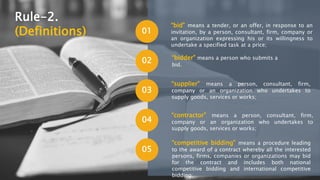
01
02
03
04
05
“bid” means a tender, or an offer, in response to an
invitation, by a person, consultant, firm, company or
an organization expressing his or its willingness to
undertake a specified task at a price;
“bidder” means a person who submits a
bid.
“competitive bidding” means a procedure leading
to the award of a contract whereby all the interested
persons, firms, companies or organizations may bid
for the contract and includes both national
competitive bidding and international competitive
bidding;
Rule-2.
(Definitions)
“supplier” means a person, consultant, firm,
company or an organization who undertakes to
supply goods, services or works;
“contractor” means a person, consultant, firm,
company or an organization who undertakes to
supply goods, services or works;
06
07
08
09
10 “emergency” means natural calamities, disasters,
accidents, war and operational emergency which may
give rise to abnormal situation requiring prompt and
immediate action to limit or avoid damage to person,
property or the environment;
“e-Procurement” means use of information and
communication technologies or digital or electronic
means for procurement process;
“framework agreement” means a contractual
arrangement which allows a procuring agency to
procure goods, services or works that are needed
continuously or repeatedly at agreed terms and
conditions over an agreed period of time, through
placement of a number of orders;]
“Open framework agreement” means an
agreement with specified terms and conditions
without an agreed price;]
Rule-2.
(Definitions)
“closed framework agreement” means an
agreement with specified terms and conditions with
an agreed price;]
11
12
13
“most advantageous bid” means,-
(i) a bid or proposal for goods, works or services
that after meeting the eligibility or qualification
criteria, is found substantially responsive to the
terms and conditions as set out in the bidding or
request for proposals document; and
(ii) evaluated as the highest ranked bid or proposal
on the basis of cost or quality or qualification or
any combination thereof, as specified in the
bidding documents or request for proposal
documents which shall be in conformity with the
selection techniques to be issued by the
Authority;]
“repeat orders” means procurement of the same
commodity from the same source without
competition and includes enhancement of contracts;
Rule-2.
(Definitions)
“call off order” means an order placed by a
procuring agency under general terms and pricing on
a range of goods under closed framework
agreement, without having to negotiate terms every
time;
14
15
“unsolicited project proposal” means any proposal
containing a unique and innovative idea and approach,
and the same is not submitted in response to any
procurement request, however is aligned with the
mission and objectives of the procuring agency and is
subject to competitive selection process by soliciting
counter proposals challenging the initiator’s proposal in
all the technical and financial aspects; and]
“value for money” means best returns for each
rupee spent in terms of quality, timeliness,
reliability, after sales service, up-grade ability, price,
source, and the combination of whole-life cost and
quality to meet the procuring agency’s requirements.
Rule-2.
(Definitions)
16
**(b*)“blacklisted” means a bidder that is declared
by the Authority untrustworthy after establishing
the fact that the bidder was found involved in any
corrupt and fraudulent practice or practices; or if
the bidder is declared incapable by the Authority
due to its established performance failure during
the execution of the contract; or if the bidder
deviates from its prior commitment or declaration
made regarding the bid or proposal submitted by
the bidder.
**Inserted vide S.R.O. No. 834(I)/2021 dated 28th June, 2021
Procedure for Declaring “Blacklisted” is explained in
Section-19 of these Rules
(fa) “cross debarred” means a bidder debarred by
any procuring agency shall be considered as
debarred by all the procuring agencies.
Rule-2.
(Definitions)
17 **(f) “corrupt and fraudulent practices” in respect of
procurement process, shall be either one or any combination of the practices
including,-
(i) “coercive practices” which means any impairing or harming or threatening to impair or harm, directly
or indirectly, any party or the property of the party to influence the actions of a party to achieve a
wrongful gain or to cause a wrongful loss to another party;
(ii) “collusive practices” which means any arrangement between two or more parties to the procurement
process designed to stifle open competition for any wrongful gain, and to establish prices at artificial,
non-competitive levels;
(iii) “corrupt practices” which means the offering, giving, receiving or soliciting, directly or indirectly, of
anything of value to influence the acts of another party for wrongful gain;
(iv) “fraudulent practices” which means any act or omission, including a misrepresentation, that
knowingly or recklessly misleads, or attempts to mislead, a party to obtain a financial or other benefit
or to avoid an obligation; and
(v) “obstructive practices” which means harming or threatening to harm, directly or indirectly, persons to
influence their participation in a procurement process, or affect the execution of a contract;
**Inserted vide S.R.O. No. 834(I)/2021 dated 28th June, 2021
Rule-2.
(Definitions)
Procuring agencies, while engaging in procurements,
shall ensure that the procurements are conducted in
a fair and transparent manner, the object of
procurement brings value for money to the agency
and the procurement process is efficient and
economical.
4. Principles of procurements.-
Save as otherwise provided, these rules shall apply
to all procurements made by all procuring agencies
of the Federal Government whether within or
outside Pakistan.
3. Scope and applicability.-
Whenever these rules are in conflict with an obligation
or commitment of the Federal Government arising out
of an international treaty or an agreement with a State
or States, or any international financial institution the
provisions of such international treaty or agreement
shall prevail to the extent of such conflict.
5. International and inter-governmental
commitments of the Federal Government.-
6. Language.-
(1) All communications and documentation related to procurements of the Federal
Government shall either be in Urdu or English or both. Except where a procuring
agency is situated outside the territories of Pakistan and procurements are to be
made locally, the procuring agency may use the local language in addition to
Urdu or English.
(2) Where the use of local language is found essential, the original documentation
shall be in Urdu or English, which shall be retained on record; for all other
purposes their translations in local language shall be used: Provided that such
use of local language ensures maximum economy and efficiency in the
procurement.
(3) In case of the dispute reference shall be made to the original documentation
retained on record.
7. Integrity pact.-
Procurements exceeding the prescribed limit shall be subject
to an integrity pact, as specified by regulation with approval
of the Federal Government, between the procuring agency
and the suppliers or contractors.
*[7A. e-public procurement.-
The procuring agencies may carry out e-procurement process
by using information and communication technologies or
digital or electronic means, in such manner as to cover any or
all aspects of the procurement process, in accordance with the
regulations or guidelines to be prescribed by the Authority.]
Thanks for watching
Next video is about:
01
Procurement Planning
The most important part of Public Procurement.
02 Procurement Advertisement
Very easy and little technical Part of Public
Procurement.
and
https://youtu.be/V0aoHkAnqZM

Public Procurement Rules 2004 (Definitions, Terminlogies and Principles) 2021

  • 1.
    Public Procurement Rules, 2004 (Amended28th June, 2021) (Definitions & Terminologies etc)
  • 2.
    01 02 03 04 05 “bid” means atender, or an offer, in response to an invitation, by a person, consultant, firm, company or an organization expressing his or its willingness to undertake a specified task at a price; “bidder” means a person who submits a bid. “competitive bidding” means a procedure leading to the award of a contract whereby all the interested persons, firms, companies or organizations may bid for the contract and includes both national competitive bidding and international competitive bidding; Rule-2. (Definitions) “supplier” means a person, consultant, firm, company or an organization who undertakes to supply goods, services or works; “contractor” means a person, consultant, firm, company or an organization who undertakes to supply goods, services or works;
  • 3.
    06 07 08 09 10 “emergency” meansnatural calamities, disasters, accidents, war and operational emergency which may give rise to abnormal situation requiring prompt and immediate action to limit or avoid damage to person, property or the environment; “e-Procurement” means use of information and communication technologies or digital or electronic means for procurement process; “framework agreement” means a contractual arrangement which allows a procuring agency to procure goods, services or works that are needed continuously or repeatedly at agreed terms and conditions over an agreed period of time, through placement of a number of orders;] “Open framework agreement” means an agreement with specified terms and conditions without an agreed price;] Rule-2. (Definitions) “closed framework agreement” means an agreement with specified terms and conditions with an agreed price;]
  • 4.
    11 12 13 “most advantageous bid”means,- (i) a bid or proposal for goods, works or services that after meeting the eligibility or qualification criteria, is found substantially responsive to the terms and conditions as set out in the bidding or request for proposals document; and (ii) evaluated as the highest ranked bid or proposal on the basis of cost or quality or qualification or any combination thereof, as specified in the bidding documents or request for proposal documents which shall be in conformity with the selection techniques to be issued by the Authority;] “repeat orders” means procurement of the same commodity from the same source without competition and includes enhancement of contracts; Rule-2. (Definitions) “call off order” means an order placed by a procuring agency under general terms and pricing on a range of goods under closed framework agreement, without having to negotiate terms every time;
  • 5.
    14 15 “unsolicited project proposal”means any proposal containing a unique and innovative idea and approach, and the same is not submitted in response to any procurement request, however is aligned with the mission and objectives of the procuring agency and is subject to competitive selection process by soliciting counter proposals challenging the initiator’s proposal in all the technical and financial aspects; and] “value for money” means best returns for each rupee spent in terms of quality, timeliness, reliability, after sales service, up-grade ability, price, source, and the combination of whole-life cost and quality to meet the procuring agency’s requirements. Rule-2. (Definitions)
  • 6.
    16 **(b*)“blacklisted” means abidder that is declared by the Authority untrustworthy after establishing the fact that the bidder was found involved in any corrupt and fraudulent practice or practices; or if the bidder is declared incapable by the Authority due to its established performance failure during the execution of the contract; or if the bidder deviates from its prior commitment or declaration made regarding the bid or proposal submitted by the bidder. **Inserted vide S.R.O. No. 834(I)/2021 dated 28th June, 2021 Procedure for Declaring “Blacklisted” is explained in Section-19 of these Rules (fa) “cross debarred” means a bidder debarred by any procuring agency shall be considered as debarred by all the procuring agencies. Rule-2. (Definitions)
  • 7.
    17 **(f) “corruptand fraudulent practices” in respect of procurement process, shall be either one or any combination of the practices including,- (i) “coercive practices” which means any impairing or harming or threatening to impair or harm, directly or indirectly, any party or the property of the party to influence the actions of a party to achieve a wrongful gain or to cause a wrongful loss to another party; (ii) “collusive practices” which means any arrangement between two or more parties to the procurement process designed to stifle open competition for any wrongful gain, and to establish prices at artificial, non-competitive levels; (iii) “corrupt practices” which means the offering, giving, receiving or soliciting, directly or indirectly, of anything of value to influence the acts of another party for wrongful gain; (iv) “fraudulent practices” which means any act or omission, including a misrepresentation, that knowingly or recklessly misleads, or attempts to mislead, a party to obtain a financial or other benefit or to avoid an obligation; and (v) “obstructive practices” which means harming or threatening to harm, directly or indirectly, persons to influence their participation in a procurement process, or affect the execution of a contract; **Inserted vide S.R.O. No. 834(I)/2021 dated 28th June, 2021 Rule-2. (Definitions)
  • 8.
    Procuring agencies, whileengaging in procurements, shall ensure that the procurements are conducted in a fair and transparent manner, the object of procurement brings value for money to the agency and the procurement process is efficient and economical. 4. Principles of procurements.-
  • 9.
    Save as otherwiseprovided, these rules shall apply to all procurements made by all procuring agencies of the Federal Government whether within or outside Pakistan. 3. Scope and applicability.-
  • 10.
    Whenever these rulesare in conflict with an obligation or commitment of the Federal Government arising out of an international treaty or an agreement with a State or States, or any international financial institution the provisions of such international treaty or agreement shall prevail to the extent of such conflict. 5. International and inter-governmental commitments of the Federal Government.-
  • 11.
    6. Language.- (1) Allcommunications and documentation related to procurements of the Federal Government shall either be in Urdu or English or both. Except where a procuring agency is situated outside the territories of Pakistan and procurements are to be made locally, the procuring agency may use the local language in addition to Urdu or English. (2) Where the use of local language is found essential, the original documentation shall be in Urdu or English, which shall be retained on record; for all other purposes their translations in local language shall be used: Provided that such use of local language ensures maximum economy and efficiency in the procurement. (3) In case of the dispute reference shall be made to the original documentation retained on record.
  • 12.
    7. Integrity pact.- Procurementsexceeding the prescribed limit shall be subject to an integrity pact, as specified by regulation with approval of the Federal Government, between the procuring agency and the suppliers or contractors.
  • 13.
    *[7A. e-public procurement.- Theprocuring agencies may carry out e-procurement process by using information and communication technologies or digital or electronic means, in such manner as to cover any or all aspects of the procurement process, in accordance with the regulations or guidelines to be prescribed by the Authority.]
  • 14.
    Thanks for watching Nextvideo is about: 01 Procurement Planning The most important part of Public Procurement. 02 Procurement Advertisement Very easy and little technical Part of Public Procurement. and
  • 15.