Public Infrastructure Districts
1
Introduction
to Senate Bill
228
2
Codified as Title 17B, Chapter 2a, Part 12
This bill grants cities and counties (Creating Entity)
the power to create Public Infrastructure Districts
(PIDs) to finance public infrastructure for new
development and redevelopment
PIDs can issue debt repayable from property taxes or
assessments on the property owners within its
boundaries
PIDs can be an effective tool to the interests of both
municipalities and property owners when potentially
competing interests are balanced
Economic Development
Tools
• Historically, there have been
two key economic development
financing tools used by cities
and counties:
✓ Tax Increment Financing (TIF)
✓ Assessment Areas & Bonds
• Public Infrastructure Districts
are intended to compliment
these tools as well as address
some of their shortcomings
PID Features
• Local district under Title 17B
• Independent political subdivision
• PID debt is not a liability or a balance
sheet item of the Creating Entity
• Defaults by PID taxpayers not
enforced by municipality
• Governed by own board
• Creates new tax revenue stream
rather than reallocation of existing
taxes
4
PID Creation
and Powers
5
• At the discretion of the Creating Entity
• Requires consent of 100% of property
owners and voters within the PID boundaries
• Costs of Creating Entity counsel in evaluating
PID to be paid by the property owner
PID Creation
• Broad powers to finance public infrastructure
of many types, generally including any
improvement that will be owned by a state or
local government, including the PID
• Powers may be limited by the Creating Entity
in the governing document entered into at
creation
PID Powers
PID Governance
• PIDs are governed by a board with
members initially appointed by the
Creating Entity
• Initial board comprised of property
owners or their designated
representatives
• Board will transition to an elected
board as electors reside in the PID,
as provided in the Governing
Document
• Board authority constrained by the
limitations established in the
Governing Document
Potential Uses of PIDs
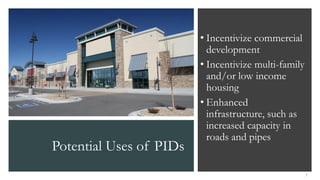
• Incentivize commercial
development
• Incentivize multi-family
and/or low income
housing
• Enhanced
infrastructure, such as
increased capacity in
roads and pipes
7
Bonds, PID Bonds
• PIDs may issue:
✓ Special Assessment
Bonds
✓ General Obligation
Bonds
✓ Limited Tax Bonds
• In addition, TIF revenues
may be pledged to repay
PID Bonds
Limited Tax Bonds
✓ Fixed rate bonds, generally for 30 year term
✓ Not subject to a fair market value ratio prior
to issuance
✓ Repaid from a limited ad valorem property tax
✓ Tax payment pegged to taxable value of
property
✓ Statutorily, this rate may not to exceed 15 mills
✓ A lower limit may be established by the Creating
Entity in the Governing Document or in the
bond documents
✓ New revenue source, no need to negotiate with
school district, RDA, etc.
9
Limited Tax Bonds, continued
• In the event the proceeds of the limited tax
are insufficient to meet annual debt service
as it comes due:
✓ Not an event of default
✓ Bondholder has no statutory remedy to
require additional taxes or fees of the PID
✓ No statutory recourse to the property or
the property owner
• Because of these unique features, the statute
limits sale of limited tax bonds to qualified
institutional buyers or to be sold in
denominations of $500,000
10
Sample Property Tax Mill
Levy – Herriman City
The property tax calculation
for a residential owner is:
Market Value x Taxable
Value (@55%, primary home
exemption) x Mill Rate
(1/1,000th) = Annual Taxes
Generally, Property taxes are
deductible from federal income
taxes.
Mill Rate
Market
Value
Taxable Value
with primary
home exemption
Mill
Rate
Annual
Taxes
Base Overlapping
Mills
$400,000 $220,000
14.7
(2009)
$3,234
+ 7 PID mills $400,000 $220,000 21.7 $4,774
+ 10 PID mills $400,000 $220,000 24.7 $5,434
+ 15 PID mills $400,000 $220,000 29.7 $6,534
Tax
Revenue
in $
Time
Max Tax Revenue
Net Debt Service
Capitalized Interest
Limited Tax Bonds – Debt Service Coverage
PID Interaction with
Tax Increment
Finance
• PIDs can act as the counterparty
to RDA revenues, thereby
creating a tax exempt borrower
to capitalize the increment
without having 3rd party debt
on RDA balance sheet
• PIDs bring additional revenues
to the project from benefitted
property owners whereas TIF
involves reallocating tax revenue
from other entities
13
Considerations for the Creating
Entity in Drafting the
Governing Document
• The statute only establishes the outer
limits of what a PID can do, greater
limitations or requirements may be
imposed by the Creating Entity
• Engage bond counsel to ensure
proper legal and tax analysis over
negotiations to ensure:
✓ eligibility for tax-exempt financing
✓ that the PID will constitute a
“separate political subdivision” for
tax purposes
• Creating Entity will want to adopt
standard policies for evaluating all
PID requests in light of its objectives
14
Considerations for the Creating
Entity in Drafting the Governing
Document, continued
• Consider what types of infrastructure the Creating
Entity wants to allow the PID to finance
• Establish a mill rate limit appropriate to accomplish
financing of approved improvements
• Establish Standards for:
✓ Any general obligation bonding
✓ Procurement
✓ Transition to elected Board
✓ PID lifespan and dissolution
✓ Notice to future property owners
15
Questions?
16
THANK YOU
RANDALL LARSEN
Direct: 801.258.2722 /
Mobile: 801.541.1108
rlarsen@gilmorebell.com
AARON WADE
Direct: 801.258.2730
awade@gilmorebell.com
17

Public Infrastructure Districts

  • 1.
  • 2.
    Introduction to Senate Bill 228 2 Codifiedas Title 17B, Chapter 2a, Part 12 This bill grants cities and counties (Creating Entity) the power to create Public Infrastructure Districts (PIDs) to finance public infrastructure for new development and redevelopment PIDs can issue debt repayable from property taxes or assessments on the property owners within its boundaries PIDs can be an effective tool to the interests of both municipalities and property owners when potentially competing interests are balanced
  • 3.
    Economic Development Tools • Historically,there have been two key economic development financing tools used by cities and counties: ✓ Tax Increment Financing (TIF) ✓ Assessment Areas & Bonds • Public Infrastructure Districts are intended to compliment these tools as well as address some of their shortcomings
  • 4.
    PID Features • Localdistrict under Title 17B • Independent political subdivision • PID debt is not a liability or a balance sheet item of the Creating Entity • Defaults by PID taxpayers not enforced by municipality • Governed by own board • Creates new tax revenue stream rather than reallocation of existing taxes 4
  • 5.
    PID Creation and Powers 5 •At the discretion of the Creating Entity • Requires consent of 100% of property owners and voters within the PID boundaries • Costs of Creating Entity counsel in evaluating PID to be paid by the property owner PID Creation • Broad powers to finance public infrastructure of many types, generally including any improvement that will be owned by a state or local government, including the PID • Powers may be limited by the Creating Entity in the governing document entered into at creation PID Powers
  • 6.
    PID Governance • PIDsare governed by a board with members initially appointed by the Creating Entity • Initial board comprised of property owners or their designated representatives • Board will transition to an elected board as electors reside in the PID, as provided in the Governing Document • Board authority constrained by the limitations established in the Governing Document
  • 7.
    Potential Uses ofPIDs • Incentivize commercial development • Incentivize multi-family and/or low income housing • Enhanced infrastructure, such as increased capacity in roads and pipes 7
  • 8.
    Bonds, PID Bonds •PIDs may issue: ✓ Special Assessment Bonds ✓ General Obligation Bonds ✓ Limited Tax Bonds • In addition, TIF revenues may be pledged to repay PID Bonds
  • 9.
    Limited Tax Bonds ✓Fixed rate bonds, generally for 30 year term ✓ Not subject to a fair market value ratio prior to issuance ✓ Repaid from a limited ad valorem property tax ✓ Tax payment pegged to taxable value of property ✓ Statutorily, this rate may not to exceed 15 mills ✓ A lower limit may be established by the Creating Entity in the Governing Document or in the bond documents ✓ New revenue source, no need to negotiate with school district, RDA, etc. 9
  • 10.
    Limited Tax Bonds,continued • In the event the proceeds of the limited tax are insufficient to meet annual debt service as it comes due: ✓ Not an event of default ✓ Bondholder has no statutory remedy to require additional taxes or fees of the PID ✓ No statutory recourse to the property or the property owner • Because of these unique features, the statute limits sale of limited tax bonds to qualified institutional buyers or to be sold in denominations of $500,000 10
  • 11.
    Sample Property TaxMill Levy – Herriman City The property tax calculation for a residential owner is: Market Value x Taxable Value (@55%, primary home exemption) x Mill Rate (1/1,000th) = Annual Taxes Generally, Property taxes are deductible from federal income taxes. Mill Rate Market Value Taxable Value with primary home exemption Mill Rate Annual Taxes Base Overlapping Mills $400,000 $220,000 14.7 (2009) $3,234 + 7 PID mills $400,000 $220,000 21.7 $4,774 + 10 PID mills $400,000 $220,000 24.7 $5,434 + 15 PID mills $400,000 $220,000 29.7 $6,534
  • 12.
    Tax Revenue in $ Time Max TaxRevenue Net Debt Service Capitalized Interest Limited Tax Bonds – Debt Service Coverage
  • 13.
    PID Interaction with TaxIncrement Finance • PIDs can act as the counterparty to RDA revenues, thereby creating a tax exempt borrower to capitalize the increment without having 3rd party debt on RDA balance sheet • PIDs bring additional revenues to the project from benefitted property owners whereas TIF involves reallocating tax revenue from other entities 13
  • 14.
    Considerations for theCreating Entity in Drafting the Governing Document • The statute only establishes the outer limits of what a PID can do, greater limitations or requirements may be imposed by the Creating Entity • Engage bond counsel to ensure proper legal and tax analysis over negotiations to ensure: ✓ eligibility for tax-exempt financing ✓ that the PID will constitute a “separate political subdivision” for tax purposes • Creating Entity will want to adopt standard policies for evaluating all PID requests in light of its objectives 14
  • 15.
    Considerations for theCreating Entity in Drafting the Governing Document, continued • Consider what types of infrastructure the Creating Entity wants to allow the PID to finance • Establish a mill rate limit appropriate to accomplish financing of approved improvements • Establish Standards for: ✓ Any general obligation bonding ✓ Procurement ✓ Transition to elected Board ✓ PID lifespan and dissolution ✓ Notice to future property owners 15
  • 16.
  • 17.
    THANK YOU RANDALL LARSEN Direct:801.258.2722 / Mobile: 801.541.1108 rlarsen@gilmorebell.com AARON WADE Direct: 801.258.2730 awade@gilmorebell.com 17